Errant Thoughts
About Andrew Cusack
 Writer, web designer, etc.; born in New York; educated in Argentina, Scotland, and South Africa; now based in London.
 read more
News
Blogs
Reviews & Periodicals
Arts & Design
World
France
Mitteleuropa
Knickerbockers
Argentina
The Levant
Africa
Cape of Good Hope
Netherlands
Scandinavia
Québec
India
Muscovy
Germany
Academica
Facebook Page
As some of our readers will have already noticed, andrewcusack.com now has a Facebook page you can join.
What a Sad, Sad Life to Lead
While innocently playing billiards in a friend’s basement towards the later years of my school days, I was inexplicably forced to endure the latter portion of an episode of the HBO television series “Sex and the City”. The show centers on four middle-aged women who refuse to settle down and lead reasonable, ordered lives but instead involve themselves in ever more flippant affairs and commit ever greater sins against their own dignity. It would be a welcome warning to women were it not for the obvious fact that the show’s intent is to glorify the sad, pitiable existence lived out by the four main characters.
The show originated from a column of the same name in the New York Observer, and after the success of the television series, a cinematic continuation was filmed, followed by a more recent sequel.
Brendan O’Neill, a liberal atheist if ever there was one, has written a superb commentary on the second “Sex and the City” film, claiming that this “execrable” movie “offers an accidentally fascinating insight into the crisis of American values”. Click here to read O’Neill thoughts on the film and its sad reflection of today’s America, and say a little prayer that no-one really leads lives as self-centered, sad, and just plain pitiable as the characters involved.
Boom-studeer
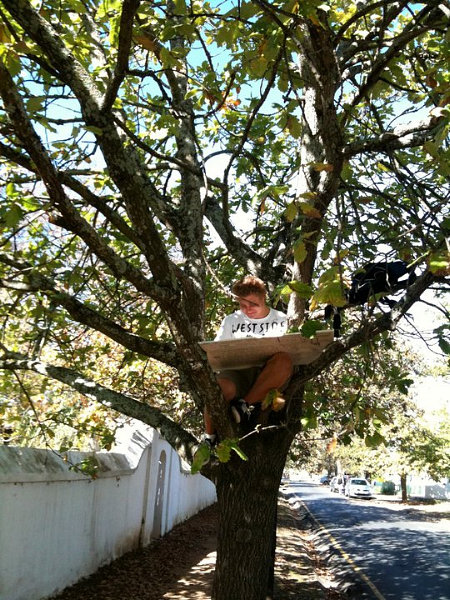
At Stellenbosch, when the J.S. Gericke Biblioteek is full-up, students must use their ingenuity to find other suitable locations where they can study for their exams.
The Presiding Officer’s Gown
While the 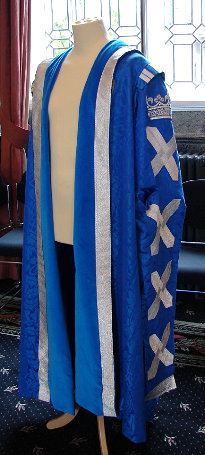 Westminster Parliament has a Speaker, the Scottish Parliament in Edinburgh has a “Presiding Officer” — a rather dull title if you ask me. The auld Estaits of Parliament abolished in 1707 were headed by the Lord Chancellor of Scotland, an office which fell into abeyance shortly after the Act of Union.
When the “Scottish Parliament” was refounded in 1997, the first man to hold the new job of Presiding Officer was Sir David Steel (the Rt. Hon. the Lord Steel of Aikwood), the despicable creature who as an MP introduced legal abortion to the United Kingdom in 1967, and who has inexplicably and disgracefully been created a Knight of the Most Ancient and Most Noble Order of the Thistle, the highest honour in the land (the Scottish equivalent of England’s Garter).
Anyhow, the St Andrews Fund for Scots Heraldry decided to commemorate the hosting of the Heraldic & Genealogical Congress in Scotland by commissioning a ceremonial gown for the Presiding Officer of the Scottish Parliament, who lacked one at the time. This rather handsome creation was presented to George Reid, the holder of the office at that time, during 27th International Congress of Genealogical and Heraldic Sciences held at St Andrews in 2006. Unfortunately I can find no evidence that this well-executed gown has ever been used. (more…)
Pure Democracy
“My firm conviction is that we of the conservative camp must put ourselves entirely onto a democratic basis. After the collapse of the old conditions nothing else can provide us with a future and a justification except pure democracy. Even if democracy has a dark side it is preferable to the quasi-democratic aristocracy of the representative system.” — Philipp Anton von Segesser, 1866
The Franco-Yorkshireman Jerome di Costanzo has an interesting article at OurKingdom on “You the People” Conservatism, interesting for the most part in that it has introduced me to Philipp Anton von Segesser, whom I had never heard of. I question, however, whether Jerome is correct to imply that Herr von Segesser and Mr. Cameron are quite such birds of a feather. The brilliance of the Swiss model — which Jerome rightly extols — is its democratic localism. But the Prime Minister is now seeking to introduce legislation which would set minimum prices for alcohol to avoid the almighty glut of cheap drink which (along with 24-hour openings) has contributed to the transformation of many British town centres into no-go-zones of public inebriation.
Would not the Swiss solution, instead, have been to merely devolve power either to counties (which barely exist anymore, and whose borders are in a state of permanent revolution) or to local town councils, and to allow them to react to the situation on the ground in a manner they deem appropriate?
Also, as Paul Mallinder points out, the government is attempting to solve a problem with a law, when really the only solution is a virtue. Virtues, though, are society’s responsibility, not the government’s. If people continually look to the government to solve problems by passing legislation instead of transforming society themselves by inculcating and promoting virtue, they deserve the nightmarish state they will end up with.
Reese Still Doesn’t Get It
“Reform movements need an enemy to organize against,” Fr. Thomas Reese, the former editor of America magazine tells TIME (which I stumbled upon at Conservative Blog for Peace). “As most bishops have gotten their acts together on sex abuse, they have looked less like the enemy and more like part of the solution. Enthusiasm for reform declined. With the Pope’s forthright response, it will decline even more.”
Bishops “getting their acts together” is reform! But of course, Fr. Reese is using the word “reform” in an Orwellian manner, meaning not reform, but in fact revolt. His use would be disingenuous, except that I suspect Fr. Reese has actually convinced himself it is appropriate: as the saying goes, “never attribute to malice that which can be adequately explained by …” well, let’s remain charitable and say “credulity”.
As bishops institute genuine reform, the sympathy — never more than limited — for progressive change-for-change’s sake unsurprisingly disappears except among the old die-hards like Fr. Reese. Enthusiasm for reform — genuine reform that is — only grows, especially in those places where it has been implemented, in accordance with the Pope’s clearly stated desires. If he is anything, Benedict XVI is a pope of reform, of putting the house back in order.
One almost feels a tinge of pity for the Fr. Reeses of this world as their hopes and dreams slip further and further away, but then one remembers it is entirely their own fault. He who marries himself to the Spirit of the Age is soon widowed. Attach yourself to the permanent things and you will never end up like poor Fr. Reese.
To London
Your humble & obedient scribe is hopping across the pond to London on Tuesday, but just for a week. As many of our dear readers already know, I am trying to escape the vile swamp of unemployment, and am attempting to find something productive (and, more importantly, remunerative) to do back over in the United Kingdom (or Ireland), where I hope to spend the rest of my life.
While most of our readers are Stateside, any of you who might have any good ideas, suggestions, or suitable persons to contact are warmly encouraged to email me at andrewcusack@yahoo.com.
It helps to be a 92-year-old D-Day veteran
Daniel Hannan, the whiggish MEP representing South East England, relays a story about His Excellency Philip Hannan, the 92-year-old former Archbishop of New Orleans:
When Hurricane Katrina wrecked the city, the old prelate went to the diocesan office to help. He found his successor wracked with concern about the fate of a parish priest who was lost in the storm. Seeing that anxiety had left the poor man paralysed, my 92-year-old kinsman called the military authorities.
“This is Phil Hannan. I jumped with the 82nd Airborne at Normandy. I need a helicopter”.
A helicopter duly arrived, and carried the former army padre to the home of the missing cleric, which had been turned to matchwood. Returning to the archiepiscopal residence, Hannan announced without ceremony, “He’s dead, may he rest in peace. Let’s move on to the next problem”.
The Evolutionary Process
Readers might notice some recent changes in the design of ‘our little corner of the web’. Or not so much changes as little evolutions which yours truly has deemed worthy and appropriate. I’ll be the first to admit there’s a strong chance we’ve had a few too many evolutions of late. There was a November 2009 redesign and then February 2010, with a new nameplate just a few weeks later, and heck it’s only May now. God willing I’ll find a job soon and won’t have so much free time to fritter away redesigning andrewcusack.com.
There was scurrilous talk in some quarters decrying the loss of our somewhat Germanic-looking wordmark for a more Wall Street Journal-inspired typeface, which I completely ignored. Gradually, however, I began to rather miss it myself, and so it has been duly resurrected, as well as returned to its original home at the center (it had been flush-left). Those who approve may give their thanks to loyal reader Tim Conroy, who was ardently resolute in his centrist rhetoric.
This site functions thanks to the WordPress content management system, and I have designed the WordPress themes (which determine what the site looks like) myself. I had mentioned in November that the new theme was called ‘Goteborg’ (after the Swedish port of Gothenburg), which was replaced in February by ‘Elsenburg’ (a misspelling of Elsenberg, the country house turned agricultural college near Stellenbosch). This new theme, ninety percent of which is the same as Elsenburg, is called ‘Rouwkoop’, after the house I wrote about previously.
Comments and thoughts, whether in favour or against, are cautiously welcome, and of course do please let me know if you notice anything isn’t functioning.
Frederik van Zyl Slabbert, 1940–2010
FREDERIK VAN ZYL SLABBERT, former South African parliamentarian, politician, and briefly chancellor of Stellenbosch university, died last week in Cape Town. ‘Van’, as he was known, was convinced after a night of heavy drinking to stand as a parliamentary candidate for the Progressive Party in 1974 and won a surprise victory in the Rondebosch constituency against the United Party incumbent by 1,600 votes. Within three years he became head of the merged Progressive Federal Party, and became Leader of the Opposition in the House of Assembly in 1979.
Koos van der Merwe, currently Chief Whip of the Inkatha Freedom Party, served in parliament alongside the liberal van Zyl Slabbert while the former was still a member of the Conservative Party. “He was a parliamentarian par excellence,” van der Merwe said after Van’s death, “and I remember how once, in a mere three-minute speech, he practically annihilated P. W. Botha.”
Despite wide acclaim as one of the finest debaters in parliament, van Zyl Slabbert shocked the political establishment in 1986 by resigning because he was convinced that parliament had become irrelevant to the running of the country. His resignation nearly ruined the PFP and frayed van Zyl Slabbert’s relationship with his fellow MP, the late Dame Helen Suzman.
Just a year later he organised the first meetings between members of the banned African National Congress and a group of National Party politicians, Afrikaner academics, and businessmen. In later years he co-founded a black investment trust, was appointed chairman of the Johannesburg Stock Exchange, sat on the boards of a number of South African corporations, and worked for the Open Society Foundation. Van Zyl Slabbert was appointed Chancellor of the University of Stellenbosch — for whom he had played rugby as an undergraduate — in 2008 but resigned for health reasons a year later, and was succeeded by Johann Rupert.
Mr. van der Merwe continued:
What amazed me about Van Zyl Slabbert was the depth of his political knowledge and his wisdom. He knew and understood the policies of each political party better than they did themselves. On one occasion, at a seminar in Williamsburg in the U.S.A., I represented the Conservative Party and was confronted with questions I could not answer. I asked to be excused for a few minutes and went to van Van Zyl Slabbert and asked him how I, as a Conservative MP, should answer. He immediately gave me the right answers because he fully understood the views and beliefs of the Conservatives. And for that matter, each and every political party. He was in fact a mobile political library.
When the late Dr Treurnicht’s daughter approached Van Zyl Slabbert for assistance to move to the U.S.A. to marry a black man, Van Zyl Slabbert did not use that information against Treurnicht. At that stage, it was unthinkable for a white Conservative to marry a black man. News of Treurnicht’s daughter marrying a black man would have led to the end of Treurnicht’s political career. Van Zyl Slabbert confidentially told me the story but it never made the headlines. What an honourable man!
His part in the struggle for Afrikaans at Stellenbosch was indeed an eye opener. Where were the Verkramptes? The old Conservatives of which I was a member? Nowhere. The fight for Afrikaans was led by the “liberal jingoes” such as Van Zyl Slabbert, Hermann Giliomee, and Breyten Breytenbach. …
I also never once saw him angry.
Mooi loop, Van Zyl. Koos gaan jou mis.
Requiescat in pace.
Swellendam Church Tower
In this video, the goodly folk of Swellendam demonstrate for us how not to remove a rotted wooden church tower. The little kid is a hoot — “It will get vrot and it will fall off on someone’s head”. The church tower has since been restored to its original iconic profile.
Cape Town’s Other St. George’s
The Greek Orthodox Cathedral of Saint George
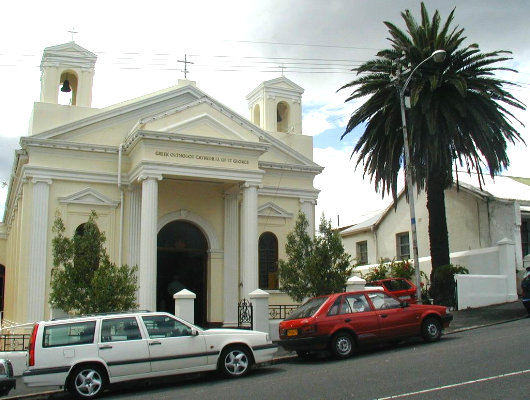
If you hear of “St. George’s Cathedral” in Cape Town, you naturally think of the big stone colossus at the bottom end of the Company’s Garden smack dab in the middle of the Mother City. There is, however, another St. George’s Cathedral, the Greek Orthodox Cathedral of St. George on Mountain Road in Woodstock. The Greek Cathedral was built in 1903–04, just a few years after Cape Town received its first Greek Orthodox priest, and expanded in 1983. Liturgies tend to be either in Greek or English, though there is an Afrikaans monastery at Robertson.
The Holy Archdiocese of the Cape of Good Hope was established in 1968 under the (Greek Orthodox) Patriarch of Alexandria and All Africa. The archdiocese covers the Western, Northern, and Eastern Cape provinces, the Orange Free State, KwaZulu-Natal, Namibia, Lesotho, and Swaziland.
I only ever knew one South African of Greek extraction (Dimitri! Not just a good egg, but a top-notch chef as well), but I assume that folks of Hellenic extraction enjoy the Mediterranean climate of Cape Town and its environs.
Cape Town’s New Way to Get Around

Over at Fascination Street, Brent Smith shows us the newly revealed branding for Cape Town’s new integrated rapid transit system: MyCiti. I’m not partlicularly impressed. Most of my fellow uitlanders will be forgiven for lacking an understanding of the stylised freehand letter ‘y’, which is rather tortured into representing an outline of Devil’s Peak, Tafelberg, and Lion’s Head. Mr. Smith diplomatically reserves judgement but I think they could’ve done better, although they could have done much worse.
A Collector’s Apartment
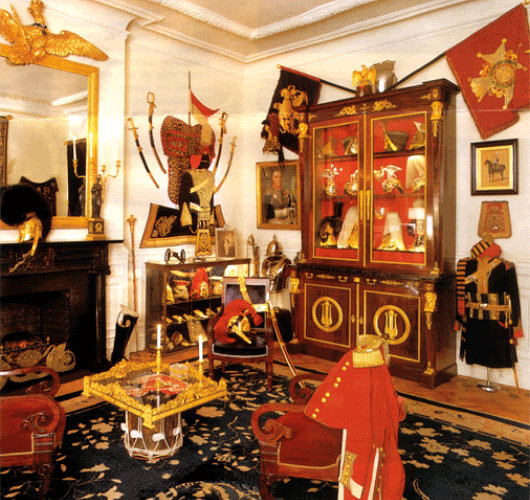
These photos come from an issue of Architectural Digest from the 1980s that some chap scanned and put online. The article that these pictures accompanied was about the New York apartment of a collector specialising in military items, but unfortunately the scanner did not post any further information. (more…)
Curated Secrets
Curated Secrets, the companion blog to our favourite recent book Secret Places, Hidden Sanctuaries, has increased in activity of late. In addition to the report on Freemasonry at Downside that we mentioned before, there has been a rumination on the Third Reich as Gesamtkunstwerk and a post about the attempt to artificially re-Saxonify the English language, which led to such interesting creations of words such as “wheelsaddle” for bicycle and “cellar-thane” for butler. The latest post is on the opium dens of old Singapore, an incongruous concept for those of us whose only conception of the South-east Asian city is as one of the most tightly run and well-managed states in the world.
Classical South Africa

I’m rather fond of the little coin logo of the Classical Association of South Africa, which appears on the front page of the society’s scholarly journal, Acta Classica: Verhandelinge van die Klassieke Vereniging van Suid-Afrika.
CASA also publishes, in cooperation with Stellenbosch University, Akroterion: Tydskrif vir die Klassieke in Suid-Afrika.
The study of our ancient civilisation is alive & well in South Africa!
Tintin à Quebec

Tintinophilia and its allied science of Tintintology can almost seem like a cult sometime, with Moulinsart, the commercial wing of the Hergé Foundation, acting feverishly to quell any and all unauthorised outbreaks of Tintin resurrection. Their assiduity notwithstanding, Tintin pastiches are fairly common (though illegal) and vary in nature from respectful admiration to downright mockery. The Quebecois cartoonist Yves Rodier is one of the foremost pasticheurs of the famous Belgian boy reporter, and produced this cover (above) of a non-existant Tintin book set in the beautiful capital city of Canada’s French province.
While Tintin did visit Scotland in The Black Isle, I’d love to see a Tintin in Edinburgh book, and even more so Tintin in the Cape.
120 East End Avenue
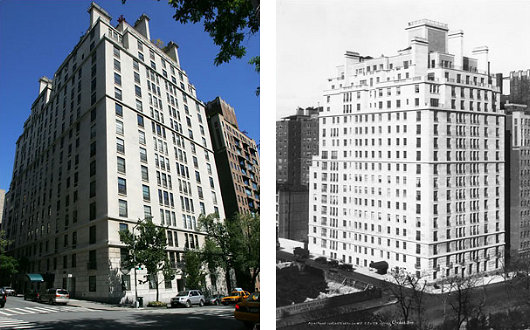
BACK IN MY school days, there was a girl in this building who threw rather good parties. Even at a decent event, however, one or two are bound to show up that really ought not to have done so, and at one of these parties at 120 East End Avenue just such a person got wildly drunk, seized a half-full bottle of vodka (Smirnoff, I believe) and launched it out the window. As luck would have it, gravity deposited the vessel many floors below, landing right on top of windshield of the doorman who happened to be serving that night.
Now, doorman relations are important in Manhattan (as apartment building owners are quite aware). When Mr. & Mrs. Smith jaunt off to Paris, leaving Jenny at home, and some twenty-odd young lads & lasses show up requesting admittance to the Smiths’ place — the doorman knows all and sees all, and one must ensure that, upon Mom & Pop’s return, he doesn’t tell all. (more…)
Moksie
Whether an irritation, an icon, or both, the Eikestad’s favourite beggar woman has over a thousand fans on Facebook

Love her or hate her, the beggar woman Moksie (“Meneer, meneer, kan ek vyf rand kry?”) is a Stellenbosch institution. She’s been known to shout, curse, steal, and worse, and is the bane of arriving eerstejaars who don’t yet know better than to head for the hills at the sight of her.
Moksie is seen most often at in the vicinity of the corner of Andringa & Victoria streets, where the customers of the Brazen Head, Bohemia, and the Mystic Boer enjoy their drinks, sometimes incurring the wrath of bar security guards who empty jugs full of water in her direction. She is known for her repeated use of the P-word, an Afrikaans vulgarism for unmentionable parts of the female anatomy (“Jou p***!”), and is a big fan of the Afrikaans soap-opera “7de Laan”.
Mokise is also believed to have the gift of bilocation, allowing her to pester innocent citizens at multiple places across die Eikestad. Despite her foul behaviour, the she-bergie of Stellenbosch now has a Facebook group created in her honour, which has attracted over a thousand members, who leave their favourite Moksie memories on the group’s wall. (more…)
Altered States in the WSJ

Here’s one for Strange Maps. An interesting article in today’s Wall Street Journal, the Saturday edition, focuses on attempts to realign state borders by seceding from one to state to form another or by merging parts of multiple states to form a new entity. There are two errors, one by the author, Michael J. Trinklein, and one by the illustrator, John Burgoyne. (more…)
Search
Instagram: @andcusack
Click here for my Instagram photos.Most Recent Posts
- West Point July 30, 2026
- Brunel’s Unbuilt Capitol February 3, 2026
- Cricket at Fordham January 27, 2026
- Palacio Barolo Revisted January 14, 2026
- Learning to Love Liguria January 14, 2026
Most Recent Comments
Book Wishlist
Monthly Archives
Categories