History
About Andrew Cusack
 Writer, web designer, etc.; born in New York; educated in Argentina, Scotland, and South Africa; now based in London.
 read more
News
Blogs
Reviews & Periodicals
Arts & Design
World
France
Mitteleuropa
Knickerbockers
Argentina
The Levant
Africa
Cape of Good Hope
Netherlands
Scandinavia
Québec
India
Muscovy
Germany
Academica
Cricket at Fordham
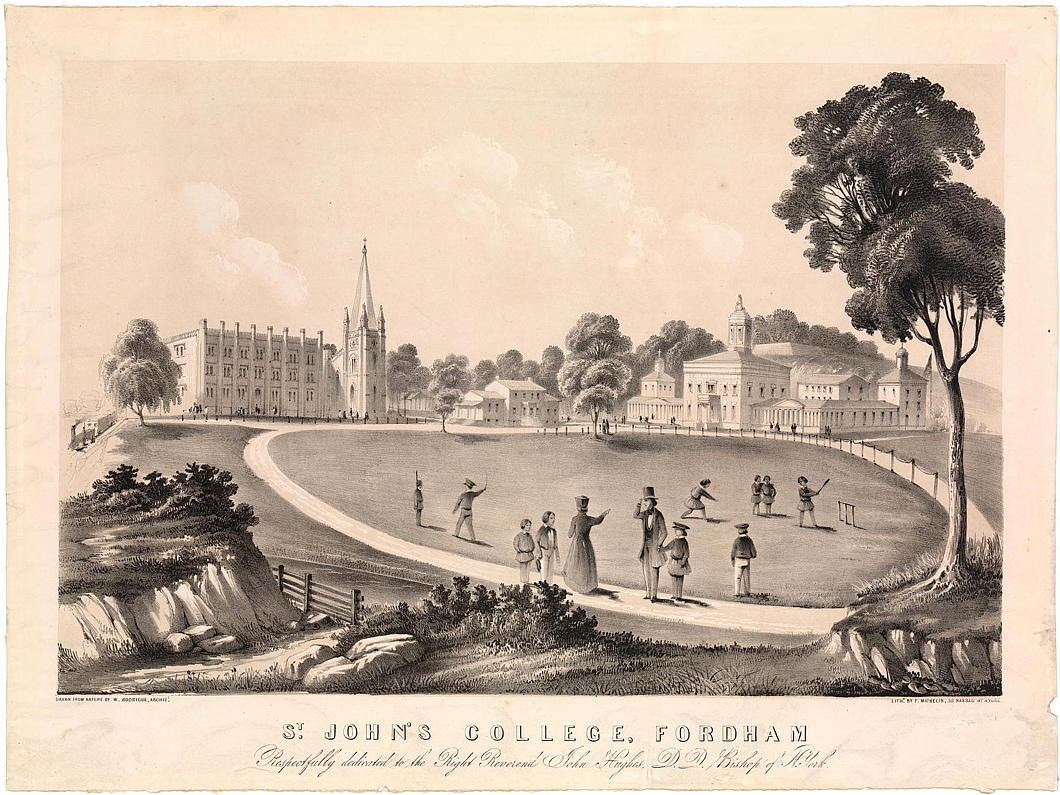
Because it was eclipsed by baseball, an infinitely more indigenous pastime, people often forget that cricket was quite a widespread and popular sport in the United States. It wasn’t until the Civil War that baseball really took over, aided by its shorter play time and the wider national mood. (Doubtless someone has, or will, write a scholarly article on this.)
It survived a few generations more as something of an elite sport, more strongly in Philadelphia and its environs, as well as in colleges and universities. The interwar period pretty much killed it off, only to be revived in interest amongst Americans by seeing it played by urban immigrant communities from the West Indies and the Subcontinent. The last time I checked there was even a cricket oval being laid out on the banks of the Mohawk river, across from the farm Jan Pieterse Mabee purchased from Daniel Janse Van Antwerpen in 1705.
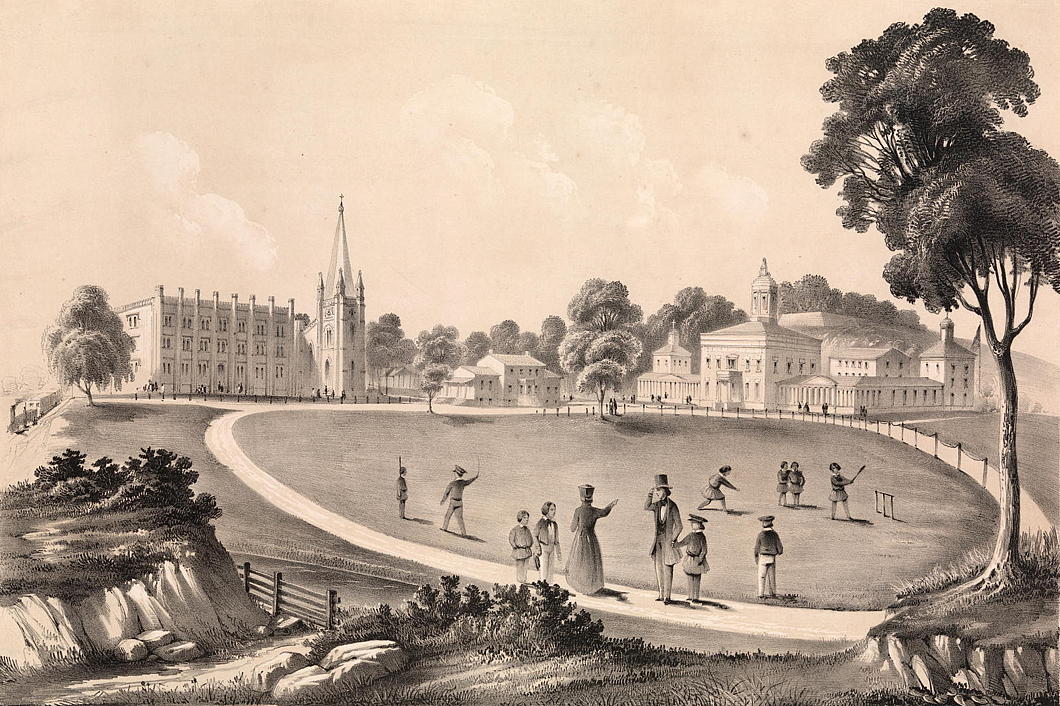
This charming rustic scene shows children playing cricket on the grounds of St John’s College, Fordham, with a priest speaking to a gentleman out on a constitutional with his son. As the college advertised itself in an early prospectus:
This institution, incorporated with the privileges of a university by an act of the Legislature, is situated near the village of Fordham, in a most picturesque and healthy part of the county of Westchester, at a distance of about eleven miles from the city of New York and three from Harlem. It is of easy access at any season of the year, by private conveyance or by the railroad, which passes immediately along the borders of the beautiful lawn in front of the college. The buildings are large, elegant and commodious; the grounds extensive and tastefully laid out.
This part of the Bronx remained within Westchester until 1874, when the parts west of the Bronx River were added to New York County. The remainder of the Bronx was ceded in 1895 and was created a borough of the consolidated City of New York in 1898, though only erected as its own county in 1914 (minus Marble Hill, which is another story entirely).
The engraving was drawn by William Rodrigue, a Philadelphia architect who later became associated with New York’s James Renwick, the designer of Grace Church and St Patrick’s Cathedral. Rodrigue auspiciously married the sister of one Fr John Hughes, who became Bishop of New York in 1842 — and the first Archbishop when the see was raised to metropolitan status in 1850.
St John’s College, now Fordham University, was one of Hughes’ pet projects, and perhaps unsurprisingly Rodrigue was chosen to design many of the earliest college buildings on the former Rose Hill estate, in addition to teaching mathematics, geometry, and drawing. He lived with his family in an outbuilding on the estate that now houses a coffee shop named “Rod’s” in his honour and his sons were among the earliest students of St John’s.
The first buildings Rodrigue completed were the chapel and the residence, the latter of which is still known as St John’s and forms one of the three sides of Queen’s Court, now a residential college within the university. The chapel benefited from stained-glass windows donated by the King of France for the (currently flourishing) old St Patrick’s Cathedral but which were found to be the wrong size and so incorporated into what is now the University Church.
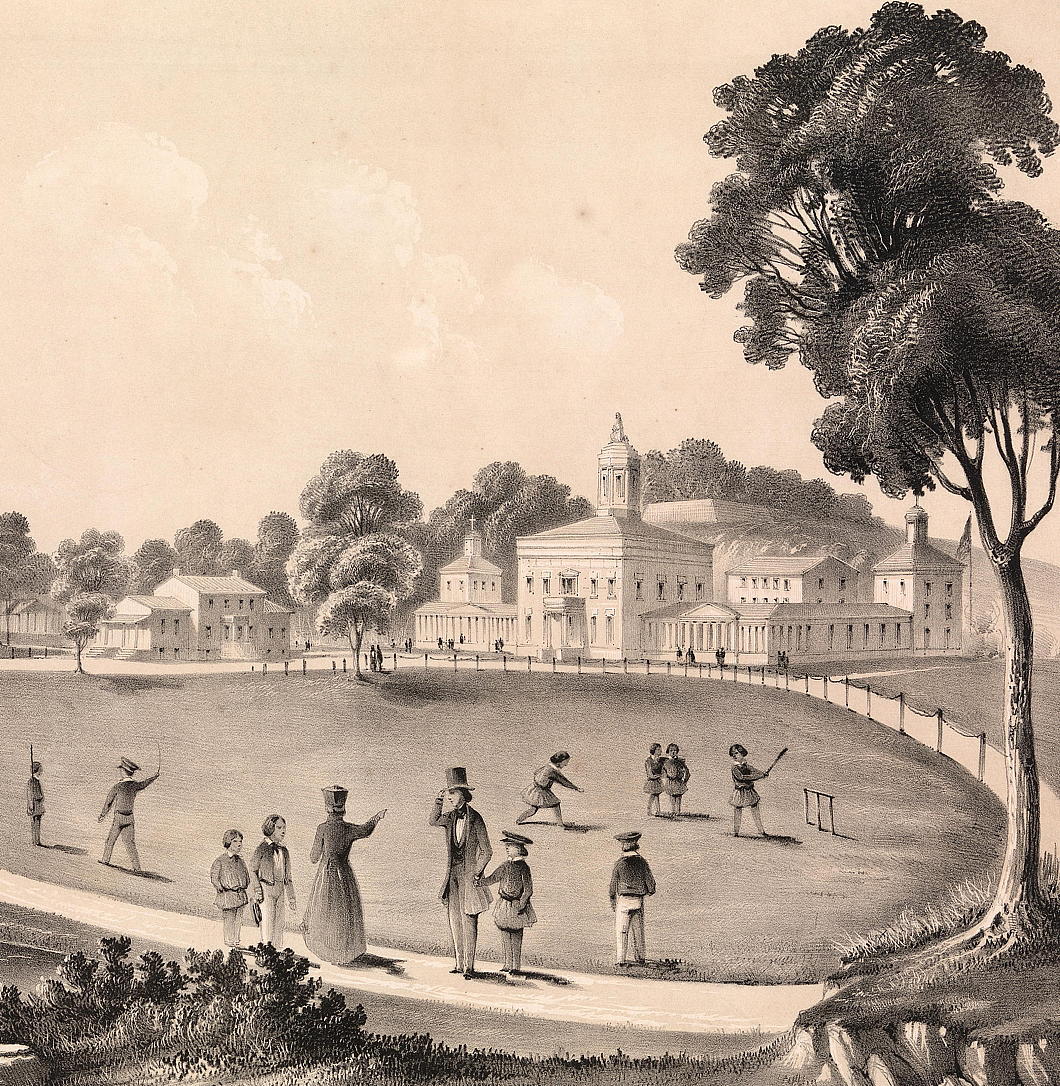
The building in the right background of the view was the main house of the Rose Hill estate purchased by Bishop Hughes. For a long time it was known as the Administration Building or the Manor House, though as it dates from the 1830s it has no direct connection to the Manor of Fordham granted to Jan Arcer by Governor Lovelace in 1671 (other than sitting on the land of it). More recently it was renamed Cunniffe House thanks to the generosity of Maurice J. “Mo” Cunniffe, Fordham Class of 1954. The wings have been much altered but the central block of the house remains largely intact.
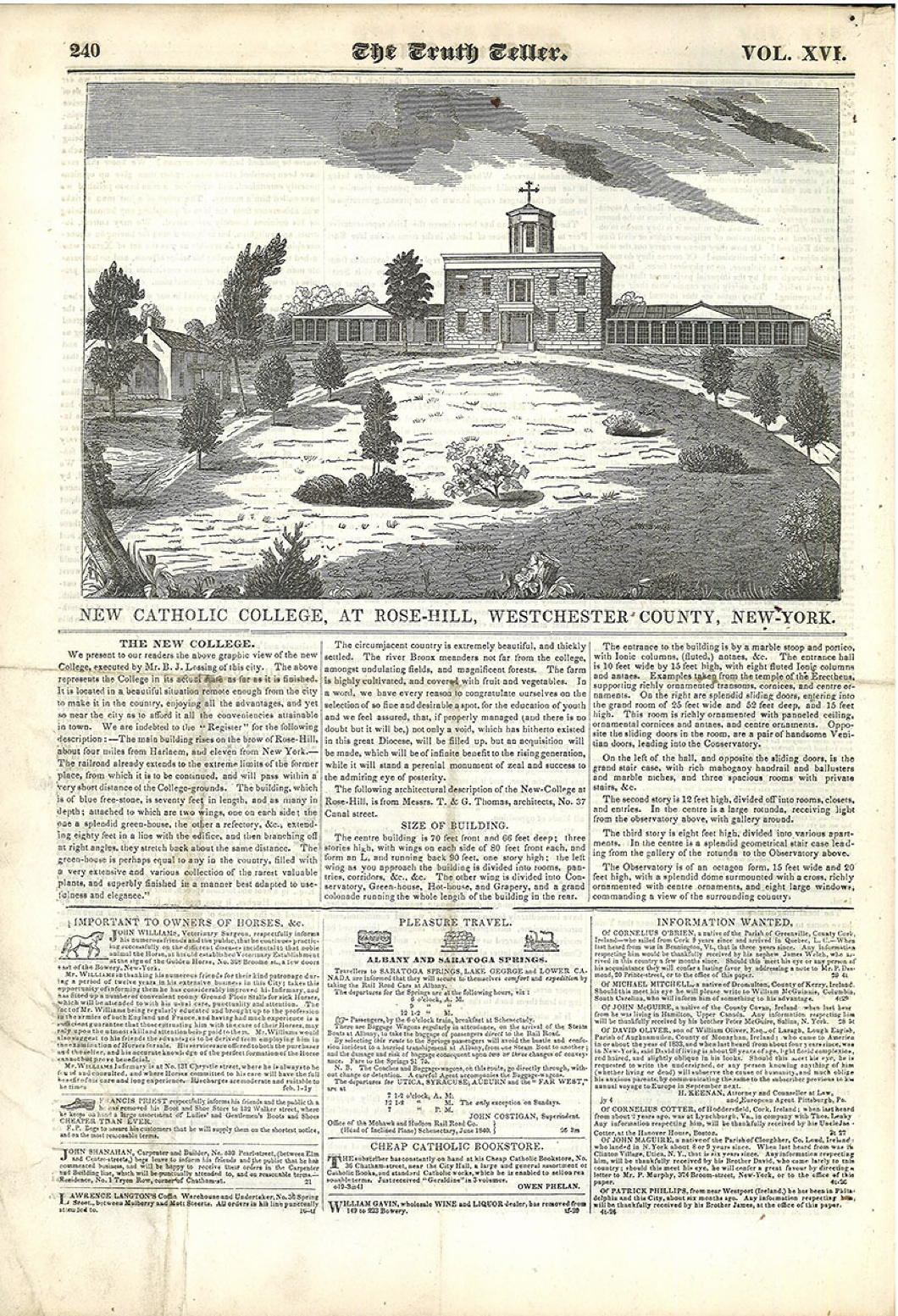
In 2019, the university’s emeritus professor of history, Dr Roger Wines, discovered the earliest known image of the institution while sifting through periodicals at the Philadelphia archdiocese’s research centre.
“It is located in a beautiful situation remote enough from the city to make it in the country,” the accompanying text in The Truth Teller, an early Catholic newspaper of New York, explained, “enjoying all the advantages, and yet so near the city as to afford it all the conveniences attainable in town.”
“The circumjacent country is extremely beautiful,” it continues. “The river Bronx meanders not far from the college, amongst undulating fields, and magnificent forests. […] We have every reason to congratulate ourselves on the selection of so fine and desirable a spot for the education of youth.”
The writer assures the college “will stand a perennial monument of zeal and success to the admiring eye of posterity”.
Churchill’s Beguinage

The last beguine Marcella Pattyn was born in Thysstad, the Belgian Congo, in 1920 and died in the beguinage of Kortrijk in West Flanders in 2013.
At the time many were tempted to mark this as the final chapter in a legacy dating back eight-hundred years, but I would not be surprised if the beguines made at least a partial comeback.
One can easily imagine a town like Oxford hosting a beguinage for the many pious ladies pursuing lifelong academic interests but seeking some sense of Christian life in common. (And the perfect property for it has just come on the market if a patron with deep pockets can be found).
Who were the beguines? As The Economist explains:
Appearing around 1200 in the Low Countries, the Beguines’ semi-religious lifestyle forged a third way for women. Though its chaste sisters, of all ranks and fortunes, prayed together, they were not bound by permanent vows. Beguines belonged to no religious order, so made their own rules.
They lived apart from society in beguinages — self-sufficient clusters of individual houses grouped around a church—but could enter the town at will (though they had to return at dusk). That allowed for an exceptional degree of independence, unknown by their medieval sisters, whether wives or nuns. Even a married woman could become a Beguine (though few did: celibacy was prized).
Most Flemish beguinages were built in urban communities, near hospitals and leper houses. The sisters ministered to the poor and sick in their own infirmaries or at nearby hospitals. But they also washed raw wool and laundered sheets, earning their livelihood through Europe’s booming cloth industry; and, later, by making lace and weaving. Others worked on farms and in gardens.
No visit to Amsterdam is complete without an exploration of its Begijnhof. Somehow, the beguines of the city miraculously survived “The Alteration” of 1578, when Amsterdam’s Catholic city fathers were overthrown, seized, and expelled by a group of Calvinists.
The old chapel was given over to the city’s English Reformed community and many of the founders of New England worshipped there before heading off to land at Plymouth Rock. The Catholic beguines made do with a clandestine chapel built in one of the houses and the last beguine of Amsterdam died in 1971.
The Great Begijnhof of Leuven is likewise well worth a wander: it is an entire quarter covering ten streets. Having fallen into disrepair while owned by the state as alms-houses, it was purchased by the University in the 1960s and restored under the guidance of Professor (and Baron) Raymond Lemaire to house students and academics.
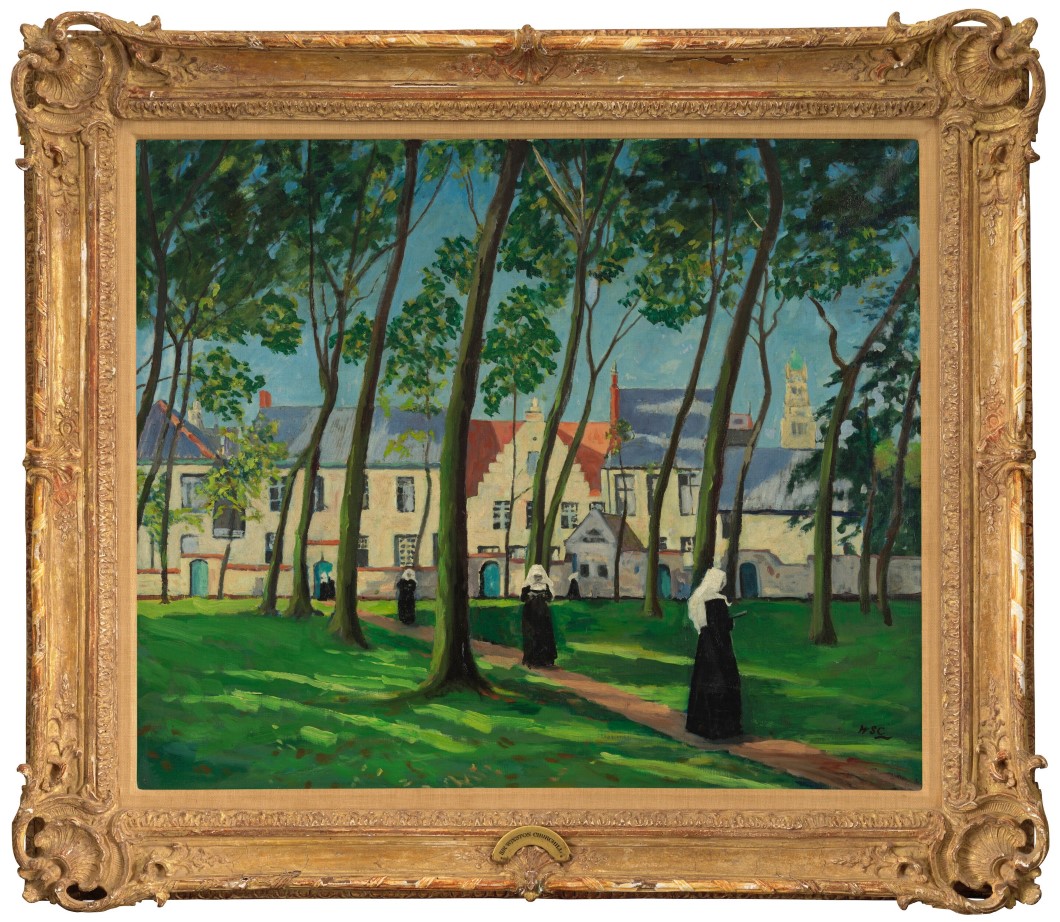
That inescapable man Sir Winston Spencer Churchill KG OM CH &c. counted painting amongst his many pastimes. A year after the British voter gave him the boot and expelled him from Downing Street, Churchill was amidst his typically extensive travels when he found time to visit Belgium and paint the beguinage of Bruges.
The sisters depicted are not actually beguines but Benedictines. They arrived at the Princely Beguinage Ten Wijngaerde in 1927 when the Grand Mistress’s house and adjacent quarters were converted into a convent. The overall site is now owned by the city of Bruges, but four Benedictine sisters remain. The other houses are run as secular alms-houses and sheltering for single women.
Churchill’s ‘Le Béguinage, Bruges’ is up for auction at Bonham’s later this month and the auctioneers provide Churchill’s secretary Grace Hamblin’s explanation of how she came to own it:
He put [a different painting] up and then he said, ‘What do you think of it?’ It was one of his most terrible paintings. And he must have seen my expression, because I wouldn’t dare to criticise it, I promise you, I know nothing about painting.
I said ‘Well, it’s not my favourite.’ And he said, ‘Which is your favourite?’ And I said, ‘Well, I love the Béguinage.’ So he said, ‘Oh, well, we’ll put that here.’
Some years later it went on exhibition with others to New York. When it came back and I was helping him unpack it, he said, ‘This is yours. Take it home.’ That’s all there was to it. Just like that… enough to kill anybody. I couldn’t believe it… to receive one of his paintings, and from him!’
The secretary had good taste.
My own collection of art by a parliamentarian — still just one item — started in a similarly haphazard manner.
I was walking down a street in Westminster one day when I came across a certain poet-painter-politician who shall remain nameless. He was parked in front of his house and packing one of his sons’ possessions into the back of his car to head off to university but was making an absolute hash of it.
I intervened saying “No, no, no: that’s no way to do it at all” and promptly re-organised the assembled items into a much more efficient arrangement. He thanked me and, as recompense for my small service, handed me a painting he had done of Santa Maria della Salute in Venice which still hangs in my somewhat meagre collection.
If you’d like to start your own collection of art by parliamentary painters, Churchill’s beguinage is going for a guide price of £300,000 to £500,000.
An Old Election in New Utrecht
In the 28 November 1868 issue of The Spectator, this account of an American village election was printed. The village in question was New Utrecht, founded in 1652 by our Dutch forefathers of old.
In 1868 it was still a village; today it is very much a neighbourhood of the Borough of Brooklyn, King’s County, in the City and State of New York.
Closer to home in Westchester, there are plenty of local offices up for the determination by citizens. It might be rather fun to stand for Town Clerk or Village Justice or Receiver of Taxes…
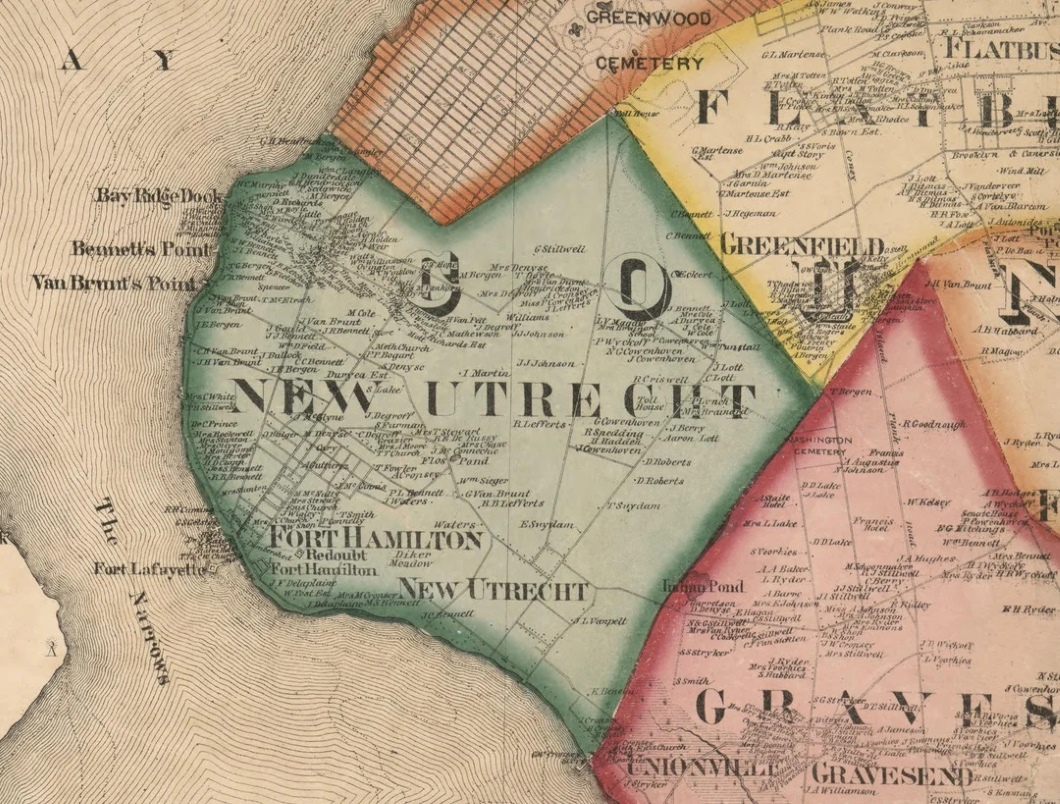
The polling-place was at the village of New Utrecht, from which the township takes its name. A township here is a sub-division of a county which manages its own local affairs by town meeting. It commonly includes several villages, from the oldest of which it takes its name; and at this all its public business is transacted, although in wealth it may be of all of them the least important.
New Utrecht was first settled by the Dutch, as its name bears witness, about two hundred years ago. Until within some thirty years a few Holland families, to which were added one or two of Huguenot origin, owned nearly all the land for many miles around; and even now, when you find yourself here in a company of farmers, it is safe to address two men in three as Van Brunt, Bergen, Cortelyon, or Bennet.
The Yankees have taken but little hold of this soil, but within the last twenty years there has been a great dispensation of Irishmen, owing to the nearness of New York and the cheapness of land, much of which, although it has owners, lies open and neglected in what are called commons, upon which shanties are huddled in little groups. After driving down the beautiful shore road, which is lined with small villa residences, and passing Fort Lafayette, the famous “Bastille” of the Rebellion, we struck across one of these commons to the road which leads to New Utrecht.
Half a mile from the shore we topped the highest point of ground in an area of many miles, and looked straight off upon the ocean. The blue above bent over a blue below; no dark, deep blue, but cold, bright, steely; the water looked like a flat sky bent back over the earth from the horizon. The road, which we soon struck, was good enough, but although the main road, it was so narrow that there was barely room for two waggons to pass each other. It is just the same little road that the Dutch farmers made when they settled the country. There has been no need for its enlargement or for any change in its direction; and it winds around little knolls and through deep cuts from this to that old farmhouse down to the village and thence to the water. Pleasant enough now, although rather desolate; in the winter it is often impassable, for the snow drifts into the deep cuts until it lies level with the laud on either side; and then sometimes these farmers do not for days go five hundred yards from their houses. And yet New York is but twelve miles away, and clear in sight pass the ships and the steamers that bear the greater part of the commerce between two hemispheres.
The village is a dead-and-alive little place, with its dead part very dead and its life sinking slowly into the salt ooze that borders the township seaward. The larger farmhouses along the road are lapsing languidly to ruin. Almost all of them are wooden buildings, but some of them were evidently the homes of men who lived handsomely as well as comfortably, and they have an Old-World look of gentility in their structure and their surroundings. But they have not been painted within the memory of this generation, the fences are broken, the gates unhinged, the grass and the walks neglected, and nothing has been done to keep up the groves of trees with which many of them are surrounded. A few of them are roofed with tiles that were brought from Amsterdam; and it is plain that there has long been an end to that importation.
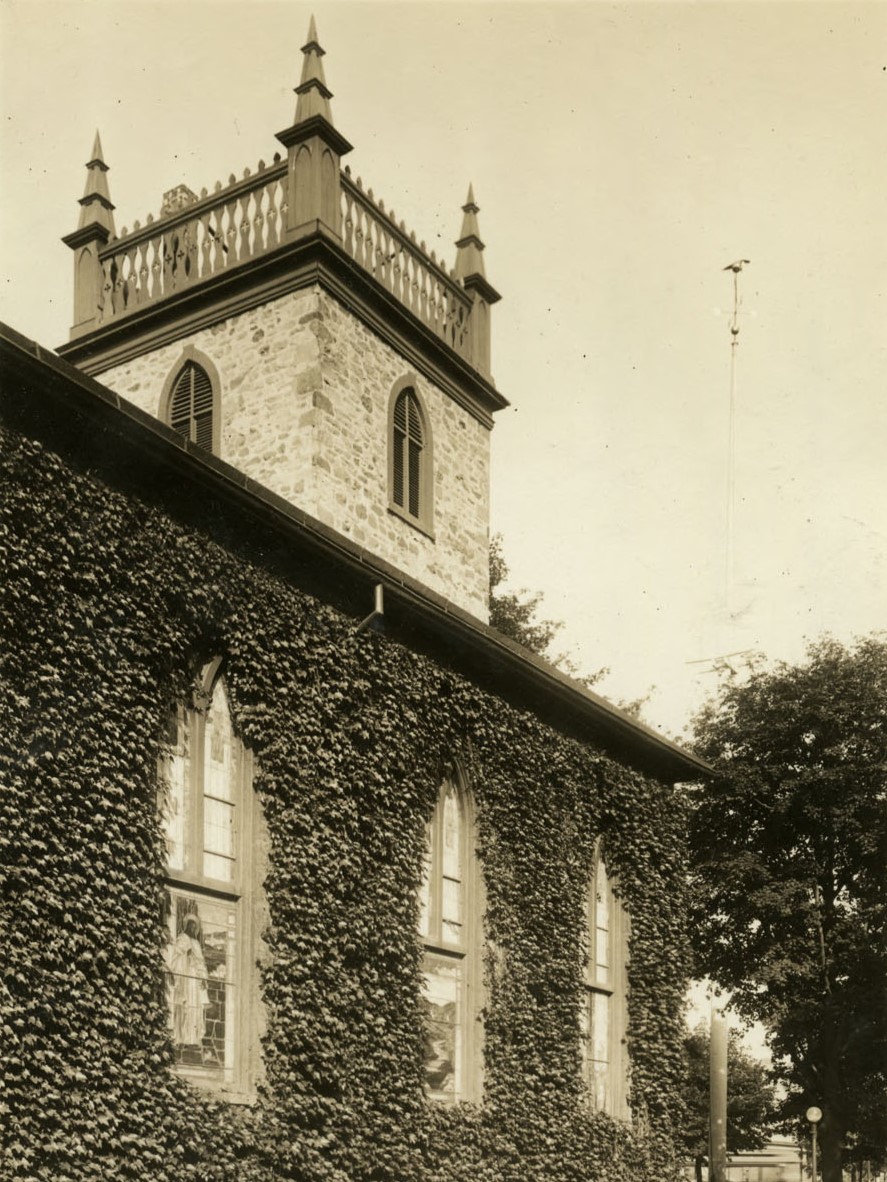
As we near the centre of the village, where two roads meet at right angles, the one in which we are not crossing the other, we see a pretty stone church with a square tower. It has some of the charm which age bestows upon buildings, but takes from man; but I am told by those who have entered it that within it is the most doleful and barn-like of all religious structures. Of course the faith preached here is that of the Dutch Reformed religion. There are Episcopal (Church of England) and Roman Catholic churches not far away; but they are in the parts of the township which are chiefly occupied by new comers. This church would have seemed more venerable to me if there had not arisen directly in front of it in the middle of the road a tall white flagstaff, topped by a gilt spread eagle, and from which on this occasion floated a spick-and-span new specimen of the flaming banner of the Union. The church and the flag are both good things in their way; but 1 like to take them separate it à la Russe as I do certain viands which some people mingle on one plate.
On the road we have met and overtaken carriages of all sorts, loaded well with voters. The most noticeable of these are the large farm waggons in which the people around here send their cabbages and turnips to the New York market. These have been hired by the political committees, or volunteered by their owners to bring voters from the remote parts of the township – voters who otherwise would hardly cast their ballots. They are almost all of them filled with Irishmen, no small proportion of whom are raw emigrants made into “American citizens” for the nonce, at the expense of the Democratic committee, who hunt them up and pay their fees of naturalization. For these men always vote the Democratic ticket, and “go it blind.” I have learned, however, that some of them down here, led by their more experienced and intelligent countrymen, have formed a society or club, the members of which vote on local questions for the man or the committee that pays the most money.
Treating here has little or no influence in elections; for whiskey and money are so plenty that the former does little for the spread of Democratic principles, except in the way of daily training. Filled although these waggons are with Irishmen going to or coming from the polls, there is no jollity in them, hardly a word spoken. The men ride along silently crouched together in the piercing wind.
Perhaps they may be chilled by our approach as well as by the stiff nor’-wester; for although the country around is a very hot-bed of Democracy, “a perfect Sodom and Gomorrah of Copperheadism,” as the gentleman who drove us said, we are all well known as staunch Republicans. I am soon confirmed in this conclusion; for one farm-waggon load of Irishmen as it passes us sets up a cheer, “Hurrah for Grant!” We are astonished. The physiognomy and the accent of the cheerers are unmistakable; and yet—Irishmen voting against the Democratic candidate! The thing is unheard of. And yet another waggon comes, and as it passes, up goes the same “Hur-r-rah for Grant!” Is the world coming to an end? Is ours a moral earthquake? I learned, too, that the gardener here, an intelligent North of Ireland man who has been in the country for fifteen years, walked the five miles to vote the whole Republican ticket. He declined an invitation to ride to the polls with the master of the house because, as he confessed in secret to one of the young gentlemen, he feared it might be thought that he had sold his vote.
As it was, he subjected himself to being called “a barrel of flour” by his Hibernian friends who voted against him, but being a powerful fellow he “polished off” one of them and settled that matter. The present of a barrel of flour (worth about twelve or fifteen dollars) to the “ould woman” seems to be one of the ways of bribery, and hence the reproach. Now, not one of these Irishmen is a Republican, and not one of them would have voted the Republican ticket if a War Democrat had been nominated instead of Mr. Seymour. But many of them had been in the Army, and most of them believe very heartily in the Union, although exactly what that Union is they seem to be almost as ignorant as some native “Americans.”
The polls are at the village tavern, which is the largest house in the neighbourhood, and has evidently been one of those fine old country taverns, rich in unpretending comfort and simple good cheer, which the railways are fast improving off the face of the earth. It is surrounded with vehicles of all sorts, most of them very humble and very much neglected; but a few of them the equipages of gentlemen of wealth who, like Dogberry, have two gowns and everything handsome. The stable-yard and the horse-shed are so full that we find a place with difficulty, under the guidance of two negro helpers. […] The steps and porch of the old tavern are filled with men, and so is the bar-room, where, however, no liquor is sold to-day. It is dismantled, and here are the ballot-boxes. They stand upon a board that rests on trestles, and behind them sit four or five men. They are the Inspectors of Election and a Justice of the Peace.
The voting is so quickly done, and with so little ceremony or fuss of any kind, that it seems strange that so trifling a matter should bring so many people together. A registered voter steps up, gives his name, it is found on the register, checked, he hands his ballots to an inspector, who announces that he votes for all, i.e., President, Governor, and Members of the Legislature, or for two or one of these tickets, the ballots are dropped into the box, and the voter gives place to another. The unregistered voter answers, under oath, a question as to his place of residence, gives a reason for not having registered himself, produces a known witness to the fact of his residence, and his ballots are also then received. In and around the tavern there is no more noise than if it were Sunday, and we were all at the old church opposite.
My friend’s wife, who did not want to come too near the poll, and who left us to wander about among the old grave stones, found the tenants of the churchyard hardly more quiet than these sober, silent farmers and labourers, who seem to do their little talking almost under breath. Outside, the only excitement is caused by a jackanapes, the fool of the village, who has rigged himself up in an old Zouave uniform, and is going through the manual with a rifle, at the command of some boys, little less silly than himself. We exchange a word or two with some friends, and then take up our fair companion, and drive home shivering through the crystal air, under overcoats and rugs, comforted but not warmed by the consciousness of having performed a duty at some sacrifice.
You will have learned long ere you see this letter that, Irishmen and all, we could not save the State for Grant, as well as that he could do without the State. The Democratic majority in the Metropolitan district (a part of which is this Bœotia) was too great to be overcome. It was increased by fraud without a doubt, but the votes thus cast were not numerous enough to materially affect the result, and Mr. Hoffman, the Democratic governor elect, is sure of his office. The important fact is that with all the enthusiasm for Grant and the disgust with Seymour, the Democratic vote was larger than ever before, and that the increase has been steady through the past twelve years. The Tribune vaunts the following increase in the Republican vote as “a record of which we have a right to be proud!”-1856, 17,771 ; 1860, 33,290 ; 1864, 36,681 ; 1868, 47,778: a notable increase truly, were it not for the suppressed fact that this (according to the Tribune Almanac) has been the increase of the Democratic vote: 1856, 41,913; 1860, 59,890; 1864, 73,709; 1868, 108,025. It is by such disingenuous fetches as this that political managers disgust people with politics.
The Long Homecoming of Eliza Monroe
A presidential daughter is reunited with her parents
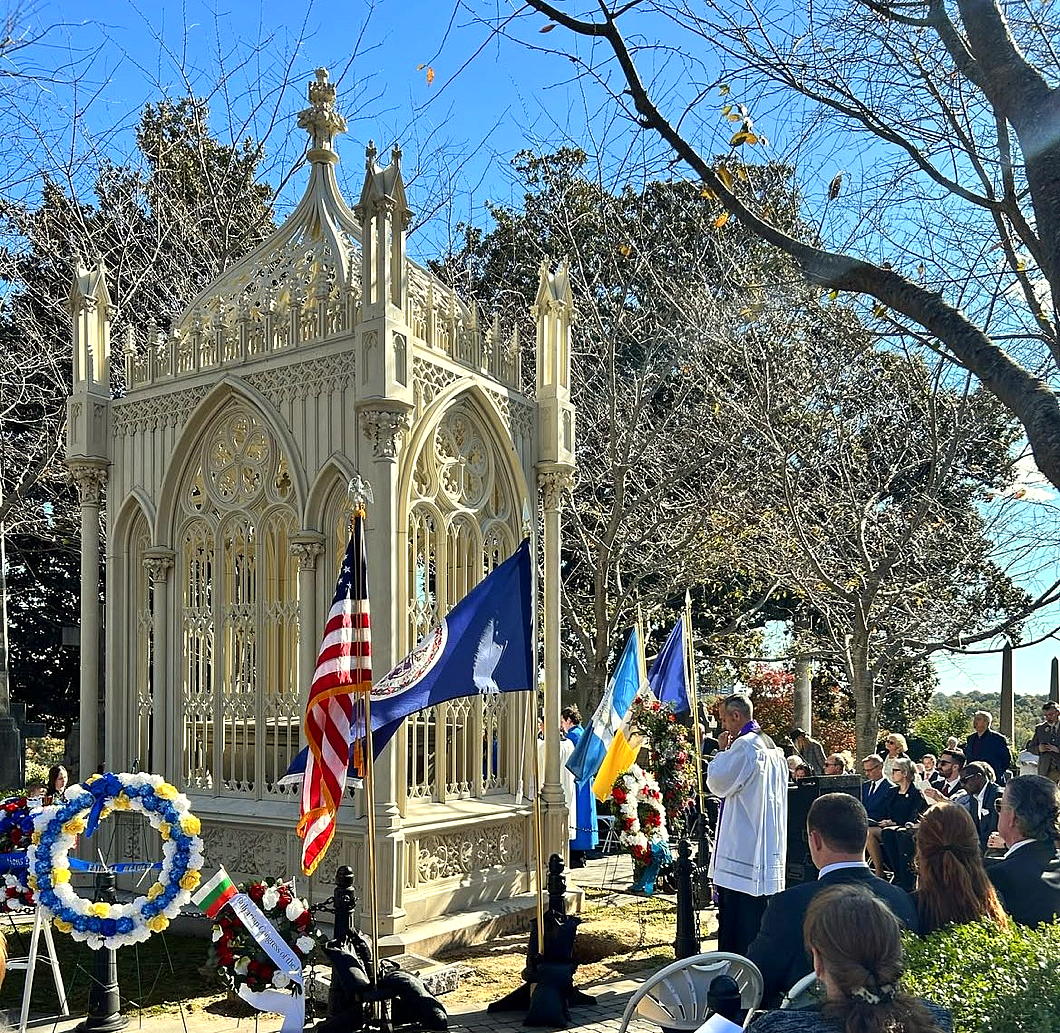
Nearly one hundred and eighty-five years after her death in Paris, the mortal remains of Eliza Monroe Hay — daughter of the fifth President of the United States — have been laid to rest in Richmond, Virginia. Her reburial beside her parents President James Monroe and First Lady Elizabeth Monroe marks the end of a long and curious chapter in the history of this illustrious American family.
The return of Eliza’s remains was the work of Barbara VornDick, a retired Virginia educator who spent more than a decade tracing Monroe descendants, searching archives and navigating French and American bureaucracy.
Working with the U.S. Embassy in Paris and the Diocese of Richmond, VornDick secured the exhumation and transport of Eliza’s remains from an unmarked Parisian grave to the family plot.
The Holy Sacrifice of the Mass was offered for the repose of Eliza Monroe Hay’s soul at the Cathedral of the Sacred Heart before the re-interment in Hollywood Cemetery on 23 October 2025.
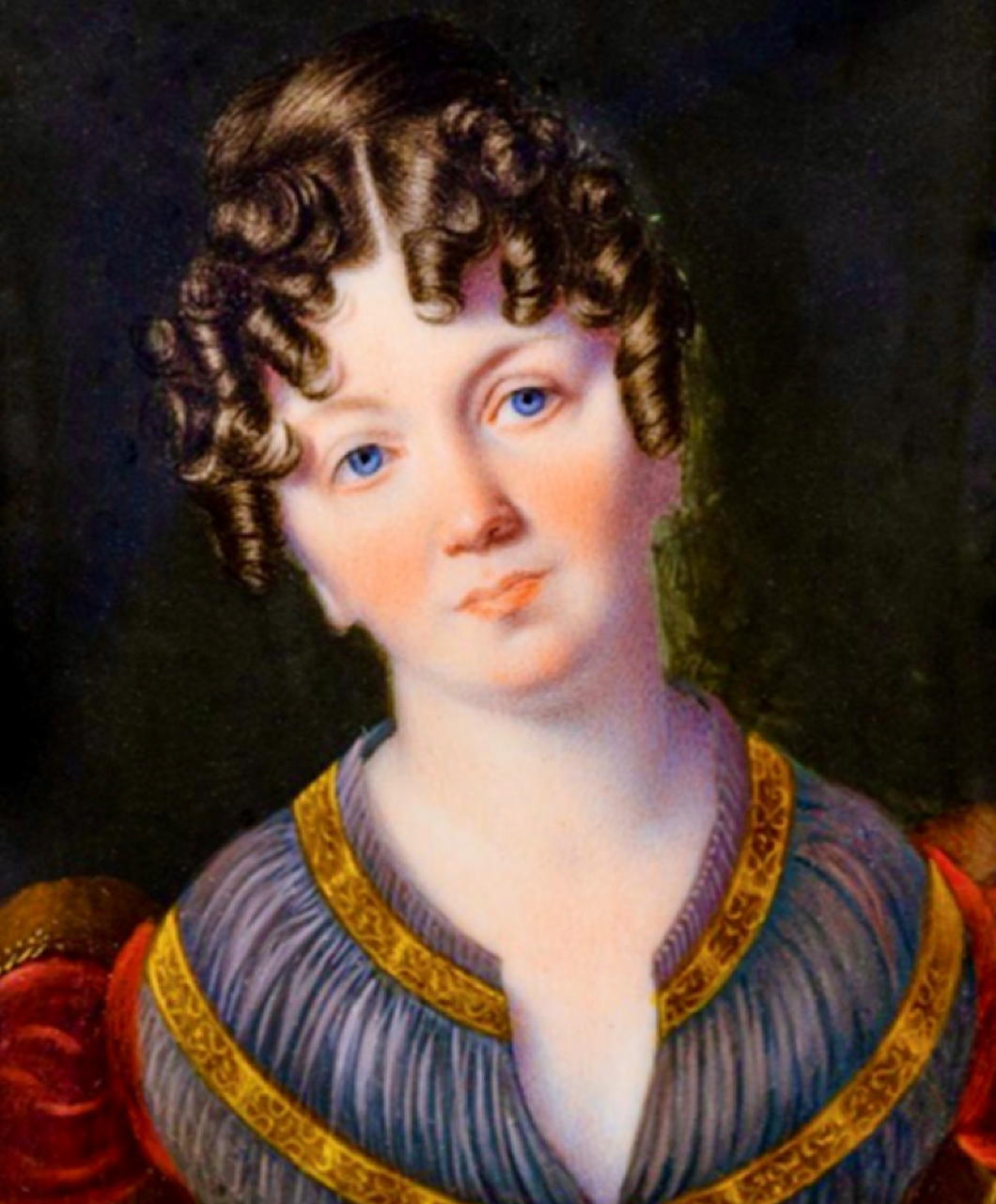
Born in Fredericksburg in 1786, Eliza Kortright Monroe grew up between Virginia and revolutionary France, where her father served as U.S. minister (as ambassadors were generally called then). A great part of her education took place in Paris where became accustomed to the courtly formality of Europe. Among the friends she made was Hortense de Beauharnais, stepdaughter of Napoleon and eventually queen consort of Holland as the wife of Lodewijk I (Luigi Buonaparte), the Emperor’s younger brother.
When James Monroe became president in 1817, her mother’s poor health led Eliza to assume many of the social duties expected of the chatelaine of the White House. Later commentators sometimes judged her reserved manner harshly, but it reflected both her upbringing and her experience of diplomacy.
In 1808 Eliza married George Hay, a Virginia lawyer best known as the U.S. Attorney who prosecuted Aaron Burr in his trial for treason before Chief Justice John Marshall the previous year. They had one daughter who was christened Hortensia after the mother’s childhood friend who acted as godmother. Hay died in 1830, followed within a year by Eliza’s mother and father.
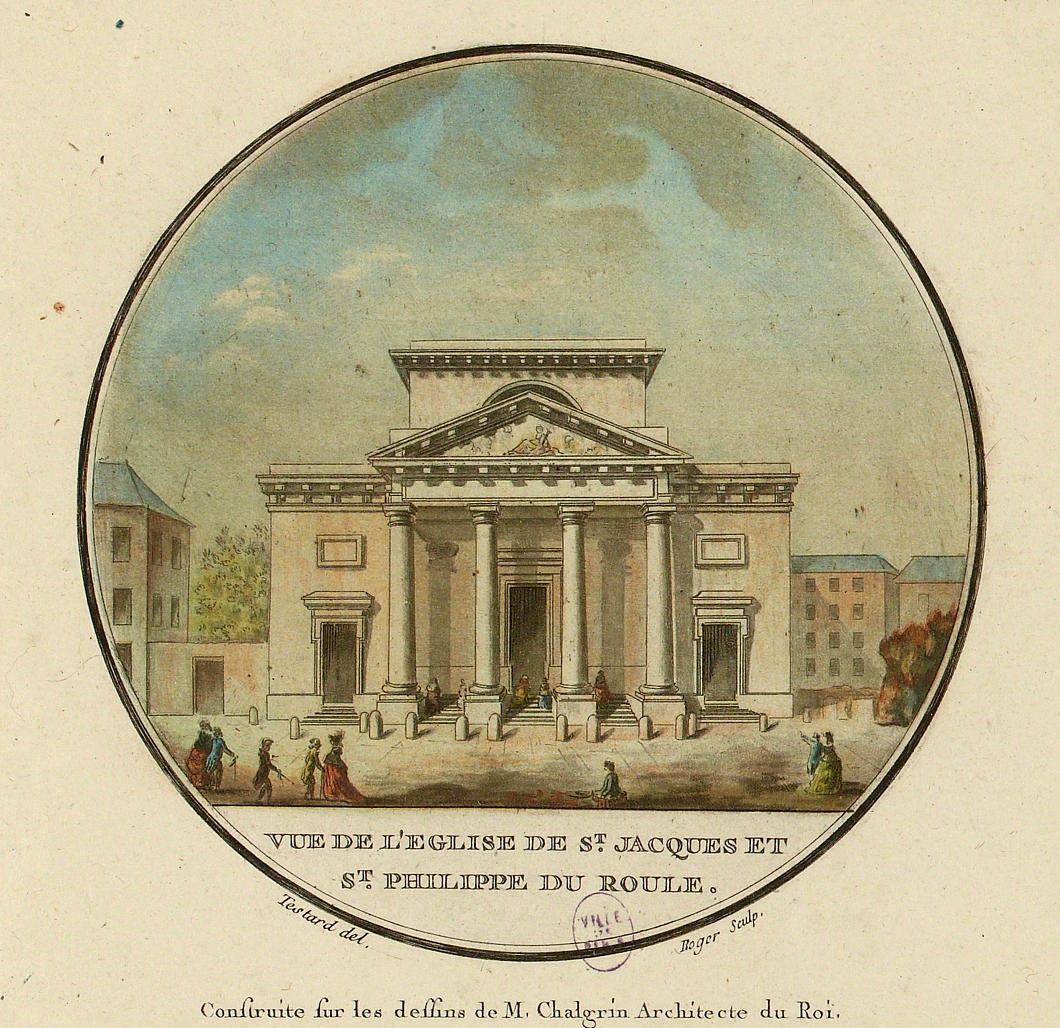
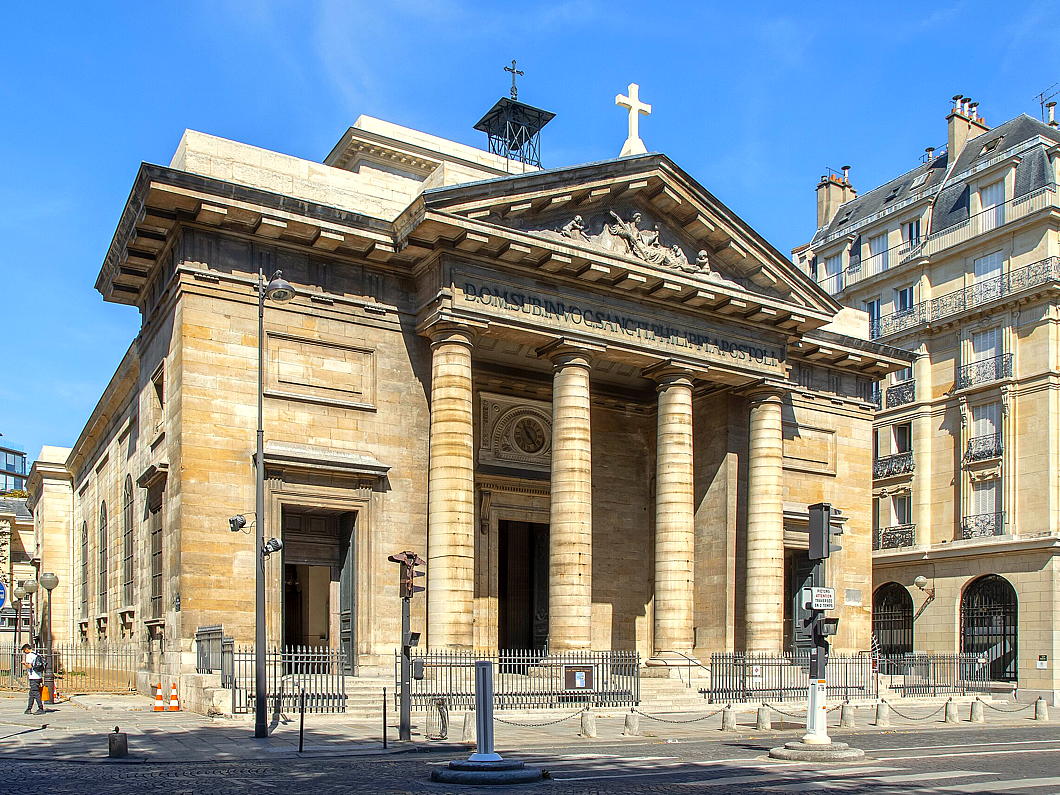
Widowed, grieving, and facing financial difficulty, Eliza returned to Paris, where Louis-Philippe had usurped the throne. Back in the French capital, Eliza embraced the Catholic faith and was received into full communion with the Church. Records identify her as a member of the parish of St-Philippe-du-Roule in the Faubourg Saint-Honoré. In 1833, she went on pilgrimage to Rome where she received a cameo depicting the head of Christ from Gregory XVI’s secretary of state.
Eliza’s final years in Paris were not entirely happy ones. A family member had deprived her of what she thought was her inheritance and she persevered in a state of penury with few possessions. Eliza Monroe Hay died in 1840, with a funeral Mass offered in her parish church and her unmarked grave purchased by the American consul, Daniel Brent.
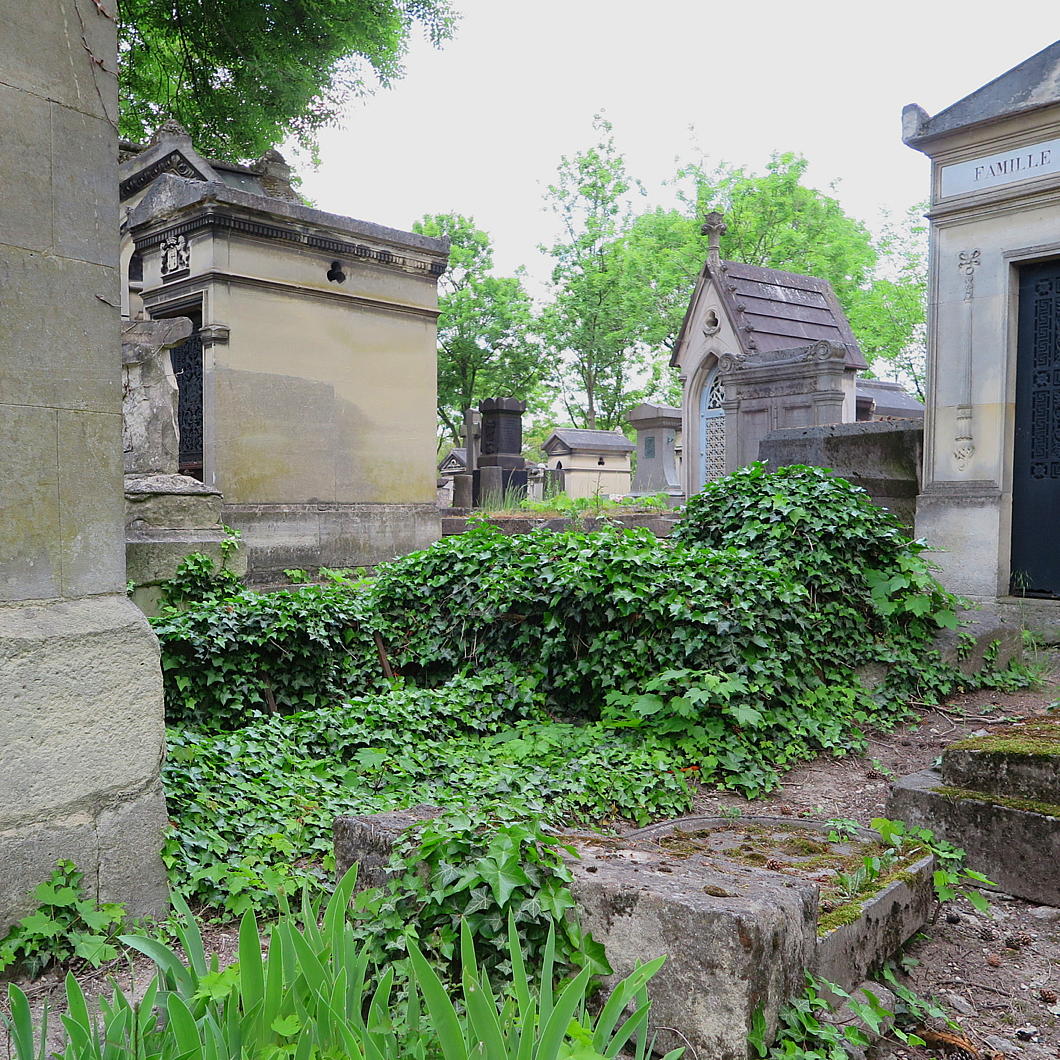
The unmarked grave of Eliza Monroe Hay.
Her memory faded, surviving mainly in family lore. The rediscovery of her letters and her reburial in Virginia have brought her back into view: a woman of faith and dignity, wronged in inheritance, isolated by loss, and now restored to her place among her own thanks to VornDick’s efforts and to her biography Eliza’s True Story: The First Biography of President Monroe’s Eldest Daughter.
For generations a family tradition held that Eliza entered a convent after her conversion. That story appears in some older biographical sketches and even in occasional press references. Recent research — especially VornDick’s examination of Eliza’s correspondence in the archives of the College of William & Mary — has found no documentary evidence that she ever took vows or joined a religious order. The legend of the nun in Paris may have arisen from confusion between her Catholic piety and the religious circles she frequented.
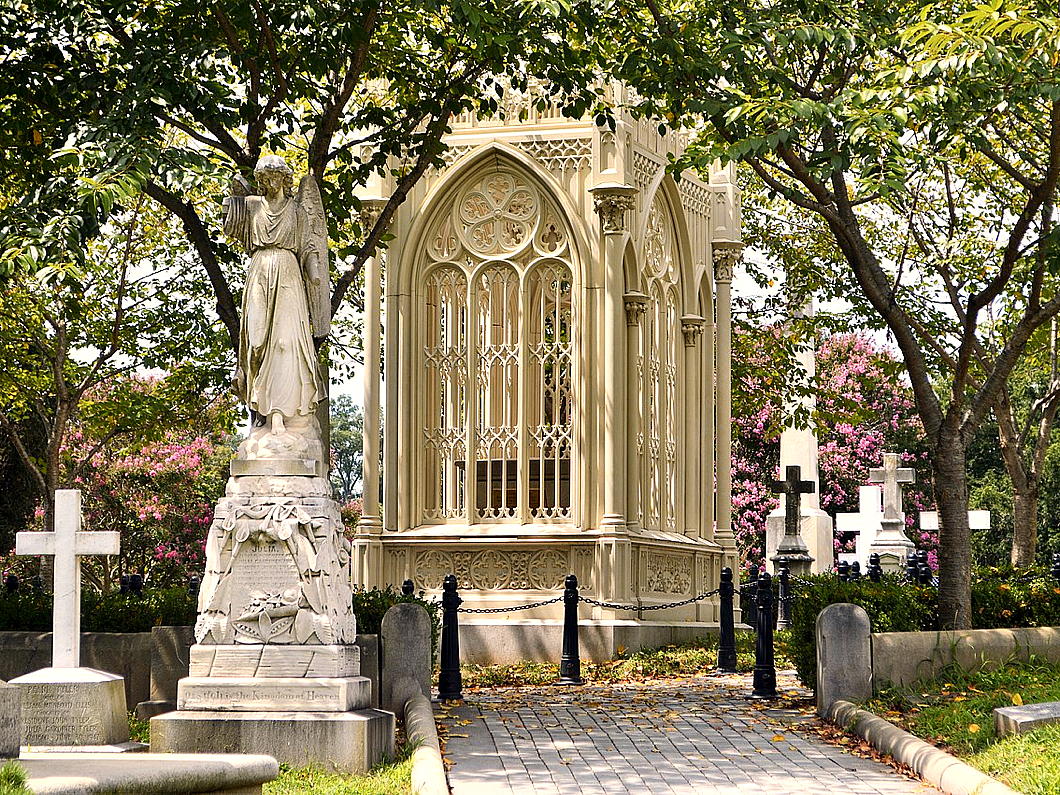
The new resting place is beside hr father’s Gothic tomb — a birdcage of traceery designed by Albert Lybrock in 1859, arches emerging like a filigree chapel above the President’s grave, but in cast-iron painted the colour of stone. The striking funerary monuments now shelters not only the nation’s fifth president but his daughter as well.
The repatriation of Eliza Monroe Hay was not a grand state ceremony but an act of personal devotion. It completes a family story interrupted by distance and time, and restores to American history a figure once nearly forgotten. In the quiet of Hollywood Cemetery, overlooking the James River, the Atlantic divide that once separated the Monroes has finally closed.


College of William & Mary: The forgotten daughter: Eliza Monroe Hay’s story revealed in her last letters
The Brooklyn Tablet: Daughter of President James Monroe Laid to Rest
Catholic News Agency: A Founding Father’s Catholic Daughter is Laid to Rest
Northern Virgina: Author Led Efforts to Rebury Monroe’s Daughter
A Magnificent Portuguese
Gonçalo Ribeiro Telles: environmentalist, democrat, monarchist, professor, government minister, landscape architect
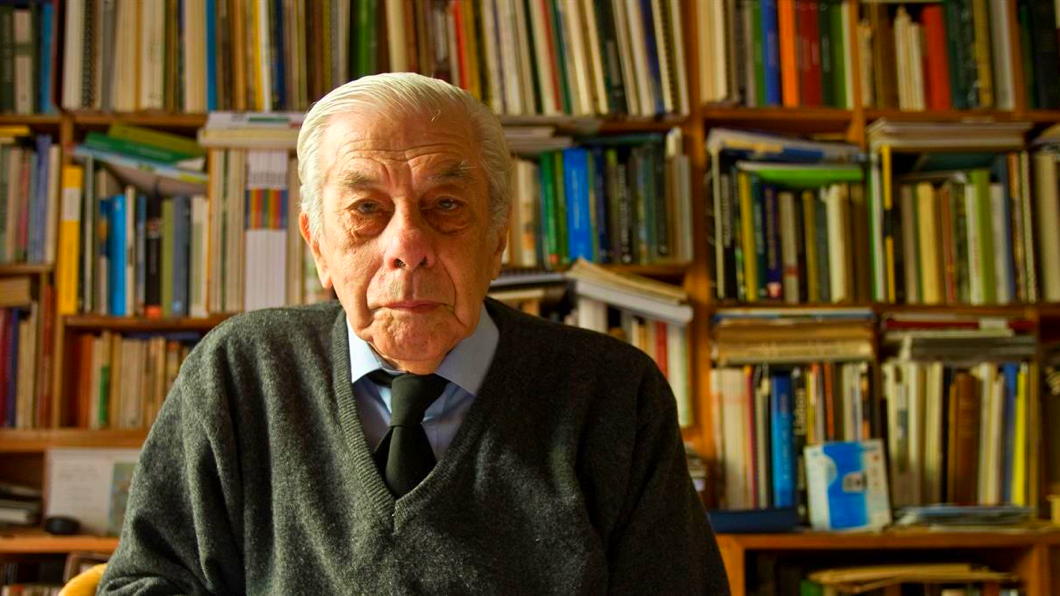
No one ever thinks about the landscape architects. Portugal is a small country that gave birth to great poets, explorers, navigators, merchants, and the entire nation of Brazil. Gonçalo Ribeiro Telles (1922-2020) followed none of those callings, but his career was by no means typical for a landscape architect.
Born a lisboeta, young Gonçalo studied at the Instituto Superior de Agronomía, then part of the Technical University of Lisbon, and housed in an inexplicably grand baroque mansion in the 250-acre leafy Tapada da Ajuda, a sprawling green space on Lisbon’s outskirts.
During the 1940s and early 1950s, the Instituto Superior de Agronomía was a hub of scientific and practical education. The school balanced rigorous agronomic and forestry studies with an increasing interest in landscape architecture — a discipline still in its infancy in Portugal. The sometimes-dry atmosphere was one of disciplined inquiry, shaped by professors with strong ties to both traditional Portuguese forestry and emerging European environmental thought.
Students were trained not merely as technicians but as stewards of the land, tasked with managing Portugal’s varied ecosystems and agricultural resources amid the challenges of modernisation. While the curriculum remained grounded in agronomy and forestry sciences, the period saw the beginnings of a more holistic approach, championed by figures like Professor Francisco Caldeira Cabral, who encouraged students to consider landscape as an integrated ecological and cultural entity.

The year Ribeiro Telles arrived at the Institute was the first in which Caldeira Cabral began offering the degree course of landscape architecture. The professor — the father of nine children, including the composer and musician Pedro Caldeira Cabral — took Gonçalo under his wing and with him the the four students on the programme made annual trips to West Germany to study and draw the landscapes there.
“My first trip was by Volkswagen to Hanover,” Ribeiro Telles told a reporter later in life. “We crossed Spain on the roads of Old Castile, France, and then went up the Rhine. Imagine what you see! Germany was a landscape ravaged by war. They were rebuilding everything, and we had the opportunity to witness it.”
After graduating, Ribeiro Telles worked for the Municipality of Lisbon, also taking time to work with his mentor Caldeira Cabral to co-author A Árvore em Portugal — even today a standard reference work detailing the trees, woods, and hedges of the country, whether in natural or contrived landscapes.
It was in the 1960s that Ribeiro Telles was drafted in to help work on redeveloping a park which had been purchased by the Calouste Gulbenkian Foundation in order to house one of the most significant private art collections in Europe.
Calouste Gulbenkian was an Ottoman-born Armenian businessman (naturalised as British in 1902) whose richesse from petroleum allowed him to become one of the most generous men in the world. In addition to being an art collector, he endowed hospitals, schools, and churches — particularly in the scattered Armenian communities — for many decades.
When the Second World War came, Gulbenkian spent a spell as the Shah’s ambassador to Vichy France before moving to the relative peace of neutral Lisbon in 1942. (His son Nubar, meanwhile, helped run the “Pat O’Leary” network helping Allied airmen escape German-occupied France to Franco’s Spain.) Calouste remained in the Portuguese capital until his death in 1955.
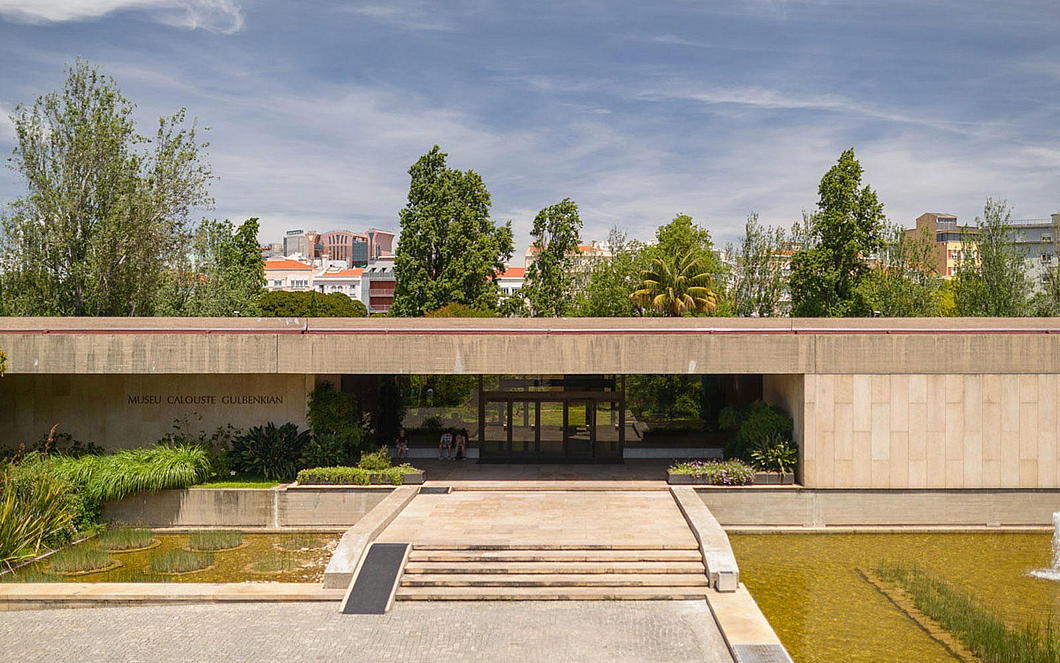
Gulbenkian’s legacy included a foundation to care for and display the art he had collected across his many decade. The trustees commissioned a team of architects to devise a strikingly modern building in Lisbon to house it within a verdant garden setting. Ruy Jervis d’Athouguia, the lead architect, recruited Ribeiro Telles to reshape the park around the museum to suitably complement its bold architecture.
Drawing on his expertise in agronomy and his philosophy of integrating native Portuguese flora with thoughtful spatial design, Ribeiro Telles conceived the garden as a harmonious blend of natural and cultivated elements. He sought to create a space that was both tranquil and educational, showcasing indigenous Mediterranean plants and trees that reflected the local ecology.
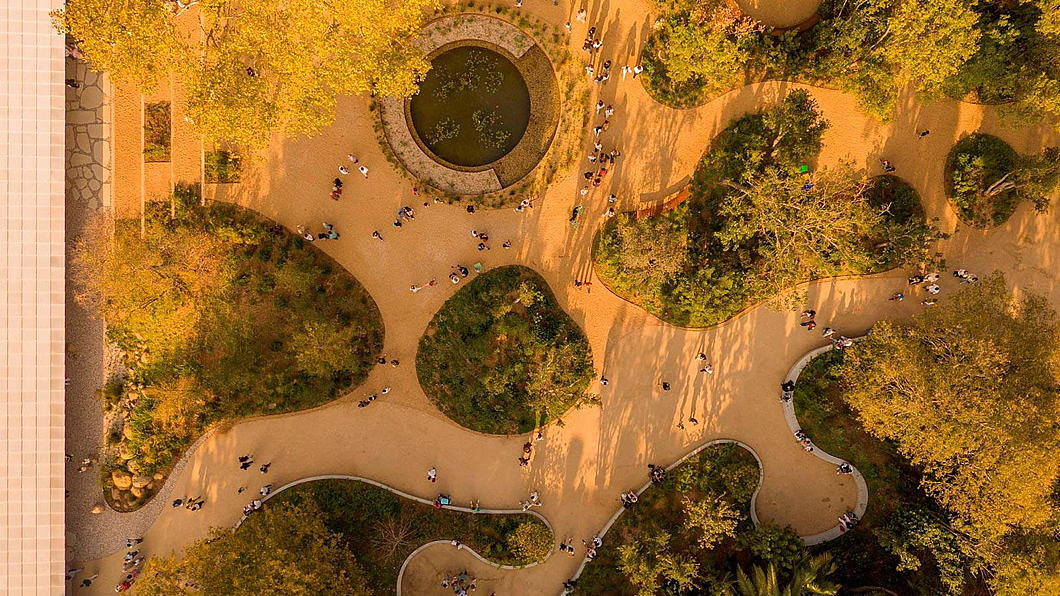
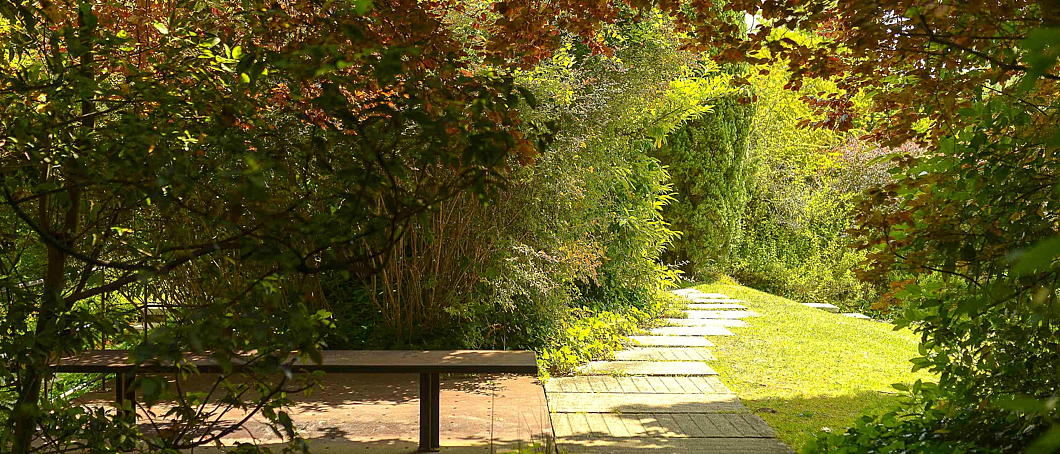
The garden’s design emphasises natural contours, water features, and a careful balance of open lawns and wooded areas, inviting visitors to experience a variety of landscapes in an urban setting. The Gulbenkian Garden is a landmark in Portuguese landscape architecture and remains a testament to Ribeiro Telles’s vision of ecological continuity and cultural identity.
As the Estado Novo began to show cracks, Ribeiro Telles’s deep-rooted Catholic sensibilities and monarchist convictions led him to notch up his role in a rapidly developing political scene. While the 1974 revolution unleashed the expression of Marxist and other far-left tendencies, it also presented an opening for the rebirth of a constitutionalist conservative tradition in Portugal — one that had been frozen in amber during the preceding decades of technocratic authoritarianism.
Ribeiro Telles was among the chief founders of the Partido Popular Monárquico — the People’s Monarchist Party — a curious coalition that brought together traditional monarchists, Catholic intellectuals, rural landowners, and a smattering of constitutional nostalgists whose political lineage traced back to the late liberal Cartistas.
The PPM claimed a place in the democratic process for the politics of rootedness, subsidiarity, cultural continuity, and the organic nature of society. It opposed the materialism of Marxism as well as the managerial blandness of Euro-technocracy and promoted a vision of Portugal as a living inheritance — not just a nation-state, but a civilisation. The party’s early years were marked by an improbable (and ultimately unfulfilled) optimism, bolstered when it was invited to join the coalition governments of the centre-right in the post-revolutionary years.

Ribeiro Telles himself entered government in 1979 under Prime Minister Francisco Sá Carneiro, serving as Secretary of State for the Environment and later as Minister for the Quality of Life. These titles, seemingly anodyne, belied the originality of his vision. He championed ecological zoning, the protection of agricultural peripheries, and the integration of green spaces within urban plans — initiatives that in retrospect seem prescient, but at the time were borderline revolutionary.
Under his guidance the Reserva Ecológica Nacional and Reserva Agrícola Nacional were established, preserving swathes of Portuguese land from the unchecked sprawl that consumed other southern European capitals. He saw farming and cultivation not as the enemy of the natural world but as integral to it. Ribeiro Telles advanced his policies not through bombast or ideology but by presenting common sense in the idiom of tradition.
For him, landscape and the countryside are a ultimately the work of centuries of human hands, and the environmentalism that seeks to undo human habitation must be called out as an Enlightenment rustic romanticism antithetical to the real countryside.
“We tend to think of landscape as a natural thing,” he told a journalist from Expresso. “It’s just there. When I began studying it, I realized it’s linked to a very important antecedent: humanity. Every landscape is the work of man, not nature. Without human influence, it would be worthless. When you begin to understand this, the greatest surprise is to see how a given landscape has an origin, not pictorial, not scenic, but how it functions in its diversity.”
By the 1990s, Ribeiro Telles became disenchanted with the limited ambitions of Portugal’s mainstream parties — including his own. In response he founded the Movimento Partido da Terra (MPT), a green-conservative party that rejected the rhetoric of metropolitan environmentalism and rooted itself instead in the lived realities of rural and regional Portugal. It was anti-centralist, pro-municipal, and unapologetically rooted in an understanding of stewardship — not ownership — of the earth that was fundamentally (but not explicitly) Catholic in inspiration. Like the PPM, the MPT occasionally participated in electoral coalitions with the larger centre-right parties in Portugal, the PSD and the CDS-PP but achieved limited success.
In his later career, Gonçalo Ribeiro Telles continued to shape the green fabric of the Lisbon metropolitan area through a series of influential projects. He played a key role in the planning and expansion of the Monsanto Forest Park, an urban forest three times the size of Manhattan’s Central Park that became known as the “lung of Lisbon,” preserving natural landscapes amid rapid urban growth. Ribeiro Telles also contributed to the design of green corridors and the rehabilitation of degraded areas, advocating for ecological connectivity across municipal boundaries. Despite his advancing years, he continued to play an active role in politics, particularly in the 2010 movement opposing the redefinition of civil marriage.
On his 98th birthday in May 2020, the landscape architect was hailed by the President of Portugal as “one of the most admirable people I have the privilege of knowing”. President Marcelo Rebelo de Sousa praised “his visionary spirit, which led him, before all of us, to anticipate the problems we face today — and which would have taken on a very different profile if, in due time, we had heeded his wise warnings.”
Four months later, on 11 November 2020, Gonçalo Ribeiro Telles drew his last breath. On the day his funeral took place in the Jerónimite monastery of Belém the Portuguese government declared a state of national mourning.
A Portuguese friend of mine who met Ribeiro Telles described him to me as “deeply free, democratic, monarchist, a true municipalist in terms of his view of politics.” Ribeiro Telles “was talking about allotments, municipal farms, green spaces… in the 1970s!”
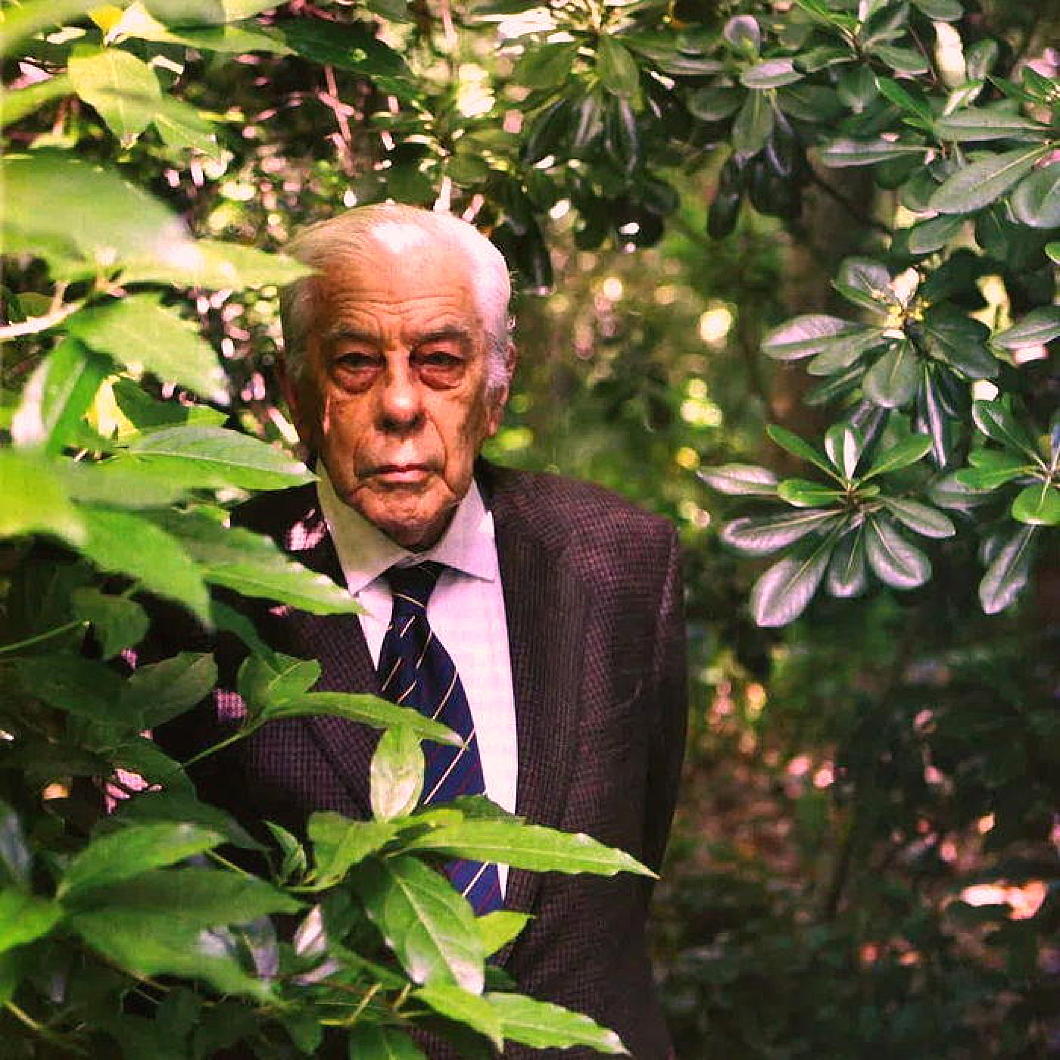
He had an excellent mind and a good hand at drawing, but somehow it seems wrong that he was not also a poet. I feel certain he must have written at least a few verses scribbled somewhere, left amongst his papers to be discovered decades from now by some earnest researcher. Instead of words, Ribeiro Telles crafted scenes out of soil, plant, water, and wood.
Next time you are in Lisbon, nip in to the garden of the Gulbenkian and spare a thought for old Gonçalo.
Si monumentum requiris, circumspice.
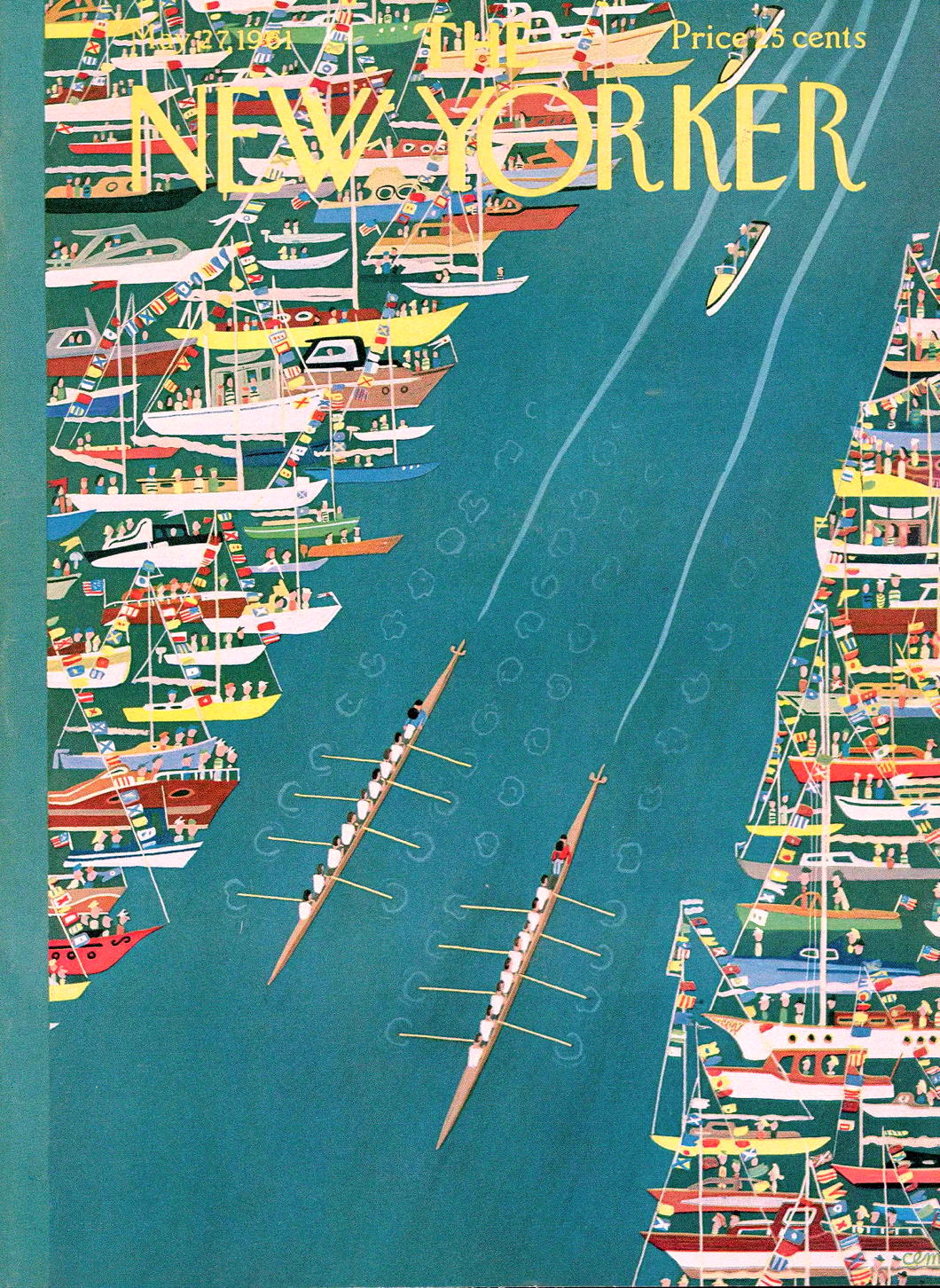
The New Yorker Rows

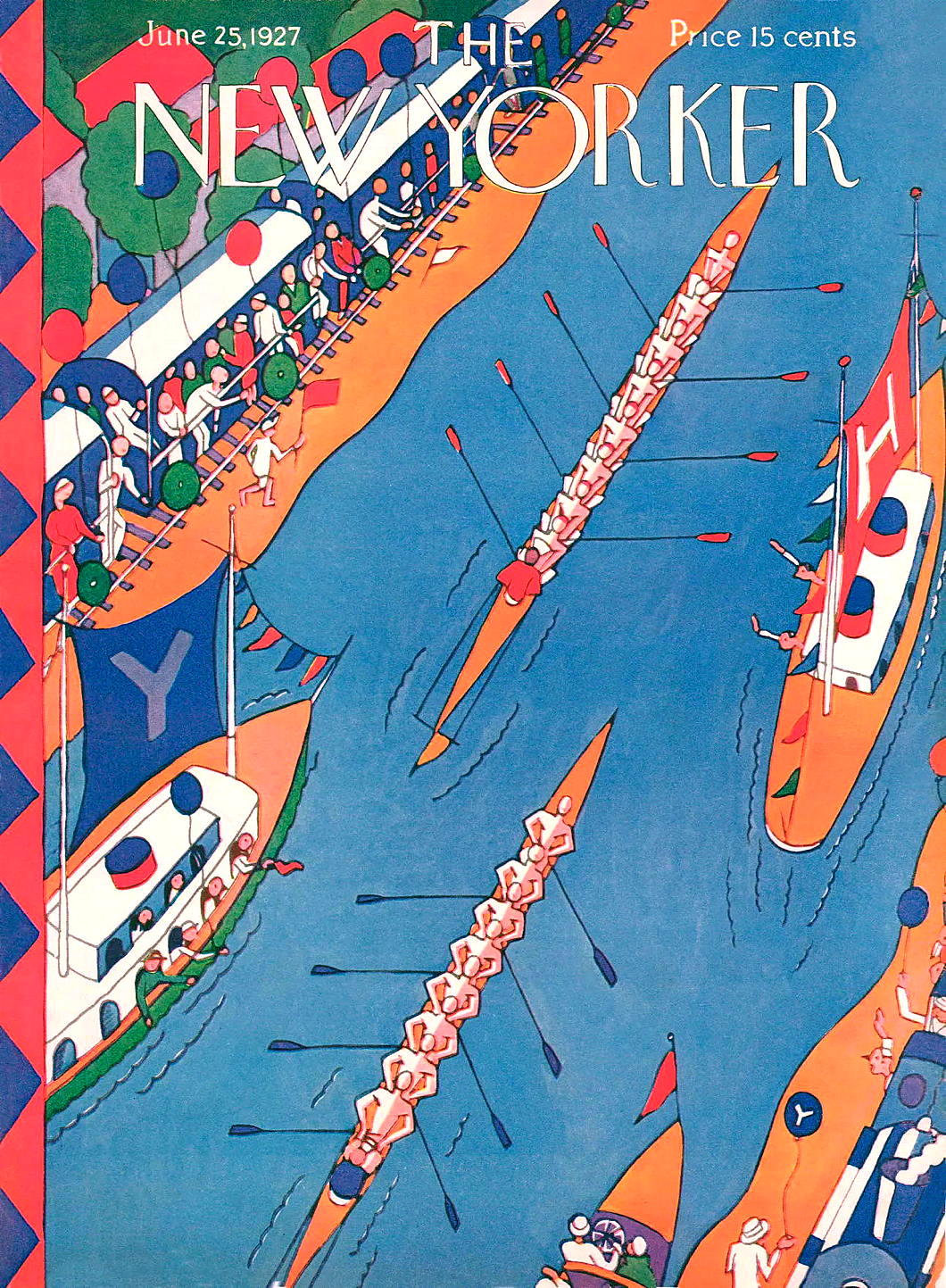
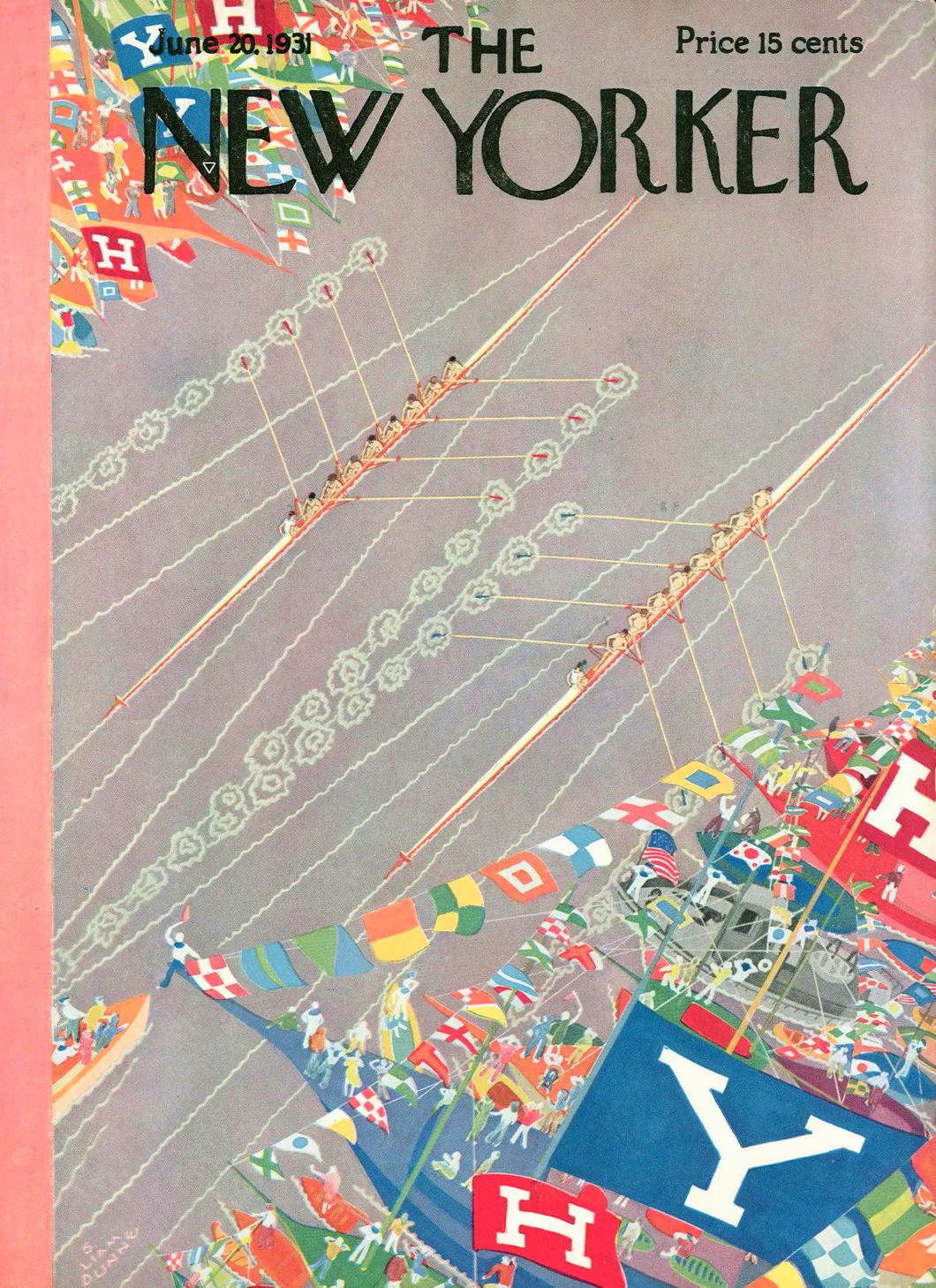
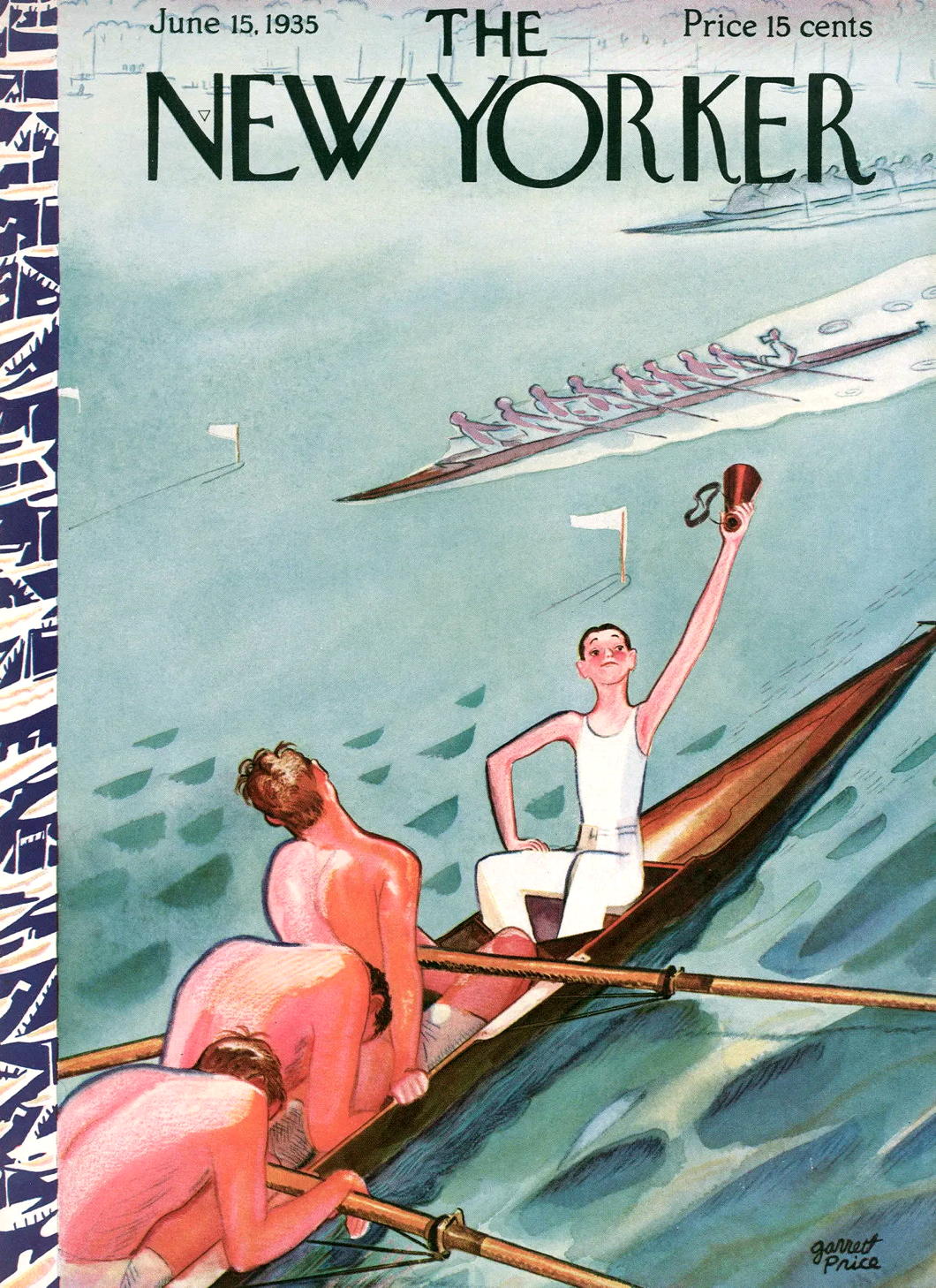
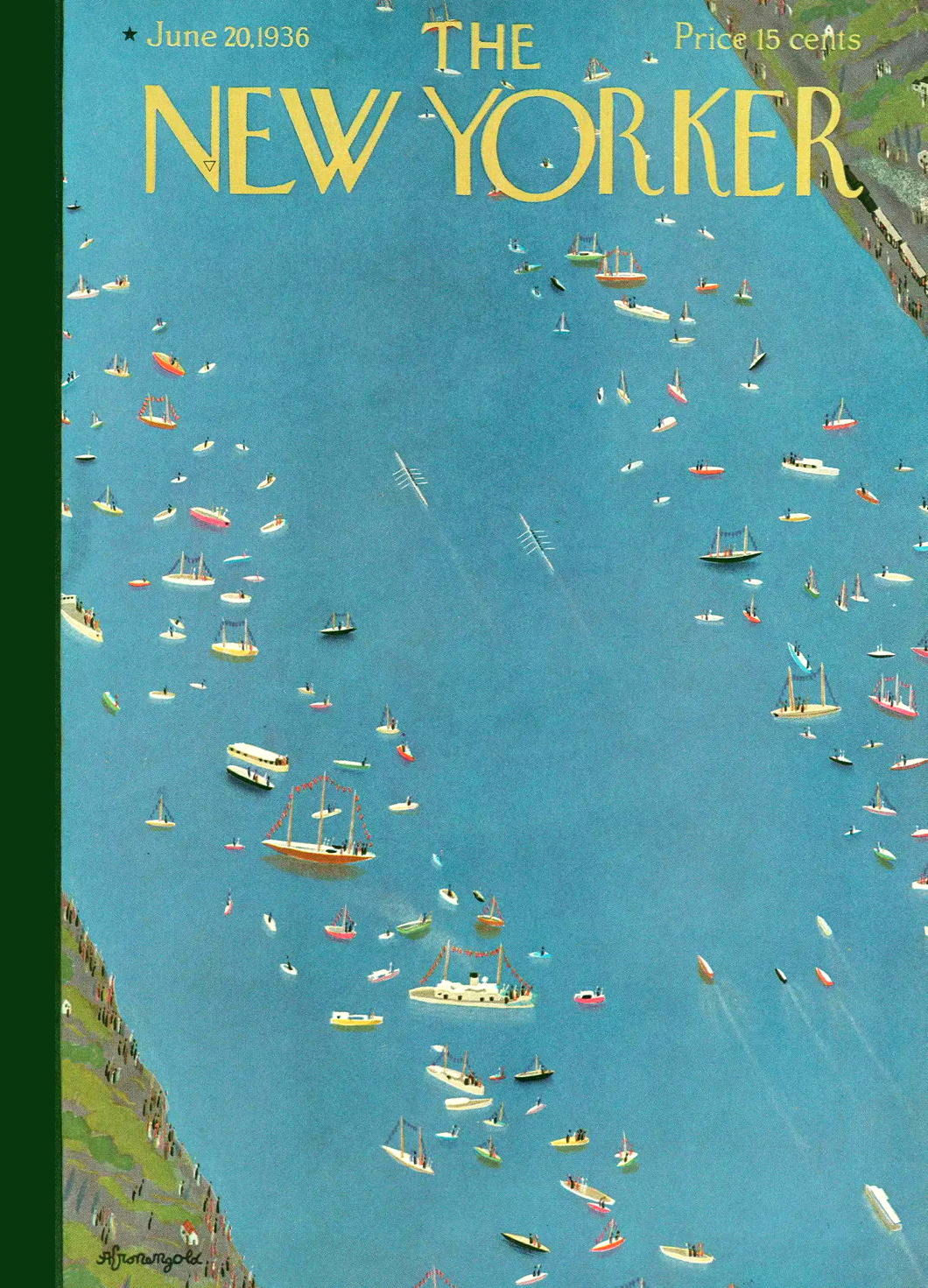
England has “The Boat Race” between Oxford and Cambridge, but America has the annual competition that sees Harvard face Yale on the Thames River in New London, Connecticut.
First held in 1852, “The Race” predates “The Game” — the two universities’ annual football match — by twenty-three years which makes it the oldest collegiate athletic competition ongoing in the States.
The Harvard/Yale battle on the river was a major sporting event for much of the twentieth century, and found its way to the cover of The New Yorker more than once.
Alas, like many totems of old New England, “The Race” has receded from the view of the common culture. Like foxhunting, it might even surprise some today that it ever held such a prime spot in people’s attention.
Les immortels

Today’s Fête Nationale gives me an excuse to talk about the Académie française, probably the coolest secular institution in the world.
In 2018, James Reginato wrote an article for Vanity Fair that peeked into the world of the « immortels ».
He pointed out that the election of an academician is sometimes compared to the election of a Pope, with Xavier Darcos joking the difference is that each academician “is convinced he is more important than the Pope”.
The College of Cardinals is also more efficient than the Académie: this year’s conclave took just two days to elect our new supreme pontiff.
It’s true the immortals have already chosen Alain Aspect to take the seat vacated by the death of the Marqués de Vargas Llosa, but there are six further empty seats.
According to the operations of the Académie, though six seats are empty, only one is actually designated as vacant.
For a vacancy to formally exist it must be declared during a formal session of the body, after which time a new academician is to be elected within three months (in theory, at least).
Seat 3’s most recent inhabitant was Jean-Denis Bredin who died in 2021. The other empty seats are number 10 (Florence Delay, m. 2025), number 11 (Gabriel de Broglie, m. 2025), number 14 (the great Hélène Carrère d’Encausse, m. 2023), number 20 (Angelo Rinaldi, m. 2025), and number 27 (Pierre Nora, m. 2025).
Needless to say, if one was called upon, one could not turn down so great an honour.
France24 recently did a small feature looking behind the scenes at the Académie française.

Druze Stirrings
The secretive sect that helped topple Assad
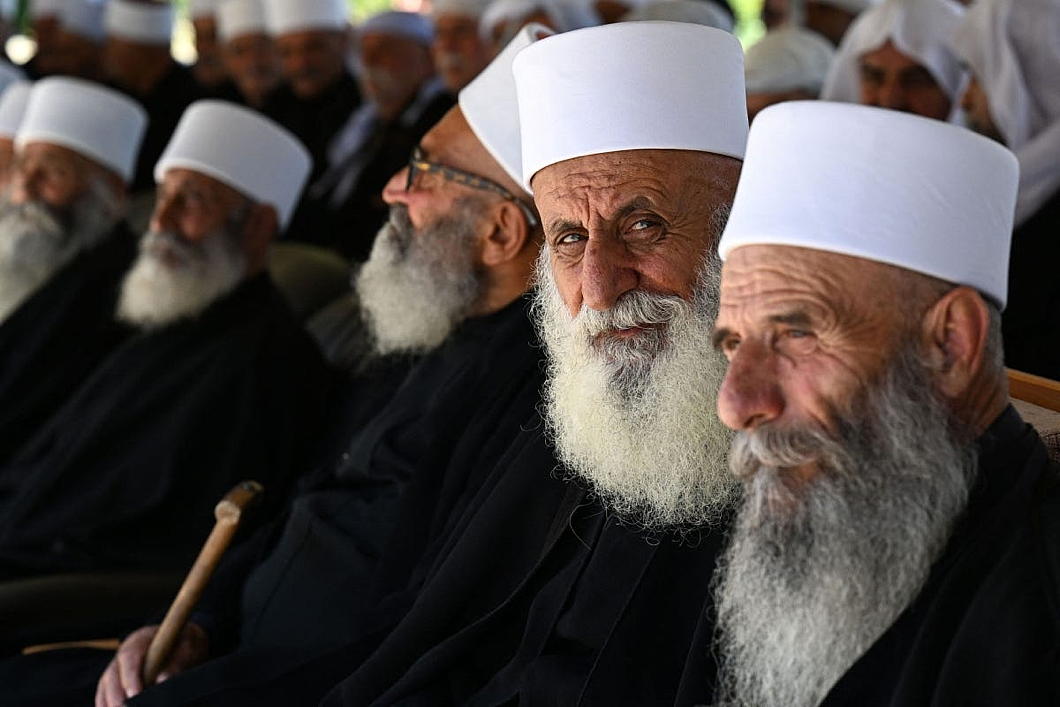
The Druze are an elusive people. During the few summers I spent in Lebanon I met Maronites, Melkites, Sunni, Shi’a, Armenians, and many others but I only recall knowingly meeting one Druze — and that’s a story for another day.
Druze beliefs are as secretive as they are distinct. Most file them as (for lack of a less judgemental word) a schismatic branch of Islam that emerged out of Isma’ilism; others argue that they are gnostics who took up the Islamic mantle to avoid oppression. Naturally they do not call themselves Druze, but muwaḥidūn, which more or less means ‘monotheists’ or ‘singularists’ — believers in the singularity of God. Ethnically, they are Arab, and migrated to the Lebanese mountains and Jabal al-Druze from south Arabia before the advent of Islam.
Christians have traversed the four corners of the globe in order to share the Gospel, but the Druze are completely at odds with this mentality. They are not bothered if you are uninterested in their religion: In fact, altogether they very much prefer you don’t ask too many questions because, frankly, they don’t want you to know. Since the closing of the daʿwa — the call to belief — in AD 1043, no converts may be accepted, nor can rituals or worship take place in public, and all marriage outside the community is prohibited.
There is only one famous Druze in the world: the perennial survivor of Lebanese politics, Walid Joumblatt. He ascended to the political headship of Lebanon’s Druze in 1977, succeeding his father Kamal as the leader of the Progressive Socialist Party — whose name elides the sectarian tribal nature of the entity as the outlet for political Druzism in the Lebanon — and maintained his leadership throughout the devastation of the fifteen-year civil war.
Joumblatt is an educated and entertaining fellow, sharing his holiday snaps on the Nile with pith helmet and parasol, mockingly comparing himself to Hercules Poirot.
Red Crosses That Weren’t
Rejected emblems of the Red Cross and Red Crescent societies
MANY MOONS AGO in South Africa, we had an assignment in Afrikaans class to do a presentation on an organisation or entity that was an example of sosiale bewustheid — “social awareness”.
The perfect exemplar held up by our delightful instructress was the Red Cross which was founded by Henri Dunant in the aftermath of the Battle of Solferino — or DIE SLAG VAN SOLFERINO in Afrikaans (it sounds much deadlier in the language of the Cape).
Strictly speaking, the Red Cross is the International Committee of the Red Cross, which was founded in 1863 to help care for wounded soldiers and to agree protections for medics and field hospitals as well as the afflicted persons they looked after.
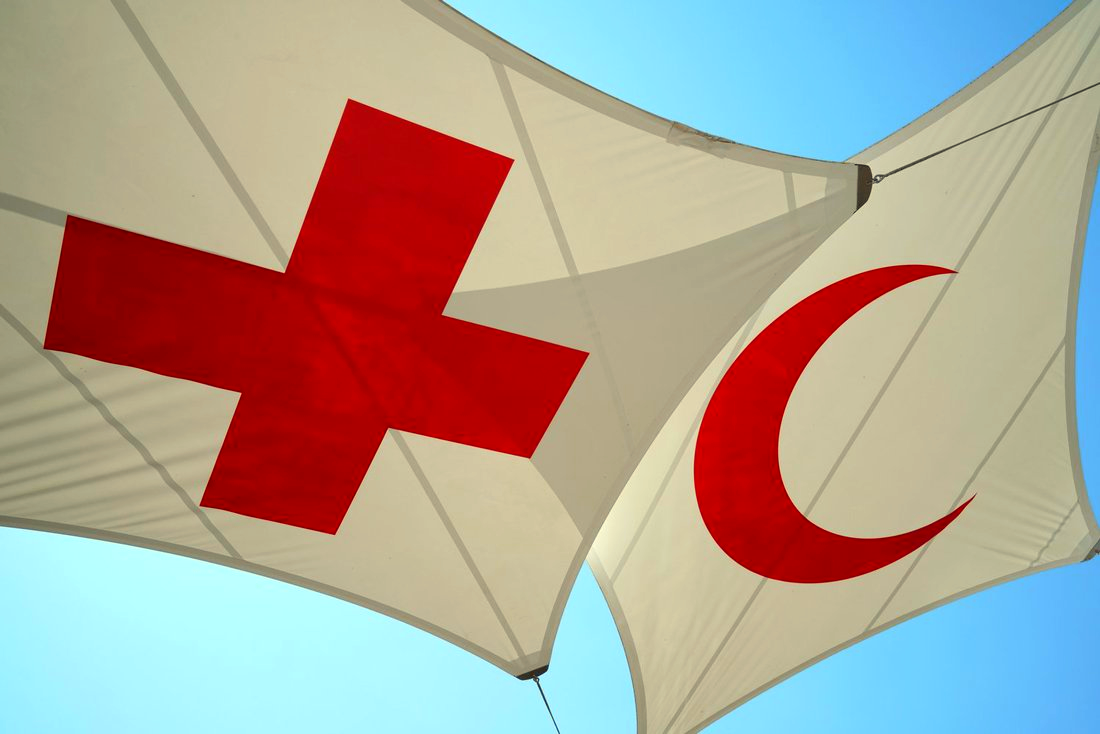
A symbol was needed to act as a clear designation to warring parties of combatants and it was decided to adopt a red cross on a white background. Field hospitals would be identifiable by flags and signposts of the red cross on white, and medics would stand out by wearing white armlets with the red symbol.

The Red Cross
Dunant suggested that each country set up its own national voluntary society to look after wounded soldiers. They did so in great numbers, with the initial seven national societies being set up within the first year of the Geneva Convention being agreed in 1864.

The Red Crescent
In 1876, however, the Ottoman Society for Relief to Military Wounded and Sick unilaterally decided to adopt the red crescent on white as its emblem, simultaneously declaring that it would continue to respect and uphold the protections on those facilities or personnel bearing the red cross in line with the agreements Turkey had acceded to.
The International Committee of the Red Cross was quite miffed about this. The red cross was not meant to be interpreted as a religious emblem but a single universal signifier (allegedly inspired by being the inverse of the flag of neutral Switzerland) that could be instantly recognised and respected.
From Geneva, the ICRC wrote to its constituent national societies informing them of this development, while also highlighting its irregularity:
We must, however, draw your attention to the fact that the Ottoman Society for Relief to Military Wounded and Sick has adopted the red crescent on a white flag and armlet as the distinctive sign of neutral personnel.
This substitution of the red crescent for the red cross, in accordance with the proposals of the Sublime Porte to the States signatories to the Geneva Convention, places the Ottoman Society in an irregular position so far as its relations with the other Societies for relief to the wounded are concerned.
While entertaining formal reservations on the substitution of the red crescent for the red cross and the adoption of the former by the Porte before the States signatories to the Geneva Convention have agreed to it, we believe the Ottoman Society can render useful service to the cause of humanity.
Headquarters in Geneva didn’t grant official status to the symbol of the red crescent until 1929 when the Geneva Convention was amended.
Meanwhile, the national societies of almost every majority-Muslim country today use the red crescent instead of the red cross. The major exception, oddly, is Indonesia — the largest Muslim country in the world by population — which has a Red Cross Society. (Perhaps another lingering remnant of the Dutch empire?)
There’s also the matter of which way the red crescent faces. Almost all the Red Crescent societies have it facing rightwards. The exceptions today are the societies of Turkey and Tunisia which both have the crescent facing left. During the days of the Soviet Union, a left-facing crescent was also used by each of the national societies for each of the traditionally Muslim republics of the USSR.

The Red Lion and Sun
The other major exception was the Empire of Persia, which adopted the name of Iran in 1935. Since the 1900s, the Persians had used a red version of their national emblem, the lion-and-sun, for their field medicine and the Red Lion and Sun Society was founded in 1922.
When the Shah was toppled and the ancient empire reduced to an Islamic Republic, the mullahs moved to adopt the Red Crescent in line with other Muslim countries. The Iranian society has always, however, maintained the right to use the Red Lion and Sun and have opposed any attempts to withdraw recognition for the symbol even though it is not actively used.

Magen David Adom (“the Red Shield of David”)
The next most significant emblem to enter the arena was the Magen David Adom, literally the “Red Shield of David”, consisting of what in English we usually call the Star of David. The Jewish medical support organisation was founded in Mandatory Palestine in 1930 with a single branch in Tel Aviv.
The name and emblem, however, date back to the Transvaal during the Anglo-Boer War when Ben Zion Aaron founded a Jewish ambulance corps under the name and symbol Magen David Adom. Paul Kruger, the President of the South African Republic, gave permission for Aaron’s medics to use the symbol and the name in the assistance they rendered to wounded Boer forces.
In May 1931, just a year after Magen David Adom was founded, it was proposed that the red Star of David be added as a protected symbol. The ICRC, however, noted that the Society of the Red Shield of David did not constitute a national society as it did not represent an independent state, this part of the Holy Land being under the British Mandate of Palestine. It also noted in its reply that the adoption of a unique and distinct emblem would harm its future chances of being recognised by the International Committee in the event an independent Jewish state in Palestine was created.
In 1947 the United Nations voted to partition Mandatory Palestine between two states— one Jewish, one Arab — and the following year the State of Israel was founded. The nascent Jewish state acceded to the Geneva Conventions without any reservation, but nonetheless tabled requests for the Magen David Adom to be recognised as a protected symbol. These proposals were continually rejected for fear of symbol proliferation.
At the time, the conciliatory Dutch proposed a compromise whereby every Red Cross society would adopt an upturned red triangle — as a harsh, angular representation of a human heart — but the national societies rejected this suggestion.
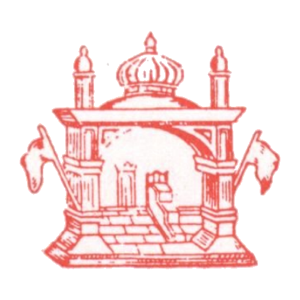
Mehrab-e-Ahmar, or Red Archway (Mehrab)
In the mean time, officials in Geneva has been in touch with the government of Afghanistan encouraging them to start a national society. In 1935, the Afghans founded the Mehrab-e-Ahmar, or Red Archway Society, and applied for recognition from the International Committee.
On the basis of the 1929 Convention, the ICRC suggested to Afghan ministers that they adopt the name Red Crescent Society instead, but the Afghans objected, claiming that the already recognised crescent and lion-and-sun emblems were national in origin and not religious symbols.
At a 1935 meeting, the ICRC rejected official recognition for both the Mehrab-e-Ahmar and Magen David Adom. Three years later, the Afghans conformed and renamed their Mehrab-e-Ahmar to the Red Crescent Society of Afghanistan. (In its early years it used a red crescent facing upwards — just to throw something into the mix.)
Magen David Adom would have to wait until 2006 for its symbol to be recognised via a compromise: the Red Shield of David would be recognised within Israel but any of MDA’s activities outside of Israel would require the emblem to be displayed within the neutral red crystal emblem.

The proposed Cypriot emblem.
The British Crown Colony of Cyprus was home to a section of the British Red Cross. In the 1950s the island — with its Greek Christian and Turkish Muslim communities — was moving towards independence and the British Red Cross was keen to elevate the status of its existing branch to a national society of the ICRC.
As a nod to the two sections of the island’s population, the British Red Cross proposed creating the Red Cross and Red Crescent Society of Cyprus, but the ICRC rather pedantically rejected the proposed combined emblem under the usual grounds of wariness towards symbol proliferation.

The Red Chakra
India’s Red Cross Society was founded just after the First World War and recognised by the ICRC in 1929. After independence in 1947 there was a drive to replace all emblems that were viewed as being British in origin, and the Red Cross reminded some nationalists of the St George’s Flag and the Union Jack.
Some thought was given to introducing a red version of Ashoka’s chakra, India’s national emblem, but the concept never gained momentum.

The Red Lion and Sword
In Ceylon, a Red Cross Society has been founded in 1949, but (like their Indian neighbours) nationalist Ceylonese associated the emblem with Great Britain and with Christianity.
In 1957 a red swastika was proposed as being common to both Buddhism and Hinduism but, as François Bugnion has noted, the proposal wasn’t followed up “for obvious reasons”.
In 1965 there was a plan to incorporate other aid and assistance bodies into the existing Red Cross Society and to adopt a red lion holding a glaive — the Ceylonese national emblem. Once again, the ICRC rejected the proposal.
Other countries which discussed or even proposed new protected emblems include:
■ Syria — where a red palm was proposed in opposition to the cross (deemed too French) and the crescent (viewed as redolent of Turkish domination)
■ Siam — where Queen Saovabha Phongsri founded a society for assistance to the wounded called the Sabha Ka Chad Syam, or Society of the Red Flame (or Unalom)
■ Sudan — the colonial chapter of the British Red Cross was joined by a local section of the Egyptian Red Crescent; a red rhinoceros was proposed but eventually the crescent was adopted
■ Lebanon — the Lebanese Red Cross was founded in 1945 but ran into some resistance from the Muslim section of the population; a red cedar tree was discussed as an emblem but never formally proposed
From 1929, the revised Geneva Convention recognised exclusively the Red Cross, the Red Crescent, and the Red Lion and Sun as the only approved emblems of the movement.
These restrictions survived until 2005 when Protocol III was agreed, creating a totally neutral emblem, the Red Crystal (sometimes referred to as the Red Diamond or the Red Lozenge).

The Red Crystal of the ICRC
This protocol clarified that within its own territory, any national society could use an indicative emblem and the protections for medical personnel would apply, but that when it was operating outside its national territory, it must use either one of the previously approved three emblems or its own distinct emblem combined with the form of the Red Crystal.
This agreement has finally allowed Magen David Adom to be granted full status as a national society of the Red Cross.
The Red Cross has been wise to be wary of new symbols, but once it conceded the point of the Red Crescent it was difficult not to allow further proliferation. With 190-something independent states across the face of the planet, it is remarkable that the number of approved symbols are still so few. (And, given recent events, let us hope for the day when the Red Lion and Sun is deployed once more.)
The legacy of each of the national societies varies widely. During the Second World War, the German Red Cross was thoroughly penetrated by the ideology of National Socialism, leading to its disbandment once the Allied Powers occupied the defeated Germany. The American Red Cross has become notorious for its success at raising money for the relief of suffering and spending it on bureaucracy instead. In Gaza, hospitals and other medical sites are routinely used for military purposes by Hamas undermining the protections the Red Crescent is meant to convey.
There will always be debits and credits, but Henri Dunant’s project for the protection of the wounded and the relief of suffering is more honoured today than offended against today: The Red Cross (or Red Crescent, or Red Crystal, or…) deserves some justified praise.
Mamarazza, R.I.P.
She had a sharp eye, and will always be remembered for one of my favourite photographs.
May her soul and the souls of all the faithful departed rest in peace.

Faithful Shepherd of the Falklands
Monsignor Daniel Spraggon, Apostolic Prefect in Stanley

The anniversary of the Argentine invasion of the Falkland Islands is a time to recall one of the archipelago’s most faithful shepherds: Monsignor Daniel Spraggon, the apostolic prefect of the Falklands, South Georgia, and South Sandwich Islands.
Born in Newcastle in 1912, Daniel’s parents died during his childhood, leaving him to be raised by Daniel and Kitty Anderson who taught him the skills of the butcher’s trade. At the age of 22, Daniel joined the Mill Hill Missionaries and studied throughout the Second World War, finally being ordained on the feast of Sts Peter & Paul in 1945.
The Mill Hill Fathers assigned him to Buea in the British Cameroons (today a component of the Anglophone part of Cameroun) where, in addition to caring for souls, he also raised pigs. Having impressed the local colonial officials, they successfully requested the Mill Hill Fathers assign Spraggon as a military chaplain to the Gold Coast Regiment of the Royal West African Field Force.
When the Gold Coast became the first of Britain’s West African colonies to achieve independence in 1957, Spraggon was retired with the rank of Major and honoured with an MBE. He maintained close and friendly contacts with several Ghanaian Army officers — “good men” in his words — some of whom were later involved in the overthrow of Ghana’s chaotic dictator Kwame Nkrumah in 1966.
To the South Atlantic
After years attending to mission appeals in Great Britain and North America, Father Spraggon was appointed to the Falklands in 1971 with the right of succession to the apostolic prefect Msgr James Ireland, who stood down in 1973. While still only a priest, Msgr Spraggon had all the authority of an ordinary bishop over the Falklands, South Georgia, the South Sandwich Islands, and the British Antarctic Territory.
Spraggon took to his task with vigour, encouraging the farmers to allow their children and farm workers to be educated, particularly when it came to matters of religion. As the Dictionary of Falklands Biography notes:
“Hospital visiting was a daily event even on a Sunday — not only were Catholic families visited but those of other denominations. This also held good on the ecumenical side. Many joint services were conducted in a warm and friendly spirit, though when he had to be firm he was.”
Pigs had been his department in Africa, but in the Falklands Msgr Spraggon turned instead to cattle. As the DFB relates:
“His cutting up of a quarter or half was a joy to behold — and his handling of the carcass showed a robust frame but belied a none too healthy body which he managed to hide so well. Sausages, brawn and soups were also his forte.”
The Argentine airline LADE began regular flights to Port Stanley in 1972, which brought Msgr Spraggon into contact with their officers and staff, by numbers overwhelmingly Catholic in religion.
In conversation, the Monsignor very frankly relayed to the LADE officials that the Islands were British, the Islanders were British, and that they would do everything in their power to remain British while also hoping to be as friendly as possible to their Argentine neighbours.
Invasion
The quiet pastoral life of the Falklands was rudely interrupted on 2 April 1982 when an overwhelming Argentine force invaded and seized the British territory.
The Argentine forces took the capital Port Stanley where the governor of the Falklands, Rex Masterman Hunt CMG, ordered them to depart the islands immediately and return to Argentina. The next day it was announced the invading occupiers were going to remove the Governor from the Falklands, flying him to Argentina where he could then return to London.
Hunt decided to don his full civil uniform — feathery cap and all — and march down the street to reassure islanders that Britain would be back. Spraggon, long since become a good friend to the administrator, ran up to take hold of him to bid farewell — for now.
“The Islanders will need you now more than ever, Monsignor,” Hunt told him. “I know you’ll do your best from them.” Spraggon embraced the Governor: “And I know you’ll be back.”
Sir Rex wrote later in his memoirs that Spraggon “universally liked and respected… was to prove a tower of strength during the occupation”.
Seeing Hunt in his full uniform, the cleric determined there and then that he would wear his full monsignor’s kit for the duration of the occupation — however long it lasted — to keep the Islanders hopes alive.
As prefect apostolic, Msgr Spraggon was not just a clergyman but the representative of the Holy See — a sovereign state in international law — on the Islands.
In his first interaction with the Argentine commanders, Msgr Spraggon echoed the Governor’s advice that they should leave the Falklands immediately, otherwise everyone “even the penguins” would depart.
As it happened, the Monsignor did everything in his power to make sure the Falklanders stayed put and were looked after. He crisscrossed the islands calling in on farmers and families, talking to islanders and calming them with his reassuring presence — again, in his full garb as prelate.
Dealing with the “Argies”
The Argentine military-civilian liaison officer on the island was a Commodore Carlos Bloomer-Reeve — an acquaintance of the Monsignor’s from the Argentine’s previous role with LADE airlines — assisted by Argentine naval captain (later vice admiral) Barry Melbourne Hussey. Spraggon and Bloomer-Reeve’s pre-existing relationship proved useful across the Argentine occupation as the Monsignor often had to advocate on behalf of individual islanders.
The only policeman on the island, PC Anton Livermore, initially tried to make do after the invasion in helping keep some civil order and preventing harm. Major Dowling of the Argentine Army was made the head of civil policing but when Dowling ordered Livermore to arrest a civilian, the constable refused. “They didn’t like that and threatened me, but Monsignor Spraggon sorted that out,” Livermore said. “I have a lot to thank Monsignor for.”
The invading forces were an odd lot. Most — not all — the Argentine officers had a decent reputation for gentlemanly conduct with the Islanders but they often showed an utter contempt for their own enlisted men. In contrast to the well-fed officers, the drafted Argentine enlistees were poorly nourished and sometimes begged or stole food from islanders.
“After the curfew they shot at anything that moved,” Spraggon reported. “They didn’t know one end of the gun from the other.” One evening a nervous conscript opened fire on the Monsignor’s house. Spraggon marched down to Comodoro Bloomer-Reeves’ office first thing the next morning and forced him to come and count the twenty-seven bullet holes in the priest’s house.
Two bullets had breached the lavatory at a potentially lethal angle. “Look at that!” he shouted at the Argentine with his thick Geordie accent. “If I’d been answering the call of nature, you’d now be answering to God!” Years later Spraggon showed Rex Hunt his thick copy of Moral and Pastoral Theology (Volume V) which a bullet had torn through: “They got through it quicker than I did!”
Throughout the occupation, the Monsignor never lost his confidence in an eventual British victory. He sensed that — once the British naval task force had been assembled — the Argentines on the island also suspected they would lose.
Mass continued to be offered in the Catholic church to mixed congregations of Islanders and occupiers. The Sunday following the Queen’s Birthday included a particularly lusty rendition of God Save the Queen, to the sheepish embarrassment of the Argentines.
Liberation and Life
When it came, the day of liberation was a source of great joy. The Islands’ old governor — and the Monsignor’s good friend — Sir Rex Hunt was flown back in triumph.
In his memoirs he recalls returning to Stanley:
“The two victorious commanders, Sandy Woodward and Jeremy Moore, welcomed me back but, before I could take the General Salute, I was engulfed by the crowd. Normally not renowned for displaying emotions, even the miserable weather couldn’t dampen their spirits. In that sea of faces I saw Syd and Betty Miller, crying this time from joy, not sorrow, and Monsignor Spraggon, in all his finery still and beaming goodwill and happiness.”
The Governor and the Prelate — Rex and Daniel — both stayed on in their roles following the liberation. There were many dead bodies scattered across the islands to deal with, and the Argentine government at that time refused to repatriate their own war dead.
The Falklands authorities decided to dedicate a plot of land for the enemy dead, consecrated by Monsignor Spraggon — saddened that so many lives had been lost so uselessly. “We looked after the poor buggers a lot better dead than their officers did alive,” he said.
For his efforts during the occupation, Monsignor Spraggon was awarded an OBE which he travelled to Buckingham Palace to receive in 1983.
The priest was no longer young, and the bad luck of an aneurysm saw him detained in the Islands’ King Edward Memorial Hospital on the fateful evening in April 1984 that a serious fire erupted.
With such a small population, in Stanley a fire is a matter of all-hands-on-deck — even the Governor. Again Sir Rex Hunt’s memoirs relay the scene:
When I got back to the west entrance, someone said that all the patients were out of the hospital and safely accounted for, but over in the nurses’ block they told me that this was not so – Monsignor was still inside, and Teresa and her baby, and perhaps others.
I dashed back to the west entrance and tried to make my way through the smoke to Monsignor’s room, but after a few yards I was coughing and spluttering and realised that, without breathing apparatus, it was hopeless. I returned to the door and waited anxiously, feeling utterly frustrated and helpless.
Suddenly figures emerged from the smoke wearing breathing apparatus and carrying a body. ‘It’s Barbara Chick’, said one, in a voice which I recognised as Marvin’s. ‘She’s dead, but there are more in there.’ They put her down in the entrance and went back into the smoke.
I tried to lift her, but she was too heavy for me. Helping hands appeared and we managed to lay her to one side of the main entrance. Apart from a blackened face, she was unharmed and indeed looked quite serene.
Out of the gloom for the second time loomed three figures, carrying another body. ‘It’s the Monsignor’, said Marvin, ‘He’s still alive.’ Four of us took him from the firemen and, as we did so, he groaned. It was music to my ears.
As we carried him across to the nurses’ quarters, his pyjama trousers slipped and I found myself holding him by one leg and a bare bottom. Alison was in the nurses’ quarters and quickly put him on oxygen. His face was absolutely black, but he was breathing.
As the life-giving oxygen filled his lungs, his eyes opened and he recognised me through the oxygen mask. Kneeling beside him, I said ‘Well, Daniel, I never thought I’d hold a Monsignor by the right buttock!’ His eyes twinkled and I knew that he was going to be all right.
Hunt had feared the Islands would lose their beloved Monsignor, but he was still going strong later that year.
On the evening of Christmas Day 1984, Hunt had Spraggon round for a glass, sitting by the peat fire in the small drawing room of Government House.
They discussed how long they might each continue in post. “I want to stay until you go,” the Prelate told the Governor, “and then I’ll go”.
The End
Spraggon made it to his friend’s final convening of the Executive Council of the colony in September 1985. He promised to see the Governor off before he left the Islands for good, scheduled for some weeks time.
Ten days later, the Governor returned to his office following his normal weekly briefing with HQ British Forces Falkland Islands when Father Monaghan, the Monsignor’s assistant, arrived “so overwrought that he could barely speak”.
Monsignor Spraggon had suffered a burst aorta and died just minutes earlier.
The Governor’s wife took Father Monaghan through to the drawing room while Sir Rex used the new satellite telephone link to ring through to the headquarters of the Mill Hill Fathers in London.
“I got through to the Superior General, Bishop de Wit, immediately,” Hunt wrote. “He promised to tell Daniel’s family and without a moment’s hesitation said that he would come down for the funeral. He caught the first available aircraft and arrived in my office with Daniel’s nephew, Edward Spraggon, six days later.”
On 3 October 1985, the six-foot-seven-inch-tall Dutch bishop presided at the funeral, speaking good English “in a deep resonant voice that seemed to come all the way up from his boots”.
Staying at the bullet-ridden priest’s house and looking out onto the ships in the harbour, the bishop spotted the name of HMS Endurance and chose this as the theme of his funeral oration, reflecting on this characteristic of the Monsignor’s life.
The Governor and the Bishop escorted Sproggan from the church to his final resting place in Stanley’s cemetery, where Sir Rex Hunt bid his friend farewell for the final time.
“For once the wind was not blowing on that bleak hillside,” Hunt reported, “and all was calm and serene.”
Monsignor Daniel Martin Spraggon MHM — requiescat in pace.
In thanksgiving for the lives and struggles of all clerics who have faithfully guided and guarded their flocks in difficult circumstances throughout the centuries.
Proportionality Destroys Representation
After the Jenkins Commission on the voting system presented its report to Parliament in 1998, the House of Commons had a chance to debate its findings and proposals.
In his contribution to the debate, Benn attacked the modish support for proportional representation, arguing instead that “direct representation is the delicate thread that links the people with their government”:
When we discussed the subject in the Labour party’s national executive a few years ago, when Neil Kinnock was leader, I said to Neil that I had a feeling that if we had a party list system my hon. Friend the Member for Bolsover (Mr. Skinner) and I would be at the bottom of the list. He laughed, but in a funny sort of way. That is the direction in which politics is going.
No doubt, all hon. Members will go to their constituencies this weekend. Every person whom we meet in our constituencies is our employer — the bus driver, the street sweeper, the home help, the policeman — and has the power to remove us. Our constituents expect to be represented. They decide whether they agree with our views and whether we have done a decent job.
Any element of proportionality, which destroys that link, could lead to people being governed by a Government whom nobody had voted for, because nobody would know the basis of the coalition on polling day. At least the coalitions of the parties are transparent: people can see them developing and know what they are voting for and what their own Member thinks.
I do not intend to waste much time on the Jenkins report because, candidly, I do not think that it has a cat in hell’s chance of succeeding. The idea that the parliamentary Labour party would go through the Lobby to destroy fifty of its own Members, to redraw all the constituencies and to introduce a new group of piggy-back Members is ludicrous. I heard it said by one cynic that the Labour party is so loyal that, if chimney boys were brought back in the name of modernisation, we would all go through the Lobby; but turkeys do not vote for Christmas. I do not honestly think that this is a serious plan.
The real issue is one that Jenkins neither considered nor was asked to consider the power that people have over the government of their country. This is the beginning of a debate about democracy generally. Unlike almost every other country, we have no vote over the head of state. We have no vote over the second Chamber. If my right hon. Friend the Prime Minister reintroduces Edward I’s method of appointing peers — when peers began in 1295, they were not hereditary — we will be modernising ourselves back to the feudal period. There will be absolutely no popular control.
The House of Commons has very limited power. After all, the Prime Minister derives his legislative majority from the people, but most of his executive power from the Crown. That is why the Prime Minister has put a spin doctor into Buckingham palace. If the Crown is not popular, the Prime Minister might lose the power to appoint bishops, judges, commissioners, peers and so on. That is how the system works.
It amazes me that the British people put up with that system. What is it about our training and breeding that makes us think that we are not fit to elect the second Chamber or the head of state? Jenkins does not deal with that, because he is an Asquithian Liberal. We have to be very careful.
People ask whether the proposals would lead to a coalition; but they are all about getting a coalition. Those who advocate the proposals favour a coalition. I do not want to be too political in a debate of this character, but it is worth noting that there is a big Labour majority and the leader of the Liberal party is on a Cabinet Committee, but I am not. I met him voting against the lone parents provisions last December. I was threatened with disciplinary action, but he knew that he would be at the Cabinet Committee the next day. There is already a broad perspective of views. For example, the right hon. Member for Henley (Mr. Heseltine), the former Deputy Prime Minister, has been given a job and the former Chancellor has been given a job. The former chairman of the Conservative party is in Northern Ireland, clearing up the RUC and David Mellor is in charge of football. When we talk about inclusiveness, I just wish some of us were part of it.
In future, unless we are clear about stopping it, all candidates will be vetted by the party machines. That is not about the power of the Prime Minister, but the power of the party leader. All the European candidates have been vetted and put on a list, as have all the Scottish candidates. My hon. Friend the Member for Falkirk, West (Mr. Canavan) was left off, because he was thought less suitable to be a Scottish candidate, although the hon. Member for Leominster (Mr. Temple-Morris) has suddenly given the Labour voters there a Member of Parliament by changing sides. Candidates for the Welsh Assembly will also be vetted. So the language of devolution is accompanied by the centralisation of power.
I do not wish to overdo the point, but as a Minister I visited the Soviet Union and Brussels many times. In the Soviet Union, we used to meet the central committee, which had not been elected. We met the commissars, and they had not been elected. I went to Brussels and met representatives of the central bank, and that had not been elected. I met the commissioners, and they had not been elected. The truth is that capitalism and communism have one thing in common: they do not want the people to have a choice of system, only a choice of management. That is the problem that we face. I have not heard anybody suggest that it would be a good idea for the Governor of the Bank of England to be elected, even by first past the post, and he has more power than any of us here. He is appointed, so he depends, like the bishops and the judges, on patronage.
We must face the problem that government now is less about representation and more about management. I get my fax from the party headquarters every morning, with quotations already attributed to me — “Mr. Tony Benn welcomes compulsory homework for pensioners”, or whatever it is, and I am supposed to put it back in the fax machine to send to the Derbyshire Times. I feel less and less like a representative and more and more like an Avon lady, who is told what to say when she knocks at the door. If the Liberals had joined the right end of the Labour party, we might have had a progressive party, but the trouble is that they joined the wrong end of the Labour party. I will not go into that now.
Direct representation is the delicate thread that links the people with their Government and the basis of it is that they elect a man or woman they know, can argue with and can get rid of. Do not think that minorities remain minorities for ever. After all, ten years ago, the environmentalists were bearded weirdos, but it will not be long before Swampy is in the House of Lords. The Dunblane massacre led to the previous Government changing their policy and apartheid ended by popular pressure. Democracy is not what somebody does to us if we vote for them but what we do where we live and work, and Parliament then gets the message. After forty-eight years here, I can say that Parliament usually gets the message last. We must listen to the people and not try to impose on them a pattern that will provide a permanent coalition and remove real choice from the electors.
Rising on a point of order, the hon. Member for Aldershot (Mr Gerald Howarth), inquired:
On a point of order, Mr. Deputy Speaker. The right hon. Member for Chesterfield (Mr. Benn) was so interesting and entertaining. May we vote for extra time for him?
Mr Deputy Speaker instead called upon the hon. Member for South Norfolk to continue to the debate. …
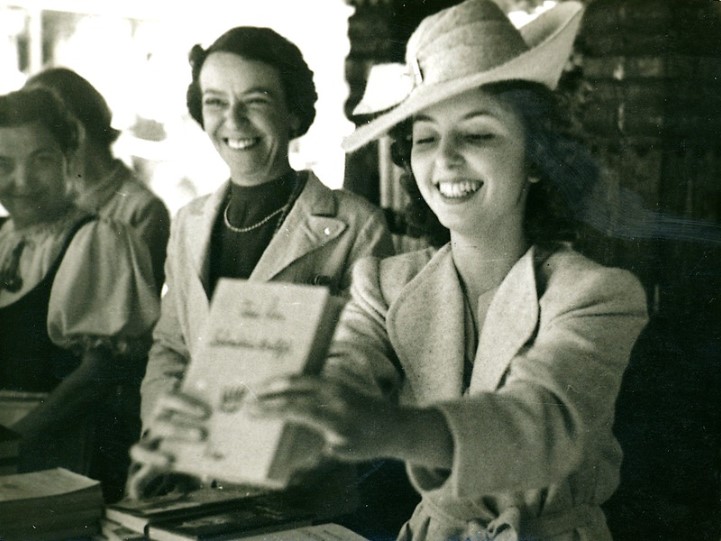
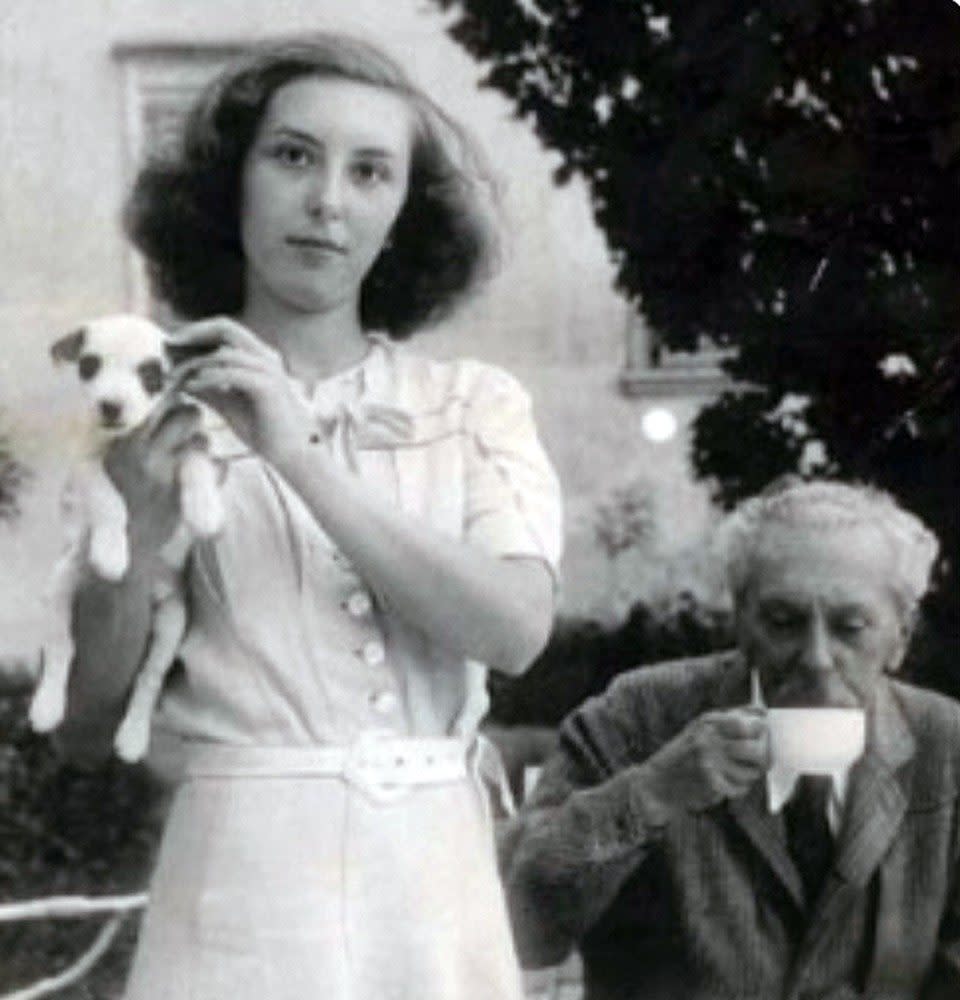
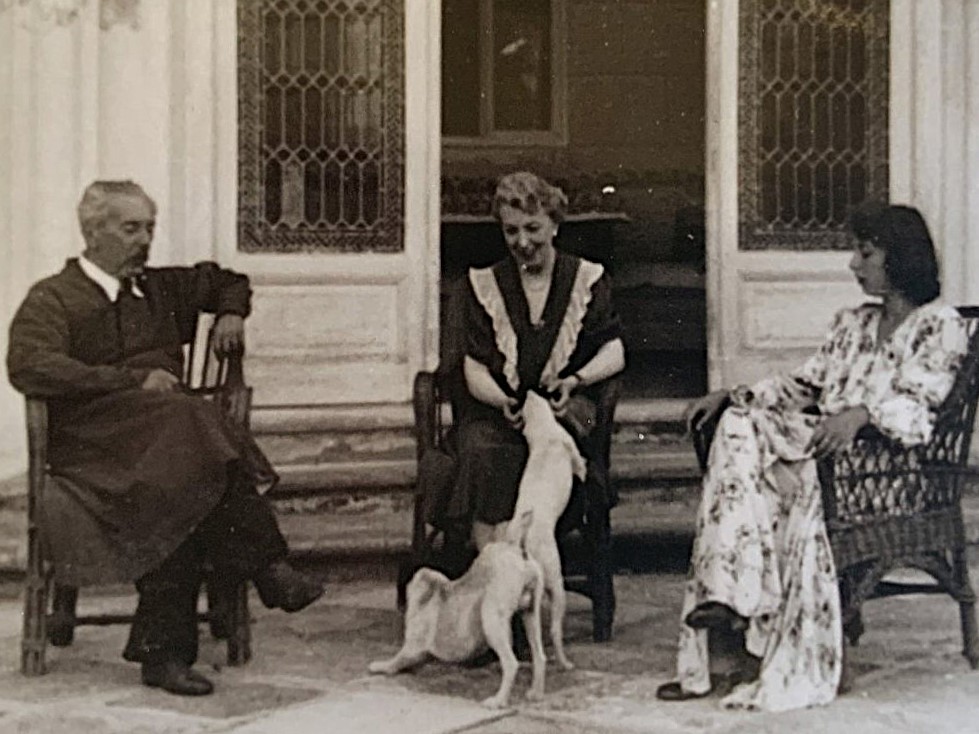
Katalin Bánffy-Jelen, R.I.P.
I have the poet Ben Downing to thank for putting me on to the great Hungarian writer Miklos Banffy. I will always be grateful.
But the one to whom I should be even more grateful is the writer’s daughter Katalin Bánffy-Jelen who died last month, 100 years old.
She, along with Patrick Thursfield (d. 2003), translated the great Transylvanian trilogy from Hungarian into English.
There were obituaries in The Times and the Daily Telegraph.
After the war, Katalin married a US naval officer and they settled in Tangier, still then a free port under a sort of multinational administration.
I wonder if she would have known Fra’ Freddy’s father when he was British delegate to the International Legislative Assembly of Tangier.
Christ Church

Christ Church
Lancaster County, Commonwealth of Virginia
Nonetheless, this gem of the American Georgian building arts — designed by an unknown hand — is an almost miraculous survival.
It was built 1732-35 by Col. Robert “King” Carter, the planter and merchant lord who served as Speaker of the House of Burgesses, President of Virginia’s Privy Council (the Governor’s Council or Council of State), and eventually Acting Governor of the Dominion.
The regal moniker by which he was known reflected the wealth and power he obtained in the colony, and Christ Church was constructed to serve Carter’s country seat at Corotoman.
The substantial mansion had burned down in 1729 but Carter carried on, living in the dower house of the estate. Such was his wealth that the fire barely featured in his diary, though he much lamented the complete loss of the wine cellar.
Christ Church had no natural parish and the loss of supporting glebe lands after the Church of England was disestablished in Virginia in 1786 removed the main source of funds to maintain the church.
It was only intermittently used during the nineteenth century, but in 1927 the Association for the Preservation of Virginia Antiquities took charge of the site and began restoring Christ Church.
In 1958 that esteemed body erected the Foundation for Historic Christ Church which has devoted its attention and resources to the care of this Georgian treasure ever since.
This work has by no means been limited to architectural preservation: the Foundation promotes scholarly research on the Carters, the world of the Virginia plantations, and every aspect thereof, in addition to operating a museum on the site to explain Christ Church to visitors and travellers.
Thanks to the efforts of Edmund Berkeley Jr (1937-2020) — who carried on the work of his uncle Francis L. Berkeley (1911-2003) on Virginia’s colonial papers — the surviving diary, correspondence, and papers of “King” Carter are now in the care of the Historic Christ Church museum.
Most importantly, God is still worshipped in some form at Christ Church: the Episcopalian congregation in Kilmarnock, Va., holds Sunday morning services here from June through September according to ‘Rite One’ of the Protestant Episcopal Church’s Book of Common Prayer.
The church is best approached through the simple avenue of cedar trees that leads the visitor straight to Christ Church’s west door.

It looks particularly cozy in winter.

and Michael Kotrady via Wikimedia Commons (modified).

Gellner’s Prague

He was Professor of Philosophy, Logic, and Scientific Method at the London School of Economics before heading to Cambridge to become the William Wyse Professor of Social Anthropology. With the Velvet Revolution and the fall of communism, Gellner returned to his native Prague as head of the new Centre for the Study of Nationalism there.
Gellner had many intellectual enemies — proponents of linguistic philosophy, Western Marxists, the post-colonialist offspring of Edward Saïd — but his hard-hitting attacks on them were often tempered by good humour and a skilful ability to tell a joke that only further infuriated his opponents.
The sociologist David Glass once said that he wasn’t sure whether the next revolution would come from the right or from the left, but he was quite sure that wherever it came from the first person to be shot would be Ernest Gellner.
Despite living most of life in exile, Gellner was above all a child of old Prague. Professor Stefan Collini explored the professor’s background in Bohemia in the LRB:
His parents were assimilated German-speaking Jews, Habsburg subjects before 1919, and thereafter citizens of the new state of Czechoslovakia (where it seemed wise to speak Czech, at least in public).
Prague in the interwar years was cosmopolitan even by the standards of Central Europe: alongside Czech schools, it could boast German gymnasia, Russian and French lycées, and an English grammar school.
It was to the last that his parents sent the nine-year-old Ernest in 1935, perhaps prudently preparing for a time when they would have to flee mainland Europe. They almost left it too late; they were fortunate to make it to England in April 1939, eventually settling in Highgate.
Gellner’s parents were representative of that stratum of educated, middle-class Jews who, profoundly grateful to Britain for providing them with a home, nonetheless continued throughout the war to speak to each other in the language of the now hated enemy.

Before his 1995 death, Gellner was interviewed by John Davis for the February 1991 issue of Current Anthropology.
In the exchange, he touched upon his relationship with Prague, the “Crown of the Realm”.
EAG: My family lived in Prague, and we were deeply urban, yes.
JD: Was Prague particularly anti-Semitic?
EAG: Yes. Very openly so in the working class, nauncé elsewhere.
This was Kafka’s Prague: tricultural, with two universities, a Czech and a German. The German university was very, very distinguished and had at one time Carnap and Einstein and so on, and of course benefited from Hitler by the influx of scholars. Two universities and three cultures and ethnic tension was certainly very emphatically part of it. I mean: if you are asking me whether this was a crucial part of my environment in Prague, then the answer is yes.
It’s a stunningly beautiful town, and during the first period of my exile, which was during the war, I constantly used to dream about it, in the literal sense: it was a strong longing. We came to England in 1939 after the German occupation of Prague.

EAG: One of my main recollections of Prague in ’45 was a communist poster saying “everyone with a clean shield into the Party,” that is, everyone whose record was good during the Occupation.
It meant in reality exactly the opposite: “If your shield is absolutely filthy we’ll scrub it for you; you are safe with us; we like you the better because the filthier your record the more we have a hold on you.” So all the bastards, all the distinctive authoritarian personalities, rapidly went into the Party, and it rapidly acquired this kind of character.
So what was coming was totally clear to me, and it cured me of the emotional hold which Prague had previously had over me. I could foresee that a Stalinoid dictatorship was due: it came in ’48. The precise date I couldn’t foresee, but that it was due to come was absolutely obvious for various reasons.
Above all, in ’45 the Czechs expelled 3,000,000 Germans with considerable brutality. I think the estimate of the number of killed in the process was 200,000 thought I don’t know how reliable that is. And at the same time everyone was scared stiff of the Germans and remembered Munich, so they handed themselves bound and helpless to Stalin as the only protection against the German revanchism which they confidently expected at the time.
They don’t expect it now, interestingly enough; but they did then. All this occurred in conjunction with the quite skilful communist exploitation of the situation. And I wanted no part of it and got out as quickly as I could and forgot about it.

The Secret Chapel of Harkness Tower

Yale’s Harkness Tower is, by my estimate, the finest tower in the United States and its designer, James Gamble Rogers, one of the best American architects of his day. JGR is in the Pantheon of his craft, though not quite as highly appreciated as Bertram Grosvenor Goodhue or Ralph Adams Cram.
Harkness Tower is a monument to verticality: from the ground up at each and every stage you expect it could end right there in completeness and beauty — but then it goes another stage higher. Rogers was inspired by the “Boston Stump” of St Botolph’s Church in Lincolnshire but he took that form and creatively expanded and elaborated upon it.
The tower rises 216 feet — one foot for every year Yale existed by the time of its construction.

Yalies – “Elis” – are inveterate founders of drinking clubs which, in order to cultivate a deliberate air of inscrutable mystery, they call “secret societies”, even though many of them are (thankfully) nothing which might rightly be called such.
It was years ago on one of my occasional stays in New Haven for some convivial merriment organised by just such a cabal that my old friend A.B. and I were passing Harkness Tower and I was expounding upon its beauty.
“You know, of course,” A.B. alleged, “it has a secret chapel in it.” I had no such knowledge, and pressed for more information. “Well it’s not quite a chapel, but it feels like one. The university almost never lets anyone use it.”
Universities never do. Once a university has anything, they do their best to stop people using it. (Anyone at Edinburgh University: just try throwing an event in the Raeburn Room in Old College and find out.) (more…)
Season’s Greetings from the Seventh

Alas, the Seventh Regiment Mess is no more, though we had a few family Christmas-time (and other) celebrations there in its final years.
Happy days when Linda MacGregor was at the helm of it.
Articles of Note: 11 November 2024

Caro had been a Nieman Fellow at Harvard studying urban planning and land use when he came up with the idea for the book. He thought it would take him nine months, but extensive research and over five-hundred in-person interviews meant it took eight years to complete.
Caro then started working on his study of Lyndon Baines Johnson, the first volume of which emerged in 1982 and the fifth (and final?) one he is still working on. (At the end of the fourth, LBJ had just become president.)
But where does he write? Christopher Bonanos of New York magazine finds out:
It’s an ageless space, one where it could be last week or 1950 inside, matter-of-fact and utilitarian. A couple of bookcases, a plywood work surface, corkboard with outlines tacked up, an old brass lamp, an underworked laptop for emails, a Smith-Corona typewriter. The desk chair is hard wood with no cushion. There’s a saltshaker next to the pencil cup for when Ina brings a sandwich out at midday. The desk has a big half-moon cutout, same as the one back in New York, so he can rest his weight on his forearms and ease his bad back. That arrangement was recommended by Janet Travell, the doctor who grew famous for prescribing John F. Kennedy his Boston rocker. She, with Ina, is a dedicatee of The Power Broker.
He bought the prefab shack, he says, from a place in Riverhead for $2,300, after a contractor quoted him a comically overstuffed Hamptons price to build one. “Thirty years, and it’s never leaked,” he says. This particular shed was a floor sample, bought because he wanted it delivered right away. The business’s owner demurred. “So I said the following thing, which is always the magic words with people who work: ‘I can’t lose the days.’ She gets up, sort of pads back around the corner, and I hear her calling someone … and she comes back and she says, ‘You can have it tomorrow.’”
Does he write out here every day? “Pretty much every day.” Weekends too? “Yeah.” Does he go out much while he’s on the East End? “We have two friends who live south of the highway, and I said to Ina, aside from them, I’m not going this year.” There are other writer friends nearby in Sag Harbor, and they get together, but at this age, Caro admits a little sadly, they’re thinning out. He’ll be 89 this fall.
■ George Grant is a still-underappreciated giant of political thinking in the English-speaking world. He is too little known outside his native Canada, which he sought to defend from the undue overwhelming influence of its sparkling and glamourous southern neighbour. Next year marks the sixtieth anniversary of his Lament for a Nation.
Of all people, a research fellow at Communist China’s Institute for the Marxist Study of Religion — George Dunn — has written a thoughtful introductory overview of Grant’s life and thinking: George Grant and Conservative Social Democracy in Compact.
■ Katja Hoyer mused on an overlapping theme in a recent Berliner Zeitung column which she has helpfully presented in English as well:
A diplomat close to the SPD recently told me that he couldn’t understand why working-class people in particular voted for the AfD. Things weren’t so bad for them, after all. I didn’t bother pointing out that rampant inflation, high energy prices and rising rents have had a hugely detrimental effect on the living standards of people with low and middle incomes because his analysis completely misses the point.
Germany’s working-class voters, Katja argues, feel forgotten by the parties founded to represent them.
■ Since the fall of the Berlin Wall — and earlier in Angledom — political conservatism has effectively been taken over by economic liberalism.
This has denied the centre-right from learning from and deploying useful experience from outside liberalism, with the wisdom of figures as varied as Benjamin Disraeli, Giorgio La Pira, Charles de Gaulle, and Thomas Playford essentially ignored or sidelined.
Kit Kowol’s new book Blue Jerusalem: British Conservatism, Winston Churchill, and the Second World War explores the visionary side of wartime Conservatism. Dr Francis Young offers his take on Tory utopias in The Critic.
■ From a similar era, Andrew Ehrhardt writes at Engelsberg Ideas on Ernest Bevin and the moral-spiritual dimension of British foreign policy.
■ Our friend Samuel Rubinstein has studied at Oxford, Leiden, and the Sorbonne — technically the oldest universities in their three respective countries (although we all know that Leuven is in fact the doyen of Netherlandish academies).
Sam offers an incredibly interesting comparison of the experiences of these three institutions in a humble essay on his Odyssean education:
I arrived in Leiden, armed with my phrase-book, with some ambitions of learning Dutch. The first blow came at the Starbucks in the train station, when the barista answered my Ik wil graag in English without hesitating. The second came the following day when I tried again, at a different café – only this time it seemed that the barista (Spanish? Italian?) didn’t know much Dutch either: even the natives were placing their orders in English. So I gave up – save one hobby, reading Huizinga in the original. I got myself an attractive coffee-table edition of Herfsttij and managed a page or so a day, strenuously piecing it together from my English, German, and smattering of Old English. I still haven’t the faintest idea how to pronounce any of it.
■ And finally, those of us who love Transylvania will enjoy Toby Guise’s summary of the Fifth Transylvanian Book Festival in The New Criterion.
The Lithe Efficiency of the Old Constitution
There is a wonderful glimpse of the old days in the memoirs of the late Lord Waddington (1929-2017).
David Waddington was a Lancashire man who became a lawyer, Member of Parliament, Government Chief Whip, Home Secretary, peer of the realm, and eventually Governor of Bermuda. (In that final role, he was the last of the big dogs — all the ones since have been civil servants.)
The old British constitution — before New Labour’s ill-judged reforms — had a lithe efficiency in those days aptly reflected in quite how few people were employed by the highest court in the realm — and how unfussedly they were officed:
I had only been in the House for two days when I received a telephone call from the clerk of my Manchester chambers asking me if later in the week I was prepared to sit as a deputy County Court judge somewhere in London. This would allow my colleague Bob Hardy, who had contracted with the Lord Chancellor’s Department, to sit as a judge on that day, to take over a brief of mine, a libel action in Leeds.
At the eleventh hour someone pointed out that if I were to sit, my career as an MP would come to an abrupt end because as a result of the House of Commons Disqualification Act I would have disqualified myself from membership of the House, thereby precipitating another by-election. I was then begged by Bob to go and explain to the lady in the Lord Chancellor’s Department why he could not sit and why I had turned out to be an inappropriate replacement.
I set off and, after journeying along many corridors and ascending and descending many staircases, I eventually found a little old lady sitting alone in a tiny office at the bottom of a gloomy stairwell somewhere in the bowels of the House of Lords.
I apologised for troubling her and she said: ‘I can assure you it is no trouble. In fact I am delighted to see you. I have been in this office for thirty-five years and you are the first person who has ever visited me.’
Articles of Note: 17 September 2024

31½ in. x 59 in.; (link)
The Lebanese banker, writer, journalist, and politician Michel Chiha postulated that Beirut was “the axis of a three-pronged propeller: Africa, Asia and Europe”.
The city’s current airport was inaugurated in 1954, towards the height of its golden years.
In L’Orient-Le Jour, Lyana Alameddine and Soulayma Mardam-Bey report on how Beirut Airport’s story reflects the highs and lows of Lebanon’s history. (Aussi en français.)
■ Another one bites the dust: this time it’s London’s Evening Standard — traditionally the most London of London’s daily newspapers — which recently announced it will move to a single weekly printed edition.
In its heyday there were several editions per day, with “West End Final” on rare occasions topped up by a “News Extra” edition.
Stuart Kuttner, a veteran of the Standard, wrote a beautiful paean to the paper published in the Press Gazette.
■ Samuel Rubinstein shows how historians’ war of words over the legacy of the British Empire tells us more about the moral battles of today than shedding actual light on the past.
■ Wessie du Toit explores the curious columnar classicism persistent across the full spectrum of South African architecture.
■ With union presidents speaking at America’s Republic party convention, Senator Josh Hawley explores the promise of pro-labour conservatism.
■ Also at the increasingly indispensible Compact, Pablo Touzon explores how the Argentine left created Javier Milei.
■ Closer to home, Guy Dampier argues that Britain’s public services, housing, and infrastructure have reached their migration breaking point and the new Government has zero solutions.
■ Meanwhile, five hundred academics have signed a joint letter urging the Labour government not to scrap university free speech laws as the Education Secretary announced they will do.
11½ in. x 16½ in.; (link)
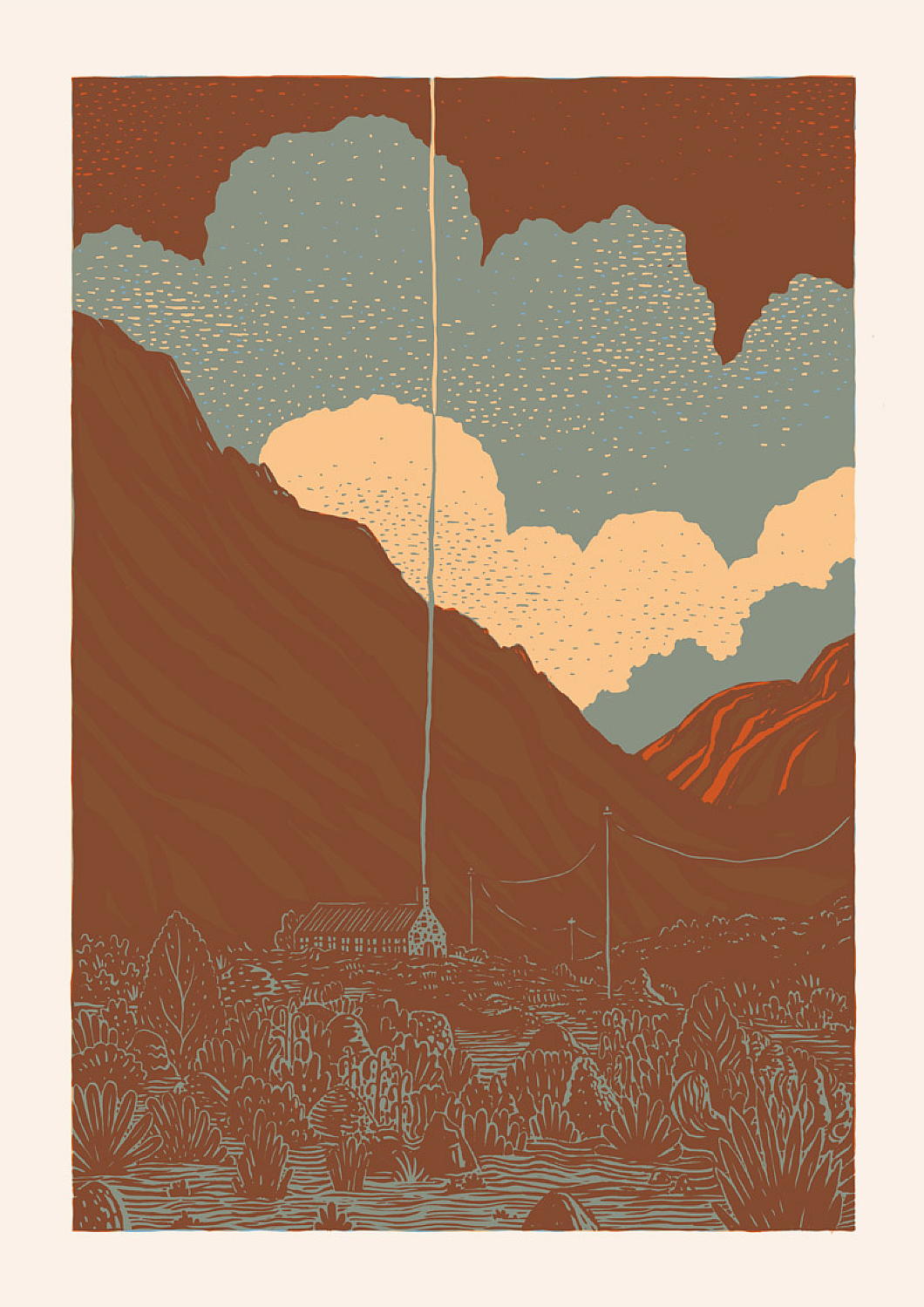
Search
Instagram: @andcusack
Click here for my Instagram photos.Most Recent Posts
- West Point July 30, 2026
- Brunel’s Unbuilt Capitol February 3, 2026
- Cricket at Fordham January 27, 2026
- Palacio Barolo Revisted January 14, 2026
- Learning to Love Liguria January 14, 2026
Most Recent Comments
Book Wishlist
Monthly Archives
Categories