Errant Thoughts
About Andrew Cusack
 Writer, web designer, etc.; born in New York; educated in Argentina, Scotland, and South Africa; now based in London.
 read more
News
Blogs
Reviews & Periodicals
Arts & Design
World
France
Mitteleuropa
Knickerbockers
Argentina
The Levant
Africa
Cape of Good Hope
Netherlands
Scandinavia
Québec
India
Muscovy
Germany
Academica

dot Scot
Since  the decision by ICANN, the mysterious council of elders whose nomenclatory dominion spans, it seems, the entirety of the “world wide web”, to designate .cat as the “sponsored Top-Level Domain” of the Catalonian linguistic and cultural community, much speculation has arisen in various sub-statal lands throughout the world about future TLDs. In our favoured realm of Scotland, a campaign has arisen for .scot to be designated the TLD for Scotland. While I wholeheartedly support the campaign for a Scottish TLD, I have already expressed my reservations about the increasing size (not number) of TLDs. The traditional country-code TLDs are all two-letter combinations, and any new TLDs representing geographic entities ought to stick to this restraint.
But then what would Scotland’s top-level domain be? .sl is taken by Sierra Leone, while .sc belongs to the Seychelles, and .st to São Tomé. We might hark back to the Gaelic with .al for Alba, except that it’s already occupied by Albania. Ah! Caledonia! How about .cd? Nope, that belongs to the Congo. Blast. It might be necessary to go to three letters then, which brings us either to .sco or .sct. Neither look all that attractive, though .sco has the advantage of being pronounceable. Actually, .sco is quite imaginable, when spoken: parliament.gov.sco, fifeherald.sco, glenfiddich.sco. It just doesn’t look right. .scot looks better, but the rhyming nature of “dot scot” is irritating to say aloud.
I do wish they’d make .gb available again. I’d much rather be a “gee-bee” than a “yoo-kay”. Great Britain is a natural entity, after all, whereas the United Kingdom is a government construct. Perhaps if the Union is re-negotiated, we might move from .uk to .gb, just as .yu was changed to .cs when Yugoslavia was renamed Serbia & Montenegro. (The two split not long afterwards, and went for .rs and .me).
With four letters, at least .scot is not the longest proposed top-level domain. Some ninny thinks there should be a .quebec — how cumbersome! .qu would be much better, and one can just imagine the Québécois pronouncing it. Other British proposals include .eng for England and .cym for Wales. “Norn Iron” loses out, as .ni belongs to Nicaragua, but .ul or .uls are conceivable for Ulster. Perhaps the Vatican could dole out .sre — Sancta Romana Ecclesia — for ecclesiastical domains.
Growing with Responsibility
THERE WAS MUCH debate in the better tea-drinking circles of New York in June when the sixteen-year-old Californian sailor Abby Sunderland had to be rescued by French fishermen in the Indian Ocean during her attempt to be the youngest person to circumnavigate the globe single-handedly. The main concern among my fellow tea-drinkers was trying to locate philosophically the appropriate dividing line between parents enforcing a proper level of safety for their own children and encouraging the appropriate spirit of adventure & human endeavour. The Dutch girl Laura Dekker, two years younger than Miss Sunderland, is now going to go for it herself and, like the California youth, was born into a sailing family.
Peter Hitchens wades gently into the debate in his latest Mail on Sunday column with these thoughts:
Good luck to Laura Dekker, the 14-year-old Dutch girl who wants to sail round the world on her own. Laura was born on a yacht, had her own boat by the time she was six, and began sailing alone when she was ten. How I envy her. The last time I tried to sail alone, I was clinging to the wreckage within five minutes.
The efforts of the authorities to stop her were obviously motivated by reasonable concern. Imagine what the British state would have done. But children can do so much more than we think they can, and grow with responsibility. Once, this attitude was common. Does anyone now read Arthur Ransome’s Swallows and Amazons, in which the children’s father is asked for his permission for the youngest to sail unsupervised, and replies in a telegram ‘If not duffers, won’t drown. Better drowned than duffers’.
In a later book, the wonderful We Didn’t Mean To Go To Sea, the same children unintentionally sail across the North Sea to Holland, when they accidentally slip anchor. They arrive safely, entirely because they have been trusted in the past. Someone should send Laura Dekker a copy.
Requiem for Fr. Fitzpatrick
Last night a Requiem Mass was offered for Father Kevin Fitzpatrick, who died two years before on July 27, 2008. The requiem was offered according to the 1962 Missal at the Church of St. Mary in Norwalk, Conn., with music under the skillful direction of David Hughes, the organist & choirmaster at St. Mary’s.
Fr. Fitzpatrick was a giant of a man, with an intelligence and a sense of humour that easily matched his size, and was an easy conversationalist. His library was one of the most enviable collections I have seen (a bibliophile like myself can’t but help wonder what’s become of it). While I couldn’t make it to the Mass yesterday, I’m very happy to see that Fr. Fitzpatrick is being suitably remembered.
Requiem aeternam dona ei, Domine, et lux perpetua luceat ei. Requiescat in pace. Amen.
Curated Secrets Guest Post
For those who didn’t come across it already, I penned a little Bastille Day guest post over at Curated Secrets, the companion blog to Stephen Klimczuk & Gerald Warner’s book Secret Places, Hidden Sanctuaries. The post consists of a brief meandering from Bastille Day to the World Cup to Iberian reactionaries to vexillological conspiracy theories.
While you’re at it, you might want to listen to Gerald Warner being interviewed for Australian radio, a fascinating exchange in which the Much Honoured Laird of Craigenmaddie discourses about topics as varied as the Mount Weather Emergency Operations Center to the Santo Caliz of Valencia.
The Hottentots Holland Capped with Snow
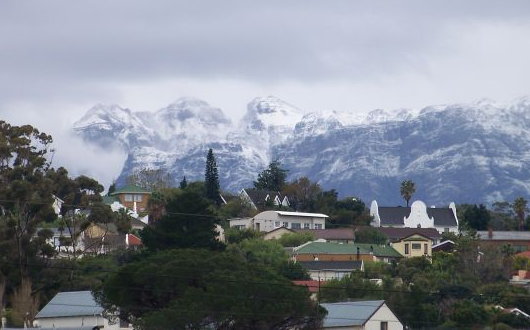
Some World Cup watchers found it slightly incongruous that as they balked in the heat of the northern summer, spectators in the stadiums were bundled up for the cold. It does snow in South Africa, though not every year and usually much less the closer you are to the sea (or rather sea-level). This recent photo distributed by Die Burger shows the Hottentots Holland range, near my former neck of the woods, capped with snow.
Even on days when you can see the mountain peaks topped in white, the temperature closer to the ground still allows you to spend a care-free afternoon relaxing at a vineyard with friends.
Portugal in the 1950s
I felt as if I were going from a noisome prison out into the morning air in the countryside. … After the clangor and tension [of New York], and so many faces taut or ugly or vicious, life in Portugal might be unaffluent but it was still quiet, still kindly, still human. The lack of development and the poverty struck one as a blessing. The absense of advertisers and of mass media men and of vote-catching politicians, bawling out their meretricious wares, was like relief from the presence of the demented.
via R.J. Stove
Aldermania
Matt Alderman, already the subject of his own tag on this site, finally has a website of his own for Matthew Alderman Studios. You can investigate his prints, drawings, ecclesiastical furnishings, and liturgical objects. You can even ‘like’ it on Facebook.
Hup Holland Hup
Laat de leeuw niet in z’n hempie staan
Hup Holland Hup
Trek het beestje geen pantoffels aan
Hup Holland Hup
Laat je uit het veld niet slaan
Want een leeuw op voetbalschoenen,
kan de hele wereld aan
Want een leeuw op voetbalschoenen,
kan de hele wereld aan.
Don’t let the lion stand in his undershirt
Go Holland Go
Don’t make the beast wear his slippers
Go Holland Go
Don’t get played off the field
Because a lion wearing football shoes
Can take on the whole word.
Because a lion wearing football shoes
Can take on the whole word.
Interesting Things Elsewhere
Copernicus re-buried: an interesting but misleading story
Phil Lawler | catholicculture.org
 An interesting AP story is making the rounds this week, reporting that the Catholic Church has finally given due honors to Copernicus. Unfortunately the story is chock-full of statements that are severely misleading if not downright wrong. Start with the opening sentence… read more
Britannia still rules the waves
Rian Malan | The Daily Telegraph
Natal was founded in the early 1840s by Sir Benjamin d’Urban on a stretch of elephant-infested bush. Some would say d’Urban stole the land from the Zulu kingdom, but the occupiers of record in 1843 were Boer Voortrekkers, who reloaded their ox wagons and headed back into the wild interior rather than submit to Queen Victoria. English-speaking Natalians heaved a sigh of relief and proceeded to turn their territory into a shrine to straight bats, and stiff upper lips. read more
Sarkozy’s arch rival Dominique de Villepin sets up rival party
conservativehome
 Dominique de Villepin, the eloquent opponent of the Iraq war and leader of the anti-Sarkozist centre-right in France, has set up a new political movement to bring the French right back to its sense. De Villepin used the launch to attack France’s involvement in the Afghan debacle, and Sarkozy’s decision to bring France back into the NATO military structure. ConservativeHome’s International section writes about the new movement with a sceptical eye. read more
Amadeo Guillet
Obituary | The Daily Telegraph
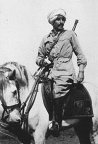 Daybreak on January 21, 1941: 250 horsemen erupted through the morning mist at Keru, cut through the 4/11th Sikhs, flanked the armoured cars of Skinner’s Horse and then galloped straight towards British brigade headquarters and the 25-pound artillery. At a distance of 25 yards they fired, cutting swathes through the galloping horses but also causing mayhem as the shells exploded amid the Sikhs and Skinner’s Horse. After a few more seconds the horsemen disappeared into the network of wadis that criss-crossed the Sudan-Eritrean lowlands. read more
Are Czechs the least religious of all?
Dana Hamplová | guardian.co.uk
This claim is usually based on the sociological surveys and census data which show that only a small proportion of Czechs goes regularly to church and that most of the Czech Republic’s population does not report even a formal affiliation to any church. But the idea that Czechs are almost completely indifferent to any religion is not accurate. read more
Happy Dominion Day
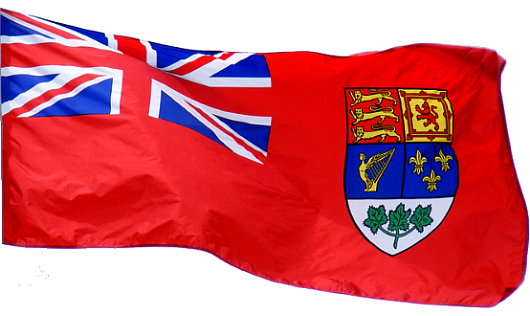
fête du Dominion
à nos voisins du nord.
Dominion Day
to our neighbours to the north.
In a Westchester auction house
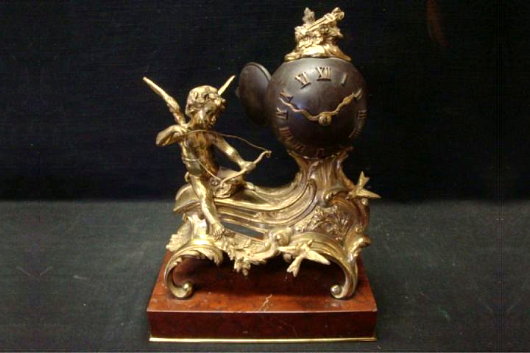
Saturday I popped in to have a friendly chat with Paterfamilias Gill, of which the usual topic of conversation is the decline of civilisation and the amusing side effects thereof. We had reached Afghanistan when Mrs. Gill eventually joined us, and, after showing me the latest addition to the Gill collection (a splendid maritime scene by William Edward Norton), Mr. Gill suggested an expedition to the auction house down a back alley in neighbouring Larchmont, and I happily agreed.
Above is a gilt bronze and patinated metal clock in the French style. I’m rather fond of the curvature of spherical clockfaces, and the serpentine hands are a nice detail as well. This clock would fit in at 15 East Ninety-sixth Street. Estimate of $800-$1,000. (more…)
Three for the Army
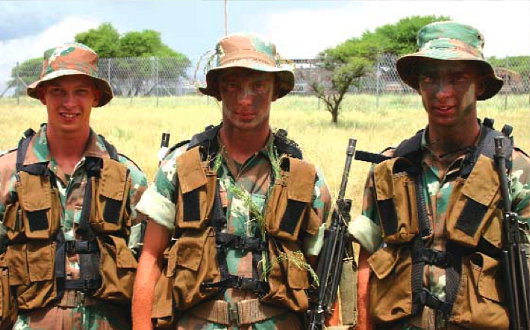
Something you don’t see every day: a set of triplets from Pretoria recently completed basic training as part of their enlistment in the South African Army. Dirk van Zyl, Tjaart van Zyl, and Hendrik van Zyl (above, left-to-right) are 20 years old and got their mechanical engineering qualifications before enlisting in the Defence Force.
The three brothers are all part of Foxtrot Company, 3 South African Infantry Battalion based at Kimberley in the Northern Cape; Hendrik in Platoon 1, Tjaart in Platoon 2, and Dirk in Platoon 3.
Large-scale operational deployments of the South African military have been few and far between since the country withdrew from the Angolan conflict and granted Namibia independence. Since then they have mostly consisted of United Nations and African Union peacekeeping operations, as well as other endeavours such as South Africa’s 1998 military intervention in a dynastic dispute in the neighbouring Catholic monarchy of Lesotho. Current defence regulations prevent siblings like the van Zyl brothers from being operationally deployed simultaneously.
Carbuncle Alert in Queens

Our carbuncle alarm, which went haywire over the Brooklyn Museum’s offensive new entrance, has alerted us to a new monstrosity nearing completion in the adjacent borough. (more…)
München: mees bewoonbare stad
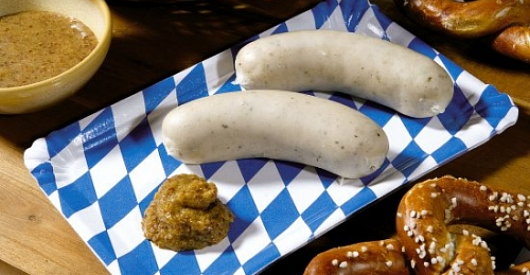
Hoeveel kere het ek dit hoor sê? München, die Beierse hoofstad, is die mees bewoonbare stad in die wêreld volgens baie lyste deur talle mense saamgestel. Die meeste kenmerk hierdie status aan die unieke kombinasie van tradisie en moderniteit in die stad. Beiere het ’n balans getref, en die Beierse mense is baie trots op hul land — en tereg! Müncher weißwurst — bedien met mosterd en ’n krakeling — is my gunsteling wors. (Jammer, boerewors! Jou Duitse neef is tops.)
In elk geval, op die webtuis van Monocle tydskrif, Tyler Brûlé het ‘n blik op München en ondersoek waarom en ondersoek waarom het dit so ‘n goeie reputasie. Kliek hier om te kyk.
It is scandalous that in all my travels I’ve never been to any part of Germany, let alone Bavaria, considering how everyone raves about it unceasingly. Once I finally get myself to the other side of the pond permanently, it’s high up on the list of places to visit pronto (alongside the Netherlands and Finland). All in good time, all in good time…
The World Cup Preserves Something America is Losing
The drama of sport is being systematically attacked by the bloated American Pro-Sports-Statistical-Media Complex. I can name for you three specific ways that this is happening, but there are doubtless more. First, a universal obsession with statistics. A common criticism of American culture is that it is so technological and empirical that you can’t say anything without backing it with numbers. But I have come to the darker conclusion that most sports broadcasters talk about numbers only because they have nothing else to say. I really don’t care, I really think it is meaningless, that the Chiefs have not succeeded in making a two-point conversion during the third quarter of a post-season game in the last five years. The quintessence of this obsession was illustrated this week by Bob Ley of ESPN, in the halftime analysis during the Argentina-Nigeria World Cup match. “The last time Argentina gave up a halftime lead was in the 1930 World Cup,” he said. “It just doesn’t happen.” This baffled the Spaniard Roberto Martinez, an ESPN commentator and former professional soccer player, who responded: “That was a different team, Bob.” Sports teach us that the possible is greater than the probable; statistics applied to sports is probability’s revenge on possibility.
The second destructive force is the delusion of the Instant Replay. We appeal to the camera when we become afraid of the human element in sport. We think that the precision and justice that the replay can provide for us will defuse the pain that is intrinsic to any competitive sport. In games we see that the best-trained can’t always play their best, and that those with the best eyes don’t always make the right call; the imprecision and the deficiency are also elements in the drama. The Instant Replay is an attempt to quell the drama, as if sports would be better without it. All it actually does is stir confusion about what a game really is, and every time we interrupt a game to watch a video, we strike a blow at the soul that keeps the game moving.
Interruptions, also, are what television commercials are. That basketball and [American] football are structured in such a way as to accommodate for television commercials is a scandal. Who enjoys watching “The Godfather Part II” when it is sliced and diced by ads for sitcoms and acne medication? The interruptions wake us up from the dream of the drama; basketball and football lose something in this constant interruption.
All of this may sound bleak, but the answer to it is flickering in a billion television screens worldwide this month. As we watch the World Cup this summer, we should be conscious that we are witnessing a sport that is resisting. It resists, if nothing else, the tyranny of television commercials. No commercials interrupt the 45 minute flow of a half of soccer—there are no “TV time outs.” The narrative builds and is resolved within continuous time, and it demands that we reclaim the patience and the attention spans most of my generation lost sometime in the late 1990s.
Moreover, even though every now and then somebody within FIFA complains that Instant Replay should be introduced into the game, most fans accept that the game includes injustices. We suffer through them, and we play again the next day. Geoff Hurst scored a “goal” for England in the 1966 Final which actually did not cross the line. Maradona scored a “goal” with his hand against England in the quarterfinals of 1986 (he attributed it to God; five minutes later, he scored the greatest goal in World Cup history). France would not be in the World Cup this year, and Ireland would be, had Thierry Henry not handled the ball during a qualifying match. What can you do? Better to make a sacrifice than to kill the sport.
As for statistics—American soccer broadcasters, too, are beholden to them. But one could always learn Spanish and switch to Univision.
The World Cup this year has its own set of stories which will congeal into the dramatic. The Brazilian squad has betrayed its principles of jogo bonito (beautiful play) and has adopted a pragmatic approach which yields victories without flair. Ironically, the German side looks more playful and creative in attack than Brazil does. Lionel Messi of Argentina will be trying to live up to his reputation of being the greatest Argentine player since Maradona. And there is a tough Paraguayan side you will not want to miss.
Most importantly, there is a drama that you will not want to miss—one that retains certain human elements which are besieged in our hyperactive media age.
Holland in die Kaap
’n Groep van Nederlanders in die Kaap het hulle Volkswagen Beetle in die Hollandse patriotiese kleure geverf om hul steun in die Sokkerwêreldbeker te vertoon en hul het hierdie vrolike YouTube video gemaak ook. (Hulle blog, in Nederlands, is 34 graden Zuid).
Watter span steun ek? Ach, baie! Teen Engeland, het ek die Verenigde State gesteun (maar ek haat die “Anyone-But-England” houding van baie in die Britse Eilande buite Engeland). Teen Duitsland, het ek die Aussies gesteun. En natuurlik al die Maties moet BAFANA BAFANA steun!
So vir groepe A-H (onderskeidelik) ons is vir Suid-Afrika, Argentinië, die VSA (of Engeland), Australië, Nederland, Nieu-Seeland, niemand in groep G, en Chili.
An “Unknown Delegate”?!?!?
It’s Bilderberg 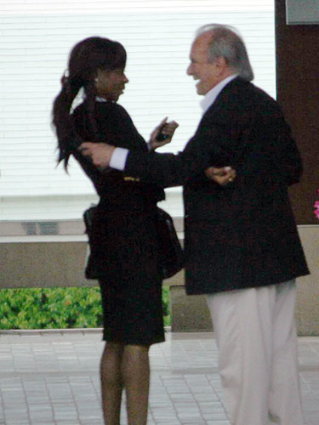 season again, which normally has all the conspiracy theorists this side of Roswell up in a flurry. This year, however, the organisers have cheated by having a website and even a press release concerning the proceedings. The Guardian has a photo gallery of the various guests arriving, mostly attired in the tiresome suit-but-no-tie combination which has become all too prevalent of late.
The super-trendy left-wing newspaper, however, demonstrates its typically Euro-centric mindset through its caption for this photo: “Francisco Pinto Balsemão, a former prime minister of Portugal and the CEO of Impresa, says goodbye to an unknown delegate.” An “unknown delegate”?!?!? That’s no less than Dambisa Moyo, the most famous Zambian in the world (referred to as “our girl” in Zambian newspapers), not to mention author of a New York Times bestseller and African star-of-the-hour for over a year now. Honestly, Mr. Guardian!
4 de Junio
On June 4, 1943, 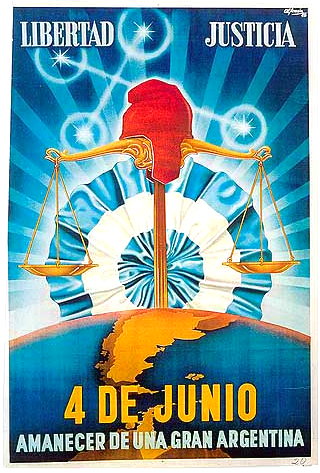 a murky group of Argentine military officers called the GOU (standing for United Officers’ Group, or Government, Order, Unity) overthrew President Ramon Castillo and ended the Década Infame, or ‘Infamous Decade’ that had begun with the 1930 coup against Hipólito Yrigoyen. The ’43 coup was led by General Arturo Rawson, who served as President of Argentina for a month before being replaced by the more politically minded Gen. Pedro Ramírez.
Ramírez sympathised with the Axis powers in the Second World War, and his inability to successfully maintain Argentina’s neutrality in the face of U.S. pressure led to his resignation and succession by Gen. Edelmiro Farrell, who was viewed by most as the instrument of his charismatic junior, the infamous Col. Juan Perón (with whom we are all too familiar).
This poster produced by the junta incorporates a number of the symbols of Argentine patriotism and nationalism. ‘Liberty’ and ‘Justice’ are proclaimed the principles of the junta, and underneath the date of the coup is announced the ‘Dawn of a Greater Argentina’. The Phrygian cap of liberty, a frequent Argentine emblem, rests atop the scales of justice while the stars of the Southern Cross imply a divine favour over the new regime.
The map of Argentina coloured in yellow includes the British colony of the Falkland Islands and Antártida Argentina, the Argentine Republic’s claimed possession on the Antarctic continent (which overlaps with competing claims by Chile and the United Kingdom). Behind the whole composition, the Argentine Cockade looms ascendant like a rising sun, affirming the text’s proclamation of a new dawn under the nationalist-revolutionary regime.
The TLS Online
I hope that one byproduct of the Times of London moving to a new website is that the Times Literary Supplement will finally get one of its own. Other Times spinoffs like Times Higher Education and the Times Education Supplement have them, so why not the jewel in the crown?
Also, I’d hate to see my pedantic letter to the editor of October 1, 2008 available only to paying subscribers (see here, scroll down to ‘Banking’, and ignore erroneous spacing).
Come on, TLS. If the LRB can do it, so can you.
Search
Instagram: @andcusack
Click here for my Instagram photos.Most Recent Posts
- West Point July 30, 2026
- Brunel’s Unbuilt Capitol February 3, 2026
- Cricket at Fordham January 27, 2026
- Palacio Barolo Revisted January 14, 2026
- Learning to Love Liguria January 14, 2026
Most Recent Comments
Book Wishlist
Monthly Archives
Categories