Errant Thoughts
About Andrew Cusack
 Writer, web designer, etc.; born in New York; educated in Argentina, Scotland, and South Africa; now based in London.
 read more
News
Blogs
Reviews & Periodicals
Arts & Design
World
France
Mitteleuropa
Knickerbockers
Argentina
The Levant
Africa
Cape of Good Hope
Netherlands
Scandinavia
Québec
India
Muscovy
Germany
Academica
Popping in to the Yale Daily News
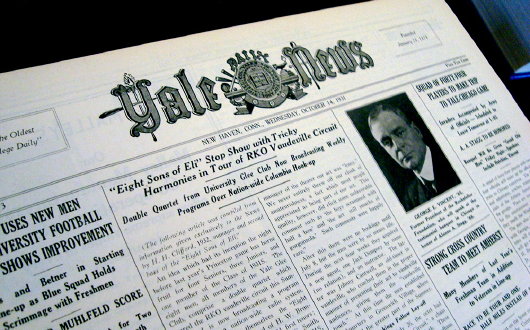
With a bit of time to spare between the rugby match and dinner, we discovered a friend of ours was exploring the newly renovated headquarters of the Yale Daily News and were invited to join in. The handsome gothic structure is now overshadowed by an ugly extension to the previously ugly Yale School of Architecture, widely believed to be the ugliest building in town. Henry Luce paid for the YDN building out of his own pocket in memory of his Yale classmate Briton Hadden, who died just 31 years old. The place went up in 1932 and underwent a multi-million-dollar renovation over the summer, and the place was looking good. (more…)
Dodgy ‘knighthood’ for a dodgy lady
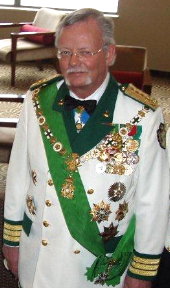
An example of the ‘Lazarus bling’, more medals than you can shake a stick at.
From the blog of John Smeaton we read that the former Irish president (and genial enemy of all that is good and holy) Mary Robinson has received a ‘knighthood’. Last month she was invested as a Dame in the self-styled ‘Order of St. Lazarus’, a fake order of knighthood. The group claims links to the old Order of St. Lazarus of which the last remnants faded away in the 1780s.
The current ‘Order’ was founded as a fake order of knighthood in 1910 by the confidence trickster Jean-Joseph Moser, and has grown by perhaps surprising leaps and bounds in the past few decades, taking into account P. T. Barnum’s famous maxim about a sucker being born every minute. The group has split into various factions and it has become notorious for having members in its ranks who don more metal “bling” than rap stars or Soviet generals.
The so-called Order of St. Lazarus exists throughout Europe and the Spanish- and English-speaking countries abroad, including the United States. The French branch of St. Lazarus was forced by the Grand Chancellor of the Legion of Honour to cease claiming to be an ‘order’, and members of the Order of Malta are forbidden from participating in St. Lazarus’s activities.
“The Order’s pretensions have been strongly condemned by the Holy See as aiming to replace ‘the legitimate forms of chivalric awards’,” according to Guy Stair Sainty, the acknowledged expert on these somewhat arcane affairs. Nonetheless, Guy points out that “supporters of Saint Lazarus include the heads of a handful of great noble families and, over the years, several leading Churchmen and Cardinals”.
“The Order of Saint Lazarus, although it is to be complimented for its considerable charitable efforts (notably in Germany), need not pretend to an historical continuity to which its claims, at the very least, are unsubstantiated,” Guy Stair Sainty concludes. “Were it to assume the character of a private association, founded in 1910, to emulate the traditions of the ancient crusader Order, it could deflect much of the hostility it has attracted… It would be much more successful and be more readily welcomed into the wider community of international humanitarian bodies, however, if it was to permit an honest appraisal of its origins.”
Mexico Week
Over the course of this week our little corner of the web will feature a series of posts relating to Mexico, the great American nation which this year commemorates the two-hundredth anniversary of the beginning of its war of independence. That revolt was begun by a heretic priest, Miguel Hidalgo, under the influence of the contemptible ideas of “the Enlightenment”, but he nonetheless marched under the banner of the Blessed Virgin of Guadalupe, who is venerated to this day as Queen of Mexico and Empress of the Americas. This curious rebel presaged so much of the history of Mexico: rebellion and devotion, religion and irreligion.
Our ‘Mexico Week’ is not intended to give any sanction to rebel priests or violent revolt against legitimate authority, but we instead aim to take this opportunity to display to readers some of the greatness of this brilliant yet troubled nation, oft forgotten due to its rather famous and prominent neighbour to the north.
Growing up in the United States, as I did, Mexico was (and still is) often written off as a place of drug killings and drunk American college students. But digging beneath the surface one easily discovers a Mexico rich in story. ‘Mexico Week’ will by no means be a comprehensive survey of the country, its history, and traditions, but rather a little cabinet of curiosities, a Mexican miscellany if you will.
ora pro nobis!
Burma’s New Flag


Burma Colony (1937–1948)

State of Burma (1943–1945)

Union of Burma (1948–1974)

Socialist Republic of the Union of Burma (1974–1988) and Union of Myanmar (1988–2010)
The military government of Burma (officially ‘Myanmar’) unveiled a new flag for the southeast-Asian country last week. The new design (above) rejects the general form of Burmese national flags since the country was granted independence from Great Britain in 1948, but instead harkens back to the ‘State of Burma’, a puppet regime set up by the Japanese to integrate Burma into their ‘Greater East Asia Co-Prosperity Sphere’.
Somewhat paradoxically, the Minister of Defence in the puppet ‘State of Burma’ was General Aung Sang, the father of Aung Sang Suu Kyi, pro-democracy activist and winner of the Nobel Peace Prize. Aung Sang Suu Kyi is the most prominent leader of the opposition to the military junta that rules Burma, and has spent fourteen of the past twenty years either in jail or under house arrest.
The flag change is part of a transition period devised by the military junta in their attempt to reform the country into a managed democracy that will be less isolated from the rest of the world without threatening the junta’s grasp on power.
Burma became a British possession in 1824, and was made a province of the Empire of India in 1886. In 1937 the province was separated from India, excluding it from the reforms aimed at eventually granting dominion status to the sub-continent but also introducing important reforms for Burma, including an elected assembly with a prime minister. The country saw some of the heaviest fighting during the Second World War, but the forces of the Japanese puppet regime, the ‘State of Burma’ eventually saw the tide turning against the Empire of Japan and switched sides to join the British and Indian armies under Lord Mountbatten.
Fellowes Prynne in Johannesburg
A Rejected Proposal for St. Mary’s Anglican Church
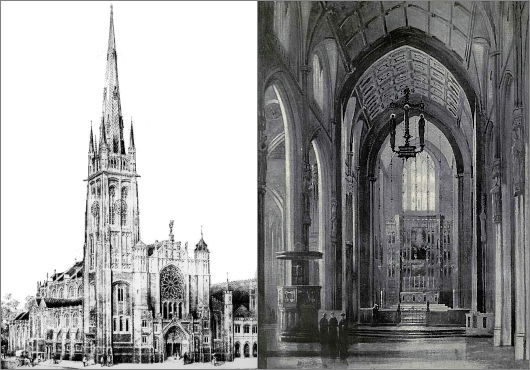
We rarely mention Johannesburg on this little corner of the web because our mother taught us that if you don’t have anything nice to say, don’t say anything at all. While ruffling through the archives the other day, however, I came across this design for the Johannesburg cathedral of the Church of the Province of South Africa. George Halford Fellowes Prynne (1853–1927) was an accomplished Gothic architect whose work is mostly found in the south of England. He’s notable for his rood screens in particular, worked in a variety of forms and materials (wood, stone, and metal), though this design employs a hanging rood. (more…)
Fated
WHETHER Parliament approves “therapeutic cloning” or not, will it make any difference in the long run? Whatever scientists can do, that will be done. Public opinion, at first aghast at artificial insemination and other landmarks on this infernal road, has largely come to accept them. So it is likely to be with this latest triumph.
 “Science has put into our hands innumerable gifts that we can use either for good or ill.” This mantra, once regularly intoned, has become less popular now that many of these gifts are plainly seen to be used for ill.
A new palliative has appeared instead: it says that we must be kept well informed about the latest scientific developments, as well as learning more about science and scientific methods, so that we can decide for ourselves whether we want these gifts or not.
But who are “we”? Would it make any difference if we said we did not want them? Would it make any difference if some scientists themselves decided they were too dangerous to proceed with? Others would somehow, somewhere, carry on the work. The progress of science and technology which has seized upon our world seems irreversible, even fated.
Will it, as in some environmentalist fantasy, gradually diminish in strength and become humanly manageable in a new, green and “sustainable” world? Or will it, as seems more likely, proceed to a catastrophic end?
‘Today It Feels Good to be An African’
I REMEMBER, shortly after President Mbeki’s resignation, conversing with a friend of mine, an Afrikaner vrou more advanced in years & experience than I. In response to my expression of ‘good riddance’ to an administration marked mostly by a detached aloofness and a willingness to abuse the prosecutorial system, this creature of the soil replied calmly, “Ah, but we will learn to miss Mr. Mbeki.” And, while I trust the instincts of Mr. Zuma more than the education of Mr. Mbeki, listening to the 1996 speech in which the latter commended the Constitution Bill to the National Assembly I can at least concede readily the eloquence of the former president.
The excerpt above was produced by South African Tourism, and ably displays the beauty of the country — “the hills and the valleys, the mountains and the glades, the rivers, the deserts, the trees, the flowers, the seas, and the ever changing seasons” as Mr. Mbeki put it — and its people: the riders on Noordhoek strand, the Dutch Reformed predikant, the proud Coloured fisherman, the Xhosa women with their pipes, a Zionist baptism on the shore, the Durban party girls driving down the boulevard. South Africa is a country that sells itself; when it’s bloody, it’s bloody, but when it’s beautiful, it’s beautiful.
Journowatch: Headline vs. Story
In an article about the soon-to-be-canonised Australian nun, Mary McKillop, the Daily Telegraph exhibits a peculiar example of the lows of newspaper journalism today.
The headline boldly states “Australian nun ‘to be made patron saint of abuse victims'” only for the sub-headline — “An Australian nun who will be canonised by the Pope next month should be made the patron saint of clerical sex abuse victims, Catholics have suggested.” — to directly contradict this.
Is Mary McKillop “to be” the patron saint of the abused or has it merely been “suggested”? The headline-writer put the ‘to be’ in quotation marks, but the article doesn’t supply a single quotation or piece of evidence showing this decision has been reached, only a quotation suggesting it would be a wise course of action.
I’ve read numerous examples of newspaper articles offering contradictory facts unreconciled, but to do so before the article has even started seems particularly bizarre.
Six to One Offered Against Xandover
The Late, Lamented Sporting Life, Daily Newspaper of the Queen Mum
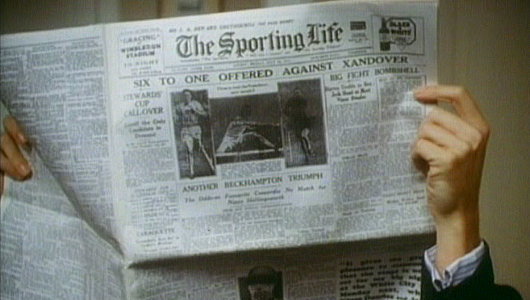
THE MOST FAVOURED daily reading material of the late Queen Mother, The Sporting Life did not survive into the twenty-first century, unlike the beloved former consort (who died 102 years of age in 2002). It was first printed in 1859, but through its 1886 acquisition of Bell’s Life in London, and Sporting Chronicle had a heritage dating back to 1822. Throughout the twentieth century, aside from being the racing newspaper of record, reading it gave a certain connotation of leisureliness, spiviness, or both. By the 1980s, it was thought the Life was getting a bit staid, and it was challenged when Sheikh Mohammed bin Rashid Al Maktoum founded the Racing Post as a daily competitor.
“The advent of the Racing Post in the 1980s was good for the Life,” Jamie Reid wrote after the older journal shut. “The old paper was in danger of becoming tired. What makes the Life’s closure so hard to take is that in the last few years it was better than ever.”
“The Post‘s editorial style was often a bit dry whereas the Life’s top writers… were clearly not good for you at all. They were basted in alcohol, toasted in tobacco and in constant desperate need of a winning tip.”
That the long tradition of The Sporting Life didn’t have to end is one of the more frustrating aspects: it was the Life’s owners, Trinity Mirror, that bought the Post in 1998 and decided to keep the title of the twelve-year-old paper instead of the one with one-hundred-and-forty-nine years of history behind it. Go figure.
Philippe Séguin
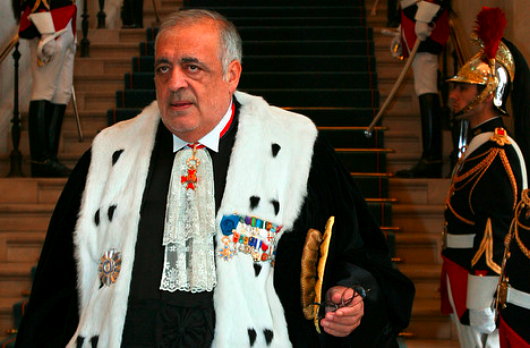
If you can possibly ignore its blood-soaked foundation and its disregard for the freedom of the Church, one can appreciate that the French Republic does republicanism with a dash of pizzazz, as evidenced by the late Philippe Séguin’s official robes as President of the Cour des comptes. Of course, most of this panache it inherited from its intermittent monarchic and (even more so) imperial past. It also inherited from Louis XIV an ever-present spirit of centralisation — the Republic frowns upon the principle of subsidiarity.
Monsieur Séguin was a decent sort. (more…)
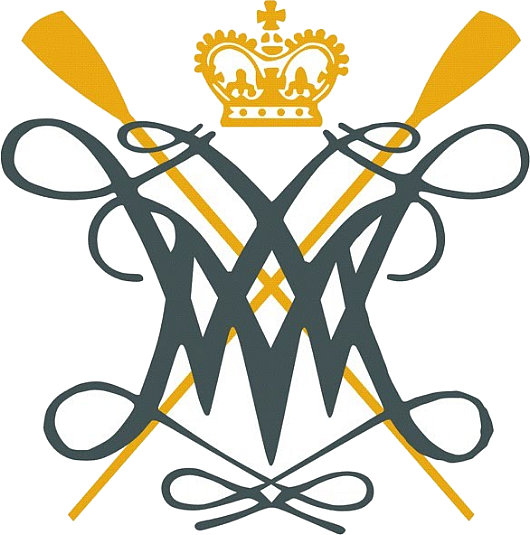
The William & Mary Cypher

In addition to its coat of arms, the College of William & Mary makes good use of the royal cypher of its eponymous monarchs, as seen above, in a version used by the whole university (it is a ‘college’ only in name), and below in a variant used by the William & Mary Rowing Club.
The East Neuk of Fife

THE  EAST NEUK of Fife is one of my favourite little corners of the globe, in what is definitely my favourite country in the world. Here are a set of almost unspoilt little fishing villages with a quite localised architectural style that makes them instantly recognisable. The name of this little regionlet signifies its location as the east ‘nook’ of the Kingdom of Fife, that juts out into the North Sea.
Those concerned for this part of the world might be interested in signing up for the East Neuk of Fife Preservation Society, which has completed admirable work all over the East Neuk, and is currently considering the restoration of the gatehouse of Pittenweem Priory.
When Newspapers Were Newspapers
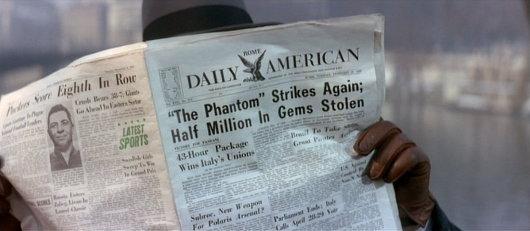
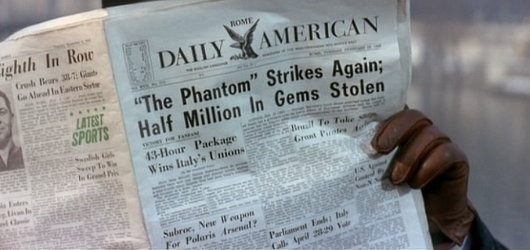
One of the things I enjoy about watching older movies is seeing the newspapers they mocked up for them. “The Pink Panther” (1963) featured this shot of an underworld figure reading the Rome Daily American on a Paris bridge or quayside.
Often these are mockups of newspapers that never existed, but the Rome Daily American was real. A handful of GIs started it in 1945 when the European edition of Stars and Stripes ceased publication. It took the Herald-Tribune two days to reach Rome from Paris in those days, and the CIA held an arms-length 40% stake of the ownership until the 1970s.
The paper was made famous by the 1953 flick Roman Holiday — there was a charming film. Its offices were in the Via di Santa Maria in via, parallel to the Corso, until the paper went bankrupt in 1984.
Follow the Pope’s Visit
What are the best ways of following the Pope’s visit to Great Britain? The official website is offering a live webcast of all events, with highlights from the day interspersed between events. The Daily Telegraph is live-blogging the papal events each day, with frequent updates; today can be found here. The Catholic Herald is also live-blogging the Papal Visit, and updates on today’s events can be found here.
Check catholicherald.co.uk and telegraph.co.uk for more throughout the visit.
The Blitz was Wrong
In his latest column for the Mail on Sunday, the commentator and Orwell Prize winner Peter Hitchens shares his thoughts on the Blitz — the Luftwaffe’s bombing campaign over London that commenced sixty years ago this month. His comments have special relevance given the previous posts on andrewcusack.com regarding the immorality of the Hiroshima & Nagasaki bombings, and likewise of the intentional and deliberate targeting of civilian non-combatants. (more…)
Stellenbosch in the ‘Cyclopædia’
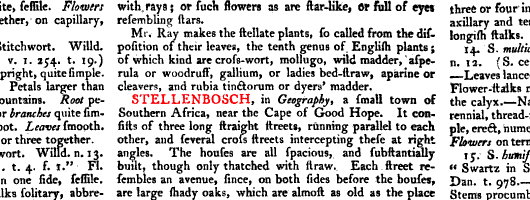
Over at afrikaans.be, Anton Raath posts a verbal snapshot of Stellenbosch in 1819 from ‘The Cyclopædia: or universal dictionary of arts, sciences, and literature’:
STELLENBOSCH, in Geography, a small town of Southern Africa, near the Cape of Good Hope. It consists of three long straight streets, running parallel to each other, and several cross streets intercepting these at right angles. The houses are all spacious, and substantially built, though only thatched with straw.
Each street resembles an avenue, since, on both sides before the houses, are large sturdy oaks, which are almost as old as the place itself, which was built at the beginning of the former century, though it was wholly burnt down in 1710. In December, 1803, a similar accident happened, when the number of houses left standing was about 80. The church was built in 1722, and though not equal in size to the churches of Roodezant and Paarl, it is no way inferior to them in point of architecture.
The number of inhabitants at Stellenbosch, including slaves and Hottentots, is estimated at 1000. Every person in this town carries on, with his trade, some portion of agriculture and horticulture; and as there are none who can be called actually poor, who labour for hire, they are obliged to have slaves, who do not pay the expence of keeping them.
Strangers, who in their long voyages make any stay at the Cape, never fail to visit Stellenbosch; and people of property at the Cape Town also, in the fine season of the year, often make parties of pleasure to this fertile spot. Hence houses are fitted up here for the accommodation and entertainment of strangers.
“Hoe meer dinge verander…” Mnr Raath comments.
Douglas Murray: In Order to Prevent the Use of WMDs, We Must Use WMDs
The slightly camp Old Etonian atheist neo-con Douglas Murray got himself into a bit of trouble recently when he and Baroness Deech unleashed a splenetic rant against Scotland and the Scots on BBC Radio 4. As head of the HFEA, Baroness Deech presided over the deaths of an untold number of humans in the embryonic stage of development, but it turns out that Mr. Murray (who is Scottish-born, curiously) has advocated hypothetical wholesale slaughter.
In 2007, Mr. Murray helped compose Towards a Grand Strategy for an Uncertain World: Renewing Transatlantic Partnership ostensibly written by Gen. Dr. Klaus Naumann (former Bundeswehr Chief of Staff), Gen. Prince John Salikashvili (Georgian prince and former U.S. Chairman of the Joint Chiefs of Staff), Field Marshal the Lord Inge (former U.K. Chief of the General Staff), Adm. Jacques Lanxade (former Chief of the French Navy), and Gen. Henk van den Breemen (accomplished organist and former Chief of Staff of the Dutch military).
This interesting document made a number of recommendations, the most intriguing of which is the suggestion that NATO should be prepared to make a pre-emptive nuclear strike… in order to prevent the use of weapons of mass destruction (“WMDs”) such as, er, nuclear weapons. You read that correctly: in order to prevent the use of WMDs, NATO should be prepared to use WMDs. You couldn’t make it up!
A book review in the Weekly Standard
While my admittedly small work on the Namibian jugendstil was recently published in Catalan, those who are interested in my review of Xander van Eck’s Clandestine Splendor: Paintings for the Catholic Church in the Dutch Republic can read it in the latest edition of the Weekly Standard.
Unfortunately the magazine’s website is mostly behind a paywall, so readers will have to swing by their local newsstand to obtain a copy.
Maine
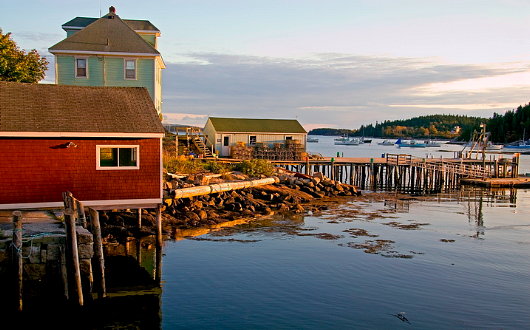
Well, your humble and obedient scribe is retreating to the coast of Maine, whence the defeated loyal men of Berwick fled after suffering defeat at the hands of the wretched Cromwell in the Battle of Dunbar. I am bringing a few friends along, including Mssrs. Trollope, Goethe, Burns, Chesterton, Balzac, von Rezzori, and a Ms. Undset (I am finally more than two-thirds of the way through Kristin Lavransdatter). There may also be a corgi or two. Internet connectivity very sketchy in those parts, though I will see if I can send a pigeon back to Hogarth if any news. (Doubtful it would do any good; the last e-mail I had him send he instinctively translated into dots and dashes — he does remind me of Uncle Otto sometimes).
So I bid you farewell, and you can expect my return in a fortnight’s time, invigorated anew by the salty breeze.
Search
Instagram: @andcusack
Click here for my Instagram photos.Most Recent Posts
- West Point July 30, 2026
- Brunel’s Unbuilt Capitol February 3, 2026
- Cricket at Fordham January 27, 2026
- Palacio Barolo Revisted January 14, 2026
- Learning to Love Liguria January 14, 2026
Most Recent Comments
Book Wishlist
Monthly Archives
Categories