Errant Thoughts
About Andrew Cusack
 Writer, web designer, etc.; born in New York; educated in Argentina, Scotland, and South Africa; now based in London.
 read more
News
Blogs
Reviews & Periodicals
Arts & Design
World
France
Mitteleuropa
Knickerbockers
Argentina
The Levant
Africa
Cape of Good Hope
Netherlands
Scandinavia
Québec
India
Muscovy
Germany
Academica
A Bunny Rampant
The carto-heraldic creativity of MacDonald Gill
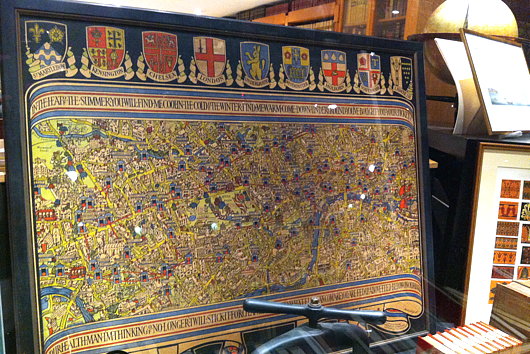
If anything, I am a lover of maps, and as a cartophile it’s a fine thing that I spend half my life in South Kensington. Here you will find two of the best antiquarian map merchants around: the Map House on Beauchamp Place and Robert Frew across from the Oratory and right next door to Orsini. Milling about in front of church after mass today I received a tip-off from a friend suggesting I have a look at the window of Robert Frew, as there was a London Underground map with coats of arms of mostly abolished boroughs.
“Sounds like the sort of thing MacDonald Gill would do,” I said, and sure enough upon investigating earlier tonight it is the work of that inventive designer (and brother of Eric Gill).
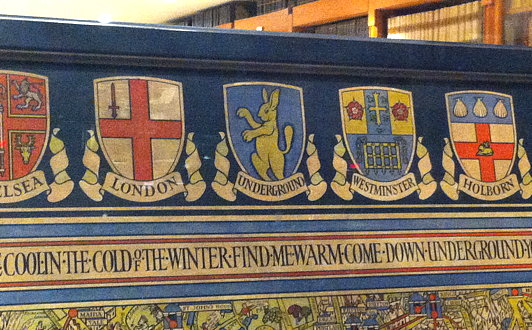
The most splendid and ridiculous aspect is that in the central place among the municipal heraldry was a putative coat of arms MacDonald Gill thought up for the Underground: a rabbit rampant. Indeed, given the twin characteristics of being speedy and digging the earth, the rabbit is a perfect animal avatar for the London Underground to adopt. Don’t go looking for this design anywhere in the rolls of Garter King of Arms, though: it’s merely the invention of the creative mind of master map-maker MacDonald Gill.
Two Flags Based on the French Tricolour
The French tricolour is one of the most influential flags in history, inspiring most prominently perhaps the Italian and Irish flags, but also dozens other, including the nationalist triband flags (like those of Germany, Russia, etc.). Indeed, the national flags of nearly sixty UN member states are based on these vertical or horizontal stripe combinations.
While long identified with revolution, republicanism, and nationalism, the French flag originally represented a combination of the blue and red of Paris — the colours of Saint Martin and Saint Denis — with the white of the French monarchy. Two (non-national) flags based directly on the French tricolour are those of the Acadians in North America and of Franschhoek in South Africa. (more…)
L’Osservatore Romano goes Hungarian
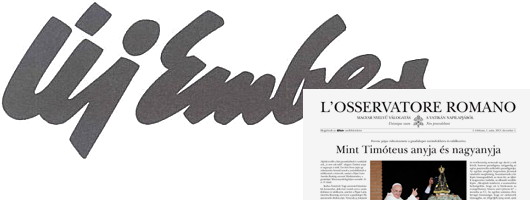
Magyarophiles will be pleased to learn that L’Osservatore Romano, the Vatican newspaper, will begin appearing in Hungarian. The new edition will appear every other week as a four-page insert into Új Ember, the Hungarian Catholic weekly founded in 1945. “We are a small editorial staff,” Balázs Rátkai, editor-in-chief of the weekly, told L’Osservatore.
“However, our intention is to probe and to make our readers think. The collaboration with the Vatican daily is of historic importance for the life of the weekly and of the entire local Church; it not only brings the Universal Church and the Pope closer to us; it will also enrich readers, and through them all of Hungarian society, with new thoughts, opinions and answers.”
Printed as a daily broadsheet in Italian, the Vatican newspaper also has weekly tabloid editions in French, Spanish, English, German, and Portuguese, as well as a monthly version in Polish.
Football at S. Maria Maggiore
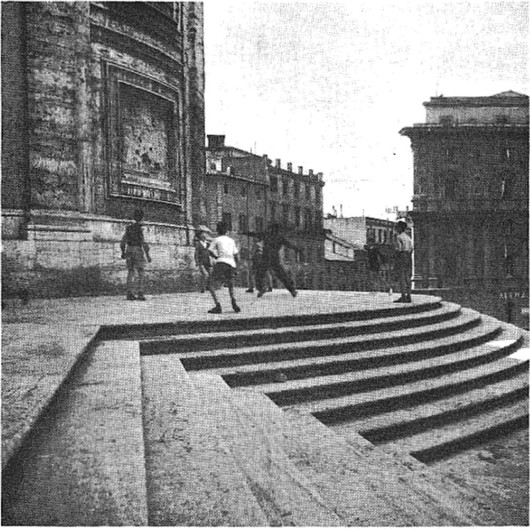
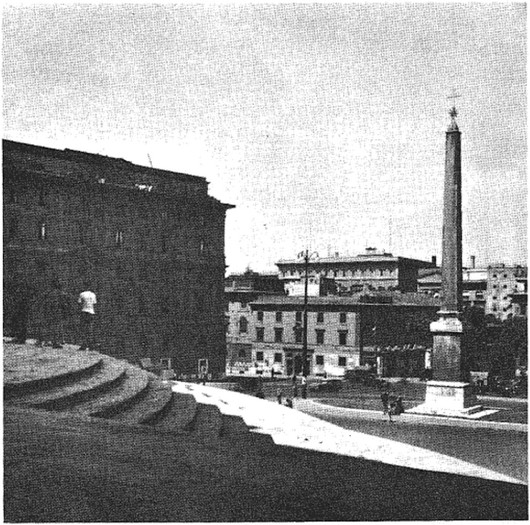
The enormous church of S. Maria Maggiore stands on one of Rome’s seven famous hills. Originally the site was very unkempt, as can be seen in an old fresco painting in the Vatican. Later, the slopes were smoothed and articulated with a flight of steps up to the apse of the basilica. The many tourists who are brought to the church on sight-seeing tours hardly notice the unique character of the surroundings. They simply check off one of the starred numbers in their guide-books and hasten on to the next one. But they do not experience the place in the way some boys I saw there a few years ago did. I imagine they were pupils from a nearby monastery school. They had a recess at eleven o’clock and employed the time playing a very special kind of ball game on the broad terrace at the top of the stairs. It was apparently a kind of football but they also utilised the wall in the game, as in squash — a curved wall, which they played against with great virtuousity. When the ball was out, it was most decidedly out, bouncing down all the steps and rolling several hundred feet further on with an eager boy rushing after it, in and out among motor cars and Vespas down near the great obelisk.
I do not claim that these Italian youngsters learned more about architecture than the tourists did. But quite unconsciously they experienced certain basic elements of architecture: the horizontal planes and the vertical walls above the slopes. And they learned to play on these elements. As I sat in the shade watching them, I sensed the whole three-dimensional composition as never before. At a quarter past eleven the boys dashed off, shouting and laughing. The great basilica stood once more in silent grandeur.
Zeitung für Deutschland
Given my total obsession with the Frankfurter Allgemeine Zeitung it will come as no surprise that my favourite advertising installation is the massive logotype for the world’s greatest newspaper which spans the railway tracks at the Frankfurter Hauptbahnhof.
In glorious Teutonic blackletter, it proclaims the newspaper’s ownership of the city to all comers:
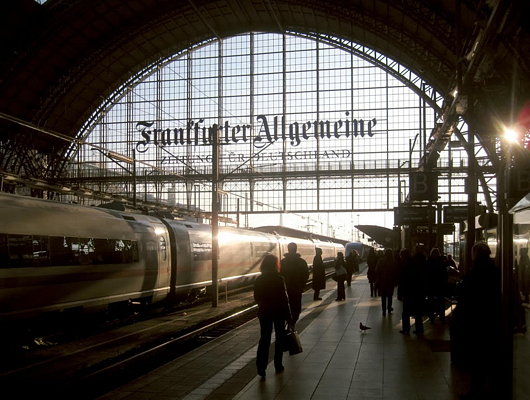
Photo: Erhard Bernstein
And while it looks great in daylight, as the evening descends it is illuminated in neon blue. Like the FAZ itself, old-fashioned and modern all in one.
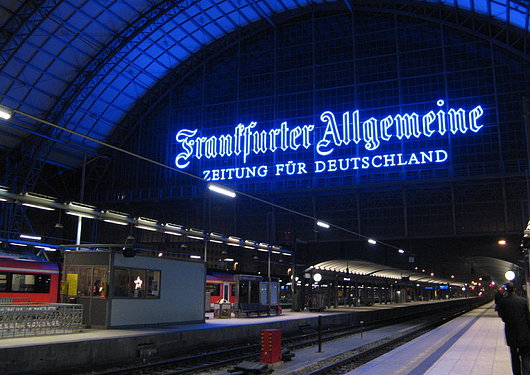
Photo: Otzberg
The Tragedy of Romeo and Rosaline
After an interlude of barely a month, the theatrical troupe of Fentiman returned to the Cathedral precincts with a presentation of Sharon Jennings’ play ‘The Tragedy of Romeo and Rosaline’. With the intriguing tagline of ‘Whatever happened to Romeo’s first love?’, the work explores the most famous love story of all time from the perspective of Rosaline, the niece of Capulet mentioned yet never seen in Shakespeare’s play.
A jaunty mix of ancient and modern, ‘Romeo and Rosaline’ includes some brilliant moments in its dialogue, peppered with occasional drops of the Bard’s own lingo and allusive humour ranging from the religious to the architectural. The action moves back and forth between just two locales: Rosaline’s own bedchamber, from which we view Verona, and Friar Lawrence’s cell, where we explore the meaning of transpired events.
Rachel Voldman as Nurse varies from the matronly to the almost sensuous. Philippa Tathum as Rosaline’s pushy mother exudes the confidence tempered by social-climbing of a minor landowner’s wife in colonial Kenya (Fair city of Verona meets the Happy Valley?). Althea Steven’s Rosaline is of course the crux of the action and capably carries off a teenage mix of coquetteishness and self-conscious over-introspection, finally consumed by the tragic epiphany that crowns the play’s final act. The theatregoer is lured in by fun and intrigue only to be hit suddenly with the full implications of has-been-ness.
In the end, ‘The Tragedy of Romeo and Rosaline’ is an exploration of isolation and ex-importance, displaying for us the furled banners of forgotten hopes and dreams, with all the faded, wasted glory of “You were the future, once.” Sharon Jennings has shined a well-aimed arclight on an unexplored realm and revealed the very essence of cathartic tragedy.
Late Summer, Early Autumn
St Paul’s Gothicised
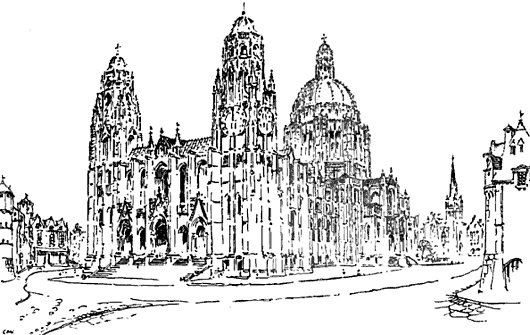
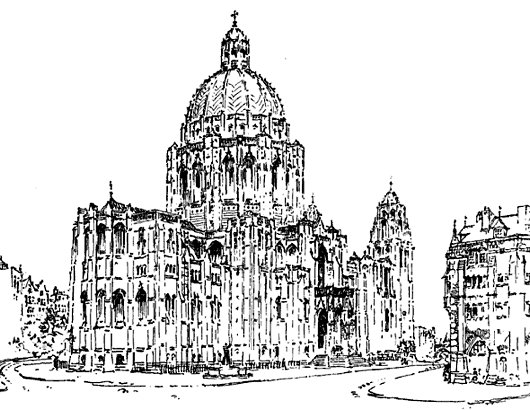
Victorian England went mad for the medieval, often neglecting or destroying buildings and structures of classical design along the way. Wren’s classical rood screen for Westminster Abbey is probably no great loss, but just imagine if his masterpiece, St Paul’s Cathedral, had been gothicised.
Just such was imagined by the architectural sketch artist C.A. Nicholson in two drawings he sent to the Architectural Record (albeit in the 1910s, not the Victorian era). Nicholson was inspired by an image printed in a previous issue of the Record showing the front of Peterborough Cathedral transformed into a classic design.
Of course before the Great Fire, Old St Paul’s was a Gothic cathedral.
A Lecture by Andrew Cusack
College of Arms Foundation
and the
Committee on Heraldry
of the New York Genealogical & Biographical Society
cordially invite you to a talk by
ANDREW CUSACK
on

‘THREE ANNULETS OR’
THE VAN RIEBEECK ARMS
& THEIR SOUTH AFRICAN LEGACY
Tuesday 17 September 2013
at
6:00 PM
Reception to follow
New York Genealogical & Biographical Society
36 West 44th Street, 7th Floor
New York, NY 10036
Open to the public. No charge.
Please rsvp to rsvp@coaf.us to reserve a place.
As the founder of the oldest European settlement in southern Africa, he came to be seen as the father of South Africa after the country was unified in 1910. The central elements of his arms — three annulets or — obtained local, regional, and finally national significance, and influenced the design of a wide variety of South African coats of arms, many of which will be examined in this lecture.
Saturday: Day of Fasting & Prayer for Peace in Syria
Given the urgent situation, please see the following from the Fathers of the London (Brompton) Oratory:
Day of Fasting and Prayer for Peace in Syria
This is in response to the following call to fasting and penance issued by His Holiness Pope Francis:
“On 7 September, in Saint Peter’s Square, here, from 19:00 until 24:00, we will gather in prayer and in a spirit of penance, invoking God’s great gift of peace upon the beloved nation of Syria and upon each situation of conflict and violence around the world. Humanity needs to see these gestures of peace and to hear words of hope and peace! I ask all the local churches, in addition to fasting, that they gather to pray for this intention.”
The London Oratory invites you to join the Holy Father in prayer for this urgent intention.
6.45pm-11.00pm Exposition of the Blessed Sacrament, the Little Oratory
The Dome of the Custom House, Dublin
THE MOST RECENT series of the ITV detective drama “Foyle’s War”, though set in London, was filmed entirely in Dublin. (Ah, those Bord Scannán incentives!). I’ve noticed a phenomenon in which something set in England but filmed in Ireland suffers from English stereotype overcompensation. What this entails is unnecessarily sticking noticeably English ‘things’ (double-decker bus, red pillarbox) into the frame when, if filmed in England, the directors might otherwise be satisfied without these subconscious emblems reassuring the viewer that they are not in fact in the country the programme was actually filmed in.
So two characters meeting on a street of Georgian houses will have a red post box shoved into some arbitrary place on the street to remind us we’re in jolly old England. Despite this, any devotées of the Georgian style will recognise the Irishness of the houses because of the subtle yet noticeable difference between the Georgian styles of, say, London, Edinburgh, Bath, and Dublin.

Anyhow, not to reveal too much of the plot of this latest series, but Chief Superintendent Christopher Foyle is recruited into a post-war British intelligence gathering organisation. The exterior shots of the building used as this group’s headquarters is the Custom House on River Liffey in Dublin, only the show’s producers have digitally removed the building’s prominent dome, presumably in order to make it less distinctive and identifiable. (more…)
IHT, RIP
New York Times Kills Off the International Herald-Tribune
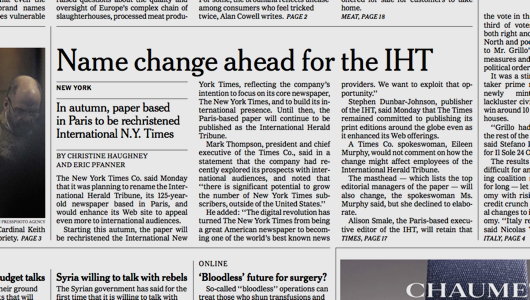
The New York Times Company, owners of the Paris-based International Herald-Tribune, announced recently that they are going to kill off the 126-year-old newspaper. I had predicted back in 2009 that this was precisely what would happen because of the aimless direction the IHT had taken since the New York Times became the sole owners of the title in 2002, after a long period of joint ownership with the Washington Post. The IHT will be merged into the worldwide operations of the Times this autumn and be rebranded as the International New York Times
 Hendrik Hertzberg of the New Yorker bids adieu to the Trib, remembering the first time he left the U.S. in 1960. Crain’s New York Business provides a brief overview of NYTCo’s decision. Margaret Sullivan, the Times’s ‘Public Editor’, reduces any appreciation for the Herald-Tribune as mere emotive romantic nostalgia. Nikki Usher mourns the IHT’s tendency to broaden the Times’s typically American editorial lens. Meanwhile, Ken Layne of The Awl is a bit frank about the decision to drop the Herald-Tribune for The International New York Times: “That’s an incredibly shitty name that makes no sense at all!”
Danzig in Flag & Arms
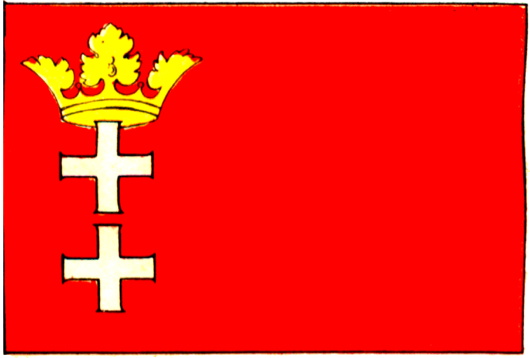
The first time I met my friend Rafal, I noticed his necktie bedecked with a subtle heraldic pattern. “I gather you’re German,” says young Cusack, summoning his Sherlockian deductive genius. “What makes you say that?” “The coat of arms on your tie: it’s Danzig.” “Actually I am Polish, and it’s Gdańsk!”
Well, so much for my deductive powers, (and Rafal is a secret wannabe-German anyhow) but the arms and flag of the Baltic city — once German, now Polish — combine the usual strong characteristics of any design: simplicity and beauty.
An Original Cusack
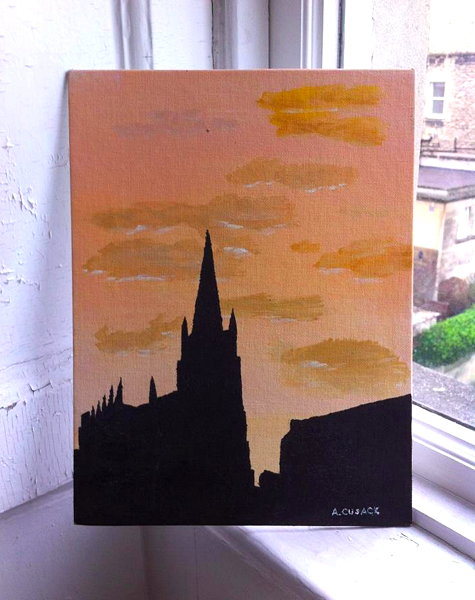
Much to my regret now, I never particularly learned nor pursued artistic skills, but this painting of St Patrick’s Church in Monaghan Town is one of the few fruits of art class from school days we’ve bothered preserving.
I think I was about 15 when this was done; the architecture was from a photo just to have something to stand out against the sunset. Our teacher was very good, but I was a poor student, and inattentive.
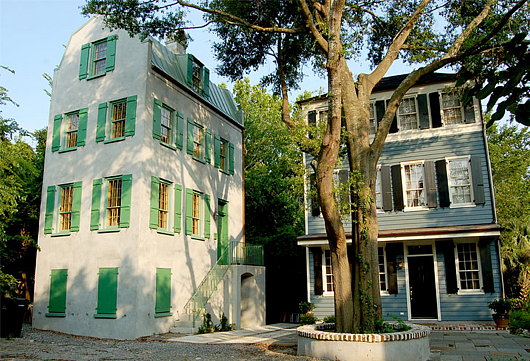
The Roman Corner
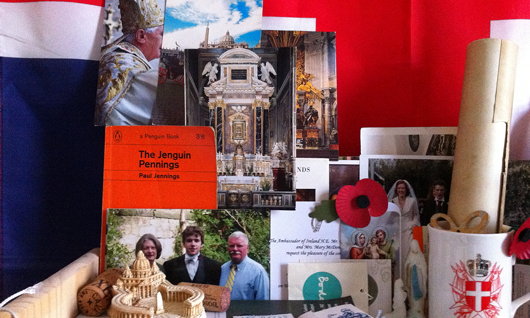
Friends are continually sending me postcards from Rome, such that they have gradually accumulated in a pile in my room. An English friend sent me one, and then an Irish friend saw it while visiting and, doubtless moved by the spirit of one-up-manship, sent one himself, whereupon the first friend sent another, to be followed by the most recent one (which arrived today) of the Chiesa di S. Agostino in the Campo Marzio. A miniature St Peter’s Basilica was recently added to the mix as well.
Vienna Views
My written views of the city you will have to wait for (presuming they ever see the light of day), but here are a few photographic impressions from my jaunt to the Kaiserliche Hauptstadt. (more…)
The Ever Useful Haggis
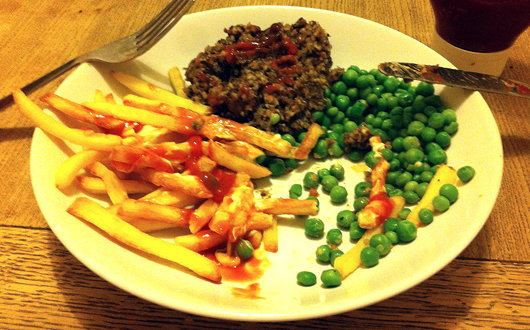
Culinary skills are not prominent among my varied talents, though I was pleased that the guests at the last dinner party I held in my riparian West London abode received the evening rather well. (If the food was only so-so at least the thought behind the choice and mixture of guests was appreciated). In my limited (but slowly expanding) experience, I have found haggis a rather useful addition to the repertoire.
T’other day I cooked a haggis for supper, alongside some chips and peas — an unjustly neglected vegetable I can’t help but feel. (Boring old botanists insist the pea is actually a fruit, but never you mind). Unfortunately I lacked a suitable gravy or sauce, so had to make do with ketchup and mayonnaise (plus a dash of HP).
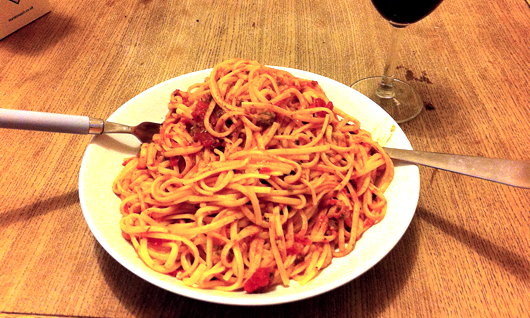
But what to do with the leftover haggis the next day? I tried spreading it on oatcakes but that was far too dry — oatcakes must be reserved for pâté, it seems. So instead I crumbled bits of haggis into a pot of tomato sauce, dobbed it with oregano, some mixed herbs, sea salt, and freshly crushed peppercorns, and enjoyed a surprisingly delicious meal which I’ve decided must be christened linguine alla scozzese.
University Nicknames in South Africa
In the course of reading any South African newspaper article about universities, the unacquainted reader may be confused by some of the terminology involved. “Maties Slaughter Ikeys” is a common enough headline prototype — given that, I think, the last time the Ikeys (University of Cape Town) beat Maties (Stellenbosch) in rugby, a white man was president.
What are these mystical nicknames for South Africa’s universities, clouded in mystery to the outsider? Here is a handy guide. (more…)
The Cathedral of the Bronx
The Augustinian Church of St Nicholas of Tolentine
The Church of St Nicholas of Tolentine dominates the busy intersection of University Avenue and West Fordham Road in the Bronx. The parish was erected by the archdiocese in 1906 and has been served by Augustinians ever since then. The present church is a modern gothic creation from 1927, and probably one of the most handsome Catholic churches in the borough — it is often nicknamed “the cathedral of the Bronx”. (Though that style is sometimes also ascribed to St Jerome’s in Mott Haven).
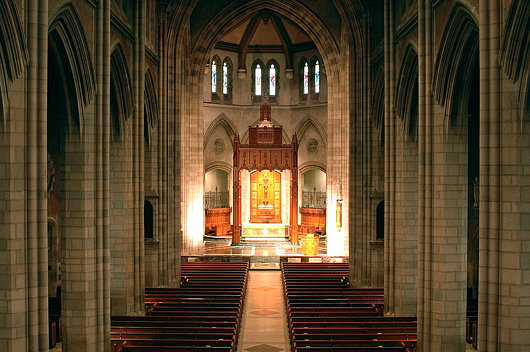
The church is of suitably grand proportions, but the effect is somewhat diminished by the unfortunate use of bulky wooden pews. They are ill-suited to such a large church, and detract from the spaciousness of the interior. This is unfortunately a very frequent problem in the United States, where clumsy pews crowd even great cathedral churches like St Patrick’s in Manhattan or the glorious Cathedral Basilica in St Louis. Regardless, St Nicholas of Tolentine is a splendid ornament in this borough of many churches. (more…)
Search
Instagram: @andcusack
Click here for my Instagram photos.Most Recent Posts
- West Point July 30, 2026
- Brunel’s Unbuilt Capitol February 3, 2026
- Cricket at Fordham January 27, 2026
- Palacio Barolo Revisted January 14, 2026
- Learning to Love Liguria January 14, 2026
Most Recent Comments
Book Wishlist
Monthly Archives
Categories