Errant Thoughts
About Andrew Cusack
 Writer, web designer, etc.; born in New York; educated in Argentina, Scotland, and South Africa; now based in London.
 read more
News
Blogs
Reviews & Periodicals
Arts & Design
World
France
Mitteleuropa
Knickerbockers
Argentina
The Levant
Africa
Cape of Good Hope
Netherlands
Scandinavia
Québec
India
Muscovy
Germany
Academica
Lourdes: To Be a Pilgrim
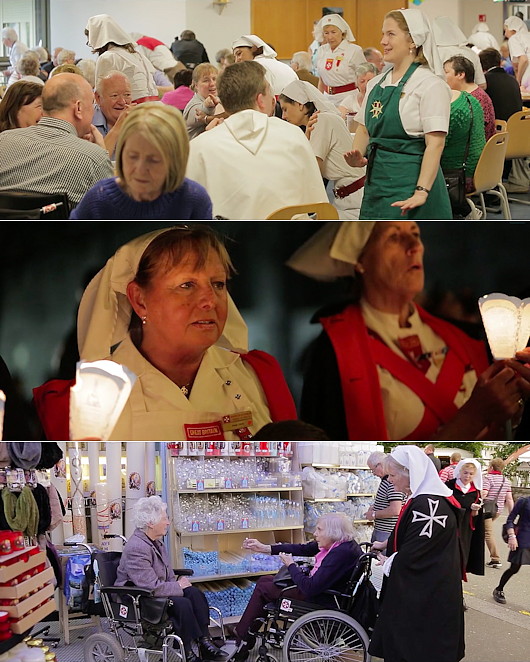
As today is the feast of Our Lady of Lourdes — and consequently the World Day of the Sick — here is the documentary we made regarding the Order of Malta’s annual pilgrimage to Lourdes each May.
Flag of an African Slaver
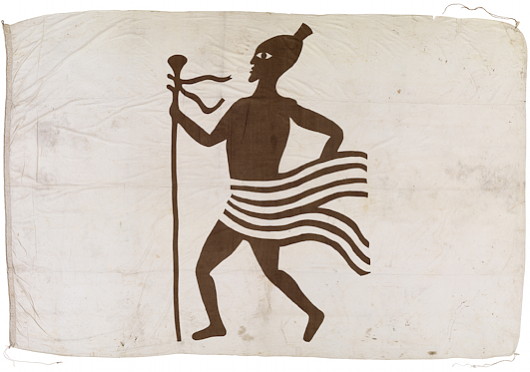
c. 1862-1866; hand-sewn cotton; 9 ft 2 in x 15 ft
Greenwich, London
The simple image of an African, garments aflutter, on a plain background provides a strikingly modern design as the commercial emblem of a firm engaged in the trade in human misery.
This flag was captured by Commodore Arthur Eardley-Wilmot while on anti-slavery operations off West Africa and given to his friend William Henry Wylde who supervised anti-slave-trade efforts at the Foreign Office in Whitehall.
The eradication of the slave trade is arguably the greatest peacetime achievement of the Royal Navy as well as powerful proof that the supremacy of economics can be overcome and made subject to morality. This is not just a possibility, but a necessary precondition for any humane and civilised order in society.
Sieg für die Schönheit
Sieg für die Schönheit
Alles Sal Reg Kom
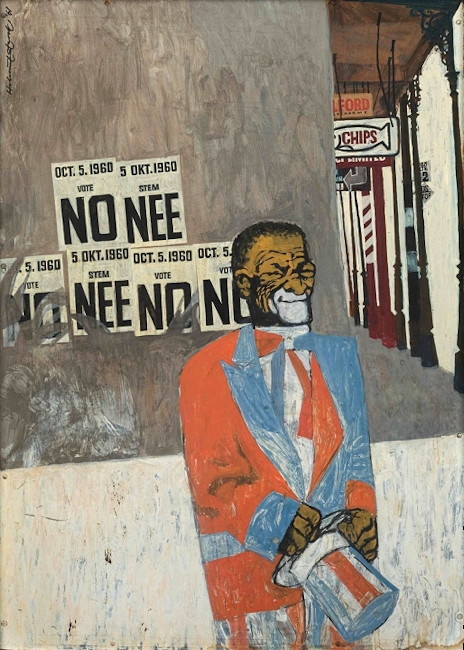
1961; Acrylic on board, 34.8 in. x 24.8 in.
A man festively attired in a Tweede Nuwejaar outfit in patriotic colours (orange, white, and blue) stands in front of a side wall in Cape Town bearing monarchist posters urging voters to vote ‘No’ in the 1960 republic referendum.
The painting’s title – Alles Sal Reg Kom – means “everything will be alright”.
A memorial to Conscience
Sharon Jennings’s new play on Franz Jägerstätter
It is often said that one man’s terrorist is another man’s freedom fighter — but what inspires the man who refuses to fight? Is he a coward? A man of conscience? Or a mere contrarian who goes too far? Sharon Jennings’s new play, ‘Memorial’, explores the surprisingly not yet well-known story of Blessed Franz Jägerstätter, an Austrian executed during the Second World War for his conscientious objection to military service under Hitler.
This clever telling frames the martyr’s life mostly in retrospect, as the Mayor (played by the very capable Joe Cushley) assembles the leading villagers of St Radegund (actors Richard Evans, Carianne Dunford, Richard Ward, and Meg Depla-Lake) to compile the list of names to be etched permanently in stone on the village’s war memorial. The list is finalised but there is one name that cries out to be remembered: their poor lamented Franz.
We meet the main character (played by Felix Dunning) both through the memories of his rural contemporaries and his own letters home to his wife during basic training. For his refusal to take the military oath of absolute obedience to Adolf Hitler, he is thrown into prison. ‘Memorial’ reaches its apex in the confrontation between the uncomplicated but principled Franz and his cunning and clever military judge (a role brilliantly performed by Gary Merry). The chilling battle between good and evil is made all too real and the viewer is reminded of the battles of conscience ongoing in our own lives and the lives of thousands of others every single day.
In the end, it is through the lens of his fellow villagers that we remember Franz. Why can’t he just sign the dotted line? All the rest of us did. It’s a mere formality. We didn’t have a choice!
Deviant? Rebel? Hero? Whatever we think of men like Franz, in this play Sharon Jennings has carved and crafted a memorial to conscience — a healthy but haunting reminder of that freedom which always remains even when all others disappear.
Die Staatsrede
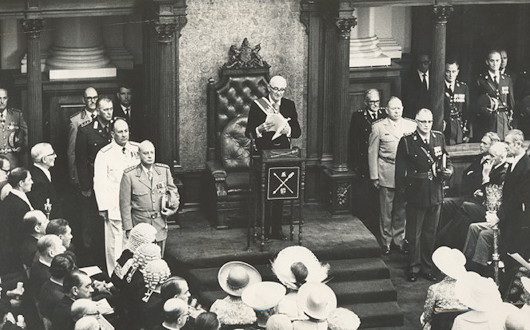
Staatspresident Jacobus Johannes Fouché giving the staatsrede from the throne of the Senate within the Houses of Parliament in Cape Town.
What is now the State of the Nation Address has its origins in the speech from the throne (in Afrikaans staatsrede meaning “state reasoning/rationale”) setting out the Government’s legislative programme for the year. The high point of the State Opening of Parliament, it was originally given by the Governor-General (or, in 1947, by the King of South Africa himself) but with the abolition of the monarchy in 1961 the sovereign’s vice-regal representative was abolished and replaced by the Staatspresident as chief officer of the South African state.
Giving a speech from an actual throne was considered too monarchic for a republican polity, so – like in the Boer republics of old – presidents gave their staatsredes standing. Here, State-President Fouché is flanked by the chiefs of the defence staff and police, the Serjeant-at-Arms with the mace, and the Gentleman Usher of the Black Rod.
Of course, much of this was abolished in the 1980s with the constitutional innovations as a last-ditch attempt to entrench apartheid. South Africa is now on its third constitution since the above photo was taken.
It reminds me of how in Ireland almost all the traditions of the Viceroy (viz. the Viceregal Guard of Battleaxes, etc.) were abolished not by the Saorstát or Éire but by the British themselves – in their case by penny-pinching Victorians who found Dublin an easy target for cost-cutting.
No ‘Malvinas’ Here
Some difficulties of Latin place names in 1930s cartography
It’s no great secret I’m a lover of maps. When calling in to the Secretariat of State on the terza loggia of the Apostolic Palace in the Vatican the other day, I was very pleased to see the cartographic murals there, including the two hemispheres done by Ignazio Danti in the 1580s. Moving to the next interior offices, however, the visitor is greeted by a much more recent mappa mundi, dating from the 1930s, replete with the glamour of empire’s heydey. (more…)
Letter to the Editor
SIPPING a postprandial Coke last week while flipping through the Irish Times, my wandering eye was drawn towards that newspaper’s report on the Madrid congress of the European People’s Party, the grouping of Christian-democratic and centre-right political parties across the European continent (Madrid congress provides forum for delegates from EU centre-right parties, Suzanne Lynch, Irish Times, 22 October 2015). The correspondent first elucidates some of the purpose of these pan-European gatherings before going on to summarise a number of the issues raised. She ends, however, on a bit of a downer by describing Hungarian Prime Minister Viktor Orbán’s “lurch to the far right”, evidenced by his “clampdown on media and internet freedoms, apparent support for the death penalty and hardline approach to refugees”.
This breezy litany of crimes is little more than shoddy journalism. The alleged “clampdown” refers to proposed internet legislation which has been withdrawn while other media laws requiring balance reflect the U.S. broadcasting rules rescinded under Ronald Reagan. The “apparent support” for capital punishment is another damp squib: Orbán called for it to be debated as intellectual speculation — a canny “dog-whistle” political move to gain votes without requiring any legislative action or serious challenge to the E.U. ban on the death penalty. (It was abolished in Hungary at the fall of communism and there are absolutely positively no government plans to bring it back.)
The refugees allegation was the most interesting, however. As it happened, I had attended a small meeting of British MPs and Hungarian foreign ministry officials the day before Ms Lynch’s report was printed. The Welsh MP David Davies gave his first-hand account of visiting the refugee camps near the Hungarian-Serb border and reported that refugees were being well-looked-after, with the quality of the facilities on the whole at least as good as when he was in the British Army, often better. An advisor from the Hungarian Foreign Ministry briefed us on the general situation, which has calmed down immensely since the Serb border has been more or less closed. He noted that broadcast media across the continent showed footage of Budapest police’s treatment of migrants gathered at the railway station without pointing out that the police were responding to violent attacks from a small minority of migrants.
Proprotionate self-defence for officers of the law is the norm across Europe, but this has mattered little when it comes to depictions of Hungary: the bien-pensant official groupthink is that anything Hungary does is wrong, so long as Fidesz is in power. Luckily some voices of dissent have emerged. The novelist Tibor Fischer — no conservative — described in The Guardian the media treatment of Hungary as “hysterical” and “ignorant nonsense”.
Anyhow, I felt obliged to send off my “Disgusted of Tunbridge Wells” to the Irish Times and it’s very good of their letters staff to print a diverging (if abridged) opinion. The last letter to any editor I succeeded in having printed was in the Times Literary Supplement in 2008 about P.G. Wodehouse’s career in banking at H.S.B.C. Who knows what the next shall bring…
Open-minded Stellenbosch
Paul Moorcraft is a Cardiff-born journalist and academic who spent many years in southern Africa, lecturing, researching, and working. I stumbled across this passage about Stellenbosch from his 2011 book Inside the Danger Zones: Travels to Arresting Places and found it interesting (though not surprising):
I found many of my all-white students at the University of Cape Town tediously dogmatic in their supposed progressiveness. I also lectured at the Afrikaans-language university of ‘Maties’ at Stellenbosch, established in 1918 [sic, f. 1866; accorded university status in 1918] as the Afrikaner Oxbridge, where I found the students much more open-minded. Simon van der Stel, a stiff Dutch bureaucrat, founded a frontier town on the banks of the Eerste River in 1679. Van der Stel loved oaks, and the graceful boulevards he planted still adorned picturesque Stellenbosch. I spent as much time as possible in the area because of the architecture. The Cape Dutch style contains elements from Dutch architecture but is also influenced by colonial Indonesian traditions and the local environment. The most characteristic feature is the graceful gabled section built around the front door, which is flanked by symmetrical wings, thatched and whitewashed, extending on either side.
I was supposed to be using my visiting lectureship to finish my doctoral research, so I became friendly with Retha, a librarian at Maties. She was a fund of knowledge on Afrikaner culture and offered herself as an intellectual guide. My scholarly investigations soon degenerated into a three-month tour of the local wine farms, for which I am eternally grateful. We drove through the old, beautiful vineyards of the valleys around Paarl, Franschoek, and Tulbagh; then returned to eat in splendid eighteenth-century farmhouses converted to hotels.
April to September
Between the vernal equinox and its autumnal confrère tomorrow there has been perhaps an excess of fevered activity. Aside from the usual time in London, I have been in Amsterdam, the Wolds of Lincolnshire, the Essex seaside, the Pyrenees, Kent, Paris (much scrubbed up since my last stay), Chartres, Oxford, Hertfordshire, Buckinghamshire, Lebanon, Midlothian, Connacht, and Norfolk. And before Christmas I should have two trips to Rome.
Regardless, here are just a few photos from the past six months, arranged in roughly chronological order and lightly explained, in order to keep you up to speed. (more…)
Putin: ‘I’d really like to see Europe show some real independence and sovereignty’
‘Europe is facing a specific problem: an influx of immigrants’ the Russian president asserts in an interview for Swiss television
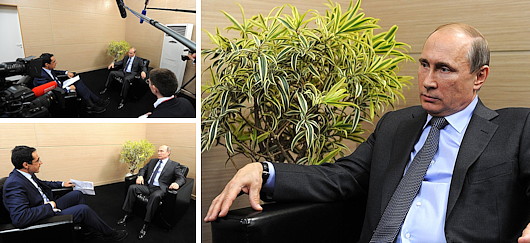
Here are a few excerpts from the interview, dealing with (among other issues) the balance of power, independence and sovereignty in Europe, and relations with the United States.
Vladimir Putin: Bonsoir.
Vladimir Putin: This is done by dishonest and inattentive people. The process of starting a new arms race began from the moment of the United States’ unilateral withdrawal from the ballistic missile defence treaty. Because this agreement was a cornerstone for the entire international security system. And when the United States withdrew from it and began to create a missile defence system as part of its global strategic weapons system, we immediately said: we will be obliged to take reciprocal steps to maintain a strategic balance of power.
I want to say something very important: we are doing this for ourselves, to ensure the security of the Russian Federation, but we are also doing it for the rest of the world, because this strategic stability ensures the balance of power.
Vladimir Putin: My mother and father. My brother, whom I never met, died here during the seige.
Vladimir Putin: I hope not. But I would really like to see Europe demonstrate some real independence and sovereignty and be capable of defending its national interests, the interests of its people and its nations. […]
Vladimir Putin: […] Participation in any military and political organisation or bloc is associated with the voluntary renunciation of a certain share of one’s sovereignty.
I think that at the time, France withdrew from NATO to preserve its sovereignty more than it is possible within the framework of a military bloc. It is not our business to analyse European nations’ foreign policy. But I think you’ll agree that if we need to discuss intra-European affairs with European partners in Washington, it is not very interesting.
Vladimir Putin: I think that this is not so much support for me as the realisation of national interests as the political parties see them.
There are certain tectonic changes underway throughout the world and in Europe within the public consciousness, which are aimed at defending national interests. You must understand that right now, Europe is facing a specific problem, an influx of immigrants. And did Europe make the decision that ultimately led to this situation? We need to be sincere and honest: these decisions were made across the ocean, but Europe must deal with the problem.
Vladimir Putin: Of course. This is just one example, but there are many. But this does not mean – and I already said this – that we should somehow demonise US policy; that is not my goal. They are conducting their policy as they see necessary in their interests.
We must strive to find a balance of interests; we need to invigorate our work, give new momentum to the work by the UN Security Council. The US is certainly a great power and the American people created this nation over several centuries, it is simply an amazing result. But that does not mean that today’s US authorities have the right to travel throughout the world and grab anyone to drag back to their prison or act from a position of “anyone who is not with us is against us.”
We need to be patient and work with our American colleagues to find solutions, the way we have in some areas of our cooperation, such as with the Iranian nuclear issue.
[…]
Vladimir Putin: After our interview, do you think I am mad?
Vladimir Putin: This is part of political struggle; it has been part of my life for quite a number of years. I try not to pay too much attention to it. I simply do what I think is necessary in the interests of my country and my people.
It is not in Russia’s interests to be in confrontation with other countries, but sometimes we are forced to protect our interests, and we will undoubtedly continue to do so. However, we will seek solution not in confrontation, particularly military confrontation, but in finding compromise and mutually acceptable solutions.
With your help I would like to address not those who criticise me, but those who support me. I would like to thank them for their support and tell them that we will continue moving ahead together. Above all, I am referring not to those who portray me [as Stalin], but to those who sympathise with what we are doing and agree with it deep inside.
Merci beaucoup.
Caped Bear Cubs in Canadian Arms

As my sister was educated (or something to that effect) by Ursulines, a recent addition to Canada’s Public Register of Arms, Flags, and Badges caught my attention. The Queen of Canada granted a coat of arms to the Quebec municipality of Sainte-Angèle-de-Mérici in 2013 (pictured above).
The shield of the arms features three chevronels represent the mountains surrounding the area while their number reminds us that Sainte-Angèle-de-Mérici is a municipality formed from two townships — Cabot and Fleuriault — and the single seigneury of Lepage-et-Thivierge. The wavy blue stripe represents the Mitis River, while gold symbolises the agricultural industry of the Sainte-Angèle-de-Mérici.
The charming aspect are the supporters: two bear cubs. St Angela Merici was the founder of the Ursulines — the Order of St Ursula — and ‘Ursula’ is Latin for ‘little female bear’.
“The bear also symbolizes bravery, thus signifying St. Angela Merici’s martyrdom,” the Canadian Heraldic Authority further explains. “The cloak is one of her traditional attributes. The flags (drapeau in French) honour Angèle Drapeau (1799-1876), the youngest daughter of Seigneur Joseph Drapeau and benefactor of the municipality.”
In Old Rio
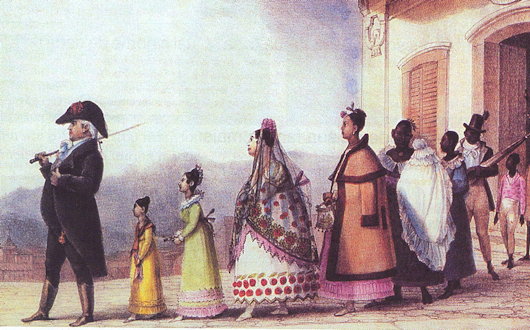
The city’s administrative and electoral units were its parishes, and the tallest buildings were all church towers. The day of the colonial port began with the cannon shot announcing the beginning of harbour commerce, at half past five.
This was followed by the opening of shops and homes of merchants and tradesmen. Early mass was signalled by church bells, and it was church bells which marked the day’s turn as they sounded the day’s regular prayers as the sun rose and set. …
One of the first, common sights in the city was that of Catholic brotherhoods seeking alms in the streets and shops, or, perhaps, a lady, humbly barefoot, seeking to fulfil a vow by begging alms with a heavy silver tray covered with rich cloth — accompanied by her servant, of course.
The Conservatives, the State, and Slavery in the Brazilian Monarchy, 1831-1871
A Horror in the Hague
The old and new buildings of the Royal Academy of Fine Arts
SINCE 1682, the Hague has been home to the oldest art school in the Netherlands, the Koninklijke Academie voor Beeldende Kunsten or Royal Academy of Fine Arts. The school has its origins in the civic corporations of the late medieval period. The Guild of Saint Luke incorporated all the artists of the Hague, and later from this group emerged a self-selecting gang of painters and sculptors who founded themselves as the Pictura Brotherhood. This fraternity in turn founded an academy of art which on its 275th anniversary was granted the royal patronage and name.
Having had previous quarters in the Korenbeurs and the Boterwaag, the Academy engaged the architect Zeger Reyers (or Reijers) to design its own building in the Prinsessegracht in 1839 (above, top). This neo-classical temple to the arts was very much in keeping with the French academic tradition which the school practised at the time, but in later years this fashion faded. Just before the Second World War, the barbarians sacked the temple and erected in its place a Bauhaus-style box (below).
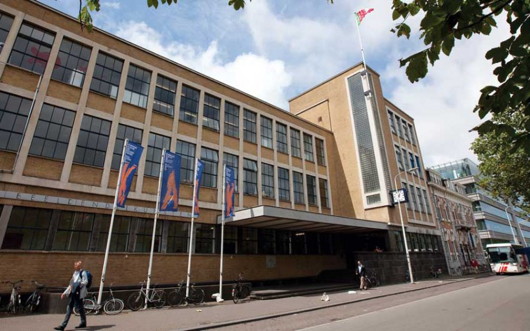
Like all too many changes, it was not an improvement. (more…)
Shedding light on the Cape Baroque
Nuwe lig op die Kaapse barok deur Dr Hans Fransen
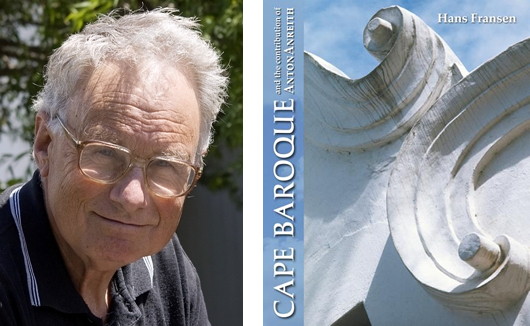
A NEW BOOK BY Dr Hans Fransen, the leading authority on Cape Dutch architecture, intends to shed new light on the Cape Baroque style through an examination of the work of the sculptor Anton Anreith. Cape Baroque and the contribution of Anton Anreith offers us the hefty subtitle of ‘A stylistic survey of architectural decoration and the applied arts at the Cape of Good Hope 1652-1800’, covering the period of the Dutch East India Company’s rule at the Cape.
The author investigates (says the publisher’s note) whether, and to what extent, the surprisingly rich body of Cape material culture can be seen as part and parcel of the international Baroque: that ebullient style of painting, architecture, and design that swept across Europe and some of its spheres of influence. After a highly interesting account of the origins of the Baroque in Italy and of its development in other parts of the world, the author concludes that ‘Cape Baroque’ does indeed form part of this. But he also points out that it has a very distinctive character of its own.
The book of 180 pages contains over 200 illustrations, mostly from the author himself, whose other works include The Old Towns and Villages of the Cape, The Old Buildings of the Cape, Drie Eeue Kuns in Suid-Afrika, and the introduction to A Cape Camera, the book illustrating the photography of early Cape photographer Arthur Elliott.
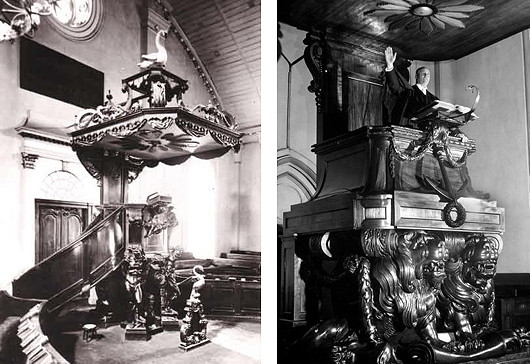
The sculptor Anreith, born in Germany at Riegel between the Rhine and the foothills of the Black Forest, was the finest and most florid artist of the Baroque in the Cape of Good Hope. His exceptional work on the pulpit of the Lutheran Church in Cape Town provoked the envy of the more prominent Dutch Reformed congregation, who quickly commissioned Anreith to carve an even more ornate pulpit for the Groote Kerk.
by Dr Hans Fransen, 160 pages, R250
deur Dr Hans Fransen, 160 bladsye, R250
New Yorkers: See New York!
Old-School Ads Employed for City’s Internal Tourism Campaign
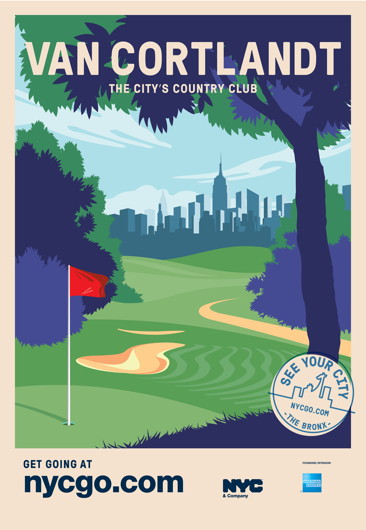
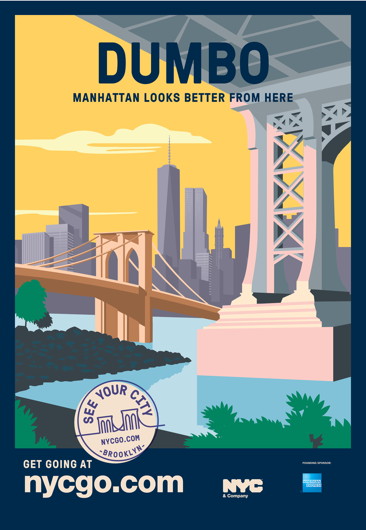
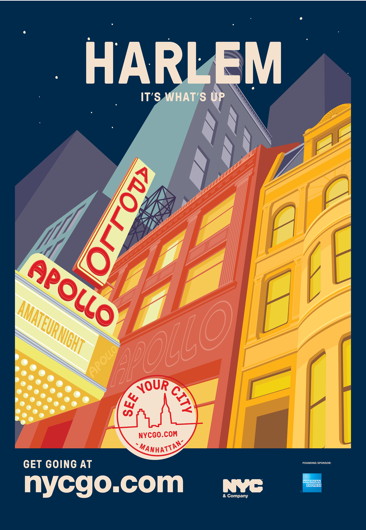
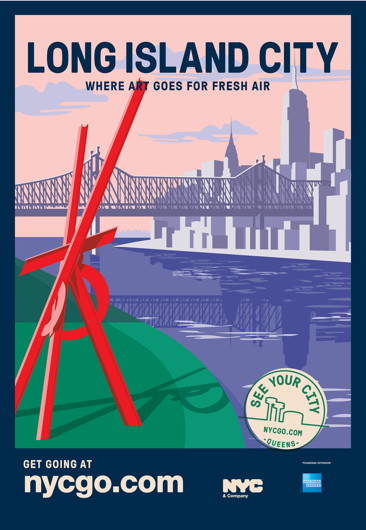
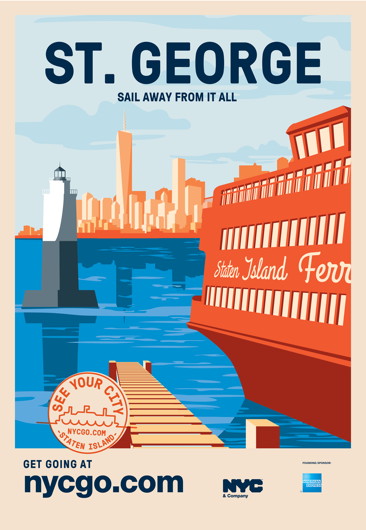
NYC & Company, the official tourism and marketing board of New York City, has cottoned on to the fact that in such a vast metropolis many parts of the city are virtually unknown to the natives of whichever particular borough.
They recently launched the ‘See Your City’ campaign encouraging New Yorkers to visit places perhaps less familiar to them within their own city. Part of the campaign involves the above series of posters for display in bus shelters.
The style evokes old-school travel posters of the 1920s & 30s, and NYC&Co commissioned one for each of the five boroughs.
Elsewhere: Adweek | New York Times | Untapped Cities | NYCgo
Ones to Watch (or Read)
In this commonwealth of knowledge, it is necessary to share out our sources of insight and wisdom. Here are just a few sites (“blogs”, even) that readers of this little corner of the web ought to take notes of.
Sancrucensis
http://sancrucensis.wordpress.com/
Fr Edmund Waldstein is a monk of Stift Heiligenkreuz near Vienna. He has been writing at Sancrucensis for some years now, but of course with so many distractions it often takes time to realise what is actually of value.
Fr Waldstein writes clearly and likes Charles de Koninck, so he can’t be all bad. His subject matter ranges from Saki to Žižek, and not long ago he weighed in on the Zmirak controversy.
His Amazon wish list is even larger — much, much larger — than my own, so perhaps you might think of shortening it through buying him a book.
Foolishly I neglected to visit Heiligenkreuz when I was in Vienna last year (though I did meet a chap there who wrote a history of the abbey), so I must make a pilgrimage next time I venture to the Kaiserstadt.
Opus Publicum
http://opuspublicum.wordpress.com/
This blog by Modestinus somewhat irritatingly uses the same WordPress theme as Sancrucensis, leading to occasional confusion in the Cusackian mind about who read what where. (UPDATE: It’s changed its design now.) Regardless, his ‘Weekly Reading’ updates feature selections that are very small-c catholic in taste (as well as big-C Catholic).
The names of Juan Donoso Cortes and Carl Schmitt are bandied about, and Modestinus is keen on elaborating upon Catholic Social Teaching, which seems to be getting a bit more attention all around these days.
Like Sancrucensis, Modestinus too has weighed in on our friend John Zmirak’s apostasy into liberalism. As a certain clerical personality on the outer reaches of London might put it: “Illiberal Catholicism? I’m into that!”
The Josias
http://thejosias.com/
This is not quite a blog, more of an occasionally updated resource. A multi-part series explores the American ‘Founders’ and the Aristotelian tradition, and be sure to check out ‘Have the Principles of the Right Been Discredited? Leo Strauss’s Rome and Ours’.
Worth reading also are ‘Theses against American Whig Catholicism, prompted by the atmosphere of 2012 and by the antiliberal writings of Deneen’, which De Koninck fans will enjoy.
For the Whole Christ
http://jcrao.freeshell.org/
Dr John C Rao posts a great deal of his work online at For the Whole Christ — skip to ‘Shorter pieces’ to find the more recent updates.
I am proudly in the Raovista camp, and this history professor and Catholic intellectual’s ongoing series of lectures in New York is enlivening, entertaining, and above all enlightening. Scandalously I have yet to attend the Summer Symposium in Gardone John organises every year under the auspices of the Roman Forum (it clashes with the part of the summer I am usually in the Lebanon). Some day, though, some day…
&c., &c., &c.
Of course there are the other usual places one ought to check often: The American Conservative and the much re-invigorated First Things. The Benedictus Trust (Patron: HMEH the P&GM) has been putting some of its lectures up on YouTube and Roger Scruton is headlining their Research Forum in London next year at the Linnean Society.
What have I been reading offline? Some Antal Szerb (Journey by Moonlight), some Tom Holland (In the Shadow of the Sword), and greatly enjoying some Régis Debray.
I recently forced the remnants of a dinner party I was hosting to listen to two and half pages of Voltaire-hatred from Maistre’s Soirées de Saint-Petersbourg (a sublime work!). The consistently interesting Dorchester Review featured an article on Joseph de Maistre not long ago, but it is impossible to obtain in London and I am too poor to subscribe. Perhaps I should give in and get a cheapo online-only subscription — this, after all, is what my iPad mini is for.
Rowing Blazers Book Launch
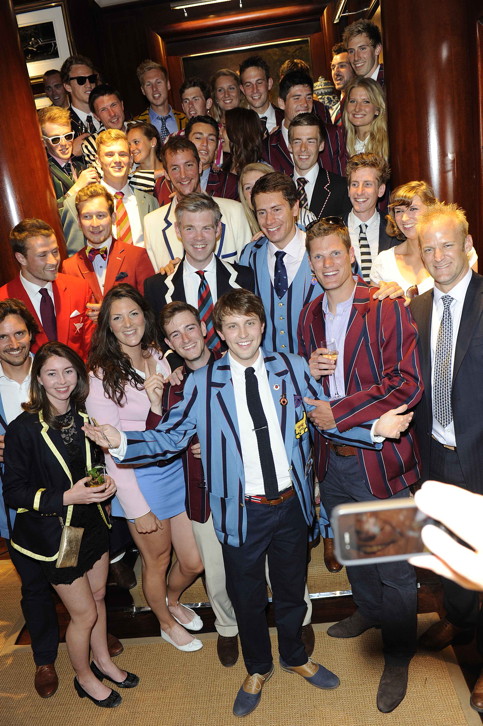
© Steve Finn Photography
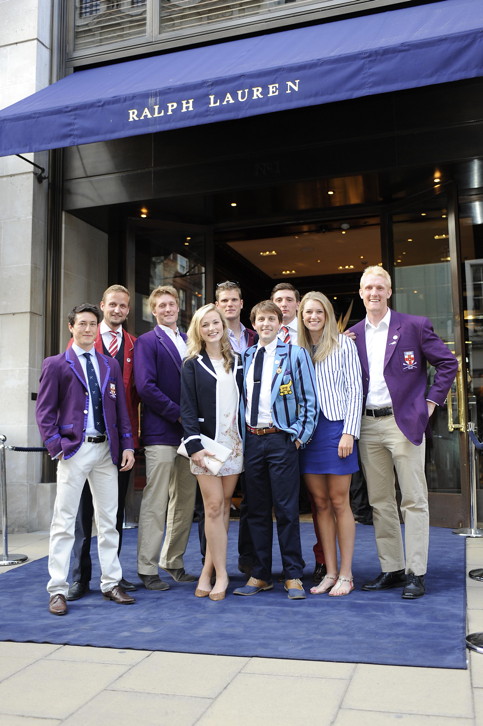
© Steve Finn Photography
by Jack Carlson, 2014
Thames and Hudson, 255 pages
£34.95 / ISBN: 978-0-500-51755-0
I am probably Jack Carlson’s worst friend — luckily for me, he is long-suffering. Many have been the mornings I have awakened in Oxford on some friend’s uncomfortable sofa (or worse: floor) and toddled haphazardly down to Jack’s regular coffee place for a restorative morning brew and inflicted upon the poor fellow my recounting of the previous night’s events in untrustworthy detail. Jack sits there, politely, smiling, waiting for the caffeine to take effect on me so that my tedious monologue can miraculously give way to the honoured pastime of friends: conversation.
It was during one of these chats — or it may have been over a winter evening pint in the King’s Arms; or a late summer afternoon pint in the Bear — that Jack revealed his book project: a coffee-table book on rowing blazers.
How tedious is that term ‘coffee table book’ which contemptuously mediocratises such beautiful, large-format, lusciously illustrated, and well-researched printed volumes into a mere additament of interior design. This format is probably my favourite kind of book, and I’m frightened to think how many pounds, dollars, rand, and euros I’ve invested in them over years.
But never mind. Rowing Blazers is now hot off the presses from Thames and Hudson here in Britain (and soon from Vendome Press across the Atlantic). And of course the perfect accompaniment to a good new book is a launch party to celebrate.
Jack assembled an impressive array of friends, rivals, and rowers to launch his latest book at Ralph Lauren in Bond Street last Thursday. There was an even more impressive array of stripes, colours, and piping on display amidst the bottomless glasses of Pimm’s and flutes of champagne generously refilled to no end by our hosts.
What about the book? It is beautifully presented, well-written, and includes a surprising variety of clubs from across the world. Rowing Blazers is a perfect gift for any rower — a must-have — so keep it in mind for birthdays and Christmases.
A number of the guests on Thursday flicked through the book’s pages to find their own clubs, rival clubs, friends photographed, and a fair amount of gossip was shared as well. Even when it came time to close up shop (literally, for once), the party continued at Bodo’s Schloss late into the wee hours. (more…)
Italy inspired by Wall Street
Il Foglio is one of the most interesting newspapers in the world, and quite unique. It’s not a “great” newspaper like the FAZ or the Financial Times, with reporters in every major city around the globe, but this little “sheet” — usually just four or six pages — contains both a gazette of the day’s events alongside some of the best analysis and commentary in Italy. I’ve often thought that a London-based newspaper of a similar mould — not an everything-paper but instead simple, accurate, brief reporting combined with intelligent insight — could have an impact in Britain (and perhaps even America).
Its editor is the affable atheist, anti-abortion campaigner, and friend of Benedict XVI Giuliano Ferrara — an ex-Communist and former minister in Berlusconi’s first cabinet in the 90s — and it’s been said that Il Foglio comes closest to being the Italian proponent of a more Anglo-Saxon style of conservatism.
Today is Il Foglio’s eighteenth birthday, and looking back at the first edition, the design of the front page (above) obviously takes its inspiration from that of the Wall Street Journal. Things have changed since then, and while the Italian daily still clings proudly to its broadsheet format, the WSJ converted to what I call narrowsheet in 2006, as reported by us at the time.
In honour of this anniversary, Il Foglio has made available in PDF form its first ever edition (shorn of advertisements) which you can download here. (more…)
End of the Line for Rizzoli Bookshop
Another New York bookshop bites the dust
In New York, good things are only allowed to last a little while: eventually they must all be destroyed. The latest to add to the pile is the Rizzolli bookshop on West 57th Street, which has received notice that the landlords intend to demolish the 109-year-old structure in which the bookshop is housed.
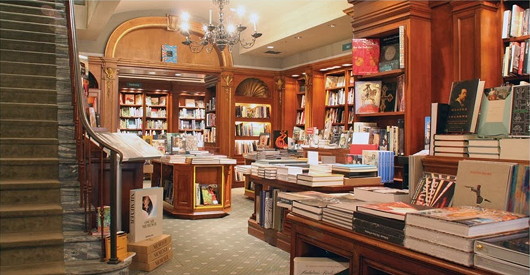
Rizzoli, publishers of some of the finest and most luxuriously printed books on the market, have not yet said whether they will be opening shop elsewhere.
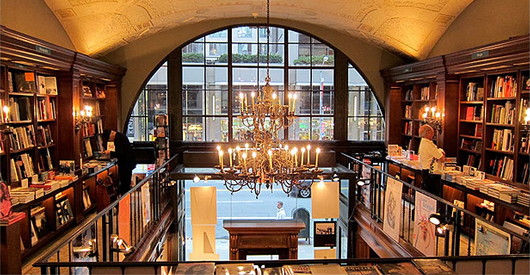
If so, it would be the second move for the shop, which opened in 1967 at 714 Fifth Avenue (below), just around the corner. A developer tried to tear that building down as well, but preservationists managed to have the façade, with its lalique glass, incorporated into the new tower. It’s now home to Henri Bendel.
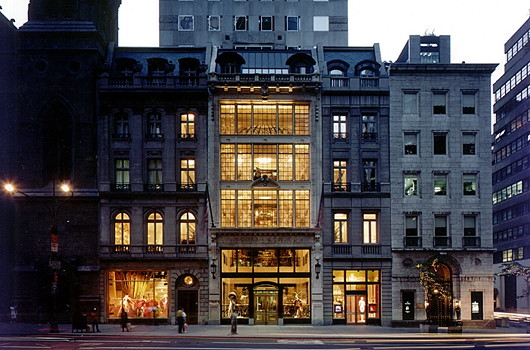
Other New York bookshops to close in recent years include the Librairie française, Coliseum Books, Gotham Book Mart, Urban Center Books, and further back more venerable institutions like Scribner’s and Brentano’s.
Top three photos: Mais Uma Pagina
Search
Instagram: @andcusack
Click here for my Instagram photos.Most Recent Posts
- West Point July 30, 2026
- Brunel’s Unbuilt Capitol February 3, 2026
- Cricket at Fordham January 27, 2026
- Palacio Barolo Revisted January 14, 2026
- Learning to Love Liguria January 14, 2026
Most Recent Comments
Book Wishlist
Monthly Archives
Categories