About Andrew Cusack
 Writer, web designer, etc.; born in New York; educated in Argentina, Scotland, and South Africa; now based in London.
 read more
News
Blogs
Reviews & Periodicals
Arts & Design
World
France
Mitteleuropa
Knickerbockers
Argentina
The Levant
Africa
Cape of Good Hope
Netherlands
Scandinavia
Québec
India
Muscovy
Germany
Academica
Norumbega No. 8

Have a look at the latest issue of Norumbega: Knights of Malta, Hungarian intellectuals, and a trip to Ulaanbaatar by London cab!
The Holy Saints of Russia
Russia remembers the murdered Tsar St. Nicholas II & his family

Christians in Russia yesterday solemnly remembered the brutal killing of the country’s Imperial Family by the Bolshevik revolutionaries 90 years earlier. Tsar Nicholas II, the Tsarina Alexandra, their daughters the Grand Duchesses Olga, Tatiana, Maria, and Anastasia, and the Tsarevich Alexei have all been added to the canon of saints of the Russian Orthodox Church. The Imperial Family were first officially recognized as saints by the Russian Orthodox Church outside the Soviet Union in 1981, and the Moscow patriarchate extended the same recognition in 2000.
Ingrid Betancourt Goes to Lourdes
Ex-hostage gives thanks at Marian shrine during its 150th year

Ingrid Betancourt has travelled to the Shrine of the Blessed Virgin at Lourdes in France to give thanks for her liberation from years of captivity as a hostage of the FARC. Alongside her mother, son, and daughter, Ms. Betancourt also offered prayers on behalf of those prisoners who are still held hostage by the FARC guerrillas.
Uribe for the White House?

Daniel Hannan, the best MEP blogger there is, thinks that Álvaro Uribe should take over the reins of the United States when he finishes his second term as President of Colombia. As Mr. Hannan points out, Uribe “has a better record on defeating terrorism than anyone else in the world, he’s a successful free marketer, and he’s the most pro-US leader in the Western Hemisphere.” Sadly, being pro-US is usually a bad sign in world leaders these days, but President Uribe is the exception that tests the rule.
President Uribe currently enjoys a 90% approval rating; President Bush hovers around 30%, while the United States Congress has reached a whopping 9% approval rating.
Castro on Franco
Saskatoon Cathedral
Matthew Alderman’s hypothetical counter-proposal

Matthew Alderman has designed a hypothetical counter-proposal for the new Catholic cathedral in Saskatoon, Saskatchewan which is infinitely more beautiful than the ugly modernist thingamajig that the diocese is actually building. Matt elaborates upon the problematic nature of the modernist design here and here.

Argentina’s Voice: La Prensa
TIME magazine, 26 October 1942
 In the ornate Paz family crypt in Buenos Aires’ comfortable La Recoleta cemetery, honors came thick last week to the late José Clemente Paz, founder of Argentina’s La Prensa. The Argentine Government issued a special commemorative postage stamp. Nationwide collections were taken to erect a monument. U.S. Secretary of State Cordell Hull sent a laudatory cable, as did many another foreign notable. It was the 100th anniversary of the birth of Argentina’s most famous journalist.
Although Don José has been dead for 30 years, the newspaper he founded 73 years ago has not changed much. La Prensa is THE Argentine newspaper, is one of the world’s ten greatest papers.
Polish, Curiosity, Comics.
A cross between the London Times and James Gordon Bennett’s old New York Herald, La Prensa is unlike any other newspaper anywhere. In its fine old building the rooms are lofty and spiced with the odor of wax polish, long accumulated. Liveried flunkies pass memoranda and letters from floor to floor on an old pulley and string contraption. But high-speed hydraulic tubes whip copy one mile from the editorial room to one of the world’s most modern printing plants—more than adequate to turn out La Prensa’s 280,000 daily, 430,000 Sunday copies.
Argentines are minutely curious about the world. Although newsprint (from the U.S.) is scarce, La Prensa usually carries 32 columns of foreign news—more than any other paper in the world. Four years ago most was European—today New York or Washington has as many datelines as London.
La Prensa’s front page is solid (save for a small box for important headlines) with classified ads. So, usually, are the following six pages—one reason the paper nets a million dollars or more annually. Lately La Prensa has made some concessions to modernity: it now carries two comic strips, occasional news pictures.
Deliveries, Duels, Discussions.
La Prensa will not deliver the paper to a politician’s office; he must have it sent to his home. It will not call for advertising copy. No local staffman has ever had a byline.
South American journalism is more hazardous than the North American brand. La Prensa’s publisher and principal owner, Ezequiel Pedro Paz, Don José’s son, has twice been challenged to a duel. Because he is a crack pistol shot, neither duel was fought. Now over 70, Don Ezequiel shows up at the paper punctually at 5 p.m. for the daily editorial conference with Editor-in-Chief Dr. Rodolfo N. Luque. Present also is his nephew and heir-apparent, handsome Alberto Gainza (“Tito”) Paz, 43, father of eight and ex-Argentine open golf champion. Significantly, La Prensa’s owner-publishers visit their editor-in-chief and not vice versa.
La Prensa’s foreign affairs editorials often wield great influence, but have not budged the isolationism of President Ramón Castillo. The paper has supported Franklin Roosevelt’s New Deal, pumped for the United Nations, denounced the totalitarians. But it speaks softly. When Argentina’s President Castillo gagged the press with a decree forbidding editorial discussions of foreign events, admirers of Don José recalled how he once suspended publication in protest at another Argentine President’s like decree. If old Don José were now alive, declared they, he would again have stopped La Prensa’s presses rather than submit to Castillo’s regulations. — TIME, Oct. 26, 1942

TIME magazine, 16 July 1934
Prensa Presses
On the roof of the imposing La Prensa building in Buenos Aires’ wide Avenida de Mayo is a large siren. Its piercing screech, audible for miles, heralds the break of hot news. Long ago a city ordinance was passed forbidding use of the siren and the publishers rarely sound it nowadays. But when some world-shaking event takes place, La Prensa’s horn shrills and a Prensa office boy trots downtown to pay the fine before its echo has died away.
Last week the fingers of La Prensa’s acting publisher, Dr. Alberto Gainza Paz, itched to push the siren button. There was much to celebrate. Not only was it Nueve de Julio, Argentina’s Independence Day, but potent old La Prensa was formally inaugurating a new $3,000,000 printing plant, finest in South America. Its holiday edition ran to 725,000 copies— 150,000 more than its previous record.
The plant is housed in a new building a half mile from the main office, in the rent-cheap industrial district. It is linked to the editorial rooms by pneumatic tubes. The installation includes a 21-unit Hoe press similar to that of the New York World-Telegram. The press is driven by 56 motors, is fed by 63 rolls of newsprint and two six-ton tanks of ink. A normal edition of 250,000 copies (400,000 Sunday) is spewed out in considerably less than an hour. Since Buenos Aires is so far from the Canadian pulp market, La Prensa keeps on hand up to 7,500 tons of newsprint, enough to supply its needs for three months or, in emergency, to produce a smaller paper for a year.
Completion of the new plant marked the almost complete retirement of La Prensa’s publisher and principal owner, Don Ezequiel P. Paz. Son of the late Dr. José C. Paz, who turned out the first copy of La Prensa 65 years ago on a tiny hand press, Don Ezequiel started to work around the shop as a youngster in 1896, took full charge while still a young man. He devoted his life completely to his newspaper, spent nearly all his waking hours in his incredibly ornate office, denied himself to practically all callers except his editors. Past 60, of nervous temperament, he lives nearly half the year at his French estate near Biarritz. On his transatlantic trips he customarily takes a large party of relatives, and for the sake of his diet, a cow. The cow makes the round trip but must be sacrificed in sight of her native land because of Argentina’s rigid quarantine against all imported cattle. Don Ezequiel sailed for Biarritz last month, regarding the new plant as perhaps the last important milestone in his publishing career. Childless, he turned his responsibilities over to his nephew, youthful Dr. Alberto Gainza Paz, whom he carefully tutored as he himself had been trained by Founder José. So puny in boyhood that he was not expected to live. Dr. Gainza made of himself one of the foremost amateur athletes in Buenos Aires.
Beyond dispute La Prensa is the leading newspaper in South America, is read throughout the continent. Sternly independent, it truckles to no political party, even refuses to accept political advertising on the ground that if any politician is really as good as he claims, he is legitimate news and will be reported accordingly.
To U. S. newsreaders, a typical copy of La Prensa is a curious sight. Prime headlines are massed in a six-column box on the front page, which is otherwise filled with classified advertisements. The “classifieds” run through the next six pages and supply the wherewithal for Publisher Paz’s proud boast that La Prensa is independent of large commercial advertisers. The news pages begin with a lengthy, learned article which most readers skip, but which is supposed to wield strong influence in high places. The news columns proper are top-heavy with foreign news. Probably no other newspaper in the world spends so much money on cable tolls—a fact partly due to Argentina’s cosmopolitan population. La Prensa demands important political speeches in full. It “discovered” Albert Einstein for the world press by first requesting United Press to interview him on his theory of relativity 15 years ago. After La Prensa printed it, U. P. decided to try Einstein on its U. S. clients. La Prensa gives any amount of space to amateur sports, demands play-by-play coverage on important chess matches, but refused Argentina’s Prizefighter Luis Firpo more than the barest mention even at the height of his popularity. It prints voluminous market news, lottery drawings, crossword puzzles, no comics except on Sunday. Its newsphotos are rare and inferior. On Sunday it offers rotogravure in color.
Employing no advertising salesmen, La Prensa never solicited an advertisement. Until a few years ago it would not permit advertisers to use large display type. It rejected a substantial Wrigley campaign because it hesitated to introduce the gum-chewing habit to Argentina. It saw no sense in a Quaker Oats breakfast food advertising program because Argentinians do not eat breakfast. However, La Prensa does print many an advertisement of doctors specializing in venereal diseases. La Prensa is one of the wealthiest newspapers in the world. The Paz family took from it enough to live in ease, plowed back huge sums for improvements and. notably, social services. One of the oldest services is a general delivery postal service, begun after the great immigration of the 1860’s when the Argentine post office proved hopelessly inadequate. To this day a letter addressed care of La Prensa will reach any Argentinian of known residence. Also La Prensa maintains free medical and surgical clinics for the poor, free legal service, and a free three-year music school. Its building houses banquet rooms, lecture halls, library, gymnasium.
The Paz family likes to regard La Prensa as Argentina’s property, themselves as hired managers. — TIME, July 16, 1934

CUSACK’S NOTE: La Prensa was confiscated by Peron’s dictatorship and its assets given to the Peronist CGT trade union. The family’s assets were restituted in 1988 and the newspaper refounded, but its readers had by then moved elsewhere and the La Prensa continues to this day in a much reduced form; its old headquarters on the Avenida de Mayo is now the Casa de la Cultura. The conservative La Nacion is now the only broadsheet in Argentina.


The Annual Inspection

The ceremonial Changing of the Guard takes place at Rideau Hall, Canada’s viceregal palace, and Parliament Hill during the warmer months of the year. I recall with great fondness a summer trip to Ottawa when I was but a little boy and watching the Changing of the Guard on the green in front of the splendidly gothic parliament buildings. I instantly wanted to become a Canadian soldier, and pondered how many chocolate bars I could hide in the bearskin cap of a red-tunic’d guardsman. (Needless to say, I have not become a Canadian soldier, but Sa Majesté need only call and I would be at her service).
Yet another reason to love the Boers
“Oom Paul” Kruger’s thoughts on the circumnavigation of the globe
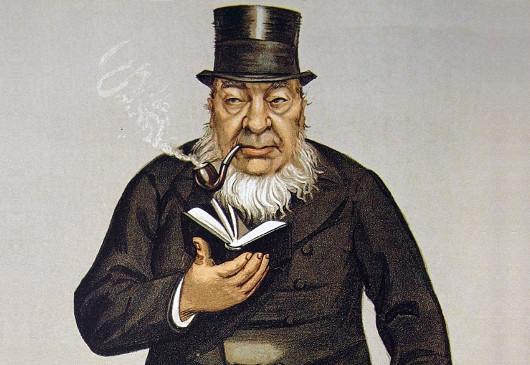
Joshua Slocum was a native of Nova Scotia who became an adventurer, seaman, and writer of some reknown in his time, and is perhaps best known both for his mysterious death and for being the first person to single-handedly circumnavigate the planet. Capt. Slocum published his memoirs of this trip in his 1899 book, Sailing Alone Across the World and one of the delightful little tales relayed is of the Captain’s docking at Durban in Natal and his journey inland to Pretoria in the Transvaal:
At Pretoria I met Mr. Kruger, the Transvaal president. His Excellency received me cordially enough; but my friend Judge Beyers, the gentleman who presented me, by mentioning that I was on a voyage around the world, unwittingly gave great offense to the venerable statesman, which we both regretted deeply.
Mr. Kruger corrected the judge rather sharply, reminding him that the world is flat. “You don’t mean round the world,” said the president; “it is impossible! You mean in the world. Impossible!” he said, “impossible!” and not another word did he utter either to the judge or to me. The judge looked at me and I looked at the judge, who should have known his ground, so to speak, and Mr. Kruger glowered at us both.
My friend the judge seemed embarrassed, but I was delighted; the incident pleased me more than anything else that could have happened. It was a nugget of information quarried out of Oom Paul, some of whose sayings are famous. Of the English he said, “They took first my coat and then my trousers.” He also said, “Dynamite is the corner-stone of the South African Republic.” Only unthinking people call President Kruger dull.
— Chapter XVIII, Sailing Alone Around the World, by Joshua Slocum
I agree entirely with Capt. Slocum’s conclusion.
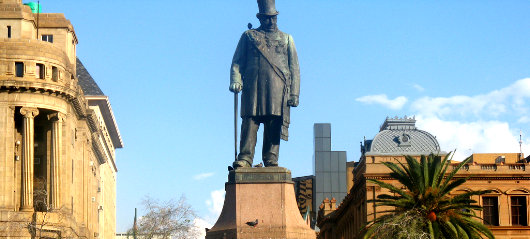
While his views on geography may not have been strictly orthodox, President Kruger is honored with an imposing monument in the Kerkplein, the central square of Pretoria, now the capital of all South Africa, not just the Transvaal. The President’s statue rests in an enviable position between two of the most handsome edifices in all of South Africa:
«Metropolis» rediscovered
Fritz Lang’s «Metropolis» was one of the most groundbreaking films of the silent era, and so the news that scenes previously lost have been rediscovered is most welcome. While «Metropolis» is one of those films that is perhaps best appreciated if only viewed once, I certainly look forward to a restored version being released in the next few years.
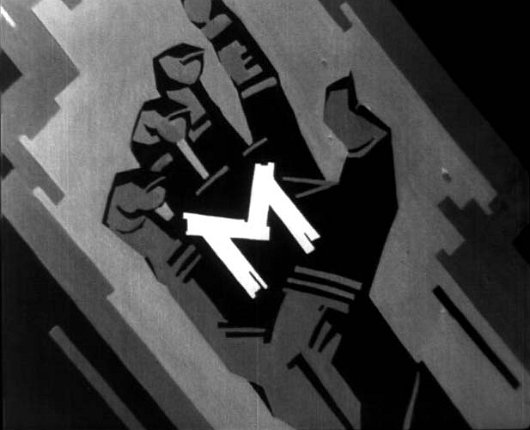
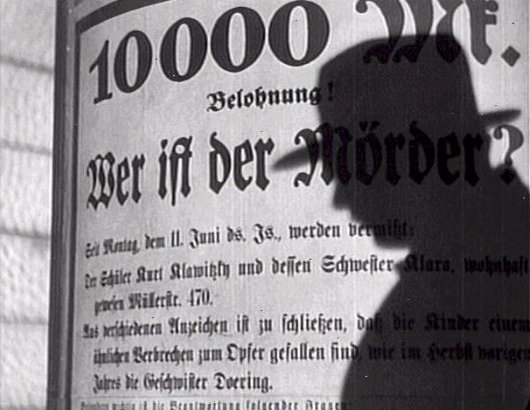
Still, my favorite of Fritz Lang’s works remains the classic «M», a sound film released in 1931, a few years into the talkie era. Peter Lorre is at his best in the starring role, and of course with Lang at the helm, «M» is expertly shot. Those whistled notes from Peer Gynt are never the same again after seeing this film!
Reunited

Ingrid Betancourt sees her children in person for the first time in over six years.
Ingrid Betancourt has described her liberation as a “miracle from the Virgin Mary” and has revealed how prayer kept her going during her six years and five months in captivity, admitting that the temptation of suicide was ever-present.
President Uribe gives credit where credit is due:
Do continue to keep up your prayers for Colombia, a land which is still plagued with many evils, though simultaneously bestowed with many graces.
So this is why people live in California

Jackson Street, San Francisco: 20 rooms, 9 bedrooms, 7 full bathrooms, 3 half-bathrooms, 7 fireplaces, hardwood floors, 4 storeys, an elevator, 4-car garage, and off-street parking.
Hic mihi patria est

The Fourth of July, we are told, is a day for celebrating the love of one’s country. Robert Harrington and I were sitting around one evening when we decided to found a guerrilla group. First, it needed a name; Front pour la libération de notre terre sacrée Amérique (or the FLNTSA) was a runner-up but we settled on the Village Green Preservation Society. Frowning upon the camouflage fatigues of most groups of this nature, we decided that our uniform would consist of tweed jackets, flat caps, and balaclavas.
But as our conversation continued we discovered, to our chagrin, that though we thought we were both from the United States of America, we were actually from entirely different countries. Robbo’s country is the nicer, rather horsey part of New Jersey near Princeton, whereas my homeland is mostly the part of New York between the Hudson and the Sound. We discovered we were fighting for the preservation of entirely different Village Greens, and that ma terre sacrée Amérique was entirely different from sa terre sacrée Amérique.
This is one of the problems of a “country” as large as the United States. I love my country, but what do I care about Montana or Texas or Alaska? I wish them well, to be sure, but they hardly seem to have much to do with my country. I once started to read a scaremongering article about the growing Mexicanization of California but I had to put it down after a few paragraphs because it didn’t seem to be anything I had to worry about. If southern California secedes and tries to join Mexico, well good for them! I’ll send them a bottle of champagne and get back in my hammock.
In The Napoleon of Notting Hill, Chesterton wrote:
In that spirit, I present to you below a map of my country, from Sleepy Hollow in the north, to Governors Island in the south. It is a mere approximation, as the borders are both indefinite and ever-shifting. Though highly populated, it is a bit on the small side, and I think I agree with Chesterton that that’s a good thing.

Gaudium magnum
The fruit of many prayers: Ingrid Betancourt is free

What a splendid thing is the liberation of Ingrid Betancourt after being held in captivity by the FARC for six years and five months. The Franco-Colombian politician was freed by the Armed Forces of Colombia in a raid planned so well that not even a single shot was fired. Ms. Betancourt has hailed the rescue operation as “perfect” and expressed her profound thanks to the Colombian military. It is understood that the commandos had an opportunity to take out as many as fifty FARC guerrillas but declined to both as a token of goodwill and in order to further encourage the massive desertions the FARC has suffered recently.
This is wonderful news for Betancourt’s family, but it is also great for Colombia and for the President of Colombia, Álvaro Uribe. President Uribe has been working feverishly during his time in office to restore the rule of law and the legitimate government throughout the troubled South American country. In contrast to his predecessors, he has been outstandingly successful in fighting the FARC (Revolutionary Armed Forces of Colombia), a Marxist guerrilla group and drug cartel that has terrorized the nation.
You will no doubt recall that President Uribe recently implored the intercession of the Blessed Virgin to prevent a possible war with Venezuela and Ecuador. We should all pray, as President Uribe does, for a Columbia that is united, free, peaceful, and just.
Catholics & the Military
Back in May, Michael J. Iafrate, a fellow Catholic who is a native of the great state of West Virginia and is now studying in the fair dominion of Canada, raised the subject of the obnoxious proselytism by Evangelical Protestants in our nation’s military on his very interesting site, catholicanarchy.org.
Mr. Iafrate commented:
To be fair, the early Christians were forbidden to serve in the Roman military because it typically involved making occasional sacrifices to pagan gods, not because of an objection to the military service itself. Indeed, we have early saints such as St. Maurice (pictured at left in a painting by Lucas Cranach the Elder), a Catholic African who served in the Roman military, and of course St. Alban as well.
 The story of Spc. Hall that Mr. Iafrate brings our attention to is not really about the “problem” of Christians in the military but rather one of the problems of Evangelical Protestant Christianity in general, exhibited in the specific situation of the military in particular. Many Evangelical Protestants know no form of evangelization other than the full frontal attack. I’m sure we’ve all had our fair share of run-ins with the “HaveyouacceptedJesusChristasyourLordandSavior?” type.
Catholics, meanwhile, are a bit lackluster in the realm in-your-face evangelization (and I’m not sure this is regrettable because I think a great many souls turn away from Christianity because Evangelical Protestantism is the only form they are familiar with). Why not, we would say, try 1) setting an example by leading a virtuous Christian life, 2) praying for those you hope God will convert, or 3) fasting, making little sacrifices, or offering up little sufferings?
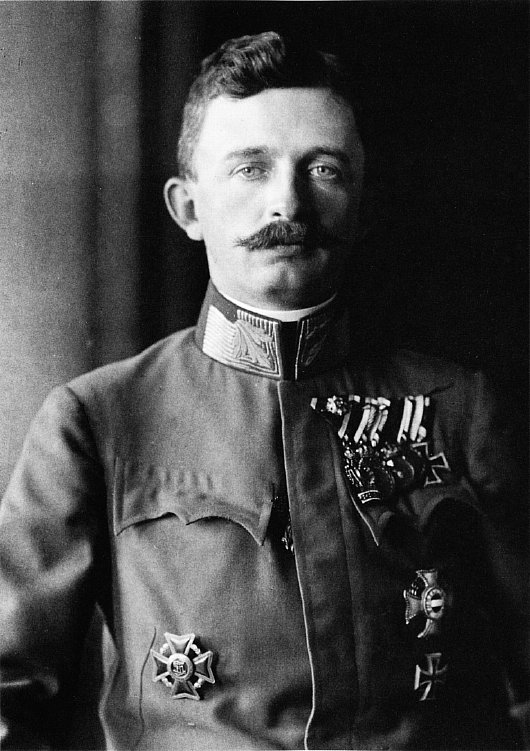
Historically, we Catholics have also preferred evangelizing through institutions, such as monarchies or universities or hospitals and other works of charity and mercy. Many a tribe and nation were converted by zealous souls going and converting their king or ruler first. Modern-day types will probably decry this as “elitist” — the Jesuit Fr. Reese, of America magazine notoriety, scandalously suggested that we shouldn’t be proud of an Emperor-Saint like Charles of Austria because it’s “elitist” and “not the kind of message we should be sending”. While Fr. Reese might be keen on abandoning the souls of the powerful and having godless un-Christian people running the world, I think most Catholics would prefer holy people to be in positions of power, and for people in positions of power to be holy.
I, for one, wish that traditional apostolic Christians (i.e. Catholics & Orthodox) would serve in the military in droves. I would feel much more comfortable were our armed forces heavily dominated by Catholics and Orthodox Christians than merely left to atheists, evangelical Christians, and run-of-the-mill materialists.
The fact that Spain ‘s military was so Catholic-dominated in the 1930’s saved the country from the Communists. (Though, admittedly, the Spanish Communists were so horrendous that the military junta even had a unbelieving Freemason among its members!). At the end of the Spanish Civil War, Franco laid his sword upon the altar of the Church of St. Barbara in Madrid, praying “Lord, benevolently accept the effort of this people, which was always Thine, which, with me and in Thy name, has vanquished with heroism the enemy of Truth in this century.” He then vowed never again to take up that sword unless Spain herself was threatened, and kept that vow til his death.
And then one thinks of anti-Nazi officers in the German army like Stauffenberg and Boeselager. One of the most faithful defenders of the (non-Catholic) Hawaiian monarchy against its American capitalist foes was a Catholic officer in the Hawaiian army. I certainly find it comforting that nearly half the officer corps of the British Army are Catholic.
UPDATE: Mr. Iafrate responds, both below and here.
The Blessing of an Apartment
Fallen Sparrow, a denizen of the Queens neighborhood of “Côté du Bois“, gives the low-down on the blessing of Matt Alderman’s apartment and unveiling of a new graphic work last Saturday. I acted as acolyte, which pretty much consisted of holding the bowl of holy water.
Herr Sparrow also covered the Dominican Saints Party that Matt threw at his place a little while back, in which partygoers nearly came to blows over which was better: the Basilica of Notre-Dame de Montréal or the Cathedral of Notre-Dame de Québec.
What Notburga Learnt in Sweden
Over at Ex Laodicea, Notburga tells us What she learnt in Sweden.
Stat Belgium, stat Europa

Search
Instagram: @andcusack
Click here for my Instagram photos.Most Recent Posts
- West Point July 30, 2026
- Brunel’s Unbuilt Capitol February 3, 2026
- Cricket at Fordham January 27, 2026
- Palacio Barolo Revisted January 14, 2026
- Learning to Love Liguria January 14, 2026
Most Recent Comments
Book Wishlist
Monthly Archives
Categories