About Andrew Cusack
 Writer, web designer, etc.; born in New York; educated in Argentina, Scotland, and South Africa; now based in London.
 read more
News
Blogs
Reviews & Periodicals
Arts & Design
World
France
Mitteleuropa
Knickerbockers
Argentina
The Levant
Africa
Cape of Good Hope
Netherlands
Scandinavia
Québec
India
Muscovy
Germany
Academica
Internet disorder and its possibilities
[Posted by Andrew Cusack on June 26, 2008 at “The Sniper’s Tower”, Taki’s Magazine]
The shady powers that control the world wide web have announced that everything you now know about the internet is about to change. Top level domains, or TLDs, are things such as .com, .org., .us and so on. Some are descriptive — .com, commercial; .edu, education — and others are geographical — .ca, Canada; .de, Germany — while still more are both — .com.au, commercial & Australian; .ac.uk, academic & British.
Now that you have gotten used to them all, ICANN (the Internet Corporation for Assigned Names and Numbers) have decided to open the floodgates and are planning to allow almost anything to be a TLD. Veteran ICANN-watchers will not be terribly surprised by this, as the consortium has tended towards greater laxity and disorder. First they introduced “.info”, extending TLDs to four letters straight, then they introduced the horrendously unhandsome “.museum” (would not “.mus” have been more sensible?). The do-gooders over at ICANN have now simply thrown up their hands and said “Feck it all, sort yourselves out”.
Libertarians will, no doubt, rejoice, but I think there was a certain harmony and order to the current (soon to be previous) set-up. The stalwart .com, the stately .co.uk, the exotic .co.za, the “we weren’t quick enough to get a .com address” .net, the slightly suspicious .cn — all these will stay, but they will be diminished by the addition of God knows what. Perhaps .sex, or .drugs, or .rocknroll. Maybe we will see the heralds of progress change their URLs: weeklystandard.neo and thenation.lib? How about johnmccain.war and obama.tax? National Review might try to recall its olden days with nationalreview.wfb.
And what about we conservatives? There is at least some comfort for Knickerbocker reactionaries like me in that we may one day have email addresses that end in @yahoo.nn (for New Netherland), and I know of at least a dozen Europeans who would love to have to have @yahoo.sri addresses (that’s Sacrum Romanum Imperium, not Sri Lanka). I just hope the good people of Newfoundland grab .nfl before the football people do.
The European I grew up with
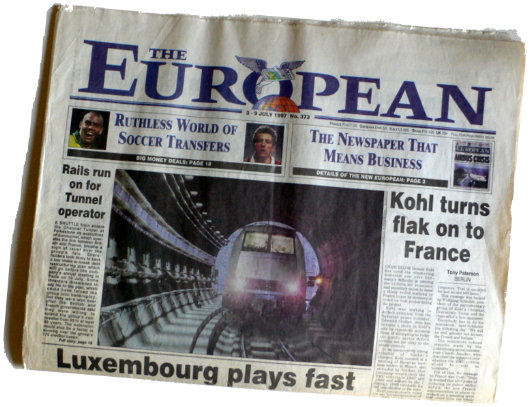
When I was a kid, The European — the weekly broadsheet that billed itself as “Europe’s national newspaper” from 1990 to 1998 — was my favourite newspaper and was an indelible part of our Sunday routine in the Cusack household. First Mass, then a trip to the pastry shop, then pick up The European at the newsagents next door, and back home to read and munch al fresco.
The paper was fiercely Euro-federalist until Andrew Neil took over, so I suspect were I to look back on a few copies now, I would probably strongly disagree with its politics. The late Peter Ustinov was a columnist, and he was not just a European integrationist but indeed a major supporter of world federalism (i.e. the abolition of nations and the rule of the planet by a single government; in theory democratic but inevitably a dictatorship of course).
Nonetheless, it was a very broad paper, with news from all across the continent from Cork to Constantinople, and I have no doubt its coverage played at least some role in the formation of your humble and obedient scribe.

The Royal Military College of St. John

WHAT BETTER WAY to celebrate this, the feast of St. John the Baptist and the national day of Quebec, than to bring you news of the reëstablishment of the Collège militaire royal de Saint-Jean. The site in the town of Saint-Jean-sur-Richelieu was first put to a military use in 1666 when the French soldiers of the Carignan-Salières Regiment. The Collège militaire royal, however, was only founded in 1952 when it was inaugurated by the Rt. Hon. Vincent Massey, CC, CH, GCStJ, CD, PC as a classical college to increase the number of French-speaking officers in the Army, the Royal Canadian Navy, and the Royal Canadian Air Force.
The Primera Revista Latinoamericana

We are of the opinion that the more publications, the merrier, and so we certainly welcome the foundation of the Primera Revista Latinoamerican de Libros. The PRL, which is a sort of Hispanic version of the TLS, started printing last September and is based right here in New York. The bimonthly is published in Spanish but reviews both books that are printed in Spanish and books printed in English. Again, like the TLS, it is not limited to book reviews but features other literary essays as well.

The head honcho at the PRL is Fernando Gubbins, who has earned a master’s degree in Public Affairs from Columbia here in New York and a philosophy degree from the Pontifical Catholic University of Peru. Mr. Gubbins previously edited the opinion & editorial section of the Peruvian newspaper Expreso, and has worked with the Economist Intelligence Unit.
Not being a hispanophone, I am not qualified to render judgement on the quality of the publication’s content, the PRL in print is well designed and has a very traditional but modern feel to it, and it was a pleasure flicking through its pages. The Primera Revista is a welcome addition to the literary world of New York, and of Latin America.

The almighty loden coat
 Judging by the evidence (yours truly, left, in Connecticut late last fall*), I quite agree with the fellow who wrote in The Field this month:
“The Bridge of San Luis Rey”

New Spain never looked so good as in the 2004 film of Thornton Wilder’s novel The Bridge of San Luis Rey. This is no doubt partly because it wasn’t filmed in New Spain but in Old Spain (specifically in Toledo and Málaga).

Trooping the Colour

At the Queen’s Birthday Parade on Saturday, the colour was trooped by none other than a friend of mine and fellow St. Andrean who is now an officer in the Welsh Guards. He is seen here, at right, in the costume of Field Marshal the Earl Haig (sometime Lord Rector and then Chancellor of the University of St Andrews) for the annual Kate Kennedy Procession.
Buckham’s Britain

 The Daily Telegraph shows us a number of photos taken by Alfred Buckham, an aerial photographer of the 1920s. Buckham was introduced to the art during his time with the aerial reconnaissance branch of the Royal Naval Air Service in the First World War.
The images themselves are composite photographs combining actual aerial views of cities and landmarks throughout Great Britain with views of the aircraft of the day flying through the skies.
As the Telegraph notes, Buckham “eschewed safety devices, saying: ‘I have used a safety belt only once, and then it was thrust upon me. I always stand up to make an exposure and, taking the precaution to tie my right leg to the seat, I am free to move about rapidly'”.
A new book on Buckham, A Vision of Flight: The Aerial Photography of Alfred G. Buckham, has just been written by Celia Ferguson, and is published by The History Press.
Los Patricios – The Patricians

In my carelessness last week, I mistakenly wrote that the presidential guard in Buenos Aires are the “Patricios” regiment, when (as Cruz y Fierro corrected me) it is actually the Regiment of Horse Grenadiers. The First Regiment of Infantry “Patricios” (literally “Patricians”) is the oldest regiment in the Argentine Army and predates by ten years the country’s Declaration of Independence. It was first assembled as the “Legion of Volunteer Urban Patricians” in 1806 to repel the English invasions of that year.
In these two photos you can see the “Patricios” performing the somewhat-rare ceremony of the changing of the guard at the Cabildo, across the Plaza de Mayo from the Casa Rosada.

andrewcusack.com: Argentina


Changing the Guard in Buenos Aires

The changing of the guard at Government House, Buenos Aires, the Presidential Palace of the Argentine Republic more popularly known as the ‘Casa Rosada’ due to its pink hue.
The Patricios regiment who provide the presidential escort were founded in 1806, making them as old as New York’s 7th Regiment. (Unlike the 7th, however, Los Patricios not only still exist but indeed flourish as the oldest regiment in the Argentine Army).
UPDATE: Cruz y Fierro corrects me that the presidential guard are formed by the Regiment of Horse Grenadiers, not Los Patricios. I have often confused the two in the past, I must admit.

andrewcusack.com: Argentina
New vice-regal flag for New Zealand

Elizabeth II, Queen of New Zealand, recently approved a new vice-regal flag (above) for her governor-general, His Excellency the Honourable Anand Satyanand, PCNZM, QSO, KStJ. The flag has a blue field charged with the shield from the coat of arms of Her Majesty in Right of New Zealand, topped by St. Edward’s crown. The previous flag (below) was of the standard viceregal type for the British Commonwealth of Nations, depicting the crest from the British royal arms with a scroll bearing the name of the dominion.
His Excellency, incidentally, is the first Catholic governor-general in the history of New Zealand.

Return of the Warner!
 Gerald Warner of Craigenmaddie, one of Britain’s greatest living journalists, now has a splendid blog over at the Daily Telegraph called Is It Just Me? I am sure you will all want to take a look at it. Already he has an appreciation of the recently deceased Franz Künstler, until his death the last living soldier of the Hapsburg army, a brief missive pointing out how terribly un-British the idea of a “Britishness Day” is, and a forthright post on the value of the stiff upper lip in times of crisis.
Much of what Gerald says is, to sensible people, simply obvious. But one of the great dangers of our modern age is that what ought to be simply obvious is becoming less and less so due to deliberate obfuscation by the political and media classes. Gerald’s talent is that he tells you what’s what and that he manages to do it with a graceful alacrity, and often wit, that are a welcome — and, sadly, rare — treat. Go, read, enjoy!
Warneriana: Gerald Warner Axed | ‘The Mass of All Time answers that need’ | Martyrs of Spain, Pray for Us! | Warner on the Gotha
Professor Haldane in the Catholic Herald

The Catholic Herald talks to Professor Haldane about the Church’s failure to halt the revolting HFE bill that recently passed (the one authorizing animal-human hybrids and the creation of human “saviour siblings” in labs for organ harvesting) and they have a nice picture of the Good Professor in his sitting room at St Andrews. Prof. & Mrs. Haldane were always very welcoming to students and had a whole bunch of us over a number of times. As I wrote before:
He has a library to be envied as well.
In my very first year at St Andrews, I had the privilege of shaking the hand of none other than Mr. James Macmillan (Greatest Living Scotsman!) at Professor Haldane’s. Certainly one to remember.


Mutton-chops

Woah! Look at the mutton-chops on our own James Poulos. Someone better bring the smelling salts for Mrs. P.. If only they had had blogging at the time of the Charlottetown Conference, I am certain Mr. Poulos would feel quite at home amongst the Fathers of the Canadian Confederation. Mutton-chops galore, up north yonder.

Norumbega No. 6

The sixth Norumbega is out now, and the site’s undergone a bit of a redesign. This fortnight we’ve got a main feature on the link between mass democracy in politics and dehumanization in warfare. Further pieces on the downfall of the International Herald Tribune‘s dingbat, on a German poet’s thoughts on NATO’s 1999 Serbia war, on the parliament of Quebec voting to keep a Crucifix in its debating chamber, and a few final words of advice on what to do should a Hohenzollern appear in your study.
The Crown of Disenchantment
Over in Great Britain, the House of Commons recently passed the Human Fertilisation and Embryology Bill which, among other things, keeps the time limit on abortions at twenty-four weeks (in spite a hope that it would be lowered), authorizes the creation of “savior siblings (brothers and sisters deliberately created in a lab solely for their organs to be harvested for use by the already-born), and allows for the creation of animal-human hybrids. The British human rights activist James Mawdsley, famously jailed for over a year by the military junta in Burma, has asked opponents of the HFE Bill to sign a petition to Queen Elizabeth II imploring her to withhold the royal assent necessary for the Bill to become law.
Under the British constitution, a bill only becomes a law when it has received the assent of all three components of the British Parliament: the Commons, the Lords, and the Crown. The last time the Crown withheld consent was in 1708 when Queen Anne refused to sign the Scottish Militia Bill. Since that time, it has been an unspoken convention that should the Crown object to a piece of legislation, it should privately inform its ministers before the legislation is voted upon in order for it to be withdrawn, thus preventing the scandal of the Crown and the Commons appearing to be in disagreement. Despite this convention, however, the Crown still has the right to withhold consent, but merely neglects to exercise that right.
While the Crown has faded to near-irrelevance in the everyday workings of the British government, this was certainly not always the case, and the Crown has intervened in politics several times since Queen Anne’s refusal of assent in 1708. What follows are but a few twentieth-century examples.
In 1925, William Mackenzie King was Prime Minister of Canada with 99 Liberal MPs to the Conservative opposition’s 116. He was able to do this by forming a minority government with the support of the 24 MPs of the Progressive Party. A year later, Liberal MPs were implicated in a bribery scandal and so the Progressives having withdrawn their support for the minority government. As parliament debated a motion to censure the MPs involved, the Prime Minister asked Lord Byng, the Governor-General of Canada (and thus the direct representative of the Crown), to dissolve parliament and call a general election.
Lord Byng did not want it to appear that the Crown was allowing parliament to be dissolved in order to prevent the censure of government MPs and so used the royal prerogative and refused to call an election. The Conservatives, as the largest party in parliament (Lord Byng argued), should have a chance at forming a government instead. The Governor-General invited Arthur Meighen, leader of the Conservatives, to form a government instead, and Meighen agreed. This, in turn, infuriated not only the Liberals but also the Progressives, throwing the middle-man back into the Liberal camp. Meighen put his government up to a vote of confidence, lost it by one vote, and so resigned and asked the Governor-General to dissolve parliament and call an election, which Lord Byng duly did.
“I have to await the verdict of history to prove my having adopted a wrong course,” Lord Byng wrote, “and this I do with an easy conscience that, right or wrong, I have acted in the interests of Canada and implicated no one else in my decision.”
In 1931, when the Labour Prime Minister Ramsay MacDonald submitted his resignation to the King, George V took the unprecedented step of asking MacDonald to form a national government with the support of Conservatives and Liberal Members of Parliament. MacDonald lasted as Prime Minister until 1935, but Great Britain would not be governed by a single-party government again until 1945.
More recently, the Crown controversially intervened in Australian politics in 1975. Gough Whitlam’s Labor government commanded a majority in the House of Representatives but the opposition coalition of the Liberals and the National Country Party held sway in the Senate. It is traditional in Westminster-style systems that if a money supply bill fails to pass, the government falls with it. The Senate refused to vote on the annual Budget, in hopes of provoking Whitlam into calling a new election. Whitlam stubbornly refused, and the impasse grew as the weeks passed and, with no budget approved, it looked like the government of Australia would not be able to meet its financial obligations for the year.
Finally, the Governor-General of Australia, Sir John Kerr, used the royal prerogative to dismiss Whitlam as Prime Minister, asked the opposition leader Malcolm Fraser to take the job. Fraser formed a caretaker government solely to pass the appropriations bill then immediately called a new election which his own Liberal/National Country coalition won handily.
Such royal interventions, however, are not limited to the English-speaking world. Belgium’s King Baudouin I, a Charismatic Catholic and friend of Francisco Franco, famously refused to give assent to a bill liberalizing the kingdom’s abortion laws. The Prime Minister, Wilfred Martens, simply had the King declared temporarily unable to reign and the Government signed the Bill in place of the King (as is provided in the Belgian Constitution). Two days later, the Government declared the King able to reign once more, and all was back to normal (except for the unborn children killed thereafter, of course).
One of the great benefits of a monarchy is this: that the Crown act as a source of authority, free from democratic accountability, who is capable of blocking any egregious acts which the government of the day may attempt. The HFE Bill is the perfect example of a bill the Crown ought to reject, for the benefit of all the kingdom, most especially the unborn. Yet we can reasonably assume that Elizabeth II will grant her assent to this travesty of law nonetheless, as the current occupant of the throne has (ironically) so thoroughly and woefully imbibed the democratic spirit that she knows not how to fulfill her purpose and duty as Queen. (It is important to note that in neither the King-Byng affair nor the Whitlam-Kerr affair was the Governor General acting on the orders of the actual person who was the Crown at the time, but rather on their dutiful instinct as the local incarnation thereof). It is disappointing to those who are unflinching in their attempts to defend the British Monarchy that the British Monarchy insists on participating in, and sometimes urging on, the very sort of wickedness which we look to the Crown to protect us from. Alas, so far we have looked in vain.
Search
Instagram: @andcusack
Click here for my Instagram photos.Most Recent Posts
- West Point July 30, 2026
- Brunel’s Unbuilt Capitol February 3, 2026
- Cricket at Fordham January 27, 2026
- Palacio Barolo Revisted January 14, 2026
- Learning to Love Liguria January 14, 2026
Most Recent Comments
Book Wishlist
Monthly Archives
Categories