Arts & Culture
About Andrew Cusack
 Writer, web designer, etc.; born in New York; educated in Argentina, Scotland, and South Africa; now based in London.
 read more
News
Blogs
Reviews & Periodicals
Arts & Design
World
France
Mitteleuropa
Knickerbockers
Argentina
The Levant
Africa
Cape of Good Hope
Netherlands
Scandinavia
Québec
India
Muscovy
Germany
Academica
The new Times of London online
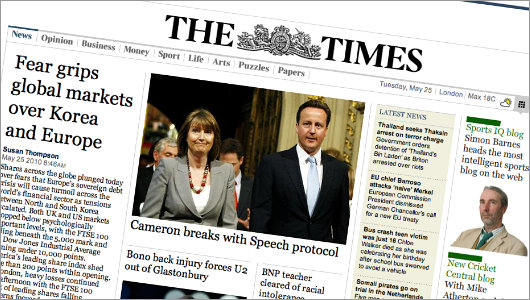
IAM MILDLY obsessed with newspaper design (in case you hadn’t noticed that already). But even those few newspapers that manage to either be attractive or worth reading (or indeed both) usually have websites that are astoundingly ugly. Check out the websites of The Scotsman, Le Monde, or the Times of India. They vary from awful to “meh”. The website of The Hindu is ugly, but is being replaced by a much more handsome design. Despite the over-sized ad on the index page, Die Zeit‘s website is on the handsome side of things, but that of the Neue Zürcher Zeitung is a mixed bag, some well-done details here, other poor ones there. I despise lefigaro.fr, especially since they started charging for their e-paper edition. The structure and flow of telegraph.co.uk is actually good, but the detailing isn’t and (like faz.net) it poorly reflects its newspaper’s personality.
Along then strolls the once-venerable Times (f. 1785), with a brand spanking new website at thetimes.co.uk. Clear, orderly, precise in its details, and just plain handsome in its overall design. There’s nothing particularly special or over-the-top about it; it’s just well done, but that is shockingly rare for newspapers today. (more…)
Swellendam Church Tower
In this video, the goodly folk of Swellendam demonstrate for us how not to remove a rotted wooden church tower. The little kid is a hoot — “It will get vrot and it will fall off on someone’s head”. The church tower has since been restored to its original iconic profile.
London Bridge City: The Neo-Venetian Scorned
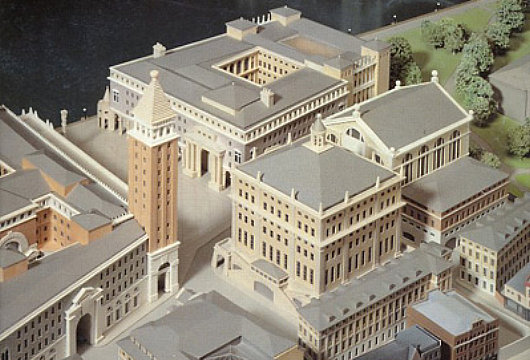
JOHN SIMPSON AND Partners 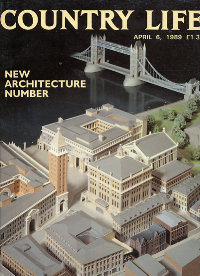 are one of the most prominent firms promoting classical architecture and urban design in Great Britain. They are perhaps most widely known for the work they did on the Queen’s Gallery at Buckingham Palace, as well as for the rejected scheme to redevelop Paternoster Square next to St. Paul’s Cathedral. Contemporary to their ultimately unsuccessful Paternoster Square bid was another ambitious scheme, Phase Two of the London Bridge City development. For Phase Two, Simpson composed a miniature Venice-on-the-Thames complete with Piazza San Marco and ersatz campanile. There seems, however, to be something just a bit un-English about the whole project. There are numerous examples of Ruskinian Venetian buildings throughout Britain, and indeed the Commonwealth, but an entire complex of Anglo-Neo-Venetian seems a bit over-the-top. Still, one can’t deny preferring a touch of Simpson’s over-the-top Venetian to the glass-plated boredom developers usually offer the public.
London Bridge City, Phase Two was proposed in the aftermath of the hugely popular speech by Prince Charles in which he condemned a planned modernist addition to the National Gallery as a “monstrous carbuncle on the face of a much-loved and elegant friend”. A bit of a donnybrook erupted between the architectural elite on the one hand (supporting the carbuncle) and the public on the other (supporting the Prince of Wales) and many a property developer was caught in the rhetorical crossfire. LBC’s backers decided, as an act of pragmatism, to come up with three radically different schemes in different styles and present them for consideration. (more…)
Cape Town’s Other St. George’s
The Greek Orthodox Cathedral of Saint George
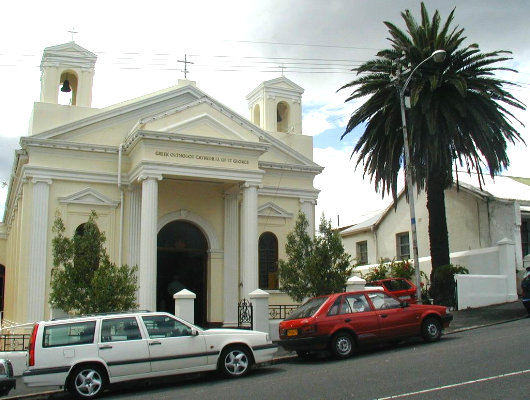
If you hear of “St. George’s Cathedral” in Cape Town, you naturally think of the big stone colossus at the bottom end of the Company’s Garden smack dab in the middle of the Mother City. There is, however, another St. George’s Cathedral, the Greek Orthodox Cathedral of St. George on Mountain Road in Woodstock. The Greek Cathedral was built in 1903–04, just a few years after Cape Town received its first Greek Orthodox priest, and expanded in 1983. Liturgies tend to be either in Greek or English, though there is an Afrikaans monastery at Robertson.
The Holy Archdiocese of the Cape of Good Hope was established in 1968 under the (Greek Orthodox) Patriarch of Alexandria and All Africa. The archdiocese covers the Western, Northern, and Eastern Cape provinces, the Orange Free State, KwaZulu-Natal, Namibia, Lesotho, and Swaziland.
I only ever knew one South African of Greek extraction (Dimitri! Not just a good egg, but a top-notch chef as well), but I assume that folks of Hellenic extraction enjoy the Mediterranean climate of Cape Town and its environs.
Cape Town’s New Way to Get Around
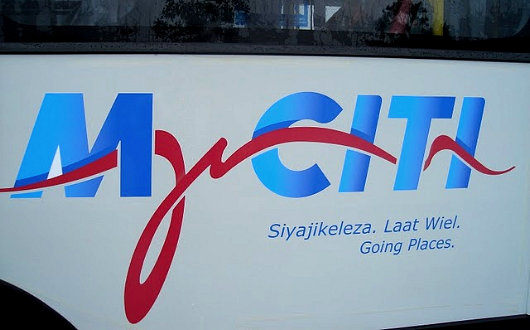
Over at Fascination Street, Brent Smith shows us the newly revealed branding for Cape Town’s new integrated rapid transit system: MyCiti. I’m not partlicularly impressed. Most of my fellow uitlanders will be forgiven for lacking an understanding of the stylised freehand letter ‘y’, which is rather tortured into representing an outline of Devil’s Peak, Tafelberg, and Lion’s Head. Mr. Smith diplomatically reserves judgement but I think they could’ve done better, although they could have done much worse.
A New Scots Town in the Highlands
The 20th Earl of Moray teams up with Miami-based firm Duany Plater-Zyberk to plant a New Town of 10,000 inhabitants outside Inverness
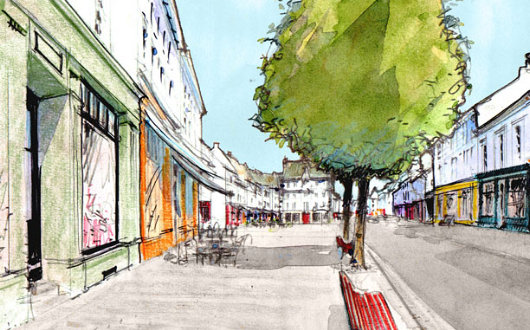
BELEIVE IT OR not, Inverness is one of the fastest-growing cities in Europe, and a local landowner, the 20th Earl of Moray, has teamed up with Duany Plater-Zyberk, an American firm known for its traditional architecture and urbanist ideas, to help create a sustainable new town of 10,000 inhabitants near the “Capital of the Highlands”. Tornagrain will rest on a 200-hectare (500-acre) site on the A96 corridor between Inverness and Nairn. Much of the recent growth in the Highlands has been poorly managed, raising concerns of suburban sprawl and poor land management. Moray Estates, the land holding company of the Earl of Moray (pronounced ‘Murry’) has decided to take the lead by planning a new town in the best tradition of Scottish architecture and urban development. (more…)
The Old New York Observer Building
No. 54, East Sixty-fourth Street
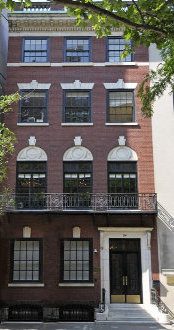
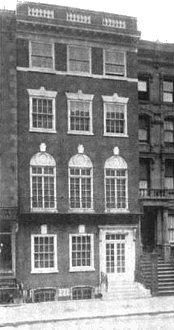
“FOR 17 YEARS,” writes Peter W. Kaplan, “since The New York Observer entered city life in 1987, it has existed within a red brick and white-marble-stepped townhouse on East 64th Street.” Designed by Ernest Flagg and Walter B. Chambers during their brief partnership, No. 54 East Sixty-fourth Street (between Park & Madison) was built in 1907 as a private residence for Robert I. Jenks. The AIA guide accurately describes it as “four stories of delicate but unconvincing neo-Federal detail… a minor Flagg.” In 1947, the townhouse was converted into offices for the Near East Foundation, which was founded in 1915 to provide relief for Armenian refugees from the Ottoman Empire and later took on greater responsibilities in North Africa and the Levant. It was then bought by Arthur L. Carter, the founder and publisher of the New York Observer for use as the salmon-tinted newspaper’s headquarters.
In 2004, the Observer moved down to Broadway, two blocks south of the Flatiron Building (and just a few blocks up from The New Criterion whose founder, Hilton Kramer, was for nearly two decades the art critic for the Observer). The townhouse was sold by Carter to the Russian-born Janna Bullock, real estate developer & sometime Guggenheim foundation board member for $9.5 million in the year the newspaper moved out. In 2005, Bullock renovated the building and had it used at the Kips Bay Decorator Show House for the year before selling it on to the Irish investor Derek Quinlan for $18.74 million. Quinlan put it on the market for $36 million but last year the asking price was chopped to $27 million.
Twenty-five feet wide, five stories, and with over 10,000 square feet, No. 54 was probably the only newspaper headquarters to feature nine working fireplaces, rosewood panelling, and oak wainscoting. But the best feature, by a mile, is the splendid iron-railed staircase, which looks like it was lifted straight from Paris. Elegant and graceful, a rare century-old survival in Manhattan. (more…)
Cockerell’s Carlton Club
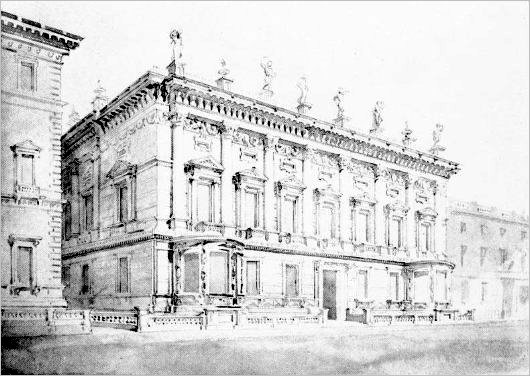
Charles Robert Cockerell is best known for designing both the Ashmolean Museum at Oxford and its Cambridge equivalent, the Fitzwilliam Museum. He is also, alongside William Henry Playfair, responsible for the twelve-columned National Monument that sits atop Calton Hill in Edinburgh — allegedly unfinished, though there is considerable debate over whether this is so. It’s not widely known, however, that the famous architect Cockerell completed a design for a new home for the Carlton Club on Pall Mall in London.
Originally Cockerell had declined the opportunity to submit a design, with such lofty names as Pugin, Wyatt, Barry, and Decimus Burton also declining the offer. A few years later, Cockerell nonetheless worked on this design for the Tory gentlemen’s club, which is superior to that conceived by another architect which was eventually built. Cockerell devised a “lofty Corinthian colonnade of seven bays” according to the Survey of London. “The columns have plain shafts, their capitals are linked by a background frieze of rich festoons, and the Baroque bracketed entablature is surmounted by an open balustrade with solid dies supporting urns and gesticulating statues.” (more…)
The Oriental Club
Stratford House, London
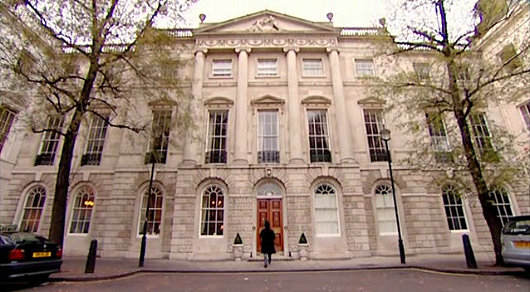
JUST STEPS AWAY  from Oxford Street, one of London’s busiest thoroughfares, rests a quiet little street called Stratford Place probably familiar only to Tanganyikans or Batswana seeking counsel from their countries’ high commissions. At the termination of the dead-end street sit the stately quarters of the Oriental Club: Stratford House. The club was founded in 1824, as British involvement and influence in both India and the Orient was waxing rapidly. General Sir John Malcolm, sometime Ambassador of His Britannic Majesty to the Court of the Peacock Throne (which is to say, Persia), coordinated the founding committee and advertised a club which would draw its members from “noblemen and gentlemen associated with the administration of our Eastern empire, or who have travelled or resided in Asia, at St. Helena, in Egypt, at the Cape of Good Hope, the Mauritius, or at Constantinople.” (more…)
Classical South Africa
I’m rather fond of the little coin logo of the Classical Association of South Africa, which appears on the front page of the society’s scholarly journal, Acta Classica: Verhandelinge van die Klassieke Vereniging van Suid-Afrika.
CASA also publishes, in cooperation with Stellenbosch University, Akroterion: Tydskrif vir die Klassieke in Suid-Afrika.
The study of our ancient civilisation is alive & well in South Africa!
The New Yale Colleges
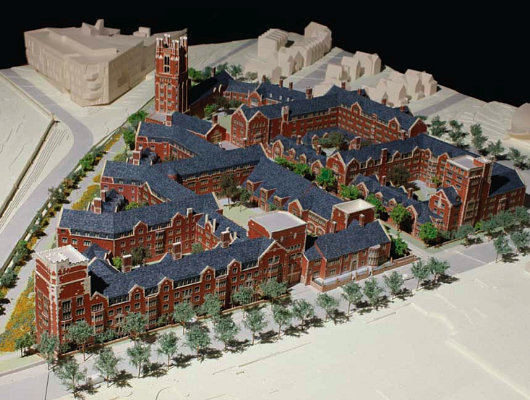
Yale University announced in 2008 that it would erect two new residential colleges in order to expand its undergraduate population without putting further strain on the twelve residential colleges that currently exist. Reportedly, Yale officials took a look at the new Whitman College at Princeton University, designed by traditional architect Demetri Porphyrios and decided even that wasn’t traditional enough. They commissioned Robert A. M. Stern, an architect who has, on occasion, proved exceptionally capable in traditional styles (the American Shingle style in particular), to design the two new colleges at the Connecticut university.
While the new colleges are currently being referred to as ‘North College’ and ‘South College’, there is little doubt that each college will find a generous benefactor who will endow it with funds and in return deign to allow the college to be named after the deep-pocketed soul.
The new colleges will, appropriately, be built in the Collegiate Gothic style, but will be faced in brick instead of stone. Brick facing in Gothic-style buildings always leaves one with a slight dissatisfaction, I’m afraid. Still, the decision to build in a traditional style is of course commendable.
For a commentary on the Collegiate Gothic of today, see this bit from Dino Marcantonio.
Here follow a few of the architect’s renderings of the new colleges. (more…)
Tintin à Quebec
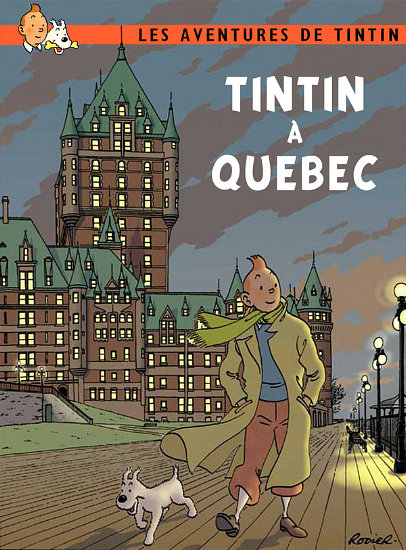
Tintinophilia and its allied science of Tintintology can almost seem like a cult sometime, with Moulinsart, the commercial wing of the Hergé Foundation, acting feverishly to quell any and all unauthorised outbreaks of Tintin resurrection. Their assiduity notwithstanding, Tintin pastiches are fairly common (though illegal) and vary in nature from respectful admiration to downright mockery. The Quebecois cartoonist Yves Rodier is one of the foremost pasticheurs of the famous Belgian boy reporter, and produced this cover (above) of a non-existant Tintin book set in the beautiful capital city of Canada’s French province.
While Tintin did visit Scotland in The Black Isle, I’d love to see a Tintin in Edinburgh book, and even more so Tintin in the Cape.
The Clootie Dumpling
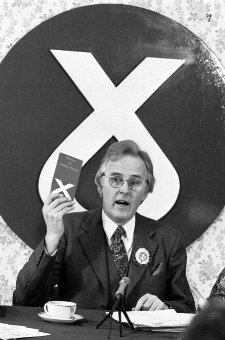 IT IS A DESIGN masterstroke, combining simplicity and ease of recognition with layers of symbolism. The emblem of the Scottish National Party is just one single line that descends, turns around, and crosses itself, but while remaining uncomplicated manages to evoke the Saltire (Scotland’s flag), the thistle (Scotland’s flower), and — the pudding which has given the logo its nickname — the clootie dumpling, a Scots specialty. And yet, despite its ubiquity, there is surprisingly little to be found online about the history of the SNP’s clootie dumpling.

The emblem was commissioned by William Wolfe (right) in 1962 for the parliamentary by-election in which he was standing as the Scottish Nationalist candidate. The party had typically employed a lion rampant as its symbol, which Wolfe thought too complex, and got Julian Gibb (in his own words, “scarcely out of childhood”) to design the brilliantly simple logo. “A political visionary with an eye for iconography,” according to Gibb, Wolfe used the emblem in the unsuccessful by-election campaign and a year later successfully proposed it to the party for adoption as the party emblem.
“The adoption of a geometric logotype is a bold act for a political organisation, especially a nationalist one, with the swastika a not too distant memory,” writes Gibb. “But the inner logic of the thing was persuasive. Forbye imagined allusions to saltire, thistle, and clootie dumpling, there was perhaps something irresistible about virile angularity supported on swelling curvature, implying among other things that in this outfit, the mechanistic depended on the organic. At one end of the scale of application it was devised to be hastily slapped on walls with a furtively loaded brush (the aerosol age had yet to come) and a quick flick of the wrist – no skill required. Try doing that with the lion rampant.” (more…)
Christen Købke in London
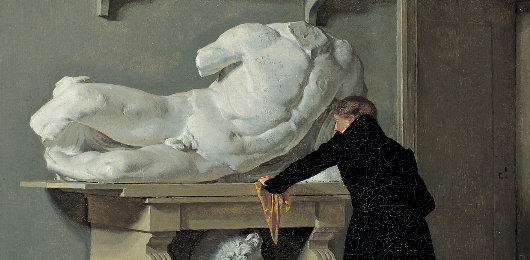
THROUGH JUNE 13, the National Gallery in London is exhibiting “Christen Købke: Danish Master of Light”, a small show of the neglected Danish Golden Age painter but the first exhibition exclusively of his works outside of Denmark. “Kobke generally chooses the quietest corner, or a view from the side,” writes Waldemar Januszczak in The Times. “What fascinates him is the way light falls on the old stones, or the tufts of grass growing between the cracks. Throughout his art, whether he is painting landscapes or people, Købke seems always to be noticing the decay of the world he grew up in.” Januszczak suggests that the warmth of Købke’s work is in reaction to the turbulence of his country’s position in Europe at the time — Denmark backed the wrong horse in the Napoleonic wars and turned to neutrality, only to face a pre-emptive attack by the British in which Copenhagen was ferociously bombarded. The painter was born three years after this humiliation, and at age 12 began his studies at the Royal Danish Academy, where he studied under Christoffer Wilhelm Eckersberg, the ‘Father of Danish painting’.
The talented Købke painted portraits, landscapes, and other scenes. The show at the National Gallery includes my favourite Købke portrait, that of his friend and fellow artist, the landscape painter Frederik Hansen Sødring, on loan from Copenhagen’s Hirschsprung Collection.
His capability aside, what I like about Købke is that he is a certifiable local boy, rarely straying from the vicinity of his native Copenhagen except for the period of study in Italy required of the academically trained artist. His portraits are of his family and his friends, his landscapes of nearby rustic lanes and royal castles. A shame he died of pneumonia just 37 years old.
I haven’t had the chance to view any of his works in the flesh, but Londoners might want to avail themselves of this rare chance to see most of Købke’s capable work while on show in the metropolis. (more…)
Some Stocks Fall, Others Rise
In the first quarter of 2010, CNN’s flagship news anchors ratings dropped by fifty percent — half their entire viewership! The New York Times continues to slide towards bankruptcy and irrelevance (who wants to pay two dollars a day to be lied to?). Exhibiting a tremendous amount of cheek, the Times Company (which owns both the Times and the Boston Globe) threatened to shut the Boston Globe unless the staff agreed to $20 million in cuts. This year, the $20 million made by salary and benefits cuts across the board at the Globe were awarded in compensation to just two Times Company employees, Chairman Arthur Sulzberger and Chief Executive Janet L. Robinson. Meanwhile, the Company’s profits are collapsing along with its circulation and ad revenue, while its debt increases.
Not everyone’s stock is going down, however. Anna Arco reports a greater-than-usual surge in Mass attendance during Holy Week at the Stefansdom in Vienna, as well as at Westminster Cathedral and the Brompton Oratory in London.
The only advice one could dispense to CNN, the Times, et al. is the aphorism that he who marries the spirit of the age is soon widowed.
French Intellectuals Pen ‘Appeal to Truth’ In Support of Benedict XVI
A number of prominent French men & women have written a ‘call to truth’ supporting Pope Benedict XVI in the current media storm and pedophilia scandal. As the Appeal’s about page says, Pope Benedict XVI “is the first pope to address head-on, without compromise, the problem. Paradoxically, he is the subject of undermining and personal attacks, attacks relayed with a certain complacency on the part of the press”.
The list of original signatories includes writers, essayists, literary critics, bloggers, professors, philosophers, businessmen, senators, members of parliament, mayors, publishers, actors, a Protestant minister, a Fields medal winner, and even a sexologist.
The ‘Appel à la Vérité’ is reproduced, in an unofficial English translation, below:
The cases of pedophilia in the Church are, for all Catholics, a source of profound grief and great sorrow. From members of the Church hierarchy were, in some cases, serious deficiencies and failures, and we welcome the Pope’s wish to shed light on these cases.
With the bishops, and as members of the Church, lay Catholics bear the brunt of the crimes of certain priests and failures of their superiors; they fall firmly, as Christ taught, on the side of those who suffer most from these crimes, the victims, while praying for the culprits.
As for us, we hope with all our hearts that the whole truth comes out and all in the Catholic Church that could enable these offenses brought to Christ should be discussed calmly and amicably amongst all men and women of good will.
At the same time, we regret the runaway and provocative press that accompany these cases. Beyond the legitimate & democratic right to information, we can only note with sadness, as Christians but also as citizens, that many media in our country (and in the West in general) treat these cases with bias, ignorance, or delight. Shourtcuts in generalizations, the portrait of the Church which is currently done in the press does not match the experiences of Catholic Christians.
While reiterating our horror at the crime of pedophile priests and our solidarity with the victims, we urge the media to an ethic of responsibility that would undertake a more ethical treatment of these cases. The effects of runaway media are, by far, reserved to the Church, but we are tired of and battered by this thrashing. We think of so many priests who courageously, and sometimes in solitude, bear the message of Christ.
We are with them.
We welcome the letter from the bishops of France to Pope Benedict XVI, and wish to see the Catholic Church, with serenity and responsibility, through this painful ordeal.
This appeal was launched at the initiative of François Taillandier (writer), Frigide Barjot (humourist), Natalia Trouiller (journalist & blogger), Koz (blogger & lawyer), and Francis Miclo (philosopher).
Original signatories (31 March 2010):
Jacques Arènes (pyschoanalyst and writer)
Denis Badré (senator)
Frigide Barjot (humourist)
Jean-Marc Bastière (journalist and writer)
Claude Bébéar (honorary president of AXA)
Michel Boyancé (Dean of the Institut de France and comparative philosopher)
Rémi Brague (philosopher, member of the Institut de France)
Alexis Brézet (journalist)
Jean des Cars (writer)
François Cassingena-Trévedy (Benedictine monk, liturgist and writer)
Jean Chélini (historian, permanent secretary of the Académie de Marseille)
Ghislain du Chéné (international coordinator of Foi et Lumière)
Colette Combe (pscyhoanalyst and writer),
François Content (Director-General of the Fondation d’Auteuil)
Philippe Delaroche (writer, journalist)
Chantal Delsol (writer and philosopher)
Patrick Demouy (historian, university professor)
Bernadette Dupont (senator)
Bertrand d’Esparron (corporate communications manager)
Emmanuel Falque (philosophee and writer)
Olivier Florant (sexologist)
Jean-Christophe Fromantin (mayor of Neuilly-sur-Seine, businessman)
Réginald Gaillard (Editions de Corlevour)
Patrick de Gméline (historian)
Samuel Grzybowski (President/founder of the association Coexister)
Fabrice Hadjadj (essayist and playwright)
Rona Hartner (singer, actress)
François Huguenin (writer)
Vincent Hervouët (journalist)
Yvon Jacob (chief executive, former member of parliament)
Gaspard-Marie Janvier (writer)
Pasteur Alain Joly (Lutheran Church)
Patrick Kéchichian (writer and literary critic)
Koz (blogger and lawyer)
Louis-Etienne de Labarthe (editor-in-chief, Il est vivant)
Philippe de Lachapelle (director of the OCH)
Laurent Lafforgue (mathematician, winner of the Fields medal)
Gérard Leclerc (essayist, journalist)
Henrik Lindell (journalist)
Michael Lonsdale (actor)
Victor Loupan (editor, La Pensée Russe)
Jean-Baptiste Maillard (journalist, essayist)
Bruno Maillé (teacher, essayist)
François Maillot (Director-General, La Procure)
Jean-Luc Marion (philosopher, member of the Académie Française)
Jean-Pierre Marcon (member of parliament)
Nicolas Mathey (Professor of Law, Université de Paris V)
Jean-Pierre Machelon (Professor of Law, Université de Paris V)
Marc Mennessier (journalist)
François Miclo (philosopher)
Jean-Marc Nesme (member of parliament & mayor)
Philippe Oswald (journalist)
Xavier Patier (writer)
Patrice de Plunkett (writer and blogger)
Hugues Portelli (senator)
Jean-Frédéric Poisson (member of parliament)
Aymeric Pourbaix (journalist)
Guillaume de Prémare (communications consultant, Médias & Evangile)
Edmond Prochain (blogger, journalist)
Samuel Pruvot (journalist)
Jacques Rémiller (member of parliament & mayor)
Alina Reyes (writer)
Damien Ricour (actor)
Ivan Rioufol (essayist, journalist)
Catherine Rouvier (jurist, political scientist)
Jean Sévillia (journalist, writer)
Grégory Solari (editor)
Raphaël Stainville (journalist)
Denis Sureau (editor, theologian)
François Taillandier (writer)
Denis Tillinac (writer)
Henri Tincq (journalist and writer)
Hubert de Torcy (editor-in-chief, L’1visible)
Vincent Trémolet de Villers (journalist)
Natalia Trouiller (blogger, journalist)
Didier Truchet (Professor of Law, Université de Paris II)
Patrick Tudoret (writer)
Christian Vanneste (member of parliament)
François de Wendel (business executive)
Potsdam’s City Palace to be Resurrected
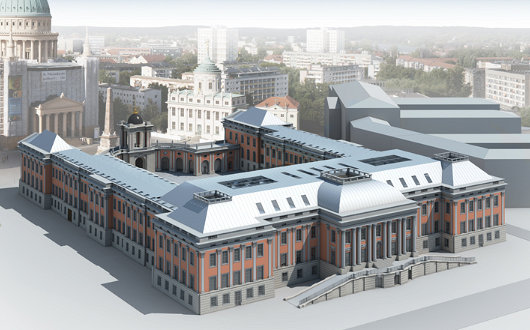
THE OLD STADTSCHLOSS of Potsdam, destroyed by aerial bombing during the Second World War, will rise again next to the Old Market in the Brandenburg capital. The provincial government has decided to rebuild the old Stadtschloss to serve as a home for the Landtag, Brandenburg’s provincial parliament. While it was first conceived of building a modern building on the site, or having some reconstructed façades and others modern, a €20-million donation from the software entrepreneur Hasso Plattner has ensured the façades and massing of the building will follow the outline of the old stadtschloss. The interiors will be simple and modern, and to keep the costs down, much of the finer Baroque detailing of the façades will not be included. “I hope,” Herr Plattner said, “that the necessary compromises do not diminish the great impression overall.” (more…)
Voorslag
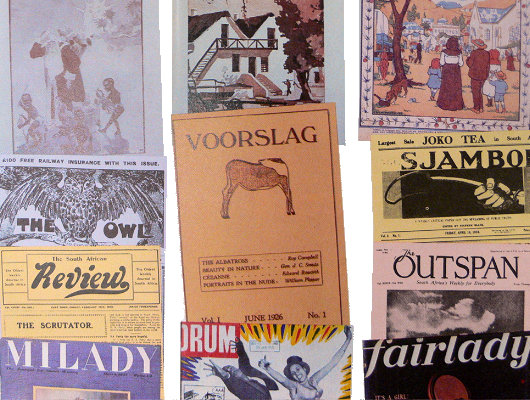
The richness and variety of South African periodicals printed during the first half of the twentieth century can surprise even the most devoted fans of the country. The circumstances at the bottom end of Africa were too particular to be overly influenced by the thought and talk of the imperial metropolis of London, and a miniature South African literary renaissance took place during the 1920s & 30s.
Among the publications one might stumble upon is Voorslag (“Whiplash”), founded by the poet Roy Campbell (who later moved to Spain, converted to Catholicism, and supported Franco during the Spanish Civil War). Campbell had returned to South Africa from England in 1924 in the hopes that his well-to-do relations in Durban might help support the struggling intellectual and his family. After finding financial backers, Campbell (with William Plomer and Laurens van der Post) launched Voorslag two years later in 1926. (more…)
The Institute for the Study of the Ancient World
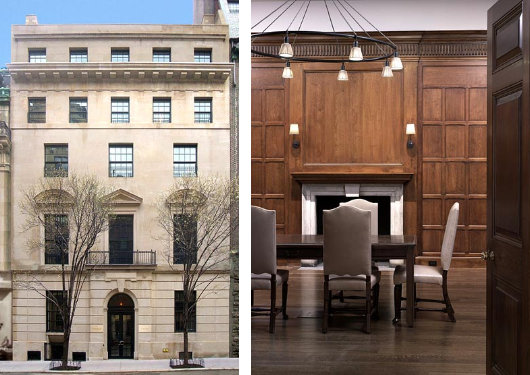
The Institute for the Study of the Ancient World commissioned Selldorf Architects, previously responsible for the renovation of the Neue Galerie on Fifth Avenue, to restore and upgrade the townhouse at 15 East 85th Street purchased to house the Institute. The house was built in 1899 but altered beyond recognition in 1928 after its purchase by Ogden Mills Reid, editor-in-chief of the New York Herald-Tribune. After the editor’s death, Mrs. Reid sold it to the American Jewish Committee, who used it as their headquarters until its sale to the Leon Levy Foundation, which endowed the creation of the Institute for the Study of the Ancient World at New York University in 2006. (more…)
La mort de la Librairie Française
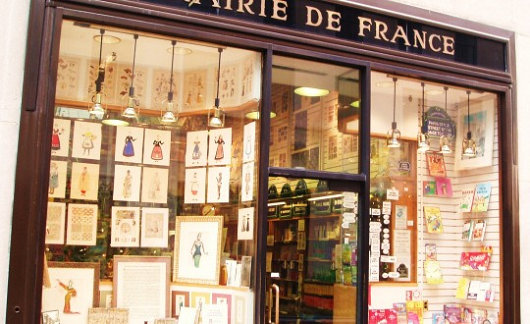
Among the unfortunate recent victims of Manhattan’s extortionately exorbitant rents is the Librairie Française. Last year the venerable New York institution had its rent raised from $360,000 to $1 million per year. The shop was founded in 1928 by Isaac Molho a Sephardic Jew from Salonika, who was invited by David Rockefeller himself to rent a space on the Promenade in Rockefeller Center in 1935. The Maison Française, in which the Librairie was located, flanked the south side of the Promenade, with the British Empire Building flanking the north — the bit of greenery in-between is called ‘Channel Gardens’ accordingly. The sign on the façade said ‘Librairie de France’ but in conversation I have never heard it referred to as anything other than the Librairie Française.
During the Second World War, the shop also operated a publishing house called La Maison Française that printed Gaullist propaganda as well as titles by French writers like Jacques Maritain, André Maurois, Jules Romains, and Antoine de Saint-Exupéry. It was the post-war period, however, in which the Librairie Française flourished. (more…)
Search
Instagram: @andcusack
Click here for my Instagram photos.Most Recent Posts
- Brunel’s Unbuilt Capitol February 3, 2026
- Cricket at Fordham January 27, 2026
- Palacio Barolo Revisted January 14, 2026
- Learning to Love Liguria January 14, 2026
- Crux Alba No. 2 January 13, 2026
Most Recent Comments
Book Wishlist
Monthly Archives
Categories