About Andrew Cusack
 Writer, web designer, etc.; born in New York; educated in Argentina, Scotland, and South Africa; now based in London.
 read more
News
Blogs
Reviews & Periodicals
Arts & Design
World
France
Mitteleuropa
Knickerbockers
Argentina
The Levant
Africa
Cape of Good Hope
Netherlands
Scandinavia
Québec
India
Muscovy
Germany
Academica
The Anthropophagus Has Quitted His Den
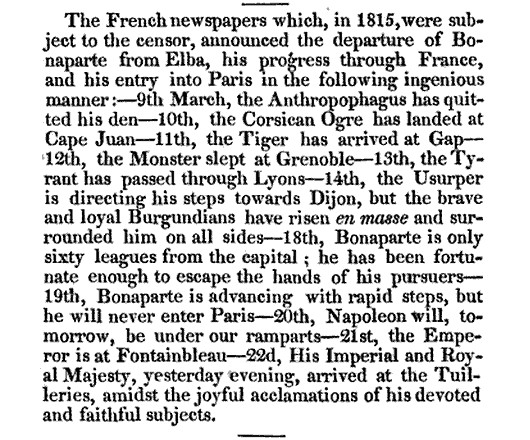
The Museum of Foreign Literature Science and Arts was a Philadelphia periodical edited by the prodiguously talented and unjustly neglected Eliakim Littell.
In January 1831 his review published this little snippet of headlines claimed to have been clipped from French newspapers:
The French newspapers which, in 1815, were subject to the censor, announced the departure of Bonaparte from Elba, his progress through France, and his entry into Paris in the following ingenious manner:
March 9 THE ANTHROPOPHAGUS HAS QUITTED HIS DEN
March 10
THE CORSICAN OGRE HAS LANDED AT CAPE JUAN
March 11
THE TIGER HAS ARRIVED AT GAP
March 12
THE MONSTER SLEPT AT GRENOBLE
March 13
THE TYRANT HAS PASSED THOUGH LYONS
March 14
THE USURPER IS DIRECTING HIS STEPS TOWARDS DIJON
but the brave and loyal Burgundians have risen en masse
and surrounded him on all sidesMarch 18
BONAPARTE IS ONLY SIXTY LEAGUES FROM THE CAPITAL
He has been fortunate enough to escape the hands of his pursuersMarch 19
BONAPARTE IS ADVANCING WITH RAPID STEPS
But he will never enter ParisMarch 20
NAPOLEON WILL, TOMORROW, BE UNDER OUR RAMPARTS
March 21
THE EMPEROR IS AT FONTAINEBLEAU
March 22
HIS IMPERIAL & ROYAL MAJESTY, yesterday evening, arrived at the Tuileries, amidst the joyful acclamation of his devoted and faithful subjects.
In the Old Dutch East Indies
Little Holland’s rule over this vast land – today the world’s largest Muslim country by population – never loomed large in the European imagination (the Netherlands excepted) and thus has been too easily forgotten. Peter van Dongen’s Rampokan series of graphic novels (in Herge’s ligne-claire style) is the most prominent recent attempt to shine some light on the Dutch East Indies and it has obtained a bit of a cult following.
The colonial architecture went through the usual transformations, from awkward hybrids of the motherland and the vernacular to a cool and crisp classical elegance of the later imperial buildings. Henri Maclaine Pont’s work at Bandung is probably the most successful Dutch take on local building traditions, and in some ways Geoffrey Bawa is his spiritual offspring.
The ministries of Indonesia’s government still convene in elegant Dutch colonial buildings, though the names have all changed. The Daendels Palace is now the Finance Ministry, Buitenzorg is now Bogor, and the old Koningsplein is now the Medan Merdeka or Freedom Square. (more…)
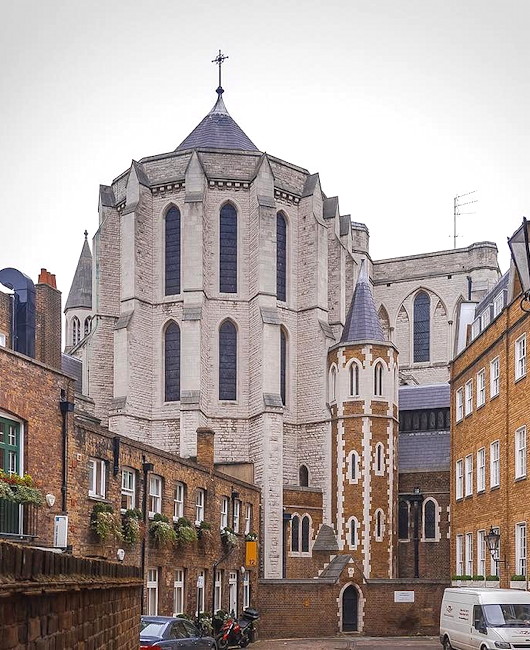
Church of St James, Spanish Place
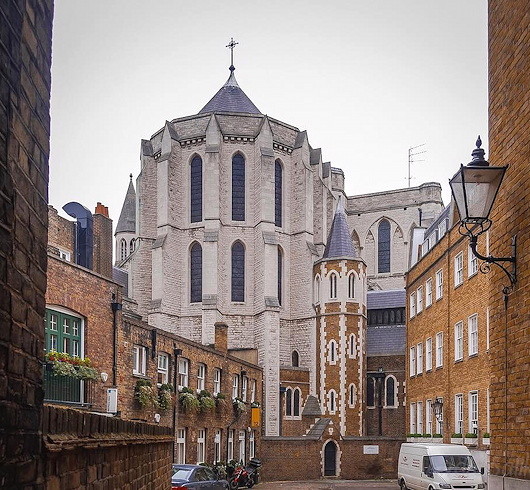
Always interesting to see a building you know well from a perspective you’ve never seen before, as in this photo of the Church of St James, Spanish Place, taken from Manchester Mews. The church somehow seems more imposing — like a great rounded keep.
A few months ago I was corralled into some favour or other that required a bit of muscle to move this there and whatnot, the payoff of which was it afforded an opportunity to explore the triforium of this Marylebone church and see the interior of the building from an entirely new vantage point.
It also meant being able to view in better detail the beautiful stained glass windows — many of them the gift of various Spanish royals, given that this parish originates as the chapel of the Spanish embassy (hence its name).
Arms of the Oudtshoorn Oratory
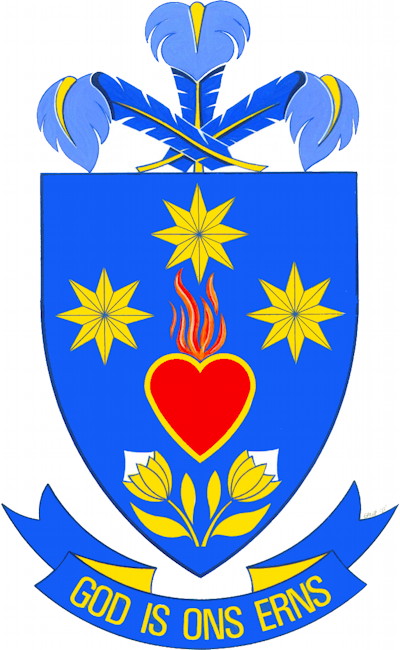
An explanation of the arms of the Afrikaans-speaking Oratory of St Philip Neri in Oudtshoorn, South Africa (edited from their own information).
Russia’s Demographic Turnaround
Most  large developed countries have been facing demographic crises, with Russia one of the worst in the past few decades. The Financial Times this week reports, however, that Russia is facing a demographic turnaround: “Rising birth rate, tumbling death rate, and immigration drives population rebound” as the subheadline puts it.
In 2000, deaths at 2.23 million outnumbered the 1.27 million births by nearly a million. In 2013, 1.94 million births finally outnumbered 1.91 million deaths, while the first quarter of 2016 has witnessed a 5 per cent drop in mortality compared to just a year before.
Still, the low birth rates of the 1980s and 1990s will continue to have a reverberating effect on the working-age population, as the children who weren’t born then will obviously not have children and grandchildren. Pension ages are being changed accordingly, rising to 65 for men and 63 for women as compared to 60 and 55 respectively up until now — a Communist hangover ridiculously low in comparison to Western countries.
Despite a perilous economic condition thanks to collapsing commodity prices, Russians clearly feel their country is in a much more stable condition than the topsy-turvy 1990s. There can be no greater vote of confidence in the future than to have children.
Previously: The World Turned Upside Down
Speyer
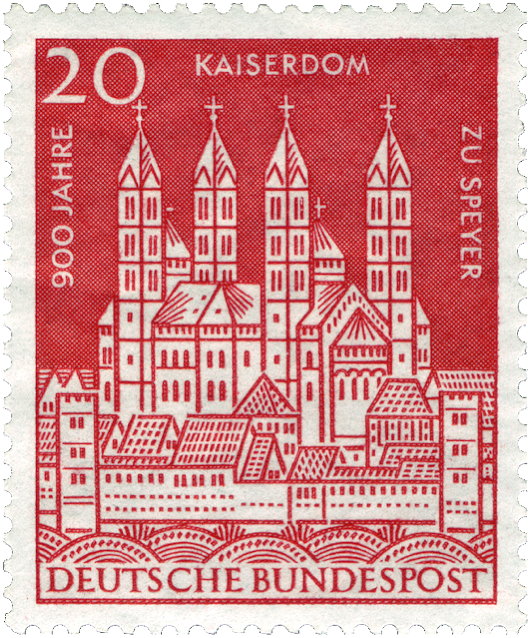
This 1961 postage stamp celebrates the consecration, nine centuries earlier, of the Imperial Cathedral Basilica of the Blessed Virgin of the Assumption and Saint Stephen at Speyer — today the largest Romanesque church still standing.
Past and Future Meet in Peru’s Navy
Lima’s Latest Warship Boasts Four Masts and Full Rigging
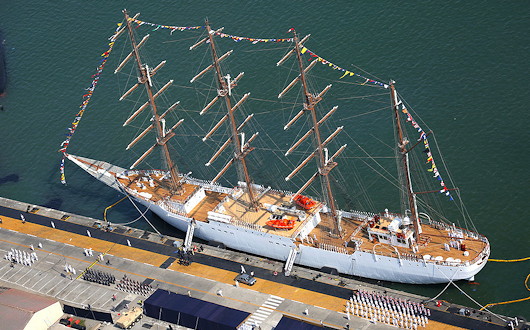
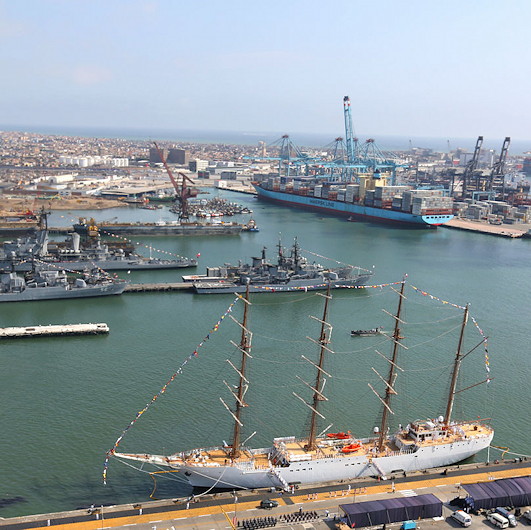
Today the Peruvian Navy’s newest ship, the BAP Unión, returns to its home port of Callao after an 8,900-mile tour at sea that took in eight countries over 98 days. But though commissioned earlier this year by then-President Ollanta Humala, the Unión isn’t some grey-painted stealth frigate but a four-masted, steel-hulled, full-rigged barque. Named after a corvette that saw action in the War of the Pacific, the Unión was laid down at Callao’s SIMA shipworks in 2010, launched in 2014, and was commissioned this past January as the primary training vessel of the Peruvian fleet.
The unimaginative might be surprised that such old-school ships are being used to train modern sailors, but the Unión’s Commander Roberto Vargas is unambiguous.
“On modern warships, working with computers and satellites all the time, we forget that we have to learn the essentials of sailing,” Commander Vargas told the Miami Herald.
“On a ship like the Unión, these cadets learn leadership, they learn cooperation, they learn group spirit. It’s impossible to work alone with these big sails — you have to work with other people. And most of the basics, like navigation and oceanography, are the same.”
Many other Latin American countries use tall ships as naval training vessels. Argentina’s ARA Libertad was the subject of an attempted seizure by foreign vulture funds seeking payments on debts defaulted upon in 2002.
While most date from the 1960s (Colombia’s Gloria), ’70s (Ecuador’s Guayas; Venezuela’s Simón Bolívar), or ’80s (Mexico’s Cuauhtémoc), Chile’s Esemeralda was launched in 1946. The grande dame of them all is Uruguay’s schooner the Capitán Miranda, launched in 1930 but docked since 2013 awaiting decisions on upgrades.
One analyst notes that even two-hundred years later the old imperial connections are still thriving in the strong Spanish influence on many of these ships:
The Peruvian state-controlled shipyard SIMA (Servicios Industriales de la Marina) constructed the Union in its shipyard in the port of Callao, but the Spanish company CYPSA Ingenieros Navales cooperated in the vessel’s structural design.
As for other ships, many were constructed by Spanish companies. For example Colombia’s Gloria, Ecuador’s Guayas, Mexico’s Cuauhtemoc, and Venezuelan’s Simon Bolivar were all manufactured by Astilleros Celaya S.A., while Chile’s Esmeralda was obtained from the Spanish government which constructed it at the Echevarrieta y Larrinaga shipyard in Cadiz.
One exception to the rule is Brazil’s Cisne Branco, which was constructed by the Dutch company Damen Shipyard.
Given the return to tradition in Peru’s army that we had previously reported on, it’s a pleasure to see this continuing in the country’s navy. Peru continues to show the world that another future is possible.
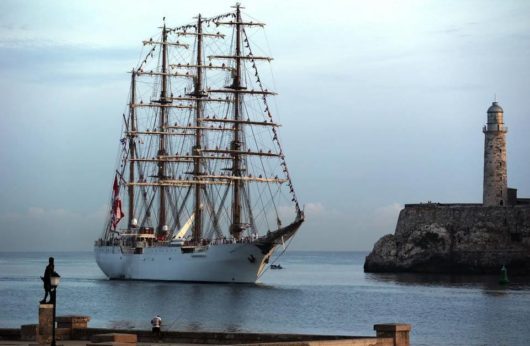
Entering the old harbour of Havana, Cuba.
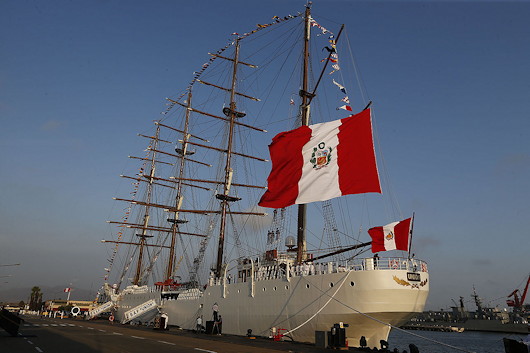
Above and below, decked out for commissioning in Callao.
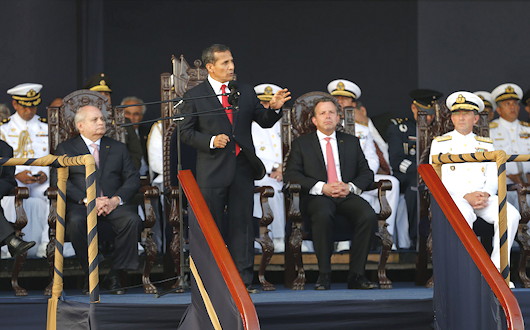
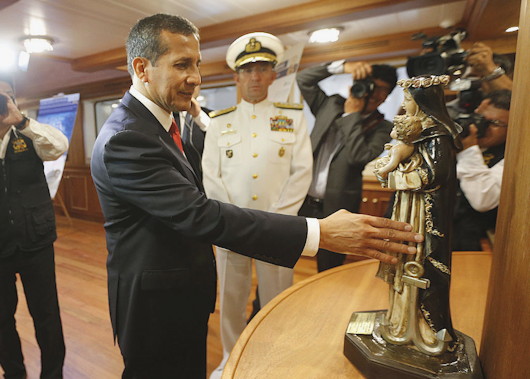
President Humala at the commissioning ceremony.
Courtyard of the Palazzo Bonagia
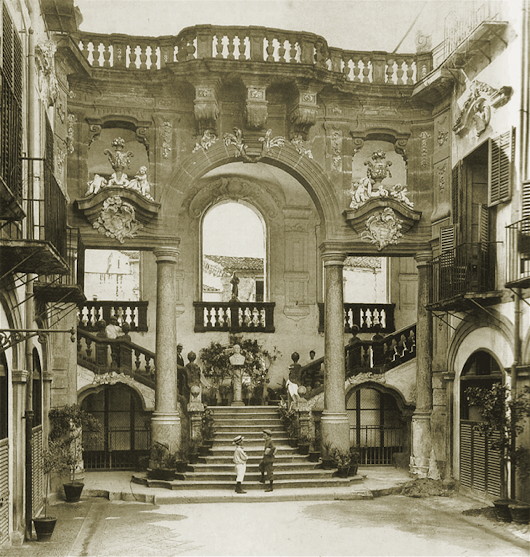
A photograph of the courtyard of the Palazzo Bonagia, the Palermo residence of the Dukes of Castel di Mirto, looking towards the rococo staircase.
The steps, columns, and balustrades are of red marble from Castellammare del Golfo, all conceived in the mind of Andrea Giganti, priest-architect of the Sicilian baroque.
The building was bombed during the last war and reduced to a shell, but thorough if slow-going restoration work began in 2009 and continues.
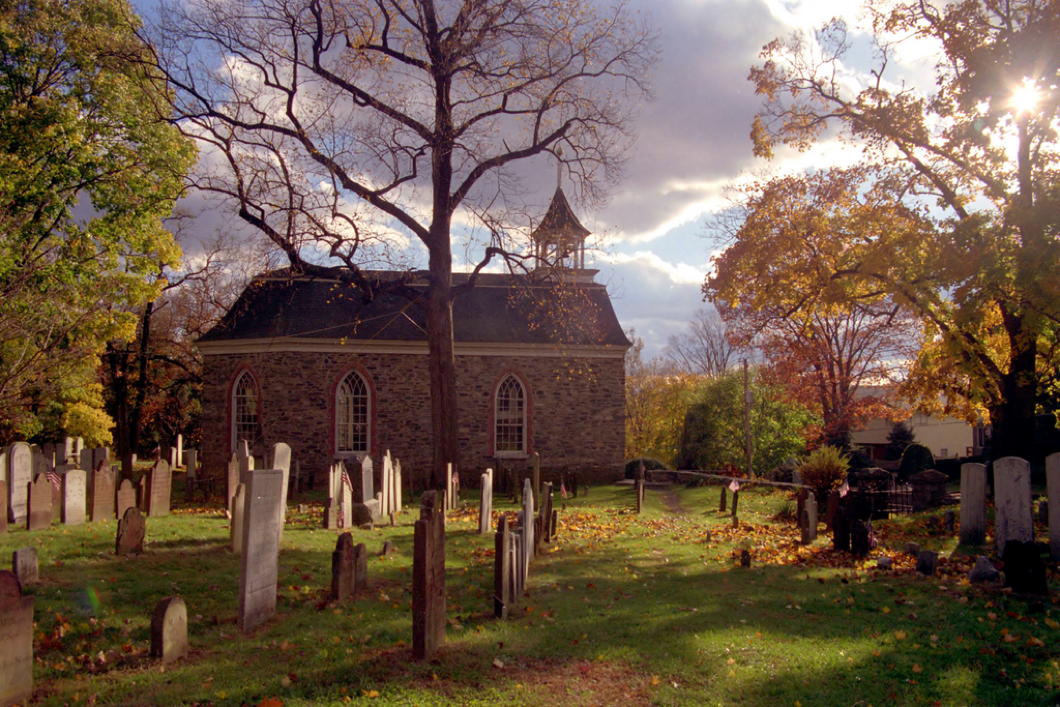
The Old Dutch Church of Sleepy Hollow
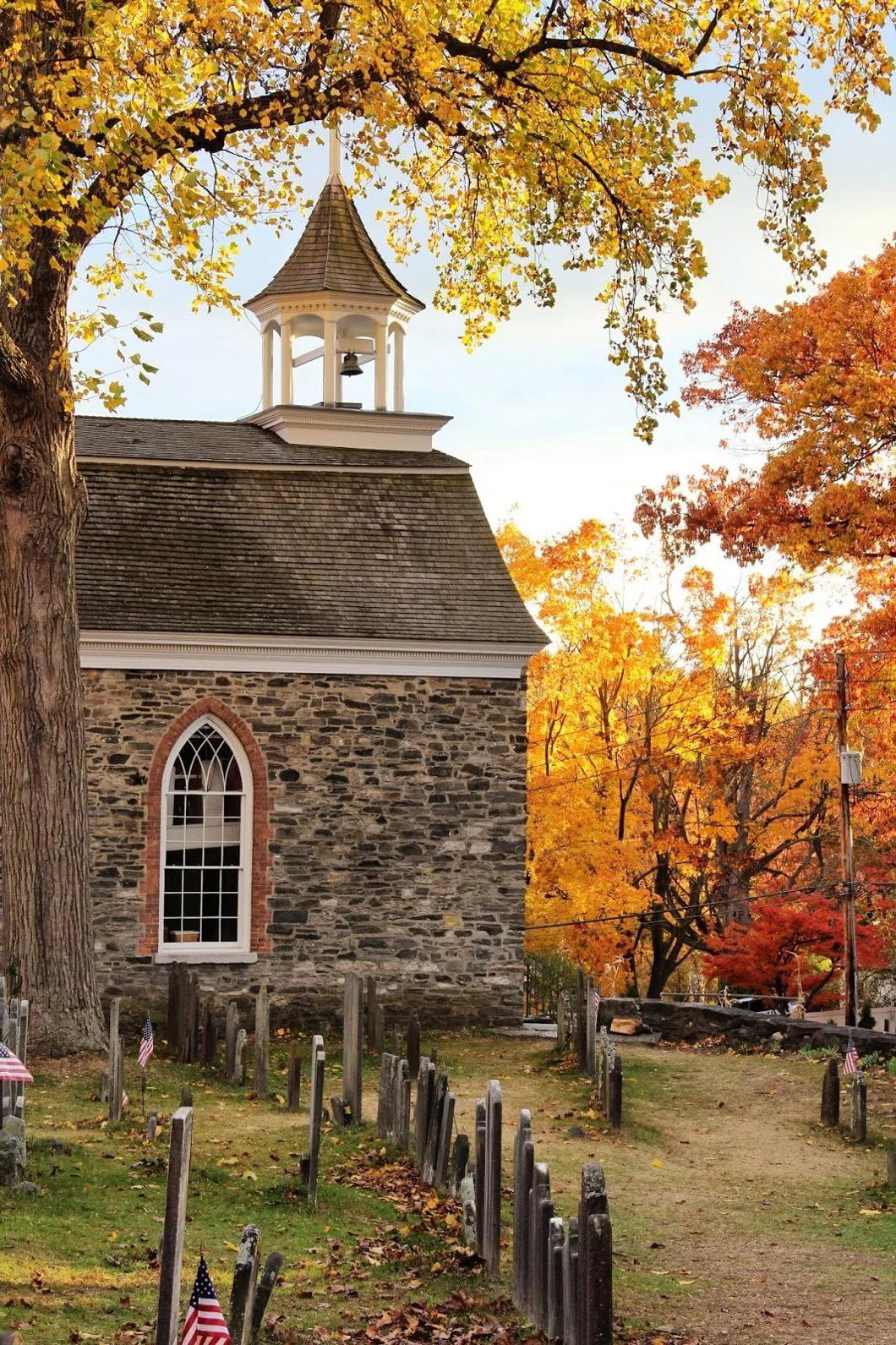
If there is any season which is plus New-Yorkaise que les autres then it must be autumn, and around the time of Hallowe’en in particular.
Thanks to the fertile imagination of Washington Irving, buried in the cemetery of the Old Dutch Church in Sleepy Hollow, the Hudson Valley is the spiritual home of this ancient Celtic feast now implanted in the New World.
The other day I dusted off the huge single-volume complete works of Irving – almost the size of an old Statenvertaling – and re-read his most famous tale, “The Legend of Sleepy Hollow”.
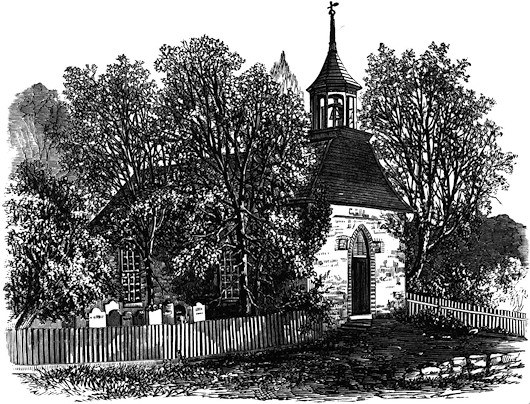
Irving describes the position of the Old Dutch Church:
The sequestered situation of this church seems always to have made it a favorite haunt of troubled spirits. It stands on a knoll surrounded by locust trees and lofty elms, from among which its decent whitewashed walls shine modestly forth, like Christian purity beaming through the shades of retirement. A gentle slope descends from it to a silver sheet of water bordered by high trees, between which peeps may be caught at the blue hills of the Hudson. To look upon its grass-grown yard, where the sunbeams seem to sleep so quietly, one would think that there at least the dead might rest in peace.
On one side of the church extends a wide woody dell, along, which raves a large brook among broken rocks and trunks of fallen trees. Over a deep black part of the stream, not far from the church, was formerly thrown a wooden bridge; the road that led to it and the bridge itself were thickly shaded by overhanging trees, which cast a gloom about it even in the daytime, but occasioned a fearful darkness at night. Such was one of the favorite haunts of the Headless Horseman, and the place where he was most frequently encountered.
The tale of the Headless Horseman is now, partly thanks to various popular reinterpretations of it, well known even outside the Hudson Valley. I remember as a wee lad growing up in that part of the world our Scout uniforms had a badge bearing the image of the “Galloping Hessian”.
Johannes Kip’s View of London
View and Perspective of the City of London, Westminster, and St James’s Park
This view of London and Westminster is most notable for the unique perspective it takes: a bird’s eye view from above the Duke of Buckingham’s house, later acquired by the Crown and now, as Buckingham Palace, the primary royal residence.
This printing of Kip’s view, which comes up for auction soon at Daniel Crouch Rare Books, may have been printed after 1726 as it incorporates Gibb’s steeple of St Martin-in-the-Fields.
‘Decisions, decisions…’
Rather horrifyingly, one of the proposals would have erected a monumental screen closing off the forecourt, completely spoiling the view of Edward Lovett Pearce’s beautiful façade.
Luckily the Bank chose Francis Johnston to harmonise the competition designs into the building we know today.
Voltaire’s Works Are Not Dead
They Are Alive: And They Are Killing Us
“It was a little after nine in the evening; the sun was setting, the weather superb. … Nothing is rare, nothing is more enchanting than a beautiful summer evening in St Petersburg. Whether the length of the winter and the rarity of these nights, which gives them a particular charm, renders them more desirable, or whether they really are so, as I believe, they are softer and calmer than evenings in more pleasant climates.”
The Soirées Saint-Petersbourg of Joseph de Maistre are philosophical dialogues that sometimes border on the mystical and delve into the dark recesses of human nature. They are eloquent, fascinating, and beautiful, traversing a broad range of subjects while hovering around evil and why it exists in the world.
In this extract from the Fourth Dialogue, the Count — generally taken to represent the author’s own view — objects to the young Chevalier citing Voltaire approvingly.
A critic might call it a rant; if so, it is at least a beautiful one:
Party in the Overberg
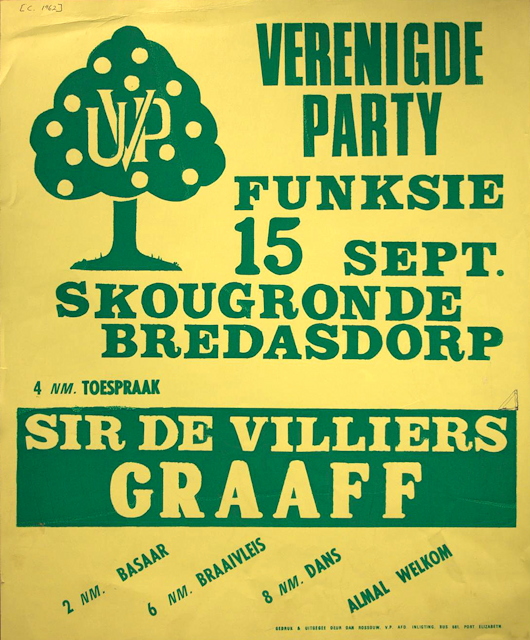
Alongside a bazaar, a braai, and dancing, a speech by Sir De Villiers Graaff is the selling point of this poster advertising a United Party (Verenigde Party) get-together in the beautiful Overberg region of the Cape.
“Sir Div” was the inheritor of one of only twelve South African baronetcies and led his party from 1956 until 1977 when it merged with the Democratic Party of verligte ex-Nationalists to form a new entity.
The broadly centrist party had lost power to the republican Nats (creators of apartheid) in 1948, and suffered splits that led to the creation of the Liberal Party and the United Federal Party in 1953, the National Conservative Party in 1954, and the Progressive Party in 1959.
The party’s emblem was a happy little citrus tree.
The Wyndham Monument, Silton
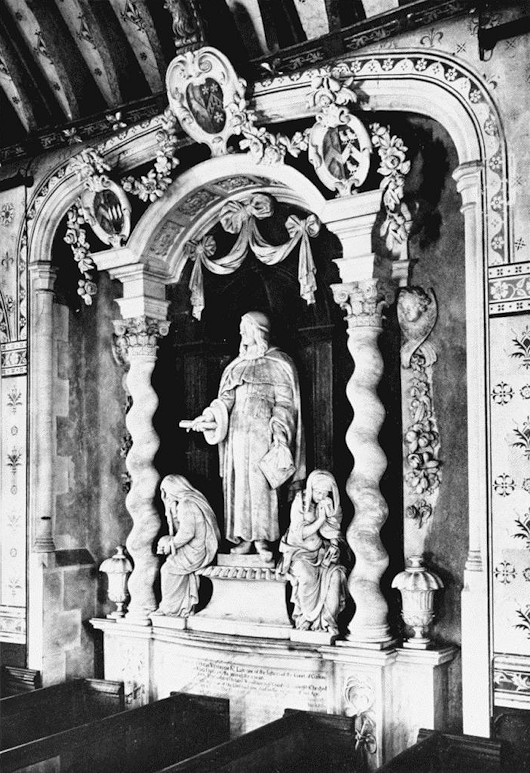
The charmingly haphazard Church of St Nicholas in Silton is home to what is arguably the finest funerary monument in Dorset not in a major church.
Sir Hugh Wyndham (1602–1684) lived through the difficult time of the Civil War and was first advanced in the law under Cromwell’s military dictatorship. It was the worst of both worlds for Wyndham, as the republican authorities never trusted him while after the Restoration his comfort with Cromwell meant he was deprived of office. Still, Charles II was no small-minded man, and after a royal pardon was granted Wyndham was appointed a Baron of the Exchequer and knighted.
The monument he left behind at Silton is is believed to be the earliest work of the Flemish sculptor Jan van Nost (also known as John Nost the elder). Sir Hugh is depicted in his judge’s robes, flanked by two mourning figures believed to represent his first and second wives. (The third wife is at least represented by having her arms impaled with Wyndham’s in one of the three heraldic sheilds gracing the monument’s surrounds.)
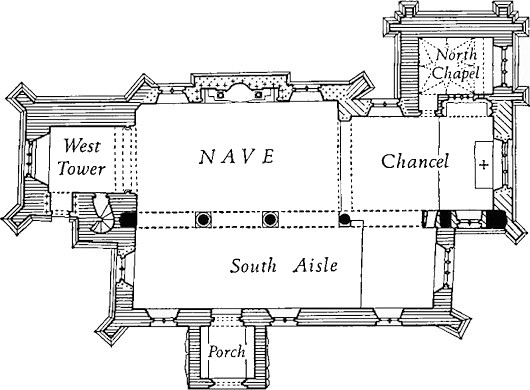
Nost’s sculpture was unveiled in the chancel of the parish church in 1692 but the Victorians thought it rather dominated the small sancutary. In 1869 a small recess was constructed in the north wall of the nave and the Wyndham monument was carefully moved there. The sculptor was also responsible for the monument to John Digby, 3rd Earl of Bristol, in Sherborne Abbey not far away, and one can see the parallels. The Earl, as it happened, married Rachel Wyndham, the younger daughter of Sir Hugh Wyndham.
Zeist’s Zest for Traditional Architecture
The Daniel Marotplein, a residential square in the town of Zeist, provides a fine recent example of traditional architecture in the Netherlands. Designed by the TU-Delft-trained architect Diederik Six, the twenty houses surround a green square named after the Huguenot craftsman and artist Daniel Marot some of whose handiwork is in the nearby Slot Zeist.
The slot (schloss/castle/house) is associated with the Protestant Moravian brotherhood who were invited to live nearby by Cornelis Schellinger in the mid-eighteenth century, and the Daniel Marotplein takes inspiration from the two squares of houses they lived in flanking the castle. (more…)
Letter to the Editor
A letter to the editor printed in this week’s edition of The Tablet:
Brendan Walsh’s report (“Heythrop’s fate”, 17 September) of a senior academic suggesting that the demise of Heythrop was an episode in a long struggle between “outward-facing, inquisitive, challenging” theology on one side and “inward-looking, submissive, unquestioning” theology on the other is telling.
Positing such a simplistic binary split between Enlightened Me and Poor Ignorant You is patronising to those attempting to live out the radical beauty of the Christian life in tune with Catholic teaching. It’s not surprising that an institution with academics holding this view is entering its death spiral, while religious communities that don’t consider basic orthodox belief as optional are bursting at the seams.
Few things are more challenging – and more rewarding – than faithfulness; while some cling to clapped-out heterodoxies and managed decline, the rest of the Catholic world has moved on.
ANDREW CUSACK
London SW1
Botswana and Hereditary Power
To any observer it must be obvious that hereditary power of some kind is natural and most of the time inescapable. It’s not that you need to be born into power to wield it, but experience shows it doesn’t hurt. Since I was born, there has been just one American presidential election (2012) in which a member of either the Bush or Clinton families was not either the official candidate of their respective party or a significant contender for that role.
In Canada, the current prime minister has sailed into office solely on a combination of good looks and being the son of a previous prime minister. In Ireland there are no fewer than forty-one families who have had three or more members elected to the Oireachtas (or to the Commons before it). The relatives and descendants of Timothy Sullivan managed to elect thirteen members between 1874 and 2016 as MPs, TDs, senators, or MEPs. Sullivan’s son and great-grandson both served as Chief Justice of Ireland to boot.
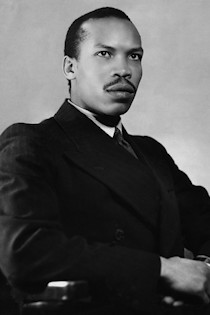
Sir Seretse Khama
Botswana — the most succesful state in Africa by many gauges — today celebrates the fiftieth anniversary of its assuming the mantle of sovereignty after eighty-one years as a British protectorate. Given that the United States, Canada, and Ireland are generally viewed as succesful countries, the hereditary aspect of power might help explain the comparitive success of Botswana, a multiparty state with free and fair elections, relative to its neighbours. The fourth and current president is Ian Khama, formerly a lieutenant general in the Botswana Defence Force. President Khama is the son of Sir Seretse Khama, the Balliol man who led his country and its people to independence fifty years ago and served as Botswana’s first president. Sir Seretse in turn is the grandson of King Khama III, last kgosi of Bechuanaland before the protectorate and leader of the Bamangwato tribe.
When Sir Seretse Khama became leader of Botswana it was the third poorest country in Africa — now it is the sixth richest on the continent in terms of GDP per capita. In a continent not known for good government Botswana, though not without its problems, is an oasis of stability and order.
At today’s celebrations for the fiftieth year of independence, President Khama wasn’t taking any credit for his country’s success: “Where we may have failed we take the blame. Where we succeeded we thank God.”
A Fifty Pound Note
The recent arrival of the new fiver has caused some flurry of excitement and one of the notes finally reached the Cusackian exchequer via the barmaid at the Ox Row Inn in Salisbury on Friday night. I’m indifferent to the design; it’s inoffensive but I’d prefer to see Churchill depicted in his coronation robes rather than Yousuf Karsh’s iconic photograph.


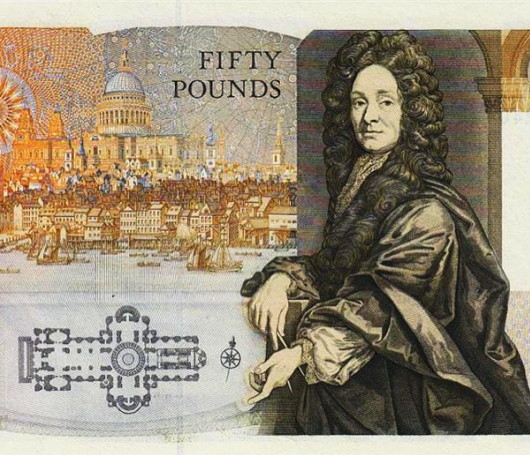
My favourite Bank of England note, however, remains the Series D £50 first issued in 1981 designed by the Black Country artist Harry Eccleston. Sir Christopher Wren lookings crackingly baroque, and St Paul’s Cathedral looms like a great ship over the City of London he helped to rebuild after the Great Fire 350 years ago.
Eccleston was the first banknote designer to work fulltime for the Bank of England which he joined in 1958, retiring in 1983, and introduced the concept of historical figures from British history gracing the back of the notes (which are of course fronted with an image of the Sovereign). This particular note was the first fifty-pound note to be issued since 1943. It was replaced in 1994 and withdrawn from circulation two years later.
Oliver VII
by Antal Szerb, trans. by Len Rix
Pushkin Press (2013), £12, 208 pages
Hungarian by nationality, Catholic by faith, Jewish by blood — Antal Szerb was capable of touching the boundaries of intense seriousness bordering on the mystical (as in Journey by Moonlight) or magical (The Pendragon Legend) even though he is probably better known as paragon and only member of the interwar neo-frivolist school of literature.
Here he is at his frivolous best with a novel about the monarch of a Ruritanian kingdom in crisis who abdicates and escapes to Venice incognito, where he falls in with a crowd of confidence tricksters who ultimately, unaware of the ex-king’s true identity, force him to impersonate himself.
In Oliver VII, romance, intrigue, and the perpetual allure of the genteel portion of the criminal class all combine in an enjoyable farce.
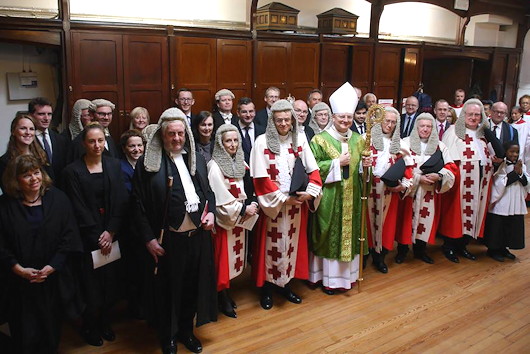
The Red Mass in Edinburgh
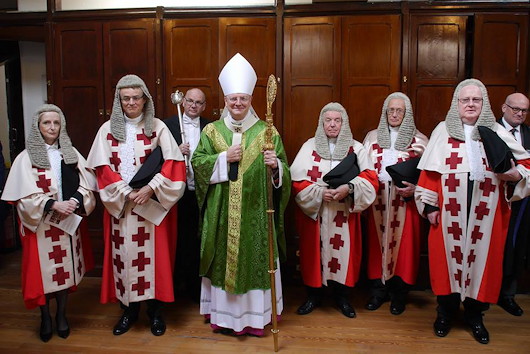
The opening of Scotland’s judicial year was marked this past Sunday by the Archbishop of St Andrews & Edinburgh offering the customary Red Mass in St Mary’s Cathedral.
This year Archbishop Leo Cushley was joined by Lord Drummond Young and his fellow Senators of the College of Justice, Lord Uist, Lord Doherty, Lord Matthews, and Lady Carmichael.
Gordon Jackson QC, the Dean of the Faculty of Advocates, and Austin Lafferty of the Law Society of Scotland joined many sheriffs, QCs, advocates, solicitors, trainee solictors, paralegals, and law students.
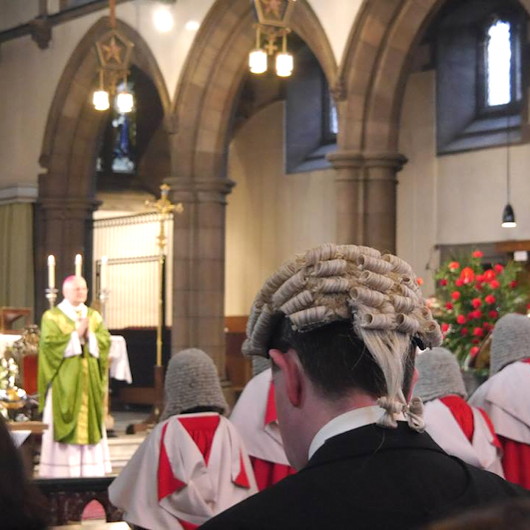
“These men and women serve the nation in a high office and come here to ask the Lord’s blessing upon this year’s work that they carry out on our behalf,” Archbishop Cushley noted in his homily.
“Know that we appreciate the difficult and complex tasks that you have and the duties that you perform – which are very onerous – on behalf of us all and that you be assured of our prayers and our support for all that you do to apply the law of the land with virtue and with justice and with mercy.”
Search
Instagram: @andcusack
Click here for my Instagram photos.Most Recent Posts
- Brunel’s Unbuilt Capitol February 3, 2026
- Cricket at Fordham January 27, 2026
- Palacio Barolo Revisted January 14, 2026
- Learning to Love Liguria January 14, 2026
- Crux Alba No. 2 January 13, 2026
Most Recent Comments
Book Wishlist
Monthly Archives
Categories