World
About Andrew Cusack
 Writer, web designer, etc.; born in New York; educated in Argentina, Scotland, and South Africa; now based in London.
 read more
News
Blogs
Reviews & Periodicals
Arts & Design
World
France
Mitteleuropa
Knickerbockers
Argentina
The Levant
Africa
Cape of Good Hope
Netherlands
Scandinavia
Québec
India
Muscovy
Germany
Academica
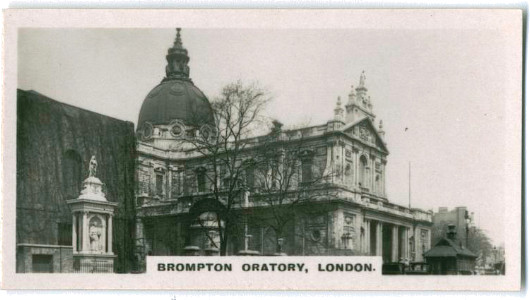
Bisset versus the Banana
My fellow St Andrean Andrew Bisset reports in from auld Caledonia, recently incapacitated by a banana:
Deserved indeed!
Mary Queen of Scots’ Tree
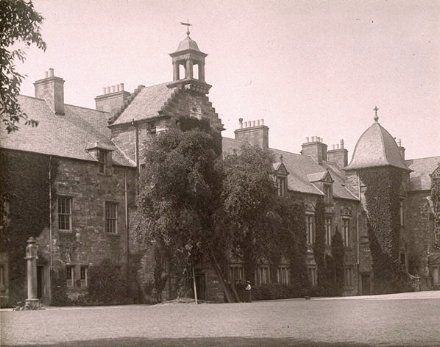
Pursuant to conversations held yesterday afternoon, I give you the thorn tree in the quad of St. Mary’s College, University of St Andrews, planted by Mary Queen of Scots. This photo was taken in the 1930’s, I believe. It looks a little worse for wear these days; rather sickly actually. Wouldn’t be surprised if the University was trying to kill it off as a safety hazard or other such bureaucratic flopdoodle.
Polo
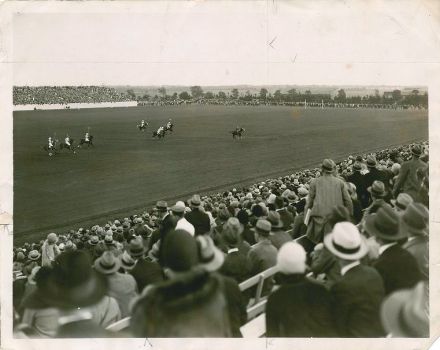
Second international polo match between the United States and the Argentine Republic, 1928.
The Church of St Agnes
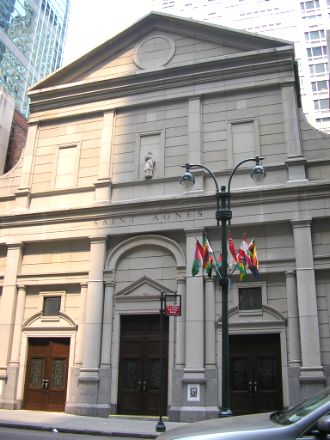
For those who have not seen St Agnes since it was rebuilt in a different style I thought I’d post a few photos I took after the 12:30 mass today. I don’t recall who the architect was; I believe it might be Thomas Gordon Smith. The reason for the vexilla-ed lampost is that East 43rd Street, in addition to being known as “Archbishop Fulton J. Sheen Place”, is also “U.N. Way” since the headquarters of that organisation terminates the vista eastwards. (more…)
Forty-fourth Street

I caught this glimpse of an apartment building on 44th St today, and rather enjoyed the uniform appearance of the glassed-in terraces, later additions I imagine.
If London Were Like Venice
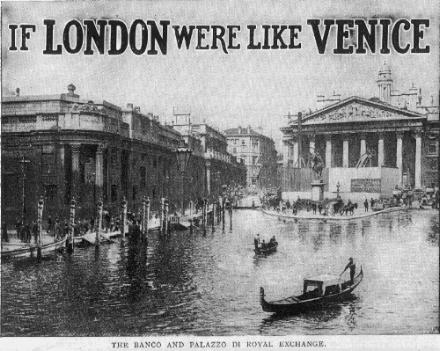
No doubt you remember If London Were Like New York, now we bring you If London Were Like Venice. A rather charming improvement, in my opinion. (more…)
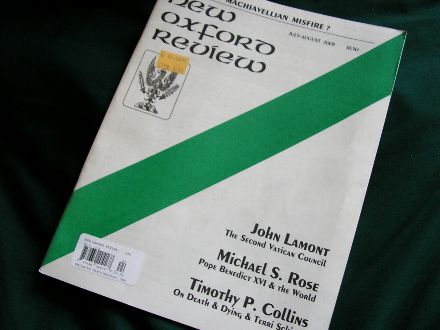
John Lamont in N.O.R.
We had something of a late evening last night at the Leviathan, in which I curiously had the chance to sample – perhaps that word is too modest, imbibe would be more accurate – a port which was, well, not a port. It was a port of New York, and I am not referring to the riparian locus wherein multifarious containers of a universal design speed cheap imported goods from the Orient to our fair city and beyond. Nay, the port was a fortified wine which claimed Long Island as its place of birth. Was it any good? Well, it was a little too fruity for my tastes, but then I’m a man of simple (some would say bland) tastes.
The Leviathan, for those who have not the pleasure of knowing it (which I take to be most of you) is a unique private club open to a select few young gentlemen and their occasional lady guests. It is not so much a club, but a private home which, given the absence of the parents off in foreign climes for rather extended periods of time, has been turned into a private club by the ingenious only child who is its sole permanent inhabitant. The club has a high proportion of members of French Canadian extraction, and features an interesting collection of Russian artifacts, provenance “unknown”.
As I was saying it was a late night, or rather late in Cusack terms as I left at half past one in the morning, and I am told the last members left around the hour of three. I nonetheless awoke this morning and took the train down to Manhattan and heard the resplendent treasure that is the Tridentine mass said in all its glory at the Church of St Agnes.
Whilst jolloping through the Hudson News shop in Grand Central, in the vain hope of being able to flip through a grievously overpriced imported latest edition of Country Life, I stumbled upon the latest issue of the New Oxford Review, the cover of which claimed that an article by John Lamont lay within. Delving into the formerly Anglican now ardent traditionalist Catholic publication I found that indeed it is the John Lamont we know and love. (He is also known as ‘Big John’ owing to his heighth and to differentiate him from the comparitively ‘Little Jon’ Burke).
Anyhow, Big John is the Gifford Research Fellow at St. Mary’s College, the School of Divinity at the University of St Andrews. He and I are seen below in a photo taken by Rebecka Winell at a dinner in the Byre Theatre organized by Miss Victoria Truett in Candlemas term 2004.

Back in the Day
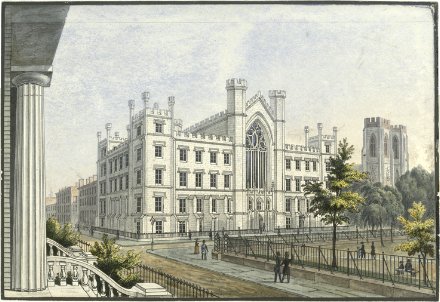
The University of the City of New York (now New York University),
Washington Square, 1850.
‘A Little Madness…’
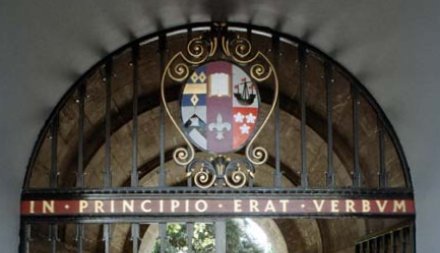
Our own Professor John Haldane, Scotland’s premier living philosopher (one wonders if he ever tires of hearing that), exhibits his rather wide breadth with an article in the Scotsman, not on his usual topics of heavier import, but rather speaking with Suggs (né Graham MacPherson) of the early-80’s band Madness.
A little Madness is good for you
by JOHN HALDANE
IN PRINCIPIO ERAT VERBUM – The Latin formula translates the opening of the prologue to the Gospel of St John: “In the beginning was the Word”. Cast in iron, the phrase spans the gateway into St Mary’s College, a reminder that a century before its foundation in 1538 the scholars of St Andrews gathered there in a long lost “College of St John”.
Six hundred years later a man in a leather jacket stands in the gateway and passers-by slow down to check that it’s really him: Suggs, lead singer of Madness, the group described as the “missing link” between The Kinks and Blur. A woman with young children stops to shake his hand, a pair of postgrads approach for autographs, even senior academics begin to hover in the background. Earlier, across at St Salvator’s College, it was the same story: seated in a stall of the 15th-century chapel or standing in the cloister, visitors approach; a cleaner makes her way around the quad just to say she thought it was him, and secretarial staff come from their offices.
Public Elitism
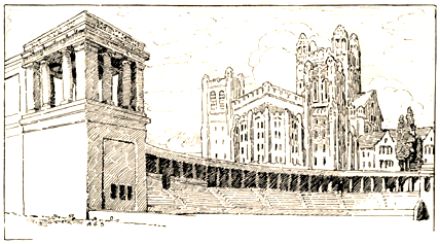
The Manhattan Institute‘s splendid City Journal of Spring 1999 carried an article worth a read entitled ‘How Gotham’s Elite High Schools Escaped the Leveller’s Ax’ on the few quality public schools left in the City of New York and how they managed to stem the tide of egalitarian senselessness.
Egalitarianism is one of the most morally repugnant of all ‘Englightenment’ ideas. To look upon success, label it “unfair” or “racist”, and then demand that, as a sacrifice to the false-goddess Equality, all must fail. It is the typical socialist formula that it is better that all wallow in poverty rather than only some (or even many but not all) succeed.
So a number of these high schools have survived. It is perhaps even more of a shame that none of the colleges did. City College was once known as “the poor man’s Columbia”. The quality of education at both City College and Columbia fell as a result of the cultural revolution of the 1960’s and 70’s. Columbia, for the most part free from the fetters of state intervention, never hit rock bottom and in many ways remains a quality institution, despite the highly politicized and racialized nature of many of its students and faculty. City College, however, went into freefall. Admission was thrust open to anyone who had graduated from a New York public high school, which coincided with the lowering of graduation requirements by these high schools. Thus you had students who could barely read and almost certainly could not write attending an institution which prided itself on its many Nobel laureates.
It is testament to the levelling zeal of the angry left that not even one college, not even one, within the entire City University of New York was allowed to maintain high standards of academic achievement. They will tear down with savage avarice the highest ideals of civilization to quench their destructive thirst. And these are colleges which for decades had been the ticket to freedom and success for hundreds and thousands of economically-disadvantaged New Yorkers. (Imagine if they had gotten their hands on the independent places of learning!). No wonder there are so many stupid people in New York these days.
But at least the high schools are still there, and calls for their emasculation are now few and far between. True, they are not ideal, but can we realistically expect a government-tethered school to be as such? Of course not. We should be glad that there remain at least a handful of public academies of high standards in New York available to all – rich, poor, and anywhere in between – based purely on merit.
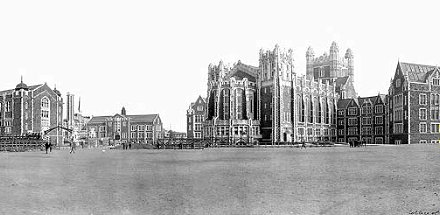
‘Mitre Schmitre’: A Brief Dissection
Nothing is quite as much fun as a good old debate in the press. Alas, the Saint, true to form, published a somewhat slapdash and second-rate response (see post below) to what I thought was a pretty decent, albeit somewhat light-hearted, attack (see the Mitre, February 15, 2005, pp. 1-3). Well, herein follows a very brief highlight of portions of Mr. Hendele’s retort.
“Most of you probably haven’t read it – or heard of it – but what is important is that it continues to provide students with a voice.”
Judging from the usual content of the Saint, we should very much hope that their target audience has not heard of us, let alone read us. We are a quality newspaper, we are not a tool for entertaining the masses.
“What is important is that it continues to provide fair and unbiased coverage of things which matter most to students.”
Here, I must report an innacuracy. Though the Mitre is fair, we are far from unbiased. In fact, I am happy to report we have all the best biases.
“In a ‘recently’ – it only comes out once a month – published editorial from the Mitre of February of this year, the paper claimed The Saint has adopted a patronising, smug tone toward Christians, evangelicals and Catholics, and that this is indicative of our ‘intellectual backwardness.’ First of all, I do not see how one’s tone can be construed as an indicator of their intellect.”
I would advise the author to keep trying; perhaps someday he will gain just such an ability.
“Further, all of the articles written about Christians this year were authored by a Catholic, me, and have been aimed at the bigots who travelled great distances in an attempt to silence students’ in their exercise of the inalienable right to expression.”
Oh, the author is Catholic! Always good to have a fellow Catholic in the student press. Strange that he would defend a supremely blasphemous and perverted play as the ‘exercise of the inalienable right to expression’, but at least the author is Catholic, right?
“Secondly, how dare a paper so obviously enamored with the intricacies of Mother Church and the brainwashing dogma prescribed by it attack The Saint for being intellectually backward.”
Wait, I thought he said he was Catholic? Labelling the dogma proclaimed by Christ’s Church as “brainwashing” and insinuating that Catholicism (which I’m sure the author will recall is responsible for the preservation and maintanence of Western civilization not to mention the foundation of the University of St Andrews and every medieval university in Europe) is actually “intellectually backward” are not things that Catholics are wont to do. Perhaps the author meant to write “former Catholic” or “ex-Catholic” or the trendy “recovering Catholic” or the slightly more neutral “was raised Catholic” which would imply the disassociation from the Church so blatant in the author’s tone.
I also, perchance, wonder what Augustine and Aquinas would think when, upon reading the Saint, they discovered – quel horreur! – that James Hendele has implied that is they, the members of the greatest intellectual tradition the world has ever known, who are intellectually backward, instead of the mindless drones who regurgitate the spirit of the age fed up by the Guardian, New Statesman and other outlets of the secularist media and culture.
“Furthermore, the only other articles written about the University’s Christians this year have been in regards to their annoying, yet undeniably plucky, insistence on inviting ‘academics’ to speak on the merits of creationism.”
First Mr. Hendele said he wrote all the articles about Christians this year, now he says that there are others. Besides, we did not attack the Saint for having a smug and patronising tone for just this year; it has existed longer than that.
“The Saint has asked the Christian Union in a number of instances to contribute pieces reflecting their stances on issues of national importance and has not once heard a reply. Pot + Kettle = Black, you do the math.”
The Mitre is in absolutely no way associated with the (evangelical) Christian Union and never shall. The Christian Union often propagates the opposite strain of anti-intellectualism to that exhibited in the Saint.
“In that same article of February of this year, the Mitre not only goes on to quote our current, supremely ineffectual and apathetic rector, as saying that he believes The Saint has let its standards slip, but also accuses the paper of printing an excess of copies in order to somehow defraud would-be advertisers out of money. Any article based on the words of Clement Freud, a man more concerned with the sound of his own voice, should be taken with a pinch of salt. His recent contradictory statements on the problems The Saint were facing is testament to that. Furthermore, I do not see how printing extra copies and not selling them would in any way entice businesses to advertise. In fact the reason we print so many copies is because we must print a minimum of 1,000 and every thousand copies above that number costs only £3. It would do the Mitre well to get its facts straight before it starts pointing fingers at out ‘faulty accountants.'”
The remarks against Clement Freud are not worth refuting. Putting quotation marks around “faulty accountants” in my mind implies that such was a term used in either the Mitre article or commentary piece. In fact, the phrase is in neither the article nor the opinion piece. A tad misleading, but easily forgiven.
Mitre Schmitre
The Uni’s other newspaper ought to get its facts straight
(Published in the Saint, Thursday 5 May 2005)
by JAMES HENDELE
Here’s something I bet you didn’t know: our university has not only one, but two student newspapers. Well, more like one student newspaper and one student evangelical handout. Now I am not one to lambaste members of my own literary community, to accuse and name call and slander those I consider my fellow scholars and thinkers and journalists. I admire their effort. To start a student newspaper from scrap and turn it into a publication that can rightfully claim to be St Andrews’ most religious monthly takes determination, smarts and a dose of class.
Most of you probably haven’t read it – or heard of it – but what is important is that it continues to provide students with a voice. A voice which can be heard all the way from North Street in the north to South Street in the south. What is important is that it continues to provide fair and unbiased coverage of things which matter most to students: the latest Vatican news, the status of the recently formed St Andrews pro-life society, a definitive guide to the town’s best martini, and in depth coverage of Pope-watch ‘05. What is important is that it continues to assail those who would hinder students in their quest to know the specific details of last week’s debate. Here here, Mitre, here here.
I do not really think that anyone could possibly argue that this town is too small for two papers or that it is too liberal for a conservative voice. Quite the contrary – this student body has long been in need of a paper dedicated to voicing the concerns of those among us with a political or religious persuasion which would cause them to vote Tory and rest on the Sabbath. What bothers me is the way in which this University’s second paper has, at many instances, rebuked the editorial team of The Saint when it is guilty of the same sins it claims to reject.
In a “recently” – it only comes out once a month – published editorial from the Mitre of February of this year, the paper claimed The Saint has adopted a patronising, smug tone toward Christians, evangelicals and Catholics, and that this is indicative of our “intellectual backwardness.” First of all, I do not see how one’s tone can be construed as an indicator of their intellect. Further, all of the articles written about Christians this year were authored by a Catholic, me, and have been aimed at the bigots who travelled great distances in an attempt to silence students’ in their exercise of the inalienable right to expression. Secondly, how dare a paper so obviously enamored with the intricacies of Mother Church and the brainwashing dogma prescribed by it attack The Saint for being intellectually backward. Furthermore, the only other articles written about the University’s Christians this year have been in regards to their annoying, yet undeniably plucky, insistence on inviting “academics” to speak on the merits of creationism. The Saint has asked the Christian Union in a number of instances to contribute pieces reflecting their stances on issues of national importance and has not once heard a reply. Pot + Kettle = Black, you do the math.
In that same article of February of this year, the Mitre not only goes on to quote our current, supremely ineffectual and apathetic rector, as saying that he believes The Saint has let its standards slip, but also accuses the paper of printing an excess of copies in order to somehow defraud would-be advertisers out of money. Any article based on the words of Clement Freud, a man more concerned with the sound of his own voice, should be taken with a pinch of salt. His recent contradictory statements on the problems The Saint were facing is testament to that. Furthermore, I do not see how printing extra copies and not selling them would in any way entice businesses to advertise. In fact the reason we print so many copies is because we must print a minimum of 1,000 and every thousand copies above that number costs only £3. It would do the Mitre well to get its facts straight before it starts pointing fingers at our “faulty accountants.”
(Transcribed as printed).
St. Vincent Ferrer
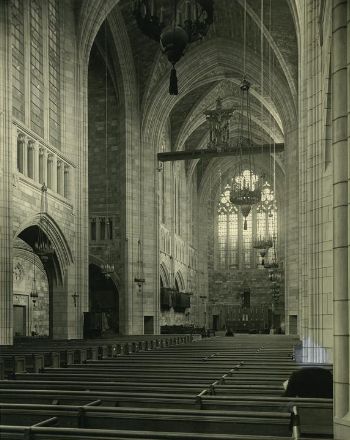
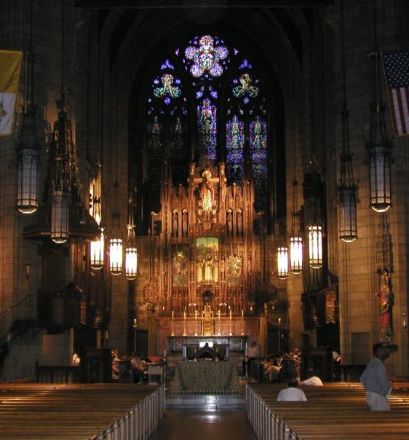
This photo shows the interior of the Dominican Church of St. Vincent Ferrer, designed by Goodhue, before it was fully completed. The stained glass has yet to be installed, and the same goes for the giant reredos which now graces the altar. A more current view is below.
The Goodwin Mansion II

As an appendix to my previous post on the Goodwin mansion, I bring you an elevation of the facade (above) and the original plan of three of its floors (below).

Church of Christ the King, Gordon Square, London
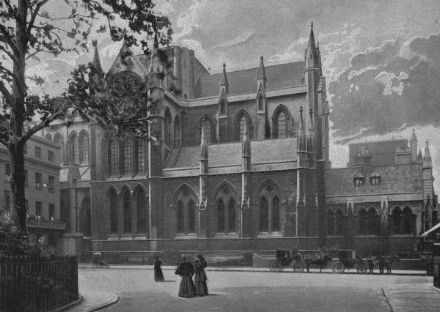
Though a comparitively small and minor sect, assiduous tithing by the members of Catholic Apostolic Church gave that group a number of stunning churches. (Their former church in Edinburgh was the subject of a previous posting).
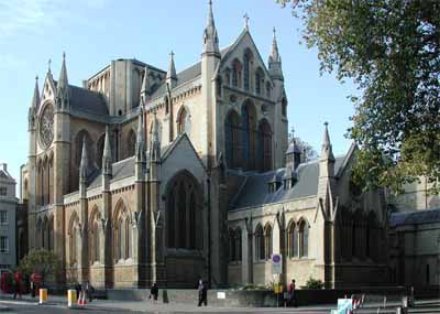
The building currently known as the Church of Christ the King on Gordon Square in Bloomsbury was constructed by the anachronistically-monikered Irvingites from 1853. The superb structure, built from Bath stone, is incomplete, lacking a few bays on the liturgical west of the building which kept the planned façade from being built. It also lacks a crossing tower, but then so does Westminster Abbey, the nave of which is only thirteen feet higher than that of Christ the King. (more…)
The Colonial Colleges
| NAME |
LOCATION | FOND. | CHART. | DENOM. |
| Harvard College (Harvard University) |
Province of Massachusetts Bay |
1636 | 1650 | Puritan |
| College of William and Mary |
Colony and Dominion of Virginia |
1693 | 1693 | Anglican |
| King William’s School (St. John’s College) |
Province of Maryland |
1696 | 1784 | Non-denominational |
| Yale College (Yale University) |
Connecticut Colony |
1701 | 1701 | Congregationalist |
| Moravian College |
Province of Pennsylvania |
1742 | 1863 | Moravian |
| Newark Academy (Univ. of Delaware) |
Delaware Colony |
1743 | 1833 | Non-sectarian |
| College of New Jersey (Princeton University) |
Province of New Jersey | 1746 | 1746 | Presbyterian |
| Augusta Academy (Washington and Lee University) |
Colony and Dominion of Virginia |
1749 | 1782 | Non-sectarian |
| Public Academy of Philadelphia (Univ. of Pennsylvania) |
Province of Pennsylvania |
1749 | 1755 | Non-sectarian |
| King’s College (See below) |
Province of New York | 1754 | 1754 | Anglican |
| Rhode Island College (Brown University) |
Colony of Rhode Island and Providence Plantations |
1764 | 1764 | Baptist |
| Queen’s College (Rutgers University) |
Province of New Jersey | 1766 | 1766 | Dutch Reformed |
| Dartmouth College | Province of New Hampshire | 1769 | 1769 | Congregationalist |
| College of Charleston | Province of South Carolina | 1770 | 1785 | Non-sectarian |
| Salem College | Province of North Carolina | 1772 | 1866 | Moravian |
| Hampden-Sydney College | Colony and Dominion of Virginia | 1775 | 1783 | Presb. |
Note One: “Non-denom.” should be interpreted as Christian but not of a denominational nature. “Non-sectarian” should be interpreted as secular and having little or nothing to do with religion.
Note Two: King’s College in New York has two successor institutions: King’s College in Halifax, Nova Scotia, and Columbia University in New York, New York. The largest portion of the faculty of King’s College in New York fled north and in 1789 refounded the college in Windsor, Nova Scotia. However, the original buildings of King’s College were usurped by a new institution called Columbia College four years earlier in 1784.
King’s College formerly counted its foundation from 1754, while Columbia used the 1784 date. However, this has since switched and Columbia now proudly (though perhaps dubiously) claims 1754 as its foundation while King’s College more safely uses 1789.
Perhaps both institutions have a shared right to the founding date, as the loyal alumni continued their allegiance to King’s in Nova Scotia while the rebellious graduates considered Columbia the rightful heir. As stated, Nova Scotia had more of the people from the original foundation, whereas New York had little more than the physical building and a few of the graduates. I would be inclined to award 1754 to King’s College and 1784 to Columbia, (but then I’m biased against Columbia for being such a fallen institution).
Canon Bernard Iddings Bell
Warden of St. Stephen’s College in the Hudson Valley of New York
As for what the Church thinks and says, what influence does that have on the handling of American politics, the conduct of American education, the regulation of marriage and divorce, on sex and drink, on how industrial disputes are settled, on how we carry on business?
As a plain matter of fact, religion in this country is generally regarded as a tolerated pastime for such people as happen to like to indulge in occasional godly exercises — as a strictly private matter in an increasingly close-knit and socially acting society — in other words, as something that does not count.
I should like to see the Church recognize that it has been pushed into the realm of the non-essentials, and to persuade it to fight like fury for the right and the duty to bring every act of America and Americans before the bar of God’s judgment.
[Christian leaders] are making valiant claim to such a right and duty; but the great mass of Church members are content to regard the Church as a conglomerate of private culture clubs, nice for christenings, weddings and funerals. Most Church members readily agree with the unchurched majority that it is not the proper business of the Church to criticize America or Americans.
— Canon Bernard Iddings Bell
The 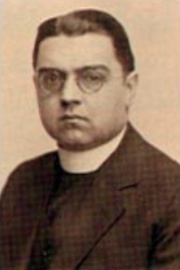 Rev. Canon Bernard Iddings Bell and seems to have been something all too rare in the history of America: a wise and presient Episcopalian cleric (which is not to say we have had any more than a mere handful of wise and presient Catholic clerics in this land).
Bell served as Warden of St. Stephen’s College – situated on the Hudson River here in New York – from 1919 to 1933, and is widely considered responsible for turning it into what was one of the best collegiate institutions in the country. In 1928, under Bell’s tenure, St. Stephen’s became a college of Columbia University, and this period of the College’s history was highly praised by the great Russell Kirk.
Kirk, in Decadence and Renewal in the Higher Learning, after positing his view of the ideal undergraduate college as a place of classical and liberal learning, takes note of St. Stephen’s. “There have been such colleges in this country,” Kirk wrote. “One such was St. Stephen’s College… when Dr. Bernard Iddings Bell was president. (He told me once that he gave up the presidency when strong objection was raised to his rule that the students should dress decently and rise when professors entered a room.)”
Of course, such arcadian days did not last. Only a year after Bell gave up the wardenship of St. Stephen’s in 1933, the college changed its name from honoring Saint Stephen, the first Christian martyr, to the more secular Bard College honoring the founder of the institution, John Bard.
A mere ten years later in 1944, Bard College became coeducational and as such severed its relationship with Columbia University, becoming independent as a secular, nonsectarian liberal arts college ‘affiliated’ with the Episcopal Church. The once-great college has now declined to such an extent that a professorship there is now named in honor of Alger Hiss, the man who betrayed America to spy for Soviet Russia. Sic transit gloria mundi.
Kirk relates another anecdote of Dr. Bell:
Canon Bernard Iddings Bell once showed a visitor from England about the environs of Chicago. They drove past a handsome Gothic building of stone. “Is that a school?” inquired the visitor.
“Yes– a new one, ‘distressed’ to appear old,” Dr. Bell replied.
“Indeed! Who is the headmaster?”
“There is no headmaster.”
“Curious! A kind of soviet of teachers, I suppose.”
“There are no masters at all.”
“Really? Do the boys teach one another?”
“As yet, there are no students. Here in the United States, we proceed educationally in a way to which you are unaccustomed,” Canon Bell told his friend. “First we erect a building; then we obtain pupils; next we recruit teachers’ then we find a headmaster; and at last we determine what is to be taught. You begin at the other end in England.”
Again, a quote from Canon Bell:
We need to forget the imaginary Christ who has been ours too long and to rediscover the real Christ, the Christ of the prophets and the martyrs and the confessors, the Christ who is not only the lover of souls but also master, a monarch with demands to make in industry, in finance, in education, in the arts, in marriage, in the home; the Christ who is teacher of a social ideology which has eternal validity; the Christ who cries aloud with convincing force, ‘He who would save his life will lose it; only he who is willing to lose his life, can find it.’
Rowing in Pelham Bay

During the past fortnight, I have been learning to row on the lagoon in Pelham Bay Park, a body of water with which I had no previous aquaintance. “Learning to row?” you ask. “But weren’t you in the University of St Andrews Boat Club during your bejant year?” Yes, dear reader, I was a full paid-up member of said body, but I was too busy avoiding lectures, failing courses, and other such frivolities of one’s first year at university to actually row, and only went to circuit training when Ezra Pierce irritated me enough that I felt obliged to give in and head on over. Nonetheless, at the suggestion of a good friend I decided to enroll in this program and have not regretted it at all. Rowing, in short, is addictive, and it is a grand shame that I shall have to wait until at least September in Scotland to get back on the water. (Above, the Travers Island clubhouse of the A.C. can be seen from the far end of the lagoon). (more…)
Search
Instagram: @andcusack
Click here for my Instagram photos.Most Recent Posts
- Brunel’s Unbuilt Capitol February 3, 2026
- Cricket at Fordham January 27, 2026
- Palacio Barolo Revisted January 14, 2026
- Learning to Love Liguria January 14, 2026
- Crux Alba No. 2 January 13, 2026
Most Recent Comments
Book Wishlist
Monthly Archives
Categories