
About Andrew Cusack
 Writer, web designer, etc.; born in New York; educated in Argentina, Scotland, and South Africa; now based in London.
 read more
News
Blogs
Reviews & Periodicals
Arts & Design
World
France
Mitteleuropa
Knickerbockers
Argentina
The Levant
Africa
Cape of Good Hope
Netherlands
Scandinavia
Québec
India
Muscovy
Germany
Academica
The Catholic Apostolic Church, Edinburgh
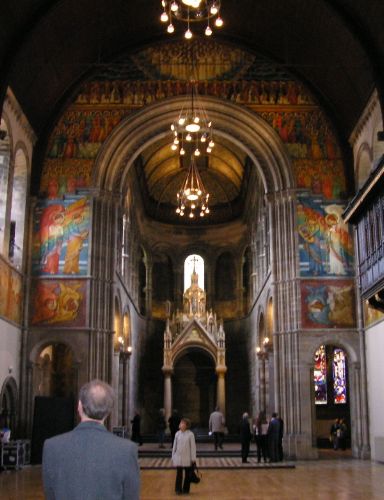
THIS AFTERNOON, Fr. Emerson and I paid a visit to the former Catholic Apostolic Church on Mansfield Place in Edinburgh, which is today the Mansfield Traquair Centre. The Catholic Apostolic Church, quite often called the Irvingites after the Church of Scotland minister who laid the basis for its creation, were a curious lot. A discussion of the CAC can be found here at Ship of Fools and, of course, Wikipedia has an article on them. Due to a number of wealthy converts as well as being fairly strict on tithing, the Irvingites were able to build some extraordinarily beautiful buildings, of which the Mansfield Place church is one. Vacated by the Catholic Apostolic Church in 1958, it is now used as a performance venue, and two floors of offices created in the crypt space (entered through a spiral staircase in what was the baptistery) provide a home for the Scottish Council of Voluntary Organisations.
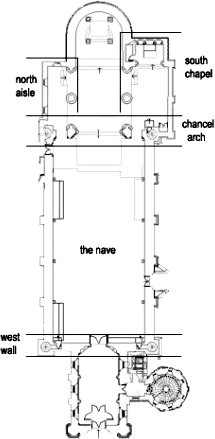
Reproduced by permission of Mansfield Traquair Trust
The building might just be considered another example of Scottish neo-Romanesque architecture were it not for the presence of the ethereal murals by Phoebe Anna Traquair, a leading light of the Arts and Crafts movement. The murals, in effect, are what make this place something else. Though a creation of the 1890’s, their polychromatic composition, Father noted, give us a glance of what the typical great cathedral used to be like. We now think of them as slightly dour, colorless places, but of course places like Nôtre-Dame de Paris et alia were originally painted all shades of glorious colors. This was eventually done away with, certainly by the iconoclasm of the French Revolution and by the Reformation in most other places where it held sway.
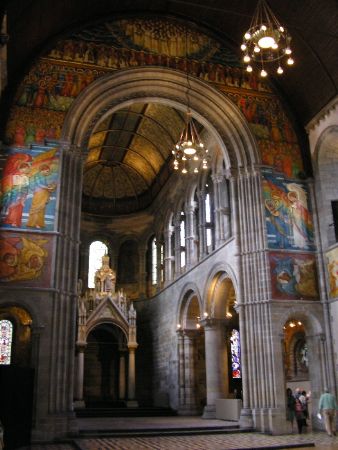
The topmost photograph and the one above show the chancel arch and its murals depicting archangles, angels, choirs, saints, martyrs, evangelists, and all sorts.
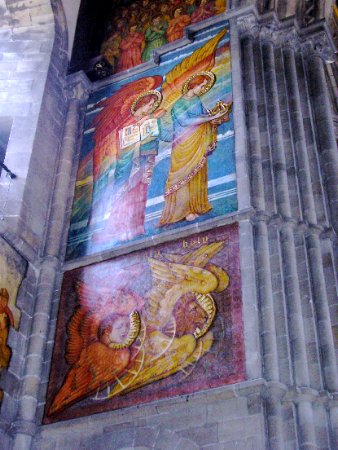
This close-up of the north arm of the chancel arch shows the three-dimensional nature of Traquair’s work. The murals are certainly short of being bas-reliefs, but the three-dimensionality makes them just that extra bit more intriguing than more conventional murals. Depicting the evangelists with wings, also unconventional.
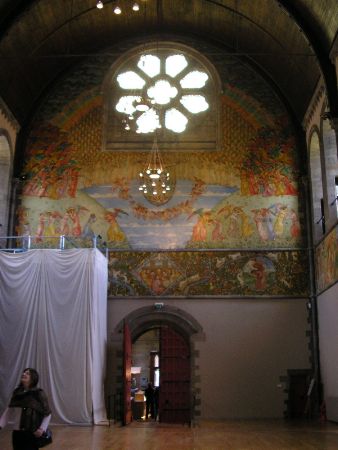
The rear wall features a mural depicting the final judgement.
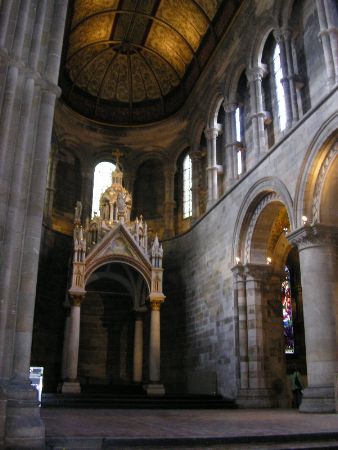
The chancel with baldachino, and below, a closer view.
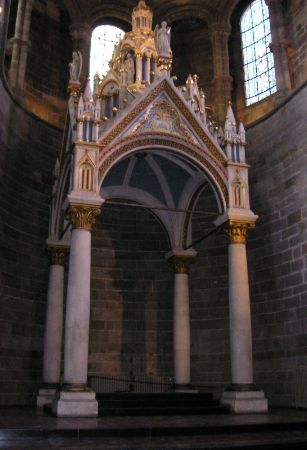
While the baldachino remains, the actual altar itself was removed. It was purchased by us Catholics, and is now the high altar of the nearby St. Mary’s Cathedral of the Archdiocese of St Andrews & Edinburgh.
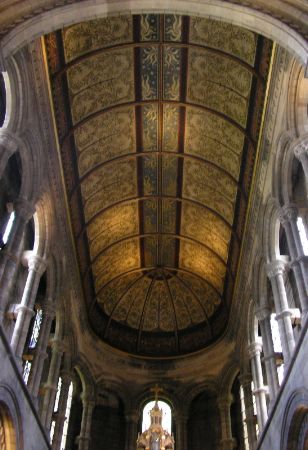
The painted ceiling of the chancel.
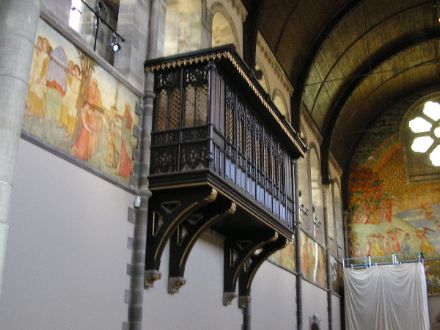
This part of the church confused us slightly. Judging by its current appearence, it looks like it could be a place for the choir, or perhaps a pew reserved for someone of great importance. The plain gray walls were also bemusing, as they seemed far too dull and boring for a church such as this. The answer to both quandaries can be found in older photographs.
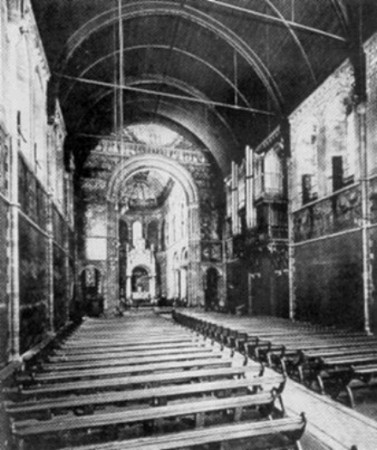
This image may be Crown copywright.
This photo of the church while still in use by the Irvingites shows the oddity was actually the organ loft. (Why didn’t we think of that?).
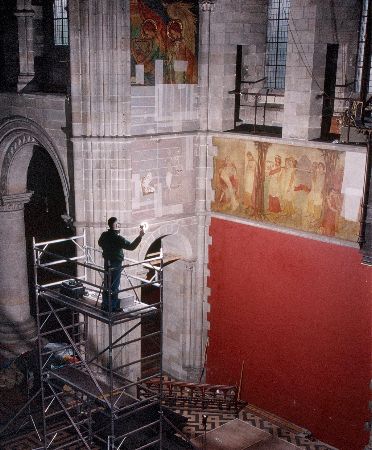
This image may be Crown copyright or belong to the Mansfield Traquair Trust.
The boring gray walls, on the other hand, were, until recently, a much more appropriate red, as can be seen above in a photo depicting the restoration of the murals. I suppose they were painted gray in order to make the former church more appropriate as a performance and conference venue. The final photo below shows the organ still in place, along with the red walls.
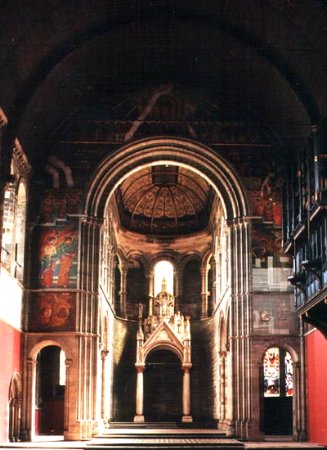
Reproduced by permission of Mansfield Traquair Trust
UPDATE: The Secretary of the Mansfield Traquair Trust informs me that the walls were painted red by Café Graffiti which operated the former church as a nightclub and venue in the 1990s. The walls were originally an iron-grey and the Trust decided to paint them buff “as an acceptable compromise”. I originally thought the red would be more appropriate but in retrospect concede that it may have been rather too overwhelming. Café Graffiti also painted the front doors blue, which the Trust restored to their original red. Also, the organ loft is not an organ loft, but merely an organ case. The actual console was located below with the choir. After the church was purchased by the Reformed Baptist Church, the actual organ itself was removed in 1975. The Trust restored the organ case to its original appearence (though sans organ, of course).
Search
Instagram: @andcusack
Click here for my Instagram photos.Most Recent Posts
- West Point July 30, 2026
- Brunel’s Unbuilt Capitol February 3, 2026
- Cricket at Fordham January 27, 2026
- Palacio Barolo Revisted January 14, 2026
- Learning to Love Liguria January 14, 2026
Most Recent Comments
Book Wishlist
Monthly Archives
Categories

My parent’s were caretakers of the Church ,not quite sure how long but I think it was about 3 years. I would have been 11 years old because I went to East London Street School and then to Bellevue which is now Drummond High.I have many happy memories of the time I spent there.
Thankyou for the great photo’s. Is it possible to have one posted of the front of the Church ?
Sincerely Margaret Blair
I was lucky enough to work at Cafe Graffiti for the last summer it was open as a night club and venue for the festival. I have great memories of working there, along with friends I made and the uniqueness of the church venue itself. Looking at the restored murals I am amazed at how beautiful the church has become, and can’t wait to go back and see it when I get to Scotland again.
Jen Randall
Chicago, IL, USA
Dear Andrew,
We actually painted the walls a lovely shade of deep terracotta which we took from th murals to echo the colours and warm up the space.
I don’t like the new colour at all!
We never painted any doors blue.
The inner doors were always blue nad the front doors red.
cheers,
Pete
About my earliest memory is of being wheeled in to the Mansfield Place Catholic Apostolic Church, Edinburgh, in my pram, aged about 3, by my mother.
As I remembered that brief visit, the Church was flooded with sunlight and my impression was that the paintings were on the ceiling.
My next visit was in the 1990s when driving past, I noted that it had re-opened as the Cafe Graffiti. Parking the car, I again briefly visited it, to note that the interior generally was in a decrepit state; and that the main paintings were in fact on the walls.
This was followed by a visit in about 2007 after being taken over and restored by the Mansfield-Traquair Trust, on one of the Open Days with a guided tour.
What a transformation.
Whilst the McEwan Hall gives some idea of how some of the cathedrals once looked like internally, it is scarcely preparation for the glorious interior of this church.
I was born and brought up in 51 Bellevue Road Edinburgh; and the caretakers of the Apostolic Church until they died in the early 1950s, were the Woods, an elderly couple who lived immediately above us in No53.
They had a newsagent’s shop in Broughton Street, with the more restricted opening hours of that period. (Most Princes Street shops were closed on Saturday afternoons and all-day Sunday.)
Hence on a Saturday afternoon, the Woods prepared the Church for the Sunday Services. It was during one of those occasions that my mother, noting that the doors were open, went in, taking me with her (of course).
John Betjeman (later Sir JB, Poet Laureate) visited the Church whenever he had time in his visits to Edinburgh. Walking down from Princes Street, he called in at the Woods shop to borrow the keys; and if closed, tried calling at the Church and frequently arriving at No53 Bellevue Road.
If the Woods were not at home, he would call at No51 to enquire if my mother knew their whereabouts.
During the 2007 tour, it was mentioned that the Altar had been acquired by the Roman Catholic Cathedral at the top of Broughton Street, in the 1960s.
Regarding the outer doors, they were definitely red during the 1940s and (early?) 1950s; bur were altered to blue (and looking very cold) probably in the late 1950s or early 1960s – did not look right in blue; and now restored to red.
If there are inner doors as suggested by one correspondent, I do not remember them. My general impression was of varnished woodwork amounting to draught protection, leading through similar varnished doors, in to the “smaller” front part of the Church. The outer doors hinged back in to the entry area, so could give the impression that they were recessed or inner doors, with an open, arched vestibule or foyer.
That 2007 visit stimulated me to research the history of the Church and the Catholic Apostolic Creed. The Creed apparently started in Germany about the 1830s, spreading to other countries in later years. Although there is no direct connection, the Church of the Latter Day Saints (Mormons) started about the same period.
In the UK, it attracted many of “the great and the good”, hence the Edinburgh adherents having the finance and power to build effectively a medium-sized cathedral very quickly in the 1870s.
In the 1881 Census, the minister, William(?) Seton, is living in Broughton Point Cottage, next to Broughton Point Dairy Farm where my Great-Grandfather Dow lived from about 1885 until his death in 1914.
The hierarchy of the Catholic Apostolic Church was 12 Apostles, with assistants. These were appointed at an Assembly; but no provision was made for Successors, so as the original appointees died, the movement withered away, resulting amongst other things in the abandonment of the Edinburgh church.
Interestingly for me, there were apparently two early British members, brothers Dow.
Apparently when the Assembly met to appoint and anoint the Apostles in London, the selected Dow brother did not turn up, resulting in the other brother being “pressed” into service. I make no claims of family connections, most unlikely as my Dow ancestry is clearly Scottish.
Alex Dow
I believe my grandparent who I never met were married in this church on 25th Dec 1895, They were Thomas Key Norris and Emma Wilson. I suppose it’s possible reading Alex Dow’s comments above that the minister would have been William Seton.
I hope to visit sometime this year and find out more.
I lived in the house belonging to this church as a young child, my father was the Caretaker. I spent many happy times playing in the old church building that was sectioned off and unused at that time. My older siblings and myself have fond memories of happy family times there and I am so happy that all the beautiful paintings were restored. We left around 1974.I can still remember the original pipe Organ as my father would play it to us sometimes. I hope to visit next time I am in Scotland.
My grandfather Edgar Bee Beck and my grandmother Nellie Stollard Osborne were married in the Catholic Apostolic church at Mare St Hackney. My great grand parents George Beck and Susan Sophia Evans were married in the Catholic Apostolic Church at Camberwell. My grandmother’s parents were Henry Osborne and Marianne Alexander. Marianne was born in London but all her brothers and sisters were born in Edinburgh. Henry Osborne’s father Samuel Osborne was married to a Margaret (surname unknown) who was born in Blantyre, Scotland. Samuel Osborne was a Catholic Apostolic Minister living in Hackney in the 1891 census. I fell there must be a connection with the Catholic Apostolic Church in Edinburgh. Has anybody any knowledge of Alexanders or Osbornes connected with the church in Edinburgh. My grandfather and grandmother George and Nellie Beck lived in Hackney when they were first married and then moved to Walton on the Hill Surrey from where they attended the Catholic Apostolic Church at Albury. My father also attended services there when young.
My ancestor Alexander Davidson was a Priest Minister Missionary of the Catholic Apostolic Church in Edinburgh in the 1840s to his death in 1875. It is impossible to find information on this church. Some of his children and descendents were married in this church in Edinburgh and Dundee.
My half brother seemed to be moving into a flat in the Caretaker’s house in July 1961. He was a young Episcopalian curate at the time, presumably with another church. Was it in the basement? I think it might have been damp, he got pneumonia and went into hospital where he met his wife, a nurse and they married the next summer and had a family house and church in Balerno.
I think that the catholic apostolic church in Dundee isnow the Scottish Episcopal church of Saint Mary Magdaleine
My father, Rev. Robert Doom was pastor at Bellvue Reformed Baptist Church until 1975. Our church pews were set up in the vestibule and the rest was curtained off. I remember playing in the nave and turning flips on the brass bars in front of the alter. Some of the glass window were broken and there were often birds inside.
I was friends with Fiona Brownlee — who wrote a comment above.
The last Angel of the Edinburgh Church was William Stevenson. He died in the 1930’s. His only child, Eric Stevenson, was an Edinburgh architect, and also a non-stipendiary priest in the Scottish Episcopal Church. I am married to his daughter, Elisabeth-Anne. The story of the CAC has an extraordinary and unique character. Peter Forster (Bishop of Chester 1996 – 2019).