Great Britain
About Andrew Cusack
 Writer, web designer, etc.; born in New York; educated in Argentina, Scotland, and South Africa; now based in London.
 read more
News
Blogs
Reviews & Periodicals
Arts & Design
World
France
Mitteleuropa
Knickerbockers
Argentina
The Levant
Africa
Cape of Good Hope
Netherlands
Scandinavia
Québec
India
Muscovy
Germany
Academica
Scotland
Written and illustrated by Andrew Cusack (at 7 years of age)
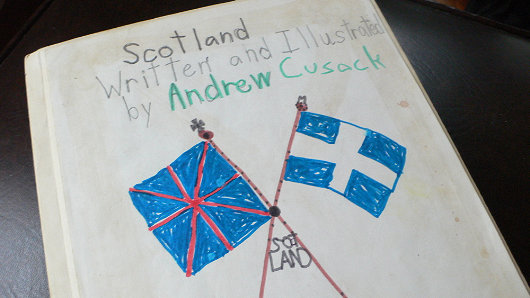
Were I to review this book, I would say it is riddled with inaccuracies and depicts a stereotypical Hollywood version of Scotland far-removed from reality. But then, it was written in 1991 by a seven-year-old (yours truly), which is already eighteen years ago now. The ultimate schoolboy error is that I was apparently incapable at age 7 of producing a vexillologically accurate reproduction of the Saltire. My incorrect version of the Scottish appears like the old Greek flag, a white cross extended across a blue field. (See the correct flag here). (more…)
Stoddart’s Ode to Ossian
The Queen’s Sculptor Plans Great Literary Monument in the West of Scotland
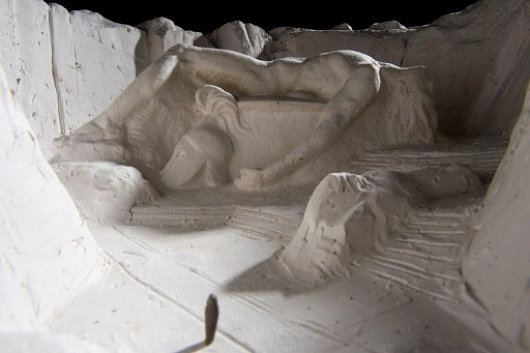
Word reaches me that Alexander Stoddart, the Queen’s Sculptor in Ordinary for Scotland, has dreamed up a massive monument to Ossian. “For fifteen years Stoddart has planned ‘a national Ossianic monument’ on the west coast of Scotland,” writes Ian Jack in The Guardian. “The scale is immense. Stoddart wants a great amphitheatre cut into the rock with Ossian’s dead son, Oscar, also cut from rock, prone on his shield on the amphitheatre’s floor.” The project would be the biggest literary monument in the world, surpassing the Scott Monument on Princes Street in Edinburgh. It could be the project of a lifetime for Stoddart.
“He says a lot of people are keen, including Scottish government ministers, landowners and historians, and that a site has been identified in Morvern and a preliminary survey completed by the engineers Ove Arup. There is also environmental opposition: the kind of people, according to Stoddart, who will ‘always find two mating ptarmigan no matter where we choose’ and haven’t taken into account Schopenhauer’s view that ‘the sound of nature is the sound of perpetual screaming’. It may account for the two death threats he says he has received.”
“The Ossian poems, especially ‘Fingal’, took Europe by storm,” the journalist continues, “and gave it a new notion of the savage and sublime. A cave on Staffa became ‘Fingal’s Cave’. Goethe incorporated Ossian into The Sorrows of Young Werther and Schubert used passages of Goethe’s translation in his lieder. By Stoddart’s estimate, nothing, not even the work of Burns, has made a larger Scottish contribution to European culture. Ossian established the Scottish wilderness as a destination for Europe’s earliest tourists. Also, by ennobling Celtic antiquity, it changed Scotland’s sense of itself.”
The traditional style of Alexander Stoddart, an avowed neo-classicist, has provoked foaming at the mouth in the rather dull arts establishment, but his works — such as the David Hume statue on the Royal Mile and the frieze on the Sackler Library at Oxford — have proven popular. Scotland’s greatest living sculptor has completed a bust of Scotland’s greatest living composer, James Macmillan, as well as of Britain’s greatest living philosopher Roger Scruton. (The old-school lefty Tony Benn — another living national institution — is the subject of a Stoddard bust as well).
“The paradox is that, by revering and understanding abandoned traditions, [Stoddart] has emerged as one of the most original artists in Britain: a stranger to his times.”
Brother Ursus of Blackfriars, Oxford
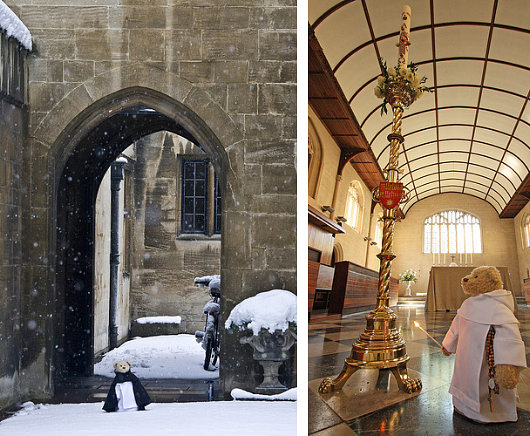
Left, contemplating the winter snow. Right, contemplating how the deuce a bear of his particular stature can light the Easter candle.
The End of India Street
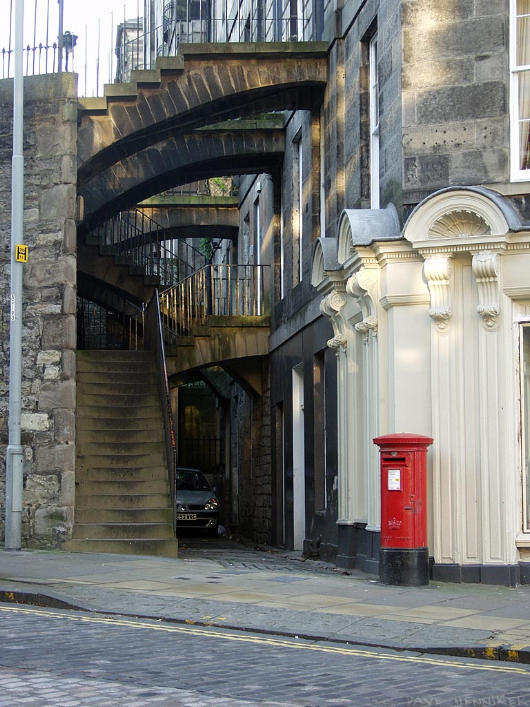
Photograph by Dave Henniker.
In the Dublin auction houses
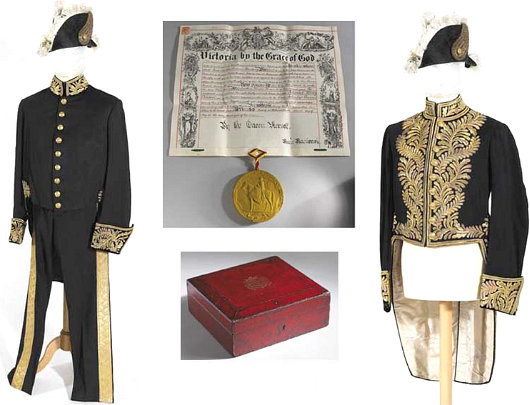
THOUGH THE BORING brains of tawdry metropolitan Londoners are all too quick at relegating Dublin to the provincial periphery of the mind, the Irish capital is a perpetual treasure trove for the old-fashioned and right-minded. A number of items of interests have recently been sold at the auction houses of the fair city, including two ceremonial uniforms (above) of that famous Dubliner, Sir Edward Carson QC. Carson was the lawyer and statesmen who passionately, but without bigotry, opposed the cause of Irish home rule. He was the defending barrister in the Archer-Shee case and led the Marquess of Queensberry’s team in Oscar Wilde’s doomed libel action. Carson and Wilde had been at Trinity together (where — little known fact! — Carson was a keen hurler), and the famous wit quipped of Carson “I trust he will conduct his cross-examination with all the added bitterness of an old friend.”
Having a fine mind for the law and being politically active meant that Carson moved through several layers of British government, holding numerous offices and positions. He was a Privy Counsellor twice over (of both Ireland and the United Kingdom), a Queen’s Counsel, served in the House of Commons as leader of the Irish Unionists, and held portfolios in the British Cabinet. The two ceremonial uniforms auctioned at Whyte’s of Molesworth Street are from his appointment as Solicitor General for England & Wales in 1900. (He had been Solicitor-General for Ireland in 1892, and was later Attorney General for England & Wales, in which position he was succeeded by the F.E. Smith of Chesterton’s famous poem).
The two black wool morning coats feature gold bullion trimming and buttons, and are sold with a pair of trousers with gold filigree stripe matching the lesser uniform, and knee breeches & silk stockings for the greater uniform. The vellum appointment as Solicitor General was also included, in a red leather box with a gilt impression of the royal arms. Whyte’s estimated a sale of €50,000-€70,000, but the lot’s realised price was €42,000. (more…)
The Oratory as It Was Built
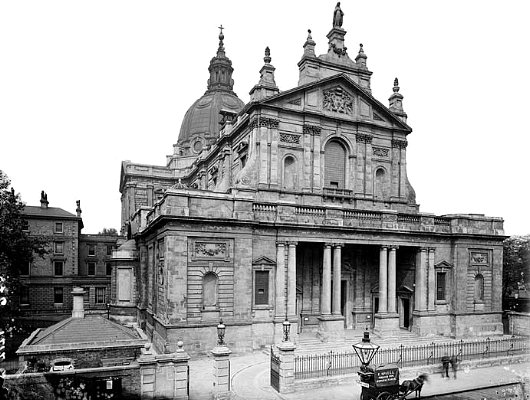
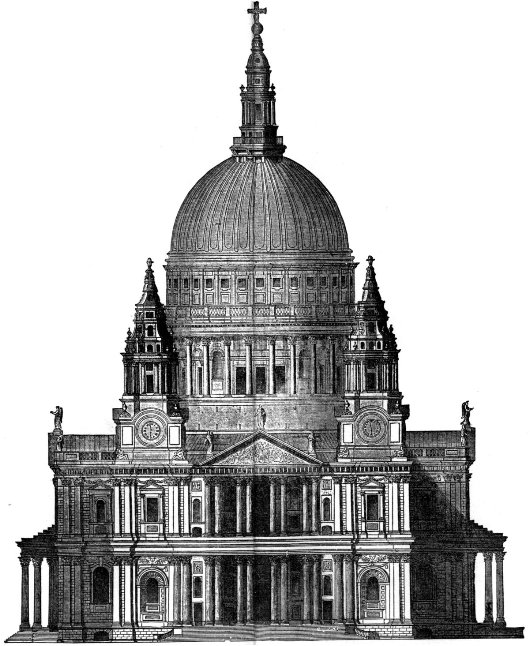
Since we explored Brompton Oratory as it might have been, here is the Oratory as it was built. The façade were finally completed in 1893 to a design by George Sherrin, with the dome following in 1894-95 by Sherrin’s assistant E. A. Rickards. How is the Oratory as depicted above different from the Oratory today? The fence and gates were replaced with a curved design at some date unknown to me, perhaps in response to a road-widening scheme.
No. 82, Eaton Square
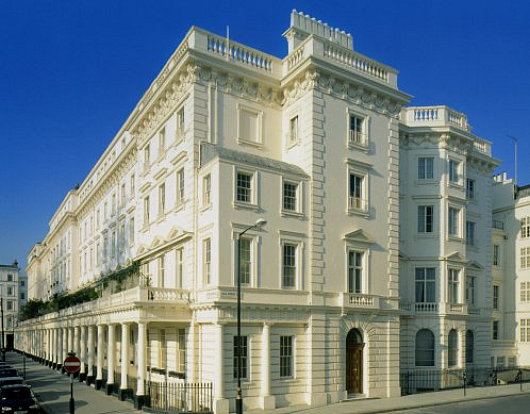
In it’s long history, the address of No. 82 Eaton Square in London has housed a Major-General of the East Indian Cavalry, a Lord Strafford, a Lord Bagot, an Earl of Dalhousie, an Earl of Clare, a Duke of Bedford, and Queen Wilhemina of the Netherlands — thankfully not all at once. It’s probably best know for its half-century as the Irish Club, a much-favoured drinking & smoking spot for the community of Gaels in London. The club was founded in 1947, with a number of pre-existing Irish clubs merging into it. George VI — grateful for the devoted service of the Irish who volunteered for his armed forces during the Second World War — heard that the club was in search of premises and asked the Duke of Westminster, one of the largest landowners in London, if he could help. The Duke provided the leasehold of No. 82 Eaton Square to the Irish Club for a nominal sum. (As it happens, the 4th Duke’s son served as a Unionist MP for Fermanagh & South Tyrone, and later in the Northern Irish Senate). (more…)
Baroness Scotland
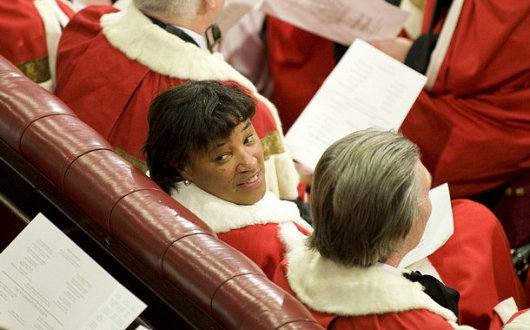
Ironically, Baroness Scotland is the Attorney-General for England, Wales, and Northern Ireland, but not Scotland.
The Diogenes Club
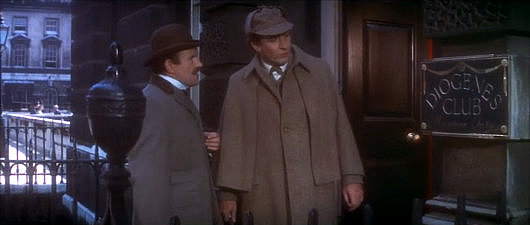
“There are many men in London, you know, who, some from shyness, some from misanthropy, have no wish for the company of their fellows,” says Sherlock Holmes in The Greek Interpreter. “Yet they are not averse to comfortable chairs and the latest periodicals. It is for the convenience of these that the Diogenes Club was started, and it now contains the most unsociable and unclubable men in town. No member is permitted to take the least notice of any other one. Save in the Stranger’s Room, no talking is, under any circumstances, allowed, and three offences, if brought to the notice of the committee, render the talker liable to expulsion. My brother was one of the founders, and I have myself found it a very soothing atmosphere.” (more…)
Brompton Oratory as It Might Have Been
Failed Entries of the 1878 London Oratory Architectural Competition
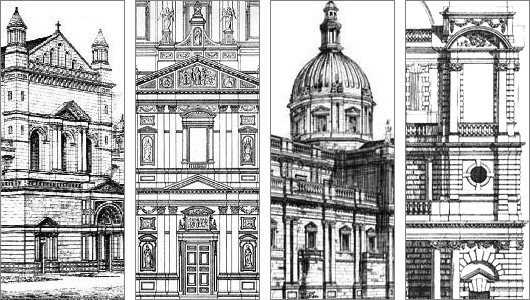
ARCHITECTURAL COMPETITIONS have always fascinated me because they give us the opportunity to glance at multiple executions for a single concept, to see different minds solve a “problem” with their own particular formulas and theorems. The designs of many of the world’s prominent buildings were chosen by competition, perhaps the Palace of Westminster — Britain’s Houses of Parliament — is most famous among them. When the Hungarian Parliament held a competition to design a grand palace to house the body, it found the top three prize designs so compelling that it built the first-prize design as parliament and the second and third places as government ministries nearby. To my surprise, I have only ever come across one book which adequately surveyed the subject of competitive architecture, Hilde de Haan’s Architects in Competition: International Architectural Competitions of the Last 200 Years. Most of the contests covered in the book are, naturally, for government buildings of national importance — private clients usually have a very firm idea of what they want and choose an architect accordingly.
One building not mentioned in the book but nonetheless very dear to me (and no doubt to many readers of this little corner of the web) is the Church of the Immaculate Heart of Mary of the Congregation of the London Oratory, more popularly known to friend and foe alike as the Brompton Oratory. It was the first church in Britain in which I ever heard mass, the summer after kindergarten when I was still but a tiny, blond-haired whippersnapper, in the midst of my first visit ever to the Old World, and the Oratory made quite a strong impression upon my young mind. It is usually one of my very first ports of call whenever I am in the capital, and I once even managed to slip in having just arrived at Heathrow while making my way to King’s Cross and the train to Scotland.
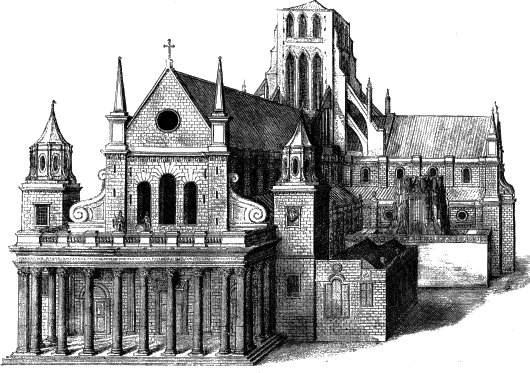
The Brompton Oratory is known for having good priests, traditional liturgy, and beautiful architecture. The final design was by one Herbert Gribble, but there was quite a bit of to-ing and fro-ing before Gribble was selected. The temporary church which had been erected on the site had been condemned by one critic as “almost contemptible” in its exterior design. In 1874, the Congregation of the Oratory (which is to say, the priests) put out an appeal for funds towards the construction of a permanent church. The 15th Duke of Norfolk obliged with £20,000 to get the ball rolling, and the next year a design by F. W. Moody and James Fergusson was agreed upon in principle. But the Reverend Fathers soon began to get creative and hatch ideas and contact other architects and very soon it was claimed that there were as many counter-proposals as there were priests of the Oratory, and perhaps more. A pack of clerics supported a suggested design by Herbert Gribble, but no accord could be reached among the Congregation as a whole.
In January 1878, then, it was announced that a competition would take place to decide the design of the permanent church of the London Oratorians. First prize was £200, with £75 for the runner-up. All entries had to meet the certain requirements drawn up by the Congregation. The style was to be “that of the Italian Renaissance”. The sanctuary, at least sixty feet deep, must be “the most important part of the Church. … Especially the altar and tabernacle should stand out as visibly the great object of the whole Church.” The minimum width of the nave was fifty feet, and maximum length 175 feet. Subsidiary chapels must be “distinct chambers”, not merely side altars. One aspect not mentioned was the projected execution costs of the designs — “an omission criticized by architectural journalists and disgruntled competitors,” the London Survey tells us, “whose designs called for expenditure ranging from £35,000 to £200,000”.
Over thirty entries were submitted to the competition, and Alfred Waterhouse was commissioned by the Fathers to provide comment on the submissions. Significantly, George Gilbert Scott, Jr. submitted a design, though I haven’t been able to get my hands on any depictions of it. Waterhouse praised it as “of no ordinary merit. … I feel that it is impossible to speak too highly of its beauty, its quiet dignity, its absence of all vulgarity and its concentration of effect around the high altar.” (more…)
The Sovereign Scotch Order of Whisky
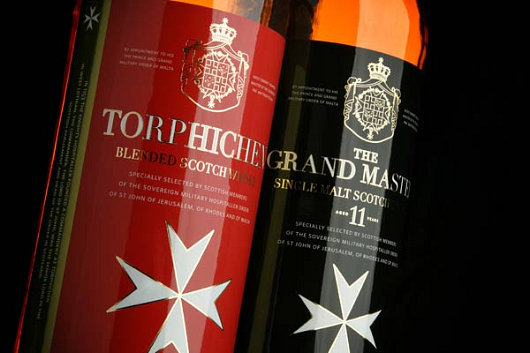
The Order of Malta recently paired up with Scotland’s own Adelphi Distillery to produce two variants of Scotch, proceeds from the sale of which support the Order’s worldwide charitable efforts. Adelphi produced a single malt called ‘The Grand Master’ and a blend named ‘Torphichen’, after Torphicen Preceptory, the headquarters of the Order in Scotland until the Reformation.
The last Preceptor of the Order in Scotland lamentably converted to Calvinism, surrendered the Order’s lands to the Crown (which were then re-granted to him specifically), and received the title Lord Torphichen (pronounced Tor-fikken).
Unlike most peerages, that of Lord Torphichen can be inherited by any assigned heir. In practice, it has descended through the Chiefs of Clan Sandilands, but in principle the holder could decide to designate any old Tom, Dick, or Harry as the next Lord Torphichen. (more…)
Clueless blogger: Alistair Bruce

Over at Sky News, we read the following from blogger Alistair Bruce:
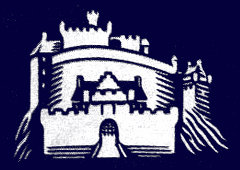 Or… perhaps because it was November 30… the Feast of Saint Andrew… Scotland’s national day? It strikes me, however, that Google UK’s little image of Edinburgh Castle is as astonishingly poor one. They should’ve commissioned Iain McIntosh, who designed the Edinburgh Castle logo of the Edinburgh Evening News (at right). Mr. McIntosh also does the splendid illustrations for the 44 Scotland Street series, not to mention the Professor von Igelfeld Entertainments, depicting the trials and tribulations of poor Professor Dr Moritz-Maria von Igelfeld of the Institute of Romance Philology at Regensburg.
Our Cardinal & Our Seminarians
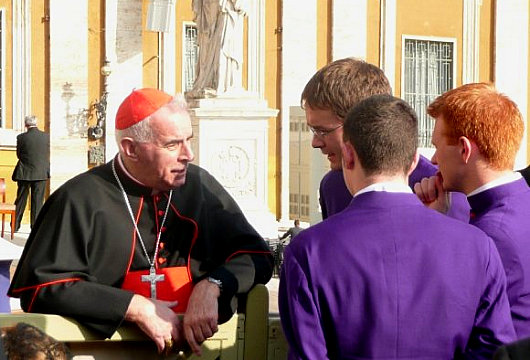
His Eminence Keith Patrick O’Brien, Cardinal Archbishop of St Andrews & Edinburgh, Primate of Scotland, has a wee chat with a triumvirate of seminarians from the Pontifical Scots College, Rome at the Holy Father’s weekly general audience. St Andreans (or at least Old Canmoreans) will recognize the ginger chap at right, attentively listening to the Cardinal’s words. I caught up with him in August when he had just a week to go before heading to seminary.
The Would-Be King of New Zealand
Brigadier the Right Honourable Sir Bernard Fergusson,
Baron Ballantrae, KT, GCMG, GCVO, DSO, OBE
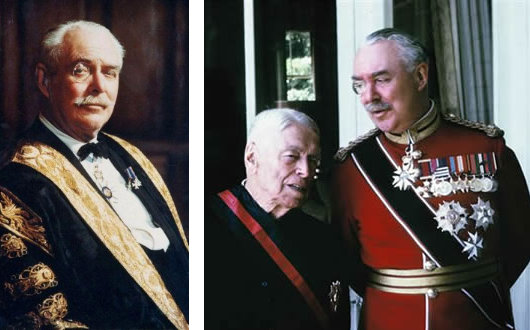
Left, Lord Ballantrae in his robes of office as Chancellor of the University of St Andrews; Right, as Governor-General of New Zealand with former Prime Minister Sir Walter Nash.
Over at Curated Secrets, Stephen Klimczuk takes a brief wander through Clubland, mentioning the illustrious Bernard Fergusson, who was known for “the skill with which he could toss his monocle in the air and catch it in his eye”. Stephen’s co-author on Secret Places, Hidden Sanctuaries, the Much Hon. Laird of Craiggenmaddie, chimes in on the commentbox, bringing to light that “when he was serving under Orde Wingate with the Chindits in Burma, among the supplies dropped by the RAF to those doughty warriors was a supply of monocles for Fergusson, since the damage/loss rate was so high in the jungle.”
Fergusson has always fascinated me, not only because he was the Chancellor of my university, but also because he has the best claim to the throne of New Zealand should the Land of the Long White Cloud ever decide to dispense with the House of Windsor. Lord Ballantrae (as Fergusson was ennobled) served as Governor-General of New Zealand, his own father served as Governor-General of New Zealand, and both his grandfathers served as Governor of New Zealand before the antipodean kingdom became a dominion. Rather appropriately, his son and heir is currently serving as Her Majesty’s High Commissioner to New Zealand, which is now the highest office of the British government in those islands.
Stephen mentions other fun stories of Clubland, such as the waggish response of the dinner guest who was kept waiting for Hermann Goering at one club before the war: “‘I have been shooting,’ said Goering. ‘Animals, I hope?’ was the quite reasonable question in response.”
Scottish Field
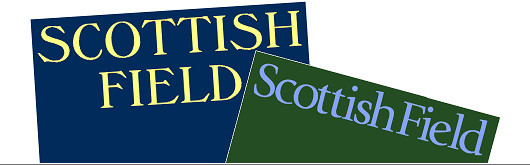
“He looked up from Scottish Field and all the colour, all the warmth of the world of those pages seemed to drain away.” So writes Alexander McCall Smith in The World According to Bertie, in which the eponymous minor’s enforced visits to the child psychiatrist at the command of his overbearing mother are made at least somewhat bearable by the freedom to flip through the pages of the magazine. Scottish Field is an institution, a staple of doctors’ waiting rooms and bed-and-breakfast sideboards, as well as acting as a Caledonian companion to Country Life and The Field (both of which are produced south of the Tweed, a world away). Your humble & obedient scribe even once graced the high-and-mighty social pages of Scottish Field, beside Lt. Col. Bogle and His Eminence the Cardinal Archbishop of St Andrews & Edinburgh.
Scottish Field recently underwent a bit of a redesign, which included a typographical change to its old-fashioned nameplate (often called a banner or, erroneously, the masthead). (more…)
Richard Demarco
“We didn’t know quite how to take this, but we sat there entranced.”
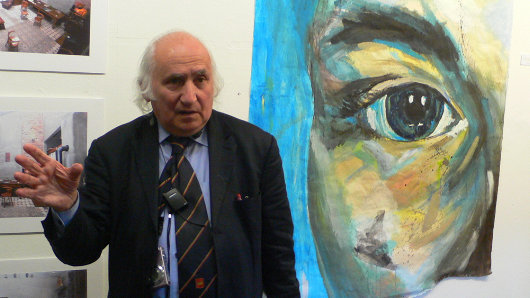
ONE OF THE markedly few deficiencies of the English language is coming up with a word to describe Richard Demarco. The Scottish press have generally settled upon “impresario” but even that somewhat-ambiguous word fails to do the man justice. Ricky was born in Edinburgh in 1930, grew up in Portobello, and remembers the day when his mother held him back from school because Italy — from whence he stock came — had just declared war on Great Britain. He’s attended every Edinburgh Festival since the very first one began in 1947 — as the founders put it, to “provide a platform for the flowering of the human spirit” in the grim aftermath of the Second World War.
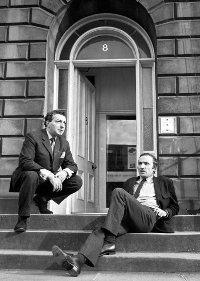 Richard Demarco, couchant, with noted Scots caricaturist Emilio Coia.
In 1963, he cofounded the Traverse Theatre, Scotland’s theatre for new writing, and three years after that founded the Richard Demarco Gallery which promoted Scotland’s cultural interchange with artists across Europe including — very importantly to Richard — from behind the Iron Curtain that divided the continent into free and captive halves. This was during an age when many in the arts world were too busy sympathizing with the murderous totalitarianism that had subjugated half of Europe. Richard has been a deep critic of the choices made by the British government as patron of the arts throughout the decades of his life, but not too long ago he finally patched things up with the Scottish Arts Council.
Readers of Alexander McCall Smith’s 44 Scotland Street might recall the man who comes to speak to the Scottish Police College. The “really important person from the art world in Edinburgh”, as Mr. McCall Smith puts it, comes and tells the trainee constables about the gorgeousness of Italian carabinieri uniforms and how the Scottish psyche still suffers from the iconoclasm of the Reformation, and even suggests architectural alterations and more sympathetic decoration of the Police College. “We didn’t know quite how to take this, but we sat there entranced,” the character admits in 44 Scotland Street. Anyone who either knows Ricky or has been to one of his lectures would immediately recognize the unnamed subject of the passage.
I first met the man when I was a first-year student at St Andrews and he had come up from the capital to give a lecture. I can’t remember what the stated subject was but this is entirely irrelevant as so vast and wide-ranging is the mind & experience of Richard Demarco that he is known for (some would say “notorious for”) never keeping within the bounds of the stated subject. Those who invite Richard to speak shouldn’t bother with a subject, just make posters stating “RICHARD DEMARCO SPEAKS”, giving the date, time, and place, and a crowd of interested characters is bound to turn up. (more…)
The Mitre
I’ve uploaded the last eleven issues of The Mitre — “the quality student newspaper at the University of St Andrews” — before its demise after the Midsummer’s Day issue of 2005. The old Mitre website can be found here.
An Early Proposal
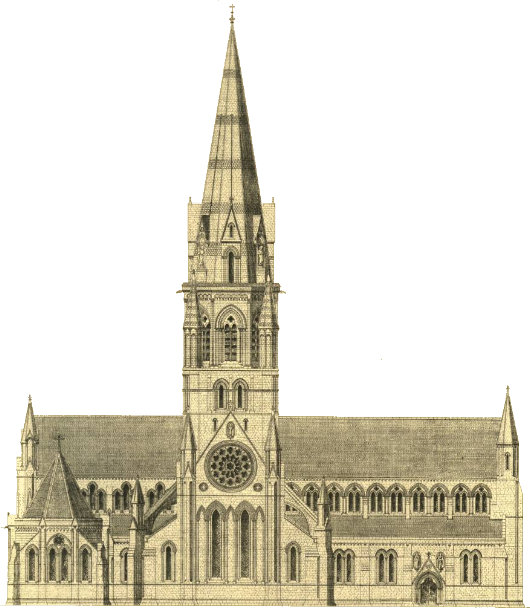
The Cathedral Church of St. Mary (Scottish Episcopal), Edinburgh.
Search
Instagram: @andcusack
Click here for my Instagram photos.Most Recent Posts
- Brunel’s Unbuilt Capitol February 3, 2026
- Cricket at Fordham January 27, 2026
- Palacio Barolo Revisted January 14, 2026
- Learning to Love Liguria January 14, 2026
- Crux Alba No. 2 January 13, 2026
Most Recent Comments
Book Wishlist
Monthly Archives
Categories