Great Britain
About Andrew Cusack
 Writer, web designer, etc.; born in New York; educated in Argentina, Scotland, and South Africa; now based in London.
 read more
News
Blogs
Reviews & Periodicals
Arts & Design
World
France
Mitteleuropa
Knickerbockers
Argentina
The Levant
Africa
Cape of Good Hope
Netherlands
Scandinavia
Québec
India
Muscovy
Germany
Academica
À bas l’Académie anglaise!
Proponents of an Academy of English are guilty of leaps of logic
IT STANDS AS one of the great monuments of autonomy and decentralisation that ever existed — the English language. But this great monument is under threat from an unlikely source: one sworn to defend it. The Queen’s English Society has announced plans to form an “Academy of English” along the lines of the Académie française for French or the Real Academia Española for Spanish.
“People misunderstand things if language is not used correctly,” argues Rhea Williams of the Queen’s English Society. “Misuse of apostrophes is the best-known problem, but people also don’t seem to know about tenses any more, for example, you hear ‘we was’ a lot.”
“An academy is needed because the correct information is not something that people can find easily. I suspect that many people in this country have easier access to a computer than to a reference book. They will be able to search without embarrassment, although people should be unafraid to say that they do not know what a word means.”
“At the moment, anything goes,” says Martin Estinel, the founder of the new academy. “Let’s set down a clear standard of what is good, correct, proper English. Let’s have a body to sit in judgment.”
No less an authority than Gerald Warner of Craiggenmaddie has waded into the debate, asserting on his Telegraph blog that “all champions of literacy will wish the society success.”
The complaints raised have a great deal of justification behind them, but the establishment of an academy does absolutely nothing to solve them. Indeed, the very complaint that the misuse of English is rampant and on the rise correctly presupposes that we are already able to discern proper English from improper English.
Rhea Williams and her confrers assume that when a person says “we was”, he is also claiming that it is right and proper English for him to say so. But, on the contrary, if you heard someone on the bus say “we was” and then inquired “Is that proper English?” he would almost certainly, if perhaps sheepishly, admit that it is not.
Similarly we hear complaints about “text speak”, as the shorthand version of English used in text messages (also known as SMSs) is called. But text speak similarly makes no claims to being acceptable as proper English. None would dream of preparing a job application, for example, in text speak.
Furthermore, the Queen’s English Society does not even use proper English on its website.
The Society aims to start using its BLOG [sic] again, following a period of inactivity. If you have something to say about the English language, in the context of education, employment, the media and feel able to contribute to the debate, we invite selected guest bloggers to send in their blogs.
“Blog” is a contraction of “web log” which has rapidly achieved legitimacy, and refers to the entirety of a blog, but the QES almost certainly used the word “blog” instead of what they actually meant, “blog entries”.
The very word “blog” itself is a perfect example of the threat to English that establishing an academy poses. I dislike the word myself, but its usefulness is inescapable. We needn’t refer to that wide and varying array of websites which are in fact an agglomeration of personal writings and links to other items of note — we can simply say “blogs”. An English Academy, on the other hand, might have banished “blog” from its fatuous version of what constitutes proper English early on, in which case the language would be all the poorer, or at least all the more cumbersome.
English speakers know good use from poor use, and when they’re not sure they overwhelmingly defer to those who do know. An Academy of English would do more harm than good and would solve none of the problems that would provoke its foundation. A massive and broad-based information campaign, on the other hand, paired with the return of authoritative teaching in schools, would aid the better use of English infinitely more than a body of pedants to settle disputes that do not exist. Pressure must be exercised against broadcasters, who spread improper English through a misguided attempt at authenticity, and we must also challenge the widespread perception of a social bias against proper speaking.
All these things can be done without any academy, and indeed establishing one would take energy away from these efforts. I’m sure therefore that, pace Mr. Warner, all champions of literacy will join me in shouting “À bas l’Académie anglaise!”
Modern Scottish Architecture
Sydney Mitchell’s Royal Bank of Scotland, Kyle of Lochalsh
Among the surprisingly large pool of under-appreciated Scottish architects is Arthur George Sydney Mitchell. His Edinbornian works include Well Court in Dean Village, Ramsay Gardens in the Old Town, and his restoration of the Mercat Cross on the Royal Mile. Sydney Mitchell also did a number of branch commissions for the Commercial Bank of Scotland (which in 1959 merged with the National Bank to form the National Commercial Bank, which in turn merged into the Royal Bank of Scotland in 1979). (more…)
Alexander Stoddart: “An Elite for All”
Scotland’s national newspaper interviews Scotland’s national sculptor
By SUSAN MANSFIELD
The Scotsman | 22 November 2008
ALEXANDER STODDART welcomes me into his studio, and into the 19th century. “It hasn’t gone away, you see,” he says, brightly. “The 19th century is not a period in time, it’s a state of mind.”
Indeed, if one could visit the workshop of one of the great monumentalists of a century ago, it might look a lot like this: plaster casts in various stages of assembly; imperious figures missing limbs or, occasionally, a head; bags of clay which until recently were a working model of physicist James Clerk Maxwell.
Stoddart is Scotland’s premier neo-classical sculptor, the man who made the figures of Adam Smith and David Hume for Edinburgh’s Royal Mile, Robert Burns for Kilmarnock, the beautiful Robert Louis Stevenson memorial on the capital’s Corstorphine Road. He’s 49, but looks boyish, with his sandy hair and dusty lab coat cut off at the elbows. He is a man of swift, enthusiastic intelligence, rarely still, and almost never silent.
Despite once being dismissed by the Scottish Arts Council as “backward-looking, historicist and not reflecting contemporary trends”, Stoddart is busy. Around us are the plastercasts of past commissions: immense allegorical figures for the £6 million Millennium Arch in Atlanta, Georgia; religious commissions for a mysterious private client who has her own chapel “somewhere in North Britain”; parts of 70ft frieze for Buckingham Palace. A bust of Pope John Paul II for a Chicago seminary.
Soon they will be joined by James Clerk Maxwell, whose statue, commissioned by the Royal Society of Edinburgh, will be unveiled on Tuesday at the East End of Edinburgh’s George Street. Stoddart is thrilled to be sharing a street with 19th-century sculptural greats like John Steel’s Thomas Chalmers. “It’s the greatest honour to be anywhere near the company of Steel.”
And he is ready and waiting for the next question, the one about relevance. (more…)
A Palace on Princes Street
The North British & Mercantile Insurance Company, No. 64 Princes Street
PRINCES STREET IS the thoroughfare of the nation, and its sad decline during the second half of the twentieth century and only partial comeback since then are reflective of Scotland itself. The architects of Edinburgh’s New Town had no idea that Princes Street would evolve into a commercial avenue, and the street was originally laid out as a handsome row of Georgian townhouses, built between 1765 and 1800, facing Princes Street Gardens and the Old Town above behind them.
Almost immediately the mercantile and social nature of the street began to assert itself, with shops and traders setting themselves up in the converted basements and ground floors of townhouses. The New Club showed up at No. 86 Princes Street in 1837, coming from previous premises in St. Andrew’s Square and before that Shakespeare Square (where the former G.P.O. now stands).
As the Victorian era progressed, more and more of the Georgian townhouses were demolished and replaced with new buildings in the varying styles of age. It was just two years after Victoria’s death that an old company built a new headquarters in a brimming Edwardian baroque: the North British and Mercantile Insurance Company. (more…)
Our Cardinal Strikes Again
Cardinal O’Brien, Scottish Primate, Preaches at Newly Ordained Priest’s First Mass in the Extraordinary Form at St. Mary’s Cathedral Edinburgh
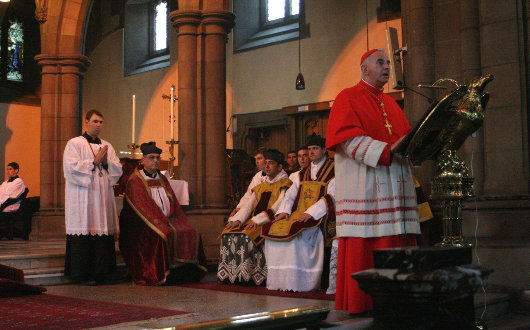
Keith Patrick O’Brien, the Primate of Scotland and Cardinal Archbishop of St Andrews & Edinburgh, this weekend preached at the first mass offered by the recently ordained Fr. Simon Harkins of the Priestly Fraternity of St. Peter. The mass was offered in the Cardinal’s own Cathedral of St. Mary in Edinburgh, Fr. Harkins’s own home town. The Very Rev. Fr Josef Bisig FSSP and the Very Rev. Fr. Franz-Karl Banauch FSSP assisted, and monks from the Transalpine Redemptorists of Papa Stronsay (who provided these photos) were also present, in addition to a number of diocesan priests.
I’ve spent the past eight years of my life divided between three (arch-) dioceses and I have to admit that Cardinal O’Brien is still the one I feel the greatest affection for. He’s an affable, uncomplicated fellow, and can be relied upon to defend what’s right in the media — unquestionably one of the best prelates in Britain today.
“I find him a much more approachable figure than other Scots prelates,” writes Damian Thompson, “less inclined to stand on his dignity despite (or perhaps because of) his red hat. I met him once at a party to relaunch the Scottish Catholic Observer, to whom he’s been a good friend; he didn’t sweep in surrounded by flunkeys, but hung around chatting in ordinary priest’s dress, reminding me a bit of Basil Hume in that respect.”
As it happens, I’m head of Cardinal O’Brien’s fan club on Facebook, which I encourage any Facebook users out there to join.
God bless our cardinal, and many congratulations to Fr. Hawkins! (more…)
The Presiding Officer’s Gown
While the 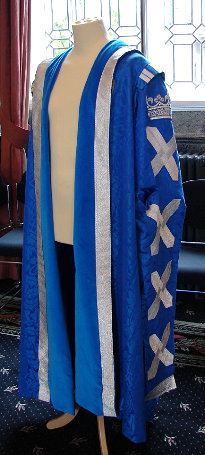 Westminster Parliament has a Speaker, the Scottish Parliament in Edinburgh has a “Presiding Officer” — a rather dull title if you ask me. The auld Estaits of Parliament abolished in 1707 were headed by the Lord Chancellor of Scotland, an office which fell into abeyance shortly after the Act of Union.
When the “Scottish Parliament” was refounded in 1997, the first man to hold the new job of Presiding Officer was Sir David Steel (the Rt. Hon. the Lord Steel of Aikwood), the despicable creature who as an MP introduced legal abortion to the United Kingdom in 1967, and who has inexplicably and disgracefully been created a Knight of the Most Ancient and Most Noble Order of the Thistle, the highest honour in the land (the Scottish equivalent of England’s Garter).
Anyhow, the St Andrews Fund for Scots Heraldry decided to commemorate the hosting of the Heraldic & Genealogical Congress in Scotland by commissioning a ceremonial gown for the Presiding Officer of the Scottish Parliament, who lacked one at the time. This rather handsome creation was presented to George Reid, the holder of the office at that time, during 27th International Congress of Genealogical and Heraldic Sciences held at St Andrews in 2006. Unfortunately I can find no evidence that this well-executed gown has ever been used. (more…)
The new Times of London online
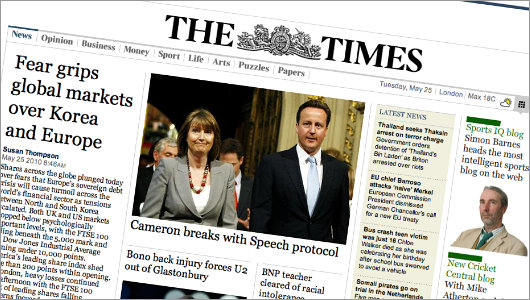
IAM MILDLY obsessed with newspaper design (in case you hadn’t noticed that already). But even those few newspapers that manage to either be attractive or worth reading (or indeed both) usually have websites that are astoundingly ugly. Check out the websites of The Scotsman, Le Monde, or the Times of India. They vary from awful to “meh”. The website of The Hindu is ugly, but is being replaced by a much more handsome design. Despite the over-sized ad on the index page, Die Zeit‘s website is on the handsome side of things, but that of the Neue Zürcher Zeitung is a mixed bag, some well-done details here, other poor ones there. I despise lefigaro.fr, especially since they started charging for their e-paper edition. The structure and flow of telegraph.co.uk is actually good, but the detailing isn’t and (like faz.net) it poorly reflects its newspaper’s personality.
Along then strolls the once-venerable Times (f. 1785), with a brand spanking new website at thetimes.co.uk. Clear, orderly, precise in its details, and just plain handsome in its overall design. There’s nothing particularly special or over-the-top about it; it’s just well done, but that is shockingly rare for newspapers today. (more…)
St Andrews, William & Mary join forces
The oldest universities in Scotland and Virginia announce they will offer a series of joint degree programs
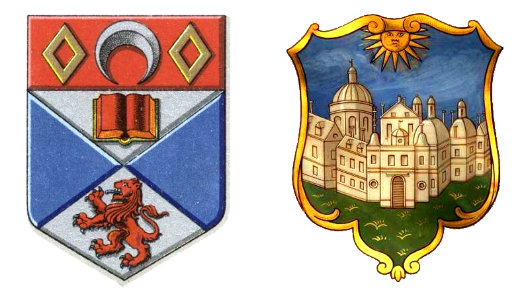
The University of St Andrews in Scotland and the College of William & Mary in Virginia are to begin offering joint degree programs starting in the autumn of 2011. Students admitted to the programs will receive a single Bachelor of Arts degree issued on behalf of both institutions — which will be the only B.A. offered by St Andrews, whose arts & humanities undergraduates typically graduate with an M.A.
The joint degrees will be available in four fields — history, international relations, English, and economics — with the aim of combining the depth traditional to the Scottish style of education with the breadth of William & Mary’s liberal curriculum. Students will spend the first year at their home university, followed by a second year abroad, with the remaining two years divided between the two. The program will start with about forty students divided between the two, with the hope to gradually double that size.
St Andrews is the oldest university in Scotland, and third-oldest in the English-speaking world. The College of William & Mary (now a university, despite its name) is the oldest in Virginia, the second-oldest in the United States, the third-oldest in North America, and the ninth-oldest in the English-speaking world. William & Mary, which is located in Virginia’s ancient capital of Williamsburg, has traditionally maintained links to Great Britain even after the Dominion of Virginia was recognised as independent in 1783. Queen Elizabeth II has visited the College twice, first in 1957 and more recently in 2007, and her former prime minister, Baroness Thatcher, served as Chancellor of the University.
London Bridge City: The Neo-Venetian Scorned
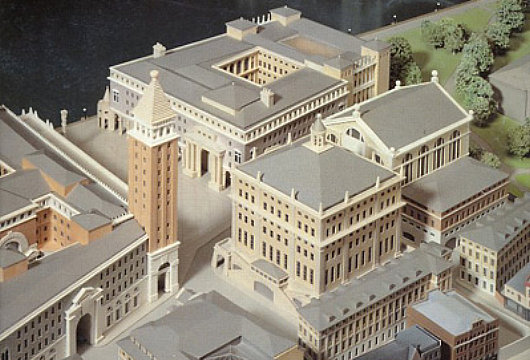
JOHN SIMPSON AND Partners 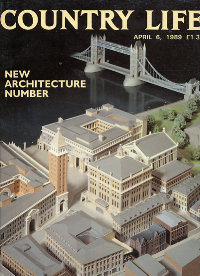 are one of the most prominent firms promoting classical architecture and urban design in Great Britain. They are perhaps most widely known for the work they did on the Queen’s Gallery at Buckingham Palace, as well as for the rejected scheme to redevelop Paternoster Square next to St. Paul’s Cathedral. Contemporary to their ultimately unsuccessful Paternoster Square bid was another ambitious scheme, Phase Two of the London Bridge City development. For Phase Two, Simpson composed a miniature Venice-on-the-Thames complete with Piazza San Marco and ersatz campanile. There seems, however, to be something just a bit un-English about the whole project. There are numerous examples of Ruskinian Venetian buildings throughout Britain, and indeed the Commonwealth, but an entire complex of Anglo-Neo-Venetian seems a bit over-the-top. Still, one can’t deny preferring a touch of Simpson’s over-the-top Venetian to the glass-plated boredom developers usually offer the public.
London Bridge City, Phase Two was proposed in the aftermath of the hugely popular speech by Prince Charles in which he condemned a planned modernist addition to the National Gallery as a “monstrous carbuncle on the face of a much-loved and elegant friend”. A bit of a donnybrook erupted between the architectural elite on the one hand (supporting the carbuncle) and the public on the other (supporting the Prince of Wales) and many a property developer was caught in the rhetorical crossfire. LBC’s backers decided, as an act of pragmatism, to come up with three radically different schemes in different styles and present them for consideration. (more…)
A New Scots Town in the Highlands
The 20th Earl of Moray teams up with Miami-based firm Duany Plater-Zyberk to plant a New Town of 10,000 inhabitants outside Inverness
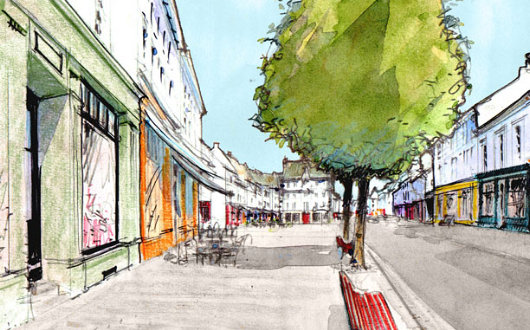
BELEIVE IT OR not, Inverness is one of the fastest-growing cities in Europe, and a local landowner, the 20th Earl of Moray, has teamed up with Duany Plater-Zyberk, an American firm known for its traditional architecture and urbanist ideas, to help create a sustainable new town of 10,000 inhabitants near the “Capital of the Highlands”. Tornagrain will rest on a 200-hectare (500-acre) site on the A96 corridor between Inverness and Nairn. Much of the recent growth in the Highlands has been poorly managed, raising concerns of suburban sprawl and poor land management. Moray Estates, the land holding company of the Earl of Moray (pronounced ‘Murry’) has decided to take the lead by planning a new town in the best tradition of Scottish architecture and urban development. (more…)
Cockerell’s Carlton Club
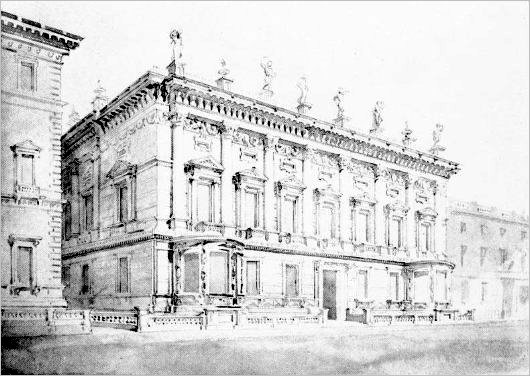
Charles Robert Cockerell is best known for designing both the Ashmolean Museum at Oxford and its Cambridge equivalent, the Fitzwilliam Museum. He is also, alongside William Henry Playfair, responsible for the twelve-columned National Monument that sits atop Calton Hill in Edinburgh — allegedly unfinished, though there is considerable debate over whether this is so. It’s not widely known, however, that the famous architect Cockerell completed a design for a new home for the Carlton Club on Pall Mall in London.
Originally Cockerell had declined the opportunity to submit a design, with such lofty names as Pugin, Wyatt, Barry, and Decimus Burton also declining the offer. A few years later, Cockerell nonetheless worked on this design for the Tory gentlemen’s club, which is superior to that conceived by another architect which was eventually built. Cockerell devised a “lofty Corinthian colonnade of seven bays” according to the Survey of London. “The columns have plain shafts, their capitals are linked by a background frieze of rich festoons, and the Baroque bracketed entablature is surmounted by an open balustrade with solid dies supporting urns and gesticulating statues.” (more…)
The Oriental Club
Stratford House, London
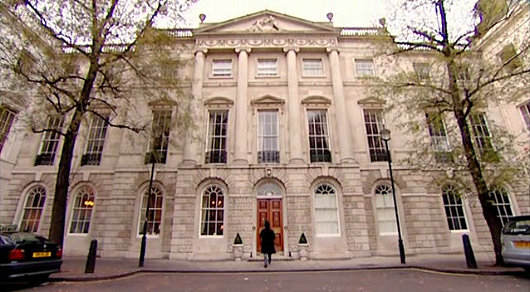
JUST STEPS AWAY  from Oxford Street, one of London’s busiest thoroughfares, rests a quiet little street called Stratford Place probably familiar only to Tanganyikans or Batswana seeking counsel from their countries’ high commissions. At the termination of the dead-end street sit the stately quarters of the Oriental Club: Stratford House. The club was founded in 1824, as British involvement and influence in both India and the Orient was waxing rapidly. General Sir John Malcolm, sometime Ambassador of His Britannic Majesty to the Court of the Peacock Throne (which is to say, Persia), coordinated the founding committee and advertised a club which would draw its members from “noblemen and gentlemen associated with the administration of our Eastern empire, or who have travelled or resided in Asia, at St. Helena, in Egypt, at the Cape of Good Hope, the Mauritius, or at Constantinople.” (more…)
Dabbling in Freemasonry at Downside
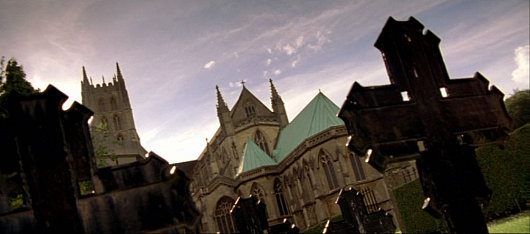
One of Britain’s most prominent Catholic schools, Downside Abbey in Somerset, has a friendship with Freemasonry that Catholics might find rather troubling. As recently brought to light in a report on the Curated Secrets blog, Downside invited “Spenny” Compton, 7th Marquess of Northampton (as well as Britain’s wealthiest Buddhist and sometime Pro-Grand Master of the United Grand Lodge of England) to talk about Freemasonry to students at the Benedictine boarding school. “I was invited two years ago to address some of the senior boys and monks at Downside, the Roman Catholic boarding school,” the Marquess wrote in 2005. (more…)
The Clootie Dumpling
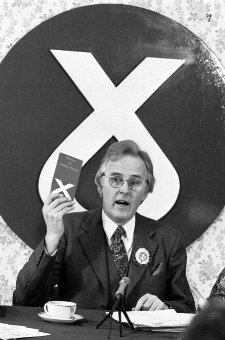 IT IS A DESIGN masterstroke, combining simplicity and ease of recognition with layers of symbolism. The emblem of the Scottish National Party is just one single line that descends, turns around, and crosses itself, but while remaining uncomplicated manages to evoke the Saltire (Scotland’s flag), the thistle (Scotland’s flower), and — the pudding which has given the logo its nickname — the clootie dumpling, a Scots specialty. And yet, despite its ubiquity, there is surprisingly little to be found online about the history of the SNP’s clootie dumpling.

The emblem was commissioned by William Wolfe (right) in 1962 for the parliamentary by-election in which he was standing as the Scottish Nationalist candidate. The party had typically employed a lion rampant as its symbol, which Wolfe thought too complex, and got Julian Gibb (in his own words, “scarcely out of childhood”) to design the brilliantly simple logo. “A political visionary with an eye for iconography,” according to Gibb, Wolfe used the emblem in the unsuccessful by-election campaign and a year later successfully proposed it to the party for adoption as the party emblem.
“The adoption of a geometric logotype is a bold act for a political organisation, especially a nationalist one, with the swastika a not too distant memory,” writes Gibb. “But the inner logic of the thing was persuasive. Forbye imagined allusions to saltire, thistle, and clootie dumpling, there was perhaps something irresistible about virile angularity supported on swelling curvature, implying among other things that in this outfit, the mechanistic depended on the organic. At one end of the scale of application it was devised to be hastily slapped on walls with a furtively loaded brush (the aerosol age had yet to come) and a quick flick of the wrist – no skill required. Try doing that with the lion rampant.” (more…)
‘Love over Parliament House’
Persuant to our discussion regarding Scotland’s three parliament buildings, Scots Law News reports that the Caledonian scribe Alexander McCall Smith has been called to the Scots bar.
Scotland’s Three Parliaments
All of Them More Beautiful than the Current Parliament Building
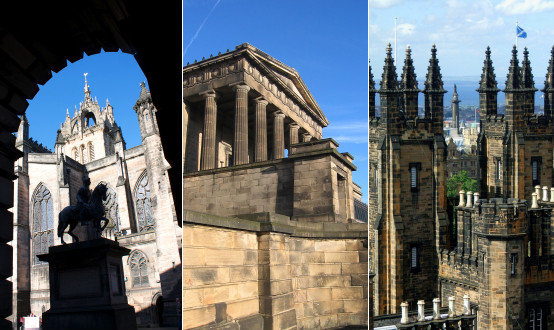
IT IS ONE OF those curious aspects of Edinburgh: its multiplicity of parliament buildings. The Estaits of Parliament, as they were known in the old days — consisting of the three estates of prelates, lairds, and burghers — first met in the Great Hall of Edinburgh Castle in 1140, though the first gathering of which we have primary source material was at Kirkliston in 1235, during the reign of Alexander II. The body led a somewhat peripatetic existence, meeting wherever was convenient, and even met for a year in St Andrews, where the building which housed it is still known as Parliament Hall. Indeed, that august edifice is home to the proceedings of the Union Debating Society, where the germinal gasbags of Scotland, and indeed of all three kingdoms, first enter the fray of political discourse.
In 1997, nearly three-hundred years after the Parliament was abolished, it was decided to bring it back, albeit in much reduced form. Great were the rumours and discussions about what effect the return of legislative power might have on the country, and Edinboronians pondered where the body might be housed. There were obvious choices, and less obvious choices, but in the end the Westminster government decided to go for the choice that hadn’t been suggested at all and built one of the most heinous offences against the sensibilities of taste that the land has ever seen. And so, the fact is that Scotland has three beautiful parliament buildings, none of which it uses. (more…)
The Abolition of Humour
Police Inspector Blog, by “Inspector Gadget”, is a pseudonymous blog written by a police officer that documents the absolute ridiculousness of modern British policing. The inspector has also published a book documenting how “you can be arrested for pinching a few crisps from a schoolfriend, throwing cream cakes or denying the existence of Santa Claus – while burglars, muggers and drug dealers go about their business unmolested by the forces of law and order”. I’ve been reading the blog for years now and it definitely lives up to its tag phrase of “You couldn’t make it up!”
Gadget’s latest post shows how humour has been systematically abolished in the modern police services:
Humour is almost exclusively at someone else’s expense, and in todays modern police service, we cannot mock anything or anyone, even if they can’t hear us, without being labelled as an “ist” of some kind. The public can ridicule the police as much as they like of course.
So, eight beautiful girls on a hen night, two men with funny hats, a uni-cyclist(???) and three lads dressed as penguins all walk past without even a comment or a snigger from the F Division Public Order team.
One night, an absolutely stunning woman approached the van and pulled aside her blouse to show us her naked chest. This happens a lot in Ruraltown, and in every big town. Hen night ladies are notorious for it. Imagine her shame when we simply stared at her, unmoved and silent.
“What the hell is wrong with you lads? You havent seen better than this have you?”
What was I supposed to say?
“I’m sorry madam but your outdated and sexist humour is not appreciated here; we are modern policemen you know, now move on and show your flesh no more.”
Shamelessly using the anonymity of this Blog, I feel that I can finally answer the lady in question. And my answer is this, No, we have not seen better than that. I thank you.
Via Hilary.
An Evening at the Travellers Club
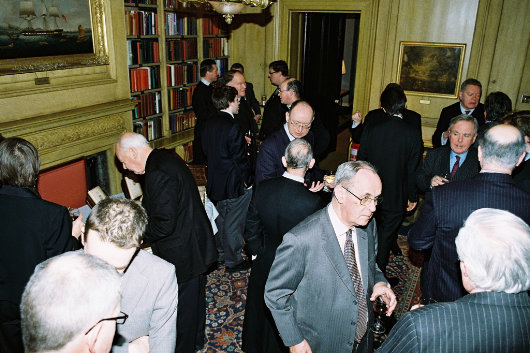
Photo: © Zygmunt von Sikorski-Mazur
TO CLUBLAND, THEN, for a book launch. Of course the secret about book launches is that they are often enough a convenient excuse to assemble a whole troop of interesting characters together, with the introduction of a newly published volume occupying a secondary (while nonetheless prominent) role. In this, our esteemed hosts Stephen Klimczuk and Gerald Warner of Craigenmaddie, authors of Secret Places, Hidden Sanctuaries, exceeded themselves. For me, the evening actually began not in the Travellers but just around the corner in the Carlton Club. Rafe Heydel Mankoo had suggested meeting up there for a drink or two or three before proceeding thencefrom toward the book launch at the Travellers. Pottering over from Victoria, I arrived at the Carlton and was guided towards the members’ bar where I easily found Rafe nursing a drink beside the hearth.
The usual updates were exchanged of various goings-on that had taken place since our last combination in August. Conversation naturally turned to Canada (where Rafe was raised) and shifted to New Zealand just before we greeted the arrival of Guy Stair Sainty. Guy I first met just four years ago while enjoying a pilgrimage to Rome. We happened to stumble upon him in the Piazza San Pietro (as one does with an odd frequency in the Eternal City), and, as it was my birthday, we invited him to join us for some champagne at this little place that overlooks the square. Guy was then in the midst of completing for Burke’s Peerage the massive, two-volume World Orders of Knighthood & Merit, or “WOKM”, which loomed restively on a nearby table as we sipped our drinks in the Morning Room. (more…)
A Wander Through the V&A
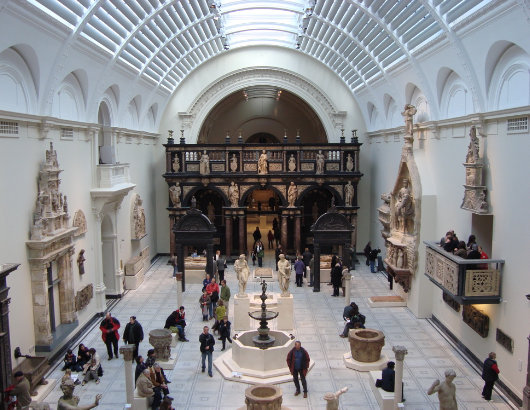
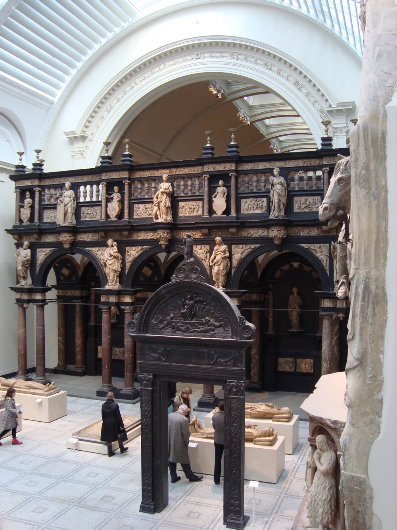 When on earth was the last time I was in the V&A? To be honest, I’ve no idea, though I’m certain my first visit was (like that of many others) as a wee one, the summer after kindergarten to be precise. It’s a stonking great place with tons of stuff in it, and one of the startling few that deal with architecture as a subject in its own right. (A fact which wins admiration in the heart of this architecture fan).
Of course the Victoria & Albert Museum has been fresh in the minds of many most recently for the re-opening of its Medieval & Renaissance sculpture galleries. The new arrangement cost over £30 million, took seven years to complete, and includes ten new display rooms displaying, as the Guardian put it, “a world of ravishing luxury”. So it seemed silly not to have a little wander round the South Ken institution yesterday, especially since it was a rainy afternoon. (more…)
Kidnap and Rescue
Followers of Seraphic’s blog will doubtless have read of my Caledonian misadventure, whereby I was kidnapped by the inhabitants of an historic house in East Lothian. This update was followed by the Sexagesima Social Report, detailing our Sunday Mass, followed by the Cup of Tea of Peace, followed by the Gin & Tonic of Fortitude. Pleasant as my enforced captivity was, various duties in London obliged me to cooperate with the successful rescue effort made, curiously, by Royal Dutch Commandos.
Further ruminations on my Britannic sojourn are forthcoming.
Search
Instagram: @andcusack
Click here for my Instagram photos.Most Recent Posts
- Brunel’s Unbuilt Capitol February 3, 2026
- Cricket at Fordham January 27, 2026
- Palacio Barolo Revisted January 14, 2026
- Learning to Love Liguria January 14, 2026
- Crux Alba No. 2 January 13, 2026
Most Recent Comments
Book Wishlist
Monthly Archives
Categories