Great Britain
About Andrew Cusack
 Writer, web designer, etc.; born in New York; educated in Argentina, Scotland, and South Africa; now based in London.
 read more
News
Blogs
Reviews & Periodicals
Arts & Design
World
France
Mitteleuropa
Knickerbockers
Argentina
The Levant
Africa
Cape of Good Hope
Netherlands
Scandinavia
Québec
India
Muscovy
Germany
Academica
A Hop Over to Cusack’s Room
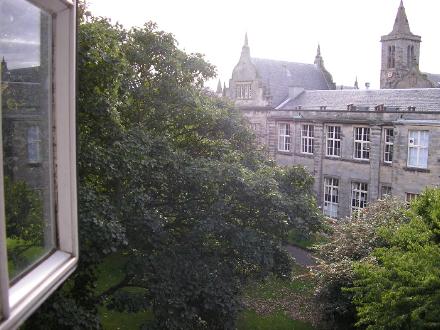
Dear friends, I have been absent from the “world wide web” of late owing to technological discrepancies. Rest assured by health and faith are still strong. No doubt you have felt a distinct lack during the past few days, which I hope to remedy by showing you a few photos of the locus in which my quotidian adventures take place.
Above is the view from the reading ledge by my window. A rather nifty thing, which obliges the requirements for some occasional fresh air along with an advantageous location from which to glance down upon the Principal’s Lawn (There’s a fine if he catches you treading on his little green patch).
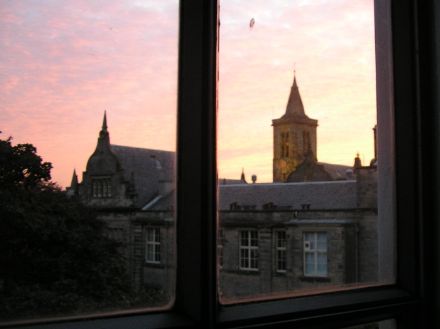
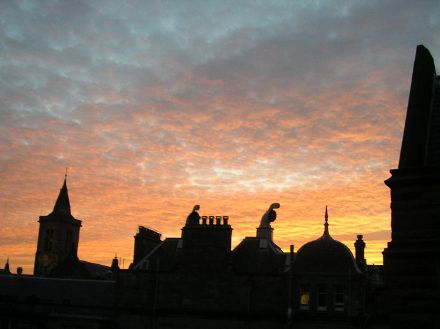
Sunset from the Cusack chamber. (more…)
‘The City of Golf’
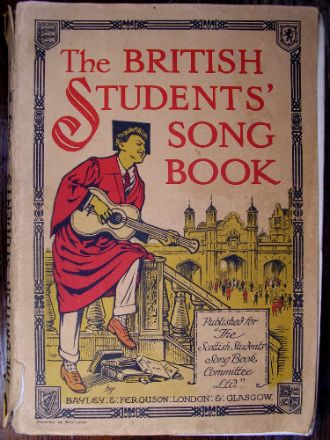
From the British Students Song Book:
Soul and body, to a tyrannising game?
If you would, there’s little need to be a rover,
For St Andrews is the abject city’s name.
It is surely quite superfluous to mention,
To a person who has been here half an hour,
That Golf is what engrosses the attention
Of the people, with an all absorbing power.
Rich and poor alike are smitten with the fever;
Their business and religion is to play;
And a man is scarcely deemed a true believer,
Unless he goes at least a round a day.
The city boasts an old and learned college,
Where you’d think the leading industry was Greek;
Even there the favoured instruments of knowledge
Are a driver and a putter and a cleek.
Golf, golf, golf – is all the story!
In despair my overburdened spirit sinks,
Till I wish that every golfer was in glory,
And I pray the sea may overflow the links.
One slender, straggling ray of consolation
Sustains me, very feeble though it be:
There are two who still escape infatuation,
My friend M’Foozle’s one, the other’s me.
As I write the words, M’Foozle enters blushing,
With a brassy and an iron in his hand…
This blow, so unexpected and so crushing,
Is more than I am able to withstand.
So now it but remains for me to die, sir.
Stay! There is another course I may pursue–
And perhaps upon the whole it would be wiser–
I will yield to fate and be a golfer too!
The First Sunday of Martinmas Term
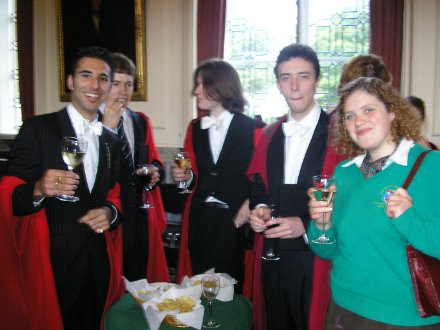
Today is the first Sunday and term and so after breakfasting in hall (a modest meal of bacon, hash-brown, and apple juice) I donned the old three-piece and gown and hopped over to Chapel for the first service of term. Chapel was packed to the brim almost, a very good showing, and as the Principal entered the Chapel following the mace-bearing Bedellus he had a very self-satisfied chagrin on, and nodded to himself no doubt reflecting upon the ancient glories of our university.
We were sadly informed that a student had died over the summer, killed in a car crash in France. Strangely enough, the same thing happened the summer before last when a very popular student died in a crash in Provence.
Other than that sad news, the service was of the usual feel-good traditional mainline psuedo-Protestant ilk that they are at St Andrews, the most interesting interesting part of which was when the University Chaplain, the Rev. Dr. James Walker, announced that our new hymnals had yet to arrive owing to a strike at the plant in Finland where they’re printed. I ran into J.E.B. tweeded and gowned, as we were exiting the service and he inquired as to whether I was “seeking religious inspiration when I had my eyes closed during the sermon or whether I was just nodding off.” I will leave our readers to guess.
Afterwards, instead of the usual post-chapel sherry in the Hebdomadar’s Chamber, the Principal hosted a little reception in Lower College Hall (from which, photographs above and below). (more…)
Scottish Weather
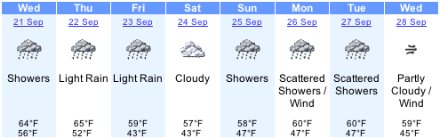
The forecast for St Andrews. Gloom and dreariness with a 90% chance of gray.
Back in the Swing of Things
Tonight at dinner we frightened the bejants and bejantines (first years) with our knowledge of random facts and history and the Ik tribe of Africa and even managed to engage one of the more comely new maidens in a plot to kidnap the Principal in order to reverse the creation of the new ‘Film Studies’ department and to get a smoking room for Sallies (St. Salvator’s, our hall). After dinner wound to a close we exited our splendid stained-glass-laden wood-panelled dining hall and headed to Jason Dunn’s room for some sherry. He has a very nice decanter and set he picked up dirt cheap from a charity shop. I’ll have to give them a browse sometime soon.
I also got a chance to catch up with Nicholas Vincent at his new abode on Greyfriars Gardens. It’s a beautiful and spacious place, “Victorian design but Georgian proportions” as Nicholas said, and I’ve actually been there before. Under the previous residents it twice acted as a sort of final locus for continued drinking after all the pubs and such had closed. I remember one night I ended up there with a small crowd including one of the wardens here at Sallies who I told I would buy two pints if he got me a place in hall (it worked), while Yaa’ra Barnoon was strumming a tune on the guitar, that most inferior of instruments, the exact opposite of the organ.
Tonight, after catching up via telephone with Rob who’s now teaching at Downside, the indomitable George Irwin, the most endearingly unpleasant person in all of St Andrews, had a little drinks party at which there were a number of usual faces; Phil Evans, Tom Kerr (PMC of the OTC), and Manuel Garces (Greco-Spaniard president of the Boxing Club), now shorn of his iconic sable locks, who spent his long vac cruising the Greek isles and lounging about (not bad). George begrudgingly allowed us access to a desirable bottle of whiskey which was left over from his sister’s recent wedding. (Apparently they were left with over 400 containers of orange juice, for the bucks fizz, and about 100 extra bottles of champagne, amongst other extras). I got a call from Jon Burke inquiring as to whether I was up for more fun and games, but alas the train for London tommorrow morning has encouraged me to call it an early night. Hoping to see a few old faces while I’m down in London, so it should be fun.
Room with a View
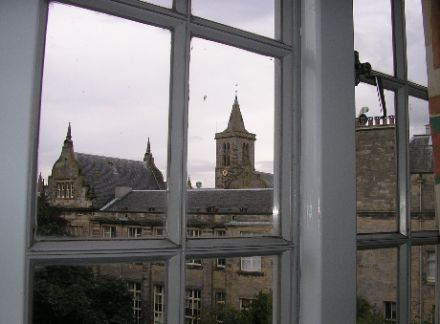
My room faces the Garden Quad (there’s a fine for walking on the Principal’s Lawn), and there is a good view of the college tower from the window.
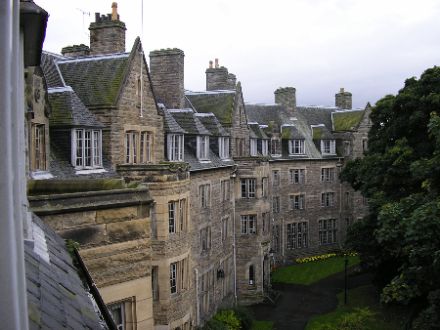
The view out the window towards the rest of the Hall. More later on, now I must rest!
Super-Regiment My Foot!
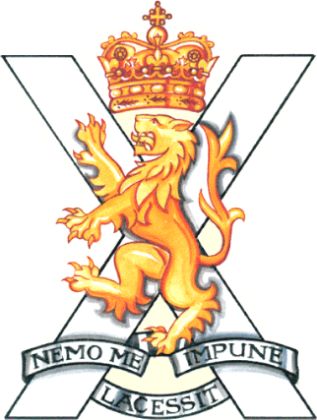
As the reader may well be aware, the last remaining six of Scotland’s historic Army regiments, one of which is so old that it is knicknamed ‘Pontius Pilate’s Bodyguard’, are to be merged into a new ‘super-regiment’ of six battallions, to be called the Royal Regiment of Scotland. Furthermore, the Royals Scots and the Kings Own Scottish Borderers are to be merged into a single battallion. In attempt to calm the fury which this announcement unleashed, government ministers promised that the six regiments would retain their historic identities and legacies as they transform into battallions of the new super-regiment by retaining their cap badges.
However, government ministers lie. A few weeks ago the new cap badge of the Royal Regiment of Scotland was unveiled, and all batallions will be required to wear it. It is simple and aesthetically pleasing, but none of these qualities really matter. It will be remembered not for its beauty but for the outrageous betrayal of tradition and common sense which will, I dare say, tar the Royal Regiment of Scotland for a very long time. There are, of course, last ditch efforts by politicians of all stripes and sizes to save the regiments, an important part of both Scotland’s history and present, but there is not much hope. What Downing Street says goes, irrespective of centuries of tradition, common sense, a public outcry, and the will of the people. Strange as it may seem, after these changes Canada will have more Scottish regiments than Scotland.
Meanwhile, Ian Hamilton ruefully mourns the lack of pomp at the recent opening of the Scottish parliament in the Sunday Times.
University of St Andrews: Tartan It Up
Meanwhile:
Alas.
Lord Dacre
The Daily Telegraph‘s recent remembrance of Maurice Cowling relays the following tale:
Invitations to the club carried a seal reading: “I’d stake my reputation on it.” Dacre was said to have retaliated by comparing Cowling’s circle to “a band of social outcasts living in a mountain cave under the command of a one-eyed Cyclops”.
There’s nothing so spiteful as an academic rivalry! I remember meeting the late Lord Dacre in Oxford about two years before his death. He was by then an ancient man, and the organiser of the assembly tried to make us feel impressed and privileged that we were able to meet such a man. I’m afraid, however, we took advantage of the Baron’s poor hearing and kept on whispering to eachother “Don’t mention the Hitler diaries!” (in the manner of Basil Fawlty’s “Don’t mention the War!” on Fawlty Towers). What can I say, we were young. At any rate, I hope the Authenticators still exist.
Bisset versus the Banana
My fellow St Andrean Andrew Bisset reports in from auld Caledonia, recently incapacitated by a banana:
Deserved indeed!
Mary Queen of Scots’ Tree
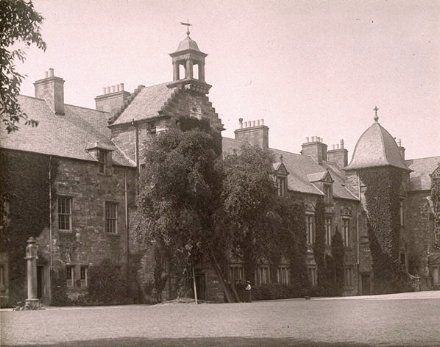
Pursuant to conversations held yesterday afternoon, I give you the thorn tree in the quad of St. Mary’s College, University of St Andrews, planted by Mary Queen of Scots. This photo was taken in the 1930’s, I believe. It looks a little worse for wear these days; rather sickly actually. Wouldn’t be surprised if the University was trying to kill it off as a safety hazard or other such bureaucratic flopdoodle.
If London Were Like Venice
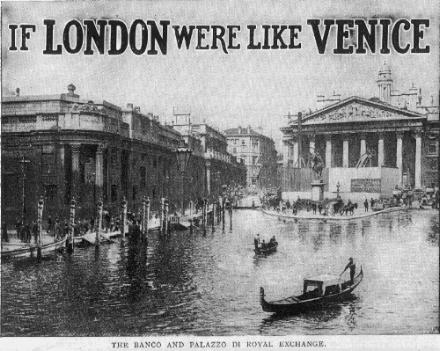
No doubt you remember If London Were Like New York, now we bring you If London Were Like Venice. A rather charming improvement, in my opinion. (more…)
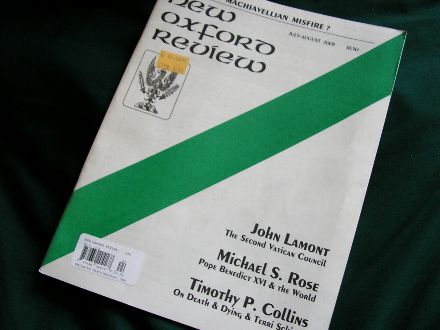
John Lamont in N.O.R.
We had something of a late evening last night at the Leviathan, in which I curiously had the chance to sample – perhaps that word is too modest, imbibe would be more accurate – a port which was, well, not a port. It was a port of New York, and I am not referring to the riparian locus wherein multifarious containers of a universal design speed cheap imported goods from the Orient to our fair city and beyond. Nay, the port was a fortified wine which claimed Long Island as its place of birth. Was it any good? Well, it was a little too fruity for my tastes, but then I’m a man of simple (some would say bland) tastes.
The Leviathan, for those who have not the pleasure of knowing it (which I take to be most of you) is a unique private club open to a select few young gentlemen and their occasional lady guests. It is not so much a club, but a private home which, given the absence of the parents off in foreign climes for rather extended periods of time, has been turned into a private club by the ingenious only child who is its sole permanent inhabitant. The club has a high proportion of members of French Canadian extraction, and features an interesting collection of Russian artifacts, provenance “unknown”.
As I was saying it was a late night, or rather late in Cusack terms as I left at half past one in the morning, and I am told the last members left around the hour of three. I nonetheless awoke this morning and took the train down to Manhattan and heard the resplendent treasure that is the Tridentine mass said in all its glory at the Church of St Agnes.
Whilst jolloping through the Hudson News shop in Grand Central, in the vain hope of being able to flip through a grievously overpriced imported latest edition of Country Life, I stumbled upon the latest issue of the New Oxford Review, the cover of which claimed that an article by John Lamont lay within. Delving into the formerly Anglican now ardent traditionalist Catholic publication I found that indeed it is the John Lamont we know and love. (He is also known as ‘Big John’ owing to his heighth and to differentiate him from the comparitively ‘Little Jon’ Burke).
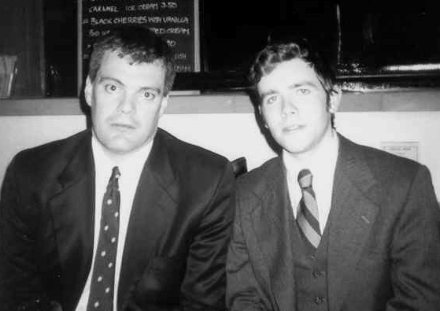
Anyhow, Big John is the Gifford Research Fellow at St. Mary’s College, the School of Divinity at the University of St Andrews. He and I are seen below in a photo taken by Rebecka Winell at a dinner in the Byre Theatre organized by Miss Victoria Truett in Candlemas term 2004.
‘A Little Madness…’
Our own Professor John Haldane, Scotland’s premier living philosopher (one wonders if he ever tires of hearing that), exhibits his rather wide breadth with an article in the Scotsman, not on his usual topics of heavier import, but rather speaking with Suggs (né Graham MacPherson) of the early-80’s band Madness.
A little Madness is good for you
by JOHN HALDANE
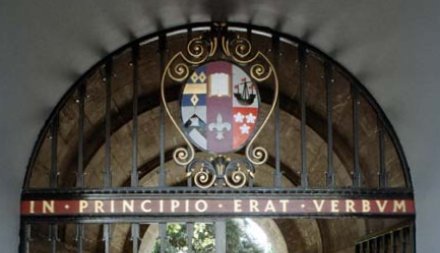
IN PRINCIPIO ERAT VERBUM – The Latin formula translates the opening of the prologue to the Gospel of St John: “In the beginning was the Word”. Cast in iron, the phrase spans the gateway into St Mary’s College, a reminder that a century before its foundation in 1538 the scholars of St Andrews gathered there in a long lost “College of St John”.
Six hundred years later a man in a leather jacket stands in the gateway and passers-by slow down to check that it’s really him: Suggs, lead singer of Madness, the group described as the “missing link” between The Kinks and Blur. A woman with young children stops to shake his hand, a pair of postgrads approach for autographs, even senior academics begin to hover in the background. Earlier, across at St Salvator’s College, it was the same story: seated in a stall of the 15th-century chapel or standing in the cloister, visitors approach; a cleaner makes her way around the quad just to say she thought it was him, and secretarial staff come from their offices.
‘Mitre Schmitre’: A Brief Dissection
Nothing is quite as much fun as a good old debate in the press. Alas, the Saint, true to form, published a somewhat slapdash and second-rate response (see post below) to what I thought was a pretty decent, albeit somewhat light-hearted, attack (see the Mitre, February 15, 2005, pp. 1-3). Well, herein follows a very brief highlight of portions of Mr. Hendele’s retort.
“Most of you probably haven’t read it – or heard of it – but what is important is that it continues to provide students with a voice.”
Judging from the usual content of the Saint, we should very much hope that their target audience has not heard of us, let alone read us. We are a quality newspaper, we are not a tool for entertaining the masses.
“What is important is that it continues to provide fair and unbiased coverage of things which matter most to students.”
Here, I must report an innacuracy. Though the Mitre is fair, we are far from unbiased. In fact, I am happy to report we have all the best biases.
“In a ‘recently’ – it only comes out once a month – published editorial from the Mitre of February of this year, the paper claimed The Saint has adopted a patronising, smug tone toward Christians, evangelicals and Catholics, and that this is indicative of our ‘intellectual backwardness.’ First of all, I do not see how one’s tone can be construed as an indicator of their intellect.”
I would advise the author to keep trying; perhaps someday he will gain just such an ability.
“Further, all of the articles written about Christians this year were authored by a Catholic, me, and have been aimed at the bigots who travelled great distances in an attempt to silence students’ in their exercise of the inalienable right to expression.”
Oh, the author is Catholic! Always good to have a fellow Catholic in the student press. Strange that he would defend a supremely blasphemous and perverted play as the ‘exercise of the inalienable right to expression’, but at least the author is Catholic, right?
“Secondly, how dare a paper so obviously enamored with the intricacies of Mother Church and the brainwashing dogma prescribed by it attack The Saint for being intellectually backward.”
Wait, I thought he said he was Catholic? Labelling the dogma proclaimed by Christ’s Church as “brainwashing” and insinuating that Catholicism (which I’m sure the author will recall is responsible for the preservation and maintanence of Western civilization not to mention the foundation of the University of St Andrews and every medieval university in Europe) is actually “intellectually backward” are not things that Catholics are wont to do. Perhaps the author meant to write “former Catholic” or “ex-Catholic” or the trendy “recovering Catholic” or the slightly more neutral “was raised Catholic” which would imply the disassociation from the Church so blatant in the author’s tone.
I also, perchance, wonder what Augustine and Aquinas would think when, upon reading the Saint, they discovered – quel horreur! – that James Hendele has implied that is they, the members of the greatest intellectual tradition the world has ever known, who are intellectually backward, instead of the mindless drones who regurgitate the spirit of the age fed up by the Guardian, New Statesman and other outlets of the secularist media and culture.
“Furthermore, the only other articles written about the University’s Christians this year have been in regards to their annoying, yet undeniably plucky, insistence on inviting ‘academics’ to speak on the merits of creationism.”
First Mr. Hendele said he wrote all the articles about Christians this year, now he says that there are others. Besides, we did not attack the Saint for having a smug and patronising tone for just this year; it has existed longer than that.
“The Saint has asked the Christian Union in a number of instances to contribute pieces reflecting their stances on issues of national importance and has not once heard a reply. Pot + Kettle = Black, you do the math.”
The Mitre is in absolutely no way associated with the (evangelical) Christian Union and never shall. The Christian Union often propagates the opposite strain of anti-intellectualism to that exhibited in the Saint.
“In that same article of February of this year, the Mitre not only goes on to quote our current, supremely ineffectual and apathetic rector, as saying that he believes The Saint has let its standards slip, but also accuses the paper of printing an excess of copies in order to somehow defraud would-be advertisers out of money. Any article based on the words of Clement Freud, a man more concerned with the sound of his own voice, should be taken with a pinch of salt. His recent contradictory statements on the problems The Saint were facing is testament to that. Furthermore, I do not see how printing extra copies and not selling them would in any way entice businesses to advertise. In fact the reason we print so many copies is because we must print a minimum of 1,000 and every thousand copies above that number costs only £3. It would do the Mitre well to get its facts straight before it starts pointing fingers at out ‘faulty accountants.'”
The remarks against Clement Freud are not worth refuting. Putting quotation marks around “faulty accountants” in my mind implies that such was a term used in either the Mitre article or commentary piece. In fact, the phrase is in neither the article nor the opinion piece. A tad misleading, but easily forgiven.
Mitre Schmitre
The Uni’s other newspaper ought to get its facts straight
(Published in the Saint, Thursday 5 May 2005)
by JAMES HENDELE
Here’s something I bet you didn’t know: our university has not only one, but two student newspapers. Well, more like one student newspaper and one student evangelical handout. Now I am not one to lambaste members of my own literary community, to accuse and name call and slander those I consider my fellow scholars and thinkers and journalists. I admire their effort. To start a student newspaper from scrap and turn it into a publication that can rightfully claim to be St Andrews’ most religious monthly takes determination, smarts and a dose of class.
Most of you probably haven’t read it – or heard of it – but what is important is that it continues to provide students with a voice. A voice which can be heard all the way from North Street in the north to South Street in the south. What is important is that it continues to provide fair and unbiased coverage of things which matter most to students: the latest Vatican news, the status of the recently formed St Andrews pro-life society, a definitive guide to the town’s best martini, and in depth coverage of Pope-watch ‘05. What is important is that it continues to assail those who would hinder students in their quest to know the specific details of last week’s debate. Here here, Mitre, here here.
I do not really think that anyone could possibly argue that this town is too small for two papers or that it is too liberal for a conservative voice. Quite the contrary – this student body has long been in need of a paper dedicated to voicing the concerns of those among us with a political or religious persuasion which would cause them to vote Tory and rest on the Sabbath. What bothers me is the way in which this University’s second paper has, at many instances, rebuked the editorial team of The Saint when it is guilty of the same sins it claims to reject.
In a “recently” – it only comes out once a month – published editorial from the Mitre of February of this year, the paper claimed The Saint has adopted a patronising, smug tone toward Christians, evangelicals and Catholics, and that this is indicative of our “intellectual backwardness.” First of all, I do not see how one’s tone can be construed as an indicator of their intellect. Further, all of the articles written about Christians this year were authored by a Catholic, me, and have been aimed at the bigots who travelled great distances in an attempt to silence students’ in their exercise of the inalienable right to expression. Secondly, how dare a paper so obviously enamored with the intricacies of Mother Church and the brainwashing dogma prescribed by it attack The Saint for being intellectually backward. Furthermore, the only other articles written about the University’s Christians this year have been in regards to their annoying, yet undeniably plucky, insistence on inviting “academics” to speak on the merits of creationism. The Saint has asked the Christian Union in a number of instances to contribute pieces reflecting their stances on issues of national importance and has not once heard a reply. Pot + Kettle = Black, you do the math.
In that same article of February of this year, the Mitre not only goes on to quote our current, supremely ineffectual and apathetic rector, as saying that he believes The Saint has let its standards slip, but also accuses the paper of printing an excess of copies in order to somehow defraud would-be advertisers out of money. Any article based on the words of Clement Freud, a man more concerned with the sound of his own voice, should be taken with a pinch of salt. His recent contradictory statements on the problems The Saint were facing is testament to that. Furthermore, I do not see how printing extra copies and not selling them would in any way entice businesses to advertise. In fact the reason we print so many copies is because we must print a minimum of 1,000 and every thousand copies above that number costs only £3. It would do the Mitre well to get its facts straight before it starts pointing fingers at our “faulty accountants.”
(Transcribed as printed).
Church of Christ the King, Gordon Square, London
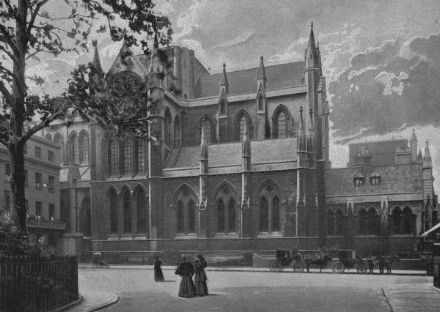
Though a comparitively small and minor sect, assiduous tithing by the members of Catholic Apostolic Church gave that group a number of stunning churches. (Their former church in Edinburgh was the subject of a previous posting).
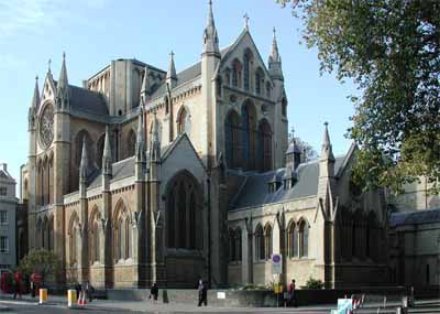
The building currently known as the Church of Christ the King on Gordon Square in Bloomsbury was constructed by the anachronistically-monikered Irvingites from 1853. The superb structure, built from Bath stone, is incomplete, lacking a few bays on the liturgical west of the building which kept the planned façade from being built. It also lacks a crossing tower, but then so does Westminster Abbey, the nave of which is only thirteen feet higher than that of Christ the King. (more…)
Films Recently Viewed
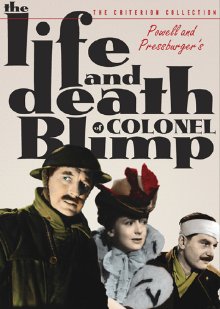
| The Life and Death of Colonel Blimp 1943 Directed by Michael Powell and Emeric Pressburger. A fine film, worth seeing. I’ve spied a few Blimps-in-training at the Mess in Wyvern. Also, Theo Kretschmar-Schuldorff is a heck of a good name for a character. |
 |
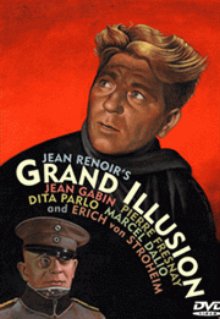
| La Grande Illusion 1937 Directed by Jean Renoir. I enjoyed this film greatly. It made me wish I had been a WWI pilot shot down by the Huns just so I could be invited to luncheon with the German officers. Everyone comported themselves well in those days (or at least in the cinema version of those days). According to IMDB, the Viennese Erich von Stroheim had spent so much time in America that he could barely speak German when the film was made. |
|
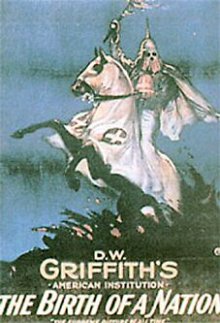
| The Birth of a Nation 1915 Directed by D.W. Griffith. Disturbing. The film’s basic premise that the United States was forged as a nation by the white knights of the Ku Klux Klan is balderdash, pure and simple. Still, a powerful and remarkable propaganda film. “It is like writing history with lightning, and my only regret is that it is all so terribly true,” said Woodrow Wilson, whose Southern racism most modern liberals like to ignore. |
|
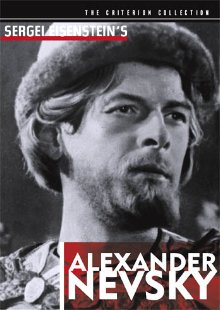
| Alexander Nevsky 1938 Directed by Sergei M. Eisenstein, score by Sergei Prokofiev. More brilliant propaganda, this time for the USSR, not the KKK. Beautifully shot, but the battle scene is a tad too long. Though very nationalistic, it is not hard to see the communism behind the film in a number of scenes. Found the only slightly veiled swastikas on the mitre of the Teutonic bishop rather droll. |
|
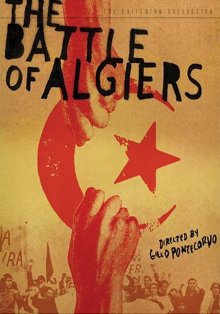
| The Battle of Algiers 1965 Directed by Gillo Pontecorvo, score by Ennio Morricone. My second viewing of this splendid film. Colonel Mathieu: “There are 80,000 Arabs in the Casbah. Are they all against us? We know they’re not. In reality, it’s only a small minority that dominates with terror and violence. That minority is our adversary; we must isolate it and destroy it.” And they did. Still managed to lose Algeria though – which was a damn shame for the Algerians. |
|
Chesterton Remembered
SIR: Your article on G.K. (This England, Summer 1986) brought back a happy personal memory of that great and kindly man. It was 1930 in Rome, where I was a pupil at a “finishing school” – in this case an English convent. G.K. sometimes came to visit our Reverend Mother; we knew him by sight and, once seen, who could forget the huge man in the big black cloak?
Part of our “finishing” process was to be taken round the museums and galleries of the Eternal City. One day we were being shepherded through the Vatican Museum. My friend and I somehow managed to get separated from the rest of our party and in one of the galleries whom should we see but Mr. G.K. Chesterton. He was about to leave so we followed him down the stairs in the hope of being able to get his autograph. At the foot of the stairs he turned. “As we had such young legs”, he said, “could one of us be so kind as to run back to the gallery where he had left his cloak, and would the other see if she could find him a carrozza [a cab, lit. ‘carriage’]?” We needed no second bidding. I raced back up the stairs, found the familiar black cloak where he had left it and triumphantly returned it to its owner. Meanwhile my friend had found a vacant carrozza. G.K. thanked us both, climbed into the carrozza and drove off. In the excitement we had forgotten about the autographs! Next day a letter arrived at our convent. He addressed it to “The Young Ladies suffering education at the convent at No. 10 Via Boncompagni.” Inside was a sheet full of auto-graphs and a little poem.
For you alone did I desire,
Who brought the prophet’s mantle down
And called his chariot of fire!
I have the precious autograph still and what a strange Chinese-looking affair it is!
— MRS. L. RIPLEY, BRIGHTON
Search
Instagram: @andcusack
Click here for my Instagram photos.Most Recent Posts
- Brunel’s Unbuilt Capitol February 3, 2026
- Cricket at Fordham January 27, 2026
- Palacio Barolo Revisted January 14, 2026
- Learning to Love Liguria January 14, 2026
- Crux Alba No. 2 January 13, 2026
Most Recent Comments
Book Wishlist
Monthly Archives
Categories