Great Britain
About Andrew Cusack
 Writer, web designer, etc.; born in New York; educated in Argentina, Scotland, and South Africa; now based in London.
 read more
News
Blogs
Reviews & Periodicals
Arts & Design
World
France
Mitteleuropa
Knickerbockers
Argentina
The Levant
Africa
Cape of Good Hope
Netherlands
Scandinavia
Québec
India
Muscovy
Germany
Academica
Pope Leo XIV Cricket Trophy
Emeriti C.C. Triumph over Old Dowegians and Vatican sides
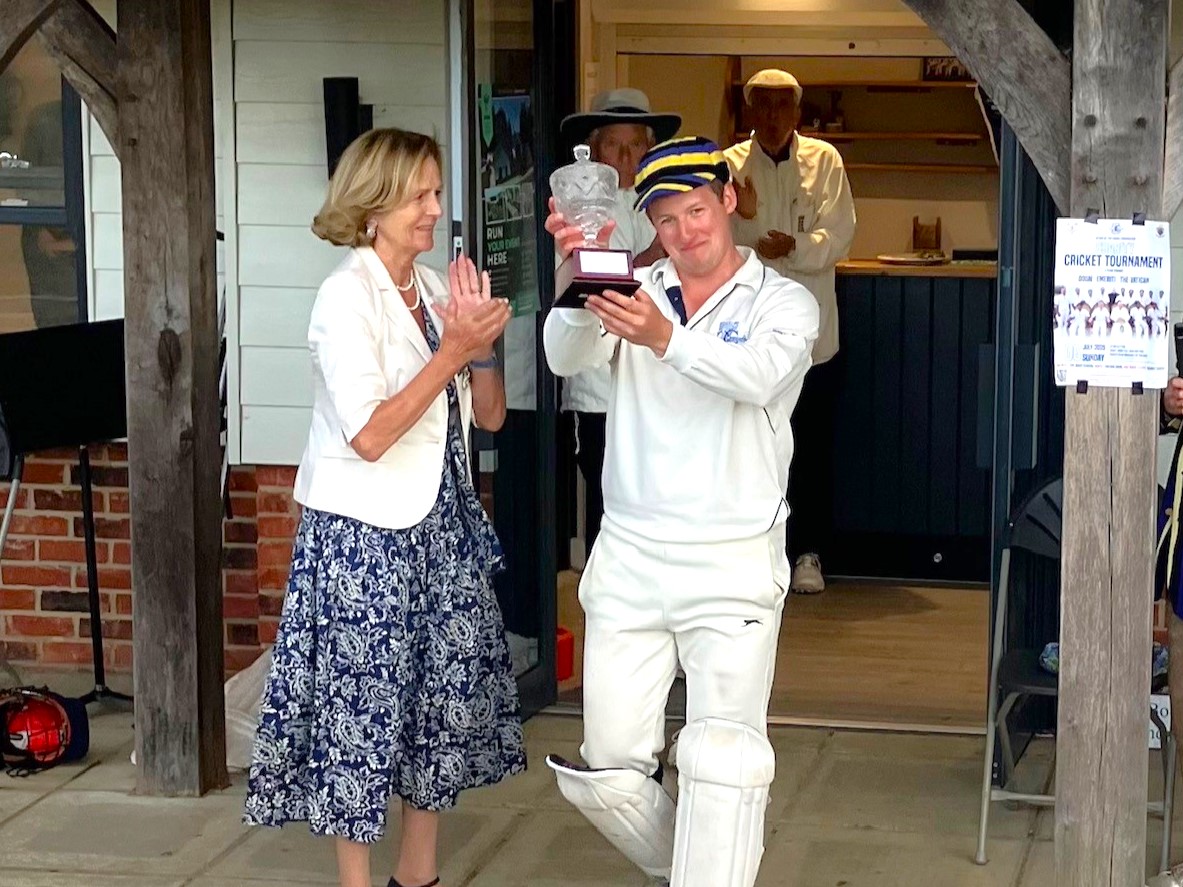
On 6 July 2025, Her Grace the Duchess of Somerset presented the inaugural Pope Leo XIV Cricket Trophy to the winners of this new sporting competition, Emeriti Cricket Club.
The Emeriti, founded in 1871 by Monsignor the Lord Petre, beat out Old Dowegians C.C. and the visiting Vatican cricket team, St Peter’s C.C., in the triangular competition.
The club takes its members from the old boys and masters of Catholic schools across England. Emeriti captain Tom Fleming received the cup from the Duchess of Somerset on behalf of his XI.
Emeriti also sponsor the Catholic Schools Cricket Festival and recently inaugurated the Catholic Schools Girls Cricket Festival to complement it. There are hopes for an independent Emeriti women’s side to emerge in the near future.
As a former Lords & Commons XI cricketer — we were beaten on the field of battle by the Vatican side — it’s good to see that cricket is alive and well in Catholic England.
Proportionality Destroys Representation
After the Jenkins Commission on the voting system presented its report to Parliament in 1998, the House of Commons had a chance to debate its findings and proposals.
In his contribution to the debate, Benn attacked the modish support for proportional representation, arguing instead that “direct representation is the delicate thread that links the people with their government”:
When we discussed the subject in the Labour party’s national executive a few years ago, when Neil Kinnock was leader, I said to Neil that I had a feeling that if we had a party list system my hon. Friend the Member for Bolsover (Mr. Skinner) and I would be at the bottom of the list. He laughed, but in a funny sort of way. That is the direction in which politics is going.
No doubt, all hon. Members will go to their constituencies this weekend. Every person whom we meet in our constituencies is our employer — the bus driver, the street sweeper, the home help, the policeman — and has the power to remove us. Our constituents expect to be represented. They decide whether they agree with our views and whether we have done a decent job.
Any element of proportionality, which destroys that link, could lead to people being governed by a Government whom nobody had voted for, because nobody would know the basis of the coalition on polling day. At least the coalitions of the parties are transparent: people can see them developing and know what they are voting for and what their own Member thinks.
I do not intend to waste much time on the Jenkins report because, candidly, I do not think that it has a cat in hell’s chance of succeeding. The idea that the parliamentary Labour party would go through the Lobby to destroy fifty of its own Members, to redraw all the constituencies and to introduce a new group of piggy-back Members is ludicrous. I heard it said by one cynic that the Labour party is so loyal that, if chimney boys were brought back in the name of modernisation, we would all go through the Lobby; but turkeys do not vote for Christmas. I do not honestly think that this is a serious plan.
The real issue is one that Jenkins neither considered nor was asked to consider the power that people have over the government of their country. This is the beginning of a debate about democracy generally. Unlike almost every other country, we have no vote over the head of state. We have no vote over the second Chamber. If my right hon. Friend the Prime Minister reintroduces Edward I’s method of appointing peers — when peers began in 1295, they were not hereditary — we will be modernising ourselves back to the feudal period. There will be absolutely no popular control.
The House of Commons has very limited power. After all, the Prime Minister derives his legislative majority from the people, but most of his executive power from the Crown. That is why the Prime Minister has put a spin doctor into Buckingham palace. If the Crown is not popular, the Prime Minister might lose the power to appoint bishops, judges, commissioners, peers and so on. That is how the system works.
It amazes me that the British people put up with that system. What is it about our training and breeding that makes us think that we are not fit to elect the second Chamber or the head of state? Jenkins does not deal with that, because he is an Asquithian Liberal. We have to be very careful.
People ask whether the proposals would lead to a coalition; but they are all about getting a coalition. Those who advocate the proposals favour a coalition. I do not want to be too political in a debate of this character, but it is worth noting that there is a big Labour majority and the leader of the Liberal party is on a Cabinet Committee, but I am not. I met him voting against the lone parents provisions last December. I was threatened with disciplinary action, but he knew that he would be at the Cabinet Committee the next day. There is already a broad perspective of views. For example, the right hon. Member for Henley (Mr. Heseltine), the former Deputy Prime Minister, has been given a job and the former Chancellor has been given a job. The former chairman of the Conservative party is in Northern Ireland, clearing up the RUC and David Mellor is in charge of football. When we talk about inclusiveness, I just wish some of us were part of it.
In future, unless we are clear about stopping it, all candidates will be vetted by the party machines. That is not about the power of the Prime Minister, but the power of the party leader. All the European candidates have been vetted and put on a list, as have all the Scottish candidates. My hon. Friend the Member for Falkirk, West (Mr. Canavan) was left off, because he was thought less suitable to be a Scottish candidate, although the hon. Member for Leominster (Mr. Temple-Morris) has suddenly given the Labour voters there a Member of Parliament by changing sides. Candidates for the Welsh Assembly will also be vetted. So the language of devolution is accompanied by the centralisation of power.
I do not wish to overdo the point, but as a Minister I visited the Soviet Union and Brussels many times. In the Soviet Union, we used to meet the central committee, which had not been elected. We met the commissars, and they had not been elected. I went to Brussels and met representatives of the central bank, and that had not been elected. I met the commissioners, and they had not been elected. The truth is that capitalism and communism have one thing in common: they do not want the people to have a choice of system, only a choice of management. That is the problem that we face. I have not heard anybody suggest that it would be a good idea for the Governor of the Bank of England to be elected, even by first past the post, and he has more power than any of us here. He is appointed, so he depends, like the bishops and the judges, on patronage.
We must face the problem that government now is less about representation and more about management. I get my fax from the party headquarters every morning, with quotations already attributed to me — “Mr. Tony Benn welcomes compulsory homework for pensioners”, or whatever it is, and I am supposed to put it back in the fax machine to send to the Derbyshire Times. I feel less and less like a representative and more and more like an Avon lady, who is told what to say when she knocks at the door. If the Liberals had joined the right end of the Labour party, we might have had a progressive party, but the trouble is that they joined the wrong end of the Labour party. I will not go into that now.
Direct representation is the delicate thread that links the people with their Government and the basis of it is that they elect a man or woman they know, can argue with and can get rid of. Do not think that minorities remain minorities for ever. After all, ten years ago, the environmentalists were bearded weirdos, but it will not be long before Swampy is in the House of Lords. The Dunblane massacre led to the previous Government changing their policy and apartheid ended by popular pressure. Democracy is not what somebody does to us if we vote for them but what we do where we live and work, and Parliament then gets the message. After forty-eight years here, I can say that Parliament usually gets the message last. We must listen to the people and not try to impose on them a pattern that will provide a permanent coalition and remove real choice from the electors.
Rising on a point of order, the hon. Member for Aldershot (Mr Gerald Howarth), inquired:
On a point of order, Mr. Deputy Speaker. The right hon. Member for Chesterfield (Mr. Benn) was so interesting and entertaining. May we vote for extra time for him?
Mr Deputy Speaker instead called upon the hon. Member for South Norfolk to continue to the debate. …
Spooks’ Crown

The Security Service, better known as “MI5” has changed its badge to incorporate the change from the St Edward’s Crown to the Tudor Crown that King Charles III has adopted.
The badge was designed by Lt-Col Rodney Dennys who himself had worked for the Security Service’s more glamorous rival, the Secret Intelligence Service (MI6). Dennys had started out in the intelligence game at the Foreign Office and was posted to the Hague before the war. When the Germans rolled in he was on one of the last boats to make it to Britain.
The MI5 emblem was approved by Garter King of Arms in 1981 but (like MI6) the Security Service was still so secret that it did not officially exist, so it was added to the secret roll of arms kept under lock and key in the depth of the heralds’ college in the City of London.
In 1993, after the Service’s existence was formally acknowledged, the badge became known and a flag bearing it often flies from the top of Thames House.

GCHQ has likewise adopted the Tudor Crown, but SIS has not publicly acknowledged any official emblem. (Perhaps it has its own entry in the heralds’ secret roll?) As such, MI6 uses a government version of the royal coat of arms, but theirs has yet to swap crowns.

Silver Jubilee
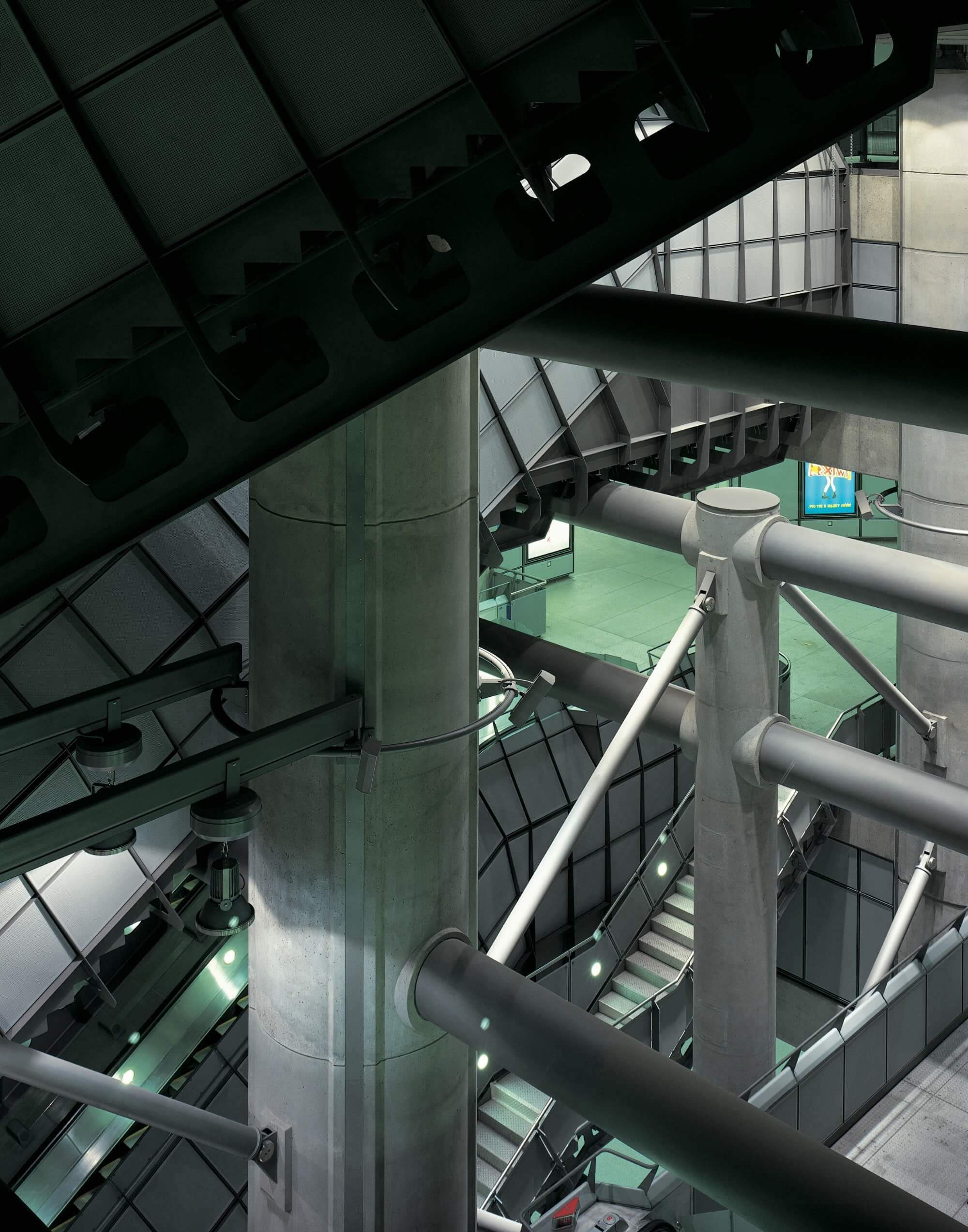
The Critic invited me to put together a few musings on the aesthetic, economic, and political impact of the JLE and the fundamentally Conservative vision that drove it. You can read it here:
■ The Half-Forgotten Promise of the Jubilee Line
Since it went up this morning, I received a kind email from Tom Newton, son of the late Sir Wilfred Newton who (as you can read in my piece) envisioned and managed the project:
You may be interested that as a family we well remember his intense frustration with the government of the time when they tried to cut back the cost of the project by reducing numbers of planned escalators across the new stations – he had to fight tooth and nail to keep the designs intact and indeed offered to resign over the matter and ultimately successfully defended the designs against cuts. He was very firm that he had no intention of building something which suffered the same capacity issues as the Victoria line resulting from similar reductions in capacity required by government during its construction. This was one of the very few times I ever saw him angry about anything.
He developed excellent relationships with railway engineers and architects whilst in Hong Kong and loved being involved in these large scale infrastructure projects – he was made an honorary member of the Royal Academy of Engineers as a result. He loved being involved in the JLE project very much. He was absolutely fascinated in how the engineers managed the risk of tunnelling across London without damaging other lines and keeping Big Ben standing.
He was asked to lead the construction of the new Hong Kong airport but decided it was time he had spent enough time in Hong Kong.
As a director of HSBC he knew Sir Norman Foster well from when he was the architect on the HSBC office building in Hong Kong. However, when he was asked by the HSBC board to oversee the building of the Canary Wharf office with Sir Norman as the architect, he was asked by the board to make sure Sir Norman was kept on a very tight leash on this build after the massive cost overruns on the Hong King building.
As regards the canopy at the JLE Canary Wharf station Dad had some robust conversations with Sir Norman about adjusting its design to make sure it would be possible to keep clean.
He always had an extraordinary ability to talk to anyone, cut through to the essentials of anything and take a very principled approach in dealing with people and problems.
Many thanks, Tom, for contributing this closer historical perspective of the Jubilee Line Extension’s construction.
Articles of Note: 11 November 2024

Caro had been a Nieman Fellow at Harvard studying urban planning and land use when he came up with the idea for the book. He thought it would take him nine months, but extensive research and over five-hundred in-person interviews meant it took eight years to complete.
Caro then started working on his study of Lyndon Baines Johnson, the first volume of which emerged in 1982 and the fifth (and final?) one he is still working on. (At the end of the fourth, LBJ had just become president.)
But where does he write? Christopher Bonanos of New York magazine finds out:
It’s an ageless space, one where it could be last week or 1950 inside, matter-of-fact and utilitarian. A couple of bookcases, a plywood work surface, corkboard with outlines tacked up, an old brass lamp, an underworked laptop for emails, a Smith-Corona typewriter. The desk chair is hard wood with no cushion. There’s a saltshaker next to the pencil cup for when Ina brings a sandwich out at midday. The desk has a big half-moon cutout, same as the one back in New York, so he can rest his weight on his forearms and ease his bad back. That arrangement was recommended by Janet Travell, the doctor who grew famous for prescribing John F. Kennedy his Boston rocker. She, with Ina, is a dedicatee of The Power Broker.
He bought the prefab shack, he says, from a place in Riverhead for $2,300, after a contractor quoted him a comically overstuffed Hamptons price to build one. “Thirty years, and it’s never leaked,” he says. This particular shed was a floor sample, bought because he wanted it delivered right away. The business’s owner demurred. “So I said the following thing, which is always the magic words with people who work: ‘I can’t lose the days.’ She gets up, sort of pads back around the corner, and I hear her calling someone … and she comes back and she says, ‘You can have it tomorrow.’”
Does he write out here every day? “Pretty much every day.” Weekends too? “Yeah.” Does he go out much while he’s on the East End? “We have two friends who live south of the highway, and I said to Ina, aside from them, I’m not going this year.” There are other writer friends nearby in Sag Harbor, and they get together, but at this age, Caro admits a little sadly, they’re thinning out. He’ll be 89 this fall.
■ George Grant is a still-underappreciated giant of political thinking in the English-speaking world. He is too little known outside his native Canada, which he sought to defend from the undue overwhelming influence of its sparkling and glamourous southern neighbour. Next year marks the sixtieth anniversary of his Lament for a Nation.
Of all people, a research fellow at Communist China’s Institute for the Marxist Study of Religion — George Dunn — has written a thoughtful introductory overview of Grant’s life and thinking: George Grant and Conservative Social Democracy in Compact.
■ Katja Hoyer mused on an overlapping theme in a recent Berliner Zeitung column which she has helpfully presented in English as well:
A diplomat close to the SPD recently told me that he couldn’t understand why working-class people in particular voted for the AfD. Things weren’t so bad for them, after all. I didn’t bother pointing out that rampant inflation, high energy prices and rising rents have had a hugely detrimental effect on the living standards of people with low and middle incomes because his analysis completely misses the point.
Germany’s working-class voters, Katja argues, feel forgotten by the parties founded to represent them.
■ Since the fall of the Berlin Wall — and earlier in Angledom — political conservatism has effectively been taken over by economic liberalism.
This has denied the centre-right from learning from and deploying useful experience from outside liberalism, with the wisdom of figures as varied as Benjamin Disraeli, Giorgio La Pira, Charles de Gaulle, and Thomas Playford essentially ignored or sidelined.
Kit Kowol’s new book Blue Jerusalem: British Conservatism, Winston Churchill, and the Second World War explores the visionary side of wartime Conservatism. Dr Francis Young offers his take on Tory utopias in The Critic.
■ From a similar era, Andrew Ehrhardt writes at Engelsberg Ideas on Ernest Bevin and the moral-spiritual dimension of British foreign policy.
■ Our friend Samuel Rubinstein has studied at Oxford, Leiden, and the Sorbonne — technically the oldest universities in their three respective countries (although we all know that Leuven is in fact the doyen of Netherlandish academies).
Sam offers an incredibly interesting comparison of the experiences of these three institutions in a humble essay on his Odyssean education:
I arrived in Leiden, armed with my phrase-book, with some ambitions of learning Dutch. The first blow came at the Starbucks in the train station, when the barista answered my Ik wil graag in English without hesitating. The second came the following day when I tried again, at a different café – only this time it seemed that the barista (Spanish? Italian?) didn’t know much Dutch either: even the natives were placing their orders in English. So I gave up – save one hobby, reading Huizinga in the original. I got myself an attractive coffee-table edition of Herfsttij and managed a page or so a day, strenuously piecing it together from my English, German, and smattering of Old English. I still haven’t the faintest idea how to pronounce any of it.
■ And finally, those of us who love Transylvania will enjoy Toby Guise’s summary of the Fifth Transylvanian Book Festival in The New Criterion.
The Lithe Efficiency of the Old Constitution
There is a wonderful glimpse of the old days in the memoirs of the late Lord Waddington (1929-2017).
David Waddington was a Lancashire man who became a lawyer, Member of Parliament, Government Chief Whip, Home Secretary, peer of the realm, and eventually Governor of Bermuda. (In that final role, he was the last of the big dogs — all the ones since have been civil servants.)
The old British constitution — before New Labour’s ill-judged reforms — had a lithe efficiency in those days aptly reflected in quite how few people were employed by the highest court in the realm — and how unfussedly they were officed:
I had only been in the House for two days when I received a telephone call from the clerk of my Manchester chambers asking me if later in the week I was prepared to sit as a deputy County Court judge somewhere in London. This would allow my colleague Bob Hardy, who had contracted with the Lord Chancellor’s Department, to sit as a judge on that day, to take over a brief of mine, a libel action in Leeds.
At the eleventh hour someone pointed out that if I were to sit, my career as an MP would come to an abrupt end because as a result of the House of Commons Disqualification Act I would have disqualified myself from membership of the House, thereby precipitating another by-election. I was then begged by Bob to go and explain to the lady in the Lord Chancellor’s Department why he could not sit and why I had turned out to be an inappropriate replacement.
I set off and, after journeying along many corridors and ascending and descending many staircases, I eventually found a little old lady sitting alone in a tiny office at the bottom of a gloomy stairwell somewhere in the bowels of the House of Lords.
I apologised for troubling her and she said: ‘I can assure you it is no trouble. In fact I am delighted to see you. I have been in this office for thirty-five years and you are the first person who has ever visited me.’
French Railways House
A disappearing remnant of 1960s Gaullist optimism in London
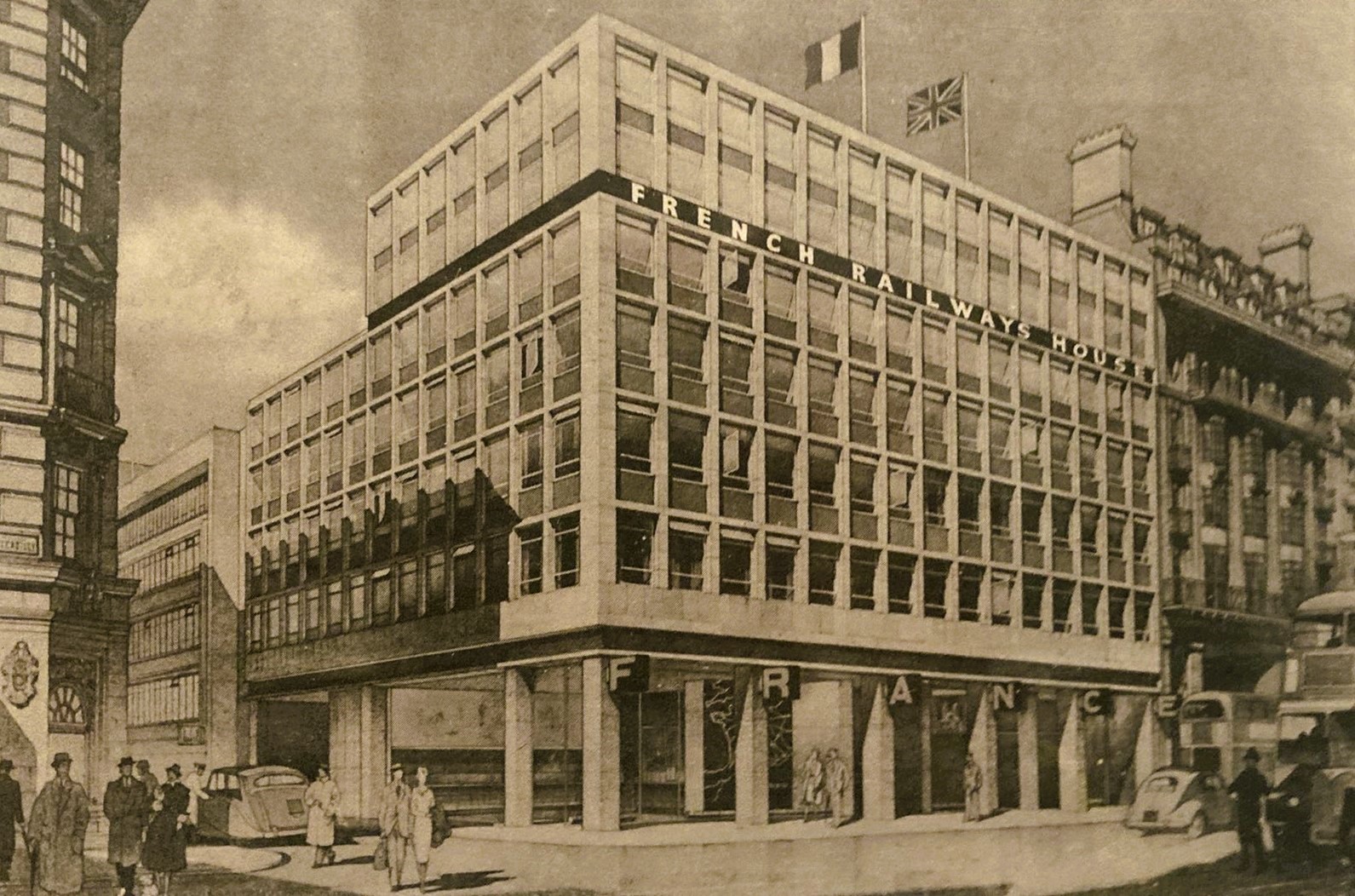
While elegant proportions and a certain timeless yet modern style might sound like some bavard’s evocation of a French woman, it seems most appropriate when describing French Railways House.
180 Piccadilly was designed by the architects Shaw & Lloyd to house the main London office of the SNCF, France’s state railway, and incorporated their sales desks and information bureau for tourists on the ground floor.


With interiors by Charlotte Perriand (left) and signage lettered by Ernő Goldfinger (right) — the architect so despised by Ian Fleming that he named a Bond villain after him — the excellent proportions of this little modernist gem exude the optimistic confidence of the Gaullist Fifth Republic.
Election Day
While in the outer world the British people have been electing as their representatives, by the degrading process of universal suffrage, several hundred paid professional politicians, few of them owners of landed property, many of them positively base-born, in the closed world of this column a very different ceremony has been taking place.
In the dark, time-worn Gothic Hall of Assembly, amid crumbling tombs and carved symbols whose inmost meaning few can now read, the Great Feudatories of the Realm have been swearing fealty to the Regent, settling on their broad shoulders once more, for another year, the dreaming loads of Church and State.
In a thousand manors too, throughout the column, the Lesser Feudatories have been receiving the allegiance of village headmen bearing baskets of eggs, indigenous stones and symbolic flowers, of representatives of the craft-guilds – wood-carvers, arquebus-designers and organ-builders prominent as ever – and tenant farmers and yeomen, red-cheeked, bucolic figures in their holiday coats of decent frieze.
After these day-long, solemn ceremonies, rituals so intricate that none but the columnar heralds can understand them, high and low, through all their exact, foreknown, immutable degrees from the Regent to the humblest labourer, feel themselves united, confirmed once more, as the mighty order of society is confirmed.
In the outer world all is ephemeral, unstable, eddying and whirling this way and that in ceaseless, unreasonable change. Within, all is unchanging and unchangeable. As it was, as it is, as it will be, till Judgment Day.
Articles of Note: 13 March 2024
My then-flatmate was getting married the next day and much pottering-about sorting things was required but the idiosyncratic beauty of this building captured my imagination — part Norman, part Moorish. I was almost insulted that I hadn’t come across it in any of my bookish explorations.
The historian Edmund Harris covers Chideock in his lusciously illustrated post on Recusancy in Dorset and the ‘other tradition’ of Catholic church-building.
■ Generations ago it was said that the three institutions no British politician dared offend were the trade unions, the Catholic Church, and the Brigade of Guards. In 2020s Britain there is only one caste which must always be obeyed: the ageing, moneyed homeowners.
Not only do these “NIMBYs” (“Not In My Back Yard”) jealously guard their freeholds, they do whatever they can to prevent more houses being built to guard the value of their prize possessions, vastly inflated by a combination of lacklustre housebuilding and irresponsible leap in migration. As old people vote and young people don’t — and when they do, vote badly — few sensible people can find a way out of this quagmire.
It might be worth looking to the Mediterranean, where Tal Alster tells us How Israel turned urban homeowners into YIMBYs.
■ It’s disappointingly rare to see intelligent outsiders give a considered impression of the current state of play in the Netherlands — that’s Mother Holland for us New Yorkers. Too often commentators in English are either rash cheerleaders for the hard right or bien-pensant liberals eager to castigate and chastise. Both rush to judgement.
What a rare diversion then to read Christopher Caldwell — the only thinking neo-con? — attempt to explore and explain the success of Geert Wilders in the recent Dutch elections.
■ One in ten of Lusitania’s inhabitants are now immigrants, and this discounts those — many from Brazil and other former parts of the once-world-spanning Portuguese empire — who have managed to acquire citizenship through various routes.
Ukrainian number-plates are now frequently be seen on the roads of Lisbon, as far in Europe as you can get from Big Bad Uncle Vlad.
Vasco Queirós asks: Who is Portugal for?
■ Speaking of world-spanning empires, in true andrewcusackdotcom fashion, we haven’t had enough of the Dutch — but we have had enough of their wicked wayward heresies.
Historian Charles H. Parker explores the legacies of Calvinism in the Dutch empire.
■ The City of New York itself is the best journalism school there is. Jimmy Breslin dropped out of LIU after two years, eventually taking up his pen. Pete Hamill left school at fifteen, apprenticed as a sheet metal worker, and joined the navy.
William Deresiewicz argues that a dose of working-class realism can save journalism from groupthink.
■ The New Yorker tells us how a Manchester barkeep found and saved a lost (ostensible) masterpiece of interwar British literature.
■ Our inestimable friend Dr Harshan Kumarasingham explores David Torrance’s history of the first Labour government on its hundredth anniversary.
■ And finally, one for nous les normandes (ok, ok, celto-normandes): Canada’s National Treasure David Warren briefly muses that the Norman infusion greatly refined Anglo-Saxon to give us the superior English tongue we speak today.
Cambridge
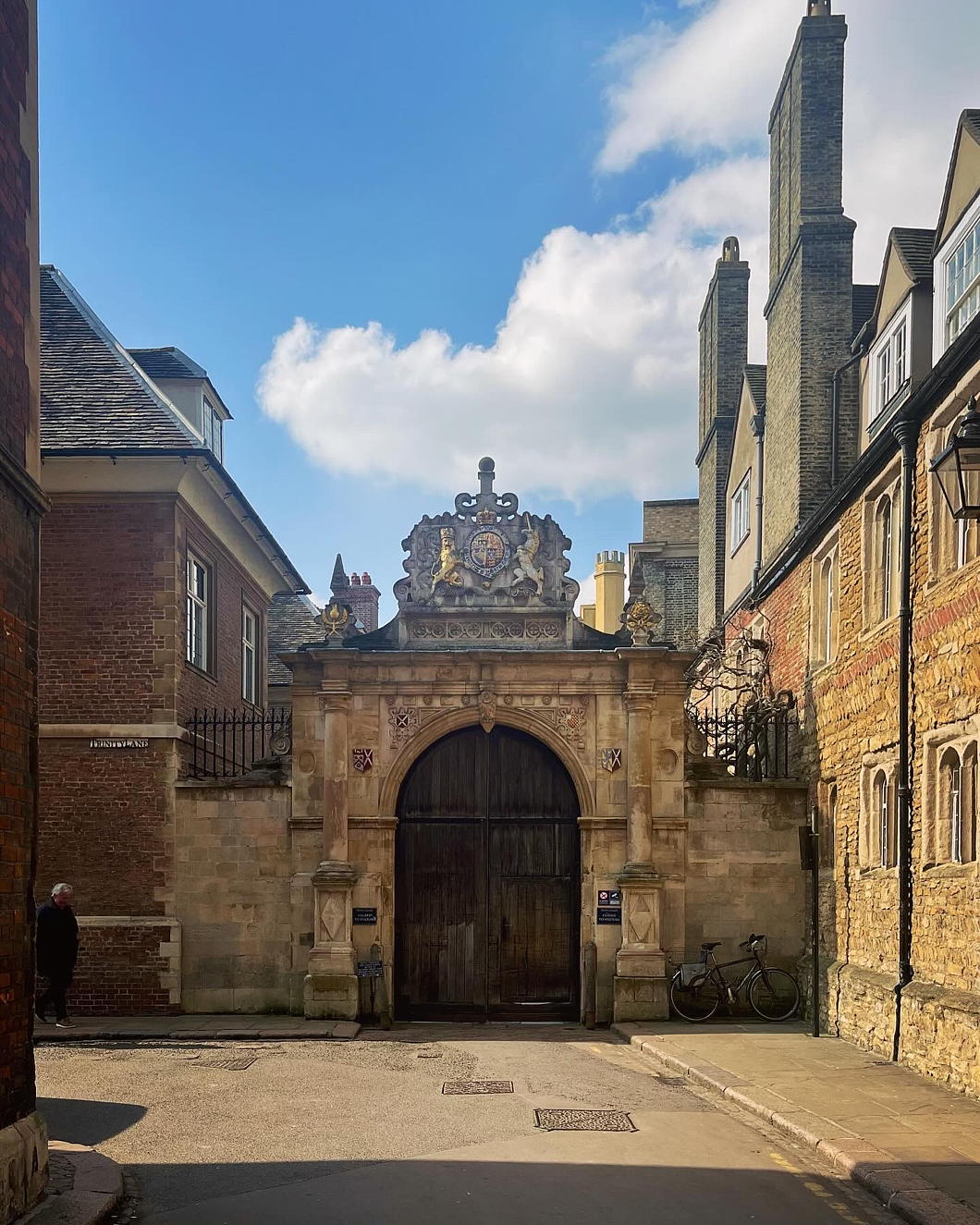
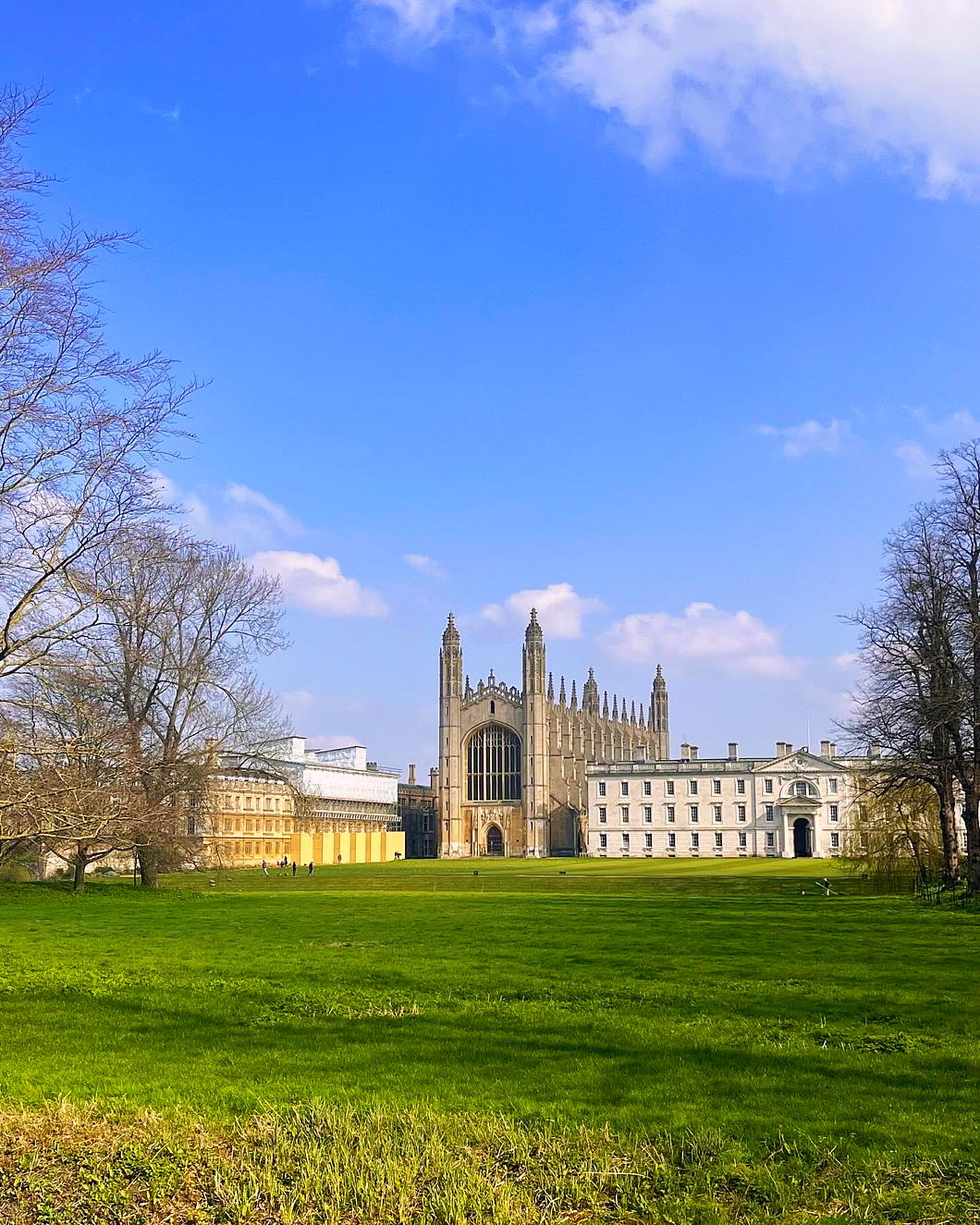
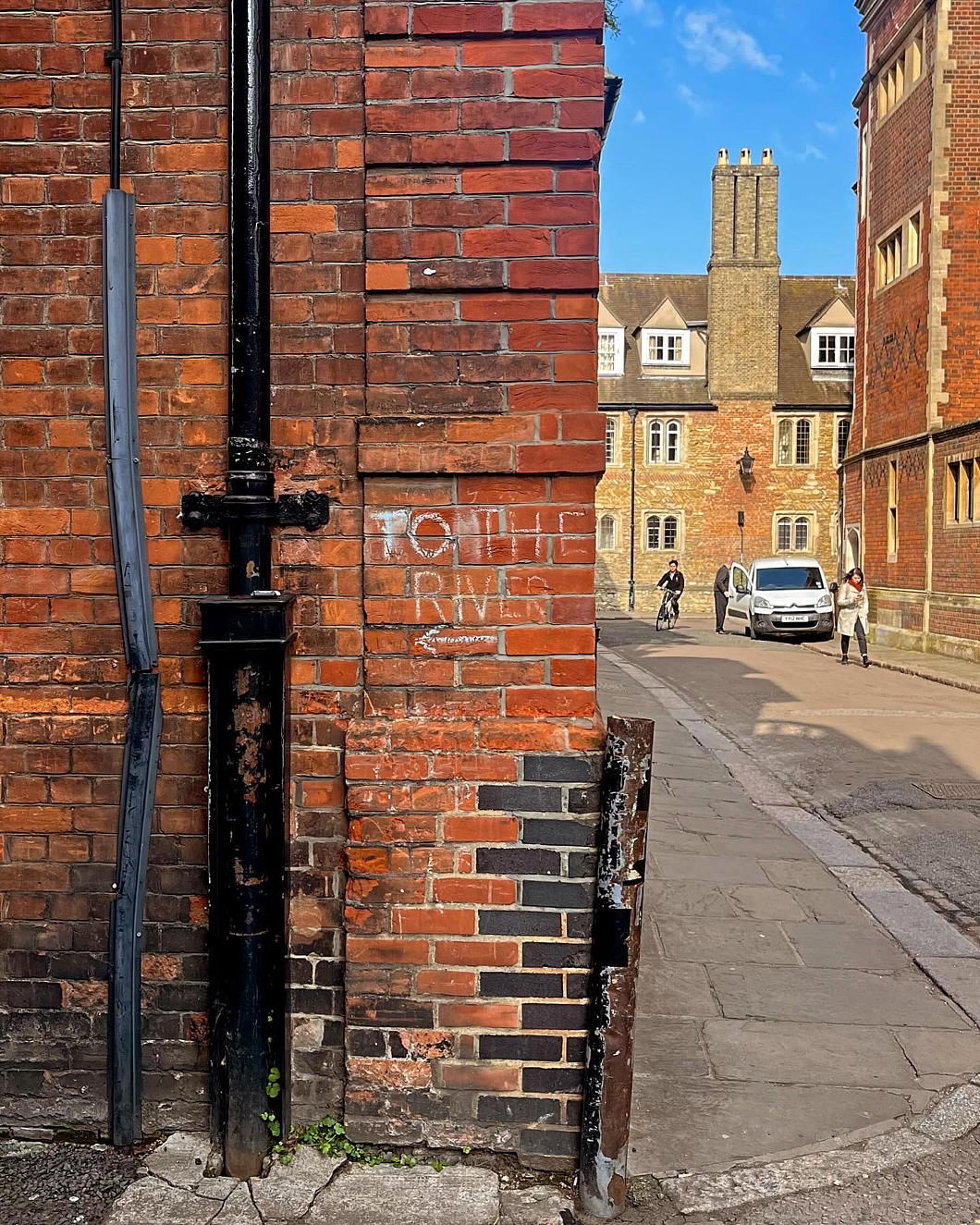
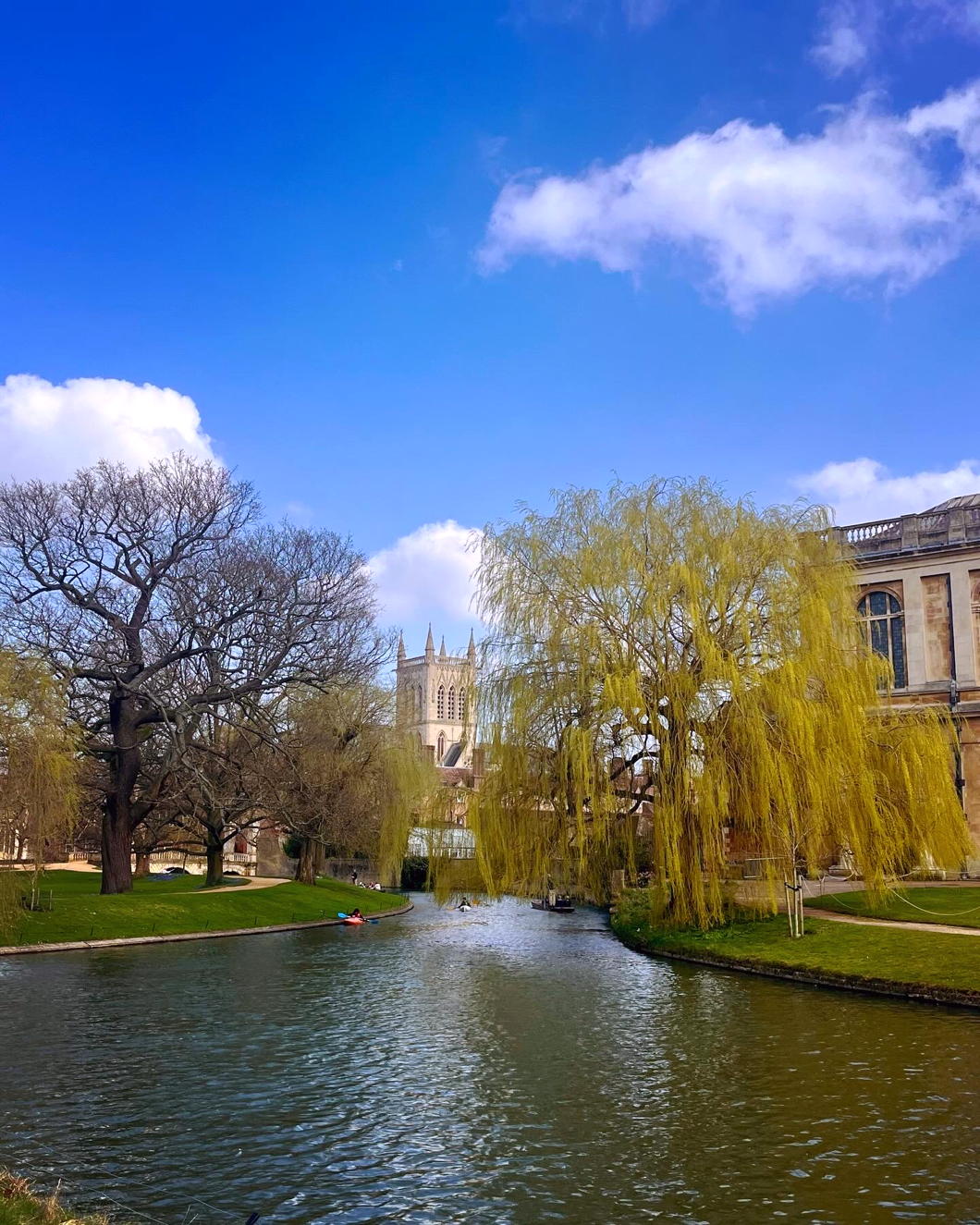
There’s a Dutch vibe to Cambridge that I rather like — but also a lingering Protestant Cromwellianism that I don’t. These two factors are not unconnected, and the highway that once was the North Sea is not so far away.
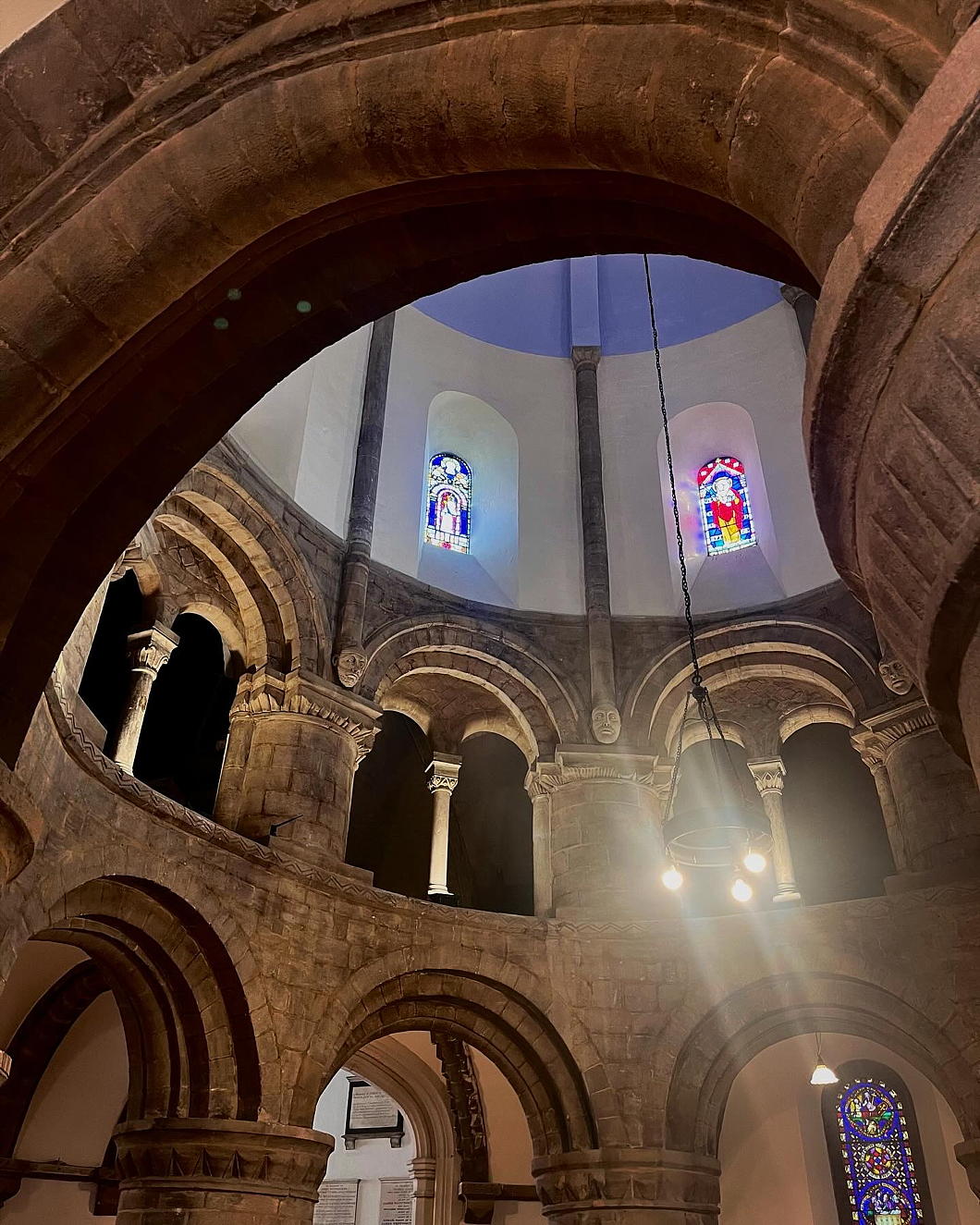
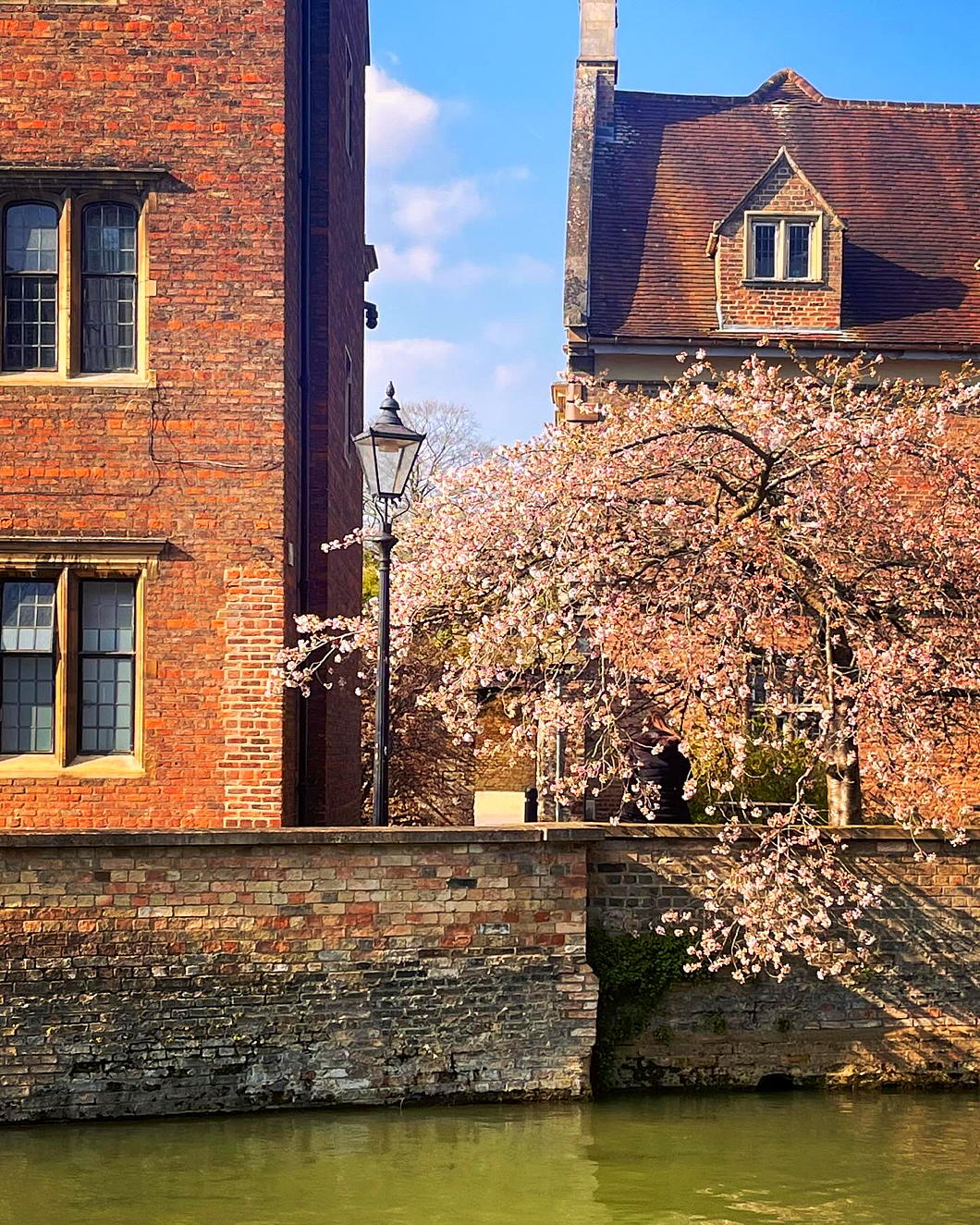
It is not a bad town. It’s like they took Oxford apart, put it back together again in not quite the same way, and added a lot of Regency infill. Oxford is more mediaeval, Georgian, and neo-mediaeval, whereas Cambridge is mediaeval, Tudor, and Regency.
The Cam is slower, quieter, and more peaceful than the Isis, which again gives it the quality of a Hollandic canal. I suspect the punting is better — or at least easier — here than at Oxford.
And of course it is rather more spacious than Oxford, which is hemmed in by geography in a way that Cambridge isn’t.
But it is also eerily quieter. A smart restaurant on a Thursday night was dead by half ten, and the staff refused our plaintive request for a second round of Tokay. (Protestantism.)
St Mary Overie in Lent
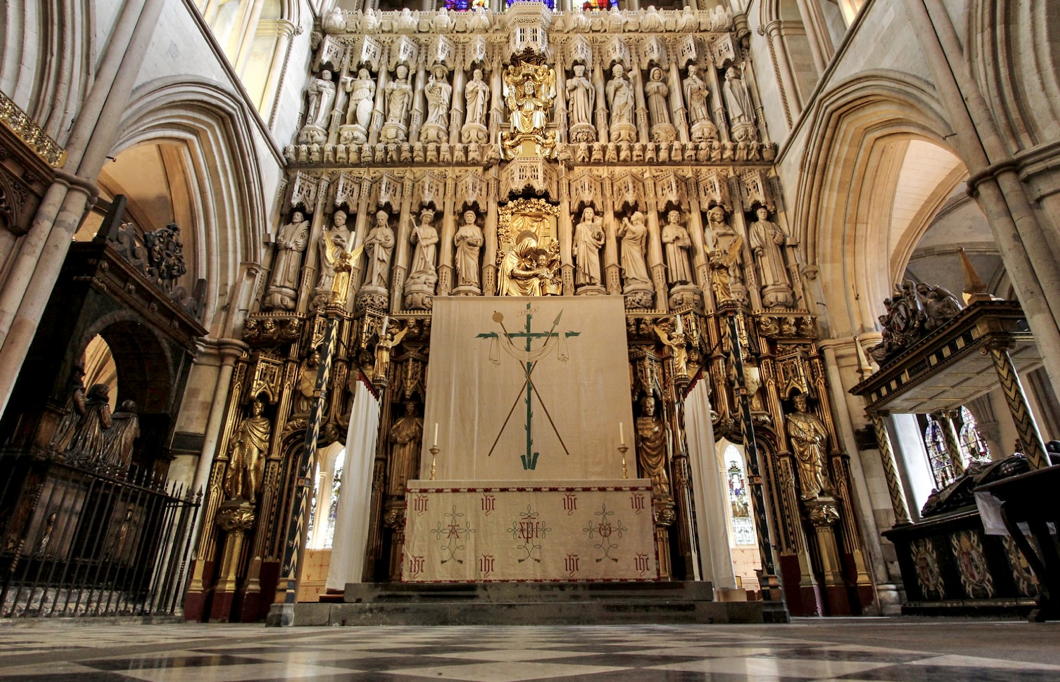
Here in Southwark I nipped in to Evensong in the late twilight of a winter’s day. They do it very beautifully with a full choir at the Protestant cathedral — old Southwark Priory or St Mary Overie to us Catholics, St Saviour’s to our separated brethren.
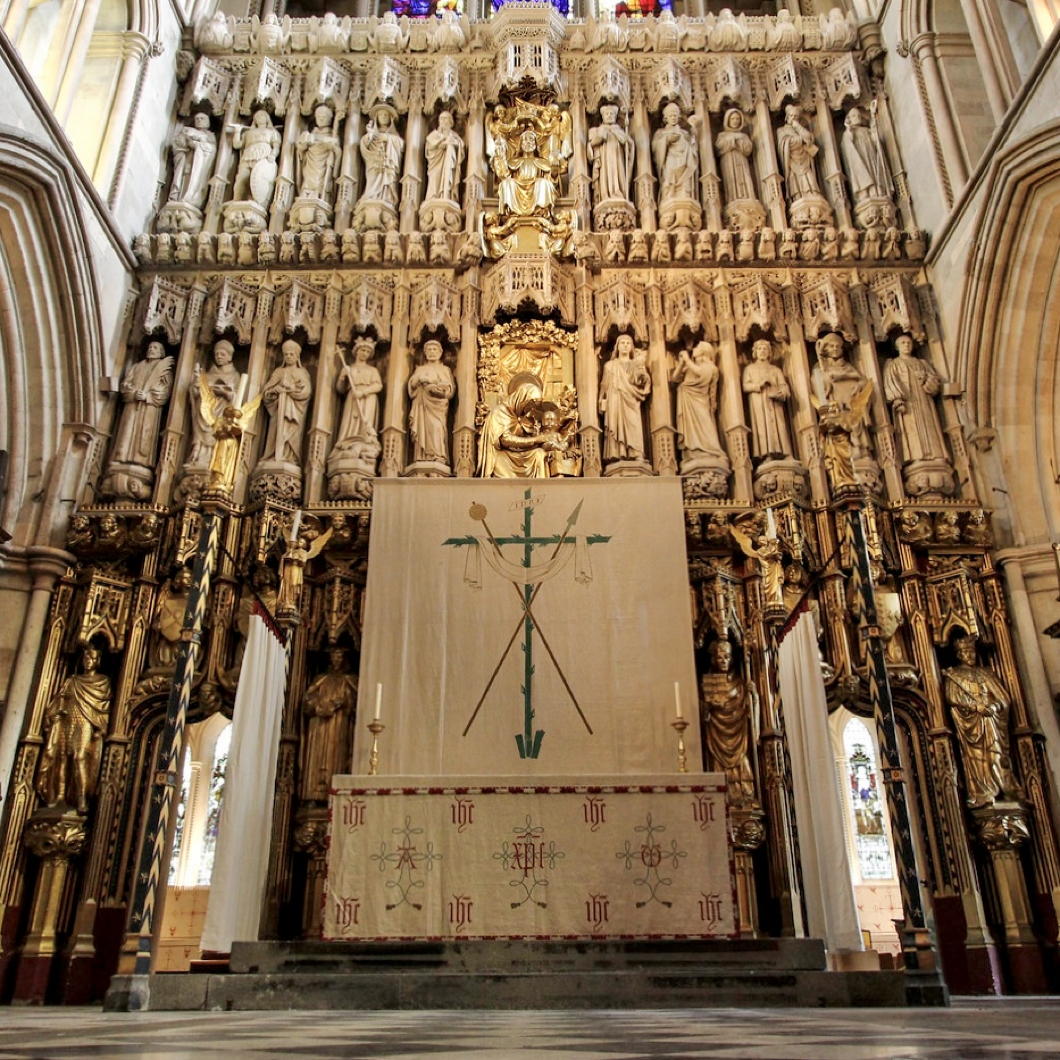
As it is the penitential season, the Lenten Array is up at Southwark Cathedral, theirs apparently designed by Sir Ninian Comper.
What is a Lenten Array? Sed Angli writes on the Lenten Array in general while Dr Allan Barton has written on Southwark Cathedral’s Lenten Array specifically.
And of course our friend the Rev Fr John Osman has one of the most beautiful Lenten Arrays at his extraordinary Catholic parish of St Birinus — a stunning church previously mentioned.
(The photograph of our local array is from Fr Lawrence Lew O.P.)
Whitechapel Library
There are precious few suitable uses for former church buildings.
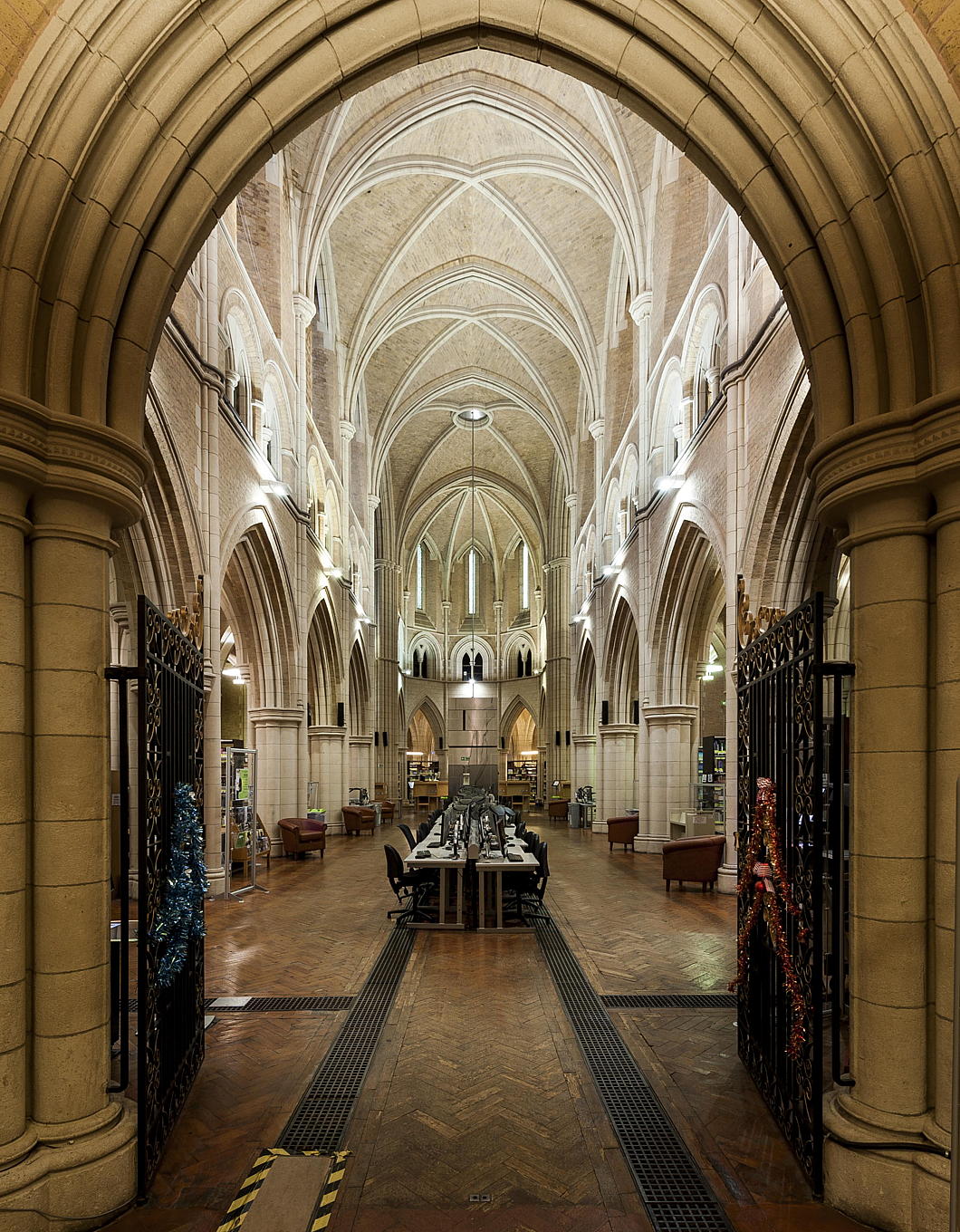
At the worst end of the spectrum is nightclub, though bar or restaurant often doesn’t fall terribly far behind either. To my mind, I can hardly think of a more suitable use for an elegant and beautiful former church than to be turned into a library.
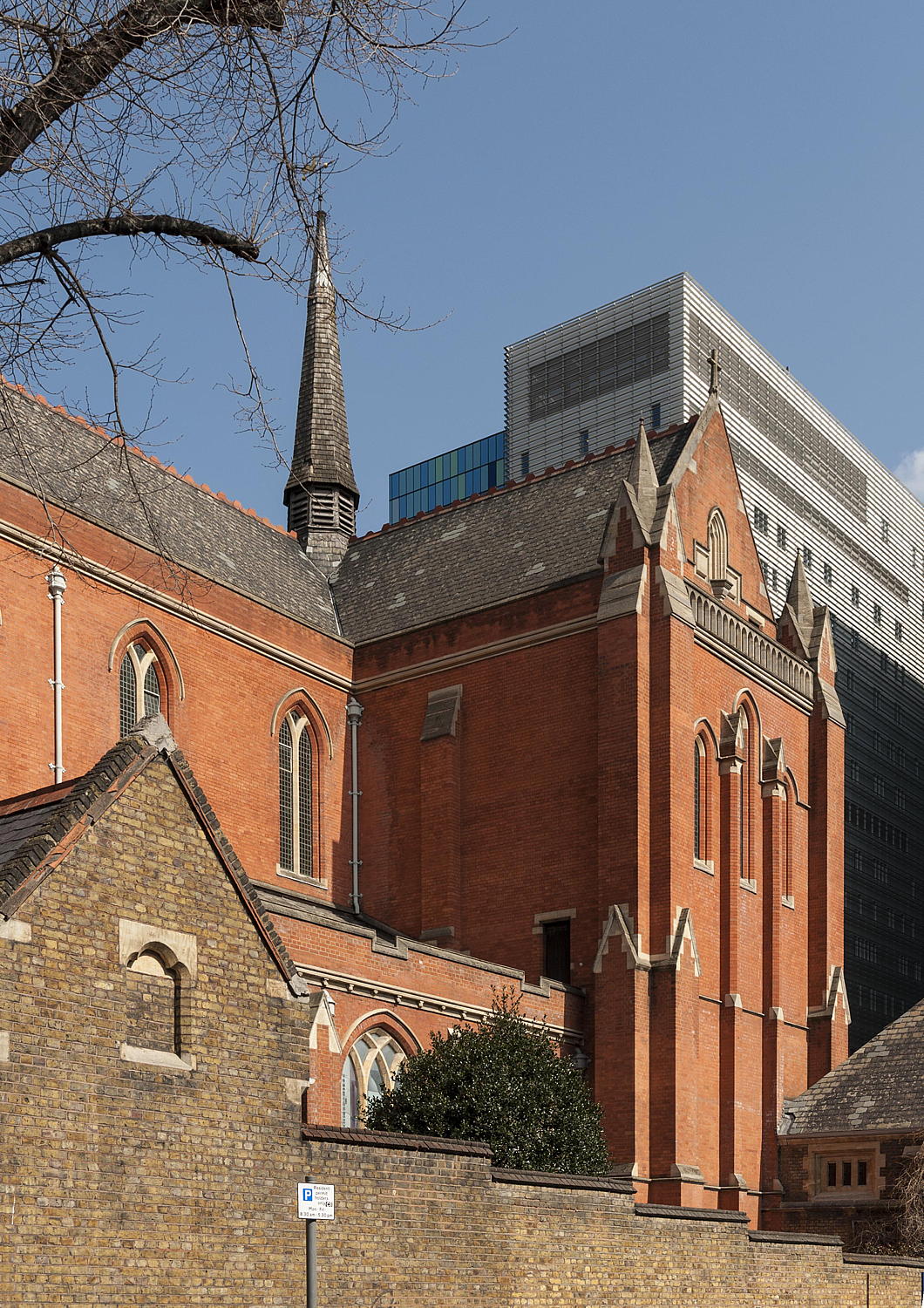
An example: the former Anglican parish church of St Philip, Stepney, in Whitechapel. Designed by Arthur Cawston, of whom I know little, it reminds me of J.L. Pearson’s Little Venice church for the eccentric “Catholic Apostolic Church”.
St Philip’s was declared redundant in 1979, at which time the neighbouring London Hospital still had its own medical school. This has since merged with that of St Bartholomew’s into “Barts and the London” or “Barts” or “BL”, under the auspices of Queen Mary University of London.
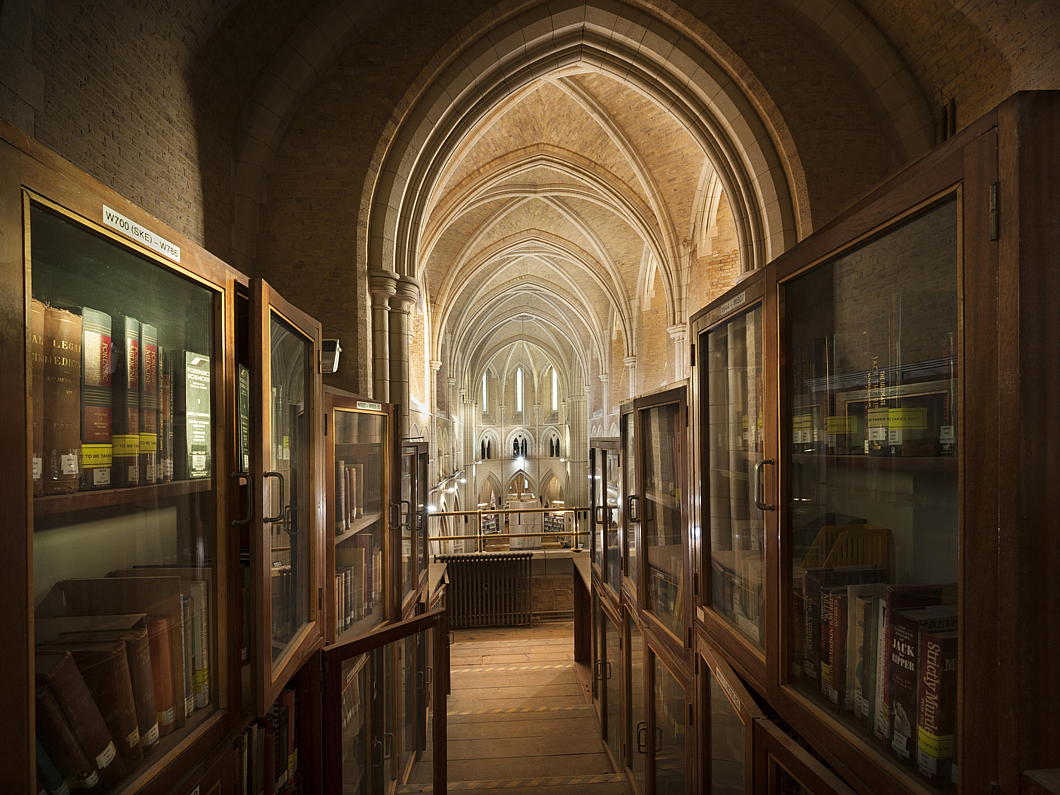
As St Philip’s sat pretty much smack dab in the middle of the campus of the London Hospital (augmented to the Royal London Hospital from 1990) and the college was surviving in cramped accommodation, it was decided to restore the fabric of the church and convert it to a library and study centre. The crypt of the church was adapted to house computer, teaching, and storage rooms as well as the museum of the Royal London Hospital.
Rather than preserve it in aspic, the medical school decided to keep this as a living building by commissioning eight new stained-glass windows to replace plain glass. They are completed along rather forthright German modernist designs and are dedicated to such themes as Gastroenterology and Molecular Biology. They will not be to everyone’s taste, but it is admirable for a medical school to commission stained glass windows at the turn of the millennium.
The Survey of London’s Whitechapel Project has a typically thorough entry on QMUL’s Whitechapel Library / the former church, including these applaudable photographs the Survey commissioned from Derek Kendall.
Articles of Note: 6 January 2024
■ I had the great privilege of studying French Algeria under the knowledgeable and congenial Dr Stephen Tyre of St Andrews University and the country continues to exude an interest. The Algerian detective novelist Yasmina Khadra — nom de plume of the army officer Mohammed Moulessehoul — has attracted notice in Angledom since being translated from the Gallic into our vulgar tongue.
Recently the columnist Matthew Parris visited Algeria for leisurely purposes and reports on the experience.
■ While you’re at the Spectator, of course by now you should have already studied my lament for the excessive strength of widely available beers — provoked by the news that Sam Smith’s Brewery have increased the alcohol level of their trusty and reliable Alpine Lager.
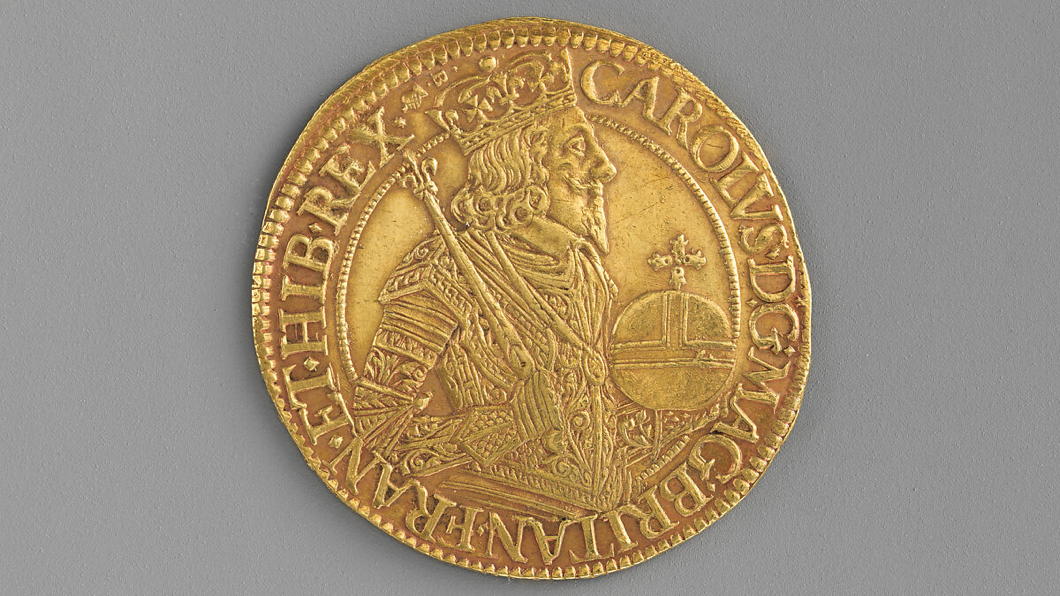
■ This week Elijah Granet of the Legal Style Blog shared this numismatic gem. It makes one realise quite how dull our coin designs are these days. I don’t see why we shouldn’t have an updated version of this for our currently reigning Charles.
■ Meanwhile Chris Akers of Investors Chronicle and the Financial Times has gone on retreat to Scotland’s ancient abbey of Pluscarden and written up the experience for the FT. As he settled into the monastic rhythm, Chris found he was unwinding more than he ever has on any tropical beach.
Pluscarden is Britain’s only monastic community now in its original abbey, the building having been preserved — albeit greatly damaged until it was restarted in 1948. The older Buckfast is also on its original site but was entirely razed by 1800 or so and rebuilt from the 1900s onwards. (Pluscarden also has an excellent monastic shop.)
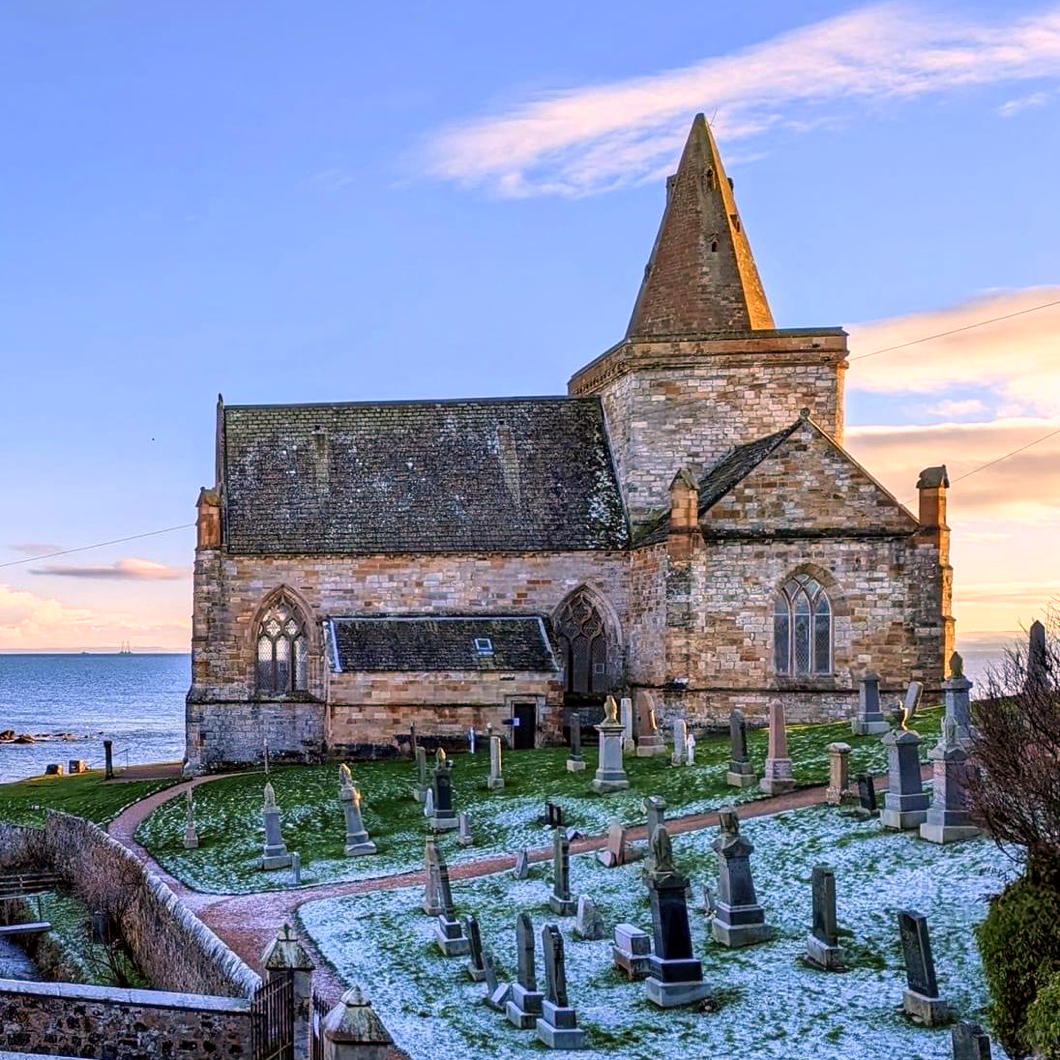
■ An entirely different and more disappointing form of retreat in Scottish religion is the (Presbyterian) state kirk’s decision to withdraw from tons of their smaller churches. St Monans is one of the mediæval gems of Fife, overlooking the harbour of the eponymous saint’s village since the fourteenth century, and built on the site of an earlier place of worship.
Cllr Sean Dillon pointed out the East Neuk is to lose six churches — some of which have been in the Kirk’s hands since they were confiscated at the Reformation, including St Monans.
John Lloyd, also of the FT, reported on this last summer and spoke to my old church history tutor, the Rev Dr Ian C. Bradley. More on the closures in the Courier and Fife Today.
What a dream it would be for a charitable trust to buy St Monans and to restore it to its appearance circa 1500 or so, available as a place of worship and as a living demonstration of Scotland’s rich and polychromatic culture that was so tragically destroyed in the sixteenth century. You could open with a Carver Mass conducted by Sir James MacMillan.
■ And finally, on the last day of MMXXIII, the architect Conor Lynch reports in from Connemara with this scene of idyllic bliss:

Regnum, Ecclesia, Studium
The threefold division of the world
As such he might be expected to have ideas about the idea of a university, and he wrote about them in The Spectator in August 1983.
Mister Grimond (as he still was then, only just), suggested those interested in the subject “might turn to a lecture by Ronald Cant, sometime Reader in Scottish History in the University of St Andrews”:
[…]
A vital aspect of this tripartite organisation, as Cant says, was that each should serve and support the other. But the studium, while interacting with the regnum and ecclesia, must maintain its independence.
It was certainly the business of the studium to advance knowledge, but that was not to be the end of the matter. Knowledge was linked to public service. The learned man had a duty to the community as well as a right to pursue his intellectual quarry. In fact he pursued the quarry on behalf of the community.
The tripartite division of the world, although old-fashioned, seems to me a useful concept, emphasising that government, morality, and higher education are separate but intertwined.
It seems to me that if we expel the regnum and the ecclesia utterly from the world of the university we shall end up paradoxically with universities totally dependent upon the state… but as subservient as those in Rome.
The liberal spirit gave birth and sustenance to universities; if its progeny does not foster it in the regnum they may indeed end up as purely vocational colleges.
Fortress London
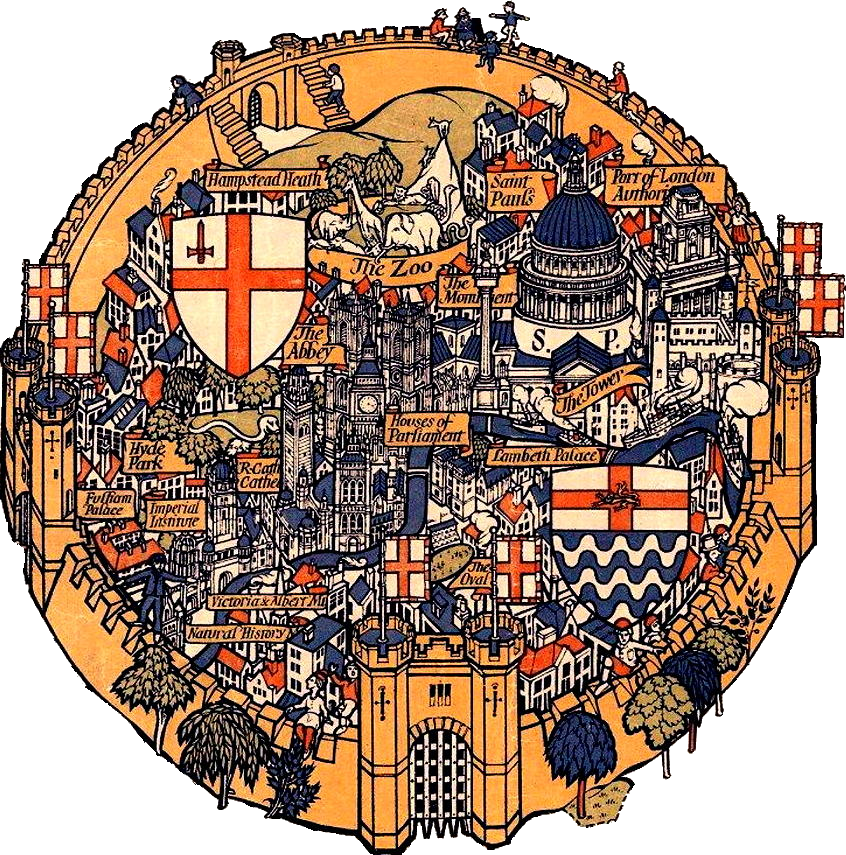
What could be more mundane than the Country Bus Services Map? Not when you put the design in the hands of Max Gill. Younger brother to the more famous (but controversial) Eric Gill, Lesilei Macdonald “Max” Gill was a polymathic artist: cartographer, designer, sculptor, painter, and letterer.
In 1914, Frank Pick, inventor of the London Underground brand, hired Max Gill to create the Wonderground Map. Each Underground station had a copy of this map with its inventive and amusing illustrations, such as the two figures hurling hams at Hurlingham. As one newspaper said when it was introduced, ‘People spend so long looking at this map – they miss their trains yet go on smiling.’
The Country Bus Services Map dates from 1928 and depicts London as a great crammed and crowded fortress city from which bus services flow forth to allow the citizens to escape its walls and experience the rustic beauty of the surrounding countryside.
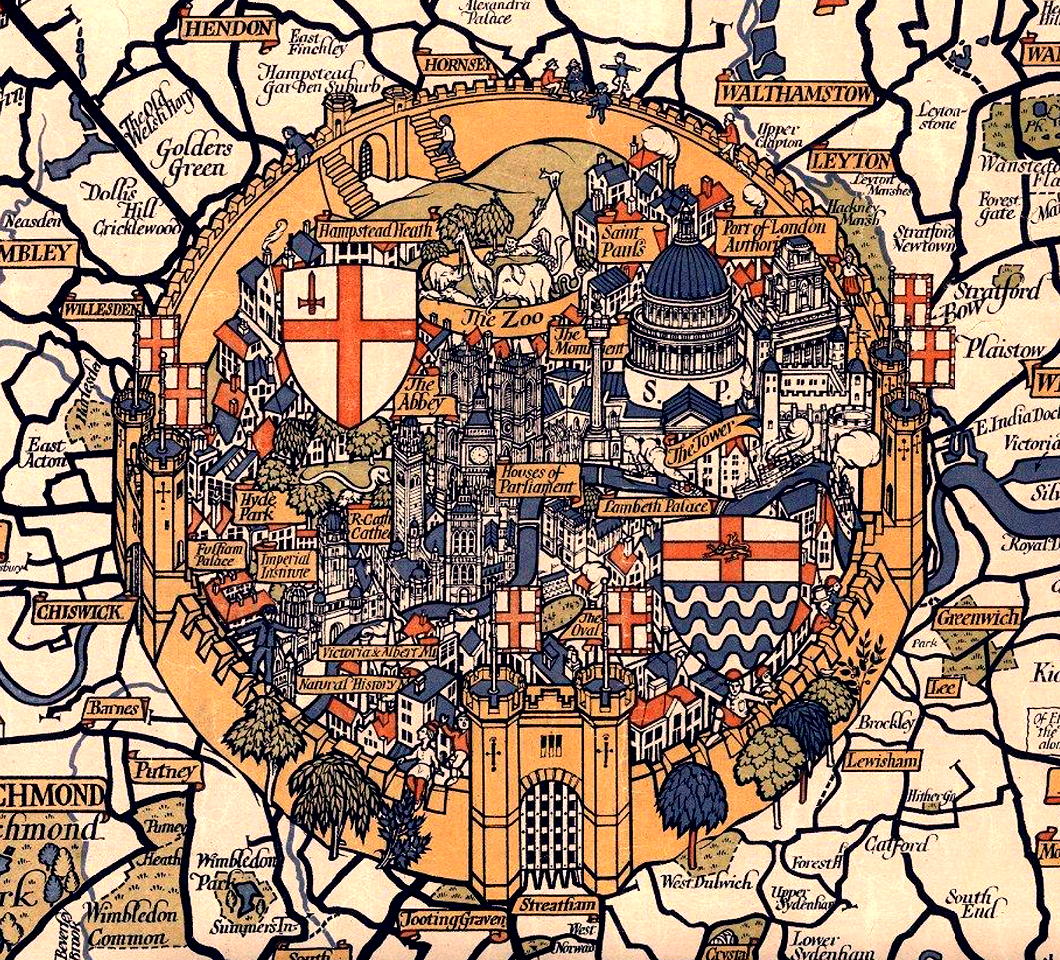
St Paul’s Cathedral looms large between shields depicting the arms of the City and County of London, with the Monument, the Port of London Authority, and the Tower cuddling up to it.
Lambeth Palace and the Oval at Kennington are the only features south of the river that make it into Gill’s walled metropolis.
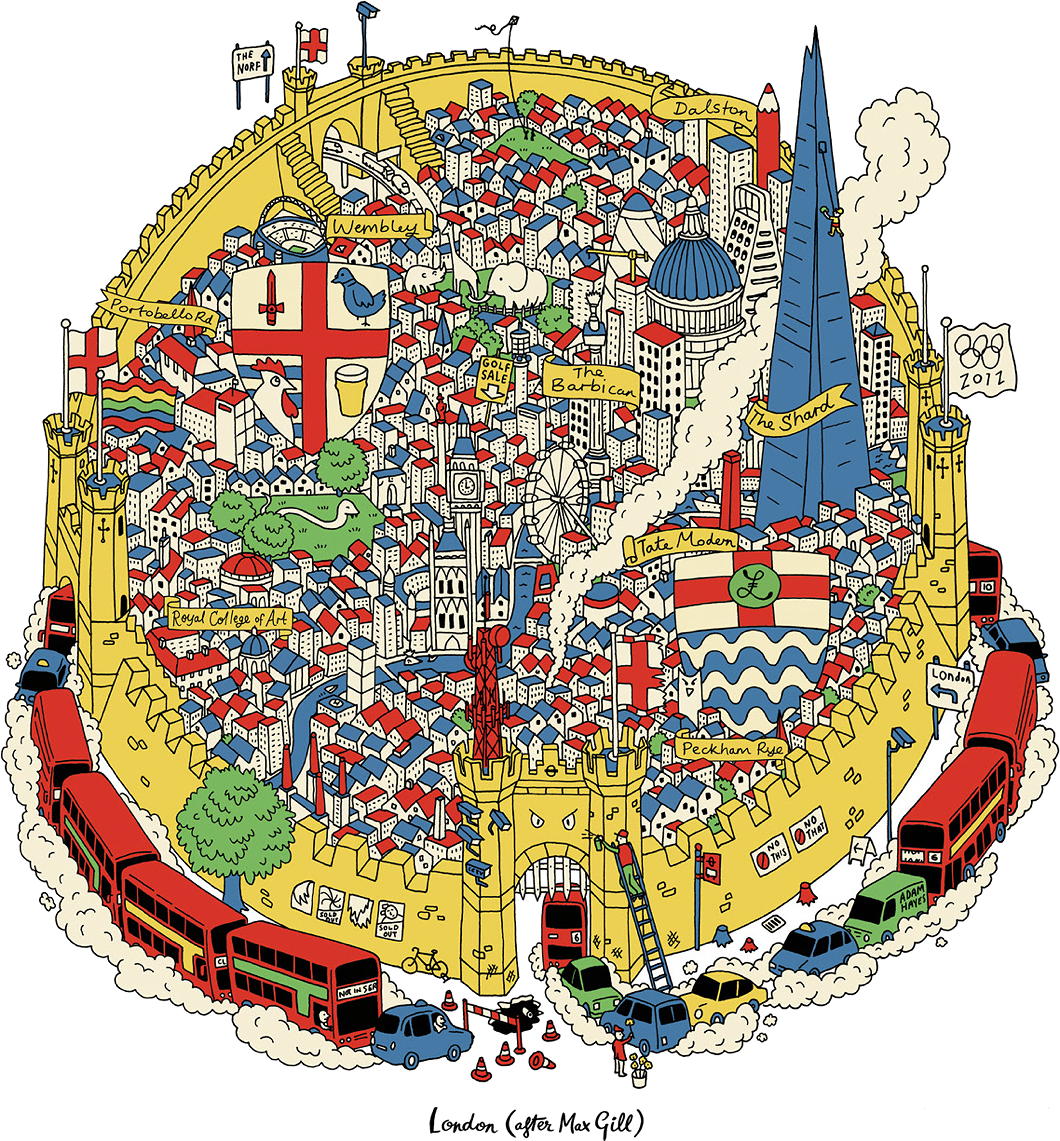
In more recent years, the designer and typographer Adam Hayes decided to issue a cheeky update entitled ‘London (After Max Gill)’ (available as a print as well).
Choked by smoggy traffic, the Shard now looms large, while a cheese grater represents the Cheesegrater. Tree stumps are joined by fussy signs instructing NO THIS and NO THAT and CCTV cameras are omnipresent.
‘Wonderground’ and the Country Bus Services Map were not the limits of Max Gill’s work for London Underground. The London Transport Museum holds many examples of his work within there collection, some of which have been digitised and are viewable online — though irritatingly not in any sufficiently zoomable detail.
St Paul’s: Before and After the War
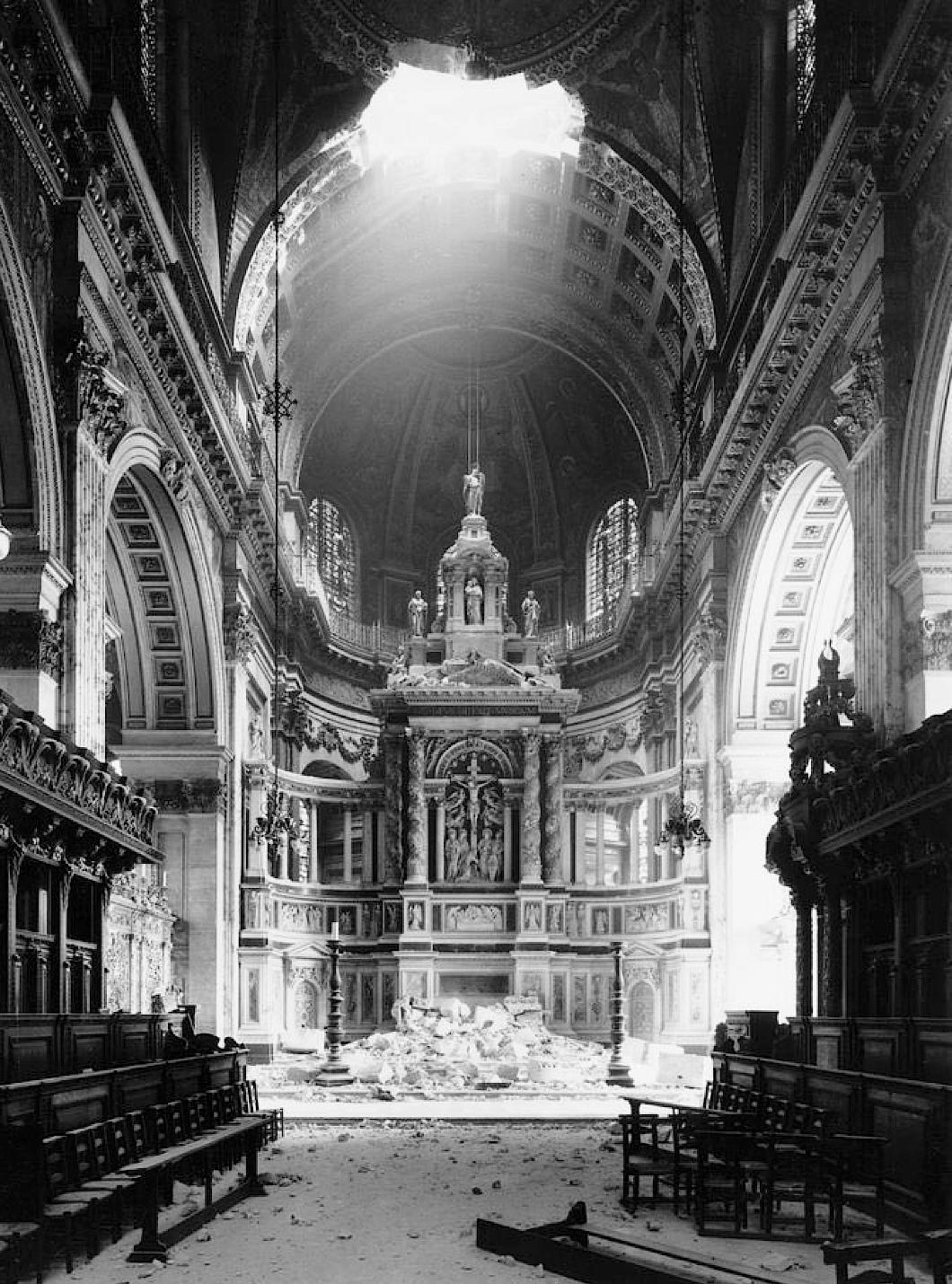
Wren’s post-Fire St Paul’s Cathedral was an icon of resistance to German aggression and an emblem of survival during the Blitz, but while the dome survived the church did suffer damage: A bomb fell threw the roof of the east end on the evening of 10 October 1940, tumbling masonry and destroying the high altar.
Despite the reredos remaining largely intact, as can be seen in the photograph above, it was decided to remove it and rebuild the High Altar under a baldacchino as Sir Christopher Wren had intended.
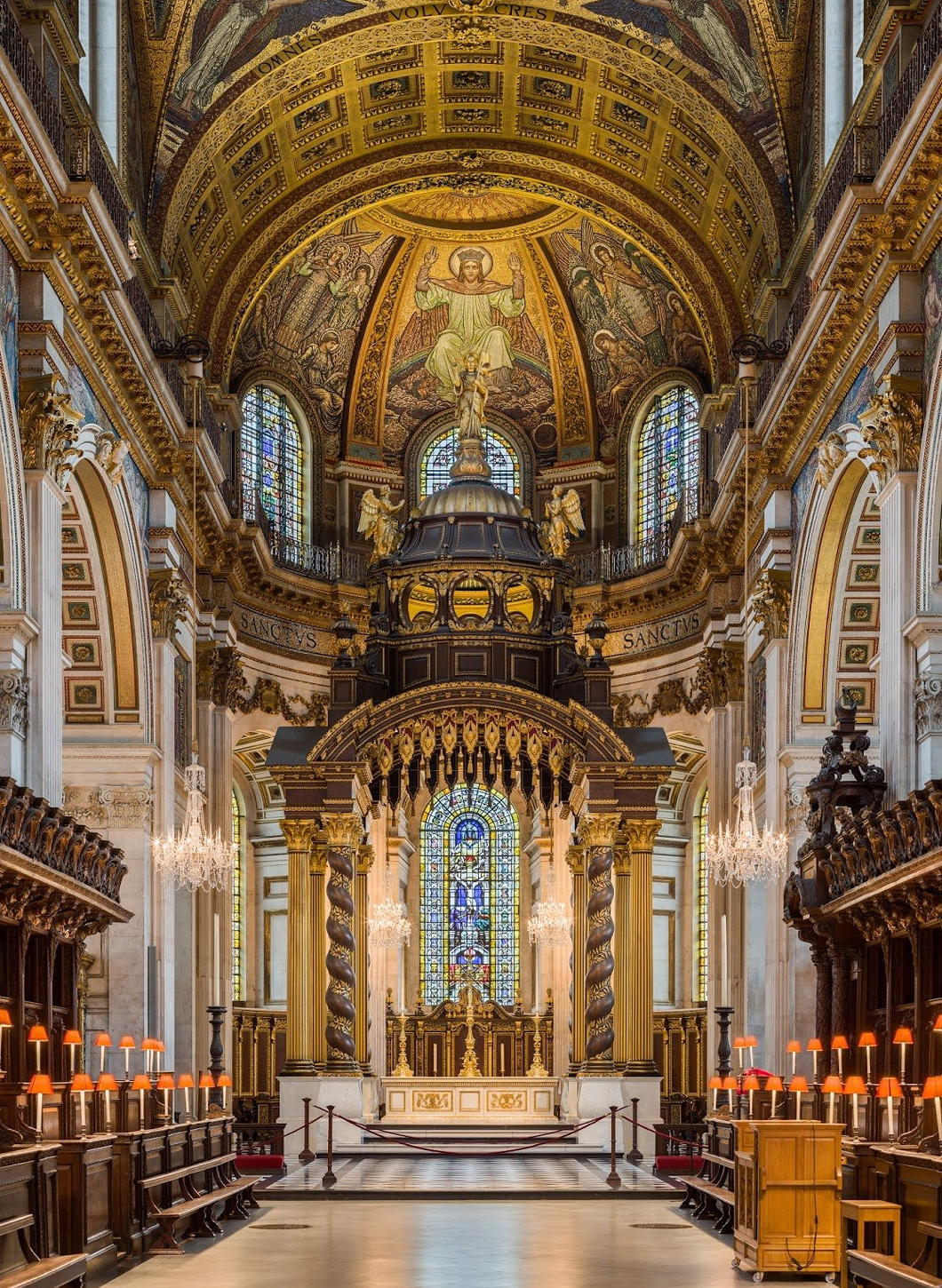
In 1958 the new High Altar, designed by W Godfrey Allen and Steven Dykes Bower, was dedicated with an American Memorial Chapel behind it.
This was proposed by the Dean of St Paul’s and General Eisenhower volunteered to raise money for it in the United States.
The Dean turned down the Supreme Commander’s offer, saying that this would be paid for by Britons as an appreciation of the American sacrifice during our common struggle.
A roll of honour lists the names of the 28,000 Americans who gave their lives while stationed from Great Britain.
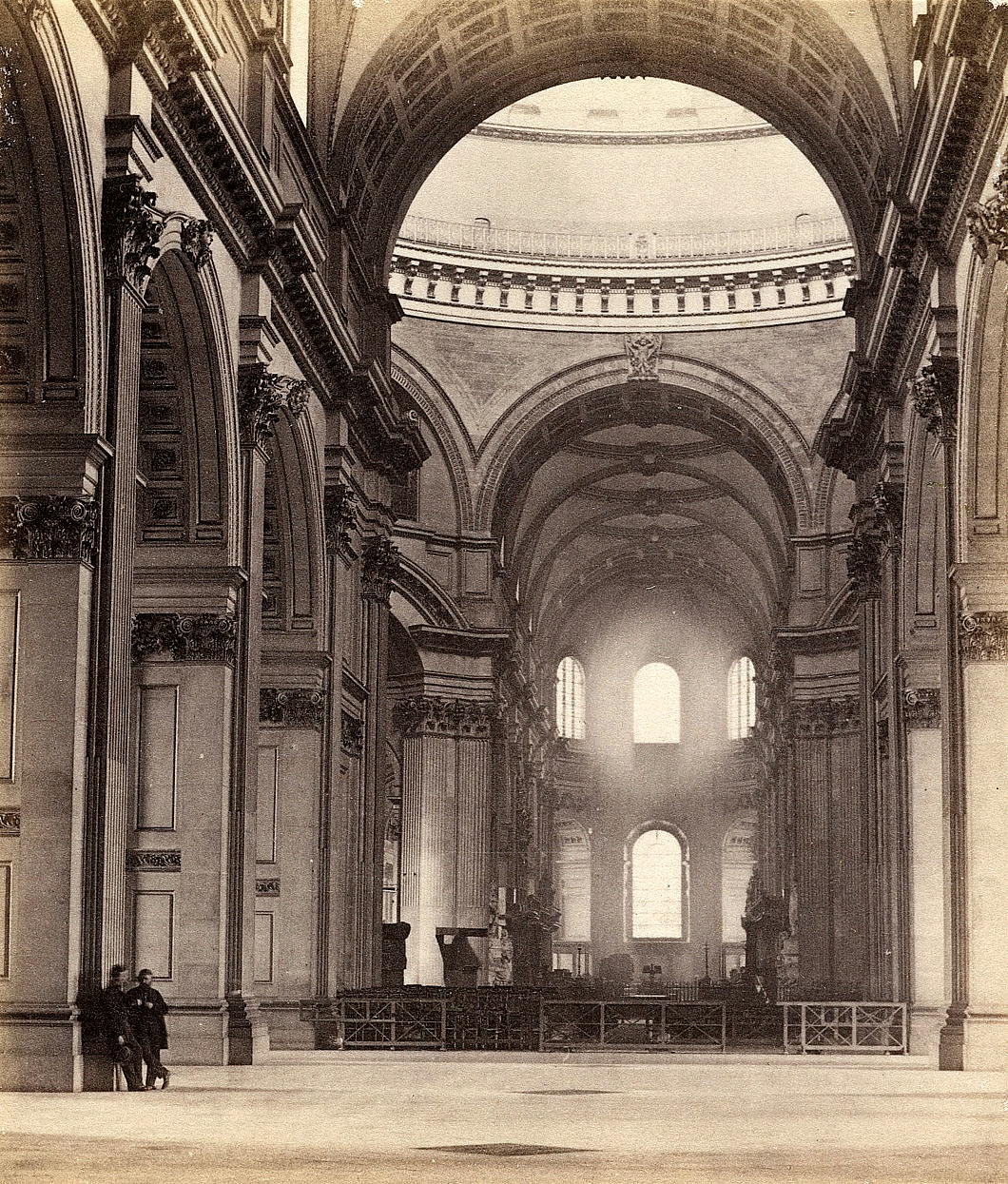
Perhaps more intriguing than either view is the one below of the interior of St Paul’s before the Victorian scheme for the High Altar was executed.
Special Mission to Rome
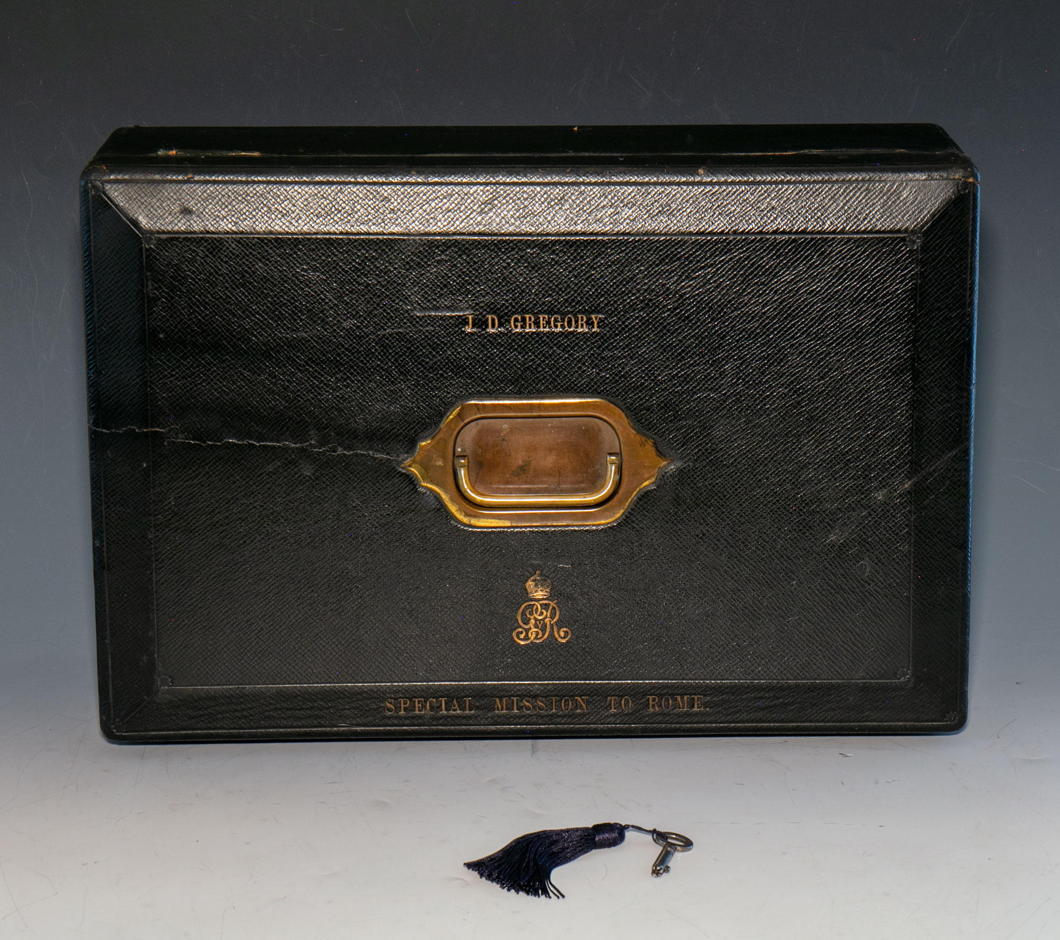
RELATIONS BETWEEN THE Court of St James’s and the Holy See have evolved in the many centuries since the Henrician usurpation. At times, such as during the Napoleonic unpleasantness, the interests of London and the Vatican were very closely aligned — despite the lack of full formal diplomatic relations. Later in the nineteenth century Lord Odo Russell was assigned to the British legation in Florence but resided at Rome as an unofficial envoy to the Pope.
It wasn’t until 1914 that the United Kingdom sent a formal mission to the Vatican, but this was a unique and un-reciprocated diplomatic endeavour — a full exchange of ambassadors would have to wait until 1982. (Until then, the Pope was represented in London only by an apostolic delegate to the country’s Catholic hierarchy rather than any representative to the Crown and its Government.)
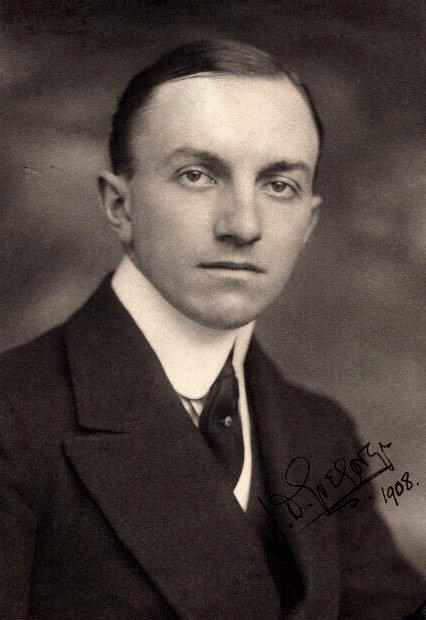 Within a year of the Special Mission to Rome being established, John Duncan Gregory (later appointed CB and CMG) was assigned to it. A diplomat since 1902 who had previously worked in Vienna and Bucharest, he was one of the central figures in the curious ‘Francs Affair’ of 1928, when two British diplomats were believed to have unduly abused their positions to speculate in currency. Despite being cleared of illegality, J.D. Gregory was dismissed from his diplomatic posting — though he was later rehabilitated.
If there are any enthusiasts of the curious subcategory of accoutrement known as the despatch box, J.D. Gregory’s one dating from his time in Rome is currently up for sale from the antiques dealer Gerald Mathias.
It was manufactured by John Peck & Son of Nelson Square, Blackfriars, Southwark — not very far at all from me as it happens. (more…)
175 Years of St George’s Cathedral
ONE HUNDRED AND SEVENTY-FIVE years ago, at a time of great uncertainty in Europe, St George’s in Southwark was opened solemnly by Bishop Wiseman — writes the Cathedral Archivist Melanie Bunch. The ceremony was attended by thirteen other bishops in all their finery, of whom four were foreign. Hundreds of clergy of all ranks were in the procession and many of the Catholic aristocracy of England were present. The music was magnificent, the choir including professional singers.
Pugin’s neo-Gothic church was impressive but not finished, and it was not to be a cathedral for another four years. Dr Wiseman, who was both the chief celebrant and the preacher, was bishop of a titular see, as the Catholic dioceses of England and Wales did not yet exist. Nonetheless the opening marked a significant stage in the revival of the Catholic Church in this region. The spur had been the spiritual needs of the poor Irish who had long formed settled communities in parts of London and other cities. The plans for the church had been drawn up in 1839 – before the severity of the famine in Ireland, which began in 1845, could have been foreseen. Some had considered the size of the new church unnecessary, but it turned out to be providential, as immigration from Ireland to this locality and elsewhere was reaching a peak at this time.
The extraordinary turmoil in Europe that had started early in the year in Sicily could not be ignored. In February Louis-Philippe was dethroned in France. There was anxiety that revolution might cross the Channel. Pugin decided that he should obtain muskets to defend his church of St Augustine under construction in Ramsgate. Revolution spread to German and Italian states and countries under Austrian rule. For four days in late June, there was a brief and bloody civil uprising in Paris.
While Europe was ablaze, London was calm, and the opening went ahead. In his homily, Wiseman praised God for all his mercies to this country. From our perspective, we might have expected that he would have spoken about the dark days of persecution, or at least the struggles of the recent past to get such a large church built, constantly hampered by lack of funds. Rev. Dr Thomas Doyle, whom we honour as the founder of the Cathedral, was present and assisting at the Mass, but his courage, faith, and dogged persistence over many years were not acknowledged on this occasion.
We might remember that a Catholic event like this had not been witnessed in England since the Reformation, seemingly prompting Wiseman to take the opportunity to explain to the non-Catholics present that the ceremony and display of the Catholic Church came from a desire to show greater respect for God. To the foreign bishops he said that their presence proved the unity and diversity of the Church. At the end of his homily, Wiseman caused a sensation by reading out a letter from the Archbishop of Paris, Mgr Affre, regretting that he could not attend the opening. By then it was known that he had already died from wounds received on the barricades while he was trying to mediate with the rebels. Wiseman called him a martyr.
Among others who never saw the opening are some who served St George’s mission with Thomas Doyle at the earlier chapel in London Road. Three of them had died before their time, only a few years before, from diseases endemic among their flock. We remember them and all who have served the Cathedral with gratitude. At the time of the opening, St George’s was the largest Catholic church in London, and for the next fifty years was to be the centre of Catholic life in the metropolis. Much has changed since, including the rebuilding of the Cathedral, but we give thanks to Almighty God who continues to sustain it. (more…)
The George
“FORTUNATE IS SOUTHWARK in her possessions,” Sir Albert Richardson wrote, “for she holds in this fragment a key to the aspect of her many vanished inns…”
The George Inn features largely in the deep psychogeography of Southwark, ours the most ancient of boroughs. Here is the greatest living remnant of the coaching inns of old, even if much reduced in form. The current structure dates from the 1670s but we know an inn on this site was well established by the 1580s. It is now in the possession of the National Trust, but is a functioning Greene King pub where you can find a good pint.
Up and down our High Street, for centuries merchants, travellers, traders, and revellers would slake their thirst in a procession of pubs, inns, and taverns. English pilgrims heading to Canterbury would start off here, and recent arrivals to London from the Continent would make their first acquaintance with England’s capital by arriving at “The” Borough after journeying from the Channel ports.
“One enters the inn yard with pleasurable anticipation,” Sir Albert continues in his 1925 volume, The English Inn, Past and Present; A Review of Its History and Social Life.
“There is fortunately sufficient of the old building remaining to carry the mind back to the days of its former prosperity. There are the sagging galleries, the heavily-sashed windows and the old glass in the squares. The rooms are panelled. In the dining-room are the pews, and the bar is typical.”
In Richardson’s time, just a century ago, these rooms would have often been full of hop growers from Kent and the hop merchants who traded with them, though they are all gone now.
And yet, some things have not changed:
“Here we can obtain old English fare, and, heedless of the beat of London, commune with ghostly frequenters to whom the place was at one time a reality.” (more…)
A Night Litany for London
Wanderers in central London who find themselves in the whereabouts of Piccadilly Circus or Soho of a Tuesday evening can avail themselves of the devotions offered by the Guild of Our Lady of Warwick Street.
Every week, the Rosary is said along with other prayers at this statue in Warwick Street Church. They conclude with the rather beautiful and moving ‘Night Litany for London’ imploring God’s mercy upon the many inhabitants of our capital city.
Its original form is believed to have been composed by the Rev’d H.A. Wilson, vicar of the Protestant parish of St Augustine in Haggerston. Msgr Graham Leonard — in the days when he was Anglican Bishop of London — also published a version through the Church Literature Association (a High Church body) with an introduction he wrote himself.
The version used at Warwick Street is included here:
OUR LADY of Warwick Street,
we plead before Thee
to present our prayers before the Throne of Grace
for all in this great city of London
who tonight need Thy merciful love and protection.
ON ALL who work tonight —— Lord, have mercy.
On the police, fire, and ambulance services —— Lord, have mercy.
On hospitals, doctors, and nurses —— Lord, have mercy.
On clergy and chaplains called out tonight —— Lord, have mercy.
On the homeless and destitute —— Lord, have mercy.
On all lost and vulnerable people —— Lord, have mercy.
On the lonely —— Lord, have mercy.
On the elderly —— Lord, have mercy.
On abused children —— Lord, have mercy.
On loveless marriages and broken homes —— Lord, have mercy.
On those who self-harm —— Lord, have mercy.
On the sick and suffering —— Lord, have mercy.
On the mentally ill —— Lord, have mercy.
On those undergoing operations —— Lord, have mercy.
On those who cannot sleep tonight —— Lord, have mercy.
On those who are depressed —— Lord, have mercy.
On those who misuse the internet —— Lord, have mercy.
On all prisoners and prison staff —— Lord, have mercy.
On all prostitutes and their clients —— Lord, have mercy.
On those addicted to alcohol and drugs —— Lord, have mercy.
On all immigrants feeling lonely and insecure tonight —— Lord, have mercy.
On all who live in fear —— Lord, have mercy.
On all victims of crime —— Lord, have mercy.
On those planning to commit a crime tonight —— Lord, have mercy.
On those who are driving tonight —— Lord, have mercy.
On all involved in accidents —— Lord, have mercy.
On those who are bereaved tonight —— Lord, have mercy.
On those for whom tonight will be their last on earth —— Lord, have mercy.
On those dying without the knowledge of Thy Love for them —— Lord, have mercy.
On those who are afraid to die —— Lord, have mercy.
On those tempted to suicide —— Lord, have mercy.
On the terminally ill —— Lord, have mercy.
On ourselves at our last hour —— Lord, have mercy.
ON BEHALF of all Londoners who today have said no prayers, let us say together:
Our Father …
Hail Mary …
℣. Most Sacred Heart of Jesus: ℟. Have mercy upon us. (thrice)
Search
Instagram: @andcusack
Click here for my Instagram photos.Most Recent Posts
- Brunel’s Unbuilt Capitol February 3, 2026
- Cricket at Fordham January 27, 2026
- Palacio Barolo Revisted January 14, 2026
- Learning to Love Liguria January 14, 2026
- Crux Alba No. 2 January 13, 2026
Most Recent Comments
Book Wishlist
Monthly Archives
Categories