Errant Thoughts
About Andrew Cusack
 Writer, web designer, etc.; born in New York; educated in Argentina, Scotland, and South Africa; now based in London.
 read more
News
Blogs
Reviews & Periodicals
Arts & Design
World
France
Mitteleuropa
Knickerbockers
Argentina
The Levant
Africa
Cape of Good Hope
Netherlands
Scandinavia
Québec
India
Muscovy
Germany
Academica
New Year, New Look
This new year brings a new look at andrewcusack.com, one I hope is simpler, cleaner, a little more crisp. Not really a total transformation, but an evolution (I hope). If, like PH, you read this site through a dreaded feed-reader, thus thwarting all the thought and energy that goes into web design, this will probably make no difference.
There are a few new links in the sidebar, and a few old links have been shed. At least one, though no longer active, is retained: Sign and Sight announced its farewell in 2012, but was always one of the most frequent stops upon Cusackian web perambulations and we simply cannot part with it.
Among the additions is the indescribable Italian periodical Il Covile. My Italian is rather poor, but I’m a firm believer in reading foreign things even if you don’t know the language. At least once a year I try and pick up a copy of the Frankfurter Allgemeine, even though my German’s worse than my Italian. (But knowing Afrikaans helps immensely with German).
And the little Twitter update line at the top is no more — whether anyone appreciated its existence is unknown to me — but tweeting continues aplenty at twitter.com/cusackandrew.
Anyway, the new design is still ‘in development’ (as the Web-folk put it) so there is probably a little tweaking here and there yet to come. We are determined to write more and post more in 2013, but London life keeps one devilishly busy, and real life is infinitely more satisfying than the internet. Still, one must try.
Grace Jones, Artist
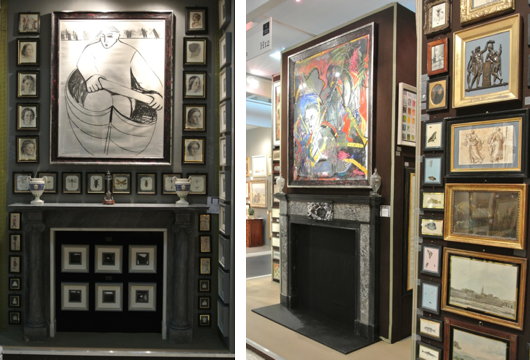
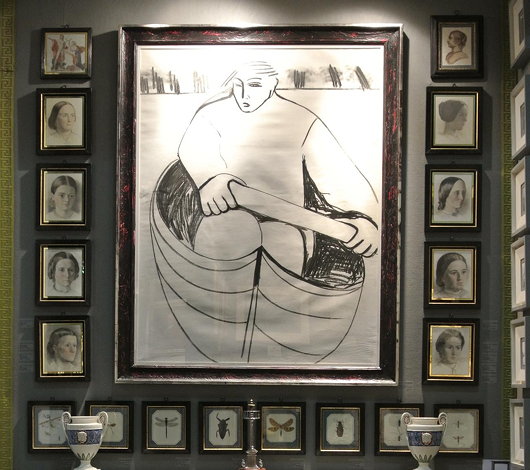
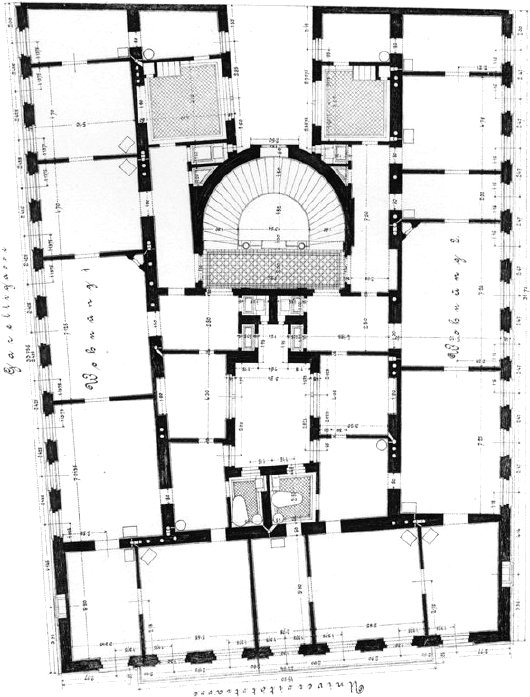
Among the surprises in store at the Collectors’ Preview of the Olympia antiques fair on Monday night were two works by the actress Grace Jones. When I was a wee bairn, “A View to a Kill” was one of my favourite Bond films, and Jones played May Day, the frightening sidekick to Christopher Walken’s Zorin. Apparently Grace Jones studied art for a period, and Charles Plante Fine Arts has two pictures by her amongst their offering: ‘An Eskimo rowing a boat’ (Charcoal with mixed media, 49 inches by 43 inches) and ‘Untitled abstract composition 1983’ (Mixed media on paper, 60 inches by 67 inches).
Return of La Rittelmeyer
One of our favourite fellow cigarette-smokers has finally returned to the web following what we hope will be the last of her episodic periods of absence therefrom. Miss Rittelmeyer has fled to Australia, that southerly kingdom of sunshine and good feeling, and from there she even includes in one of her pieces a kind remark about your humble and obedient servant. [Though I would pedantically clarify that, while I do drink port, as a Catholic (not an Anglican) I am not “high church”, I do not dress like a dandy (this is being written in RL khakis and an Ireland rugby top), and while I have an appreciation for monarchy I would not really call myself a monarchist; but then I tend to disdain all -isms.]
In her post Welcome she gives a brief overview of recent events and motivations, though I am confused by her concern over bad coffee in Australia, as the most celebrated coffee-merchants in London are Antipodean. I would have put Australian television in the ‘Pro’ column, as I am the most committed propagandist for the cause of Australian television in the British Isles. “Home & Away” is a favourite in our riparian London flat, “Sea Patrol” is a ridiculous enjoyment, “Packed to the Rafters” worth watching, and “Round the Twist” and “Spellbinder” are childhood favourites, alongside other random productions like “The Wayne Manifesto” and “Sky Trackers”. (I won’t admit to having seen “H2O: Just Add Water”). If Helen is allowed her in-depth knowledge of Maldivian heavy metal, I am allowed my Australian television.
Anyhow, pop over and have a read. As one American inhabitant of the Queen’s realms to another, I wish her the best of luck under the Southern Cross.
African Independence
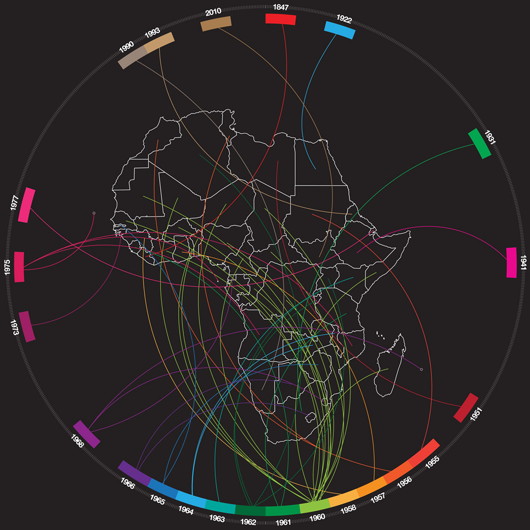
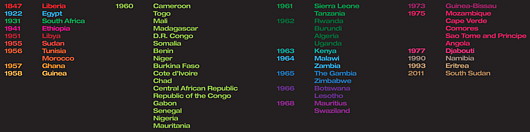
The nifty ‘Tumblr’ site Afrographique, which Africa-related facts and statistics in a visually appealing and accessible way, created a handy chart of all the countries of Africa and the years they became independent. The chart correctly gives Zimbabwe’s date of independence as 1965, even though it had a brief return to colonial status for a few months in 1979-1980. Yet it lists Ethiopia’s “independence” year as 1941, despite the fact that Ethiopia has arguably been independent forever.
The Empire of Ethiopia was founded in 1137 with the ascent of the Zagwe dynasty (responsible for the country’s world-famous rock-hewn churches), and while it was occupied by the Kingdom of Italy (whose monarch usurped the title ‘Emperor of Abyssinia’) from 1936 to 1941 with a continued insurgency and a lack of abdication by the legitimate emperor, Haile Selassie, there’s a strong case that Ethiopia retained her independence throughout but merely suffered a temporary foreign occupation.
Despite this arguable discrepancy it’s not nearly so bad as Africa Report, which published a chart claiming that South Africa gained its independence in 1994. Pray tell, what colonial power ran South Africa before 1994? South Africa was unified and gained dominion status in 1910, and Afrographique goes for the much safer independence date of 1931 when the Statute of Westminster was adopted asserting the sovereignty of the dominions of the British Empire. Some Afrikaners claim South Africa did not become independent until the Republic was declared in 1961, but this is neither legally nor constitutionally the case as the country as an internationally recognised sovereign independent nation merely changed its form of government from a monarchy to a republic.
Afrographique has a number of other interesting posts, including African Nobel Prize winners (nine of them South African, across medicine, peace, and literature) and the ten richest Africans (fellow Matie Johann Rupert is #4).
Marlow’s St Paul’s Capriccio
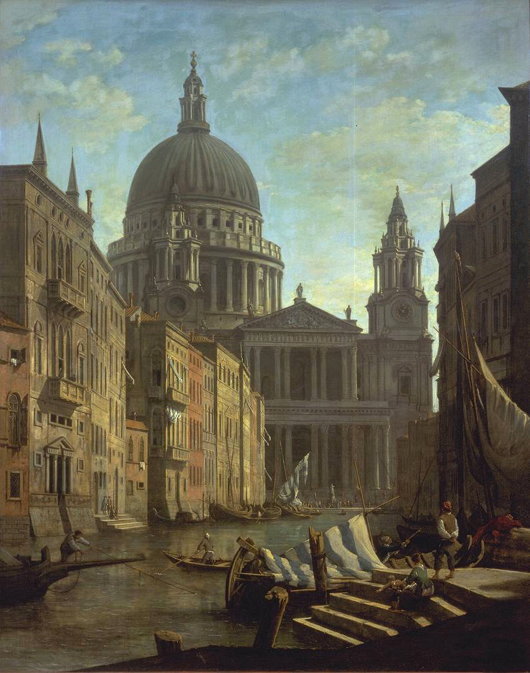
c. 1795; oil on canvas, 60 x 41 in.; London, Tate Gallery
The view of St Paul’s Cathedral as if it had been completed according to the original plans of Wren and with Hawksmoor’s baptistry (which I posted yesterday) reminded me of this capriccio by William Marlow. And then this in turn recalled my 2005 post If London Were Like Venice.
The UN at Quebec
IN 1943, THE BRITISH, Canadian, and American governments descended upon the city of Quebec, capital of la vieille province, for an intergovernmental conference to plan the invasion of France — surely one of the greatest military tasks ever undertaken in the modern era. The site proved auspicious due to a peculiar combination of factors: Quebec City enjoys a certain European cachet but with both the geographic safety of North America and the more spacious accommodation usual to that continent. The three governments held a second conference there in 1944, and in 1945 the International Labour Organisation met in the city, followed a few months later by the Food & Agriculture Organisation of the nascent United Nations.
With this track record of indisputable experience, the ville de Québec, lead by its mayor Lucien Borne, put in a bid to be the permanent seat of the United Nations Organisation. (more…)
London to Istanbul
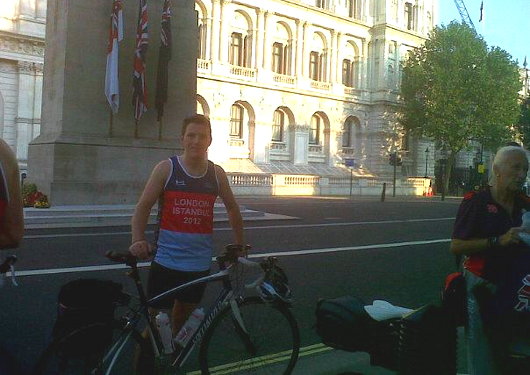
As we speak, Kit S-W is en route from London to Istanbul via bicycle, raising money for Help for Heroes. He and his team of fellow Exonians departed from the Cenotaph (photo above) at the ungodly hour of 7:00am Thursday morning. We were meant to be there to provide moral support, but some Lebanese friends were in town the night before and with the ensuing joviality I couldn’t extract myself from bed until just past 11:00am.
Oh well. Of the twelve siblings at least one sister was there. If you want to put a bit of dosh in the cap of this worthwhile cause, nip over to Kit’s JustGiving page, where you’ll see he’s currently 70% towards his target of £1,350.
Little Ben
 WALKING THROUGH Victoria recently, I was horrified to see the recent renovations and street improvements have led to the disappearance of ‘Little Ben’, the small Victorian clocktower that sat in a traffic island halfway between Westminster Cathedral and Victoria Station. Little Ben is a convenient meeting place in a district that is rather uninspiring and surprisingly lacking in conveniences.
Why, for example, is there no decent pub in Victoria? If you need a meal, Grumbles of Pimlico is walking distance, and they treat you well at Il Posto. But a decent pub atmosphere is not to be had, unless you fancy The Pub Formerly Known as the Cardinal (now styling itself as ‘The Windsor Castle’).
Happily, a simple Google search reveals that Little Ben’s absence is merely temporary: indeed, Little Ben is taking a rest-cure. The goodly folk at Wessex Archaeology have informed us as such.
The clock owes its creation to Gillet & Johnston of Croydon, who built Little Ben in 1892 and erected it in the middle of Victoria Street. It fell victim to a road-widening scheme and was removed in 1964 but, after sitting in storage unappreciated for some years, it was finally renovated and restored to its original location in 1981.
Transport for London is currently working on a significant upgrade to Victoria Underground Station, including a rearranged traffic alignment on surface level, in addition to new entrances and exits and a great big whopping ticket hall sous la terre. When all is finished and done and in tip-top shape, Little Ben will be returned to his traditional location, and some semblance of order will return to this sector of the most unglamorous Victoria Street.
Overwhelming the Farber Building
A bland glass-plated giant will piggy-back onto a sound example of the Modern Movement in Cape Town
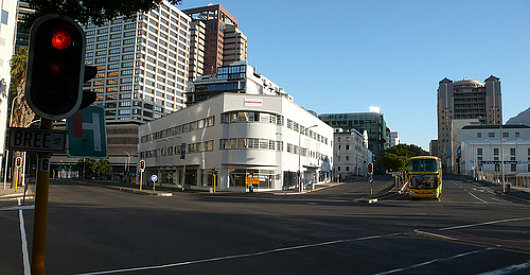
The Farber Building, one of the few extant examples of the Modern movement in architecture in Cape Town, is to be overwhelmed by an eighteen-storey plate-glass skyscraper. The developers had sought to have the 1935 building designed by Roberts & Small demolished, but the city fathers wisely refused permission. The price of its salvation, however, is that the boring skyscraper will piggy-back onto this actually rather inoffensive Modern structure. (more…)
Cribbed from Hillenbrand
Persian: that’s the word I’ll always associate with Shusha Guppy. Uttered with a luxurious protraction of the first syllable — Purrrzhen, as if a … well, Persian cat were being stroked—it conjured up all those Oriental refinements rudely swept aside by the ayatollahs, a lost world of Hafez recitations and elaborate compliments (taarof, as she taught me to call them) paid in jewel-like gardens. Though she’d occasionally employ the bare geopolitical term “Iran,” the adjective was always “Persian,” and so was the name, in English, of her mother tongue—Allah help anyone who referred to it in her hearing as “Farsi,” which, she would witheringly point out, was like saying “Deutsch” or “français.”
— Ben Downing, The New Criterion
JUST 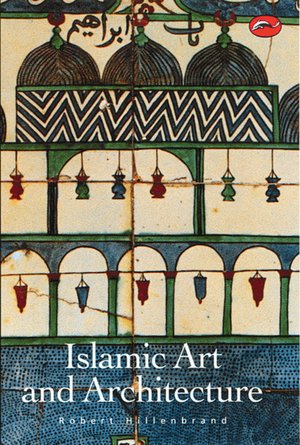 THE OTHER day I remembered what was quite possibly the nerdiest and most wonkish social interaction I ever had. Summering in Maine a summer or two ago, I came across Luke P., who studies Persian at SOAS here in London, standing on Sunset Rock staring out towards Strawberry Island.
There were six or seven of us there, and in the course of conversation Luke made some rather clever or obscure point about Islamic architecture, perhaps it was Cairene funerary monuments or maybe it was even within his Iranian remit — I don’t remember.
What I did remember is that the substance of this remark, seemingly original, was in fact cribbed in its entirety from Hillenbrand, which is to say from Professor Robert Hillenbrand’s Islamic Art & Architecture, pretty much the standard work on the subject. Like a flash, I came back, “Pah! You got that straight from Hillenbrand!” A flick of the cigarette, and a wry smile emerging from the corner of his mouth, Luke immediately and very graciously conceded this as being the case.
The lesson our tutors taught us at university rings true: always attribute and acknowledge sources! You never know who’ll have read Hillenbrand.
Fr Kramer on Tradition
Readers might enjoy this video from CNS featuring Fr Joseph Kramer, one of the FSSP’s priests in Rome. I met Fr Kramer very briefly on the street when I was in Rome in 2006. It might be time for another visit to the Eternal City.
Evil! Evil Think-tank!
Those of us enjoying our Easter Monday bank holiday will look with ire and scorn upon the recent report of the Centre for Economics & Business Research which, according to the BBC, says that if bank holidays were scrapped the gross domestic product of Great Britain would £19 billion higher every year. No mention of what manner of witch-doctery science they used to determine this figure — whether they employed an augur to tell the auspices or consulted the oracle at Delphi itself (hasn’t done the Greeks much good of late).
Also, it is improper to misuse the English language in such a way as to imply bank holidays entail a “loss” or a “cost”. If I fancy Springtime Surprise in the Grand National, forget to put a bet on her, and she wins, I haven’t “lost” any money at all, I just haven’t gained any. I suspect this study also fails to account for the increased cost of the general misery which would be caused by the lack of bank holidays. People might be tempted to go around burning or bombing things — y’know, just because. People do funny things when deprived the ordinary pleasures of freedom.
What’s more, who’s to say people being at work more means they actually do more work? I remember seeing a delightful Figaro headline: Les françaises: champions du monde en vacances. It’s true, the French do take their time off. But studies have also shown that when physically at work they tend to work harder and more efficiently than other countries, particularly Americans.
The BBC article also provides a table of public holidays per a selection of countries. I quite happily lived in South Africa, a country with 12 bank holidays to Great Britain’s measly 8. What about those hyperproductive Japanese and South Koreans? They must be slaves to their jobs, poor suckers! Apparently not: both countries have 15 public holidays per year.
We must beware those who would prioritise economic growth over life itself. The philosopher Roger Scruton put it best:
When people refuse to pull down a cathedral for the sake of the coal beneath it, or insist on retaining a Georgian city when it could be rebuilt as a business park, they create obstacles to economic growth. Most forms of love are obstacles to economic growth. Thank God for obstacles to economic growth.
George Tupou V, RIP
I note with great regret the early death of George Tupou V, the King of Tonga. Readers will remember the King from our 2008 report, Monocled Monarch is the King of Fashion. The blog post was forwarded to the King a year later by one of his honorary consuls, and it’s rather nice to think that a reigning sovereign has visited our little corner of the web.
Requiem aeternam dona ei, Domine: et lux perpetua luceat ei.
Requiescat in pace. Amen.
Charles Taylor & Tu Weiming
Two of the brightest philosophical minds, China’s Tu Weiming and Canada’s Charles Taylor, combined at the Institut für die Wissenschaften vom Menschen in Vienna last year for a dialogue. The video is above, or you can click the link here.
McGill’s Prof. Charles Taylor is the author of A Secular Age and winner of the Templeton Prize. Prof. Tu Weiming is director of the Institute for Advanced Humanistic Studies at Peking University and a leading proponent of Confucian thinking.
Update on Msgr Barreiro
From a Rome friend, here is the latest on Msgr Ignacio Barreiro who has been very ill of late:
I spoke last night with Monsignore Barreiro. He tells me that he is recovering well from surgery and moving on to the next stage of treatment and is hopeful for a good recovery. I am also happy to report that he sounded very cheerful and in excellent spirits. I will continue to pray for him, and I hope that all his friends will too.
Sounds like very good news indeed, as things were looking exceptionally dicey a few weeks ago.
Investigating the Other Modern
A theme which Matthew Alderman and like-minded souls have been keen to explore in recent years is that of ‘The Other Modern’: advances in architecture that are evolutionary within the grand scheme of Western architecture rather than revolutionary and rejecting tradition. (c.f. Alderman’s Modernism and the Other Modern: A Cautionary Tale and other NLM posts on the subject). We’ve explored this idea ourselves, looking at the Universidad Laboral in Spain and Brasini’s unfinished church in Rome.
One of the sessions at the 2012 conference of the Association of Art Historians will “to bring together an international group of scholars to investigate architectural projects and strategies that have been eclipsed, ignored or derided in favour of an architectural historical narrative which has privileged the ideologies and outputs of Modernism”
The description ‘Modernism’s Other’ accounts for the majority of architect-designed buildings in the developed world before 1950, and a substantial quantity thereafter. While the claims of Modernism to command the intellectual and social heights of the century have been disputed, and while the 1980s saw the beginning of a reappraisal of different design strategies, recent trends in the academy have reaffirmed Modernism’s primacy.
Many questions regarding architectural projects and their interpretation invite fresh consideration. What constitutes marginal or eclipsed history, which architects might be included in this category, and how architectural theories might support or inhibit new understandings of twentieth-century work are all fertile lines of enquiry. ‘Otherist’ projects produced in the twentieth century offered a sophisticated engagement with the past, with decoration and with symbolism. To investigate, correlate and evaluate the ‘lost histories’ remains a challenge to art historians. This session therefore encourages contributions on individual designers and critics, national schools, international tendencies, urbanism, conservation and historiography, which speak directly to alternative expressions of modernity.
More information is available here at the blog of Ayla Lapine, a Canadian art & architectural historian based in London.
Adding to Ulster’s Party Panoply
Tim Montgomerie’s ConservativeHome website reports that the Conservative & Unionist Party is setting up its own party in Northern Ireland, following the failure of its collaboration with the Ulster Unionist Party. At the last election, the Tories ran a joint ticket with the UUP under the name ‘Ulster Conservatives and Unionists – New Force’ which fell rather flat.
In the years before the party system was as solidly formalised as it now is, Unionist MPs took the Conservative whip at Westminster but today the SDLP is the only Northern Irish party which takes the whip of a British party (in its case, Labour). Gradually official Unionists found themselves increasingly challenged by upstarts, which evolved into the formal division between the Ulster Unionist Party (moderate liberal-conservative unionists) and Paisley’s Democratic Unionist Party (hardcore conservative unionists).
The decision to start a separate Conservative & Unionist party for Ulster is a curious one, as it can only further split the Unionist vote, already divided between the dominant DUP and the fading UUP. This is at least simpler than in the 1990s and 2000s, when the vote split between these two and smaller Unionist groupings like the UK Unionists, the Progressive Unionist Party, the Ulster Democratic Party, and the Northern Ireland Unionist Party.
My favourite Unionist Party, however, was that which dominated the political scene in the Punjab from the First World War until Partition. It was primarily the instrument of the Muslim, Hindu, and Sikh gentry of the province, and counted three holders of knighthoods — Sardar Sir Sikander Hayat Khan, Sir Fazli Husain, and Rao Bahadur Sir Chhotu Ram — among its founders. Alas, with the increasing enmity between the Hindu and Muslim populations of India, its existence became unsustainable, and even the Punjab Province itself was split between Pakistan and India at independence. Sic transit gloria mundi!
Cardinal Manning
Over at Reluctant Sinner, Dylan Parry has an excellent post on Cardinal Manning, the second man to serve as Archbishop of Westminster. Manning is all too often forgotten, despite being one of the most widely loved and respected men of his generation. His funeral, famously, was the largest ever known in the Victorian era. Besides his wisdom at the helm of England’s most prominent see, the good cardinal’s greatest legacy might be his influence on Rerum Novarum, the great social encyclical of Leo XIII. Dylan is planning on writing further on the subject of Cardinal Manning, giving us something to look forward to. (more…)
Die nuwe Volksblad
Not to be too Gollumesque about things, but I hates it! I always thought the Volskblad (Bloemfontein, daily, Afrikaans, f. 1904, circ. 28,000) had one of the most dignified and handsome banners of all the Afrikaans dailies. The logo of the “People’s Paper” exudes a certain classical dignity and seriousness. Previous banners (see slideshow below) conveyed an individuality. I particularly like the chiseled blackletter typeface used in the second banner displayed below: strength, dignity, tradition, age. (more…)
Search
Instagram: @andcusack
Click here for my Instagram photos.Most Recent Posts
- West Point July 30, 2026
- Brunel’s Unbuilt Capitol February 3, 2026
- Cricket at Fordham January 27, 2026
- Palacio Barolo Revisted January 14, 2026
- Learning to Love Liguria January 14, 2026
Most Recent Comments
Book Wishlist
Monthly Archives
Categories