Church
About Andrew Cusack
 Writer, web designer, etc.; born in New York; educated in Argentina, Scotland, and South Africa; now based in London.
 read more
News
Blogs
Reviews & Periodicals
Arts & Design
World
France
Mitteleuropa
Knickerbockers
Argentina
The Levant
Africa
Cape of Good Hope
Netherlands
Scandinavia
Québec
India
Muscovy
Germany
Academica
Mendicant Architecture in Mediaeval Oxford
An interesting video from two American academics on the subject of Mendicant architecture in mediaeval Oxford, with some three-dimensional theoretical reconstructions of the Dominican and Franciscan houses in the city.
Both orders returned to Oxford in the twentieth century. The Capuchins refounded Greyfriars in 1910 and it was recognised as a permanent private hall (PPH) of the University in 1957. Its end as an academic institution was announced sadly on its fiftieth anniversary in 2007, but Greyfriars continues as a Capuchin friary.
Blackfriars under the Dominicans is still going strong, exercising a triple function as a priory of the Order of Preachers, a house of studies for the English province of the Order, and a PPH of the University of Oxford.
Church of St James, Spanish Place
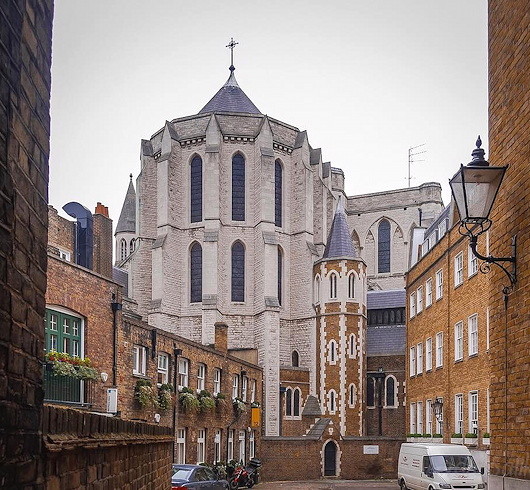
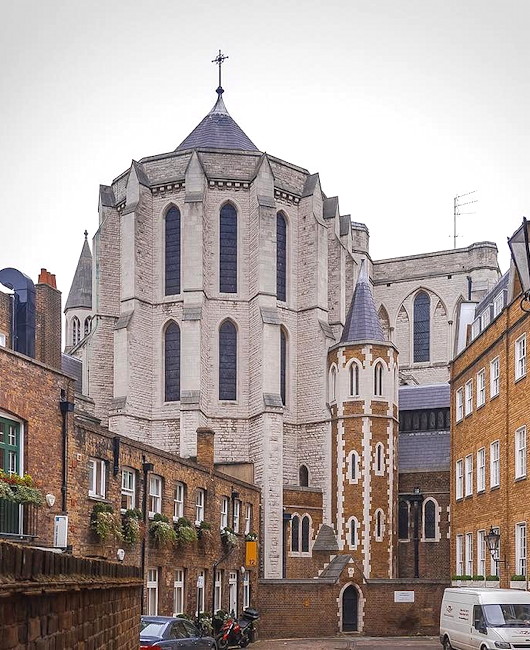
Always interesting to see a building you know well from a perspective you’ve never seen before, as in this photo of the Church of St James, Spanish Place, taken from Manchester Mews. The church somehow seems more imposing — like a great rounded keep.
A few months ago I was corralled into some favour or other that required a bit of muscle to move this there and whatnot, the payoff of which was it afforded an opportunity to explore the triforium of this Marylebone church and see the interior of the building from an entirely new vantage point.
It also meant being able to view in better detail the beautiful stained glass windows — many of them the gift of various Spanish royals, given that this parish originates as the chapel of the Spanish embassy (hence its name).
Letter to the Editor
A letter to the editor printed in this week’s edition of The Tablet:
Brendan Walsh’s report (“Heythrop’s fate”, 17 September) of a senior academic suggesting that the demise of Heythrop was an episode in a long struggle between “outward-facing, inquisitive, challenging” theology on one side and “inward-looking, submissive, unquestioning” theology on the other is telling.
Positing such a simplistic binary split between Enlightened Me and Poor Ignorant You is patronising to those attempting to live out the radical beauty of the Christian life in tune with Catholic teaching. It’s not surprising that an institution with academics holding this view is entering its death spiral, while religious communities that don’t consider basic orthodox belief as optional are bursting at the seams.
Few things are more challenging – and more rewarding – than faithfulness; while some cling to clapped-out heterodoxies and managed decline, the rest of the Catholic world has moved on.
ANDREW CUSACK
London SW1
The Red Mass in Edinburgh
The opening of Scotland’s judicial year was marked this past Sunday by the Archbishop of St Andrews & Edinburgh offering the customary Red Mass in St Mary’s Cathedral.
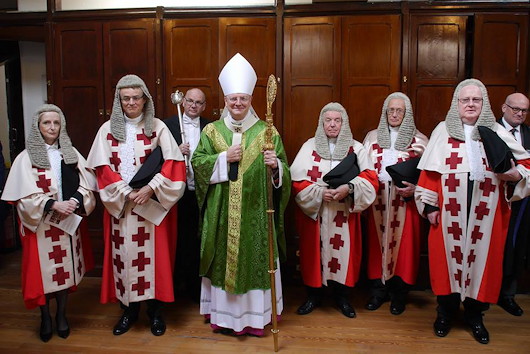
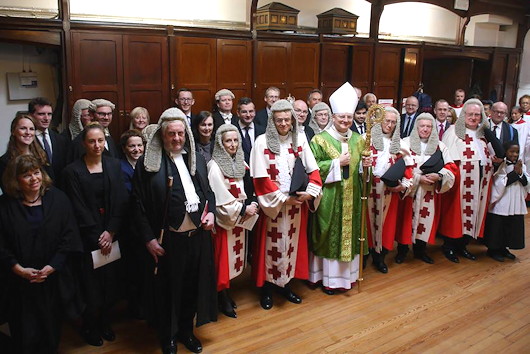
This year Archbishop Leo Cushley was joined by Lord Drummond Young and his fellow Senators of the College of Justice, Lord Uist, Lord Doherty, Lord Matthews, and Lady Carmichael.
Gordon Jackson QC, the Dean of the Faculty of Advocates, and Austin Lafferty of the Law Society of Scotland joined many sheriffs, QCs, advocates, solicitors, trainee solictors, paralegals, and law students.
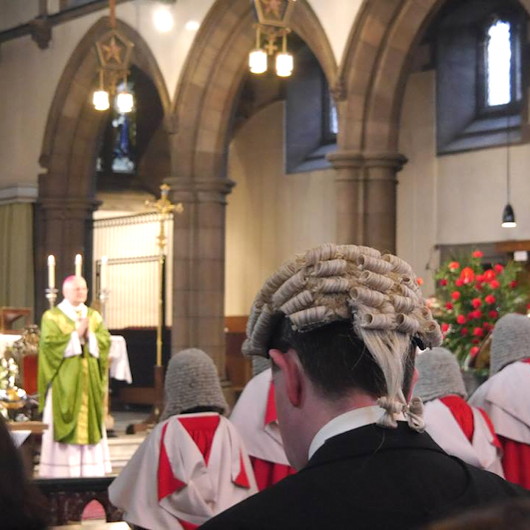
“These men and women serve the nation in a high office and come here to ask the Lord’s blessing upon this year’s work that they carry out on our behalf,” Archbishop Cushley noted in his homily.
“Know that we appreciate the difficult and complex tasks that you have and the duties that you perform – which are very onerous – on behalf of us all and that you be assured of our prayers and our support for all that you do to apply the law of the land with virtue and with justice and with mercy.”
The Spina di Borgo
The Baroque is a style of joy. It is often hailed (or derided) as the most Catholic of styles and in some sense this is true. The festivity and physicality of the Baroque reflect the God that Catholics worship — “the Love that moves the Sun and other stars” as Dante put it — but a Love made incarnate, made man, in a very real and tangible world.
The Baroque is also the style of the surprise: the corner turned to an unexpected vista or the jet of water sprinkling a king’s unsuspecting courtier.
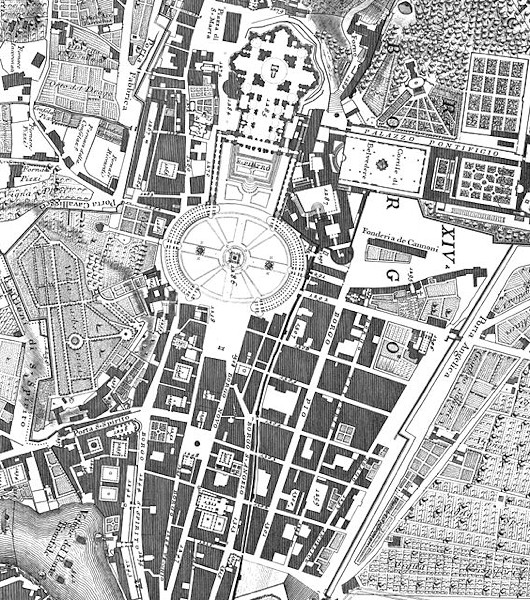
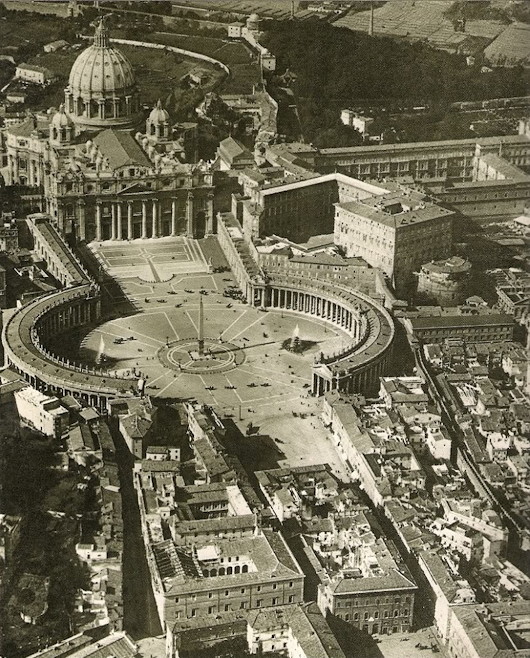
One of the most superb examples of this was the great basilica church of Saint Peter in Rome where prince, pilgrim, and pauper alike moved in a dark warren of palaces, hovels, churches, and alleyways, perhaps catching an occasional glimpse of the great dome looming as they closed in on San Pietro, finally to emerge from the shadow into the great light of the piazza.
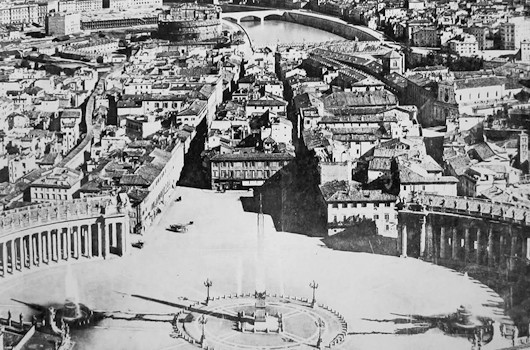
That warren of buildings was the Spina di Borgo (“Spine of the Borgo”) but this experience is now sadly lost to us since the 1930s when the Kingdom of Italy’s fascist premier Benito Mussolini decided to raze the neighbourhood. Instead we now have the long boulevard called the Via della Conciliazione, named in commemoration of the Lateran Treaty establishing formal relations between the Holy See and the Italian state.
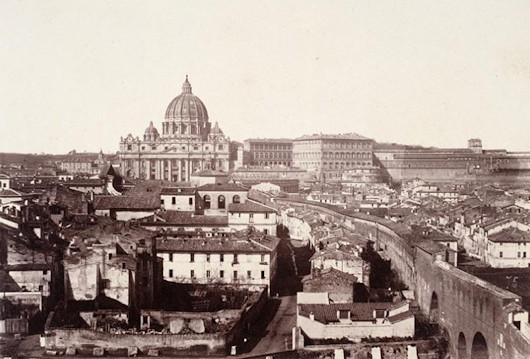
While Il Duce ostentatiously took credit for this urban crime by symbolically swinging the pickaxe beginning demolition, the concept, though flawed, was in fact an old one. Leon Battista Alberti submitted proposals during the reign of Pope Nicholas V (mid fifteenth century), and numerous other architects — Carlo Fontana, Giovanni Battista Nolli, Cosimo Morelli — drew up similar plans. The Piazza San Pietro only took its now instantly recognisable form in the 1650s when the curved flanking collonades enclosed the space like great welcoming arms superbly framing the basilica’s façade.
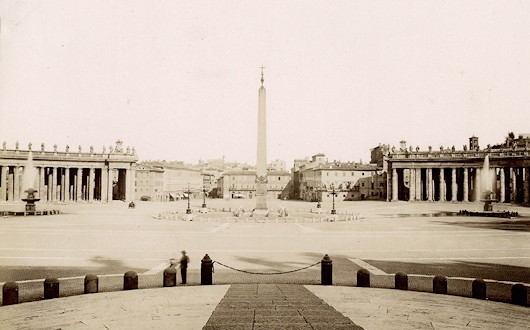
Mussolini turned to Marcello Piacentini — an accomplished if sometimes uneven architect — assisted by Attilio Spaccarelli. Piacentini favoured closing off the view from the avenue with a closed collonade, echoing Bernini’s own plans for the piazza, but was overruled.
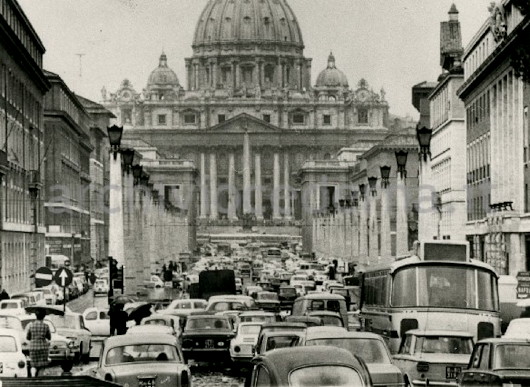
The razing of the Spina presented a problem in that the undemolished buildings left flanking the Via della Conciliazione were now mostly at odd angles to the new boulevard. Piacentini attempted to solve this by flanking the road with two rows of obelisks that doubled as streetlamps providing a line directing the viewer towards the great basilica beyond, otherwise unimpeded by any visual interruption.
Overall the construction of the Via leaves a rather boring and clinical feeling. The charm and chaos of the Spina has been replaced by a clean and dull boulevard, useful for little more than traffic efficiency and crowd control. The loss of the Spina di Borgo is mourned.
Master Mitsui’s Ink Garden
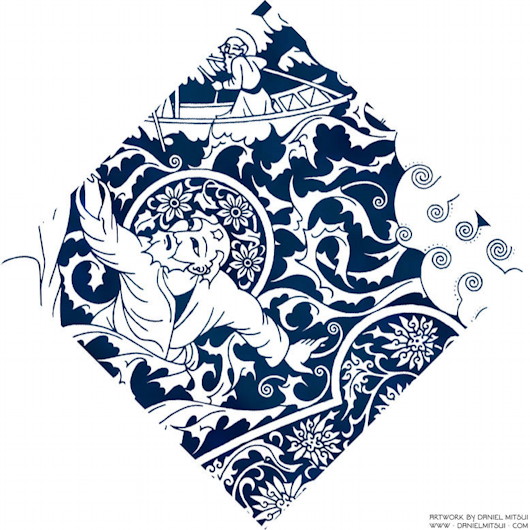
Daniel Mitsui is one of the most interesting artists out there, exhibiting a wide range of influences from the Celtic to the Oriental. Among his latest works is an ink drawing on a Catholic theme. As Daniel explains:
I received a commission to create a Catholic religious drawing in a Chinese style. These explorations into artistic traditions outside of European Christendom are always exciting, and China was new territory for me. When developing the concept for the project, I looked to one of the early missionaries to China, the Italian Jesuit Matteo Ricci.
Some time in the very early 17th century, Ricci gifted four European prints to the Chinese publisher Cheng Dayue: two engravings by Anthony Wierix from a series illustrating the Passion and Resurrection of Christ, another by the same artist reproducing the painting of the Virgin of Antigua in Seville Cathedral, and one by Crispin De Pas the Elder from a series illustrating the life of Lot.
Master Cheng copied these images into his Ink Garden, a model book of illustrations and calligraphy. The missionary saw this as a good opportunity to disseminate lessons in Christian doctrine and morality among the Chinese population.
Continue reading here.
Joy
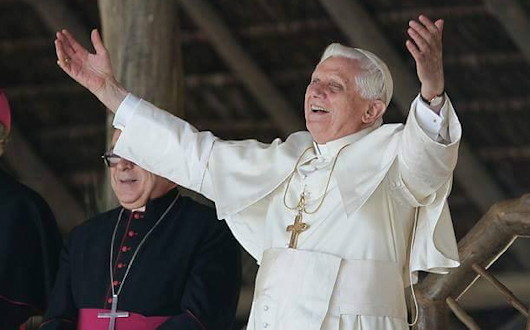
Something I constantly notice is that unembarrassed joy has become rarer. Joy today is increasingly saddled with moral and ideological burdens, so to speak. When someone rejoices, he is afraid of offending against solidarity with the many people who suffer. I don’t have any right to rejoice, people think, in a world where there is so much misery, so much injustice.
I can understand that. There is a moral attitude at work here. But this attitude is nonetheless wrong. The loss of joy does not make the world better — and, conversely, refusing joy for the sake of suffering does not help those who suffer. The contrary is true. The world needs people who discover the good, who rejoice in it and thereby derive the impetus and courage to do good. Joy, then, does not break with solidarity. When it is the right kind of joy, when it is not egotistic, when it comes from the perception of the good, then it wants to communicate itself, and it gets passed on. In this connection, it always strikes me that in the poor neighborhoods of, say, South America, one sees many more laughing happy people than among us. Obviously, despite all their misery, they still have the perception of the good to which they cling and in which they can find encouragement and strength.
In this sense we have a new need for that primordial trust which ultimately only faith can give. That the world is basically good, that God is there and is good. That it is good to live and to be a human being. This results, then, in the courage to rejoice, which in turn becomes commitment to making sure that other people, too, can rejoice and receive good news.
Lourdes: To Be a Pilgrim
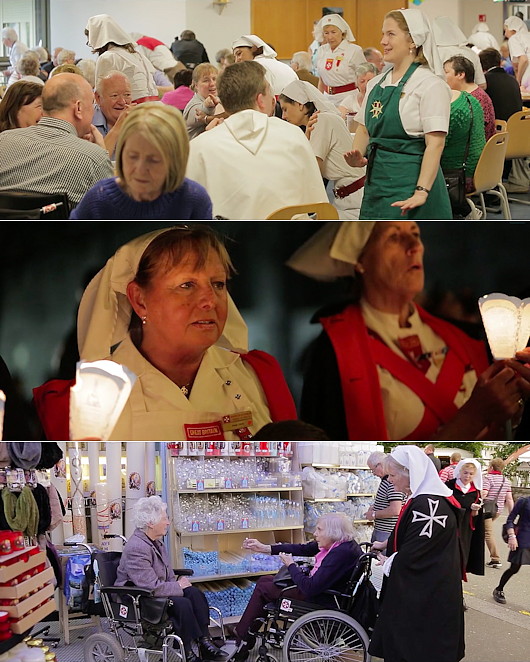
As today is the feast of Our Lady of Lourdes — and consequently the World Day of the Sick — here is the documentary we made regarding the Order of Malta’s annual pilgrimage to Lourdes each May.
No ‘Malvinas’ Here
Some difficulties of Latin place names in 1930s cartography
It’s no great secret I’m a lover of maps. When calling in to the Secretariat of State on the terza loggia of the Apostolic Palace in the Vatican the other day, I was very pleased to see the cartographic murals there, including the two hemispheres done by Ignazio Danti in the 1580s. Moving to the next interior offices, however, the visitor is greeted by a much more recent mappa mundi, dating from the 1930s, replete with the glamour of empire’s heydey. (more…)
Chartres 2015
Chartres is filed in my mind as the cathedral of my childhood. I must’ve been around 4 or 5 when I first walked amidst this medieval vision of stone and stained glass — some years before I ever visited the cathedral of New York where I was born. Cathedrals offer a prodigious mental stomping ground for the imagination of a young boy, and David Macaulay’s pen-and-ink book Cathedral (winner of the 1975 Deutscher Jugendliteraturpreis — take note!) I read and re-read over and over again as a child.
The marvel of this great church is that, while most medieval cathedrals took centuries to build, Chartres was constructed in an astonishing fifty-four years between 1194 and 1250, lending it a unity as an architectural composition that puts its rivals to shame. Chartres was made a diocese as early as the third century and tradition even upholds that from around the year 50 B.C., local Druids who had heard the prophecies of Isaiah here enshrined a statue of the ‘Virgo Paritura’, the Virgin-who-will-give-birth.
Having such a long history, Chartres’ fortunes have waxed and waned. In medieval times it was one of the most popular pilgrimage shrines in all of Europe, and in the 11th and 12th century its cathedral school far outshone England’s provincial attempt at a university at Oxford. But France’s civil wars and then revolution put an end to the town’s days as a destination for pilgrims until the poet Charles Péguy revived them himself in the years leading up to the First World War.
For the past thirty-three years, the largest pilgrimage to Chartres has been undertaken over Pentecost weekend, a bank holiday in France which happily coincided with our second May bank holiday in Great Britain this year. On this trek, over 11,000 pilgrims walk all the way from Notre Dame de Paris to Notre Dame de Chartres. Our chapter of about twenty pilgrims marched under the banner of Notre Dame de Philerme, patroness of the Order of Malta — mostly French and British but with a few participants from other countries as well. (more…)
Faith, Freedom, and Respect
Religion grows in the very depths of our being. Mocking it, ridiculing it, can be especially hurtful.
by FRANÇOIS HUGUENIN
Unanimous France has marched on January 11 in the name of Charlie to defend freedom of expression. Is it useful to say at the start that, at this moment of national unity, I agree with the condemnation of these heinous acts of terrorism and that I welcome hearing some courageous voices dare to finally name the danger — radical Islamism? But I am surprised and worried to see a France that, with the resultant “diversity” noticeable in its absence, is becoming a supporter of a newspaper that it never bothered to read. The defence of freedom of expression seems to have created an epidemic of blindness with respect to the problems, not of the freedom to express ideas, but of the manner in which that freedom is used.
It is clear that freedom of expression is regulated in France, since some words (such as those inciting racial hatred) are legitimately subject to prosecution, while there are no laws against blasphemy. But the question posed by the humour of Charlie Hebdo, that everyone will enjoy according to their own standards, seems to be beyond the law. If liberty is a core value of our society, conquered after many struggles, is it assigned an absolute value that is greater than all the others? Doesn’t the motto of our republic put it at the same level of equality and fraternity? In the name of fraternity, we can not take seriously a value that is unlikely to be framed in legal texts, as it is impossible to codify, and yet is inherent in the dignity of man and entered in the heart of everyone: that of respect for others. This is precisely what makes a large contribution to the charm of life: giving up one’s seat on the bus to let an elderly person sit; politely asking your neighbour to lower the volume of his music instead of yelling in the stairway “Turn it down!” — none of this is prescribed by law, but it makes life better.
Now, if there is a value to be respected in others, it is his religion. (more…)
Papal Mace for St Andrews
Archbishop Presents New Mace to Scotland’s Oldest University Amidst 600th Anniversary
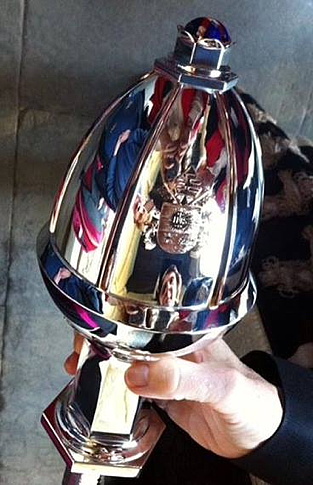
Above: The 600th Anniversary Mace.
Below: The University’s three medieval maces:
St Salvator’s College, 1461; Faculty of Canon Law, circa 1450; Faculty of Arts, 1416.
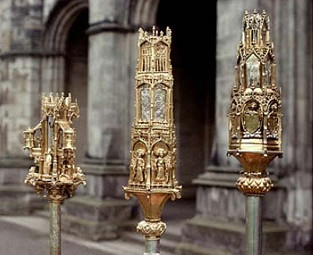
ST ANDREWS University already boasts the world’s finest collection of medieval maces, but a new ceremonial mace was added to the university’s hoard recently. In honour of the University’s six-hundredth anniversary, the Most Rev Leo Cushley, Archbishop of St Andrews & Edinburgh, has presented the institution with a new ceremonial mace on behalf of the Catholic Church.
“This completes a triple recognition of the University St Andrews,” said Dr John Haldane, the University’s professor of philosophy.
“During his visit to Scotland at the outset of this decade, Pope Benedict referred to the university beginning to mark the 600th anniversary of its foundation, then last year Pope Francis sent a message of congratulation, and now his office has granted permission for the inclusion of his coat of arms on the head of a mace commissioned to mark the completion of several centuries and the beginning of who knows how many more.”
The silver mace with gold rose details was crafted by Hamilton & Inches of Edinburgh, who also constructed the mace of the Faculty of Medicine at St Andrews over a half-century ago. Their master silversmith Jon Hunt designed the mace, in consultation with Prof Haldane.
The mace’s head is reminiscent of Brunelleschi’s dome of Florence Cathedral, recalling St Andrews’s links with the Continent which were foremost in the University’s first century and a half while it was a Catholic institution. Atop the head a saltire design is incorporated, referencing the apostle who gave his name to both the Royal Burgh and the University as well as the country who’s first university St Andrews is.
Heraldic shields display the arms of the University and of Pope Francis who invoked “upon all the staff and students of the University, past and present, the abundant blessings of Almighty God, as a pledge of heavenly peace and joy”. (more…)
Change in the air at the Catholic Herald
Title will cease to operate as a newspaper and relaunch in magazine format
Britain’s leading Catholic publication, the Catholic Herald, will be relaunching as a magazine before the end of this year. Invites have already gone out to an event celebrating the change to be held in early December.
The relaunch might be interpreted as a move against the Tablet, which styles itself “the international Catholic weekly” and has been nicknamed “The Bitter Pill” by English Catholics for its widely perceived lack of faithfulness to Catholic teaching. The Tablet is associated with the country’s old liberal Catholic elite, counting among its trustees such figures as Chris Patten and Sir Gus O’Donnell. A Herald reader, meanwhile, is more likely to be young, intellectual, and strongly influenced by John Paul II and Benedict XVI.
When told of the news, one young churchman welcomed the change as a good move for the generally orthodox Herald against its looser rival. (more…)
L’Osservatore Romano goes Hungarian
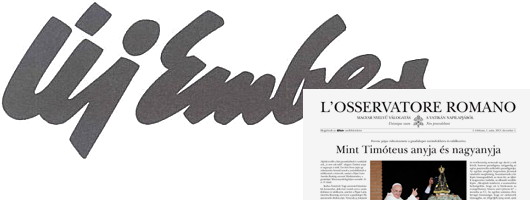
Magyarophiles will be pleased to learn that L’Osservatore Romano, the Vatican newspaper, will begin appearing in Hungarian. The new edition will appear every other week as a four-page insert into Új Ember, the Hungarian Catholic weekly founded in 1945. “We are a small editorial staff,” Balázs Rátkai, editor-in-chief of the weekly, told L’Osservatore.
“However, our intention is to probe and to make our readers think. The collaboration with the Vatican daily is of historic importance for the life of the weekly and of the entire local Church; it not only brings the Universal Church and the Pope closer to us; it will also enrich readers, and through them all of Hungarian society, with new thoughts, opinions and answers.”
Printed as a daily broadsheet in Italian, the Vatican newspaper also has weekly tabloid editions in French, Spanish, English, German, and Portuguese, as well as a monthly version in Polish.
Saturday: Day of Fasting & Prayer for Peace in Syria
Given the urgent situation, please see the following from the Fathers of the London (Brompton) Oratory:
Day of Fasting and Prayer for Peace in Syria
This is in response to the following call to fasting and penance issued by His Holiness Pope Francis:
“On 7 September, in Saint Peter’s Square, here, from 19:00 until 24:00, we will gather in prayer and in a spirit of penance, invoking God’s great gift of peace upon the beloved nation of Syria and upon each situation of conflict and violence around the world. Humanity needs to see these gestures of peace and to hear words of hope and peace! I ask all the local churches, in addition to fasting, that they gather to pray for this intention.”
The London Oratory invites you to join the Holy Father in prayer for this urgent intention.
6.45pm-11.00pm Exposition of the Blessed Sacrament, the Little Oratory
Some Norwegian Catholics
Writers, politicians, journalists, academics — Norway’s Catholics seem an intellectual bunch. The Church in Scandinavia is on a slow but steady ascendant, and it’s telling (of both the rise and fall of many) that there are now more seminarians studying for the priesthood for the Nordic countries than there are for all of Ireland.
As a Norwegian acquaintance of ours was ordained for the Diocese of Oslo within the past year, I thought a little jaunt through a handful or two of Norwegian Catholics might be interesting. There are some I would have liked to included — the conversion of the former Lutheran ecumenist Ola Tjørhom provoked controversy and Wilhelm Wedel-Jarlsberg preceded Christopher de Paus as a papal chamberlain — but there is only so much time and space and effort.
Of those mentioned here below, only Sigrid Undset has achieved worldwide fame. Her work Kristin Lavransdatter is an absolute must for any serious reader of literature and was recently re-translated into English by Penguin. (more…)
Into the Qadisha Valley
THE HOLY VALLEY cuts down like a gash in the earth, with the cathedral city of Bcharré on the clifftop, almost hanging off of it. One almost wonders if you started building at the other end of the town, it might force St Seba’s Cathedral off over into the deep beyond. There is something almost Lord of the Rings about the setting, a Levantine Minas Tirith, if only Tolkein had been a Maronite.
The Qadisha Valley (Ouadi Qadisha, وادي قاديشا, literally the “Holy Valley”) takes its name from the Aramaic word for saintly and for over a millennium its natural caves have provided shelter for hermits seeking solitude as well as others seeking refuge and safety. Evidence of human habitation dates back to the Paleolithic era, and the Qannubin Monastery here is said to have been founded by the Emperor Theodosius the Great in the fourth century. While this is the holiest ground of the Maronite Catholics, hermits living in these caves and in these monasteries have been Melchite, Nestorian, Armenian, Syrian Orthodox, and Ethiopian. When the Monastery of St Maron was sacked by Antiochene Monophysites, many monks fled to the Qadisha Valley, strengthening the presence of this Eastern church which has always remained in communion with Rome. For over five hundred years, the Maronite patriarch made Deir Qannubin his seat. (Since 1830 the Patriarchate has been based at Bkerké above the pleasant Mediterranean city of Jounieh). (more…)
The Lady Altar
The Oratory Church of the Immaculate Heart of Mary,
Brompton Road, London
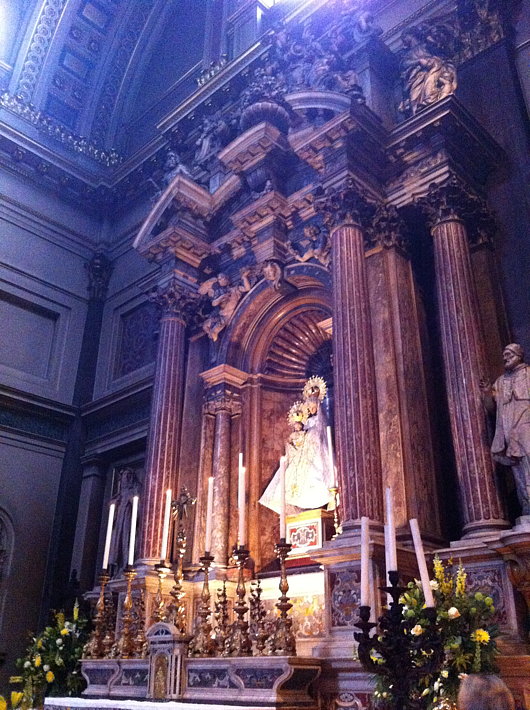
In the south transept of the Brompton Oratory is the altar dedicated to the Blessed Virgin, perhaps the finest altar in the entire church. It is a favourite place for getting in a few prayers and offering a candle or two or three or four. At the end of Solemn Vespers & Benediction on Sunday afternoon (above) it is where the Prayer for England is said and the Marian antiphon sung.
The Lady Altar was designed and built in 1693 by Francesco Corbarelli of Florence and his sons Domenico and Antonio and for nearly two centuries stood in the Chapel of the Rosary in the Church of St Dominic in Brescia. That church was demolished in 1883, and the London Congregation of the Oratory purchased the altar two years beforehand for £1,550.
The statue of Our Lady of Victories holding the Holy Child had previously stood in the old Oratory church in King William Street, and the central space of the reredos was slightly modified to house it. The Old and New Worlds are represented in the flanking statues, which are of St Pius V and St Rose of Lima — both by the Venetian late-baroque sculptor Orazio Marinali. The statues of St Dominic and St Catherine of Siena which now rest in niches facing the altar were previously united to it, and are by the Tyrolean Thomas Ruer.
The Cathedral of the Bronx
The Augustinian Church of St Nicholas of Tolentine
The Church of St Nicholas of Tolentine dominates the busy intersection of University Avenue and West Fordham Road in the Bronx. The parish was erected by the archdiocese in 1906 and has been served by Augustinians ever since then. The present church is a modern gothic creation from 1927, and probably one of the most handsome Catholic churches in the borough — it is often nicknamed “the cathedral of the Bronx”. (Though that style is sometimes also ascribed to St Jerome’s in Mott Haven).
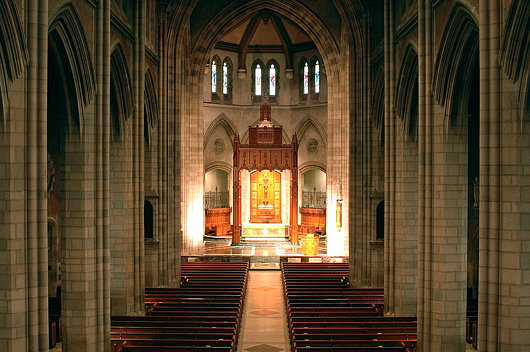
The church is of suitably grand proportions, but the effect is somewhat diminished by the unfortunate use of bulky wooden pews. They are ill-suited to such a large church, and detract from the spaciousness of the interior. This is unfortunately a very frequent problem in the United States, where clumsy pews crowd even great cathedral churches like St Patrick’s in Manhattan or the glorious Cathedral Basilica in St Louis. Regardless, St Nicholas of Tolentine is a splendid ornament in this borough of many churches. (more…)
Better late than never
Old hat already, but following the announcement of Benedict XVI’s abdication, the Los Angeles Times solicited opinions from eleven American Catholics — among them your humble & obedient scribe — what they would like to see in the new pope.
I posted in on Twitter, but in case you didn’t catch it there, you can find my contributions (in addition to those of the ten others) at this link. (more…)
Search
Instagram: @andcusack
Click here for my Instagram photos.Most Recent Posts
- Brunel’s Unbuilt Capitol February 3, 2026
- Cricket at Fordham January 27, 2026
- Palacio Barolo Revisted January 14, 2026
- Learning to Love Liguria January 14, 2026
- Crux Alba No. 2 January 13, 2026
Most Recent Comments
Book Wishlist
Monthly Archives
Categories