Church
About Andrew Cusack
 Writer, web designer, etc.; born in New York; educated in Argentina, Scotland, and South Africa; now based in London.
 read more
News
Blogs
Reviews & Periodicals
Arts & Design
World
France
Mitteleuropa
Knickerbockers
Argentina
The Levant
Africa
Cape of Good Hope
Netherlands
Scandinavia
Québec
India
Muscovy
Germany
Academica
A Gothic Abbey in Virginia
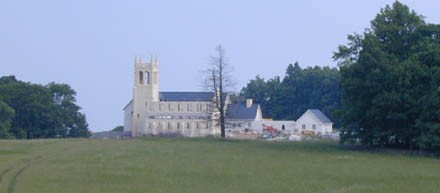
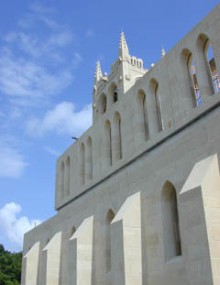
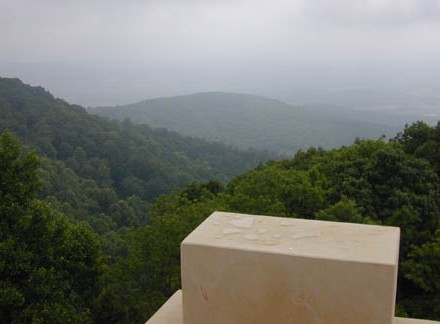
HDB/Cram and Ferguson has designed a Gothic abbey for an apparently schismatic Benedictine congregation in the mists of the Blue Ridge mountains of Virginia. It looks as if it will be very beautiful when finished but, alas, will not be open to the public as these Benedictines seem to greatly value their privacy. See the article, ‘In Virginia, a monastery rises in the mountains‘ (Associated Press, 2004).
Cassock Pursuivant
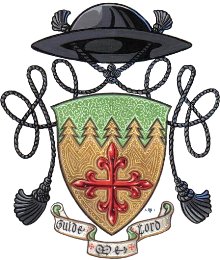 Last night the G&B played host to a lecture by one Fr. Guy Selvester, America’s ecclesiastical heraldist extraordinaire (arms at right). The good Reverend clearly has an unadulterated and unaffected love for heraldry, which, as he was very keen to point out, is unquestionably both an art and a science. He also has flaming red sideburns which give one the vague impression that he was a Civil War chaplain in a past life. After a brief introduction from a member of the G&B’s heraldry committee, the cassocked Father Guy gave a very clear and well-delivered talk, amply displaying his broad and deep knowledge of the subject, especially when responding to off-the-cuff inquiries from the audience.
Of course no talk on ecclesiastical heraldry would be complete without mentioning the late Bruno Heim, the expert on church heraldry as well as Grand Prior of the Constantinian Order and the first full papal nuncio to the Court of St. James since the Reformation. Heim’s book Heraldry in the Catholic Church (available in the St Andrews University Library) is the essential work on the subject. Fr. Selvester interestingly pointed out that Blessed Pope John XXIII intended to found a heraldic authority for the Church. He was dissuaded from this task by none other than Archbishop Heim, who believed the Church covered too far broad a swathe to effectively and appropriately constitute its own heraldic authority mindful of the vernacular traditions. (more…)
Remembering Gemayel

September 14 is the twenty-third anniversary of the assasination of the Catholic general and politician Bachir Gemayel by Syrian agents, only nine days before he was to be inaugurated as President of Lebanon. Gemayel was the son of Pierre Gemayel, the founder of the Lebanese Kataeb (Phalange) which Bachir eventually led himself, and was also instrumental in unifying the Christian militias of the country into the Lebanese Forces, which joined with the conventional Lebanese Armed Forces in their 100-day attempt to expel the Syrians from Lebanon in 1978.
A massive bomb exploded in the Kataeb headquarters on September 14, 1982, killing the President-elect and twenty-four other souls. The assasination only further escalated the violence of the Civil War, a conflict which was taken to regretable extremes by all the parties invovled. (more…)
Cappa Magna Sighting
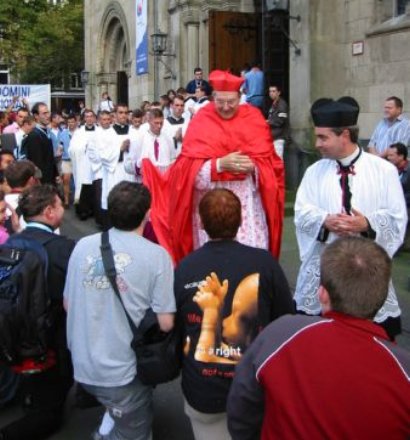
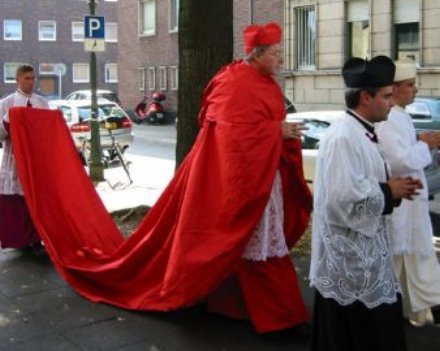
His Eminence George Cardinal Pell, the Archbishop of Sydney, happily donned the traditional (and these days rarely seen) cappa magna during his presence amongst the Juventutem pilgrims at the recent World Youth Day in Germany. His Eminence, known for his Australian candor, is seen above blessing young folks outside the Düsseldorf church designated for the use of the Juventutem traditional Catholic youth.
The Catholic Encyclopedia informs us that the “great cope” is not a liturgical vestment per se but rather a glorified version of the cappa choralis (choir cope), and is reserved for cardinals, bishops, and certain privileged prelates.
Photos from the FSSP.
The Story of Notre Dame de Bon Secours
The background story to Nôtre Dame de Bons Secours, from the Catholic Community Forum:
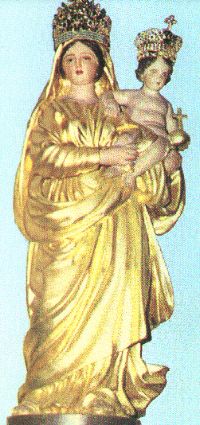 In 1727, French Ursuline nuns founded a monastery in New Orleans, Louisiana, and organized their area schools from it. In 1763 Louisiana became a Spanish possession, and Spanish sisters came to assist. In 1800 the territory reverted back to France, and the Spanish sisters fled in the face of France anti-Catholicsm. In 1803, short on teachers, Mother Saint Andre Madier requested reinforcements in the form of more sisters from France. The relative to whom she wrote, Mother Saint Michel, was running a Catholic boarding school for girls. Bishop Fournier, short-handed due to the repressions of the French Revolution, declined to send any sisters. Mother Saint Michel was given permission to appeal to the pope. The pope was a prisoner of Napoleon, and it seemed unlikely he would even receive her letter of petition. Mother Saint Michel prayed,
O most Holy Virgin Mary, if you obtain for me a prompt and favorable answer to this letter, I promise to have you honored at New Orleans under the title of Our Lady of Prompt Succor.
and sent her letter on 19 March 1809. Against all odds, she received a response on 29 April 1809. The pope granted her request, and Mother Saint Michel, commissioned a statue of Our Lady of Prompt Succor holding the Infant Jesus. Bishop Fournier blessed the statue and Mother’s work.
Mother Saint Michel and several postulants came to New Orleans on 31 December 1810. They brought the statue with them, and placed it in the monastery chapel. Since then, Our Lady of Prompt Succor has interceded for those who have sought her help.
A great fire threatened the Ursuline monastery in 1812. A lay sister brought the statue to the window and Mother Saint Michel prayed
Our Lady of Prompt Succor, we are lost if you do not come to our aid.
The wind changed direction, turned the fire away, and saved the monastery.
Our Lady interceded again at the Battle of New Orleans in 1815. Many faithful, including wives and daughters of American soldiers, gathered in the Ursuline chapel before the statue of Our Lady of Prompt Succor, and spent the night before the battle in prayer. They asked Our Lady for the victory of the American forces over the British, which would save the city from being sacked. General Andrew Jackson and two hundred men from around the South won a remarkable victory over a superior British force in a battle that lasted twenty-five minutes, and saw few American casualties.
It is still customary for the devout of New Orleans to pray before the statue of Our Lady of Prompt Succor whenever a hurricane threatens New Orleans.
Hat tip: Irish Elk. The image used below is of the National Shrine of Our Lady of Prompt Succor in New Orleans.
Notre Dame de Bon Secours, Pray for New Orleans!

Intercede for us with Jesus that we may always accept God’s graces and be found faithful to Him in our particular states of life. As you once saved our beloved City of New Orleans from ravaging flames, and our Country from an invading army, have pity on us and obtain for us protection from Hurricane Katrina and all other disasters.
Assist us in the many trials which beset our path through life. Watch over the Church and the Pope as they uphold with total fidelity the purity of faith and morals against unremitting opposition. Be to us truly Our Lady of Prompt Succor now and especially at the hour of our death, that we may gain everlasting life through the merits of Jesus Christ Who lives and reigns with the Father and the Holy Spirit, one God world without end.
Amen.
Rye Gothic
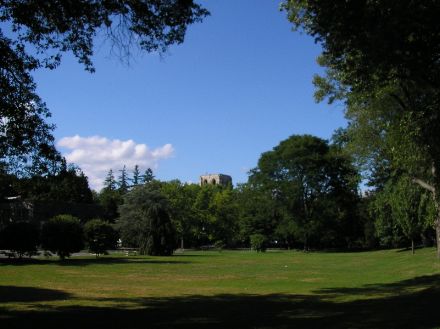
There’s a little portion of Rye on the Boston Post Road here in Westchester which is a veritable Gothic wonderland. From the south it begins on Rye High School’s beautiful campus with the track and playing field across a brook from the neo-Gothic middle and high school buildings, with sympathic additions covered in the same stone. Immediately to the north is the Victorian Gothic Rye Presbyterian Church, built in 1870 by architect Richard Upjohn, whose son and grandson designed two later additions, respectively. Just north of Rye Presbyterian is the Church of the Resurrection, and a little further north of that is Christ’s Church Rye, both of which are in the Gothic style.
The photo above shows the top of the crossing tower of the Church of the Resurrection, a 1930 structure built for Rye’s Catholic parish, viewed from Milton Road. I popped round to the area today and took a few photos, though I did not go inside Resurrection, as there was a wedding taking place. (more…)
The Church of St Agnes
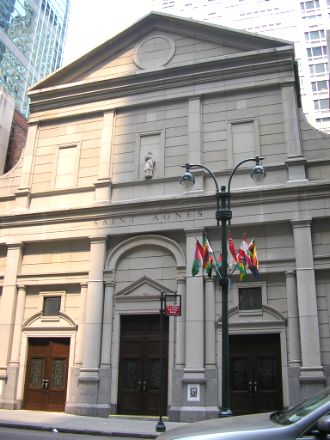
For those who have not seen St Agnes since it was rebuilt in a different style I thought I’d post a few photos I took after the 12:30 mass today. I don’t recall who the architect was; I believe it might be Thomas Gordon Smith. The reason for the vexilla-ed lampost is that East 43rd Street, in addition to being known as “Archbishop Fulton J. Sheen Place”, is also “U.N. Way” since the headquarters of that organisation terminates the vista eastwards. (more…)
Walsingham Tabernacle

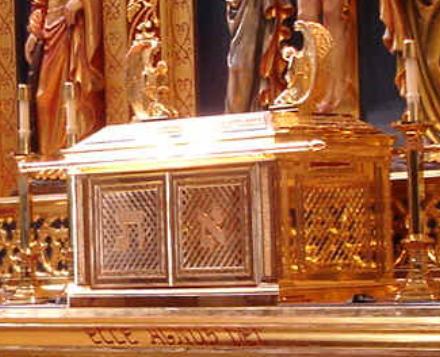
I had not noticed that the tabernacle in the brand new Church of Our Lady of Walsingham in Houston, Texas was a smaller replica of the Ark of the Covenant.
Rather appropriate, considering one of Mary’s titles is ‘Ark of the New Covenant’.
St. Edith Stein: Martyr for Truth
The 20th witnessed great advances in science and medicine. But it was not an era for truth. Research uncovered remarkable facts about the physical world, but philosophers and even average people were gripped by the idea that we cannot know anything for certain. Today, many — especially the most educated — allow that we all have notions of true and false, right and wrong, but that no one can claim anything is really the truth.
It is a hopeful sign, then, is that one 20th-century martyr made an extraordinary journey through modern uncertainties, and not only embraced, but was willing to die for the truth of the Catholic Faith.
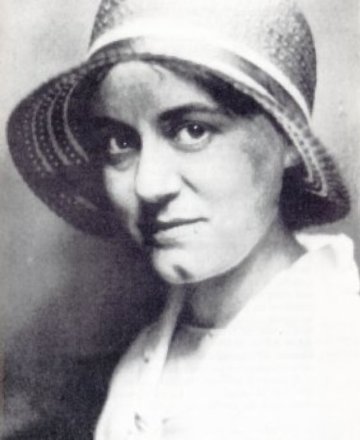
Edith Stein was born to a well-off Jewish family in Breslau, Germany. Her father died when she was very young, and her mother was a very devout Jew and powerful woman. Edith early showed exceptional intelligence and, when few women pursued higher education, enrolled at the university. Along the way, she had lost her childhood Jewish faith, but her studies were to lead her to quite an unexpected rediscovery of God. [Continue]
Edith Stein — Convert, Nun, Martyr
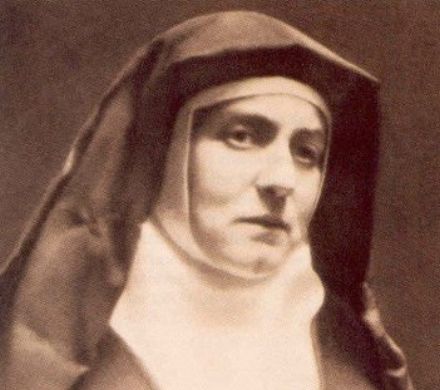
Edith Stein is one of those people whose entire life seems to be a sign. She was born on Yom Kippur, the Jewish Day of Atonement, in 1891 in Breslau, Germany (now Wroclaw, Poland), the youngest of eleven children in a devout Jewish family.
When she was not yet two years old her father died suddenly, leaving Edith’s mother to raise the seven remaining children (four had died in childhood) and to manage the family business. Brought up on the Psalms and Proverbs, Stein considered her mother a living example of the strong woman of Proverbs 31, who rises early to care for her family and trade in the marketplace. By her teenage years, Stein no longer practiced her Jewish faith and considered herself an atheist, but she continued to admire her mother’s attitude of total openness toward God. [Continue]
More:
Carmelite Saints – The Life of Edith Stein
Edith Stein: A Brilliant Scholar Called to Share in Both the Virtue and Martyrdom of Christ
Women for Faith and Family – Saint Edith Stein (includes collect prayer, reading, and homily from canonization by John Paul II)
Association of Hebrew Catholics
The Church in China
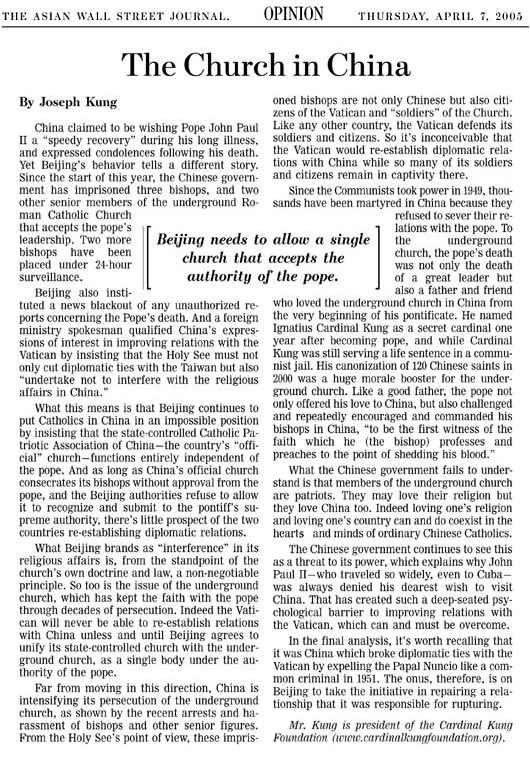
C.f. the Cardinal Kung Foundation.
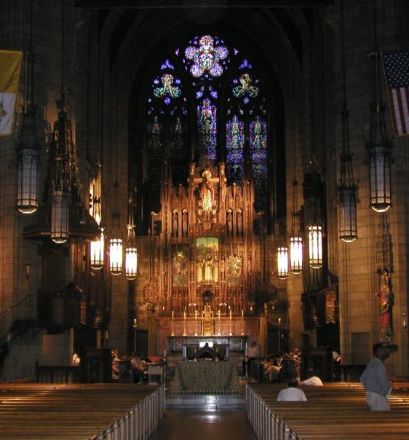
St. Vincent Ferrer
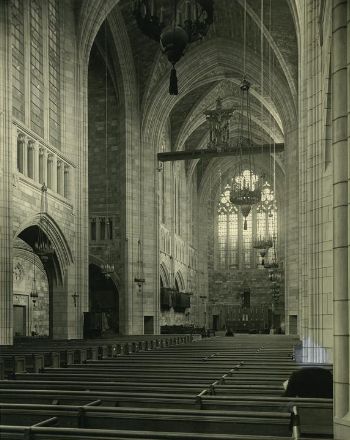
This photo shows the interior of the Dominican Church of St. Vincent Ferrer, designed by Goodhue, before it was fully completed. The stained glass has yet to be installed, and the same goes for the giant reredos which now graces the altar. A more current view is below.
Church of Christ the King, Gordon Square, London
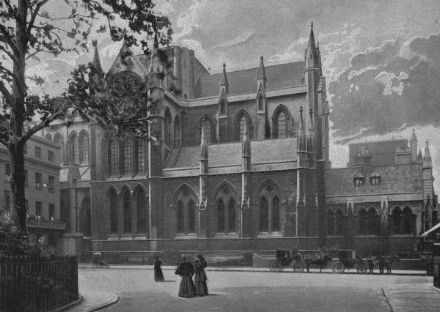
Though a comparitively small and minor sect, assiduous tithing by the members of Catholic Apostolic Church gave that group a number of stunning churches. (Their former church in Edinburgh was the subject of a previous posting).
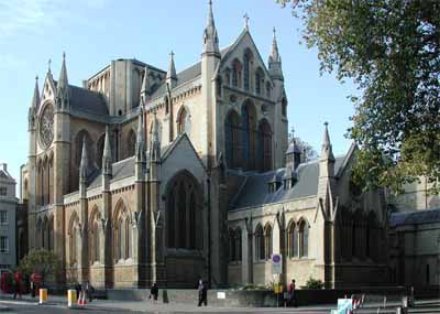
The building currently known as the Church of Christ the King on Gordon Square in Bloomsbury was constructed by the anachronistically-monikered Irvingites from 1853. The superb structure, built from Bath stone, is incomplete, lacking a few bays on the liturgical west of the building which kept the planned façade from being built. It also lacks a crossing tower, but then so does Westminster Abbey, the nave of which is only thirteen feet higher than that of Christ the King. (more…)
Canon Bernard Iddings Bell
Warden of St. Stephen’s College in the Hudson Valley of New York
As for what the Church thinks and says, what influence does that have on the handling of American politics, the conduct of American education, the regulation of marriage and divorce, on sex and drink, on how industrial disputes are settled, on how we carry on business?
As a plain matter of fact, religion in this country is generally regarded as a tolerated pastime for such people as happen to like to indulge in occasional godly exercises — as a strictly private matter in an increasingly close-knit and socially acting society — in other words, as something that does not count.
I should like to see the Church recognize that it has been pushed into the realm of the non-essentials, and to persuade it to fight like fury for the right and the duty to bring every act of America and Americans before the bar of God’s judgment.
[Christian leaders] are making valiant claim to such a right and duty; but the great mass of Church members are content to regard the Church as a conglomerate of private culture clubs, nice for christenings, weddings and funerals. Most Church members readily agree with the unchurched majority that it is not the proper business of the Church to criticize America or Americans.
— Canon Bernard Iddings Bell
The 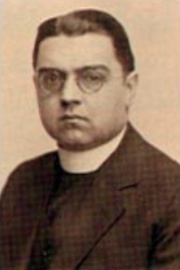 Rev. Canon Bernard Iddings Bell and seems to have been something all too rare in the history of America: a wise and presient Episcopalian cleric (which is not to say we have had any more than a mere handful of wise and presient Catholic clerics in this land).
Bell served as Warden of St. Stephen’s College – situated on the Hudson River here in New York – from 1919 to 1933, and is widely considered responsible for turning it into what was one of the best collegiate institutions in the country. In 1928, under Bell’s tenure, St. Stephen’s became a college of Columbia University, and this period of the College’s history was highly praised by the great Russell Kirk.
Kirk, in Decadence and Renewal in the Higher Learning, after positing his view of the ideal undergraduate college as a place of classical and liberal learning, takes note of St. Stephen’s. “There have been such colleges in this country,” Kirk wrote. “One such was St. Stephen’s College… when Dr. Bernard Iddings Bell was president. (He told me once that he gave up the presidency when strong objection was raised to his rule that the students should dress decently and rise when professors entered a room.)”
Of course, such arcadian days did not last. Only a year after Bell gave up the wardenship of St. Stephen’s in 1933, the college changed its name from honoring Saint Stephen, the first Christian martyr, to the more secular Bard College honoring the founder of the institution, John Bard.
A mere ten years later in 1944, Bard College became coeducational and as such severed its relationship with Columbia University, becoming independent as a secular, nonsectarian liberal arts college ‘affiliated’ with the Episcopal Church. The once-great college has now declined to such an extent that a professorship there is now named in honor of Alger Hiss, the man who betrayed America to spy for Soviet Russia. Sic transit gloria mundi.
Kirk relates another anecdote of Dr. Bell:
Canon Bernard Iddings Bell once showed a visitor from England about the environs of Chicago. They drove past a handsome Gothic building of stone. “Is that a school?” inquired the visitor.
“Yes– a new one, ‘distressed’ to appear old,” Dr. Bell replied.
“Indeed! Who is the headmaster?”
“There is no headmaster.”
“Curious! A kind of soviet of teachers, I suppose.”
“There are no masters at all.”
“Really? Do the boys teach one another?”
“As yet, there are no students. Here in the United States, we proceed educationally in a way to which you are unaccustomed,” Canon Bell told his friend. “First we erect a building; then we obtain pupils; next we recruit teachers’ then we find a headmaster; and at last we determine what is to be taught. You begin at the other end in England.”
Again, a quote from Canon Bell:
We need to forget the imaginary Christ who has been ours too long and to rediscover the real Christ, the Christ of the prophets and the martyrs and the confessors, the Christ who is not only the lover of souls but also master, a monarch with demands to make in industry, in finance, in education, in the arts, in marriage, in the home; the Christ who is teacher of a social ideology which has eternal validity; the Christ who cries aloud with convincing force, ‘He who would save his life will lose it; only he who is willing to lose his life, can find it.’
Downside
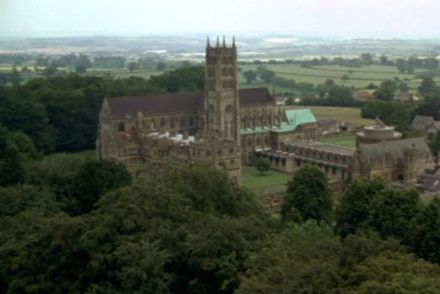
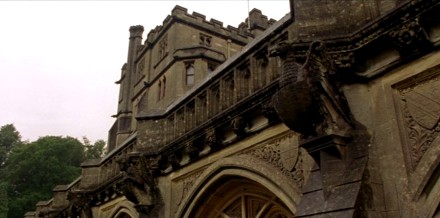
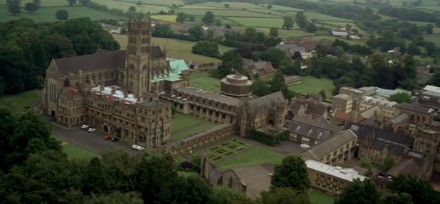
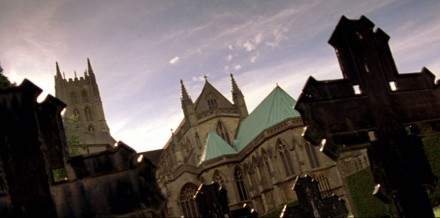
Last night I saw The Hole, a somewhat amusing ‘psychological thriller’ about a bunch of boarding school kids who lock themselves in an old bunker, have a party, then realise they can’t get out, yadda yadda yadda, people die. It was fairly light and worth watching if you’re easily entertained (and I often am). Perhaps the most enjoyable part was a few aerial shots of the Basilica of Saint Gregory the Great, Downside Abbey and School where our own Robert O’Brien will be teaching in the autumn. (The school was given a different name in the film).
Chesterton Remembered
SIR: Your article on G.K. (This England, Summer 1986) brought back a happy personal memory of that great and kindly man. It was 1930 in Rome, where I was a pupil at a “finishing school” – in this case an English convent. G.K. sometimes came to visit our Reverend Mother; we knew him by sight and, once seen, who could forget the huge man in the big black cloak?
Part of our “finishing” process was to be taken round the museums and galleries of the Eternal City. One day we were being shepherded through the Vatican Museum. My friend and I somehow managed to get separated from the rest of our party and in one of the galleries whom should we see but Mr. G.K. Chesterton. He was about to leave so we followed him down the stairs in the hope of being able to get his autograph. At the foot of the stairs he turned. “As we had such young legs”, he said, “could one of us be so kind as to run back to the gallery where he had left his cloak, and would the other see if she could find him a carrozza [a cab, lit. ‘carriage’]?” We needed no second bidding. I raced back up the stairs, found the familiar black cloak where he had left it and triumphantly returned it to its owner. Meanwhile my friend had found a vacant carrozza. G.K. thanked us both, climbed into the carrozza and drove off. In the excitement we had forgotten about the autographs! Next day a letter arrived at our convent. He addressed it to “The Young Ladies suffering education at the convent at No. 10 Via Boncompagni.” Inside was a sheet full of auto-graphs and a little poem.
For you alone did I desire,
Who brought the prophet’s mantle down
And called his chariot of fire!
I have the precious autograph still and what a strange Chinese-looking affair it is!
— MRS. L. RIPLEY, BRIGHTON
Chartres 2005
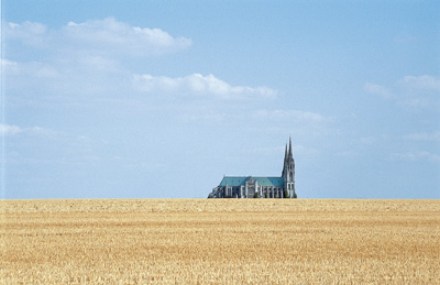
Various sites have put up photos from this year’s annual traditionalist Pentecost pilgrimage to Chartres, and I thought, as I did last year, I would gather a few of them and present them to you. (more…)
Risen from the Ashes
by Austin Ruse
Sursum Corda, Summer 1998
The first wholly traditional Catholic parish structure built since Vatican II could not be situated in a more central location, at a more opportune time. New York is enjoying an astounding 1990s rejuvenation, bulging with tourists and new business. St. Agnes Church is at the center of it all, in midtown Manhattan, near Grand Central Station.
 Only at St. Agnes in New York City can an orthodox churchman be attacked from the right. Yet there they were, a dedicated band of angry young people picketing Msgr. Eugene V. Clark at Mass only one week after St. Agnes had burned nearly to the ground in late 1992. Their charge? That the good Monsignor intended to replace the old brick Gothic structure, now ruined, with what they called a “Swedish-Igloo-Modern.” Monsignor Clark never gets mad, but he got mad that day – although today he looks back on the incident with amusement. He even saved one of their flyers and is considering having it framed.
Did those excitable young men and women actually live within the parish boundaries of St. Agnes? No. But then hardly anybody actually lives in the East 40s. St. Agnes has maybe 100 to 150 residential parishioners. Nobody really cares, either; and this is one of the charms of St. Agnes. It is a commuter church located next to one of the busiest ports of call in the world, Grand Central Station. St. Agnes Church is a place that is searched out, discovered, chosen. To many it seems that St. Agnes chooses them.
But there was that awful day when many thought it might close. (more…)
His Holiness and His Most Eminent Highness
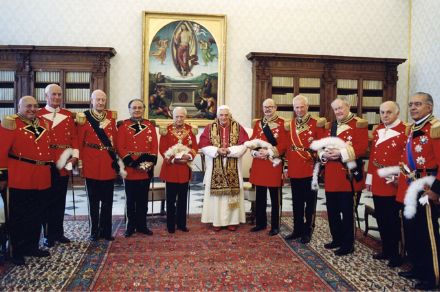
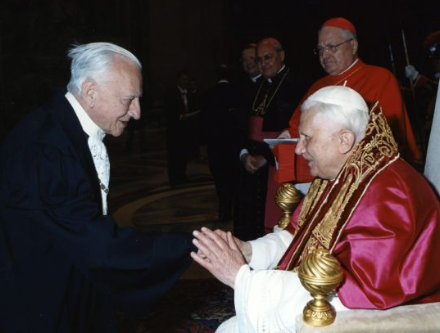
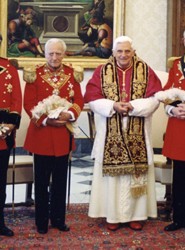 By special request, I bring you photos of the recent audience of His Holiness Benedict XVI, Bishop of Rome, Vicar of Jesus Christ, Successor of the Prince of the Apostles, Supreme Pontiff of the Universal Church, Patriarch of the West, Primate of Italy, Archbishop and Metropolitan of the Roman Province, Sovereign of the State of the Vatican City, Servant of the Servants of God (to use his full title) with His Most Eminent Highness, Fra’ Andrew Willoughby Ninian Bertie, Prince and Grand Master of the Sovereign Military and Hospitaller Order of St. John of Jerusalem, of Rhodes, and of Malta, Most Humble Guardian of the Poor of Jesus Christ (likewise, to use his full title) along with the Sovereign Council of the said order. According to ecclesiastical protocol the Grand Master, though merely a vowed religious, is accorded a dignity equal to that of a cardinal. His Holiness received the Grand Master and Sovereign Council on June 24, 2005, the Feast of St. John the Baptist, who is the patron saint of the Order. The Grand Master was also greeted on April 24 of this year, when the photograph below was taken.
If we have any more Order-of-Malta-related posts, a whole category will have to be devoted to them!
Search
Instagram: @andcusack
Click here for my Instagram photos.Most Recent Posts
- Brunel’s Unbuilt Capitol February 3, 2026
- Cricket at Fordham January 27, 2026
- Palacio Barolo Revisted January 14, 2026
- Learning to Love Liguria January 14, 2026
- Crux Alba No. 2 January 13, 2026
Most Recent Comments
Book Wishlist
Monthly Archives
Categories