Arts & Culture
About Andrew Cusack
 Writer, web designer, etc.; born in New York; educated in Argentina, Scotland, and South Africa; now based in London.
 read more
News
Blogs
Reviews & Periodicals
Arts & Design
World
France
Mitteleuropa
Knickerbockers
Argentina
The Levant
Africa
Cape of Good Hope
Netherlands
Scandinavia
Québec
India
Muscovy
Germany
Academica
In Old New York
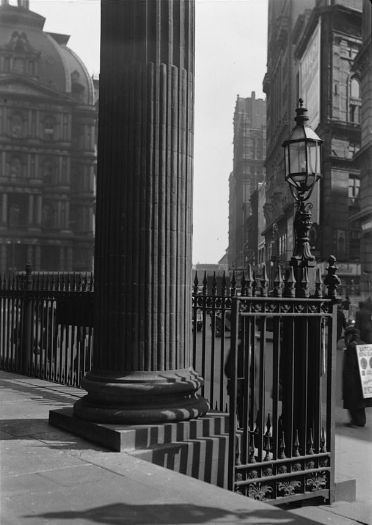
The steps of St. Paul’s Chapel, Broadway, looking towards Park Row, March 1937.
A Lawyer’s Studio in Recoleta
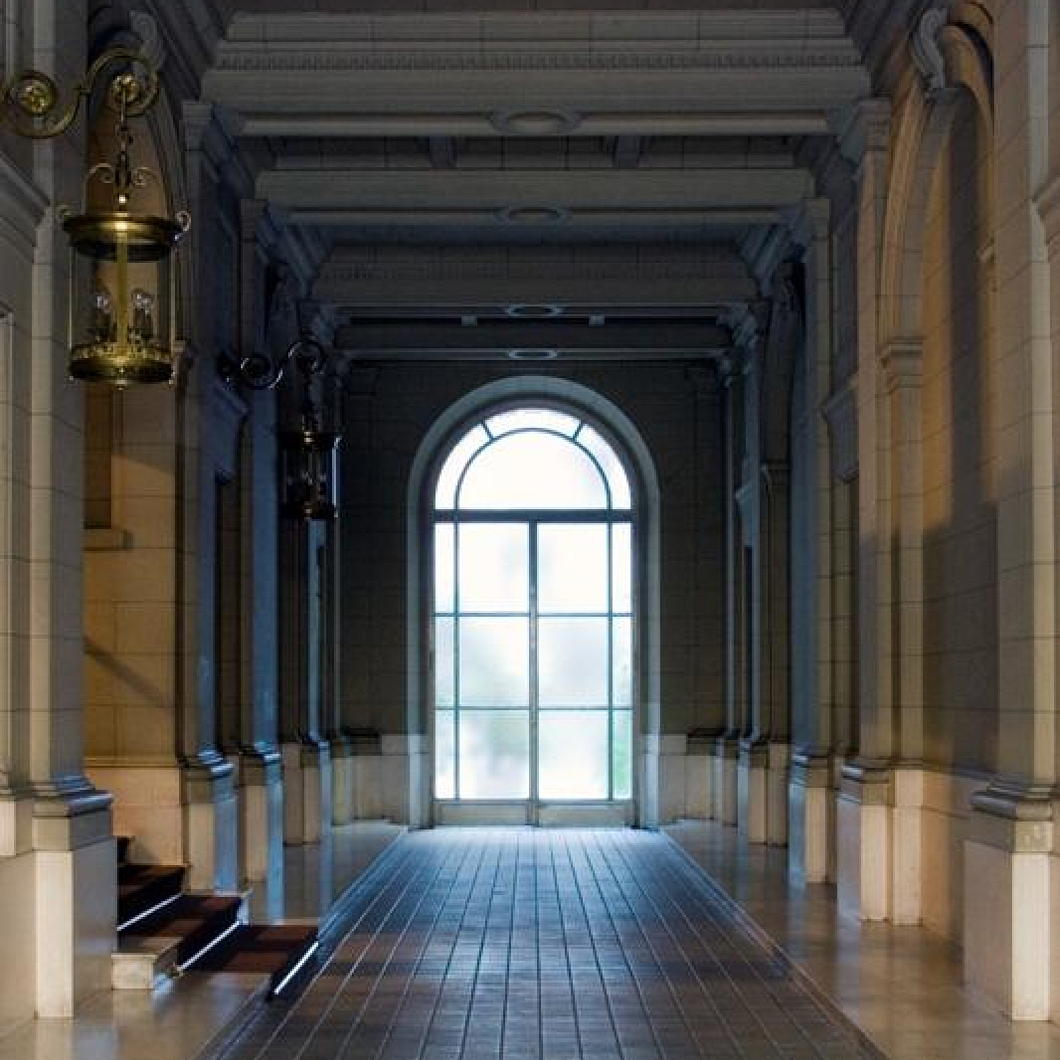
This property in the Recoleta neighborhood of Buenos Aires was once a residential apartment until a multi-generational family of lawyers bought and transformed it into a law office. (more…)
Sniffen Court
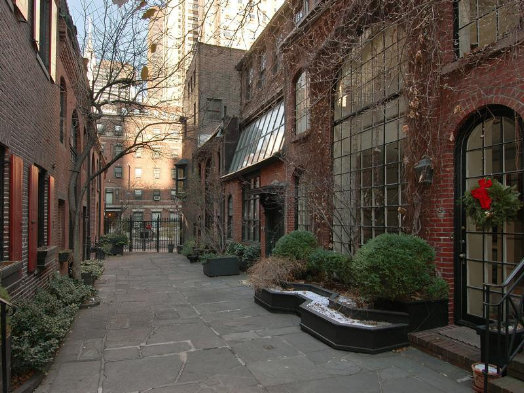
A PROPERTY IN Sniffen Court coming on the market is a rare event, but two up for grabs at the same time must be a first. Like Grove Court, MacDougal Alley, or Washington Mews, this little alleyway is one of the most desirable of those little nooks and crannies that hide amidst the hurly-burly of Manhattan. Tradition holds that Sniffen Court was built as stables by one John Sniffen around the time of the Civil War, but there is no record of any Sniffen ever having owned the properties (some therefore presume he was the architect). They were converted, like many mews around the city, from stables to residences in the 1920s and all have gradually adapted and changed since then.
Boullée’s Opera
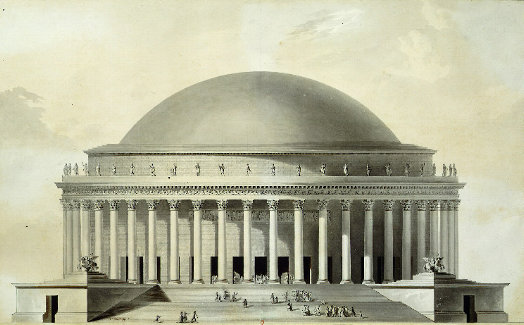
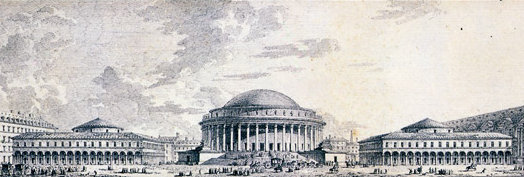
ÉTIENNE-LOUIS BOULLÉE was an architect whose great influence can chiefly be attributed more to his unexecuted designs than to those that were actually constructed. His most famous creation is the Cenotaph to Isaac Newton of 1784, conceived but never built. Many of his designs — especially his plan for a metropolitan basilica — exude a certain feeling as cold and soulless as can be expressed within the welcome restraints of classicism. One of his museum designs is almost proto-secessionist. But I am rather fond of his design for an opera house.

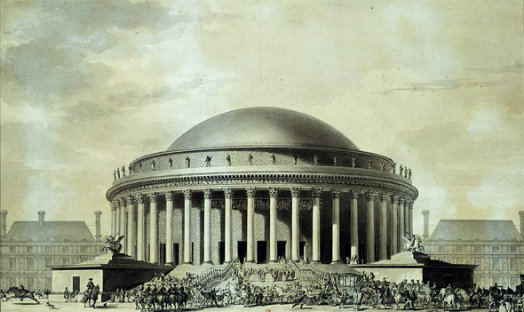
The perennial problem with opera house design is the flyspace: the large area above the stage into which elements of the set design can be lifted to change scenes during a performance. Garnier’s Paris Opera House uses a recessed pediment for its flyspace, while the Teatro Colon has a consistent sloped roof the length of the building tall enough to conceal the space. The modernist Metropolitan Opera House at Lincoln Center here in New York has a bland rectangular box stuck on top. At first, you glance at the exterior of Boullée’s design and think “Where’s the flyspace?” Boullée’s solution was simply to design on a scale large enough to encase the entire auditorium, stage, and flyspace in a single unified domed structure.
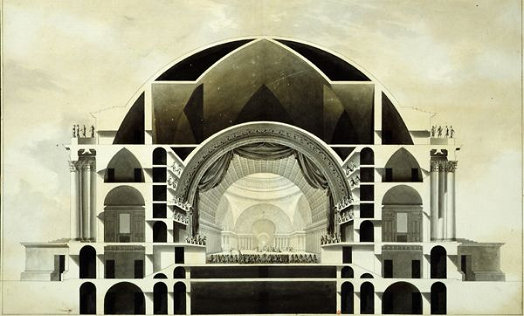
A sectional view towards the proscenium.
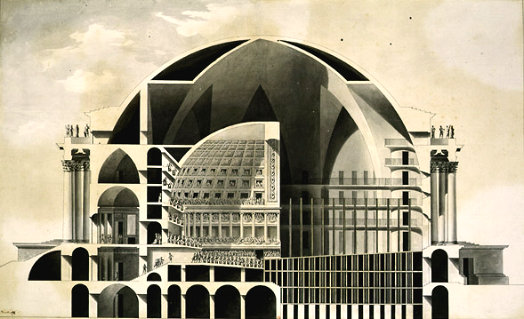
A cross-section from the side showing the auditorium on the left and the stage on the right.
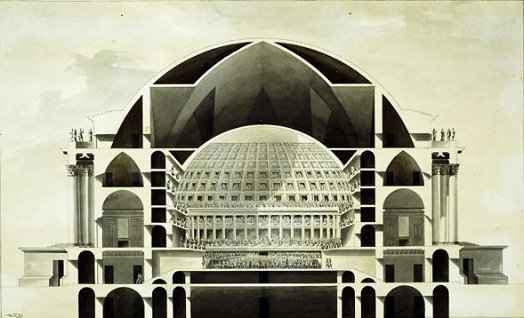
A sectional view looking from the stage towards the auditorium.

While Boullée’s opera was never built, I’ve often thought it had something of an imitator in the opera house of Novosibirsk, Russia’s third-largest city. The Novosibirsk State Academic Opera and Ballet Theatre is the largest theater in all of Russia and is located right at the center of the Siberian capital (which, founded in 1893, had originally been known as Novonikolayevsk, after Czar St. Nicholas II).
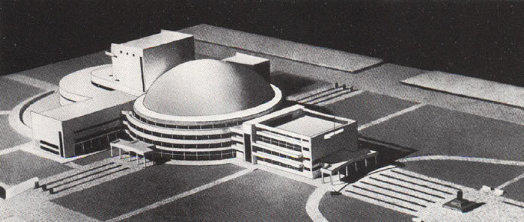
The first scheme for the Novosibirsk opera house was a modernist design drawn up in the 1930’s.
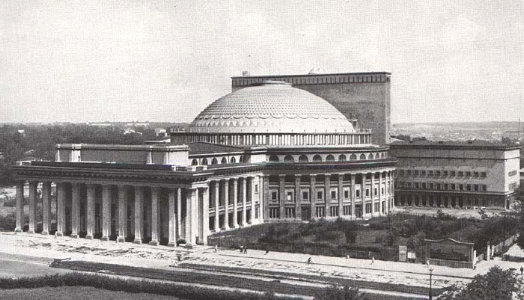
A classical design won the day, however, and the building was completed in 1945. As you can see, the Novosibirsk structure fails to follow Boullée in unifying the entire opera house under a single dome, but rather opts for the more pragmatic if less handsome separate flyspace. (Interestingly, the ratio of its dome’s thickness to its radius is less than that of a typical chicken egg). I still hope someone comes around and fulfills Boullée’s plan.
St. George Guards India’s Fleet Once More
In a return to tradition, the old Indian naval ensign is reinstated.

AFTER AN EXPERIMENT with an allegedly more ‘indigenous’ design, India’s traditional naval ensign has been restored, and so the Cross of St George once again snaps from the sterns of the Union’s warships. The old Indian Naval Ensign dated to 1950, when the Indian Union became a republic, three years after achieving dominion status as a wholly self-governing member of the British Commonwealth. The Royal Indian Navy had flown the unaltered White Ensign but with the changeover to a republic it was decided to simply exchange the Union jack in the canton with the national flag of India, retaining the red St. George’s cross on a white field. (more…)
A Tribute to Cockerell
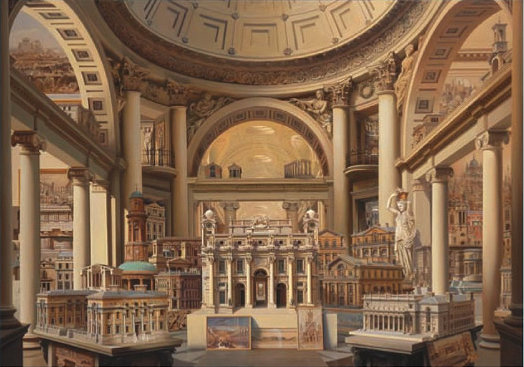
Carl Laubin, A Tribute to Charles Robert Cockerell, RA
Oil on canvas, 39′ 11″ x 60′
2005, Private collection
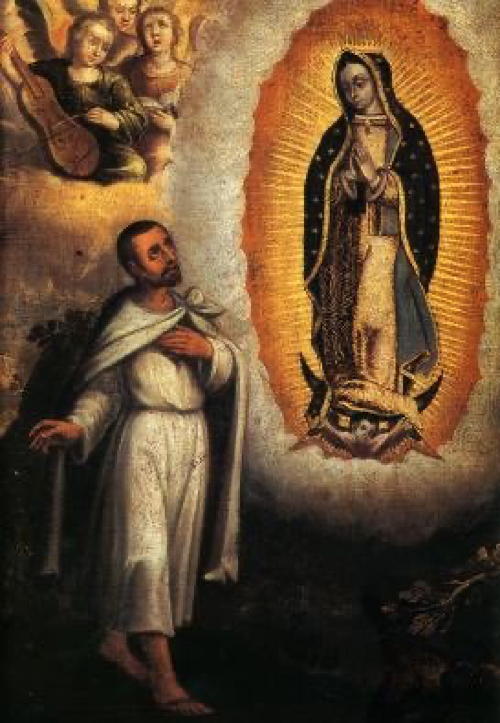
Ave Maria, Plena Gratia!
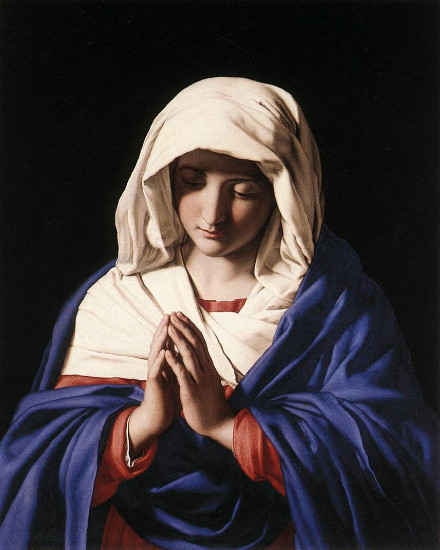
In thanksgiving for many petitions granted.
The Café Society of Ferenc Molnár
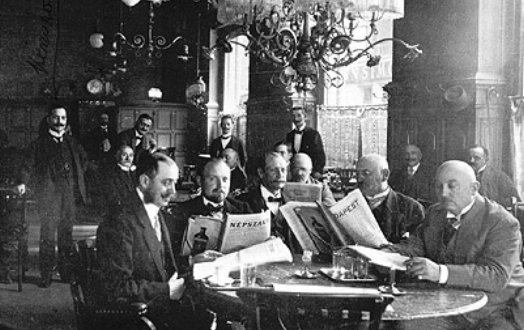
FROM 1887, the Café Central (or Centrál Kávéház, in Magyar) has been a meeting place for artists, intellectuals, professionals, and others located on Budapest’s Károlyi Mihály street. One of its most famous patrons was the novelist and dramatist Ferenc Molnár (born Ferenc Neumann and often anglicized as Franz Molnar), whose 1906 book The Paul Street Boys is perhaps the most widely-read Hungarian novel. His 1909 play “Liliom” was later adapted by Rodgers and Hammerstein into the musical “Carousel”. Both his plays “The Guardsman” and “The Swan” were later made into films (the latter being Grace Kelly’s final appearance on the silver screen), while “The Play at the Castle” was adapted by P.G. Wodehouse into “The Play’s the Thing” and by Tom Stoppard into “Rough Crossing”. (more…)
Krummau on the Moldau
Český Krumlov Revisited
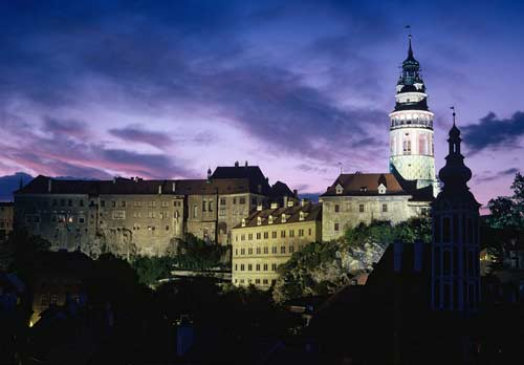
THE CASTLE OF Krummau in Bohemia stands majestically on its crag in a bend of the Moldau river, presiding confidently over the town below. Český Krumlov, as the town is known in the currently-reigning Czech language, began in the thirteenth century under the Rosenberg family and was purchased by the Emperor Rudolf II in 1602. Yet it was under the princely house of Schwarzenberg (proprietors of Krumau from 1719 to 1945) that the castle flourished. The name Český Krumlov means Bohemian Krummau, to differentiate it from a Moravian town of the same name. (It is also often rendered as Krumau or Krumau-an-der-Moldau).
While the advent of Communism deprived the Schwarzenbergs of this great castle and numerous other vast properties of theirs behind the Iron Curtain, the Schwarzenbergs have since regained their natural prominence in Bohemia. His Serene Highness Prince Karl VII of Schwarzenberg, Duke of Krummau, Count of Sulz, Princely Landgrave of Kelttgau currently serves his country as Minister of Foreign Affairs of the Czech Republic, as well as being a member of the Czech Senate which convenes in the Wallenstein Palace in Prague. For the sake of convenience, however, His Serene Highness goes by ‘Karel Schwarzenberg’. (more…)
St Andrews in London
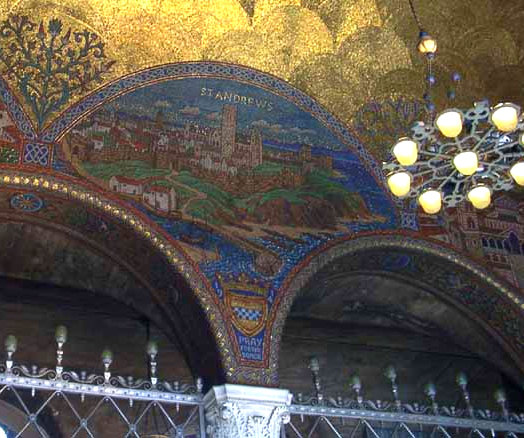
A LITTLE SOMETHING for our good friends from university who’ve just moved to London from the countryside. I hope that when they are in the Cathedral they will pop into our patron’s chapel, glance at the mosaic of our dear old Royal Burgh of St Andrews, remember good times, and say a prayer for us all.
Hipódromo Argentino de Palermo
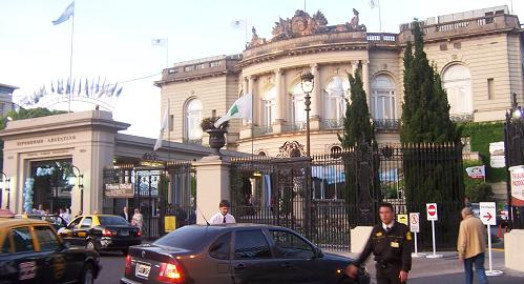
THE PALERMO RACETRACK is the main center for equestrian events in Buenos Aires. It was first built in 1876. In 1908 the current main stand was built to the beaux-arts design of a French architect, Louis Faure Dujarric. The Argentine Grand National, a race of 2,500 meters, has been run here annually since 1885. (more…)
Columbus Circle: A Wider View
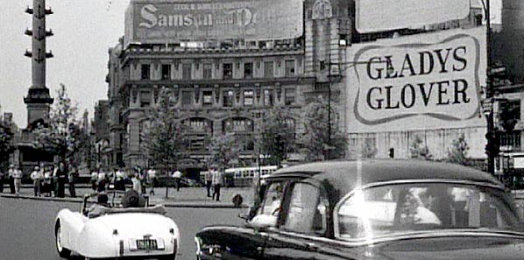
I THOUGHT THAT since we widened our window of opportunity, I ought to give you a wider view of this capture from the 1954 film ‘It Should Happen to You!’, previously displayed in our exposition on Columbus Circle and the Human Scale. The more recent rehabilitation of this grand public place was discussed in one of my diary entries. (more…)
Christopher Street, Greenwich Village
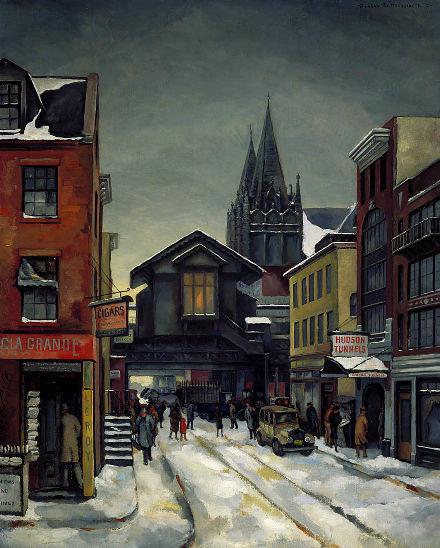
Beulah R. Bettersworth, Christopher Street, Greenwich Village
Oil on canvas, 30 1/8″ x 24 ¼”
1934, Smithsonian American Art Museum
The Old State House
Hartford, Connecticut
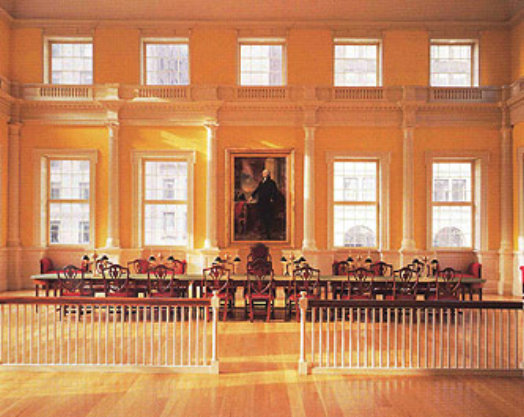
THE GREAT Russell Kirk once called the main chambers of the Old Connecticut State House “perhaps the most finely-proportioned rooms in all America”. The Senate of Connecticut met in the stately Senate Chamber (above) around a long table, as was the general fashion of the legislative councils which formed the upper house of most colonial legislatures. It was in the House of Representatives Chamber (below) that the famed Hartford Convention of December 1814 and January 1815 met and discussed New England’s possible secession from the Union. The State House was built in 1796 to the designs of Charles Bulfinch, on land which had been granted to Connecticut by King Charles II in 1662. (more…)
Grand Central Station at Night
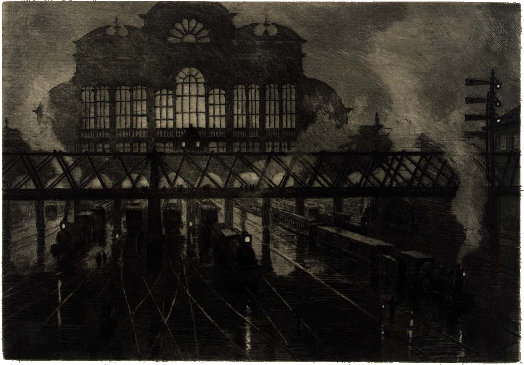
Charles Frederick William Mielatz, Grand Central Station at Night
Etching on paper, 7″ x 10″
1890, Smithsonian American Art Museum
This, of course, is not the Grand Central we know today, but its immediate predecessor.
Sinterklaasfeest
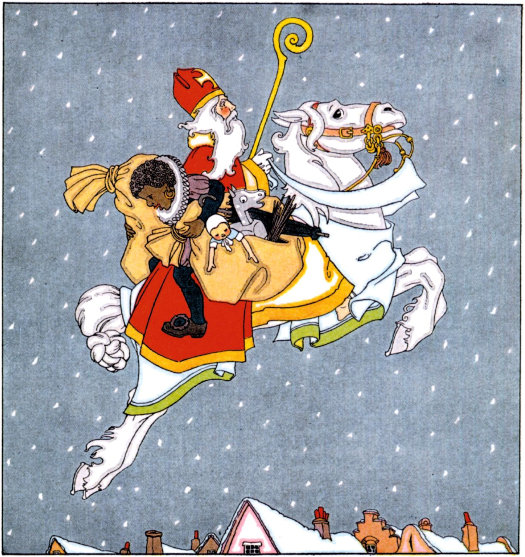
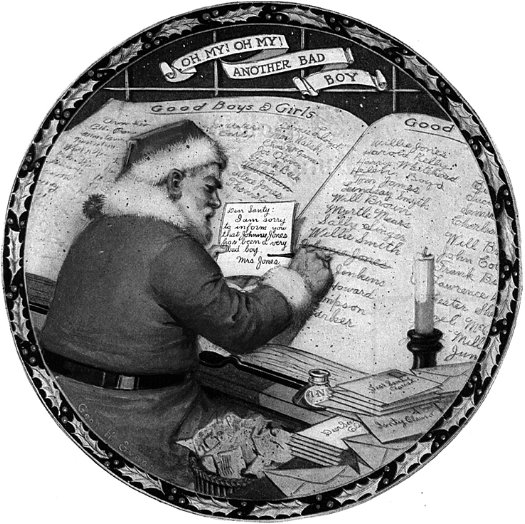
Wishing you all a very blessed Saint Nicholas day!
Sloppy Journalism at the National Catholic Register
Not long ago I signed up for a trial subscription to the National Catholic Register, and while it certainly exceeds the other national Catholic newspapers on presentation, it lacks the weight of the Wanderer. A quick glance in the October 28, 2007 edition makes this clear. I speak, namely, of the article “Knights Templar: More Than the Stuff of Fiction”. The article points out that the Order of the Knights Templar was “founded in Jerusalem in 1118 to protect Christian pilgrims and defend the Christian presence in the Holy Land. … It was suppressed by Pope Clement V in 1312, following accusation of heresy against its members, and subsequently became the focus of legends and mysteries, most recently the outrageously inaccurate Da Vinci Code by Dan Brown.” The article then mentioned the recent rediscovery in the Vatican Archives of a document relating to the Knights Templar. All fair enough, up to now.
The Register‘s correspondent “spoke last month in Rome with Patrick Rae, a former brigadier general in the U.S. Army Reserve who serves as Grand Commander of the Knights Templar.” Huh? What? Was it not just stated that the Knights Templar were suppressed by Pope Clement V in 1312? The Register offers no help in explaining this discrepancy to us. General Rae, however, later informs us that the Knights Templar “reconstituted as a French order under Napoleon and from that day until today it has existed, an unbroken string”. This is rather mixing fact and fiction.
1) The Knights Templar no longer exist. They were suppressed by the Pope in the fourteenth century and not revived.
2) The group of which Patrick Rae is Grand Commander is an organization called the “Ordo Supremus Militaris Templi Hierosolymitani” (OSMTH) also known by its English name of the “Sovereign Military Order of the Temple of Jerusalem” (SMOTJ). It is neither sovereign, nor is it an order, but is instead a Christian ecumenical aid organization which styles itself an order.
3) There are dozens, if not hundreds, of groups going around calling themselves the Order of Knights Templar. In actual fact, they are not orders (they are merely ordinary associations, like a chess club or your friendly local circle of stamp-collectors) and they are not Templar (since the Templars no longer exist).
It is beyond me why the Register‘s correspondent chose to speak with the head of this particular Templar-style group out of the hundreds of Templar-style groups. Perhaps the correspondent was impressed by the UN’s recognition of the OSMTH with special consultative status. This status has also been granted to many other groups, such as the Rotary Club of Kathmandu, the Tunisian Mothers Association, and the Boy Scouts of America. But the reporter makes no real attempt to point out that the Knights Templar in question are not, in fact, the Knights Templar (which, again, no longer exist). Whether he is disingenuous or merely ignorant is up to question (in a spirit of Christian charity, let us assume the latter). However there can be no question that this is simply sloppy journalism.
And for the man with $3,500 to spare…
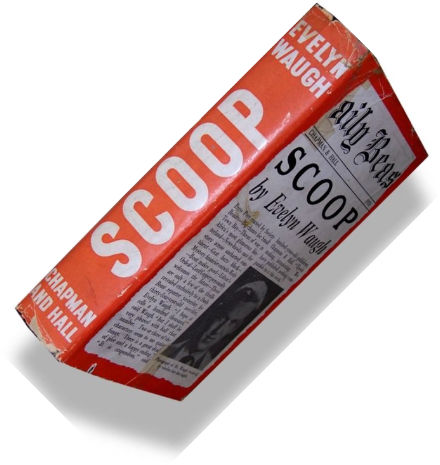
Scoop, by Evelyn Waugh
Chapman & Hall, London, 1938
First edition, hardcover, very good condition.
Small octavo, 308 pages, dust jacket.
Bring Back the Broadsheet!
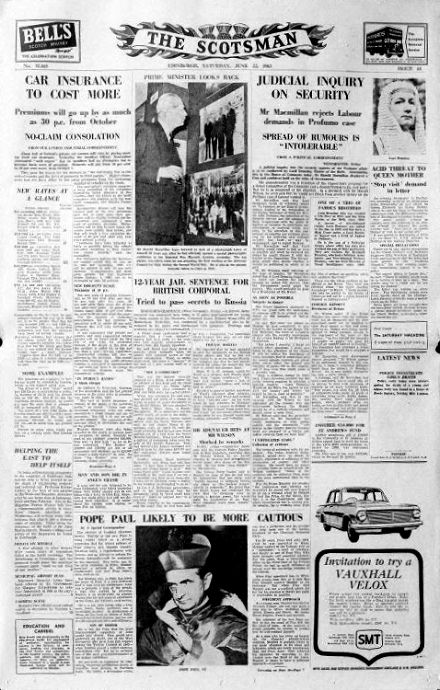
THE DECLINE OF Scotland’s nation newspaper is marked and lamentable. Once exhibiting a certain grace and dignity, the Scotsman was the most respected of Caledonian dailies. It was the only to have bureaus overseas, and it presided as king of the newspaper realm from stately offices on the heights of North Bridge. All of that, of course, is all gone. It’s all about cost-cutting and driving up circulation instead of maintaining the role as Scotland’s newspaper of record. (more…)
Irish Parliament House
Please see the updated article of the Irish Houses of Parliament, College Green, Dublin here.
Search
Instagram: @andcusack
Click here for my Instagram photos.Most Recent Posts
- Brunel’s Unbuilt Capitol February 3, 2026
- Cricket at Fordham January 27, 2026
- Palacio Barolo Revisted January 14, 2026
- Learning to Love Liguria January 14, 2026
- Crux Alba No. 2 January 13, 2026
Most Recent Comments
Book Wishlist
Monthly Archives
Categories