Arts & Culture
About Andrew Cusack
 Writer, web designer, etc.; born in New York; educated in Argentina, Scotland, and South Africa; now based in London.
 read more
News
Blogs
Reviews & Periodicals
Arts & Design
World
France
Mitteleuropa
Knickerbockers
Argentina
The Levant
Africa
Cape of Good Hope
Netherlands
Scandinavia
Québec
India
Muscovy
Germany
Academica
Simon Kuper: Coloured Identity is an “Artificial, Ugly Leftover from Apartheid”
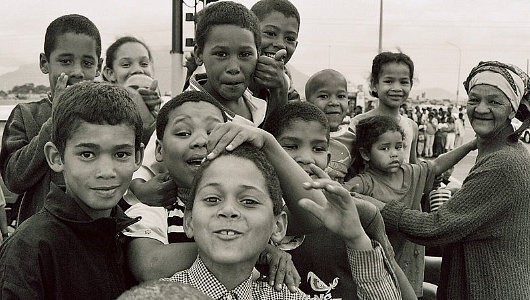
Honestly, a man like Simon Kuper should know better. The sports columnist for the Financial Times was born in Uganda, raised in the Netherlands, but both his parents are South African. In a recent article (“Apartheid casts its long dark shadow on the game”, Financial Times, 4 December 2009), Kuper discusses the racial divisions in South Africa and how they are reflected in terms of sport: White South Africans tend to gravitate towards rugby and cricket, whereas their Black compatriots overwhelmingly prefer soccer.
There exists in South Africa, however, a very large community known as the Coloureds, who are of mixed ethnic descent. Mr. Kuper, in his article, implies that they exist merely thanks to “the racial classifications of apartheid”, as if there were no Coloured people before 1948. Furthermore, he explicitly calls the difference between Coloured and Black South Africans “artificial” and an “ugly leftover from apartheid”. This is simple ignorance. He also refuses to use the word Coloured without quotation-marks, though one suspects he does not refer to Basques as “Basques”, Scots as “Scots”, Maoris as “Maoris” or so on and so forth.
The Coloureds (or kleurlinge or bruinmense in Afrikaans) are a very distinct people who form the majority of the population in the Western Cape and Northern Cape provinces. They are over four million in number and, while their distinct identity only came about after the intermarriage (and interbreeding) between the Dutch and natives after 1652, they include the genetic descendants of the old Khoisan tribes, the first people of the Cape. The Coloureds have been hugely influential in the history of the Afrikaans language, which is spoken by nine out of ten Coloured people. Just as the majority of Coloureds speak Afrikaans, the majority of Afrikaans-speakers are Coloured, not Afrikaner.
In short, Coloured people are real. They exist, and are a distinct, historical, vibrant, active culture. It is true that Coloureds are sometimes lobbed together with Zulus, Xhosa, Tswana, and others as “Black” but if one is forced to pigeon-hole them in Black-and-White terms it would be much more accurate to say either that they are both or that they are neither. Indeed, Coloureds, like Indian and White South Africans, have often faced discrimination at the hands of the ruling party, which is multi-ethnic in composition but dominated by Xhosas & Zulus in practice. The differences between Blacks and Coloureds are no more “artificial” than those between English and Irish. Mr. Kuper may want to ignore those differences (ergo, erase Coloured identity) but I say vive la différence.
The Diogenes Club
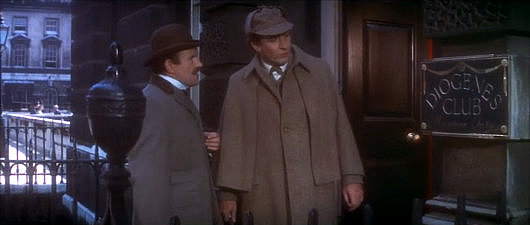
“There are many men in London, you know, who, some from shyness, some from misanthropy, have no wish for the company of their fellows,” says Sherlock Holmes in The Greek Interpreter. “Yet they are not averse to comfortable chairs and the latest periodicals. It is for the convenience of these that the Diogenes Club was started, and it now contains the most unsociable and unclubable men in town. No member is permitted to take the least notice of any other one. Save in the Stranger’s Room, no talking is, under any circumstances, allowed, and three offences, if brought to the notice of the committee, render the talker liable to expulsion. My brother was one of the founders, and I have myself found it a very soothing atmosphere.” (more…)
Brompton Oratory as It Might Have Been
Failed Entries of the 1878 London Oratory Architectural Competition
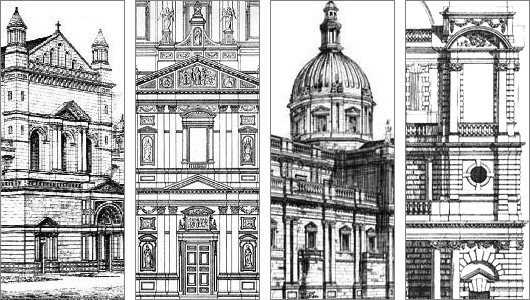
ARCHITECTURAL COMPETITIONS have always fascinated me because they give us the opportunity to glance at multiple executions for a single concept, to see different minds solve a “problem” with their own particular formulas and theorems. The designs of many of the world’s prominent buildings were chosen by competition, perhaps the Palace of Westminster — Britain’s Houses of Parliament — is most famous among them. When the Hungarian Parliament held a competition to design a grand palace to house the body, it found the top three prize designs so compelling that it built the first-prize design as parliament and the second and third places as government ministries nearby. To my surprise, I have only ever come across one book which adequately surveyed the subject of competitive architecture, Hilde de Haan’s Architects in Competition: International Architectural Competitions of the Last 200 Years. Most of the contests covered in the book are, naturally, for government buildings of national importance — private clients usually have a very firm idea of what they want and choose an architect accordingly.
One building not mentioned in the book but nonetheless very dear to me (and no doubt to many readers of this little corner of the web) is the Church of the Immaculate Heart of Mary of the Congregation of the London Oratory, more popularly known to friend and foe alike as the Brompton Oratory. It was the first church in Britain in which I ever heard mass, the summer after kindergarten when I was still but a tiny, blond-haired whippersnapper, in the midst of my first visit ever to the Old World, and the Oratory made quite a strong impression upon my young mind. It is usually one of my very first ports of call whenever I am in the capital, and I once even managed to slip in having just arrived at Heathrow while making my way to King’s Cross and the train to Scotland.
The Brompton Oratory is known for having good priests, traditional liturgy, and beautiful architecture. The final design was by one Herbert Gribble, but there was quite a bit of to-ing and fro-ing before Gribble was selected. The temporary church which had been erected on the site had been condemned by one critic as “almost contemptible” in its exterior design. In 1874, the Congregation of the Oratory (which is to say, the priests) put out an appeal for funds towards the construction of a permanent church. The 15th Duke of Norfolk obliged with £20,000 to get the ball rolling, and the next year a design by F. W. Moody and James Fergusson was agreed upon in principle. But the Reverend Fathers soon began to get creative and hatch ideas and contact other architects and very soon it was claimed that there were as many counter-proposals as there were priests of the Oratory, and perhaps more. A pack of clerics supported a suggested design by Herbert Gribble, but no accord could be reached among the Congregation as a whole.
In January 1878, then, it was announced that a competition would take place to decide the design of the permanent church of the London Oratorians. First prize was £200, with £75 for the runner-up. All entries had to meet the certain requirements drawn up by the Congregation. The style was to be “that of the Italian Renaissance”. The sanctuary, at least sixty feet deep, must be “the most important part of the Church. … Especially the altar and tabernacle should stand out as visibly the great object of the whole Church.” The minimum width of the nave was fifty feet, and maximum length 175 feet. Subsidiary chapels must be “distinct chambers”, not merely side altars. One aspect not mentioned was the projected execution costs of the designs — “an omission criticized by architectural journalists and disgruntled competitors,” the London Survey tells us, “whose designs called for expenditure ranging from £35,000 to £200,000”.
Over thirty entries were submitted to the competition, and Alfred Waterhouse was commissioned by the Fathers to provide comment on the submissions. Significantly, George Gilbert Scott, Jr. submitted a design, though I haven’t been able to get my hands on any depictions of it. Waterhouse praised it as “of no ordinary merit. … I feel that it is impossible to speak too highly of its beauty, its quiet dignity, its absence of all vulgarity and its concentration of effect around the high altar.” (more…)
‘The Feast of St Nicholas’, Jan Steen
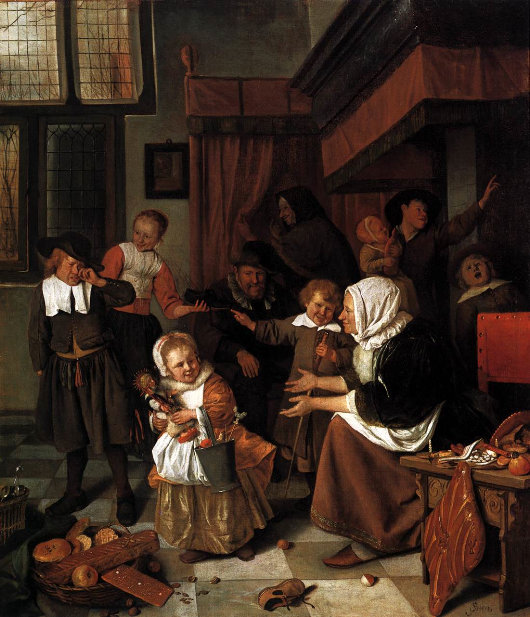
1665-68, Rijksmuseum
The Messiah in the Sportpalast
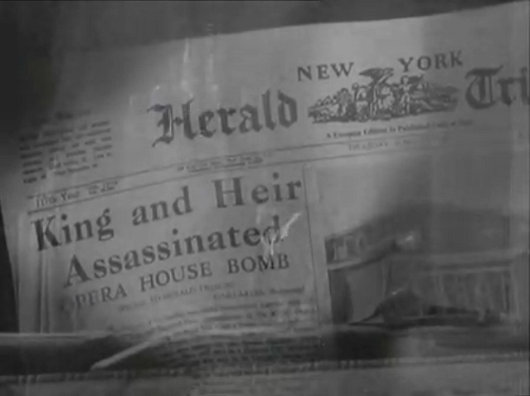
The following feuilleton was written before Hitler became the master of Germany. The scene is the Berlin Sportpalast, the largest indoor arena in the world when it opened in 1910 and, at this time, the setting for the rallies of the various political parties vying for control of the Weimar Republic.
On the night of the Horst Wessel commemoration Hitler speaks in the Berlin Sportpalast. People who have neither seen nor heard him will perhaps never fully understand the significance of the profoundly ominous mind-set that has developed in Germany since the war. The reality — Hitler’s version of reality and its full implications — goes far beyond anything you might read in the newspapers, or imagine. Here is that reality, drawn from the life. (more…)
The Parliament of the Venerable Island
Geoffrey Bawa’s Sri Lankan Parliament at Kotte
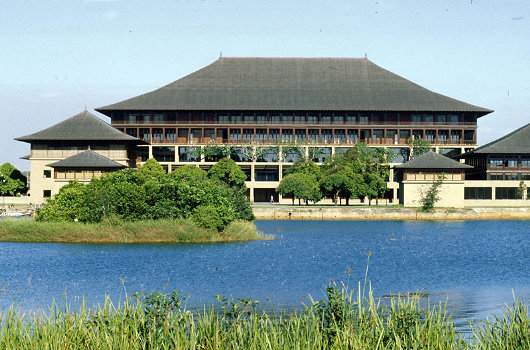
CEYLON IS AN ancient island whose history spans the epochs of human existence: palaeontologists estimate it has been inhabited for over 34,000 years. A series of ancient and medieval native kingdoms have ruled this island over the centuries before foreigners from abroad decided to enter the game. The Portuguese were the first Europeans to stake a claim here, followed by the Dutch Republic. And, yes, as with almost every place of intrigue and tradition, even Ceylon belonged to the Hapsburgs at one point: from 1580 to 1640. Native kingdoms persisted nonetheless, even while European powers bickered over their own portions of the island.
It was in 1815 that the Chiefs of the Kandyan Kingdom agreed to depose their own monarch, Sri Vikrama Rajasinha, and place George III of the House of Hanover on the throne. Ceylon was united at last, and — after the end of the Kandyan Wars — the island enjoyed relative peace and prosperity during one-hundred-and-thirty-three years of British rule.
In 1948, the British granted independence to the Dominion of Ceylon. The island continued as an independent constitutional monarchy for much longer than its neighbours India and Pakistan. The rudiments of a two-party system emerged, with the United National Party bringing together the conservative, traditional element in political society, while the Freedom Party advocated non-revolutionary socialism.
The population of Ceylon, however, are a complete hodgepodge of ethnicities. The largest group are the Sinhalese, a Buddhist people constituting over 70% of the population. But at the northern end of the island, the Tamil people were dominant, even though these were split between “Ceylonian” Tamils native to the island and “Indian” or “Plantation” Tamils brought during British rule to work the large plantations. Then there are the Moors, a multiracial Muslim community of primarily Arab and Malay descent. And, of course, there are the famous Burgher people, descendants of the island’s Portuguese, Dutch, and English mixed with Sinhalese, Tamil, and Creole.
Democratically elected politicans replaced English (the intercommunal lingua franca) with Sinhala (the language of the Sinhalese majority) as the official language, abolished the Senate, severed appeal to the Privy Council and, in 1970, abolished the monarchy. The Dominion of Ceylon was renamed the Republic of Sri Lanka — the name literally means “Venerable Island”. Left-wing nationalists continually stoked tensions with the country’s conservatives, traditional elite, and minorities, and provoked right-wing reactions. Aside from the left-right divide, Tamil extremists began an anti-Sinhalese terror campaign that increased the oppression of the Tamil people and strengthened the country’s divisions. In short, it all became a mess. (more…)
Kiest Welter
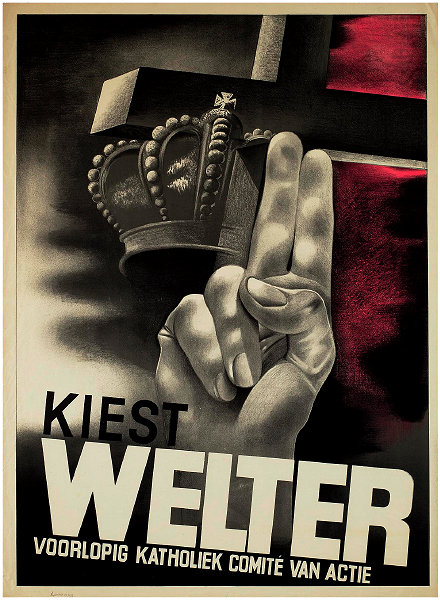
Christianity — Monarchy — Loyalty. This Dutch election poster urges voters to “Choose Welter”, referring to the sometime Dutch government minister Charles Welter. (more…)
Praga Caput Regni
Prague: Capital & Head of the Bohemian Realm
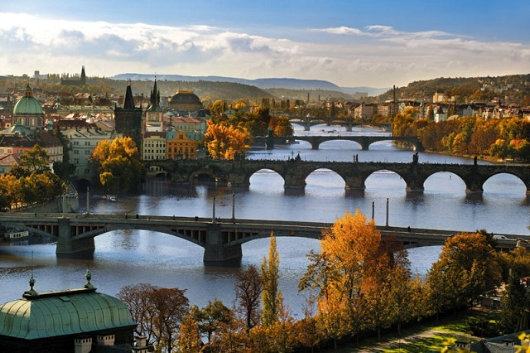
Prague is traditionally known as “Praga Caput Regni” — the capital of the realm, or indeed the head of the Bohemian body. Changing times and a different form of government mean that the arms of this ancient city now bear the motto “Praga Caput Rei Publicae” instead. The photographer Libor Sváček was born in the be-castled city of Krummau, and has a splendid book of photographs of that town, but here are a number of his photographs of Prague, which splendidly exhibit the Old Town at its most beautiful. (more…)
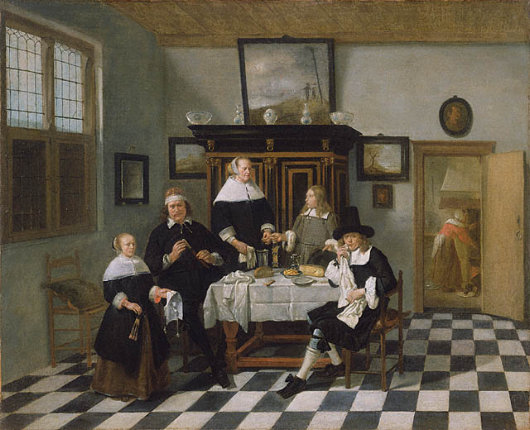
Quiringh Gerritsz. van Brekelenkam, Family Group at Dinner Table
Oil on canvas, 22 5/8 x 28 3/8 in.
1658-1660, J. Paul Getty Trust
Note: Previously attributed to Cornelis de Man.
The Senate of South Africa
Die Senaat van Suid-Afrika
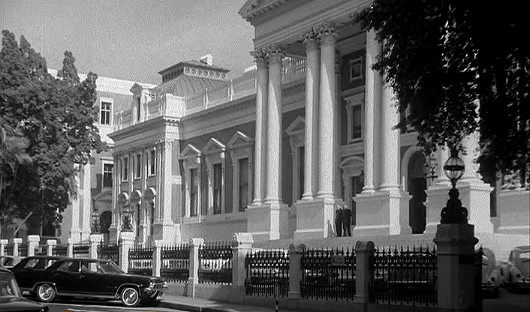
THE SENATE OF South Africa has had something of a tempestuous history, a fact which is attested to by the vicissitudes of the Senate chamber in the House of Parliament in Cape Town. The Senate formed the upper house of South Africa’s parliament from the unification of the country in 1910, in accordance with the proposals agreed to by Briton & Boer at the National Convention of 1908. Its members were originally selected by an electoral college consisting of the Provincial Councils of the Cape, the Transvaal, the Orange Free State, and Natal, and the members of the House of Assembly (the parliament’s lower house), along with a certain number of appointments by the Governor-General on the advice of the Prime Minister. When South Africa abolished its monarchy, the State President took over the appointing role held until then by the Governor-General, but the Senate remained largely intact until 1981, when it was abolished in advance of the foolish introduction of the 1984 constitution with its racial tricameralism.
The Senate made a brief comeback in 1994, when the interim constitution provided for a Senate composed of ninety members, ten elected by each of the provincial legislatures of the new provinces. The 1994 Senate, however, was replaced by the “National Council of Provinces” in the final 1997 constitution. (more…)
How “New Yorker” is the Staats-Zeitung?
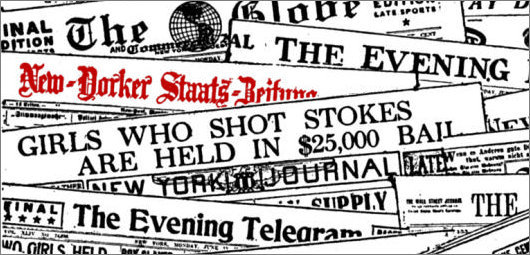
When I was a youngin’, one of the joys of Sundays was the trip to the bakery and the newsagent after church. A vast array of newspapers was on hand for perusal while Pop nipped into Topps Bakery next door. We usually only bought The European, but I browsed everything on hand. One of the available titles was the New-Yorker Staats-Zeitung, founded in 1834, and the oldest German newspaper in the New World. The “Staats” was daily from 1854 until 1953, when it went weekly. In the late 1930s, the circulation was about 80,000, falling to 25,000 in the late 1990s, and stands around 10,000 today. It seems a pity that this “New York” newspaper is now edited from Sarasota, Florida instead of from Manhattan, but at least the Staats-Zeitung survives.
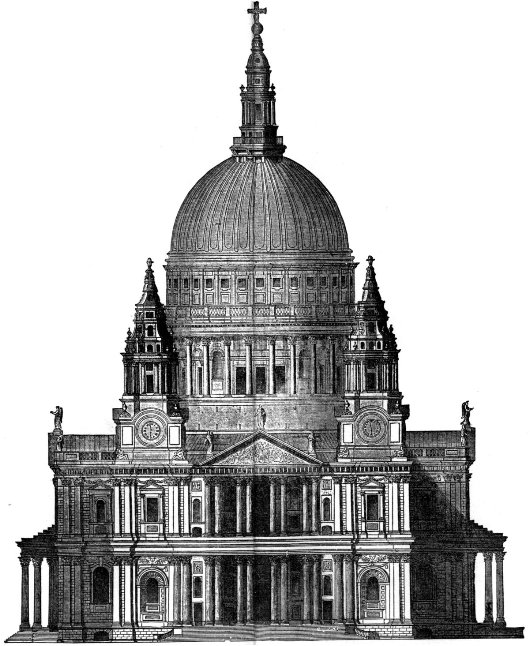
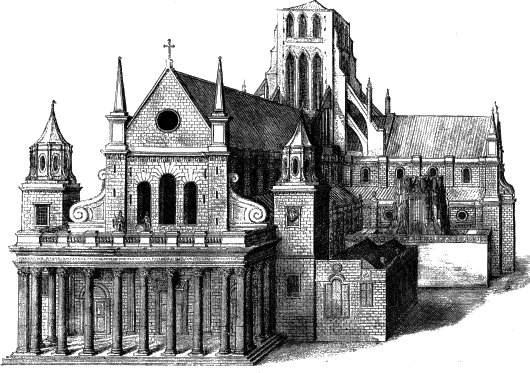
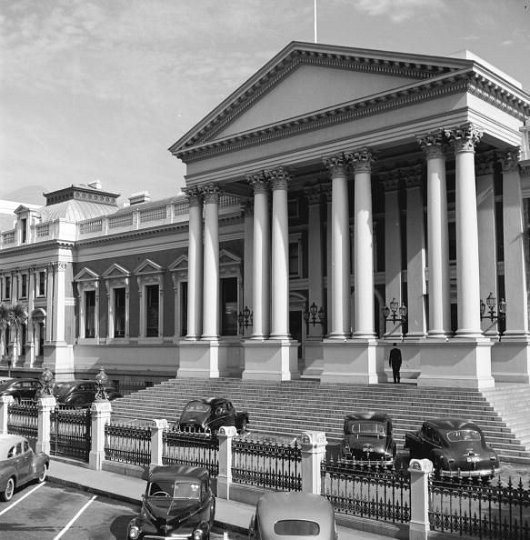
The Houses of Parliament, Cape Town
Die Parlementsgebou, Kaapstad.
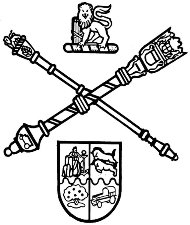
The insignia of the Parliament of South Africa, showing the Mace and Black Rod crossed between the shield and crest of the traditional arms of South Africa.
CAPE TOWN IS justifiably known as the “mother-city” of all South Africa, paying tribute to that day over three-hundred-and-fifty years ago when Jan van Riebeeck planted the tricolour of the Netherlands on the sands of the Cape of Good Hope. Numerous political transformations have taken place since that time, from the shifting tides of colonial overlords, to the united dominion of 1910, universal suffrage in 1994, and beyond. The history of self-government in South Africa has unfolded in a well-tempered, slow evolution rather than the sudden revolutions and tumults so frequent in other domains. No building has born greater witness to this long evolution than the Parliament House in Cape Town.
The British first created a legislative council for the Cape in 1835, but it was the agitation over a London proposal to transform the colony into a convict station (like Australia) that threw European Cape Town into an uproar. The proposal was defeated, but the colonists grew concerned that perhaps they were better guardians of their own affairs than the Colonial Office in far-off London. In 1853, Queen Victoria granted a parliament and constitution for the Cape of Good Hope, and the responsible government the Kaaplanders so desired was achieved. (more…)
A Message from the Minister of Culture
I’ve sometimes thought that the Director of the Metropolitan Museum is New York’s unofficial Minister of Culture. Concerned New Yorkers were at the edge of their seats with anticipation to discover who would be chosen to direct this great museum once it was announced that the legendary Philippe de Montebello was relinquishing the throne. As The New Criterion put it “Few events have been awaited with more trepidation in the world of culture — we were going to say ‘the art world,’ but it embraces much more than that — than the appointment of the next director of the Metropolitan Museum of Art.”
The massive sigh of relief when Thomas Campbell was announced as the successor could probably be heard as far as the Louvre (or even the Hermitage), even though Campbell’s name was on none of the supposed shortlists for the job. Judging by his past as curator of tapestries, Campbell is widely believed to be utterly reliable at continuing the high standard maintained during de Montebello’s reign. May God guide him well in his task! (more…)
Krummau, Crown of the Moldau
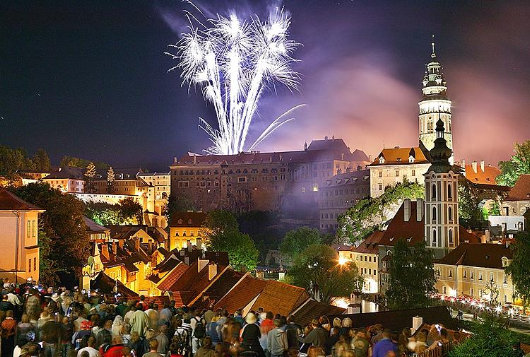
BY NOW THE denizens of this little corner of the web are surely aware of Krummau, the splendid castle and town that towers above the banks of the Moldau river in Bohemia. I was never particularly interested in Bohemia until Fr. Emerson came up to St Andrews and gave a talk on the Hapsburgs. Unfortunately, this was before they began to record the talks (and offer them online) as it was an excellent brief lecture that I’d love to revisit. Now Bohemia is one of my passions, in addition to an increasingly large burden of passions (Scotland, New York, Argentina, the Netherlands, South Africa, France, Hungary, Transylvania, Canada, Scandinavia, … ). The architecture is superb and varied, and of course the Duke of Krummau is none other than a certain Prague pol. The complex is no longer in the Schwarzenberg family, but is instead now the State Castle of Český Krumlov.
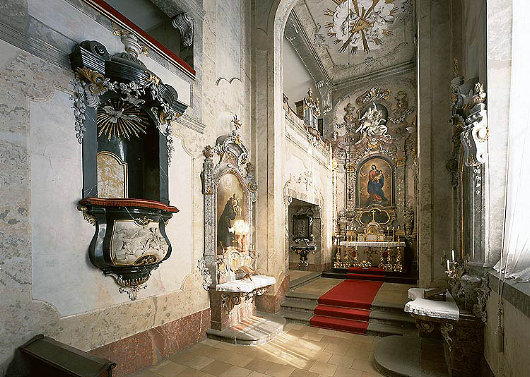
The Chapel of Saint George in the Castle once contained the skull and bones of Pope St. Callixtus I. The remains were obtained by the Emperor Charles IV, who gave them to the Rosenberg family who built the castle, from whom they (and the castle itself) passed to the Schwarzenbergs, only to be lost after 1614. Nonetheless, the skull of an unknown North African martyr came here in 1663, and tradition donated to the unknown saint the name of Callixtus also.
Nature diary
by ‘REDSHANK’
With the prolonged fine weather, all kinds of exotic creatures have appeared in our part of the countryside for the first time in living memory. Hummingbird hawkmoths are plentiful. I have seen not one but a dozen at a time hovering over the snapdragons in our flower garden.
 Not only hummingbird moths but hummingbirds have appeared. Calling at the Three Tuns, I found the regulars in an uproar as a whole bevy of these beautiful little creatures hovered over their pint pots, causing the less wide-awake to drop them on the floor.
At last Old Ted, the landlord, fairly lost his temper. “Get away, you pesky little varmints!” he shouted, lunging at the glittering little beauties, then chasing them across the room until he tripped over an antique horsecollar he keeps for grinning through and fell heavily to the ground, cursing all tropical interlopers.
There was a big laugh at this, and Old Jim, who always keeps a stuffed magpie on his person to avoid bad luck if he should meet a single magpie, annoyed the landlord even more by producing it and waving it in his face.
Meanwhile, the hummingbirds were hovering over the shove-halfpenny board, putting Old Frank and Old Amos off their game. Rustic oaths bombinated about the smoky room, growing ever more archaic and outlandish as I tried to make hurried notes in phonetic script.
Search
Instagram: @andcusack
Click here for my Instagram photos.Most Recent Posts
- Brunel’s Unbuilt Capitol February 3, 2026
- Cricket at Fordham January 27, 2026
- Palacio Barolo Revisted January 14, 2026
- Learning to Love Liguria January 14, 2026
- Crux Alba No. 2 January 13, 2026
Most Recent Comments
Book Wishlist
Monthly Archives
Categories