Arts & Culture
About Andrew Cusack
 Writer, web designer, etc.; born in New York; educated in Argentina, Scotland, and South Africa; now based in London.
 read more
News
Blogs
Reviews & Periodicals
Arts & Design
World
France
Mitteleuropa
Knickerbockers
Argentina
The Levant
Africa
Cape of Good Hope
Netherlands
Scandinavia
Québec
India
Muscovy
Germany
Academica
Scotland’s Three Parliaments
All of Them More Beautiful than the Current Parliament Building
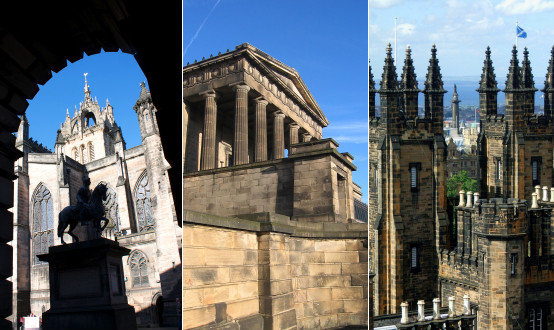
IT IS ONE OF those curious aspects of Edinburgh: its multiplicity of parliament buildings. The Estaits of Parliament, as they were known in the old days — consisting of the three estates of prelates, lairds, and burghers — first met in the Great Hall of Edinburgh Castle in 1140, though the first gathering of which we have primary source material was at Kirkliston in 1235, during the reign of Alexander II. The body led a somewhat peripatetic existence, meeting wherever was convenient, and even met for a year in St Andrews, where the building which housed it is still known as Parliament Hall. Indeed, that august edifice is home to the proceedings of the Union Debating Society, where the germinal gasbags of Scotland, and indeed of all three kingdoms, first enter the fray of political discourse.
In 1997, nearly three-hundred years after the Parliament was abolished, it was decided to bring it back, albeit in much reduced form. Great were the rumours and discussions about what effect the return of legislative power might have on the country, and Edinboronians pondered where the body might be housed. There were obvious choices, and less obvious choices, but in the end the Westminster government decided to go for the choice that hadn’t been suggested at all and built one of the most heinous offences against the sensibilities of taste that the land has ever seen. And so, the fact is that Scotland has three beautiful parliament buildings, none of which it uses. (more…)
Cape Dutch California
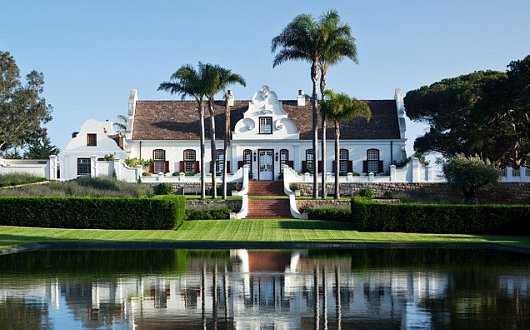
While this Cape Dutch mansion sits in the hills of Montecito in California, it bears the name (and style) of an old Cape Peninsula town. “Constantia” was designed by Ambrose Cramer (take a peek at his nifty grave) in 1929 for Arthur & Grace Meeker, with landscaping by Lockwood deForest, Jr. The Meekers sold the house to the architect Jack Warner. In the late 1960s, Stewart & Katherine Abercrombie bought the place, and hosted the Dalai Lama on one of his trips to the United States. It was the subject of a 1979 feature in Architectural Digest. The place is for sale, currently listed at $17,900,000. (more…)
“Lourdes”
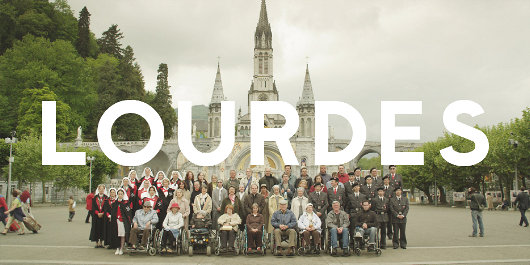
Various sources have brought to light the new film “Lourdes” by the Austrian director Jessica Hausner. The film depicts the pilgrimage to Lourdes of a non-particularly religious woman (played by Sylvie Testud) suffering from Mutiple Sclerosis who is healed of her illness. The film by a non-believing director has met with both praise and suspicion from Catholic quarters, and has been compared, at least stylistically, to the work of Michael Haneke (whose latest, “The White Ribbon” is currently showing in New York). Latest to weigh in is the Catholic Herald‘s indispensable Anna Arco, who writes:
I saw it as an exercise in theodicy where God loses. In a quiet dispassionate way, Jessica Hausner, the film’s Austrian director, paints a bleak picture of a world where fate is a blind, arbitrary force and human beings clutch at the straws of faith, half-truths in their cowardly despair. The suffering are not healed, human nature is selfish and the problem of pain is not solved. God can’t exist because he isn’t fair. Christianity offers a web of half-truths obscuring a nihilistic reality.
Miss Arco recently spoke with the director, and the interview will be published in the next Catholic Herald. (more…)
Alexander McCall Smith & the Sisters of Jaipur
The Scottish writer Alexander McCall Smith — noted for the fact that his books are actually a pleasure to read — pens a letter to readers every few months. In the latest letter, he mentions that he recently attended the Jaipur Literary Festival in Rajasthan’s famous “Pink City”:
But the visit to Jaipur was not all literary festival. My wife and I paid a visit to the Mother Theresa Home in the city, which was, as you can imagine, a very moving experience. Over two hundred residents, most of them with nowhere else to go, no possessions, and no money, are looked after by some seven sisters. These sisters are tireless – completely tireless – and give their lives over to the living care of these abandoned people.
At a time when the Catholic Church is coming under severe criticism for its failures (which have been, understandably, very much in the news), we should perhaps remember the extraordinary work of people such as the nuns of this community, who have done so much to bring love into the lives of those who have nothing and who would otherwise die alone and uncared for. I cannot tell you how moved I was by what I saw and by my conversation with the nuns.
An apposite reminder.
If you haven’t yet read Prof. McCall Smith’s 44 Scotland Street series, I suggest you float down to your nearest bookseller and purchase the first installation (handily titled 44 Scotland Street) today. They are a procession of delightful stories surrounding a number of fictional characters in an Edinburgh townhouse, and if you’re familiar with the capital city, you might just come a cross the occasional non-fictional friend interspersed amongst the creations of McCall Smith’s mind.
Mimi Coertse: “Der Hölle Rache” van Die Zauberflöte
Van al die operahuise in Afrika, die helfte is in Suid-Afrika — dink jy, daar is net vier operahuise in die vasteland. Nietemin, opera het ’n ryk en vrugbaar tradisie in die land, en die koningin van Suid-Afrikaanse opera-sangers is die sopraan Mimi Coertse. Sy was in Durban gebore in 1932 en het haar stem-opleiding in Suid-Afrika voltooi. In 1953, Coertse het die uitsaaier en komponis Dawid Engela getroud. (Engela het sy “Huwelikskantate” vir hul troue saamgestel). In Januarie 1955, Coertse het haar opera debuut gemaak in ’n kleine rol in Parsifal by die Teatro San Carlo in Napels.
Dit was 17de Maart 1956 — St. Patrick’s Day — toe Coertse die rol van die Koningin van die nag gesing in “Die Zauberflöte” met die Weense Staatsopera in Oostenryk. Sy het met die Weense Staatsopera vir meer as twintig jare gebly. Gravin Christl Schönfeld onthou:
In sy lang voortgang, Mimi Coertse het baie eerbewyse opgestapel. In 1961, die Medalje van Eer van Die Suid-Afrikaanse Akademie vir Wetenskap en Kuns; in 1966, die prestige titel van “Kammersängerin” vanaf die regering van Oostenryk; in 1985, die Suid-Afrikaanse Dekorasie vir Voortreflike Diens; en in 1996, die “Oesterreichische Ehrenkreuz für Wissenschaft und Kunst” (Oostenrykse Erekruis vir Wetenskap en Kuns) — die hoogste kunsdekorasie van Oostenryk.
Waar is sy nou? Sedert 1998, Mimi Coertse bestuur die “Black Tie Ensemble” — ’n projek om die verandering tussen opleiding en professionele uitvoering te versag. ’n Halfeeu van diens in die kunste voortsit!
Blogging now and then
I’ve only just discovered the blog of The New York Review of Books and found this entry on blogging in eighteenth-century France (if you will) interesting.
A friend accuses me of being able to connect everything back to either Scotland or South Africa, depending on my whim, and this blog post provides a handy example. It’s author is Robert Darnton, a Harvard cultural historian and expert on eighteenth-century France. Professor Darnton is the son of the much-respected war correspondent Byron Darnton, who was killed during the war while reporting in New Guinea. (Gen. MacArthur, a difficult man to impress, held Darnton père in such regard that he informed Darnton’s widow and his newspaper, The New York Times, personally).
In 1943, a year after his death, a Liberty ship was christened the U.S.S. Byron Darnton. After the war, the Byron Darnton was beached off the isle of Sanda in Scotland. The pub on Sanda — one of the most isolated pubs in the country — is now named The Byron Darnton after the ship that was named after the father of Prof. Robert Darnton.
So there, from eighteenth-century French blogging to twenty-first-century Scottish pubs.
A Seraphic Book Launch in Toronto
Torontonians or those in the general vicinity of that metropolis might be interested in attending the upcoming launch of Seraphic‘s new book, Seraphic Singles: How I Learned to Stop Worrying and Love the Single Life. Of course, Dorothy is no longer single but instead happily married to a Scottish friend of mine, and you can see her gleefully prancing about the grounds of the Historical House the happy couple now call their home in this 4m29s video clip.
But when & where’s the book launch you say? It’s Thursday, March 25, from 7:00–10:00pm at the Duke of York Pub, 39 Prince Arthur Avenue, Toronto, Ontario, in God’s Own Dominion of Canada. The book is printed by the Canadian publisher Novalis, and is already obtainable from Amazon.com. Copies of the book will also be available for purchase at the book launch.
Seraphic Singles:
How I Learned to Stop Worrying and Love the Single Life
by
DOROTHY CUMMINGS
25 March 2010 (Thursday)
7:00pm–10:00pm
The Duke of York Pub
39 Prince Arthur Avenue
Toronto, Ont.
Hollandic Heraldry
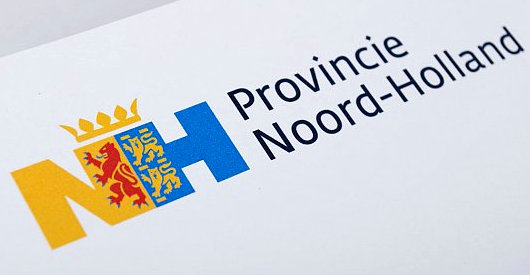
The Eden Spiekermann group, who were responsible for the redesign of The Economist in 2001, recently developed this logotype for the Dutch province of North Holland. The conjoined legs of the ‘N’ and ‘H’ integrate the province’s coat of arms.
A little dilapidation goes a long way
Chelsea, Muttontown, L.I.
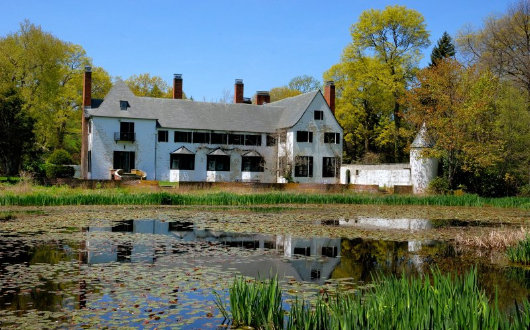
I have commented before about the perils of over-restoration, in which a building’s owner becomes a little too enthusiastic about its preservation and ends up with a building that, except in style, looks almost new. Chelsea sits on a 500-acre preserve in Muttontown, L.I. which has come into the hands of the government of Nassau (the county on Long Island in-between Queens County and Suffolk). The county has managed to maintain the house and its grounds at exactly the appropriate level: not plastering over every crack to make it ‘good-as-new’, nor neglecting it so it becomes structurally unsound, but rather allowing it to develop and age naturally. These photographs from the ever-capable James Robertson admirably display the house and its grounds, including its shallow canal-moat. (more…)
Hans Laagland
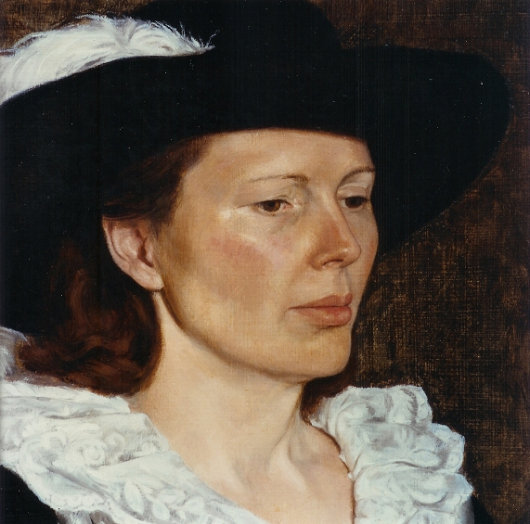
Oil on wood, 1980
“It does not matter what the artist paints, but how he paints it,” proclaims the painter Hans Laagland. “That is why Rubens is a genius while Picasso’s work is passable.” Laagland, a Fleming himself, is one of the scant few artists in our day who paint in the grand style of the Flemish baroque master. He was born in Belgium’s Dutch province in 1965 and took up the brush and easel when ten years old. The young boy quickly developed a fascination with Rubens, considering and absorbing his works in the neighbouring city of Antwerp. Laagland’s emphasis is on traditional craftsmanship, painting in oils on wood panel, investigating and recreating the Old-Dutch lead white used by Rembrandt and the vermilion of Rubens. With a particularly capable hand at portraits, his work can be seen everywhere from the Norbertine abbey at Postel to the Belgian parliament in Brussels.
“It has been downhill ever since Rubens,” the painter says. Rembrandt — “Rubens’s disabled cousin” according to Laagland — was the last great painter; “What comes after him no longer has any significance.” Those versed in the Netherlandic tongue can read Mr. Laagland expounding upon his artistic ideas in De Kunstverduistering (“The Eclipse of Art”), his extended essay on art and painting now published as a book by KEI Zutphen. (more…)
The National Assembly
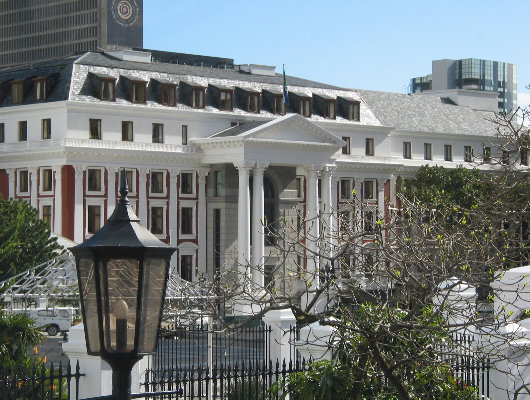
Despite the longer history behind the original wing of South Africa’s Parliament House, when most people think of Parliament today they think of the 1983 wing that currently houses the National Assembly. The wing was designed by the architects Jack van der Lecq and Hannes Meiring in a Cape neo-classical style similar to the rest of the building, and it is actually quite a handsome composition despite the awkwardly proportioned portico, which is too tall for its width or two narrow for its height. (more…)
‘Starchitecture’ Assaults the Stately City
In the Heart of Old Valletta, Architect Renzo Piano Plans a Gate without a Gate, a Theatre with no Roof, and a Parliament on Stilts
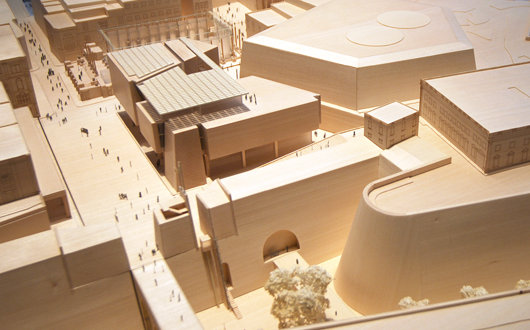
“THE MOST HUMBLE City of Valletta” is the official title of Malta’s capital, which was founded in response to Moorish threats and withstood the onslaught of Nazi bombers. But ‘La Ċittà Umilissima’ is now facing a humiliation brought about by its own rulers, who have commissioned the modernist architect Renzo Piano to reshape the entrance to the oldest quarter of the city. ‘Starchitects’ like Piano are so called because their temporal success lies more on their ability to create hype about their sensational and novel designs than on the quality and timelessness of their work itself. Most notorious for collaborating with Richard Rogers on the despised Pompidou Center in Paris, Piano has re-envisioned Valletta’s city gate without a gate, placed a new Maltese parliament on stilts next to it, and developed plans for a roofless theatre on the bombed-out ruins of the Royal Opera House.
The foundation of the Maltese capital was initiated by the Order of Malta during its rule over the island, not long after the famous Ottoman attack of 1565 was repulsed. The city takes its name from Jean Parisot de Valette, one of the greatest men to have ever served as Prince & Grand Master of the Sovereign Military & Hospitaller Order of St. John of Jerusalem, and the knights’ impact on Valletta’s development have led some to call it “the city designed by gentlemen for gentlemen”. This stateliness led some to give ‘The Most Humble City’ its second moniker of ‘La Superbissima’ — the most proud. (more…)
Rouwkoop: An Old Cape Hodgepodge
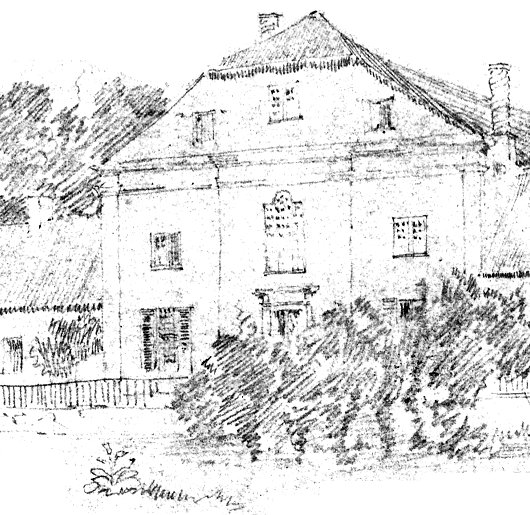
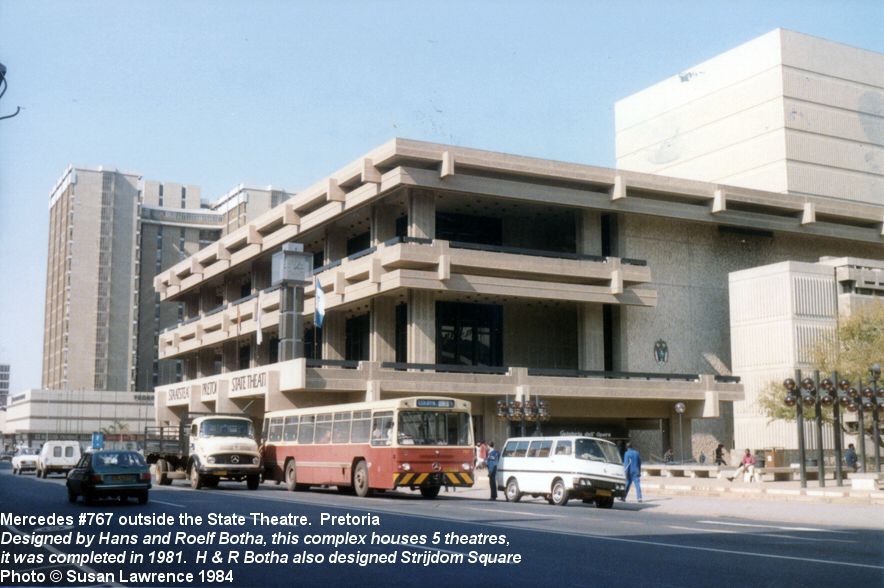
We can deduce a lot about a power by looking at the structures it erects. The return to neo-classicism under Stalin after the earlier Russian deconstructivist architecture of the 1920s is telling, as is the almost universal (and only seemingly contradictory) adoption of socialist Bauhaus architecture for the headquarters of New York corporations in the post-war period, or the turn to Brutalism by the governments of numerous Western liberal countries in the 1960s, 70s, and 80s. While the apartheid government adopted a guise of conservatism, its revolutionary re-ordering of South African society was so radical that, for example, the old Edwardian railway station in Cape Town was demolished and completely rebuilt in order to better accommodate the separation of the races.
When the Afrikaner Nationalist government was elected in 1948, it inherited one of the richest architectural traditions in the world. South African architecture, from the original Cape Dutch so praised by Ruskin, through the Cape Classical of the architect Thibault and the sculptor Anreith, and on to the attempt at a South African national style by Edwardian architects like Herbert Baker, the nation’s legacy of boukuns (building-art) is one of which any nation would be proud.
The Cape Dutch style has proved particularly versatile and easily reinterpreted in almost every age of South African history since Jan van Riebeeck planted the oranje-blanje-blou on these shores in 1652. Yet from 1948 until its final electoral demise in 1994 the National Party government erected almost no buildings in the “national style” of Cape Dutch or its aesthetic descendants. Instead, they built in the grim modernist style found everywhere else in the world, both in the liberal-capitalist West and the totalitarian-Marxist East. One need only consider the Nico Malan (now Artscape) in Cape Town, the Staatsteater in Pretoria, or the Theo van Wijk building at Unisa. (more…)


’n Indiese woning in die Moederstad
Kaapstad het ’n bietjie van die Himalajas
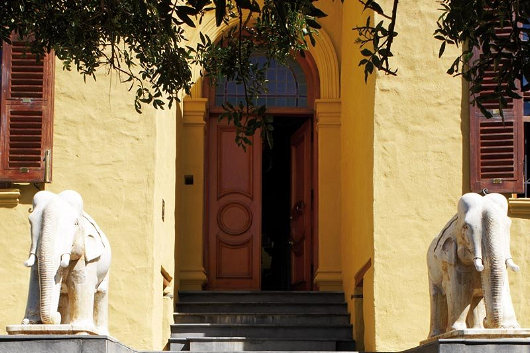
Twee versamelaars van suid-Asiatiese kuns het ’n subkontinentale woning in ’n Kaapstadse meenthuis geskep. Die huis was die onderwerp van ’n artikel deur Johan van Zyl in ’n onlangse uitgawe van Visi-tydskrif met hierdie foto’s van Mark Williams. Die algehele effek is ’n bietjie “over the top” vir my, maar die verleiding van die Oriënt sal nooit ophou. (Bo: ’n Paar van marmer-olifante uit Udaipur wagte by die hoofingang).
“In ’n nou keisteenstraat aan die rand van die Kaapse middestad staan ’n huis met ‘n geskiedenis” Mnr van Zyl skryf. “Toe dit in 1830 vir Britse soldate gebou is, het die branders nog digby die voordeur geklots, en nie lank daarna nie het Lady Anne Barnard hier sit en peusel aan ’n geilsoet vy wat ’n slaaf vir haar gepluk het, stellig van dieselfde boom wat nou in die huis se (nuwe) trippelvolume-glashart staan, ’n knewel met ’n vol lewe agter die blad.”
“’n Dekade of twee gelede het die reeds luisterryke geskiedenis van die huis ’n eksotiese dimensie bygekry toe twee toegewyde versamelaars — selferkende stadsjapies wat destyds in die modebedryf werksaam was — hier kom nesskop met hulle groeiende versameling Indiese oudhede.” (more…)
An Evening at the Travellers Club
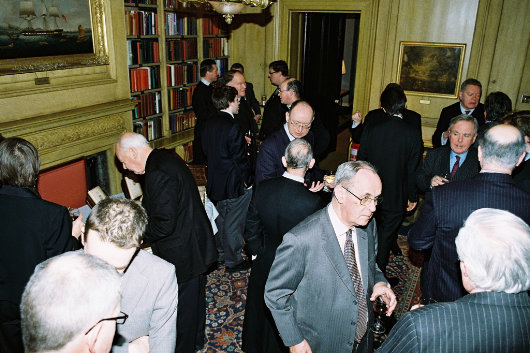
Photo: © Zygmunt von Sikorski-Mazur
TO CLUBLAND, THEN, for a book launch. Of course the secret about book launches is that they are often enough a convenient excuse to assemble a whole troop of interesting characters together, with the introduction of a newly published volume occupying a secondary (while nonetheless prominent) role. In this, our esteemed hosts Stephen Klimczuk and Gerald Warner of Craigenmaddie, authors of Secret Places, Hidden Sanctuaries, exceeded themselves. For me, the evening actually began not in the Travellers but just around the corner in the Carlton Club. Rafe Heydel Mankoo had suggested meeting up there for a drink or two or three before proceeding thencefrom toward the book launch at the Travellers. Pottering over from Victoria, I arrived at the Carlton and was guided towards the members’ bar where I easily found Rafe nursing a drink beside the hearth.
The usual updates were exchanged of various goings-on that had taken place since our last combination in August. Conversation naturally turned to Canada (where Rafe was raised) and shifted to New Zealand just before we greeted the arrival of Guy Stair Sainty. Guy I first met just four years ago while enjoying a pilgrimage to Rome. We happened to stumble upon him in the Piazza San Pietro (as one does with an odd frequency in the Eternal City), and, as it was my birthday, we invited him to join us for some champagne at this little place that overlooks the square. Guy was then in the midst of completing for Burke’s Peerage the massive, two-volume World Orders of Knighthood & Merit, or “WOKM”, which loomed restively on a nearby table as we sipped our drinks in the Morning Room. (more…)
Government Buildings, Dublin
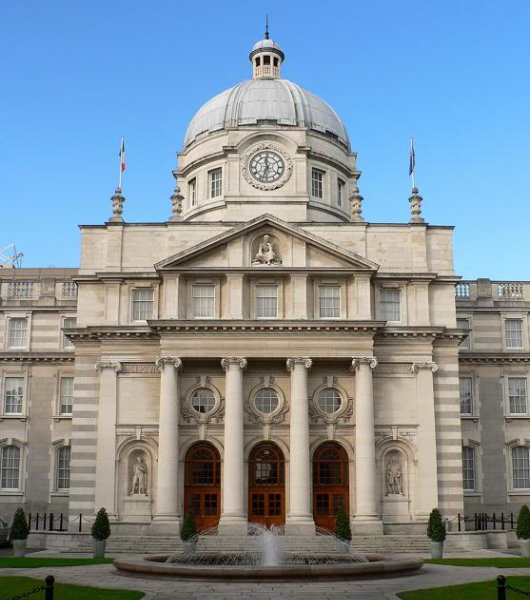
Image: GrahamH
On Upper Merrion Street at the end of Fitzwilliam Lane in Dublin sits a thoroughly Edwardian pile which has been given the thoroughly boring title of ‘Government Buildings’. The city ceased to be a legislative capital in 1800 when the Irish Parliament voted to abolish itself and join the United Kingdom, so government edifices constructed during the nineteenth century lacked the proud stateliness of the Grattan era. The Westminster parliament finally conceded the principle of Irish home rule in 1914 but disastrously suspended its implementation due to the First World War. In stepped the Irish Volunteers, Easter 1916, the IRB, and all that and by the time the Treaty of Versailles ended the conflict on the continent, Britain was up to her neck in troubles in Ireland. Events had intervened and the unimplemented concession of home rule proved insufficient to quell the dire situation.
Even so, the Government of Ireland Act 1920 partitioned the island and created a separate government for ‘Southern Ireland’ and ‘Northern Ireland’, each with its own devolved legislature. The old Irish Parliament House had been sold to the Bank of Ireland so there was a question as to where the two houses of the new Southern Irish body would convene. Eventually the government decided upon this building, the Royal College of Science, and it was commandeered for that purpose. (more…)
A Wander Through the V&A
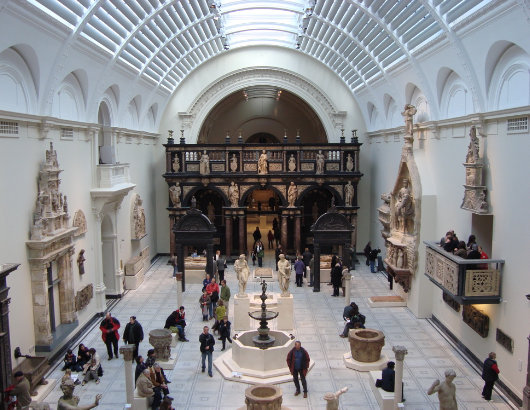
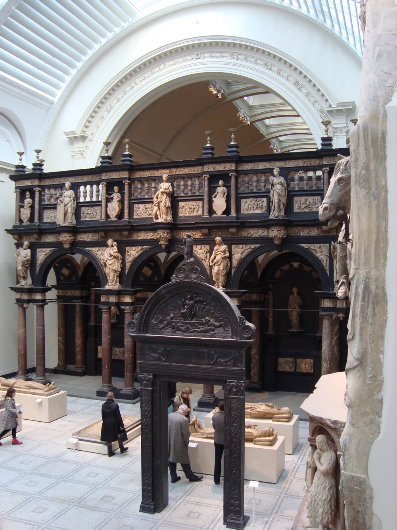 When on earth was the last time I was in the V&A? To be honest, I’ve no idea, though I’m certain my first visit was (like that of many others) as a wee one, the summer after kindergarten to be precise. It’s a stonking great place with tons of stuff in it, and one of the startling few that deal with architecture as a subject in its own right. (A fact which wins admiration in the heart of this architecture fan).
Of course the Victoria & Albert Museum has been fresh in the minds of many most recently for the re-opening of its Medieval & Renaissance sculpture galleries. The new arrangement cost over £30 million, took seven years to complete, and includes ten new display rooms displaying, as the Guardian put it, “a world of ravishing luxury”. So it seemed silly not to have a little wander round the South Ken institution yesterday, especially since it was a rainy afternoon. (more…)
Old Master & 19th Century at Christie’s
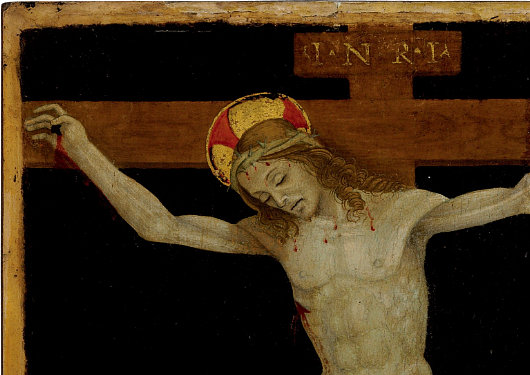
Being something of an auction-house dilettante — I last brought you a virtual update from the Dublin bidding chambers — there are a number of works up for grabs in tomorrow’s Old Master & 19th Century Paintings, Drawings, and Watercolors auction at Christie’s here in New York that caught my eye. A few other items sold in recent auctions follow at the bottom. (more…)
The Patriarchal Cathedral Basilica of Saint Mark the Evangelist, Venice
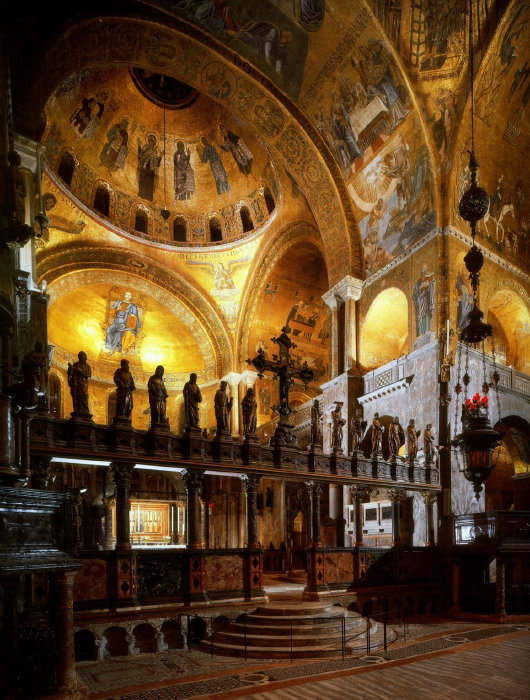
One of the readers over at the NLM sent in these photos of St. Mark’s Basilica in Venice. The reason why St. Mark’s is usually referred to as a mere basilica is because for centuries this was not the seat of the Patriarch of Venice. From the seventh century, the Church of San Pietro di Castello was the cathedral of Venice, while St. Mark’s was the house church of the Doge, the elected duke of the Venetian aristocratic republic. It was only in 1807 that St. Mark’s was made the cathedral of Venice, and San Pietro di Castello reduced to co-cathedral status. But by the time St. Mark’s became a cathedral, everyone had already become accustomed to referring to it as “St. Mark’s Basilica”. (more…)
Search
Instagram: @andcusack
Click here for my Instagram photos.Most Recent Posts
- Brunel’s Unbuilt Capitol February 3, 2026
- Cricket at Fordham January 27, 2026
- Palacio Barolo Revisted January 14, 2026
- Learning to Love Liguria January 14, 2026
- Crux Alba No. 2 January 13, 2026
Most Recent Comments
Book Wishlist
Monthly Archives
Categories