Arts & Culture
About Andrew Cusack
 Writer, web designer, etc.; born in New York; educated in Argentina, Scotland, and South Africa; now based in London.
 read more
News
Blogs
Reviews & Periodicals
Arts & Design
World
France
Mitteleuropa
Knickerbockers
Argentina
The Levant
Africa
Cape of Good Hope
Netherlands
Scandinavia
Québec
India
Muscovy
Germany
Academica
Preservation is Not Enough
A Proposal for Enhancement
IT IS COMMONLY said of St Andrews that it is a place of beauty. This is often a compliment to its natural setting, with open skies arcing over the reaches of the bay, and ancient rock and cliff yielding to the changing rhythms of the waves. At the same time visitors are generally struck by the pleasing combination of natural and built environments: the ruined grandeur of the Cathedral and Priory standing bare to the elements; crowstep-gabled cottages gathered in against the wind; the broad thoroughfares interlinked with narrow cobbled lanes; and the church towers etched against the sky. There is also the scholarly dignity of Deans Court, the quizzical posture of the Roundel, the charm of the courtyards to the south of South Street, the sad ruination of Blackfriars juxtaposed with the aspiring frontage of Madras College, and other evocative sights besides.
Here and there within the midst of all of this stands, physically, historically, and socially, the University. Its contributions to the architectural distinction of the old town are obvious enough. They are, principally, the harmonious South Street complex of St Mary’s College (1593-41) to the west, Parliament Hall (1612-43) to the north, and the Library extension (1889-1959) – now the Psychology wing – to the east; and the North Street set of the Collegiate Church of St Salvator, Gate Tower and tenement (1450-60), and beyond it the west block (1683-90) containing the Hebdomadar’s Room, and to the east and north the College buildings (1829-31 and 1845-6, respectively). There are other smaller and oft-reworked jewels associated within the University: St John’s House in South Street (15th, 17th, 18th, 19th, and 20th centuries), St Leonard’s Chapel (remodelled c. 1512), and the ‘Admirable Crichton’s House’ (16th century), but the principal architectural benefactions of the University to the town are the North and South Street college complexes. I have not mentioned the Younger Graduation Hall (1923-9) and the Student Union (1972) and prefer to leave it for readers to determine what might be said of these.
It could hardly have passed unnoticed that the list of contributions dates mostly from the late middle-ages to the nineteenth century, and this fact raises two questions: first, whether in the second half of the twentieth century the University was sufficiently attentive to its role as principal architectural patron; and second, how it might now hope to enhance the built environment of St Andrews. (more…)
Fellowes Prynne in Johannesburg
A Rejected Proposal for St. Mary’s Anglican Church
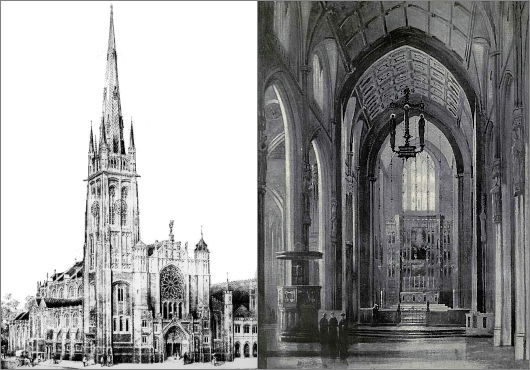
We rarely mention Johannesburg on this little corner of the web because our mother taught us that if you don’t have anything nice to say, don’t say anything at all. While ruffling through the archives the other day, however, I came across this design for the Johannesburg cathedral of the Church of the Province of South Africa. George Halford Fellowes Prynne (1853–1927) was an accomplished Gothic architect whose work is mostly found in the south of England. He’s notable for his rood screens in particular, worked in a variety of forms and materials (wood, stone, and metal), though this design employs a hanging rood. (more…)
Unbuilt St. Thomas
Lord & Hewlett’s Competition Entry for the Church of St. Thomas
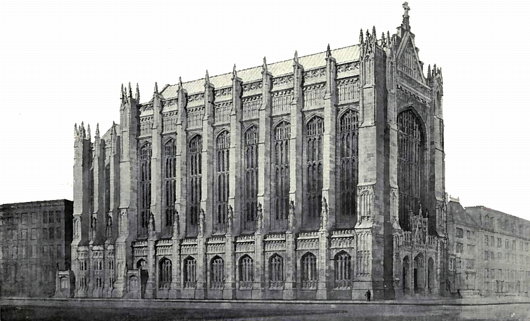
THE CHURCH OF Saint Thomas on the corner of Fifty-third Street and Fifth Avenue in New York is one of the artistic gems of the city: both as an architectural marvel designed by Ralph Adams Cram & Bertram Grosvenor Goodhue and as a musical paradise with its renowned choir of men & boys formerly under the tutelage of Gerre Hancock. (It’s foolish for anyone in the city during Advent to miss the Service of Lessons & Carols). The parish of the Episcopal Diocese of New York was established in 1834, and its first building was erected in the Gothic style on the corner of Broadway and Houston.
In 1870, after that neck of the woods became less fashionable, the congregation moved to its current location at 53rd & Fifth, to a new Gothic edifice by Richard Upjohn. That church hosted the marriage of Consuelo Vanderbilt to the 9th Duke of Marlborough. When it burned down in 1905, a competition was held to select the design of the new Church of St. Thomas, then perhaps at the peak of its high social status among Manhattan’s Protestant congregations. (more…)
Fated
WHETHER Parliament approves “therapeutic cloning” or not, will it make any difference in the long run? Whatever scientists can do, that will be done. Public opinion, at first aghast at artificial insemination and other landmarks on this infernal road, has largely come to accept them. So it is likely to be with this latest triumph.
 “Science has put into our hands innumerable gifts that we can use either for good or ill.” This mantra, once regularly intoned, has become less popular now that many of these gifts are plainly seen to be used for ill.
A new palliative has appeared instead: it says that we must be kept well informed about the latest scientific developments, as well as learning more about science and scientific methods, so that we can decide for ourselves whether we want these gifts or not.
But who are “we”? Would it make any difference if we said we did not want them? Would it make any difference if some scientists themselves decided they were too dangerous to proceed with? Others would somehow, somewhere, carry on the work. The progress of science and technology which has seized upon our world seems irreversible, even fated.
Will it, as in some environmentalist fantasy, gradually diminish in strength and become humanly manageable in a new, green and “sustainable” world? Or will it, as seems more likely, proceed to a catastrophic end?
Journowatch: Headline vs. Story
In an article about the soon-to-be-canonised Australian nun, Mary McKillop, the Daily Telegraph exhibits a peculiar example of the lows of newspaper journalism today.
The headline boldly states “Australian nun ‘to be made patron saint of abuse victims'” only for the sub-headline — “An Australian nun who will be canonised by the Pope next month should be made the patron saint of clerical sex abuse victims, Catholics have suggested.” — to directly contradict this.
Is Mary McKillop “to be” the patron saint of the abused or has it merely been “suggested”? The headline-writer put the ‘to be’ in quotation marks, but the article doesn’t supply a single quotation or piece of evidence showing this decision has been reached, only a quotation suggesting it would be a wise course of action.
I’ve read numerous examples of newspaper articles offering contradictory facts unreconciled, but to do so before the article has even started seems particularly bizarre.
The Daisy Wheel
Among the most well-known works of modern Scottish design, besides the ‘Clootie Dumpling’ of the Scottish National Party, there is the logo of the Royal Bank of Scotland: the Daisy Wheel. Now one of the most well-known financial brands in the world, the Royal Bank of Scotland was founded in Edinburgh in 1727, thirty-two years after its rival, the Bank of Scotland. (The Bank of Scotland, as it happens, was founded by an Englishman, John Holland — just as the Bank of England was founded by a Scot, Sir William Paterson).
The Scottish Parliament had declared in 1689 that King James VII had, by his absence, forfeited the throne, and handed the Crown to his Dutch rival William of Orange, who had already seized the throne in England. The House of Hanover succeeded to the throne of the new United Kingdom which had been created in 1707, but the Bank of Scotland was suspected of harbouring Jacobite sympathies. The London government was keen to help out Scottish merchants loyal to the Hanoverians and so, in 1727, King George granted a royal charter to the new Royal Bank of Scotland. (more…)
Antipodean Heraldic Philately
One of my favourite series of stamps comes from New Zealand. In 1929, the New Zealand Post Office commissioned the Englishman H. L. Richardson, an artist and teacher at the Wellington Technical College, to design a series of fiscal revenue stamps, or duty stamps. The design employed the New Zealand coat of arms in a variety of colours depending on the value of the stamp. Richardson erroneously had the lion in the crest of the arms hold aloft a New Zealand flag instead of the Union Jack that he was supposed to carry. The crest was changed to a crown in 1956 (along with a series of other changes) to signify that New Zealand had by then become a sovereign realm of its own. Richardson’s stamps were withdrawn from use in 1967 when New Zealand’s currency was decimalised. (more…)
Six to One Offered Against Xandover
The Late, Lamented Sporting Life, Daily Newspaper of the Queen Mum
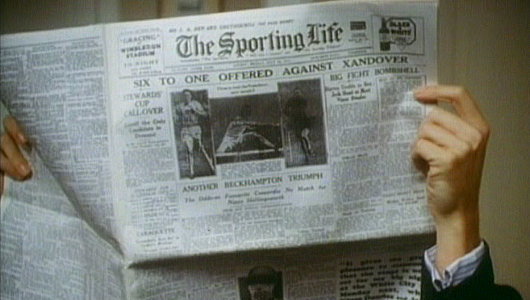
THE MOST FAVOURED daily reading material of the late Queen Mother, The Sporting Life did not survive into the twenty-first century, unlike the beloved former consort (who died 102 years of age in 2002). It was first printed in 1859, but through its 1886 acquisition of Bell’s Life in London, and Sporting Chronicle had a heritage dating back to 1822. Throughout the twentieth century, aside from being the racing newspaper of record, reading it gave a certain connotation of leisureliness, spiviness, or both. By the 1980s, it was thought the Life was getting a bit staid, and it was challenged when Sheikh Mohammed bin Rashid Al Maktoum founded the Racing Post as a daily competitor.
“The advent of the Racing Post in the 1980s was good for the Life,” Jamie Reid wrote after the older journal shut. “The old paper was in danger of becoming tired. What makes the Life’s closure so hard to take is that in the last few years it was better than ever.”
“The Post‘s editorial style was often a bit dry whereas the Life’s top writers… were clearly not good for you at all. They were basted in alcohol, toasted in tobacco and in constant desperate need of a winning tip.”
That the long tradition of The Sporting Life didn’t have to end is one of the more frustrating aspects: it was the Life’s owners, Trinity Mirror, that bought the Post in 1998 and decided to keep the title of the twelve-year-old paper instead of the one with one-hundred-and-forty-nine years of history behind it. Go figure.
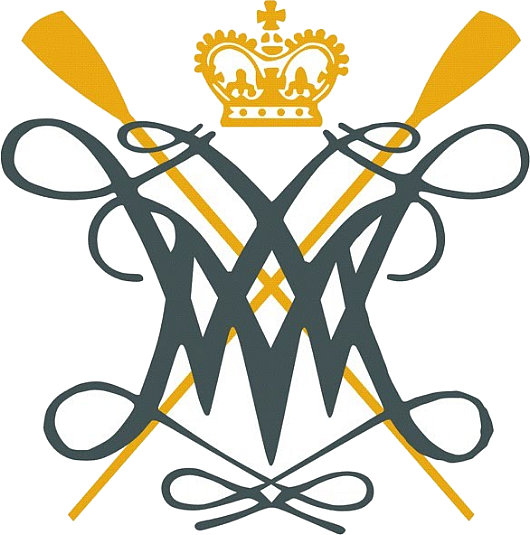
The William & Mary Cypher

In addition to its coat of arms, the College of William & Mary makes good use of the royal cypher of its eponymous monarchs, as seen above, in a version used by the whole university (it is a ‘college’ only in name), and below in a variant used by the William & Mary Rowing Club.
The East Neuk of Fife
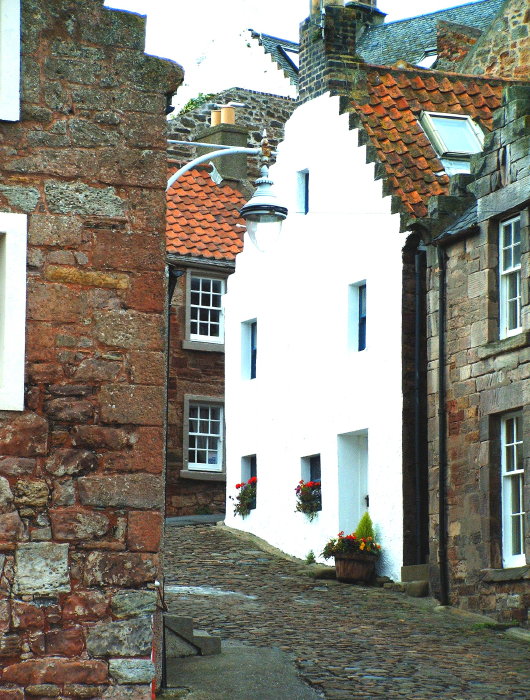
THE 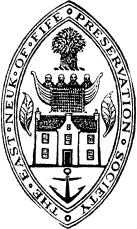 EAST NEUK of Fife is one of my favourite little corners of the globe, in what is definitely my favourite country in the world. Here are a set of almost unspoilt little fishing villages with a quite localised architectural style that makes them instantly recognisable. The name of this little regionlet signifies its location as the east ‘nook’ of the Kingdom of Fife, that juts out into the North Sea.
Those concerned for this part of the world might be interested in signing up for the East Neuk of Fife Preservation Society, which has completed admirable work all over the East Neuk, and is currently considering the restoration of the gatehouse of Pittenweem Priory.
When Newspapers Were Newspapers
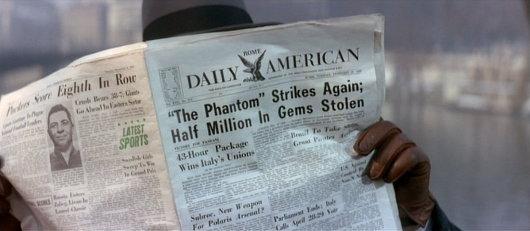
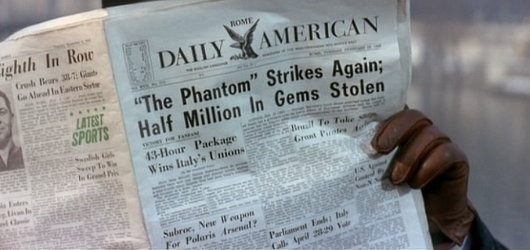
One of the things I enjoy about watching older movies is seeing the newspapers they mocked up for them. “The Pink Panther” (1963) featured this shot of an underworld figure reading the Rome Daily American on a Paris bridge or quayside.
Often these are mockups of newspapers that never existed, but the Rome Daily American was real. A handful of GIs started it in 1945 when the European edition of Stars and Stripes ceased publication. It took the Herald-Tribune two days to reach Rome from Paris in those days, and the CIA held an arms-length 40% stake of the ownership until the 1970s.
The paper was made famous by the 1953 flick Roman Holiday — there was a charming film. Its offices were in the Via di Santa Maria in via, parallel to the Corso, until the paper went bankrupt in 1984.
Mauritshuis Digs Deep
Art Gallery in the Heart of the Hague Unveils Expansion Plans
WELL, NOT THAT deep, really. The Mauritshuis museum in the Hague recently unveiled its plans to expand underground and across the street into a neighbouring building. The square-footage of the museum will double after the completion of the new project, which will include a new entrance, exhibition hall, café, and lecture theatre. The entrance to the museum, currently accessed from the side street, will return to the front of the Mauritshuis but underground rather than through the main doorway on the ground floor.
The building was originally constructed between 1636 and 1641 for Johan Maurits, Prince of Nassau-Siegen next to the Binnenhof palace. At the time, Prince Johan Maurits (a cousin of the stadtholder Frederik Henrik, Prince of Orange) was governor of the New Holland, the Dutch colony in Brazil. In 1820, the palace was purchased by the government to house the Royal Cabinet of Paintings. The Mauritshuis art museum was separated from the state by being transformed into a private foundation which enjoys the use of the building and the art collection on long-loan from the government. (more…)
A book review in the Weekly Standard
While my admittedly small work on the Namibian jugendstil was recently published in Catalan, those who are interested in my review of Xander van Eck’s Clandestine Splendor: Paintings for the Catholic Church in the Dutch Republic can read it in the latest edition of the Weekly Standard.
Unfortunately the magazine’s website is mostly behind a paywall, so readers will have to swing by their local newsstand to obtain a copy.
The Lion’s Gate
VISITORS TO CAPE TOWN may be surprised that, given the beauty and multiplicity of animals in the vicinity, the ‘Mother City’ has no zoo. There is actually a popular zoo at Tygerberg, twenty-four miles from Cape Town and less than ten miles from Stellenbosch, which is the only zoo in the province. But centuries ago — around 1700 — a ‘menagerie’ was founded in the Company’s Gardens in Cape Town which survived for over a hundred years.
François Valentijn, in his visit of 1714, noted the menagerie boasted a pair of ‘rheen’ or ‘rheebokken’ (probably kudu), a black rhinoceros, an eland, a ‘rossen bok’ (possibly a hartebeest), a hippopotamus, two lions, and a zebra. In the 1770s, the Swede Anders Sparrman noted the presence of many springbok, a warthog, some ostriches, and even a cassowary. The selection varied widely through the years, and given Cape Town’s status as ‘The Tavern of the Seas’ central to the European route to the Indies and the Far East, the zoo included not only African beasts but also some (like the Papuan cassowary) brought from the Orient.
In 1777, the notorious rake William Hickey ventured to extoll it as “the finest menagerie in the world, in which are collected the most extraordinary animals and birds of every quarter of the globe”. Less than fifteen years later, however, Lt. George Tobin of the Royal Navy described it as “a menagerie of some extent. It was but poorly supplied, there being but a few ostriches and some different kinds of deer.” Decades later, in February 1825, a traveller noted the menagerie in the pages of the Montly Magazine of London:
At the end of the Grand Walk, which is nearly three-quarters of a mile long, is the Company’s Menagerie, which is worth seeing, on account of a good-natured old lion, supposed to be the largest ever taken into captivity, and a tiger of immense size and power; there are several other specimens of African animals: but those are infinitely the largest of their species I ever saw—we have nothing that comes near them in England.
A spiritually inclined passer-through, the Rev. Henry Martyn, Chaplain to the Honourable East India Company, stated in 1832 that the “lion and a lioness, amongst the beasts, and the ostrich, led my thoughts very strongly to admire and glorify the power of the great Creator.” It was around that time that Sir Benjamin d’Urban, Governor of the Cape, granted land next to the menagerie for the erection of a building for the South African College, the germ of what would become the University of Cape Town. This was the beginning of what is now called the Hiddingh campus of UCT, the institution’s first home which continues alongside the main campus built on the Rhodes estate on the slopes of Devil’s Peak. The menagerie was shut in 1838 and the first building of the proto-UCT went up the next year in an exotic Egyptian Revival style.
The lion gates, however, are from earlier. They were built in 1805, probably by Thibault, with the lions & lionesses sculpted by the architect’s frequent collaborator Anton Anreith, also responsible for the magnificent pulpit in the Groote Kerk. The lionesses on the UCT side are original but the lions on the other side, curiously, were removed in 1873. In 1958 they were restored when Ivan Mitford-Barberton — arguably South Africa’s greatest sculptor after Anreith — created new beasts for the old perches. The gates are still there if you walk up the Government Avenue that bisects the Company’s Gardens, beautiful in the eye of this beholder in their immaculate, white, classical elegance.
The Academic Portraits of Cyril Coetzee
A Selection of University Portraiture by the South African Painter
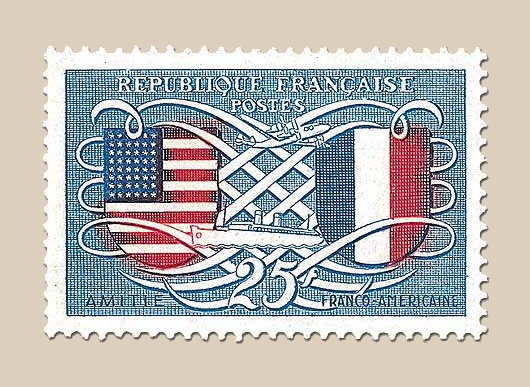
THE ART SCENE in South Africa is widely varied in both style and quality, and the individual artist who is devoted solely to a single school is almost rare. The works of Cyril Coetzee (born in 1959) vary from quasi-figurative explorations of colour dynamics to multi-layered, almost mythological narrative paintings. His academic research at Rhodes University, located in his Eastern Cape hometown of Grahamstown, explored anthroposophic colour theory, so it’s no surprise part of his further studies were undertaken at the Goetheanum in Dornach, Switzerland (one of the sites covered in Stephen Klimczuk & Gerald Warner of Craigenmaddie’s Secret Places, Hidden Sanctuaries). Coetzee’s corpus also include a number of purely figurative portraits, many of which were commissioned by places of learning in South Africa. (more…)
Come to Finland
Travel Advertising from the Golden Age of Poster Design
FINLAND IS HIGH on my list of places to visit once I am re-situated across the pond, mainly because of the exceptional warmth and charm of the Finns I am blessed enough to call my friends. If the Finns themselves weren’t reason enough to visit the Land of the Midnight Sun, journalist & travel historian Magnus Londen has teamed up with copywriter Joakim Enegren and web operative Ant Simons to compile Come to Finland: Posters & Travel Tales 1851-1965. The art of poster design is one sadly neglected today, when advertising has developed into myriad other more pervasive yet less impressive forms. The book’s closing date, 1965, roughly marks the end of the golden years of poster design. Visitors to the book’s website can order postcards of the posters featured in the book, or copies of the posters themselves, more of which the dedicated poster-hunting authors are continually discovering. (more…)
Interesting Things Elsewhere
This determined Celt is gunning for Thabo
Kevin Bloom | The Daily Maverick
Ireland’s 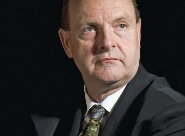 Paul O’Sullivan took over as head of security at South Africa’s airport authority in 2001, and discovered something was wrong from the start: why didn’t the policeman on duty want to take a statement about the attempted theft of his baggage? Since then, his life has been a series of bizarre events leading him ever deeper into the most complex criminal network of the post-apartheid era, including the recent the trial and conviction of former national police chief Jackie Selebi. But O’Sullivan’s determined quest to expose crookedness isn’t over yet, and he now has former president Thabo Mbeki in his sights. read more
The apparatus of state will simply ignore the government
‘Inspector Gadget’ | Police Inspector Blog
Police across England were told by the responsible minister of the democratically elected government that they must not chase performance targets any longer. “I can also announce today that I am also scrapping the confidence target,” said the Home Secretary, Theresa May, “and the policing pledge with immediate effect”. But the ‘senior management team’ of the West Yorkshire Police have stated they will go on no matter what the government says. read more
Has Christian Democracy reached a dead end?
Jan-Werner Mueller | Guardian.co.uk
The commentator completes a brief survey of the struggles of Christian Democracy in Germany and Europe today. The French leader Georges Bidault claimed that Christian Democracy meant “to govern in the centre, and pursue, by the methods of the right, the policies of the left”. But Christian Democracy’s brief French moment in the 1950s didn’t survive the return of de Gaulle, and Christian Democratic parties on the continent today face an existential crisis. read more
Also: Monsignor Ignacio Barreiro’s talk at the Roman Forum’s 2010 Summer Symposium, entitled The Problem of Christian Democracy will be made available online in audio form sometime in the coming months.
Deep in Shanxi, the most Catholic village in China
Anthony E. Clark | Ignatius Insight
Church after church dot the landscape and high steeples rise above small villages as they do in southern France. Passing through a narrow side road one arrives and is welcomed by three great statues at the village entrance: St. Peter holding his keys is flanked by Saints Simon and Paul. Thirty minutes before Mass the village loudspeakers, once airing the revolutionary voice of Mao and Party slogans, now broadcasts the rosary. Welcome to Liuhecun, the most Catholic village in China. read more
Look for me in the Cotswolds.
Dino Marcantonio
The apologists for modernist architecture have tried for a century to gain public acceptance of and appreciation for their horrors. While the elites have almost overwhelmingly been converted, the general populace around the world still sees that the Emperor has no clothes, and almost always prefers architecture that reflects the tried and true, the local and the natural. Alain de Botton, the Swiss essayist, ‘pop philosopher’, and former ‘writer-in-residence’ at Heathrow Airport, is the latest to give it a go, this time in the pages of the modernist Architectural Record. Dino Marcantonio provides a most useful fisking. read more
Canada is a French country
Andrew Coyne | Maclean’s
At the recent Canada Day celebrations on Parliament Hill, Canadian PM Stephen Harper spoke of “the steadfast determination and continental ambition of our French pioneers, who were the first to call themselves ‘Canadians.’” At other times he has spoken of Canada as having been “born in French,” of French as “Canada’s first language,” and, most famously, of Quebec City as “Canada’s first city,” its founding in 1608 as marking “the founding of the Canadian state.” While the sentiment may seen anodyne, moreover, the implications are radical. read more
A School Chapel on Long Island
St. Anthony’s High School, South Huntington, L.I.
“I have a general disgust for Catholic architecture since the 1950s,” says Brother Gary Cregan, the Franciscan friar who is principal of St. Anthony’s High School in South Huntington. The friar was quoted by the once-great New York Times in a 2008 article on the new chapel built by the Catholic school on Long Island, recently featured on the NLM blog. The Franciscans, according to the Times, “believe that the new chapel, with its soaring 30-foot ceilings, will teach teenagers that they are ‘worshiping God, not each other.'” Many of the chapel’s furnishings were bargain finds on eBay including the confessionals, the pews, a 110-year-old stained-glass window, and a century-old statue of St. Anthony. A new bell for the chapel’s tower would’ve cost $20,000, but Brother Gary (or “Mr. Cregan” as the newspaper referred to him) found an old one for $4,000. (more…)
Search
Instagram: @andcusack
Click here for my Instagram photos.Most Recent Posts
- Brunel’s Unbuilt Capitol February 3, 2026
- Cricket at Fordham January 27, 2026
- Palacio Barolo Revisted January 14, 2026
- Learning to Love Liguria January 14, 2026
- Crux Alba No. 2 January 13, 2026
Most Recent Comments
Book Wishlist
Monthly Archives
Categories