About Andrew Cusack
 Writer, web designer, etc.; born in New York; educated in Argentina, Scotland, and South Africa; now based in London.
 read more
News
Blogs
Reviews & Periodicals
Arts & Design
World
France
Mitteleuropa
Knickerbockers
Argentina
The Levant
Africa
Cape of Good Hope
Netherlands
Scandinavia
Québec
India
Muscovy
Germany
Academica
Classic Beck
I’ve heard tell that the ‘Indian head’ is a ‘racist depiction’ of Native Americans. But it should be obvious that the Indian mascot is not meant to depict present-day Native Americans, so how can this be the case? Native Americans have changed a great deal over the course of history. So have people of all ethnicities. That’s why I’m studying English at Dartmouth College rather than wearing a bearskin and sacrificing holly-crowned virgins to Wotan. That’s why people of Scandinavian descent don’t dust off their battle-axes and sack Minneapolis whenever the Vikings play.
Evacuation Day
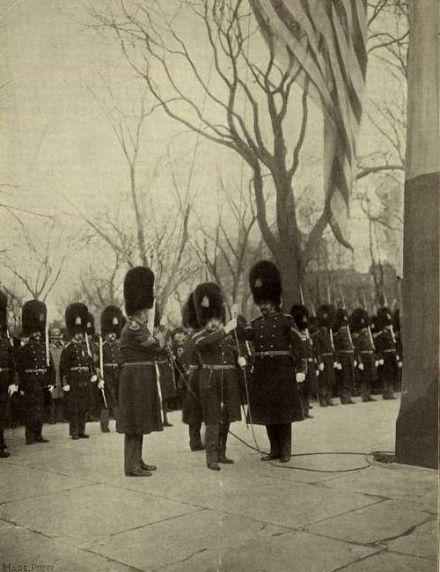
The Old Guard of the City of New York, raising the flag at the Battery on Evacuation Day, 1897. The day commemorates November 25, 1783, when the last royal troops left New York in accordance with the terms of the Treaty of Paris.
A Lone Star Thanksgiving
I will be spending the next few days in Texas, in the city of Saint Anthony. It will be my fifth consecutive Thanksgiving in a foreign land.
Old Dominion Will Receive Her Majesty
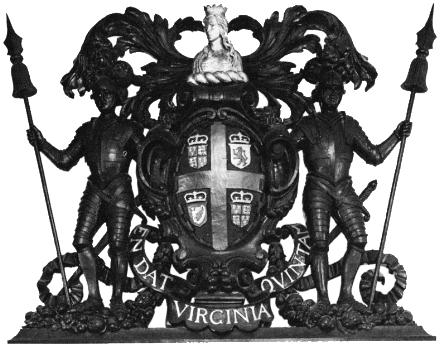
With these words spoken yesterday in the House of Lords, the Queen revealed the plans for her visit to the Commonwealth of Virginia for the upcoming celebrations surrounding the quatercentenary of the first permanent English settlement in the New World. Her Majesty is no stranger to Virginia, nor even to Jamestown, as her very first visit to the New World took place in 1957 when she attended the 350th anniversary celebrations at Jamestown. Following that 1957 official visit to the United States, the Queen opened her parliament at Ottawa for the first time since her accession to the Canadian throne. (more…)
Empire State Beauty

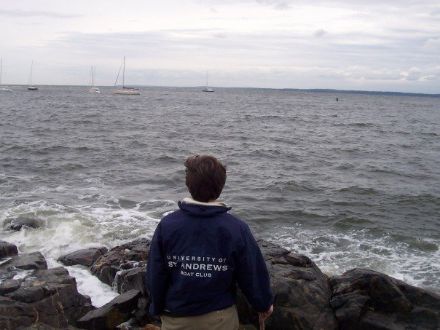
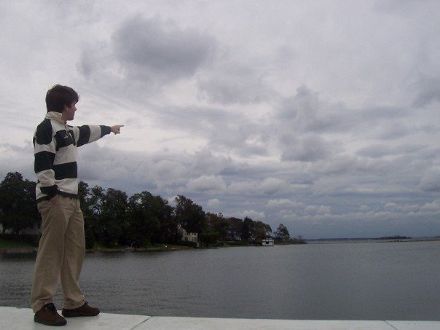
THE BRIDGE AND TUNNEL CLUB site often features photographs of myriad places, scenes, and things all around New York and beyond. Recently, the Bridge-and-Tunneller made a sojourn to various sites up the Hudson, and thankfully decided to share his photos. We bring you a selection of them, which you can find in their original form on the B&TC website. (more…)
The ‘Day of Fate’
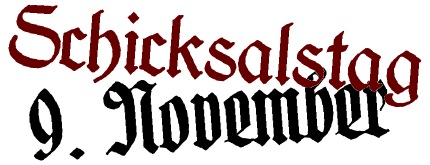
THE NINTH OF November is sometimes known in Germany as ‘Schicksalstag’ or the ‘Day of Fate’ owing to the series of events significant to modern German history which took place on the day in 1848, 1918, 1923, 1938, and 1989.
1918: Kaiser Wilhelm II is dethroned in the November Revolution, marking the end of the German monarchy.
1923: Hitler attempts his failed ‘Beer Hall Putsch’ which signficantly raises the profile of his tiny National Socialist German Workers’ Party.
1938: Synagogues and private property belonging to Jews are violently attacked in the ‘Kristallnacht’ pogrom.
1989: The politburo of Communist East Germany decides to relax the border-crossing restrictions between East and West Germany, leading to the fall of the Berlin Wall.
The first and last events (1848 and 1989) were encouraging events, while the three in between (1918, 1923, and 1938) were progressively worse. Indeed, it could easily be said that 1938 could not have happened without 1923, and that 1923 could not have happened without 1918, so these occurrences are not unrelated.
‘A Bloodless Coup’
The Panero recently announced my accession to the position of Assistant Editor at the New Criterion, from which Associate Editor Stefan Beck is sadly departing at the end of the month. The most ardent followers of this little corner of the web will recall that I interned at the august publication in the summer of 2005. I started work just yesterday and am already privy to all the guild secrets of the New Criterion. If I am unexpectedly found dead at the bottom of a river with my heart carved out and my hands tied behind my back, look for Stefan Beck. He’ll be the one with the daring but strangely successful combination of seersucker and denim, sunning himself on a Greek isle.
Previously: Awaiting Pars Secunda | Whither Cusack?
Children of a Common Mother
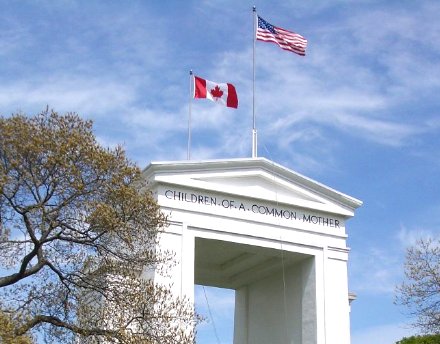
The 22-yard-tall Peace Arch stands between the city of Blaine in Washington state, and the city of Surrey in the province of British Columbia, demarcating the boundary between the United States of America and the Dominion of Canada. The monument, built in 1921, commemorates the 1814 Treaty of Ghent re-establishing peace between the United States and the British Empire.
Cousins

Nicholas II, Tsar of All the Russias and George V, the King Emperor.
Previously: Father & Son | Tennis, Anyone?
The Rosary Crusade
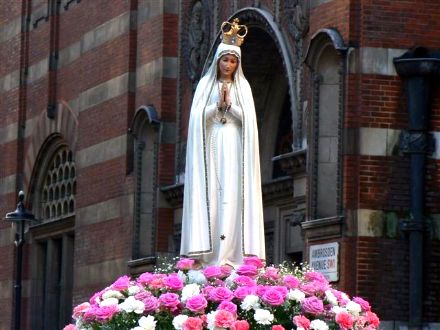
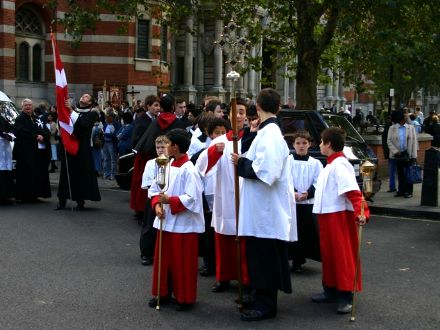
THE BLESSED VIRGIN HAS quite the legion of followers at her beck and call, and a good many battalions (perhaps even a regiment?) turned up on October 14 for the annual Rosary Crusade for the reparation of sins. The event began with a procession from Westminster Cathedral near Victoria Station, through the streets of London, to Brompton Oratory in Kensington. A statue of Our Lady was borne aloft by members of the Catholic Police Guild the whole way to the Oratory, where Benediction was held. We bring you these photos, taken by, amongst others, Matt Doyle, and Ken Simpson, all of which we found via ‘Joee Blogs‘, a Catholic medical student in London.
Poor Old Bram
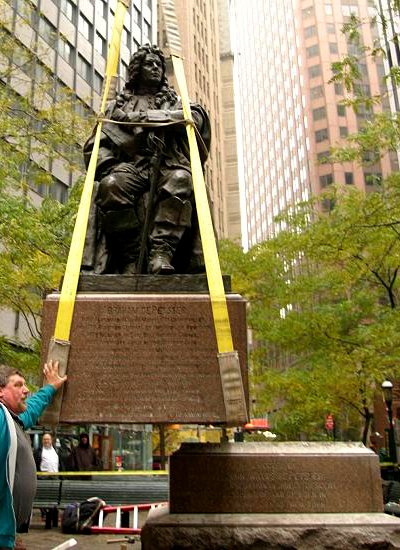
ONE HAS TO FEEL A certain amount of sympathy poor old Abraham de Peyster. The city fathers, in their infinite and unending wisdom, sought fit to erect a statue of Bram in Bowling Green, the old town square of New York down at the beginning of Broadway, many moons ago. However, having set Bram very nicely upon that green, the first public park in all New York, the city fathers have of late refused to let old Heer de Peyster rest. In 1972, the park was ‘renovated’ which entailed the statue’s forced removal. He ended up four years later in Hanover Square, a quite suitable though less prominent location, where he gazed across the square towards India House. It was then that old rivalries flared anew. (more…)
Our Holy Emperor
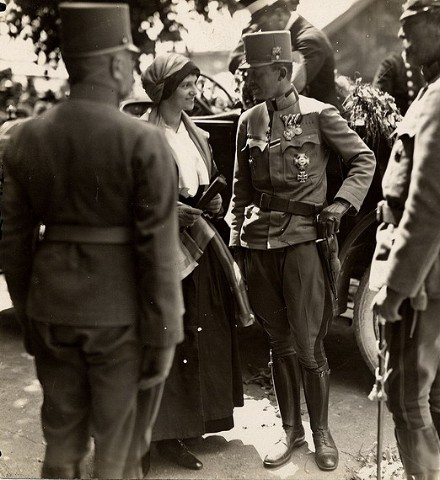
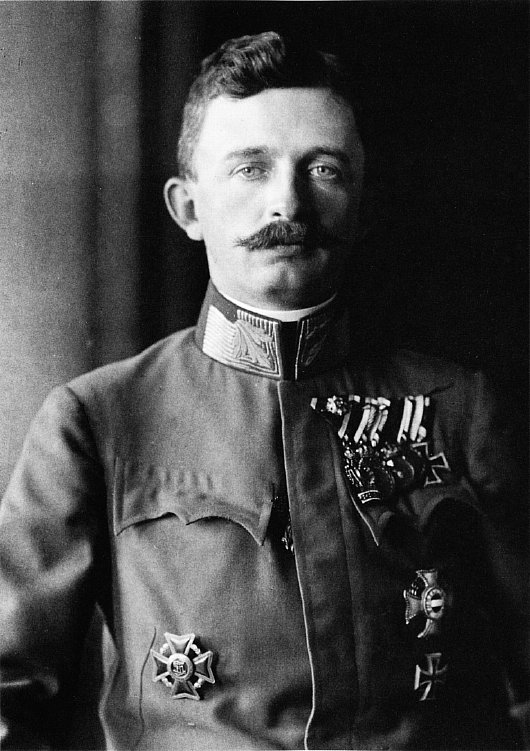
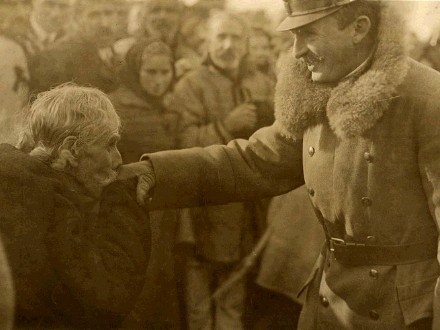
OCTOBER 21 IS the feast of Blessed Charles of Austria, the saintly emperor of that sacred realm whose life stands as an example of the price of sanctity. Charles worked tirelessly for peace both between the peoples of his own numerous realms and between all the nations, seeking to bring to an end the ceaseless and suicidal slaughter of the Great War, in the midst of which he had ascended to the throne of his fathers. A defender of social order, Charles reminds us of our many responsibilities to each other, even though the spirit of our current age would have us clamor only for our supposed rights. In the face of repeated betrayal and intense pressure, he refused to abdicate and so abandon his peoples to their fates, which were terrible indeed. That terrible cross he bore, the crown, was in fact a penitential grace, the sufferings he bore for the benefit of his – and indeed all – people. His reward was not in this world.
The Duke of York in New York
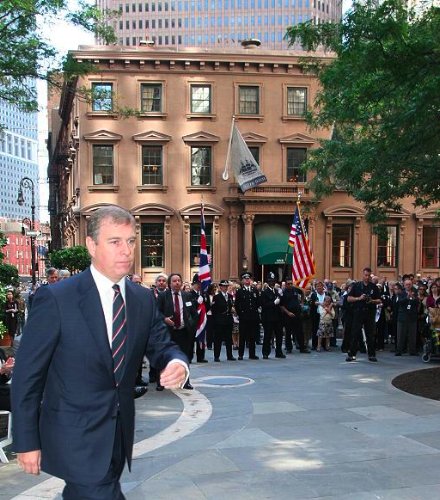
We neglected to mention Prince Andrew’s recent visit to New York in commemoration of the anniversary of the attacks on the World Trade Center. Sixty-seven British subjects died in the September 11, 2001 attacks, and eleven more were non-citizens with British ties. A ceremony was held in Hanover Square, where the British Memorial Garden is being built, followed by a reception at India House, which is located at No. 1 Hanover Square (the brown edifice in the photos above and below). (more…)
Lions and Torches and Trees (Oh My!)
Or, What £40,000 Gets You in Today’s World


A
MONG THE MANY changes which the Rt. Hon. David Cameron MP has wrought in his ten months as leader of the Conservatives one of the most public is the change of the party’s emblem. The flaming torch is out and the solid oak is in, at a cost of £40,000 to Conservative Central Office (according to the Times). There are three slightly different designs of the tree for the UK-wide, Scottish, and Welsh parties. Previously, the national party used the ‘flaming torch of liberty’ logo while the Scottish party used a blue lion rampant and Wales had its rather comely red-white-and-blue dragon with fire pouring forth from its mouth. The former logo was the ‘flaming torch of liberty’, which only entered into usage in the 1980’s under Mrs. Thatcher. In its place, we find instead an oak tree with healthy greenery on its limbs and a trunk made out in the traditional Tory blue. (more…)
James II, Our Catholic King
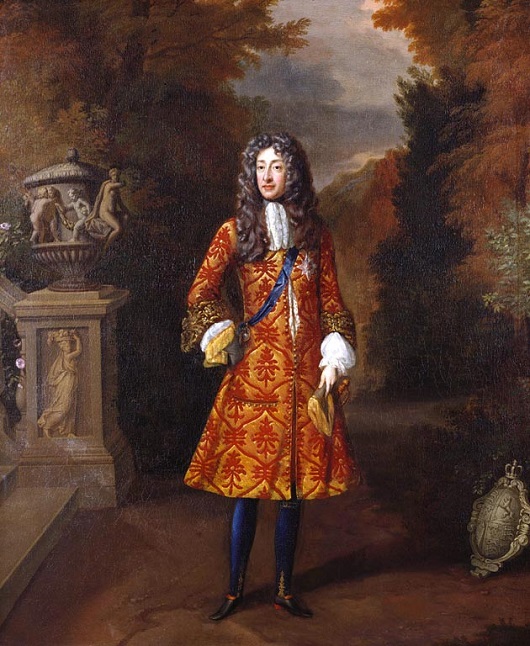
THIS PAST SATURDAY was the anniversary of the birth of King James II and VII of England and Scotland. The third son of Charles I, he was baptised into the Anglican church six weeks after his birth and was created Duke of York at eleven years of age. James married Anne Hyde, the daughter of the Earl of Clarendon, by whom he fathered eight children, though only two survived past childhood.
In 1664 the Duke of York equipped an expedition to relieve the Dutch of responsibility for their colonies in North America, and henceforth New Amsterdam and New Netherland were known as New York after their new Lord Proprietor.
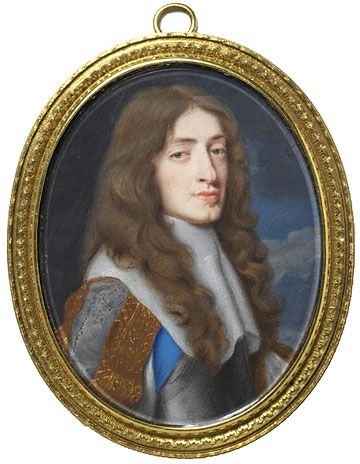
Sometime during the year 1670 both the Duke and Duchess of York were received into the Catholic Church and stopped attending Anglican services, though the conversion did not become public knowledge until the Test Act (requiring officeholders to receive communion in a Church of England service and take an oath against Transubstantiation) was passed three years later. James was forced to renounce his offices, such as Lord High Admiral of England, though not his titles. At any rate, Anne, the Duchess of York had died in 1671 only a year after her conversion. He married Princess Maria of Modena in 1673.
The Protestant oligarchs felt threatened by the prospect of a Catholic king and thrice tried to pass laws barring James from succeeding to the throne. However his elder brother Charles II, the reigning king, dissolved parliament each time before the bill was to be passed. King Charles II died in February 1685, (having reconciled himself to the Catholic faith before his end) and thus the Duke of York was proclaimed James II of England and VII of Scotland. A private Catholic coronation was held at Whitehall Palace on April 22 before the public coronation the following day on the feast of Saint George, which was performed according to the rites of the Church of England.
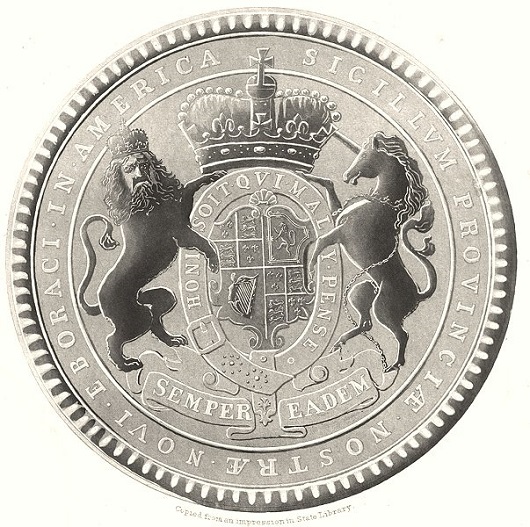
James had appointed the Catholic Thomas Dongan
as Governor of New York in 1682.
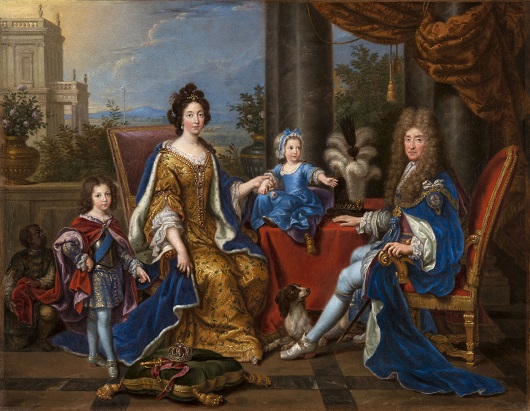
The Protestant oligarchs’ fears that James would end their hegemonic grip on Scotland and England proved well-founded as in 1687 he issued a Declaration of Toleration as King of Scotland, allowing Catholics, Episcopalians, and other non-Presbyterians to hold public office and the right of public worship, and a Declaration of Indulgence as King of England removing the laws penalizing non-attendance or non-communion at Church of England services, permitting non-Anglican worship in private homes or chapels, and abolishing religious oaths for public offices. Furthermore, James had allowed Catholics to hold positions at the University of Oxford for the first time since the Protestant Revolution. More provocatively, he tried to transform Magdalen College Oxford into a Catholic seminary. He had already reckoned with the rebellion of the Duke of Monmouth who proclaimed himself king two years earlier but had been captured, tried, and executed for treason. With the birth of a Catholic son and heir, Prince James Francis Edward, in 1688 a cabal of seven Protestant nobles issued an invitation to William of Orange, the Protestant Stadtholder of the Netherlands. A few months later, William of Orange duly arrived and usurped the throne, having already married James’ daughter Mary from his first marriage. The two ruled jointly as William and Mary.
Unwilling to create a popular martyr as had happened with the executed Charles I, William allowed James to escape and fled to France where Louis XIV gave the exiled monarch the use of a palace and an ample pension. James was intent on returning to his birthright, however, and took advantage of the Irish parliament’s refusal to recognise William’s usurpation of the throne. The King landed in Ireland in March of 1689 at the head of a Franco-Irish army but was defeated by William in the famous Battle of the Boyne in July 1690, and returned to his place of exile in France.
There, Louis allowed him to live in the château of Saint-Germain-en-Laye and offered to get James elected King of Poland but James felt this would prevent any chance of a Stuart again holding the throne of England. From that time onwards, James led a simple life of penance in reparation for his sins (he had had a number of mistresses in his younger days) and finally died in 1701. He was entombed in the Chapel of St. Edmund within the English Benedictine church on the Rue St. Jacques in Paris, while his brain was sent to the Scots College in Rome, his heart to the Visitandine Convent at Chaillot, and his bowels divided between the College of St. Omer (the exiled English Catholic school, now Stonyhurst in Lancashire), and the nearby parish church of St. Germain where they remained until they were desecrated by a Revolutionary mob and lost forever. His monument at Saint-Germain, however, was rediscovered in 1824 and is proudly displayed there to this day. There is also a monument to James and the Stuarts in St. Peter’s Basilica in Rome (c.f. Roma – Caput Mundi).
Aside from the pious tradition that Edward VII was received into the Church on his deathbed, James II was the last Catholic king (and as good King Edward never reigned over New York, James is even more certifiably so for us). There is a lovely coronation ode to James which I just might bring to your attention someday. But for now, reflect and remember our monarchs of old and pray that God in His mercy might grant us good Catholic rulers in stead of the shabby lot we elect today.
Old Dutch Gable
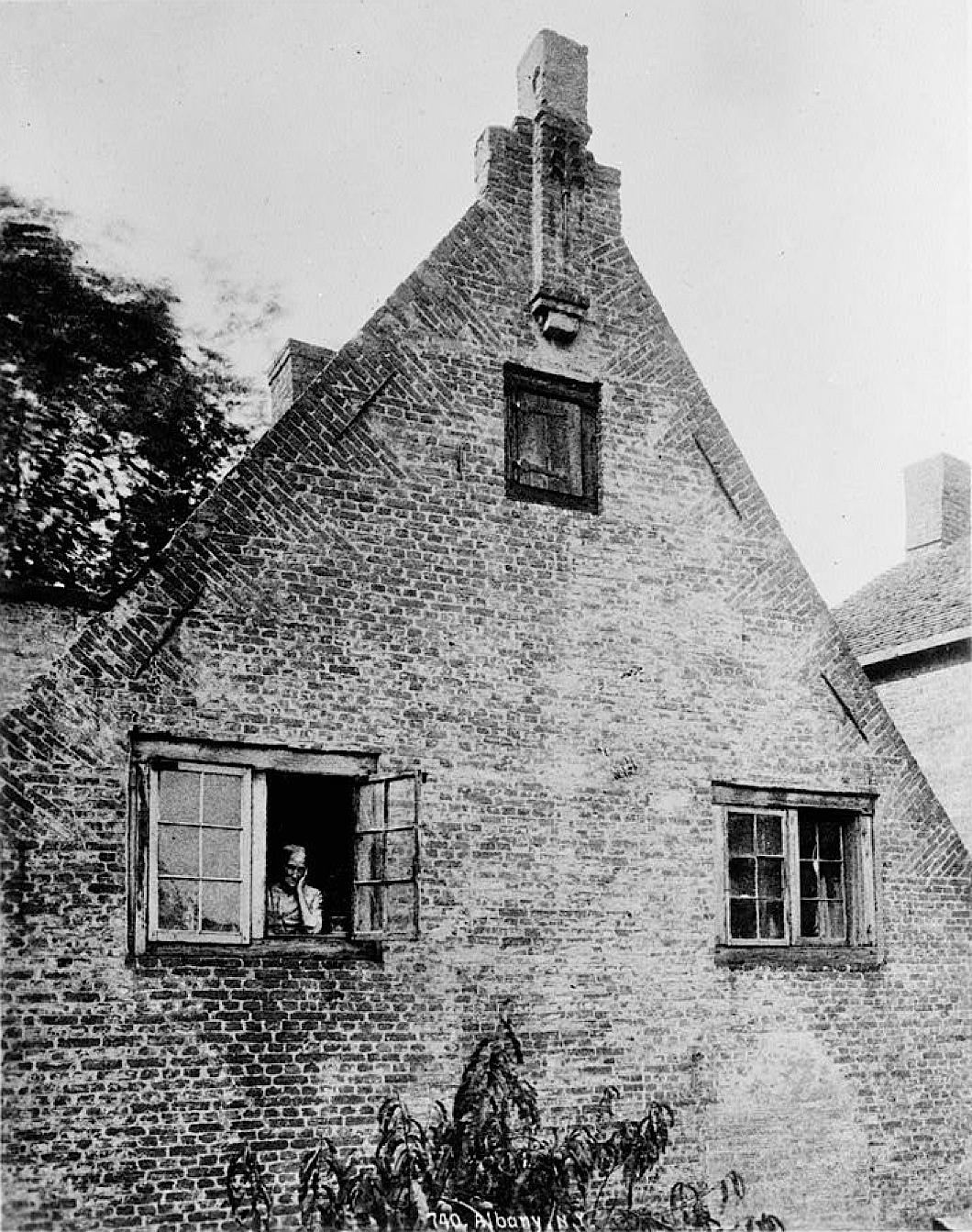
An old Dutch gable complete with old Dutch vrouw gazing miserably from the window. Albany County, New York, 1930’s.
The form of brick course on the gable is known as ‘mouse-tooth’ and is found primarily in Holland, East Anglia, and the Hudson Valley of New York, though also here and there in the American South.
Old Yale Boathouse Faces Wrecking Ball
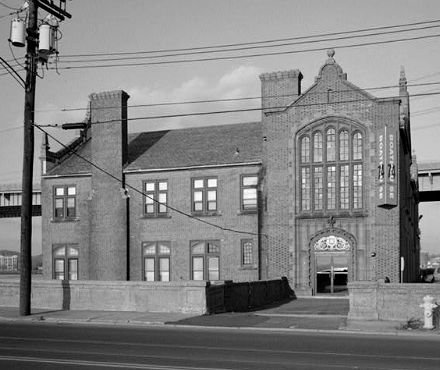
AND SO, THE ONWARD march of progress continues. Yale University’s old Adee Boathouse on New Haven harbor is to face the wrecking ball to make way for traffic improvements to the Pearl Harbor Memorial Bridge which carries Interstate 95 across the Quinnipiac River. Despite some quite extraordinary plans to physically cut the building from the shore and float it across to the opposite side of the river, it now appears that the boathouse is to be demolished. (more…)
Goosesteps and Pickelhaubes
The Republic of Chile’s Annual ‘Parada Militar’
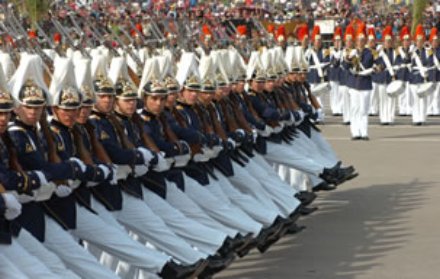
WHILE MANY NATIONS have thrown time-honored traditions and ceremonies to the wind, they remain central to the South American nation of Chile. Through the wisdom of its leaders, be they civil, military, Liberal, Conservative, Radical, Socialist, or Christian Democrat, this republic on the Pacific has not sampled the bitter taste of war since 1883 when they snatched the last remnants of Bolivia’s coastline. (Bolivia, now landlocked and ever holding a grudge, still maintains a small navy in defiance of geography). Having steered clear of the suicidal bloodlust which consumed much of the Western world during the Twentieth Century (say what you will about the deaths of the Allende/Pinochet years, they are far fewer than our dead of the World Wars, Korea, and Vietnam), Chile feels free to continue in the best of its European traditions free from emotional hangups.
For we in the Anglo-American world, goosesteps and pickelhaubes evoke nasty images of Prussian militarism and Nazi hegemony. While the pickelhaube is actually of Prussian origin, having been designed in 1842 by Frederick William IV, the revolutionary Hitler eventually banished them as fusty remnants of the ancien regime. And, while Hitler did popularize the goosestep, this particular form of march has its origins in old Imperial Russia.
Chile is a nation composed of settlers from almost every European country, and has adapted and melded its traditions and culture thencefrom. The ‘Father of the Country’ was an Irishman by the name of Bernardo O’Higgins, while the founder of the Chilean Navy was the 10th Earl of Dundonald. Later immigrants brought influence from Germany, Italy, and other countries, while the founding influence of Spain remained.
Every year, Chile celebrates the ‘Day of the Glories of the Armed Forces’ on September 19, the day following Chile’s Independence Day of September 18 commemorating the 1810 junta. The civil leaders of the land and high-ranking military officers assemble at a stand on the Campos de Marte in the Parque O’Higgins in Santiago and review a long parade of the Army, the Navy, the Air Force, and the Carabineros, Chile’s gendarmerie-style national police.
I’ve always loved a parade, and there is no parade like a military parade, so I decided to share with you a few views of Chile’s annual parada militar. One gets the impression that just before we put the Third Reich out of business, they contracted a huge surplus uniform sale to the Chileans which has left them a bountiful supply of uniforms to this day. Indeed, judging by some of the uniforms, one might even get the impression that the same happened earlier in the century when we (lamentably) forced the Kaiser to close shop. But the Chileans will continue to wear their uniforms with pride, and who can blame them? They look good. (more…)
The Auld Scotsman
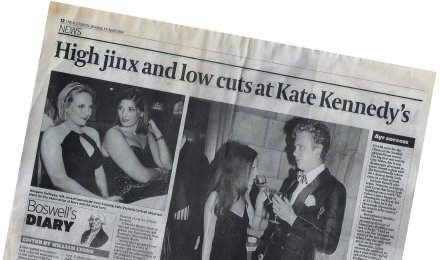
ONE THING WE greatly enjoyed about the Scotsman in its pre-tabloid days was that they often deemed St Andrews social events worthy of coverage in their august pages. It was a source of pride to see ‘the national newspaper’, a respectable broadsheet, covering events at the oldest university in the land (which we are proud to call our own). Naturally, once the conversion to tabloid size was complete, we were rarely heard of again, which was a little saddening. The Scotsman is not what it used to be —a beautiful, well-designed, informative respectable newspaper— but it still manages to print some thoroughly worthwhile articles which is more than can be said of any other Scottish daily. (One need only point out two articles by Prof. Haldane, c.f. here and here, recently posted on this site).
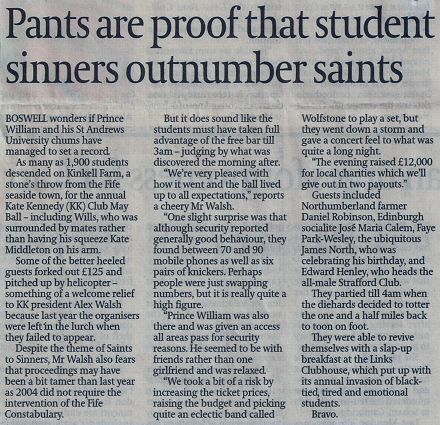
“…when the diehards decided to totter the one and a half miles back to toon on foot.” Sounds familiar.
Admittedly, most of the events covered were organised by the Kate Kennedy Club, which seems to take pride in the sheer vulgarity and tastelessness with which they advertise many of their events. (This is only slightly mitigated by their superb running of the annual Kate Kennedy Procession). Still, we enjoyed the Scotsman‘s coverage and wish it had continued. I only bought the Scotsman on occasion after the switch, but often gave the Common Room’s copy a browse when I lived in St. Salvator’s. (Its Sunday edition, Scotland on Sunday is worth buying for Gerald Warner alone).
Here are a few bits and pieces clipped from the Scotsman for your perusal:
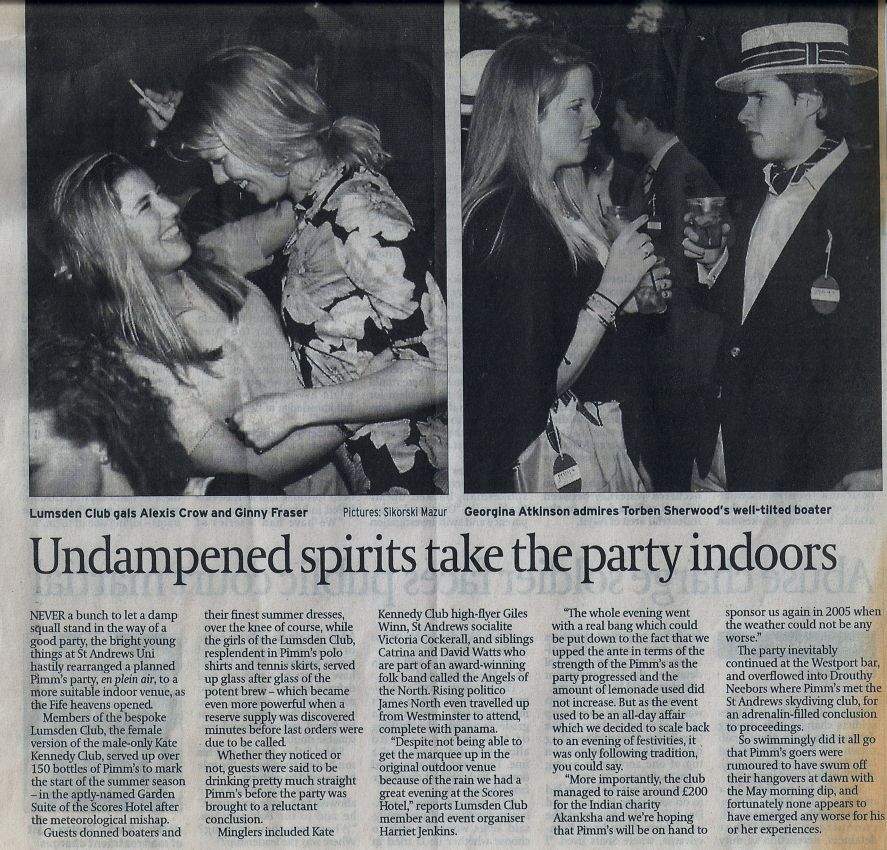
‘Undampened spirits take the party indoors‘ / Lumsden Club garden party moved indoors on account of the rain. (I didn’t go).
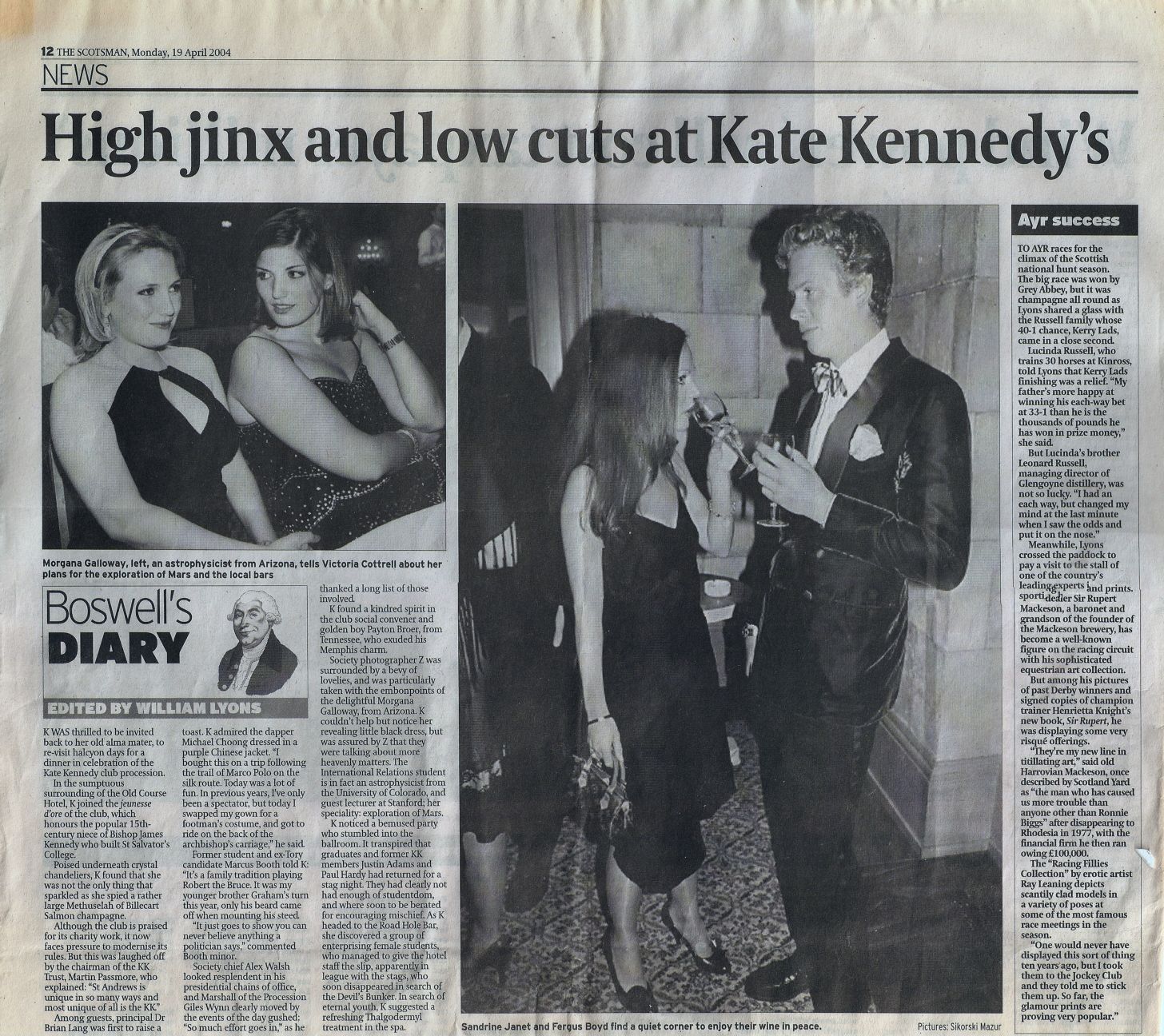
‘High jinks and low cuts at Kate Kennedy’s‘ / This covered the Kate Kennedy Procession dinner which takes place at the Old Course Hotel on the evening following the procession. This particular year I was in attendance myself and recall commiserating with Michelle Romero, that charming daughter of Venezuela, about the troubled state of her native land. I was their with our favorite Dane, Sofie von Hauch, and my flatmate, a member of the KK who wishes to remain unnamed on this site. Will Lyons couldn’t make the dinner himself, so he sent ‘K‘ up instead, accompanied by ‘society photographer Z‘ whom I ran into while we were on our way out.
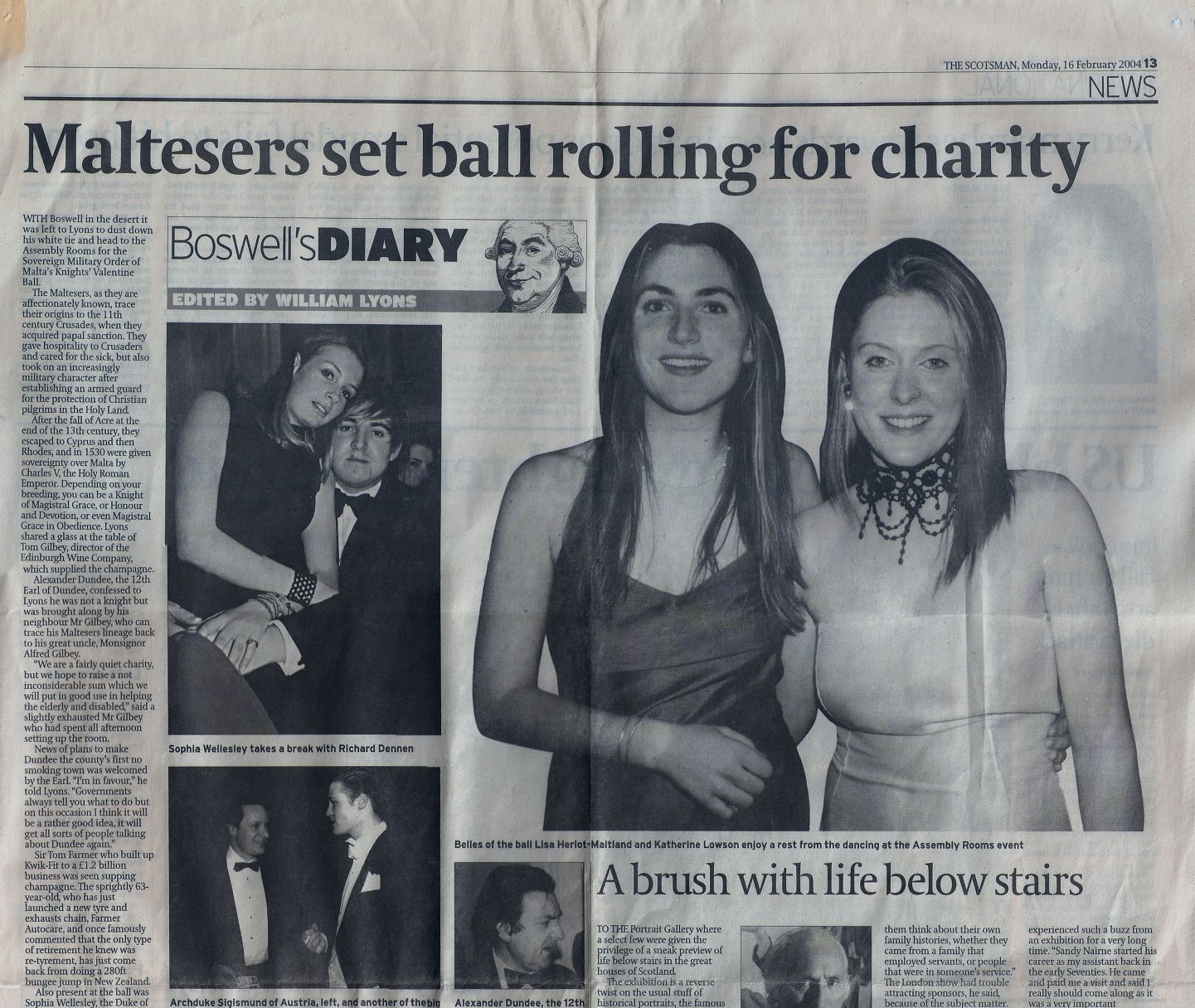
‘Maltesers set ball rolling for charity‘ / The 2004 Knights of Malta Ball, not covered by this website because it did not exist at the time. It was a good time, especially so because I had three friends over from the States. Yalie Adam Brenner was doing his semester abroad at St Andrews at the time, and fellow Old Thorntonian Clara de Soto popped over from Boston College for the weekend with her good friend Katie Cordtz of Atlanta. The four of us together with Michelle Romero and the aforementioned unnamed flatmate of mine piled into a cab and made the hour’s journey to Edinburgh for the soirée. Poor Adam, though. Towards the latter part of the evening Archie Crichton-Stuart, an exceptionally amusing Edinburgh student, and his friend Ramsay forced Adam to consume the significant remnants of a bottle of house red. It all went down swimmingly, but came back up on the cab ride back to Fife. Freddy McNair, who was recently nearly killed by an incompetent gurkha on a training ground, sat at the table next to ours, I recall. (Also, in the lower right-hand corner of the clipping you can spy the face of our good friend Ricky Demarco peering out from an unrelated article).
Previously: Another Broadsheet Bites the Dust
Search
Instagram: @andcusack
Click here for my Instagram photos.Most Recent Posts
- West Point July 30, 2026
- Brunel’s Unbuilt Capitol February 3, 2026
- Cricket at Fordham January 27, 2026
- Palacio Barolo Revisted January 14, 2026
- Learning to Love Liguria January 14, 2026
Most Recent Comments
Book Wishlist
Monthly Archives
Categories