About Andrew Cusack
 Writer, web designer, etc.; born in New York; educated in Argentina, Scotland, and South Africa; now based in London.
 read more
News
Blogs
Reviews & Periodicals
Arts & Design
World
France
Mitteleuropa
Knickerbockers
Argentina
The Levant
Africa
Cape of Good Hope
Netherlands
Scandinavia
Québec
India
Muscovy
Germany
Academica
A Book to Remember
Chumley’s Launch Party for ‘Forgotten New York’ Book
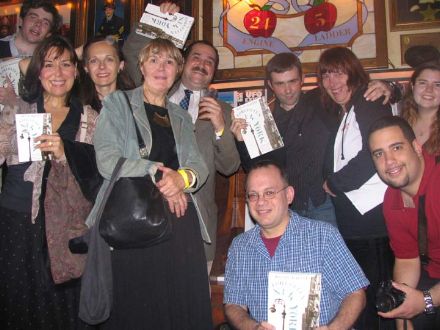
AS I GROW more and more cantankerous, my tolerance for evening trips down to Mannahatta declines, but on occasion there’s an event which would be a crime to miss. Last Thursday, Dawn Eden and I popped down to Chumley’s, the old speakeasy on Bedford Street in the West Village, for the shindig launching Kevin Walsh’s brilliant book, Forgotten New York: Views of a Lost Metropolis. (Kevin reports on the party here). I’ve been following Kevin’s Forgotten New York website for years now, and it has earned an unquestionable rank as one of my favorite sites ever (though, shamefully, I’ve never been on one of his legendary ‘Forgottentours’). The author himself was on hand, naturally, and I also enjoyed meeting a number of very kind people who are as fond of Forgotten New York as I am.
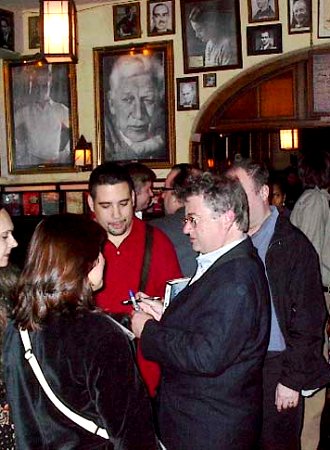
The Man of the Hour himself: Kevin Walsh (in glasses).
While Dawn and Kevin are familiar friends (she even gets a mention in the book’s acknowledgements), I had never before had the privilege of meeting this great chronicler of quinqueboronian miscellany. He is very much like his website: simple and brilliant. Happily, I got my complementary copy of the book personally inscribed, though I quite presumptuously upbraided him for only mentioning Audubon Terrace in passing (c.f. FNY: ‘I Can’t Drive 155’) while I believe it is worth a Forgotten page of its own. (Naturally, I have a post slowly developing on Audubon Terrace, which I believe is one of the most beautiful public spaces in all New York, as well as one of the most underappreciated).
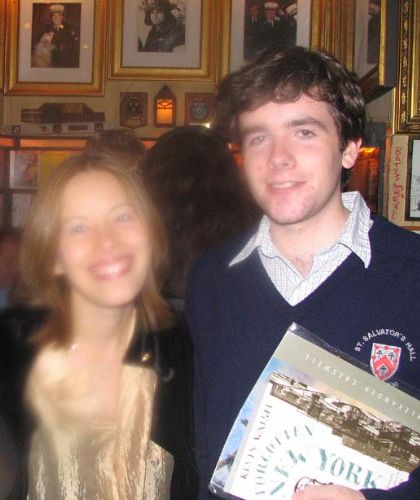
No, the camera isn’t smudged; an angelic haze follows Dawn wherever she goes.
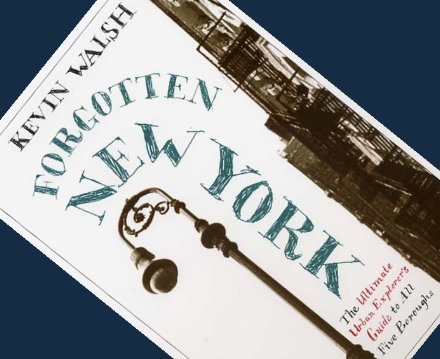
But enough of the fun, how’s the book? Well I love it. It’s emphasis is on breadth rather than depth, since it’d be impossible to reproduce the entire contents of the encyclopedic website in a mid-sized paperback book. I view the book in two regards: first, as a handy basic guide referencing the variety of forgotten, unnoticed, and underappreciated sites around the Five Boroughs; and second, as a good jump-start companion to the more thoroughly informative website.
Take, for example, the Lent Riker Smith House out in Queens. Browsing through the book we see the entry on the ‘Lent Riker Smith Homestead’ which gives us two paragraphs of information. Enough to whet the appitite and plant the seed of intrigue, but when we check out the website’s entry on the house we get much, much more… and in color, to boot. I hope readers not yet familiar with the website will use the book as a springboard, but I also hope that we will be gifted with updated editions of the book in years to come, with added features.
Buy the book. Aficionados of forgotten-ny.com will appreciate a version of the familiar in dead-tree form, while the uninitiated will find it extremely useful as a foundation for appreciating Gotham’s numerous nooks and crannies. Kevin Walsh has done a great service to all those who have a love for the Big Apple.
Esther Goes to the State Fair
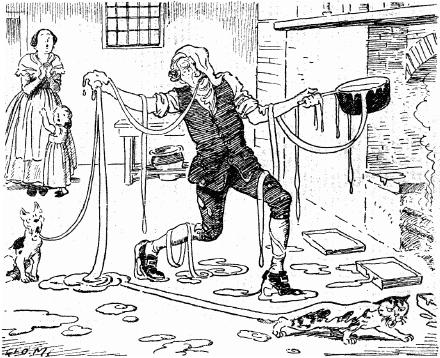
Once, when I was worried that someone would find my money, I taped it under the sofa and forgot about it. Later, when I traded that sofa for a new sofa, I forgot to transfer my taped money to the new sofa. When I found the guy who had my money sofa, I told him I forgot my leg medicine in the cushions and could he please let me find my leg medicine. He said sure, so I retrieved my money and got out of there.
But that’s not all. I also use the leg medicine story to get free admission to the state fair. Every year I tell the admissions guy that I left my leg medicine at the root beer stand. “I need that medicine to live,” I tell him. One year, when the state fair guy got wise and asked me why I take leg medicine, I told him I don’t take leg medicine, and then I punched him in the face.
Birds of a Feather?
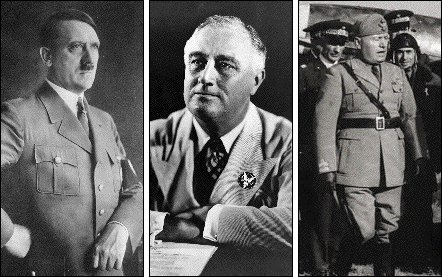
 Were Hitler, Roosevelt, and Mussolini really just different cuts of the same cloth? In a new book, Three New Deals: Reflections on Roosevelt’s America, Mussolini’s Italy, and Hitler’s Germany, 1933-1939, Wolfgang Schivelbusch makes precisely that argument. Interestingly, the National Socialists in Germany looked with fondness towards Roosevelt’s style of rule. The Nazi party newspaper Völkischer Beobachter actually praised “the adoption of National Socialist strains of thought in his economic and social policies” while Mussolini also saw a bit of himself in FDR. Roosevelt wouldn’t give the time of day to Herr Hitler but was actually quite fond of Signor Mussolini, calling him “that admirable Italian gentleman”.
That there were massive differences between the three is obvious. (Mussolini and Hitler came to the brink of war over Austria, and later they both had a war with Roosevelt). Nonetheless, the similarities are worth pointing out, and David Gordon has written a review of the book over at the Ludwig von Mises Institute. Give it a read.
Without family & faith we’ve lost our way
by JOHN HALDANE
THE SCOTSMAN | Friday 1 September 2006
DR JOHNSON’S memorable observation that “nothing so concentrates the mind as the prospect of imminent hanging”, has provided a formula for highlighting other attention-focussing threats. Currently, for example, the minds of Scotland’s MSP’s may be said to be concentrated by nothing so much as by the prospect of next year’s Holyrood elections.
It is reported that Labour and the SNP are each holding strategy discussions to prepare for May’s poll. The latter in hope of victory, the former in fear of defeat. Meanwhile, the Liberal Democrats try to look principled while yet pondering the best bet for coalition partners; Conservative MSPs are under attack from within their own party for their mediocre performance; and Scottish Socialists are breaking apart and regrouping in smaller cells. Concentrating the mind is rarely easy, often uncomfortable, and sometimes destructive.
So much for the politicians, what of the electorate? or more aptly, in times of declining voter participation, what of the people of Scotland? It is clear that here, as in the UK more generally, people have little confidence not only in politicians but in politics. Apart from cynicism encouraged by decades of scandals which, whatever their differences, give the general impression of exploitation of office; there is the feeling that most policies simply fail to make life better.
Heraldry is as much part of the future as present
by JOHN HALDANE
THE SCOTSMAN | Saturday 9 September 2006
A COUPLE of weeks ago St Andrews was treated to the sight of a colourful parade of heralds, hereditary standard bearers, nobility and clan chiefs, representatives of the University, leaders of the Christian churches, and sundry others, processing through the town to the accompaniment of the pipes. The occasion was the opening by the Princess Royal of the 27th International Congress of Genealogical and Heraldic Sciences, featuring the first meeting of European heralds since the middle ages.
This weekend St Andrews sees another ritual procession: this of Knights and Dames of the Equestrian Order of the Holy Sepulchre gathering for an investiture in the 15th century chapel of St Salvator’s College. Once again gowns, insignia, and banners of medieval inspiration will be on view as Scottish members are joined by representatives from abroad and from the Sovereign Military Order of St John – with the pipes again adding a distinctively Caledonian note.
Such events, and the groups and individuals they bring together can easily be seen as part of a world of childlike, or even childish, fantasy. Trying to live as if in a realm of castles, chivalarous knights, noble heroes, fair ladies, courtly love and sacred adventures, all rendered for posterity in chronicles and ballads.
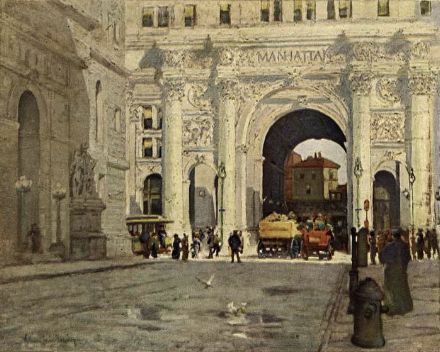
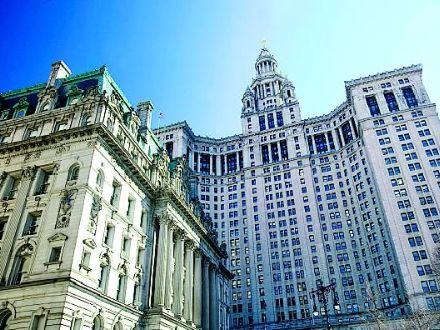
The Old Police Headquarters

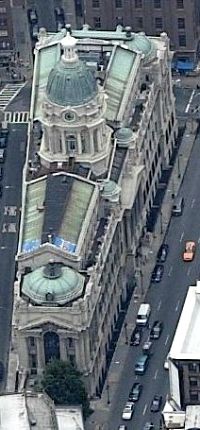 ONE OF THE finest buildings in all New York is also one of the least-appreciated and most forgotten. The old Police Headquarters at No. 240 Centre Street was built in 1909 on a triangular lot in what was then solidly Little Italy. Arguably, it is today located in the ever-expanding Chinatown, but real estate brokers usually describe its location non-ethnically as Soho, just on the cusp of the area which is increasingly (and most irritatingly) known as NoLIta, ‘North of Little Italy’.
From the basement shooting range to the rooftop observation deck, the building was designed in the monumental Beaux-Arts style by the firm of Hoppin & Koen, “to impress both the officer and the prisoner with the majesty of the law.” The New York Times wrote that “its grandeur contrasted utterly with the little buildings and crooked streets around it.”
The older old Police Headquarters, where reformer Teddy Roosevelt held court as Police Commissioner, was located nearby on Mulberry Street and when the nerve center of the N.Y.P.D. shifted to Centre St. between Broome and Grand, the gun shops, cop saloons, and police reporters followed suit. One restaurant across the street was simply called ‘Headquarters’. With its oak bar and ceiling of carved wood, the ‘Headquarters’ restaurant became a particular favourite among the higher brass of the N.Y.P.D. According to popular lore, a tunnel was actually constructed connecting the restaurant with the actualy Police HQ, in which a number of the Boys in Blue used to enjoy a drink during the trying days of Prohibition. (more…)
Vienna on 43rd Street
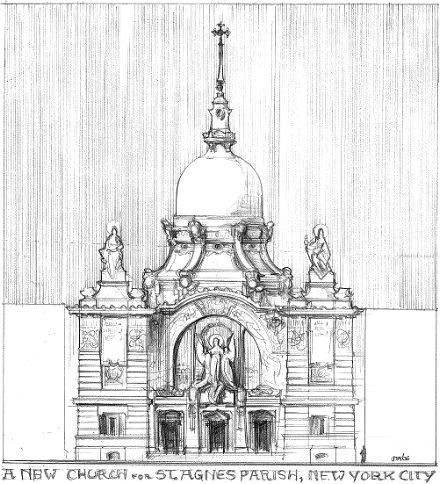
A WEEK AGO AFTER the 11 o’clock Sunday Mass at St. Agnes, Dino Marcantonio, Matt Alderman, and I stood in front of the church and fantasized about how we would fix the old place. Well, perhaps ‘old’ isn’t the right word for the place. While the parish was founded in the 1840’s, the current church building only dates from the late 1990’s, built after the old Victorian edifice was consumed by fire. As for design, its heart is in the right place, but as they say the Devil is in the details. The interior is marred by quite obviously large joints between component parts of arches and cornices and the exterior just looks fake. Is craftsmanship dead? No, but it helps to search it out instead of accepting just any old thing.
At any rate, Matt Alderman has thrown together these esquisses of what his St Agnes would look like, and it’s all rather Austrian. (more…)
Centro Naval, Buenos Aires
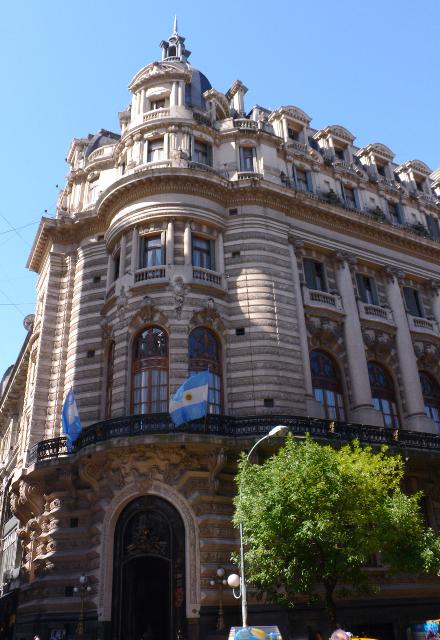
OUR GOOD FRIEND Tori Truett sends greetings from Buenos Aires where she is visting relatives and her salutation sparked a number of memories from my all-too-short time down there. One of these memories was being relieved upon by a bird whilst pottering about the market of San Telmo one afternoon (it remains the only time I have suffered the indignity of such an aerial bombardment). The good city, however, has more beautiful buildings than the Big Apple, both in quality and quantity. Their good buildings are better than ours, but then their ugly buildings are even uglier. (As terrible as the Whitney Museum is, I doubt it matches the Biblioteca Nacional for sheer vulgarity). (more…)
A Picture of Domestic Bliss
I work at my computer in a small room here at home, and Jamie has his in the main room alongside. When we are both tapping away busily, our work is punctuated by his pleas for cups of tea (sometimes he just makes a sort of bleating noise – it’s really quite heart-rending) and by the telephone ringing (annoying – so we often leave the answerphone on and deal with calls later). […]
Later, emerging from a tube station on my way to St Mary’s Church in Chelsea where I was due to give a talk to young engaged couples as part of a Marriage Preparation course, I had a most extraordinary and wonderful experience. There are eight million people in London. And there, walking towards me, was the one person dearest to me in all of them: my husband Jamie. He would never normally be in that part of London, and it is unusual for me to be there too. Neither of us had co-ordinated our activities today, just normal busy schedules for us both…….. He had been at some event at Brompton Oratory followed by lunch and a meeting nearby…..it was a chance in eight million that we should both happen to be in Sloane Square at that precise moment.
Just a little snippet from Joanna Bogle’s new blog, Auntie Joanna Writes. Joanna is an author and journalist, as well as being wife to Jamie Bogle (c.f. balls of ’05 and ’06). You can go on a tour of Catholic England by listening to fourteen of Joanna’s ‘Catholic Heritage’ programs available at this address.
La Fallaci is Dead
Leftist Italian Writer, Atheist, Defender of the West, Sometime New Yorker, Once Made the Ayatollah Laugh
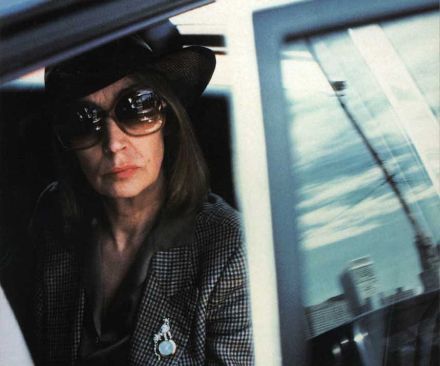
Oriana Fallaci, that indomitable and cantankerous Italian, has finally succumbed to cancer in her native land. When she first learnt of her cancer years ago, she kept smoking and refused to treat it because she had “too much writing to do”. Later, when it became difficult to eat solid foods, she drank champagne instead. Her 1972 interview with Henry Kissinger was described by him as “the single most disastrous conversation I have ever had with any member of the press”.
While an ardent leftist, she was an unrepentant foe of what she saw as the Islamic colonization of Europe. Her diatribes against the Muslim immigrants who habitually pissed on the walls of Florence cathedral earned her the ire of many, and legal proceedings were initiated against her in France. The liberal commentator Christopher Hitchens described her work as “an example of how not to write about Islam”. She began writing her infamous The Rage and the Pride, a book teeming with passion and righteous indignation, on September 11, 2001 at her home in New York.
Fallaci said she felt encouraged when Cardinal Ratzinger, another thinker who warned against Western self-loathing, was elected pope. “I feel less alone when I read the books of Ratzinger,” she wrote. The Telegraph reports that the Holy Father granted her a private audience a number of months ago, on the condition that never disclose its contents.
Oriana Fallaci will be buried tommorrow in the family tomb in the Protestant Cemetery in Florence. There will be no funeral; I hope a priest will say a mass for the repose of her soul.
Daily Telegraph obituary
Times of London obituary
‘La journaliste Oriana Fallaci est morte’, Le Figaro
Elephant Season Begins November 7
 We don’t often like discussing politics because it’s such a filthy business these days, and besides, if there’s anything worth saying about politics, no doubt Daniel Larison has already said it. Nonetheless, it is interesting to see the schadenfreude developing amongst conservatives eager to see the Republican Party wreap what it hath sewn come the midterm elections of November 7 this year. The GOP has really done it this time, or so says the common wisdom, and the combined effect of conservatives staying home on Election Day and of swing voters swinging to the Democrats may very well throw the House of Representatives to the Democrats for the first time in twelve years. The glee conservatives once exhibited only for the most delightful defeats of Democrats is now, in a truly bi-partisan spirit, extended to the Republicans as well.
Why will conservatives stay home on Election Day? Well, that is not the right question, as it is the natural inclination of the conservative to be at home. The question then is: why should a conservative vote Republican? The President, for starters, is an ardent devotée of liberal internationalism abroad and wants to impose it with our military, which he has disgracefully abused as his own little plaything. In Congress, meanwhile, the Republican majorities in both houses have enacted an orgy of spending and goverment largesse as if the concept of self-restraint is foreign and irrelevant, while refusing to act on issues important to conservatives, such as border enforcement.
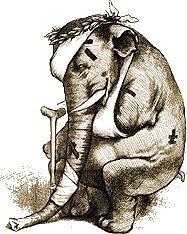 Voting Republican means we get liberal internationalism at our own expense (in blood, mind you, not just taxes), while at home we get porous borders (despite the terrorist threat), implicitly condoned illegal immigration (it’s good for business!), egregious spending (the ‘compassionate conservatism’ which is neither compassionate nor conservative), and the expansion of the powers of the federal government (continuing and augmenting the flagrant breaches of the Constitution which began in the 1960’s). Such being the case, the real question should be: what kind of self-respecting conservative would support such things with his vote?
But of course there is a silver lining. As much as conservatives may delight in seeing the Republicans thrown from office, in our two-party system the defeat of Republicans means the victory of Democrats. This is most unfortunate. However, with the appointments of Roberts and Alito to the Supreme Court (which will likely be remembered as one of G.W. Bush’s few conservative acts in his eight years as president), there is a feeling that sooner or later the highest court in the land will hear cases which return power to the states, as ordained in the Constitution. Having Democrats in charge, given their traditional predilection for centralization, might further spur such cases to come to the fore.
So farewell, then, GOP majority… and good riddance. Think about what you’ve done and come back in a few years. We are good Christian folk, after all, and forgiving; we will likely give you another chance in the future.
NOTE: I should clarify that we are speaking in this post only about the federal government. No doubt there are many decent conservative and conservative-leaning GOP officeholders on the state and local level.
The Heraldic Congress
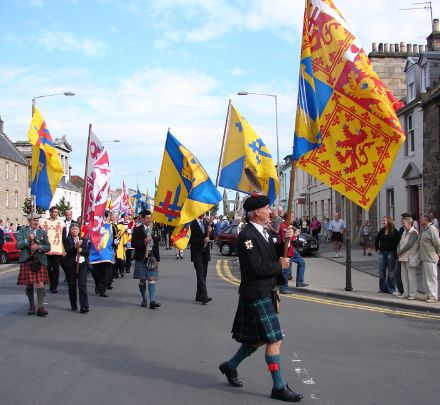
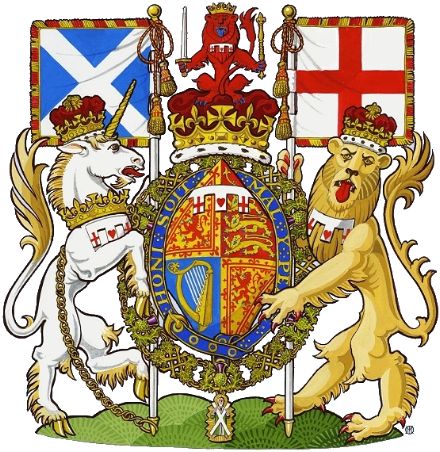
THE ROYAL BURGH of St Andrews was recently host to the largest gathering of heralds since the Middle Ages for the XXVII International Congress of Genealogical and Heraldic Sciences. Taking place in the last week of August, the Congress was opened with a grand ceremony in the University’s Younger Hall which was attended and addressed by the XXVII Congress’s patron, the Princess Royal (Scottish arms below). The event lured state heralds, genealogists, heraldists, and other enthusiasts from around the world, as well as local heralds from the Court of Lord Lyon (Scotland’s heraldic authority) and the personal heralds of Scots noble houses. Aside from the ceremonial, a broad variety of lectures were given on various topics in the realm of heraldry and genealogy. We present to you here a number of photographs from the event, which have been taken from the Congress website as well as from the personal collections of Mr. John Gaylor, a member of the Heraldry Society of Scotland, and Mr. David Appleton of the American Heraldry Society.
Wedding of the Century
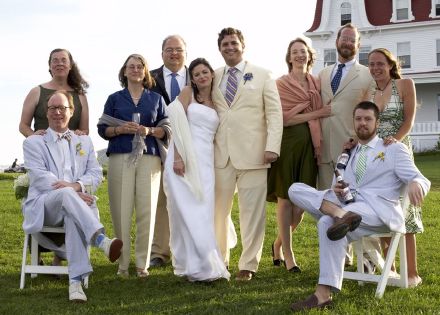
A most hearty congratulations to Mr. and Mrs. James Panero, who were wed recently in a ceremony on Block Island. The Times carried the announcement.
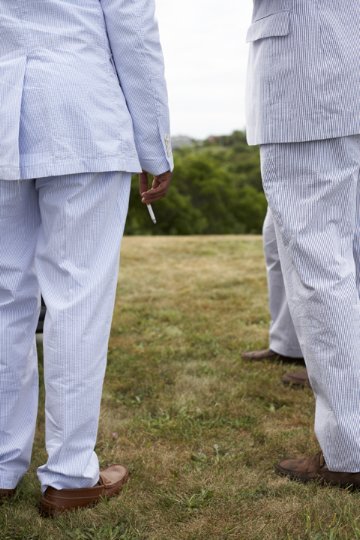
Scientists informed the media that the combined lightness of all the seersucker and linen suits worn at the ceremony raised Block Island four inches out of the water.
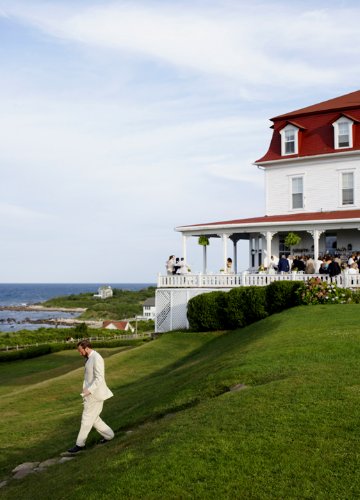
For David Yezzi, poetry is a lonely business…
The Jefferson Guards
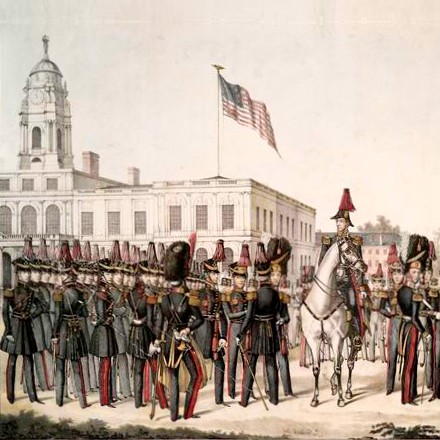
I recently stumbled upon this image depicting a militia regiment gathered in front of New York’s City Hall. The unit in question is the Jefferson Guards, 38th Regiment, New York State Artillery, amassed in bearskin caps and red-plumed shakos (red being the traditional color of the artillery). I confess I’d never heard of the Jefferson Guards before, but this is not entirely surprising. The Armed Forces of the State of New York – today composed of the New York Army National Guard, the New York Air National Guard, the New York Guard, and the New York Naval Militia – was once composed of a vast array of assorted regiments, battalions, and companies (a quite literal example of the ‘little platoons’ praised by Burke). These militia companies varied greatly in form, from little more than glorified social clubs to the crack units of the day.
As strange as it may seem, considered as a whole they were an almost completely organic military and, while they would be ill-suited to the armed exigencies of today, I refuse to believe that our little realm is better off for their general disappearance. Certainly the V.C.A. and the Old Guard, among others, survive to this day (in a somewhat different form, naturally), but what of the Empire Light Cavalry and the German Horse Guards? The Ulster Guard, the Weschester Chasseurs, and the New York Highlanders? The gallant Seventh Regiment of New York survived even into the 1990’s before its dissolution was ensured by the monotony monitors who now, fifteen years later, seek to destroy the great and blessed monument of an armory on Park Avenue which the Seventh built and guarded for over a century. We mourn their disappearance, just as we detest the continued and increasing disdain for the proud military heritage of the City and State of New York, but the entire culture which created and sustained them is gone, too.
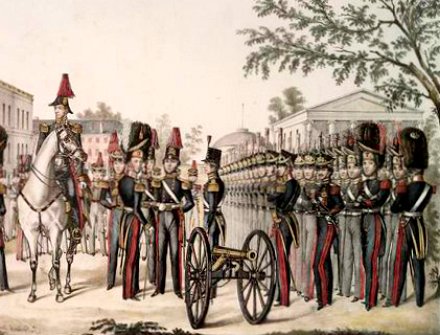
Category: Militaria – New York
The Unique Genius of Our American Democracy
“A famous Loyalist said that ‘I would rather be ruled by one tyrant 3,000 miles away, than by 3,000 tyrants not a mile away.’ It is the unique genius of our system (given that D.C. is 3,000 miles away from my home here in Los Angeles) that we are able to have both.”
Martyrs of Science
The Inventor of Toffee
A Scene at the Club
Punch, 28 July, 1920
I never liked Buttinbridge. I considered him a vulgar and pushful fellow. He had thrust himself into membership of my club and he had forced his acquaintance upon me.
I was sitting in the club smoking-room the other day when Buttinbridge came in. His behaviour was characteristic of the man. He walked towards me and said in a loud voice, “Cheerioh, old Sport!”
I drew the little automatic pistol with which I had provided myself in case of just such an emergency, took a quick aim and fired. Buttinbridge gave a convulsive leap, fell face downwards on the hearthrug and lay quite still. It was a beautiful shot—right in the heart.
The room was fairly full at the moment, and at the sound of the shot several members looked up from their newspapers. One young fellow—I fancy he was a country member recently demobilised—who had evidently watched the incident, exclaimed, “Pretty shot, Sir!” But two or three of the older men frowned irritably and said, “Sh-sh-sh!”
Seeing that it was incumbent upon me to apologise, I said, in a tone just loud enough to be audible to all present, “I beg your pardon, gentlemen.” Then I dropped the spent cartridge into an ash-tray, returned the pistol to my pocket and was just stretching out my hand to touch the bell when old Withergreen, the doyen of the club, interposed.
“Pardon me,” he said, “I am a little deaf, but almost simultaneously with the fall of this member upon the hearthrug I fancied I heard the report of a firearm. May I claim an old man’s privilege and ask if I am right in presuming a connection between the two occurrences, and, if so, whether there has been any recent relaxation of our time-honoured rule against assassination on the club premises?”
Shouting into his ear-trumpet, I said, “I fired the shot, Sir, which killed the member now lying upon the hearthrug. I did so because he addressed me in a form of salutation which I regard as peculiarly objectionable. He called me ‘Old Sport,’ an expression used by bookmakers and such.”
“Um! Old Port?” mumbled old Withergreen.
“Old Sport,” I shouted more loudly. Then I stepped to the writing-table, took a dictionary from among the books of reference, found the place I wanted and returned to the ear-trumpet.
“I find here,” I said, for the benefit of the room at large, for all were now [pg 75] listening, though with some impatience, “that in calling me a ‘sport’ the deceased member called me a plaything, a diversion. If he had called me a sportsman, which is here defined as ‘one who hunts, fishes or fowls,’ he would have been not necessarily more accurate but certainly less offensive.”
At this point there stood up a member whom I recognised as one of the committee. “I am sure, Sir,” he said, “that all present are agreed that you fired in defence of the purity of English speech, and that the incident was the outcome of an unfortunate attempt to relieve the financial embarrassment of the club by relaxing our former rigorous exclusiveness. Speaking as one of the committee, I have no doubt that the affair will be dismissed as justifiable homicide.”
Having bowed my acknowledgments I rang the bell. When the waiter appeared I bade him “Bring me a black coffee and then clear away the remains of Mr. Buttinbridge.”
Then I was awakened by the voice of Buttinbridge yelling, “Wake up, old Sport!”
‘We Stand By You’
Old Europe Lives?
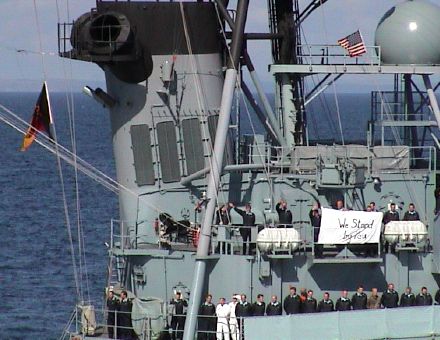
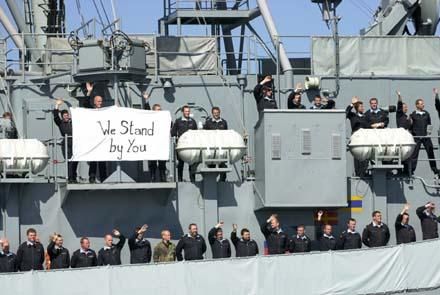
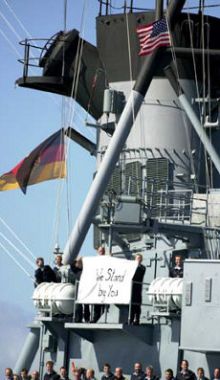 An incident at sea took place on September 14, 2001, just a few days after the attacks on New York and Washington, which has not been widely recounted. In the time leading up to September 11, the U.S.S. Winston S. Churchill was in port in Plymouth, England, where it was moored next to the Lütjens of the German Navy. During their time in port together, the officers and crews of the Churchill and the Lütjens had combined for a number of lively convivial undertakings in the generous spirit of friendship and brotherhood. After the attacks, however, Churchill immediately put to sea to perform a number of drills while maneuvering back in forth in the same area.
“It hasn’t been that fun I must confess,” an ensign aboard the Churchill wrote home, “and to be even more honest, a lot of people are frustrated at the fact that they either can’t be home, or we don’t have more direction right now. We have seen the articles and the photographs, and they are sickening. Being isolated as we are, I don’t think we appreciate the full scope of what is happening back home, but we are definitely feeling the effects.”
“About two hours ago the junior officers were called to the bridge to conduct Shiphandling drills. We were about to do a man overboard when we got a call from the Lutjens. […] Now at sea they called over on bridge-to-bridge, requesting to pass us close up on our port side, to say good-bye.”
“We prepared to render them honors on the bridgewing, and the Captain told the crew to come topside to wish them farewell. As they were making their approach, our Conning Officer announced through her binoculars that they were flying an American flag. As they came even closer, we saw that it was flying at half-mast. The bridgewing was crowded with people as the Boatswain’s Mate blew two whistles – Attention to Port – the ship came up alongside and we saw that the entire crew of the German ship were manning the rails, in their dress blues. They had made up a sign that was displayed on the side that read ‘We Stand By You’.”
As the ensign wrote later in the email, “It’s amazing to think that only a half-century ago things were quite different,” and it’s interesting to note that both ships are named after figures from the Second World War; Winston Churchill the half-American Prime Minister of Great Britain, and Günther Lütjens the admired German Admiral who died aboard the Bismarck.
Search
Instagram: @andcusack
Click here for my Instagram photos.Most Recent Posts
- West Point July 30, 2026
- Brunel’s Unbuilt Capitol February 3, 2026
- Cricket at Fordham January 27, 2026
- Palacio Barolo Revisted January 14, 2026
- Learning to Love Liguria January 14, 2026
Most Recent Comments
Book Wishlist
Monthly Archives
Categories