About Andrew Cusack
 Writer, web designer, etc.; born in New York; educated in Argentina, Scotland, and South Africa; now based in London.
 read more
News
Blogs
Reviews & Periodicals
Arts & Design
World
France
Mitteleuropa
Knickerbockers
Argentina
The Levant
Africa
Cape of Good Hope
Netherlands
Scandinavia
Québec
India
Muscovy
Germany
Academica
An Undesired Leave of Absence
Mes camarades! Unfortunately my precious MacBook — the technological device by which we keep you informed of russet-cheeked peasantry, hearty, cheerful nobles, and anything generally old-school and interesting — is steadily decreasing in functionality. I feel like an Indian colonial official discovering that the telegraph workers are about to go on strike and cut off the Jewel in the Crown from contact with the rest of the civilised world.
Fear not for me, my friends! This nifty book arrived in the post the other day, and I’m in the middle of Kristin Lavransdatter, the 1,200-page Norwegian masterpiece of Nobel laureate Sigrid Unset. It will likely be some months before I can scrap together the oojah for a new Mac, and these books will help me bide the time. As for you, dear readers, I hope the links in the sidebar will keep you at least partly entertained during my absence, and I apologise for any inconvenience to your lunch-break internet wanderings this period of absence may cause.
E-mail and Facebook communication will be exceptionally sparse, so friends are recommended to get in touch via telephone, carrier pigeon, or the sidewalk of 43rd Street in front of St. Agnes after the 11:00am Latin Mass on Sundays.
Until next time, whenever that might be, over and out.
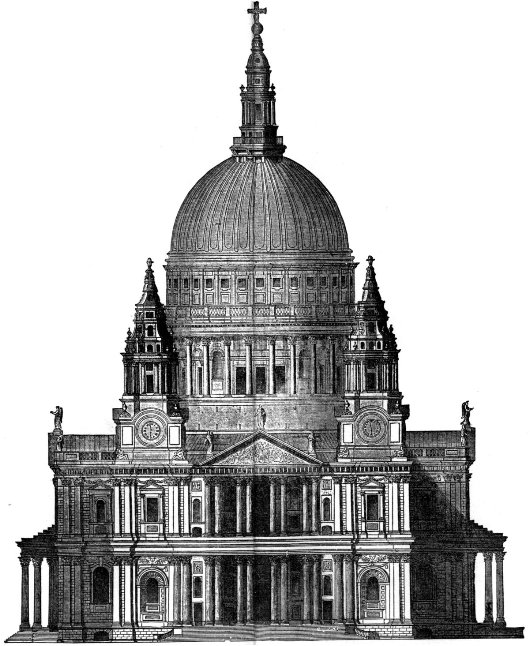
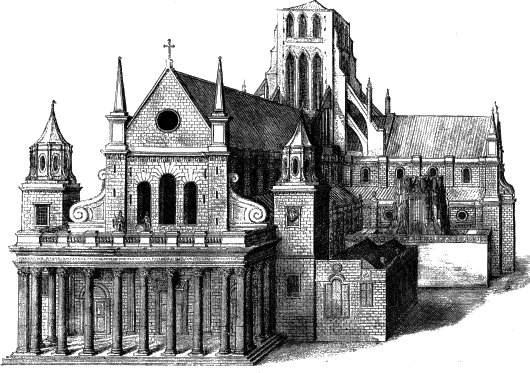
Udo & Marianna
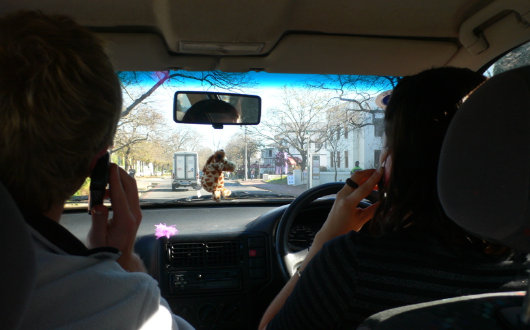
One’s chatting on the phone in Afrikaans, the other in Finnish.
221B Baker Street
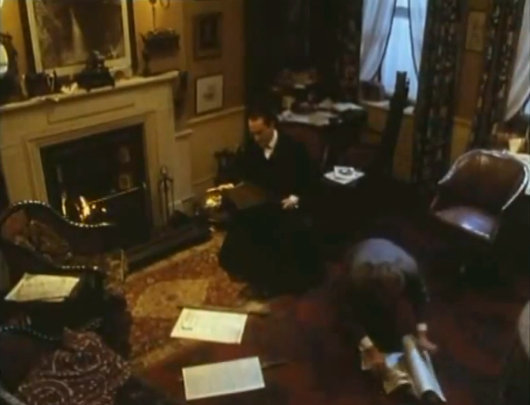
I think the ideal model for bachelor digs must be No. 221B Baker Street from the Granada TV production of Sherlock Holmes (Jeremy Brett’s performance as the title character being his most enduring and remembered role). Needless to say, one would have to have Mrs. Hudson as well, lest one starve to death or suffer the ignominy of microwaved meals.
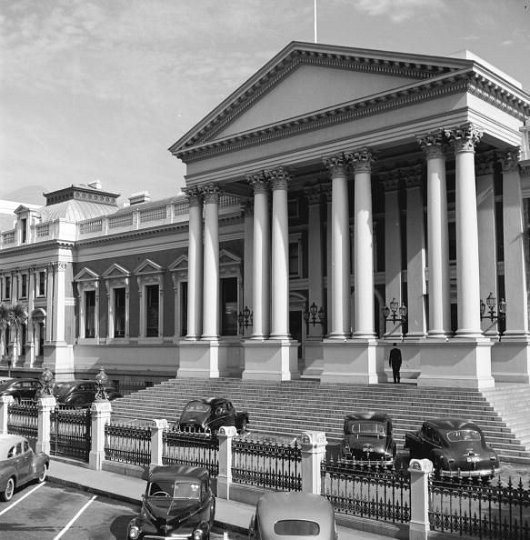
The Houses of Parliament, Cape Town
Die Parlementsgebou, Kaapstad.
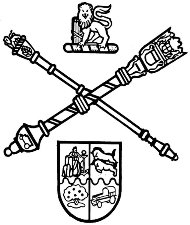
The insignia of the Parliament of South Africa, showing the Mace and Black Rod crossed between the shield and crest of the traditional arms of South Africa.
CAPE TOWN IS justifiably known as the “mother-city” of all South Africa, paying tribute to that day over three-hundred-and-fifty years ago when Jan van Riebeeck planted the tricolour of the Netherlands on the sands of the Cape of Good Hope. Numerous political transformations have taken place since that time, from the shifting tides of colonial overlords, to the united dominion of 1910, universal suffrage in 1994, and beyond. The history of self-government in South Africa has unfolded in a well-tempered, slow evolution rather than the sudden revolutions and tumults so frequent in other domains. No building has born greater witness to this long evolution than the Parliament House in Cape Town.
The British first created a legislative council for the Cape in 1835, but it was the agitation over a London proposal to transform the colony into a convict station (like Australia) that threw European Cape Town into an uproar. The proposal was defeated, but the colonists grew concerned that perhaps they were better guardians of their own affairs than the Colonial Office in far-off London. In 1853, Queen Victoria granted a parliament and constitution for the Cape of Good Hope, and the responsible government the Kaaplanders so desired was achieved. (more…)
Fraktur Ausgabe
Little known fact: when this website is accessed from German-speaking countries, it appears in an old-fashioned fraktur typeface. (more…)
Our Cardinal & Our Seminarians
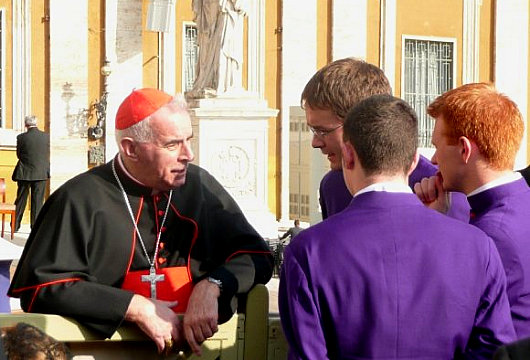
His Eminence Keith Patrick O’Brien, Cardinal Archbishop of St Andrews & Edinburgh, Primate of Scotland, has a wee chat with a triumvirate of seminarians from the Pontifical Scots College, Rome at the Holy Father’s weekly general audience. St Andreans (or at least Old Canmoreans) will recognize the ginger chap at right, attentively listening to the Cardinal’s words. I caught up with him in August when he had just a week to go before heading to seminary.
The Would-Be King of New Zealand
Brigadier the Right Honourable Sir Bernard Fergusson,
Baron Ballantrae, KT, GCMG, GCVO, DSO, OBE
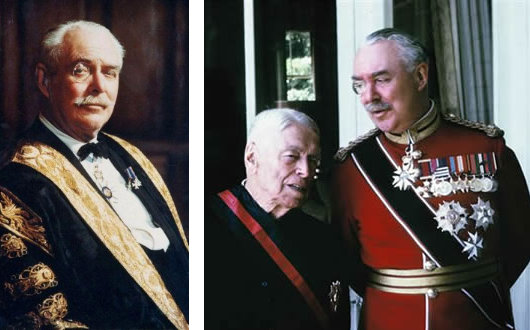
Left, Lord Ballantrae in his robes of office as Chancellor of the University of St Andrews; Right, as Governor-General of New Zealand with former Prime Minister Sir Walter Nash.
Over at Curated Secrets, Stephen Klimczuk takes a brief wander through Clubland, mentioning the illustrious Bernard Fergusson, who was known for “the skill with which he could toss his monocle in the air and catch it in his eye”. Stephen’s co-author on Secret Places, Hidden Sanctuaries, the Much Hon. Laird of Craiggenmaddie, chimes in on the commentbox, bringing to light that “when he was serving under Orde Wingate with the Chindits in Burma, among the supplies dropped by the RAF to those doughty warriors was a supply of monocles for Fergusson, since the damage/loss rate was so high in the jungle.”
Fergusson has always fascinated me, not only because he was the Chancellor of my university, but also because he has the best claim to the throne of New Zealand should the Land of the Long White Cloud ever decide to dispense with the House of Windsor. Lord Ballantrae (as Fergusson was ennobled) served as Governor-General of New Zealand, his own father served as Governor-General of New Zealand, and both his grandfathers served as Governor of New Zealand before the antipodean kingdom became a dominion. Rather appropriately, his son and heir is currently serving as Her Majesty’s High Commissioner to New Zealand, which is now the highest office of the British government in those islands.
Stephen mentions other fun stories of Clubland, such as the waggish response of the dinner guest who was kept waiting for Hermann Goering at one club before the war: “‘I have been shooting,’ said Goering. ‘Animals, I hope?’ was the quite reasonable question in response.”
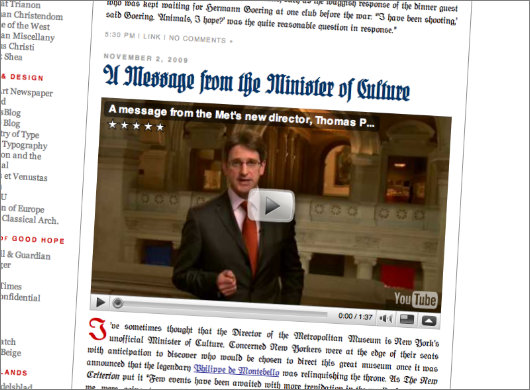
A Message from the Minister of Culture
I’ve sometimes thought that the Director of the Metropolitan Museum is New York’s unofficial Minister of Culture. Concerned New Yorkers were at the edge of their seats with anticipation to discover who would be chosen to direct this great museum once it was announced that the legendary Philippe de Montebello was relinquishing the throne. As The New Criterion put it “Few events have been awaited with more trepidation in the world of culture — we were going to say ‘the art world,’ but it embraces much more than that — than the appointment of the next director of the Metropolitan Museum of Art.”
The massive sigh of relief when Thomas Campbell was announced as the successor could probably be heard as far as the Louvre (or even the Hermitage), even though Campbell’s name was on none of the supposed shortlists for the job. Judging by his past as curator of tapestries, Campbell is widely believed to be utterly reliable at continuing the high standard maintained during de Montebello’s reign. May God guide him well in his task! (more…)
Sidebar Changes
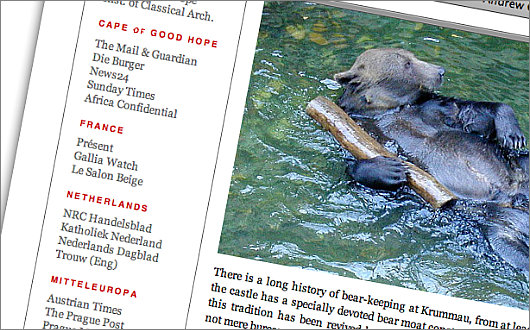
Finally got around to reorganising the sidebar. It had been a bit chaotic and disorganised before, but I’ve managed to shape it up a bit, deleting a few links while adding others. Take a gander, you might find something you didn’t have a chance to stumble upon before.
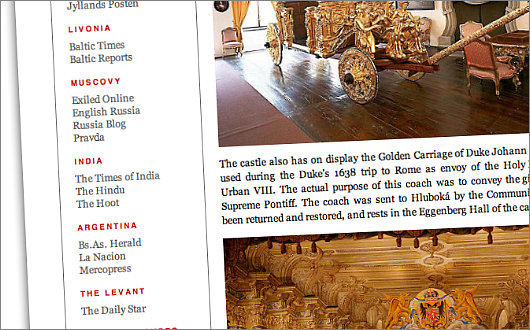
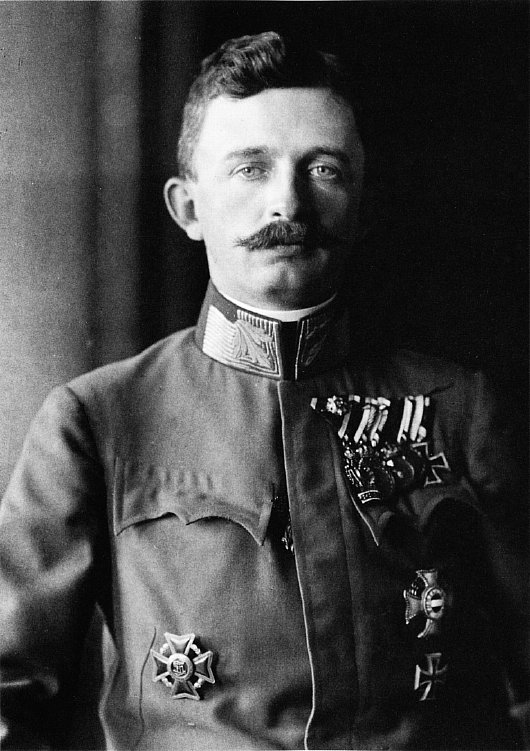
Argentines Recall Blessed Emperor

An Argentine correspondent informs us that the Holy Sacrifice of the Mass was offered on October 28th at the Church of St. Boniface, the German-speaking parish of the Archdiocese of Buenos Aires, to commemorate the fifth anniversary of the beatification of Blessed Charles, Emperor of Austria and Apostolic King of Hungary. The mass was organized by Viscountess Huges Stier de Saint Jean (née Princess Isabelle Auersperg-Breunner), whose mother was a descendant of the Emperor Franz Joseph through his daughter Valerie. The Mass was offered in Spanish and German, with the prayers of intention read in those languages as well as Hungarian, Slovak, Ukrainian, Croatian, and Italian.
Category: Charles of Austria
Krummau, Crown of the Moldau
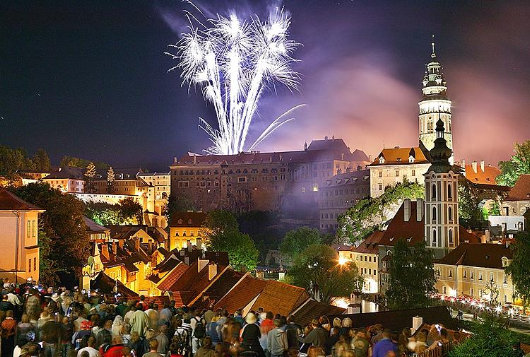
BY NOW THE denizens of this little corner of the web are surely aware of Krummau, the splendid castle and town that towers above the banks of the Moldau river in Bohemia. I was never particularly interested in Bohemia until Fr. Emerson came up to St Andrews and gave a talk on the Hapsburgs. Unfortunately, this was before they began to record the talks (and offer them online) as it was an excellent brief lecture that I’d love to revisit. Now Bohemia is one of my passions, in addition to an increasingly large burden of passions (Scotland, New York, Argentina, the Netherlands, South Africa, France, Hungary, Transylvania, Canada, Scandinavia, … ). The architecture is superb and varied, and of course the Duke of Krummau is none other than a certain Prague pol. The complex is no longer in the Schwarzenberg family, but is instead now the State Castle of Český Krumlov.
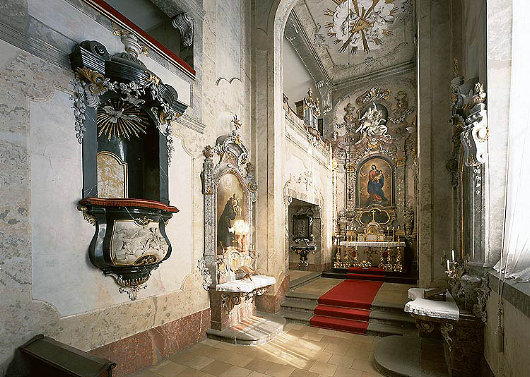
The Chapel of Saint George in the Castle once contained the skull and bones of Pope St. Callixtus I. The remains were obtained by the Emperor Charles IV, who gave them to the Rosenberg family who built the castle, from whom they (and the castle itself) passed to the Schwarzenbergs, only to be lost after 1614. Nonetheless, the skull of an unknown North African martyr came here in 1663, and tradition donated to the unknown saint the name of Callixtus also.

The World Turned Upside Down
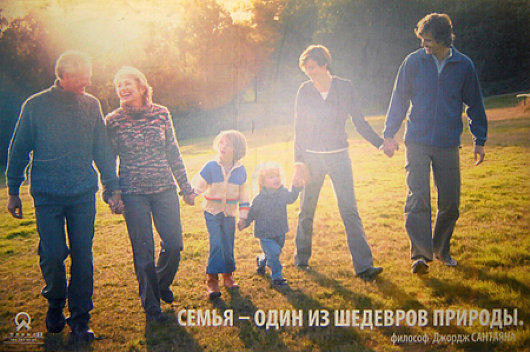
— philosopher George Santayana
I can’t remember who it was that, watching the fall of the Berlin Wall and the collapse of the Iron Curtain, said never in his right mind did he expect that within just a decade Washington would be the chief propagator of worldwide revolution and the Kremlin would be a relatively conservative power, guarding jealously its local sphere of influence. What could add more of a dash of the absurd (and yet, eminently sensible) than the Russian government, facing the worst crisis of population decline of any major power, promoting larger families with a poster campaign quoting the conservative American philosopher George Santayana.

Novanglian Peregrinations
A journey to the shining city of Saint Botolph, and return
THE PERIOD OF MY removal to South Africa sometimes inclines me to think that time stood still during my absence from the northern hemisphere. It is as if the mental chronicle of my brain simply ceased, and took up writing in a different book, and then went back to the end of the old page upon my return. But time indeed did pass, and many were the old friends and acquaintances with whom we had not combined in some time. Communication was no better than intermittent while exiled in southerly climes, but, freshly returned, the tom-toms were beat and the smoke signals sent to the usual suspicious characters of note. A convocation of cohorts and old confederates was then proposed, to take place in Boston — caput and urbs maxima of God’s own province of New England.
 My first stop was actually New Haven, and traversing the border into Connecticut I crossed myself in accordance with ancient custom, invoking the guardian angel of that jurisdiction in the usual pleas for safe travel, easy passage, and the avoidance of traffic cops & parking fines. In New Haven, I attended the meeting of a learned society (composed of both postgraduates & undergraduates) devoted to polite discourse, under the sacred patronage of the Saints Augustine of Hippo and of Canterbury, and the secular patronage of the Anglo-Irish divine Bishop Berkeley. Speaking of the divine, the society’s meeting was preceded by Mass, offered by one of the Dominicans who unofficially tend to the flock of Yale students (the official Roman chaplaincy there having a poor reputation) in an improvised chapel at the club’s quarters.
Mass was followed by port, smoking, and some cheese & finger foods for the hungry souls. I mentioned to a friend that the Choco-Leibniz cookies on offer were my favourite, the official state biscuit of the house of Cusack. “Of course they are,” the wag responded. “Choco-Leibniz are the best of all possible biscuits!” (Some jokes are so bad that the resulting chortles are both inevitable and involuntary.)
Then, the subject at hand. This meeting was convened to discuss the recently announced Apostolic Constitution establishing “personal ordinariates” to ease the reception of Anglican Christians into full visible communion with the Pope. The assembled members were by no means only Catholics, but with a significant portion of Episcopalians, and the odd Calvinist for good measure. A brief paper by an entrenched Anglican was read, and the members responded and discussed the matter with courtesy and depth as the fire crackled in the background. Which groups are likely to take advantage of the coming ordinariates? Which are least likely? Was this chiefly a pastoral move? What do the Orthodox think? What will the reaction be outside North America? All these questions and many, many more were raised and, so far as possible, answered.
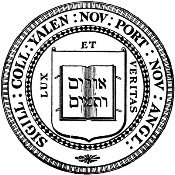 The formal discussion was concluded with the invocation of the two Augustines and a toast to Bishop Berkeley. A number of members remained by the fire while others dispersed for other events. The weekend beheld the 75th Anniversary of the Yale Political Union, and so the constituent parties of the YPU were all having events for their members and alumni. (From what I can understand of the YPU’s right-leaning parties, the Conservative Party is for Republicans, the Tory Party is for decadent Anglophiles, and the Party of the Right is for conservatives.)
Following the procurement of beer and the ordering of pizza, the consumption of both, and the extinguishing of the fire, it was time to retreat for the evening to the splendid old Victorian house where a number of folks live. It’s one of those old, solidly American homes, with a swinging chair on the porch, splendid wood detailing inside, and pocket doors between the receiving rooms. Dotted around an old dining room table, more news and rumours were exchanged between the inhabitants and guests as the remnants of a bottle of Macallan was polished off. The Choco-Leibniz joke was repeated for those who were not in attendance before. A South Carolinian’s reaction to the health-food movement was recalled: “They won’t buy an egg if it ain’t free-range but they put on all manner of uh-koo-tra-mints so as not to conceive!” One of our friends, an Englishman, treated us to a rendition of “Come Thou Font of Every Blessing” on the banjo, and we were informed that a group of Yale Divinity students were officially reprimanded for having a watermelon-eating competition. (Watermelons often feature in stereotypical caricatures of American Blacks, and thus are apparently forbidden by the Monotony Monitors). We went on in such manner until the wee hours, when the assembled finally adjourned to bed.
Then the morning: breakfast — pumpkin pancakes from S.O.’s wife before she popped off to riding practice — before A.L. and I combined to continue the journey onwards to the City of Saint Botolph, Boston. The city’s name comes from the Lincolnshire town of Boston, itself a contraction of “Saint Botolph’s Town”. Many of the Puritans hailed from the East Midlands, and it was John Cotton, the controversial Vicar of Saint Botolph’s Church in Boston, who encouraged many separatist radicals to emigrate to the Massachusetts Bay Colony in New England. The New-World town of Boston was founded in 1630, and named in honor of the place associated with Cotton, who himself emigrated three years later. The Church of Saint Botolph is the most prominent landmark of old Boston, founded in 1309 and famous for its late-fifteenth-century English Perpendicular lantern tower. As coincidences go, the design of Harkness Tower at Yale University in New Haven is inspired by that of Saint Botolph’s in old Boston. New Haven’s name also harks back to the River Haven which flows just some thirty-odd feet from the great tower of Saint Botolph.
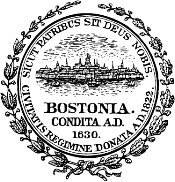 A New Yorker is always of two minds about Boston. We consider it a somewhat uppity member of our northern periphery and despise the attitude of some of its lowlier inhabitants (the sporting fans of red hosiery), but the old Knickerbocker can’t help but envy the skill and ability with which the Bostonians have preserved so much that has been utterly destroyed in New York. Boston, despite its politics, might just be the most conservative town in the American Republic. During our stay in Boston, we never left the immediate vicinity of Beacon Hill and Back Bay, except for one foray into Chinatown for dinner. The architecture is splendid, traditional, and vernacular, and the streets are uncrowded compared to the vast hordes that swarm around Manhattan.
Our home for the time being was a handsome apartment in Beacon Hill, well-decorated and amply supplied with books and booze. A.L. and I parked the car in the garage under Boston Common, and were met by our close friend I.M.C., who is the lynchpin uniting this social circle. I.M.C. hails from north of Boston, towards Gloucester, but had arranged for his friend T.L.G. to host us in his flat overlooking the Public Garden. Upon arriving we were offered generous cups of tea, ginger snaps, and sliced mango and conversed for quite some time before we decided upon a light Saturday afternoon jaunt around Back Bay and Beacon Hill.
T.L.G. explained the creation of Back Bay from landfill as the four of us swaggered down Commonwealth Avenue, be-tweeded on this autumn day. We popped into the Boston Public Library just before closing, and gazed out onto Copley Square that was once the epicenter of the city. The square is or was, at various times, home to the Public Library, Old South Church (Cong.), Trinity Church (Episc.), the Massachusetts Institute of Technology, the Museum of Fine Arts, and the Copley Plaza Hotel. Sadly, it is now disfigured by the looming bulk of the John Hancock Tower, a modern skyscraper by I. M. Pei that is the tallest building in New England. It was so shoddily constructed that entire panes of glass began to fall off after it was completed, eventually forcing the owners to replace ever single pane of glass within just a few years. We swung by the Church of the Advent where our host is a parishioner and whose Lady Chapel and rood cross were designed by Ralph Adams Cram. Just after we exited the Church, we were introduced to the Rector, who was just coming home from the wine shop.
Returning to the apartment, it was time for drinks. The gin flowed like wine, and it wasn’t long before we were joined by J.T., A.R., and M.D. All manner of things under Heaven were discussed, from the latest exploits of mutual friends, to matters of state, and of course church affairs (this is a half-papist, half-’piskie crowd). Said discussions continued around a table for seven at the Taiwan Café in Boston’s Chinatown. (Good to support Nationalist China, but it did require crossing Boston in the rain). Our dinner of pork, dumplings aplenty, soup, and tea finished, we progressed to a certain private club for more drinks. M.D. treated us to his side-splitting imitation of Katharine Jefferts Schori and Peter Akinola having an argument before the evening finally came to it’s conclusion.
Sunday morning, breakfast of tea, sausages, and proper porridge. Despite all the previous evening’s drinks, not so much as a hint of a hangover. Stood on the balcony overlooking Charles Street in the unseasonable warmth and began to appreciate Boston’s existence. I.M.C. cordially invited us to visit his home town of Beverly, a good New England town north of Boston and on the sea. Lunch, evening Mass, dinner, more good conversation throughout. But an early morning’s rise on Monday, to make it back south home to New York, ending a fine and invigorating peregrination through at least part of New England.
Nature diary
by ‘REDSHANK’
With the prolonged fine weather, all kinds of exotic creatures have appeared in our part of the countryside for the first time in living memory. Hummingbird hawkmoths are plentiful. I have seen not one but a dozen at a time hovering over the snapdragons in our flower garden.
 Not only hummingbird moths but hummingbirds have appeared. Calling at the Three Tuns, I found the regulars in an uproar as a whole bevy of these beautiful little creatures hovered over their pint pots, causing the less wide-awake to drop them on the floor.
At last Old Ted, the landlord, fairly lost his temper. “Get away, you pesky little varmints!” he shouted, lunging at the glittering little beauties, then chasing them across the room until he tripped over an antique horsecollar he keeps for grinning through and fell heavily to the ground, cursing all tropical interlopers.
There was a big laugh at this, and Old Jim, who always keeps a stuffed magpie on his person to avoid bad luck if he should meet a single magpie, annoyed the landlord even more by producing it and waving it in his face.
Meanwhile, the hummingbirds were hovering over the shove-halfpenny board, putting Old Frank and Old Amos off their game. Rustic oaths bombinated about the smoky room, growing ever more archaic and outlandish as I tried to make hurried notes in phonetic script.
« Sans la liberté de blâmer, il n’est point d’éloge flatteur »
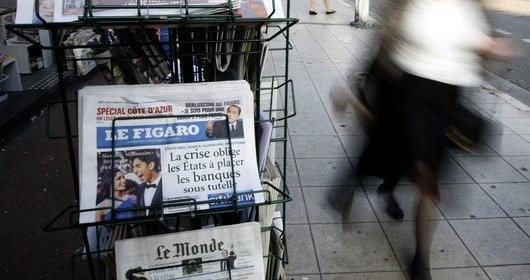
I‘m sure I’m not the only one whose information-gathering habits have changed for the worse since Le Figaro started charging for access to their online digital version. I much prefer flipping through digital “e-paper” versions to trying to sort through a newspaper’s actual website. When you flip through a laid-out newspaper, you get an overall picture of news and information as the editors have sought to present it to you. On websites, it’s all too easy to ignore all but that which you click on. I was about to complain that Le Figaro‘s change means I will no longer be able to stumble upon interesting articles on Romanian restitution cases and a bold Hungarian countess, but in truth those were from the days when I tended to pick up the actual printed edition rather than flip through it online.
Nature diary
by ‘REDSHANK’
THE badgers were out again last night. Not content with taking three pockets from the billiard table. Old Brock had made off with all the billiard balls as well, as I discovered when proposing a game with a fellow nature diarist this morning. What can your average badger want with billiard balls? Will this sagacious beast barter them for more useful objects with owl or weasel?
Musing on this, we wandered out across the garden in the golden September sunshine, and into the village giving a “good morning” now to Old Jim the Poacher, sweating in his heavy multi-pocketed poacher’s greatcoat, now to Old Miss Briggs, the former dame school economics teacher, now to a foursome of commercial travellers setting off for a solo whist session in Bragg’s Wood.
Passing the lopsided thatched cottage of Old Seth Gummer the Waspkeeper, last of his kind, we knew by the unusually loud buzzing from his garden croft that he was busy with the ancient custom of “telling the wasps”, so different from that equally ancient custom “telling the bees”. A grizzled figure dressed in waspkeeper’s sacking, with a perforated tin pail over his head, he was telling his vespine charges about all the happenings in the neighbourhood this summer that he thought would interest them.
Sure enough, their eager buzzing grew frenzied as he described, in lurid detail, adulterous affairs, divorces, rapes, lesbian elopements, cases of drug addiction, paedophilia, muggings and other assaults, and, most exciting of all, the formation of a retro-techno-sado-rap group in the village.
Pausing only to say a hurried “good morning” to Old Seth, who was fumbling vaguely with his antique Edison Bell recording apparatus, we walked on, accompanied by a few enterprising wasps, pondering on the strange mixture of old and new, of immemorial tradition and brash modernity in our part of the countryside.
Search
Instagram: @andcusack
Click here for my Instagram photos.Most Recent Posts
- Brunel’s Unbuilt Capitol February 3, 2026
- Cricket at Fordham January 27, 2026
- Palacio Barolo Revisted January 14, 2026
- Learning to Love Liguria January 14, 2026
- Crux Alba No. 2 January 13, 2026
Most Recent Comments
Book Wishlist
Monthly Archives
Categories