2008 May
About Andrew Cusack
 Writer, web designer, etc.; born in New York; educated in Argentina, Scotland, and South Africa; now based in London.
 read more
News
Blogs
Reviews & Periodicals
Arts & Design
World
France
Mitteleuropa
Knickerbockers
Argentina
The Levant
Africa
Cape of Good Hope
Netherlands
Scandinavia
Québec
India
Muscovy
Germany
Academica
The life & death of The European
An idea before its time or the mad dream of a master swindler?
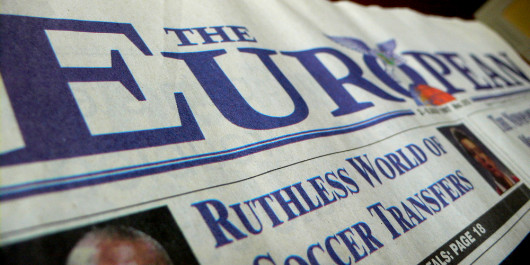
The inception of The European at the dawn of the 1990s was emblematic of the age. Triumphant scenes of joyful crowds tearing down the Berlin Wall in 1989 sparked exhilaration across the continent and the high spirits from the fall of the Iron Curtain were transformed into Euro-phoria as the ideal of a ‘United States of Europe’ now seemed a very real possibility. The media and publishing magnate Robert Maxwell vigorously supported ‘the European ideal’ and founded The European newspaper to act as a cheerleader for that ideal. Rolling from the printing presses within a year of the Wall’s fall, the newspaper had nonetheless folded by the time the Amsterdam Treaty was ratified in 1999 despite the continued growth in the size and power of European institutions. But the story of the rise and fall of Maxwell’s newspaper — the life and death of The European — is itself indicative of the strengths and weaknesses of the European project itself.
Robert Maxwell’s euro-enthusiasm might be explained by his transnational roots. “Captain Bob” (as Private Eye labeled him) was born Ján Ludvík Hoch in 1923 into a poor Jewish family in a small town in Carpathian Ruthenia — then in Czechoslovakia, now in the Ukraine — and escaped to Great Britain in 1940. He entered the British Army shortly thereafter as a private but his natural intelligence and gift for languages meant that by the war’s end he was a captain, having also been awarded the Military Cross for gallantry.
Using the many contacts he had made amongst the Allied occupation officials, Maxwell went into business as the British and American distributor for Springer Verlag, a German scientific publishing firm. In 1951, he went into publishing on his own when he purchased Pergamon Press, a textbook-printing subsidiary, from Springer Verlag, turning the company around and making handsome profits from the endeavour. A socialist, despite his business acumen, he was elected to the House of Commons in 1964 on the nomination of the Labour party, losing his seat six years later.
Through Pergamon Press, he gradually began accumulating media interests. He lost the battle to buy the News of the World to Australia’s Rupert Murdoch, who duly emerged as his arch-nemesis. By the middle of the 1980s, however, Maxwell owned the London-based Daily Mirror and Sunday Mirror, the Daily Record and the Sunday Mail (both Scottish), as well as other newspapers, a number of publishing houses, a record label, the Berlitz language schools, and half of MTV Europe, and the Oxford United Football Club.
But conventional newspapers, no matter how numerous, did not satisfy the massive ego which had become one of Maxwell’s most notorious characteristics. In June 1988, he began planning for a transnational, pan-European daily newspaper, The European, printed in colour with articles in English, French, and German. Maxwell was a keen proponent of European integration and saw the new title as a method of bridging the gap between Britain and the Continent, as well as hoping that it would act as a counterweight to the well-established American weeklies Time and Newsweek.
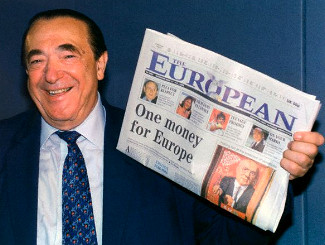
Maxwell brandishing issue No. 1 of The European
Maxwell’s ideal for the newspaper proved impossible to realize immediately, and when The European finally emerged on newsstands in May, 1990, it had been brought down in scope to an English-language weekly newspaper. The title emblazoned across the top — with an emblematic white dove hovering above the continent, a copy of the newspaper firmly clasped in its beak — the first copy of The European proclaimed it would bolster ‘the supporters of the integration of Europe’. Divided into three sections — the main news section, Business, and a tabloid-sized culture review named Élan — the paper made a bold use of colour long before most other broadsheets converted from black-and-white.
One million copies of the first issue were printed by Maxwell, with a guarantee to advertisers that the weekly would settle down in six months with a circulation of at least 225,000. Three months after the launch (July 1990), Maxwell claimed a circulation of 340,000 for his pet project, divided between 187,000 in Great Britain and 153,000 on the Continent. The first audited sales figure, however, came out in February 1991 with 226,000, below Maxwell’s promise to advertisers. That month, Maxwell replaced the founding editor, Ian Watson, with John Bryant, who had edited the acclaimed Sunday Correspondent during that newspaper’s brief existence.
As the sales figures continued to settle downwards, Maxwell grew less comfortable with realistic circulation estimates and he began a number of schemes aimed at driving up the numbers. That February, it was decided that ‘significantly different’ U.K. and overseas versions would be printed. In October 1991, just a few months later, Maxwell attempted to introduce an edition specific to North America, where officially 15,000 copies of the U.K. edition were sold each week. By the end of the month, however, the scheme was abandoned, and many of the hacks in The European‘s London headquarters were reduced to working a three-day week to cut corners, while some were made redundant outright.
The European aside, Maxwell’s empire was coming apart at the seams. High interest rates and a general recession were bad for business overall, but investigations had been launched into various dodgy business practices throughout Maxwell’s companies. Profits had been overstated while losses were hidden away. Money had been looted from corporate pension funds to prop up entities personally owned by Maxwell and to artificially inflate share prices. The London Metropolitan Police were even compiling a file on Maxwell’s war years, towards the aim of charging him with war crimes for killing at least one German civilian.
On November 5, 1991, Robert Maxwell disappeared from his super-yacht sailing off the Canary Islands, and his body was found floating in the Atlantic shortly afterward. Officially ruled an accidental drowning (the more imaginative claimed he was murdered), most assumed that “Captain Bob” had taken his own life rather than face the unravelling of his business empire and its supportive web of deceit. Maxwell was buried five days later on the Mount of Olives in Jerusalem, with Israeli Prime Minister Yitzhak Shamir delivering the eulogy.
Ian Maxwell, the paper’s chief executive and son of the dead proprietor, announced to the assembled staff the true extent of his father’s crimes and their consequent impact for the newspaper, bursting into tears before making a quick exit from the newsroom. Not only were the various Maxwell operations suddenly and very seriously bankrupt, but it became apparent that Maxwell had continually fiddled with the newspaper’s circulation figures. “Rumour had it,” wrote one editor, Richard Holledge, “that copies were being burnt by that year’s particular brand of rioting French” outside the continental print site in Beauvais, and “[t]heir charred numbers were added enthusiastically to the figures”. “A better rumour,” bearing in mind Maxwell’s end, Holledge continued, “was that copies were shipped across the Channel, lost overboard and also added to the circulation”.
Bereft of its chief architect and founder, it was widely thought that The European would have to call it a day and cease operations. The remaining staff held a raucous Christmas party, presuming it would be the last undertaking of ‘Europe’s national newspaper’. But the party was far from over. Deputy editor Charles Garside, an old hand with experience in many a Fleet Street newsroom, bought the title and organised the staff, who worked without pay over the Christmas holiday in order to keep The European alive long enough until a suitable owner could be found. On one of the first weekends of 1992, Garside flew to Monte Carlo, returning the following Monday with new proprietors for The European: the famously reclusive Barclay brothers.
Identical twins, David and Frederick Barclay first made their money with a hotel they expanded into a chain and were not previously involved in the media. Under the Barclay regime and with Garside at the editorial helm, the aim was not so much to advance The European, as it was under the circulation-mad Maxwell, but to stabilise the title. With growth in sales in France, Germany, and Spain, the newspaper brought back Élan, its third section which had been suspended while the paper was losing £1 million a month. By the end of the year, the circulation appeared stable at 200,000.
As 1993 dragged on, however, the circulation dropped by at least 20,000. By August, fourteen members of staff were sacked and a plan was made to move The European into a more upmarket niche. A month later, Garside resigned and was replaced by the long-time managing editor Herbert Pearson. Pearson was immediately undermined when the Barclays’ managing director Greg MacLeod secretly prepared a magazine version of The European with a greater emphasis on features and analysis. The Barclay brothers, known for being hands-off proprietors, expressed little interest in the MacLeod project. MacLeod made his exit and Garside promptly returned as editor in June of 1994.
All continued as per usual until October 1996 when the Barclays appointed the former Sunday Times editor Andrew Neil as editor-in-chief of the Barclays’ three newspapers: The European and the two Scottish titles, The Scotsman and Scotland on Sunday, which they had bought a year before. Soon after, and surprisingly to the staff, Garside quit as European editor and Neil took over that responsibility too, with Herbert Pearson acting as the day-to-day head honcho. Andrew Neil brought new ideas to reinvigorate the paper but the perennial plan to turn upmarket finally materialized in 1997. The European was transformed into a high-end tabloid-sized colour magazine from June 1997 before it emerged in its final magazine form in March 1998.
But the Barclays were at the end of their tether. The European had lost £50 million since they took it over in 1992, and through the many trials and transformations its circulation failed to stabilise and continued its decline. By the middle of 1998, the Barclays threw in the towel and put The European, with Gerald Malone now at the editorial helm, up for sale. In September, it was announced that, unless a buyer was found, the paper would be wound down over the next ninety days. While there were hopes for an eleventh-hour savior in the form of Time Warner, and then Bloomberg, neither conglomerate made an offer. The final number of The European came out on December 14, 1998.
What then was the cause of The European‘s downfall? While it may seem strange that ‘Europe’s national newspaper’ faltered during the decade that witnessed the greatest leaps in European integration, the title was beset by such a multitude of problems from the very start that one might very well ask the question how it survived so long.
While undoubtedly the driving force behind The European, Robert Maxwell, with his erratic disposition, was a problem in and of himself. The unreliability of the paper’s circulation figures, actively fudged by ‘Captain Bob’, made advertisers think twice before investing part of their marketing budget. Maxwell’s problematic nature culminated in the massive financial scandal that rocked his empire, finalized by his mysterious death at sea. That the newspaper survived the death of its animating spirit so soon after its foundation is testament to the people who were determined to keep The European alive.
The commercial end of the newspaper’s operation was always a source of woe. Maxwell had been obsessed with newsstand circulation and so The European was one of the few newspapers that was actually more expensive to subscribe to than to buy from a newsagent — a factor which was unhelpful in building a loyal readership.
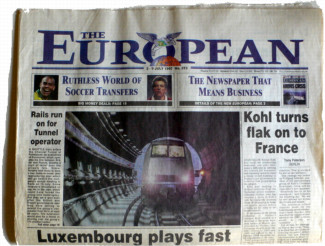
Starting a newspaper aimed at the middle-market at a time when that market is abandoning the printed media was doubtless an insolvable conundrum. The most obvious solution was to reorient the newspaper upmarket and find a suitable niche, but that too was already well taken care of by the Financial Times, the Economist, and the Wall Street Journal.
Distribution, meanwhile, was “an impenetrable mystery” according to Gerald Malone, the paper’s final editor. “I could never buy it in [the London Borough of] Wandsworth, but without fail found a copy in the village shop in Earlston, a tiny community in the Scottish Borders.”
Malone also claimed The European‘s staff was somewhat inconsistent in ardour. Mixed amongst the “hardworking young talent” and the “corps of professionals who brought the paper out through thick and thin” were “prima donnas” and “opinionated misfits past their sell-by date”. “In fact,” Malone wrote after the newspaper’s demise, “they were Fleet Street’s finest freeloaders: old-style fat-cats paid prodigious sums, in one case £75,000 for a three-day week”.
“One senior editor, who carped when I complained that the newsroom often resembled the aft deck of the Mary Celeste, resigned minutes before I could sack him, resenting my outrageous demand that he spend a bit more time in the office and forego long, boozy lunches fuelled with with Bulgarian wine.”
These practical problems aside, The European suffered a debilitating schizophrenia from birth. It claimed to be a European newspaper published in English but it was viewed more as a British newspaper reporting on European affairs. Maxwell’s stated aim (“Barking mad,” according to Malone) was to produce a newspaper for “the housewife in Toulouse”. But the Tolosanian housewife was already well catered for by the media of her own country, printed in her own language.
With institutional schizophrenia, a host of distribution problems, a staff of “freeloading prima donnas”, and the disappearance of its founder into the murky depths of the sea, it is indeed surprising that The European managed a good eight years in print. But besides all these there remained a never-solved existential dilemma at the heart of The European — “Europe’s national newspaper” — that it was impossible to be the national newspaper of a nation that doesn’t exist.
How a newspaper should look
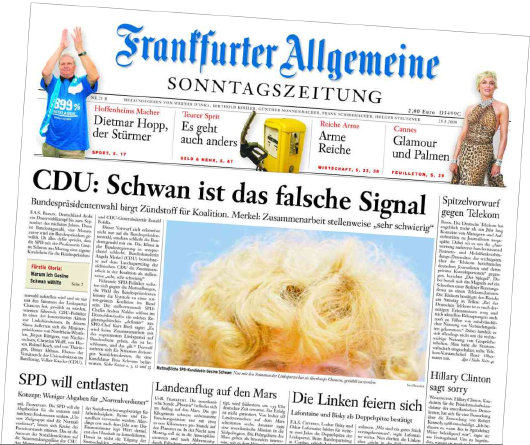
The Sunday edition of the Frankfurter Allgemeine Zeitung has always been a handsome newspaper. I admired its appearance so much that it provided much of the inspiration for the look of the Mitre during my editorship of that august publication. The weekday FAZ was famously reactionary in forbidding the appearance of photographs or any colour on the front page, so the Sonntagszeitung was viewed as an opportunity to be a bit more colourful and a little more free, but still within a solid traditional design.
It saddened me to learn that the Monday-through-Thursday FAZ has given in to the Spirit of the Age and now allows not only colour on its front page but photographs there as well. It now looks like a fairly conventional German newspaper, rather than the king of German dailies.
I will miss the old black-and-white FAZ because for me it brings back memories of visits to Dr. Timmerman‘s flat in St Andrews. Sofie and I used to go over to the good professor’s place for German pancakes on Shrove Tuesday (or to listen to his giant old radio, or to simply enjoy good conversation with good wine) and he had a massive pile of Frankfurter Allgemeine Zeitungs which I believe he only discarded at the end of the month.
Because the Frankfurter Allgemeine‘s front page is now a little less boring, the world in general is now a little less interesting.
‘Flying High’
[I came across this piece by Taki whilst trawling through the Cusack archives, and I thought now would be the appropriate time to share it.]
By Taki Theodoracopulos (The Spectator, 22 April 2006)
Do any of you remember a film called The Blue Max? It is about a German flying squadron during the first world war. A working-class German soldier manages to escape trench warfare by joining up with lots of aristocratic Prussian flyers who see jousting in the sky as a form of sport, rather than combat. Eager for fame and glory — 20 confirmed kills earns one the ‘Blue Max’, the highest decoration the Fatherland can bestow — the prole shoots down a defenceless British pilot whose gunner is dead. His squadron leader is appalled. ‘This is not warfare,’ he tells the arriviste. ‘It’s murder.’
I know it’s only a film, and a Hollywood one at that, but jousting in the air was a chivalric endeavour back then, with pilots who crash-landed behind enemy lines being treated as honoured guests before being interned for the duration. The man who embodied all the chivalric virtues was, of course, Manfred von Richthofen, whose family had been ennobled by Frederick the Great in the 1740s. When Baron Richthofen became a fighter pilot in the late summer of 1916, it was still only 13 years since the first flight of Orville Wright. The technique of applying air power to warfare was barely understood. One looped-the-loop, and pilots who managed to shoot down enemy aircraft and survive were regarded as heroes and quickly accumulated chestfuls of medals. When the Red Baron (his plane was painted a dark red, hence the nickname) died on 21 April 1918, the Times for 23 April devoted one third of a column to England’s fallen enemy, remarking that ‘all our airmen concede that Richthofen was a great pilot and a fine fighting man’.
By the time of his death, the Red Baron had notched up 80 victories, a record, with the leading French ace, René Fonck, claiming to have shot down 157 German aircraft, but only 75 being confirmed. (Rather French, that.) Needless to say, the mystery surrounding Richthofen’s death added to his legend. No one knows for sure who shot him down, or even if the bullet which killed him came from the ground. The English who found his body treated it with all the ceremony they would have accorded one of their own. An honour guard escorted the corpse to his own lines and British pilots overflew and dipped their wings. Those were the days. Out of 8 million men of his generation who died in that useless war, Richthofen’s is among the few names which will most likely be remembered by the general public on the 200th anniversary of his death.
His brother Lothar and his cousin Wolfram (who bombed Stalingrad 25 years later, and was one of Hitler’s favourites) flew alongside the baron, establishing a tradition for excellence and gallantry in the Luftwaffe. The second world war saw great heroics by German pilots, starting with Hans Ulrich Rudel, with something like 400 Stalin tanks to his credit, Adolf Galland, Erich Hartmann, who shot down 352 Soviet aircraft in the course of 1,500 missions, and Walter Novotny, with 250 Soviet aircraft in fewer than 450 missions.
My favourite is, of course, Prince Heinrich Sayn-Wittgenstein, whose heroics overshadowed the rest, and whose plane was shot down at the very, very end of the war in Schonhausen, the Bismarck home. Wittgenstein had his crew bail out first but was unconscious when he hit the ground. He had been hit while in the cockpit. By the end of the war he had become such an ace and legend he could do what he pleased. He once flew a combat mission with a raincoat over his dinner jacket. A few days before he had been to Hitler’s headquarters to receive the Oak Leaves to his Knight’s Cross. He told the beautiful Missie Vassiltchikov on the telephone, ‘Ich war bei unserem Liebling’ (I have been to see our darling) and added how surprised he was his handgun had not been removed before he entered ‘the Presence’. Heinrich would have loved to have bumped him off, but by then Germany was ruined and the prince died three days later. Hitler had many heroic pilots grounded towards the end, but Wittgenstein, being noble, was kept flying.
Why am I bringing all this up in the year of Our Lord 2006? As I told you last week, while down in Palm Beach, a friend of mine, Richard Johnson, tied the knot with Sessa von Richthofen, and I flew down a group of friends for three days of non-stop celebrations. The couple exchanged vows on an 80-year-old river boat which plies its trade in the inland waterway which crisscrosses Florida. My speech went down great, but then some ghastly paparazzo by the name of Harry Benson went around complaining about it. Never to me, needless to say, otherwise one more kill would have been added to the Richthofen legend.
“Der Rote Baron”
Foreign Film Fictively Frames Favorite Fabled Freiherr
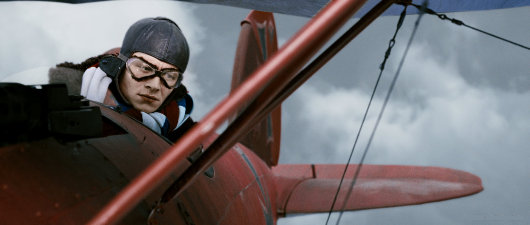
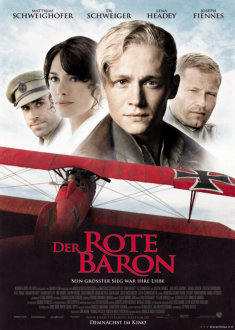 Our cunning cousin, the Hun, has cleverly concealed a card up his hunting-jacket sleeve. Just when you thought the continual winging by hand-wringing Germans about their militarist past (or at least the thoroughly shameful parts thereof) would never end, a new film depicts the life of the dashing Manfred Albrecht Freiherr von Richthofen: better known to us as The Red Baron.
“Der Rote Baron” is showing in den deutschen Kinopalästen as we speak, but the motion picture was not actually meant for a German audience: this is but part of the clever ruse. The film was actually made in English and then dubbed back into German by the mostly Allemanic cast.
Having convinced us of their peaceful intentions through more than a half-century of “Guys, we really messed up circa 1933-1945”, the obvious intent is to swamp the English-speaking world with a film depicting the charming gentlemen fighters of the first weltkreig in order to disarm us as they prepare for their dastardly plans.
Why, as we speak, Georg Friedrich von Preussen is polishing his pickelhaube and dusting off his feather cap in preparation for this latest Prussian plot for world domination. While the Western world worried itself sick over global Islamism and the Chinese threat, little did we know that a swelling irredentism was brewing deep within the hearts of every Berliner; a tear developing in the eye at the mere mention of Tsingtao; a soul in mourning for the loss of Tanganyika. How naïve we were not to realize that all those bright young Germans spending their gap year teaching smiling Herero natives in Namibia were actually forward units of intelligence-gatherers yearning for the return of Ketmanshoop and Swakopmund to the Germanic fold.
Christ at the heart of Quebec
Quebec, la belle province, was once a land as Christ-haunted as Flannery O’Connor’s American South, with classical parish churches at the heart of towns and cities, and crucifixes in classrooms, courtrooms, and most prominently looking down from on high above the Speaker’s Chair in the Parliament of Quebec. (Alfred Hitchcock’s “I Confess” superbly depicts Quebec’s Catholic society in the 1950s). While the so-called “Quiet Revolution” of the 1960s created an altogether more secularized modern society, robbing the Quebecois of their cultural and religious heritage, the crucifix in parliament remained, most recently challenged by the Bouchard-Taylor report, released this week.
Quebec has undergone an identity crisis concurrent with its latest wave of immigration, most of these immigrants hailing from Africa and the Middle East. Whereas there is no dominant ethnic group or ethnic-based identity in English-speaking Canada (descendants of Britons comprising 34% of the population), in Quebec 77% of the population are ethnic French-Canadians. Of those Quebecois whose primary language is French, 71.7% claim that their society is “overly tolerant” with regard to immigration (a figure that drops to 35.2% for those whose primary language is not French).
The specially-commissioned Bouchard-Taylor report makes a number of recommendations of how to better integrate the newer immigrants, and repeatedly calls for the removal of the crucifix from parliament as well as an end to all public prayers at government functions.
Happily, the National Assembly of Quebec has unanimously passed a resolution stating that the crucifix will stay where it is. The motion was proposed by the Premier of Quebec, Mr. Jean Charest, and Mr. Charest’s Liberals were joined by the official opposition, the Action democratique de Quebec, and the separatist Parti Quebecois.
“We cannot erase our history,” Premier Charest said. “The crucifix is about 350 years of history in Quebec that none of us are ever going to erase, and of a very strong presence, in particular of the Catholic Church. And that’s our reality. And those who come to Quebec are joining a society where that history is now something that is part of our story.”
The Bouchard-Taylor report, however, draws some altogether different conclusions. “Catholicism has left an indelible mark on Québec’s history,” the report concedes. “Traces of it are all around us. Under the principle of the neutrality of the State, religious displays linked to the functioning of public institutions should be abandoned. Thus, we do not believe that the crucifix in the National Assembly and the prayers that precede municipal council meetings have their place in a secular State. In both instances, public institutions are associated with a single religious affiliation rather than addressing themselves to all citizens.”
“That being the case,” the report continues, mixing common sense with liberal cant, “it would be absurd to want to extend this rule of neutrality to all historic signs that no longer fulfil an obvious religious function, e.g. the cross on Mont-Royal or the crosses on old buildings converted to secular uses. The same is true of Québec toponymy, which is largely inspired by the calendar of the saints. Quebecers’ common sense will surely prevail in this respect.”
(Rather absurdly, the Societé Saint-Jean-Baptiste de Montréal, a cultural nationalist group named after the province’s patron, St. John the Baptist, has stated in response to the report that it wholly supports the concept of a secular Quebec and that prayer has no place in civic forums.)
It would be more heartening if the National Assembly’s refusal to remove the crucifix were evidence of a renewed commitment to keep Christianity as the governing principle of Quebec society, but sadly Our Lord has been reduced to a cultural relic of great importance. However, the mere fact that it is being left alone, despite many challenges, gives us hope. So does the surprising success of Quebec’s ADQ party, which came from almost nowhere to within a few breaths of actually forming the government at the last provincial election.
Should the ADQistes capture the premiership at the next election they will have succeeded in bringing moderate conservative government to one of the New World’s most secularized bailiwicks. Conservatives, having once written off the province entirely, should definitely keep Quebec on our list of “ones to watch”.
[First published in Taki’s Magazine]
The next Norumbega
The next Norumbega will not be released tomorrow, Memorial Day here in New York, but on the following Monday, June 2, instead.
Abomination
This act of willful cultural vandalism is noxious in the sight of both God and Man and is a complete and utter abomination. Whoever is responsible for this should be hanged, drawn, and quartered, and buried at a crossroads with a stake through his heart.
Observe the beauty of this building at the corner of Harrison & Penn in Williamsburg, Brooklyn: its classic composition, its complete vernacular ease. And look at the cheap, tawdry, wrongly-colored brick used to hide and ultimately destroy this ordinary gem.
How can the perpetrator of this act sleep at night? It boggles the mind…
Facebook: Stop Messing Things Up!

When will the folks at Facebook learn to stop messing about with something successful. Surely they should be giving their users more options rather than taking them away. Isn’t that what the internet’s supposed to be all about? Introducing the “Mini-Feed” without making it optional was intrusive enough, the least they could do is allow us to collapse it thus banishing it from our sight and by extension our consciousness.
Ah, but we are cunning and have deleted every item in our mini-feed. You’ll nae get the better o’ us!
Facebook is planning even greater changes to the profile page, nearly all of which are bad news. Some rogue programmers should copy the code and start a Facebook (Ancien Régime) for those of us who are loyal to the old ways and believe strongly in the principle of “if it ain’t broke, don’t fix it”.
Facebook: stop messing things up!
Im wunderschönen Monat Mai
Als alle Knospen sprangen,
Da ist in meinem Herzen
Die Liebe aufgegangen.
Im wunderschönen Monat Mai,
Als alle Vögel sangen,
Da hab ich ihr gestanden
Mein Sehnen und Verlangen.
Victoria Day – Fête de la Reine
The Official Birthday of the Queen of Canada
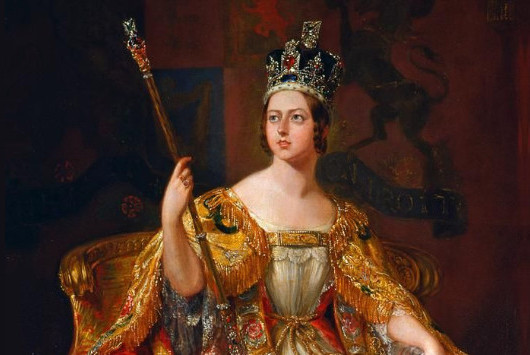
ELIZABETH II will have had, in her lifetime, more birthdays than Methuselah. This is because, in addition to the actual date of her birth, April 21, 1926, she has several different days which are designated as the Sovereign’s Official Birthday. In Britain, her birthday (which is the official national day of the United Kingdom) generally falls on the first or second Sunday in June and is the occasion of the ceremony of Trooping the Colour. Australia celebrates her birth on the first Monday in June with a public holiday, except for in Western Australia, where it is usually either the last Monday in September or the first Monday in October. This is the day when the latest members of the Order of Australia are announced. New Zealand also holds the Sovereign’s Birthday on the first Monday of June. Fiji is now a republic but Elizabeth II remains ‘Paramount Chief of Fiji’ and so a Monday in June is declared a holiday each year to commemorate her birth.
Athens of the North
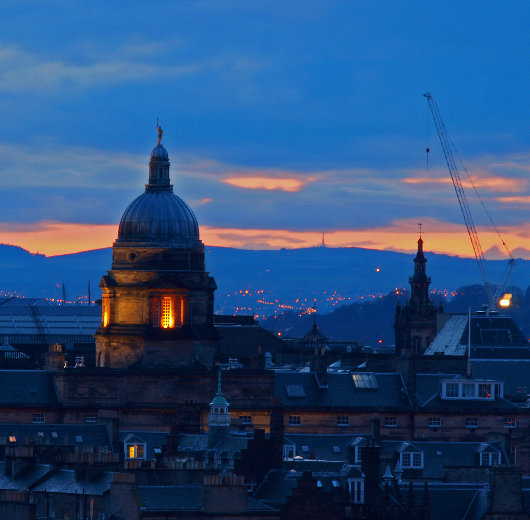
Photo: Steven Lees
Which Scots conservatism?
FOR THOSE WHO haven’t been keeping up with Caledonian affairs, Scottish independence has been brought onto the agenda by the victory of the anti-unionist, pro-independence Scottish National Party in the general election for the Scottish Parliament last year. The SNP victory comes after about half a century of solid domination of Scottish politics by the Labour party (now in regional opposition in Edinburgh, but still in power at the British parliament in Westminster). Yet an important portion of the electorate, while willing to vote the SNP into power — or at least to vote Scottish Labour out of power — have proved more reticent when it comes to the actual matter of ending the 300-year union between England and Scotland. While the SNP is riding high in Holyrood (the seat of the Scottish Parliament), support for Scottish independence is at its lowest since the discovery of North Sea oil.
This may seem like something of a contradiction, but Scottish voters are just trying to make the best of a tricky situation. Labour have proved unpopular both for national reasons (the war in Iraq particularly and Tony Blair in general) and for local reasons (Scottish Labour’s mismanagement during ten years in power at Holyrood and the presumption the Labour clique have that they are Scotland’s natural rulers and how dare anyone think otherwise). Of the five parties in the Scottish Parliament, the Nationalists are the only purely Scottish party — with Labour, the Conservatives, the Liberal Democrats, and the Greens all having either superior (or in the Greens’ case, co-equal) bodies in London. The best way of kicking out Labour was to vote SNP, and enough Scots thought it was worthwhile this time around.
That the Nationalists are a broad-based party has proved a great advantage. Beyond the central issue of their proposal to make Scotland independent, the SNP’s policies are, roughly-speaking, pro-business center-left. At the same time, their student federation is officially socialist, and they receive a fair amount of conservative support because conservatives tend to of a somewhat nationalist strain — and because the Scottish Conservatives give the appearance that they are more than comfortable to simply sit in Holyrood, collect their parliamentary salaries, and twiddle their thumbs. The Conservatives have always been a London-centric party anyhow, and under David Cameron it has become even more clear that it is a rural conservative party which exists in the hope of placing respectable metropolitan liberals in power. Faced with the choice of three liberal parties — the SNP, the Lib Dems, and the Conservatives — and pseudo-socialist Labour, Scots have made a sensible decision by choosing the liberal party which cares most for Scotland: the Nationalists.
But what, again, of this divergence: a party in government for which independence is its foremost purpose and a people who still seem content on (in some shape or form) maintaining the Union? Some in the opposition parties have seen an opportunity in this contradiction and have called for a referendum on independence to be held now; independence would almost (but only almost) certainly be defeated. Wendy Alexander, the Scottish Labour leader, surprisingly lent her support this idea before being forced by her superiors in London to issue a “clarification” opposing the idea. Those who support the continued union between Scotland and England, Wales & Northern Ireland would be wise to push for a referendum at the nearest moment and pull the rug from beneath the independence lobby.
But is the Union worth preserving? Ought conservative Scots to support the continuation of the Union or a move to independence? A unionist conservative might claim that by our very nature as conservatives we ought to support the status-quo and be wary of such far-reaching radical ideas such as ending three centuries of union. To which, of course, the nationalist conservative replies by asking why Scotland should be ruled by a London-based government intent on social and cultural revolution and the overthrow of all tradition. To which the unionist conservative replies that an independent Scottish government is just as likely to be the enemy of all that is good and holy as the London government. And so on and so forth.
Right-thinking Scots who condescend to involve themselves in politics are currently divided between two political parties — the Scottish Nationalists and the Scottish Conservatives — and that this hampers the cause of tradition, order, and liberty in Scotland.
What, then, should be done? The Scottish Conservative party is an inherently flawed vehicle for the advancement of conservatism in Scotland. The party itself only dates to 1965; before then there was a loose association of unionist elected officials who ran under various banners — Liberal Unionist, Scottish Unionist, Progressive, Independent, National Liberal, etc. It was only in that year that the Scottish Unionist Association decided to become the Scottish Conservative & Unionist Party, the official Scottish branch of the (traditionally English) Conservative & Unionist party. The fortunes of the Scottish Conservatives have gone downhill ever since, and there is a very strong cultural bias (sometimes even hatred) of “the Tories” in general that hurts the Scottish party.
There are two main options at hand. The first is that the Scottish Conservatives completely divorce themselves from the English & Welsh party, undergo a complete “re-branding” and transformation. The Conservative name will have to be dumped and there must be a clear indication that the party’s officials are willing to put Scotland’s interest first and foremost both at Westminster and in Holyrood. The disadvantage is that any new identity will still be tarred with the Tory brush and be denigrated as English lackeys.
The second option is for the party simply to be dissolved and for unionist conservatives to join their nationalist conservative confrères in the Scottish Nationalist Party to form a united bloc of sensible people in the party. The disadvantage of this option is that the center-left leadership of the SNP will have an obvious advantage in being able to shut out any former Tories from party positions. The anti-Tory cultural bias is so strong that expulsion may even be considered.
Still, if the SNP wants to be both the party of the Scottish people and the party of Scottish government it would be wise to fulfill two tasks: wooing Scottish Conservatives and reacting to the electorate’s reticence towards full independence. Despite the SNP having 47 seats in Holyrood to the Conservatives’ 17, the Scottish Conservatives are believed to have a larger membership than the Nationalists. Feet on the ground are one of the more important factors in winning elections, and the end of the Scottish Conservative Party could shift a great number of party activists into the SNP camp. On the second point, polls show the Scots voting down independence but being nonetheless dissatisfied with the state of the Union. Rather than the current process of revisiting which powers are “reserved” (kept in London) and which are “devolved” (decided at Holyrood) every few years, it might be better to seek a new concept of union altogether, with the preponderance of governmental power shifted from Whitehall to Belfast, Edinburgh, Cardiff, and English MPs voting on English affairs at Westminster (though some have suggested creating a new English parliament).
The danger here is that any significant reappraisal of the constitutional framework of the Union at this moment might result in any or all of the following: 1) even more power for the government; 2) a step towards the total dissolution of the Union; 3) republican moves towards the abolition of the monarchy. Unionist conservatives ought to oppose all three and nationalist conservatives should at least join in opposing further centralization and the abolition of the Crown, both of which would result in removing any checks on the power of Britain’s political class.
Indeed, perhaps that is the cause around which conservatives of all stripes should unite: opposition to the political class which has seized control of almost all the major institutions of public life in Great Britain and which guards its power jealously. The current political class, which replaced a more multifaceted Establishment (consisting of the commercial class, aristocrats, bishops, do-gooding campaigners, skillful parliamentarians, trade unionists, and the British officer corps) consists almost wholly of boring people who are carbon copies of one another. The fact that no political party currently opposes this political class and its consensus is likely the reason why Britons are so apathetic and unlikely to vote in elections. Peter Hitchens has suggested the first thing that must happen for this situation to change is for the Conservative Party to self-destruct and cease to exist. There are still in Britain today many deeply-conservative people who nonetheless vote Labour (or Lib Dem or SNP) because they feel culturally obliged to, or because they have inherited the bias against the Conservatives. Hitchens posits that the existence of the Conservative Party and the cultural hatred of it are the only factors which keep Labour going as a single party. If the Conservatives collapse, then Labour is soon to follow it (in this hypothesis) and once these two deep-seated “brands” are destroyed, there is finally the possibility of a truly conservative political force emerging; union-wide, not just in Scotland.
[First published in Taki’s Magazine]
Chartres 2008

It’s that time of year again. This Pentecost weekend, 10,000 traditional Catholic pilgrims walked en masse over the space of three days from Paris to Chartres. The annual “Notre Dame de Chrétienté” (Our Lady of Christendom) pilgrimage is mostly French but with a healthy spattering of Britons, Americans, and others to add to their happy numbers. It begins in the Cathedral of Notre-Dame de Paris on the vigil of Pentecost and ends up at the Cathedral of Notre-Dame de Chartres on Pentecost Monday, which is traditionally a day off in France. Traditional Masses are said each day (with confessions heard beforehand) along the route.
From “A Suburban Country Place”
Claremont, at the end of Riverside Drive, near the tomb of General Grant, suggests in a rather humble way what these mansions were, and in a very magnificent way what their outlooks were. Others linger, desecrated, here and there, closely pressed by new-laid brick and stone. And away up at the extreme tip of Manhattan there are still a few quiet, shady places which may call themselves suburban in the old and honorable sense. But everywhere else around the outskirts of Manhattan the term has gained an unattractive, hybrid meaning. To speak it with pleasure, New-Yorkers must apply it to those remoter regions which can be reached only by a railway journey of considerable length. And then it is incorrectly applied, for a real suburban place is rural in aspect, but urban in convenience — private, green, and peaceful in itself, yet close in touch with the true self of the town. …
“A Suburban Country Place”
The Century Magazine,
May 1897
Norn Iron Unites

What issue could be so important that it unites Northern Ireland’s four main political parties? The leaders of the Democratic Unionist Party, Sinn Féin, the Social Democratic & Labour Party, and the Ulster Unionist Party (to name the parties, from largest to smallest in number of votes) have written to Westminster MPs urging them to oppose the extension of the 1967 Abortion Act to Northern Ireland. Northern Ireland was exempt from the Act legalizing abortion in Great Britain because at the time it had its own parliament handling regional issues. The six Irish counties that have remained in the Union are the most strongly anti-abortion part of the United Kingdom.
The Other Modern
An Architecture of Continuity:
Luis Moya Blanco’s Universidad Laboral de Gijón
In 1944, an undersecretary of Francoist Spain’s Ministry of Labour visited the city of Gijón to attend the funerals of a group of miners killed in a mine collapse. After the solemn rites took place, Turiño Carlos Pinilla met with a group of locals filled with concern for the offspring of the dead workers. All they asked of the bureaucrat was an orphanage; what they ended up with ten years later was a magnificent palace of charity, almost a city unto itself and the largest building in Spain: the Universidad Laboral de Gijón.
An example of Catholic social teaching (which upholds the essential dignity of work and the working man), the “labor university” was founded as a secondary-level institution to teach vocational and technical skills to the children of Spain’s working class. At over 2,900,000 sq. ft. of space, it is more than double the size of the great Royal Monastery and Palace of El Escorial built by Phillip II in the sixteenth century, and was accompanied by over 380 acres of farmland.
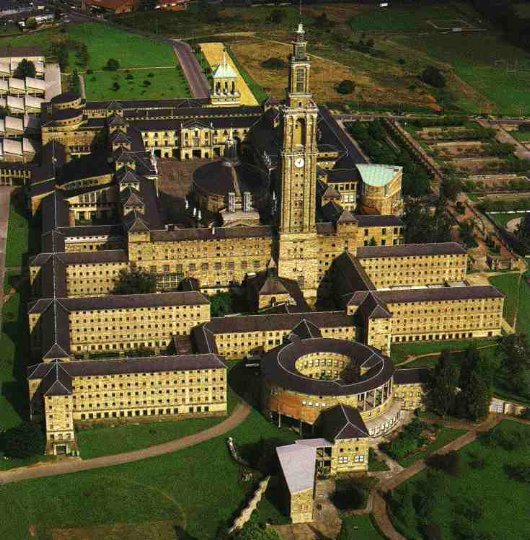
The goal was to accommodate 1,000 students (eventually doubling) from the age of 12 to 16, with residences, school facilities, industrial workshops, working farmland, athletic facilities, and sporting fields. The educational aspect and leadership of the Laboral was entrusted to the Jesuits, while the Poor Clares also had a convent on the premises, performing various household tasks and caring for the girls as their particular charism. (more…)
Q&A: Lady Cochrane Sursock

In a fascinating interview, Canadian journalist and Monocle editor-in-chief Tyler Brûlé talks with Lady Yvonne Cochrane, “doyenne of the Christian East”, discussing Beirut past, Beirut present, and Beirut future.
Update: She is actually Yvonne, Lady Cochrane Sursock, not Lady Yvonne Cochrane as Monocle styles her. Hat tip to Mr. Bond.
Glass-plating the Coliseum
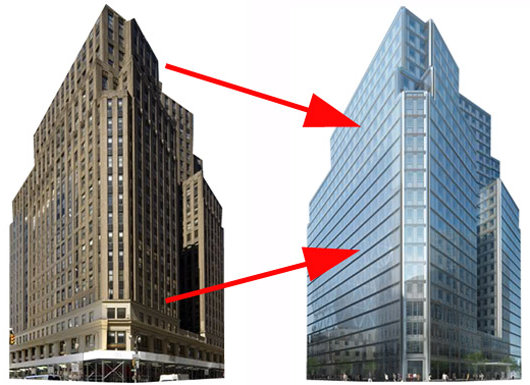
1775 Broadway, formerly the home of Coliseum Books (which I believe got its name from the splendid columns ringing the first two floors, as well as from the nearby now-demolished New York Coliseum), is to be glass-plated and re-addressed as “3 Columbus Circle”. As John Massengale commented, “Because if there’s anything New York City needs it’s another glass-covered office building…”.
Fred Henzer
What can one say about Fred Henzer? Fred was a man of some contradictions. The very first time I ever met him, back in high school (it seems eons ago), he tried to beat the living daylights out of me because I had mistaken him for a particular enemy of his. Luckily for me he was restrained by his friends (indeed, my friends) who vouched for me and urged him to forget such an innocent error. I didn’t think much of him and made a mental note not to get involved with such a character. But of course it was hard not to come across Fred often if you were born in 1984 and hung around Bronxville. Our introductory incident was quickly forgotten and we soon became friends (though admittedly never close), mostly because we had friends in common.
Fred was charming without being a cad. It was no doubt why and how, despite his many flaws, he managed in those days to have a girlfriend as pretty and immediately endearing as Alana (who flew across the country to attend his funeral today — her birthday). And while his friends were his friends (and indeed being his friend was something that mattered to Fred), he did have his enemies as well — more out of pride and anger, I think, than out of a genuine hate.
He was an inveterate moocher. Of course the man whom he mooched off of the most was Frank Powers. Frank, without a doubt the most respected and admired man of those our age in Westchester, was probably the best friend he ever had, but as Frank said when once asked of Fred, there’s only so much you can do for a friend.
Fred found some of the slight restrictions the rest of us take for granted quite irritating, and sometimes he in turn became an irritation to others because of it. I remember once driving back from some party or gathering at 2:00 in the morning when we stopped at a red light. Sitting in the passenger seat, he found the red light unbearable and begged me to pass through it, there was no one behind us, nor in front of us, not a single car in sight, he pleaded. No one would notice, it wouldn’t hurt a fly, just run this light! But I was as stubborn as he, and it was not long before it turned green anyhow and he shut up.
But his flaws were always excused, weren’t they? He was Fred after all. In hindsight, there is an obvious and quick temptation to call ourselves to account for his ultimate downfall. Could we have done more for him? Were we too tolerant? Too forgiving? Couldn’t we have somehow intervened? I doubt it. Fred was his own master. He made his own decisions; he made good ones and he made poor ones, but they were his. As Frank (who would know more than anyone else) said, there’s only so much you can do.
His end did not come as a surprise to those who knew him, but this does not negate the tragedy of his death, and indeed his life. We must restrain ourselves from romanticizing the life and death of an addict. It was undignified. Fred was a human being — a son, a brother, a friend — he deserved better. It is saddening that someone as vivacious and lively and indeed loving as Fred did not have enough of that most necessary love, the love of life, to keep himself in order and his bad habits in check.
What has he left us in this world? Bits of laughter and hilarity, some very amusing times, moments of lightness and indeed even wit, too many to even attempt to record here. These may sound like light and ephemeral things, but there was an underlying goodness to Fred that animated them, and it is that underlying goodness that I hope we will all recall in years to come when our minds turn back to the man we used to know, Fred Henzer.
We will remember him.
1984-2008
Requiem aeternum dona eis Domine:
et lux perpetua luceat eis.
Requiescat in pace.
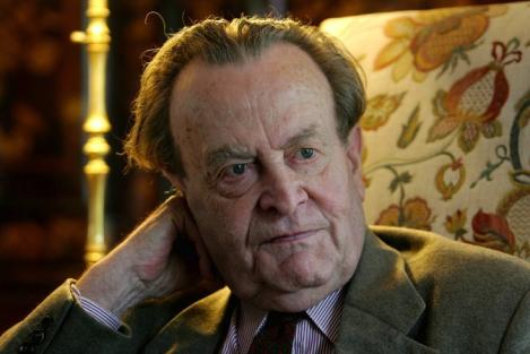
Philipp Freiherr von Boeselager, 1917-2008
Catholic Nobleman, Forester, Knight of Malta, Plotted to Kill Hitler
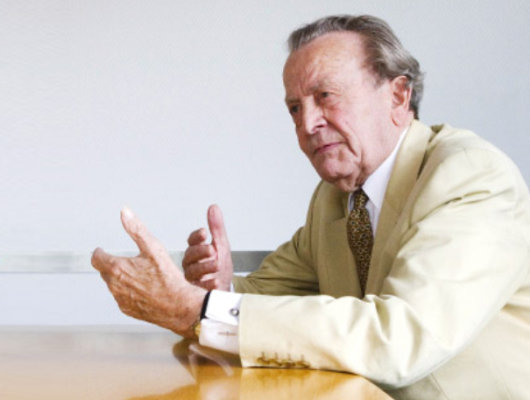
Philipp Freiherr (Baron) von Boeselager, the last surviving member of the conspiracy of anti-Nazi German officers, has died at 90 years of age. The freiherr‘s background and upbringing were distinctly Catholic. The Boeselagers are a Rhenish family with Saxon origins in Magdeburg. Philipp was the fourth of eight children and was educated by the Jesuits at Bad Godesborg. His grandfather had been officially censured by the Imperial German goverment for publically taking part in a Catholic religious procession.
Boeselager had most intimately been involved in the March 1943 plot to assasinate Hitler and Himmler when the the Fuhrer and the SS head were visiting Field Marshal Günther von Kluge on the Eastern Front. Boeselager, then a 25-year-old cavalry lieutenant under the Field Marshal’s command, was to shoot both Hitler and Himmler in the officers mess with a Walther PP. Himmler, however, neglected to accompany Hitler and so the Field Marshal ordered Boeselager to abort the attempt fearing that Himmler would take over in the event of Hitler’s death, changing nothing.
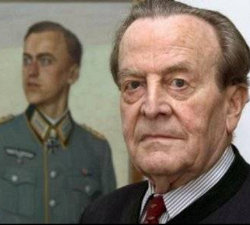 «Each day Hitler ruled, thousands died unnecessarily — soldiers, because of his stupid leadership decisions. And later, I learned of concentration camps, where Jews, Poles, Russians — human beings — were being killed.»
«It was clear that these orders came from the top: I realised I lived in a criminal state. It was horrible. We wanted to end the war and free the concentration camps.»
Boeselager later procured the explosives for the famous July 1944 plot (the subject of the upcoming film “Valkyrie“), under the cover of being part of an explosives research team. He handed a suitcase with the explosives on to another conspirator. When the bomb exploded in Hitler’s conference room, Boeselager and his 1,000-man cavalry unit made an astonishing 120-mile retreat in under 36 hours to reach an airfield in western Russia from where the aristocrat would fly to Berlin to join the other conspirators.
At the airfield, however, he received a message from his brother (Georg von Boeselager, a fellow cavalry officer who was repeatedly awarded for his consistent bravery on the battlefield) saying “All back into the old holes”, the code signifying the failure of the coup. Even more astonishingly than his swift retreat was his return, with his unit, to the front quickly enough not to raise any eyebrows. As a result, he was not known to be part of the conspiracy and escaped the gruesome tortures and executions dealt to many of his fellow conspirators.
After the war, his role in the plot was revealed and Philipp von Boeselager was awarded the Legion d’honneur by France and the Great Cross of Merit by West Germany. He joined the Order of Malta in 1946, eventually co-founding Malteser Hilfdienst, the medical operation of the German knights of the Order, and helping coordinate German pilgrimages to Lourdes.
The greater part of his post-war years was spent in forestry, and Boeselager served as head of the Arbeitsgemeinschaft Deutscher Waldbesitzerverbände (the coordinating body of private and cooperative forest-owners) from 1968 to 1988. Coincidentally, he was succeeded in that post by Franz Ludwig Schenk Count von Stauffenberg, the son of the July ’44 plot mastermind.
Search
Instagram: @andcusack
Click here for my Instagram photos.Most Recent Posts
- West Point July 30, 2026
- Brunel’s Unbuilt Capitol February 3, 2026
- Cricket at Fordham January 27, 2026
- Palacio Barolo Revisted January 14, 2026
- Learning to Love Liguria January 14, 2026
Most Recent Comments
Book Wishlist
Monthly Archives
Categories