About Andrew Cusack
 Writer, web designer, etc.; born in New York; educated in Argentina, Scotland, and South Africa; now based in London.
 read more
News
Blogs
Reviews & Periodicals
Arts & Design
World
France
Mitteleuropa
Knickerbockers
Argentina
The Levant
Africa
Cape of Good Hope
Netherlands
Scandinavia
Québec
India
Muscovy
Germany
Academica
The Farm Killings of South Africa
The above video is a ten-minute portion of a South African news programme exploring the brutal killings of innocent farmers in that country. It is most certainly worth watching, with the caveat that it’s not for the faint of heart. It is astonishing that people can live in such a climate of violence and fear. “But with the Lord’s strength, I’m here,” says one victim.
Even more appalling once you’ve watched that video is to watch the video below of South Africa’s Safety and Security Minister, Charles Nqakula, attacking those who complain about the rise in rape and murder. “They can continue to winge until they are blue in the face, they can continue to be as negative as they want to or they can simply leave this country.” It doesn’t take a genius to understand that the ‘they’ he speaks of is the community of white South Africans. Plus ça change, eh?
Further along the theme of South African online videos, why not watch the trailer for the upcoming film ‘Catch A Fire’? Soon to be released by Focus Features, the film tells the true story of Patrick Chamusso, a man brutally tortured by the police while falsely accused of terrorism. He is freed when they realize he is innocent, but soon makes up for his innocence by, you guessed it, becoming a terrorist.
Racialist Thinking Behind the Times
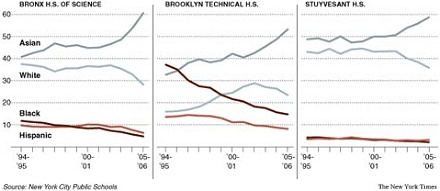
The fair-minded, independent observer would look at the figures above and think to himself “Interesting, the proportion of Asian students is on the rise, while that of White, Black, and Hispanic students is generally in decline”. However the racialists (I will not use the more loaded term of ‘racist’, though the meaning is exactly the same) at the New York Times can only see the Black and Hispanic decline, captioning the chart ‘The share of black and Hispanic students New York City’s three most elite specialized schools has declined’.
And why no chart depicting the racial make-up of the also public selective Hunter College High School? Is it, by some unknown criterion, not in the same league or perhaps the proportion of black and Hispanic students there actually rose? The Times reader is left uninformed as to the greater picture, but suitably inculcated in racialist thinking.
Gothamist’s Jen Chung notes the decline is “in spite of the city’s best efforts to encourage [Black and Hispanic students] to apply and attend” while City Councilman Robert Jackson ponders “”Is it institutional racism or is it something else?”.
Could it perhaps be that the racial makeup of the city’s elite public high schools is subject to (quel horreur!) occasional fluctuations? What is the racial makeup of an elite public high school “supposed” to be? Here’s a concept worth considering: how about giving the students in selective public high schools the best education on offer and admit students based purely on a meritocratic standard which does not descriminate by sex, race, class, or creed? Just a thought.
Two Scotsmen
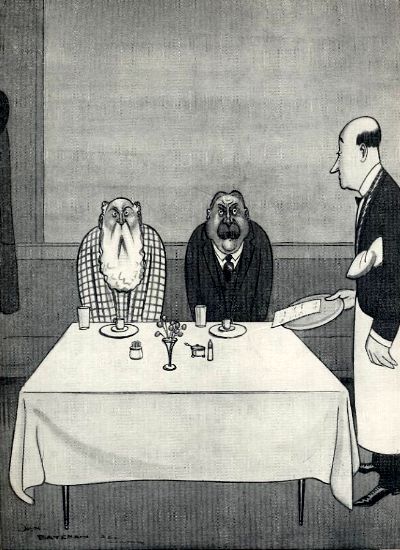
THE ORIGIN OF THE SLOW MOTION PICTURE
Study of two Scotsmen, having dined together, reaching for the bill.
H.M. Bateman
The Haunting Richardsonian
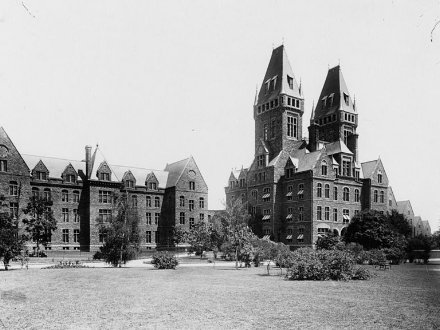
ONE OF THE splendid things about New York is that it’s a land which continually manages to throw up a surprise or two, even to time-hardened devotées of all things knickerbocker such as yours truly. One of my most recent discoveries is the fabulously haunting and impressive Buffalo State Hospital out in the far west of the Empire State.
The magnificent building was built to the design of Henry Hobson Richardson, the progenitor of the eponymous ‘Richardsonian Romanesque’ style, as one of a series of governmental asylums for the insane founded throughout the nineteenth century. Richardson also did a great deal of work on the Capitol in Albany, designing the south façade which, since the construction of Nelson Rockefeller’s Little Brasilia, is now the main façade of the building and was inspired by the Hôtel de Ville in Paris.
Construction on the State Hospital began in 1870, and the central administration block with its two towers and a number of flanking pavilions housing patients were opened in 1880. Interestingly, the towers which so dominate the building are purely decorative and remain unfinished on the interior.

The footprint of the building follows the V-shaped Kirkbride plan, conceived by Pennsylvania’s Dr. Thomas Story Kirkbride in his 1854 opus, On the Construction, Organization and General Arrangements of Hospitals for the Insane which revolutionized care for the mentally unstable in the nineteenth century. The location was a 100-acre parcel of property near the city of Buffalo, and the grounds were landscaped by Frederick Law Olmsted, who designed Central Park with Calvert Vaux.
The grounds originally included farms which helped to feed the patients and staff, but in the 1920’s this land was redeveloped as the Buffalo State College, now the University at Buffalo (State University of New York). The hospital, renamed Buffalo Psychiatric Center, moved out of the Richardsonian complex into a plain, ugly, modern building on the grounds in the 1960’s, leaving the beautiful Victorian structure to rot and ruin.
However recent efforts by Buffalo and New York state officials have led to the replacement of the roof and other work to ensure the continued integrity of the building. The latest plans would have the building serve an educational function under the auspices of the State University next door, an appropriate purpose for this majestic gem of New York architecture.
The Assumption

Nicolas Poussin, The Assumption of the Virgin
Oil on canvas, 22″ x 16″
1650, Musée du Louvre, Paris
Click here for a closer view.
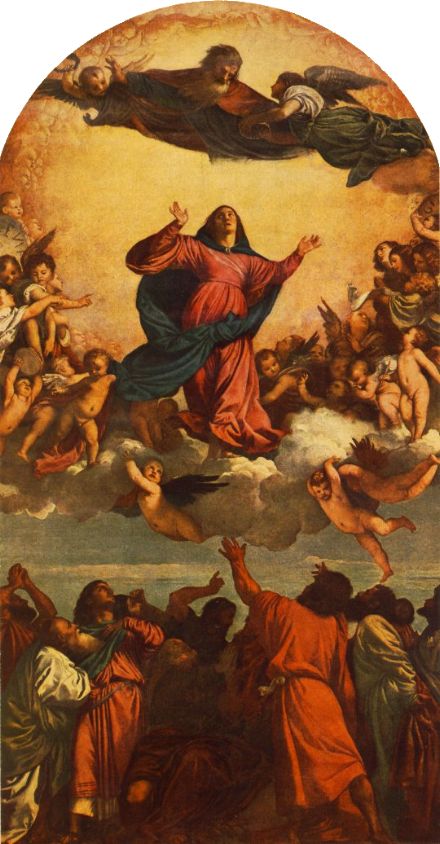
Titian, Assumption of the Virgin
Oil on wood, 272″ x 142″
1516-18, Santa Maria Gloriosa dei Frari, Venice
Peter Simple III
As the Anglo-American intervention in Mesopotamia took place, Peter Simple found he could not avoid the subject. In the first column we present to you today, Peter Simple tells us of another, more dangerous invasion. The second column was written after Defense Secretary Donald Rumsfeld brushed aside the Franco-German opposition to the Second Iraq War, chiding Paris and Berlin as ‘Old Europe’. Of course, the secularist modern republican governments which today rule from Paris and Berlin are about as far from Old Europe as possible, but read on. Peter Simple says it all.
Signs and Portents
January 17, 2003
 We are sometimes asked about our columnar policy in the matter of the proposed American war on Iraq. There is an ongoing discussion about this in the Supreme Columnar Council where the great abbots and nobles meet. They ask: what likely outcome could benefit or damage our columnar interests? Some say one thing, some another; there are as many opinions as men.
Of more immediate concern are rumours of incursions by agents of the American mass-culture, as it is called, into columnar territory. Last week there were reports that infiltrators, most likely seaborne invaders from the vast wastelands of television across the Interpaginal Channel, had appeared in a remote mountain region.
They had installed illegal electro-galvanic machines, distributed cheap “television sets” to a few gullible peasants and begun “broadcasting” seditious and obscene material.
This attempt to defy the fundamental columnar laws against technology did not last long. Sturdy, loyal peasants, wielding the infrangible iron bar of Luddite-Sibthorpian theory, soon smashed the evil machines and chased the interlopers over the border, chanting the old song: “Lift up the stones and expose the technological bandits to the eye of Heaven.”
In another attempt, infiltrators carrying large sums in columnar currency and Maria Theresa dollars, erected an infernal eating house and tried to sell their disgusting fare to the peasants. They even displayed an illicit electro-galvanic sign, “Simpleburgers”, to seduce the peasants from the homely, healthy fare they produce from their own immemorial labours in the fields.
When the victims fell ill from eating this unaccustomed rubbish, a traditional panic set in. Soon the more ignorant took to the roads, wheeling handcarts crammed with pathetic household goods: pots and pans, rocking chairs, bedsteads and icons, with here and there an ancestral grandfather clock, barometer or stringless harp handed down from forgotten bards of old.
A headlong rush towards the Dreaded Eastern Void was averted just in time by greybeard village elders and a few militiamen on leave who knew how to reinforce advice with rougher methods of persuasion. But now worrying supernatural phenomena were seen. A moderate-sized green dragon reading a newspaper was stretched out lazily by the roadside. A plague of frogs invaded a wayside shrine. From abandoned wells voices gave warning in unknown languages, immediately identified by village schoolmasters as “Hittite” or “Old Sorb” – there were few to argue.
Only by continual vigilance can we prevent such incursions, which, as the outer world grows ever more demented and corrupt, can only grow more frequent. What, it may be asked, are the implications for world and other world affairs? Our primary concern, as always, is to defend our borders and uphold our columnar interests. We cannot point out too often that in the event of a serious threat to the paginal balance of power, this column could not and would not stand idly by.
Gone for Ever
“Old Europe”: with this contemptuous phrase, Rumsfeld and his fellow eminences at the White House dismissed French and German opposition to military action against Iraq. Supremely arrogant, confident of a future world order even more repellent than the present, how should they know or care that for some of us Old Europeans the phrase can induce a mood of hopeless longing?
A hundred years ago, Old Europe ruled the world. From its colonies in every continent came tribute which daily enhanced its wealth, convenience and comfort. The old kingdoms and empires were still intact. The Kaiser ruled in Berlin, the Tsar in St Petersburg, the Emperor Franz-Joseph in Vienna, each with his splendid court whose customs and ceremonies seemed made to last for ever.
The civilisation of Europe – the greatest civilisation the world has known – still seemed secure. Its ancient cities, so varied in their beauty and splendour, still held glorious treasuries of art. Its noble landscapes were still unsullied. Its various peoples kept their own historical traditions.
But the death wish fell on Old Europe, and it collapsed in fratricidal war. The Americans arrived to hasten its ruin with their pernicious doctrines of self-determination, equality and perfectability. Mortally wounded, Old Europe staggered on, but could not recover.
Now there is talk of a New Europe. It is a matter not of emperors and kings but of technicians, accountants and businessmen. It may or may not prosper. What do we care, when Old Europe has gone for ever?
Avenida de Mayo, Buenos Aires
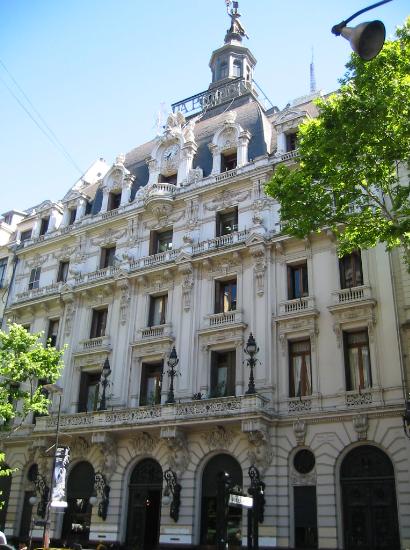
The La Prensa building, formerly home to the newspaper of that name, now the Casa de Cultura.
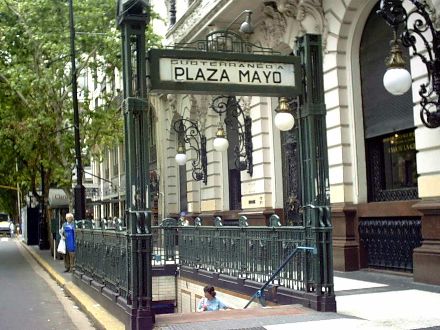
The subte entrance in front of the edificio La Prensa.
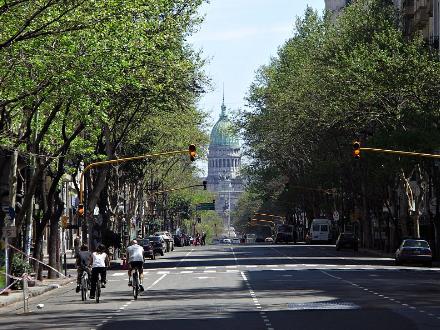
Looking down the Avenida toward the Palacio del Congreso.
On Walkabout with Philippe de Villiers
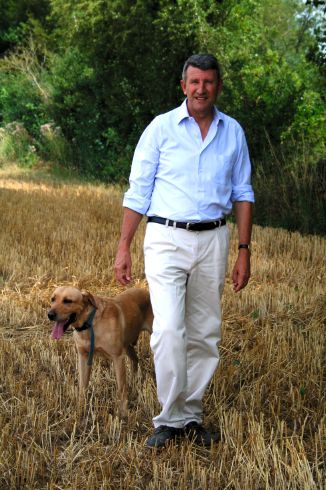
Viscount Philippe le Jolis de Villiers de Saintignon is the head of the French political party Mouvement pour la France, and one of the leading voices against the Islamisation of France. The MPF is, in some sense, the ‘Catholic’ party on the French right, being conservative and traditionalist in contrast to the Front National (headed by the genial misanthrope Jean-Marie le Pen), which is thoroughly republican and nationalist. De Villiers has been trying to encourage patriotism in contrast to the nationalism of the FN and the continentalism of the other parties.
A native of the Vendée, he led the right flank (so to speak) in the May 2005 French referendum against the European Constitution. The rejection of the Constitution by the French voters has put the nefarious project on hold, though likely not for long. (The established precedent with European treaties of this nature is for the ruling bureaucratic elite to hold as many referenda as it takes to pass). Let’s follow le bon vicomte and see what he’s up to these days…
The Great Seal of Carolina
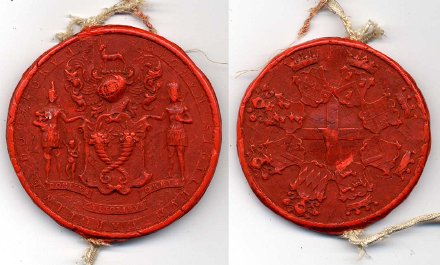
THE ROYAL CHARTER which erected the Province of Carolina created the colony as a county palatine, similar to Durham, Chester, and Lancashire back in England. However, instead of being ruled by a Count Palatine (or Prince-Bishop in Durham’s case), Carolina, named after England’s martyr-king Charles I, was to be ruled by eight Lords Proprietor, the eldest of which would hold the title of Lord Palatine of Carolina. The charter even allowed for the granting of titles…
…to Men well deserving the same Degrees to bear, and with such Titles to be Honoured and adorned, AND WHEREAS by our form of Government It was by our said Predecessor Established and Constituted, and is by us and our Heires and Successors for ever to be observed, That there be a certain Number of Landgraves and Cassiques who may be and are the perpetual and Hereditary Nobles and Peers of our said Province of Carolina, and to the End that above Rule and Order of Honor may be Established and Settled in our Said Province.
The granting of the titles of ‘landgrave’ and ‘cassique’ never really took off, but the Lords Proprietor did have a rather splendid Great Seal for their own private fiefdom in the New World, an impression of which is happily preserved by the good people of the South Carolina Department of Archives and History down in the Palmetto State.
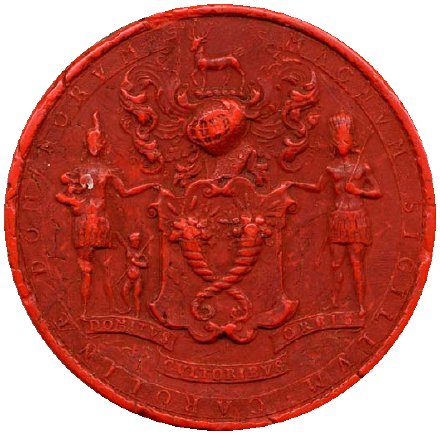
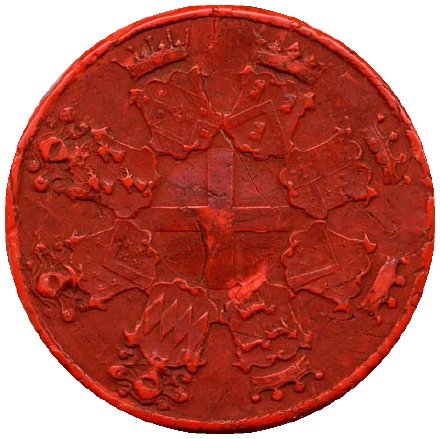
The obverse (above) shows the arms of the Province of Carolina with two cornucopias in saltire. Joseph McMillan, Director of Education for the American Heraldry Society, has posited that this is the probable origin of the cornucopia depicted in the Great Seal of the State of North Carolina, the larger of the two Carolinas. The motto reads “Domitus Cuitoribus Orbis” which perhaps some learned reader could translate properly. The reverse (below) depicts the eight heraldic shields of the Lords Proprieter, surrounding a simple Cross of Saint George. Some readers may recall this configuration being used, in a much simplified form, in the heraldic achievement recently devised by the College of Arms for the Senate of North Carolina, mentioned and depicted previously on this site. The arms of the North Carolinian Senate also show the cornucopias in saltire in the crest above the shield.
UPDATE:
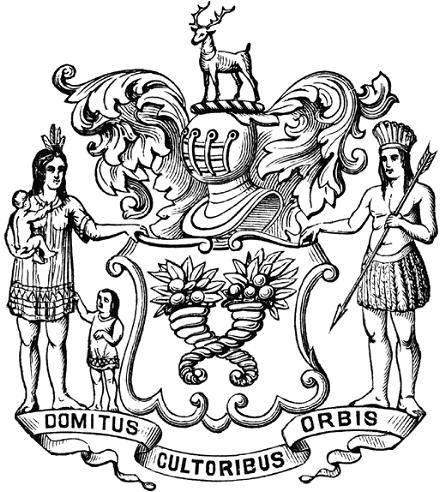
The commenter below is correct; the motto is ‘Domitus Cultoribus Orbis’ or ‘Tamed by the Husbandmen (cultivators) of the World’, as shown clearly in this alternate depiction which I have discovered.
Stauffenberg’s Arms

Hommage à la mémoire de Claus Philip Maria Schenk comte von Stauffenberg, homme d’honneur et de foi, qui participa à l’attentat contre Hitler, le 20 juillet 1944 dans le cadre du plan ‘Walkyrie’ destiné à renverser le régime nazi.
The arms of Claus Philipp Maria Schenk Count von Stauffenberg, beautifully depicted by the French heraldic artist Laurent Granier.

Previously: Long Live Our Holy Germany!
Monarchs and Presidents in Islam
National Review, Nov 21, 1986
by Erik von Kuehnelt-Leddihn
IN THE Islamic world’s relations with Israel, the hard-liners are the various Arab and non-Arab republics. When there is any sign of softness, it comes, almost always, from one of the monarchies. (Egypt, and Egypt alone, is the exception.) It thus did not come as a great surprise that King Hassan II of Morocco agreed to meet with the then Israeli prime minister, Shimon Peres, this summer.
While individual monarchs historically may have been capricious or cruel, monarch as an institution is inclined to be generous: Montesquieu has told us that while the driving element in republics is virtue, in monarchies it is clemency. And, indeed, the Islamic monarchs of old were infinitely more tolerant than their modern republican successors. They traveled extensively, and many had a cosmopolitan outlook. Some had relatives abroad. When King Hassan II of morocco writes to members of Europe’s royal families, he addresses them as “cher cousin” or “chere cousine,” since he is a descendant of Mohammed’s daughter Fatima, as by now are all the Christian royal families. (Many centuries ago, a Moroccan prince was taken prisoner by the Castilians and converted in captivity. After his release he married into a princely family, and over the centuries his bloodline has spread into countless aristocratic and royal families.) In chooing their administrators, officers, diplomats, bankers, and doctors, Islam’s monarchs looked for able men regardless of religion, never caring whether their choices were popular or not.
It is true that local slaughters of Christians took place in various parts of the Turkish Empire, but things got really bad only when the enlightened, highly nationalistic Young Turks appeared on the scene. Their political organization was called “Unity and Progress,” by which they meant ethnic uniformity and modern methods. It was they who were behind the big Armenian massacres during World War I. The Turkish sultans, by contrast, frequently gave preferment to Christians (and sometimes Jews) in high positions. The Phanariotic Greeks, so called after the Lighthouse Quarter of Constantinople in which most of them lived, acted as trusted administrators; the governors of the Rumanian-speaking provinces, for instance, were taken from their families.
Very typical is the story of a family known to me. Originally called Black, they were Scots and good Catholics who emigrated after the fall of the Stuarts and settled in France, where they Gallicized their name. There are still Blacques in France, but one branch of the family emigrated to Turkey, where its scions made a splendid career without changing either their name or their religion. One of them, Edward Blacque-Bey, became the last Turkish imperial ambassador in Washington. (His sons, too, made diplomatic careers. One married an American, and his son, having graduated from Harvard, became a colonel in the U.S. Marines and later an American diplomat.) Edward Blacque-Bey wore a fez and was a loyal subject of the sultan, under whom Constantinople became an international metropolis. All this ended with the republic under Ataturk.
Similar conditions existed in the kingdom of Egypt before Nagib and Nasser. Forty per cent of the administrators and civil servants were Coptic Christians, who considered themselves the genuine descendants of the Old Egyptians. Before 1952 Cairo was an eastern Paris, where Christians and Jews played an important role–socially, commercially, politically, Arab nationalism put an end to all this, not only in Cairo, but also in Alexandria, which is so well described in Lawrence Durrell’s Alexandria Quartet. In Iran–a non-Arab state–the old monarcy under the Kajar dynasty and the more recent one under the Pahlavis were notably tolerant. Non-Muslims (such as the still-surviving Zoroastrians) could make all sorts of careers, and the country’s political orientation was Western. The window to the West remains open in the Islamic monarchies of today–in Morocco, in Saudi Arabia, in Oman, and even in Malaysia.
MONARCHIES HAVE the advantage that, although they might be oppressive toward the political ambitions of their subjects, they are never totalitarian. To my knowledge there is no Jewish community left in Algeria, but there still is a small one in Morocco. Variety is the keynote of monarchies, and with it goes internationalism. In 1910 only two sovereign nations in Christian Europe had truly native dynasties: Serbia and Montenegor. (Peter III was the last genuine Romanov; the Hohenzollerns were not Prussians but Swabians; and so forth.) These dynasties could often follow unpopular policies, both domestic and foreign. Popular policies are not always good for the country, and the courage required to stick to an unpopular good policy is immensely rare among politicians in democracies. They crave popularity and want, above all, to be re-elected. King Hassan II might be trembling lest he be assassinated by fanatics, but he pursues policies that he considers to be right. He certainly is not guided by Sir Henry Campbell-Bannerman’s idiotic dictum, “Self-government is better than good government,” which is roughly equivalent to saying that self-treatment in case of illness is better than treatment by a qualified physician.
New York in Philately
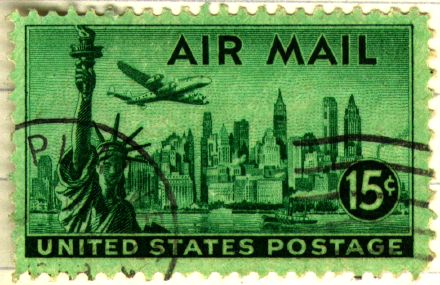
Wandering around the merry old world wide web I stumbled upon these stamps, which I bring to you for your own enjoyment. Above we have the Great Metropolis itself, the island of Manhattan in its swankier days. Below we have a view of the Crown of the Hudson, West Point, with the beautiful Cadet Chapel designed by that American Master, Bertram Grosvenor Goodhue himself, presiding over the campus of the United States Military Academy.
The postage stamp was once a thing of beauty and composition, but it’s heartening to see that some still design beautiful stamps. Just examine Elliott Banfield’s stamp of General Washington, based upon the staute in Union Square. Mr. Banfield believes that the decline in the design of postage stamps is due to a “moral void” most readily shown when the Postal Service unveiled its famous ‘Elvis Stamp’ a few years back.
“Elvis was important in the popular culture, yes,” writes Mr. Banfield. “But how important is the pop culture? Important only to those who can’t see anything higher or better. It’s scary to think that people like that are in charge of public policy. But they are, and the Elvis stamp proves it.”
Hear! Hear!
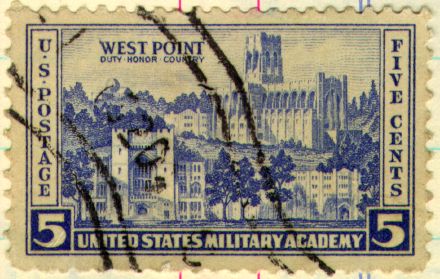
An irrelevant stamp, after the jump.
Can Kid Save This Sinking Ship?
25-Year-Old Buys the Salmon Siren of the Upper East Side
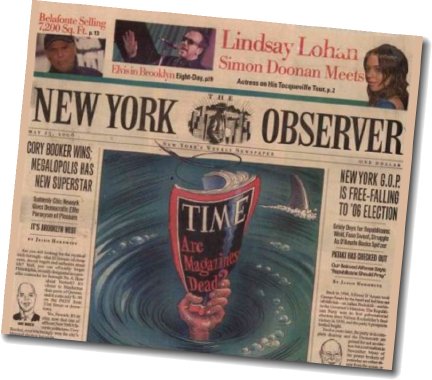
AN NYU LAW  student of just twenty-five years of age has purchased the majority stake in the New York Observer. Jared Kushner (right), son of the currently jailed big-time donor to the New Jersey Democrats Charles Kushner, bought the biggest-piece-of-the-pie off of publisher Arthur Carter, who founded the insouciant weekly printed on salmon-tinted paper back in 1988. No official word on how much money changed hands during the deal, though the Times cites “one person familiar with details of the sale” claiming the amount was nearly $10 million. Carter will maintain a significant say in the paper’s operations, and there are no plans to make any changes to the masthead as of the moment. Earlier in the year Robert de Niro was in talks to buy the Observer through his Tribeca Film Festival operation, but the negotiations fell through.
The Observer, with a small-but-influential circulation of 55,000, has undergone a miniature transformation recently with the hopes of turning around the current losses of about $2 million a year. The most noticeable of these changes came in May when the paper trimmed over an inch in width, moving from six front-page columns to five and giving it a taller, more narrow appearance. While the thinner size saves on rising newsprint costs it also means diminished space for advertising, and the newspaper lost its easy, leisurely feel, also moving from two sections to one. The Observer has also increased the volume of its internet operations on Observer.com, some might say at the expense of the quality of the printed edition. The new owner, however, will take a back seat in the content of the newspaper while concentrating on improving the bottom line, citing the Observer‘s strong brand despite its current financial woes.
Kushner’s father, a well-known New Jersey real estate developer, was sentenced to a jail term last year after being found guilty of tax evasion, and is well-known for a number of other stunts which do not bear repeating on, er, family-friendly sites such as this. The younger Kushner himself has given over $100,000 to various (Democratic) political outfits since 1992, when he was a mere eleven years of age.
I used to read the Observer often (though not regularly) because it had the most style of all the New York newspapers. While its flighty spirit meant it lacked a certain depth, it still had zing and usually at least a handful of interesting articles each week. The quality of the content began slipping, however, and when I came home to New York I bought one copy while waiting for the train in Grand Central, was completely dissatisfied like the new size and feel, and decided to give it up. I will always have a certain fondness for the Observer though; in the age when Gannett-style corporate monotony is king, it has managed to maintain a certain classic swankiness (epitomised in its reporter-and-skyline emblem) and for that we can be grateful.
The Spectator

Taki Jr Ties the Knot
I’ve always liked Taki’s columns in the Spectator; for his sins, the man has a good heart and often writes with brutal honesty. Anyhow, Mr. Theodoracopulos’s son recently got hitched, with the priest shipped in from Staten Island, and the baptism of the couple’s six-month-old child (!) on the same day. You can read it all yourself. (The links are Taki’s).
Midsummer marriage
Frankly, this was not a cool wedding. There were no security guards, no stretch limos, no Liz Hurleys, no cutting-edge genetic technology, not even a same-sex marriage. Not very with it, I know, but there we are. John Taki and Assia got hitched last Saturday in the most magical setting I have ever seen a Xanadu. ‘And there were gardens bright with sinuous rills/Where blossomed many an incense-bearing tree;/And here were forests ancient as the hills,/Enfolding sunny spots of greenery.’
Old Sam Coleridge must have visited Prince Nettuno Borghese’s property by the sea, west of Rome, because what Kubla Khan decreed is where my boy got hitched. Assia’s father Count Maurizio Baudi di Selve and her mother Maria Grazia never let on what they had in store for us. Maurizio is the scion of the Borghese clan, the oldest princely family of Italy, and he began the celebrations on Friday evening in the Palazzo Borghese, with a small dinner for around 250.
Back in the good old days, Rome was led by princes who built palaces reflecting their power. The present head of the family still lives in an apartment there, sharing the rest of the palazzo with the Circolo della Caccia, Rome’s most exclusive gentlemen’s club. Liveried staff move silently, evoking a time when nobility led from the front. The place is so grand and so beautiful even I managed to behave. The trick for a successful wedding is to keep it small. Only good friends need be invited. The mother of my children, John Taki and I invited 90, Assia’s family 135. Not a freak among them, no stuffed shirts, no charlatans, just young people full of grace and manners to match their beauty.
Afterwards, on the terrace of the Hassler, we began to blow off steam. I had friends who had flown in from New York, Los Angeles, Athens and three all the way from deepest Mexico. The jet lag helped. At five in the morning, the management declared the bar closed because a few bores upstairs found it hard to sleep.
Next day was the big one, so I went to the Borghese Gardens and tried to sweat off some of the booze. After a while I had to sit down next to some fat American tourists who, I think, were complaining about the lack of air-conditioning.
Around five in the afternoon I was driven towards Anzio, where Nettuno lies high above the sea. A long alley lined with hay bales suddenly revealed a beautiful small chapel next to a handsome red house which I mistook for the main one. (It turned out to be the gardener’s cottage; some cottage.) Two large semi-circles of armchairs were provided for the guests outside the chapel. The ceremony was conducted by Father Ramsay, a close friend of my family who had flown in from Staten Island, Noo Yawk.
Though I say it myself, never have I seen a better-looking couple. The father of the bride is a tall and very handsome man, some 20 years younger than me, and when he came in with Assia, the Med glistening in the distance behind, the green walls of the surrounding woods, spots of light penetrating, the scene was so moving I almost blubbed. Close but no cigar. John Taki, an incredibly sloppy dresser, was for the first time in his life looking like Beau Brummell. He had spent three months preparing his sartorial triumph. Two violinists played Vivaldi and, after a ceremony conducted in English and Italian by the polyglot Father Ramsay, it was time for…yes, the baptism of Taki-Tancredi, aged six months. (Leave it to a son of mine to get married in front of his baby son.) My daughter Lolly was his godmother.
The party that followed I will not soon forget. We walked from the chapel to a wood under a canopy of pines where a jazz band played in the pink light of dusk. My friend John Sutin mistook the round tables lined with drink and pizza-makers for the real thing, and had 24 slices of freshly made pizza. As it got dark and we were asked to proceed to an open lawn under an 11th-century tower for dinner, Sutin looked like the proverbial cat that had swallowed you-know-what. Dinner under the stars, topiary transforming the house into a stage set, so many beautiful young girls, it was a bit too much for me. I got completely blotto, gave a good speech, and danced all night to Zulu music, something I don’t do that often. The newly-weds left as the sun was rising, on Bushido, anchored off in the distance and gave a long whistle goodbye. I thought I saw some dolphins escorting them away, but obviously my eyes were playing tricks. A long summer day and night had ended but the memories will always linger like echoes of the mind.
Peter Simple II
Traditionalists are very wary of claims that ‘the world has changed’, for we have long memories. We know that the world has only ever truly changed twice: when man first rebelled in the Garden of Eden, and when Christ defeated that rebellion on the Cross of Calvary. Nonetheless, men are fickle and can easily be overwhelmed by events, be they calamitous or felicitous. In his first column after the tragedy of September 11th, Peter Simple mourns the loss while sagaciously pointing out the utter futility of the ‘war on terror’ which had been proclaimed. What took a few years for we foolish knaves to discover, the Grand Old Man was already reminded us merely a week after the terrible attack.
No Change
21 SEPTEMBER 2001
ONLY a stony-hearted fanatic could have been unmoved by the massacre in America. Yet for us feudal landlords and clerical reactionaries, cranks, conspiracy theorists and luddite peasants, the downfall of the twin towers that symbolised the worldwide empire of imaginary money is not in itself a cause of grief.
Ever since the atrocity, dense clouds of hysterical rhetoric have been drifting about the world. America is at war, says President Bush. Britain is at war, says Tony Blair, dutifully echoing his master. The whole world is at war, say the “media”. But what enemy is the world at war against? Terrorism!
A war against terrorism is as futile and fatuous as those other fashionable wars, “the war against drugs” and “the war against racism”. You might as well declare war against old age or death.
September 11, the “media” say, was the day that changed the world for ever. But the world has not changed. It is still the same old world, good and bad, that it has always been. As for terrorism and terror, only one thing is certain: we have seen nothing yet.
A month later, a lighter heart returned. Using one of his favourite fictional devices, the Feudal Times and Reactionary Herald, Simple reminds us of the familial bonds which bind Britain and America, and suggests a novel demand to be laid on the Americans’ for support in their time of need.
What the Papers Say
5 OCTOBER 2001
IN A thoughtful leader, The Feudal Times and Reactionary Herald offers an alternative prospect for the world to that of Tony Blair: “Now that our rebellious North American colonists, justifiably enraged by the late atrocities in their country, have put themselves on a war footing, few will doubt that we have a certain family duty to help these wayward but redoubtable people in their time of trouble.
“Few will doubt, however, that the price of our support must be their concurrence with a general settlement in the world: a return to the principles of sanity that were so disastrously overturned by their own revolt and by the even more lamentable events that followed it in France.
“First and foremost, we must assert the superiority of our own European civilisation – a principle left to an Italian politician (whose name escapes us) to enunciate some time ago, to the scorn and derision, needless to say, of the enemies of our civilisation in our own country and abroad.
“We must restore the stability and good government formerly assured by colonial rule in Africa, Asia and South America. A reunited India must again accept the benevolent authority of the Raj. The Chinese Empire, too, must be restored together with its admirable mandarinate.
“In Europe itself, the empires and monarchies which were so lamentably swept away after the First World War, must rise again, ensuring those civilities of diplomacy temporarily replaced by a graceless rabble of ignorant upstarts, low-bred bagmen and radical students. But the price of our support for our rebel colonists in their present trouble must be an end to their present anomalous position which, thanks in part to our own supine policies, has now lasted for more than 200 years.
“We are convinced that the better sort among our rebel colonists would welcome a new declaration of allegiance to Crown and Empire. Sentiment apart, who can doubt that the Empire, newly invigorated by the return of these impetuous but energetic people, would be the dominant power in the world for the foreseeable future, unchallenged by any power or combination of powers that could be brought against it?”
Previously: I: ‘Quiz’ and ‘A Model Planet’
The Felicity of Chronicles
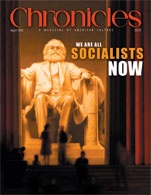 In the midst of my summer indolence, reading Chronicles proves to be one of the most nourishing experiences. There is no other monthly (except the New Criterion) which features such good writing on such a variety of subjects and which refuses to take anything for granted. The overwhelming majority of the intellectual culture of the West today lazily presupposes agreement with Enlightenment concepts and all that nasty business unleashed by the French Revolution. Chronicles dares ask the question “What if they’re wrong?” and quite often posits the statement “Actually, they are wrong!” which then opens the door to truly considering, well, all the aspects of society; this even though Chronicles rather humbly subtitles itself ‘A Magazine of American Culture’.
The August 2006 edition highlights the convergence between socialism and capitalism in our society and contains much of interest. However we will provide you with only a few good snippets from Thomas Fleming’s piece, ‘Socialism is Theft’.
[…] I remember my astonishment, in the 1980’s, meeting college students who were already talking about which corporations offered the best retirement plans. At that age, I did not imagine I would live to see 25 – and the way I was living more than justified such skepticism. Girls and Greek poetry were my principal inspirations, and Greek still brings pleasure. When a young male is thinking about retirement at the age of 20, he has already given up all hope of ever becoming a man. […]
‘We are all socialists now,’ as Sir William Harcourt observed over a century ago, and nothing has so contributed to the socialist mentality of modern life as the disappearance of private property, not only as reality but even as an ideal. American mobility, combined with the frenetic hallucination that ‘ending is better than mending,’ has detached Americans, in particular, from local roots. These days, a home is not the place in which your father was born or your grandfather died; homes are sold by the dozens by realtos who are ever eager to help you move up. If a ‘home’ is nothing more than an investment, it is hard to blame the politicians for thinking they could turn your house and lot into a more socially productive investment by selling it to developers. […]
The abuse of eminent domain is only a minor symptom of a much deeper malaise. Our rights of possession are contingent on the power of government at every level to tax property and, if taxes are not paid within a specified period of time, to confiscate it and sell it to the highest bidder. For most of us, this power does not represent an imminent danger, but it is symbolic of our dependency on government. […]
Whatever they may earn, working stiffs who depend for their very existence on government agencies and corporations larger than most nation-states are a far cry from the confident and assured citizens of the old America. The old Americans were men and women few government lackeys wished to provoke. Today, we seem to live at the behest of powerful and impersonal forces. At best, we are their loyal (and timid) retainers.
Is this result – the weakening of our character – intentional? I do not know, but the motives of politicians are always suspect. The most successful lie put forth by neoconservatives is the so-called law of unintended consequences, which would have us believe that the architects of centralized state education, the New Deal, and the Great Society did not realize that the consequence of taking control of schooling might be to transfer authority from families and communities to state and federal bureaucracies, and they never imagined that, in paying people to do nothing, they would not only discourage the necessary habits of work and thrift but undermine the self-reliance and initiative that supposedly characterized the true American. This same political class, we are called upon to believe, had absolutely no idea that the 1965 Immigration Act would dramatically alter the ethnic composition of the United States or that flooding the Horn of Africa with weapons would lead to war. Credat Apella iudeaus!
Socialism marches on, and, in its progress, it attracts more dedicated capitalists and free-enterprise capitalists to the cause. Planned obsolescense in appliances is good, argues one libertarian con man, because we should always be buying the new and improved model. The same argument applies to houses, wives, families, and communities. We are all caught up in Progress Fever, like the Gold Fever that sent so many foolish men to die, far away from all they loved, in California or Montana.
Economic liberty and free enterprise can be maintained only by a certain kind of human character that is created and nourished under certain specific social and cultural conditions. A farmer who farms his own land and defends it with his gun, who supervises the schooling of his children and sits on his church’s vestry, is a far cry from the deracinated consumer who switches houses every five years and pays other people to protect him. The consumer may make and spend far more money, but he does not have a clue as to the meaning of the term economic liberty, and, when times are hard, he will cry like a stuck pig for government to reach out its ever-extending arms to save him from the consequences of his cowardice and greed.
America’s Latest Basilica

Holy Hill, the National Shrine of Mary, Help of Christians, has been named a basilica minor by the Holy Father. The Carmelite friars came from Bavaria to found the monastery at this hill in Wisconsin one hundred years ago in 1906. While the invocation of Mary as Help of Christians (Auxilium Christianorum) began in the 1500’s, the feast of Our Lady, Help of Christians was instituted in 1815 by Pope Pius VII in thanksgiving to God and Our Lady for the freedom of the Papacy and of Europe brought about by the defeat and exile of Napoleon Bonaparte.
Via the Holy Whapping.
Above photograph of Holy Hill by Carl Waltz
A Royal Gathering
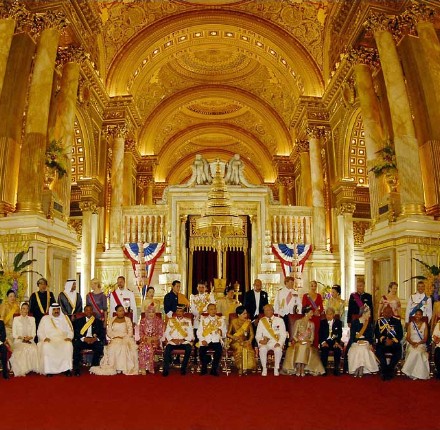
Click here for a photo of most of the world’s reigning monarchs and a number of other royalty, gathered to celebrate the jubilee of the King of Thailand’s accession to the throne.
A few weeks ago, Fr. Rutler informed me that the Queen of Thailand, upon acceding to the throne, made a vow never to perspire. No word on whether she’s kept her vow.


Search
Instagram: @andcusack
Click here for my Instagram photos.Most Recent Posts
- Brunel’s Unbuilt Capitol February 3, 2026
- Cricket at Fordham January 27, 2026
- Palacio Barolo Revisted January 14, 2026
- Learning to Love Liguria January 14, 2026
- Crux Alba No. 2 January 13, 2026
Most Recent Comments
Book Wishlist
Monthly Archives
Categories