New York
About Andrew Cusack
 Writer, web designer, etc.; born in New York; educated in Argentina, Scotland, and South Africa; now based in London.
 read more
News
Blogs
Reviews & Periodicals
Arts & Design
World
France
Mitteleuropa
Knickerbockers
Argentina
The Levant
Africa
Cape of Good Hope
Netherlands
Scandinavia
Québec
India
Muscovy
Germany
Academica
St Vincent Ferrer
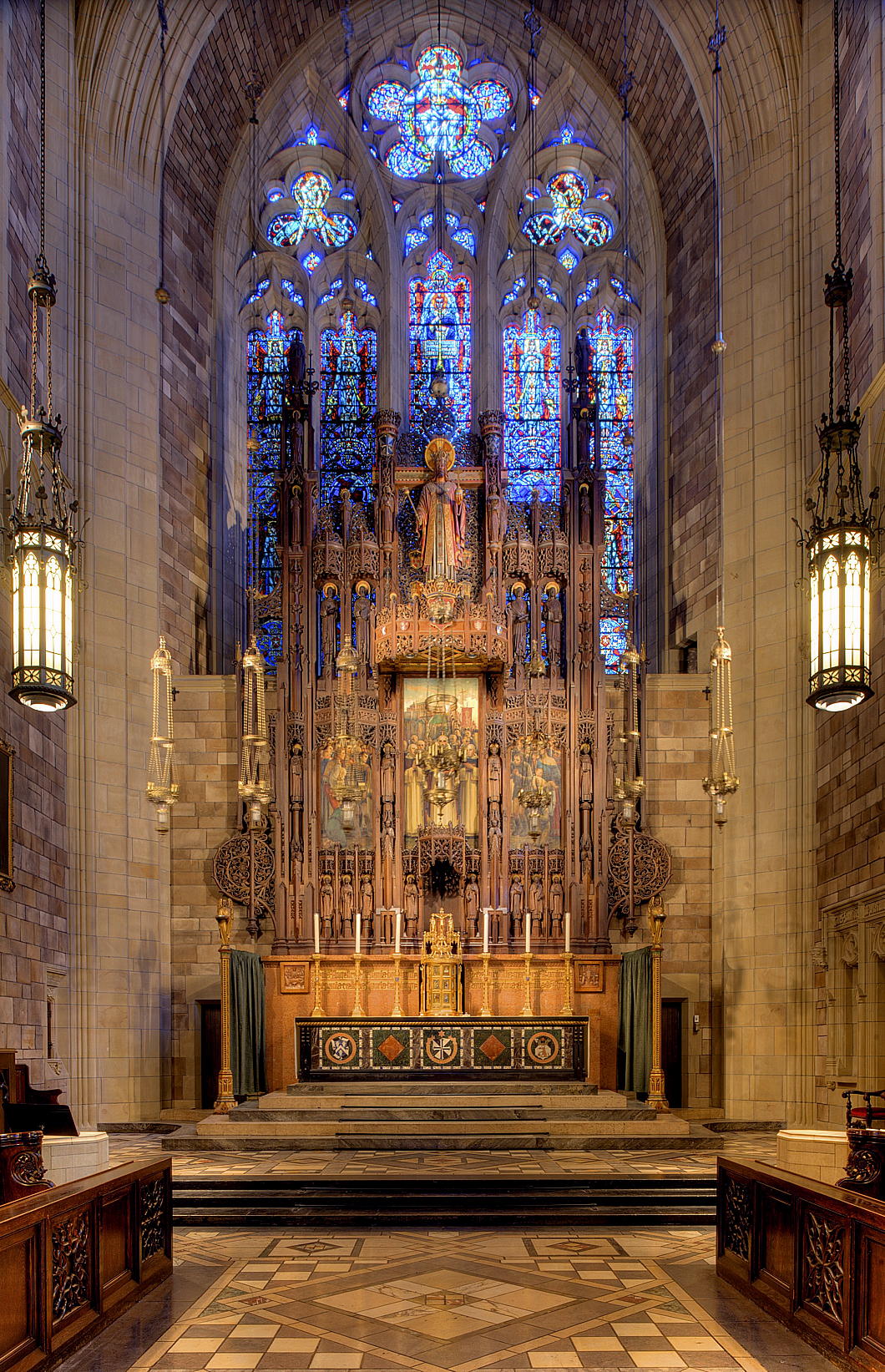
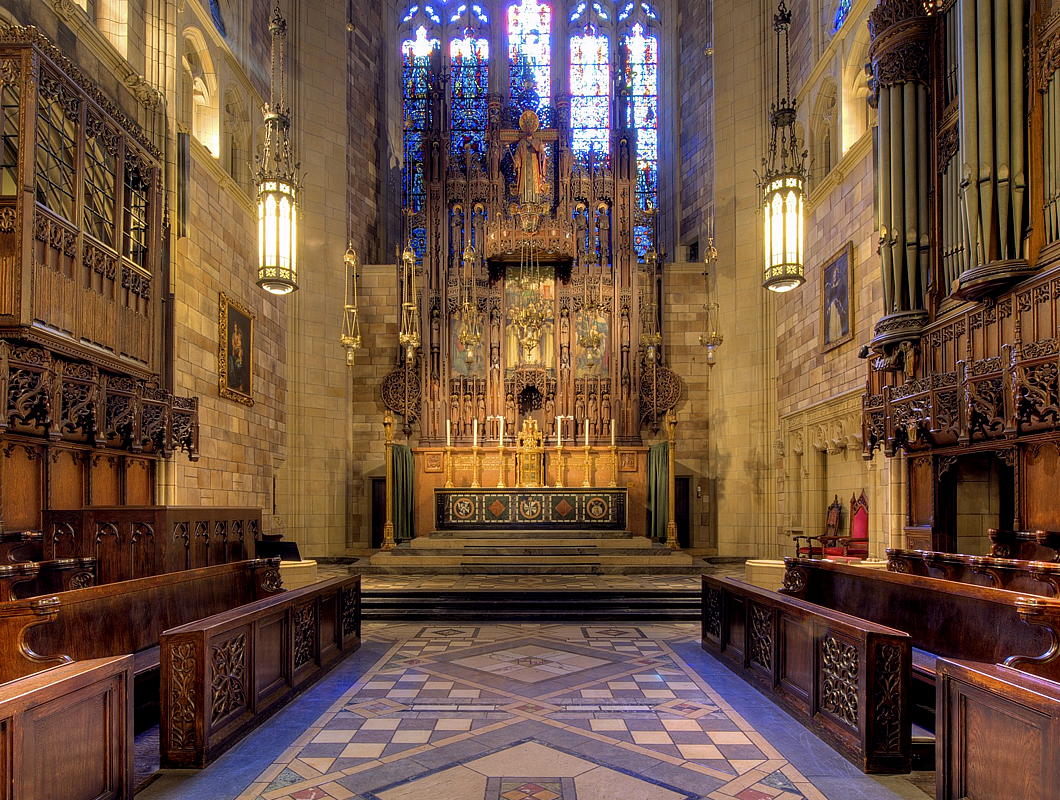
This week marked the ninetieth anniversary of the consecration of the high altar of the Dominican Church of St Vincent Ferrer in New York — one of the most beautiful churches in Manhattan.
To mark the occasion, a sung requiem Mass was offered in the Dominican rite (under the sponsorship of the New York Purgatorial Society) for the benefactors of the parish.
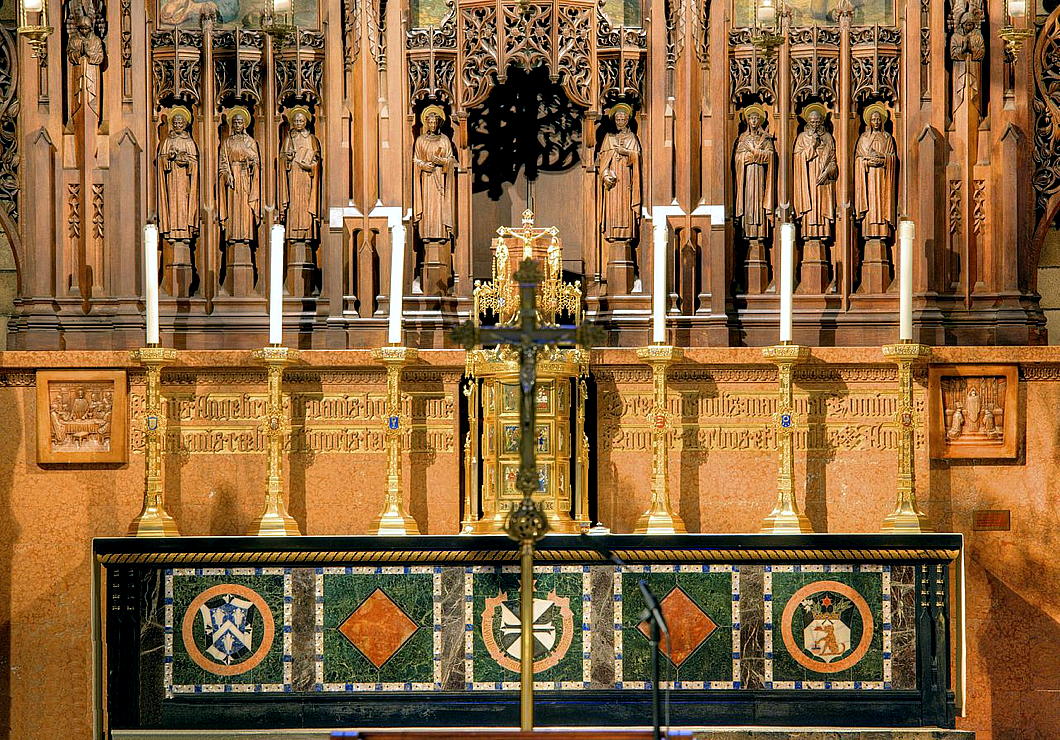
The parish also shared this explanation of the art and symbolism of the high altar:
The Altar itself, the footpace of which is atop five steps from the presbytery, is in the form of a sepulcher. The Mensa is of Belgian Black marble inlaid with five crosses of Red Verona. It measures 15 feet long, 3 feet wide, and 6 inches thick, weighing about 2 tons.
The Altar Front consists of uprights of Belgian Black and Lepanto Marbles. The Frontal has five panels in a field of Tinos Green surrounded by a border of Mother-of-Pearl and Lapis Lazuli. The three principal panels, left to right, are: the arms of the Dominican Province of Saint Joseph (notice the carpenter’s T-square and the lilies, symbols of Saint Joseph); the shield of the Dominican Order in black and white marble surrounded by a carved inscription of the Dominican motto, “Laudare, benedicere, praedicare” (to praise, to bless, to preach), this is capped with a star; another Dominican shield with the crown, dog, lily, laurel, and star. The carving on the Mensa and the Altar Frontal is finished off in gold.
The Reredos Wall, acting as a back to the Altar and a base for the Reredos, is of Siena Marble. The wall contains a carved inscription of the Eucharistic hymn “Panis angelicas” written by St. Thomas Aquinas, O.P. On each side of the inscription are carved two large corbels the subjects of which are the Last Supper and the Elevation of the Mass.
On the Mensa of the Altar there are also six large candle- sticks of gold-plated bronze. Each candlestick weighs eighty-five pounds. On each candlestick is a medallion containing a symbol of the Passion or the Holy Eucharist, from left to right: Crown of Thorns and Three Nails on a background of blue; silver Rooster; silver Chalice with a Host bering the emblem IHS; three fish on a background of red enamel representing the Holy Trinity; Veronica’s veil; money bag of Judas on a background of red.
The Reredos is a magnificent structure of wood carving which forms the setting for a central painted triptych by Alfredo Mira depicting the miracles of Saint Vincent Ferrer, twenty-four statuettes of saints, and thirty angels of varying sizes. Dominating the entire structure is a majestic figure of Christ the King, approximately eight feet tall. The Reredos, extending forty-four feet above the floor, is of Hungarian oak which is stained to preserve the natural color of the wood. The color work has been done sparingly since it was not intended to destroy the natural finish of the wood by complete polychroming; yet the figure of Christ the King and the tester or canopy above it have been elaborately colored.
The Tabernacle at the center of the Altar is of gold-plated bronze, with twelve panels of symbols and miniature Biblical scenes in colored enamels. On the left door are six images from the Old Testament in which the Eucharist is prefigured. On the right door is the fulfillment of those types in the New Testament and the early Church. The Tabernacle, with its triple crown, is intended to look like a medieval tent, the literal meaning of tabernacle.
The Altar and Reredos were imported from Belgium where they were constructed by Joseph Van Uytvanch of Louvain. Almost two years were required to complete the work. The scheme was conceived by Wilfred Anthony, Bertram Goodhue’s assistant on the project.
The Pale Blue Eye
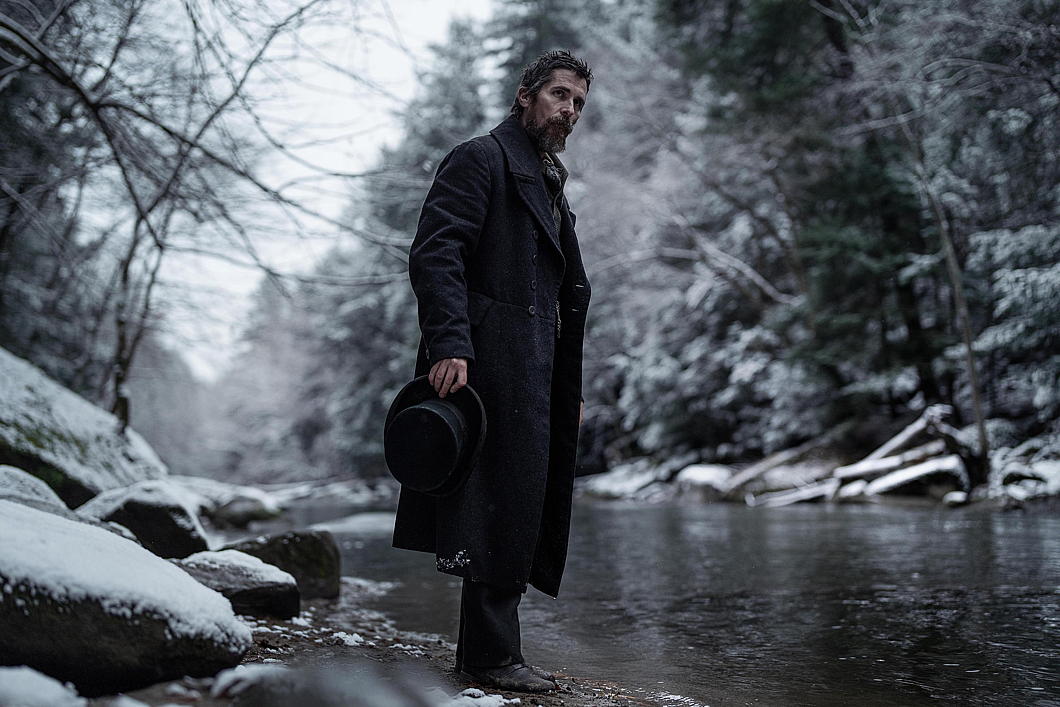
Just as there aren’t enough films set in seventeenth-century Holland, we don’t get enough films set in God’s own Hudson Valley of New York. When I saw the trailer for ‘The Pale Blue Eye’, a semi-supernatural mystery set in 1830s West Point, I thought: yes, sign me up.
A cadet at the military academy is found hanged and, a day later, his heart carved out. USMA commandant Sylvanus Thayer enlists the help of Augustus Landor, a former detective from New York City — in the pre-NYPD days when crime was fought by an odd hodge-podge of the night watch, city magistrates, and a few dozen constables.
Conveniently for Thayer, the highly reputed Landor has retired to the Hudson Highlands. Thayer hopes his investigation will prevent any scandal giving impetus to the still-fledgling Academy’s enemies in Washington.
Conveniently for Landor, he is aided and abetted in this task by an eccentric bohemian amongst the “Long Gray Line” of cadets: Edgar Allan Poe. The paragon of American Gothick was indeed a cadet at West Point in 1830 under his own name, after having spent a few years in the Army as an enlisted man under a pseudonym.
It would be easy to reduce any film with Poe as a central character to a procession of campy retro-emo tropes, but the role is played by Harry Melling with surprising skill. Timothy Spall plays Sylvanus Thayer — rather unfairly, I thought — with Simon McBurney as the commandant’s sidekick Captain Hitchock.
Toby Jones is the academy doctor with Gillian Anderson as his scheming, driven wife, Lucy Boynton the beautiful daughter (apple of the eye of many a cadet) and Harry Lawtey as their smug son Artemis, also enrolled in the Academy.
It is a fundamental Cusackian principle never to let the perfect be the enemy of the good, so I won’t complain that ‘The Pale Blue Eye’ is actually filmed in western Pennsylvania rather than along the actual banks of the Hudson. Riparian overdevelopment makes it difficult to evoke the Hudson of 1830s effectively today, and the filmmakers have done well recreating the spirit of the gothic revival era in America’s Rhineland with the locations they chose and the set design. This is fiction, after all, and it needn’t be pedantically true to the time-period — so long as nothing jars.
As it proceeds, the plot is intriguing, fantastic, and absurd and it gives us a final twist in the end. Some strands develop a little two quickly — the connection between Poe and Lea — and Robert Duvall’s role as an expert in the occult is too much of a deus ex machina.
But this is simple fun, not high art, and as a gothick conjuring of a formative but under-explored time and place it is well worth a viewing. (more…)
Celebrating Saint Nicholas in New York
As any fool knows, the great city of New York has as its patron and protector a great and holy saint, the wonderworker Nicholas of Myra (AD 270-343).
A great city and a great saint merit a great feast, and since 1835 the Society of Saint Nicholas in the City of New York has risen to the task of commemorating the holy bishop as well as rendering honour to our Dutch forefathers of old who founded New Amsterdam in the colony of New Netherland where the waters of the Hudson meet the Atlantic Ocean.
Blustering through the archives, it is rewarding to read of how this feast has been kept over the years.
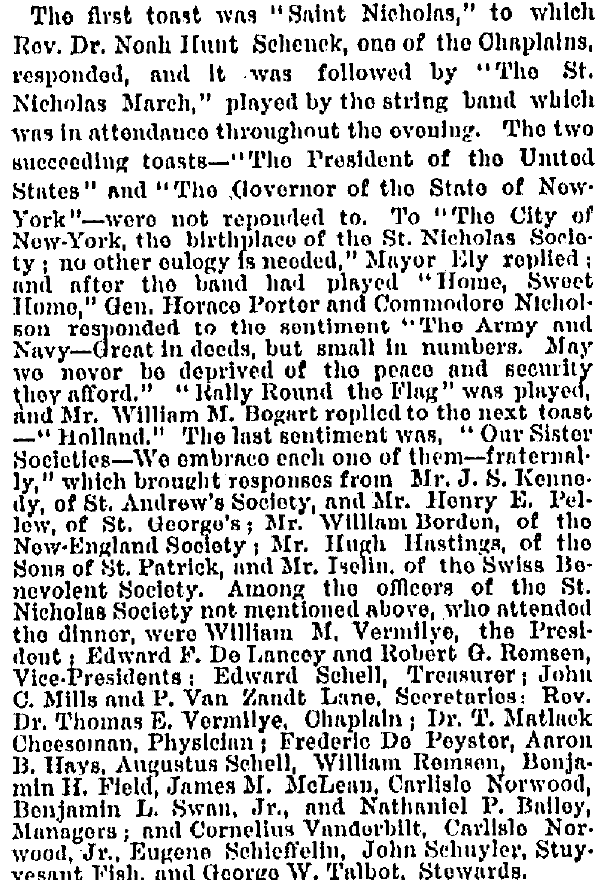
This little snippet from The New York Times relays the St Nicholas Society’s feasting in 1877:
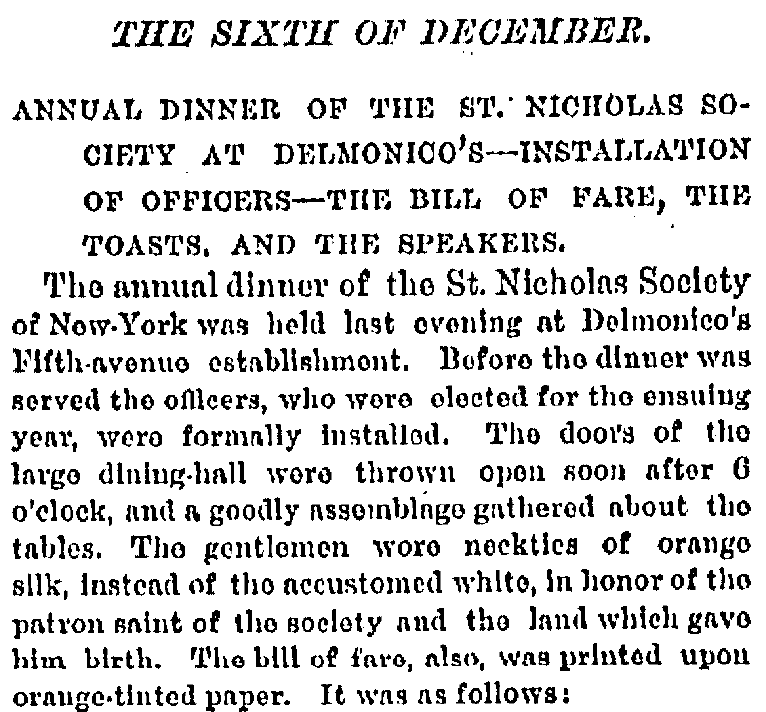
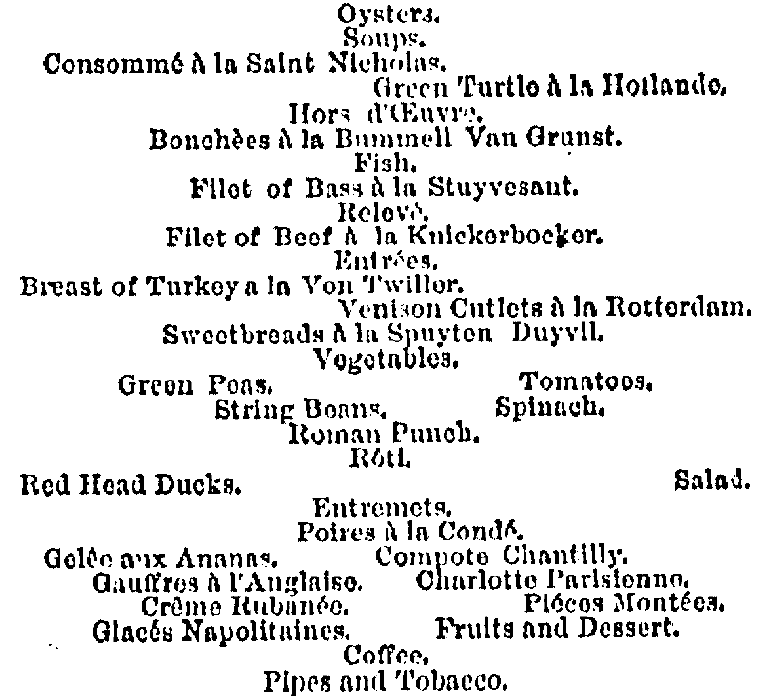
Sounds like quite a meal, but it was followed by toasts and responses appropriate to St Nicholas Day and to the city:
Just over a decade later in 1888, the Times again gives its report on what sounds like an amusing evening:
After an elaborate dinner had been discussed and as the coffee and long clay pipes were handed around, the old weathercock that Washington Irving gave the society was brought in and placed at its post of honor before the President, and the toast-making was begun. Austin G. Fox replied to the toast “Saint Nicholas,” and paid an eloquent tribute to the memory of W. H. Bogart of Aurora, N.Y., who had answered that sentiment at nearly every previous dinner.
The toast “The President of the United States” was drank standing and was lustily cheered. Ex-Judge Henry E. Howland made a witty response to “The Governor of the State of New-York,” touching upon every other imaginable subject but the one to which he was to respond, and James C. Carter responded to “Our City.” The Rev. Dr. J.T. Duryea spoke to “Holland,” and Warner Miller, in the absence of Gen. Sherman, replied to “The Army and Navy.” Joseph H. Choate made a characteristic reply to “The Founders of New-Amsterdam.”
The newspaper further relates that: “At the request of the St. Nicholas Society, Mayor Hewitt had flags displayed on the City Hall yesterday in honor of the festival of St. Nicholas, the patron of this city.”
In 1907, the Society’s members and guests marched into dinner at Delmonico’s two-by-two, preceded by a trumpeter and twelve servants “clad in the black and orange liveries of early Holland” escorting the newly elected president, Col. William Jay.
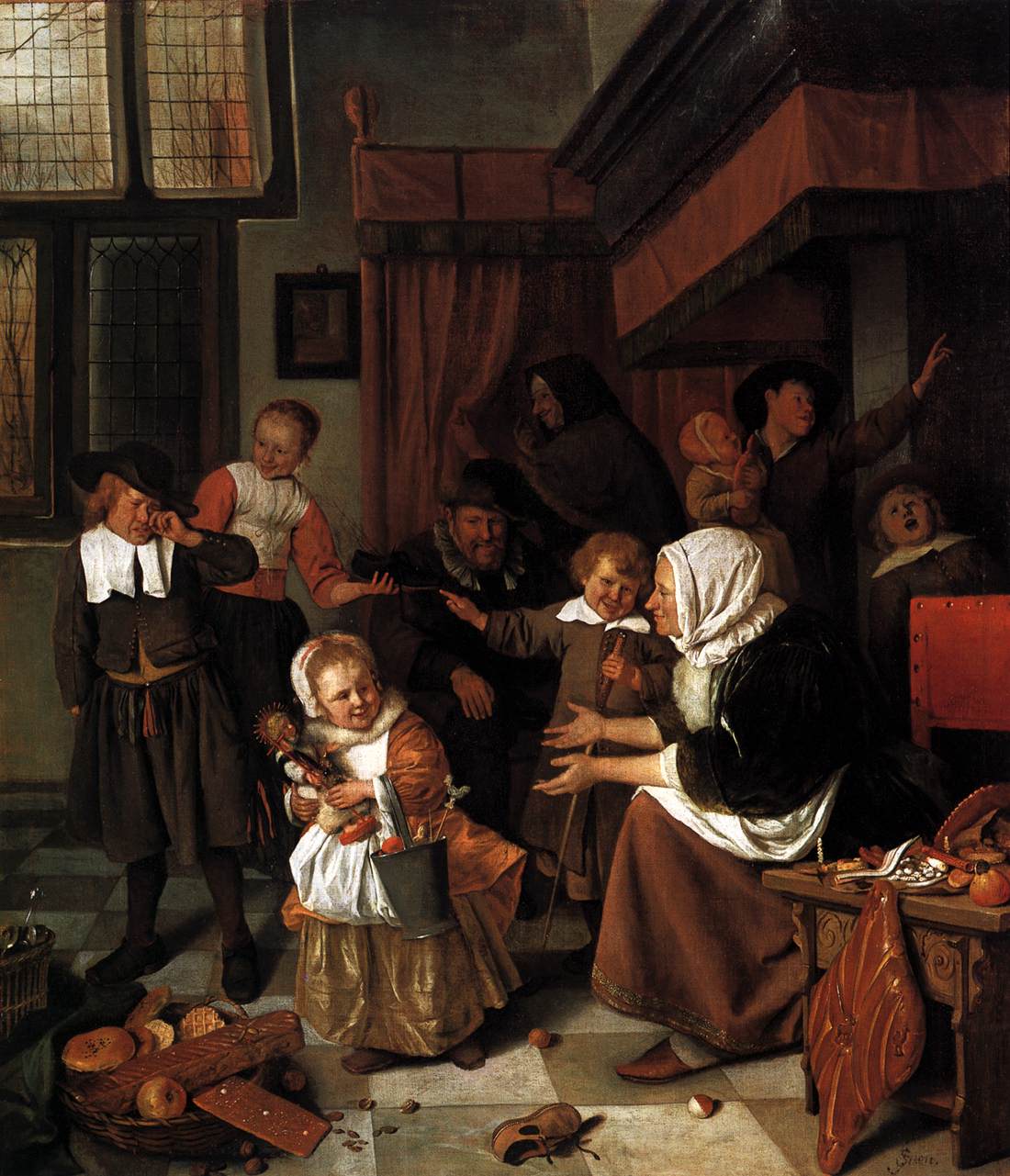
Another tradition of the evening kept each year was “the carrying round the great room of the bronze rooster that at one time surmounted the first City Hall built in New York by the Dutch in the seventeenth century”. The weathervane was presented to the Society by Washington Irving, its first Secretary, back in 1835. Some years the weathervane was oriented in turn to each speaker giving the response to the toasts accordingly.
Again, in 1907, one Dr Vandyke toasted the health of St Nicholas who “gladdens youth and makes the old seem young”. The Times relates:
“He explained that the long clay pipes which had been handed round to each guest was an old Dutch custom on St. Nicholas night. If a man got home with the pipe intact he was considered sober. Sad to relate, he said, it was the habit of those persons who had broken their own pipes to stand outside the tavern doors and break those of their more sober-minded brethren.”
While the St Nicholas Society has ancestral requirements for its membership, there are no such restrictions for the hospitable group’s guests. By the seventy-fifth anniversary of the Society in 1910, even we Irish we invited:
“William D. Murphy, who was called upon to give the toast of “Our City” said that he, an Irishman, was there at the feast for three reasons — first, because the Dutch founded the city; second, that the English took it away from them, and lastly, the Irish had it now.”
By 1919, New Yorkers were living in a changed world, with the war only just passed, and the dreaded Prohibition ever present. In that year, the Times reports that the speakers “expressed their opinions of Bolshevism, communism, and prohibition at their eighty-fourth annual dinner at Delmonico’s last night.”
Happily, these sons of Holland and devotees of Saint Nicholas kept his holy day festive despite the restrictions in place:
“Supreme Court Justice Victor J. Dowling, who was one of the speakers, expressed his thanks to the society for the Constitutional violations that had been provided for him.”
Lest you fear that the days (or nights) of celebrating this holy saint have faded into the folds of yesteryear, the Saint Nicholas Society of the City of New York is still in excellent health, and does not fail to keep the feast in accordance with the ways of its forefathers.
Indeed, the Society’s newsletter reported in 2018 that,
“Chief Steward Maximilian G. M. deCuyper Cadmus led the traditional procession of the Weathercock, which was raised high all around the room as members and guests energetically waved their napkins to generate a breeze that would waft him onto his perch near the lectern, facing east so as to crow out a warning in case of the approach of invaders from New England.”
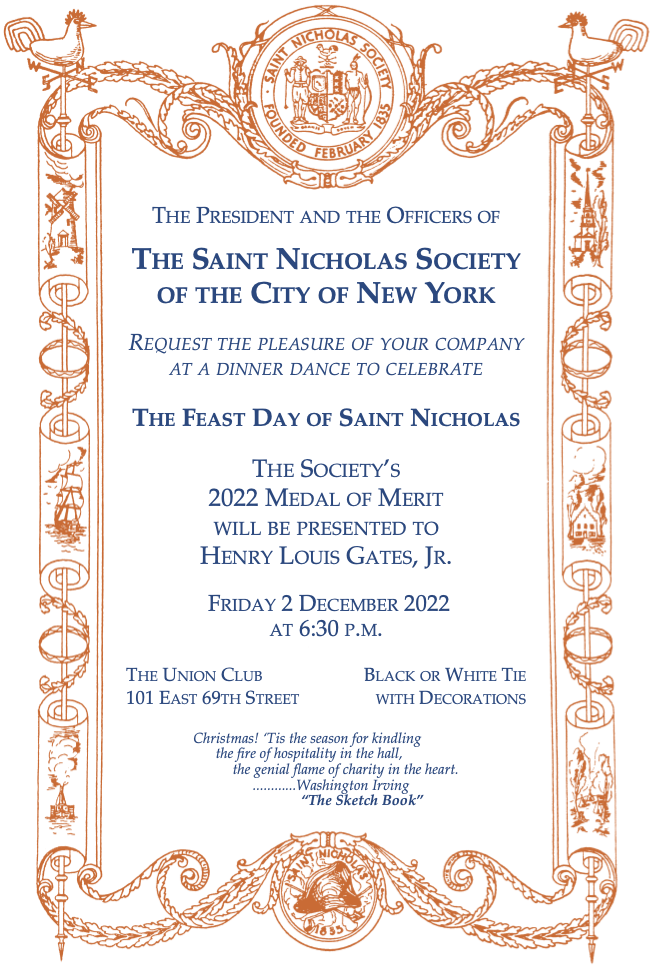
This year the Society celebrated at the Union Club, and presented its Medal of Merit to the Harvard professor Henry Louis Gates, Jnr.
The Headless Horseman & Hallowe’en
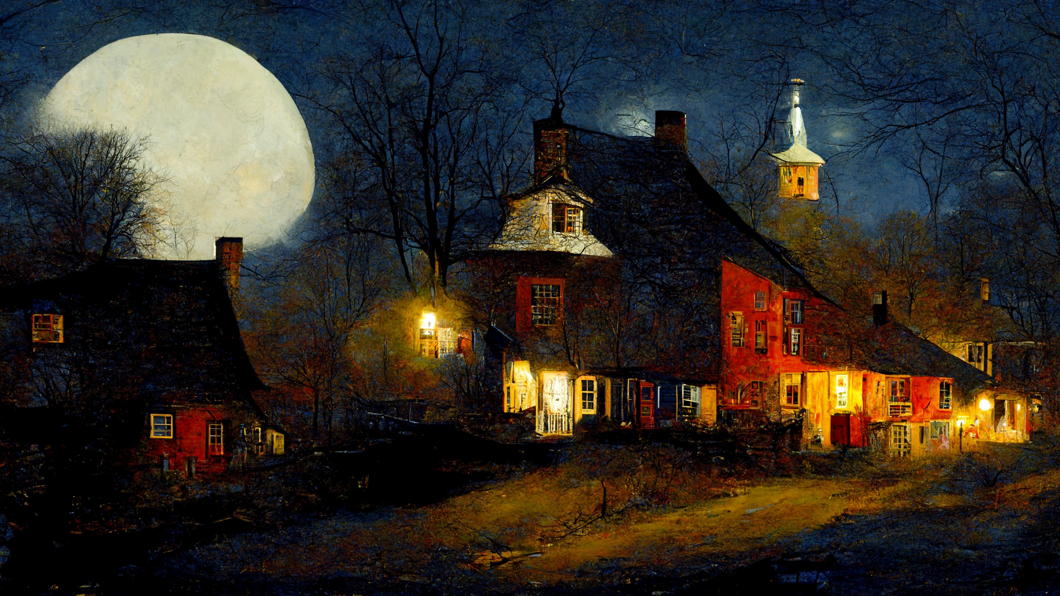
Washington Irving’s Legend of Sleepy Hollow — perhaps better known as the tale of the Headless Horseman — is inevitably and almost universally linked to the great feast of Hallowe’en.
There are obvious reasons for this in that Hallowe’en has become the festival of ghoulish otherworldliness, sadly now devolved into plastic mawkishness in a manner old followers of the Knickerbocker ways must surely condemn and mourn.
But this tale is always worth a revisiting; even now in early Advent.
Irving purists — we exist — might point out there there is no indication Ichabod Crane’s fateful evening ride through the Hollow took place on Hallowe’en.
Indeed, Hallowe’en is not mentioned at all in the text of the Legend, and all the author shares with us regarding the date is that it was “a fine autumnal day”:
…the sky was clear and serene, and nature wore that rich and golden livery which we always associate with the idea of abundance.
The forests had put on their sober brown and yellow, while some trees of the tenderer kind had been nipped by the frosts into brilliant dyes of orange, purple, and scarlet.
Streaming files of wild ducks began to make their appearance high in the air; the bark of the squirrel might be heard from the groves of beech and hickory-nuts, and the pensive whistle of the quail at intervals from the neighboring stubble field.
It makes for a luscious harkening of old Westchester and the Hudson Valley in the early days of the republic.
Tastier still is the scene set as the Yankee newcomer Crane enters the home of an old Dutch household for the evening’s revelries:
Fain would I pause to dwell upon the world of charms that burst upon the enraptured gaze of my hero, as he entered the state parlor of Van Tassel’s mansion.
Not those of the bevy of buxom lasses, with their luxurious display of red and white; but the ample charms of a genuine Dutch country tea-table, in the sumptuous time of autumn.
Such heaped up platters of cakes of various and almost indescribable kinds, known only to experienced Dutch housewives!
There was the doughty doughnut, the tender oly koek, and the crisp and crumbling cruller; sweet cakes and short cakes, ginger cakes and honey cakes, and the whole family of cakes.
And then there were apple pies, and peach pies, and pumpkin pies; besides slices of ham and smoked beef; and moreover delectable dishes of preserved plums, and peaches, and pears, and quinces; not to mention broiled shad and roasted chickens; together with bowls of milk and cream, all mingled higgledy-piggledy, pretty much as I have enumerated them, with the motherly teapot sending up its clouds of vapor from the midst—Heaven bless the mark!
I want breath and time to discuss this banquet as it deserves, and am too eager to get on with my story.
Happily, Ichabod Crane was not in so great a hurry as his historian, but did ample justice to every dainty.
So celebrate Hallowe’en not with plastic costumes and cheap trinketry but with Dutch delicacies and tasty treats. (And for helpful suggestions, see Peter G. Rose’s Food, Drink, and Celebrations of the Hudson Valley Dutch.)
Put aside the vampire capes and risqué nurses’ kit and, amidst candles and pumpkins of all shapes and sizes, think of the Dutch Hudson of long ago that lingers still in heart and mind.
Lafayette at the Seventh
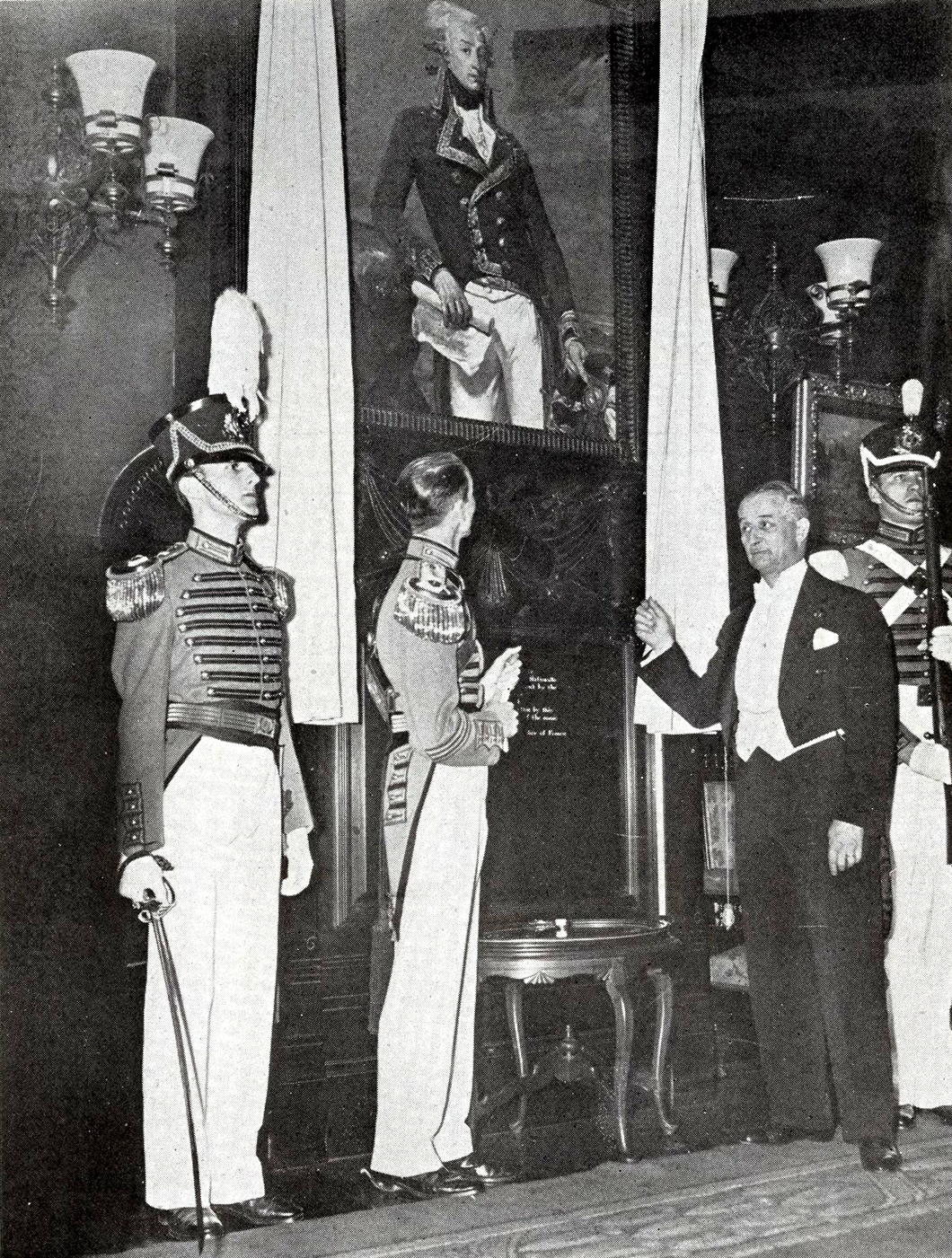
For the first century or so in the history of the United States, there was no more popular Frenchman in America than the Marquis de Lafayette. This nobleman of the Auvergne was an officer in the King’s Musketeers aged 14 and was purchased a captaincy in the Dragoons as a wedding present aged 18 in 1775. Within a year the rebel faction in North America had sent Silas Deane of Groton to Paris as an agent to negotiate support from the French sovereign, but Paris acted cautiously at first.
Lafayette — a young aristocratic freemason and liberal with a head full of Enlightenment ideas — escaped to America in secret and was commissioned a major-general on George Washington’s staff in the last of his teenage years.
Given his relative youth, Lafayette inevitably turned out to be the final survivor of the generals of the Continental Army, and his 1824 trip to the United States solidified his popularity. He visited each of the twenty-four states in the Union at the time, including New York where the predecessor of the Seventh Regiment named itself the National Guards in honour of the Garde nationale Lafayette commanded in France.
This was the first instance of an American militia unit taking the name National Guard, which in 1903 was extended to all of state militia units which could be called upon for federal service.
In honour of this connection and on the centenary of Lafayette’s 1834 death, the French Republic presented the Seventh Regiment with a copy of Joseph-Désiré Court’s portrait of the general that hangs in the 1792 Room of the Palace of Versailles. The Seventh set this in the wall of the Colonel’s Reception Room in their Armory, facing a copy of Peale’s portrait of General Washington.
The privilege of unveiling the portrait went to André Lefebvre de Laboulaye, the French Ambassador to the United States, who was given the honour of a full dress review of the Seventh Regiment on Friday 12 April 1935 before a crowd of three thousand in the Amory’s expansive massive drill hall.
Also present at the occasion was his son François, who eventually in 1977 stepped into his late father’s former role as French Ambassador to the United States. His Beirut-born grandson Stanislas served as French Ambassador to Russia 2006-2008 before being appointed to the Holy See until 2012. In April 2019, Stanislas de Laboulaye was put in charge of raising funds for the rebuilding of Notre-Dame following the fire that devastated the cathedral.
Harlem Reformed Dutch Church
For much of Manhattan’s early colonial history, the island was home to two primary settlements: the port of New Amsterdam (later, from 1664, New York) way down at the southern tip and the town of Harlem up where the East River meets the Harlem River.
Christened after the Dutch city, Harlem is one of Manhattan’s most visible links to the Netherlands. The local newspaper is even called the New York Amsterdam News, once a prominent voice in Black America given this neighbourhood became predominantly African-American in the early twentieth century, and Amsterdam Avenue runs up as the spine of West Harlem.
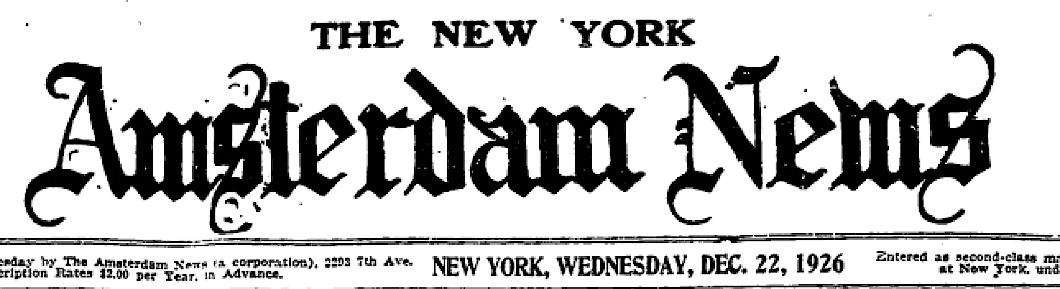
Harlem was founded in 1658, thirty-four years after New Amsterdam was founded and thirty-two since Peter Minuit bought the whole island of Mannahatta off the Indians for sixty guilders.
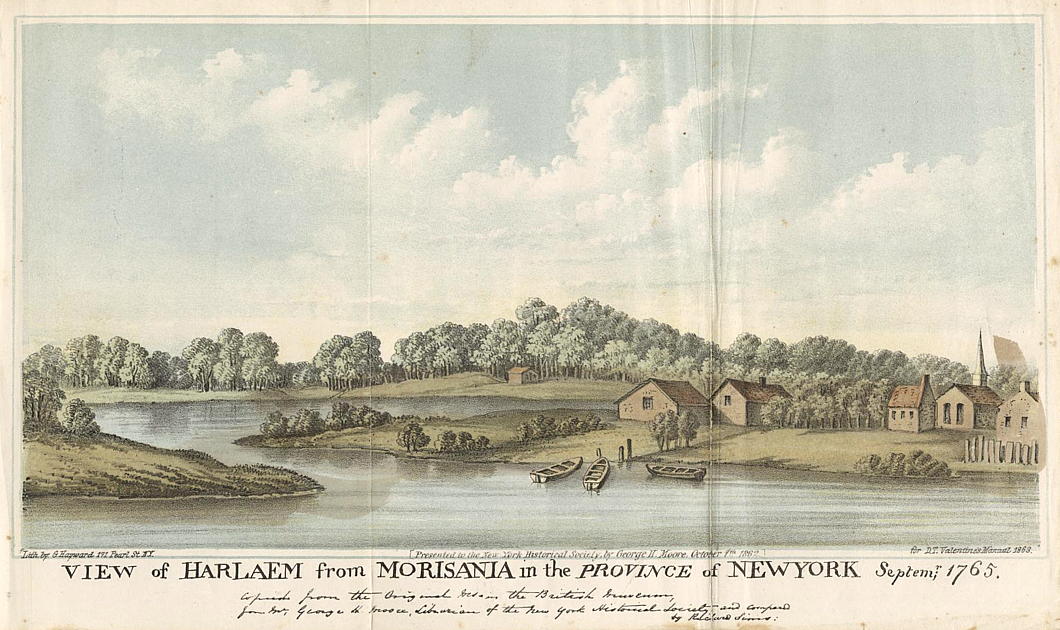
The town’s first church was founded in 1660 but didn’t have its own dedicated building for a few years. The Harlem Reformed Dutch Church, or Collegiate Church of Harlem, was built in 1665-67 right on the banks of the Harlem River, around the site of East 127th Street and First Avenue today.
Both the building and site was abandoned twenty years later when the congregation moved to its second building, completed 1687, just a little bit further south — near where East 125th meets First Avenue, or where the entrance ramp to the Triborough Bridge meets 125th.
It is this second building, which is depicted in the view above of Harlem village from Morissania across the river in the Bronx in 1765 (below).
Three Bedrooms in Manhattan
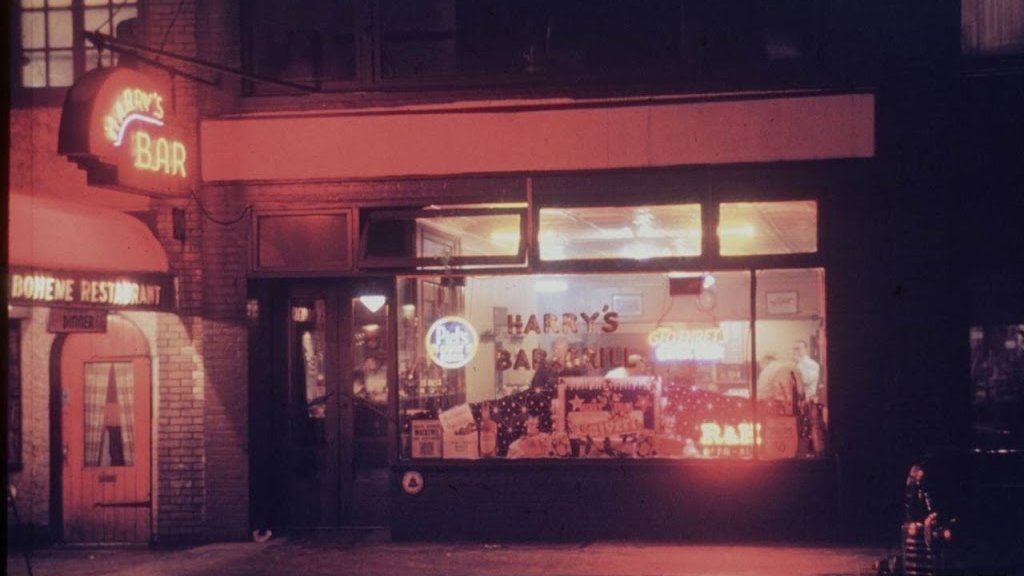
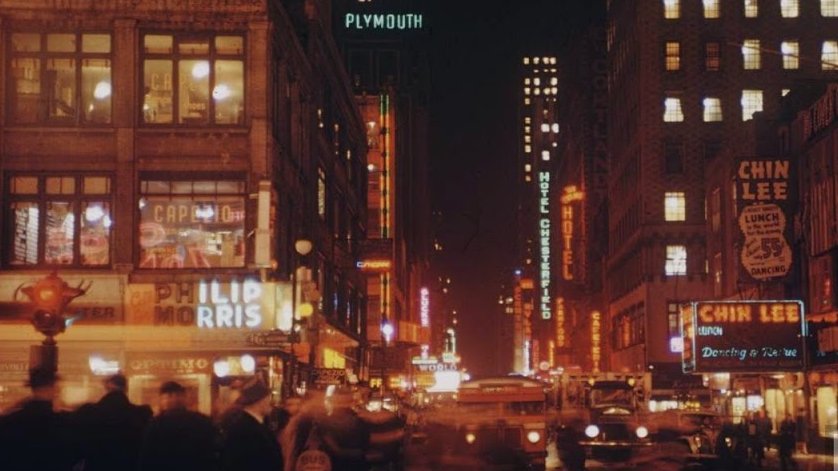
An Approach Not Taken
John Russell Pope’s Unexecuted ‘Museum Walk’
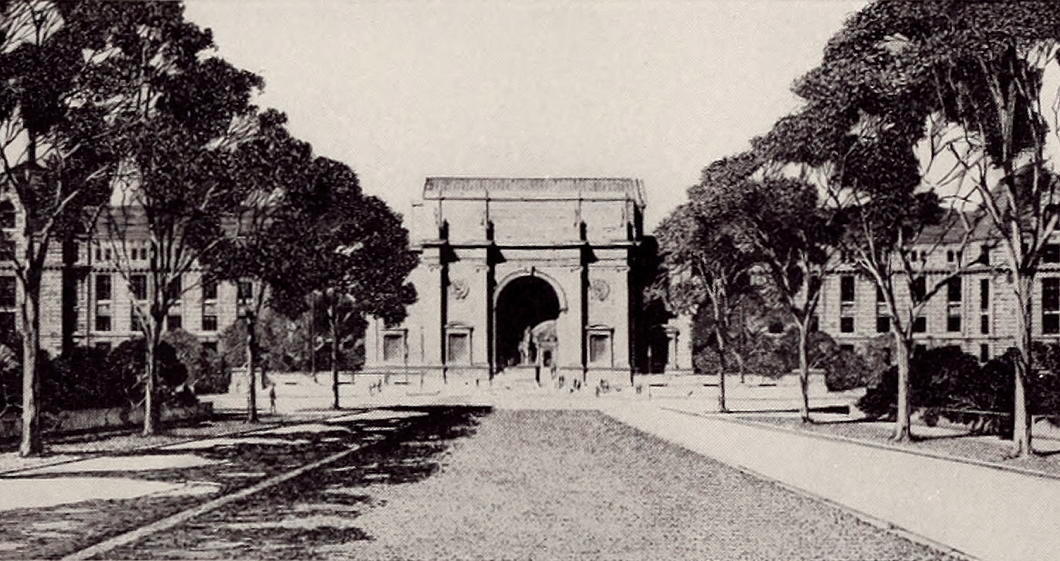
While John Russell Pope won the competition to design the New York State Theodore Roosevelt Memorial currently under attack, not every aspect of his design was executed.
The architect planned for an avenue to be built in Central Park to provide a suitable approach to the American Museum of Natural History and his memorial to the twenty-sixth president.
160 feet wide and 500 feet long, it would feature a broad central lawn flanked by drives and forming an allée of trees. Other versions of the plan have a roadway heading down the middle of the approach.
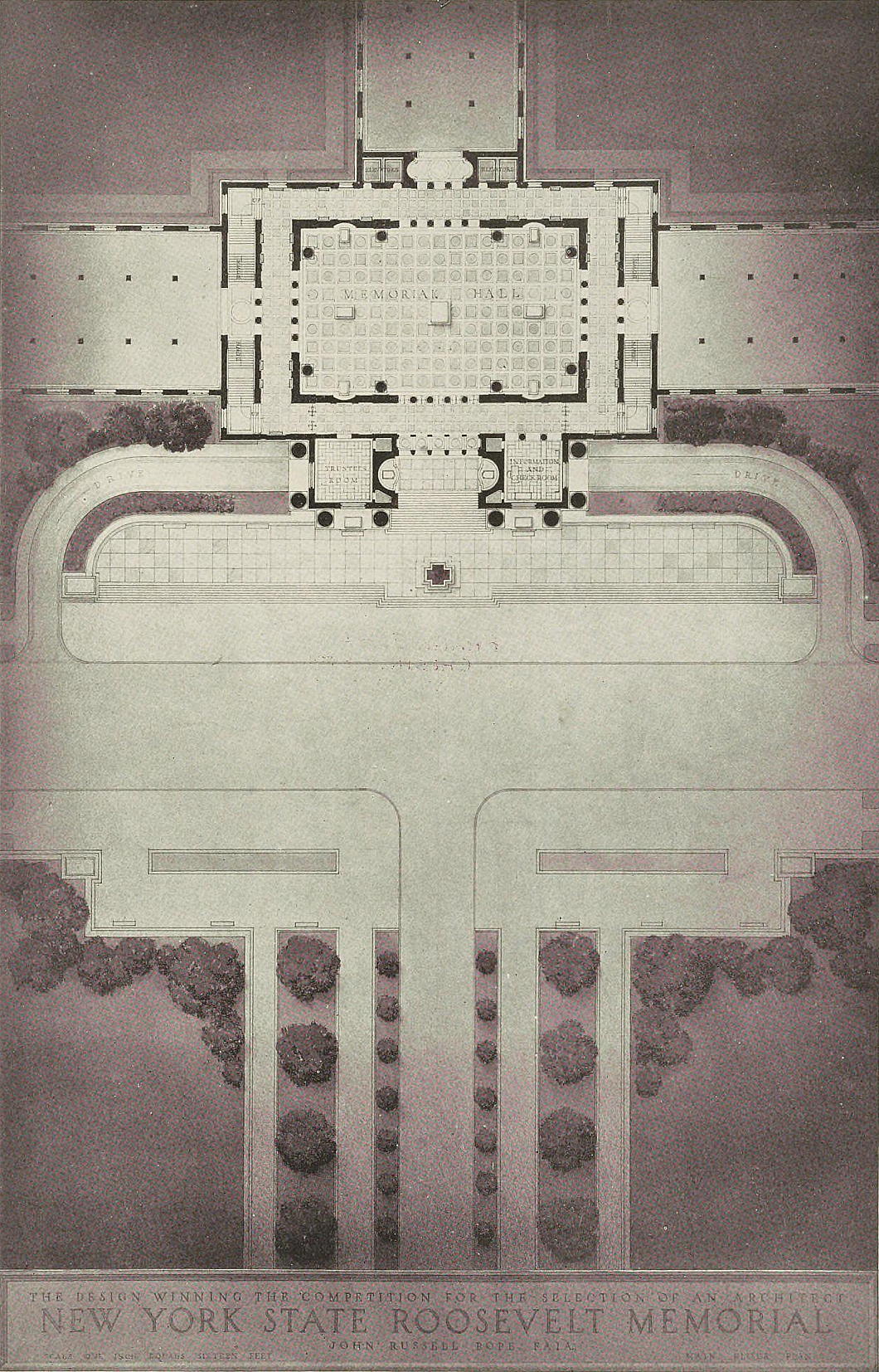
The idea of this ‘museum walk’ was originally that of Henry Fairfield Osborn, for a quarter-century president of the American Museum of Natural History.
Osborn was also president of the New York Zoological Society — they who run the Bronx Zoo — while his brother was president of the Metropolitan Museum across Central Park.
His son Fairfield also led the NYZS (renamed the Wildlife Conservation Society in 1993) and both père et fils held dodgy pseudoscientific Malthusian views about race and eugenics.
Their family house, Castle Rock, has one of the finest views of West Point across the Hudson and is still in private hands.
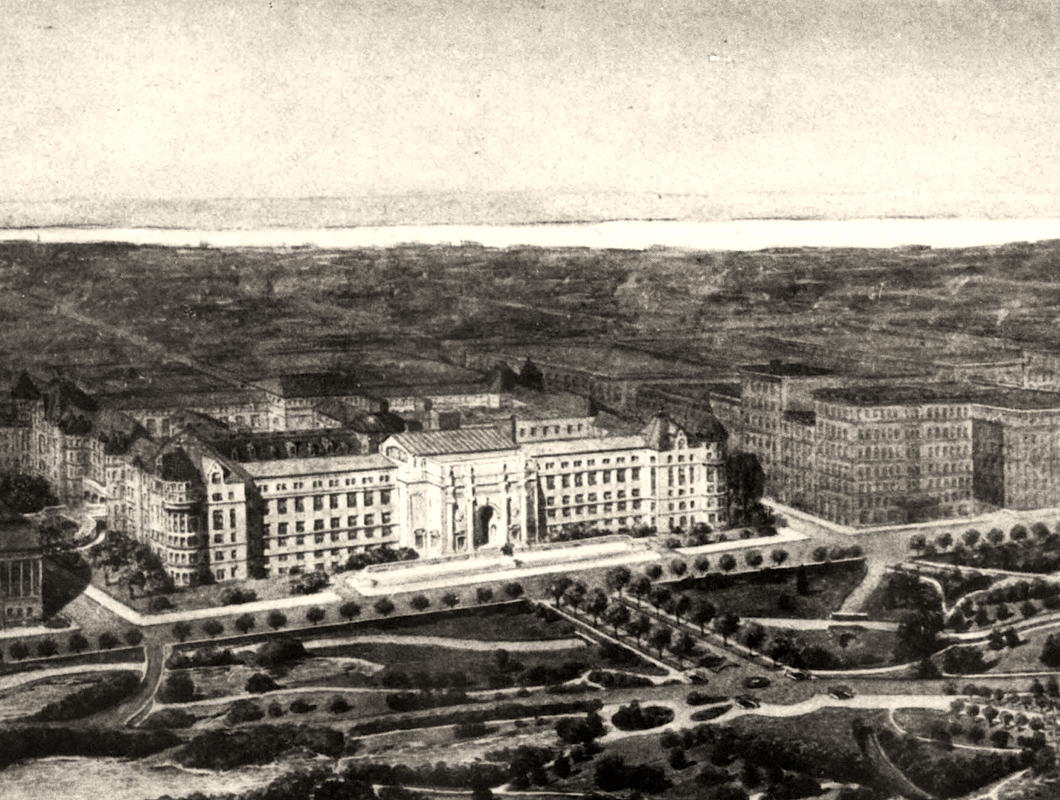
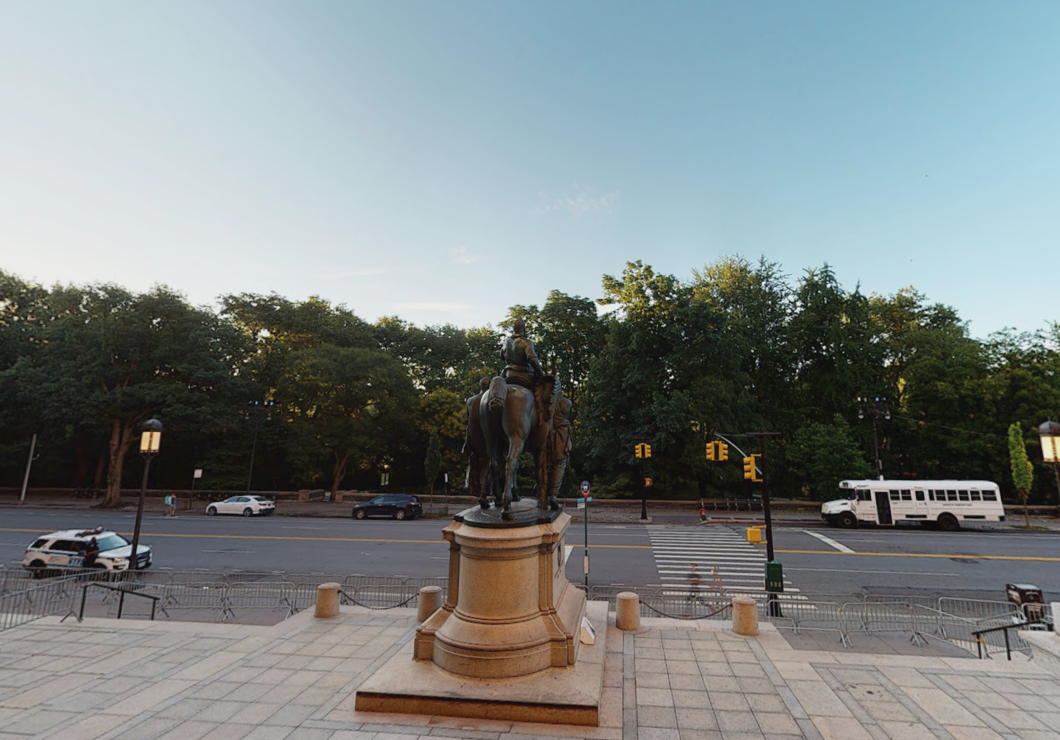
For whatever reason — possibly not wanting to redirect the 79th Street Transverse Road through the park that was in the way — Obsborn/Pope’s approach was never built.
It’s a shame as, aside from augmenting the impact of Theodore Roosevelt Memorial, it also would have provided a better vista from the steps of Museum itself.
Theodore Roosevelt
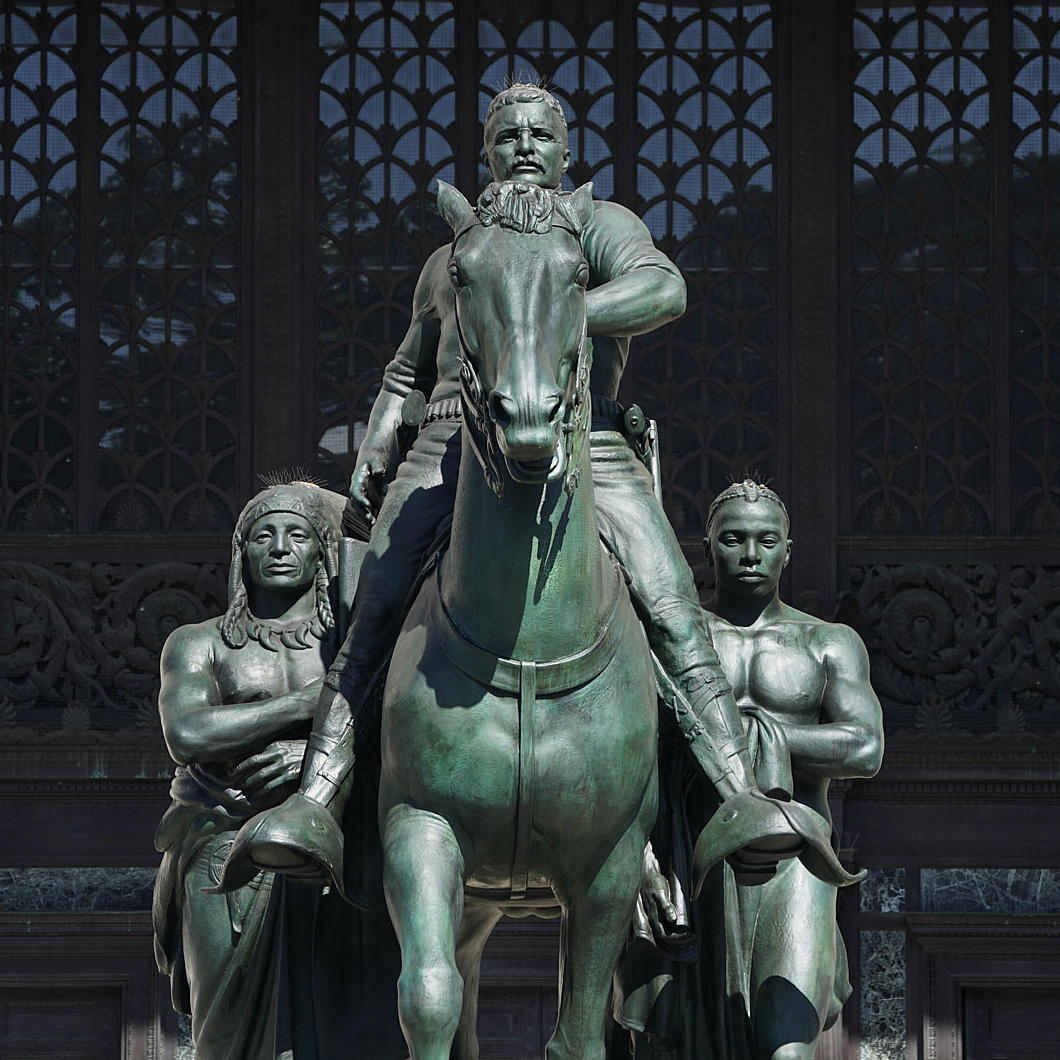
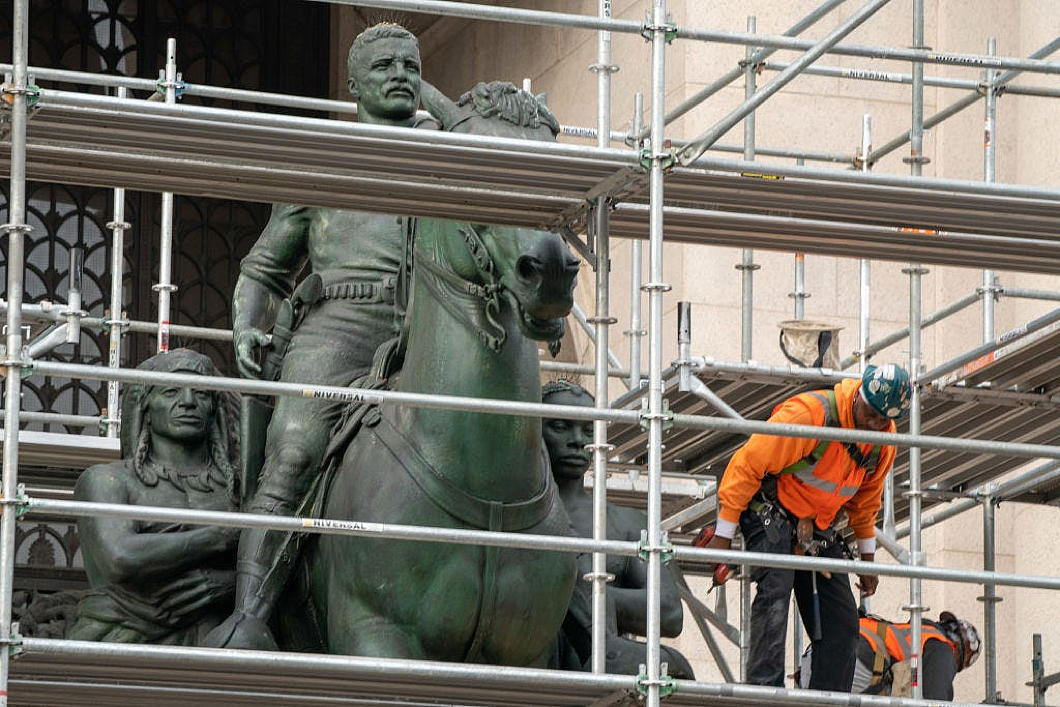
The ancient heresy of iconoclasm claimed a new victim this week: The statue of Theodore Roosevelt which graced the Manhattan memorial dedicated to him at the American Museum of Natural History has been removed at a cost of two million dollars.
The sculpture had attracted the ire of protestors who objected to the inclusion of a Native American and an African by the side of twenty-sixth President of the United States and sometime Governor of New York, which they claimed glorified colonialism and racism.
While the American Museum of Natural History is a private institution, it sits on land owned by the City, and the statue was paid for by the State.
The statue was doomed in June of last year when the New York City Public Design Commission voted unanimously to rip Teddy down.
As the New York Post put it, “He’s going on a rough ride!”
The statue was severed in two this week, with the top half removed and the bottom half following shortly after.
It will be shipped to the Badlands of North Dakota to be displayed as an object in a museum under construction there. (more…)
Abbott’s Gun
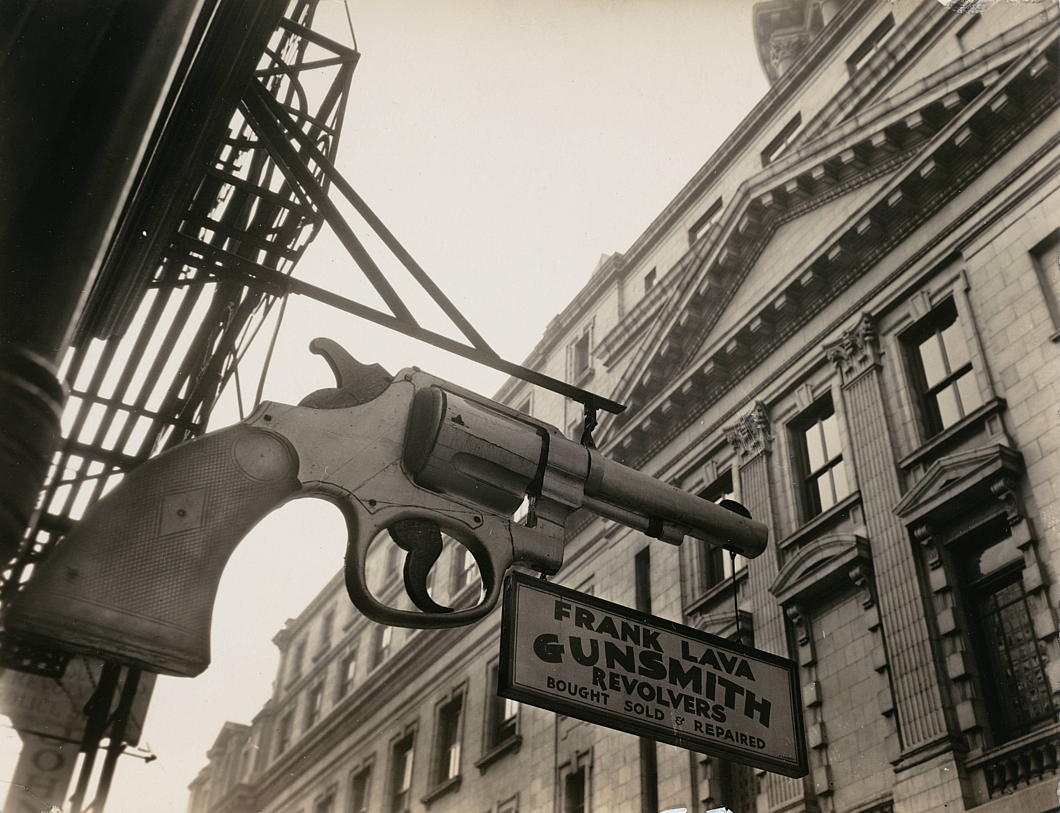
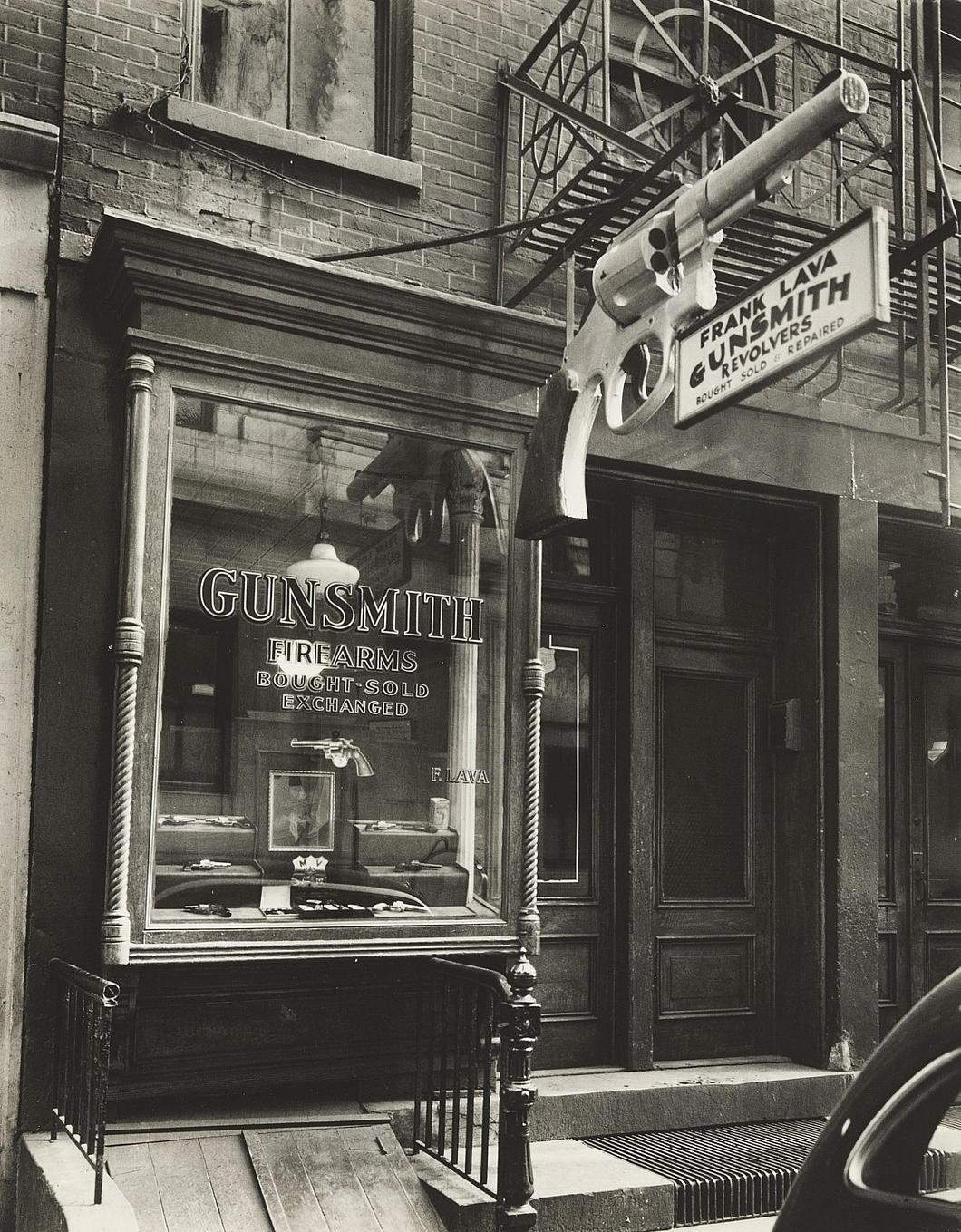
Berenice Abbott took a few photographs of New York’s old Police Headquarters viewed from one of the gunsmiths across Centre Market Place.
This street behind the NYPD HQ (which fronts on to Centre Street) became the gunsmiths’ district of Manhattan — policemen being one of the best customers for many of these businesses. (Criminals being another.)
There is something almost mediæval about the giant gun hanging outside, advertising to one and all what the shop had to offer.
Frank Lava, the gunsmith photographed, shut decades ago, but the John Jovino Gun Shop was originally next door before moving around the corner into Grand Street.
Like Lava’s, Jovino’s continued the tradition of hanging a giant gun outside the shop like in Abbott’s photograph.
The John Jovino Gun Shop, founded 1911, chucked in the towel last year when “Gun King Charlie” — owner Charlie Yu — decided the rent was too damn high.
A Metropolitan Christmas
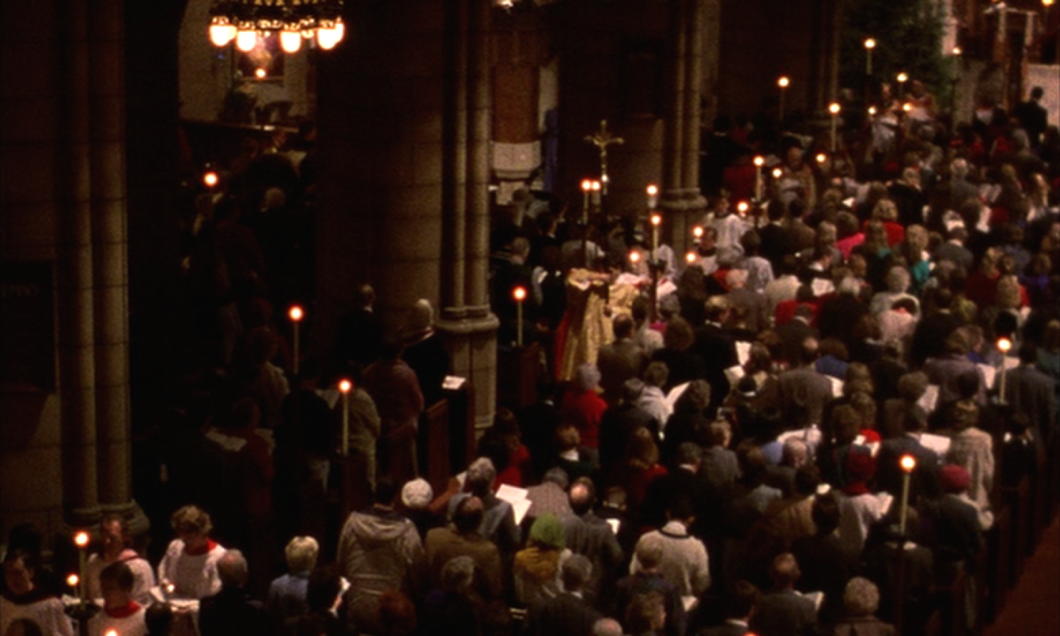
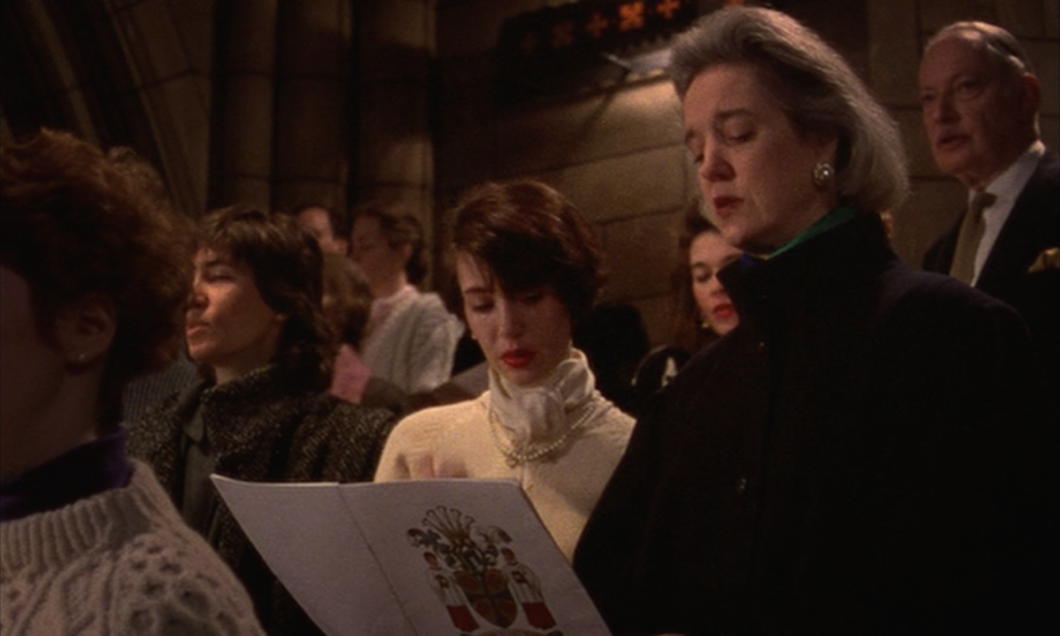
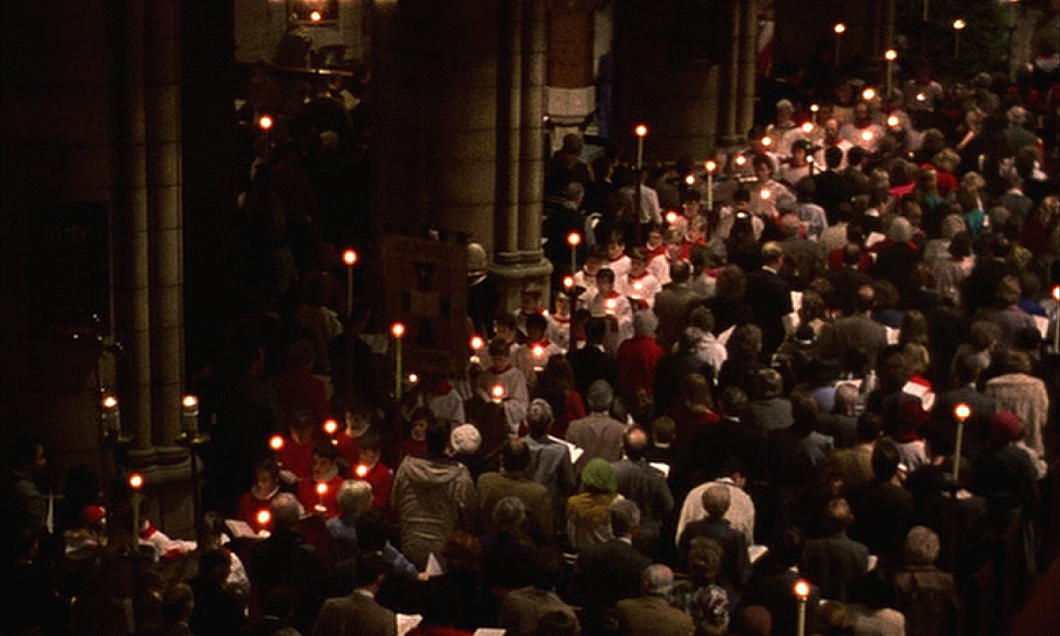
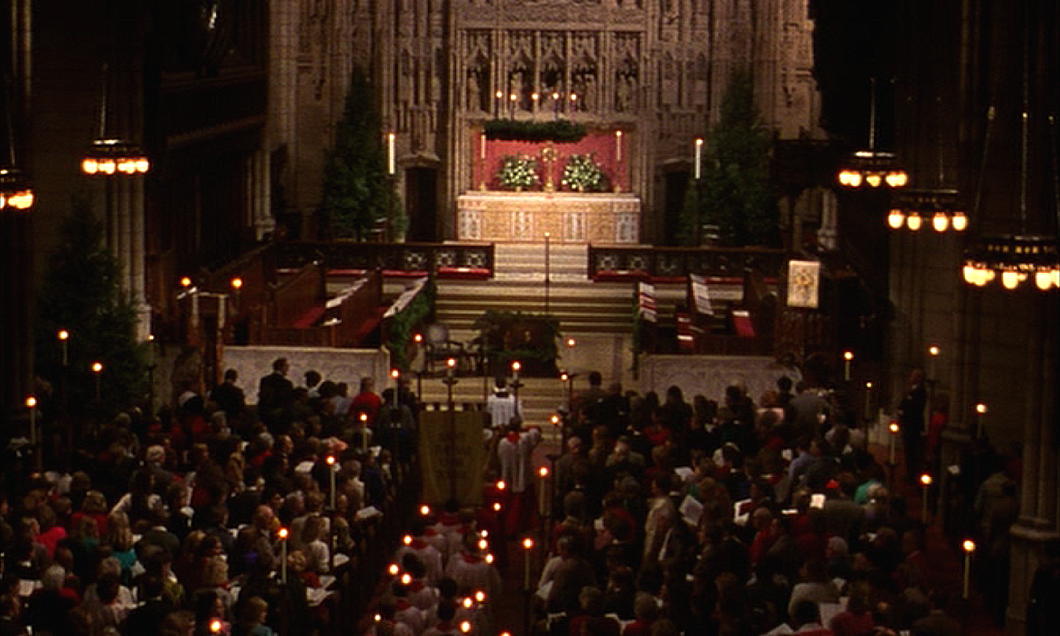
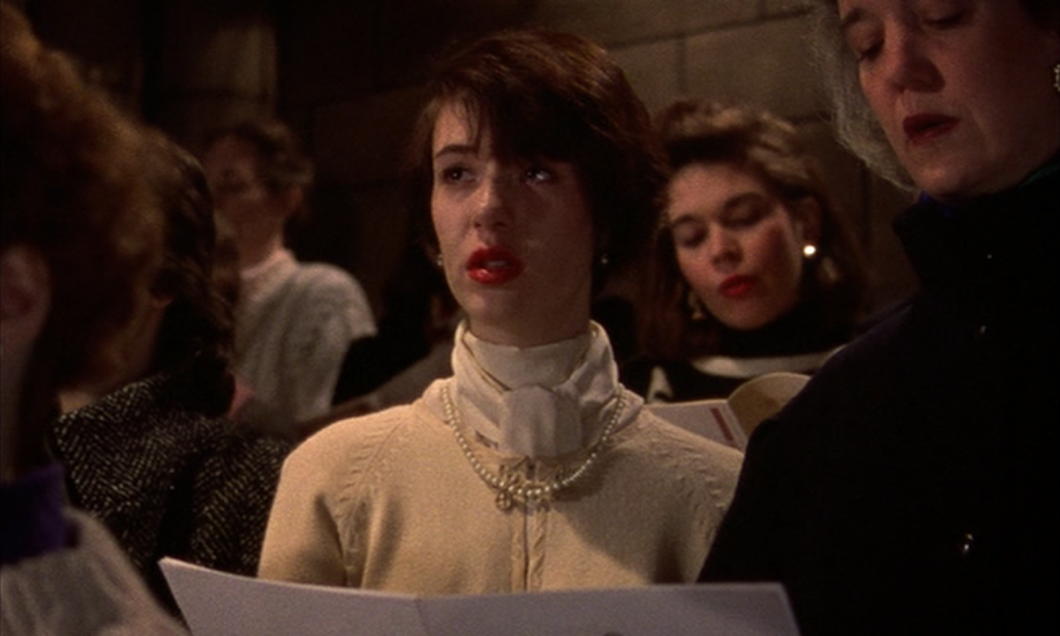
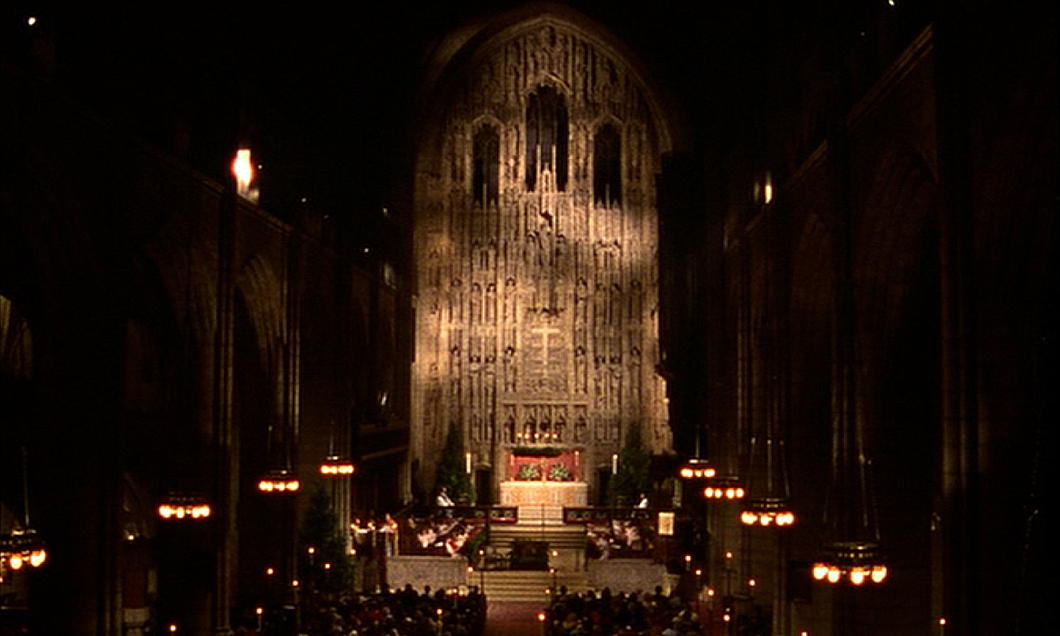
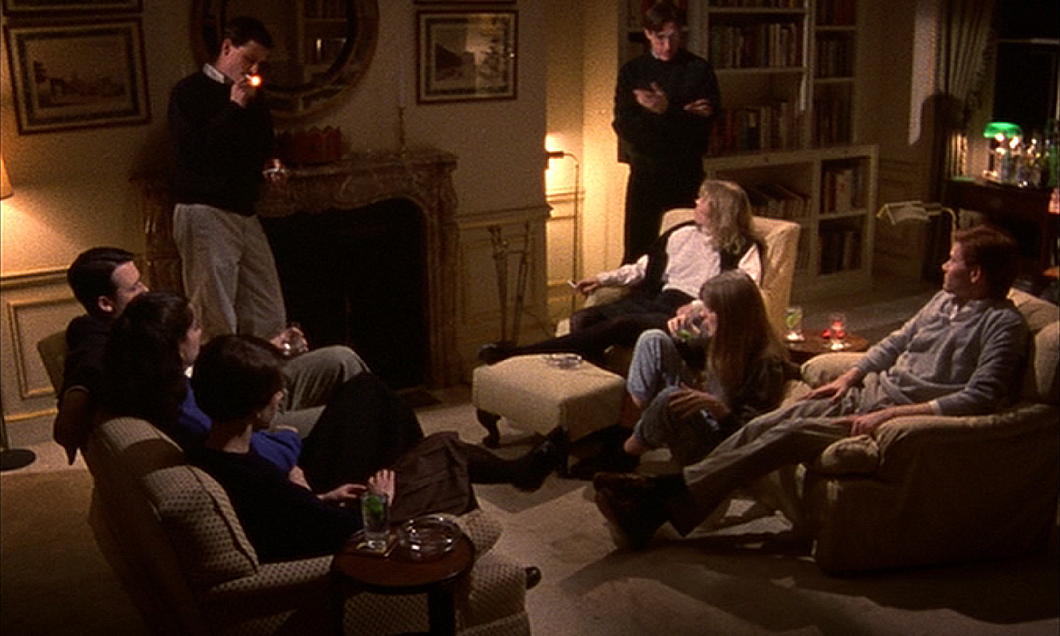
I suppose Whit Stillman’s ‘Metropolitan’ is not strictly speaking a Christmas film but Yuletide is as good a time as any to watch the most Upper-East-Side movie ever to make the silver screen.
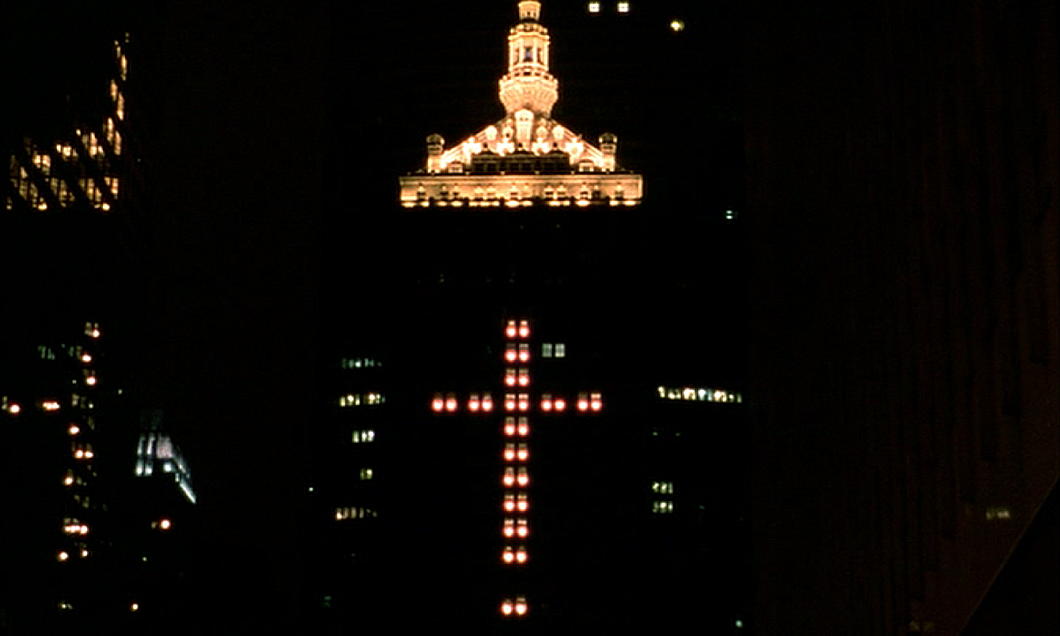
It includes a scene (clip above) from the Service of Nine Lessons and Carols at St Thomas, Fifth Avenue, which to my mind is the best carol service in New York. It’s even better when followed by a few drinks at the University Club one block up.
Bronxville’s Coat of Arms
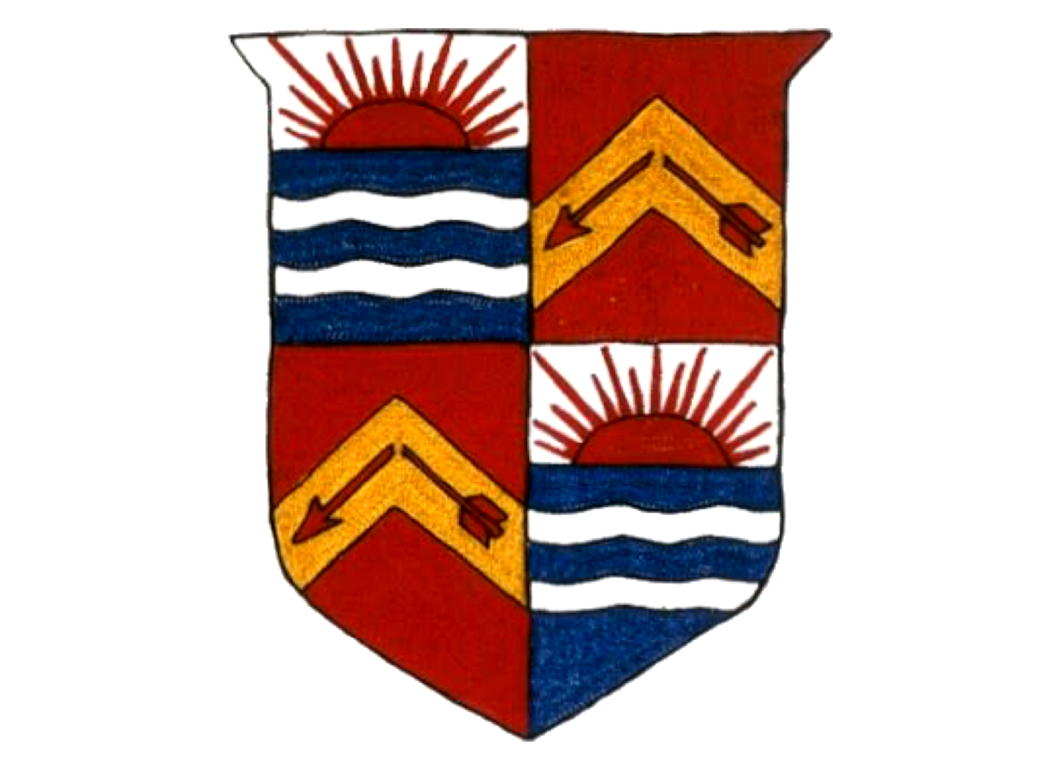
 The coat of arms of the Village of Bronxville is a surprisingly handsome design, for which we can thank a gentleman named Lt. Col. Harrison Wright.
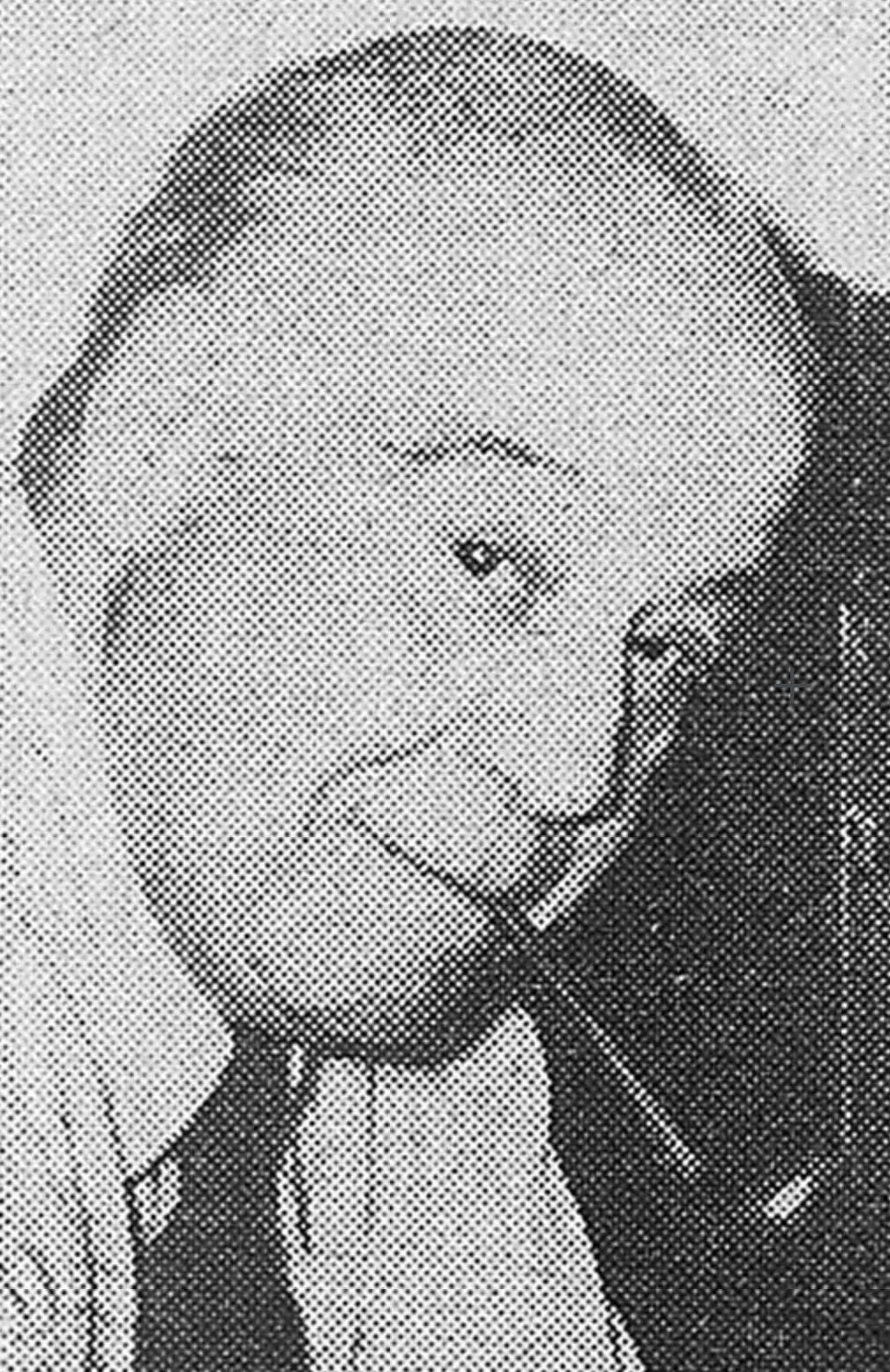
Known to most as Hal, Wright (1887–1966) was one of those citizens who seemed to have had endless time to devote to those around them. In the Great War he served in a variety of roles and had the pleasure of personally delivering a Packard automobile to General Pershing.
He helped coordinate the village police when its captain’s ill health forced an unexpected retirement and was an active member of the American Legion post.
Wright was also Scoutmaster of Troop 1 and served as the local District Commissioner for the Boy Scouts. In that role he had under his purview a young scout from my old troop — Troop 2, Bronxville — named Jack Kennedy.
During the Second World War, Wright deployed his significant logistical expertise as an officer at the U.S. Army’s New York Port of Embarkation but, with his artistic skills and heraldic interest, he also found time in 1942 to design Bronxville’s coat of arms. (more…)
Staats Long Morris
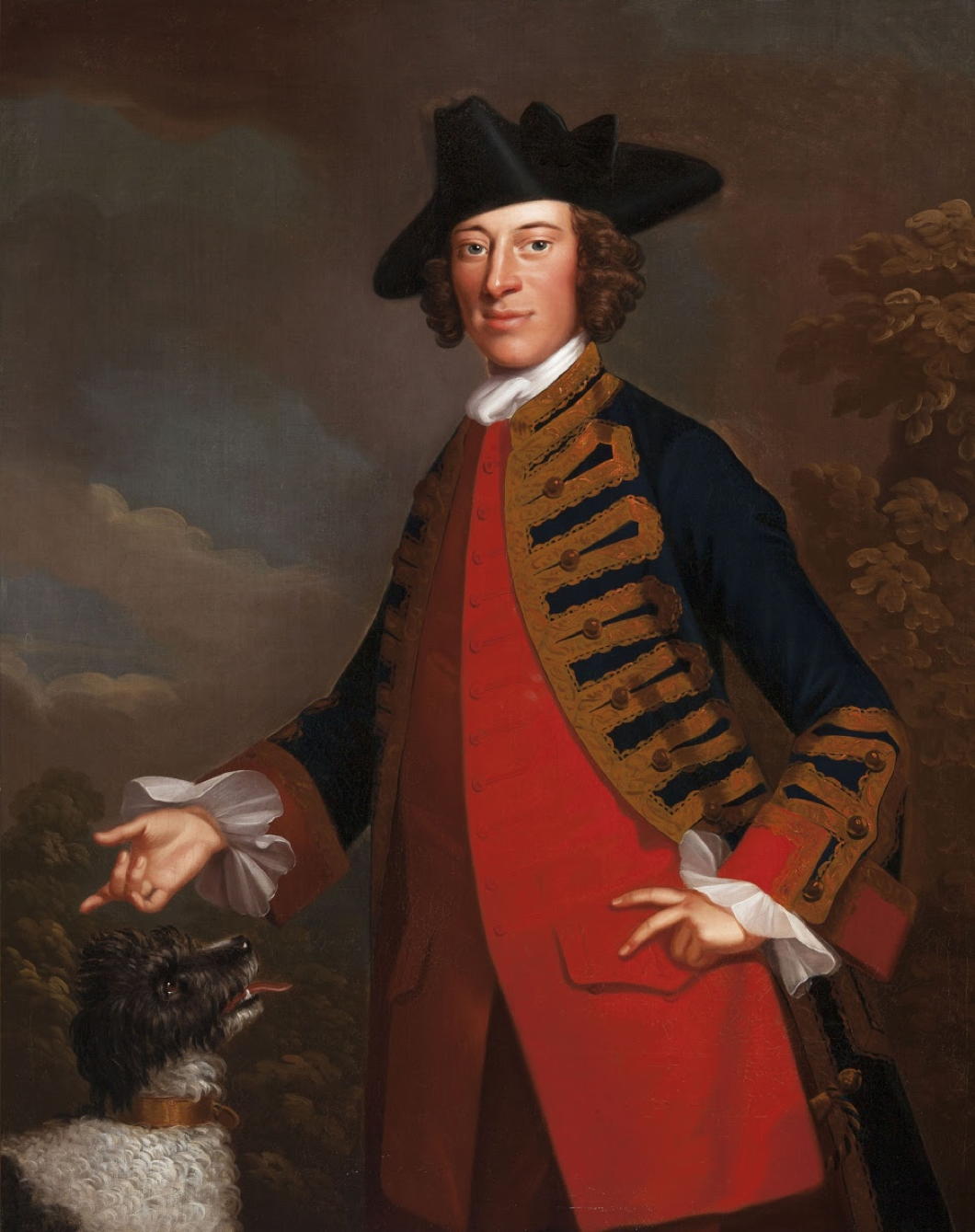
Everyone knows about Gouverneur Morris, scion of one of New York’s great landowning families and given the moniker ‘penman of the Constitution’. As a signer of the Declaration of Independence his half-brother Lewis Morris III was a fellow ‘founding father’. Less well-remembered is his other half-brother Staats Long Morris (1728–1800).
Their father Lewis Morris II was the second lord of Morrisania, the feudal manor that covered most of what is now the South Bronx and has given its name to the smaller eponymous neighbourhood today.
Staats and Gouveneur owe their distinctive Christian names to the family names of their respective mothers.
Lewis II married Katrintje Staats who provided him with four children. After Katrintje died in 1730, Lewis married Sarah Gouverneur, daughter of the Amsterdam-born Isaac Gouverneur. Sarah’s uncle Abraham was Speaker of the General Assembly of the Province of New York, a role Lewis Morris II eventually filled.
Staats was born at Morrisania on 27 August 1728 and studied at Yale College in neighbouring Connecticut as well as serving as a lieutenant in New York’s provincial militia. He switched to the regular forces in 1755 when he obtained a commission as captain in the 50th Regiment of Foot, moving to the 36th in 1756.
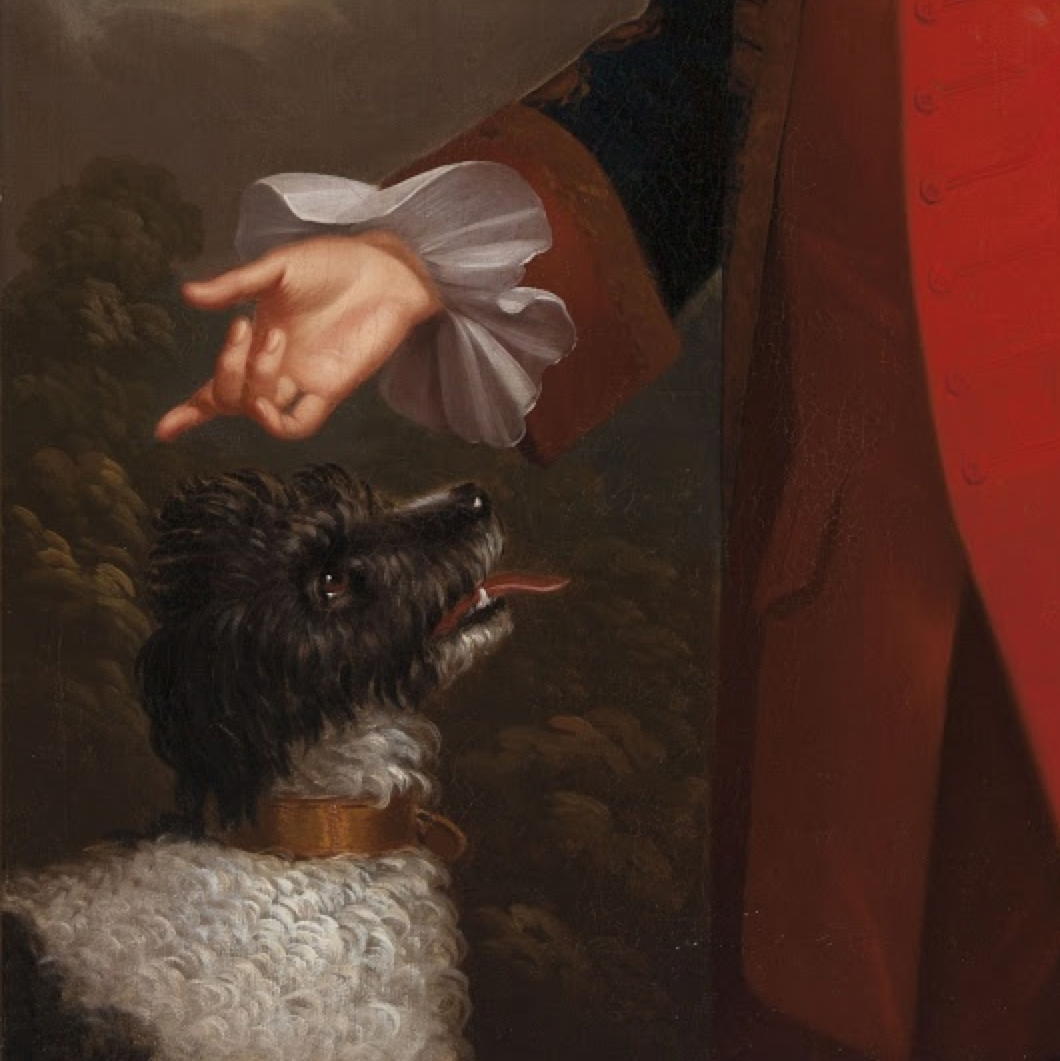
Around that time Catherine, Duchess of Gordon, the somewhat eccentric widow of the third duke, was on the lookout for a second husband and Staats — though American, mere gentry, and ten years her junior — met with her approval. They were married in 1756 and Staats moved in to Gordon Castle to live as the Dowager Duchess’s husband.
‘He conducted himself in this new exaltation with so much moderation, affability, and friendship,’ a newspaper reported in 1781, ‘that the family soon forgot the degradation the Duchess had been guilty of by such a connexion, and received her spouse into their perfect favour and esteem.’
With the Duchess’s patronage, Lieutenant-Colonel Staats raised the 89th Regiment of Foot — “Morris’s Highlanders” — from the Scottish counties of Aberdeenshire and Banffshire though she was extremely cross when her new husband’s regiment was despatched to India where it took part in the siege of Pondichery.
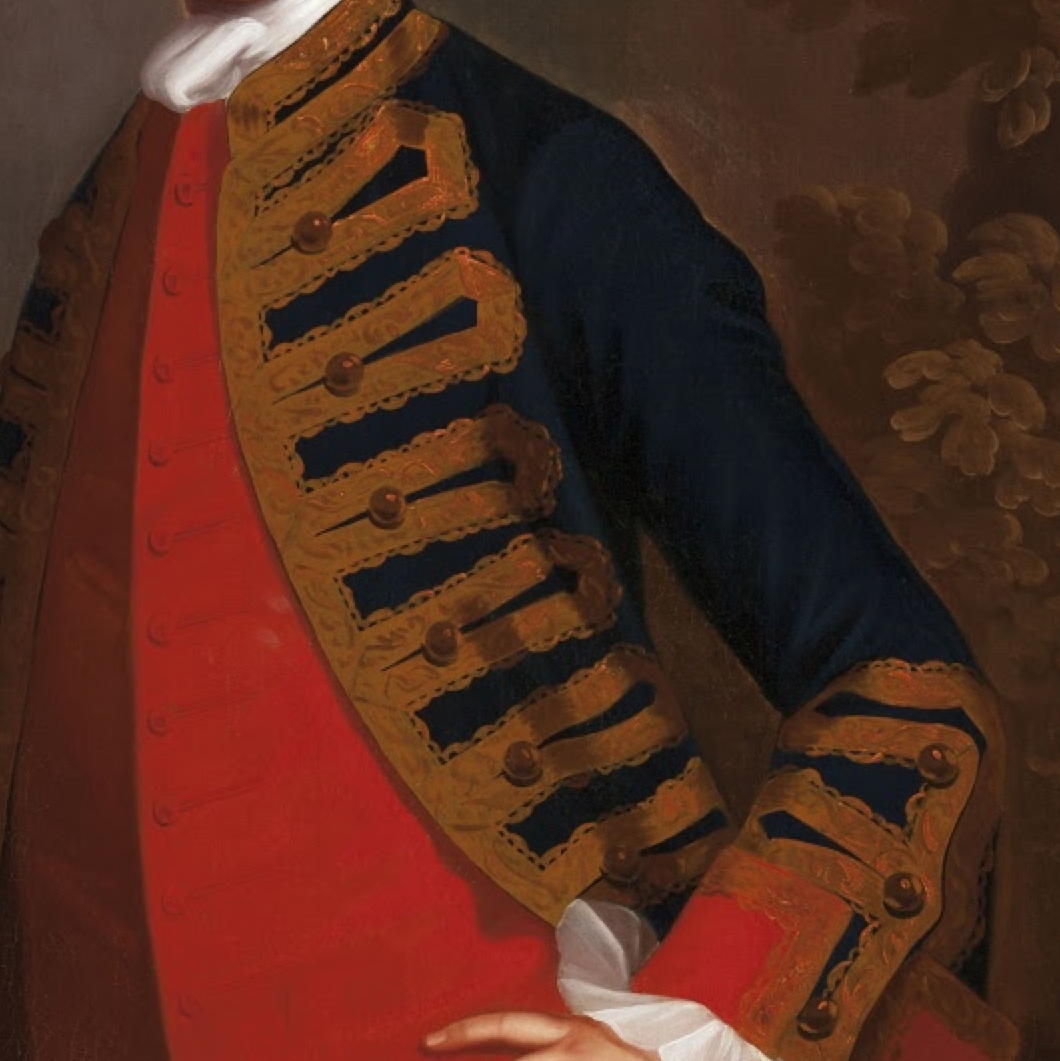
In the event, Morris delayed following his regiment to India, leaving England in April 1762 and remaining there only until December 1763. When the young fourth Duke of Gordon came of age the following year, Staats turned his eyes to America and engaged in land speculation there. In 1768 he and the Duchess even went to visit their purchases in the new world, returning to Scotland in the summer of the following year.
With the fourth Duke’s help, and on the eve of the revolutionary stirrings in North America, Staats was elected to the British parliament for the Scottish seat of Elgin Burghs in 1774. He managed to hold on to it for the next ten years. Was this New Yorker the first Yale man to be elected to Parliament? I can’t find any before him, but more thorough research might prove fruitful.
In 1786 he inherited the manor of Morrisania but with the intervening separation between Great Britain and most of her Atlantic colonies General Morris thought it best to sell it on to his brother Gouverneur.
Though he had rejected a future in the world into which he had been born, Staats did return to North America in a professional capacity in 1797 when he was appointed governor of the military garrison at Quebec in what by then was Lower Canada.
Morris died there in January 1800, but his earthly remains were sent back to Britain where he was interred in Westminster Abbey — the only American to receive that honour.
Articles of Note: 15.I.2021
• Autumn and winter are a time for ghouls and ghosts and eery tales. At Boodle’s for dinner two or three years ago I sat next to the wife of a friend and exchanged favourite writers. I gave her the ‘Transylvanian Tolstoy’ Miklos Banffy, in exchange for which she introduced me to the English writer M.R. James — whose work I’ve immensely enjoyed diving into. The inestimable Niall Gooch writes about Christmas, Ghosts, and M.R. James, as well as pointing to Aris Roussinos on how Britons’ love for ghostly tales is a sign of (little-c) conservatism.
• There can be few figures in English history more ridiculous than Sir Oswald Mosley. But the Conservative MP who became a Labour government minister and then British fascist führer-in-waiting was also forceful in his condemnation of the savagery unleashed by the Black-and-Tans. In 1952 a local newspaper in Ireland announced that Sir Oswald and Lady Mosley “charmed with Ireland, its people, the tempo of its life, and its scenery” had taken up residence at Clonfert Palace in Co. Galway. “Sir Oswald,” the paper noted with amazing restraint, “was the former leader of a political movement in England.” Maurice Walsh presents us with the history of Mosley in Ireland.
• The death of the late Lord Sacks, Britain’s former Chief Rabbi, was the subject of much lament. Rabbi Sacks was obviously no Catholic, but his intellect, frankness, and generosity were much appreciated by Christians. Sohrab Ahmari, one of the editors at New York’s most ancient and venerable daily newspaper, offers a Catholic tribute to Jonathan Sacks.
• “Education, Education, Education” has become a mantra in the past quarter-century and while there is a point there’s also a certain error of mistaking the means to an end for the end itself. After all, in the 1930s Germany was the most and highest educated country in the world. At Tablet, probably America’s best Jewish magazine, Ashley K. Fernandes explores why so many doctors became Nazis.
• Fifty years ago the great people of the state of New York rejected both the Republican incumbent and a Democratic challenger to elect the third-party Conservative candidate James Buckley as the Empire State’s senator in Washington. At National Review Jack Fowler tells the gleeful story of the unique circumstances that brought about this victory for Knickerbocker Toryism and how Mr Buckley went to the Senate.
Onze Grootste President
The London Residence of President Martin van Buren
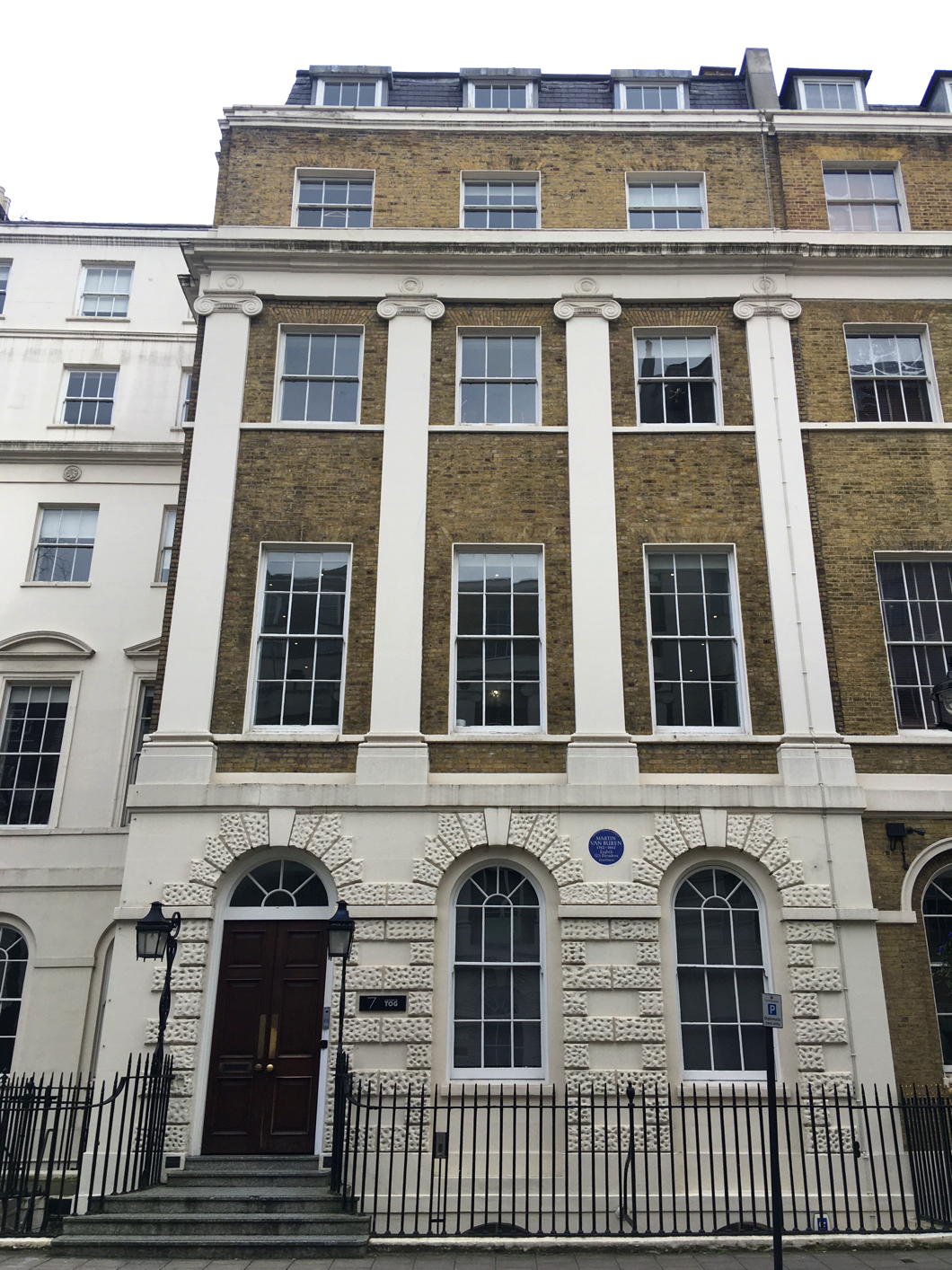
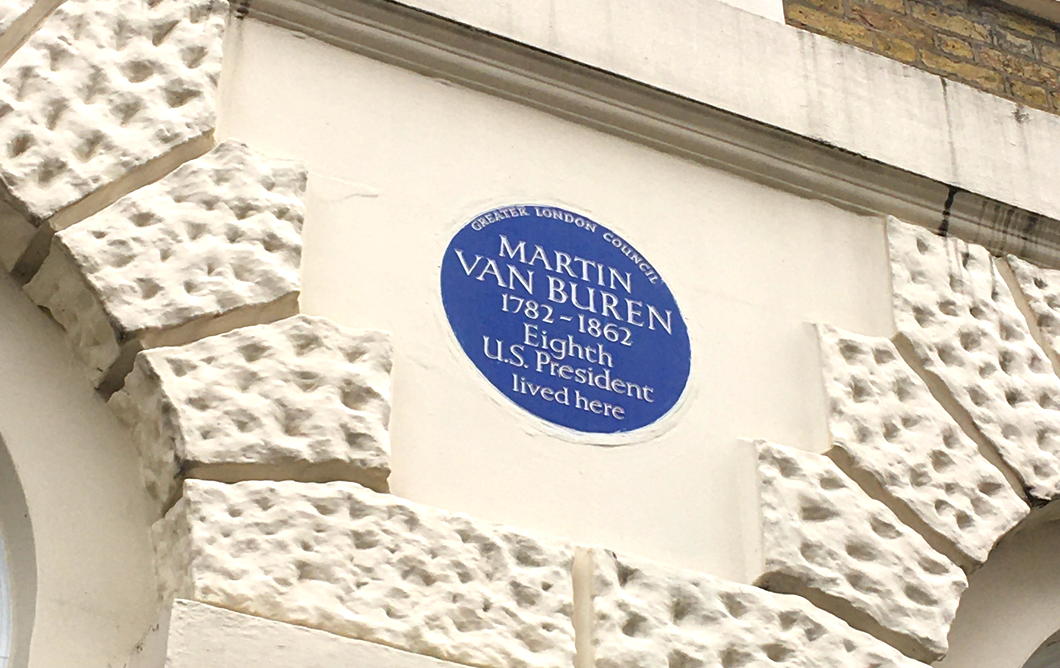
Transacting some business in March before the plague struck us here in London I found myself with a moment to spare and made a brief pilgrimage to No. 7, Stratford Place. It was in this handsome townhouse that Martin van Buren, the first New Yorker to ascend to the chief magistracy of the American Republic, had his residence when he served as the United States’s minister to Great Britain in 1831.
While I often claim that Calvin Coolidge was America’s greatest president in reality my chief devotion in that contest is to the Little Magician himself, the Red Fox of Kinderhook.
Among the many characteristics of this esteemed Knickerbocker is that English was not his native language and throughout his career as a democratically elected politician he spoke with a thick Dutch accent. To his wife, he spoke almost entirely in Dutch.
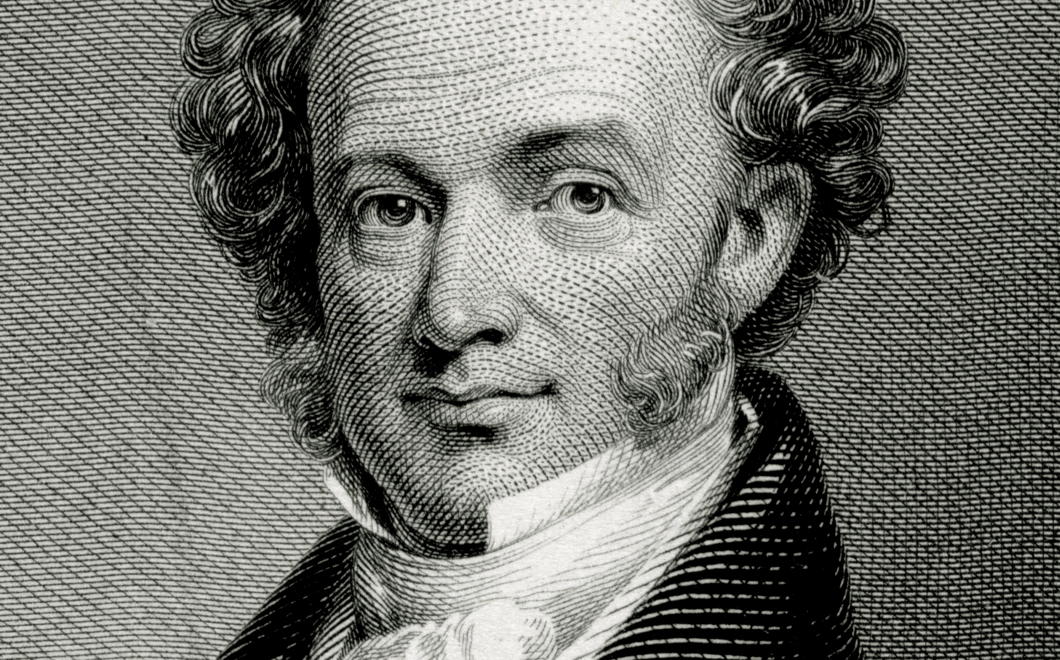
Jay Cost and Luke Thompson’s Constitutionally Speaking podcast at National Review recently released the first of a two episodes about van Buren and while I’m no fan of podcasts in general this was worth listening to.
One of the factors Cost and Thompson highlight is the utility of the party machine structures of the day in solidifying the practice of America’s democracy and acting as a vehicle of accountability, something too little appreciated by most later observers of the period.
We keen Kinderhookers and Van Buren Boys await the second instalment with anticipation.
Shamefully I have not yet made the pilgrimage to Kinderhook itself, but it’s pleasing to learn that the dominie of the Dutch Reformed Church is a graduate of the greatest university in the southern hemisphere.
How Our Ancestors Built
The Hudson River Day Line Building in Albany
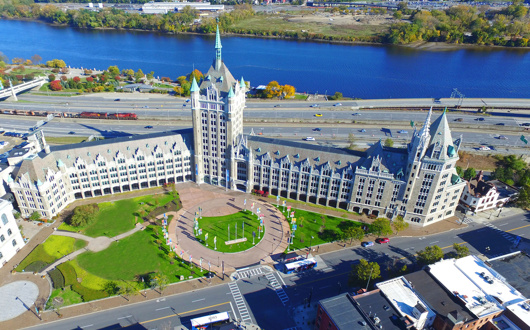
The visitor arriving at Albany, the capital of the Empire State, might be forgiven for presuming the riparian French gothic mock-chateau he first views is the most important building in town.
Built as the headquarters of the Delaware & Hudson, a canal company founded in 1823 that successfully transitioned into the railways, the chateau now houses the administration of the State University of New York. (Indeed, the Chancellor once had a suitably grandiose apartment in the southern tower.) That building, with its pinnacle topped by Halve Maen weathervane, is worthy of examination in its own right.
But next to this towering edifice is an altogether smaller charming little holdout: the ticket office of the Hudson River Day Line.
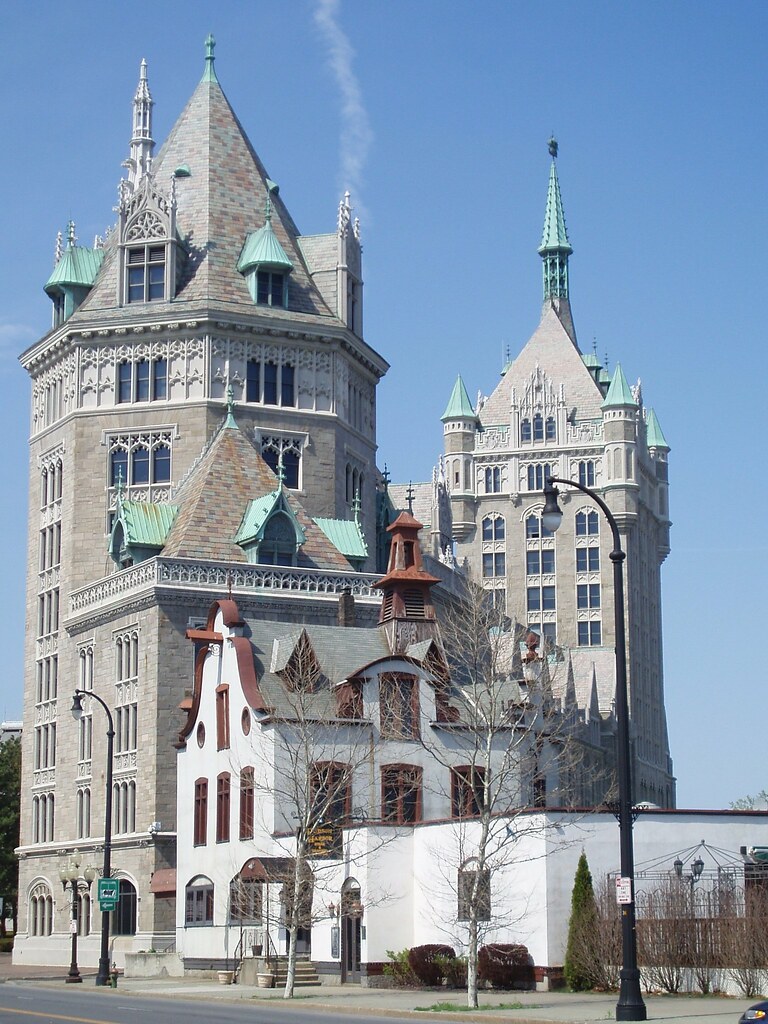
In the nineteenth century the Hudson River Valley was often known as “America’s Rhineland” and travel up and down the river was not just for business but also for the aesthetic-spiritual searching that inspired the Hudson River School of painters.
The Day Line’s origins date to 1826 when its founder Abraham van Santvoord began work as an agent for the New York Steam Navigation Company. Van Santvoord’s company merged with others under his son Alfred’s guidance in 1879 to form the Day Line. (more…)
Haussmanhattan
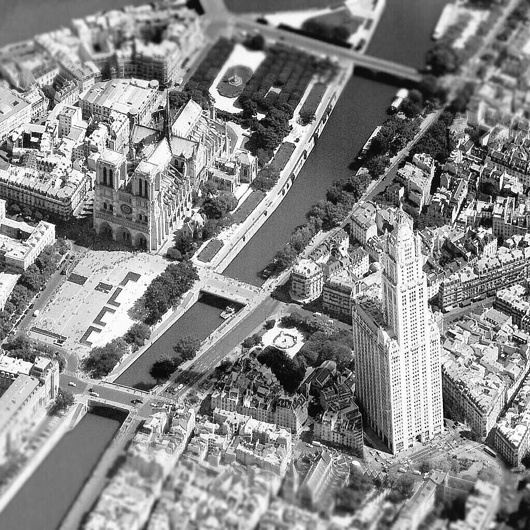
Paris and New York are two cities radically different in design and character, but they are smashed together in this little project from architect Luis Fernandes.
‘Haussmanhattan’ is a portmanteau of Baron Haussmann, the Prefect of the Seine whose reconfiguration of the French capital made it the Paris we know today, and Manhattan, the most renowned of New York City’s five boroughs.
Haussmann’s plan of broad boulevards and radial avenues is a far cry from the artless Commissioners’ Plan of 1811 which created the unforgiving city blocks that colonised the entire island of Manhattan ad infinitum.
The contrast only makes the pick-and-mix Fernandes has confected all the more fun/ridiculous/interesting.
Claudia McNeil
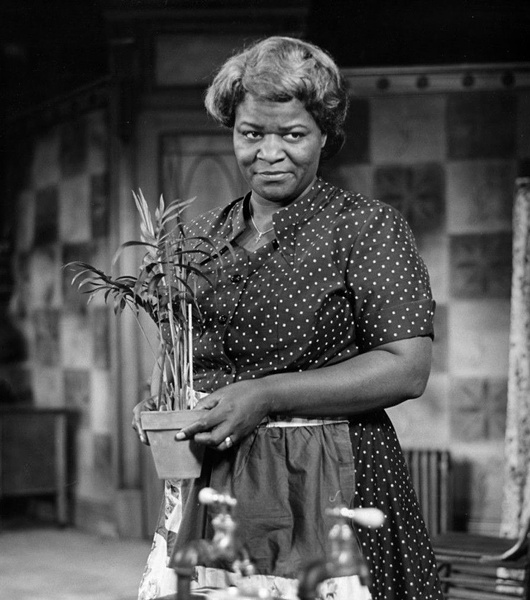
As a black Jewish Catholic, Claudia McNeil was pretty much everything the Ku Klux Klan hated. She was born to a black father and a part-Apache mother in Baltimore, Maryland but in her teenage years was adopted by a Jewish family in New York who instructed her in Judaism and taught her fluent Yiddish.
She married aged 19 but lost her husband in the Second World War and both her sons in the Korean War.
After training as a librarian, McNeil drifted into vaudeville theatre and nightclubs, eventually making her Broadway debut in 1953 as Tituba in The Crucible.
“The Jewish faith left an indelible stamp on her spirit,” Ebony magazine reported in 1960, “but she became a convert to Catholicism in 1952.” McNeil often reported that she stopped to pray before every evening’s performance.
Her most famous role was as the matriarch in A Raisin in the Sun in 1959, reprised in the 1961 film in both of which Sidney Poitier also starred.
Deeply appreciative of the gifts God gave her, McNeil was known never to turn down a chance to appear at charity benefit performances, especially for the NAACP and the American Jewish Congress.
Despite the losses she suffered in her life Claudia McNeil insisted “I have everything I’ve ever wanted from life.”
“I have more work than I can do. I have a nice, cheerful, comfortable home. I am solvent. Above all, I have strength, health, and peace of mind. I know where I’m going. I am an American citizen. I love my country. I pay my taxes and vote, and I intend to have a say in how my country is run.”
McNeil retired in 1983 and died ten years later.
Neo-Classical New York
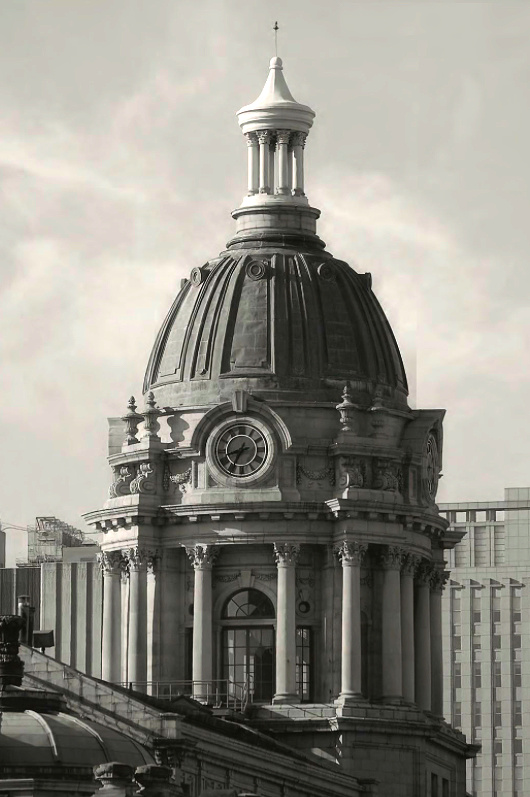
The dome of the old Police Headquarters Centre Street in New York.
More Dutch Flags of New York


Areas shaded in orange are the counties of New York with Dutch-influenced flags
Natives and outsiders alike are often surprised when it’s pointed out just quite how much New York continues to be influenced by its Dutch foundation to this day, even though Dutch rule ended in the seventeenth century.
Previously I explored a number of local or regional flags in the state of New York that show signs of Dutch influence: those of the cities of New York and Albany, the Boroughs of Manhattan, Brooklyn, the Bronx, and Queens, and the counties of Westchester, Nassau, and Orange.
I’ve since found a few more counties to add to our survey of Dutch flags in the Empire State.
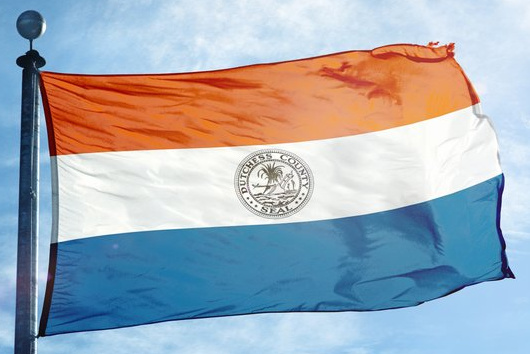
Dutchess County
One of the original counties of New York established in 1683, Dutchess retains the archaic spelling of Mary of Modena’s title while she was Duchess of York. Appropriately for a county that was until very recently largely agricultural, the county seal depicts a sheaf and plough, and sits on the county’s flag with its horizontal tricolour of orange, white, and blue.
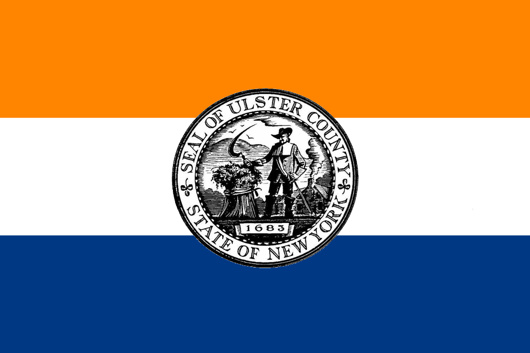
Ulster County
Across the Hudson from Dutchess County is Ulster, another of New York’s first counties. Its handsome seal features an early farmer wielding a sickle in front of a sheaf and a farmhouse, with the year of the county’s erection proudly included. The Dutch had begun to trade here as early as 1614, and the village of Wiltwijck was given municipal status by Peter Stuyvesant in 1663. Wiltwijck became Kingston in 1669 and remains a very handsome town today.
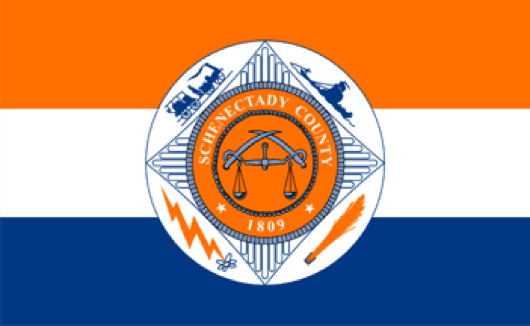
Schenectady County
The county of Schenectady is of later origin, 1809, and became industrialised in the latter half of the nineteenth century — the General Electric Company was founded here in 1892. Like Ulster and Dutchess, the county flag is just the seal displayed on an orange-white-blue tricolour.
The seal is a relatively boring depicting of crossed swords combined with the scales of justice, but on the flag it is depicted with a locomotive, canal boat, broomhead, and lightning bolt and atom.
Search
Instagram: @andcusack
Click here for my Instagram photos.Most Recent Posts
- Brunel’s Unbuilt Capitol February 3, 2026
- Cricket at Fordham January 27, 2026
- Palacio Barolo Revisted January 14, 2026
- Learning to Love Liguria January 14, 2026
- Crux Alba No. 2 January 13, 2026
Most Recent Comments
Book Wishlist
Monthly Archives
Categories