History
About Andrew Cusack
 Writer, web designer, etc.; born in New York; educated in Argentina, Scotland, and South Africa; now based in London.
 read more
News
Blogs
Reviews & Periodicals
Arts & Design
World
France
Mitteleuropa
Knickerbockers
Argentina
The Levant
Africa
Cape of Good Hope
Netherlands
Scandinavia
Québec
India
Muscovy
Germany
Academica
“The Bridge of San Luis Rey”

New Spain never looked so good as in the 2004 film of Thornton Wilder’s novel The Bridge of San Luis Rey. This is no doubt partly because it wasn’t filmed in New Spain but in Old Spain (specifically in Toledo and Málaga).

Buckham’s Britain

 The Daily Telegraph shows us a number of photos taken by Alfred Buckham, an aerial photographer of the 1920s. Buckham was introduced to the art during his time with the aerial reconnaissance branch of the Royal Naval Air Service in the First World War.
The images themselves are composite photographs combining actual aerial views of cities and landmarks throughout Great Britain with views of the aircraft of the day flying through the skies.
As the Telegraph notes, Buckham “eschewed safety devices, saying: ‘I have used a safety belt only once, and then it was thrust upon me. I always stand up to make an exposure and, taking the precaution to tie my right leg to the seat, I am free to move about rapidly'”.
A new book on Buckham, A Vision of Flight: The Aerial Photography of Alfred G. Buckham, has just been written by Celia Ferguson, and is published by The History Press.
‘Flying High’
[I came across this piece by Taki whilst trawling through the Cusack archives, and I thought now would be the appropriate time to share it.]
By Taki Theodoracopulos (The Spectator, 22 April 2006)
Do any of you remember a film called The Blue Max? It is about a German flying squadron during the first world war. A working-class German soldier manages to escape trench warfare by joining up with lots of aristocratic Prussian flyers who see jousting in the sky as a form of sport, rather than combat. Eager for fame and glory — 20 confirmed kills earns one the ‘Blue Max’, the highest decoration the Fatherland can bestow — the prole shoots down a defenceless British pilot whose gunner is dead. His squadron leader is appalled. ‘This is not warfare,’ he tells the arriviste. ‘It’s murder.’
I know it’s only a film, and a Hollywood one at that, but jousting in the air was a chivalric endeavour back then, with pilots who crash-landed behind enemy lines being treated as honoured guests before being interned for the duration. The man who embodied all the chivalric virtues was, of course, Manfred von Richthofen, whose family had been ennobled by Frederick the Great in the 1740s. When Baron Richthofen became a fighter pilot in the late summer of 1916, it was still only 13 years since the first flight of Orville Wright. The technique of applying air power to warfare was barely understood. One looped-the-loop, and pilots who managed to shoot down enemy aircraft and survive were regarded as heroes and quickly accumulated chestfuls of medals. When the Red Baron (his plane was painted a dark red, hence the nickname) died on 21 April 1918, the Times for 23 April devoted one third of a column to England’s fallen enemy, remarking that ‘all our airmen concede that Richthofen was a great pilot and a fine fighting man’.
By the time of his death, the Red Baron had notched up 80 victories, a record, with the leading French ace, René Fonck, claiming to have shot down 157 German aircraft, but only 75 being confirmed. (Rather French, that.) Needless to say, the mystery surrounding Richthofen’s death added to his legend. No one knows for sure who shot him down, or even if the bullet which killed him came from the ground. The English who found his body treated it with all the ceremony they would have accorded one of their own. An honour guard escorted the corpse to his own lines and British pilots overflew and dipped their wings. Those were the days. Out of 8 million men of his generation who died in that useless war, Richthofen’s is among the few names which will most likely be remembered by the general public on the 200th anniversary of his death.
His brother Lothar and his cousin Wolfram (who bombed Stalingrad 25 years later, and was one of Hitler’s favourites) flew alongside the baron, establishing a tradition for excellence and gallantry in the Luftwaffe. The second world war saw great heroics by German pilots, starting with Hans Ulrich Rudel, with something like 400 Stalin tanks to his credit, Adolf Galland, Erich Hartmann, who shot down 352 Soviet aircraft in the course of 1,500 missions, and Walter Novotny, with 250 Soviet aircraft in fewer than 450 missions.
My favourite is, of course, Prince Heinrich Sayn-Wittgenstein, whose heroics overshadowed the rest, and whose plane was shot down at the very, very end of the war in Schonhausen, the Bismarck home. Wittgenstein had his crew bail out first but was unconscious when he hit the ground. He had been hit while in the cockpit. By the end of the war he had become such an ace and legend he could do what he pleased. He once flew a combat mission with a raincoat over his dinner jacket. A few days before he had been to Hitler’s headquarters to receive the Oak Leaves to his Knight’s Cross. He told the beautiful Missie Vassiltchikov on the telephone, ‘Ich war bei unserem Liebling’ (I have been to see our darling) and added how surprised he was his handgun had not been removed before he entered ‘the Presence’. Heinrich would have loved to have bumped him off, but by then Germany was ruined and the prince died three days later. Hitler had many heroic pilots grounded towards the end, but Wittgenstein, being noble, was kept flying.
Why am I bringing all this up in the year of Our Lord 2006? As I told you last week, while down in Palm Beach, a friend of mine, Richard Johnson, tied the knot with Sessa von Richthofen, and I flew down a group of friends for three days of non-stop celebrations. The couple exchanged vows on an 80-year-old river boat which plies its trade in the inland waterway which crisscrosses Florida. My speech went down great, but then some ghastly paparazzo by the name of Harry Benson went around complaining about it. Never to me, needless to say, otherwise one more kill would have been added to the Richthofen legend.
“Der Rote Baron”
Foreign Film Fictively Frames Favorite Fabled Freiherr
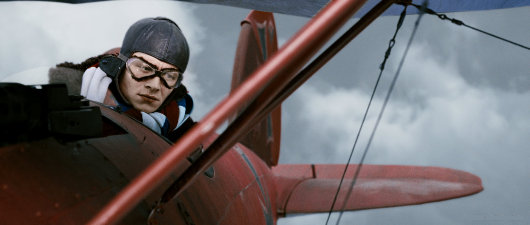
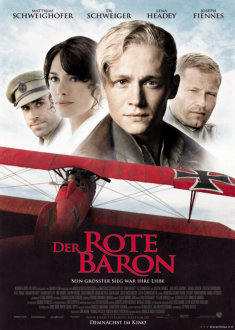 Our cunning cousin, the Hun, has cleverly concealed a card up his hunting-jacket sleeve. Just when you thought the continual winging by hand-wringing Germans about their militarist past (or at least the thoroughly shameful parts thereof) would never end, a new film depicts the life of the dashing Manfred Albrecht Freiherr von Richthofen: better known to us as The Red Baron.
“Der Rote Baron” is showing in den deutschen Kinopalästen as we speak, but the motion picture was not actually meant for a German audience: this is but part of the clever ruse. The film was actually made in English and then dubbed back into German by the mostly Allemanic cast.
Having convinced us of their peaceful intentions through more than a half-century of “Guys, we really messed up circa 1933-1945”, the obvious intent is to swamp the English-speaking world with a film depicting the charming gentlemen fighters of the first weltkreig in order to disarm us as they prepare for their dastardly plans.
Why, as we speak, Georg Friedrich von Preussen is polishing his pickelhaube and dusting off his feather cap in preparation for this latest Prussian plot for world domination. While the Western world worried itself sick over global Islamism and the Chinese threat, little did we know that a swelling irredentism was brewing deep within the hearts of every Berliner; a tear developing in the eye at the mere mention of Tsingtao; a soul in mourning for the loss of Tanganyika. How naïve we were not to realize that all those bright young Germans spending their gap year teaching smiling Herero natives in Namibia were actually forward units of intelligence-gatherers yearning for the return of Ketmanshoop and Swakopmund to the Germanic fold.
Victoria Day – Fête de la Reine
The Official Birthday of the Queen of Canada
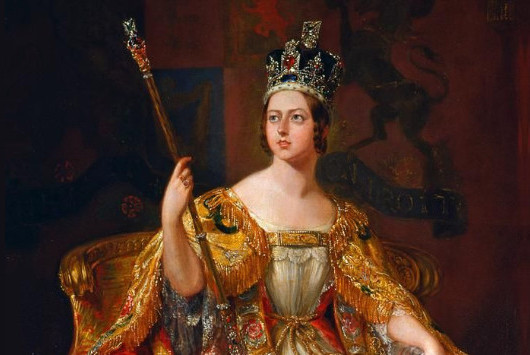
ELIZABETH II will have had, in her lifetime, more birthdays than Methuselah. This is because, in addition to the actual date of her birth, April 21, 1926, she has several different days which are designated as the Sovereign’s Official Birthday. In Britain, her birthday (which is the official national day of the United Kingdom) generally falls on the first or second Sunday in June and is the occasion of the ceremony of Trooping the Colour. Australia celebrates her birth on the first Monday in June with a public holiday, except for in Western Australia, where it is usually either the last Monday in September or the first Monday in October. This is the day when the latest members of the Order of Australia are announced. New Zealand also holds the Sovereign’s Birthday on the first Monday of June. Fiji is now a republic but Elizabeth II remains ‘Paramount Chief of Fiji’ and so a Monday in June is declared a holiday each year to commemorate her birth.
From “A Suburban Country Place”
Claremont, at the end of Riverside Drive, near the tomb of General Grant, suggests in a rather humble way what these mansions were, and in a very magnificent way what their outlooks were. Others linger, desecrated, here and there, closely pressed by new-laid brick and stone. And away up at the extreme tip of Manhattan there are still a few quiet, shady places which may call themselves suburban in the old and honorable sense. But everywhere else around the outskirts of Manhattan the term has gained an unattractive, hybrid meaning. To speak it with pleasure, New-Yorkers must apply it to those remoter regions which can be reached only by a railway journey of considerable length. And then it is incorrectly applied, for a real suburban place is rural in aspect, but urban in convenience — private, green, and peaceful in itself, yet close in touch with the true self of the town. …
“A Suburban Country Place”
The Century Magazine,
May 1897
Philipp Freiherr von Boeselager, 1917-2008
Catholic Nobleman, Forester, Knight of Malta, Plotted to Kill Hitler
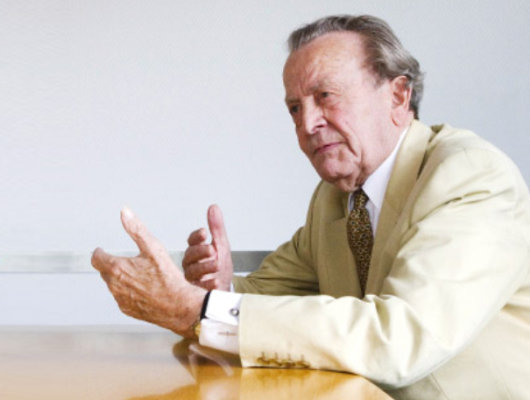
Philipp Freiherr (Baron) von Boeselager, the last surviving member of the conspiracy of anti-Nazi German officers, has died at 90 years of age. The freiherr‘s background and upbringing were distinctly Catholic. The Boeselagers are a Rhenish family with Saxon origins in Magdeburg. Philipp was the fourth of eight children and was educated by the Jesuits at Bad Godesborg. His grandfather had been officially censured by the Imperial German goverment for publically taking part in a Catholic religious procession.
Boeselager had most intimately been involved in the March 1943 plot to assasinate Hitler and Himmler when the the Fuhrer and the SS head were visiting Field Marshal Günther von Kluge on the Eastern Front. Boeselager, then a 25-year-old cavalry lieutenant under the Field Marshal’s command, was to shoot both Hitler and Himmler in the officers mess with a Walther PP. Himmler, however, neglected to accompany Hitler and so the Field Marshal ordered Boeselager to abort the attempt fearing that Himmler would take over in the event of Hitler’s death, changing nothing.
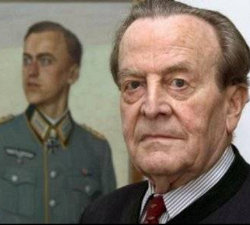 «Each day Hitler ruled, thousands died unnecessarily — soldiers, because of his stupid leadership decisions. And later, I learned of concentration camps, where Jews, Poles, Russians — human beings — were being killed.»
«It was clear that these orders came from the top: I realised I lived in a criminal state. It was horrible. We wanted to end the war and free the concentration camps.»
Boeselager later procured the explosives for the famous July 1944 plot (the subject of the upcoming film “Valkyrie“), under the cover of being part of an explosives research team. He handed a suitcase with the explosives on to another conspirator. When the bomb exploded in Hitler’s conference room, Boeselager and his 1,000-man cavalry unit made an astonishing 120-mile retreat in under 36 hours to reach an airfield in western Russia from where the aristocrat would fly to Berlin to join the other conspirators.
At the airfield, however, he received a message from his brother (Georg von Boeselager, a fellow cavalry officer who was repeatedly awarded for his consistent bravery on the battlefield) saying “All back into the old holes”, the code signifying the failure of the coup. Even more astonishingly than his swift retreat was his return, with his unit, to the front quickly enough not to raise any eyebrows. As a result, he was not known to be part of the conspiracy and escaped the gruesome tortures and executions dealt to many of his fellow conspirators.
After the war, his role in the plot was revealed and Philipp von Boeselager was awarded the Legion d’honneur by France and the Great Cross of Merit by West Germany. He joined the Order of Malta in 1946, eventually co-founding Malteser Hilfdienst, the medical operation of the German knights of the Order, and helping coordinate German pilgrimages to Lourdes.
The greater part of his post-war years was spent in forestry, and Boeselager served as head of the Arbeitsgemeinschaft Deutscher Waldbesitzerverbände (the coordinating body of private and cooperative forest-owners) from 1968 to 1988. Coincidentally, he was succeeded in that post by Franz Ludwig Schenk Count von Stauffenberg, the son of the July ’44 plot mastermind.
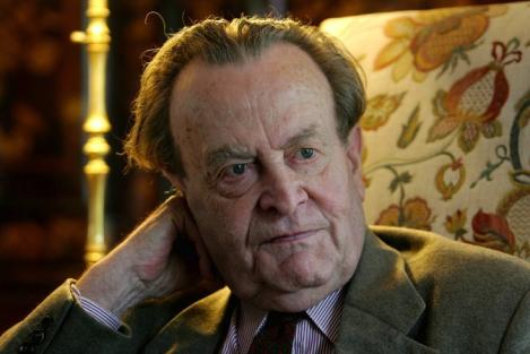
“Valkyrie”

No, this isn’t a photograph of the latest Norumbega staff meeting, it’s a publicity shot from the upcoming United Artists film, “Valkyrie”. The film tells the story of Claus Philipp Maria Schenck von Stauffenberg, the heroic German Catholic noble who was the mastermind behind the July 20 plot against Hitler. Needless to say, there has been much anticipation over this film, especially since the lead role went to Tom Cruise, who has never quite got the knack of acting. Like Jeremy Irons, he seems to believe that completely different characters require little or no change in performance, but is mysteriously still making films nonetheless. (Cruise at least has the excuse of being a Scientologist to explain his success… what’s Jeremy Irons’s?).

Despite the poor choice of Mr. Cruise play Count Stauffenberg, the rest of the cast includes some pretty inspired choices. Playing Countess Nina von Stauffenberg is Carice von Houten (above), whom you will remember from “Zwartboek”. She’s joined by fellow “Zwartboek” actor Christian Berkel (top photo, seated far left), who played the evil General Kaütner in the Dutch film, the character responsible for the downfall of the good German, General Müntze, who was played by Sebastian Koch (better known for his role in the hit “Das Leben der Anderen”) who (pause for breath) actually played Count Stauffenberg himself in a 2004 German television production called “Stauffenberg”. Speaking of downfalls, Berkel (we’re back to him now) also played a nasty Nazi in the 2004 film “Downfall” depicting the last few days in Hitler’s bunker. [Correction: Berkel actually played Dr. Ernst-Günter Schenck, one of the good guys.] Some more of the cast…
(more…)
The Queen in Williamsburg
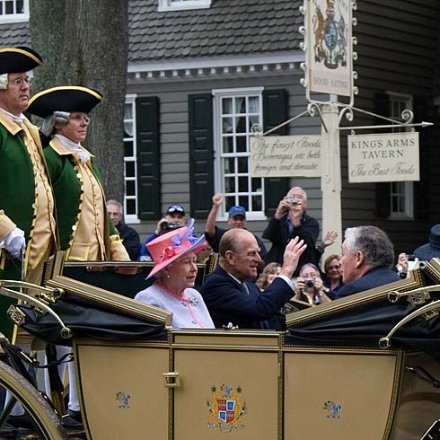
THE QUEEN HAS once again visited Williamsburg, Virginia’s ancient capital, after an absence of half a century. His Excellency Mr. Timothy Kaine, the Governor of the Commonwealth Virginia, was good enough to call a public holiday in the state, giving public workers the day off in celebration of the Queen’s visit. During the trip, Her Majesty spoke to the General Assembly of Virginia, the oldest legislature in the New World, in Richmond (the current capitol), as well as meeting privately with the friends and relatives of the victims of the recent tragedy at Virginia Tech. In Williamsburg, she received an honorary degree from the College of William and Mary and was the guest at a luncheon at the Governor’s Palace, once the official residence of her predecessors’ viceroys in Virginia. (more…)
Poor Old Bram
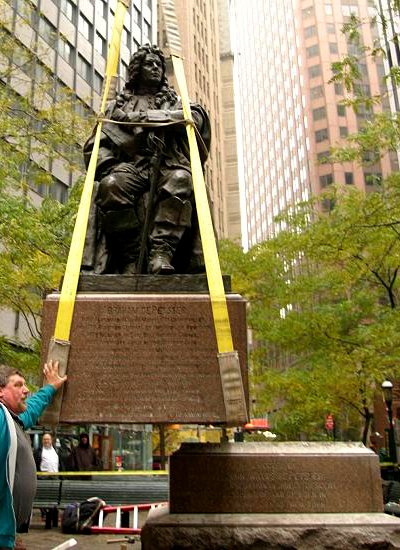
ONE HAS TO FEEL A certain amount of sympathy poor old Abraham de Peyster. The city fathers, in their infinite and unending wisdom, sought fit to erect a statue of Bram in Bowling Green, the old town square of New York down at the beginning of Broadway, many moons ago. However, having set Bram very nicely upon that green, the first public park in all New York, the city fathers have of late refused to let old Heer de Peyster rest. In 1972, the park was ‘renovated’ which entailed the statue’s forced removal. He ended up four years later in Hanover Square, a quite suitable though less prominent location, where he gazed across the square towards India House. It was then that old rivalries flared anew. (more…)
The Jefferson Guards
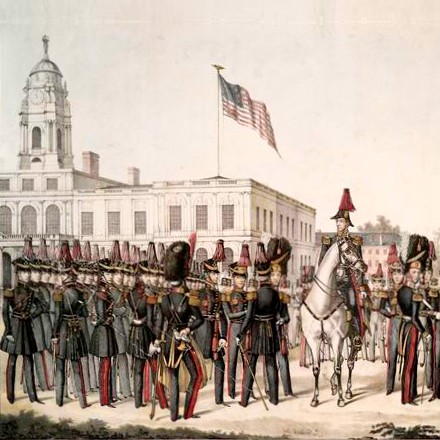
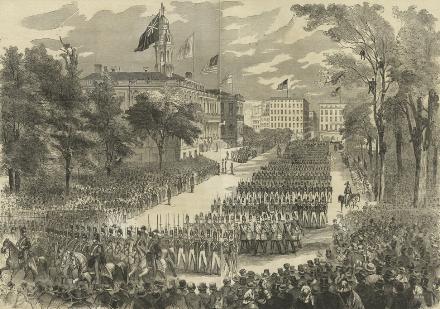
I recently stumbled upon this image depicting a militia regiment gathered in front of New York’s City Hall. The unit in question is the Jefferson Guards, 38th Regiment, New York State Artillery, amassed in bearskin caps and red-plumed shakos (red being the traditional color of the artillery). I confess I’d never heard of the Jefferson Guards before, but this is not entirely surprising. The Armed Forces of the State of New York – today composed of the New York Army National Guard, the New York Air National Guard, the New York Guard, and the New York Naval Militia – was once composed of a vast array of assorted regiments, battalions, and companies (a quite literal example of the ‘little platoons’ praised by Burke). These militia companies varied greatly in form, from little more than glorified social clubs to the crack units of the day.
As strange as it may seem, considered as a whole they were an almost completely organic military and, while they would be ill-suited to the armed exigencies of today, I refuse to believe that our little realm is better off for their general disappearance. Certainly the V.C.A. and the Old Guard, among others, survive to this day (in a somewhat different form, naturally), but what of the Empire Light Cavalry and the German Horse Guards? The Ulster Guard, the Weschester Chasseurs, and the New York Highlanders? The gallant Seventh Regiment of New York survived even into the 1990’s before its dissolution was ensured by the monotony monitors who now, fifteen years later, seek to destroy the great and blessed monument of an armory on Park Avenue which the Seventh built and guarded for over a century. We mourn their disappearance, just as we detest the continued and increasing disdain for the proud military heritage of the City and State of New York, but the entire culture which created and sustained them is gone, too.
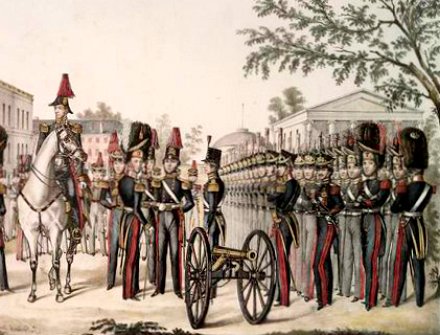
Category: Militaria – New York
Your Royal Highness, Cead Mile Failte
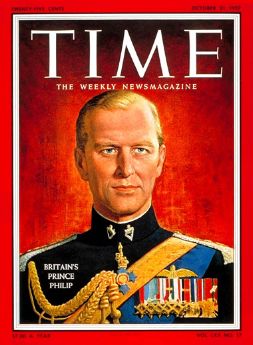
Thus wrote Francis Finnegan of the Ancient Order of Hibernians to H.R.H. Prince Philip, the Duke of Edinburgh, (above, in the uniform of the Queen’s Royal Irish Hussars) inviting him to partake in New York’s St. Patrick’s Day festivities in 1966 during his visit to North America. The invitation was made in recompense for the opprobrious breach of propriety in 1861 when Col. Michael Corcoran, Commanding Officer of the New York 69th committed an act of insubordination when he refused to order his troops to take part in the official festivities welcoming the Prince of Wales to New York. Corcoran was dropped from the Officers Roll of the New York State Militia for the offense, and was to be court-martialled but for the outbreak of the Civil War.
Finnegan, the public relations director of the New York St. Patrick’s Day Parade organised by the Ancient Order of Hibernians every year, assured the Duke of Edinburgh that he would not be mistreated as the Prince of Wales had been one hundred and five years previous. “Alas,” TIME magazine reported, “he arrived in Manhattan too late on St. Patrick’s Day to march in the Fifth Avenue parade, even though he did sport a fine green tie. Britain’s Prince Philip, 44, in a green tie? ‘Just a coincidence,’ chuckled the consort.” (TIME, 25 March, 1966).
The 1861 visit of the Prince of Wales to New York was a spectacular event, despite the insults of Col. Corcoran. A ball was held, just as for the Queen Mother during her 1954 visit to New York, as well as a parade and pass-in-review.
The Story of Notre Dame de Bon Secours
The background story to Nôtre Dame de Bons Secours, from the Catholic Community Forum:
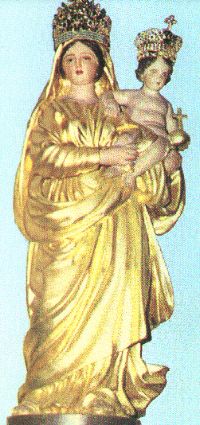 In 1727, French Ursuline nuns founded a monastery in New Orleans, Louisiana, and organized their area schools from it. In 1763 Louisiana became a Spanish possession, and Spanish sisters came to assist. In 1800 the territory reverted back to France, and the Spanish sisters fled in the face of France anti-Catholicsm. In 1803, short on teachers, Mother Saint Andre Madier requested reinforcements in the form of more sisters from France. The relative to whom she wrote, Mother Saint Michel, was running a Catholic boarding school for girls. Bishop Fournier, short-handed due to the repressions of the French Revolution, declined to send any sisters. Mother Saint Michel was given permission to appeal to the pope. The pope was a prisoner of Napoleon, and it seemed unlikely he would even receive her letter of petition. Mother Saint Michel prayed,
O most Holy Virgin Mary, if you obtain for me a prompt and favorable answer to this letter, I promise to have you honored at New Orleans under the title of Our Lady of Prompt Succor.
and sent her letter on 19 March 1809. Against all odds, she received a response on 29 April 1809. The pope granted her request, and Mother Saint Michel, commissioned a statue of Our Lady of Prompt Succor holding the Infant Jesus. Bishop Fournier blessed the statue and Mother’s work.
Mother Saint Michel and several postulants came to New Orleans on 31 December 1810. They brought the statue with them, and placed it in the monastery chapel. Since then, Our Lady of Prompt Succor has interceded for those who have sought her help.
A great fire threatened the Ursuline monastery in 1812. A lay sister brought the statue to the window and Mother Saint Michel prayed
Our Lady of Prompt Succor, we are lost if you do not come to our aid.
The wind changed direction, turned the fire away, and saved the monastery.
Our Lady interceded again at the Battle of New Orleans in 1815. Many faithful, including wives and daughters of American soldiers, gathered in the Ursuline chapel before the statue of Our Lady of Prompt Succor, and spent the night before the battle in prayer. They asked Our Lady for the victory of the American forces over the British, which would save the city from being sacked. General Andrew Jackson and two hundred men from around the South won a remarkable victory over a superior British force in a battle that lasted twenty-five minutes, and saw few American casualties.
It is still customary for the devout of New Orleans to pray before the statue of Our Lady of Prompt Succor whenever a hurricane threatens New Orleans.
Hat tip: Irish Elk. The image used below is of the National Shrine of Our Lady of Prompt Succor in New Orleans.

The Remarkable Hapsburgs
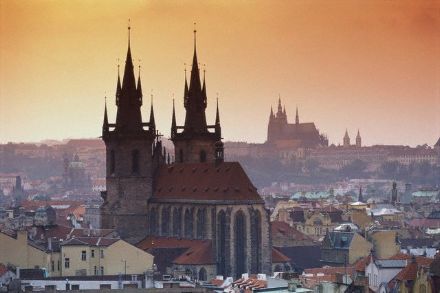
Last night, Fr. Emerson popped up from Edinburgh and gave a talk on the Hapsburg dynasty. It was tremendously interesting. I learned so much I hadn’t known before and it opened up a terrific number of avenues of information down which I have only begun to stroll.
I had no idea how remarkable a man Franz Ferdinand was. All they teach you in America is “This is the guy who got shot” instead of “This man would have been the savior of all that is good and holy in Europe.”
I have seen and read a lot of what Europe is today; Fr. Emerson gave us a glimpse of what Europe was yesterday, before the utter destruction of the social order of the continent by that moment in Sarajevo and everything that came after it. Knowing what Europe was, how depressing to see it now!
It also filled me with some optimism, oddly enough. I used to be partly in the school of thought that’s convinced that Europe is lost. If this is how Europe was, surely it could be again? Perhaps, perhaps not. (more…)
Search
Instagram: @andcusack
Click here for my Instagram photos.Most Recent Posts
- Brunel’s Unbuilt Capitol February 3, 2026
- Cricket at Fordham January 27, 2026
- Palacio Barolo Revisted January 14, 2026
- Learning to Love Liguria January 14, 2026
- Crux Alba No. 2 January 13, 2026
Most Recent Comments
Book Wishlist
Monthly Archives
Categories