History
About Andrew Cusack
 Writer, web designer, etc.; born in New York; educated in Argentina, Scotland, and South Africa; now based in London.
 read more
News
Blogs
Reviews & Periodicals
Arts & Design
World
France
Mitteleuropa
Knickerbockers
Argentina
The Levant
Africa
Cape of Good Hope
Netherlands
Scandinavia
Québec
India
Muscovy
Germany
Academica
Smuts at Leiden
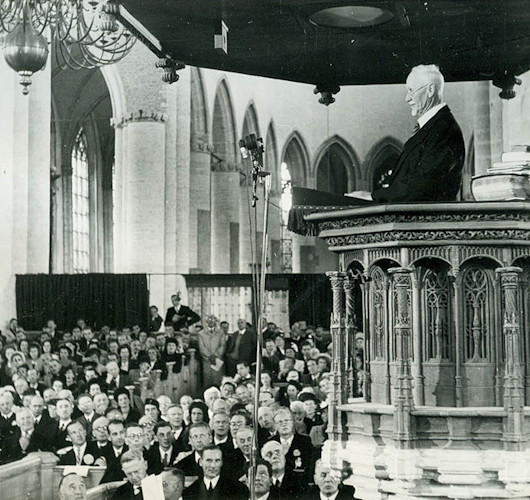
For quite some time, Leuven — in what is currently known as Belgium — was the only university in the Netherlands. It is still (barely, some argue) a Catholic university, and after the Protestant revolt sealed its rule over the northern part of the Dutch realms, William the Silent founded a university at Leiden as a Calvinist academy in 1575.
Leiden University has had strong links with South Africa from the earliest days. Ds. Johannes de Vooght — in the 1660s, the second leraar of Cape Town’s Dutch Reformed congregation — studied here, as did numerous predikante of that period and onwards, including Ds. Petrus van der Spuy, the first NGK minister to be born in South Africa.
South African politicians studied here aplenty: Sir Christoffel Brand (first Speaker of the Cape Parliament); Jan Brand (fourth president of the Orange Free State); Marthinus Steyn (sixth and final president of the O.F.S.); and Nicolaas Diederichs (third staatspresident of the Republic of South Africa).
Probably the first South African to be granted an honorary degree by Leiden (c. 1830) was Antoine Changuion, the founder of the Dutch language movement which advocated preserving Dutch as the cultural language of the Afrikaners against the emerging Afrikaans.
It was in 1948 that Leiden granted the greatest Afrikaner — Field Marshal Smuts — a Doctorate of Law honoris causa. Smuts was on his way back from Cambridge where he had been granted the honour of being installed as Chancellor of the University. Even Die Burger, a Nationalist paper opposed to his Verenigde party, found the event worthy of a caustic near-compliment:
“We may differ from him on many issues, but the honour which he has won for the Afrikaner does not leave us untouched.”
Wednesday 27 January
– Margaret Beaufort was one of the greatest women England ever produced, but her legacy has been plagued by misogyny combined with Protestant suspicion of her Catholic piety. Leanda de Lisle delves into the question of whether she was a hero or a villain.
– Speaking of powerful women, James Panero’s examines the monument to Joan of Arc on New York’s Riverside Drive. The artist was a female sculptor, Anna Hyatt Huntington, whose statue of El Cid in the forecourt of the Hispanic Society on Audubon Terrace is one of the finest sculptural arrangements in the New World.
– Lent is about to stare us in the face, but so far as I am concerned we are allowed to wallow in Christmas cheer until Candlemas comes on 2 February. Dr John C Rao (of St John’s University and the Roman Forum) offers us a reflection on the Christmas Crèche and its origins as Saint Francis’s giant “F.U.” to Cathar heretics, while putting the thinking behind that great saint’s actions in a modern context.
– It’s good to see neglected favourites receive a bit of unexpected attention. One such is the Irish writer George Russell, more often known by his pen name ‘Æ’. The Irish Ambassador to Great Britain, Dan Mulhall, begins a series on Irish writers and 1916 by looking at Æ in the context of the Rising.
One project that TCD or UCD – or anyone for that matter – needs to take on is digitising the entirety of The Irish Statesman, the journal mostly edited by Russell which presented a fascinating counterpoint to the more common narratives, first in 1919/20 and then from 1922 to 1930.
– And finally, some Goethe love from The New Yorker’s Adam Kirsch.
Darkness
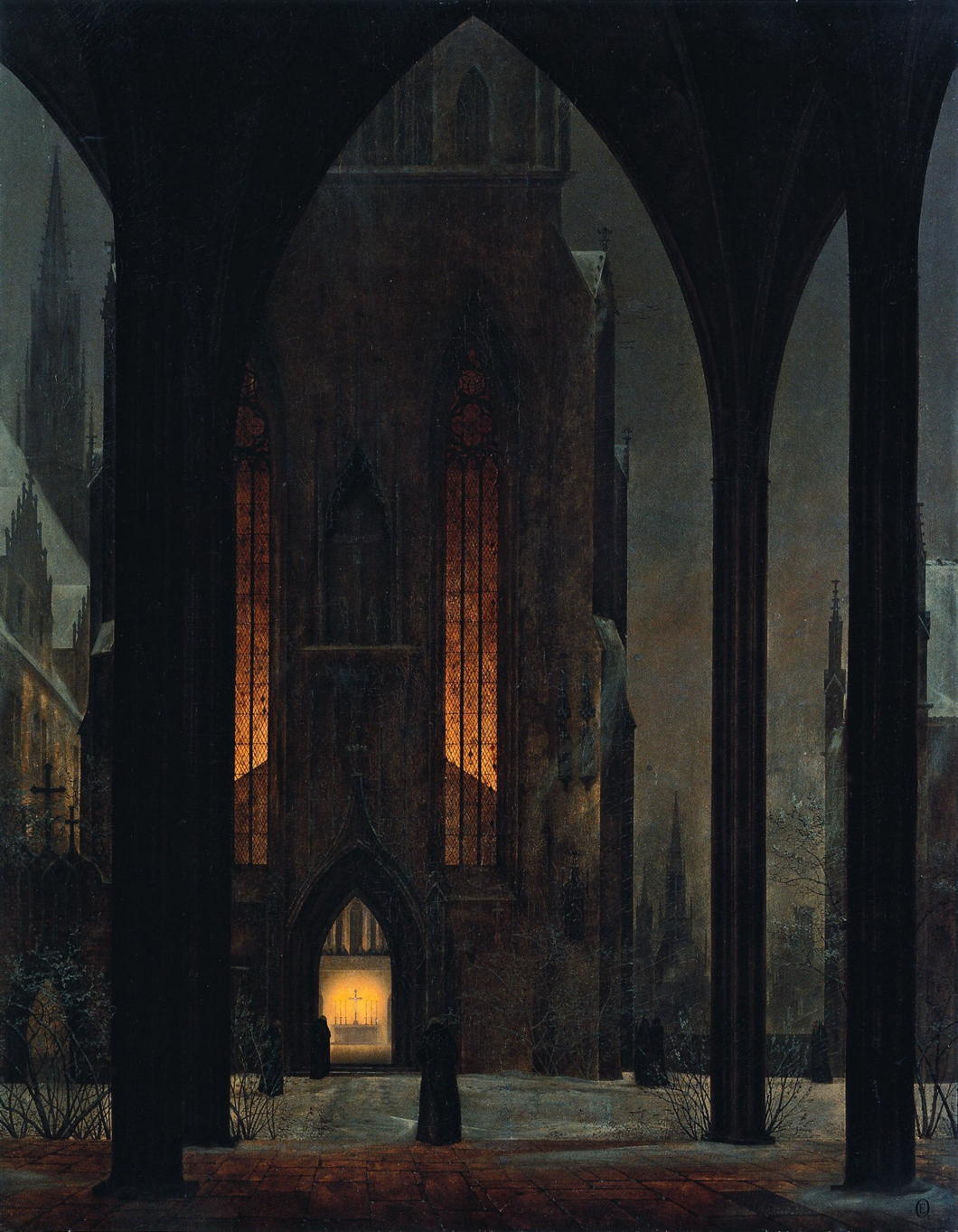
I had a dream, which was not all a dream.
The bright sun was extinguish’d, and the stars
Did wander darkling in the eternal space,
Rayless, and pathless, and the icy earth
Swung blind and blackening in the moonless air;
Morn came and went—and came, and brought no day,
And men forgot their passions in the dread
Of this their desolation; and all hearts
Were chill’d into a selfish prayer for light:
And they did live by watchfires—and the thrones,
The palaces of crowned kings—the huts,
The habitations of all things which dwell,
Were burnt for beacons; cities were consum’d,
And men were gather’d round their blazing homes
To look once more into each other’s face;
Happy were those who dwelt within the eye
Of the volcanos, and their mountain-torch:
A fearful hope was all the world contain’d;
Forests were set on fire—but hour by hour
They fell and faded—and the crackling trunks
Extinguish’d with a crash—and all was black.
The brows of men by the despairing light
Wore an unearthly aspect, as by fits
The flashes fell upon them; some lay down
And hid their eyes and wept; and some did rest
Their chins upon their clenched hands, and smil’d;
And others hurried to and fro, and fed
Their funeral piles with fuel, and look’d up
With mad disquietude on the dull sky,
The pall of a past world; and then again
With curses cast them down upon the dust,
And gnash’d their teeth and howl’d: the wild birds shriek’d
And, terrified, did flutter on the ground,
And flap their useless wings; the wildest brutes
Came tame and tremulous; and vipers crawl’d
And twin’d themselves among the multitude,
Hissing, but stingless—they were slain for food.
And War, which for a moment was no more,
Did glut himself again: a meal was bought
With blood, and each sate sullenly apart
Gorging himself in gloom: no love was left;
All earth was but one thought—and that was death
Immediate and inglorious; and the pang
Of famine fed upon all entrails—men
Died, and their bones were tombless as their flesh;
The meagre by the meagre were devour’d,
Even dogs assail’d their masters, all save one,
And he was faithful to a corse, and kept
The birds and beasts and famish’d men at bay,
Till hunger clung them, or the dropping dead
Lur’d their lank jaws; himself sought out no food,
But with a piteous and perpetual moan,
And a quick desolate cry, licking the hand
Which answer’d not with a caress—he died.
The crowd was famish’d by degrees; but two
Of an enormous city did survive,
And they were enemies: they met beside
The dying embers of an altar-place
Where had been heap’d a mass of holy things
For an unholy usage; they rak’d up,
And shivering scrap’d with their cold skeleton hands
The feeble ashes, and their feeble breath
Blew for a little life, and made a flame
Which was a mockery; then they lifted up
Their eyes as it grew lighter, and beheld
Each other’s aspects—saw, and shriek’d, and died—
Even of their mutual hideousness they died,
Unknowing who he was upon whose brow
Famine had written Fiend. The world was void,
The populous and the powerful was a lump,
Seasonless, herbless, treeless, manless, lifeless—
A lump of death—a chaos of hard clay.
The rivers, lakes and ocean all stood still,
And nothing stirr’d within their silent depths;
Ships sailorless lay rotting on the sea,
And their masts fell down piecemeal: as they dropp’d
They slept on the abyss without a surge—
The waves were dead; the tides were in their grave,
The moon, their mistress, had expir’d before;
The winds were wither’d in the stagnant air,
And the clouds perish’d; Darkness had no need
Of aid from them—She was the Universe.
This year — 2016 — will be the two-hundredth anniversary of the Year without a Summer, caused by the eruption of Mount Tambora in the Dutch East Indies the year before.
The extremely high levels of volanic material in the atmosphere led to darker skies which meant colder temperatures and failed harvests. Brown snow was reported in Hungary and red snow in Italy.
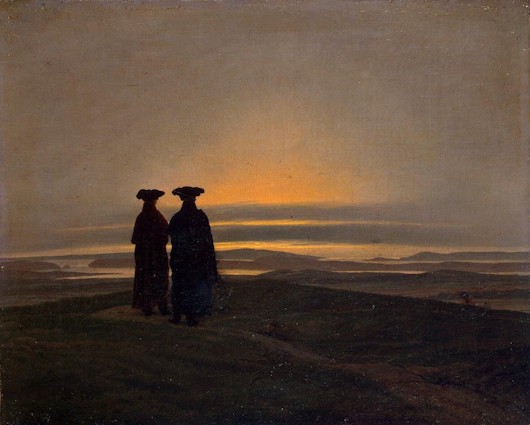
But the abnormalities in the sky were also responsible for the spectacular sunsets that inspired artists like Caspar David Friedrich and J M W Turner and the unceasing rain that provoked Mary Shelley to write Frankenstein and Lord Byron to write ‘Darkness’.
It’s no coincidence that, soon after this year of darkness, John Polidori published his book The Vampyre and the modern concept of this undead creature began to haunt the gothic imagination.
The Accession
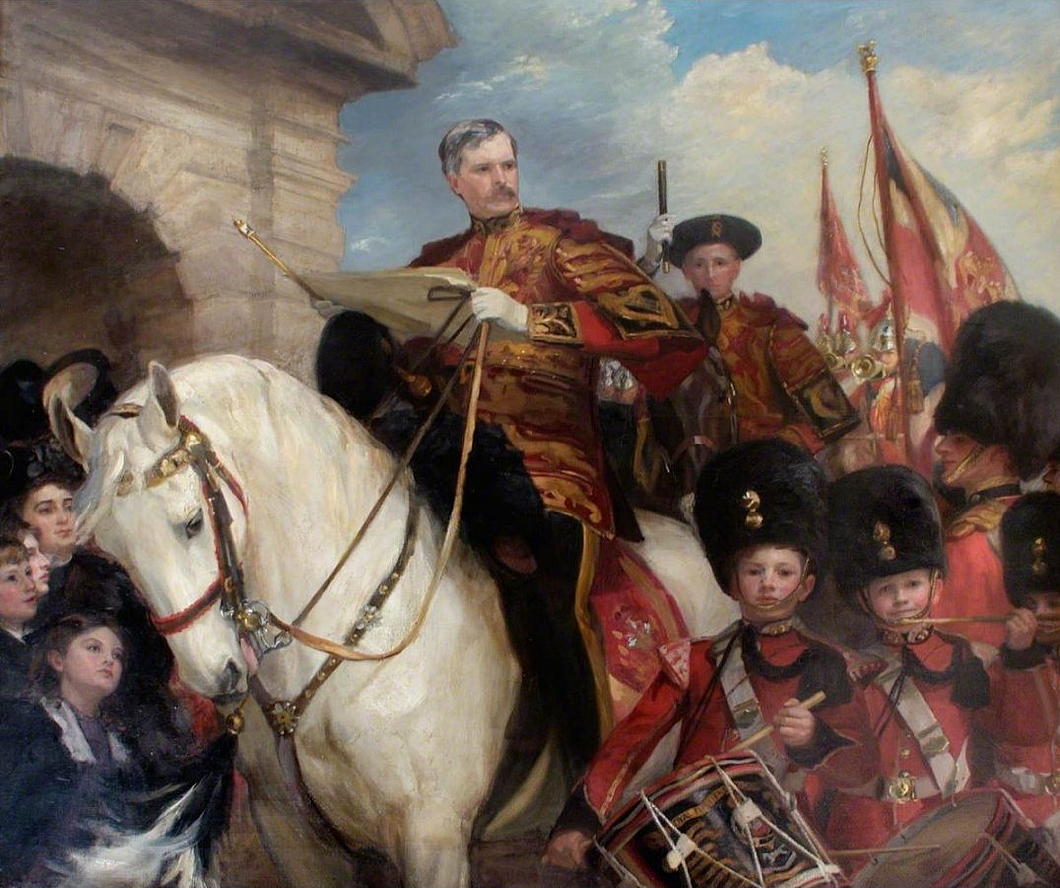
c. 1911; Oil on canvas, 68 in. x 76.9 in.
A triumphant painting, but a last hurrah. The central figure is Sir Nevile Wilkinson, the last ever Ulster King of Arms & Principal Herald of Ireland, exercising the duties of his office by proclaiming the accession of the new king at Dublin Castle.
The Anglo-Irish Treaty and its legislative acts neglected to make provision for transferring this ancient office to the new Irish Free State, but Sir Nevile carried on regardless for nearly two decades, even issuing two dozen grants of arms on the day before his death in 1940.
After his death, the Oireachtas created the office of the Chief Herald of Ireland to continue the granting of arms, and in some sense the Chief Herald is a spiritual successor to the Ulster King of Arms.
Die Staatsrede
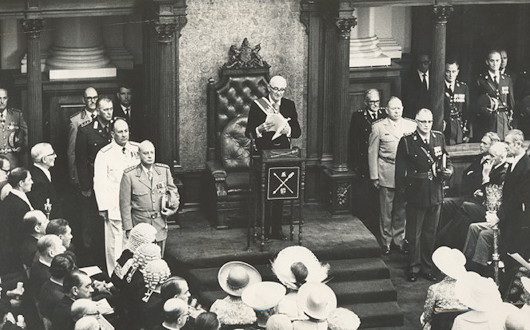
Staatspresident Jacobus Johannes Fouché giving the staatsrede from the throne of the Senate within the Houses of Parliament in Cape Town.
What is now the State of the Nation Address has its origins in the speech from the throne (in Afrikaans staatsrede meaning “state reasoning/rationale”) setting out the Government’s legislative programme for the year. The high point of the State Opening of Parliament, it was originally given by the Governor-General (or, in 1947, by the King of South Africa himself) but with the abolition of the monarchy in 1961 the sovereign’s vice-regal representative was abolished and replaced by the Staatspresident as chief officer of the South African state.
Giving a speech from an actual throne was considered too monarchic for a republican polity, so – like in the Boer republics of old – presidents gave their staatsredes standing. Here, State-President Fouché is flanked by the chiefs of the defence staff and police, the Serjeant-at-Arms with the mace, and the Gentleman Usher of the Black Rod.
Of course, much of this was abolished in the 1980s with the constitutional innovations as a last-ditch attempt to entrench apartheid. South Africa is now on its third constitution since the above photo was taken.
It reminds me of how in Ireland almost all the traditions of the Viceroy (viz. the Viceregal Guard of Battleaxes, etc.) were abolished not by the Saorstát or Éire but by the British themselves – in their case by penny-pinching Victorians who found Dublin an easy target for cost-cutting.
The Rova of Antananarivo
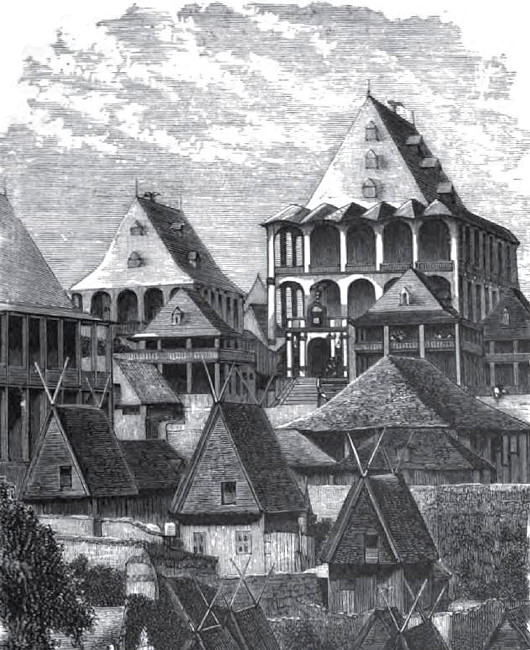
The Rova of Antananarivo
The Tranovola (left) and Manjakamiadana (right) in the Rova of Antananarivo.
The Manjakamiadana (“Where It is Pleasant to Rule”) was the royal residence, later pretentiously clad in stone by Protestant missionaries, while the Tranovola (“Silver House”) was where the nefarious Rainivoninahitriniony received foreign diplomats after the nobles’ coup of 1863.
His complicity in the supposed regicide of that year — no one’s really quite sure what happened to Radama II — eventually led to his downfall two years later. His younger brother Rainilaiarivony proved a more skilful political operator, succeding Rainivoninahitriniony as prime minister and arranging his own marriage to the last three queens of the Merina kingdom of Madagascar.
Borris House
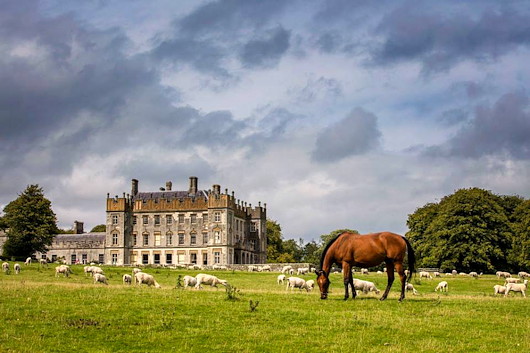
The County Carlow seat of the MacMorrough Kavanaghs, ancient Kings of Leinster, whose sixteenth generation live here still.
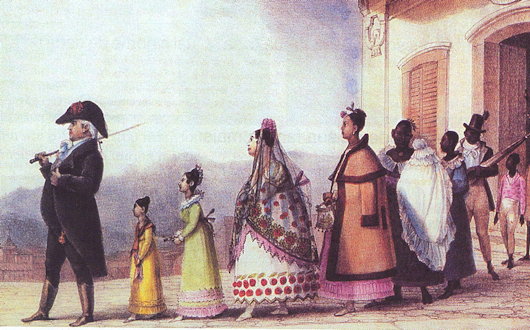
In Old Rio
The city’s administrative and electoral units were its parishes, and the tallest buildings were all church towers. The day of the colonial port began with the cannon shot announcing the beginning of harbour commerce, at half past five.
This was followed by the opening of shops and homes of merchants and tradesmen. Early mass was signalled by church bells, and it was church bells which marked the day’s turn as they sounded the day’s regular prayers as the sun rose and set. …
One of the first, common sights in the city was that of Catholic brotherhoods seeking alms in the streets and shops, or, perhaps, a lady, humbly barefoot, seeking to fulfil a vow by begging alms with a heavy silver tray covered with rich cloth — accompanied by her servant, of course.
The Conservatives, the State, and Slavery in the Brazilian Monarchy, 1831-1871
Evolution of a Napoleonic Parliament
The Salle des états in the Palais du Louvre
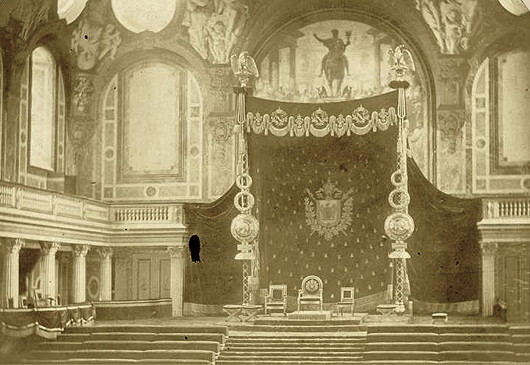
Among the numerous rituals of the ordinary visitor’s pilgrimage to Paris — trip up the Eiffel Tower, lunch at a tourist-trap café — braving the teeming hordes in the Louvre to view da Vinci’s ‘Mona Lisa’ ranks near the top. What very few of the camera-toting hordes realise is that they are shuffling through the room that once housed France’s parliament. The history of the Palais du Louvre is long, exceptional, and varied.
Originally built as a stern castle in the 1190s, the Louvre’s secure reputation led Louis IX to house the royal treasury there from the mid-thirteenth century. Charles V enlarged it in the fifteenth century to become a royal residence, while François Ier brought the grandeur of the Renaissance to the Louvre — as well as acquiring ‘La Gioconda’. In 1793, amidst the revolutionary tumult, part of the palace was opened to the public as the Musée du Louvre, but the Louvre has always housed a variety of institutions — the Ministry of Finance didn’t move out until 1983.
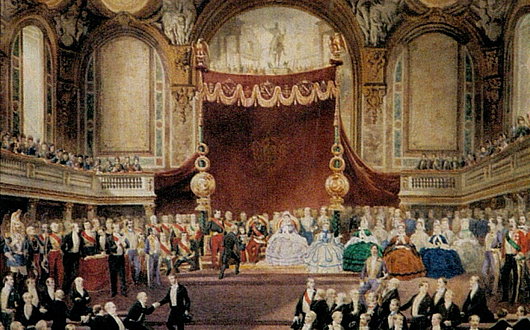
Napoleon III took as his official residence the Tuileries Palace which the Louvre was slowly enlarged towards over the centuries to incorporate. The Emperor needed a parliament chamber close at hand so he could easily address joint sittings of the Senate and the Corps législatif (as the lower house was called during the Second Empire) which opened the parliamentary year. By doing so at his residence, the Bonaparte emperor was following the example left by his kingly Bourbon predecessor Louis XVIII. (more…)
Les jours heureux du Liban
Being an omnivore of nations I’m not short of favourite countries, but the Lebanon is towards the top of my list. I’ve spent some weeks there each summer for the past few years and we’re hoping to return this July (God willing). Friday night B. invited a few of us round for an impromptu supper and in the kitchen I happened to mention that I had met his ambassador the day before — the Lebanese ambassador.
This provoked a lament on B’s part as he relayed the history of his family’s service in the diplomatic corps and of Lebanon in the old days: black-tie dinners, summer in the mountains, the casinos and the glamour of the Beirut he was born too late to experience.
It’s become a cliché for foreigners to cite Beirut’s former glory as ‘the Paris of the Orient’ and Lebanon ‘the Switzerland of the Middle East’. Civil war wreaked its devastation on the country but its revival in more recent years has still been remarkable. Everything, of course, is exceptionally tenuous, but despite the clouds of uncertainty there remains a lot for which to be grateful.
We both wished, however, that today’s ordinary culture in Lebanon was a bit more informed by the style of the past. While old buildings are often restored, far too many of the new buildings are horrendously bland or offensively modern. Perhaps most unfortunately, a large proportion of Lebanon’s women — already endowed with a natural beauty unparalleled in the Middle East — are too mimicking of American styles: nosejobs and dyed blonde hair.
For my part, however, the conversation provoked a little dip into the photographic archives, seeking out some images of Lebanon in its halcyon days. (more…)
Kolmanskop
Ghost town of the Namib
NAMIBIA IS A LAND that fascinates me, which is perhaps surprising. This arid land is sparsely populated — just 6.6 people per square mile — but its deserts are believed to be the oldest in the world. Those who haven’t experienced its harsh beauty may wonder why this land has attracted its odd and varied collection of peoples, but here the Ovambo, the Kavango, the Herero, the Afrikaner, the German, and the Bushman all call home.
I have already written somewhat about Lüderitz and beyond it the Diaz Point. As you speed down the B4 from Keetmanshoop to Lüderitz — a four-hour drive passing through just the one small village of Aus — you can turn off just before you reach the coastal town and pay a visit to the eerily ghost town of Kolmanskop: Kolmannskuppe in the original German. (more…)
‘Bon Voyage’
Jean-Paul Rappeneau’s ‘Bon Voyage’ (2003) is one of those superb films that come around all too rarely. It manages to balance perfectly all the elements of drama, comedy, action, and romance, set in a convincing historical context.
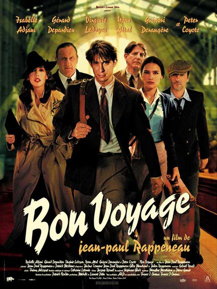
Bon Voyage
Jean-Paul Rappeneau
2003, France
1 hour 54 minutes
In 1940, Viviane Denvert (played by Isabelle Adjani) is a fickle, self-promoting film star who enlists her childhood friend, Frédéric Auger (Grégori Derangère), to extract herself from a compromising situation. As war creeps upon France, Auger finds himself behind bars for Viviane’s crime, but in the confusion of battle he manages to escape with the seasoned ne’erdowell Raoul (Yvan Attal). All of Paris is fleeing the German advance, and on the train to Bordeaux the two come across physics student Camille (Virginie Ledoyen) who helps them reach the western city by car when the train is stopped on the line.
In Bordeaux we come across government minister Jean-Étienne Beaufort, Viviane’s lover whom she uses to get Frédéric out of a sticky situation resulting from her own manipulation of him. Meanwhile, with all of Paris in Bordeaux, Viviane comes across another ex-paramour, Alex Winckler (Peter Coyote), keeping an unnatural interest in the affairs of the government, while the physics student Camille and her mentor Professor Kopolski are harbouring an important cargo they are determined must not fall into the hands of the Germans.
For fear of spoilers, that is all I will say about the plot, but it all comes packaged in a score by Gabriel Yared, better known for his scoring of ‘The English Patient’, ‘The Talented Mr. Ripley’, and Florian Henckel von Donnersmarck’s ‘Das Leben der Anderen’. The film was nominated for eight César awards in 2004 — best costumes, best director, best editing, best film, best original score, best sound editing, best supporting actor, and best writing — while it won three Césars that year for photography, best set design, and, for Grégori Derangère, best promising actor. (more…)
A Maori in Buenos Aires
The Argentine stopover of Te Pēhi Kupe
So  far as I can tell, the first Maori to visit Argentina (or the United Provinces of the River Plate as it was then called) was the young nobleman Te Pehi Kupe in October 1824. (The name is spelt varyingly as Te Pēhi Kupe, Tupai Cupa, Te Pai Kupa, and Tippahée Cupa). Te Pehi was born on the North Island, probably around 1795, and was a senior-line descendant of Toarangatira (founder of the Ngati Toa tribe) as well as an uncle to the more famous Ngati Toa chief, Te Rauparaha.
Most of New Zealand was a bit of a mess at the time, as various Maori tribes fought each other for land to grow potatoes on. Te Pehi Kupe, being a chief and military leader, was desirous to go to Europe in order to obtain weapons for his tribe. When the British ship Urania went past the southern tip of the North Island, Te Pehi forced himself aboard despite the violent resistance of the ship’s officers and crew. When asked what he desired by the Urania‘s captain, Richard Reynolds, Te Pehi replied in broken English, “Go Europe, see King George”.
Captain Reynolds did not think this a good idea and, knowing the Maori to be good swimmers, tried to have him thrown overboard, but the native nobleman’s physical strength prevented this. (And a good thing, too, as Te Pehi managed to save the Captain from drowning later on in the journey.)
The Urania made its return to England with Te Pehi Kupe aboard, calling at Lima and then sailing around the Southern Cone, where they called in at Buenos Aires. George Thomas Love provides us with an account of the Maori’s arrival in A Five Years’ Residence in Buenos Ayres (published in 1827):
In the month of October, 1824, the visit of a New-Zealand chief to Buenos Ayres, by name Tippahée Cupa, attracted much curiosity; he arrived in the British ship Urania, Captain Reynolds. Tippahée came alongside this ship in Cook’s Straits, with a war canoe filled with his people, and, in spite of the remonstrances and even force used by Captain R. refused to quit the vessel, expressing his determination to proceed to England. He bade his followers an affectionate adieu, enjoining obedience to his successor during his absence. The Urania sailed for London with her passenger the 8th December, 1824.
Tippahée, when he first arrived in Buenos Ayres, was clothed in an old red coat, formerly belonging to a London postman. The English paid him many attentions, inviting him to dine at their houses, and new clothing him. His behaviour at table was easy and unembarrassed; and, when requested, he would perform the dances and war songs of New Zealand. He understood a little of the English language, and spoke a few words of it; his intelligent manners, and circumspect conduct, rendered him an universal favourite.
On the map he could trace the ship’s course from New Zealand to Lima and Buenos Ayres. He knew an Englishman immediately; the Spaniards he did not much admire, fancying they viewed him with contempt, and was glad to get among Englishmen. His age is about forty; he possesses amazing strength; his tattooed face and appearance always attracted a crowd after him in Buenos Ayres.
On board ship he was found very useful, doing all sorts of work, but he positively declined to go aloft. The fate of Captain Thompson, and the crew of the British ship Boyd, ought to bespeak caution in using coercion with these savage chieftains of New Zealand.
In Cruise’s book of New Zealand, Tippahee was shewn a picture of a chief of his country, with which he was greatly delighted. The object of his journey to England is to solicit arms and ammunition, to place him upon a par with a rival chief, who possesses those requisites.
In England, Te Pehi was indeed presented to King George IV. He also learned to ride, visited factories, was given many gifts, and survived the measles before leaving England aboard the Thames on 6 October 1825. In Te Pehi’s absence abroad, peace had been agreed between the Ngati Toa and their Ngati Apa rivals. Ngati Toa eyes soon turned to the South Island, and during the military campaign there Te Pehi Kupe was killed, his body cooked and eaten, and his bones turned into fish hooks.
Still, at least he enjoyed Buenos Aires before he died.
Some Aspects of the Fall of the Fourth Republic
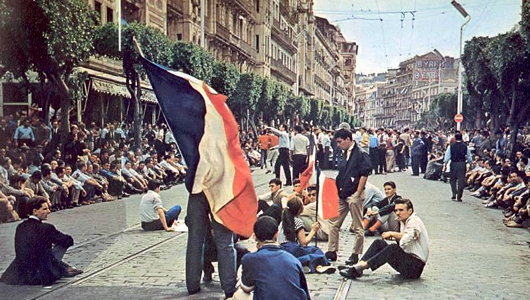
(Only interesting, I’m afraid, to those reasonably acquainted with the situation of France in May 1958)
• The French-Algerian instigators of the military rebellion led by Salan didn’t know what to make of him when he was first appointed to Algeria so they decided, just to be on the safe side, to assassinate him on his first day on the job. Salan survived the bazooka attack on his office but his ADC was killed. The general later became the only socialist freemason to lead a right-wing terror group (the OAS).
• Once the Algiers rebellion commenced and travel between Algeria and metropolitan France was cut, many supporting figures made their way across the Mediterranean by whatever means at hand. Soustelle managed to escape his police guards and get to Algiers via a secretly chartered Swiss plane, but the more romantically inclined Roger Frey — later Minister of the Interior — first tried to get to Algiers on the actor Errol Flynn’s yacht. It didn’t pan out, and instead he was forced to hire the boat of an English ex-naval officer turned smuggler.
• The man in charge of wiretapping French telephones was unsure which side would emerge on top so cautiously refrained from giving the government the full picture of the information his wiretaps revealed.
• When Corsica was seized by the rebels, Moch, the Interior Minister, decided to send in the elite of the police force, the CRS. He was afraid, however, that military transport planes would fly them directly to Algeria, so he was forced to commission Air France planes instead. Upon landing in Corsica, the entire CRS contingent was met by the rebel parachute regiment and immediately defected to the rebellion.
• So widespread was the reluctance to support the government against the military rebels that even the meteorologists send false warnings of storms in the Mediterranean in the hopes of keeping the French Navy from moving against the rebels in Algiers.
• The air force was particularly keen for de Gaulle to take power, and took to flying planes in a Cross of Lorraine formation, as well as sending troop transport planes to Algeria in case they would be needed to invade mainland France.
• Regional military commanders in France varied in their loyalty to the government and sympathy for the rebels. One commander is alleged to have told the regional prefect “M. le Préfet, I am not here to defend your préfecture, but to take it.” Other prefects warned the cabinet that any orders for the police to arrest those suspected of aiding the rebellion might result in the prefects instead being arrested themselves.
• The government had sometimes ordered firemen to unleash their water hoses against rioters in the past. As popular support for the cabinet faded away, the head of the fire brigade felt compelled to inform ministers that his men would not take part in any anti-riot measures but would merely put out any fires that erupted. “And,” he said, referring to the home of France’s National Assembly, “in the Palais Bourbon, they wouldn’t bother.”
• As Philip Williams reports in his article “How the Fourth Republic Died”:
At that night’s cabinet Pleven summed up: “We are the legal government, but what do we govern? The Minister for Algeria cannot enter Algeria. The Minister for the Sahara cannot go to the Sahara. The Minister of Information can only censor the press. The Minister of the Interior has no control over the police. The Minister of Defence is not obeyed by the army.” Said a left-wing Gaullist in the Assembly, “You are not abandoning power — it has abandoned you.”
The Legacy of 1916
The commemoration of the 1916 rebellion takes place at Arbour Hill prison, where the earthly remains of the executed leaders of the Easter Rising were laid in a pit by the British military authorities. Some of the rebellion’s leaders who did not face the firing squad, most prominently Éamon de Valera and Countess Markievicz, founded Fianna Fáil ten years later in 1926.
Micheál Martin’s address is presented here without comment.
Every state should take time to commemorate and celebrate the people and events of their founding. This commemoration is organised by Fianna Fáil the Republican Party, but we come here as Irish men and women to fulfil our responsibilities to the great generation of 1916.
After 97 years their deeds resonate even more than ever. They saw an Ireland which should not accept limits on its future. They committed everything to the vision of a country with the right to shape its own destiny.
As we quickly approach the centenary of the Rising no one can doubt that the Irish people see the men and women of 1916 as noble and courageous. No one can question their central place in our history. (more…)
The Historical Sale at Adam’s
800 Years: Irish Political, Literary, and Military History – 18 April 2012
THE ANCIENT PRACTICE of lèche-vitrine is one hallowed by time and tradition. I remember one December day I had a lunch appointment with a friend who worked at the late, lamented Anglo-Irish Bank on Stephen’s Green in Dublin and, being early, I nipped a few doors down to the auction house Adam’s to engage in a bit of what I like to call thing-avarice (which the Germans probably have a word for). We do enjoy taking the occasional peek round the Dublin auction houses to see what’s what, and to examine the cabinet of curiosities that come out from ancient houses and rotting flats and appear in these bright places where commerce and refinement play their strange little waltz. When it comes down to it, though, it’s really just about having nice things — the sort of stuff you want lying around the house inexplicably.
Anyhow, the historical auction at Adam’s is coming up on 18 April and sure enough their senior rival Whyte’s is having a similar sale just a few days later on 21 April. We’ll only look at Adam’s here — if we considered Whyte’s as well, we’d be here all day. (more…)
Cardinal Manning
Over at Reluctant Sinner, Dylan Parry has an excellent post on Cardinal Manning, the second man to serve as Archbishop of Westminster. Manning is all too often forgotten, despite being one of the most widely loved and respected men of his generation. His funeral, famously, was the largest ever known in the Victorian era. Besides his wisdom at the helm of England’s most prominent see, the good cardinal’s greatest legacy might be his influence on Rerum Novarum, the great social encyclical of Leo XIII. Dylan is planning on writing further on the subject of Cardinal Manning, giving us something to look forward to. (more…)
A Breath of Fresh, Northern Air
The Dorchester Review Proves That Canada is Still Thinking
This summer I received an email from my friend Bruce Patterson, all-around nice guy and Deputy Chief Herald of Canada, informing me of a new historical and literary review just founded called the Dorchester Review. Intrigued, I obtained a copy and was pleasantly enthralled with what I found. The first issue of the Dorchester Review contained a variety of thoughtful articles on fascinating subjects. I spent an entire morning sitting comfortably on a café sofa and imbibing the intelligent and enlightening contents of the magazine.
The editors did issue a brief statement explaining the genesis of their new review. They had me at their Pieperian first sentence: “The Dorchester Review is founded on the belief that leisure is the basis of culture.”
Just as no one can live without pleasure, no civilized life can be sustained without recourse to that tranquillity in which critical articles and book reviews may be profitably enjoyed. The wisdom and perspective that flow from history, biography, and fiction are essential to the good life. It is not merely that “the record of what men have done in the past and how they have done it is the chief positive guide to present action,” as Belloc put it. Action can be dangerous if not preceded by contemplation that begins in recollection.
The endeavour of reviewing books, the editors acknowledge, has too often been reduced either to brief puff-pieces in the Saturday insert of the local paper or more high-minded but uncritical praise of like-minded academics for one another. “There are too few critical reviews published today, particularly in Canada, and almost none translated from francophone journals for English readers.” As someone with a lifelong love of Quebec, I am relieved that finally there is a review in my own language willing to take Quebec seriously.
“At the Review,” the editors continue, “we shall praise the good books and assail the bad.”
They also forthrightly explain their rejection of the narrow nationalist perspective that has been on the ascendant in Canada throughout the past century, especially since the foundation of The Canadian Forum. The Dorchester Review effectively throws Canada’s doors open to a more reasoned understanding of the country’s relationship with Europe (Britain and France particularly), America, the Commonwealth, and the world.
But the Dorchester Review is not a publication just for Canadians. There is a great deal of Canada in it, but also a great deal of the world. The second issue (just printed) features articles with titles such as “Why Marx is Still (Mostly) Wrong”, “1789: The First Counter-Revolutionaries”, “What Sort of Autocrats Were the Popes?”, “Can Vichy France Be Defended?”, and “The Scots Fight Back” (the last in response to an article in the first issue: “How the English Invented the Scots”).
Contributing editor Chris Champion is interviewed by CBC Radio here. A number of the contributors (Conrad Black, Paul Hollander, etc.) readers of The New Criterion will already be familiar with. The latest number also includes a book review by this, your humble and obedient scribe.
Head over to dorchesterreview.ca to find out more or subscribe.
A Rioplatense Kingdom?
New book explores the monarchic projects of the River Plate, 1808–1825
A book recently published in Buenos Aires sheds new light on the difficult transition period between the Spanish Empire on the River Plate and the foundation of the Argentine Republic. The launch party for Bernado Lozier Almazán’s Proyectos monárquicos en el Río de la Plata 1808-1825. Los reyes que no fueron (“Monarchic projects in the River Plate 1808–1825: The kings who weren’t”) was held recently in the Quinta ‘Los Ombúes’, home of the municipal library, museum, and archives of San Isidro, the city in the Provincia de Buenos Aires known as Argentina’s ‘Rugby Capital’.
Proyectos monárquicos highlights the forgotten truth that most of the Argentine ‘patriots’ — San Martín, Belgrano, and Alvear among them — were monarchist, not republican. Proposals involving the courts of Spain, Portugal, France, and even England were proffered, and there was even an interesting proposal to marry a European prince to an Incan princess and offer him the throne of the Río de la Plata. (more…)
Cape Town’s ‘Nazi’ Street to be Renamed
Oswald Pirow Street will rechristened after Dr. Christiaan Barnard
The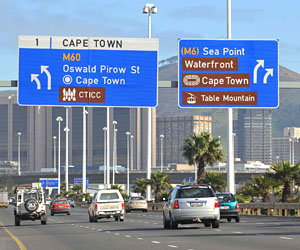 city of Cape Town has recently effected a small number of street name changes decided at the end of last year. The N2 route as it heads into the centre of the city, currently called Eastern Boulevard, will be renamed Nelson Mandela Boulevard. The open square between the opera house and the city offices will be renamed Albert Luthuli Place. Most significantly, Oswald Pirow Street on the Cape Town foreshore will be renamed Christiaan Barnard Street.
The renaming of streets and other places in South Africa has proved a controversial and unsettling task. Many streets named after leading figures associated with the 1948-1990 apartheid regime remain. In 2001, the New National Party (NNP) mayor of Cape Town, Peter Marais, attempted to rename Adderley Street and Wale Street after Nelson Mandela and F.W. de Klerk respectively. But Marais’s plan provoked a surprising public backlash, as well as opposition-for-opposition’s sake from the local ANC. The proposed ‘Nelson Mandela Avenue’ had already been renamed once: originally Heerengracht, the grateful citizens of Cape Town rechristened it Adderley Street in 1850, as a token of thanks to Charles Bowyer Adderley MP (later 1st Baron Norton) for his successful campaign against turning the Cape into a penal colony. (more…)
Search
Instagram: @andcusack
Click here for my Instagram photos.Most Recent Posts
- Brunel’s Unbuilt Capitol February 3, 2026
- Cricket at Fordham January 27, 2026
- Palacio Barolo Revisted January 14, 2026
- Learning to Love Liguria January 14, 2026
- Crux Alba No. 2 January 13, 2026
Most Recent Comments
Book Wishlist
Monthly Archives
Categories