Architecture
About Andrew Cusack
 Writer, web designer, etc.; born in New York; educated in Argentina, Scotland, and South Africa; now based in London.
 read more
News
Blogs
Reviews & Periodicals
Arts & Design
World
France
Mitteleuropa
Knickerbockers
Argentina
The Levant
Africa
Cape of Good Hope
Netherlands
Scandinavia
Québec
India
Muscovy
Germany
Academica
Neo-Classical New York
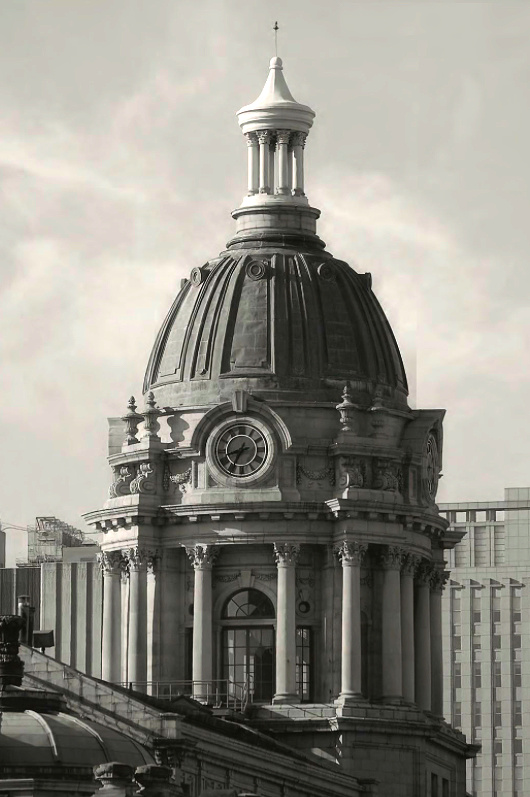
The dome of the old Police Headquarters Centre Street in New York.
Chartres Disfigured
Plans for modern monstrosity in venerable cathedral’s forecourt
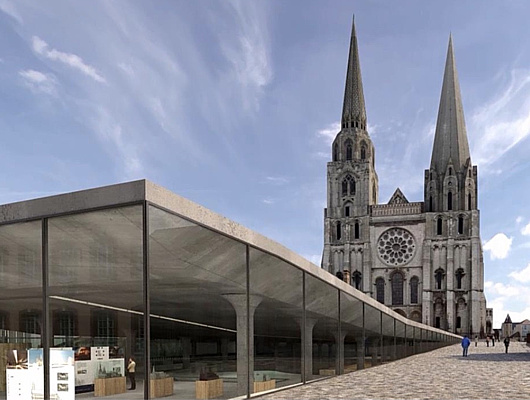
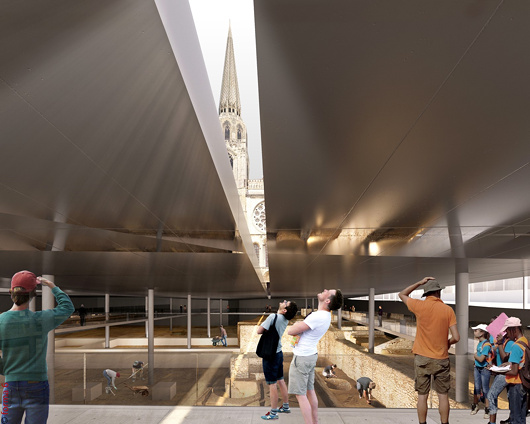
MORE BAD NEWS from Chartres. Fresh from the completion of a controversial and much criticised renovation of the ancient cathedral’s interior, le Salon Beige reports the city has unveiled plans to tear up the parvis in front of the cathedral and replace it with a modernist “interpretation centre”.
The original parvis (or forecourt) was much smaller than the one we know today. Between 1866 and 1905 the majority of the block of buildings in front of the cathedral, including most of the old Hôtel-Dieu, were demolished to give a wider view of the cathedral’s west façade and its “Royal Portals”.
After the war various plans to tart the place up were made and variously foundered — from a modest alignment of trees in the 1970s to Patrick Berger’s plan for an International Medieval Centre. More recently the gravelly space was unsuccessfully “improved” by the addition of boxes of shrubbery placed in a formation that, jarringly, fails to align with the portals of the cathedral.
The proposed “interpretation centre” designed by Michel Cantal-Dupart — at a projected cost of €23.5 million — destroys the gentle ascent to the cathedral and indeed reverses it. At a projected cost of €23.5 million, a giant slab juts apart as if displaced by an earthquake. The paying tourist is invited down into its infernal belly while others prat about on the slab’s upwardly angled roof, ideal for gawking at the newly commodified beauty of this medieval cathedral. It is practically designed for Instagramming, rather than reflection and contemplation.
As you would imagine, reaction has been strong. Michel Janva, writing at le Salon Beige, says the project “plans to imprison the cathedral” and “will disappoint not only pilgrims on their arrival, but also inhabitants and tourists”.
In the Tribune de l’Art, Didier Rykner is damning: “All this is purely and simply grotesque.” The sides of the centre, he points out, will be glazed to allow in natural light, but this will both interfere with multimedia displays and be bad for the conservation of fragile works of art. “This architecture, which looks vaguely like that of a parking lot, is frighteningly mediocre, and this in front of one of the most beautiful cathedrals of the world.”
Rykner attributes blame for the “megalomaniac and hollow project, expensive and stupid” at the doors of the mayor of Chartres, Jean-Pierre Gorges, who he argues has allowed much of the rest of the city’s artistic and architectural heritage to go to rot while devoting resources to this pharaonic endeavour.
Having walked from Paris to Chartres myself I can imagine how much this proposal will injure the experience for pilgrims. After three days on the road, to arrive at Chartres, stand in the parvis, and gaze up at this work of beauty, devotion, and love for the Blessed Virgin is a profound experience. If constructed, this plan would deprive at least a generation or two from having this experience. (But only a generation or two, for it is simply unimaginable to think this building will not be demolished in the fullness of time.)
Chartres is part of the patrimony of all Europe and one of the most important sites in the whole world. For it to be reduced to the plaything of some momentary mayor is a crime. With any luck, the good citizens of Chartres, of France, and of the world will put a stop to this monstrosity. (more…)
Happy New Year
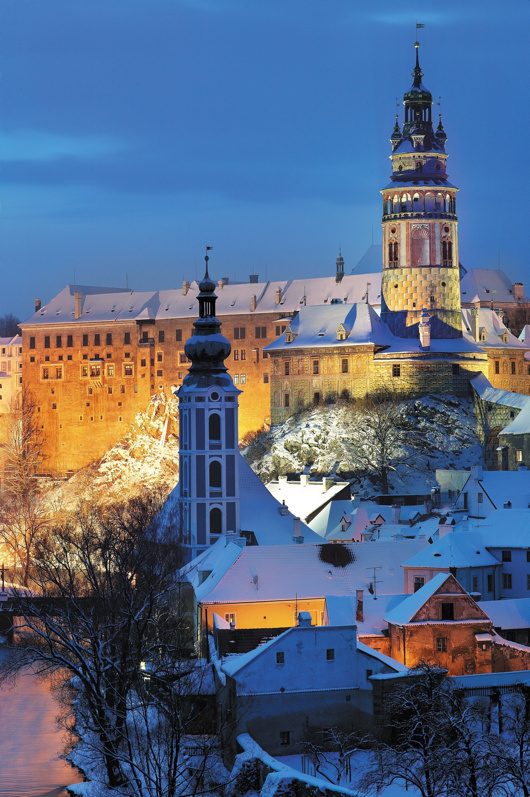
The castle at Český Krumlov (or Krummau) in southern Bohemia, as photographed in winter by Libor Sváček.
Soho Iridescent
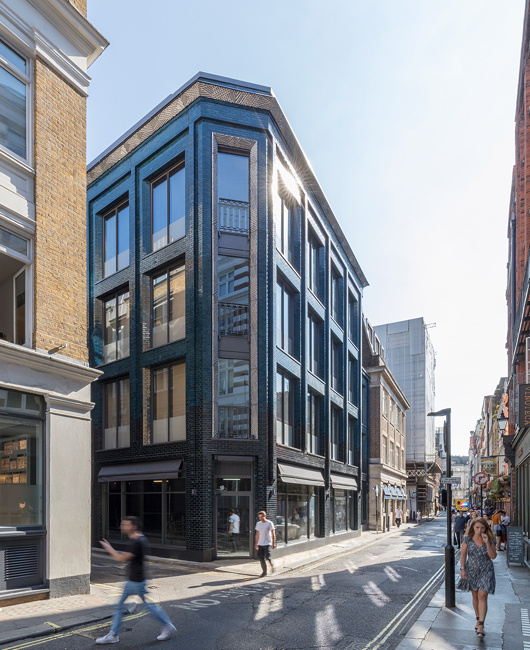
Stiff & Trevillion’s 40 Beak Street in London
Beak Street in London is teeming with turquoise iridescence since the completion of a new office building by the architectural firm of Stiff & Trevillion earlier this year. A joint project between property investment companies Landcap and Enstar, Number 40 Beak Street has been purchased for £40 million by Damien Hirst — the canny businessman who sells dead animals in formaldehyde glass boxes. The over-27,000-square-foot building will serve as the primary London studio for Hirst and headquarters for his company, Science (UK) Ltd, in addition to housing a restaurant at ground level.
Five storeys tall, 40 Beak Street features a number of roof terraces in addition to cornice work designed by Hertfordshire-based artist Lee Simmons. The glazed bricks — “hand dipped” the architects tell us — make for a welcome change from the omnipresence of metal and glass on one end of the spectrum and cheap monotone brick on the other.
The PR hype makes much of bringing a bit of artistic and creative edge back into Soho, a neighbourhood whose final glory days have been depicted in a much-praised book by the Telegraph’s Christopher Howse. We’re not so sure.
Hype aside, 40 Beak Street is an excellent addition to the London landscape and the designers are to be commended for their fine eye for detail. Someone at Stiff & Trevillion knows what they’re doing.
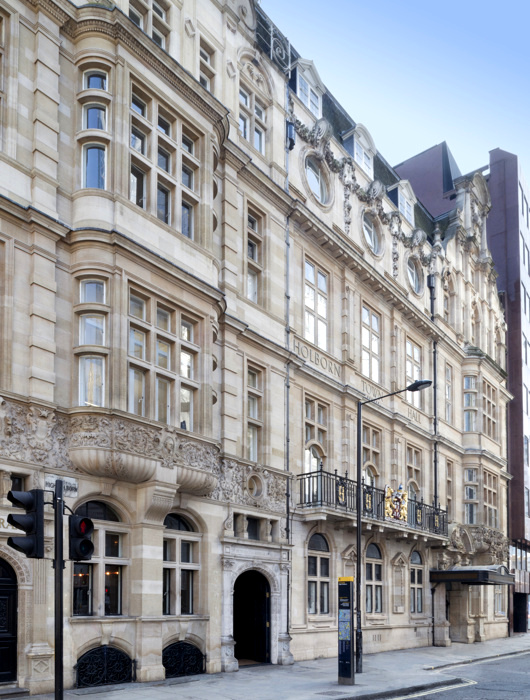
Holborn Town Hall
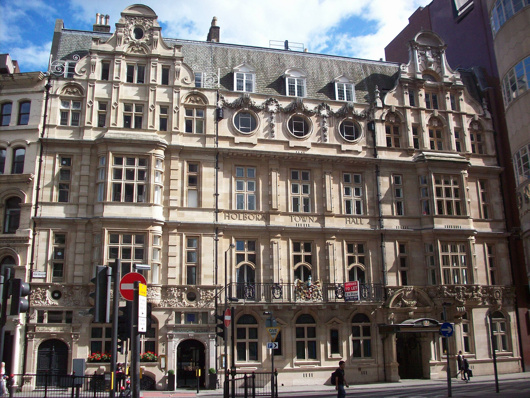
The Metropolitan Borough of Holborn was the smallest borough of London both in geography and population so perhaps it’s not surprising that its town hall was a pretty but rather humble affair. The civic pride and municipal pomposity for which this realm was once renowned are nowhere on show in this handsome building which, but for a few details, could easily be mistaken for a hotel, office building, or private residences.
Holborn Town Hall was built in stages, with the public library on the left-hand side completed in 1894 by the Holborn District Board of Works to a design by Isaacs. With the erection of the borough in 1900, a town hall was needed, and the central and right-hand sections of the building were added between 1906 and 1908 by the architects Hall & Warwick.
In 1965 the borough was merged with St Pancras to form the new London Borough of Camden. It was decided to consolidate the civic government at St Pancras Town Hall, to which the local government union members objected. To placate their ire, a bar for the use of employees was erected atop the annexe being added to the Camden (ex St Pancras) Town Hall — quickly nicknamed ‘the White Elephant bar’.
Though long sold off and converted into office space, the arms of the old borough of Holborn still grace the first floor balcony.
Knickerbocker Spires
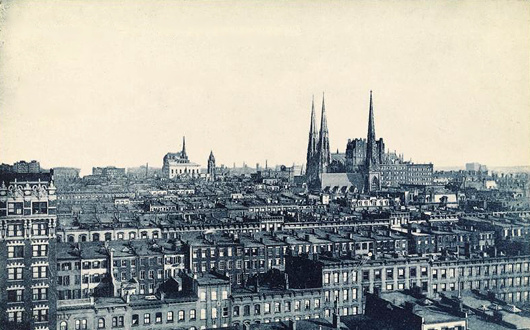
Before the age of the skyscrapers, New York’s church spires dominated the horizon and dwarfed their neighbours just like in the medieval towns and cities of the old world — as this photo from the 1900s shows.
Here St Patrick’s Cathedral holds court, with the St. Nicholas Collegiate Reformed Protestant Dutch Church poking up a few blocks down Fifth Avenue.
Slightly north on that same boulevard sits the grand renaissance palazzo of the University Club, with the spire of the Fifth Avenue Presbyterian Church poking up behind it.
Classical New England
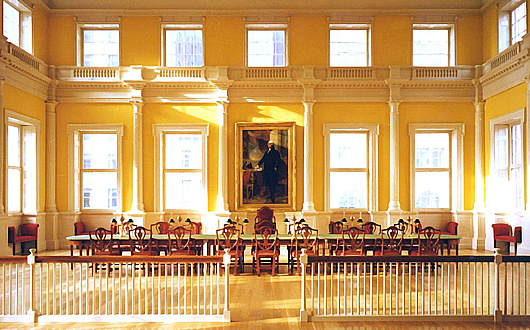
A reminder that Russell Kirk once described the piano nobile of the Old State House in Hartford, Connecticut, as:
“perhaps the most finely proportioned rooms in all America”
Given the elegant restraint and classical detail of the old Senate chamber, it’s hard to disagree.
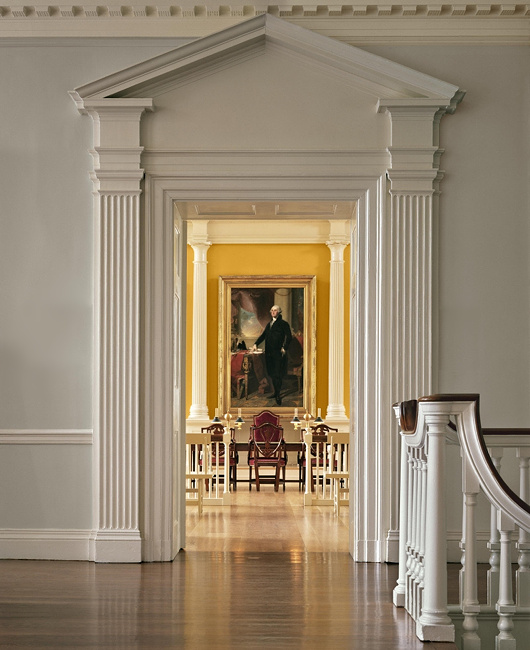
The Governor’s Room
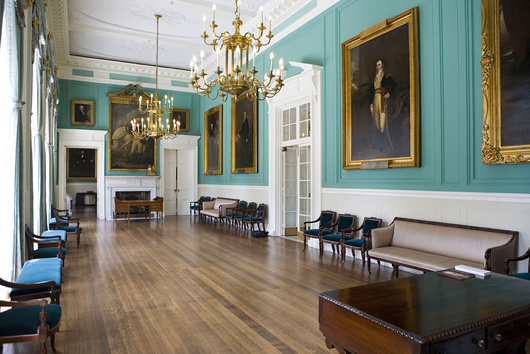
Pursuant to my post of John Bartlestone’s photographs of City Hall, I came across this photo the other day and it reminded me that this is still one of my favourite rooms in all New York. There’s something about that particular shade of green. I previously wrote about this suite of three rooms in 2006.
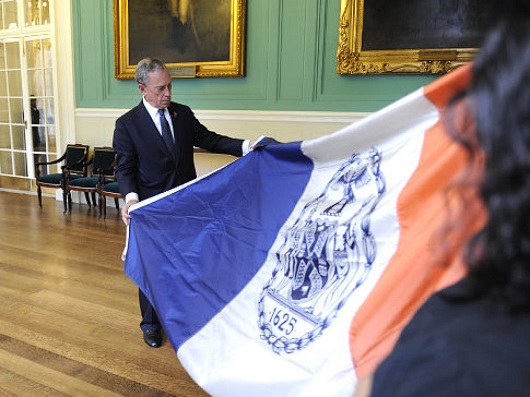
The above photo is by Ramin Talaie while below, in 2010, Mayor Bloomberg inspects a city flag being sent to a New Yorker serving in Afghanistan as reported by the Daily News.
The late & much-missed New York Sun also reported on the portraits hanging in City Hall in 2008.
Eton College Chapel
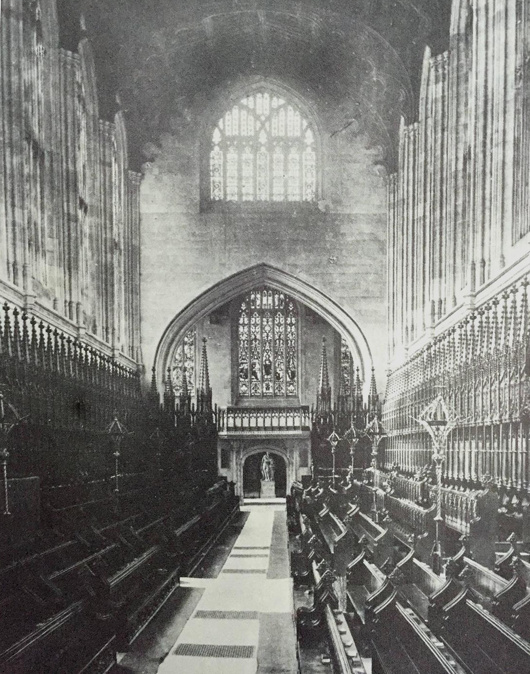
The interior of Eton’s chapel has changed markedly over the past hundred or so years, mostly so thanks to the rediscovery of the priceless medieval wall paintings which had been hidden for centuries by the choir stalls. Painted in the Flemish style in 1479–87, they were whitewashed over by the college barber in 1560 on orders from the wicked new Protestant authorities who had taken over this Catholic school.
The wall paintings were rediscovered in 1847 but it wasn’t until 1923 that the stall canopies in the photograph above were permanently removed, allowing the medieval paintings to be cleaned, restored, and permanently viewed.
In addition to this, in the 1880s (after this photograph was taken) the Great Organ was installed in the broad entrance arch between the narthex and the body of the chapel. The Victorians very handsomely painted it in the medieval fashion and it fits in rather well.
More recently, most of the stained glass was blown out by a German bomb landing in the adjacent Upper School in 1940. A decade later, deathwatch beetles claimed the wooden roof, which was then replaced by fan vaulting (of stone-fronted concrete) in line with the original intentions of Eton’s holy founder, King Henry VI.
A Chapel in Bavaria
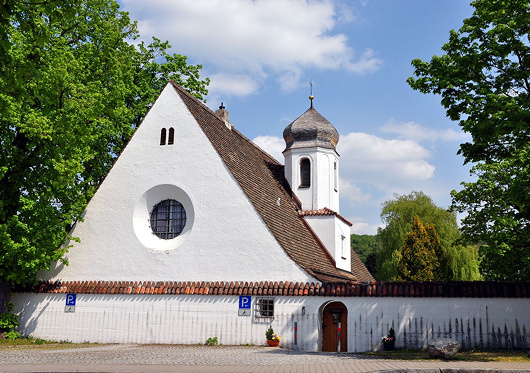
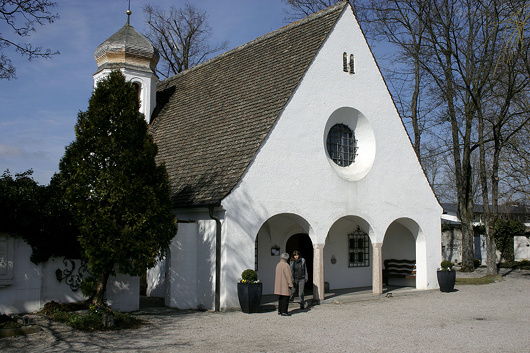
The Friedhofskapelle, or cemetery chapel, in Herrsching on the Ammersee in Upper Bavaria is a wonderful model of a small church or chapel.
It was designed in 1926 by Roderich Fick, who was a disciple of Theodor Fischer. Herr Fick participated in an expedition to traverse Greenland and joined the German colonial service in Cameroon, after the war moving to Herrsching in 1920.
During the Third Reich he was tasked with redesigning the city of Linz where Hitler had spent his childhood, but the dictator found Fick’s plans somewhat restrained, while Martin Bormann was constantly picking fights with the architect. The dominant style of the regime did not align with Fick’s preference for humble, unpretentious tradition in building design.
After the war he was sentenced to aid in the reconstruction of Munich, and also helped restore the magnificent Town Hall of Augsburg.
City Hall
These images of City Hall show the superb skill and eye for detail of the architectural photographer John Bartelstone — a licensed architect in his own right — and date from the completion of the most recent set of renovations in 2015.
Pretoria Philadelphia
Andries Pretorius grew up on his father’s farm near Graaf-Reinet in the Cape of Good Hope, but the Great Trek took him (and many other Boers) into the South African interior. Pretorius’s victory, against all odds, over Dingane’s Zulu forces at Blood River in 1838 was to be commemorated from that day forevermore by Afrikaner piety as Geloftedag — the Day of the Vow. When the South African Republic (ZAR) was established in 1852 the capital was Potchefstroom, but Andries’s son Marthinus founded the city of Pretoria Philadelphia in 1855 to be the new capital of the Transvaal.
The four colonies at the end of the continent were conjoined in 1910 as the Union of South Africa, with Pretoria (as it was soon shortened to) named the seat of the executive and thus the nation’s capital. The parliament met in Cape Town and the highest courts in Bloemfontein so that, in some sense, the new nation had three capitals — administrative, legislative, and judicial. As the seat of the visible sovereignty of the realm, the Governor-General, as well as the Prime Minister’s administration and cabinet, however, it was Pretoria that held precedence.
We’ve already examined Kerkplein — Church Square — at the heart of the city, but the rest of the capital is worth exploring further. (more…)
The ‘Other Modern’ in Portugal
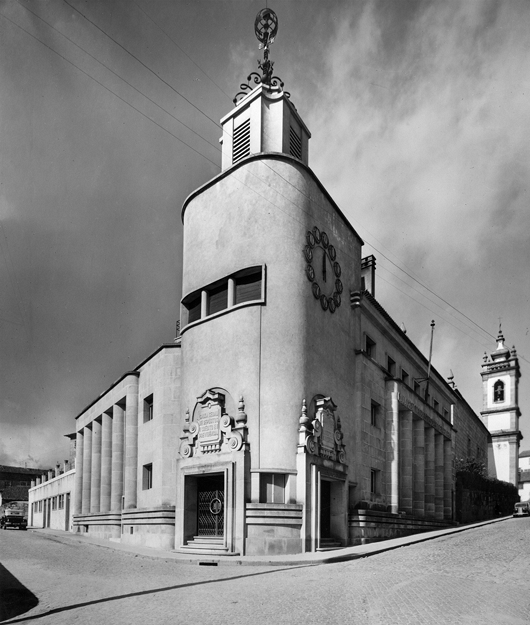
Guarda, Portugal; 1939–1942
[A] core aspiration can be discerned that runs through the entire [architectural] output of the “Estado Novo”, particularly from the second half of the 1930s. It is a catchphrase, never defined with absolute clarity and therefore tested by approximation, trial and error: the demand for a national modern style, a construction style that was at the same time contemporary and suited to the locality and/or specificity of the country. This agenda accommodated various formulations, depending on the evolution of the regime itself, the type of public building in question, the place for which it was intended, the profile of the people responsible for its appraisal and the margin granted to the architect-designer. […]
Salazarism never upheld anachronism or the practice of an archaeological type of architecture. It did not reject modernity entirely, but disliked disaggregating, standardising, stateless foreignness, embodied in its view by the architectural abstractionist internationalism (dubbed “boxes”). An alternative modernity was thus aspired to and achieved; far from being an exclusive diktat of the state, this idea of an alternative modernity pervaded the discourses of the timid specialist press, the opinions generally expressed by the civil society and the dilemmas of the architects themselves.
RIHA Journal 133, 15 July 2016
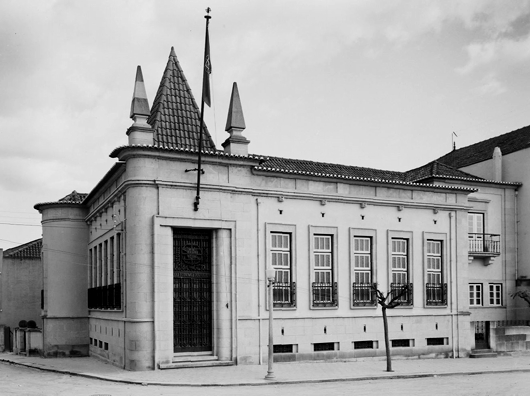
See also: The Other Modern
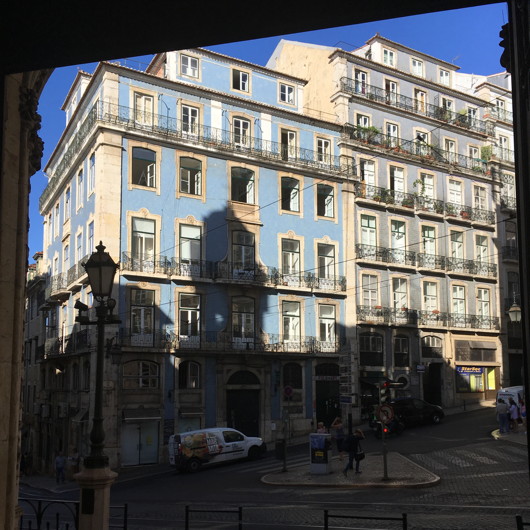
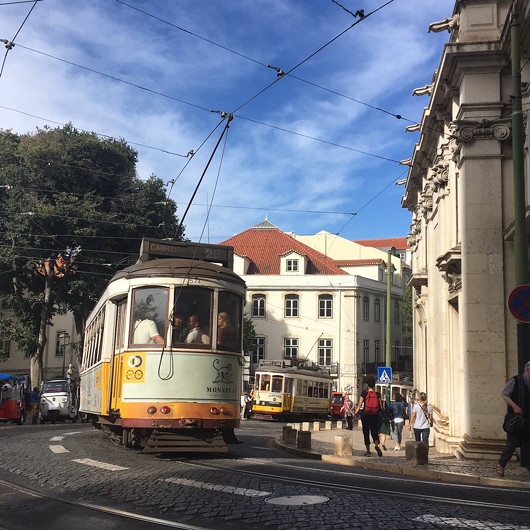
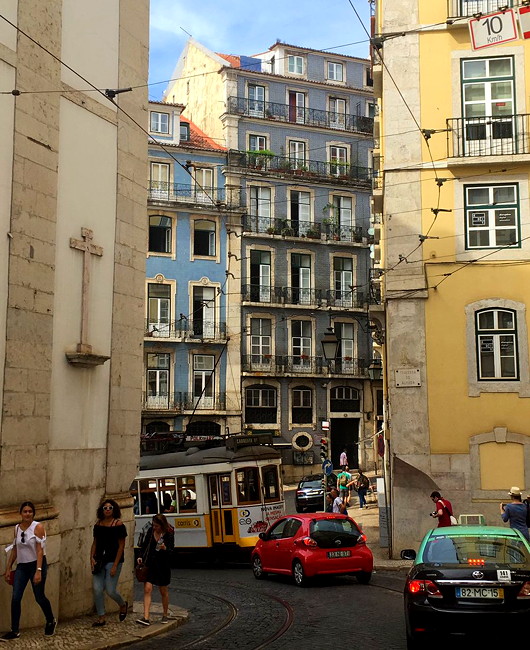
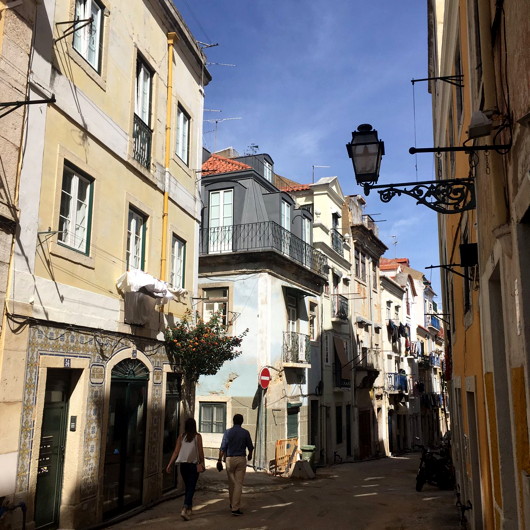
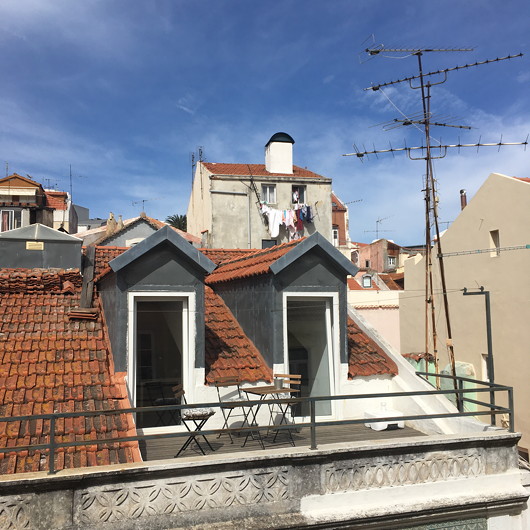
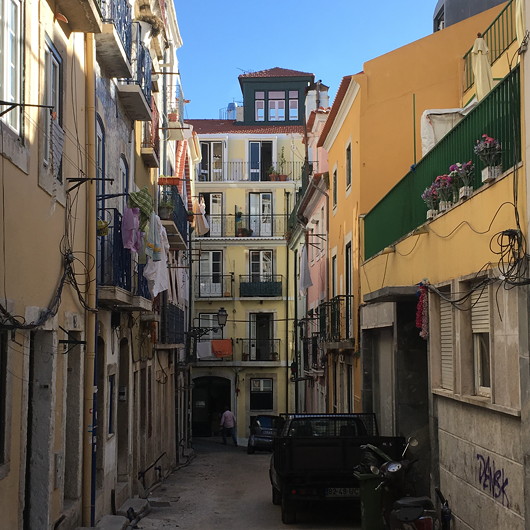
Lisbon
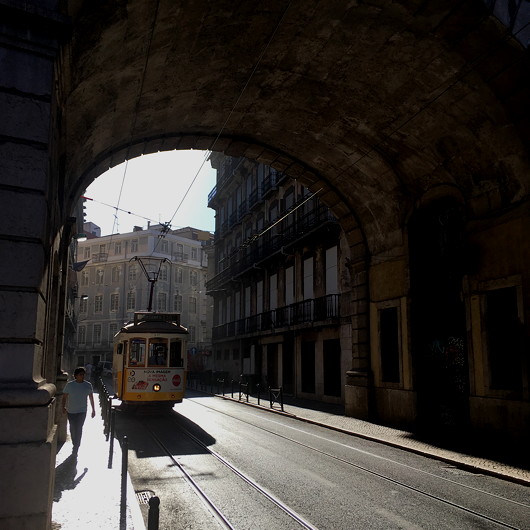
One of the finest cities I have had the privilege of visiting, only lightly touched by the grim hand of modernism.
The Old Scots College
Via delle Quattro Fontane, Rome
Next month I’m off to Rome and the last time I was there I happened to walk past the old Scots College on the via delle Quattro Fontane. The Pontifical Scots College is probably the oldest Scottish institution abroad and certainly one of the most important, both historically and today. As Scotland’s primary seminary it has — almost literally — helped form the soul of the country, particularly during times of widespread persecution back in the mother country.
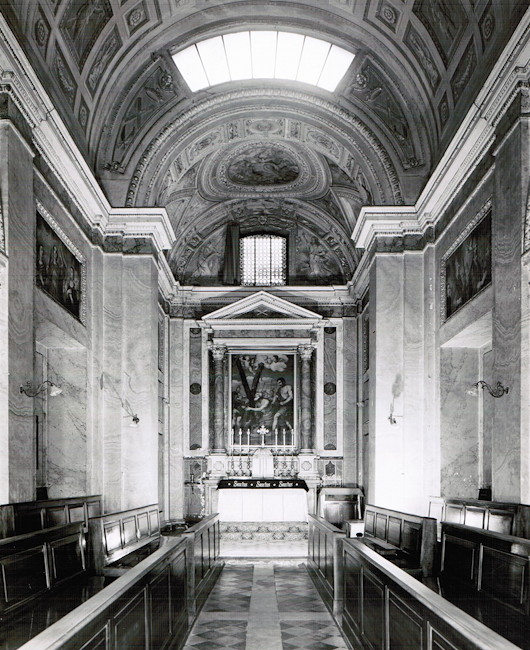
The church of Sant’Andrea degli Scozzesi (St Andrew of the Scots) was built in 1592 during the reign of Clement VIII, and early in the seventeenth century the church and neighbouring hospice were given over to the Scots College which had been founded a few years before. The seminary building itself was (I believe) built much later, in the nineteenth century after the college briefly ceased instruction due to the tumult of the French Revolution.
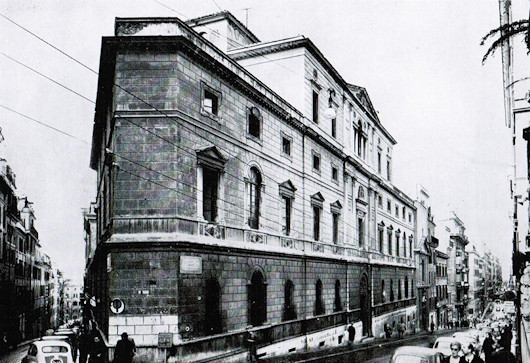
Sadly the building was not very well maintained and by 1960 it was falling apart. It was decided to sell the old college buildings in the Via delle Quattro Fontane and move to a larger site out the middle of nowhere in the Via Cassia. The move was made in 1964, and the Scots College has remained there ever since, while the old college housed a bank for many years and more recently a lawfirm.
The slums of the Louvre
We are so used to the now-familiar image of the palais du Louvre — with its central wing and flanking arms wide open to the Jardin des Tuileries — that it’s easy to forget just how recent a creation this ensemble is. The palace began as a square chateau expanding upon the site of the medieval citadel. The Tuileries it eventually stretched towards was then an entirely separate palace. In-between the Louvre and the Tuileries was a whole neighbourhood of buildings, streets, alleyways, and squares.
Henri IV built the grande galerie on the banks of the Seine connecting the Old Louvre to the Tuileries by 1610, but the Louvre we know today really only came together under Napoleon III in the 1850s.
Until that point, a slum was built right up to the walls of the Palace, and even within the old courtyard. Balzac, predicting that one day all this would be cleared, noted the slum with amusement as “one of those protests against common sense that Frenchmen love to make”. (more…)
Holy Trinity Kingsway
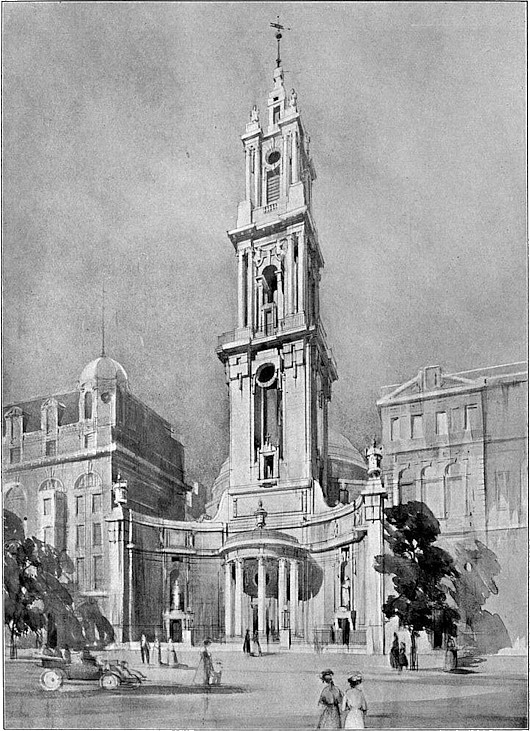
Holy Trinity, Kingsway
Not much information is available about this church. The architect was John Belcher but the ambitious tower was never built, nor was there much money to complete the interior.
After it was made redundant in the 1990s the church was demolished — except for the façade so obviously influenced by Santa Maria della Pace.
The angel of Görlitz
An anonymous benefactor gives Görlitz half a million euros every year for the benefit of the Old Town.
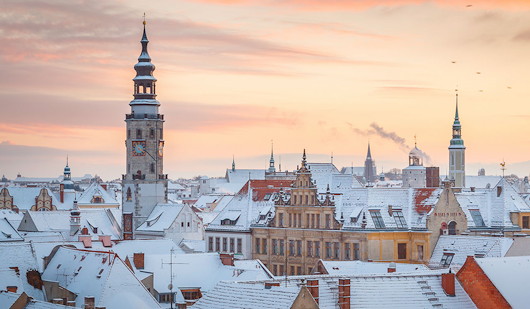
24.02.2015, by MONA JAEGER, GÖRLITZ (Frankfurter Allgemeine Zeitung)
PASTOR, YOU MUST know, are there angels? He jumped up, went to a shelf, grabbed a thin brochure, and opened it. Here, says Minister Hans-Wilhelm Pietz, pointing to a photograph of the Church of the Holy Trinity, the roof was leaking, it was almost raining. And there, at the Lutherkirche, the facade was washed-out.
Four houses of God are maintained by the Lutheran church in Görlitz, between 100 and 700 years old. From the crypt to the tower there is always something to bang, grind, or sand. Sometimes this costs 500 euro, sometimes 5,000. In any case more than the 2,500 congregants contribute to the Sunday collection. “Alone, we would be overwhelmed with the neverending renovations.” But there is indeed him. Or her. An angel, at least, Father Pietz is certain.
He must be a pretty fat angel. He distributes half a million euros in the city every year — €511,500 to be exact. Not an angel as such, but a wealthy entrepreneur or someone with a rich inheritance, the Görlitzers speculate at the bakery counter or at their Stammtisch. Who else would have had so much money left for twenty years that he could simply donate to the city?
For it’s been the same game in Görlitz every year for that long: always in the first quarter, without announcement, half a million euros (formerly a million marks) find their way into the municipal coffers. It has always been a different date. This year it was 18 February. Whether the money will come next year, the donor does not reveal. (more…)
Christmas on College Green
There are some good (if brief) shots of the Irish House of Lords chamber in this Christmas ad for the Bank of Ireland, 0:35-0:45.
The former Irish Houses of Parliament on College Green in Dublin were the first purpose-built parliament building in the world, and were purchased by the Bank of Ireland after the parliament was abolished by the Act of Union in 1800.
Unfortunately a condition of sale was demolishing the elegant octagonal Commons chamber at the centre of the building, to prevent it being used in the effort to have the Act of Union repealed.
Sir Thomas Cusack (1505-1571) has the distinction of having at times served as the presiding officer of both the upper and lower houses of the Irish Parliament. From 1541-1543 he was as Speaker of the House of Commons, in which role some scholars argue he was a prime mover behind the legislation erecting Ireland as a kingdom.
In the following decade he served as Lord Chancellor of Ireland, presiding in the House of Lords, from 1551 until 1555 when revelations about his involvement in the creative finances of Sir Anthony St Leger’s viceregal regime brought about Sir Thomas’s dismissal and (temporary) imprisonment.
He returned to favour when the Earl of Sussex was appointed viceroy, but never again held high office.
Of course, all that was before this neoclassical building was erected, when Parliament met mostly in Dublin Castle.
Church of the Intercession
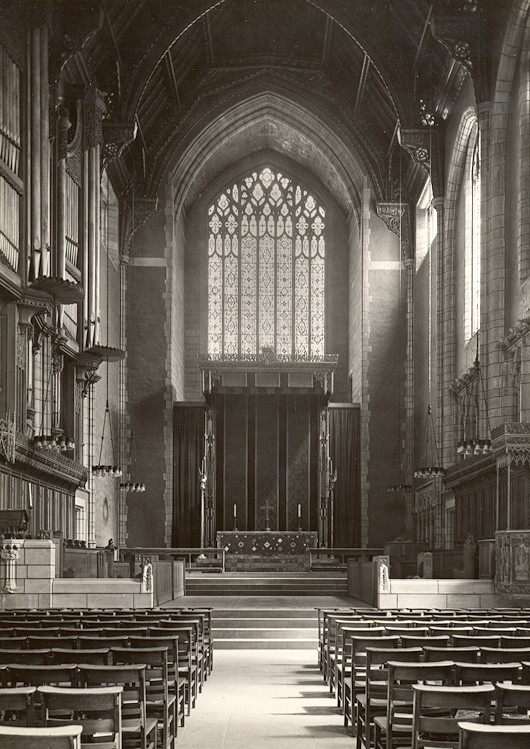
The huge and spacious interior of the Church of the Intercession, New York. One of Bertram Grosvenor Goodhue’s masterpieces; so much so that he decided to be interred in the north transept of the church.
Search
Instagram: @andcusack
Click here for my Instagram photos.Most Recent Posts
- Brunel’s Unbuilt Capitol February 3, 2026
- Cricket at Fordham January 27, 2026
- Palacio Barolo Revisted January 14, 2026
- Learning to Love Liguria January 14, 2026
- Crux Alba No. 2 January 13, 2026
Most Recent Comments
Book Wishlist
Monthly Archives
Categories