New York
About Andrew Cusack
 Writer, web designer, etc.; born in New York; educated in Argentina, Scotland, and South Africa; now based in London.
 read more
News
Blogs
Reviews & Periodicals
Arts & Design
World
France
Mitteleuropa
Knickerbockers
Argentina
The Levant
Africa
Cape of Good Hope
Netherlands
Scandinavia
Québec
India
Muscovy
Germany
Academica
James II, Our Catholic King
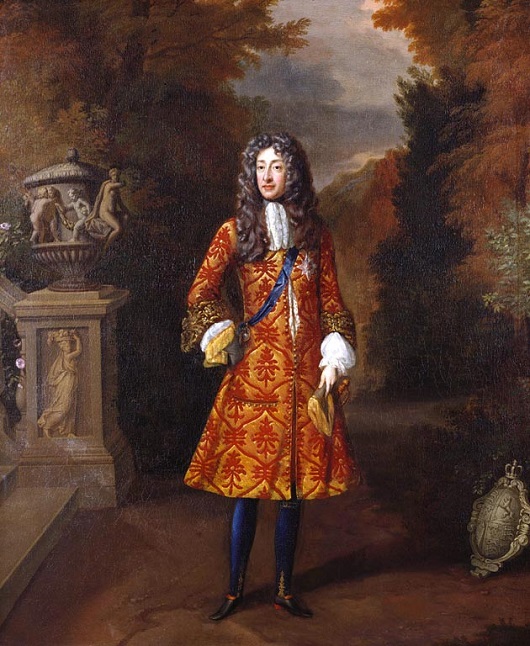
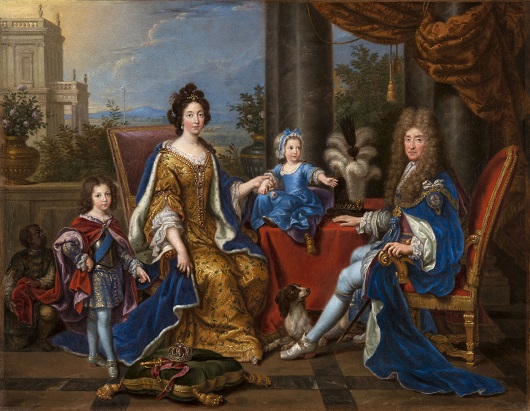
THIS PAST SATURDAY was the anniversary of the birth of King James II and VII of England and Scotland. The third son of Charles I, he was baptised into the Anglican church six weeks after his birth and was created Duke of York at eleven years of age. James married Anne Hyde, the daughter of the Earl of Clarendon, by whom he fathered eight children, though only two survived past childhood.
In 1664 the Duke of York equipped an expedition to relieve the Dutch of responsibility for their colonies in North America, and henceforth New Amsterdam and New Netherland were known as New York after their new Lord Proprietor.
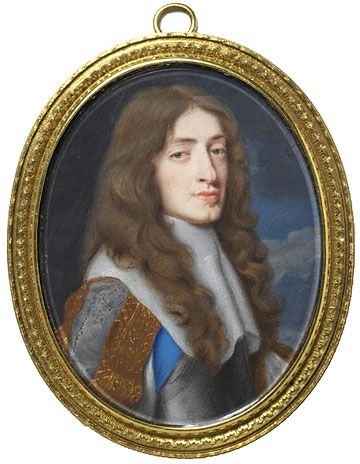
Sometime during the year 1670 both the Duke and Duchess of York were received into the Catholic Church and stopped attending Anglican services, though the conversion did not become public knowledge until the Test Act (requiring officeholders to receive communion in a Church of England service and take an oath against Transubstantiation) was passed three years later. James was forced to renounce his offices, such as Lord High Admiral of England, though not his titles. At any rate, Anne, the Duchess of York had died in 1671 only a year after her conversion. He married Princess Maria of Modena in 1673.
The Protestant oligarchs felt threatened by the prospect of a Catholic king and thrice tried to pass laws barring James from succeeding to the throne. However his elder brother Charles II, the reigning king, dissolved parliament each time before the bill was to be passed. King Charles II died in February 1685, (having reconciled himself to the Catholic faith before his end) and thus the Duke of York was proclaimed James II of England and VII of Scotland. A private Catholic coronation was held at Whitehall Palace on April 22 before the public coronation the following day on the feast of Saint George, which was performed according to the rites of the Church of England.
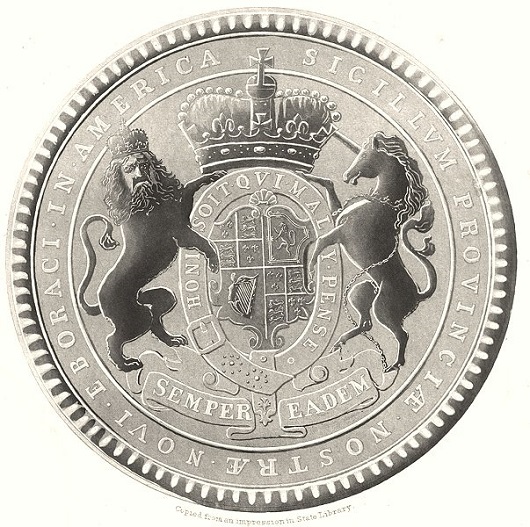
James had appointed the Catholic Thomas Dongan
as Governor of New York in 1682.
The Protestant oligarchs’ fears that James would end their hegemonic grip on Scotland and England proved well-founded as in 1687 he issued a Declaration of Toleration as King of Scotland, allowing Catholics, Episcopalians, and other non-Presbyterians to hold public office and the right of public worship, and a Declaration of Indulgence as King of England removing the laws penalizing non-attendance or non-communion at Church of England services, permitting non-Anglican worship in private homes or chapels, and abolishing religious oaths for public offices. Furthermore, James had allowed Catholics to hold positions at the University of Oxford for the first time since the Protestant Revolution. More provocatively, he tried to transform Magdalen College Oxford into a Catholic seminary. He had already reckoned with the rebellion of the Duke of Monmouth who proclaimed himself king two years earlier but had been captured, tried, and executed for treason. With the birth of a Catholic son and heir, Prince James Francis Edward, in 1688 a cabal of seven Protestant nobles issued an invitation to William of Orange, the Protestant Stadtholder of the Netherlands. A few months later, William of Orange duly arrived and usurped the throne, having already married James’ daughter Mary from his first marriage. The two ruled jointly as William and Mary.
Unwilling to create a popular martyr as had happened with the executed Charles I, William allowed James to escape and fled to France where Louis XIV gave the exiled monarch the use of a palace and an ample pension. James was intent on returning to his birthright, however, and took advantage of the Irish parliament’s refusal to recognise William’s usurpation of the throne. The King landed in Ireland in March of 1689 at the head of a Franco-Irish army but was defeated by William in the famous Battle of the Boyne in July 1690, and returned to his place of exile in France.
There, Louis allowed him to live in the château of Saint-Germain-en-Laye and offered to get James elected King of Poland but James felt this would prevent any chance of a Stuart again holding the throne of England. From that time onwards, James led a simple life of penance in reparation for his sins (he had had a number of mistresses in his younger days) and finally died in 1701. He was entombed in the Chapel of St. Edmund within the English Benedictine church on the Rue St. Jacques in Paris, while his brain was sent to the Scots College in Rome, his heart to the Visitandine Convent at Chaillot, and his bowels divided between the College of St. Omer (the exiled English Catholic school, now Stonyhurst in Lancashire), and the nearby parish church of St. Germain where they remained until they were desecrated by a Revolutionary mob and lost forever. His monument at Saint-Germain, however, was rediscovered in 1824 and is proudly displayed there to this day. There is also a monument to James and the Stuarts in St. Peter’s Basilica in Rome (c.f. Roma – Caput Mundi).
Aside from the pious tradition that Edward VII was received into the Church on his deathbed, James II was the last Catholic king (and as good King Edward never reigned over New York, James is even more certifiably so for us). There is a lovely coronation ode to James which I just might bring to your attention someday. But for now, reflect and remember our monarchs of old and pray that God in His mercy might grant us good Catholic rulers in stead of the shabby lot we elect today.
Old Dutch Gable
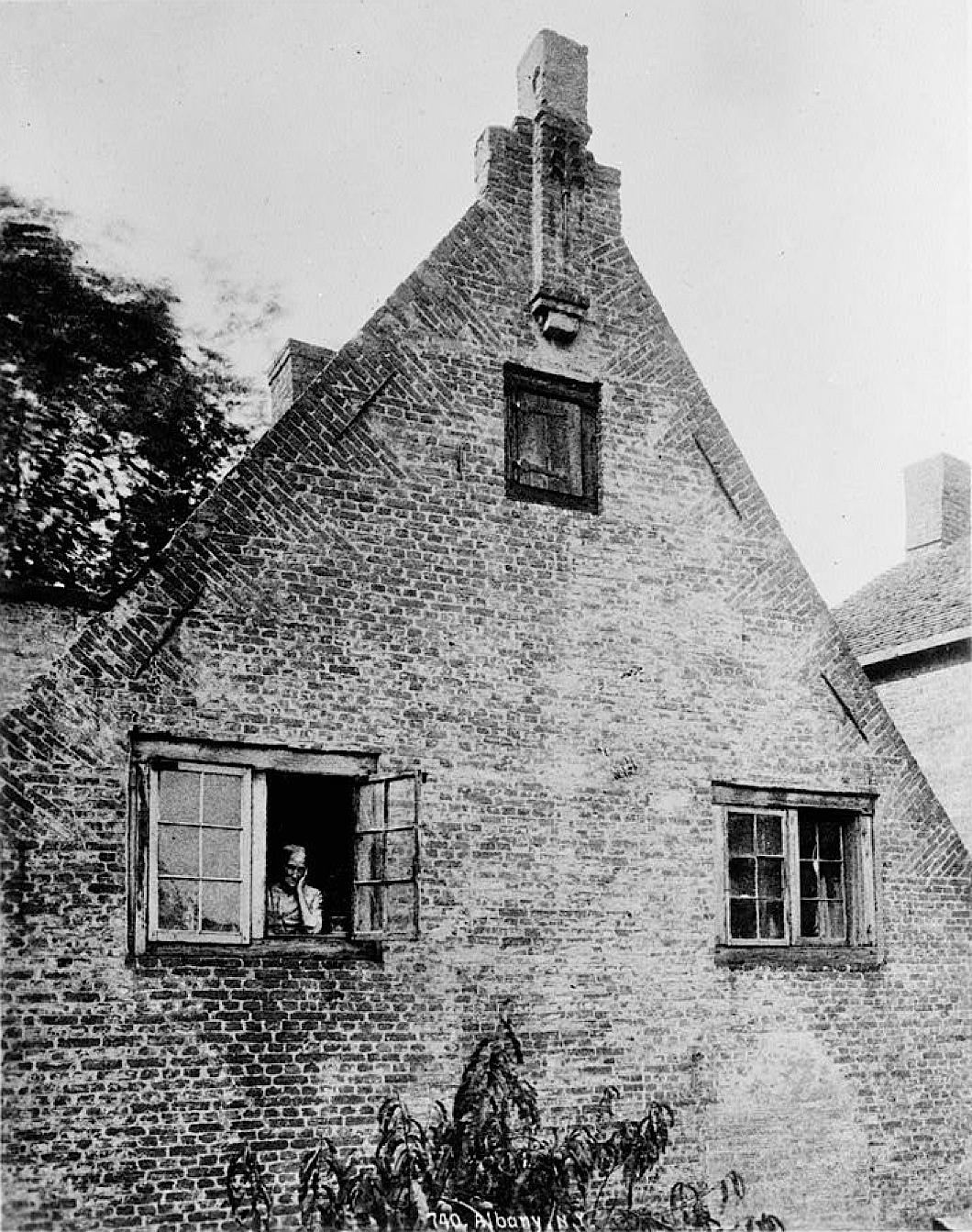
An old Dutch gable complete with old Dutch vrouw gazing miserably from the window. Albany County, New York, 1930’s.
The form of brick course on the gable is known as ‘mouse-tooth’ and is found primarily in Holland, East Anglia, and the Hudson Valley of New York, though also here and there in the American South.
A Book to Remember
Chumley’s Launch Party for ‘Forgotten New York’ Book
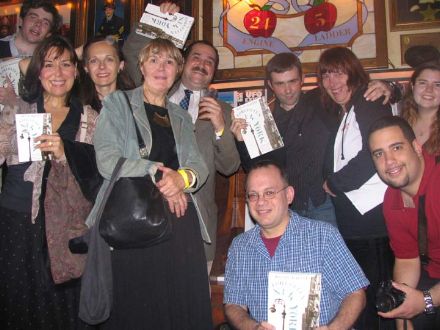
AS I GROW more and more cantankerous, my tolerance for evening trips down to Mannahatta declines, but on occasion there’s an event which would be a crime to miss. Last Thursday, Dawn Eden and I popped down to Chumley’s, the old speakeasy on Bedford Street in the West Village, for the shindig launching Kevin Walsh’s brilliant book, Forgotten New York: Views of a Lost Metropolis. (Kevin reports on the party here). I’ve been following Kevin’s Forgotten New York website for years now, and it has earned an unquestionable rank as one of my favorite sites ever (though, shamefully, I’ve never been on one of his legendary ‘Forgottentours’). The author himself was on hand, naturally, and I also enjoyed meeting a number of very kind people who are as fond of Forgotten New York as I am.
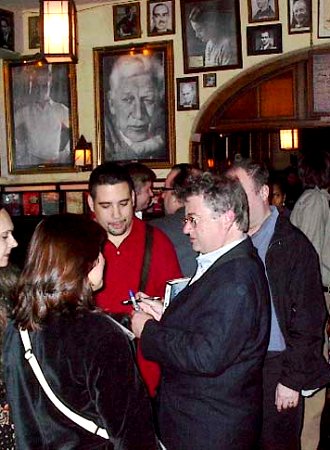
The Man of the Hour himself: Kevin Walsh (in glasses).
While Dawn and Kevin are familiar friends (she even gets a mention in the book’s acknowledgements), I had never before had the privilege of meeting this great chronicler of quinqueboronian miscellany. He is very much like his website: simple and brilliant. Happily, I got my complementary copy of the book personally inscribed, though I quite presumptuously upbraided him for only mentioning Audubon Terrace in passing (c.f. FNY: ‘I Can’t Drive 155’) while I believe it is worth a Forgotten page of its own. (Naturally, I have a post slowly developing on Audubon Terrace, which I believe is one of the most beautiful public spaces in all New York, as well as one of the most underappreciated).
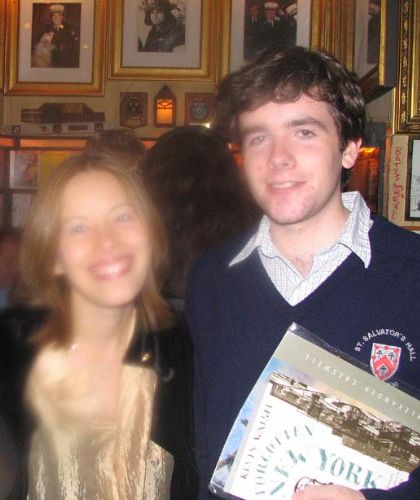
No, the camera isn’t smudged; an angelic haze follows Dawn wherever she goes.
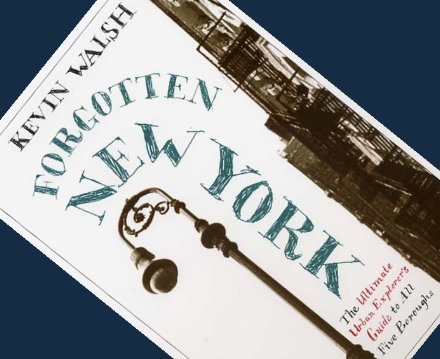
But enough of the fun, how’s the book? Well I love it. It’s emphasis is on breadth rather than depth, since it’d be impossible to reproduce the entire contents of the encyclopedic website in a mid-sized paperback book. I view the book in two regards: first, as a handy basic guide referencing the variety of forgotten, unnoticed, and underappreciated sites around the Five Boroughs; and second, as a good jump-start companion to the more thoroughly informative website.
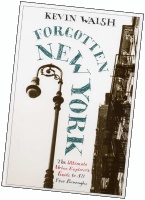
Take, for example, the Lent Riker Smith House out in Queens. Browsing through the book we see the entry on the ‘Lent Riker Smith Homestead’ which gives us two paragraphs of information. Enough to whet the appitite and plant the seed of intrigue, but when we check out the website’s entry on the house we get much, much more… and in color, to boot. I hope readers not yet familiar with the website will use the book as a springboard, but I also hope that we will be gifted with updated editions of the book in years to come, with added features.
Buy the book. Aficionados of forgotten-ny.com will appreciate a version of the familiar in dead-tree form, while the uninitiated will find it extremely useful as a foundation for appreciating Gotham’s numerous nooks and crannies. Kevin Walsh has done a great service to all those who have a love for the Big Apple.
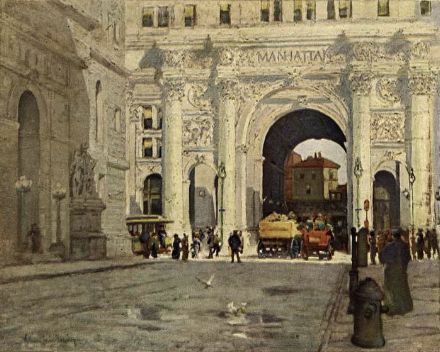
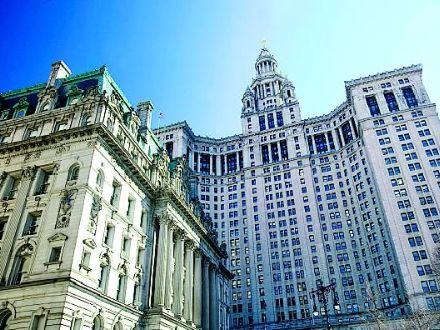
The Old Police Headquarters
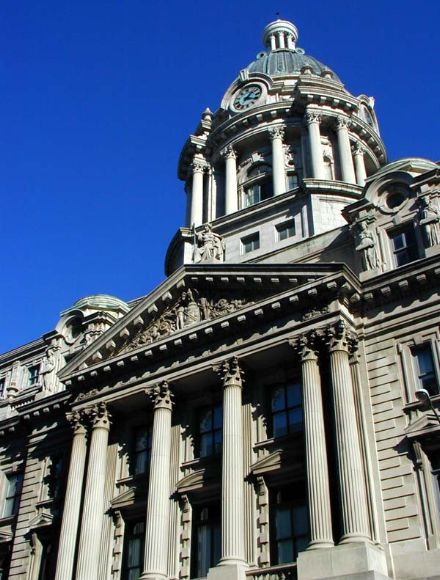
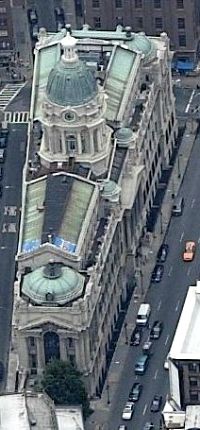 ONE OF THE finest buildings in all New York is also one of the least-appreciated and most forgotten. The old Police Headquarters at No. 240 Centre Street was built in 1909 on a triangular lot in what was then solidly Little Italy. Arguably, it is today located in the ever-expanding Chinatown, but real estate brokers usually describe its location non-ethnically as Soho, just on the cusp of the area which is increasingly (and most irritatingly) known as NoLIta, ‘North of Little Italy’.
From the basement shooting range to the rooftop observation deck, the building was designed in the monumental Beaux-Arts style by the firm of Hoppin & Koen, “to impress both the officer and the prisoner with the majesty of the law.” The New York Times wrote that “its grandeur contrasted utterly with the little buildings and crooked streets around it.”
The older old Police Headquarters, where reformer Teddy Roosevelt held court as Police Commissioner, was located nearby on Mulberry Street and when the nerve center of the N.Y.P.D. shifted to Centre St. between Broome and Grand, the gun shops, cop saloons, and police reporters followed suit. One restaurant across the street was simply called ‘Headquarters’. With its oak bar and ceiling of carved wood, the ‘Headquarters’ restaurant became a particular favourite among the higher brass of the N.Y.P.D. According to popular lore, a tunnel was actually constructed connecting the restaurant with the actualy Police HQ, in which a number of the Boys in Blue used to enjoy a drink during the trying days of Prohibition. (more…)
Vienna on 43rd Street
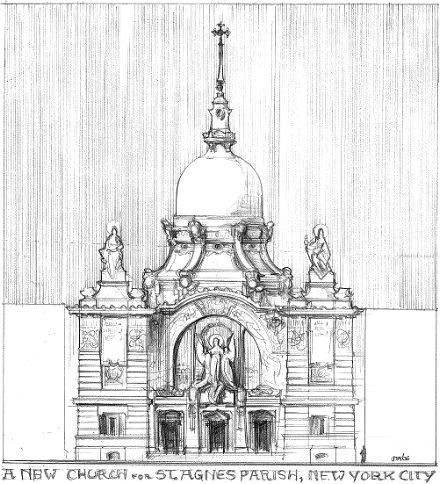
A WEEK AGO AFTER the 11 o’clock Sunday Mass at St. Agnes, Dino Marcantonio, Matt Alderman, and I stood in front of the church and fantasized about how we would fix the old place. Well, perhaps ‘old’ isn’t the right word for the place. While the parish was founded in the 1840’s, the current church building only dates from the late 1990’s, built after the old Victorian edifice was consumed by fire. As for design, its heart is in the right place, but as they say the Devil is in the details. The interior is marred by quite obviously large joints between component parts of arches and cornices and the exterior just looks fake. Is craftsmanship dead? No, but it helps to search it out instead of accepting just any old thing.
At any rate, Matt Alderman has thrown together these esquisses of what his St Agnes would look like, and it’s all rather Austrian. (more…)
The Jefferson Guards
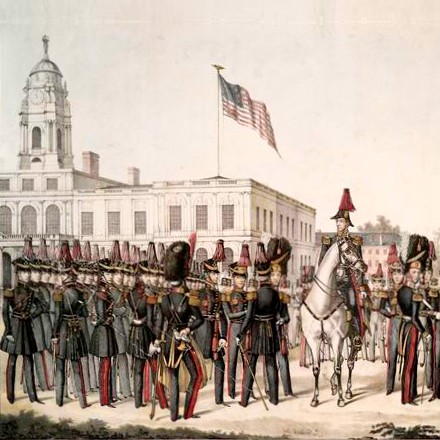
I recently stumbled upon this image depicting a militia regiment gathered in front of New York’s City Hall. The unit in question is the Jefferson Guards, 38th Regiment, New York State Artillery, amassed in bearskin caps and red-plumed shakos (red being the traditional color of the artillery). I confess I’d never heard of the Jefferson Guards before, but this is not entirely surprising. The Armed Forces of the State of New York – today composed of the New York Army National Guard, the New York Air National Guard, the New York Guard, and the New York Naval Militia – was once composed of a vast array of assorted regiments, battalions, and companies (a quite literal example of the ‘little platoons’ praised by Burke). These militia companies varied greatly in form, from little more than glorified social clubs to the crack units of the day.
As strange as it may seem, considered as a whole they were an almost completely organic military and, while they would be ill-suited to the armed exigencies of today, I refuse to believe that our little realm is better off for their general disappearance. Certainly the V.C.A. and the Old Guard, among others, survive to this day (in a somewhat different form, naturally), but what of the Empire Light Cavalry and the German Horse Guards? The Ulster Guard, the Weschester Chasseurs, and the New York Highlanders? The gallant Seventh Regiment of New York survived even into the 1990’s before its dissolution was ensured by the monotony monitors who now, fifteen years later, seek to destroy the great and blessed monument of an armory on Park Avenue which the Seventh built and guarded for over a century. We mourn their disappearance, just as we detest the continued and increasing disdain for the proud military heritage of the City and State of New York, but the entire culture which created and sustained them is gone, too.
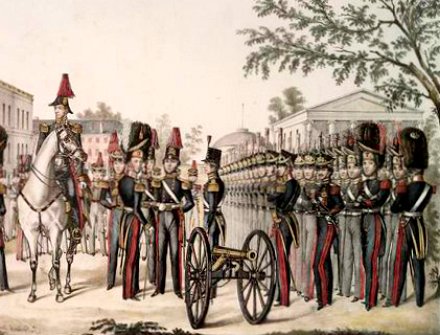
Category: Militaria – New York
The Neue Galerie
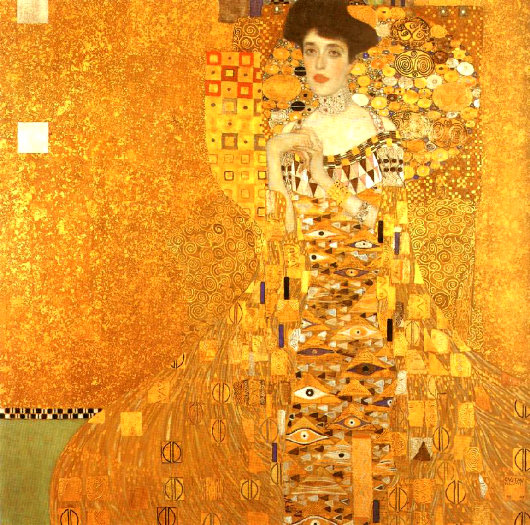
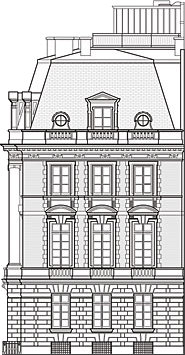 THE RECENT PURCHASE for the Neue Galerie of Gustav Klimt’s 1907 ‘Adele Bloch-Bauer I’ (above), alledgedly for a record-breaking price of $135,000,000, gives me the perfect opportunity to write a post on the eponymously recent addition to New York’s coterie of art museums. Since its 2001 opening, the Neue Galerie has resided in the handsome 1914 beaux-arts mansion on the corner of Fifth Avenue and 86th Street, designed by Carrère and Hastings (of New York Public Library fame) for industrialist William Starr Miller and later inhabited by Mrs. Cornelius Vanderbilt III. In the time since the construction of No. 1048, the rest of Fifth Avenue has undergone a lamentable transformation from a boulevard of beautiful townhouses and mansions to an avenue predominantly consisting of apartment buildings. While one appreciates the inoffensive design of the pre-war buildings on Fifth, there remain a number of thoroughly opprobrious modern interlopers which offend the graceful avenue. One can’t help but pine for Fifth Avenue before the mansions came down, but we can at least give thanks for holdouts like the Neue Galerie. (more…)
Racialist Thinking Behind the Times
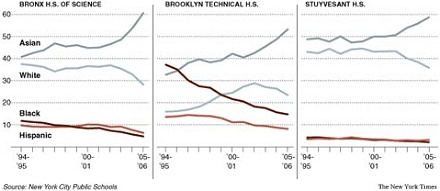
The fair-minded, independent observer would look at the figures above and think to himself “Interesting, the proportion of Asian students is on the rise, while that of White, Black, and Hispanic students is generally in decline”. However the racialists (I will not use the more loaded term of ‘racist’, though the meaning is exactly the same) at the New York Times can only see the Black and Hispanic decline, captioning the chart ‘The share of black and Hispanic students New York City’s three most elite specialized schools has declined’.
And why no chart depicting the racial make-up of the also public selective Hunter College High School? Is it, by some unknown criterion, not in the same league or perhaps the proportion of black and Hispanic students there actually rose? The Times reader is left uninformed as to the greater picture, but suitably inculcated in racialist thinking.
Gothamist’s Jen Chung notes the decline is “in spite of the city’s best efforts to encourage [Black and Hispanic students] to apply and attend” while City Councilman Robert Jackson ponders “”Is it institutional racism or is it something else?”.
Could it perhaps be that the racial makeup of the city’s elite public high schools is subject to (quel horreur!) occasional fluctuations? What is the racial makeup of an elite public high school “supposed” to be? Here’s a concept worth considering: how about giving the students in selective public high schools the best education on offer and admit students based purely on a meritocratic standard which does not descriminate by sex, race, class, or creed? Just a thought.
The Haunting Richardsonian
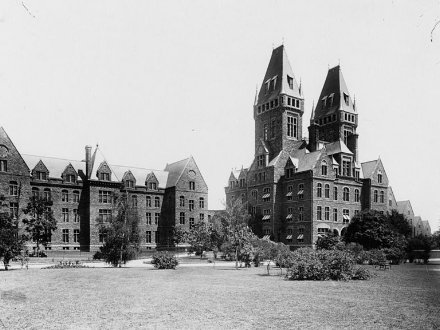
ONE OF THE splendid things about New York is that it’s a land which continually manages to throw up a surprise or two, even to time-hardened devotées of all things knickerbocker such as yours truly. One of my most recent discoveries is the fabulously haunting and impressive Buffalo State Hospital out in the far west of the Empire State.
The magnificent building was built to the design of Henry Hobson Richardson, the progenitor of the eponymous ‘Richardsonian Romanesque’ style, as one of a series of governmental asylums for the insane founded throughout the nineteenth century. Richardson also did a great deal of work on the Capitol in Albany, designing the south façade which, since the construction of Nelson Rockefeller’s Little Brasilia, is now the main façade of the building and was inspired by the Hôtel de Ville in Paris.
Construction on the State Hospital began in 1870, and the central administration block with its two towers and a number of flanking pavilions housing patients were opened in 1880. Interestingly, the towers which so dominate the building are purely decorative and remain unfinished on the interior.
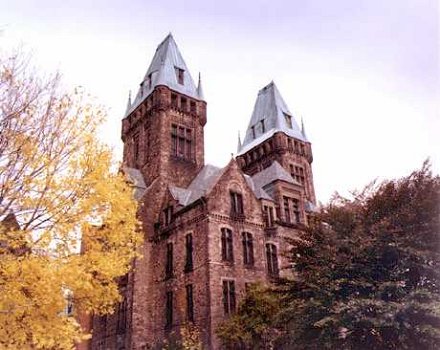
The footprint of the building follows the V-shaped Kirkbride plan, conceived by Pennsylvania’s Dr. Thomas Story Kirkbride in his 1854 opus, On the Construction, Organization and General Arrangements of Hospitals for the Insane which revolutionized care for the mentally unstable in the nineteenth century. The location was a 100-acre parcel of property near the city of Buffalo, and the grounds were landscaped by Frederick Law Olmsted, who designed Central Park with Calvert Vaux.
The grounds originally included farms which helped to feed the patients and staff, but in the 1920’s this land was redeveloped as the Buffalo State College, now the University at Buffalo (State University of New York). The hospital, renamed Buffalo Psychiatric Center, moved out of the Richardsonian complex into a plain, ugly, modern building on the grounds in the 1960’s, leaving the beautiful Victorian structure to rot and ruin.
However recent efforts by Buffalo and New York state officials have led to the replacement of the roof and other work to ensure the continued integrity of the building. The latest plans would have the building serve an educational function under the auspices of the State University next door, an appropriate purpose for this majestic gem of New York architecture.
New York in Philately
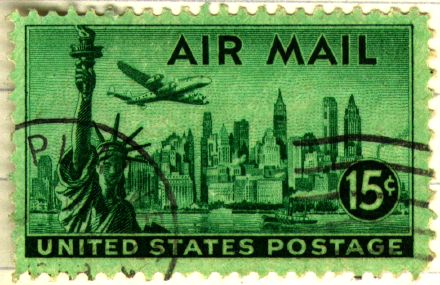
Wandering around the merry old world wide web I stumbled upon these stamps, which I bring to you for your own enjoyment. Above we have the Great Metropolis itself, the island of Manhattan in its swankier days. Below we have a view of the Crown of the Hudson, West Point, with the beautiful Cadet Chapel designed by that American Master, Bertram Grosvenor Goodhue himself, presiding over the campus of the United States Military Academy.
The postage stamp was once a thing of beauty and composition, but it’s heartening to see that some still design beautiful stamps. Just examine Elliott Banfield’s stamp of General Washington, based upon the staute in Union Square. Mr. Banfield believes that the decline in the design of postage stamps is due to a “moral void” most readily shown when the Postal Service unveiled its famous ‘Elvis Stamp’ a few years back.
“Elvis was important in the popular culture, yes,” writes Mr. Banfield. “But how important is the pop culture? Important only to those who can’t see anything higher or better. It’s scary to think that people like that are in charge of public policy. But they are, and the Elvis stamp proves it.”
Hear! Hear!
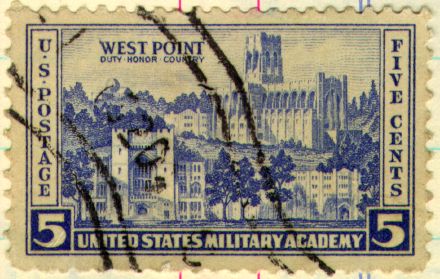
An irrelevant stamp, after the jump.
Can Kid Save This Sinking Ship?
25-Year-Old Buys the Salmon Siren of the Upper East Side
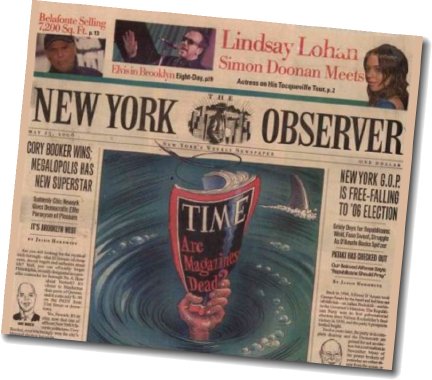
AN NYU LAW  student of just twenty-five years of age has purchased the majority stake in the New York Observer. Jared Kushner (right), son of the currently jailed big-time donor to the New Jersey Democrats Charles Kushner, bought the biggest-piece-of-the-pie off of publisher Arthur Carter, who founded the insouciant weekly printed on salmon-tinted paper back in 1988. No official word on how much money changed hands during the deal, though the Times cites “one person familiar with details of the sale” claiming the amount was nearly $10 million. Carter will maintain a significant say in the paper’s operations, and there are no plans to make any changes to the masthead as of the moment. Earlier in the year Robert de Niro was in talks to buy the Observer through his Tribeca Film Festival operation, but the negotiations fell through.
The Observer, with a small-but-influential circulation of 55,000, has undergone a miniature transformation recently with the hopes of turning around the current losses of about $2 million a year. The most noticeable of these changes came in May when the paper trimmed over an inch in width, moving from six front-page columns to five and giving it a taller, more narrow appearance. While the thinner size saves on rising newsprint costs it also means diminished space for advertising, and the newspaper lost its easy, leisurely feel, also moving from two sections to one. The Observer has also increased the volume of its internet operations on Observer.com, some might say at the expense of the quality of the printed edition. The new owner, however, will take a back seat in the content of the newspaper while concentrating on improving the bottom line, citing the Observer‘s strong brand despite its current financial woes.
Kushner’s father, a well-known New Jersey real estate developer, was sentenced to a jail term last year after being found guilty of tax evasion, and is well-known for a number of other stunts which do not bear repeating on, er, family-friendly sites such as this. The younger Kushner himself has given over $100,000 to various (Democratic) political outfits since 1992, when he was a mere eleven years of age.
I used to read the Observer often (though not regularly) because it had the most style of all the New York newspapers. While its flighty spirit meant it lacked a certain depth, it still had zing and usually at least a handful of interesting articles each week. The quality of the content began slipping, however, and when I came home to New York I bought one copy while waiting for the train in Grand Central, was completely dissatisfied like the new size and feel, and decided to give it up. I will always have a certain fondness for the Observer though; in the age when Gannett-style corporate monotony is king, it has managed to maintain a certain classic swankiness (epitomised in its reporter-and-skyline emblem) and for that we can be grateful.
An Old Military Academy on Long Island
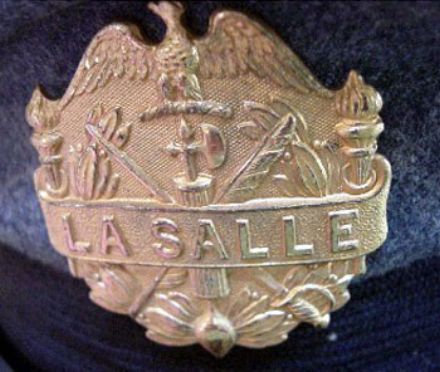
EDUCATION HAS BEEN one of the long-standing traditions of the Christian faith, as has service, and what better expression of education and service is there than the Catholic military school. La Salle Military Academy in Oakdale, L.I. was just one of these institutions, founded by the de la Salle Christian Brothers in 1883. The school was actually founded here in Westchester as the Westchester Institute, but moved in 1926 to Indian Neck Hall on Long Island, built by F.G. Bourne (whose upsate shack was Singer Castle on Dark Island) and once one of the largest estates on the Island. The main building was a 110-room mansion overlooking Great South Bay, designed by Ernest Flagg who, coincidentally, was responsible much of the Naval Academy at Annapolis including the great chapel which contains the tomb of John Paul Jones, sometime admiral of the United States and Imperial Russian navies. (more…)
An Old Boathouse in Spuyten Duyvil
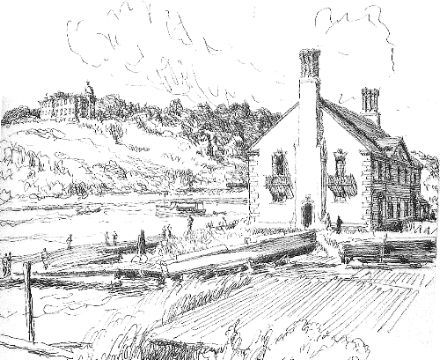
Flipping through an old book called ‘Magical City: Intimate Sketches of New York’, I came upon this sketch of the Gould Boathouse of Columbia University on the Harlem River by Spuyten Duyvil. I had never come across this little building before and had significant doubts as to whether it was still there, but to my pleasant surprise it does. I’m afraid I don’t know much about the boathouse nor its history, but here follows a number of photos and images of it, and of various Columbia boathouses of the past. (more…)
Marshal Foch and the Old Guard
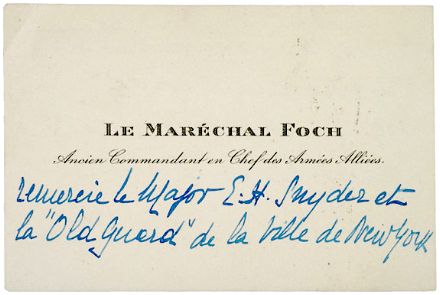
This calling card of Marshal Ferdinand Foch, Supreme Allied Commander during the First World War, was for sale in November of 2005. The text reads Le Maréchal Foch, Ancien Commandant en Chef des Armées Alliées, remercie le Major E.H. Snyder et la “Old Guard” de la Ville de New York or, in English, “Marshal Foch, Former Commander in Chief of the Allied Armies, thanks Major E.H. Snyder and the Old Guard of the City of New York”.
Previously: A New York Funeral | Old Guardsmen | The Old Guard | Grandpa
The Veteran Corps of Artillery
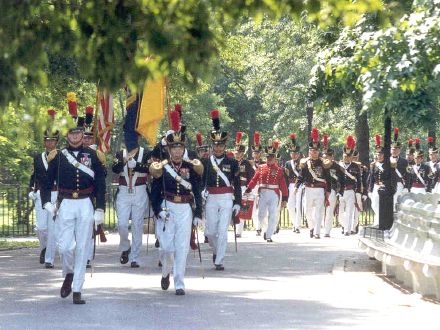
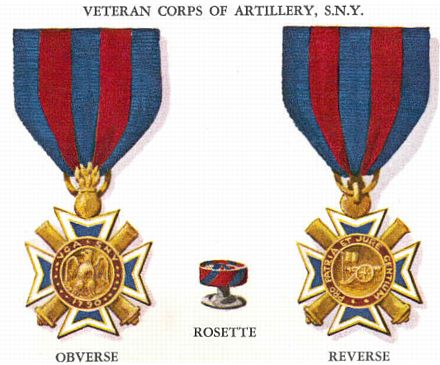 I PROMISED MYSELF I’d wake up this 4th of July morning and head down to the Battery for the annual Independence Day artillery salute by the Veteran Corps of Artillery. However, the gods of slumber ordained that I remain in bed asleep and so in recompense I thought I’d bring you, dear readers, an informative post about the Corps itself. While this site has featured a fair amount on the Old Guard we mustn’t let our readers be mistaken that we are somehow ignoring the VCA. After all, the Veteran Corps of Artillery, State of New York, founded in 1790, is more senior to the Old Guard, founded in 1826 (though in fact an amalgamation of the two older militia companies, if I recall correctly). While there is more of the Old Guard available from online research, I am more familiar with the VCA owing to my Uncle Matt’s membership thereof. And of course, like the Old Guard, the VCA operates on a seperate ranking structure, so that one could be a Major General in the Army, National Guard, or New York Guard, and yet be a mere private in the Veteran Corps of Artillery. (more…)


Empire State
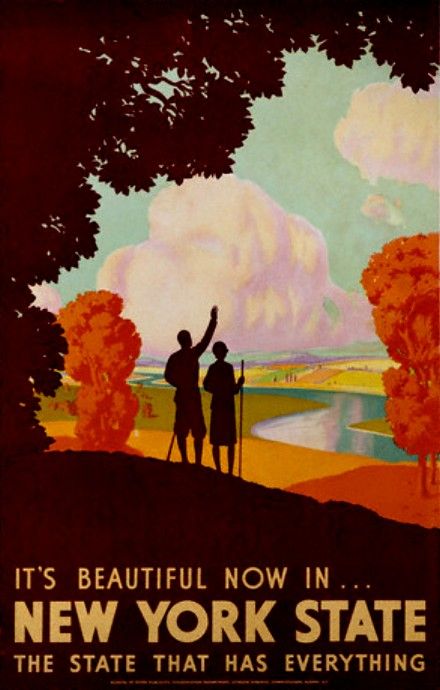
Having been duly capped on the head by the Rt. Hon. Menzies Campbell QC MP with John Knox’s breeks last Thursday I have returned to the land of my birth a Master of the Arts. Details of the various rites and festivities are forthcoming, but in the mean time I share with you these three travel posters from back in the day when they made proper travel posters. All three advertise our blessed Empire State, two of them West Point, the glorious gothic crown of the Hudson. Excelsior!
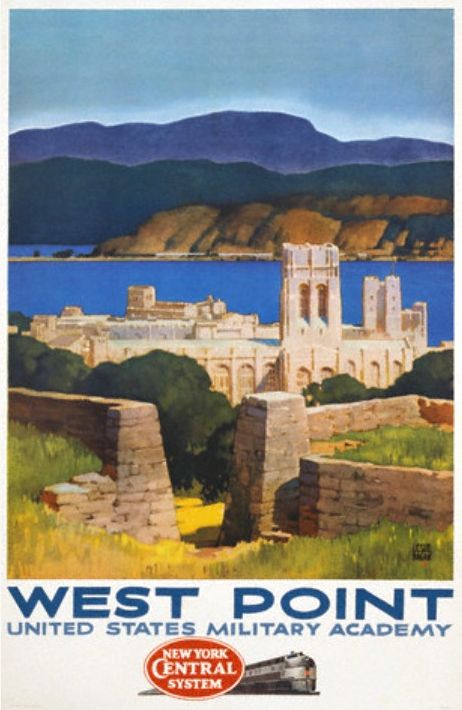
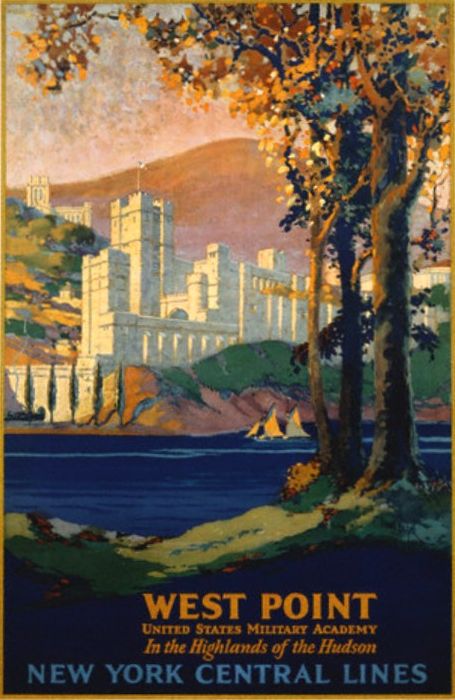
Click on the images for the full posters.
Forgotten New York in Print
 I look forward with excitement to the publication of ‘Forgotten New York: Views of a Lost Metropolis’, by Kevin Walsh of the brilliant Forgotten New York site and due out this October from Harper Collins. (Click here for the Amazon link). Forgotten New York is one of my favorite sites and an excellent way of exploring the myriad of neglected and underappreciated nooks and crannies which pepper the great metropolis. My personal favorite of all the sections of the site is ‘You’d Never Believe You’re in NYC‘ highlighting the somewhat rustic nature of some parts of the city. The site also exhibits some of the ongoing tragedies of the Big Apple, including historic buildings which have been destroyed even in the space of time since the site began, and the ongoing over-development of Staten Island, which contains some of the last tranquil places in New York.
Another great site for New York City virtual exploration is Bridge and Tunnel Club. The most recent additions are shown on the main page, and the total contents can be accessed via the Big Map. Perhaps you’d like to take a peek at Columbus Circle, or explore the Public Library, remember the dead of the Great War at the Victory Column, or maybe visit the cricket grounds of Van Cortlandt Park in the Bronx.
Some New York Coinage
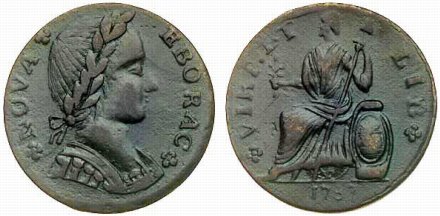
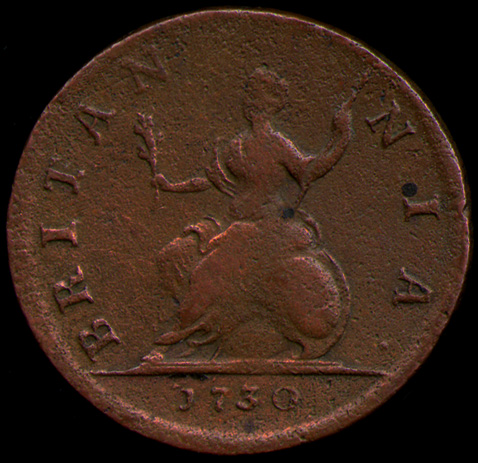
IT MAY INTEREST our readers to know that before the Feddle Gummint started throwing its weight around, the Great State of New York was in the habit of minting its own coinage. One of the most famous of the coins produced during the era is the 1787 ‘Nova Eborac’, so called for its abbreviation of Nova Eboracum; that’s ‘New York’ in the language of our ancient Roman forbearers.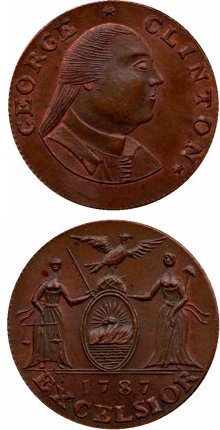 All decent people being lovers of monarchy, the New Yorkers of yore found themselves in a slight predicament. Their king had granted them independence four years earlier, but George III (the forgetful man!) neglected to indicate who would be king once he relinquished the sacred office. Every country must have a king — if not, then whose face would go on coins and such? “Not to worry,” saith the designer of the Nova Eborac. “We’ll stick a king on and just not say who he is.” And so they did, as seen on the obverse of the above Nova Eborac. The reverse depicts a figure who looks suspiciously like the Britannia on the old British coins. Old habits die hard. Around this Britannia-esque figure is the inscription VIRT. ET LIB for Virtus et Libertas – Virtue and Liberty.
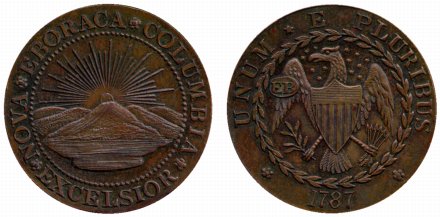
One Thomas Machin, however, clearly thought this was a bit silly and so decided to simply put the Governor on the coins he produced. His coins (seen on the right) show Gov. George Clinton on the obverse and a depiction of the arms of the Empire State on the reverse (they also grace the banner of this webpage). A chap named Ephraim Brasher went a little further and depicted neither the anony-king nor the governor but instead put depictions of heraldic arms on both side of the coin; New York on the obverse and the United States on the reverse. These coins are known as ‘Brasher’s Dubloons’ and the front and back can be seen below.
Previously: New York Currency
Search
Instagram: @andcusack
Click here for my Instagram photos.Most Recent Posts
- Brunel’s Unbuilt Capitol February 3, 2026
- Cricket at Fordham January 27, 2026
- Palacio Barolo Revisted January 14, 2026
- Learning to Love Liguria January 14, 2026
- Crux Alba No. 2 January 13, 2026
Most Recent Comments
Book Wishlist
Monthly Archives
Categories