New York
About Andrew Cusack
 Writer, web designer, etc.; born in New York; educated in Argentina, Scotland, and South Africa; now based in London.
 read more
News
Blogs
Reviews & Periodicals
Arts & Design
World
France
Mitteleuropa
Knickerbockers
Argentina
The Levant
Africa
Cape of Good Hope
Netherlands
Scandinavia
Québec
India
Muscovy
Germany
Academica
Spring hath duly sprung
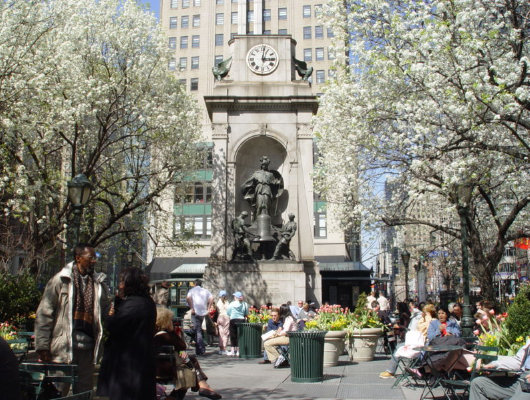
Herald Square, at the confluence of Broadway and the Avenue of the Americas.
In Old New York
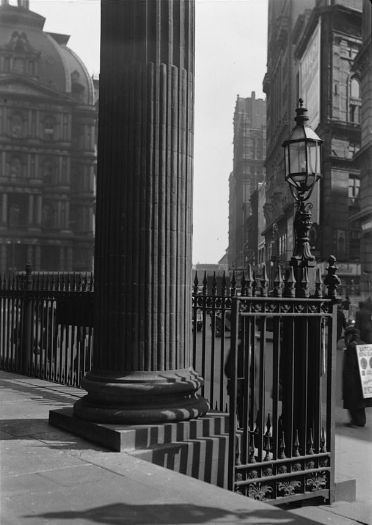
The steps of St. Paul’s Chapel, Broadway, looking towards Park Row, March 1937.
Upcoming Events
April 26, 2008 (Saturday)
The Birthday of Rome: 753 B.C. – 2003 A.D.
The Roman Forum Spring Ball
7:00pm – midnight
Catholic Center at New York University
238 Thompson Street
(between Washington Square South & West 3rd Street)
A, B, C, D, E, F, V trains to West 4th St.; R to 8th St.; 6 to Bleecker St.
7-Piece Rich Siegel Ballroom Orchestra
Grand Imperial Buffet and Dessert
Well Done Roma! Festivities and Spontaneous Outburst of Joy, 10:00 pm.
According to tradition, Romulus took up his trusty plow and marked out a sulcus around “Shepherds’ Hill” on the twelfth day before the Kalends of May, i.e., a.d. XII Kal. Mai-a date which, give or take eleven or twelve days, roughly corresponds to what we call April 21st. Conveniently, the date was also the festival of the shepherd goddess Pales (the Parilia), in whose honor the hill, chosen by Romulus, had been named the Palatine.
When the festival was adopted by city dwellers, the date was set to coincide with the date of the traditional founding of Rome. Each area of Rome set up festivities, much like a block party. Bonfires were set onto which offerings were thrown. The event concluded with a bountiful feast set up out of doors. Catholics can also commemorate the day due to Rome’s Christian meaning.
Two songs will be sung at the 10:00 P.M. festivities: The papal hymn, Roma Immortale, and Rome’s Birthday Song, the latter to the tune of Oklahoma, with lyrics by Judy Hallet.
For further information please contact the Roman Forum (dvhinstitute@aol.com or call 212-645-2971).
COST
$50 per person
(Children 16 and under, free)
Reserve by April 21
ATTIRE
Suit and tie or dinner jacket for the men
Checks payable to:
The Roman Forum
11 Carmine Street, 2C
New York, NY, 10014
May 3, 2008 (Saturday)
The Glass of Absinthe and the Rules of the Game
Part two of the Roman Forum’s Modern Image & Catholic Truth series
9:00am – 5:00pm
Catholic Center at New York University
238 Thompson Street
(between Washington Square South & West 3rd Street)
A, B, C, D, E, F, V trains to West 4th St.; R to 8th St.; 6 to Bleecker St.
Modern man has a positive image of himself that has been shaped and very effectively propagandized since the time of the Renaissance. The Roman Forum’s Modern Image and Catholic Truth series explores the gap between this image and the true predicament in which both the individual and contemporary society as a whole now find themselves imprisoned.
Part Two: The Glass of Absinthe and the Rules of the Game
This year’s series began in November with a conference called The Sleep of Reason, designed to underline the fact that modern naturalism ends with the destruction of the rational in man, achieved in a variety of different ways depending upon the particular approaches of the thinkers and activists concerned.
The Glass of Absinthe and The Rules of the Game were originally intended to be two separate conferences—the first focusing on the destructive aspects of the naturalist separation of the individual from society and his own past; the second on the intellectual, artistic, psychological and socio-political obstacles placed in the path of identification of the disease that afflicts us. These have now been combined into one session— the last Roman Forum event in the United States in the 2007-2008 academic year.
9:00 – 10:00 am
Registration and coffee hour
10:00 – 11:00 am
The Glass of Absinthe and the Rules of the Game
Dr. John C. Rao
St. John’s University, Director of Roman Forum
11:15 am – 12:15 pm
The Empire of Nothingness
Christopher A. Ferrara, Esq.
President, American Catholic Lawyers Association
12:15 – 1:45 pm
Luncheon
1:45 – 2:45 pm
Citycraft and Soulcraft
Dino Marcantonio, AIA
Architect and Lecturer at the Yale School of Architecture
3:00 – 4:00 pm
Reason Gone Mad
James Kalb, Esq.
International Catholic lecturer and writer; author of The Tyranny of Liberalism: Understanding and Overcoming Administered Freedom, Inquisitorial Tolerance, and Equality by Command (Fall, 2008, ISI Books).
4:00 – 5:00 pm
General Discussion
For further information please contact the Roman Forum (dvhinstitute@aol.com or call 212-645-2971).
COST
$35: Reserve by April 28, entrance & luncheon
$10: Pay at the door, entrance alone
Checks payable to:
The Roman Forum
11 Carmine Street, 2C
New York, NY, 10014
Sniffen Court
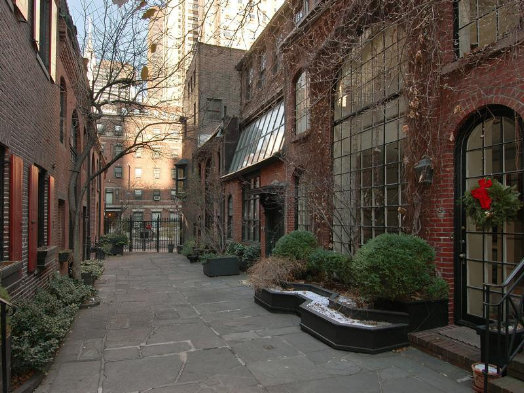
A PROPERTY IN Sniffen Court coming on the market is a rare event, but two up for grabs at the same time must be a first. Like Grove Court, MacDougal Alley, or Washington Mews, this little alleyway is one of the most desirable of those little nooks and crannies that hide amidst the hurly-burly of Manhattan. Tradition holds that Sniffen Court was built as stables by one John Sniffen around the time of the Civil War, but there is no record of any Sniffen ever having owned the properties (some therefore presume he was the architect). They were converted, like many mews around the city, from stables to residences in the 1920s and all have gradually adapted and changed since then.
The long and the short of it
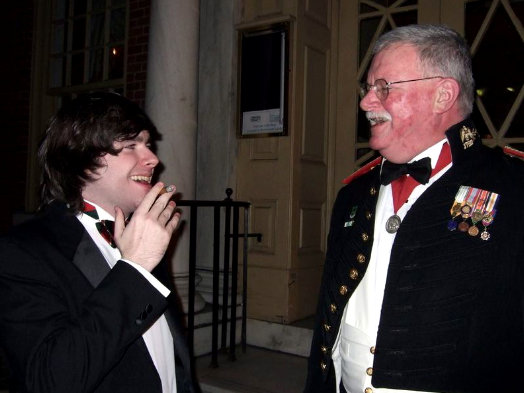
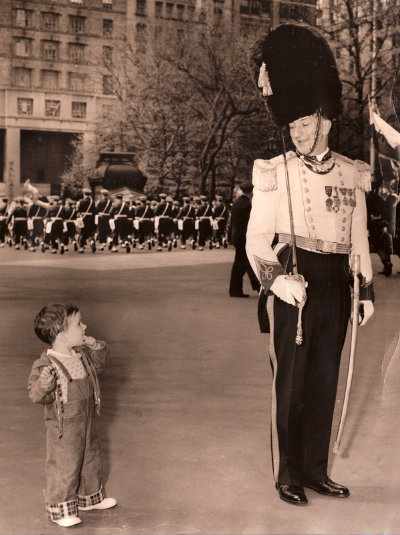
My Uncle Matt and I share a joke outside Fraunces Tavern while the 218th Annual Mess Dinner of the Veteran Corps of Artillery takes place inside.
And before anyone comments, yes I know I need a haircut! (Photo courtesy of Mike Leventhal)
Grand Central in the Good Old Days
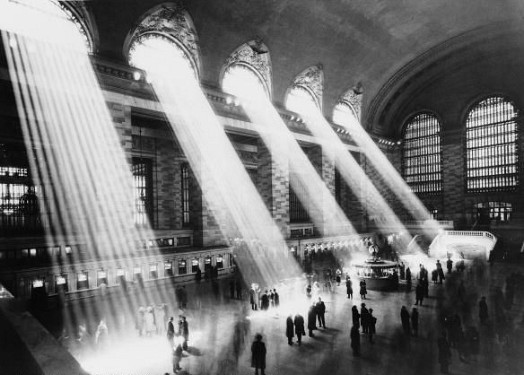
“Give me rail travel, trans-Atlantic liners, and electric cars and you will have Taki on your side,” writes our favorite Greek philosopher over on his online magazine. The invocation of rail transportation prompted one reader, Mr. Roland Maruska, to send in his response to Taki’s call:
I worked in the Central’s General Claims Attorney’s office at 466 Lexington Avenue in 1967 and 1968 and had enormous respect for my boss, Mr. J.T. Lynch, a fine man and World War II veteran. I learned first hand about sleazy lawyers and outrageous lawsuits, my favorite being the one brought by a woman who tried to commit suicide by jumping off a moving train, then, having failed, sued the railroad for not keeping the coach doors locked.
After work on Friday nights it was off to The Cattleman with friends for a small glass of brandy on the house (if one had to wait too long to be seated), a steak, and last a cigar, again on the house, then to the Railroad Enthusiasts club, which had its own room in Grand Central Terminal, in perpetuity due to the generosity of the railroad. Later some of us would head over to the Oyster Bar for a late night cocktail and hors d’oeuvres ( I hope I didn’t shock Taki with that one.), the latter courtesy of the excellent manager Mr. Drummond.
Ah, memories.
Previously: Grand Central Station at Night
The Feast of St. Sylvester
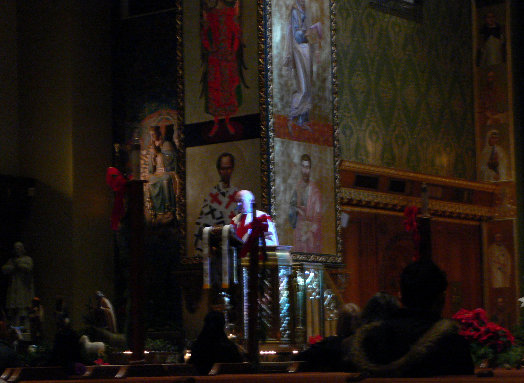
Fr. Rutler preaches, illuminated by the midday winter sun, at the Church of Our Saviour on the Feast of St. Sylvester. And a fine sermon it was, too.
Columbus Circle: A Wider View
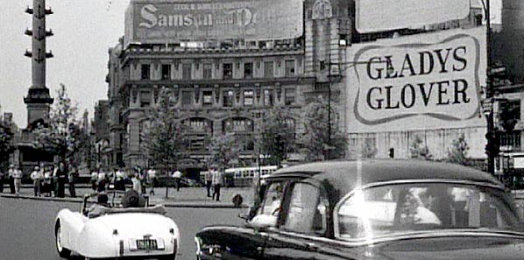
I THOUGHT THAT since we widened our window of opportunity, I ought to give you a wider view of this capture from the 1954 film ‘It Should Happen to You!’, previously displayed in our exposition on Columbus Circle and the Human Scale. The more recent rehabilitation of this grand public place was discussed in one of my diary entries. (more…)
Christopher Street, Greenwich Village
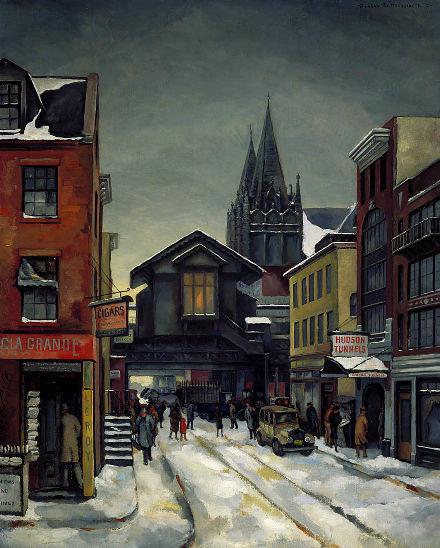
Beulah R. Bettersworth, Christopher Street, Greenwich Village
Oil on canvas, 30 1/8″ x 24 ¼”
1934, Smithsonian American Art Museum
Grand Central Station at Night
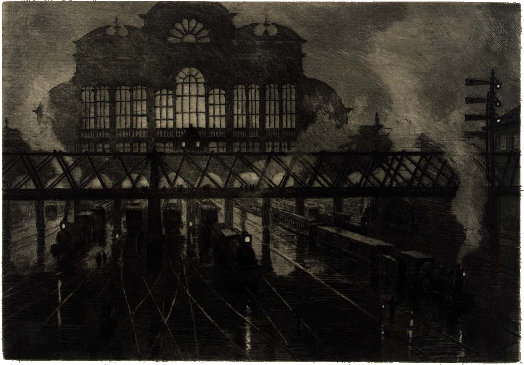
Charles Frederick William Mielatz, Grand Central Station at Night
Etching on paper, 7″ x 10″
1890, Smithsonian American Art Museum
This, of course, is not the Grand Central we know today, but its immediate predecessor.
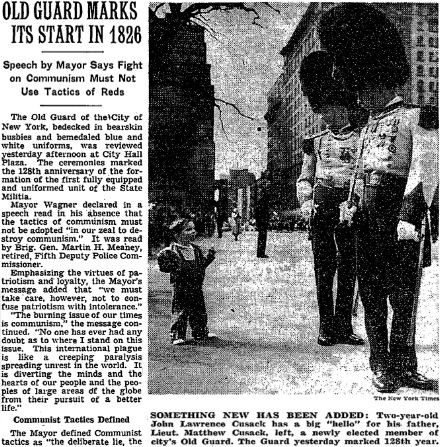
The Light Guard
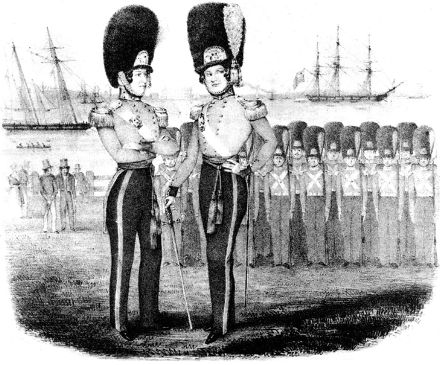
Officers of the New-York Light Guard, an antecedent of the Old Guard of the City of New York. The City Guard and the Light Guard combined in 1826 to form the Old Guard.
Categories: The Old Guard | Militaria
Upcoming Events
Tradition in New York
November 1, 2007 (Thursday)
The Feast of All Saints
Holy Day of Obligation
Latin Mass (Extraordinary Form)
7:30 pm
Church of Our Lady of Good Counsel
230 East 90th Street
(between 2nd & 3rd)
November 2, 2007 (Friday)
The Commemoration of All Souls
& First Friday
Latin Mass (Extraordinary Form)
6:30 pm
Church of St. Vincent de Paul
123 West 23rd Street
(between Avenue of the Americas & 7th Avenue)
November 5, 2007 (Monday)
Annual Solemn Requiem
of the New York Purgatorial Society
Latin Mass (Extraordinary Form)
6:15pm
Church of St. Agnes
143 East 43rd Street
(between 3rd & Lexington)
November 17, 2007 (Saturday)
The Sleep of Reason
Part one of the Roman Forum’s Modern Image & Catholic Truth series
9:00am – 4:00pm
Church of Our Lady of Good Counsel
230 East 90th Street
(between 2nd & 3rd)
Modern man has a positive image of himself that has been shaped and very effectively propagandized since the time of the Renaissance. In three conferences between November and May, the Roman Forum’s Modern Image and Catholic Truth series will explore the gap between this image and the true predicament in which the individual and contemporary society now find themselves trapped.
Part One: The Sleep of Reason
Modernity speaks of the eighteenth century Enlightenment as the “Age of Reason”. But proponents of the Enlightenment were often dubious about the ability of the human mind to understand man and nature and more interested in limiting the scope of rational activity than increasing it. Much of their labor ended by declaring the universe to be the mere plaything of the human will and passion, while practical backing for many of the Enlightenment’s goals came from strange combinations of mystical speculation and calls for the exercise of Machtpolitik.
9:00am
Holy Mass
(Latin, Extraordinary Form)
9:45am – 10:30am
Registration
10:30am – 11:30am
Pietism, Jansenism, Enlightenment
& the Victory of Power over Reason
Dr. John Rao
11:45am – 12:45pm
Adam Smith and Karl Marx:
A Study in the Logic of the Enlightenment
Dr. Jeffrey Bond
12:45pm – 2:15pm
Lunch
(A second Mass is also available in the Church)
2:15pm- 3:15pm
The Scientific Revolution & the Social Contract
Theory of Hobbes, Locke & Rousseau
Rev. Dr. Richard Munkelt
3:15pm – 4:00pm
Panel Discussion
For further information please contact the Roman Forum (dvhinstitute@aol.com or call 212-645-2971).
COST
$30: Reserve by November 10th
$40: Pay at the door, entrance and lunch
$10: Pay at the door, entrance alone
Checks payable to:
The Roman Forum
11 Carmine Street, 2C
New York, NY, 10014
The Rapalje Children
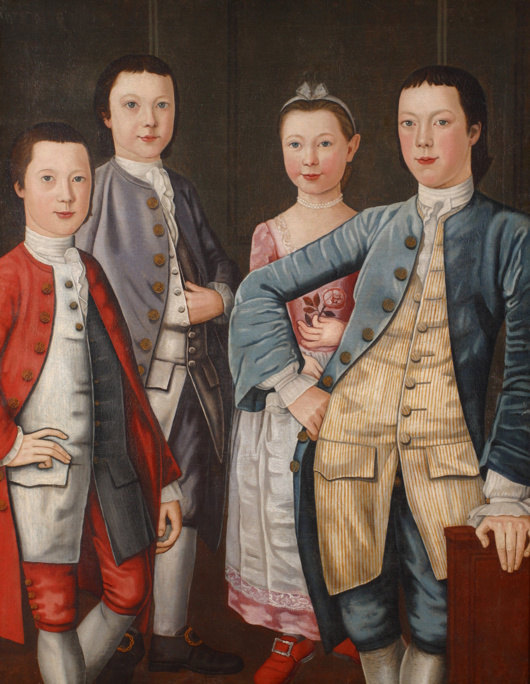
Oil on canvas, 50¾″ x 40″
1768, New-York Historical Society
Durand’s painting of the four children of this prominent mercantile family of Manhattan is one of the finest examples of group portraiture from the colonial period in America. From left to right are Garret (b. 1757), George (b. 1759), Anne (b. 1762), and Jacques (b. 1752).
The painter had come to New York from Virginia two years previous to paint individual portraits of the children of the Beekman family. Art historians suspect he was born or trained in France. Durand later returned to Virginia, where he continued to paint until his death in 1805.
Corpus Christi Church
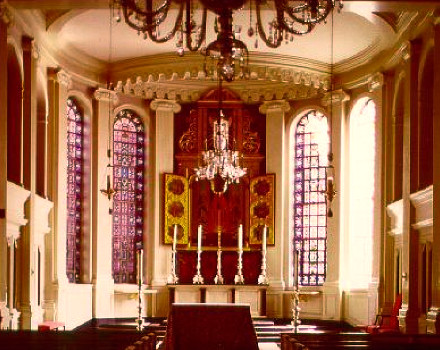
Corpus Christi Church, West 121st Street, New York: perhaps my favorite Catholic church interior in all New York, and one which simply cries out for a traditional Mass. (more…)
The Assay Office
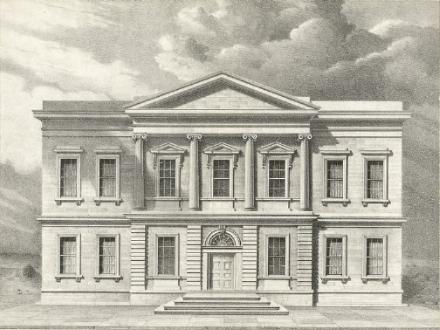
THE ASSAY OFFICE was built in 1822 as the New York branch of the Bank of the United States, located at 15½ Wall Street. The (Second) Bank of the United States was the second attempt at a central bank for this country. Eventually, the central bank grew too powerful, trying to manipulate politics and master the economy itself, and so it was abolished in 1836. The building later became the Assay Office, an adjunct to the Customs House and Sub-Treasury next door, which itself is now known as Federal Hall National Monument. When the Assay Office was torn down, the façade was preserved and donated to the Metropolitan Museum of Art by Robert W. de Forest in 1924. It is now presented in the glass-covered courtyard of the American Wing of the greatest museum of art in the New World. (more…)
Along the Hudson
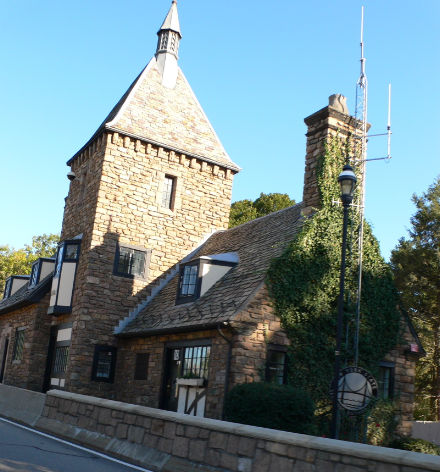
THE TOLLBOOTH AT THE Bear Mountain Bridge is built in a whimsical style meant to harken back to the Dutch patriarchs of old who roamed and ruled (and fell asleep in) these lands. The Bear Mountain Bridge spans the Hudson River between Bear Mountain and Anthony’s Nose, and was the longest suspension bridge in the world upon its completion in 1924. (As of 2007, it is the 62nd longest suspension bridge). The South Gate of the Hudson Highlands is composed of Anthony’s Nose rising from the east bank and Dunderberg (lit. thunder mountain) on the west, while Wind Gate between Breakneck Ridge and Storm King Mountain marks the northern reach of the Highlands. (more…)
USMA 37, Temple 21
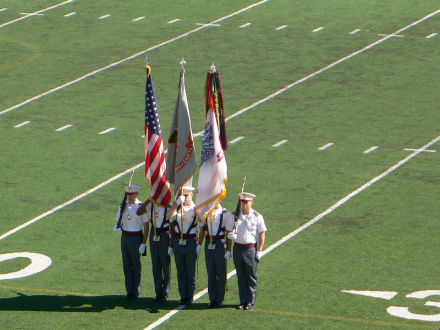
A HIKE UP into the Hudson Highlands, to see West Point trounce Temple University 37-21. (The last time I saw Temple play at Michie Stadium was in September 1994, when they beat Army 23-20). Army opened this game well by scoring a touchdown and field goal in the first minute, but gave the Temple Owls too much leeway, matching Army 21-21 by the half. Luckily, the Black Knights pulled through in the second half and finished the Owls off rather nicely. (more…)
Rip van Winkle
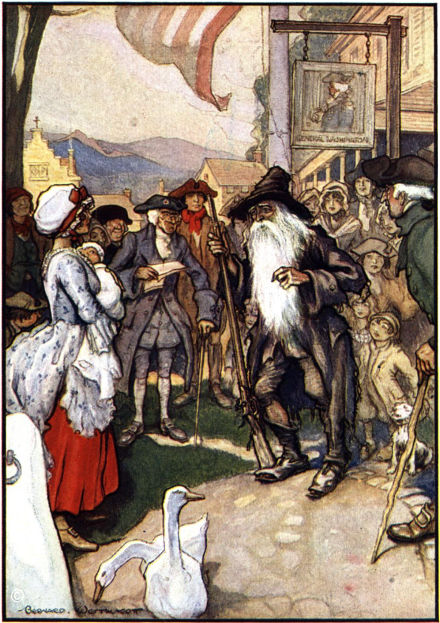
POOR RIP van Winkle; I always felt bad for him. He falls asleep for twenty years, and returns to his own native village where is now unknown and taken for some strange vagrant. “I am a poor quiet man, a native of the place, and a loyal subject of the king, God bless him!” he exclaims, in blissful ignorance of the Revolution which took place during his slumber. “A tory! a tory! a spy! a refugee! hustle him! away with him!” cry the by-standers.
I have long thought that Washington Irving was trying to make a subtle traditionalist point here: the definition of a good citizen has been arbitrarily changed. If a man was a good New Yorker in 1765 and hasn’t changed, why is he a traitor in 1785? It’s clearly ridiculous, except to proto-Jacobins and ideologues.
Anyhow, the lesson of the story: drink not from the flagons of odd-looking personages playing nine-pins amidst the Hudson Highlands.
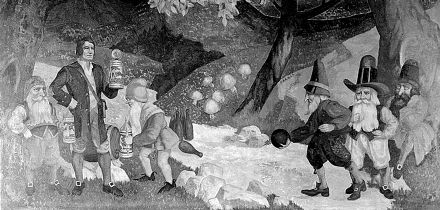
Previously: Rip van Winkle
They don’t all hate us
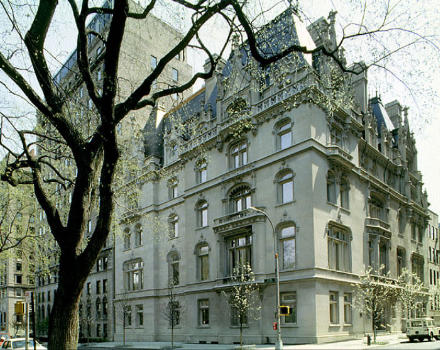
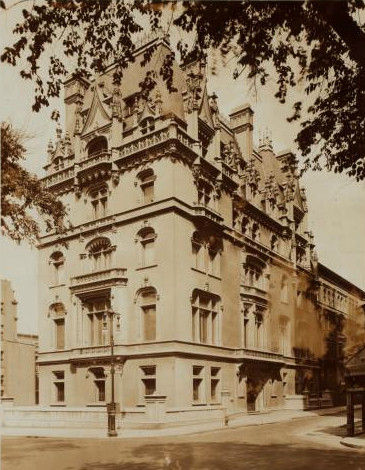
THE JEWISH MUSEUM sits at the corner of 91st Street and Fifth Avenue in the old Warburg mansion. It was expanded in 1993, nearly doubling its frontage on the avenue. See the modern addition? No? That’s the point.
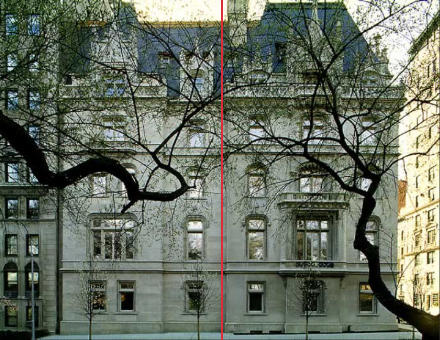
In the photograph above, the section to the right of the red line is the original Warburg house, built in 1909 and designed by C.P.H. Gilbert. The section to the left of the red line is the 1993 addition. If only the directors of the Morgan Library and the Brooklyn Museum had been similarly inspired.
Search
Instagram: @andcusack
Click here for my Instagram photos.Most Recent Posts
- Brunel’s Unbuilt Capitol February 3, 2026
- Cricket at Fordham January 27, 2026
- Palacio Barolo Revisted January 14, 2026
- Learning to Love Liguria January 14, 2026
- Crux Alba No. 2 January 13, 2026
Most Recent Comments
Book Wishlist
Monthly Archives
Categories