New York
About Andrew Cusack
 Writer, web designer, etc.; born in New York; educated in Argentina, Scotland, and South Africa; now based in London.
 read more
News
Blogs
Reviews & Periodicals
Arts & Design
World
France
Mitteleuropa
Knickerbockers
Argentina
The Levant
Africa
Cape of Good Hope
Netherlands
Scandinavia
Québec
India
Muscovy
Germany
Academica
Some Exceptionally Random Photos
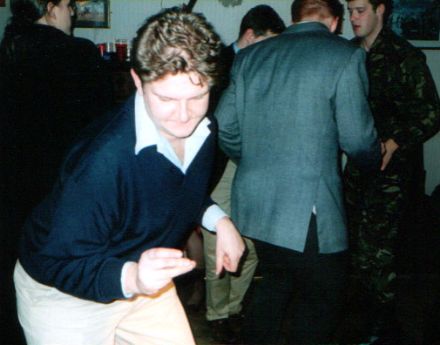
Clive jiving in the Mess.
Stanford White Palazzo
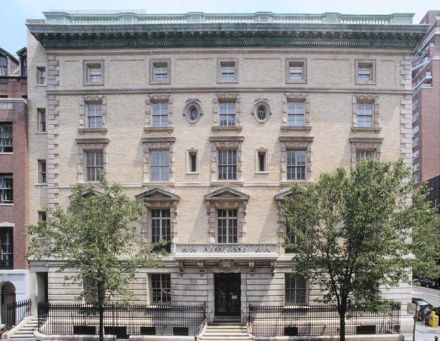
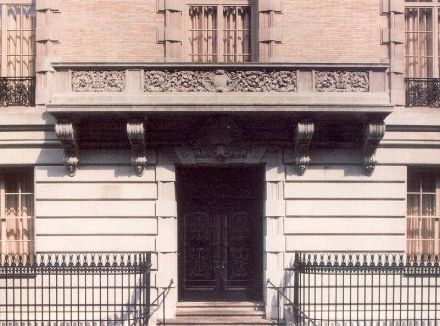
Got $50,000,000 to spare? Why not buy this Stanford White original on East 78th Street in Manhattan? Would be suitable for residence, offices, or club quarters. Even includes balcony from which fearless leader can make inspiring demagogic speeches. Who can resist? Contact Sotheby’s International Realty for details.
Last Night in the Metropolis
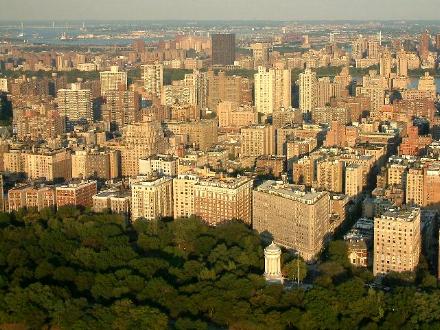
Last night I stumbled down into the city for the last time before I fly back to Britain tomorrow evening. I had the immense pleasure of taking a coffee with Adam Brenner and Dr. Nathaniel Kernell at Edgar’s Café on West 84th Street. Dr. Kernell, known varyingly as “the Good Doctor”, “Newbury”, “Mistah Lassitah”, and “the Genius of the Carpathians”, is the inimitable man who, in schooldays since past, had the task of teaching me Latin. (Our man Brenner is not a Thorntonian, but rather a Riverdale grad who had Dr. Kernell as a Greek and Latin tutor). His knowledge of subjects as varying as etymology, architecture, crime, and Jai alai is both profound and illuminating. Furthermore, he is gifted with a manner that is warm and inviting, if perhaps tempered by a tendency to ramble. The wandering tangents of Dr. Kernell, however, are not ad infinitum irritations but rather intriguing paths along which one picks up much more information, learning, and amusement than one would ever imagine. School would not have been the same without him, nor the quotations he bestowed upon our ears like priceless pearls. I foolishly only recorded a few in a little notebook I can’t find, but I believe Clara de Soto preserved more for posterity. I will have to get her to send me a few of the jewels.
Nonetheless dear readers, I’m back off to Caledonia tommorrow evening and thus of course it may be a few days before I settle in and get things organised enough to post again. I am, to boot, heading down to London pretty soon for the U.K. launch of the New Criterion as well. Fun shall be had by all!
A Bit of Sun
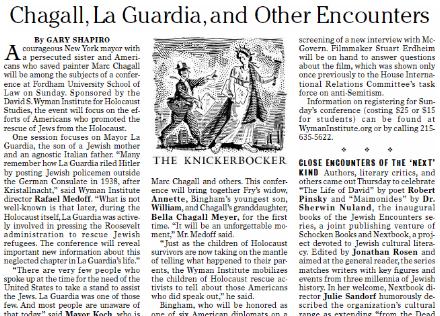
My ownly major aesthetic gripe against the Sun is the layout of the front page of their Friday second section, currently titled ‘Arts+’. (The ‘plus’ presumably refers to the inclusion of the Sports pages towards the end). Below at left is Section II as it appeared in the September 2-4 edition. The sans-serif font is just a tad too Gannett for a publication as esteemed as the Sun. To the right and below it I have placed two proposals for a reform of the Section II front page, both of which, I believe, are much more in keeping with the general aesthetic and demeanor of the rest of the New York Sun.
Rye Gothic
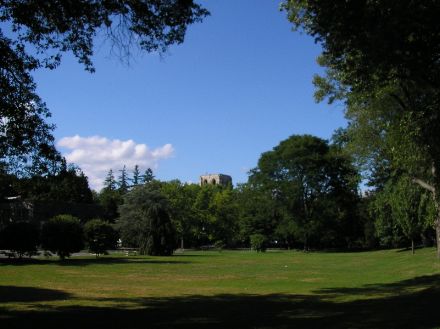
There’s a little portion of Rye on the Boston Post Road here in Westchester which is a veritable Gothic wonderland. From the south it begins on Rye High School’s beautiful campus with the track and playing field across a brook from the neo-Gothic middle and high school buildings, with sympathic additions covered in the same stone. Immediately to the north is the Victorian Gothic Rye Presbyterian Church, built in 1870 by architect Richard Upjohn, whose son and grandson designed two later additions, respectively. Just north of Rye Presbyterian is the Church of the Resurrection, and a little further north of that is Christ’s Church Rye, both of which are in the Gothic style.
The photo above shows the top of the crossing tower of the Church of the Resurrection, a 1930 structure built for Rye’s Catholic parish, viewed from Milton Road. I popped round to the area today and took a few photos, though I did not go inside Resurrection, as there was a wedding taking place. (more…)
Polo
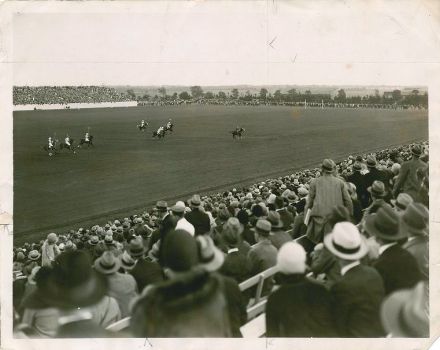
Second international polo match between the United States and the Argentine Republic, 1928.
The Church of St Agnes
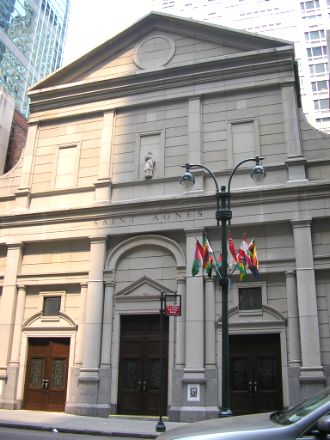
For those who have not seen St Agnes since it was rebuilt in a different style I thought I’d post a few photos I took after the 12:30 mass today. I don’t recall who the architect was; I believe it might be Thomas Gordon Smith. The reason for the vexilla-ed lampost is that East 43rd Street, in addition to being known as “Archbishop Fulton J. Sheen Place”, is also “U.N. Way” since the headquarters of that organisation terminates the vista eastwards. (more…)
Forty-fourth Street
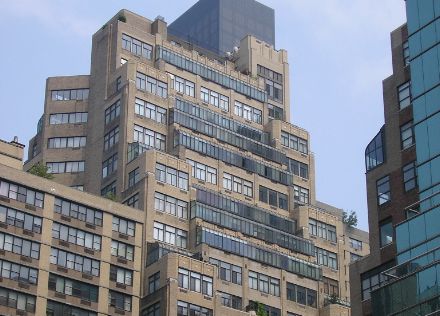
I caught this glimpse of an apartment building on 44th St today, and rather enjoyed the uniform appearance of the glassed-in terraces, later additions I imagine.
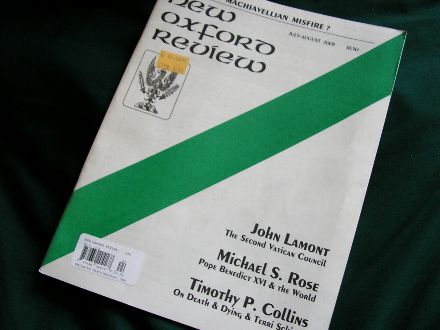
John Lamont in N.O.R.
We had something of a late evening last night at the Leviathan, in which I curiously had the chance to sample – perhaps that word is too modest, imbibe would be more accurate – a port which was, well, not a port. It was a port of New York, and I am not referring to the riparian locus wherein multifarious containers of a universal design speed cheap imported goods from the Orient to our fair city and beyond. Nay, the port was a fortified wine which claimed Long Island as its place of birth. Was it any good? Well, it was a little too fruity for my tastes, but then I’m a man of simple (some would say bland) tastes.
The Leviathan, for those who have not the pleasure of knowing it (which I take to be most of you) is a unique private club open to a select few young gentlemen and their occasional lady guests. It is not so much a club, but a private home which, given the absence of the parents off in foreign climes for rather extended periods of time, has been turned into a private club by the ingenious only child who is its sole permanent inhabitant. The club has a high proportion of members of French Canadian extraction, and features an interesting collection of Russian artifacts, provenance “unknown”.
As I was saying it was a late night, or rather late in Cusack terms as I left at half past one in the morning, and I am told the last members left around the hour of three. I nonetheless awoke this morning and took the train down to Manhattan and heard the resplendent treasure that is the Tridentine mass said in all its glory at the Church of St Agnes.
Whilst jolloping through the Hudson News shop in Grand Central, in the vain hope of being able to flip through a grievously overpriced imported latest edition of Country Life, I stumbled upon the latest issue of the New Oxford Review, the cover of which claimed that an article by John Lamont lay within. Delving into the formerly Anglican now ardent traditionalist Catholic publication I found that indeed it is the John Lamont we know and love. (He is also known as ‘Big John’ owing to his heighth and to differentiate him from the comparitively ‘Little Jon’ Burke).
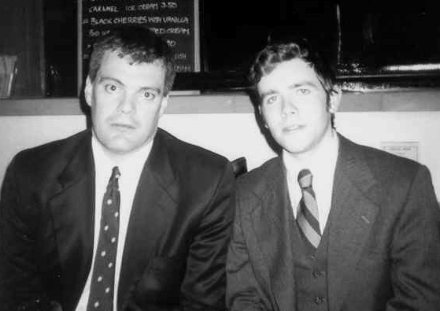
Anyhow, Big John is the Gifford Research Fellow at St. Mary’s College, the School of Divinity at the University of St Andrews. He and I are seen below in a photo taken by Rebecka Winell at a dinner in the Byre Theatre organized by Miss Victoria Truett in Candlemas term 2004.
Back in the Day
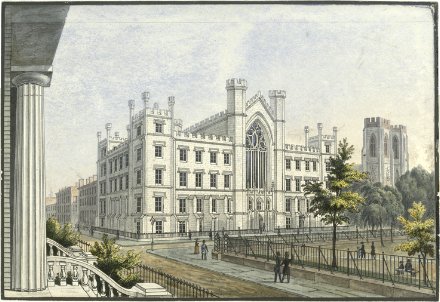
The University of the City of New York (now New York University),
Washington Square, 1850.
Public Elitism
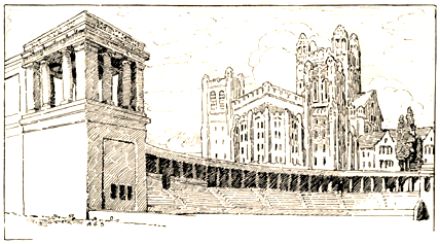
The Manhattan Institute‘s splendid City Journal of Spring 1999 carried an article worth a read entitled ‘How Gotham’s Elite High Schools Escaped the Leveller’s Ax’ on the few quality public schools left in the City of New York and how they managed to stem the tide of egalitarian senselessness.
Egalitarianism is one of the most morally repugnant of all ‘Englightenment’ ideas. To look upon success, label it “unfair” or “racist”, and then demand that, as a sacrifice to the false-goddess Equality, all must fail. It is the typical socialist formula that it is better that all wallow in poverty rather than only some (or even many but not all) succeed.
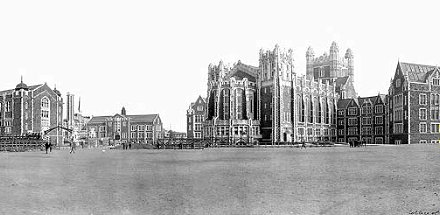
So a number of these high schools have survived. It is perhaps even more of a shame that none of the colleges did. City College was once known as “the poor man’s Columbia”. The quality of education at both City College and Columbia fell as a result of the cultural revolution of the 1960’s and 70’s. Columbia, for the most part free from the fetters of state intervention, never hit rock bottom and in many ways remains a quality institution, despite the highly politicized and racialized nature of many of its students and faculty. City College, however, went into freefall. Admission was thrust open to anyone who had graduated from a New York public high school, which coincided with the lowering of graduation requirements by these high schools. Thus you had students who could barely read and almost certainly could not write attending an institution which prided itself on its many Nobel laureates.
It is testament to the levelling zeal of the angry left that not even one college, not even one, within the entire City University of New York was allowed to maintain high standards of academic achievement. They will tear down with savage avarice the highest ideals of civilization to quench their destructive thirst. And these are colleges which for decades had been the ticket to freedom and success for hundreds and thousands of economically-disadvantaged New Yorkers. (Imagine if they had gotten their hands on the independent places of learning!). No wonder there are so many stupid people in New York these days.
But at least the high schools are still there, and calls for their emasculation are now few and far between. True, they are not ideal, but can we realistically expect a government-tethered school to be as such? Of course not. We should be glad that there remain at least a handful of public academies of high standards in New York available to all – rich, poor, and anywhere in between – based purely on merit.
St. Vincent Ferrer
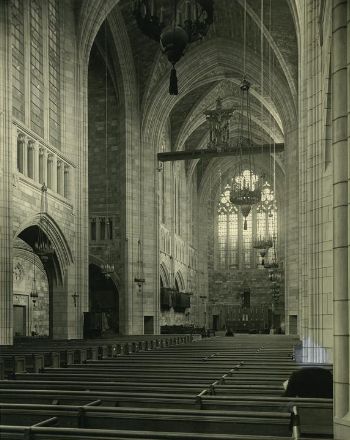
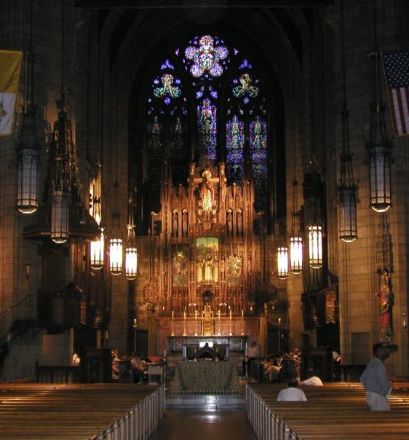
This photo shows the interior of the Dominican Church of St. Vincent Ferrer, designed by Goodhue, before it was fully completed. The stained glass has yet to be installed, and the same goes for the giant reredos which now graces the altar. A more current view is below.
The Goodwin Mansion II
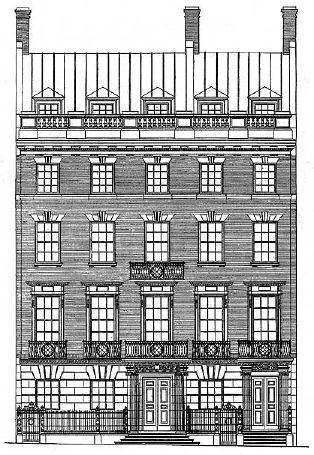
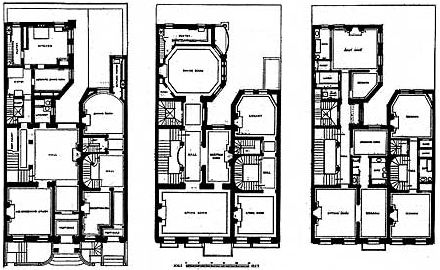
As an appendix to my previous post on the Goodwin mansion, I bring you an elevation of the facade (above) and the original plan of three of its floors (below).
The Colonial Colleges
| NAME |
LOCATION | FOND. | CHART. | DENOM. |
| Harvard College (Harvard University) |
Province of Massachusetts Bay |
1636 | 1650 | Puritan |
| College of William and Mary |
Colony and Dominion of Virginia |
1693 | 1693 | Anglican |
| King William’s School (St. John’s College) |
Province of Maryland |
1696 | 1784 | Non-denominational |
| Yale College (Yale University) |
Connecticut Colony |
1701 | 1701 | Congregationalist |
| Moravian College |
Province of Pennsylvania |
1742 | 1863 | Moravian |
| Newark Academy (Univ. of Delaware) |
Delaware Colony |
1743 | 1833 | Non-sectarian |
| College of New Jersey (Princeton University) |
Province of New Jersey | 1746 | 1746 | Presbyterian |
| Augusta Academy (Washington and Lee University) |
Colony and Dominion of Virginia |
1749 | 1782 | Non-sectarian |
| Public Academy of Philadelphia (Univ. of Pennsylvania) |
Province of Pennsylvania |
1749 | 1755 | Non-sectarian |
| King’s College (See below) |
Province of New York | 1754 | 1754 | Anglican |
| Rhode Island College (Brown University) |
Colony of Rhode Island and Providence Plantations |
1764 | 1764 | Baptist |
| Queen’s College (Rutgers University) |
Province of New Jersey | 1766 | 1766 | Dutch Reformed |
| Dartmouth College | Province of New Hampshire | 1769 | 1769 | Congregationalist |
| College of Charleston | Province of South Carolina | 1770 | 1785 | Non-sectarian |
| Salem College | Province of North Carolina | 1772 | 1866 | Moravian |
| Hampden-Sydney College | Colony and Dominion of Virginia | 1775 | 1783 | Presb. |
Note One: “Non-denom.” should be interpreted as Christian but not of a denominational nature. “Non-sectarian” should be interpreted as secular and having little or nothing to do with religion.
Note Two: King’s College in New York has two successor institutions: King’s College in Halifax, Nova Scotia, and Columbia University in New York, New York. The largest portion of the faculty of King’s College in New York fled north and in 1789 refounded the college in Windsor, Nova Scotia. However, the original buildings of King’s College were usurped by a new institution called Columbia College four years earlier in 1784.
King’s College formerly counted its foundation from 1754, while Columbia used the 1784 date. However, this has since switched and Columbia now proudly (though perhaps dubiously) claims 1754 as its foundation while King’s College more safely uses 1789.
Perhaps both institutions have a shared right to the founding date, as the loyal alumni continued their allegiance to King’s in Nova Scotia while the rebellious graduates considered Columbia the rightful heir. As stated, Nova Scotia had more of the people from the original foundation, whereas New York had little more than the physical building and a few of the graduates. I would be inclined to award 1754 to King’s College and 1784 to Columbia, (but then I’m biased against Columbia for being such a fallen institution).
Canon Bernard Iddings Bell
Warden of St. Stephen’s College in the Hudson Valley of New York
As for what the Church thinks and says, what influence does that have on the handling of American politics, the conduct of American education, the regulation of marriage and divorce, on sex and drink, on how industrial disputes are settled, on how we carry on business?
As a plain matter of fact, religion in this country is generally regarded as a tolerated pastime for such people as happen to like to indulge in occasional godly exercises — as a strictly private matter in an increasingly close-knit and socially acting society — in other words, as something that does not count.
I should like to see the Church recognize that it has been pushed into the realm of the non-essentials, and to persuade it to fight like fury for the right and the duty to bring every act of America and Americans before the bar of God’s judgment.
[Christian leaders] are making valiant claim to such a right and duty; but the great mass of Church members are content to regard the Church as a conglomerate of private culture clubs, nice for christenings, weddings and funerals. Most Church members readily agree with the unchurched majority that it is not the proper business of the Church to criticize America or Americans.
— Canon Bernard Iddings Bell
The 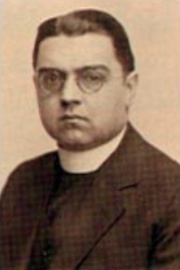 Rev. Canon Bernard Iddings Bell and seems to have been something all too rare in the history of America: a wise and presient Episcopalian cleric (which is not to say we have had any more than a mere handful of wise and presient Catholic clerics in this land).
Bell served as Warden of St. Stephen’s College – situated on the Hudson River here in New York – from 1919 to 1933, and is widely considered responsible for turning it into what was one of the best collegiate institutions in the country. In 1928, under Bell’s tenure, St. Stephen’s became a college of Columbia University, and this period of the College’s history was highly praised by the great Russell Kirk.
Kirk, in Decadence and Renewal in the Higher Learning, after positing his view of the ideal undergraduate college as a place of classical and liberal learning, takes note of St. Stephen’s. “There have been such colleges in this country,” Kirk wrote. “One such was St. Stephen’s College… when Dr. Bernard Iddings Bell was president. (He told me once that he gave up the presidency when strong objection was raised to his rule that the students should dress decently and rise when professors entered a room.)”
Of course, such arcadian days did not last. Only a year after Bell gave up the wardenship of St. Stephen’s in 1933, the college changed its name from honoring Saint Stephen, the first Christian martyr, to the more secular Bard College honoring the founder of the institution, John Bard.
A mere ten years later in 1944, Bard College became coeducational and as such severed its relationship with Columbia University, becoming independent as a secular, nonsectarian liberal arts college ‘affiliated’ with the Episcopal Church. The once-great college has now declined to such an extent that a professorship there is now named in honor of Alger Hiss, the man who betrayed America to spy for Soviet Russia. Sic transit gloria mundi.
Kirk relates another anecdote of Dr. Bell:
Canon Bernard Iddings Bell once showed a visitor from England about the environs of Chicago. They drove past a handsome Gothic building of stone. “Is that a school?” inquired the visitor.
“Yes– a new one, ‘distressed’ to appear old,” Dr. Bell replied.
“Indeed! Who is the headmaster?”
“There is no headmaster.”
“Curious! A kind of soviet of teachers, I suppose.”
“There are no masters at all.”
“Really? Do the boys teach one another?”
“As yet, there are no students. Here in the United States, we proceed educationally in a way to which you are unaccustomed,” Canon Bell told his friend. “First we erect a building; then we obtain pupils; next we recruit teachers’ then we find a headmaster; and at last we determine what is to be taught. You begin at the other end in England.”
Again, a quote from Canon Bell:
We need to forget the imaginary Christ who has been ours too long and to rediscover the real Christ, the Christ of the prophets and the martyrs and the confessors, the Christ who is not only the lover of souls but also master, a monarch with demands to make in industry, in finance, in education, in the arts, in marriage, in the home; the Christ who is teacher of a social ideology which has eternal validity; the Christ who cries aloud with convincing force, ‘He who would save his life will lose it; only he who is willing to lose his life, can find it.’
Rowing in Pelham Bay
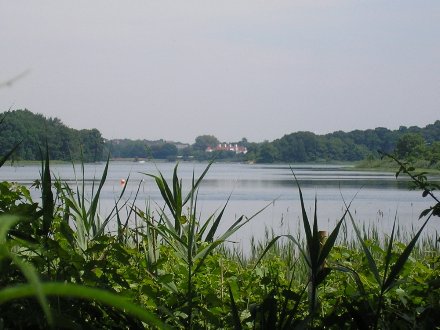
During the past fortnight, I have been learning to row on the lagoon in Pelham Bay Park, a body of water with which I had no previous aquaintance. “Learning to row?” you ask. “But weren’t you in the University of St Andrews Boat Club during your bejant year?” Yes, dear reader, I was a full paid-up member of said body, but I was too busy avoiding lectures, failing courses, and other such frivolities of one’s first year at university to actually row, and only went to circuit training when Ezra Pierce irritated me enough that I felt obliged to give in and head on over. Nonetheless, at the suggestion of a good friend I decided to enroll in this program and have not regretted it at all. Rowing, in short, is addictive, and it is a grand shame that I shall have to wait until at least September in Scotland to get back on the water. (Above, the Travers Island clubhouse of the A.C. can be seen from the far end of the lagoon). (more…)
The Carbuncle Responds
Well our favorite Jewess-turned-evangelical-turning-Catholic, Miss Dawn Eden, picked up on the complaints yours truly had about the Brooklyn Museum in her weekly Daily News column (scroll down, “A Boil Grows in Brooklyn”, NY Daily News, July 10, 2005). Well folks, someone at the B.M. must’ve been reading because later in the week upon collecting our mail I received an envelope from none other than the Brooklyn Museum itself.
The contents? Four free guest passes and a brief missive:
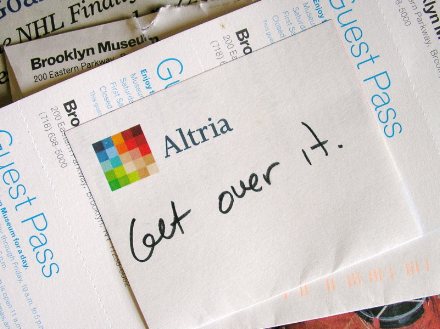
I laughed out loud when I read it. I’m glad they have a sense of humor, though it doesn’t make up for the new entrance. Nonetheless, I shall take them up on their offer. Perhaps the carbuncle is not quite as grievous in the flesh. Perhaps it’s worse. It remains to be seen.
The last time I went to Brooklyn (so far as I can remember) was to Fort Hamilton, one of the few remaining military installations in the city, back in 2000. It was Independence Day and my uncle was leading the artillery battery firing the salutes at the incoming tall ships for OpSail 2000.
Risen from the Ashes
by Austin Ruse
Sursum Corda, Summer 1998
The first wholly traditional Catholic parish structure built since Vatican II could not be situated in a more central location, at a more opportune time. New York is enjoying an astounding 1990s rejuvenation, bulging with tourists and new business. St. Agnes Church is at the center of it all, in midtown Manhattan, near Grand Central Station.
 Only at St. Agnes in New York City can an orthodox churchman be attacked from the right. Yet there they were, a dedicated band of angry young people picketing Msgr. Eugene V. Clark at Mass only one week after St. Agnes had burned nearly to the ground in late 1992. Their charge? That the good Monsignor intended to replace the old brick Gothic structure, now ruined, with what they called a “Swedish-Igloo-Modern.” Monsignor Clark never gets mad, but he got mad that day – although today he looks back on the incident with amusement. He even saved one of their flyers and is considering having it framed.
Did those excitable young men and women actually live within the parish boundaries of St. Agnes? No. But then hardly anybody actually lives in the East 40s. St. Agnes has maybe 100 to 150 residential parishioners. Nobody really cares, either; and this is one of the charms of St. Agnes. It is a commuter church located next to one of the busiest ports of call in the world, Grand Central Station. St. Agnes Church is a place that is searched out, discovered, chosen. To many it seems that St. Agnes chooses them.
But there was that awful day when many thought it might close. (more…)
The Vicious Carbuncle of Brooklyn
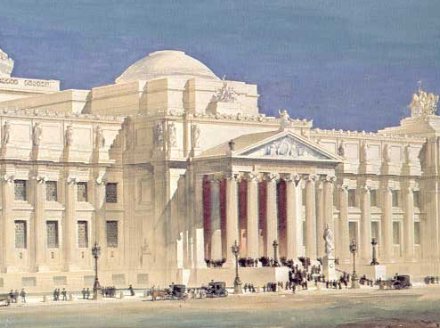
The Brooklyn Museum ought to be ashamed of itself. Though frequently overshadowed by its civic compatriot, the world-class Metropolitan Museum of Art in Central Park, this institution in Brooklyn’s Prospect Park is still considered one of the best museums in the United States. Its overall design was the work of the renowned McKim, Mead, and White who planned a sprawling beaux-arts palace for what was then known as the Brooklyn Insitute of Arts and Sciences. Their own illustration of the final design can be seen above and below (click the below image for a larger version). (more…)
Search
Instagram: @andcusack
Click here for my Instagram photos.Most Recent Posts
- Brunel’s Unbuilt Capitol February 3, 2026
- Cricket at Fordham January 27, 2026
- Palacio Barolo Revisted January 14, 2026
- Learning to Love Liguria January 14, 2026
- Crux Alba No. 2 January 13, 2026
Most Recent Comments
Book Wishlist
Monthly Archives
Categories