New York
About Andrew Cusack
 Writer, web designer, etc.; born in New York; educated in Argentina, Scotland, and South Africa; now based in London.
 read more
News
Blogs
Reviews & Periodicals
Arts & Design
World
France
Mitteleuropa
Knickerbockers
Argentina
The Levant
Africa
Cape of Good Hope
Netherlands
Scandinavia
Québec
India
Muscovy
Germany
Academica
Columbus Circle and the Human Scale
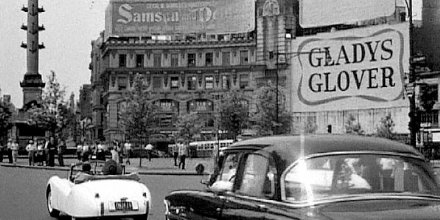
Meandering through the internet yesterday, I came across the above image from the 1954 film ‘It Should Happen to You!’ (via a New York Times article). The film capture shows Columbus Circle in 1954 and was I immediately struck by the superiority of the scale of the buildings to the street, especially compared to today when the Columbus Column is rather overshadowed by the AOL Time Warner Center. It’s not that I don’t like tall buildings; after all New York has some of the most beautiful skyscrapers in the world (though I can’t think of a single great one built after the second war).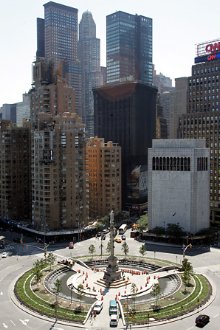 I don’t even object to the residential apartment buildings lining Central Park on Fifth Avenue and Central Park West, except for the fact that on Fifth Avenue they almost always replaced superior, smaller buildings. However, with a public square as small as Columbus Circle, it somehow seems as if lower buildings of only 3-10 storeys would be more appropriate.
The latest brouhaha concerns No. 2 Columbus Circle (the shorter, white building in the photo on the right), designed in the early 1960’s by Edward Durell Stone to house the art collection of Huntington Hartford. The current owners want to chic-ify the building by taking off the façade and recladding No. 2 in the more fashionable glass, akin to the neighboring Time Warner Center, and this has roused the ire of many of New York’s preservationist crowd. Though No. 2 has its charms, I’m not a huge fan of the building myself, but the redesign would only make it worse. The chief value of the building is its comparitively low height which, when viewed from the northwest, contributes to the feeling as if the midtown buildings are gradually lowering in height to meet the scale of Columbus Circle. Unfortunately the Time Warner Center doesn’t comply well with this lessening scale, though it at leasts goes through the motions by have a consistent, low base from which its two towers rise. The stone cladding of the Center, however, is rather too dark and gives a slightly gloomy feel to what ought to be a lovely, bright place. (more…)
A New York Funeral
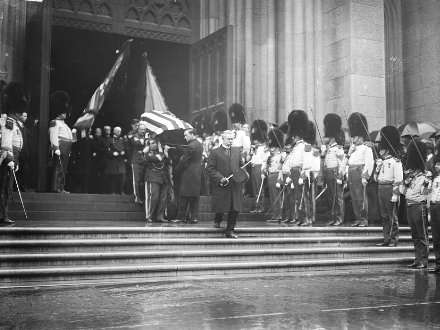
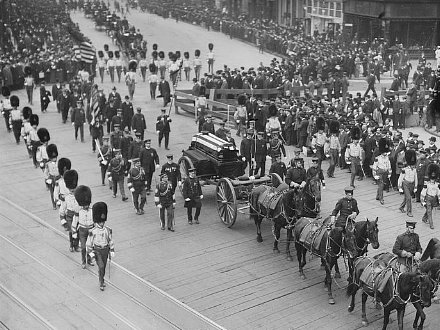
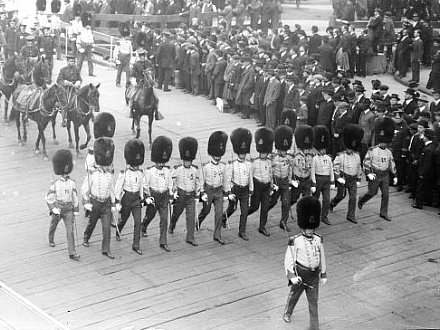
These photos are from the funeral procession of Gen. Daniel Sickles in 1914. Above, the General’s coffin leaves St. Patrick’s Cathedral. Below, the procession down an avenue (I can’t tell which one), eventually to be transported to Washington and buried at Arlington National Cemetery. The Old Guard of the City of New York provides the Guard of Honor.
Previously: Old Guardsmen | The Old Guard | Grandpa
What A Difference A Line Doth Make
I have always considered myself a patriotic New Yorker as well as being rather partial to the County of Westchester; the former being the greater whole to which I owe my loyalty, and the latter being the more familiar portion of which I am very fond. Yet a mere eight miles northeast of my place of birth, growth, and residence there lies a foreign land by the name of Connecticut. Now Connecticut is a fine little land in its own right, possessing natural beauty, some pretty towns and villages, and an ancient seat of learning. Living in Connecticut, one imagines, would not be a bad thing. The Connecticutian even enjoys the privilege of being able to serve in either company of the Governor’s Foot Guard or Horse Guards. Could I ever be a Connecticutian, then? No, I think not. It may just be an imaginary line separating Westchester in New York from Fairfield County in Connecticut, but no, I don’t think I could ever tear myself from the Empire State (nor would I want to!). Imaginary line perhaps, but a damned important one if you ask me.
At any rate, both my patriotism for New York and my suspicion of Connecticut suitably affirmed, I’ve decided to share with you a little amusing snippet I discovered while flipping through an edition of the William and Mary Quarterly, the premier scholarly journal on early American history published at the College of the same name. I must admit that reading it filled my heart with not a little admiration for Lewis Morris, despite scandalous support for and signature of the Declaration of Independence.
“It is my desire that my son Gouverneur Morris may have the best education that is to be had in England or America but my express will and directions are that he be never sent for that purpose to the Colony of Connecticut least he should imbibe in his youth that low craft and cunning so incident in the people of that Country which is so interwoven in their constitutions that all their art cannot disguise it from the world tho’ many of them under the sanctified garb of religion have endeavoured to impose themselves on the world for honest men.”
— Will of Lewis Morris of Morrisania, Westchester County, New York, November 19, 1760, Wills of New York County, Vol. 23, p. 430.
It also reminded me of that quip of Chesterton’s that God tells us to love our enemies and our neighbors, probably because they’re usually the same people.
‘Voltaire’s Castle’ Up For Sale
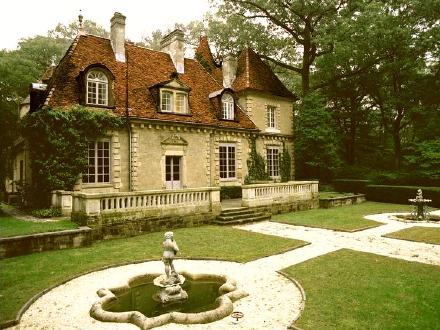
Want to live in a French philosophe’s petit chateau but don’t want to put up with high taxes, soaring unemployment, and immigrant neighborhoods in a permanent state of rebellion? Then boy have I got the house for you! The seventeenth-century Château des Thons, which tradition claims is where the dastardly ‘Enlightenment’ thinker Voltaire carried out his affair with Madame de Chatelet, was shipped during the 1920’s to the peaceful village of Upper Brookville, L.I. in the Great State of New York and is currently on the market. The house features Louis XIV panelling, a sweeping staircase, a tower, and a good few fireplaces.
One of my favorite Voltaire anecdotes is his confident claim – hilarious in hindsight – that “One hundred years from my day there will not be a Bible in the earth except one that is looked upon by an antiquarian curiosity seeker.” Two hundred and twenty eight years after his death, the Bible is still a best-seller and the most widely-read book in the world.
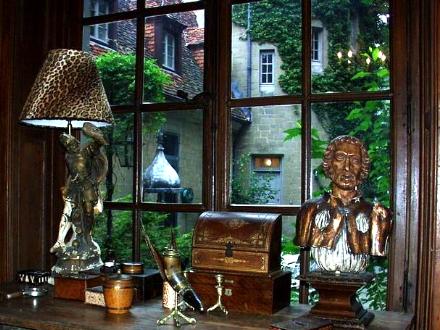
Clerics of the Old School
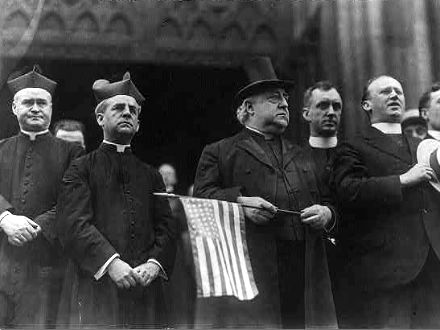
Msgr. Lavelle and others review the 69th N.Y. Regiment from the steps of St. Patrick’s Cathedral, 21 June 1916.
Previously: Your Royal Highness, Caed Mile Failte | Fighting 69th: Home for St. Patrick’s Day
Bronxville Library
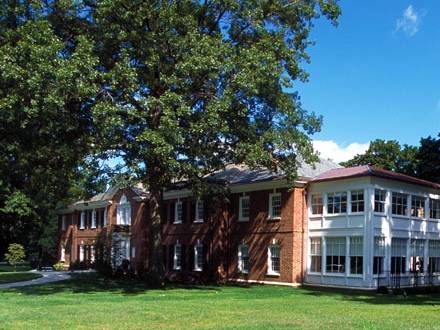
I do miss my library. In a perfect world, I would spend half the day wandering through various libraries of lower Westchester and the City. Of course we have a university library here in St Andrews, but its selection is fairly poor, especially in the subjects in which I am particularly interested. (more…)
Recent American Heraldry
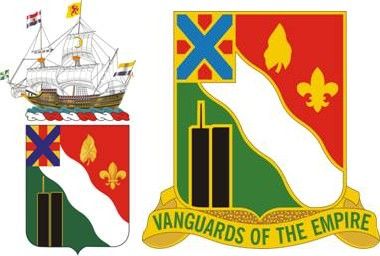
The Army Institute of Heraldry on 7 April 2006 approved a new coat-of-arms (left) and Distinctive Unit Insignia (right) for the 104th Military Police Battalion. According to the information provided by TIOH (as the Institute goes by), the red in the shield represents the unit’s role as a Field Artillery Battalion during World War II, while the green signifies the military police. The taro leaf represents the unit’s service in Hawai’i during the Spanish-American War, while the fleur-de-lis stands for service in France during both World Wars.
The black silhouette of the World Trade Center, a unique heraldic innovation, honors members of the unit who died in the Twin Towers on September 11, as well as the members of the battalion deployed to Manhattan. The service of earlier component units are represented in the canton. The red cross of St George symbolizes the War of Independence, while the blue saltire of St Andrew (akin to that of the Confederate battle flag) symbolizes the Civil War.
In blazonry, the language of heraldry, the shield is “per bend Gules and Vert, a bend wavy Argent, to chief a taro leaf and fleur-de-lis in bend Or; issuing from base the silhouette of the Twin Towers Sable edged of the fourth; on a canton of the last a cross Gules surmounted by a saltire Azure”. The crest is that which is standard to all New York Army National Guard units, depicting the Halve Maen on which Hudson explored New York harbor and his eponymous river. It is blazoned “from a wreath Argent and Gules, the full rigged ship “Half Moon” all Proper”.
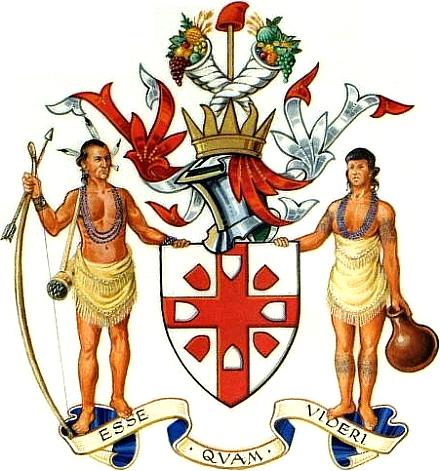
Meanwhile, the President of the Senate of North Carolina petitioned the College of Arms in London for a coat of arms for the upper house of the state legislature. The devisal by Letters Patent of Arms, Crest, and Supporters was made 25 November 2005 by Garter, Clarenceux, and Norroy and Ulster Kings of Arms. The eight little shields (known as escutcheons in blazonry) on the main shield allude to the eight proprietary Lords of the Province of Carolina. The colonial grant for Carolina was one of the most feudal, allowing the Lords of Carolina to grant minor hereditary titles of nobility, and in terms of heraldry allowed for the appointment of a Carolina Herald to grant arms independently of the College of Arms in England. The noble coronet atop the shield is apparently one of the heraldic ornaments worked out in 1705 for landgraves and cassiques in the Province of Carolina.
The shield of the coat of arms of the Senate of North Carolina is blazoned as “Argent on a Cross between four Escutcheons bases inwards Gules four Escutcheons bases also inwards Argent” while the crest is “Issuant from a Coronet of a Noble of the former Province of Carolina Or a Cap of Liberty Gules raised upon a Pole Or between two Cornucopiae in saltire Argent replenished proper”. The supporters are “On each side an Aborigine of North Carolina as depicted by John White in the reign of Queen Elizabeth the First that on the dexter a Warrior supporting with his exterior hand a Long Bow and holding an Arrow girded at his back a Quiver that on the sinister a Woman holding in her exterior hand a Gourd all proper”.
An interesting note: the lower house of North Carolina’s General Assembly was known as the House of Commons until the conquest of the South during the Civil War.
Images from the United States Army Institute of Heraldry and the College of Arms respectively.
Chinatown Bus Terminal
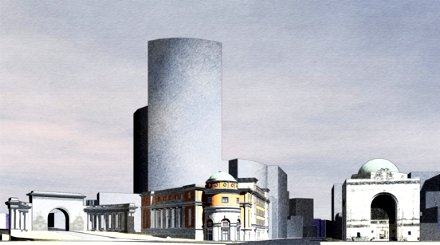
Chinatown’s Fung Wah bus is famously one of the cheapest ways to get to Boston, costing only only $15 to get to New York’s most northerly suburb. The preferred mode of transport between home and university for many a student and an economical mode of transport for the traveller-in-the-know, the chief deficiency of the ‘China bus’ as it is known is that in New York it just lets you off on a random street corner at the eponymous end of the Manhattan Bridge. Wendan Tang, a graduate student at Notre Dame’s School of Architecture (arguably the best in the country), produces his solution to the problem with a hypothetical design for a bus terminal in Chinatown, nudged between the bland modern Confucius Plaza and the beautiful classical entrance collonade and arch of the Manhattan Bridge.
Your Royal Highness, Cead Mile Failte
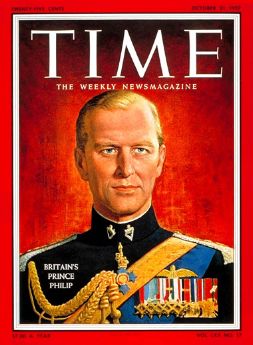
Thus wrote Francis Finnegan of the Ancient Order of Hibernians to H.R.H. Prince Philip, the Duke of Edinburgh, (above, in the uniform of the Queen’s Royal Irish Hussars) inviting him to partake in New York’s St. Patrick’s Day festivities in 1966 during his visit to North America. The invitation was made in recompense for the opprobrious breach of propriety in 1861 when Col. Michael Corcoran, Commanding Officer of the New York 69th committed an act of insubordination when he refused to order his troops to take part in the official festivities welcoming the Prince of Wales to New York. Corcoran was dropped from the Officers Roll of the New York State Militia for the offense, and was to be court-martialled but for the outbreak of the Civil War.
Finnegan, the public relations director of the New York St. Patrick’s Day Parade organised by the Ancient Order of Hibernians every year, assured the Duke of Edinburgh that he would not be mistreated as the Prince of Wales had been one hundred and five years previous. “Alas,” TIME magazine reported, “he arrived in Manhattan too late on St. Patrick’s Day to march in the Fifth Avenue parade, even though he did sport a fine green tie. Britain’s Prince Philip, 44, in a green tie? ‘Just a coincidence,’ chuckled the consort.” (TIME, 25 March, 1966).
The 1861 visit of the Prince of Wales to New York was a spectacular event, despite the insults of Col. Corcoran. A ball was held, just as for the Queen Mother during her 1954 visit to New York, as well as a parade and pass-in-review.
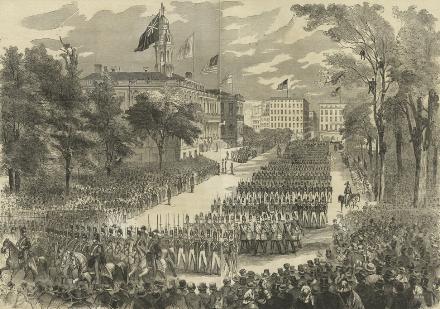
Fighting 69th: Home for St. Patrick’s Day
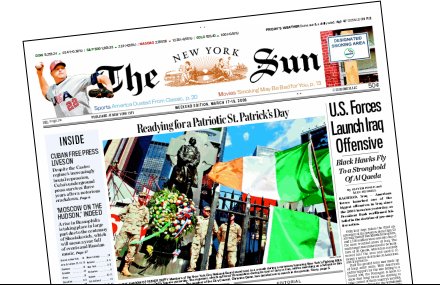
IN THE SHADOW OF FATHER DUFFY: Members of the New York City National Guard (sic) stand next to a wreath during a ceremony honoring New York’s Fighting 69th at Times Square’s Father Duffy Square (sic) yesterday. The regiment, which suffered 19 casualties during its tour of duty in Iraq, will be marching as a full unit in this year’s St. Patrick’s Day Parade on Fifth Avenue. The speaker of the City Council, Christine Quinn, has decided not to march in the parade. Story, page 3.
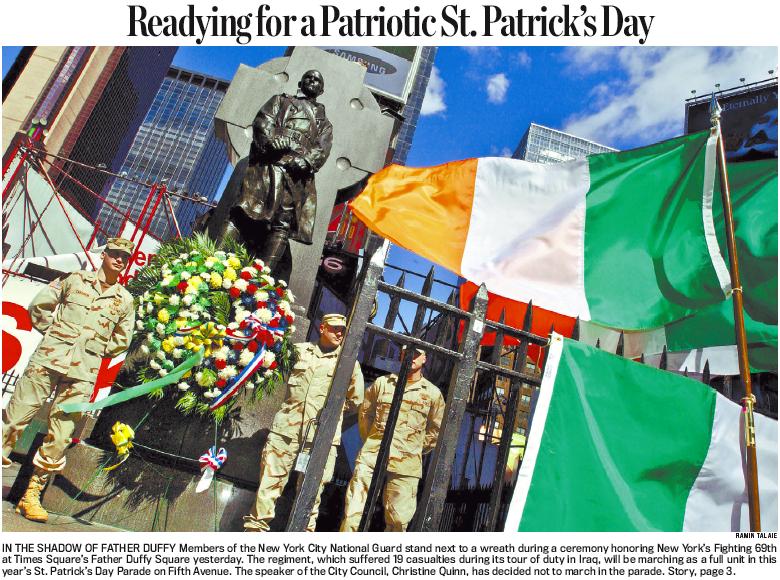
Despite the inaccuracies (it’s the New York National Guard, not New York City National Guard, and Father Duffy Square is opposite Times Square, not in it), it’s nice to see one of the Empire State’s greatest regiments remembered in the press, and on no less than the front page.
Further:
A Pat on hero’s back — Fighting 69th vet to lead parade in honor of slain pal (New York Daily News)
The Governor’s Suite, City Hall
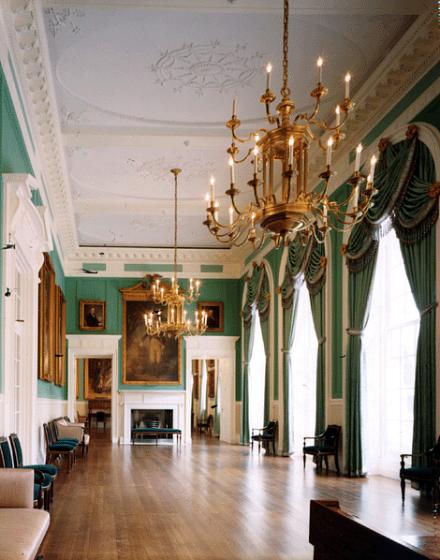
I HAVE NEVER been inside New York’s City Hall, though I have walked or driven past it on a number of occasions. With tall skyscrapers of various ilks towering over it, it always seemed rather small and inconsequential, and I knew nothing of the interiors save the Blue Room in which the Mayor usually gives press conferences and the rotunda which is fairly well-known as well.
I was delighted, therefore, to stumble upon the above photo of the recently-restored Governor’s Suite in City Hall, which shows it to have a rather handsome interior. Since the state government embarked upon an up-river journey to Albany, I presume the purpose of the Governor’s Suite is to provide a place for New York’s head of state to receive and entertain important dignitaries visiting the Big Apple. The current green color of the walls seems much preferable to the previous and rather dull white. I must endeavour to visit City Hall when I next return to the metropolis. (more…)
The Eastchester Covenant
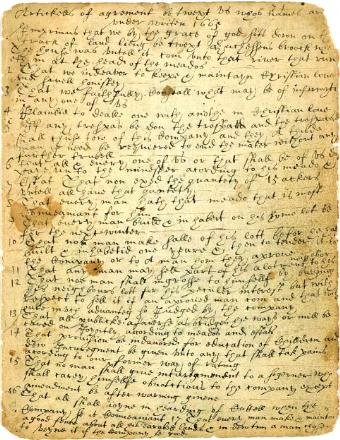
The Town of Eastchester, New York was settled in 1664 and in the following year the English inhabitants thereof drew up a covenant binding all the townsfolk. Among the various articles within this foundational tract are sensible pronouncements guaranteeing the rights of private property, forbidding trespassing, and a promise to “indeavor to keepe & maintayn Christian love and sivell honesty”.
My favorite part, however, is article 15, stating that “no man shall entertain obnoxious foreigners”.
Monster Swallows Village Whole
‘But will it give birth?’ the Villagers Inquire
“NYU is the largest private university in the United States and they are growing,” Andrew Berman, executive director of the Greenwich Village Society for Historic Preservation, told Community Board 2 Thursday night. “They are growing at a much faster pace than our neighborhood is. NYU has always been here. It should always be here. I don’t think the Village would be the Village if NYU wasn’t here. But I don’t think the Village can stay the Village if it is predominantly NYU.” And so a new campaign to get NYU to check it’s own expansions in the Village by creating a “secondary campus” begins. [Gothamist]
A secondary campus such as, for example, the one they sold off in 1979? I would have to concur that NYU has grown rather too large for the Village’s britches, and the fact that NYU is trying to build a towering dormitory where St. Ann’s once stood doth not encourage feelings of merriment (though, of course, the blame for that belongs mostly to our archbishop from the Middle West). At any rate, perhaps NYU can strike a deal and buy back the University Heights campus. Unlikely, since the City University of New York which now owns the campus (run as Bronx Community College) would probably like to see itself as a competitor to NYU (it isn’t; they’re leagues apart).
Of course one idea is to stop expanding and maintain the current size and facilities of the university, but this is unlikely. NYU have displayed a Hitlerian glee in the acquisition of neighboring properties, and, to stretch the analogy beyond any rational use, Fordham, St. John’s, and Columbia have no strategic interest in acting as the UK, US, and Soviet Union (respectively) in uniting to counter that expansion.
Previously: Thoughts on NYU et cetera | Back in the Day | New Washington Square Plans | NYU – Old & New
New York in the Early Republic
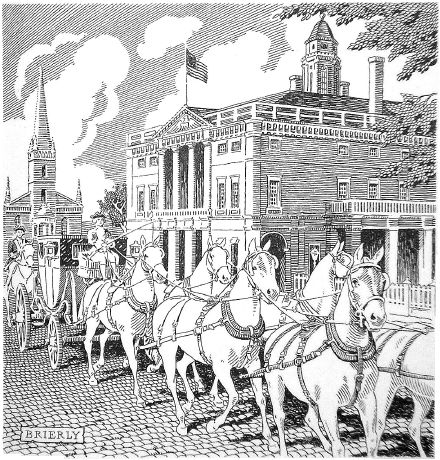
IT IS NOT OFTEN remembered that New York was the first capital of the United States and, as such, was home to the executive, legislative, and judicial branches of the new republic, albeit only for a short time. Federal Hall (above, with the Presidential carriage) was originally constructed in 1699 as a City Hall for New York. It was in this building at 26 Wall Street in 1735 that John Peter Zenger was tried and acquitted of libeling the Governor, affirming the Freedom of the Press. The Continental Congress began meeting in the City Hall in the 1780’s, and with the ratification of the new Constitution of the United States it became the first home of the federal government. Having been elected the first President of the United States, General George Washington was inaugurated on the balcony of the building on April 30, 1789. (more…)
Fresh Kills

Hail, rustic metropolis! I’d file this view of Fresh Kills on Staten Island under ‘You’d Never Believe You’re In New York City‘. The name might seem odd to those who aren’t either New Yorkers or Dutch. ‘Kill’ is a common placename in the Empire State, from the Middle Dutch ‘kille’ meaning riverbank or channel of water. Exempli gratia Arthur Kill, Kill van Kull, Fishkill, and Peekskill in New York, or the Schuykill River in Pennsylvania.
Previously: Rowing in Pelham Bay
The Queen Mother in New York, 1954
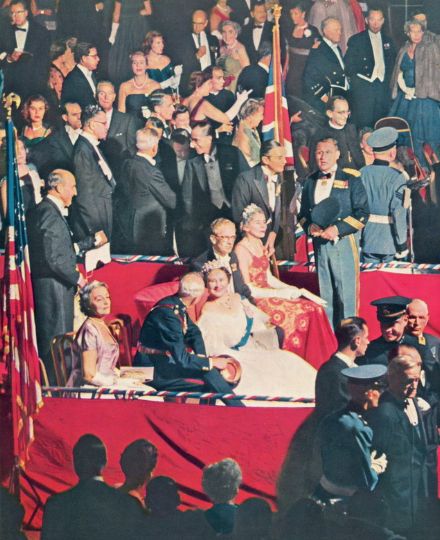
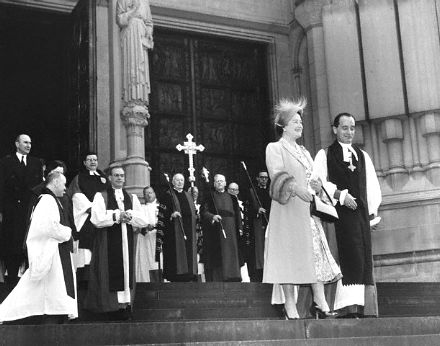
In 1954 Queen Elizabeth, the Queen Mother (n.1900, m.2002) visited New York to accept an educational fund raised by Americans in memory of the late King George VI. On the evening of November 1 of that year, the Seventh Regiment entertained Her Majesty with a special ball held in her honor at the Armory on Park Avenue (view above). Her Majesty also visited the Cathedral of St. John the Divine where she was received by the (Episcopal) Bishop of New York, the Dean, and the clergy of the Cathedral. The three stone blocks on the façade seen in the view below have since been sculpted.
Savoy in New York
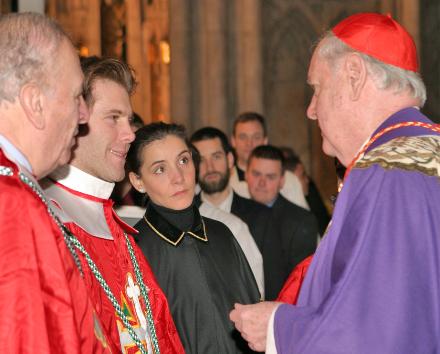
New York recently played host to the Prince and Princess of Venice and Piedmont, Emanuele Filiberto and Clotilde of the House of Savoy. Emanuele Filiberto is the son and heir-apparent of HRH Vittorio Emanuele the Prince of Naples (Vittorio Emanuele IV) who currently lives in voluntary exile from the Italian Republic. The laws forbidding the House of Savoy from visiting and living in Italy were finally overturned in 2002.
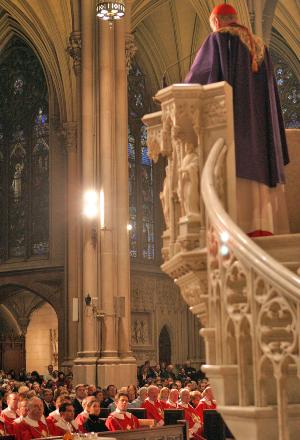
The two day visit to New York organized by the American Delagation of Savoy Orders culminated in a Solemn Mass in St. Patrick’s Cathedral on January 6 said by His Eminence Cardinal Egan, himself a Cavaliere di Gran Croce. About three dozen members of the orders of the House of Savoy attended the Mass with friends and family.
The 7th Regiment in Washington Square
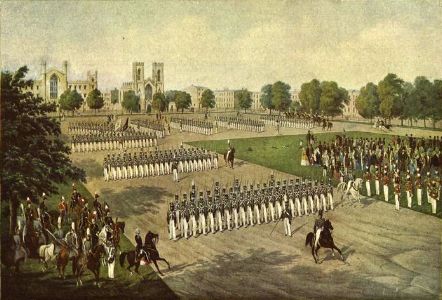
Entitled “National Guard – 7th Regiment New York State Militia”, this mid-nineteenth century view shows the famous 7th Regiment of New York, nicknamed the Silk-Stocking Regiment, parading in Washington Square. In the background can be seen the University of the City of New York and the Church of St. Thomas, which has since moved to Fifth Avenue in Midtown.
Thomas Dongan, 2nd Earl of Limerick
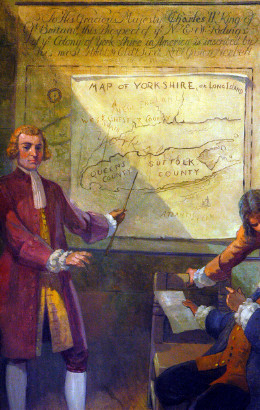 Thomas Dongan establishing the counties of New York |
AS VIRGINIA, a year short of four centuries since her foundation, has only recently inaugurated her first Catholic governor, it might be an appropriate time to remember the first Catholic governor of New York, Thomas Dongan (right). Dongan’s tenure as Governor of the Province of New York was one of the most important in the history of our land, and witnessed the formative period of responsible government in what would eventually become the Empire State.
Thomas was born in 1634, the youngest son of Sir James Dongan, Bt., a Member of the Irish Parliament. After the regicide of Good King Charles in 1649, the Catholic family feared persecution and fled to France, as did the Royal Family. In France, having Gallicized his surname to D’Unguent, Thomas joined an Irish regiment and fought under the Vicomte de Turenne (who himself, born into Calvinism, became a Catholic in October 1668). Despite the Restoration of the Crown in Britain and Ireland, Dongan remained in France, being promoted to colonel in his fortieth year. The 1678 Treaty of Nijmegen, however, required all of Charles II’s subjects in the service of France to return home, and so Thomas obliged. Through the efforts of James, Duke of York, with whom Dongan had the privilege of serving in the French Army, he was granted a pension, a high-ranking commission, and was appointed Lieutenant-Governor of Tangiers, of all places, which (along with Bombay) had been given to England as part of the dowry of Catherine of Braganza.
It was in 1682 that James, Duke of York, as Lord Proprietor of New York, appointed Thomas Dongan to govern the bankrupt colony. “In this office,” the Catholic Encyclopedia says, “Dongan proved himself an able lawgiver, and left an indelible mark on political and constitutional history.” He convened the first representative assembly of the Province in 1683, which enacted the Charter of Liberties enunciating the form of government in New York. The Duke of York’s supreme legislative power as Lord Proprietor would reside in a governor, council, and general assembly. Members of the assembly were conferred rights and privileges making their august legislature coequal to and independent of Parliament. Courts of justice were established, liberty of conscience regarding religion was declared, and the principle of no taxation without representation was affirmed. Dongan signed the Charter of Liberties on 30 October 1683, and solemnly proclaimed it the next day at the Stadt Huys, New York’s city hall.
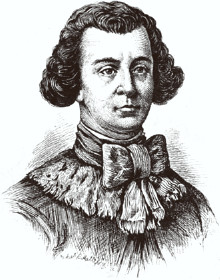 “Thus to Dongan’s term as governor,” quoth the Encyclopedia, “can be dated the Magna Charta of American constitutional liberties, for his system of government became the programme of continuous political agitation by the colonists of New York Province during the eighteenth century. It developed naturally into the present state government, and many of its principles passed into the framework of the Federal Government. Moreover, a rare tribute to his genius, the government imposed by him on New York Province, 1683, was adopted by England after the American War of Independence as the framework of her colonial policy, and constitutes the present [1909] form of government in Canada, Australia, and the Transvaal.”
The peace and harmony of the Province was furthered in 1684 when Dongan, in the presence of Lord Howard, the Governor of Virginia, received the voluntary submission of the Iroquois confederacy to “the Great Sachem Charles”. The following year saw the death of Charles II and the ascent of the Lord Proprietor, James, Duke of York, to the thrones of England, Scotland, and Ireland. In that year of 1685, Dongan established a Post Office to strengthen communications within his colony and between all the English colonies in America. In the next year, 1686, the Governor granted civic charters to New York and Albany. Dongan’s charter for the City of New York lasted 135 years, while that of Albany was only replaced in 1870. Avid historians would have been bemused/irritated by Archdiocese’s celebration just a few years ago of the two-hundredth anniversary of Catholic education in New York. This would be because New York’s first Catholic school was not in the 1800’s during the republic’s early years but in the 1680’s when Governor Dongan established a college (in the secondary sense) under the guidance of three Jesuit priests, one of whom was his own private chaplain.
Despite the brief attempt to merge New York and New England, followed by the overthrow of James, our last Catholic king, in the so-called ‘Glorious Revolution’, Governor Dongan’s legacy in establishing the institutions of responsible government in New York remains. Indeed he was unquestionably New York’s greatest governor until the advent of ‘Magnus Apollo’ himself, DeWitt Clinton, in the nineteenth century. With the new Protestant Williamite administration in charge, Thomas Dongan returned to England in 1691 and, with the death of his elder brother, inherited the Earldom of Limerick under its first (1686) creation. He died in 1715, poor and childless. Nonetheless, as the Encyclopedia notes:
The tribute of history to his personal charm, his integrity, and character, is outspoken and universal. His public papers give evidence of a keen mind and a sense of humour. He was a man of courage, tact, and capacity, an able diplomat, and a statesman of prudence and remarkable foresight. In spite of the brief term of five years as Governor of New York Province, by virtue of the magnitude, of the enduring and far-reaching character of his achievements, he stands forth as one of the greatest constructive statesmen ever sent out by England for the government of any of her American colonial possessions.
Search
Instagram: @andcusack
Click here for my Instagram photos.Most Recent Posts
- Brunel’s Unbuilt Capitol February 3, 2026
- Cricket at Fordham January 27, 2026
- Palacio Barolo Revisted January 14, 2026
- Learning to Love Liguria January 14, 2026
- Crux Alba No. 2 January 13, 2026
Most Recent Comments
Book Wishlist
Monthly Archives
Categories