Great Britain
About Andrew Cusack
 Writer, web designer, etc.; born in New York; educated in Argentina, Scotland, and South Africa; now based in London.
 read more
News
Blogs
Reviews & Periodicals
Arts & Design
World
France
Mitteleuropa
Knickerbockers
Argentina
The Levant
Africa
Cape of Good Hope
Netherlands
Scandinavia
Québec
India
Muscovy
Germany
Academica
St Andrews on the Beeb
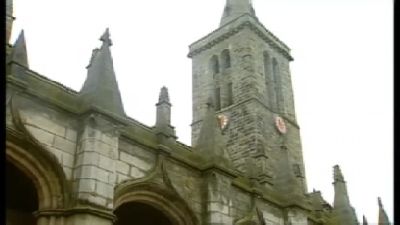
Here at good old St Andrews we find ourselves thrust into the lens of the news camera, this time thanks to the Association of University Teachers strike. Basically, the AUT are on partial-strike (they won’t set exams and won’t grade papers) in hopes of better pay. The idea is that by the time exams come around in June the whole thing will be settled. Unfortunately, here in Scotland our exams our a month earlier in May, so there’s a good chance that the strike will disrupt some students’ exams.
To solve the quandary, the University decided to negotiate locally with the AUT chapter in St Andrews. After all, why should our superb institution be cast in with all the others? Well, the University administration made a good offer and the local chapter voted 94% in favor of the deal. Swell! At least it was until the national AUT came in and said “Sorry chaps, we’re invalidating your ballot. How many times do we have to tell you: don’t think for yourselves, just do as Union says!”
So BBC Scotland sent out their intrepid reporter to interview a few folks, and if you watch the video you can see the Younger Hall where I will be graduating in June. I will be graduating because not all the teachers are on strike. In fact, I think most St Andrews lecturers and tutors aren’t in the union. But it’ll still cause a right ruckus for some if the whole thing isn’t sorted out. The University will stick to the agreed pay deal nonetheless.
Local lecturer pay deals rejected, BBC News, click ‘ Views on the lecturers’ pay deal impasse’ on the right for the video.
March against exam papers action, BBC News, (same video link).
A Mighty Headache
Ask not for whom the bell tolls, it tolls for thee…
As I sat in bed this morning, hearing the bells of St. Salvator’s summoning the studentry from their cozy chambers to the hebdomadal chapel service, the fifteen minutes of tolling summoned naught but two thoughts from the deep recesses of my brain: doom and misery. The reader will forgive this rather grim introduction, but grim was precisely the feeling in the ascendant this morning. I shall continue by retreating to the beginning.
The merriment began at about one o’clock in the afternoon in the Central bar, as have many a session of merriment and good laddery. My good friend Chris C. was visiting the Royal Burgh for the weekend and we decided to head to the Central for a smooth, satisfying pint of John Smith’s, which is the preferred tipple for joint C./Cusack operations. Making our way to that public house, we chanced upon none other than Manuel Pantelias Garces, the little fellah who packs a tremendous punch, and invited him to join in our imbibing of Yorkshire ale.
And imbibe we did. We had one pint of John Smith’s, followed by another, then another, and then another until I swept over to Step Rock Cottage to be fashionably late for Jon and Abby’s engagement party. There, for some unknown reason, I declined copious amounts of Louis Jadot instead deciding to drink down a mighty torrent of Bucks Fizz. In a jocular and celebratory mood, I decided to purchase a ticket to tommorrow’s charity polo tournament off Richard Holtum, and discussed various things with Adrian and young Miss Tori Truett who had popped up from London to grace us with her beauty and wit. (more…)
Old Speckled Hen
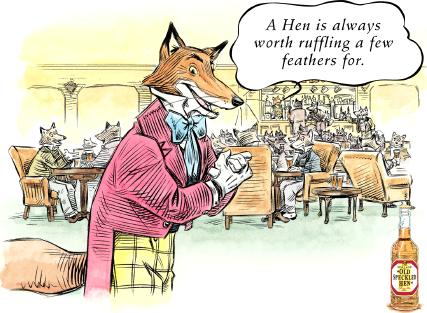
Spring has come late to Fife this year, but I do think we’re all the better for it. One appreciates so much more these spriteful spring days after a longer dark season, though in all honesty I already partly miss the many snowy days we enjoyed in St Andrews this winter. How splendid it is to warm oneself by the fire on a cold winter’s day, with a cup of coffee or a pint of ale and some Washington Irving to read. None of that today, however!
Quite a decent day, really. The eleven o’clock Mass saw a good friend received into the Church, followed by her Confirmation along with another friend of mine. After the post-Mass tea and coffee, myself, young McMorrin, Tom Howard, Adrian, Miss Brennan, Michelle, and Miss Dempsey got sandwiches from Cherries and enjoyed the sun-soaked ruins of the Cathedral cloister. I had a delicious honey mustard chicken and stuffing brown-bread baguette, splendidly washed down with a bottle of Old Speckled Hen. (more…)
Some Photographs
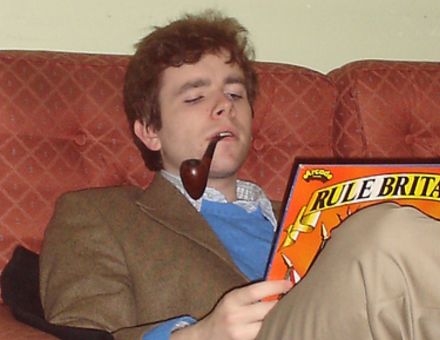
A young lass of Ulster claims I look “adorably marriageble” in this photograph. (more…)
I am an Uncle
Hot dang, what a break! I am now safely entrenched in my humble little chamber in St. Salvator’s Hall, North Street, Royal Burgh of St. Andrews, Kingdom of Fife, Scotland, United Kingdom of Great Britain and Northern Ireland, God’s Own English-Speaking World, the Planet Earth, the Milky Way, the Universe, the Mind of God. The first week of my two-week vacation, you will no doubt recall, was spent in the Eternal City: Roma, Caput Mundi. I had not been to Europe in six years, I believe, and since that time the entire continent has adopted Monopoly Money as the official currency. Johnny Foreigner, what will he do next! Despite being in Europe, it is Rome after all, and thus both the birthplace and font of Western Civilization. A suitably humbling experience. Brilliant.
Then an exceedingly brief foray to Trinity College Dublin in our neighbourly Republic to have a few pints and some damn good laughs with one of the leaders of Youth Defence, Ireland’s main pro-life group, (I would give his name but it’s Gaelic and thus impossible to spell) and to hear an update on the general state of things large and small in Éire. Despite being civilised English-speakers over there, they seem to have adopted the Monopoly Money as well. Odd.
Then to Somerset (or ‘Zomerzet’ as the endearing locals call it) to the great Basilica and Monastery of Saint Gregory the Great, founded at Douai in France, removed to Acton Burnell in England to escape the nefarious and ungodly French Revolution, and currently located at a place most commonly called Downside. Our good friends Robert and Maria O’Brien upheld their usual high standard of entertainment. A week in the English countryside is a most enjoyable thing after having spent week on the Continent, perhaps even necessary. Last night, Jon and Abby joined us since they were in nearby Bristol and we all got drunk as lords. To top it all off, Pop called heralding the birth of Master Finn Daniel Larson, thus elevating me to Unclehood. Well, as you can imagine, we had even more to drink after hearing that news. Splendid!
Well friends, you can appreciate the need for a little rest and relaxation, even though I just spent a week resting and relaxing at Downside, so I will bid you adieu for now. You can expect a full report on our amazing Roman expedition within the next few days.
A Victory for Common Sense

In a shocking defeat for the Hacks, Tom d’Ardenne has been elected President of the University of St Andrews Students Association, though not without a fight! First, the background.
What is the Hack? The Hack is a strange subspecies of human which populates the myriad committees and offices of the Students Union. They are vile, strange, self-delusional people who live in an alternative universe purely of their own creation. The Hack is the enemy of all that is good and holy and sensible in this world. They have committee meetings which are hours long and which achieve nothing. They devote indordinate amounts of time to the Students Association, and to no real use. The Union (and all its works and worthless pomps) has absolutely no bearing, impact, or influence on the lives of the overwhelming majority of students. Hacks pretend this isn’t so, and when they are confronted with this reality (usually by injurious ne’erdowells such as myself), the reactions vary from the hilarious to the pitiable.
Nonetheless, the free reign the hacks have in the union has led them to create an intricate code of complex rules, regulations, and decrees. The hack has spent years studying and being inculcated in this strange Justinian code of darkness, which makes it intrinsically difficult for any non-hack to win any union election. First of all, the electoral rules can punish a candidate for factors completely outside his control. If you’re running for office and someone you don’t know, have never met, and have nothing to do with has completely unknowingly violated some minutiae of a footnote of a rule, you can be punished for it. Even thrown out of the race!
This is what happened to dear old Tom, the non-hack, the anti-hack. But with appeals and tribunals and what have you, somehow common sense prevailed and it was decided that his votes would be counted along with the others. And when the votes were counted, it was announced that the Anti-Hack himself had been duly elected Association President! Of course, it doesn’t really mean much. It’s largely a figurehead position as he has no real power to abolish, reform, or streamline the Union. But it’s an important symbolic victory against the hacks and their reign of self-importance. Plus, it’s always somewhat comforting to know that nice guys don’t always finish last. Our most profound congratulations to Tom d’Ardenne and best wishes for his sabbatical year as the head student representative of our ancient university. Do us proud!

Visit of King Peter
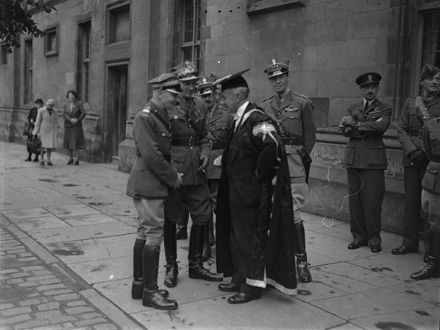
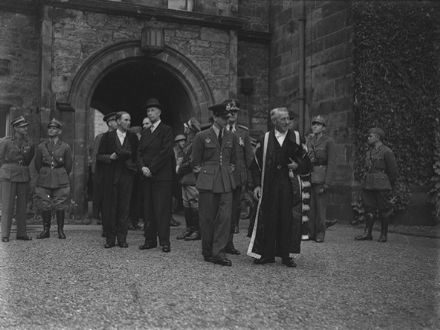
King Peter of Yugoslavia visits the University of St Andrews, September 1941. Above, on South Street outside Parliament Hall and St. Mary’s College gate. Below, in St. Mary’s quad.
The Rectorial Festivities
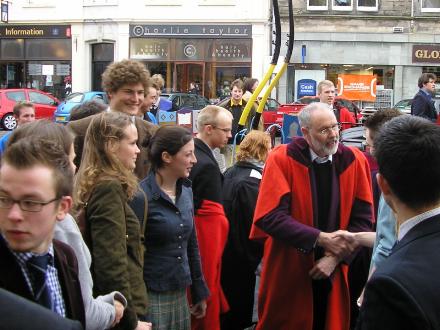
How one enjoys the traditional and ceremonial side of university life! Having duly elected Simon Pepper OBE as the new Lord Rector of the Universitas Sancti Andreae, the usual rigamarole of festivities and rites recently took place. The first is the Rectorial Drag, in which the Blues of the University drag the new Lord Rector around the town in a carriage. Along the way he makes various stops, mostly at public houses, in which a number of student groups and the like present him with gifts and drinks. We in the Boat Club arranged to meet the Lord Rector at the Central bar in Market Street. Above (and below), having alighted from his carriage, the Lord Rector greets a number of students, among them Felix Lobkowicz, the recently-elected President of the Boat Club, and Chris Kololian, the outgoing president. (more…)
Thoughts of Late
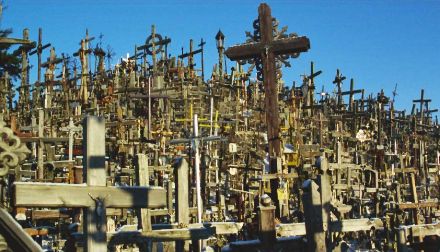
The Hill of Crosses in Lithuania. Over the years, the faithful left crosses on this hill to praise God and signify their appreciation for the many graces and mercies bestowed by Him. During the Soviet occupation of Lithuania, the hill was twice demolished and cleared by the Communists. Each time it was reconstructed by the people, and on its third appearance the Soviets finally allowed it to stay. Despite strong evidence of Christian faith such as this, the University of St Andrews ‘Christian Union’ claims that Lithuania is a heathen country, ‘with only 35 Christians’.
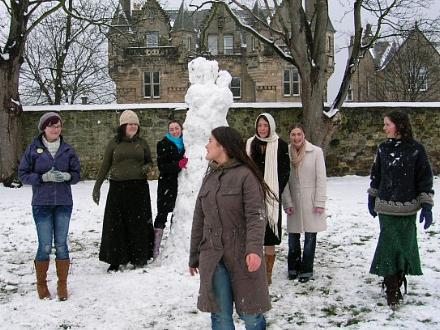
 During my presence at St Andrews over four years, it has snowed on a few occasions, though never stuck for more than a few minutes. I was much pleased, then, to awake on March 2 and spy through my windows (I never draw the curtains, as I enjoy the early morning sun) a blissful wintry utopia. The auld gray toon had been transformed into a veritable snow-globe, with snowflakes shifting back and forth with the wind as gravity drew them nearer their earthly home. Delightfully, this snow lasted, affording thousands of students myriad opportunities for heavenly mischief and giving me an excuse to put on my trusty Sportos. (Trusty Sportos seen at right).
But, woe of woes, I had a presentation to give that afternoon on the mundane and irascibly dull subject of the historiography of Indian/Settler relations in colonial America. I, and about four or five others out of a class of nearly twenty, duly arrived in the Old Library of St. John’s House at the appointed hour. We, the few, pondered where everyone else was. Had they autonomously declared a holiday? Risky business, considering this was a tutorial, and thus required, unlike lectures, of which I likely attended less than a third of my due during the past four years. A kindly secretary came in to inform us that Dr. Hart had cancelled the class and thus we were all free to frolic in the abundant snow to our little hearts’ content. Naturally, I just went to Rosary.
Speaking of Rosary, one day the week previous the post-Rosary revelry nearly drank the town dry. Well, perhaps I ought to give some background to our bliss. The Rosary is said every day Monday through Friday in St. James Church at 1:30 after which we all process across the street to the Common Room in Canmore. One or two of the girls, or Adrian if the girls are absent, make a round of tea for the merry band of Marian devotees. Well, on this frigid day in Scotland (a land of poorly-heated buildings, if one’s lucky enough to have heating on at all), we all huddled by the electric fire in our chairs, surmounted by a large communal blanket. Tom brought a bottle of port, of which we all partook, before I then excused myself to go off and do some equally time-wasting task. Well apparently the Rosary crew finished off that bottle of port, and then went and purchased another one! What’s more, the rapacious dipsomaniacs, once they had finished that bottle of port they emptied the reserve bottle of whiskey I keep hidden behind the German dictionaries in the library upstairs. Disgraceful! I have decided not to replenish the secret reserve, since, to put it in the vernacular parlance, is nae secret anaemoor!
Of course it’s my own fault for leaving it in the Chaplaincy. Should I have hidden it in the chaplaincy of the very friendly heretics over in St. Mary’s Place across from the Students Union, it would have remained unmolested. The worse that could happen would be the Christian Union forming a prayer circle around it and praying for the Good Lord to make it go away. (We Catholics already posess the knowledge on making drink disappear, and how!).
Ah, the ‘Christian Union’! Not in the entire English-speaking world, I daresay, does there exist a more delusional body of people. Everything about them is either hilariously funny or pitably sad, beginning with the irony of their very name. The Christian Union, as it styles itself, actually bans most Christians from joining. Those who wish to sign up (poor fools!) must be willing to sign a statement of faith extolling the tenets of the Evangelical Protestant religion. Thus Catholics, Orthodox, and even most Anglicans are not allowed to join. I have sometimes posited contacting whichever bureau of Britain’s behemoth government is responsible for truth in advertising and trying to get them to get the Christian Union to change their name. ‘Evangelical Society’ would be the most appropriate; while ‘Society of Over-Emotional Self-Deluding Followers of Feel-Good Teddy-Bear Christianity’ might be more accurate we must give some allowance for PR these days.
One of the latest projects of the Christian Union is to work for the ‘Christianization’ of Lithuania, “since there are only 35 Christians in the entire country”. It has apparently escaped the C.U. that Lithuania was Christianised ten centuries ago and has remained a vibrantly Christian country, even through decades of Soviet persecution. But perhaps we should leave them in their self-delusion, if only for the hilarity it provides for the rest of us. One can almost imagine them being given demographic information about the population of heaven, with thousands upon thousands of the patriarchs and prophets of the Old Testament, the apostles, the Church fathers, the martyrs, confessors, priests, nuns, and all the legions of holy souls: “But there are only 35 Christians!”

St Andrews Snowfall
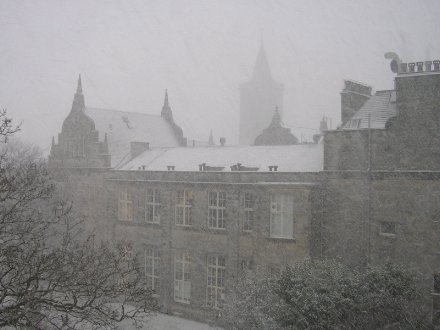
In an act of worship of the goddess Effeciency, the U.K. Government, or the Meteorological Office thereof, declared March 1 to be the beginning of Spring rather than the traditional, astronomical, and accurate Vernal Equinox (March 20). True to form, Mother Nature (a proud woman), decided that, in the interests of putting the upstarts in their proper place, she would open the heavens and thus a bountiful snowfall was produced the ver next day. I took a few snaps from my little chamber in St. Salvator’s Hall for your enjoyment. (more…)
The Knights of Malta Ball 2006

BACK DOWN TO the Assembly Rooms of Edinburgh for the annual ritual of the Knights of Malta Ball and I am happy to report that, as per usual, a good time was had by all. We had a larger contingent heading down from the Auld Grey Toon than last year (when it was just Fräulein Hesser and myself), consisting of Abigail, Jon Burke, Stefano, Clare Dempsey, and yours truly. After gliding down from Fife via taxicab, we met up with Zygmunt Sikorski-Mazur, Jamie Bogle (sans Joanna, alas), and Gerald Warner at the Opal Lounge, a little past half six, and managed to pack in at least a round of drinks before heading across George Street to the Assembly Rooms (depicted in the engraving below).

Having dropped off our coats and such, we swept up the staircase to the Ballroom for some champagne before dinner. After mulling about and conversing for a while we bumped into the Cardinal Archbishop of St Andrews himself, H.E. Keith Patrick O’Brien, himself a Grand Cross Conventual Chaplain to the Order of Malta. We apologised for not maintaining his senior cathedral in St Andrews in the same state as his junior one in Edinburgh, but I did thank him profusely for allowing us an indult mass at Ravelston. (more…)
Improvements
REACTIONARIES HAVE FOOLED themselves into believing the world has been getting worse and worse, essentially since the Fall. Progressives meanwhile, heartened by fairly recent progress-heralding genocidal masterpieces such as the French, Russian, and Chinese revolutions, believe the world is getting better and better with the March of Time. But we, the happy middle, – conservatives and traditionalists – know that Man is as Man was and as Man will be, and that we will see days of sadness and terror just as we will see days of greatness and glory. It was found to be greatly encouraging, therefore, when I chanced upon the Mess of the Officer Training Corps here in St Andrews last night and was greeted not by the bilious throbbing beats of noxious rap music, but instead by the dulcet syncopations of Tchaikovsky’s Swan Lake. Under the attentive ear of J.E.B., new President of the Mess Committee, A Squadron, TUOTC, I am happy to report that bad music has been given the old heave-ho.
YET, AS THE commendable is oft accompanied by the regretable, the hallowed pasttime of smoking has tragically been banned in the Mess. This is doubly wounding as the ban has taken place before the Scottish ban on smoking in public places takes effect (March 27), but also because the Mess is Ministry of Defence property and thus effectively exempt from the ban. Alas, the spirit of bureaucracy and nanny-ism has partly infected (some would say taken over) the caverns of the M.o.D. and decrees were handed down from above that smoking would be banned from January 1, 2006. Shameful, as it was one of the best places to enjoy a toke on the old pipe, especially since a pipe rack (donated by J.E.B. himself) was dutifully placed on the mantle below the portrait of Her Majesty. Nonetheless, we look forward to continued improvements under the tenure of Mr. J.E.B., and wish him well.
A Journey to Mells
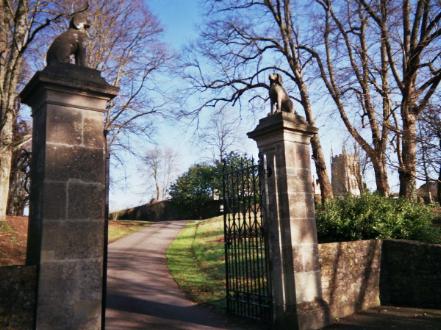
A good number of we happy St Andreans were down in the West Country recently — Somerset to be precise — for the wedding of two of our dear and closest friends [to be covered in a later post]. Being in Somerset, Alec, “Ishmael”, Clare and my good self decided to hop over to the little village of Mells last Friday to see the grave of Msgr. Ronald Knox and to sup at what is known as one of the best pubs in all of England. (more…)
Return and Remembrance
Well, yours truly has dutifully returned to hallowed Andreanopolis in pursuit of his last Candlemas term ever, to be capped off (Deo gratia) by the awarding of Master of the Arts degree this June. George Ronald Valentine Hastings Irwin picked me up from the airport on Friday morning and expressed his shock that he was graduating on time in the alloted four years and his even greater shock that I too am on course to complete the very same task.
As we drove down the Guardbridge Road towards our ancient seat of learning, the turrets, towers, and spires of the Royal Burgh were completely shrouded in haugh, that peculiar Scottish form of fog that rolls off the North Sea. Returning to dear old Sallies I came upon Dawn and Lisa, the two cleaners responsible for our corridor, chatting in the hallways (as is their wont), welcoming my return while lamenting my longer-than-ordinary absence. Most of the day was spent unpacking my various posessions. Because St. Salvator’s Hall was used to host a conference over the break, all the inhabitants thereof had been forced to pack away their belongings in storage. Thus after picking up my key from the porter and turning the lock on my room, I was greeted not by the welcome signs of my inhabitation but instead by a room bare but for the rearranged furniture, a different lamp (which doesn’t work, unlike the previous one), and the usual New International Version of the Holy Bible in the desk drawer.
Much to my lamentation, I quickly discovered that the great majority of my cohortem had skipped off to Pluscarden Abbey for a few days. Nonetheless, the trusty Alexander O’Hara was amongst the remaining and we met for a pint at the Whey Pat, just outside the town’s remaining city gate, before repairing to the Cellar Bar for a better brew. The following morning I met up with Ishmael for breakfast at the Victoria Café. [TEXT REDACTED]
After breakfast, I fell asleep in the library reading La Vita Nuova (apologies to Mr. Aligheri, but I did finish it when I awoke). After a woefully disappointing luncheon in hall, followed by ever-so-slighly less disappointing but more filling microwave meal to fill my empty belly, I watched Passport to Pimlico, the splendid Ealing Comedy in which the bombed-out inhabitants of a street in Pimlico discover an ancient document revealing that their home turf is actually an independent territory of the Duke of Burgundy. (Upon the revelation, the local Police Constable Spiller exclaims “Blimey, I’m a foreigner!”). When Whitehall bureaucrats interfere with the tiny statelet’s new-found freedom from pub licensing hours and the post-war remnants of rationing, the people of the district unite to defend their liberties in the long tradition of the English peoples. Quoth one character: “We always were English and we always will be English and it’s just because we ARE English that we’re sticking up for our right to be Burgundians!”
After attending the Vigil Mass at St. James, I had dinner at Abigail’s, after which a gang of us drank a few bottles of red while watching Bright Young Things, Stephen Fry’s directorial debut, which would have been much better if it had ended in the same manner as Vile Bodies, the novel by Evelyn Waugh on which the film is based. After that, we started House of Cards, of which I watched an hour before deciding it was necessary to retire. Woke up rather later this morning, missing chapel, but in time to lunch in hall whereupon I was informed by various chapelgoers that the new hymnal, previously delayed by a strike at the Finnish printing works where it is produced, has been introduced. We mused that since it was printed in Finland and the Muslim hordes are going after anything Scandinavian these days, we’re surprised the hymnal’s not being burnt in the streets at the moment. (My, how all conversation turns to Muslims on this side of the pond!). We mulled torching the nearest consulate of an Islamic country, but we concluded that would make us no different from the wicked ochlos, and remembered they have recently suffered a terrible disaster. “No doubt,” one bejant noted, “were it mostly Christians on the ferry, it would be extolled throughout the Muslim world as God reaking vengeance for the Danish cartoons.” After luncheon, I decided to write this post informing you, dear readers, of the latest.
In the mean time, Ezra Pierce texted from Oxford, reminding me of the Feast of the Holy New Martyrs, Confessors, and Passion-Bearers of Russia. Here is an icon depicting the martyrs, who include one of my favorite saints, the Grand Duchess Elizabeth, a widower of the Royal Family who became a nun and a great servant of the poor founding hosptials, convents, and orphanages. After the murder of Tsar St. Nicholas II and his immediate family, the Grand Duchess Elizabeth with a few other members of the Royal Family and their loyal servants who refused to leave them, were hurled down a mineshaft in Alapaevsk by the Communist Secret Police. Despite the great fall, they did not die, and so the Cheka threw grenades down the mineshaft, all of which refused to explode. The victims below could do nothing but sing God’s praises, quite literally, as they began to sang hymns and continued as the Communists sealed the mineshaft. When the bodies were recovered they were shown to have died of starvation. The icon in question also depicts the martyrdom of Archbishop Joachim, whom the Communists crucified, upside-down like St. Peter, on the Royal Doors of the Cathedral of Sebastopol in 1920.
These are stories rarely told, let alone heard, in the West where for so long this evil terror was praised in the lecture halls and academic presses of our universities and elsewhere. It is telling that in our nation’s capital today there is an entire museum devoted to the Holocaust, and similarly Holocaust memorials are worthily to be found in most major cities, while the victims of Communism are virtually forgotten. Not to denigrate the 10 million souls of the Holocaust, but it was small in comparison to first Lenin and Stalin, then Mao, the greatest mass-murderer of all time, and the dozens of murderous regimes spawned by the Russian Revolution. And unlike Nazism, which has been almost totally defeated, Communism and the ideas behind it have saturated the Western world and, while most (not all) of its despotic regimes have fallen Marxism continues to have great influence today.
Yet, at the end of the day, all that is left for us is to continue to pray and fight Evil wherever it may be found. They can destroy every single thing we hold dear – and rest assured they will try – except for our souls which belong to God. And should we find ourselves as victims of Evil we still have nothing to do but sing God’s praises like saints and martyrs of yesterday, today, and eternity.
Sir John Cowperthwaite
St Andrean Responsible for Hong Kong’s ‘Economic Miracle’
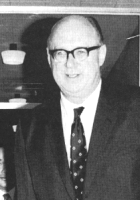 Sir John Cowperthwaite was the main figure responsible for Hong Kong’s economic transformation, lifting millions of people out of poverty. While scholars like Milton Friedman and F. A. Hayek put an intellectual case for the free markets, it was Cowperthwaite who provided the textbook example showing economically liberal policies leading to swift economic development. His practical example provided confidence to the Thatcher and Reagan governments, and was a key influence in China’s post-Mao economic liberalisation.
Cowperthwaite read classics at St Andrews and Christ’s College, Cambridge. While waiting to be called up by the Cameronians (Scottish Rifles), he went back to St Andrews to study economics. This Scottish education imbibed him with the ideas of the Enlightenment, especially the work of Adam Smith, who had been born nearby in Kirkcaldy. He was a liberal in the 19th century sense, believing that countries should open up to trade unilaterally. In 1941, he joined the Colonial Administrative Service in Hong Kong. When it fell to the Japanese, he was seconded to Sierra Leone as a district officer, before returning in 1946 to help the colony’s economic recovery. “Upon arrival,” the Far Eastern Economic Review put it, “he found it recovering quite nicely without him.” He quickly worked his way up the ranks and was made Financial Secretary in 1961, in charge of its economic policy for a decade.
When he became Financial Secretary, the average Hong Kong resident earned about a quarter of someone living in Britain. By the early 90s, average incomes were higher than Britain’s. Cowperthwaite made Hong Kong the most economically free economy in the world and pursued free trade, refusing to make its citizens buy expensive locally-produced goods if they could import cheaper products from elsewhere. Income tax was never more than a flat rate of fifteen percent. The colony’s lack of natural resources, apart from a harbour, and the fact that it was a food importer, made its success all the more interesting. Cowperthwaite’s policies soon soon attracted the attention of economists like Milton Friedman, whose television series Free to Choose featured Hong Kong’s economic progress in some detail.
Asked what is the key thing poor countries should do, Cowperthwaite once remarked: “They should abolish the Office of National Statistics”. In Hong Kong, he refused to collect all but the most superficial statistics, believing that statistics were dangerous: they would led the state to to fiddle about remedying perceived ills, simultaneously hindering the ability of the market economy to work. This caused consternation in Whitehall: a delegation of civil servants were sent to Hong Kong to find out why employment statistics were not being collected; Cowperthwaite literally sent them home on the next plane back.
Cowperthwaite’s frugality with taxpayers’ money extended to himself. He was offered funds from the Hong Kong Executive to do a much needed upgrade to his official residence, but refused pointing out that since others in Hong Kong did not receive that sort of benefit, he did not see why he should.
Cowperthwaite’s hands off approach, and rejection of the in vogue economic theory, meant he was in daily battle against Whitehall and Westminster. The British government insisted on higher income tax in Singapore; when they told Hong Kong to do the same, Cowperthwaite refused. He was an opponent of giving special benefits to business: when a group of businessmen asked him to provide funds for tunnel across Hong Kong harbour, he argued that if it made economic sense, the private sector would come in and pay for it. It was built privately. His economic instincts were revealed in his first speech as Financial Secretary: “In the long run, the aggregate of decisions of individual businessmen, exercising individual judgment in a free economy, even if often mistaken, is less likely to do harm than the centralised decisions of a government, and certainly the harm is likely to be counteracted faster.”
His ability to pursue policies which, at the time, were deeply unfashionable, was helped by having supportive Hong Kong Governors, Sir Robert Black and Sir David Trench, who both had free market sympathies. Moreover, Cowperthwaite was formidable at arguing his case: as Dennis Healey recalled: “I always retired hurt from my encounters with the redoubtable Financial Secretary.”
From 1972 to 1981, Cowperthwaite was an advisor to Jardine Flemming & Co in Hong Kong. He retired to St Andrews with his wife Sheila and was an active member of the Royal & Ancient. For many years, he spent six months of the year with his wife traveling the world visiting friends and relatives. He was an old school civil servant and, much to the frustration of economists, resisted requests to write an autobiography about his time in Hong Kong, believing that his duty was to serve, not to reveal the minutiae of government business.
– John James Cowperthwaite KBE OBE CMG, Financial Secretary of Hong Kong, born 25 April 1915; died 21 January 2006.
How Sensitive the Constabulary are About Their Equine Colleagues!
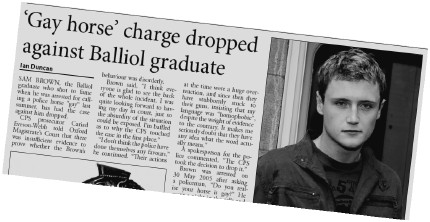
The famous ‘gay horse’ case, in which an Oxford student was being prosecuted for calling a policeman’s horse ‘gay’ at a protest, has been dropped. Even Peter Tatchell, the noxious and himself outrageous head of the outrageous group OutRage!, though the case was outrageous, commenting “The idea that saying a police horse is gay is homophobic is laughable. It brings the police into disrepute.”
‘Gay horse’ case dropped (The Scotsman, Edinburgh)
Case dropped against ‘gay horse’ student (Cherwell, Oxon)
The Queen Mother in New York, 1954
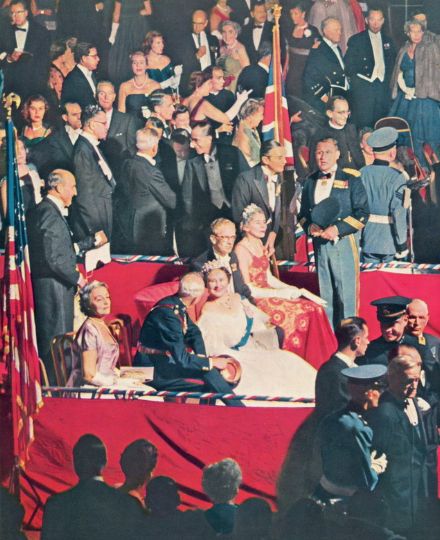
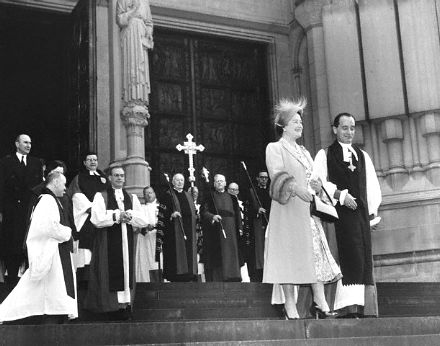
In 1954 Queen Elizabeth, the Queen Mother (n.1900, m.2002) visited New York to accept an educational fund raised by Americans in memory of the late King George VI. On the evening of November 1 of that year, the Seventh Regiment entertained Her Majesty with a special ball held in her honor at the Armory on Park Avenue (view above). Her Majesty also visited the Cathedral of St. John the Divine where she was received by the (Episcopal) Bishop of New York, the Dean, and the clergy of the Cathedral. The three stone blocks on the façade seen in the view below have since been sculpted.
The New PMC
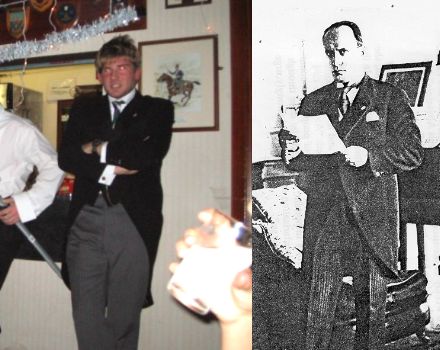
At left: The newly-elected PMC, A Sqn TUOTC, Scotland, 2005. At right: The newly-elected Prime Minister, Italy, 1922. An intriguing juxtaposition.
Though I am still Stateside, I should like extend our slightly belated congratulations to J.E.B., Esq., whom Tom Marshall has described as “the greatest potential cavalryman since Harry Flashman”, on his election to the Presidency of the Mess Committee this past December. Mr. J.E.B. is something of a legend in the Auld Grey Toon and the Mess will benefit from his profound wisdom, not to mention his lack of affection for bad music. A pipe smoker, J.E.B. is the donor of the Mess’s engraved pipe rack which rests on the mantel below the portrait of Her Majesty.
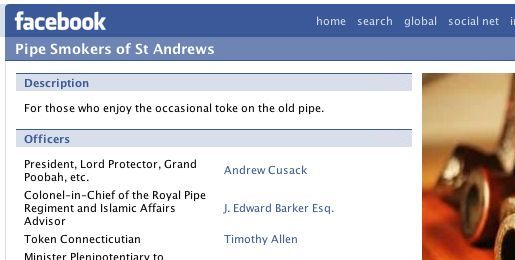
(Photos courtesy of Miss K. Dilworth)
Welcome to Doughty Street
It is an eternal and reassuring fact of human nature that when an editor announces that he is stepping down from a great publication, there is not the slightest interest in what he plans to do with his life, or even who he was.
I have received many phone calls from friends and colleagues since announcing last Friday that this would be my last edition, and they only want to know one thing. ‘Who is taking over?’
I wish I knew myself. But since the white smoke has yet to go up, I thought I had better write a general welcome to whoever you are out there. I propose to open the door of 56 Doughty Street and show you — not so much how it’s done — but where it’s done.
You arrive at a big black door in Holborn with a brass plaque, and after you have gained admission, you find a scene of domestic chaos, with dog leads, umbrellas, champagne and other impedimenta. Immediately beneath a sign saying ‘No Bicycles’ you will notice several bicycles.
You will dimly glimpse other offices ahead and to your left, the Books and Arts and Cartoon departments, bulging with the greatest talents in journalism. But if you are like me, you will be overcome with nerves and scoot straight upstairs for your office, on the first floor. As soon as you walk in, your heart will lift.
It is a magnificent room, a huge Victorian drawing-room with a chandelier and three sash windows looking out on the street where Charles Dickens lived, with an assortment of furniture both distinguished and distressed.
As you walk to your desk you cross Ian Gilmour’s (editor 1954–59) carpet, a large, fine and extremely valuable Turkish rug. Occasionally in the last 50 years there have been peeps from Isleworth suggesting this carpet might be returned. You will find these suggestions increasingly easy to ignore.
You sit down at the colossal desk. You find a Black Museum of Spectator history. There is a fragment of red telephone box, rescued by Charles Moore (editor 1984–1990). There is a big yellow molar in a plastic thimble, apparently wrenched from the merry chaps of Frank Johnson (editor 1995–1999). There is a silver-plated statuette of a miner with pick and shovel, presented to ‘The Spectator’ by the townsfolk of Aberdare in 1929. ‘In grateful recognition,’ says the plaque, adding, ‘the greatest of these is love.’
Hear, hear, you say, and try the drawers. You will find the handles mainly broken, but in the bottom left is a fabulous cache of letters congratulating Dominic Lawson (editor 1990–1995) on acceding to your chair. You will by now be blizzarded with your own letters of congratulation, and in some cases you will have received the same letters, from the same people, offering the same columns!
Before you have time to recover, your hugely efficient PA will be patching you through to Downing Street, because the Prime Minister wants to congratulate you in person. You leave instantly, and have half an hour in the sofa room with Tony, during which he will extol the magazine and (quite properly) the genius of Paul Johnson.
If you do the job in the way that we all hope, that will be the last friendly contact you have with the regime. In due course, when Downing Street takes you to the Press Complaints Commission over a story that turns out to be 100 per cent right, you will have to keep your nerve. Old chums will turn up in your office, urging you to capitulate. Don’t.
The Spectator surrenders to no one. The Spectator is always right.
When you return from your audience you may be tired and cold, and I recommend that you light the gas fire. There are few sights more cheering than that fire on a winter’s day, though you should not forget to turn it off when you leave. I did, and the Nigerian security guy put it out with the fire extinguisher.
Once the fire is going well, you may find your eyes drifting to the lovely striped chesterfield across the room. Is it the right size, you wonder, for a snooze…? You come round in a panic, to find a lustrous pair of black eyes staring down at you.
Relax. It’s only Kimberly, with some helpful suggestions for boosting circulation. Just pat her on the bottom and send her on her way. Whatever you do, don’t get depressed if she starts saying ‘noos-stand is sawft this week, Booriss’ (she is American) or that she doesn’t like your cover. That’s her job, and if you put your back into yours you’ll find that news-stand has a way of gently recovering.
Just as you’re drifting off again, the phone goes. There are two phones on the desk, white and black. If it is the white phone, on your first day in the job, I would say it is a dime to a dollar that the caller is Bruce Anderson.
Now Bruce is a wonderful fellow and an excellent writer, but if you happen to tell him, after lunch, that you do not have space for a piece, he is apt to get morbid. ‘I will destroy you,’ he starts saying. ‘I will destroy you and your reputation for ever.’ Do not on any account take fright. He doesn’t mean it. The best thing is to blow kisses down the phone and commission a piece for the following week.
And then the phone goes again, and this time I would wager it is Taki, calling from Gstaad, full of good cheer and anxious to find out whether or not you are going to sack him. At this stage in your editorship the sacking or keeping of Taki is likely to be turned into a culture war of Dreyfus-like proportions.
The Guardian and other papers will start a horrible drumming roar for his dismissal. It is time, they say, that The Spectator showed it has moved on. Soon the whole of civilised London has joined in. Sack Taki! Sack Taki!
Faced with that overwhelming consensus, you have only one choice, though it is of course entirely up to you to decide what that is.
By now the day is drawing to an end, and it is time to see how everyone else is getting on. You stick your head round the next-door office, about a third of the size of yours, and occupied by three people and….Is that a dog? It is Harry, a highly intelligent and handsome Jack Russell, and certainly no smellier than anyone else in the building.
You go upstairs, past girlish giggles and shrieks emanating from the publisher’s office, and you pass other tiny offices, full of editors and computers and industry of all kinds, until you reach the dining-room.
Here you will pass many happy hours, some of them conscious. These are the very windows through which the magazine’s famous cook, Jennifer Paterson, threw the crockery into the garden of the National Association of Funeral Directors next door. This is the table where most of the copy-editing is done on Mondays and Tuesdays, expert hands and eyes buffing and polishing the contributions with the care of Amsterdam jewellers.
And then, last but not least, you go downstairs to pay homage to the advertising and production teams, who keep The Spectator awash with ads for handbags and help to pay your mortgage. Over time you will find that it pays to listen carefully to what they say, and oblige them as far as you can.
So ends the tour of the ancient distillery. The big black door slams behind you for the first time, as it slammed behind me for the last time this week. Thanks to the exertions of the brilliant team you inherit, the magazine is in the pink of financial health with circulation at an all-time high.
You will be urged to drag it ‘kicking and screaming into the 21st century’. But as editor of The Spectator you should not be tied to any particular decade, century, or even millennium.
You are a Time Lord, and your readers expect you to take them to all parts of the human experience, and to remember that the Bible and Homer are far more interesting and important, sub specie aeternitatis, than the price of oil or Tory prospects.
You will be told that the magazine is elitist, and you should take that as a compliment. Every society that we know of has been run by an elite, and every elite needs elucidation.
Every industry or profession needs an angel at the top of their Christmas tree, and in the case of journalism you hold that angel in your hands.
You will receive threatening letters from female journalists, urging you to have more female bylines, starting with their own, and I would not dream of advising you there.
You will find that our proprietors are little short of superb. They are cheerful, tolerant, wise, and eager to develop and improve the magazine.
I have a feeling that they are bluff enough not to mind the occasional laugh at their own expense, but I confess I have not had the nerve to find out.
Like everyone in a new post, you will probably have a tough first six months. You will then discover that you have, by some margin, the best job in London, and I have no doubt that you will have fun to a degree that is almost improper.
Search
Instagram: @andcusack
Click here for my Instagram photos.Most Recent Posts
- Brunel’s Unbuilt Capitol February 3, 2026
- Cricket at Fordham January 27, 2026
- Palacio Barolo Revisted January 14, 2026
- Learning to Love Liguria January 14, 2026
- Crux Alba No. 2 January 13, 2026
Most Recent Comments
Book Wishlist
Monthly Archives
Categories