![]() |
||
Top Sites
Top Blogs
Friendly Blogs
Reviews
Periodicals
Church
Art & Design
Cape of Good HopeFranceNetherlandsMitteleuropa
ScandinaviaLivoniaMuscovyIndiaArgentinaThe LevantKnickerbockersAcademica
Miscellaneous |
Franco index
Letter to the Editor
I only write letters to the editors of publications very rarely, but the Catholic Herald was decent enough to publish a missive I sent defending Franco as the lead Letter to the Editor in this week’s edition. Readers of the Times Literary Supplement will recall seeing a brief note from me on the subject of Wodehouse & banking published in that weekly’s letters page a few months ago.
February 1, 2009 11:08 am | Link | 8 Comments »
Franco at Mass![]() “El Jefe de Estado que más ha hecho en el mundo moderno por la salvación de la catolicidad, pide a Dios, antes de entregarse al trabajo diario, que ilumine su inteligencia.”
The Chief of State that has done more in the modern world for the salvation of Catholicism, prays to God, before giving himself to daily work, that illuminates his intelligence.
Found in an old Spanish magazine printed towards the end of the Civil War. Category: Franco
September 2, 2008 8:34 pm | Link | 5 Comments »
Castro on FrancoCastro also admits to some unexpected sympathies with a few enemies of the left: He wistfully recalls Francisco Franco, whom he describes as “honourable” for not bending to Washington’s will and breaking relations with Cuba. Just as Castro reaches back past his own birth to claim spiritual kinship with Marti and other independence leaders, he weaves the Spanish general into a broader tapestry of Cuban history. Franco was born in a town that sent troops to a Spanish battalion defeated by US troops in 1898. Castro speculates that perhaps Franco as a boy welcomed the beaten soldiers home and thus might have seen the Cuban Revolution as “Spain’s revenge.” In any case, Franco, a Galician like Castro’s father, was shrewd and stayed out of WWII, unlike the “stupid” war that Bush and Aznar got themselves into.
— Greg Grandin, The Nation, 8 July 2008
July 17, 2008 6:32 pm | Link | 3 Comments »
The Other ModernAn Architecture of Continuity: Luis Moya Blanco’s Universidad Laboral de Gijón
In 1944, an undersecretary of Francoist Spain’s Ministry of Labour visited the city of Gijón to attend the funerals of a group of miners killed in a mine collapse. After the solemn rites took place, Turiño Carlos Pinilla met with a group of locals filled with concern for the offspring of the dead workers. All they asked of the bureaucrat was an orphanage; what they ended up with ten years later was a magnificent palace of charity, almost a city unto itself and the largest building in Spain: the Universidad Laboral de Gijón. An example of Catholic social teaching (which upholds the essential dignity of work and the working man), the “labor university” was founded as a secondary-level institution to teach vocational and technical skills to the children of Spain’s working class. At over 2,900,000 sq. ft. of space, it is more than double the size of the great Royal Monastery and Palace of El Escorial built by Phillip II in the sixteenth century, and was accompanied by over 380 acres of farmland.
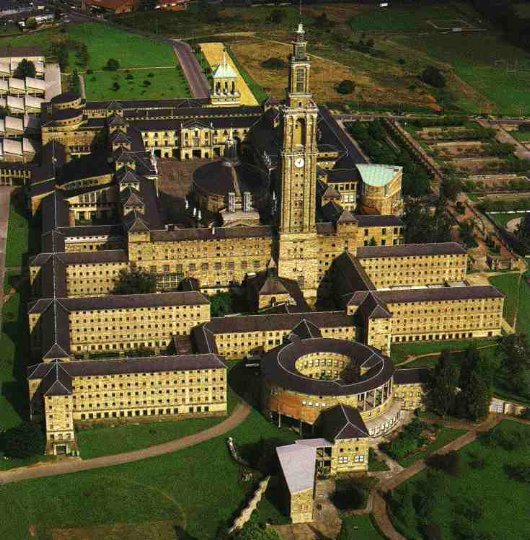
The goal was to accommodate 1,000 students (eventually doubling) from the age of 12 to 16, with residences, school facilities, industrial workshops, working farmland, athletic facilities, and sporting fields. The educational aspect and leadership of the Laboral was entrusted to the Jesuits, while the Poor Clares also had a convent on the premises, performing various household tasks and caring for the girls as their particular charism.
Construction began in 1946, while much of the rest of Europe was recovering from the horrors of the Second World War. The Universidad Laboral de Gijón was the first of the handful of “labor universities” founded during Franco’s rule, and some of the brightest minds in Spain were involved in its creation. The gardens, created to train students in landscaping, were designed by Javier de Winthuyssen, the National Inspector of Parks and Artistic Gardens while the farms where students would learn the skills of agriculture were orchestrated by Gabino Figar, Spain’s leading agronomist. The building itself featured sculpture by Manuel Alvarez Laviada and Florentino Trapero, mosaics by Santiago Padrós, and murals by the painter Joaquin Valverde.
The architect, however was Luis Moya Blanco. Born in Madrid in 1904, Moya came from an architectural family. His father (and namesake), Luis Moya Idígoras, was the most prominent road engineer in Spain while his uncle was the head of the School of Architecture in Madrid. Before the Universidad Laboral, Moya was best known for his work on the Museo de America, the museum exhibiting Spain’s artistic and archaeological treasures from the New World, situated on the Avenue of the Catholic Monarchs in Madrid.
Part of the plan of the Universidad Laboral was to act as a miniature ideal city, and the building asserts its independence by facing away from the city of Gijón. Passing through the massive entrance gate, the visitor first encounters the Corinthian Court, a massive atrium lined with ten Corinthian columns 34 ft. tall. Originally open to the heavens, the top of the courtyard was recently given a glass roof.
![]()
Through the Corinthian Court, one proceeds into the great central courtyard of the Laboral and is immediately drawn to the church at the center, with the 385-ft. tower behind it, and flanked by the theatre (on the right) and the entrance to the school wing (on the left). ![]() Reflecting the concept of the ideal city, the Church is at the very center and heart of the Laboral. The church is elliptical in shape, but retains the traditional linear liturgical arrangement inside, like all the churches designed by Moya. In the main portal of the Church, above the lintel over the entrance, is a statue of Our Lady of Covadonga, patroness of the Asturias.
The main portal is itself flanked by four columns, two on either side, which are topped by statues of saints: St. Joseph, St. Ignatius, St. Peter, and St. Paul. Atop the portal is St. James the Apostle on horseback, with two angels worshipping a Cross. Originally, this was a specially crafted version of the Cruz de la Victoria, a particular symbol of the Asturias which appears on the principality’s flag, but this precious work of art has since been removed and replaced with a more simple metal version. Circling the church are statues of St. John of the Cross, St. John Bosco, St. Vincent Ferrer, St. Melchor de Quiros, St. Clare, St. Peter of Alcantara, St. Laurence, St. Isidore of Seville, St. Teresa of Avila, St. Dominic Guzman, St. Francis, St. Joseph Calasanctius, St. Eulalia, King St. Ferdinand III of Castile, St. Isidore the Laborer, and St. Toribio de Liébana.
The interior of the church features inlaid marble floors and specially-constructed pews (one of the necessary drawbacks of elliptical churches) made of embero wood imported from Spanish (now Equatorial) Guinea.
The original high altar was removed during the 1970s, but strangely it seems the baldacchino was never completed.
A thin altar rail divided the sanctuary from the nave.
The workshops where students were taught industrial skills.
Classrooms all had a crucifix and a picture of Spain’s caudillo.
Franco was present at the official opening of the Universidad Laboral in 1955.
Major construction finished a year later, though one portion of the complex (above left) remains unfinished.
The theatre of the Laboral was the first air-conditioned theatre in all of Europe.
Above the façade of the theatre rests a sculpture of the Spanish coat of arms under Franco. The yoke and arrows (el yugo y las flechas) were the symbols of Ferdinand and Isabella, the Catholic Monarchs who united Spain as one kingdom. These symbols were included in the coat of arms of Spain from 1492 to 1504 and then from 1938 to 1981. The Falange, the official (yet still somewhat marginalized) political party of the Franco regime, used a stylized yoke-and-arrows as their official emblem.
The Poor Clares doing the laundry in the lower part of their convent. The circular convent (below) was located towards the rear of the Laboral, and featured an open loggia looking out over the nuns’ garden.
Teachers at the café bar.
The Universidad Laboral’s cows pose to have their picture taken.
Unfortunately, with the death of Franco and the subsequent transformation of the Spanish state, all the Universidad Laborals began to suffer from neglect. The Jesuits handed over control of the Gijón school to the faculty in 1978. Originally funded by the trade unions, they became part of the state-run National Institute for Integrated Education in the 1980s. Shortly afterwards, the Poor Clares were kicked out of their convent. As Luis Moya’s great palace of learning deteriorated, enrollment fell and the Universidad Laboral de Gijón moved to a separate, much smaller campus where it continues today as an “institute of secondary education”.
In 2001, the regional government of the Asturias took charge of the building and its massive grounds. The greater part of the school’s farms were turned into a public golf course. The Laboral itself has been reinvented as a “City of Culture”, its massive complex housing a variety of enterprises. The classrooms now house a campus of the University of Oviedo, where students of business, tourism, and public administration are now taught, as well as the Higher School of Performing Arts. Technological innovations are explored at the Science Park Technology Gijón, while the German multinational ThyssenKrupp has its Spanish headquarters and research & development labs in the Laboral. A hospital is located in the building, and a five-star hotel is due to open in April 2009.
The convent from which the Poor Clares were expelled has been turned into a television studio for RTPA, the regional broadcaster for the Principality of the Asturias.
At least partly in keeping with the original idea, a vocational training center remains at the Laboral’s industrial workshop, with 900 students enrolled.
Deconsecrated, the church that once housed Christ at the center of the Universidad Laboral now serves primarily as a performance venue.
While the departure from its original purpose is to be lamented, at least Moya’s beautiful structure is now being maintained and appreciated after years of neglect. During the interwar period, architects plumbed the depths of modernism with interesting results, but after the war they abandoned the safety of the surface and were submerged into those depths. The results were almost entirely catastrophic. Luis Moya, and a number of the other Spanish architects favored under the Franco regime, present a convincing counterargument. The Universidad Laboral presents us with an architecture that is a continuation of history, rather than a rejection of history. Its components exhibit a classical symmetry but, like the human body itself, are arranged in a somewhat asymmetrical but nonetheless orderly form. It is the largest building in Spain but is broken up into smaller portions to prevent it from overburdening the inhabitants. It exhibits a natural hierarchy of forms, with the Church at its very heart. The Laboral is proof that there is another way of doing things: that one can be at once modern and traditional. That is a lesson that certainly needs to be understood by architects, but surely also by the rest of society as well. First published in Norumbega.
May 12, 2008 1:47 pm | Link | No Comments »
Martyrs of Spain, Pray for Us!![]() POOR, PITIABLE SPAIN. So rich in saints in Heaven, but, to the outside observer, so poor in saints on Earth. There were days, of course, when Spain was governed by saints and holy men and women, but today Spain is ruled by the wayward, the foolish, and perhaps even the downright evil. Error is proclaimed truth, wrong is called right, and evil hailed as good.
In total, 498 names will be added in October to the list of those already beatified or canonized. Among those 498 names are a number from the many killed in the massacres of Paracuellos de Jarama. Coincidentally, Gerald Warner recently touched upon this place of death in a Scotland on Sunday column on the occasion of Edinburgh University revoking the honorary degree bestowed upon Zimbabwean President Robert Mugabe. In the column, Gerald discussed various honorary degrees which had been bestowed upon monsters, tyrants, and evil men, and finished his column with a case from Spain. The most morally grotesque academic elevation was perpetrated in Spain, in 2005, when the Universidad Autónoma de Madrid conferred a doctorate honoris causa on Santiago Carrillo, former leader of the Spanish Communist Party. As chief of police in Madrid in 1936, he had presided over Cheka death squads that murdered huge numbers of people (2,800 in one weekend) for the crime of being ‘bourgeois’. Throughout the squalid degree ceremony, people concerned with the honour of Spanish academe punctuated the proceedings with shouts of “Murderer!”
The most effective denunciation of this naked emperor, however, had been made during his journey back from exile. As the aircraft approached Madrid, with the arrogance of a reinstated member of the nomenklatura, he told the stewardess to ask the captain if he could enter the cockpit to get a better view of the capital. Moments later the public address system came to life: “This is your captain speaking. In 15 minutes we shall be landing at Madrid Barajas airport. Before that, I would like you to see the historic site of Paracuellos de Jarama to the right of us. That was where thousands of innocent people were executed during our civil war. The man responsible for those executions is one of your fellow passengers, Don Santiago Carrillo Solares. He is sitting in seat 27-B.” “That pilot,” Gerald concluded his column, “deserved an honorary degree”. There is a good website which lists many of the Catholic martyrs of the Spanish Civil War; it starts here and carries on for sixty pages. The list also contains photographs or images of the individual martyrs when it has been possible to obtain them. Look at these photographs, see the faces of these holy men and women who now intercede for us in Heaven. They are priests and bishops, nuns and brothers, penniless Franciscans and wealthy aristocrats. They are fathers and mothers, husbands, wives, sons, daughters, workers, craftsmen, students, nurses, teachers, young and old. In many cases, entire monasteries and convents were killed en masse, their cloisters flowing with blood, and the bodies of the martyrs dumped by the sides of highways, their killers vainly hoping their names would be forgotten and struck from history. But, as has oft been said before, the blood of the martyrs is the seed of the Church. We are human, and can only see with our eyes. Who knows what untold and unseen burdens have been lifted from Spain’s shoulders by the intercession of their prayers?
Previously: Man of the Month: Professor Giertych | The Tomb of Francisco Franco | Requiescat in Pace | The Caudillo in Action! | Fun with Franco! | The Reconquest of Madrid
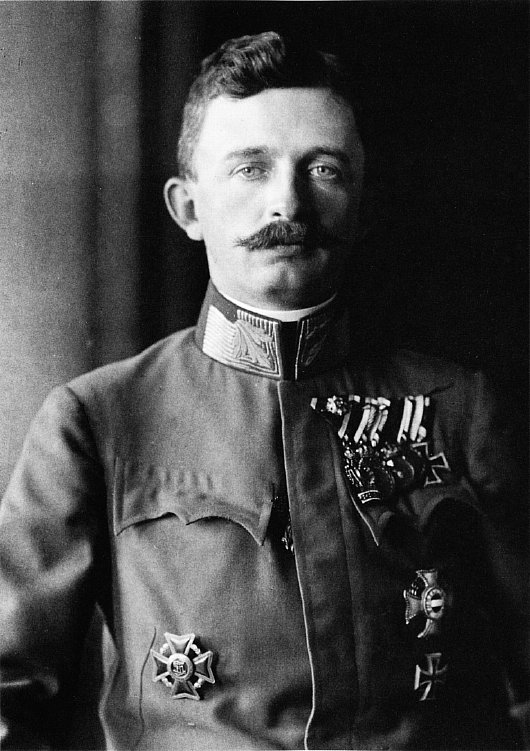
Christian Leaders Emperor Charles of Austria | James II, Our Catholic King | Gabriel García Moreno | Nicholas II | Thomas Dongan | Admiral Thierry d’Argenlieu
June 13, 2007 10:00 pm | Link | 3 Comments »
‘Franco’s British Friends’![]() IN CASE YOU were in need of someone to raise a glass to, why not the 14th Duke of Hamilton and his friends? A reader and friend of ours from the fair Dominion of Virginia sent us a link to this program, which is available for listening to until next Monday, about “a famous flying ace, a top racing driver and an aristocrat” who together lent a helping hand to Christian Spain in her hour of need. Famously, the four Douglas-Hamilton brothers (below) all simultaneously held the rank of Squadron Leader in the RAF. In the BBC program linked to above, one of the living Douglas-Hamiltons relates the tale of when all four brothers individually flew to a certain aerodrome and when the tower radio operator heard “Squadron Leader Douglas-Hamilton requesting permission to land” one time after another, he thought someone was pulling his leg. Air Commodore Douglas Douglas-Hamilton, 14th Duke of Hamilton and 11th Duke of Brandon, KT, GCVO, AFC, PC, DL, FRCSE, FRGS, also served as Chancellor of the University of St Andrews. ![]() Previously: The Tomb of Francisco Franco | The Caudillo in Action! | Fun With Franco
January 30, 2007 7:04 pm | Link | 11 Comments »
New Year’s Resolution for Journal is to Lose Weight, Dignity![]()
Narrow broadsheets are not only a contradiction in terms, they are exceptionally irritating to read. The Berliner size of the Guardian, Le Figaro, and other papers is a handy, convenient size, and of a very comely proportion. The normal broadsheet of the Daily Telegraph, the current Wall Street Journal, and the Scotsman in its pre-tabloid days exudes soundness, reliance, and dignity. But ungainly tabloids and these new narrow broadsheets ought to be relegated to the dustbin of dodgy newspaper ideas.
December 9, 2006 10:12 am | Link | 20 Comments »
Man of the Month: Professor Giertych![]() AS THE MONTH of July draws to a close, we’d like to announce the Polish scientist and politician Prof. Maciej Giertych has been anointed our ‘Man of the Month’. Professor Giertych, who holds two degrees from Oxford and his PhD in tree physiology from the University of Toronto, is a Member of the European Parliament and recently took part in that inauspicious body’s debate commemorating the seventieth anniversary of the commencement of the Spanish Civil War, a debate which even the BBC’s Europe editor slated as “one of those debates that seem rather pious and pointless”. While the usual gang of characters spouted their unthinking praise for the tyrannical and genocidal Communist and Anarchist forces, Prof. Giertych had the decency to stand up and set the record straight. “Thanks to the Spanish Army and Franco the Communist attack on Catholic Spain was thwarted,” Prof. Giertych told the European Parliament. “The presence of such people in European politics as Franco guaranteed the maintenance of traditional values in Europe and we lack such statesmen today. Christian Europe is losing against atheistic socialists today and this has to change.” “I thought it was necessary to remind listeners in the EU Parliament,” the Professor said later, “that this was not an anti-democratic movement, but a movement that was in defense of certain values that are inherent in the Catholic way of seeing things pertinent to government to run civil society. The uprising was a defense of Catholic Spain, so the civil war in Spain was a conflict between Catholic Spain and communist Spain.” The Professor also used his speech to praise António de Oliveira Salazar, Portugal’s Catholic dictator who, like Franco, managed to keep his country free from the devastation of the Second World War. (Salazar was also a very close friend of Rhodesian Prime Minister Ian Smith, who claimed in his memoirs that if Salazar had lasted a few more years, Rhodesia would still exist today). Prof. Giertych is a Member of the European Parliament for the League of Polish Families, one of the political parties in Poland’s tripartite coalition government. His son, Roman Giertych, is both Deputy Prime Minister and Minister for Education of Poland.
General Eisenhower and General Franco
July 31, 2006 8:24 am | Link | 8 Comments »
The Tomb of Francisco Franco![]() I attended a little get-together on the East Side back on New Year’s Day and met one of our loyal readers who requested more Francoiana, and thus I make this very rare concession to public opinion. I wonder if this splendid view can’t officially be considered P.O.D. (pious and overly devotional in Catholic blogspeak) until the good man is canonized, which could take centuries, if done at all. At any rate, a bit more reflective than most of our previous Franco appreciations, which have highlighted the Generalissimo’s more humorous side. Dedicated specifically to our friends at a certain New York law firm. Photo Credit: AP (I think)
Previously: Requiescat in Pace | The Caudillo in Action! | Fun With Franco! | The Reconquest of Madrid
January 18, 2006 6:07 pm | Link | 5 Comments »
Requiescat in Pace
Generalissimo FRANCISCO PAULINO HERMENEGILDO TEÓDULO FRANCO y BAHAMONDE SALGADO PARDO DE ANDRADE, Caudillo de España por la gracia de Dios, Jefe del Estado, requiescat in pace. 4 December 1892 — 20 November 1975
![]() I searched through the Franco section of the Cusack archives and found this photograph of the Caudillo with His Imperial Highness the Archduke Otto, the son and heir of Blessed Charles of Austria, as well as being a sometime Member of the European Parliament for Bavaria (until recently). We’ve already seen a photo of Franco with the artist Salvador Dalí who described him as nothing short of a saint. I apologise for not spacing out more widely our appreciation of the Generalissimo, but I felt obliged to observe the day of his death. Previously: The Caudillo in Action | Fun with Franco! | The Reconquest of Madrid ![]()
November 20, 2005 10:58 am | Link | 3 Comments »
The Caudillo in Action!![]() Franco fishes! ![]() Franco golfs! ![]() Franco hunts! ![]() Franco takes the helm! But of course our readers already know what a sporting yachtsman the Caudillo was. ![]() And of course Franco knows how to be reverent in church. Who’s that in the back? Late arrivals, there’s always one! Previously: Fun with Franco! | The Reconquest of Madrid
November 17, 2005 6:40 am | Link | No Comments »
Fun with Franco!![]() In honor of Spain’s patronal feast, that of St. James the Greater, and because I’ve been reading Stanley Payne’s The Franco Regime 1936-1975 I’ve decided to bring you, our dear readers, a bit of Francophilia to brighten your day. • “In an interview with an American history professor,” writes Payne, “[Franco] declared that his role had been analogous to that of the sheriff in the typical American western, a cinematic genre that he enjoyed. Franco went on to observe with considerable mirth that the Spanish, rather than being rebellious and difficult as they were often portrayed, were generally patient and long-suffering. ‘The proof of that,’ he said breaking into a sudden loud cackel, ‘is that they have put up with [soportado] my regime for so long!’” (p.398, S. Payne, The Franco Regime 1936-1975). • Remarkably, General Franco persisted in surviving much longer than even his supporters anticipated. On his deathbed at last, Franco was told that General Garcia wished to say goodbye. “Why?” Franco replied. “Is Garcia going on a trip?” (Anecdotage.com)
Hey look! Franco has a friend over to play! The Generalissimo is seen here with artist Salvador Dali, who was later ennobled as the Marquis de Pubol. • A foreign journalist went to Spain to find out the truth about the Franco regime. One fellow agreed to tell him, but insisted they meet secretly. The journalist then asked him “What do you think about Franco?” Looking cautiously around, the fellow replied “To tell the truth… I like him!” • Much was made last year about the statue of Saint James portrayed as the Slayer of the Moors (‘Matamoros’) at his cathedral in Compostela: On Sunday, in a ceremony that will resound with ancient symbolism, King Juan Carlos will pay homage to the Moor Slayer on his saint day by making the annual National Offering at Santiago. The dictator Gen Francisco Franco once sent his only Moroccan general, Mohamed ben Miziam del Qasim, to make the offering. Sensitive officials covered the base of the statue with cloth to hide the decapitated heads of his compatriots. (The Daily Telegraph, July 22, 2004) And finally, since if I were to build a yacht I would have it christened the Matamoros, I bring you the following, which ought to be filed under “Magazines We’d Like to See”: ![]() Happy Saint James Day everyone! ¡Viva España!
July 25, 2005 6:35 pm | Link | 12 Comments »
The Reconquest of Madrid![]() On this day in 1939, Madrid was reconquered by the Christians, the final victory in the Spanish Civil War. The price of victory, however, was high: • 12% of all Spanish priests were martyred. (In one diocese, Barbastro, this was as high as 85%).
• 72,344 officially executed by the Socialist/Communist/Anarchist government, with many more informally killed or massacres. • Around 20,000 churches and chapels damaged or destroyed As Warren Carroll points out in his history of the war, after giving thanks at a Te Deum service at the Church of Saint Barbara in Madrid, Franco prayed: Lord, benevolently accept the effort of this people, which was always Thine, which, with me and in Thy name, has vanquished with heroism the enemy of truth in this century.
And then Franco laid his sword upon the high altar, vowing to God never to take it up again unless Spain itself was faced with invasion. (A vow he kept).
March 28, 2005 5:07 pm | Link | 3 Comments »
|
AboutMore or less, the musings of a 25-year-old New Yorker, a graduate of the University of St Andrews in Scotland, with a brief residence in South Africa. [more]DonateClick here to make a financial contribution towards the expense of maintaining andrewcusack.com.Remembrances
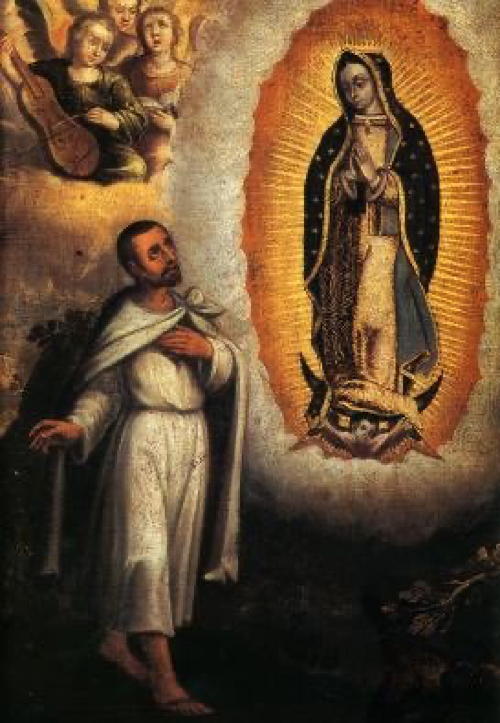
St. Juan DiegoRecommended
|


Francisco Franco, meanwhile, had vowed at the end of Spain’s tragic Civil War (1936-1939) to never again take up his sword unless Spain herself was attacked, and the country was spared the further horrors of the global conflict.


Of course, these things that happen today have happened in the past as well, and even within living memory — less than a eighty years ago. It is announced from Rome that, with the approval of the Holy Father,