Errant Thoughts
About Andrew Cusack
 Writer, web designer, etc.; born in New York; educated in Argentina, Scotland, and South Africa; now based in London.
 read more
News
Blogs
Reviews & Periodicals
Arts & Design
World
France
Mitteleuropa
Knickerbockers
Argentina
The Levant
Africa
Cape of Good Hope
Netherlands
Scandinavia
Québec
India
Muscovy
Germany
Academica
Some Finnish Words
We’ve been rather too neglectful of Finnish, the language so beloved of Tolkien. The South-African-born philologist and mythmaker described his introduction to the Finnish tongue as being “like discovering a complete wine-cellar filled with bottles of an amazing wine of a kind and flavour never tasted before. It quite intoxicated me.” Aside from Tolkein’s love of the Finnish language, Elias Lönrott’s Kalevala epic was a central influence on the creation of The Lord of the Rings, as numerous scholars have written about.
I mentioned kaupunkilaissuomenruotsalaiset on Facebook the other day, and Sara piped up with the remainder of the following list of Finnish words. (more…)
Catholic Ambassadors to the U.N.
Diplomats’ group hears Latin Mass at St Agnes
On Sunday 21 August 2011, the Church of St Agnes on 43rd Street in Manhattan was host to a group of Catholic ambassadors to the United Nations for the regular 11:00 Extraordinary Form Mass, offered by Fr. Richard Trezza OFM. (Fr. Cid, a recently ordained Franciscan priest was also in choro). The group included representatives from Grenada, Haiti, the Philippines, Korea, the United Kingdom, and Japan.
The informal gathering, formed just this year, is open to Catholic Permanent Representatives and Deputy Permanent Representatives — the first- and second-highest ranking diplomats at national missions to the U.N. — and has heard Mass at a number of different parishes around Manhattan. (more…)
Una Voce New York Symposium
presents its
Second Annual Dinner Symposium
Harvard Club of New York
35 West 44th Street
with
Christopher A. Ferrara, J.D.
President, American Catholic Lawyers Association
“Distributism: The Libertarian Caricature vs. the Reality”
John Médaille, B.A., M.Th.
Adjunct Instructor, University of Dallas
“Distributism and the Coming Crash or How to Rebuild the World”
Master of Ceremonies
John C. Rao, D. Phil. (Oxon)
Director, The Roman Forum
Una Voce New York’s second annual dinner symposium will feature an evening meal with like-minded Catholics followed by presentations by two well-known speakers. The cost is $75 per person, reduced to $65 for those who register by 16 September. (more…)
August Recess
Our little corner of the web will be taking a bit of a break for the month of August.
However — O tempora! O mores! — you can now follow our official ‘Twitter’ account, @cusackandrew, which features periodic ‘tweets’ by your humble and obedient servant, as well as ‘re-tweets’ from other twitterers so deemed worthwhile.
See you à septembre!
Vatican Insider
Anyone remotely interested in the important affairs of the church and the world should make themselves aware of the new ecclesial news site, Vatican Insider. The site offers English translations of the significant journalistic output of the Italian newspaper La Stampa and includes commentary from Andrea Tornielli, John Allen, and others. V.I. already has an interview with Mons Georg Ratzinger and a look at church-state relations in mainland China, amongst other things. Definitely one to add to your daily perusing.
Cape Town’s ‘Nazi’ Street to be Renamed
Oswald Pirow Street will rechristened after Dr. Christiaan Barnard
The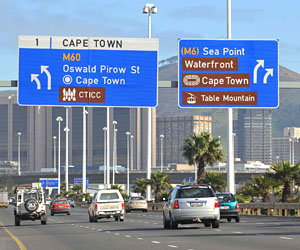 city of Cape Town has recently effected a small number of street name changes decided at the end of last year. The N2 route as it heads into the centre of the city, currently called Eastern Boulevard, will be renamed Nelson Mandela Boulevard. The open square between the opera house and the city offices will be renamed Albert Luthuli Place. Most significantly, Oswald Pirow Street on the Cape Town foreshore will be renamed Christiaan Barnard Street.
The renaming of streets and other places in South Africa has proved a controversial and unsettling task. Many streets named after leading figures associated with the 1948-1990 apartheid regime remain. In 2001, the New National Party (NNP) mayor of Cape Town, Peter Marais, attempted to rename Adderley Street and Wale Street after Nelson Mandela and F.W. de Klerk respectively. But Marais’s plan provoked a surprising public backlash, as well as opposition-for-opposition’s sake from the local ANC. The proposed ‘Nelson Mandela Avenue’ had already been renamed once: originally Heerengracht, the grateful citizens of Cape Town rechristened it Adderley Street in 1850, as a token of thanks to Charles Bowyer Adderley MP (later 1st Baron Norton) for his successful campaign against turning the Cape into a penal colony. (more…)
Salazar-plein / Salazar Square
Cape Town’s monument to a Portuguese friend of South Africa
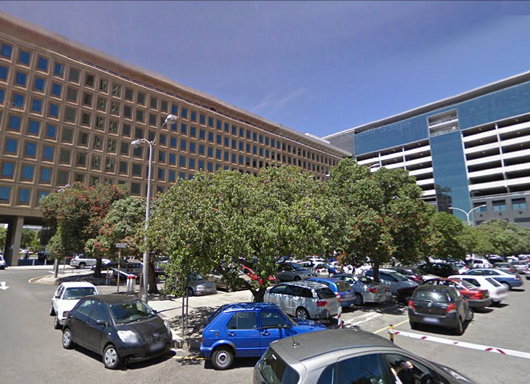
Doubtless there were once many streets, squares, and places named after António de Oliveira Salazar, Portugal’s longtime dictator — the Ponte Salazar being the one that springs immediately to mind. That bridge, like most other Salazarian toponyms in the Lusosphere, was renamed after Portugal’s Carnation Revolution, even though the dictator remains a reasonably popular figure (a poll for the RTP television programme The Greatest Portuguese he came out top with twice as many votes as the runner-up). (more…)
Too moderate to defend the defenseless
Betty Ford was ‘a strong female voice for moderate Republicanism’
Over at Telegraph Blogs, Tim Stanley posts the following about Betty Ford, the First Lady of the United States who died recently:
Betty was a strong female voice for moderate Republicanism. It was the Republicanism of New England suburbs, Wall Street brokerage firms, golf clubs, yacht houses, East Coast fraternities, drunken bridge games and James Stewart. It was wrong on so many things, but it was gentle and sophisticated and meant well.
The suburbs, the Wall Street firms, the golf clubs, yes, but also the abortion clinics. Mrs. Ford was an ardent supporter of a woman’s right to kill her child. So many evils are easily excused because they were gentle, sophisticated, and meant well.
Decline of the Herr Professor
The Herr professor has been caught up in a whirlwind of protest, eventually to emerge as a humble guest on a television talk show.
No Nobel prize compensates for this loss of prestige at the apex of a crumbling pyramid.
His desperate references to the false problem of “academic freedom” sound not only hollow, but like the exchanges between pagan Roman priests at magical ceremonies in whose effectiveness they no longer believed.
Modern Age, Spring 1999
Senator Eugene McCarthy: A Kirkian Anecdote
Russell Kirk, the great St Andrean and American man of letters, relates this anecdote in his article “Will American Caesars Arise?” (Modern Age, Summer 1989):
The most interestingly complex of all recent aspirants to the presidency, [Senator Eugene] McCarthy obdurately called himself a liberal during years when that appellation was sinking swiftly in popular favour – although he abjured all forms of liberalism earlier than Franklin Roosevelt’s. (During the past few years, as he now remarks, he has employed the word ‘‘liberal’’ as an adjective merely.) In his political theories, actually, McCarthy has been a conservative: He declared long ago that Edmund Burke was his political mentor, and no one has more warmly praised Tocqueville. He has read seriously and written intelligently. In the White House – per impossibile – he might have turned the most imaginatively conservative of Presidents.
Or perhaps not. Once upon a time I had an assistant who was a graphoanalyst, an expert on handwriting. Having examined a specimen of Senator McCarthy’s handwriting, my assistant pronounced him rebellious, a hard master, and desirous of power. A touch of Caesar even in Caesar’s adversary? However that may be, McCarthy’s only considerable assertion of power was his unseating of President Johnson by running a good second in the New Hampshire primary of 1968.
A congenital no-sayer, Eugene McCarthy never ran with the hounds. He was candid and witty always. He and I first met as debaters before a large audience, in Boston. After this exchange, sponsored by the Paulist Fathers, a reception was held for us. Up to Senator McCarthy came a zealous young Paulist, inquiring, “Senator McCarthy, don’t you think that Jack Kennedy is the finest president this nation ever has had?” (This occurred during the first year of the Kennedy administration.)
“No,” said McCarthy, unsmiling.
Although taken aback, the Paulist returned to the charge: “But surely you agree, Senator, that President Kennedy has given this nation a new hope, a new vigor, a sense of moving forward toward great things?”
“No,” said Eugene McCarthy.
The Paulist persisted: “But of course you’ll agree with me when I say, Senator, that the Kennedy family have brought to our life a culture, a refinement, a meaningfulness, that we have not known before.”
“No,” said Eugene McCarthy.
“But – but Senator McCarthy, surely Jack Kennedy is a very nice man personally?”
Eugene McCarthy turned his back upon the Paulist and slowly walked away. He knew how to say no, he was not ensnared by cliché and slogan, and he had a poet’s attachment to truth.
Cooking with Sir Laurens van der Post
East and West Meet at the Cape
The Cape Malays came up with dishes that are all so a part of the South African way of life that they have become almost sacramental substances. Among them are bobotie, sosaties, and bredie. Bobotie, a kind of minced pie, is to South African what moussaka is to the Greeks. Sosaties, or skewered and grilled meats are what shashlyk are to the people of the Caucasus and shish kabob to the Turks. The stew called bredie is what goulash is to Hungarians.
A basic bobotie begins with minced lamb or beef, a little soaked bread, eggs, butter, finely chopped onion, garlic, curry powder and turmeric. All are mixed together, put in a pie dish with meat drippings, and baked in a low oven for a time. The moment the mixture begins to brown, the dish is taken from the oven and some eggs beaten up with milk are poured over the top; then the dish is put back into the oven and baked very slowly to a deep brown. The pace of the cooking is important: if the oven is too hot the bobotie will be dry, and that should never happen, for an ideal bobotie is eaten moist, over rice. (more…)
The Advent of Virgin Australia
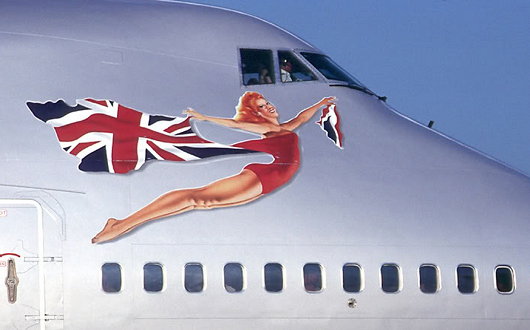
Virgin Atlantic Airways has always inexplicably attempted a fine balance between the crisply modern and the vaguely old-school. It is also unashamedly British. When the lumbering giants at British Airways were busy banishing the Union Jack from their aircraft livery — prompting Baroness Thatcher to cover the model of a BA 747 with a handkerchief — Sir Richard Branson said “We’re British: why don’t we fly the flag?” The Union Jack was added to every Virgin Atlantic plane and a flag design was later added to the wingtips. Virgin Atlantic now has a patriotic red-head (above) bedecked in the Union flag on the nose of each of its aircraft glamourously advertising their national origins in this hyperglobalist age.
Virgin Group has not restrained itself from expanding beyond the trans-Atlantic flightpath. In 2000, they established Virgin Blue in Australia, originally flying only between Brisbane and Sydney, but gradually expanding within the country, especially after the 2001 collapse of the major domestic carrier Ansett Australia. In 2003, Virgin started Pacific Blue Airways out of New Zealand, operating trans-Tasman routes, followed by the founding of Polynesian Blue in 2005 running flights between New Zealand, Australia, and Samoa. Finally, V Australia was started operations in 2009 running long-haul flights out of Australia. (more…)
Les fondements de notre civilisation occidentale
« Les fondements de notre civilisation occidentale sont chrétiens ; le respect du christianisme est une condition sine qua non d’une droite qui veut conserver non seulement la prospérité économique, mais ce qui est au fondement de toute prospérité durable : le souci du bien commun, le respect de la loi naturelle, le sens de la justice. »
The latest issue of Égards, the premier journal of traditional conservatism in Quebec, contains an interesting analysis of the current situation faced by the various streams of the centre-droit spectrum in the province. I am, however, very much against the perpetual organisation-founding that goes on in political circles. There seems to be a belief that, when in doubt, start a new organisation, but this is precisely what the author, M. Décarie, proposes.
Dino Takes on Nic & Rem
Dino Marcantonio is on his usual top form when responding to an interview with the “Dutch architect and uber-gobbledegook-meister” Rem Koolhas by Nicolai Ouroussoff, the architecture praiser for the New York Times. Many modernists now find themselves in the role of perverse preservationists, trying to save ugly modernist buildings that are already falling apart because of their inherent conceptual flaws and rejection of inherited architectural wisdom. But while the Mods want to save the crumbling monstrosities, they attack the natural human instinct to preserve what is beautiful (i.e. traditional and vernacular architecture) and to destroy or get rid of what is ugly (their own work, the “ambitious” carbuncles of the past century).
Koolhaas and Ouroussoff pretend to confuse the true spirit of preservation with hoarding. A hoarder makes no value judgments about what should be kept. It all stays, and the result is his home is a dump. If we keep everything, we wind up preserving nothing–and that, my friends, is what Koolhaas is really all about. His endgame is the embalming of our architectural identity. He is suffering from an acute case of cronophobia, the irrational fear that old things might still be alive to us today.
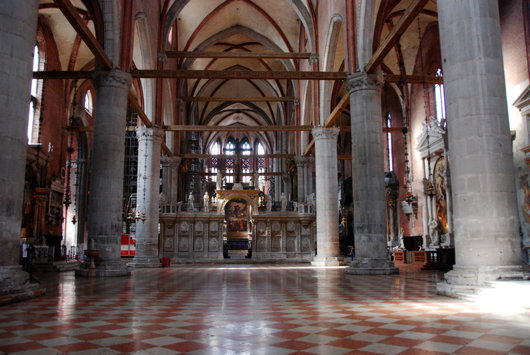
Dino, however, is not having it:
Consider another approach taken by the Venetians toward the beautiful church Santa Maria Gloriosa dei Frari. Completed in the early 14th century, it has been lovingly embellished by generations and generations, all meaningfully, and without any angst about what is authentic and what is not. It has also suffered through suppression, looting, and radical restoration. I Frari has been through it all. It is almost 700 years old, yet because it has been properly cared for, it still looks fresh as a garden daisy. And it is mobbed by visitors year-round who yearn to follow its example, not only in the preservation and handing down of churches, but also our cities, our homes, our culture.
Cross-Border Raids into Finance
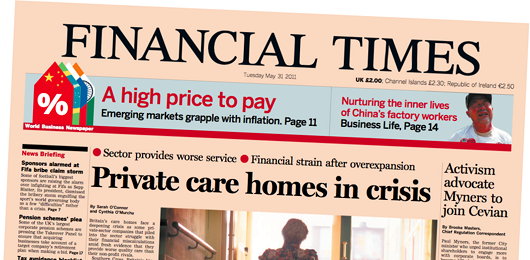
The St James’s offices of Aim-quoted Cluff Gold in London resemble an explorer’s den: an antique globe, exotic objets d’art on the walls and a bust of Jan Smuts, the South African statesman, greeting visitors in the corridor.
It is the work of Algy Cluff, the buccaneering 71-year-old chairman of the west African gold producer. Just returned from shooting guinea-fowl in the Kalahari Desert, Mr Cluff’s air of patrician derring-do could have been sketched by the pen of Evelyn Waugh.
Having worked in Africa long before it became a fashionable investment destination Mr Cluff is modest about the key to success in frontier markets: “Good manners.”
It used to be the certifiable Cusack position that the realms of finance & business were dead dull and to be avoided at all costs. I do read the Financial Times fairly often — especially for its praise-worthy and restrained weekend edition — but I’ve always steered well clear of the Companies & Markets section that appears in the paper’s Monday-through-Friday editions. A week or so ago, inspired by some bizarre exotic curiousity, I wandered over the borders into the territory of Companies & Markets for the first time, and was fascinated by the intricacy of what I found, as well as how interesting it all was.
Also, when younger I thought only boring people went into finance, but after graduating from university and seeing everyone toddle along their various paths, I find that about half the fun and interesting people I know have ended up doing somethingerother financial — another assault on Cusack’s anti-finance defences. I am aided in my exploration of this intricate world by a nifty little book I’ve stolen from a friend’s collection: How to Read the Financial Pages by Michael Brett; basically finance for layfolk such as yours truly. And of course I am still enjoying Philip O’Sullivan’s Market Musings.
Admittedly, much of this is sparked by the initial public offering of Glencore. There’s something splendidly boyish and fun about commodities (especially gold, as the above-mentioned Mr Cluff surely knows) and Glencore’s massive corner of the global commodities market is truly beyond the dreams of avarice. There is, apparently, gold in them thar hills.
Turning the Book on its side
Books are a central obsession of mine. I’ve a reasonably large and ever-increasing library of my own and wherever I’ve called home there have been larger collections available to tap into: the Society Library in Manhattan, the Gericke-biblioteek in Stellenbosch, and the mostly excellent public libraries dotted around lower Westchester. When you see the wide range and styles of the book — it’s size, proportion, paper, appearance — it’s depressing to see how monotonous contemporary book publishing is today. I have a thousand different ideas on book publishing and the wide gaps in the market that are completely ignored today, but here’s one inventive idea I didn’t have.
According to Le Figaro, Editions Point Deux (a subsidiary of the La Martinière group, the third-largest publishers in France) has begun offering what it calls « le plus portables des livres » . These little books are printed on their side to be read like a flipbook rather than in the more conventional format. The idea, apparently, comes out of Holland and has proved successful in Spain, but I haven’t come across it at all in the English-speaking world.
The first question is: what’s the point? At 4.75 in. x 3.15 in., they’re a handy size, but is anything actually gained by turning the text on its side? I imagine it’d be helpful for commuters, but I think it’d be difficult to judge the concept without actually having one in hand and using it, so I think I’ll refrain from handing down a verdict just yet. Very boring of me, I know, but I’ll admit I’m intrigued by the idea.
Licorne Perdue
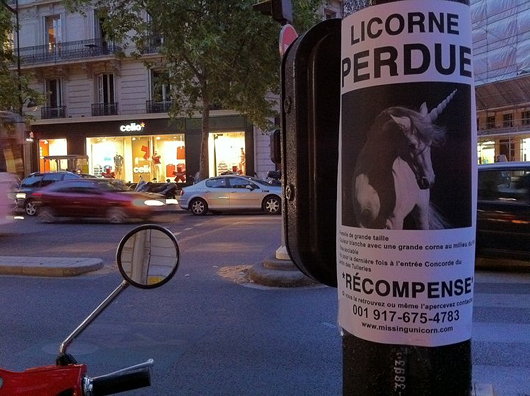
“Vu hier soir à Odéon” writes Nicholas S-M, posting this photo on Facebook.
Of course, my mind immediately wanders to Le Secret de La Licorne, the 3D film version of which (directed by Mr. Spielberg) will be released before the end of the year. I am sure I will hate it, but in that way you can hate things while still liking them.
An Update
Please don’t think I’ve been neglecting you! There has been a lot going on of late, some of which I will report on later, but I can tell you that I have been rendered temporarily homeless, my phone has been stolen, and my computer is (what’s new?) on the fritz. The damned fan is broken and so you’re lucky to get an hour out of it. Of course, before its latest round of hiccups, I took on a little charitable web design project for a certain non-profit London institution currently in its hour of need, so working on that has priority over compiling blog posts in the little time the aged laptop affords me. (If anyone wants to buy me a new MacBook – get in touch!).
Still, there is the office computer, a miserable Dell running miserable Windows on which I am forced to use miserable Internet Explorer (system administrators – that ominous tribe – forbid the downloading of more useful browsers like Safari, Firefox, etc.).
My computer woes have inhibited all my creative efforts! It’s funny (and worrying) how one’s thinking and operation can be so tied to a machine. The flip side of it is that you’re getting more word entries than image entries (even though my writing flows much more fluidly when typing on my Mac). So many damned images on my machine, most waiting for their ticket to come up so I will write what I hope will be an attractive, handsome, and informative article about whatever the subject matter is. You know I am a very visual person, but I am also a word person strangely.
If you’re lucky, perhaps we might tempt Alexander to make another appearance, though he’s currently in Paris trying to undermine French republicanism in an exceptionally asymmetric and perhaps not entirely logical fashion.
UPDATE: Just to clarify: please don’t think I’m homeless in the sense of sleeping rough on the streets. It’s merely that my flatmate fled the country and the landlord sold the place, so I’m currently staying with friends.
The Meeting Place
A Bigoted, Drunken Rant
by the Hon. Alexander Shaw
WANDERING AROUND St. Pancras International railway station today, I came across Paul Day’s ‘The Meeting Place.’ The much acclaimed, £1m, nine-meter-high statue of a couple embracing is, at a glance, a nice image for a railway station — a theme of reunion and all that. But looking up at the gargantuan PDA, I started to realise that this was actually an audacious assault on sovereignty and a shameless celebration of European supremacy over Britain. (more…)
Prayer to St. Joseph for Priests
Where would we be without priests? Terrible to even consider. Ever since the Year for Priests held in 2009-2010, I have tried to remember priests in my intentions much more frequently than before, especially those brilliant priests who’ve had an influence in my life in Scotland, South Africa, New York, and elsewhere.
Fr Mark over at Vultus Christi posted this prayer to Saint Joseph for priests a few weeks back, and it seems worth reblogging.
O glorious Saint Joseph,
who, on the word of the angel
speaking to you in the night,
put fear aside to take your Virgin Bride into your home,
show yourself today the advocate and protector of priests.
Protector of the Infant Christ,
defend them against every attack of the enemy,
preserve them from the dangers that surround them
on every side.
Remember Herod’s threats against the Child,
the anguish of the flight into Egypt by night,
and the hardships of your exile.
Stand by the accused;
stretch out your hand to those who have fallen;
comfort the fearful;
forsake not the weak;
and visit the lonely.
Let all priests know that in you
God has given them a model
of faith in the night, obedience in adversity,
chastity in tenderness, and hope in uncertainty.
You are the terror of demons
and the healer of those wounded in spiritual combat.
Come to the defence of every priest in need;
overcome evil with good.
Where there are curses, put blessings,
where harm has been done, do good.
Let there be joy for the priests of the Church,
and peace for all under your gracious protection.
Amen.
Search
Instagram: @andcusack
Click here for my Instagram photos.Most Recent Posts
- West Point July 30, 2026
- Brunel’s Unbuilt Capitol February 3, 2026
- Cricket at Fordham January 27, 2026
- Palacio Barolo Revisted January 14, 2026
- Learning to Love Liguria January 14, 2026
Most Recent Comments
Book Wishlist
Monthly Archives
Categories