Church
About Andrew Cusack
 Writer, web designer, etc.; born in New York; educated in Argentina, Scotland, and South Africa; now based in London.
 read more
News
Blogs
Reviews & Periodicals
Arts & Design
World
France
Mitteleuropa
Knickerbockers
Argentina
The Levant
Africa
Cape of Good Hope
Netherlands
Scandinavia
Québec
India
Muscovy
Germany
Academica
Appeal to the Holy Father
From the British Isles
This appeal was recently sent to Pope Benedict XVI from a number of British intellectuals and public figures. (Source: Rorate Caeli).
In 1971 many leading British and international figures, among whose number were Yehudi Menuhin, Agatha Christie, Vladimir Ashkenazy, Nancy Mitford, Graham Greene, Joan Sutherland, and Ralph Richardson, presented a petition to His Holiness Pope Paul VI asking for the survival of the traditional Roman Catholic Mass on the grounds that it would be a serious loss to western culture. The then Archbishop of Westminster, Cardinal Heenan himself appealed to Pope Paul for the continued celebration of the traditional Mass. The full text of this appeal in 1971 was:
“If some senseless decree were to order the total or partial destruction of basilicas or cathedrals, then obviously it would be the educated – whatever their personal beliefs – who would rise up in horror to oppose such a possibility. Now the fact is that basilicas and cathedrals were built so as to celebrate a rite which, until a few months ago, constituted a living tradition. We are referring to the Roman Catholic Mass. Yet, according to the latest information in Rome, there is a plan to obliterate that Mass by the end of the current year. One of the axioms of contemporary publicity, religious as well as secular, is that modern man in general, and intellectuals in particular, have become intolerant of all forms of tradition and are anxious to suppress them and put something else in their place. But, like many other affirmations of our publicity machines, this axiom is false. Today, as in times gone by, educated people are in the vanguard where recognition of the value of tradition in concerned, and are the first to raise the alarm when it is threatened. We are not at this moment considering the religious or spiritual experience of millions of individuals. The rite in question, in its magnificent Latin text, has also inspired a host of priceless achievements in the arts – not only mystical works, but works by poets, philosophers, musicians, architects, painters and sculptors in all countries and epochs.
“Thus, it belongs to universal culture as well as to churchmen and formal Christians. In the materialistic and technocratic civilisation that is increasingly threatening the life of mind and spirit in its original creative expression – the word – it seems particularly inhuman to deprive man of word-forms in one of their most grandiose manifestations. The signatories of this appeal, which is entirely ecumenical and non-political, have been drawn from every branch of modern culture in Europe and elsewhere. They wish to call to the attention of the Holy See, the appalling responsibility it would incur in the history of the human spirit were it to refuse to allow the Traditional Mass to survive, even though this survival took place side by side with other liturgical reforms.”
This appeal in 1971 came at a crucial time in the history of civilisation when the future of the traditional Latin “Tridentine” Mass was in jeopardy. Pope Paul VI graciously acknowledged this appeal and the traditional Mass was saved, at least in England and Wales. Since this momentous appeal in 1971 the traditional Latin Mass has prospered once again among the faithful worldwide and is now celebrated in almost every country in the world. Now, in 2007, there is great hope and expectation that this treasure of civilisation will be freed from its current restrictions. We, the signatories of this petition, wish to associate ourselves to the sentiments expressed in the petition of 1971 which, perhaps, are even more valid today, and appeal to His Holiness Pope Benedict XVI in 2007 to allow the free celebration of the traditional Roman rite of Mass, the Mass of Ages, the Mass of Antiquity, on the altars of the Church.
Miss Madeleine Beard, M.Litt. (Cantab).
Dr. Mary Berry CBE, Founder of the Schola Gregoriana in Cambridge.
James Bogle, TD, MA, ACIarb, Barrister, Chairman of the Catholic Union of Great Britain.
Count Neri Capponi, Judge of the Tuscan Ecclesiastical Matrimonial Court.
Fr. Antony F.M. Conlon, Chaplain to the Latin Mass Society.
Julian Chadwick, Chairman – The Latin Mass Society of England and Wales.
Rev. Fr. Ronald Creighton-Jobe, The Oratory, London.
Fra’ Fredrik Crichton-Stuart, Chairman CIEL UK.
Leo Darroch, Secretary – International Federation Una Voce.
Adrian Davies, Barrister.
R.P. Davis, B.Phil., M.A., D.Phil (Oxon), retired senior lecturer in Ancient History, Queen’s University of Belfast; translator/commentator on the Liber Pontificalis of the Roman Church.
John Eidinow, Bodley Fellow and Dean, Merton College, Oxford.
Jonathan Evans MEP, Vice Chairman Catholic Union of Great Britain.
Fra’ Matthew Festing, OBE, TD, DL. Grand Prior of England of the Sovereign Military Order of Malta.
The Right Honourable Lord Gill, Lord Justice Clerk of Scotland.
Dr. Sheridan Gilley, Emeritus Reader, University of Durham.
Dr. Christopher Gillibrand, MA (Oxon).
Rev. Dr. Laurence Paul Hemming, Heythrop College, University of London.
Stephen Hough, Concert Pianist and Composer.
Neville Kyrke-Smith, National Director, Aid to the Church in Need UK
Prince Rupert zu Loewenstein, President of the British Association of the Sovereign Military Order of Malta. KCSG.
James MacMillan, CBE, Composer and Conductor.
Anthony McCarthy, Research Fellow, Linacre Centre for Healthcare Ethics.
Mrs. Daphne McLeod, Chairman – Pro Ecclesia et Pontifice.
Anthony Ozimic, MA (bioethics).
Dr. Susan Frank Parsons, President, Society for the Study of Christian Ethics (UK) and Co-Founder of the Society of St. Catherine of Siena.
Dr. Catherine Pickstock, Lecturer in Philosophy and Religion; Fellow – Emmanuel College, Cambridge.
Dr. Thomas Pink, Reader in Philosophy and Director of Philosophical Studies, Kings College, London.
Piers Paul Read, Novelist and Playwright; Vice-President of the Catholic Writers’ Guild of England and Wales.
The Rev’d. Dr. Alcuin Reid, Liturgical Scholar and Author.
Nicholas Richardson, Warden of Greyfriars Hall, Oxford.
Prof. Jonathan Riley-Smith, retired Dixie Professor of Ecclesiastical History, Cambridge University.
Fr. John Saward, Lisieux Senior Research Fellow in Theology, Greyfriars, Oxford University.
Dr. Joseph Shaw. Tutorial Fellow in Philosophy, St. Benet’s Hall, Oxford University.
Damien Thompson, Editor-in-Chief, The Catholic Herald.
Almodovar on Liturgy
“Ceremonies are what I enjoyed the most in my school days. I consider myself agnostic, but find Catholic liturgy absolutely wonderful, fascinating and touching. It’s been a long time since I last attended mass, though. I don’t know what it’s like these days.”
The Cardinal Duke of York
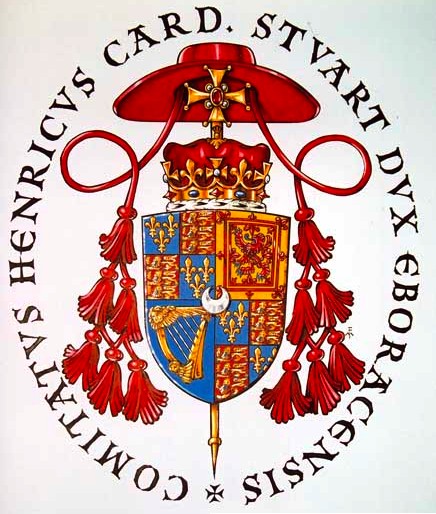
The great Marco Foppoli has designed (and very kindly passed along to me) the badge for the committee which has been assembled to commemorate the two-hundredth anniversary of the passing of the Cardinal Duke of York, or King Henry IX and I as was his style according to the Jacobite succession. I’m not entirely sure what events are being planned, but I believe there will be a conference in Rome around the anniversary in August.
The Greatest Building Never Built

LUTYENS’ SCHEME FOR the Metropolitan Cathedral of Christ the King, Liverpool is oft hailed as the greatest building to never have been built. Strictly speaking, this is not accurate, as the building was structurally finished, although not completely decorated, up to the crypt level. Nonetheless, had it been finished, the cathedral almost certainly would have been considered Sir Edwin Lutyens’ greatest work; though his hand (with Herbert Baker) in building the Indian capital of New Delhi, including the monumental Viceregal Palace, would certainly vie for the title. (more…)
Christmas
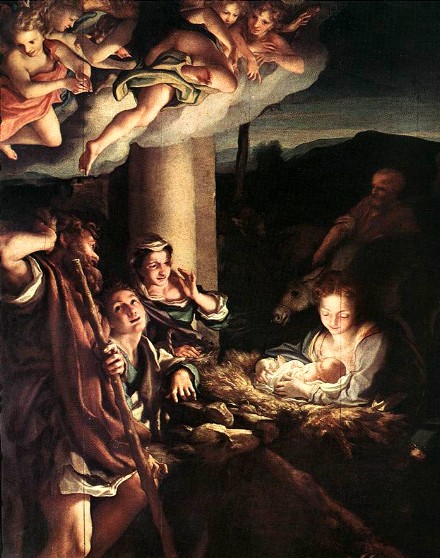
Corregio, Nativity
Oil on canvas, 101″ x 74″
1528-30, Gemäldegalerie, Dresden
Who with His life, the world to save,
All honor, power, glory, Thine,
and in Thy Heart our souls do bind.
a very merry and blessed Christmas.
Drink Audit Ale in Heaven With Me
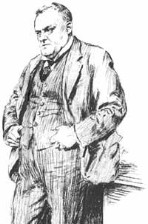
I pray good beef and I pray good beer
This holy night of all the year,
But I pray detestable drink to them
That give no honour to Bethlehem.
May all good fellows that here agree
Drink Audit Ale in heaven with me,
And may all my enemies go to hell!
Noel! Noel! Noel! Noel!
May all my enemies go to hell!
Noel! Noel!
WITH THESE SIMPLE and lovely lines, Hilaire Belloc superbly expressed the esprit de Noël of the Christian curmudgeon. It amounts, more or less, to “Rend honor to the Holy Child, and to hell with the rest”.
His Lines for a Christmas Card are obviously meant in a jovial and light-hearted spirit (naturally, we would not wish Hell on any poor soul) and are completely intelligible but for this curious line: “May all good fellows that here agree / Drink Audit Ale in heaven with me”. What on earth is Audit Ale?
Before the Reformation, the English year was a calendar of feasts, festivals, and holidays — holy days, even. Four of these holy days, spaced fairly evenly throughout the year, were marked for such things as the collection of rents and the paying of feudal tributes. These four were Lady Day (March 25, the Feast of the Annunciation), Midsummer Day (June 24, the Feast of St. John the Baptist), Michaelmas (September 29, the Feast of St. Michael the Archangel), and Christmas (December 25, of course, the Feast of the Nativity of Christ).
Now, events such as the collection of fees and taxes and the giving of feudal tribute tend towards the dour, and so often a feudal lord would have a special ale brewed for these occasions, to ensure a certain amount of merriment among the commonfolk once their tribute had been paid and the burden lifted. This tended to be called ‘audit ale’, since it was brewed around the time of audit.
They were not, you will be happy to learn, the only seasonal brews around. There was ‘leet-ale’ for when the manorial court, or court-leet, convened, and there was Whitsun-ale for Whitsuntide, and there were church-ales which went towards the upkeep of the parish church and alms for the poor. Indeed, in village of Sygate in Norfolk, there is an inscription on the gallery of the church which reads:
And give us good ale enow . . .
Be merry and glade,
With good ale was this work made.
Also, interestingly, the very word ‘bridal’ comes not from the -al suffix English developed up from Latin, but rather from the Old English brýd-ealo: bride-ale or wedding-ale.
With the advent of Protestantism — and most especially the Puritan variant thereof — feasts, seasons, and other joviality generally became frowned-upon. England was forced to be less English, as the monotonous bores took over.
Still, remnants of the feasts and seasons remained. Lady Day was the first day of the year in Great Britain and its empire until 1752, when the Gregorian calendar was finally adopted. Similarly, the fiscal year in the United Kingdom begins on April 6 because that day in the Gregorian calendar corresponds to Lady Day in the old Julian calendar.
 In Oxford and Cambridge, meanwhile, colleges still brewed special ales for the time when grades were released; either to celebrate the achievement or to soften the blow. These brews kept the old moniker of ‘audit ales’ and Belloc most likely uses the term in this derivation. Even in my own time at St Andrews we often sipped home-brewed ale from ancient, battered pewter tankards, though we rarely needed the excuse of holy days to continue the tradition.
So this Yuletide perhaps you will consider home-brewing, and brew a special ale for the festal season now that the penetential time of Advent is passing. But, if you’re otherwise engaged, head into town and make sure to have a beer, and raise your pint to that Wondrous Babe whose birth brings us such mirth and cheer.
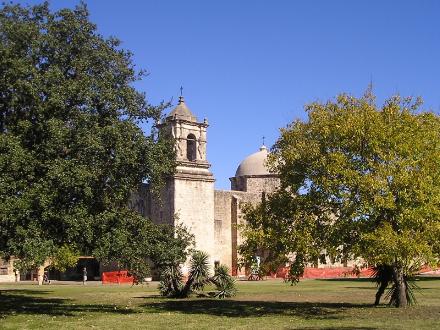
San Fernando Cathedral
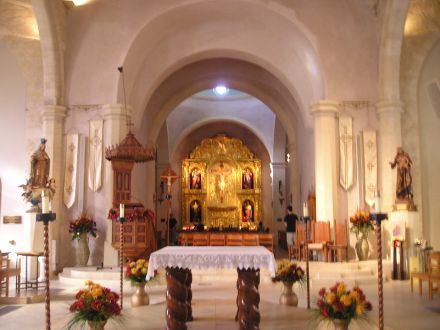
SAN FERNANDO CATHEDRAL in San Antonio, Texas, named after the holy King Ferdinand III of Castile, is one of the oldest cathedrals in the United States. Indeed, there is considerably debate as to precisely which church is the oldest cathedral in the United States. The Baltimore Basilica, recently restored, was the first cathedral to be located in the political entity known as the United States. The Cathedral Basilica of Saint Augustine in the Floridian city of that name was founded in 1594 (making it the oldest parish in the U.S.) but the current structure was not built until 1793, and the church did not become a cathedral until 1870. The core of San Fernando was built from 1738 to 1750, but the nave was replaced in 1868 with one of a neo-Gothic design. It became a cathedral when the See of San Antonio was erected in 1874. So the Baltimore Basilica (or the Basilica of the National Shrine of the Assumption of the Blessed Virgin Mary, to give it its full name) was certainly the first cathedral in the United States, though not the oldest church serving as a cathedral. To add to the fray, the Cathedral of Our Lady of Peace claims that it is the oldest continuously operating cathedral in the United States, since the Baltimore Basilica is no longer the cathedral of Baltimore, but rather merely co-cathedral to the bizarre art-deco-gothic Cathedral of Mary Our Queen in that city. It’s all quite mad really. Suffice to say, San Fernando is old and it is a cathedral; it’s an old cathedral. (more…)
The Rosary Crusade
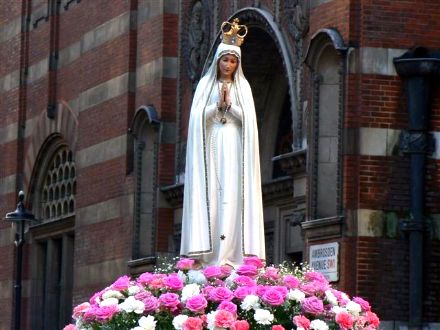
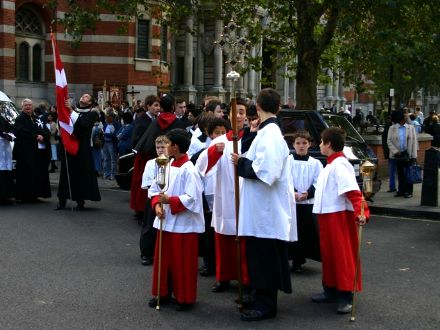
THE BLESSED VIRGIN HAS quite the legion of followers at her beck and call, and a good many battalions (perhaps even a regiment?) turned up on October 14 for the annual Rosary Crusade for the reparation of sins. The event began with a procession from Westminster Cathedral near Victoria Station, through the streets of London, to Brompton Oratory in Kensington. A statue of Our Lady was borne aloft by members of the Catholic Police Guild the whole way to the Oratory, where Benediction was held. We bring you these photos, taken by, amongst others, Matt Doyle, and Ken Simpson, all of which we found via ‘Joee Blogs‘, a Catholic medical student in London.
Our Holy Emperor
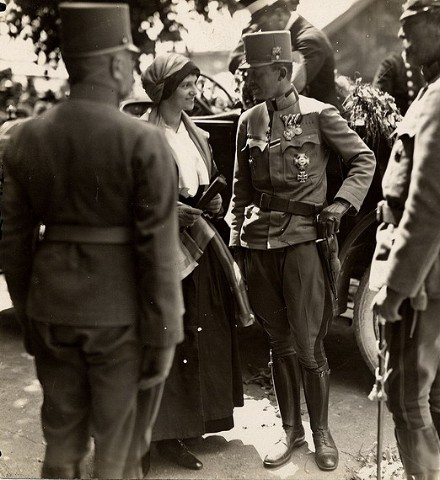
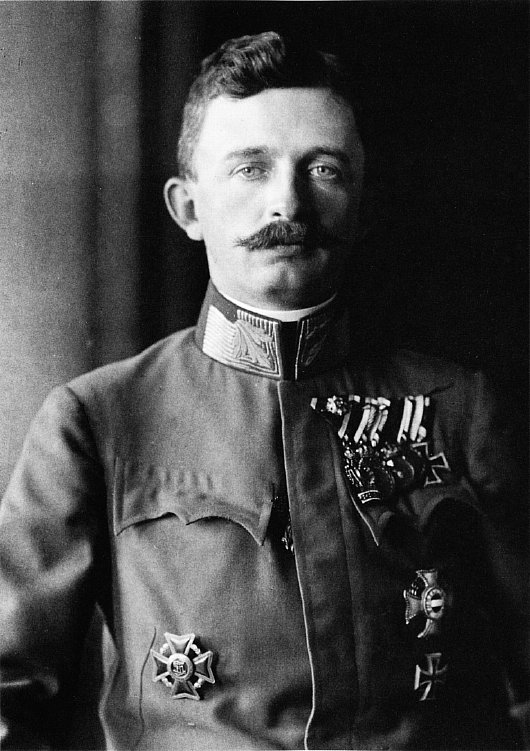
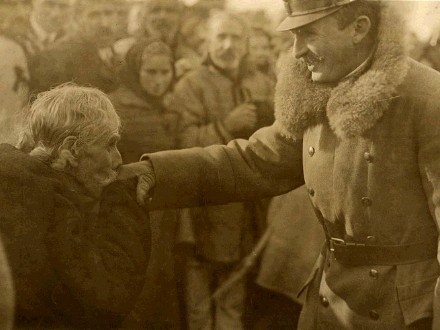
OCTOBER 21 IS the feast of Blessed Charles of Austria, the saintly emperor of that sacred realm whose life stands as an example of the price of sanctity. Charles worked tirelessly for peace both between the peoples of his own numerous realms and between all the nations, seeking to bring to an end the ceaseless and suicidal slaughter of the Great War, in the midst of which he had ascended to the throne of his fathers. A defender of social order, Charles reminds us of our many responsibilities to each other, even though the spirit of our current age would have us clamor only for our supposed rights. In the face of repeated betrayal and intense pressure, he refused to abdicate and so abandon his peoples to their fates, which were terrible indeed. That terrible cross he bore, the crown, was in fact a penitential grace, the sufferings he bore for the benefit of his – and indeed all – people. His reward was not in this world.
James II, Our Catholic King
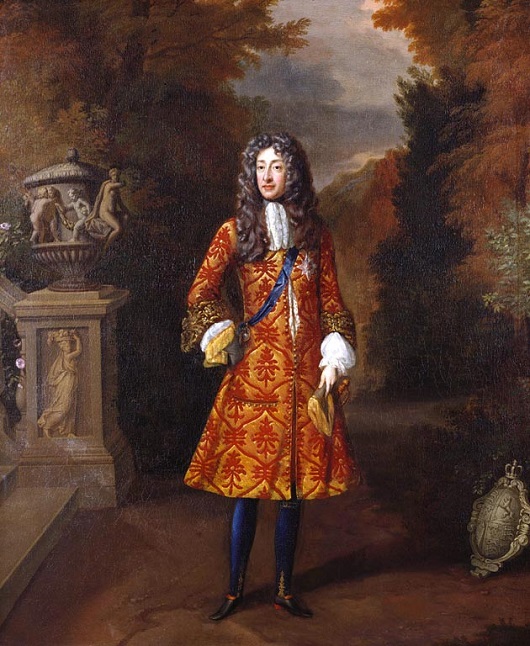
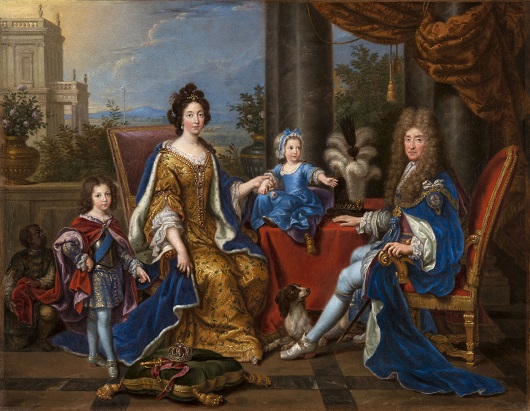
THIS PAST SATURDAY was the anniversary of the birth of King James II and VII of England and Scotland. The third son of Charles I, he was baptised into the Anglican church six weeks after his birth and was created Duke of York at eleven years of age. James married Anne Hyde, the daughter of the Earl of Clarendon, by whom he fathered eight children, though only two survived past childhood.
In 1664 the Duke of York equipped an expedition to relieve the Dutch of responsibility for their colonies in North America, and henceforth New Amsterdam and New Netherland were known as New York after their new Lord Proprietor.
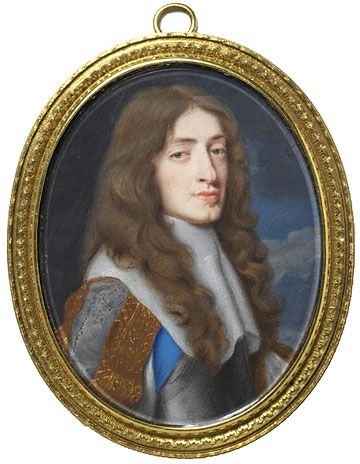
Sometime during the year 1670 both the Duke and Duchess of York were received into the Catholic Church and stopped attending Anglican services, though the conversion did not become public knowledge until the Test Act (requiring officeholders to receive communion in a Church of England service and take an oath against Transubstantiation) was passed three years later. James was forced to renounce his offices, such as Lord High Admiral of England, though not his titles. At any rate, Anne, the Duchess of York had died in 1671 only a year after her conversion. He married Princess Maria of Modena in 1673.
The Protestant oligarchs felt threatened by the prospect of a Catholic king and thrice tried to pass laws barring James from succeeding to the throne. However his elder brother Charles II, the reigning king, dissolved parliament each time before the bill was to be passed. King Charles II died in February 1685, (having reconciled himself to the Catholic faith before his end) and thus the Duke of York was proclaimed James II of England and VII of Scotland. A private Catholic coronation was held at Whitehall Palace on April 22 before the public coronation the following day on the feast of Saint George, which was performed according to the rites of the Church of England.
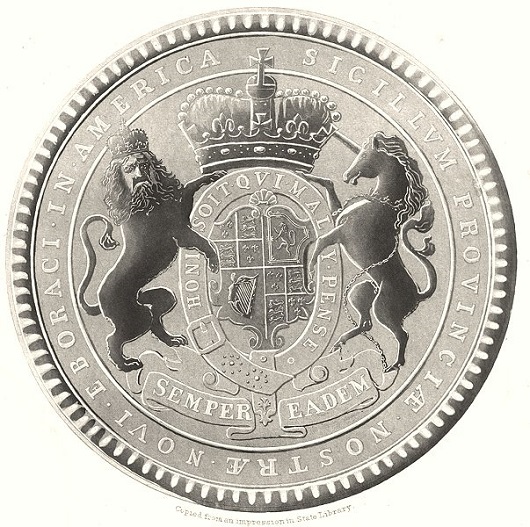
James had appointed the Catholic Thomas Dongan
as Governor of New York in 1682.
The Protestant oligarchs’ fears that James would end their hegemonic grip on Scotland and England proved well-founded as in 1687 he issued a Declaration of Toleration as King of Scotland, allowing Catholics, Episcopalians, and other non-Presbyterians to hold public office and the right of public worship, and a Declaration of Indulgence as King of England removing the laws penalizing non-attendance or non-communion at Church of England services, permitting non-Anglican worship in private homes or chapels, and abolishing religious oaths for public offices. Furthermore, James had allowed Catholics to hold positions at the University of Oxford for the first time since the Protestant Revolution. More provocatively, he tried to transform Magdalen College Oxford into a Catholic seminary. He had already reckoned with the rebellion of the Duke of Monmouth who proclaimed himself king two years earlier but had been captured, tried, and executed for treason. With the birth of a Catholic son and heir, Prince James Francis Edward, in 1688 a cabal of seven Protestant nobles issued an invitation to William of Orange, the Protestant Stadtholder of the Netherlands. A few months later, William of Orange duly arrived and usurped the throne, having already married James’ daughter Mary from his first marriage. The two ruled jointly as William and Mary.
Unwilling to create a popular martyr as had happened with the executed Charles I, William allowed James to escape and fled to France where Louis XIV gave the exiled monarch the use of a palace and an ample pension. James was intent on returning to his birthright, however, and took advantage of the Irish parliament’s refusal to recognise William’s usurpation of the throne. The King landed in Ireland in March of 1689 at the head of a Franco-Irish army but was defeated by William in the famous Battle of the Boyne in July 1690, and returned to his place of exile in France.
There, Louis allowed him to live in the château of Saint-Germain-en-Laye and offered to get James elected King of Poland but James felt this would prevent any chance of a Stuart again holding the throne of England. From that time onwards, James led a simple life of penance in reparation for his sins (he had had a number of mistresses in his younger days) and finally died in 1701. He was entombed in the Chapel of St. Edmund within the English Benedictine church on the Rue St. Jacques in Paris, while his brain was sent to the Scots College in Rome, his heart to the Visitandine Convent at Chaillot, and his bowels divided between the College of St. Omer (the exiled English Catholic school, now Stonyhurst in Lancashire), and the nearby parish church of St. Germain where they remained until they were desecrated by a Revolutionary mob and lost forever. His monument at Saint-Germain, however, was rediscovered in 1824 and is proudly displayed there to this day. There is also a monument to James and the Stuarts in St. Peter’s Basilica in Rome (c.f. Roma – Caput Mundi).
Aside from the pious tradition that Edward VII was received into the Church on his deathbed, James II was the last Catholic king (and as good King Edward never reigned over New York, James is even more certifiably so for us). There is a lovely coronation ode to James which I just might bring to your attention someday. But for now, reflect and remember our monarchs of old and pray that God in His mercy might grant us good Catholic rulers in stead of the shabby lot we elect today.
The Auld Scotsman
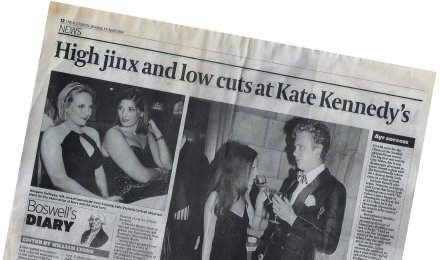
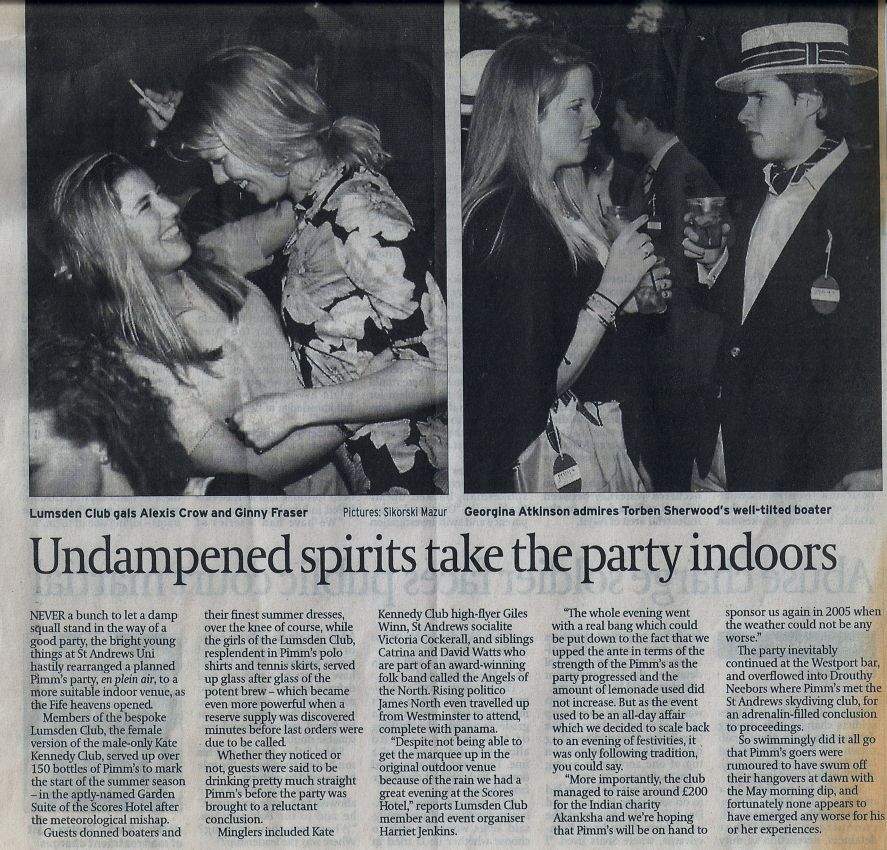
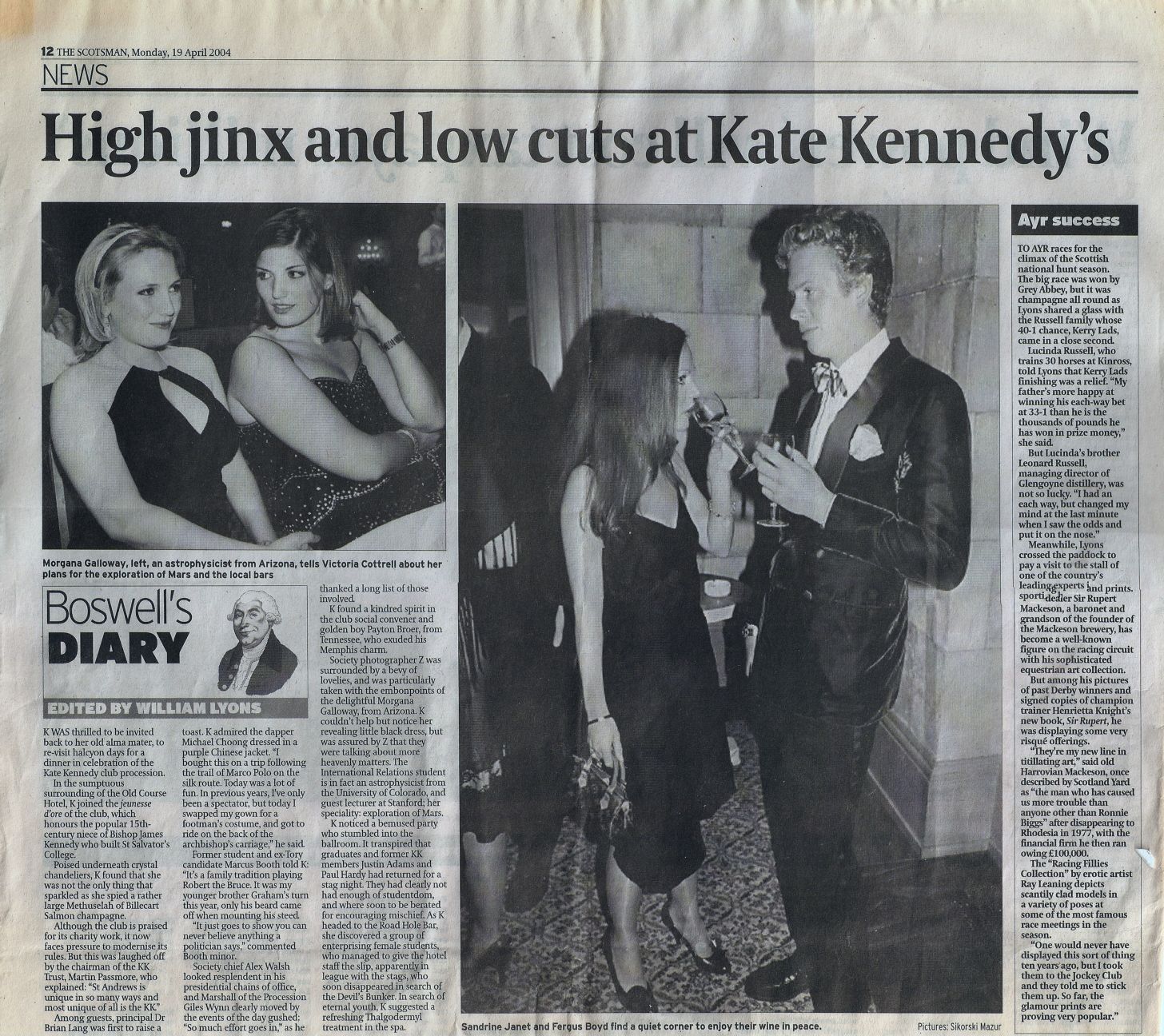
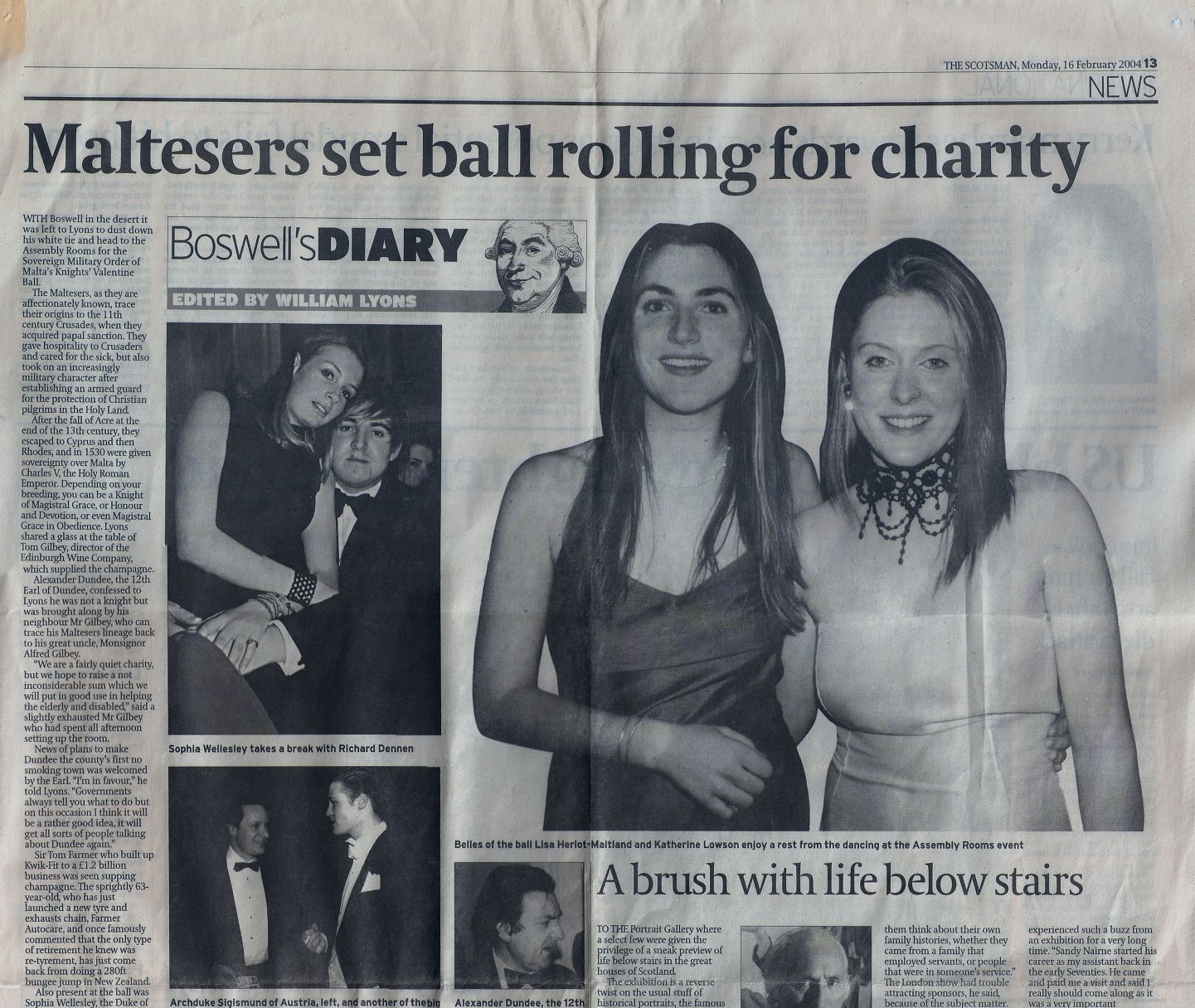
ONE THING WE greatly enjoyed about the Scotsman in its pre-tabloid days was that they often deemed St Andrews social events worthy of coverage in their august pages. It was a source of pride to see ‘the national newspaper’, a respectable broadsheet, covering events at the oldest university in the land (which we are proud to call our own). Naturally, once the conversion to tabloid size was complete, we were rarely heard of again, which was a little saddening. The Scotsman is not what it used to be —a beautiful, well-designed, informative respectable newspaper— but it still manages to print some thoroughly worthwhile articles which is more than can be said of any other Scottish daily. (One need only point out two articles by Prof. Haldane, c.f. here and here, recently posted on this site).
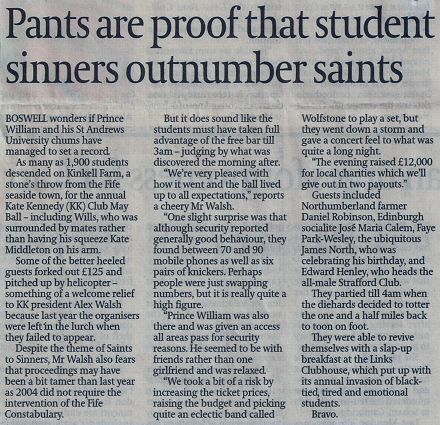
“…when the diehards decided to totter the one and a half miles back to toon on foot.” Sounds familiar.
Admittedly, most of the events covered were organised by the Kate Kennedy Club, which seems to take pride in the sheer vulgarity and tastelessness with which they advertise many of their events. (This is only slightly mitigated by their superb running of the annual Kate Kennedy Procession). Still, we enjoyed the Scotsman‘s coverage and wish it had continued. I only bought the Scotsman on occasion after the switch, but often gave the Common Room’s copy a browse when I lived in St. Salvator’s. (Its Sunday edition, Scotland on Sunday is worth buying for Gerald Warner alone).
Here are a few bits and pieces clipped from the Scotsman for your perusal:
‘Undampened spirits take the party indoors‘ / Lumsden Club garden party moved indoors on account of the rain. (I didn’t go).
‘High jinks and low cuts at Kate Kennedy’s‘ / This covered the Kate Kennedy Procession dinner which takes place at the Old Course Hotel on the evening following the procession. This particular year I was in attendance myself and recall commiserating with Michelle Romero, that charming daughter of Venezuela, about the troubled state of her native land. I was their with our favorite Dane, Sofie von Hauch, and my flatmate, a member of the KK who wishes to remain unnamed on this site. Will Lyons couldn’t make the dinner himself, so he sent ‘K‘ up instead, accompanied by ‘society photographer Z‘ whom I ran into while we were on our way out.
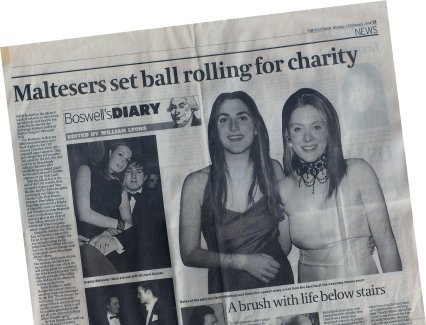
‘Maltesers set ball rolling for charity‘ / The 2004 Knights of Malta Ball, not covered by this website because it did not exist at the time. It was a good time, especially so because I had three friends over from the States. Yalie Adam Brenner was doing his semester abroad at St Andrews at the time, and fellow Old Thorntonian Clara de Soto popped over from Boston College for the weekend with her good friend Katie Cordtz of Atlanta. The four of us together with Michelle Romero and the aforementioned unnamed flatmate of mine piled into a cab and made the hour’s journey to Edinburgh for the soirée. Poor Adam, though. Towards the latter part of the evening Archie Crichton-Stuart, an exceptionally amusing Edinburgh student, and his friend Ramsay forced Adam to consume the significant remnants of a bottle of house red. It all went down swimmingly, but came back up on the cab ride back to Fife. Freddy McNair, who was recently nearly killed by an incompetent gurkha on a training ground, sat at the table next to ours, I recall. (Also, in the lower right-hand corner of the clipping you can spy the face of our good friend Ricky Demarco peering out from an unrelated article).
Previously: Another Broadsheet Bites the Dust
Without family & faith we’ve lost our way
by JOHN HALDANE
THE SCOTSMAN | Friday 1 September 2006
DR JOHNSON’S memorable observation that “nothing so concentrates the mind as the prospect of imminent hanging”, has provided a formula for highlighting other attention-focussing threats. Currently, for example, the minds of Scotland’s MSP’s may be said to be concentrated by nothing so much as by the prospect of next year’s Holyrood elections.
It is reported that Labour and the SNP are each holding strategy discussions to prepare for May’s poll. The latter in hope of victory, the former in fear of defeat. Meanwhile, the Liberal Democrats try to look principled while yet pondering the best bet for coalition partners; Conservative MSPs are under attack from within their own party for their mediocre performance; and Scottish Socialists are breaking apart and regrouping in smaller cells. Concentrating the mind is rarely easy, often uncomfortable, and sometimes destructive.
So much for the politicians, what of the electorate? or more aptly, in times of declining voter participation, what of the people of Scotland? It is clear that here, as in the UK more generally, people have little confidence not only in politicians but in politics. Apart from cynicism encouraged by decades of scandals which, whatever their differences, give the general impression of exploitation of office; there is the feeling that most policies simply fail to make life better.
Vienna on 43rd Street
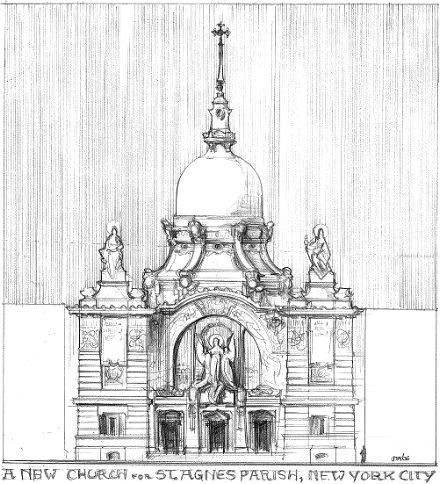
A WEEK AGO AFTER the 11 o’clock Sunday Mass at St. Agnes, Dino Marcantonio, Matt Alderman, and I stood in front of the church and fantasized about how we would fix the old place. Well, perhaps ‘old’ isn’t the right word for the place. While the parish was founded in the 1840’s, the current church building only dates from the late 1990’s, built after the old Victorian edifice was consumed by fire. As for design, its heart is in the right place, but as they say the Devil is in the details. The interior is marred by quite obviously large joints between component parts of arches and cornices and the exterior just looks fake. Is craftsmanship dead? No, but it helps to search it out instead of accepting just any old thing.
At any rate, Matt Alderman has thrown together these esquisses of what his St Agnes would look like, and it’s all rather Austrian. (more…)
Gabriel García Moreno
Ecuador’s Saintly President
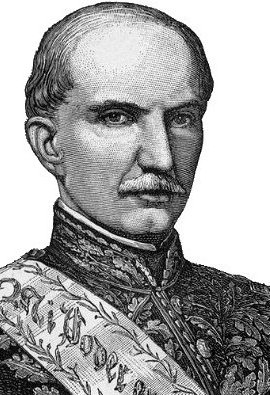
WE LIVE IN an age which is almost completely devoid of Christian statesmen. In their stead, we are today ruled by faceless bureaucrats and vapid masters of spin. Gentlemen once sought public office in the hopes of ensuring order and the public good while dark and knavish men sought the same in their lust for power. The politicians of today, meanwhile, tend to be of neither inspiration but rather seem all too often to have engaged upon the ‘career’ of ‘public servant’ because they lack any of the skills necessary to succeed in any real, productive employ, station, or vocation. Given the sad state of affairs in our day, we must look to the past — to another age and indeed another continent — in our search for models of Christian leadership in the temporal realm of a modern republic. In this search, the name of the journalist, scholar, statesman, and saint, President GABRIEL GARCÍA MORENO of Ecuador, stands taller than any other in the Americas. (more…)
The Assumption

Nicolas Poussin, The Assumption of the Virgin
Oil on canvas, 22″ x 16″
1650, Musée du Louvre, Paris
Click here for a closer view.
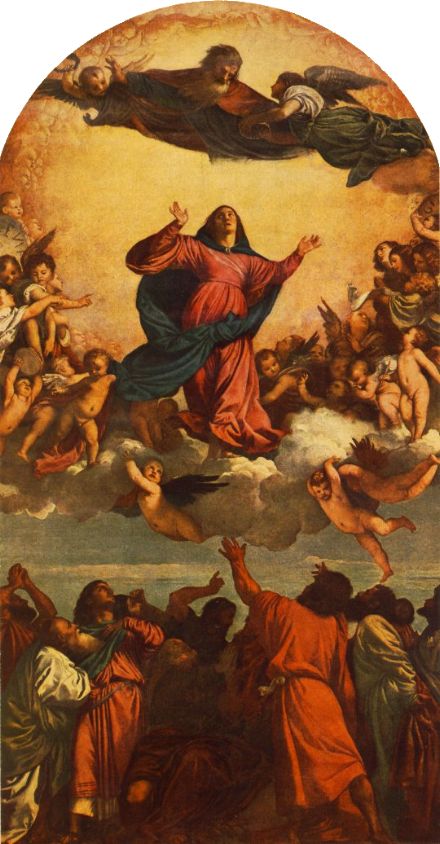
Titian, Assumption of the Virgin
Oil on wood, 272″ x 142″
1516-18, Santa Maria Gloriosa dei Frari, Venice
Monarchs and Presidents in Islam
National Review, Nov 21, 1986
by Erik von Kuehnelt-Leddihn
IN THE Islamic world’s relations with Israel, the hard-liners are the various Arab and non-Arab republics. When there is any sign of softness, it comes, almost always, from one of the monarchies. (Egypt, and Egypt alone, is the exception.) It thus did not come as a great surprise that King Hassan II of Morocco agreed to meet with the then Israeli prime minister, Shimon Peres, this summer.
While individual monarchs historically may have been capricious or cruel, monarch as an institution is inclined to be generous: Montesquieu has told us that while the driving element in republics is virtue, in monarchies it is clemency. And, indeed, the Islamic monarchs of old were infinitely more tolerant than their modern republican successors. They traveled extensively, and many had a cosmopolitan outlook. Some had relatives abroad. When King Hassan II of morocco writes to members of Europe’s royal families, he addresses them as “cher cousin” or “chere cousine,” since he is a descendant of Mohammed’s daughter Fatima, as by now are all the Christian royal families. (Many centuries ago, a Moroccan prince was taken prisoner by the Castilians and converted in captivity. After his release he married into a princely family, and over the centuries his bloodline has spread into countless aristocratic and royal families.) In chooing their administrators, officers, diplomats, bankers, and doctors, Islam’s monarchs looked for able men regardless of religion, never caring whether their choices were popular or not.
It is true that local slaughters of Christians took place in various parts of the Turkish Empire, but things got really bad only when the enlightened, highly nationalistic Young Turks appeared on the scene. Their political organization was called “Unity and Progress,” by which they meant ethnic uniformity and modern methods. It was they who were behind the big Armenian massacres during World War I. The Turkish sultans, by contrast, frequently gave preferment to Christians (and sometimes Jews) in high positions. The Phanariotic Greeks, so called after the Lighthouse Quarter of Constantinople in which most of them lived, acted as trusted administrators; the governors of the Rumanian-speaking provinces, for instance, were taken from their families.
Very typical is the story of a family known to me. Originally called Black, they were Scots and good Catholics who emigrated after the fall of the Stuarts and settled in France, where they Gallicized their name. There are still Blacques in France, but one branch of the family emigrated to Turkey, where its scions made a splendid career without changing either their name or their religion. One of them, Edward Blacque-Bey, became the last Turkish imperial ambassador in Washington. (His sons, too, made diplomatic careers. One married an American, and his son, having graduated from Harvard, became a colonel in the U.S. Marines and later an American diplomat.) Edward Blacque-Bey wore a fez and was a loyal subject of the sultan, under whom Constantinople became an international metropolis. All this ended with the republic under Ataturk.
Similar conditions existed in the kingdom of Egypt before Nagib and Nasser. Forty per cent of the administrators and civil servants were Coptic Christians, who considered themselves the genuine descendants of the Old Egyptians. Before 1952 Cairo was an eastern Paris, where Christians and Jews played an important role–socially, commercially, politically, Arab nationalism put an end to all this, not only in Cairo, but also in Alexandria, which is so well described in Lawrence Durrell’s Alexandria Quartet. In Iran–a non-Arab state–the old monarcy under the Kajar dynasty and the more recent one under the Pahlavis were notably tolerant. Non-Muslims (such as the still-surviving Zoroastrians) could make all sorts of careers, and the country’s political orientation was Western. The window to the West remains open in the Islamic monarchies of today–in Morocco, in Saudi Arabia, in Oman, and even in Malaysia.
MONARCHIES HAVE the advantage that, although they might be oppressive toward the political ambitions of their subjects, they are never totalitarian. To my knowledge there is no Jewish community left in Algeria, but there still is a small one in Morocco. Variety is the keynote of monarchies, and with it goes internationalism. In 1910 only two sovereign nations in Christian Europe had truly native dynasties: Serbia and Montenegor. (Peter III was the last genuine Romanov; the Hohenzollerns were not Prussians but Swabians; and so forth.) These dynasties could often follow unpopular policies, both domestic and foreign. Popular policies are not always good for the country, and the courage required to stick to an unpopular good policy is immensely rare among politicians in democracies. They crave popularity and want, above all, to be re-elected. King Hassan II might be trembling lest he be assassinated by fanatics, but he pursues policies that he considers to be right. He certainly is not guided by Sir Henry Campbell-Bannerman’s idiotic dictum, “Self-government is better than good government,” which is roughly equivalent to saying that self-treatment in case of illness is better than treatment by a qualified physician.
America’s Latest Basilica
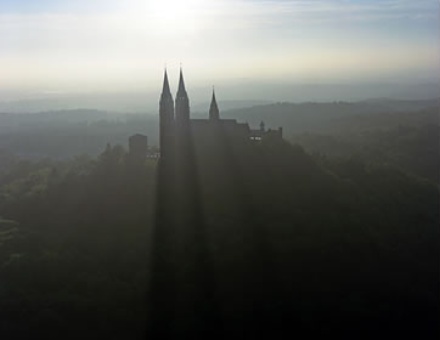
Holy Hill, the National Shrine of Mary, Help of Christians, has been named a basilica minor by the Holy Father. The Carmelite friars came from Bavaria to found the monastery at this hill in Wisconsin one hundred years ago in 1906. While the invocation of Mary as Help of Christians (Auxilium Christianorum) began in the 1500’s, the feast of Our Lady, Help of Christians was instituted in 1815 by Pope Pius VII in thanksgiving to God and Our Lady for the freedom of the Papacy and of Europe brought about by the defeat and exile of Napoleon Bonaparte.
Via the Holy Whapping.
Above photograph of Holy Hill by Carl Waltz
Dawn Eden in the Irish Times

This morning I was browsing the front pages of a few of the world’s leading dailies and came across the Irish Times. I thought to myself “My, that lady bears a striking resemblence to Dawn Eden.” Then I read the headline ‘Chastity Can Make You Happier, Says Author’ and thought to myself “How bizarre! That sounds just like something Dawn would say.” Finally I put two and two together and thought “Crikey! That is Dawn!” C.f. the Dawn Patrol.
Our readers will no doubt recall that Dawn mentioned my comments regarding the Brooklyn Museum’s mauling of their own façade in her Daily News column. More recently she’s written a book and has been buying refrigerators for nuns.
Elsewhere: Superpower: The View from New York – Matt Alderman reports on a night on the town with Dawn Eden including the ever-prescient and incisive wisdom of Andrew Cusack
The Rome of the West
The Churches of Glorious St. Louis, Capital of Middle America
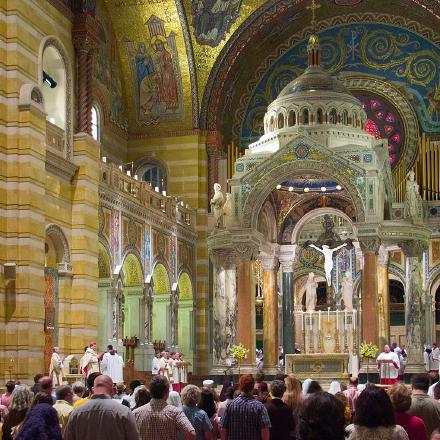
WE ON THE EASTERN Seabord often think that our cities are the last word in ecclesiastical architecture, but Mark Scott Abeln’s splendid ‘Rome of the West‘ site goes a long way towards reminding us of the great physical deposit of Western Civilization and Christian culture situated in the city of St. Louis on the Mississippi River, deep in the heart of America. To show my fellow provincial knickerbockers the richness of St. Louis’s church architecture, I’ve chosen a few photos from Mr. Abeln’s site for posting on this site. A wonderful exhibiton of America’s (which is to say Europe’s) rich cultural heritage.
The jewel in this crown of Catholic Middle America is most certainly the Cathedral Basilica of Saint Louis (above and below). The Cathedral was begun in 1907 and contains the largest collection of mosaic artwork in the world covering 83,000 square feet, the last tesserae of which was installed in 1988. The architecture of the basilica features a number of styles, from the Romanesque Revival exterior to the Byzantine plan and interior, and even contains a chapel designed in the Viennese Reconstructionist style. (more…)
Search
Instagram: @andcusack
Click here for my Instagram photos.Most Recent Posts
- Brunel’s Unbuilt Capitol February 3, 2026
- Cricket at Fordham January 27, 2026
- Palacio Barolo Revisted January 14, 2026
- Learning to Love Liguria January 14, 2026
- Crux Alba No. 2 January 13, 2026
Most Recent Comments
Book Wishlist
Monthly Archives
Categories