Church
About Andrew Cusack
 Writer, web designer, etc.; born in New York; educated in Argentina, Scotland, and South Africa; now based in London.
 read more
News
Blogs
Reviews & Periodicals
Arts & Design
World
France
Mitteleuropa
Knickerbockers
Argentina
The Levant
Africa
Cape of Good Hope
Netherlands
Scandinavia
Québec
India
Muscovy
Germany
Academica

Reunited

Ingrid Betancourt sees her children in person for the first time in over six years.
Ingrid Betancourt has described her liberation as a “miracle from the Virgin Mary” and has revealed how prayer kept her going during her six years and five months in captivity, admitting that the temptation of suicide was ever-present.
President Uribe gives credit where credit is due:
Do continue to keep up your prayers for Colombia, a land which is still plagued with many evils, though simultaneously bestowed with many graces.
Catholics & the Military
Back in May, Michael J. Iafrate, a fellow Catholic who is a native of the great state of West Virginia and is now studying in the fair dominion of Canada, raised the subject of the obnoxious proselytism by Evangelical Protestants in our nation’s military on his very interesting site, catholicanarchy.org.
Mr. Iafrate commented:
To be fair, the early Christians were forbidden to serve in the Roman military because it typically involved making occasional sacrifices to pagan gods, not because of an objection to the military service itself. Indeed, we have early saints such as St. Maurice (pictured at left in a painting by Lucas Cranach the Elder), a Catholic African who served in the Roman military, and of course St. Alban as well.
 The story of Spc. Hall that Mr. Iafrate brings our attention to is not really about the “problem” of Christians in the military but rather one of the problems of Evangelical Protestant Christianity in general, exhibited in the specific situation of the military in particular. Many Evangelical Protestants know no form of evangelization other than the full frontal attack. I’m sure we’ve all had our fair share of run-ins with the “HaveyouacceptedJesusChristasyourLordandSavior?” type.
Catholics, meanwhile, are a bit lackluster in the realm in-your-face evangelization (and I’m not sure this is regrettable because I think a great many souls turn away from Christianity because Evangelical Protestantism is the only form they are familiar with). Why not, we would say, try 1) setting an example by leading a virtuous Christian life, 2) praying for those you hope God will convert, or 3) fasting, making little sacrifices, or offering up little sufferings?
Historically, we Catholics have also preferred evangelizing through institutions, such as monarchies or universities or hospitals and other works of charity and mercy. Many a tribe and nation were converted by zealous souls going and converting their king or ruler first. Modern-day types will probably decry this as “elitist” — the Jesuit Fr. Reese, of America magazine notoriety, scandalously suggested that we shouldn’t be proud of an Emperor-Saint like Charles of Austria because it’s “elitist” and “not the kind of message we should be sending”. While Fr. Reese might be keen on abandoning the souls of the powerful and having godless un-Christian people running the world, I think most Catholics would prefer holy people to be in positions of power, and for people in positions of power to be holy.
I, for one, wish that traditional apostolic Christians (i.e. Catholics & Orthodox) would serve in the military in droves. I would feel much more comfortable were our armed forces heavily dominated by Catholics and Orthodox Christians than merely left to atheists, evangelical Christians, and run-of-the-mill materialists.
The fact that Spain ‘s military was so Catholic-dominated in the 1930’s saved the country from the Communists. (Though, admittedly, the Spanish Communists were so horrendous that the military junta even had a unbelieving Freemason among its members!). At the end of the Spanish Civil War, Franco laid his sword upon the altar of the Church of St. Barbara in Madrid, praying “Lord, benevolently accept the effort of this people, which was always Thine, which, with me and in Thy name, has vanquished with heroism the enemy of Truth in this century.” He then vowed never again to take up that sword unless Spain herself was threatened, and kept that vow til his death.
And then one thinks of anti-Nazi officers in the German army like Stauffenberg and Boeselager. One of the most faithful defenders of the (non-Catholic) Hawaiian monarchy against its American capitalist foes was a Catholic officer in the Hawaiian army. I certainly find it comforting that nearly half the officer corps of the British Army are Catholic.
UPDATE: Mr. Iafrate responds, both below and here.
“The Bridge of San Luis Rey”

New Spain never looked so good as in the 2004 film of Thornton Wilder’s novel The Bridge of San Luis Rey. This is no doubt partly because it wasn’t filmed in New Spain but in Old Spain (specifically in Toledo and Málaga).

Professor Haldane in the Catholic Herald

The Catholic Herald talks to Professor Haldane about the Church’s failure to halt the revolting HFE bill that recently passed (the one authorizing animal-human hybrids and the creation of human “saviour siblings” in labs for organ harvesting) and they have a nice picture of the Good Professor in his sitting room at St Andrews. Prof. & Mrs. Haldane were always very welcoming to students and had a whole bunch of us over a number of times. As I wrote before:
He has a library to be envied as well.
In my very first year at St Andrews, I had the privilege of shaking the hand of none other than Mr. James Macmillan (Greatest Living Scotsman!) at Professor Haldane’s. Certainly one to remember.
Christ at the heart of Quebec
Quebec, la belle province, was once a land as Christ-haunted as Flannery O’Connor’s American South, with classical parish churches at the heart of towns and cities, and crucifixes in classrooms, courtrooms, and most prominently looking down from on high above the Speaker’s Chair in the Parliament of Quebec. (Alfred Hitchcock’s “I Confess” superbly depicts Quebec’s Catholic society in the 1950s). While the so-called “Quiet Revolution” of the 1960s created an altogether more secularized modern society, robbing the Quebecois of their cultural and religious heritage, the crucifix in parliament remained, most recently challenged by the Bouchard-Taylor report, released this week.
Quebec has undergone an identity crisis concurrent with its latest wave of immigration, most of these immigrants hailing from Africa and the Middle East. Whereas there is no dominant ethnic group or ethnic-based identity in English-speaking Canada (descendants of Britons comprising 34% of the population), in Quebec 77% of the population are ethnic French-Canadians. Of those Quebecois whose primary language is French, 71.7% claim that their society is “overly tolerant” with regard to immigration (a figure that drops to 35.2% for those whose primary language is not French).
The specially-commissioned Bouchard-Taylor report makes a number of recommendations of how to better integrate the newer immigrants, and repeatedly calls for the removal of the crucifix from parliament as well as an end to all public prayers at government functions.
Happily, the National Assembly of Quebec has unanimously passed a resolution stating that the crucifix will stay where it is. The motion was proposed by the Premier of Quebec, Mr. Jean Charest, and Mr. Charest’s Liberals were joined by the official opposition, the Action democratique de Quebec, and the separatist Parti Quebecois.
“We cannot erase our history,” Premier Charest said. “The crucifix is about 350 years of history in Quebec that none of us are ever going to erase, and of a very strong presence, in particular of the Catholic Church. And that’s our reality. And those who come to Quebec are joining a society where that history is now something that is part of our story.”
The Bouchard-Taylor report, however, draws some altogether different conclusions. “Catholicism has left an indelible mark on Québec’s history,” the report concedes. “Traces of it are all around us. Under the principle of the neutrality of the State, religious displays linked to the functioning of public institutions should be abandoned. Thus, we do not believe that the crucifix in the National Assembly and the prayers that precede municipal council meetings have their place in a secular State. In both instances, public institutions are associated with a single religious affiliation rather than addressing themselves to all citizens.”
“That being the case,” the report continues, mixing common sense with liberal cant, “it would be absurd to want to extend this rule of neutrality to all historic signs that no longer fulfil an obvious religious function, e.g. the cross on Mont-Royal or the crosses on old buildings converted to secular uses. The same is true of Québec toponymy, which is largely inspired by the calendar of the saints. Quebecers’ common sense will surely prevail in this respect.”
(Rather absurdly, the Societé Saint-Jean-Baptiste de Montréal, a cultural nationalist group named after the province’s patron, St. John the Baptist, has stated in response to the report that it wholly supports the concept of a secular Quebec and that prayer has no place in civic forums.)
It would be more heartening if the National Assembly’s refusal to remove the crucifix were evidence of a renewed commitment to keep Christianity as the governing principle of Quebec society, but sadly Our Lord has been reduced to a cultural relic of great importance. However, the mere fact that it is being left alone, despite many challenges, gives us hope. So does the surprising success of Quebec’s ADQ party, which came from almost nowhere to within a few breaths of actually forming the government at the last provincial election.
Should the ADQistes capture the premiership at the next election they will have succeeded in bringing moderate conservative government to one of the New World’s most secularized bailiwicks. Conservatives, having once written off the province entirely, should definitely keep Quebec on our list of “ones to watch”.
[First published in Taki’s Magazine]
Chartres 2008

It’s that time of year again. This Pentecost weekend, 10,000 traditional Catholic pilgrims walked en masse over the space of three days from Paris to Chartres. The annual “Notre Dame de Chrétienté” (Our Lady of Christendom) pilgrimage is mostly French but with a healthy spattering of Britons, Americans, and others to add to their happy numbers. It begins in the Cathedral of Notre-Dame de Paris on the vigil of Pentecost and ends up at the Cathedral of Notre-Dame de Chartres on Pentecost Monday, which is traditionally a day off in France. Traditional Masses are said each day (with confessions heard beforehand) along the route.
Norn Iron Unites

What issue could be so important that it unites Northern Ireland’s four main political parties? The leaders of the Democratic Unionist Party, Sinn Féin, the Social Democratic & Labour Party, and the Ulster Unionist Party (to name the parties, from largest to smallest in number of votes) have written to Westminster MPs urging them to oppose the extension of the 1967 Abortion Act to Northern Ireland. Northern Ireland was exempt from the Act legalizing abortion in Great Britain because at the time it had its own parliament handling regional issues. The six Irish counties that have remained in the Union are the most strongly anti-abortion part of the United Kingdom.
The Other Modern
An Architecture of Continuity:
Luis Moya Blanco’s Universidad Laboral de Gijón
In 1944, an undersecretary of Francoist Spain’s Ministry of Labour visited the city of Gijón to attend the funerals of a group of miners killed in a mine collapse. After the solemn rites took place, Turiño Carlos Pinilla met with a group of locals filled with concern for the offspring of the dead workers. All they asked of the bureaucrat was an orphanage; what they ended up with ten years later was a magnificent palace of charity, almost a city unto itself and the largest building in Spain: the Universidad Laboral de Gijón.
An example of Catholic social teaching (which upholds the essential dignity of work and the working man), the “labor university” was founded as a secondary-level institution to teach vocational and technical skills to the children of Spain’s working class. At over 2,900,000 sq. ft. of space, it is more than double the size of the great Royal Monastery and Palace of El Escorial built by Phillip II in the sixteenth century, and was accompanied by over 380 acres of farmland.
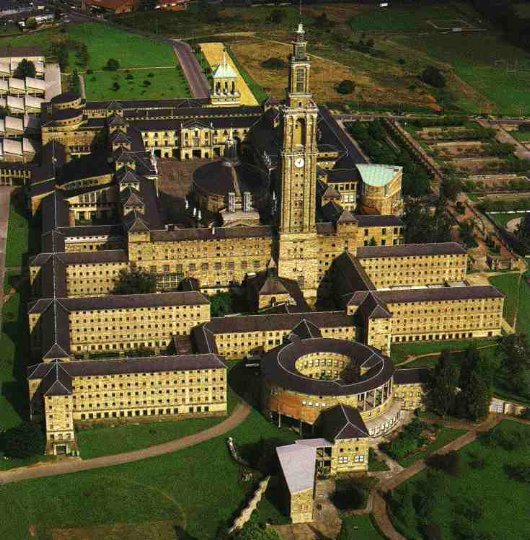
The goal was to accommodate 1,000 students (eventually doubling) from the age of 12 to 16, with residences, school facilities, industrial workshops, working farmland, athletic facilities, and sporting fields. The educational aspect and leadership of the Laboral was entrusted to the Jesuits, while the Poor Clares also had a convent on the premises, performing various household tasks and caring for the girls as their particular charism. (more…)
Philipp Freiherr von Boeselager, 1917-2008
Catholic Nobleman, Forester, Knight of Malta, Plotted to Kill Hitler
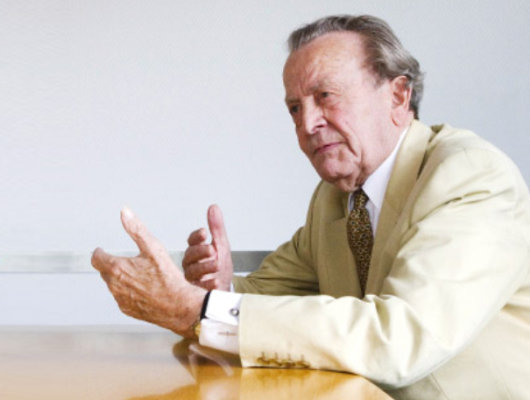
Philipp Freiherr (Baron) von Boeselager, the last surviving member of the conspiracy of anti-Nazi German officers, has died at 90 years of age. The freiherr‘s background and upbringing were distinctly Catholic. The Boeselagers are a Rhenish family with Saxon origins in Magdeburg. Philipp was the fourth of eight children and was educated by the Jesuits at Bad Godesborg. His grandfather had been officially censured by the Imperial German goverment for publically taking part in a Catholic religious procession.
Boeselager had most intimately been involved in the March 1943 plot to assasinate Hitler and Himmler when the the Fuhrer and the SS head were visiting Field Marshal Günther von Kluge on the Eastern Front. Boeselager, then a 25-year-old cavalry lieutenant under the Field Marshal’s command, was to shoot both Hitler and Himmler in the officers mess with a Walther PP. Himmler, however, neglected to accompany Hitler and so the Field Marshal ordered Boeselager to abort the attempt fearing that Himmler would take over in the event of Hitler’s death, changing nothing.
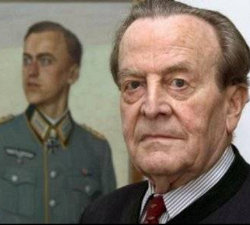 «Each day Hitler ruled, thousands died unnecessarily — soldiers, because of his stupid leadership decisions. And later, I learned of concentration camps, where Jews, Poles, Russians — human beings — were being killed.»
«It was clear that these orders came from the top: I realised I lived in a criminal state. It was horrible. We wanted to end the war and free the concentration camps.»
Boeselager later procured the explosives for the famous July 1944 plot (the subject of the upcoming film “Valkyrie“), under the cover of being part of an explosives research team. He handed a suitcase with the explosives on to another conspirator. When the bomb exploded in Hitler’s conference room, Boeselager and his 1,000-man cavalry unit made an astonishing 120-mile retreat in under 36 hours to reach an airfield in western Russia from where the aristocrat would fly to Berlin to join the other conspirators.
At the airfield, however, he received a message from his brother (Georg von Boeselager, a fellow cavalry officer who was repeatedly awarded for his consistent bravery on the battlefield) saying “All back into the old holes”, the code signifying the failure of the coup. Even more astonishingly than his swift retreat was his return, with his unit, to the front quickly enough not to raise any eyebrows. As a result, he was not known to be part of the conspiracy and escaped the gruesome tortures and executions dealt to many of his fellow conspirators.
After the war, his role in the plot was revealed and Philipp von Boeselager was awarded the Legion d’honneur by France and the Great Cross of Merit by West Germany. He joined the Order of Malta in 1946, eventually co-founding Malteser Hilfdienst, the medical operation of the German knights of the Order, and helping coordinate German pilgrimages to Lourdes.
The greater part of his post-war years was spent in forestry, and Boeselager served as head of the Arbeitsgemeinschaft Deutscher Waldbesitzerverbände (the coordinating body of private and cooperative forest-owners) from 1968 to 1988. Coincidentally, he was succeeded in that post by Franz Ludwig Schenk Count von Stauffenberg, the son of the July ’44 plot mastermind.
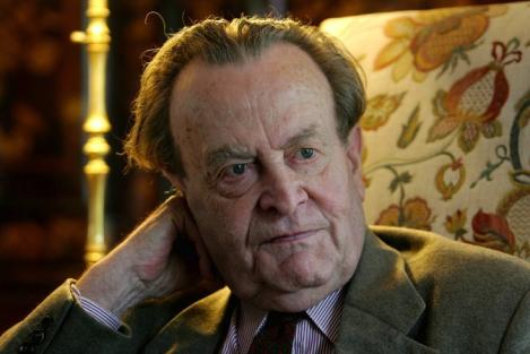
“Brideshead” Regurgitated

Well, the trailer for the film adaptation of Evelyn Waugh’s classic novel “Brideshead Revisited” is out, and the film is slated for a summer release here in the States. (Trailer | Official Site). Waugh fans can but lament that, whereas Waugh said the book was essentially about “the operation of divine grace”, the screenwriter of this adaptation openly admitted that the script “turns God into a villain”.
Rather than being bold and creating a genuine work of cinematic art to match the novel, they’ve decided to take the easy and conformist route and do a God-hating rompy flick. (Because we can’t have too many of those!). A shame, of course, but entirely predictable. Shall we at least have a look at the cast?
Cry God for Britain, Harry, and St. Aidan?
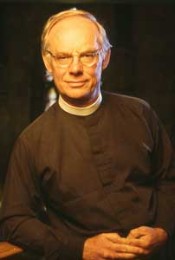
“St Aidan unites three of the countries by having lived there,” Dr. Bradley says, “and is, I believe, a better symbol for Britishness” [than the George, Andrew, and Patrick, the patrons of England, Scotland, and Ireland respectively].
“It’s like Billy Bragg says in his song ‘Take Down the Union Jack’ about Britain; ‘It’s not a proper country, it doesn’t have a patron saint’. Aidan was the sort of hybrid Briton that sums up the overlapping spiritual identities of Britain.
“He also makes a good patron saint of Britain because of his character. He was particularly humble and believed in talking directly to people. When he was given a horse by King Oswald of Northumbria, he immediately gave it away because he was worried that he would not be able to communicate properly.
“He was also not shy of reprimanding the mighty and powerful about their failings. He saw it as part of his job to remind secular rulers not to get above themselves. At a time when we are thinking about what makes Britishness, he had a sense of openness and diversity for his time that I think makes him a good candidate as the patron saint of Britain.”
Find out more in this article:
“Home-grown holy man” (The Independent, 23 April 2008)
On a somewhat similar note, here’s Aelianus (one of our favourite bloggers) writing on British Identity last September.
La principessa, non la senatrice

 Isn’t it a shame that the citizens of Rome & Lazio neglected to choose Princess Alessandra Borghese as their senator? Our favorite inhabitant of the Palazzo Borghese is a sound Catholic, is good friends with the Pope, and was seen from afar during our first pilgrimage to Rome; good enough reasons to get my vote. While the UDC won a respectable 36 seats in the population-based Chamber of Deputies (an acceptable loss of 3 seats since the last election), la Principessa was a candidate for the regionally-based Senate, in which the UDC won only 3 seats, a loss of 18 since the 2006 elections.
Another young royal vied for a parliamentary seat in the recent Italian election, but you will have to wait until the next Norumbega for our little overview of the results.

John Zmirak is “The Church’s Comedian”
Note: This was just sent me by a mutual friend of Herr Zmirak and myself. At first thought it was a wry parody of a ZENIT article but, lo and behold, it is actually a real ZENIT article praising this loyal son of the Empire State (who proudly boasts of his descent from subjects of the Hapsburgs).
Stand-up Apologist
John Zmirak Called to Be Church’s Comedian
by Elizabeth Lev
VATICAN CITY, APRIL 23, 2008 (Zenit.org).- In his 1980 novel “The Name of the Rose,” Umberto Eco dedicated a lengthy erudite section to the question, “Did Jesus Laugh?” Reading the works of Catholic author John Zmirak, he probably laughs a lot.
John Zmirak, a Queens-born author, journalist and apologist, regaled students and adults alike last week in Rome during the launch of his new book “The Grand Inquisitor.”
I spoke to Zmirak about how he reconciled a rapier wit with an ironclad faith, and was fascinated to hear the story of how this prickly pear of piety sprouted in the heart of 1970s Queens.
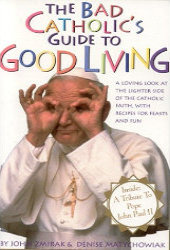 The first of Zmirak’s guides follows the liturgical calendar, covering the various feasts and seasons with his jovial wit and banter. 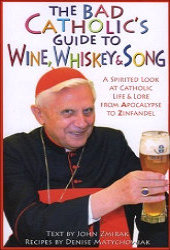 In the second guide, John gives us a jaunty and alcohol-tinged A-to-Z journey through the Faith. 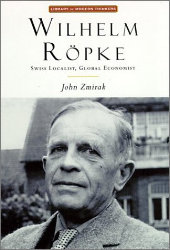 But John Zmirak bears the scholar’s cap as well as the jester’s. Here’s his introduction to the life and work of Wilhelm Röpke, the Swiss architect of Germany’s postwar economic miracle. |
While other adolescents challenged authority by flaunting curfews or smoking, Zmirak was a youthful rebel for God. During his sophomore year, his religion teachers at his local Catholic high school began teaching notions contrary to the faith. Not being particularly well formed, Zmirak absorbed the doubts and contradictions until one day he was told that the transubstantiation — the change of bread and wine into the body and blood of Christ — wasn’t real.
The 15-year-old student balked, remembering vividly his mother explaining that when the bells rang “the bread turns into God.” (This by the way, is a reminder of the centrality of the role of parents in the formation of children.)
Zmirak found a Catechism and read the Church’s teaching for himself. Outraged, the teenager began a letter-writing campaign to his local bishop, persevering in the face of indifference and even hostility. One can almost imagine Zmirak as an early Christian martyr, proclaiming his faith and poking fun at his persecutors even as he faced the lions in the arena.
Zmirak’s unique perspectives and fine mind won him a scholarship at Yale, where he faced the full gale of secular intelligentsia. But he soon realized that it wasn’t the finely reasoned arguments against the tenets of Catholicism that were weakening the faithful, but ridicule.
Zmirak has an unusual take on what undermined the faith of Catholics in America. “It wasn’t eroded by earnest atheists and intellectual attacks,” he states. “What broke down ordinary people was a thousand clever comedic skits.”
So George Carlin and Saturday Night Live’s Father Guido Sarducci are responsible for the rise of the “cafeteria Catholics?” Zmirak says yes. “If you get people laughing, whatever your message is, it slides in unnoticed under the door.”
And thus Zmirak found his vocation. He thought that if humor could be used against the Church, then it could be used for it.
Two of the author’s most popular books are “The Bad Catholic’s Guide to Good Living” and “The Bad Catholic’s Guide to Wine, Whiskey and Song.” Like handbooks for fraternity boys, these books dream up parties, games and drinking activities, all laced with good humor and anchored in Catholic belief.
The good-living guide is dedicated to the fine sense of humor of the Pope John Paul II. Zmirak points out that the Pope not only brought down the Iron Curtain, but also won hearts with his refreshing comedic moments. Even a generation raised on Seinfeld and Monty Python found him accessible.
His guide follows the liturgical calendar with hilarious takes on the individual feasts and recipes and party ideas to celebrate them. In the pages of his book, every day is a reason to make merry in the Catholic world.
The “Guide to Wine, Whiskey and Song” is the rarest of things — a successful sequel. From A to Z, Zmirak runs through the most well-stocked liquor cabinet imaginable, tracing every form of spirit and elixir back to its Christian origin. In the finest of traditions, he also provides drinking songs, the funniest being Monty Python’s “Philosopher Song” reworked to feature heretics.
Zmirak’s latest effort, “The Grand Inquisitor” is a different genre for him, a graphic novel. Dubbed the anti-“Angels and Demons,” the story is set during a conclave, involves kidnapped cardinals, but champions the cause of orthodoxy and fidelity to the magisterium.
“The Grand Inquisitor” features all the staples of a good noir thriller — dark, graphic design, striking portraits and flashes of razor sharp wit — but contrary to genre which invariably transmits an anti-Christian message, Zmirak’s story is rooted in love for the Church.
After several days with John Zmirak, it became clear that a deep faith and great intelligence provide ballast for what seems to be Christendom’s first stand-up comic. A refreshing reminder of how it takes all kinds to make the Catholic Church.
St. George
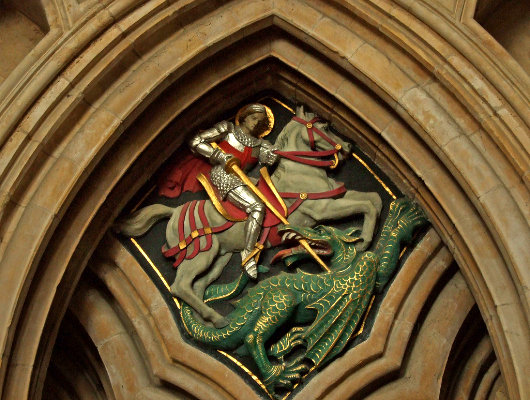
Today is St. George’s Day.
On this day in 303, St. George was killed; in 997, St. Adalbert of Prague died; in 1014, Brian Boru defeated the Vikings at Clontarf; in 1348, the Order of the Garter was founded by Edward III; in 1564,William Shakespeare was born; in 1616, both Miguel Cervantes and William Shakespeare died; in 1635, the Boston Latin School was founded; in 1661, Charles II was crowned at Westminster; in 1725, St. Gerard Majella was born; in 1775, J.M.W. Turner was born; and in 1794, Guillaume-Chrétien de Lamoignon de Malesherbes was guillotined for his defense of King Louis XVI before the Convention.
There is hope for America
A vignette from the Holy Father’s recent youth rally in Yonkers:
From For God, For Country, and For Yale, via Benedicite, Pater reverende.
Our Lady of Esperanza
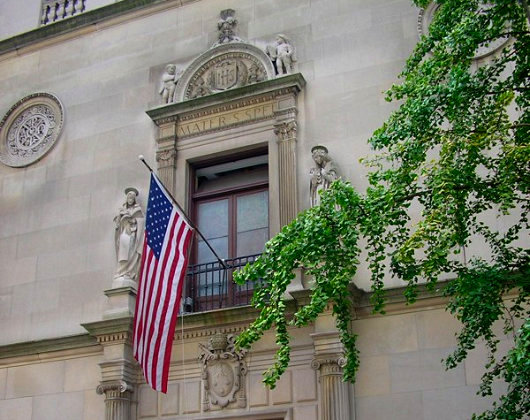
The Church of Our Lady of Esperanza, 156th Street & Broadway. The Church was built by Archer Huntington at the urging of Doña Manuela de Laverrerie de Barril and designed by Huntington’s brother Charles. The sanctuary lamp was a gift from King Alfonso XIII of Spain. The present façade dates from 1924, when the Church was expanded under the direction of Lawrence G. White, the son of Stanford White of McKim Mead & White and himself a partner in his father’s firm.
A Miracle from Blessed Charles
Vatican to Review Case of Inexplicable Healing of Florida Woman
The seemingly inexplicable healing of a Baptist woman from Florida may provide the miracle necessary for the canonization of Emperor Charles of Austria. The woman, in her mid-50s, suffered from breast cancer and was bedridden after the cancer had spread to her liver and bones. Despite treatment and hospitalization, doctors diagnosed her case as terminal. But after intercessory prayers to the Emperor Charles, the woman (who wishes to maintain her privacy and remain unnamed) was completely healed.
The story begins when Joseph and Paula Melançon, a married couple from Baton Rouge, Louisiana and friends of the healed woman, travelled to Austria, where they met Archduke Karl Peter, son of Archduke Rudolf, and grandson of the holy Emperor Charles. The Archduke invited the couple to his grandfather’s beatification in Rome in 2004. Mrs. Melançon gave the novena to Blessed Charles to her sister-in-law, Vanessa Lynn O’Neill of Atlanta.
“I knew that when I got that novena — I knew that my mother’s best friend was sick — I just knew at that moment that it was something I was going to do,” Mrs. O’Neill told the Florida Catholic in an interview. “And that is how I got started, I just prayed the novena.”
The woman’s recovery was investigated by an official church tribunal consisting of Father Fernando Gil (judicial vicar of the Diocese of Orlando), Father Gregory Parkes (chancellor of canonical affairs of the Diocese), Father Larry Lossing, diocesan notary Delma Santiago, as well as an unnamed medical doctor. The tribunal examined the evidence at hand and invited the participation of medical experts, who could find no earthly explanation for the woman’s recovery.
“Other alleged miracles attributed to the intercession of Blessed Karl I are currently being investigated in different places in the world,” Fr. Gil said.
The sixteen-month investigation has now concluded, and the conclusions have been signed by the participants, sealed, and placed in special boxes which are then themselves tied, sealed with wax, and sent to the Congregation for the Causes of the Saints in Rome via diplomatic pouch. The Congregation will examine the case further and then present its findings to Pope Benedict XVI, who will decided if a miracle has taken place. If the Pope is convinced by the evidence, then the Emperor’s canonization can proceed.
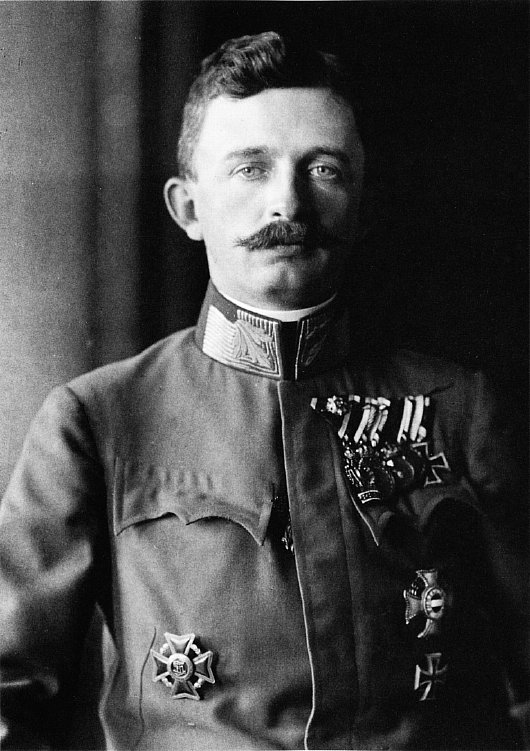
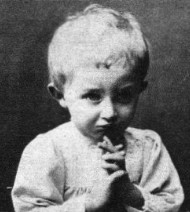 The future emperor, 1889 |
Blessed Charles’s reign as Emperor of Austria and Apostolic King of Hungary began in November 1916 during the First World War. The Emperor realized the heavy toll the Christian countries were suffering and almost immediately began to make peace manouevers. The insane obstinacy of both his German allies and the enemy alliance of France, Great Britain, and the United States, however, meant that Charles’s multiple attempts to negotiate a mutually-acceptable end to the war were not even considered.
After the war, President Woodrow Wilson insisted on dismantling the Austro-Hungarian Empire and the Emperor was forced into exile, first in Switzerland and finally, after two attempts to regain his Hungarian throne, on the Portuguese island of Madeira. Charles had always been particularly devout, and his devotion to God only increased when he caught a severe case of pneumonia on Madeira. He died from the illness in April 1922.
The English writer Herbert Vivian wrote that Charles was “a great leader, a prince of peace, who wanted to save the world from a year of war; a statesman with ideas to save his people from the complicated problems of his empire; a king who loved his people, a fearless man, a noble soul, distinguished, a saint from whose grave blessings come.”
Even Anatole France, the radical French intellectual and novelist, wrote “Emperor Karl is the only decent man to come out of the war in a leadership position, yet he was a saint and no one listened to him. He sincerely wanted peace, and therefore was despised by the whole world. It was a wonderful chance that was lost.”
Recent history has come to fulfil the expectations of Pope St. Pius X, who received Charles when the Austrian was a young archduke and not in direct line to succeed to the throne, saying “I bless Archduke Charles, who will be the future Emperor of Austria and will help lead his countries and peoples to great honor and many blessings–but this will not become obvious until after his death.”
Mourning in Vienna
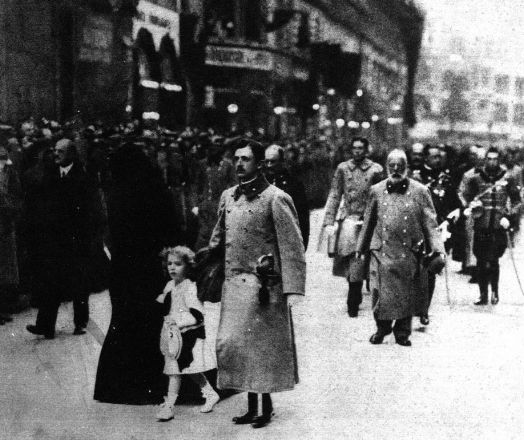
The Blessed Emperor Charles at the funeral of the late Emperor Franz Joseph, the saint’s great uncle, in November 1916. Between the Blessed Charles and his Empress, Zita of Bourbon-Parma, is Crown Prince Otto. Otto lives today, and is the head of the Hapsburg family.
Grant us the grace, with his intercession, to follow his example and serve the true cause of peace, which we find in the faithful fulfillment of Your holy will. We ask this through Jesus Christ our Lord, who lives and reigns with You and the Holy Spirit, one God, forever and ever.
Amen.
Category: Monarchy | Previously: Our Holy Emperor
Upcoming Events
April 26, 2008 (Saturday)
The Birthday of Rome: 753 B.C. – 2003 A.D.
The Roman Forum Spring Ball
7:00pm – midnight
Catholic Center at New York University
238 Thompson Street
(between Washington Square South & West 3rd Street)
A, B, C, D, E, F, V trains to West 4th St.; R to 8th St.; 6 to Bleecker St.
7-Piece Rich Siegel Ballroom Orchestra
Grand Imperial Buffet and Dessert
Well Done Roma! Festivities and Spontaneous Outburst of Joy, 10:00 pm.
According to tradition, Romulus took up his trusty plow and marked out a sulcus around “Shepherds’ Hill” on the twelfth day before the Kalends of May, i.e., a.d. XII Kal. Mai-a date which, give or take eleven or twelve days, roughly corresponds to what we call April 21st. Conveniently, the date was also the festival of the shepherd goddess Pales (the Parilia), in whose honor the hill, chosen by Romulus, had been named the Palatine.
When the festival was adopted by city dwellers, the date was set to coincide with the date of the traditional founding of Rome. Each area of Rome set up festivities, much like a block party. Bonfires were set onto which offerings were thrown. The event concluded with a bountiful feast set up out of doors. Catholics can also commemorate the day due to Rome’s Christian meaning.
Two songs will be sung at the 10:00 P.M. festivities: The papal hymn, Roma Immortale, and Rome’s Birthday Song, the latter to the tune of Oklahoma, with lyrics by Judy Hallet.
For further information please contact the Roman Forum (dvhinstitute@aol.com or call 212-645-2971).
COST
$50 per person
(Children 16 and under, free)
Reserve by April 21
ATTIRE
Suit and tie or dinner jacket for the men
Checks payable to:
The Roman Forum
11 Carmine Street, 2C
New York, NY, 10014
May 3, 2008 (Saturday)
The Glass of Absinthe and the Rules of the Game
Part two of the Roman Forum’s Modern Image & Catholic Truth series
9:00am – 5:00pm
Catholic Center at New York University
238 Thompson Street
(between Washington Square South & West 3rd Street)
A, B, C, D, E, F, V trains to West 4th St.; R to 8th St.; 6 to Bleecker St.
Modern man has a positive image of himself that has been shaped and very effectively propagandized since the time of the Renaissance. The Roman Forum’s Modern Image and Catholic Truth series explores the gap between this image and the true predicament in which both the individual and contemporary society as a whole now find themselves imprisoned.
Part Two: The Glass of Absinthe and the Rules of the Game
This year’s series began in November with a conference called The Sleep of Reason, designed to underline the fact that modern naturalism ends with the destruction of the rational in man, achieved in a variety of different ways depending upon the particular approaches of the thinkers and activists concerned.
The Glass of Absinthe and The Rules of the Game were originally intended to be two separate conferences—the first focusing on the destructive aspects of the naturalist separation of the individual from society and his own past; the second on the intellectual, artistic, psychological and socio-political obstacles placed in the path of identification of the disease that afflicts us. These have now been combined into one session— the last Roman Forum event in the United States in the 2007-2008 academic year.
9:00 – 10:00 am
Registration and coffee hour
10:00 – 11:00 am
The Glass of Absinthe and the Rules of the Game
Dr. John C. Rao
St. John’s University, Director of Roman Forum
11:15 am – 12:15 pm
The Empire of Nothingness
Christopher A. Ferrara, Esq.
President, American Catholic Lawyers Association
12:15 – 1:45 pm
Luncheon
1:45 – 2:45 pm
Citycraft and Soulcraft
Dino Marcantonio, AIA
Architect and Lecturer at the Yale School of Architecture
3:00 – 4:00 pm
Reason Gone Mad
James Kalb, Esq.
International Catholic lecturer and writer; author of The Tyranny of Liberalism: Understanding and Overcoming Administered Freedom, Inquisitorial Tolerance, and Equality by Command (Fall, 2008, ISI Books).
4:00 – 5:00 pm
General Discussion
For further information please contact the Roman Forum (dvhinstitute@aol.com or call 212-645-2971).
COST
$35: Reserve by April 28, entrance & luncheon
$10: Pay at the door, entrance alone
Checks payable to:
The Roman Forum
11 Carmine Street, 2C
New York, NY, 10014
Search
Instagram: @andcusack
Click here for my Instagram photos.Most Recent Posts
- Brunel’s Unbuilt Capitol February 3, 2026
- Cricket at Fordham January 27, 2026
- Palacio Barolo Revisted January 14, 2026
- Learning to Love Liguria January 14, 2026
- Crux Alba No. 2 January 13, 2026
Most Recent Comments
Book Wishlist
Monthly Archives
Categories