Church
About Andrew Cusack
 Writer, web designer, etc.; born in New York; educated in Argentina, Scotland, and South Africa; now based in London.
 read more
News
Blogs
Reviews & Periodicals
Arts & Design
World
France
Mitteleuropa
Knickerbockers
Argentina
The Levant
Africa
Cape of Good Hope
Netherlands
Scandinavia
Québec
India
Muscovy
Germany
Academica
Reclaiming his Birthright
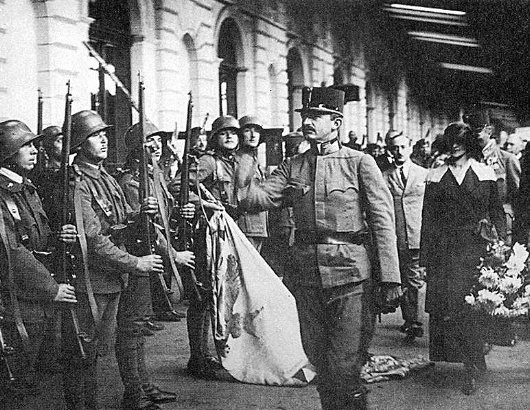
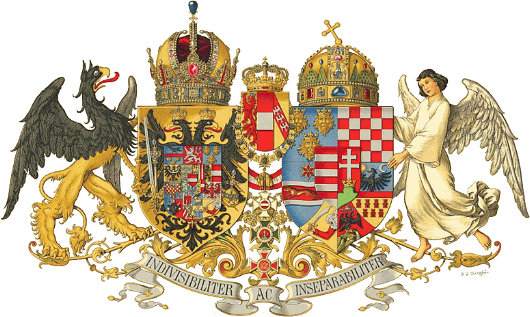
Blessed Emperor Charles’s two homecomings to Hungary after the overthrow of the Hapsburgs are worthy of the greatest spy novels, except they are fact: the hushed secrecy and underground preparations, the airplane contracted under a false name, the disguises used to sneak over borders. In his first attempt, Charles — the Apostolic King of Hungary — made it all the way to Budapest, only to be persuaded to return to exile by the self-appointed regent, Admiral Horthy (a naval commander in what, by then, was a land-locked country).
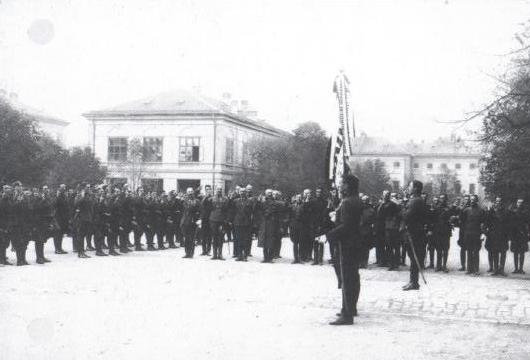
The King’s second attempt to reclaim his power was much more considered and deliberate, and he spent some time securing a loyal power base of local nobility before pressing on to Budapest by armoured railway train. The King’s force made it to just outside of the Hungarian capital before they were overwhelmed by troops loyal to Horthy — who, in order to maintain their loyalty, neglected to inform the soldiers and officers that the “rebels” they were fighting were actually those of their King and Queen.
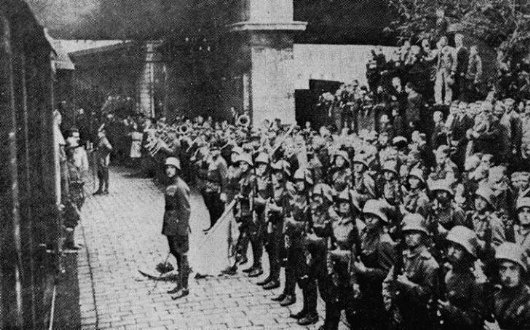
Along his path to the capital, the King was greeted by fervent crowds, and stopped at least twice to review small detachments of troops and to show himself in person to his loyal Hungarian subjects. The King had returned, but sadly not for long. After the failure of this second attempt, the Allied powers refused to allow the Imperial & Royal family to remain in mainland Europe, and exiled them to the Portuguese island of Madeira, where the Emperor-King grew ill and eventually died. He is entombed on the island today — a source of great pride, I am told, to the Madeirans.
Elsewhere: Miracle Attributed to Blessed Charles (Norumbega)
Crosses Return to Columbia Crown
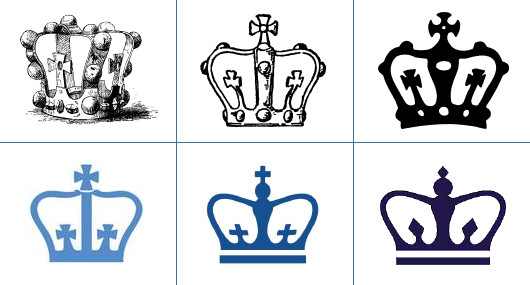
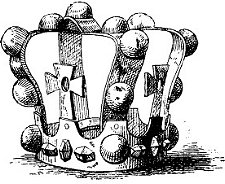 AFTER AN ABSENCE of some years, Columbia University has returned the crosses to its official crown emblem. The crosses had been missing since March 2004, when they were replaced with trapezoidal lozenges, but the more historic cross design has quietly returned to favour as the Ivy League institution’s official symbol. Columbia was founded in 1784, but claims the earlier heritage of King’s College, founded in 1754 but exiled to Nova Scotia, where it now has university status, after the tumult of the American Revolution. A copper crown (right) was originally attached to the cupola of College Hall, King’s College’s home in the colonial city of New York. When Columbia was founded in 1784, a year after New York’s independence was recognized, the state legislature gave the property and endowment of King’s College to the new Columbia College, which was organized by the remaining non-Loyalist members of King’s College. (more…)
Wisconsin Baroque, Priests, and Paper Architecture
Matthew G. Alderman
Taken from: Dappled Things, Ss. Peter & Paul, 2009
MY FAVORITE BUILDINGS never got around to being built. Some, like Sir Edwin Lutyen’s majestic design for Liverpool Cathedral, fell victim to budget cuts and the vagaries of history. Others were consigned by good taste, or occasionally outright timidity, to competition honorable mentions, and still others, like numerous student proposals or visionary dreams—like Boulée’s alarming hemispherical cenotaph for Newton, or an imaginary papal palace in Jerusalem cooked up by one of the votaries of the Vienna Sezession—weren’t terribly serious to begin with, unfortunately.
Note that I say favorite buildings, my own personal favorites, rather than the best or the most beautiful. Lutyens’ and Boulée’s fantasies may cross into that sublime territory of beauty by the power of their imaginative vision, but so many of the others owe their charm to their dreamlike extravagances, their intriguing if perhaps incomplete answers. An architect’s education lies in gathering up such fragmentary answers for the questions he will face down the road from clients and patrons. And therein lies the lure, and the value, of paper architecture.
I, like most of my colleagues, spent much of my time in school devising such useful fantasies, sometimes grand, sometimes small. Yet, they were not castles in the air. Each, while often existing in something like the best of all possible worlds in terms of budget and client, was grounded by an actual site and the laws of nature.
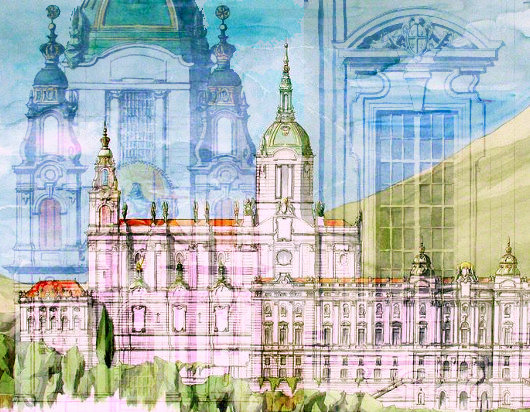
The most elaborate of all was my thesis project. It was an imaginary American seminary for a very real religious order, the fast-growing Institute of Christ the King, Sovereign Priest. This new congregation, dedicated to evangelization through the beauty of art, music, and the traditional Latin Mass, started out in, of all places, Gabon in Africa, but its present headquarters lies in Tuscany, in a villa bursting at the seams with seminarians in formation. While their ranks are dominated by Germans and Frenchmen, the increasing number of American clergy and their recent erection of a number of apostolates scattered across the Midwest suggested that a seminary in the United States, if not planned, might at least make for a plausible student project. Also, they seemed to have adventurous taste. I have since developed a passion for the Gothic but my first love has always been the Italian baroque. Perhaps they might be open to its vigorous beauty.
I garnered an award for the end result, the Rambusch Prize for Religious Architecture, and my putative patrons wanted copies of my enormous presentation watercolors to hang on their office walls—though, of course, the seminary would forever remain unbuilt. Its gigantic scale—typical for a student project—put it outside budgetary reach, unless, as someone cheerfully quipped, Bill Gates converted. Yet, the design was logical, consistent, and helped hone design skills I use every day at my drafting board.
The notion for the seminary came shortly after my first real-life encounter with the Institute’s work. My friends and I were road-tripping through the hill country of central Wisconsin, thick with vivid fall colors, and had just come back from a serene, silent low Mass and a long, talkative, private tour of St. Mary’s Oratory in Wausau. The Institute had transformed from a bland Midwestern Gothic to a dazzling near-replica of a fourteenth-century Bavarian court chapel. Bill Gates or no, these priests think big. Since then, they’ve overhauled a historic church in downtown Kansas City, and they’re presently turning their American priory from a burnt-out shell in a borderline south-side Chicago neighborhood into something out of Counter-Reformation Rome, and I have no doubt they’re going to succeed. Lest these projects seem like archaeological transplants, they are in fact derived from a logical extrapolation from local Catholic culture—Chicago’s colorful Polish cathedrals brought back to their ultramontane source, or, as I had just discovered, Midwestern Gothic returned to its Germanic roots. (more…)
Recent Promulgations from the Holy See
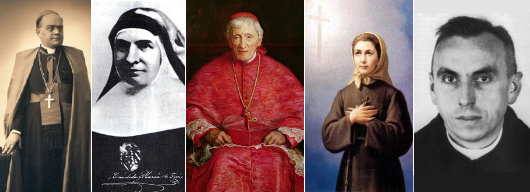
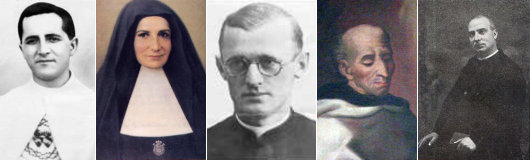
Decrees recently promulgated in the Vatican move sixteen candidates for sainthood forward in their cause. The most famous of the twelve is the English cardinal & convert from Anglicanism, John Henry Newman (above, center). A miracle attributed to the intercession of Cardinal Newman has been accepted by the Congregation for the Causes of the Saints. The Congregation has also accepted individual miracles attributed to the intercession of: Blessed Cándida Maria de Jesús Cipitria y Barriola (above, second from left; 1845-1912), the Spanish founder of the Congregation of the Daughters of Jesus; the Servant of God Angelo Paoli (below, second from right; 1642-1720), an Italian Carmelite priest; the Servant of God Maria Alfonsina Danil Ghattas (1843-1927), a cofounder of the Congregation of the Sisters of the Most Holy Rosary of Jerusalem.
Eight martyrs were proclaimed in the recently-promulgated decrees: all of them of the twentieth century and all of them victims of totalitarianism. Fr. Teófilo Fernández de Legaria Goñi (below, far left) and four companions (all professed priests of the Congregation of the Sacred Hearts of Jesus and Mary), as well as the diocesan priest Fr. José Samsó i Elías (below, far right), were all killed by the Communists in 1936 during the horrible persecution of the Church during the Spanish Civil War. Fr. Georg Häfner (above, far right), a German diocesan priest, was killed in the concentration camp of Dachau in 1942 under the Nazi regime. Bishop Zoltán Lajos Meszlényi (above, far left), an auxiliary bishop of Esztergom, was killed at Kistarcsa in Hungary by the Communist authorities in January 1953.
Proclamations of heroic virtue — the first step on the road to being recognised as a saint — were issued for: Fr. Engelmar Unzeitig (below, center; 1911-1945), a German priest of the Mariannhill missionaries; Anna María Janer Anglarill (below, second from left; 1800-1885), the Spanish founder of the Institute of Sisters of the Holy Family of Urgell; Maria Serafina del Sacro Cuore di Gesu Micheli (1849-1911), the Italian founder of the Institute of Sisters of the Angels; Teresa Manganiello (above, second from right; 1849-1876), an Italian laywoman of the Third Order of St. Francis.
The Prime Minister of China who became a Benedictine Abbot
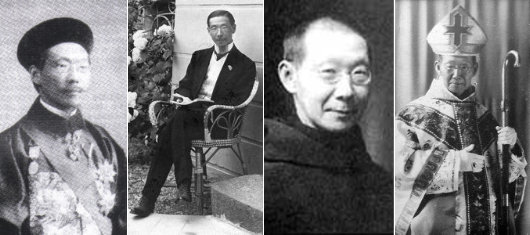
CHRISTIANITY HAS A LONG and varied history in China stretching over at least one-and-a-half millenia. The ancient country has even had Christian leaders, such as the Congregationalist founder of the Chinese Republic, Sun Yat-sen, and his Methodist successor, Gen. Chiang Kai-shek (head of the Kuomintang for nearly forty years). Still, until I read this fascinating story in the Catholic Herald I had no idea that there was a Prime Minister of China, Lou Tseng-tsiang (陸徵祥), who ended his days as a Benedictine monk by the name of Dom Pierre-Célestin. Lou was born a Protestant in Shanghai in 1871, but married a Belgian woman and eventually converted to Catholicism. Serving his country in the diplomatic arena, he accomplished extensive reforms of the Ministry of Foreign Affairs, avoided becoming part of any of the various factions that divided the government, and was one of the founding members of the Chinese Society of International Law. Lou bravely stood up to the indignities imposed upon China through the 1919 Treaty of Versailles by refusing to sign the shameful document which sewed the seeds of future disaster.
Xu Jingcheng, Lou’s mentor and sometime Ambassador to the Court of the Tsars in St. Petersburg, instructed the up-and-coming diplomat that “Europe’s strength is found not in her armaments, nor in her knowledge — it is found in her religion. … Observe the Christian faith. When you have grasped its heart and its strength, take them and give them to China.”
After the death of his wife, Lou became a Benedictine monk at the abbey of Sint-Andries in Flanders, and was eventually ordained a priest in 1935. A decade later, Pope Pius XII — who cared deeply for the Church in China and finally settled the long-standing dispute over Chinese ancestor-honouring rituals in favour of the practices — appointed him titular abbot of the Abbey of St. Peter in Ghent. Sadly, the Chinese Civil War prevented Dom Pierre-Célestin from returning to China, and he died in Flanders in 1949.
The words of Lou’s mentor that Europe’s strength is her faith found recent confirmation from Professor Zhao Xiao, a prominent Chinese economist at the University of Science & Technology Beijing. Prof. Zhao, a member of the Chinese Communist Party, began studying the differences between the economies of Christian societies and those of non-Christian societies. As a result of his investigations, he argued that Christianity would provide a “common moral foundation” for China that would help the economy by reducing corruption, narrowing the gap between rich and poor, preventing pollution, and promoting philanthropy.
“A good business ethic or business morality,” Prof. Zhao says, “can provide for a type of motivation that transcends profit seeking. Why do people want to do business? The main goal would be to earn money. The purpose of a company is to maximize profits. But this can cause companies to look for quick results and nearsighted benefits. It can cause companies to disregard the means and earn money at the expense of destroying the environment, society and the livelihood of others, or endangering the entire competitive environment of the trade.”
“If my motivation for doing business is the glory of God, there is a motivation that transcends profits. I cannot go and use evil methods. If I used some evil methods to enlarge the company, to earn money, then this is not bringing glory to God. Therefore, this is to say that it [bringing glory to God] can provide a transcendent motivation for business. And this kind of transcendental motivation not only benefits an entrepreneur by making his business conduct proper but it can also benefit the entrepreneur’s continued innovation.” (more…)
Our Cardinal at the Oratory
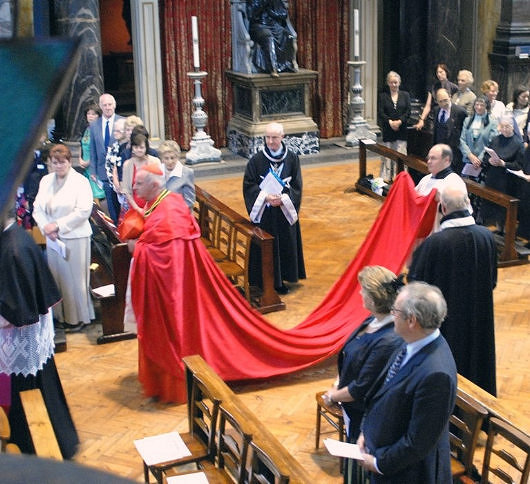
His Eminence Keith Patrick O’Brien, Cardinal Archbishop of St Andrews & Edinburgh, at the Brompton Oratory for the Feast of St. John the Baptist this year.
(From the NLM)
Praying with the Kaisers
by JOHN ZMIRAK
INSIDECATHOLIC.COM
As I’m writing this column at the tail end of my first trip to Vienna, some of you who’ve read me before might expect a bittersweet love note to the Habsburgs — a tear-stained column that splutters about Blessed Karl and “good Kaiser Franz Josef,” calls this a “pilgrimage” like my 2008 trip to the Vatican, and celebrates the dynasty that for centuries, with almost perfect consistency, upheld the material interests and political teachings of the Church, until by 1914 it was the only important government in the world on which the embattled Pope Pius X could rely for solid support. Then I’d rant for a while about how the Empire was purposely targeted by the messianic maniac Woodrow Wilson, whose Social Gospel was the prototype for the poison that drips today from the White House onto the dome of Notre Dame.
And you would be right. That’s exactly what I plan to say — so dyed-in-the-wool Americanists who regard the whole of the Catholic political past as a dark prelude to the blazing sun that was John Courtenay Murray (or John F. Kennedy) might as well close their eyes for the next 1,500 words — as they have to the past 1,500 years.
But as I bang that kettle drum again, I want to set two scenes, one from a fine and underrated movie, the other from my visit. The powerful historical drama “Sunshine” (1999) stars Ralph Fiennes as three successive members of a prosperous Jewish family in Habsburg Budapest. The film was so ambitious as to try portraying the broad sweep of historical change — and, as a result, it was not especially popular. What historical dramas we moderns tend to like are confined to the tale of a single hero, and how he wreaks vengeance on the villains with English accents who outraged the woman he loved. “Sunshine”, on the other hand, tells the vivid story of the degeneration of European civilization in the course of a mere 40 years. The Sonnenschein family are the witnesses, and the victims, as the creaky multinational monarchy ruled by the tolerant, devoutly Catholic Habsburgs gives way through reckless war to a series of political fanaticisms — all of them driven by some version of Collectivism, which the great Austrian Catholic political philosopher Erik von Kuenhelt-Leddihn calls “the ideology of the Herd.”
From a dynasty that claimed its legitimacy as the representative of divine authority at the apex of a great, interconnected pyramid of Being in which the lowliest Croatian fisherman (like my grandpa) had liberties guaranteed by the same Christian God who legitimated the Kaiser’s throne, Central Europe fell prey to one strain after another of groupthink under arms: From the Red Terror imposed by Hungarian Bolsheviks who loved only members of a given social class, to radical Hungarian nationalists who loved only conformist members of their tribe, to Nazi collaborationists who wouldn’t settle for assimilating Jews but wished to kill them, finally to Stalinist stooges who ended up reviving tribal anti-Semitism. The exhaustion at the film’s end is palpable: In the same amount of time that separates us today from President Lyndon Johnson, the peoples of Central Europe went from the kindly Kaiser Franz Josef through Adolf Hitler to Josef Stalin. Call it Progress.
Apart from a heavily bureaucratic empire that spun its wheels preventing its dozens of ethnic minorities from cleansing each other’s villages, what was lost with the fall of the Austro-Hungarian monarchy? For one thing, we lost the last political link Western Christendom had with the heritage of the Holy Roman Empire. (Its crown stands today in the Imperial Treasury at the Hofburg, and for me it’s a civic relic.) Charlemagne’s co-creation with the pope of his day, that Empire had symbolized a number of principles we could do well remembering today: Principally, the Empire (and the other Christian monarchies that once acknowledged its authority) represented the lay counterpart to the papacy, a tangible sign that the State’s authority came not from mere popular opinion, or the whims of tyrants, but an unchangeable order of Being, rooted in divine revelation and natural law.
The job of protecting the liberty of the Church and enforcing (yes, enforcing) that Law fell not to the clergy but to laymen. The clergy were not a political party or a pressure group — but a separate Estate that often as not served as a counterbalance to the authority of the monarchy. No monarch was absolute under this system, but held his rights in tension with the traditional privileges of nobles, clergy, the citizens of free towns, and serfs who were guaranteed the security of their land. Until the Reformation destroyed the Church’s power to resist the whims of kings — who suddenly had the option of pulling their nation out of communion with the pope — no king would have had the power or authority to rule with anything like the monarchical power of a U.S. president. Of course, no medieval monarch wielded 25-40 percent of his subjects’ wealth, or had the power to draft their children for foreign wars. It took the rise of democratic legal theory, as Hans Herman Hoppe has pointed out, to convince people that the State was really just an extension of themselves: a nice way to coax folks into allowing the State ever increasing dominance over their lives.
A Christian monarchy, whatever its flaws, was at least constrained in its abuses of power by certain fundamental principles of natural and canon law; when these were violated, as often they were, the abuse was clear to all, and the monarchy often suffered. In extreme cases, kings could be deposed. Today, by contrast, priests in Germany receive their salaries from the State, collected in taxes from citizens who check the “Catholic” box. So much for the independence of the clergy.
The House of Austria ruled the last regime in Europe that bound itself by such traditional strictures, which took for granted that its family and social policies must pass muster in the Vatican. By contrast, in the racially segregated America of 1914, eugenicists led by Margaret Sanger were already gearing up to impose mandatory sterilization in a dozen U.S. states (as they would succeed in doing by 1930), while Prohibitionist clergymen and Klansmen (they worked together on this) were getting ready to close all the bars. As historian Richard Gamble has written, in 1914 the United States was the most “progressive” and secular government in the world — and by 1918, it was one of the most conservative. We didn’t shift; the spectrum did.
Dismantled by angry nationalists who set up tiny and often intolerant regimes that couldn’t defend themselves, nearly every inch of Franz-Josef’s realm would fall first into the hands of Adolf Hitler, then those of Josef Stalin. Today, these realms are largely (not wholly) secularized, exhausted perhaps by the enervating and brutal history they have suffered, interested largely in the calm and meaningless comfort offered by modern capitalism, rendered safer and even duller by the buffer of socialist insurance. The peoples who once thrilled to the agonies and ecstasies carved into the stone churches here in Vienna can now barely rouse the energy to reproduce themselves. Make war? Making love seems barely worth the tussle or the nappies. Over in America, we’re equally in love with peace and comfort — although we’ve a slightly higher (market-driven?) tolerance for risk, and hence a higher birthrate. For the moment.
Speaking of children brings me to the most haunting image I will take away from Austria. I spent a whole afternoon exploring the most beautiful Catholic church I have ever seen — including those in Rome — the Steinhof, built by Jugendstil architect Otto Wagner and designed by Kolomon Moser. An exquisite balance of modern, almost Art-Deco elements with the classical traditions of church architecture, it seems to me clear evidence that we could have built reverent modern places of worship, ones that don’t simply ape the past. And we still can. A little too modern for Kaiser Franz, the place was funded, the kindly tour guide told me in broken English, by the Viennese bourgeoisie. (Since my family only recently clawed its way into that social class, I felt a little surge of pride.) Apart from the stunning sanctuary, the most impressive element in the church is the series of stained-glass windows depicting the seven Spiritual and the seven Corporal Works of Mercy — each with a saint who embodied a given work. All this was especially moving given the function of the Steinhof, which served and serves as the chapel of Vienna’s mental hospital. (It wasn’t so easy getting a tour!) The church was made exquisite, the guide explained, intentionally to remind the patients that their society hadn’t abandoned them. Moser does more than Sig Freud can to reconcile God’s ways to man.
We see in the chapel the spirit of Franz Josef’s Austria, the pre-modern mythos that grants man a sacred place in a universe where he was created a little lower than the angels — and an emperor stands only in a different spot, with heavier burdens facing a harsher judgment than his subjects. No wonder Franz Josef slept on a narrow cot in an apartment that wouldn’t pass muster on New York’s Park Avenue, rose at 4 a.m. to work, and granted an audience to any subject who requested it. He knew that he faced a Judge who isn’t impressed by crowns.
As we left the church, I asked the guide about a plaque I’d seen but couldn’t quite ken, and her face grew suddenly solemn. “That is the next part of the tour.” She explained to me and the group the purpose of the Spiegelgrund Memorial. It stands in the part of the hospital once reserved for what we’d call “exceptional children,” those with mental or physical handicaps. While Austria was a Christian monarchy, such children were taught to busy themselves with crafts and educated as widely as their handicaps permitted. The soul of each, as Franz Josef would freely have admitted, was equal to the emperor’s. But in 1939, Austria didn’t have an emperor anymore. It dwelt under the democratically elected, hugely popular leader of a regime that justly called itself “socialist.” The ethos that prevailed was a weird mix of romanticism and cold utilitarian calculation, one which shouldn’t be too unfamiliar to us. It worried about the suffering of lebensunwertes Leben, or “life unworthy of life”–a phrase we might as well revive in our democratic country that aborts 90 percent of Down’s Syndrome children diagnosed in utero. So the Spiegelgrund was transformed from a rehabilitation center to one that specialized in experimentation. As the Holocaust memorial site Nizkor documents:
In Nazi Austria, parents were encouraged to leave their disabled children in the care of people like [Spiegelgrund director] Dr. Heinrich Gross. If the youngsters had been born with defects, wet their beds, or were deemed unsociable, the neurobiologist killed them and removed their brains for examination. …
Children were killed because they stuttered, had a harelip, had eyes too far apart. They died by injection or were left outdoors to freeze or were simply starved.
Dr. Gross saved the children’s brains for “research” (not on stem cells, we must hope). All this, a few hundred feet from the windows depicting the Works of Mercy. Of course, they’d been replaced by the works of Modernity.
We’re much more civilized about this sort of thing nowadays, as the guests at Dr. George Tiller’s secular canonization can testify. In true American fashion, our genocide is libertarian and voluntarist, enacted for profit and covered by insurance.
I will think of the children of the Spiegelgrund tomorrow, as I spend the morning in the Kapuzinkirche, where the Habsburg emperors are buried — and the Fraternity of St. Peter say a daily Latin Mass. As I pray the canon my ancestors prayed and venerate the emperors they revered, I will beg the good Lord for some respite from all the Progress we’ve enjoyed.
Blessed Karl I, ora pro nobis.
[Dr. John Zmirak‘s column appears every week at InsideCatholic.com.]
The Order of Malta in Peru
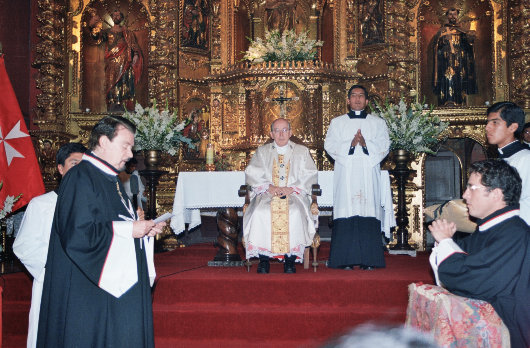
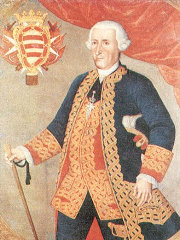 A correspondent of this site sends these images of the Order of Malta in Peru. The Order of Malta has a long history in Peru: Manuel de Guirior, 1st Marqués de Guiror and a knight of the Order (right, baptised José Manuel de Guirior Portal de Huarte Herdozain y González de Sepúlveda) was Viceroy of Peru from 1776 to 1780, having previously served the King of Spain as Viceroy of New Granada.
More recently, in 2008, this investiture (above) was presided over by Fernando de Trazegnies, Marquis of Torrebermeja, the former Dean of Law at the Catholic University of Peru and now head of the Peruvian Association of the Order. The investiture took place in the eighteenth-century Church of the Magdalena, and the Mass was offered by the Cardinal Archbishop of Lima, Juan Luis Cipriani.


Mass for Prince Pedro Luiz
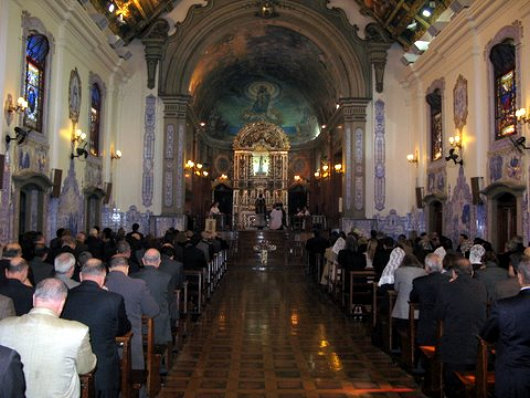
The “week’s mind” Mass, or Mass of seven days, was held a week after the death of Dom Pedro Luiz of Orleans-Braganza in São Paulo, Brazil on June 8, 2009. The Mass was offered according to the extraordinary (or Tridentine) form of the Latin rite. The members of the Imperial Family of Brazil were in attendence. (more…)
Universitas Catholica Ucrainorum, Leopolis
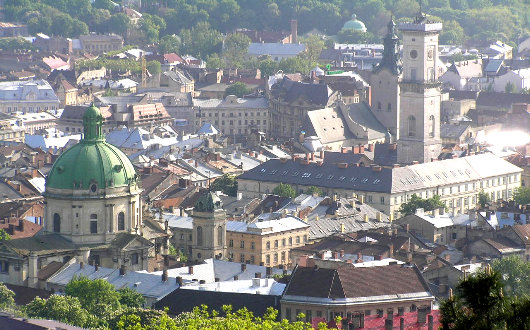
Lviv — sometimes called Lemberg, Lwów, or Leopolis — sits in one of those corners of Europe that has born tremendous witness to the unfolding of history over the centuries. It was founded in the fourth century, built by the Poles, besieged by the Turks, ceded to the Austrians, regained by the Poles, captured by the Nazis, subjugated by the Soviets, and finally freed under an independent Ukraine. Lviv is the capital of Carpathia… and Galicia… not to mention Ruthenia, and nobody can quite define the difference between those three places, while some even argue that one or another (or all) don’t actually exist. For now, we can say with authority that Lviv is the most prominent city in the western Ukraine, and has for centuries been an important place of Catholic culture.
As Damian Thompson points out, Lviv is now home to the Ukrainian Catholic University (Український Католицький Університет). “You must look into this place,” Edward Lucas of the Economist told Damian Thompson: “It’s quite amazing.” (more…)
S.R.E. & S.R.I.
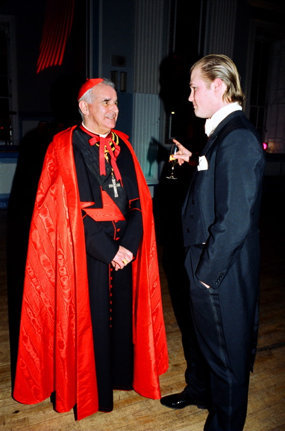
Left, a prince of the Holy Roman Church and right, a prince of the Holy Roman Empire.
Credit: I think this is one of Zygmunt’s photos.
St. Juan Macias, ora pro nobis
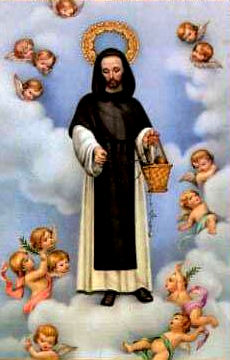
I would ask that all readers of this blog pray for a good friend of mine in Scotland who is now very, very ill.
St. Stephen and the Virgin & Child
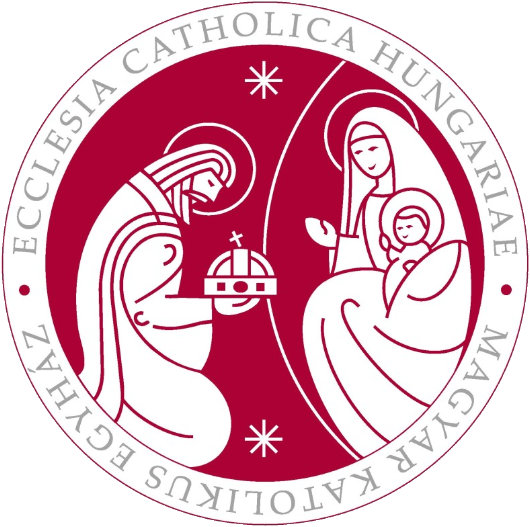
The Hungarian Bishops’ Conference has a surprisingly handsome logo (above) depicting their patronal saint, King Stephen I, bestowing his crown to the Blessed Virgin and Our Saviour. Some might think the depiction of the Madonna & Child a touch too cartoonish, but I enjoy it.
Le Pape à Paris
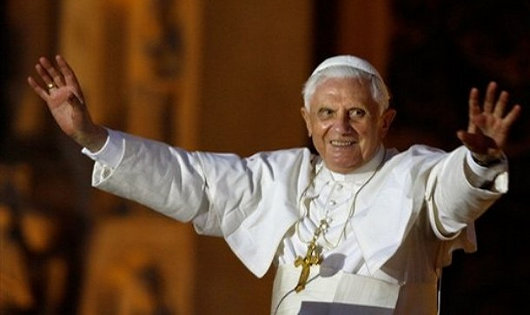
While Benedict XVI is currently in the headlines for his visit to the Holy Land, here is a translation into French by Béatrice Bohly of my piece on Benedict’s visit to Paris last year.
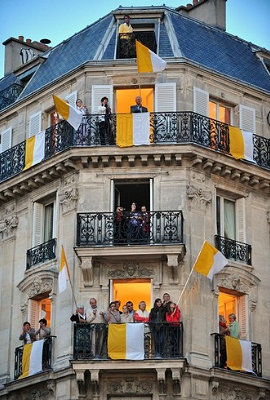 La devise de la ville de Paris, Fluctuat nec mergitur est parfaitement appropriée: « Battue par les flots, elle ne sombre pas ». Difficile de trouver des mots plus aptes à décrire la barque de Pierre, dont le Saint-Père, le pape, a passé ces deux jours dans la capitale française. Depuis des temps immémoriaux, la France a été considérée comme « la fille aînée de l’Eglise », son siège de primauté de Lyon ayant été établi au cours du deuxième siècle et Clovis, son premier roi chrétien, ayant reçu le baptême en 498. Mais à côté de 1.500 ans de christianisme, au cours des deux derniers siècles, la France, a également servi de fonds baptismaux à la révolution et à la rupture – dans l’esprit-même de ce premier “non serviam” (phrase attribuée à Lucifer, refusant de servir Dieu, ndt) .
Ce fut le penseur français Charles Maurras – lui-même non-catholique jusqu’à la fin de sa vie – qui a conçu de la notion que (depuis la révolution) il n’y avait pas une France mais deux : le pays réel et le le pays légal. La vraie France, catholique et droite, contre la France officielle, irreligieuse et artificielle. Tout comme Maurras différenciait les deux visions de la France, nous, dans le monde d’expression anglaise, savons que l’Angleterre est vraiment un pays catholique qui souffre d’un interregnum de quatre-siècle (de même que l’Ecosse, et l’Irlande, et l’Amérique, et le Canada, et l’Australie…). Nous aimons nos patries mais nous savons qu’elles ne sont pas vraiment elles-mêmes – elles ne reflètent pas vraiment cette idée de leur essence – jusqu’à ce qu’elles jouissent de la plénitude de la communion chrétienne.
Boers, Peter Simple, and Pith Helmets
Sometimes something rather interesting is right under your nose and you never even notice it. I read the Catholic Herald — the premier Catholic newspaper in the English-speaking world — every week and have been reading it since university days, but I have rarely read Stuart Reid’s “Charterhouse” column on the back page. A few recent perusals have exposed my foolishness for neglecting it. They are presented for your reading here.
(Of course, there has never been a columnist as brilliant as Peter Simple, whose works we have shown you in a series of installments.)
Charterhouse
by STUART REID
Everyone needs a secular hero or two, and one of mine is Rian Malan. In the Sunday Times at the weekend he had a very nice diary, in which he said that he liked Jacob Zuma, because the president-elect of South Africa had “old-fashioned views on stuff like law and order”.
Malan also said that it was a good time to be a Boer: “…as South Africa staggers towards its destiny, it’s white Left-liberals who are wailing about our government’s shortcomings. The Boers never expected any better, so we are generally immune to the gloom.”
The diary made my heart go out, once again, to the Boers. They are brave, honest, hard-working, courteous, old-fashioned and often God-fearing, with a weakness for the bottle. Plus they were on the right side in the Boer War and their women – sometimes their men too – are beautiful.
High Church Dutch Reformed
Not even the peaceful hills and dales of the Hudson Valley were left untouched by the liturgicalism of the Oxford Movement
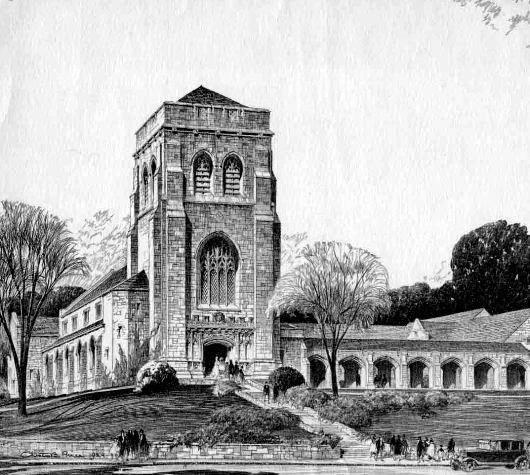
SUCH WAS THE influence of the nineteenth-century “Oxford Movement” in the Church of England that it engulfed the great preponderance of the Anglican Communion. It is surprising when you consider that Anglican priests and even a bishop were jailed in England for such scandalous acts as calling the Communion service “the Mass”, wearing vestments, and putting candles on the altar; these are now so widespread in the Church of England to be commonplace. But the Oxford movement also spilled out into other Protestant groups as well. The liturgical movement changed the Church of Scotland in the 1900s, and many of the Kirk’s medieval church buildings that had been converted into pulpit-centered preaching halls were reordered in a way emphasizing the “Communion table” that was an altar in all but name. (Those who can find before & after shots of the ‘Toon Kirk’ of Holy Trinity in St Andrews, Fife will notice this marked contrast).
Meet the new boss
The Pope sends New York a genial, beer-swilling man of an archbishop
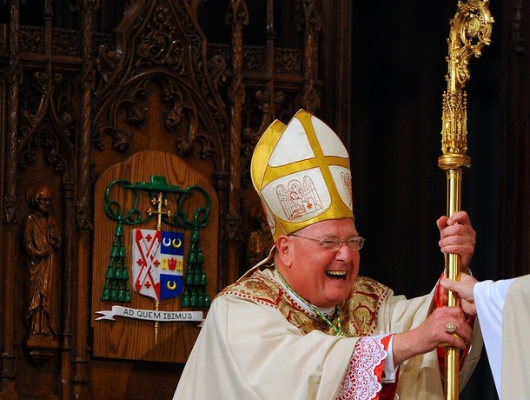
The Most Rev. Timothy Michael Dolan, the newly installed Archbishop of New York, has a reputation as a genial beer-swilling giant that will doubtless serve him well as he takes possession of his new see. With a Ph.D. in Church History, Archbishop Dolan formerly served as Secretary to the Nuncio in Washington, D.C. before becoming Rector of the Pontifical North American College in Rome — the “West Point” of the Catholic Church in Anglo-America. Having improved the NAC’s reputation both in studies and in orthodoxy, Msgr. Dolan was then sent by the Holy Father to be an Auxiliary Bishop in the Archdiocese of St. Louis. From there, our man was given the charge of see himself, that of Milwaukee.
The Arms of the Archbishop
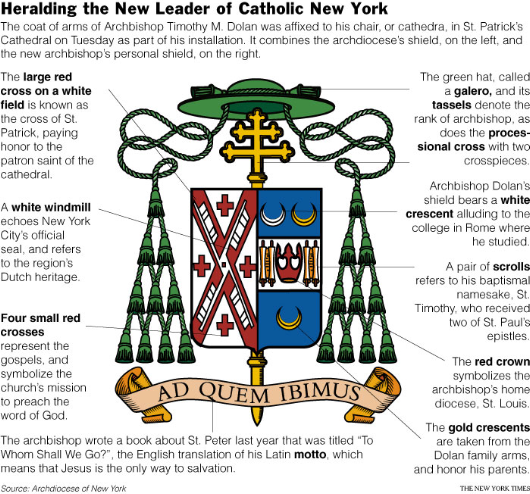
The New York Times offered a little sidebar on the heraldry of our new ecclesiastical boss in its coverage of Archbishop Dolan’s installation, and Fr. Selvester offers his commentary as well.
The arms of the Hon. Paul Comtois
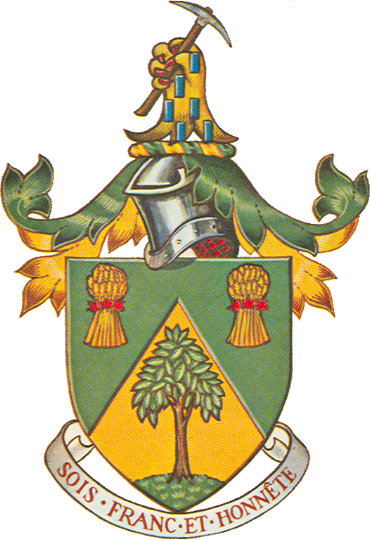
Our friend Mr. Bruce Patterson, who is St-Laurent Herald up in the Canadian Heraldic Authority, was kind enough to send along this rendering of the arms of the Hon. Paul Comtois from Beddoe’s Canadian Heraldry. As Bruce points out, the garbs probably refer to Comtois’s agricultural background, and the miner’s pick in the crest alludes to his ministerial portfolio. The motto is “Be frank & honest”.
Search
Instagram: @andcusack
Click here for my Instagram photos.Most Recent Posts
- Brunel’s Unbuilt Capitol February 3, 2026
- Cricket at Fordham January 27, 2026
- Palacio Barolo Revisted January 14, 2026
- Learning to Love Liguria January 14, 2026
- Crux Alba No. 2 January 13, 2026
Most Recent Comments
Book Wishlist
Monthly Archives
Categories