Arts & Culture
About Andrew Cusack
 Writer, web designer, etc.; born in New York; educated in Argentina, Scotland, and South Africa; now based in London.
 read more
News
Blogs
Reviews & Periodicals
Arts & Design
World
France
Mitteleuropa
Knickerbockers
Argentina
The Levant
Africa
Cape of Good Hope
Netherlands
Scandinavia
Québec
India
Muscovy
Germany
Academica
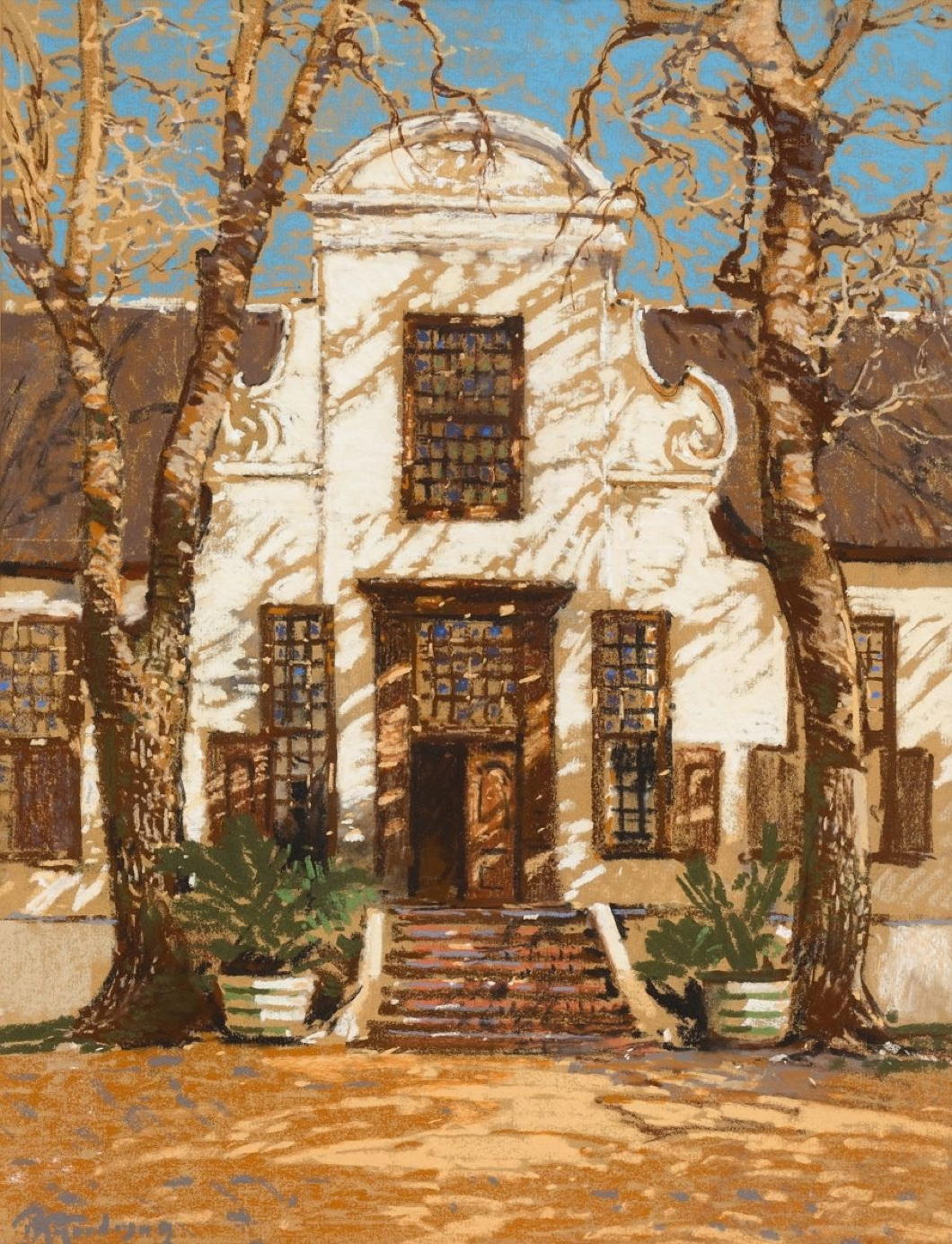
The old Dutch houses of the Cape
From Here There and Everywhere (1921) by Lord Frederic Hamilton:
THESE OLD DUTCH HOUSES are a constant puzzle to me. In most new countries the original white settlers content themselves with the most primitive kind of dwelling, for where there is so much work to be done the ornamental yields place to the necessary; but here, at the very extremity of the African continent, the Dutch pioneers created for themselves elaborate houses with admirable architectural details, houses recalling in some ways the chateaux of the Low Countries.
Where did they get the architects to design these buildings? Where did they find the trained craftsmen to execute the architects’ designs? Why did the settlers, struggling with the difficulties of an untamed wilderness, require such large and ornate dwellings? I have never heard any satisfactory answers to these questions.
Groot Constantia, originally the home of Simon Van der Stel, now the government wine-farm, and Morgenster, the home of Mrs. Van der Byl, would be beautiful buildings anywhere, but considering that they were both erected in the seventeenth century, in a land just emerging from barbarism seven thousand miles away from Europe, a land, too, where trained workmen must have been impossible to find, the very fact of their ever having come into existence at all leaves me in bewilderment.
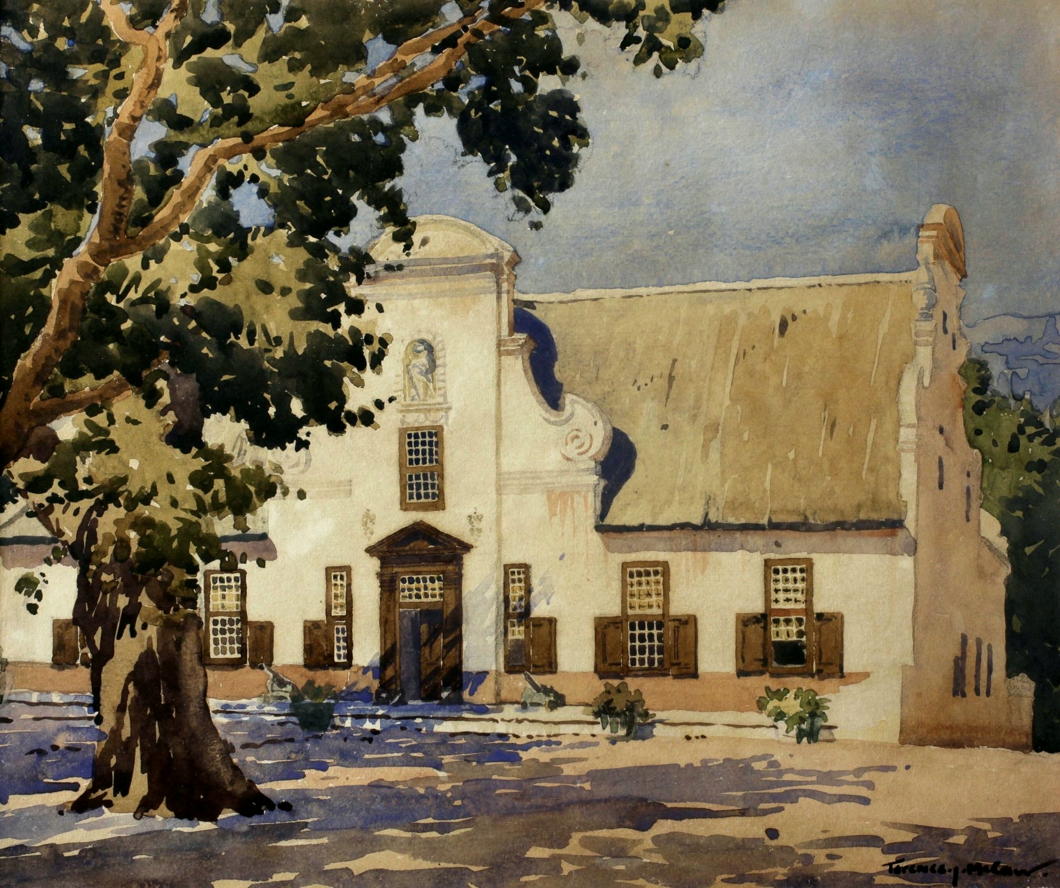
These Colonial houses, most admirably adapted to a warm climate, correspond to nothing in Holland, or even in Java. They are nearly all built in the shape of an H, either standing upright or lying on its side, the connecting bar of the H being occupied by the dining-room. They all stand on stoeps or raised terraces; they are always one-storied and thatched, and owe much of their effect to their gables, their many-paned, teak-framed windows, and their solid teak outside shutters. Their white-washed, gabled fronts are ornamented with pilasters and decorative plaster-work, and these dignified, perfectly proportioned buildings seem in absolute harmony with their surroundings.
Still I cannot understand how they got erected, or why the original Dutch pioneers chose to house themselves in such lordly fashion. At Groot Constantia, which still retains its original furniture, the rooms are paved with black and white marble, and contain a wealth of great cabinets of the familiar Dutch type, of ebony mounted with silver, of stinkwood and brass, of oak and steel; one might be gazing at a Dutch interior by Jan Van de Meer, or by Peter de Hoogh, instead of at a room looking on to the Indian Ocean, and only eight miles distant from the Cape of Good Hope.
How did these elaborate works of art come there? The local legend is that they were copied by slave labour from imported Dutch models, but I cannot believe that untrained Hottentots can ever have developed the craftsmanship and skill necessary to produce these fine pieces of furniture.
I think it far more likely to be due to the influx of French Huguenot refugees in 1689, the Edict of Nantes having been revoked in 1685, the same year in which Simon Van der Stel began to build Groot Constantia. Wherever these French Huguenots settled they brought civilisation in their train, and proved a blessing to the country of their adoption. […]
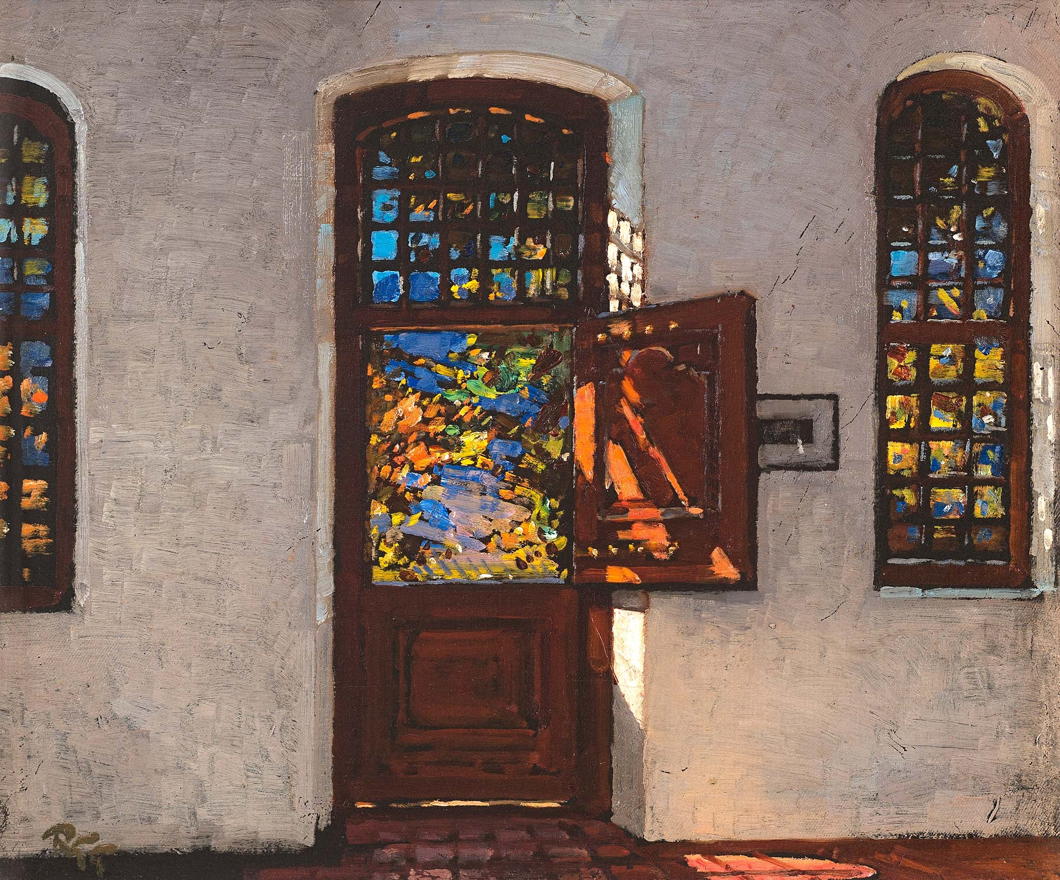
Here, at the far-off Cape, the Huguenots settled in the valleys of the Drakenstein, of the Hottentot’s Holland, and at French Hoek; and they made the wilderness blossom, and transformed its barren spaces into smiling wheatfields and oak-shaded vineyards. They incidentally introduced the dialect of Dutch known as “The Taal,” for when the speaking of Dutch was made compulsory for them, they evolved a simplified form of the language more adapted to their French tongues.
I suspect, too, that the artistic impulse which produced the dignified Colonial houses, and built so beautiful a town as Stellenbosch (a name with most painful associations for many military officers whose memories go back twenty years ) must have come from the French.
Stellenbosch, with its two-hundred-year-old houses, their fronts rich with elaborate plaster scroll-work, all its streets shaded with avenues of giant oaks and watered by two clear streams, is such an inexplicable town to find in a new country, for it might have hundreds of years of tradition behind it!
Wherever they may have got it from, the artistic instinct of the old Cape Dutch is undeniable, for a hundred years after Van der Stel’s time they imported the French architect Thibault and the Dutch sculptor Anton Anreith. To Anreith is due the splendid sculptured pediment over the Constantia wine-house illustrating the stoiy of Ganymede, and all Thibault’s buildings have great distinction.
But still, being where they are, they are a perpetual surprise, for in a new country one does not expect such a high level of artistic achievement.
The Other Modern: Otto Schöntal
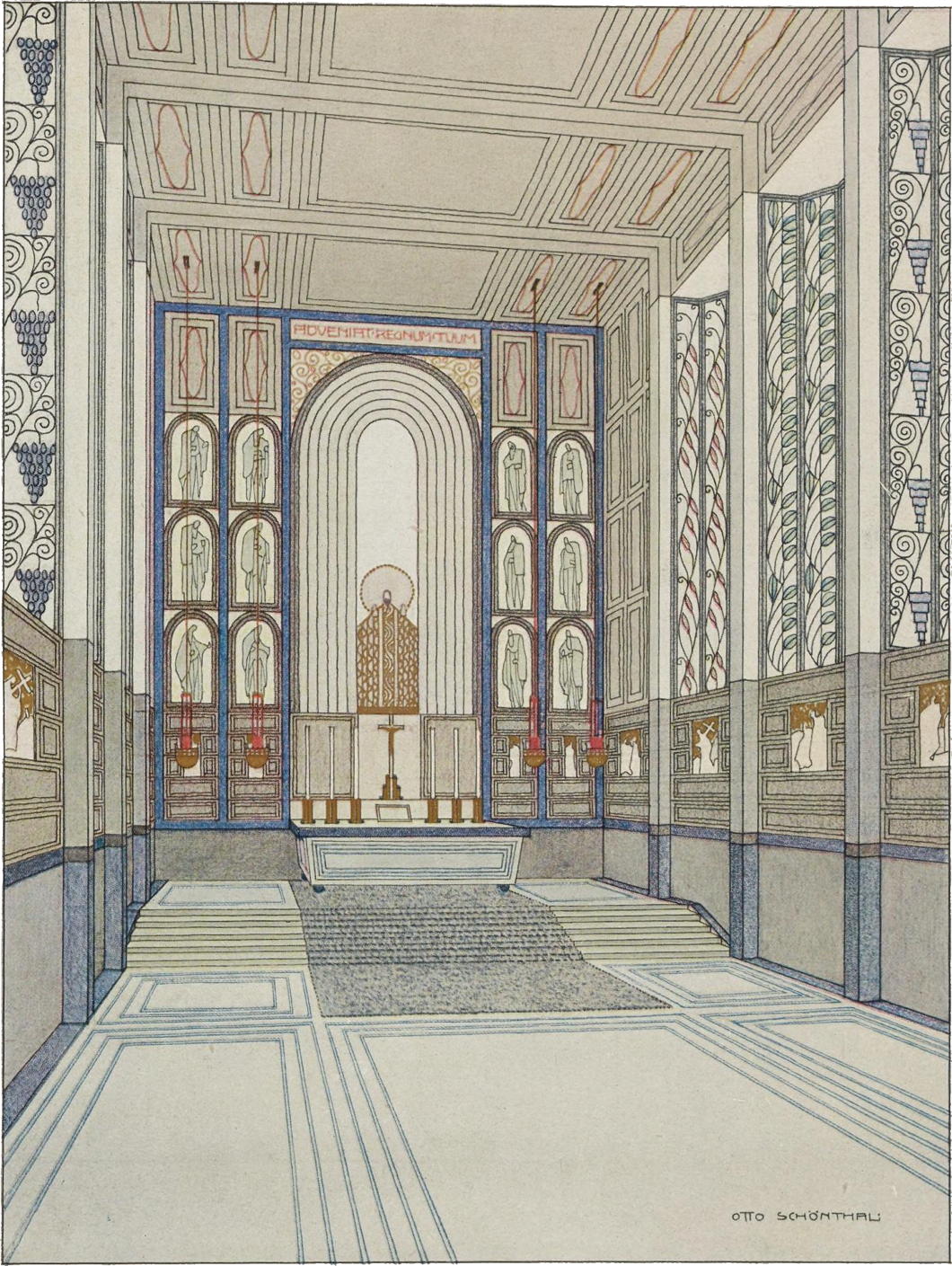
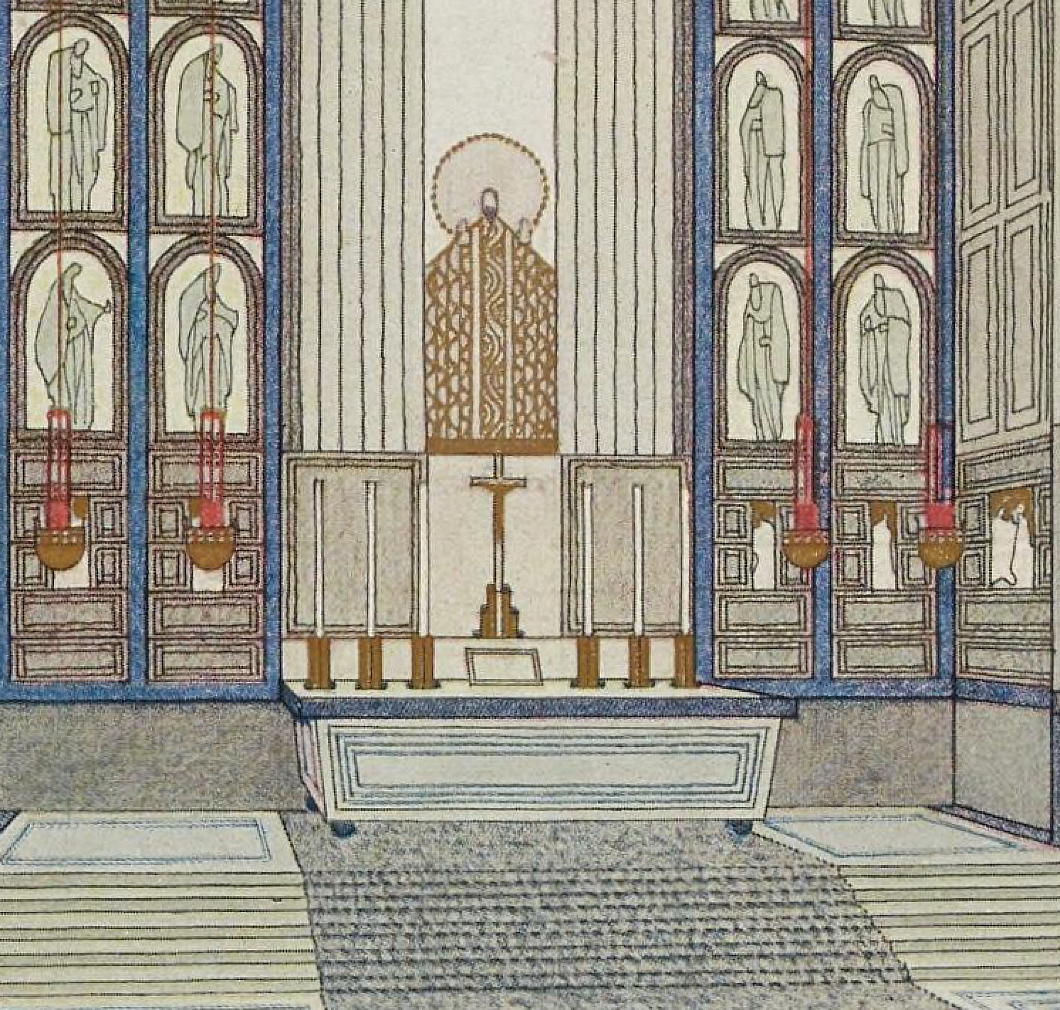
The Viennese architect Otto Schöntal was a student of Otto Wagner at the Academy of Fine Arts and exhibited this project for a Schloßkapelle in the periodical Moderne Bauformen in 1908.
It combines a simplicity of form with greater complexity in its decoration but like the work of many of the more mid-ranking architects of the Secession it comes across as a bit rigid and angular despite a certain freeness in its design.
A rood-stair pulpit
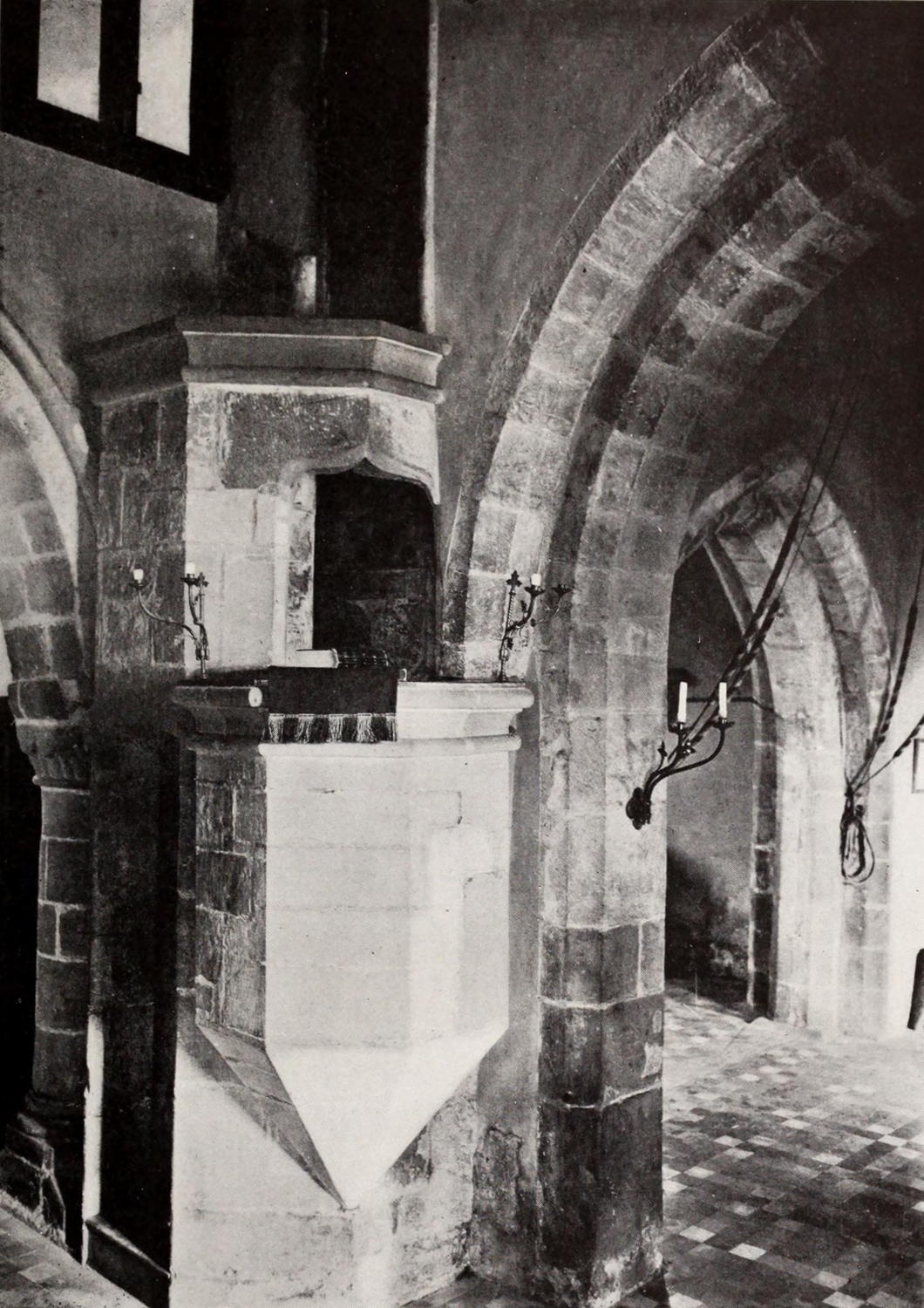
Among the features of the Church of All Saints in the Forest of Dean village of Staunton, Gloucestershire, is this fifteenth-century stone pulpit.
It is built into a rood-stair that once led to a wooden rood loft, demolished and removed some centuries ago.
This church also has a Norman font thought to have been hollowed out of an earlier square pagan Roman altar.
Pentonville Expressionism
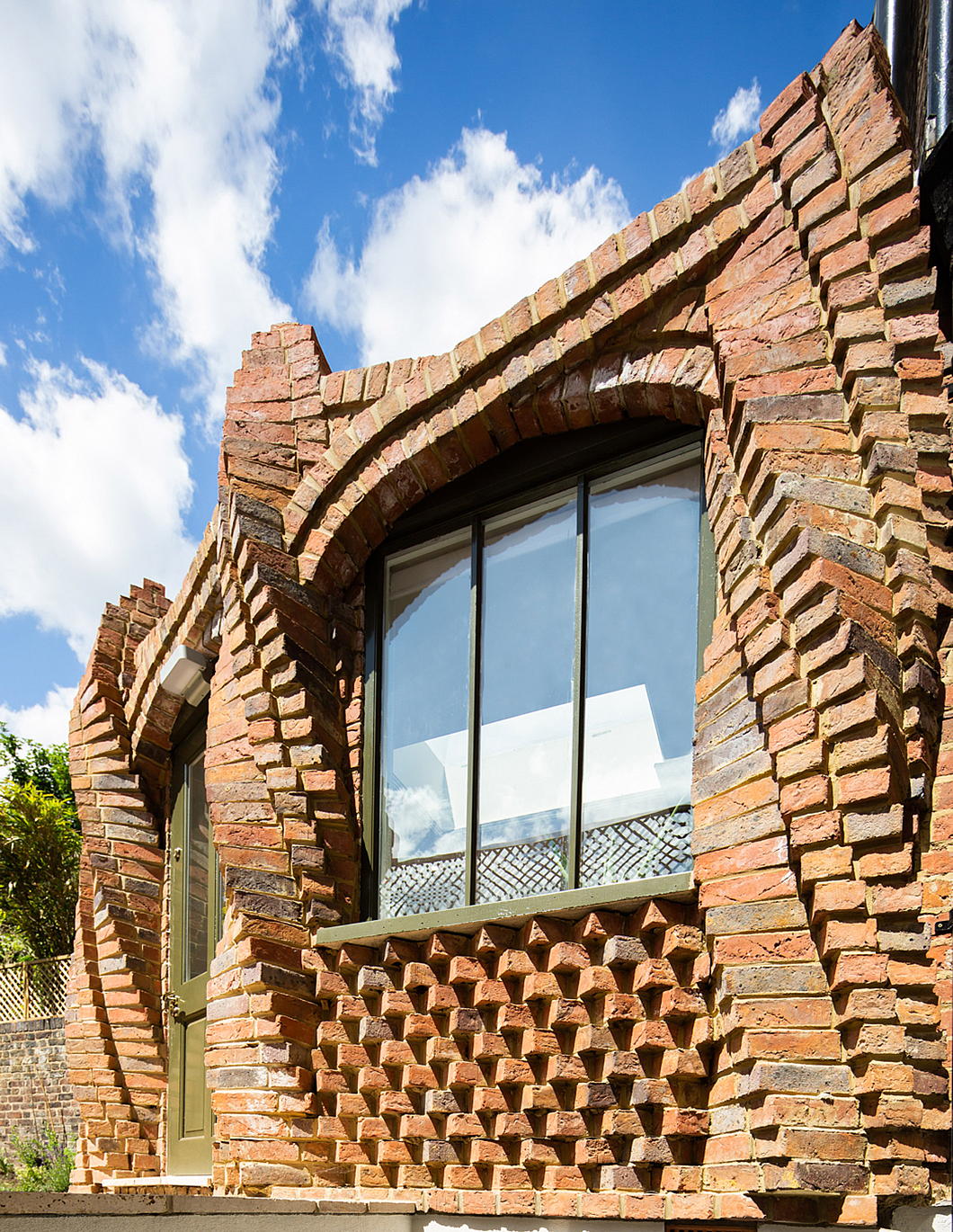
When partner James Beazer of architectural firm Urban Mesh wanted to build an extension onto his Pentonville townhouse his tenderness towards brick expressionism took physical form.
“I love the work of the German Expressionists,” Beazer told the FT. “The playfulness of their use of brick. I think we’ve become uncomfortable with decoration today. Perhaps property has become too valuable. If it wasn’t, we’d all feel more able to take risks.”
Bringing brick expressionism down to a smaller scale produces interesting results here in Beazer’s case. It’s fun and somewhat slapdash — all the unconcerned confidence of an amateur delivered by a professional in his back garden. Hamburg meets the Shire in Islington.
I would have gently arched the windows, however, and the choice of lighting fixture is mundane. But it is a fundamental Cusackian principle never to let the perfect be the enemy of the good.
“I would probably have struggled to convince a client to do it,” Beazer says. But he has no confidence in the twisted brick add-on’s future once he moves house. “To be honest, the next people who move in will probably flatten it and replace it with a huge glass extension.”
The late Gavin Stamp gave an excellent lecture under the auspices of the Twentieth Century Society entitled ‘Hanseatic visions: brick architecture in northern Europe in the early twentieth century’.
It had been available online but now, alas, seems to be lost in the mists of time since the new incarnation of the Society’s website went up. Hope they stick it back online soon.
Het Spui
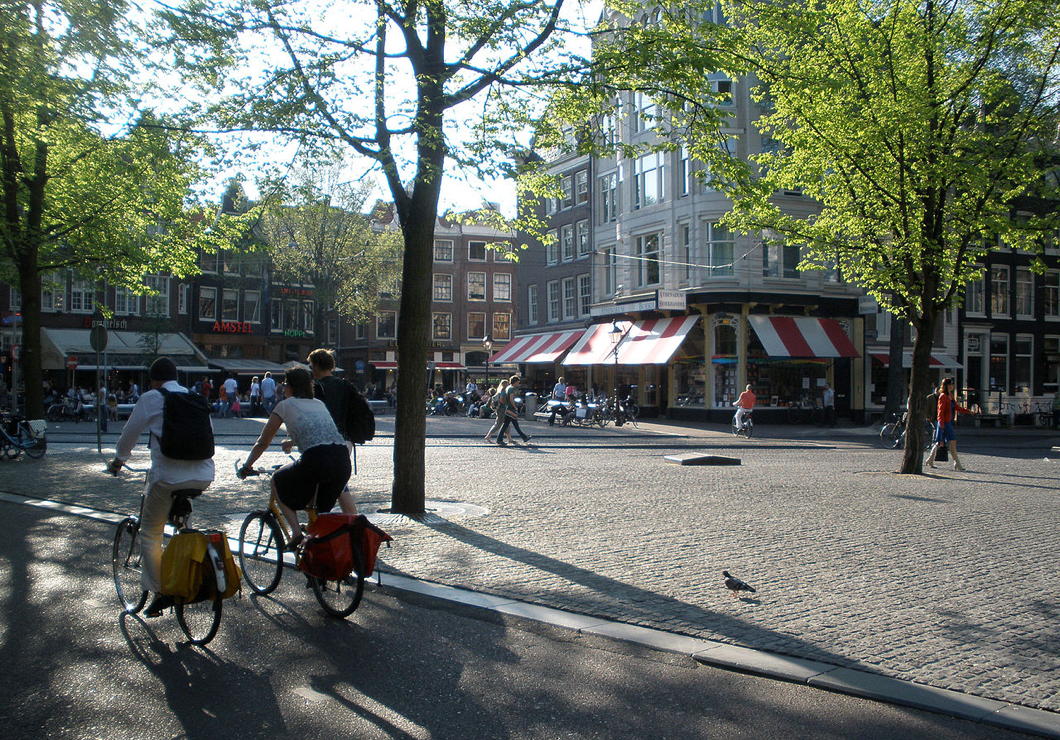
Amsterdam is known for its canals, not its public squares, but Het Spui is quite welcoming all the same. The name means roughly sluice or floodgate, pointing to the unsurprisingly watery origins of the place.
At first, it was a canal like any other and was only filled in during the nineteenth century: The first part in 1867 when the neighbouring Nieuwezijds Achterburgwal was filled in, the rest in 1882, two years before the Nieuwezijds Voorburgwal.
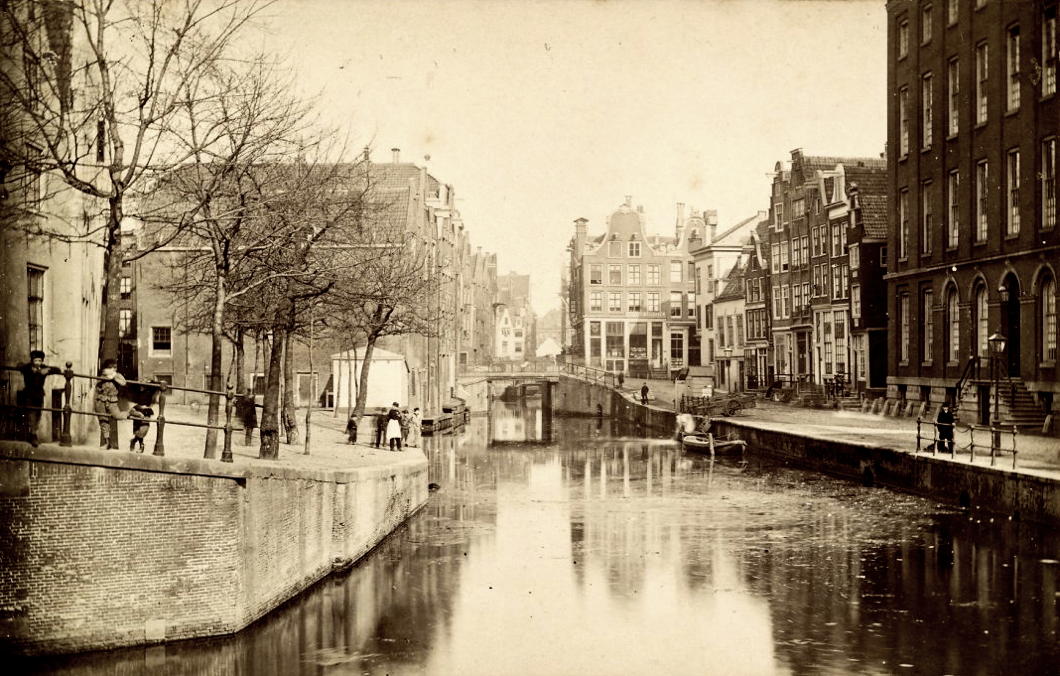
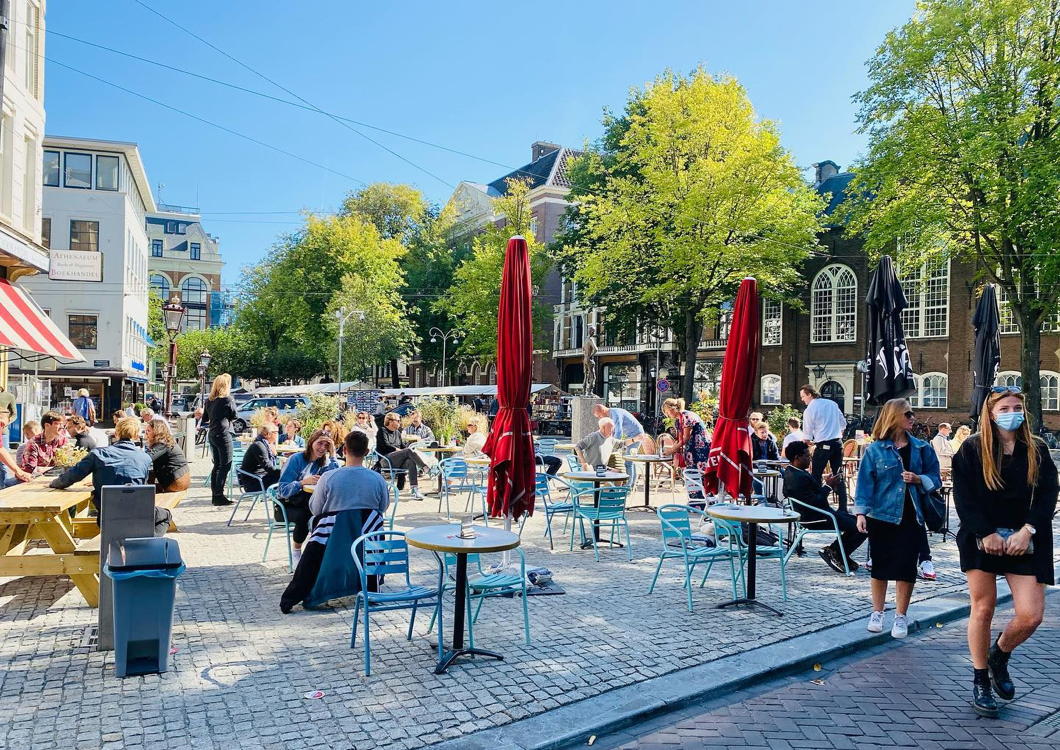
The Spui (pronounced “spouw” — unless Dawie van die bliksem corrects me) is a focal point surrounded by a number of sights. There’s the Old Lutheran Church, where the Maatschappij tot Nut van ’t Algemeen met in its early years and still a working congregation today.
There’s the Maagdenhuis, built as a Catholic orphanage and also the seat of the Archpriest of Holland and Zeeland until the restoration of the hierarchy in 1856. The orphanage moved out in 1957 when the building became a bank branch but was purchased by the University of Amsterdam in 1962 to house the administration of the growing institution. (more…)
The Perfect Home Garage
The Coach-House at Saasveld, Cape Town
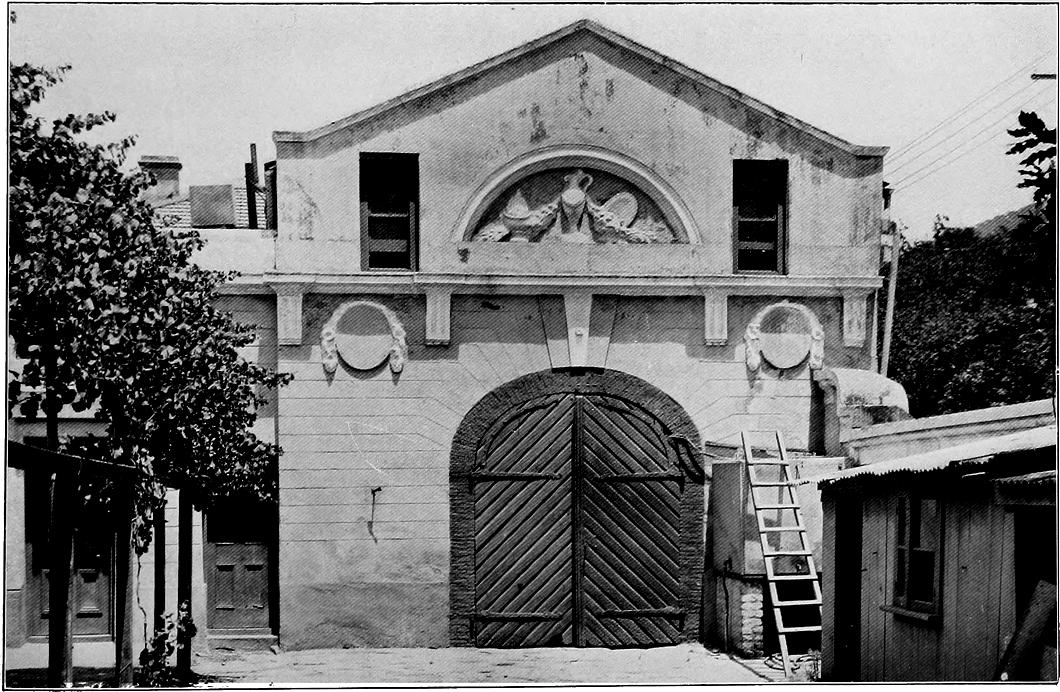
With all of Suburbia working from impromptu home offices set up in their garages during Covidtide — presumably clinging to their space heaters at this time of year — the subject of the residential garage came up in conversation.
America, being a land of plenty, has the very worst and the very best of home garages. The best are, if a separate structure, often in an arts-and-crafts style and ideally with a floor above perfect for extra storage, conversion to a rental unit, or space for disgruntled teenagers. If attached to the house itself, it is to the side, and only one storey, so as not to distract attention.
The worst, however, are double wide and take up most of the facade, as well documented by McMansion Hell.
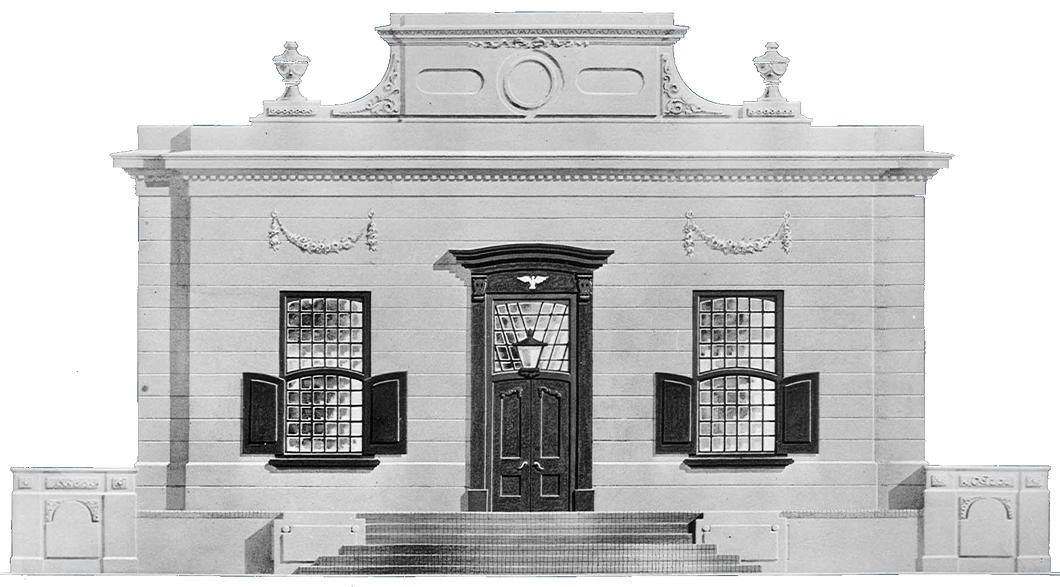
My perfect residential garage, however, is not in the States but from the Western Cape. Saasveld was the home of Baron William Ferdinand van Reede van Oudtshoorn, also 8th Baron Hunsdon in the Peerage of England.
In the 1790s, the Baron built the house on his Cape Town estate — between today’s Mount Nelson Hotel and the Laerskool Jan van Riebeeck. The elegant house and outbuildings were almost certainly the work of Louis Michel Thibault, the greatest architect of the Cape Classical style.
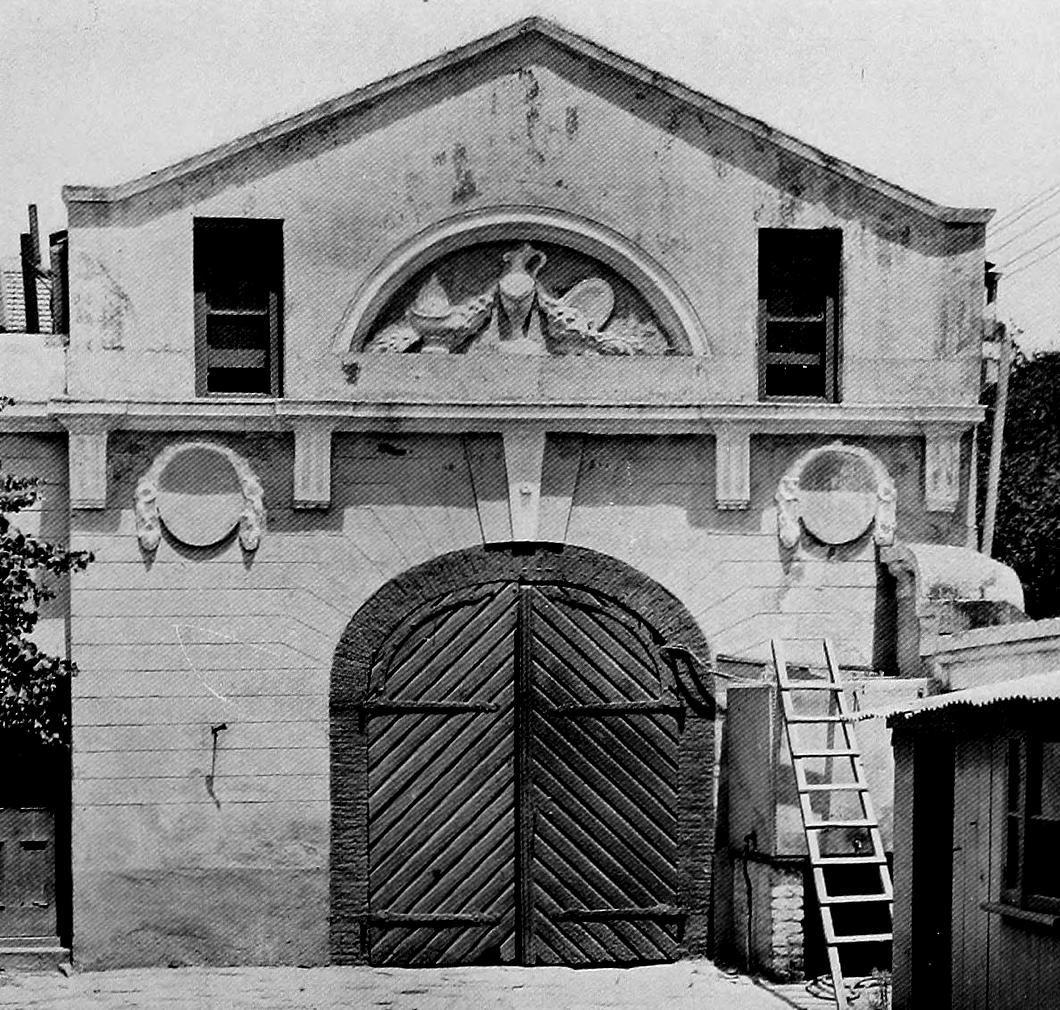
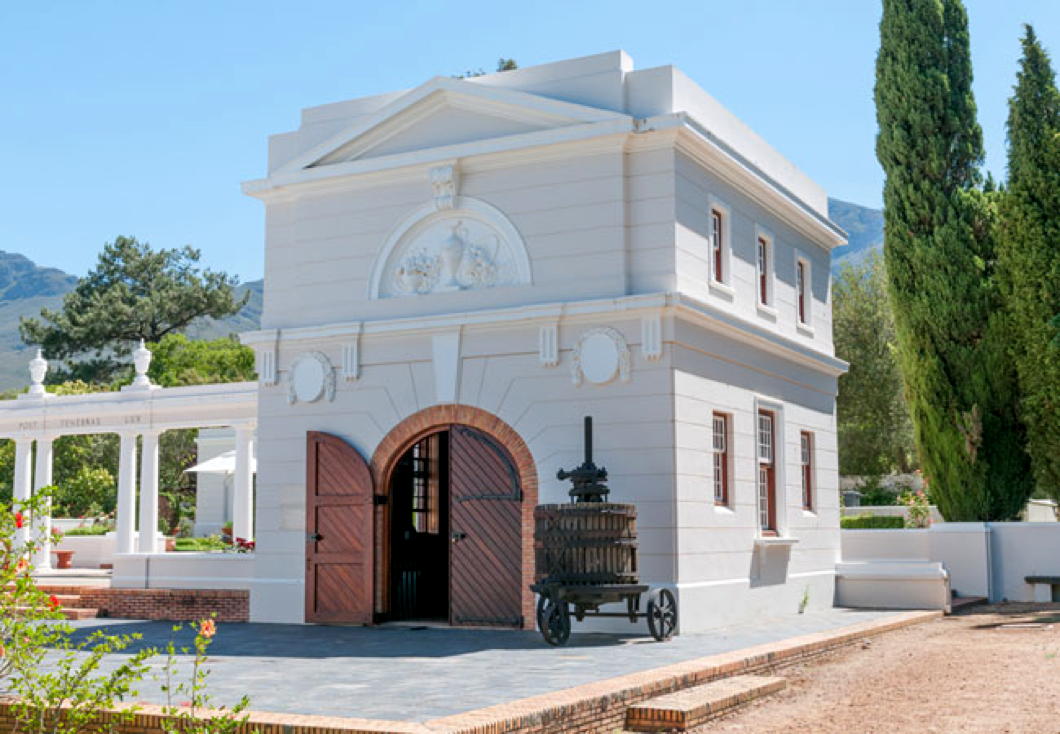
Behind the house were two flanking wine cellars linked by a colonnade, at least one of which (above) was eventually put to use as a coach house or garage and photographed by Arthur Elliott.
Unfortunately the house and its grounds fell into ruin and the Dutch Reformed Church bought the site for development and decided to demolish Saasveld. Architectural elements from the house were preserved and eventually re-assembled at Franschhoek where a reconstructed Saasveld serves as the Huguenot Memorial Museum today.
As Mijnheer van der Galiën reports, however, the tomb of William Ferdinand is still at the original site.
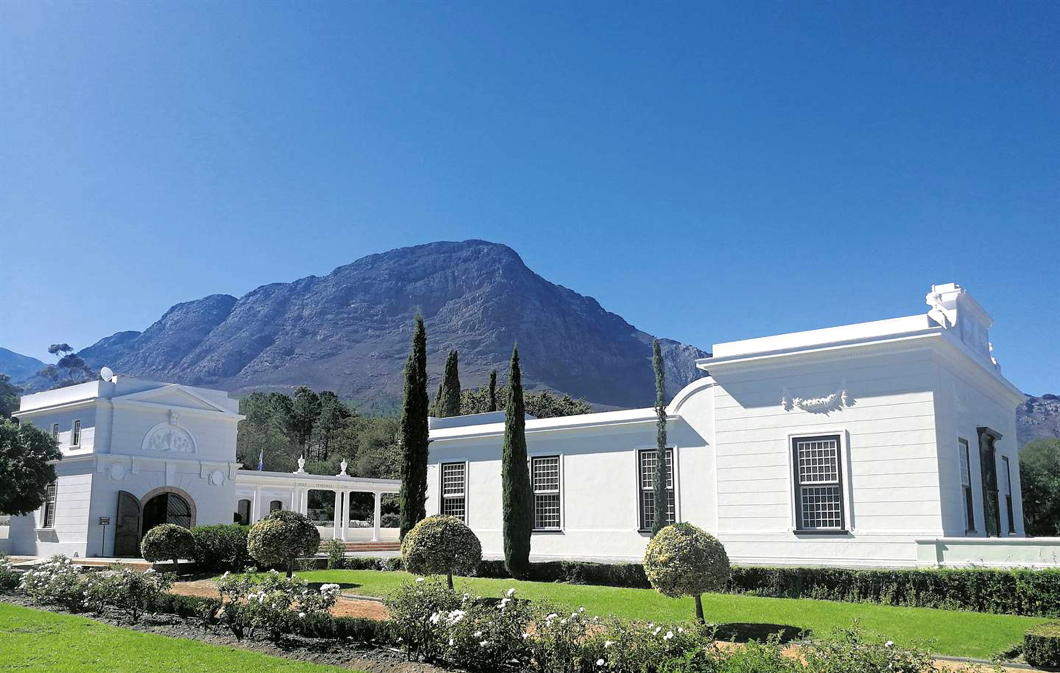
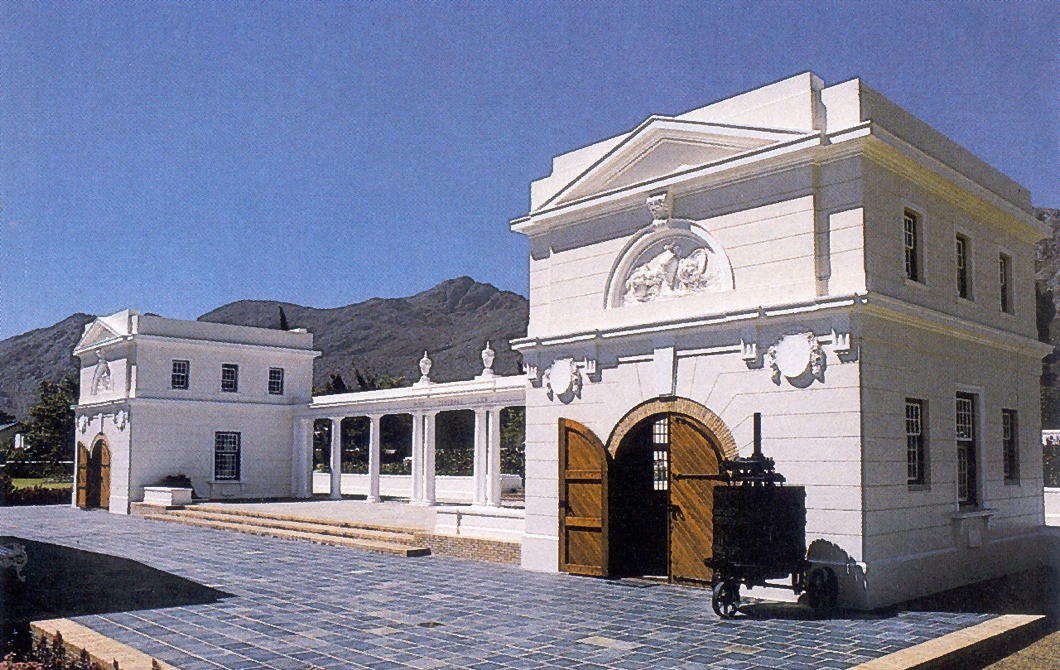
Here in Franschhoek the matching wine-cellars-turned-coach-houses are reproduced with their linking colonnade. And I still can’t help but think that — so long as you could fit a Land Rover through the doors — they would make the perfect home garage.
Staats Long Morris
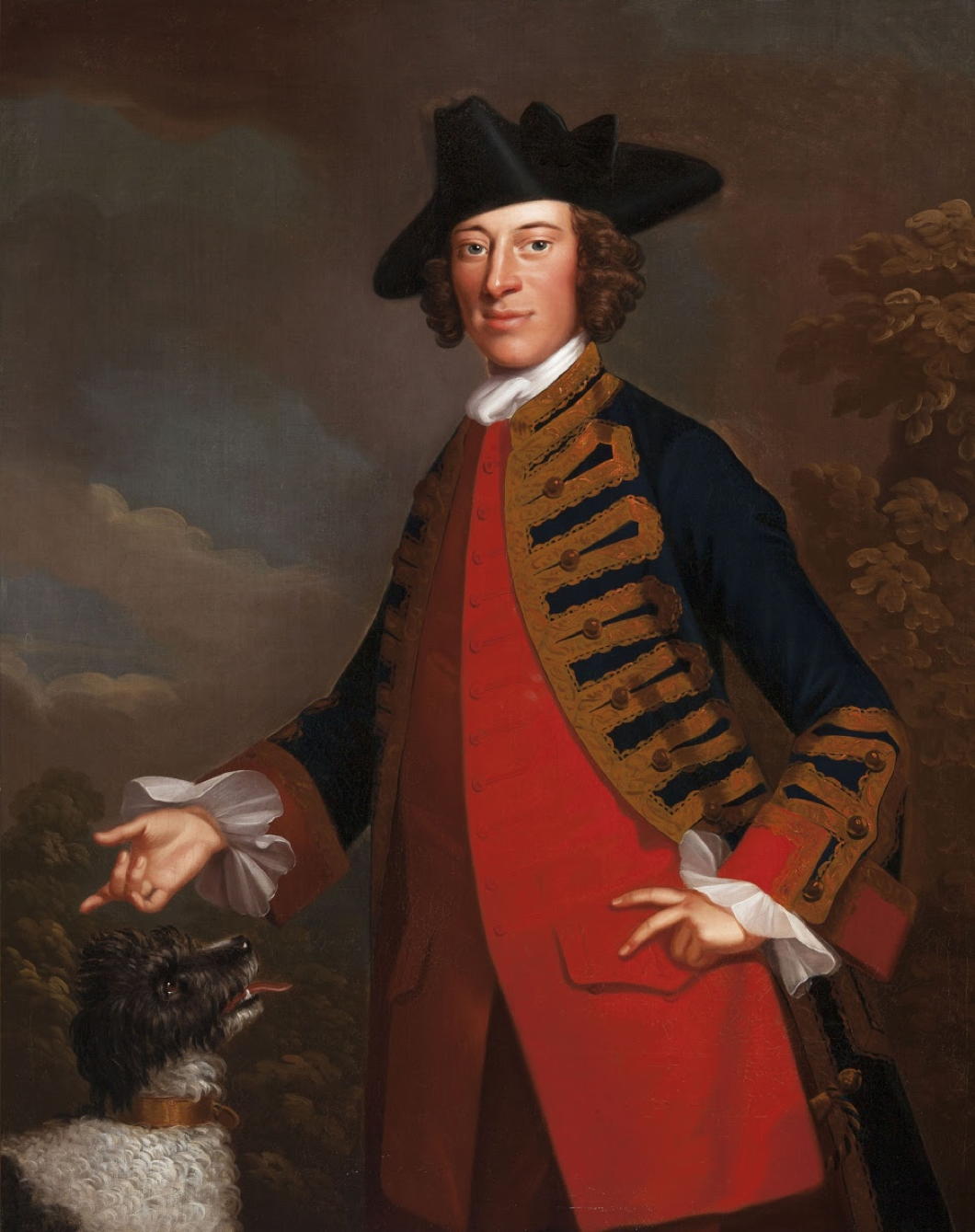
Everyone knows about Gouverneur Morris, scion of one of New York’s great landowning families and given the moniker ‘penman of the Constitution’. As a signer of the Declaration of Independence his half-brother Lewis Morris III was a fellow ‘founding father’. Less well-remembered is his other half-brother Staats Long Morris (1728–1800).
Their father Lewis Morris II was the second lord of Morrisania, the feudal manor that covered most of what is now the South Bronx and has given its name to the smaller eponymous neighbourhood today.
Staats and Gouveneur owe their distinctive Christian names to the family names of their respective mothers.
Lewis II married Katrintje Staats who provided him with four children. After Katrintje died in 1730, Lewis married Sarah Gouverneur, daughter of the Amsterdam-born Isaac Gouverneur. Sarah’s uncle Abraham was Speaker of the General Assembly of the Province of New York, a role Lewis Morris II eventually filled.
Staats was born at Morrisania on 27 August 1728 and studied at Yale College in neighbouring Connecticut as well as serving as a lieutenant in New York’s provincial militia. He switched to the regular forces in 1755 when he obtained a commission as captain in the 50th Regiment of Foot, moving to the 36th in 1756.
Around that time Catherine, Duchess of Gordon, the somewhat eccentric widow of the third duke, was on the lookout for a second husband and Staats — though American, mere gentry, and ten years her junior — met with her approval. They were married in 1756 and Staats moved in to Gordon Castle to live as the Dowager Duchess’s husband.
‘He conducted himself in this new exaltation with so much moderation, affability, and friendship,’ a newspaper reported in 1781, ‘that the family soon forgot the degradation the Duchess had been guilty of by such a connexion, and received her spouse into their perfect favour and esteem.’
With the Duchess’s patronage, Lieutenant-Colonel Staats raised the 89th Regiment of Foot — “Morris’s Highlanders” — from the Scottish counties of Aberdeenshire and Banffshire though she was extremely cross when her new husband’s regiment was despatched to India where it took part in the siege of Pondichery.
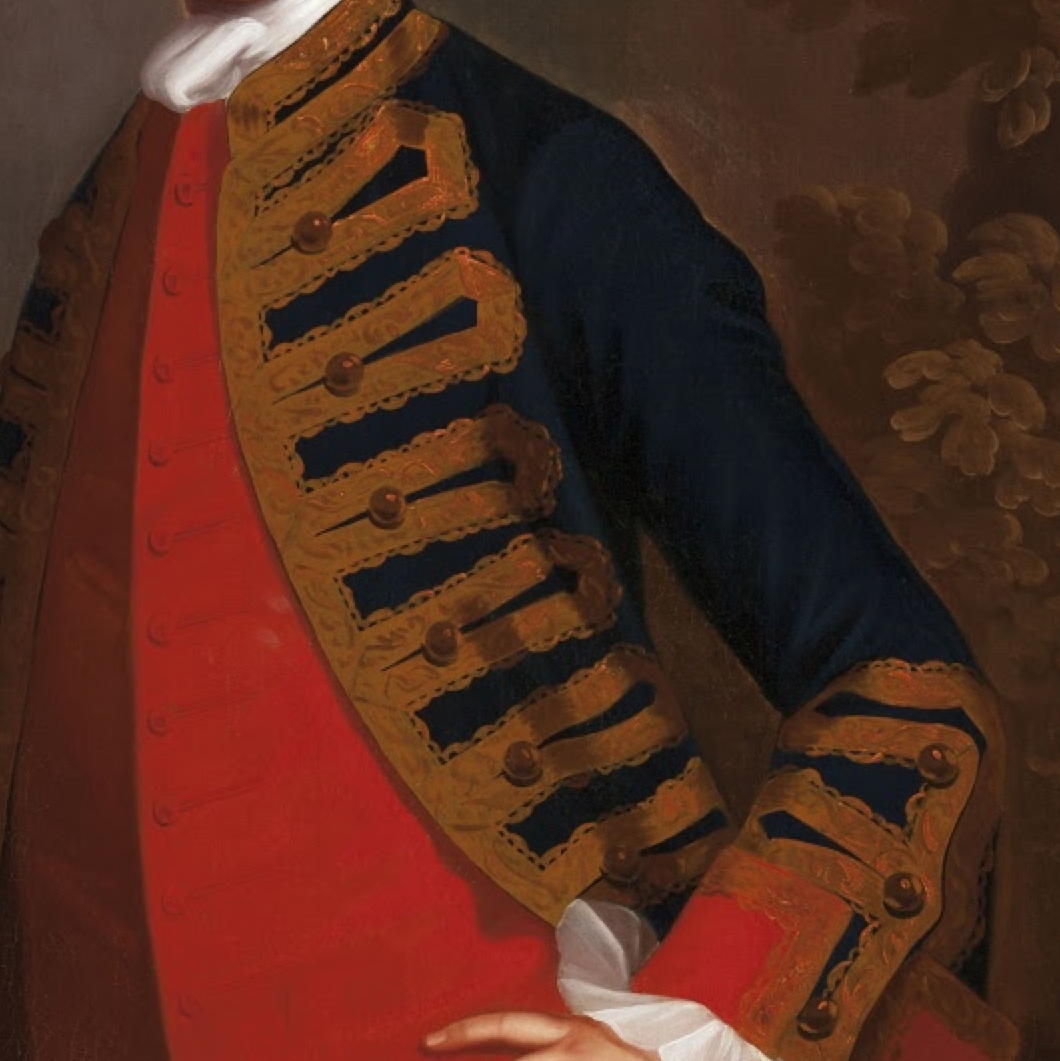
In the event, Morris delayed following his regiment to India, leaving England in April 1762 and remaining there only until December 1763. When the young fourth Duke of Gordon came of age the following year, Staats turned his eyes to America and engaged in land speculation there. In 1768 he and the Duchess even went to visit their purchases in the new world, returning to Scotland in the summer of the following year.
With the fourth Duke’s help, and on the eve of the revolutionary stirrings in North America, Staats was elected to the British parliament for the Scottish seat of Elgin Burghs in 1774. He managed to hold on to it for the next ten years. Was this New Yorker the first Yale man to be elected to Parliament? I can’t find any before him, but more thorough research might prove fruitful.
In 1786 he inherited the manor of Morrisania but with the intervening separation between Great Britain and most of her Atlantic colonies General Morris thought it best to sell it on to his brother Gouverneur.
Though he had rejected a future in the world into which he had been born, Staats did return to North America in a professional capacity in 1797 when he was appointed governor of the military garrison at Quebec in what by then was Lower Canada.
Morris died there in January 1800, but his earthly remains were sent back to Britain where he was interred in Westminster Abbey — the only American to receive that honour.
Benedict of Palermo
The island of Sicily is a cross-section of the numerous kingdoms and empires which have ruled and inhabited it from the Phoenecians down to the present day. During the Norman conquest of the island — those Normans did get around — many Lombards came to help secure the Normans’ rule over the existing Sicilians who were mostly Greek and Arab. The Gallo-Italic dialect of those Lombards is still spoken in a few towns and villages speckled across the island and the settlements they founded are known as the Oppida Lombardorum.
In one such Lombard town, San Fratello, in the 1520s a son was born to an enslaved couple named Cristoforo and Diana whose piety was so highly regarded that their master granted this first-born son, Benedetto (Benedict), his freedom from birth.
From his earliest days Benedict was prone to solitude to the extent that he was mocked by his peers, in addition to being insulted frequently for his black skin. As a teenager he left the family home and became a shepherd but gave whatever he could to help the poor and those even less fortunate than him.
Discerning the call to solitude, Benedict entered the hermitage of Santa Domenica in Caronia but his reputation for holiness was such that the pious people of the island began to visit him and implore him for his prayers and miracles.
Accompanied by another member of the community, Benedict fled to other places around the island, offering great and severe penances in reparation for the sins of humanity, but no matter where he went within days the faithful had found out and pestered him.
When the founder of the hermetic community at Santa Domenica died, the brothers elected Benedict his successor, despite his lack of education and illiteracy. Benedict returned to lead the community until it was abolished in 1562 by the reforms of Pope Pius IV who urged independent groups of Francis-inspired hermits to regularise themselves into existing Franciscan orders.
Benedict went first to a Franciscan friary in Giuliana before settling into that of Santa Maria di Gesù in Palermo, the primary city of Sicily. Having been a superior of his old community, Benedict arrived at the Palermo community as a simple cook but even here his piety and talents were recognised. He was first put in charge of the novices and then, in 1578, his confrères elected him their custos or superior though he was only a brother rather than a priest.
He was known as a miracleworker across the island, but it was not only the poor, the sick, and the destitute who flocked to Benedict to seek his help. Theologians and men of learning came to visit this humble and uneducated friar. Even the viceroy of the island was known to take his counsel on important affairs of state.
In his later years, Benedict returned to being the cook of the friary until his death in April 1589. By that time the whole island of Sicily — Greeks, Arabs, Latins, all — revered this poor, humble, and unlettered friar.
Sicily’s ruler, King Philip III of Spain, ordered a magnificent tomb to be built to house Benedict’s remains in the friary of Santa Maria di Gesù, and in death his cult spread far beyond the island.
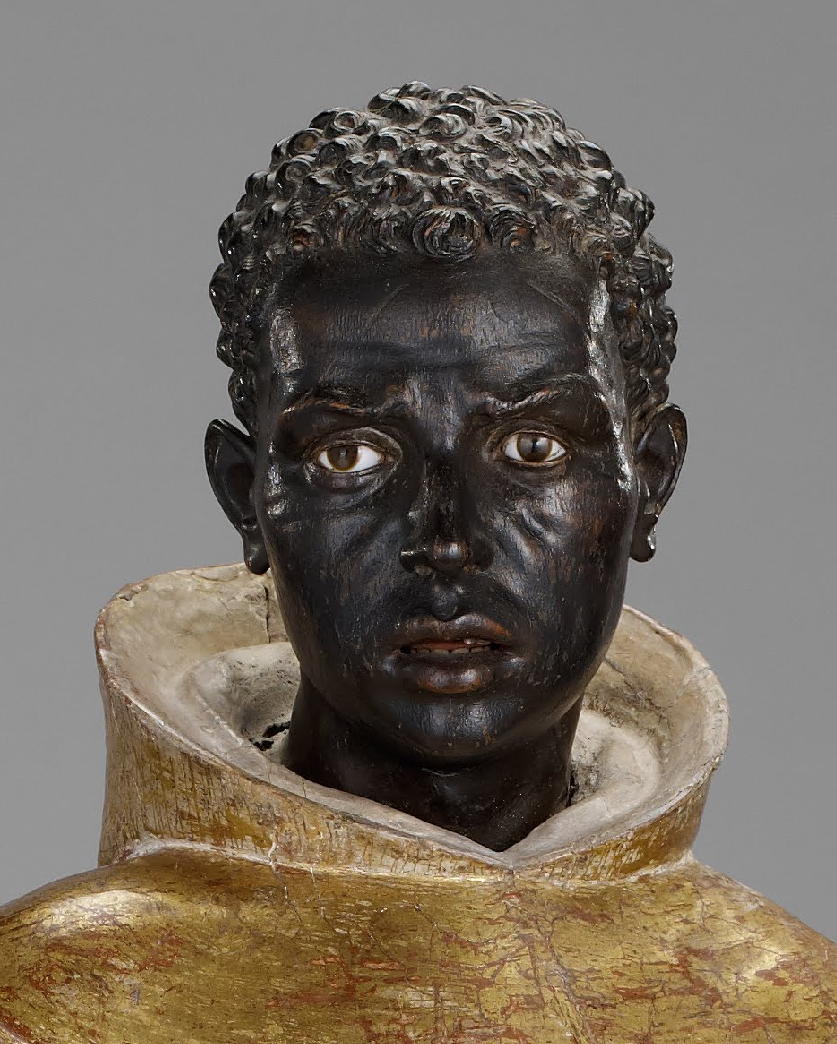
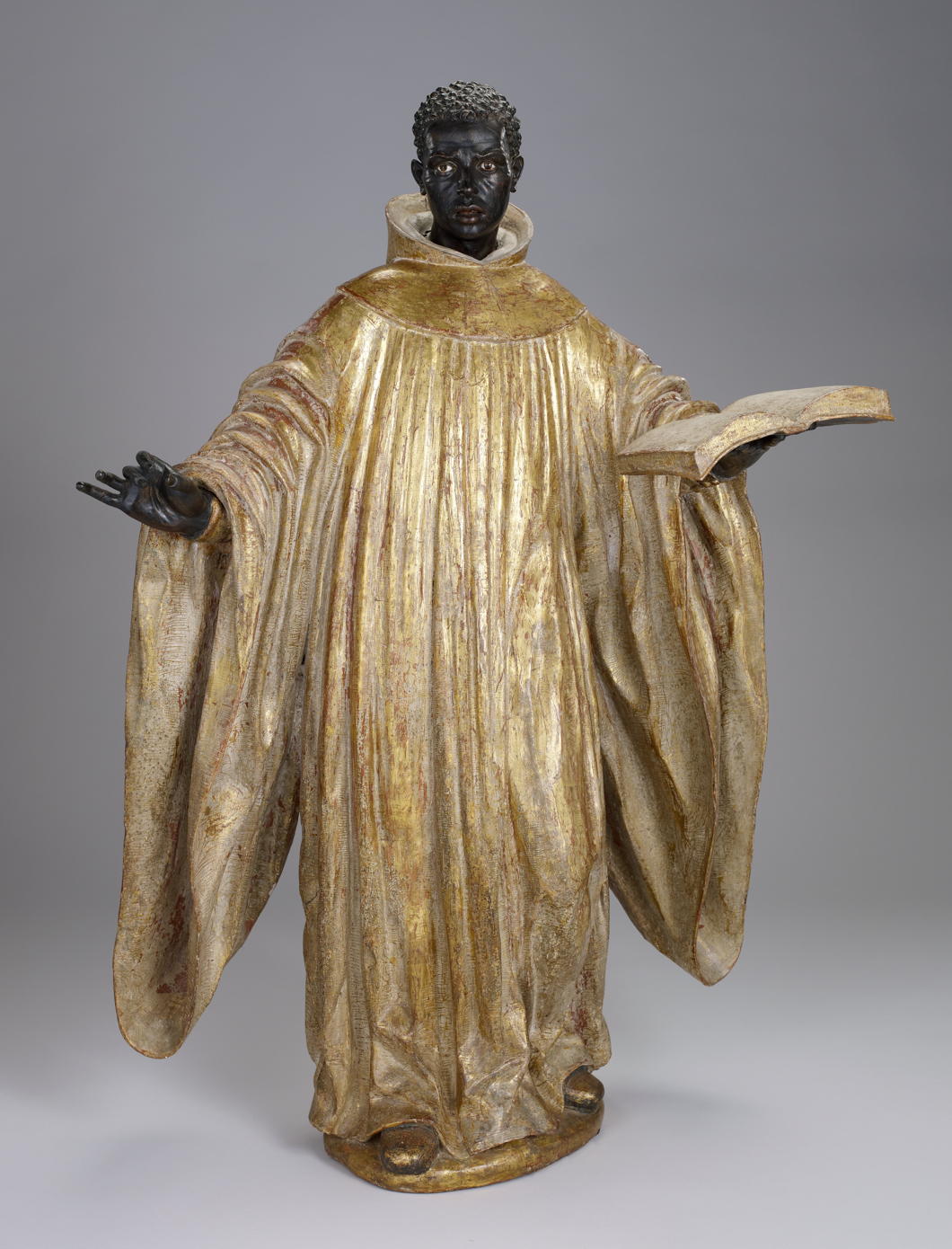
St Benedict of Palermo — or Benedict the Moor — was beatified by Benedict XIV in 1743 and canonised by Pius VII in 1807. Over the centuries, many non-white Christians came to implore his intercession and he became particularly popular among natives and mixed-race peoples in South America, in Africa itself, and amongst African-Americans in the United States.
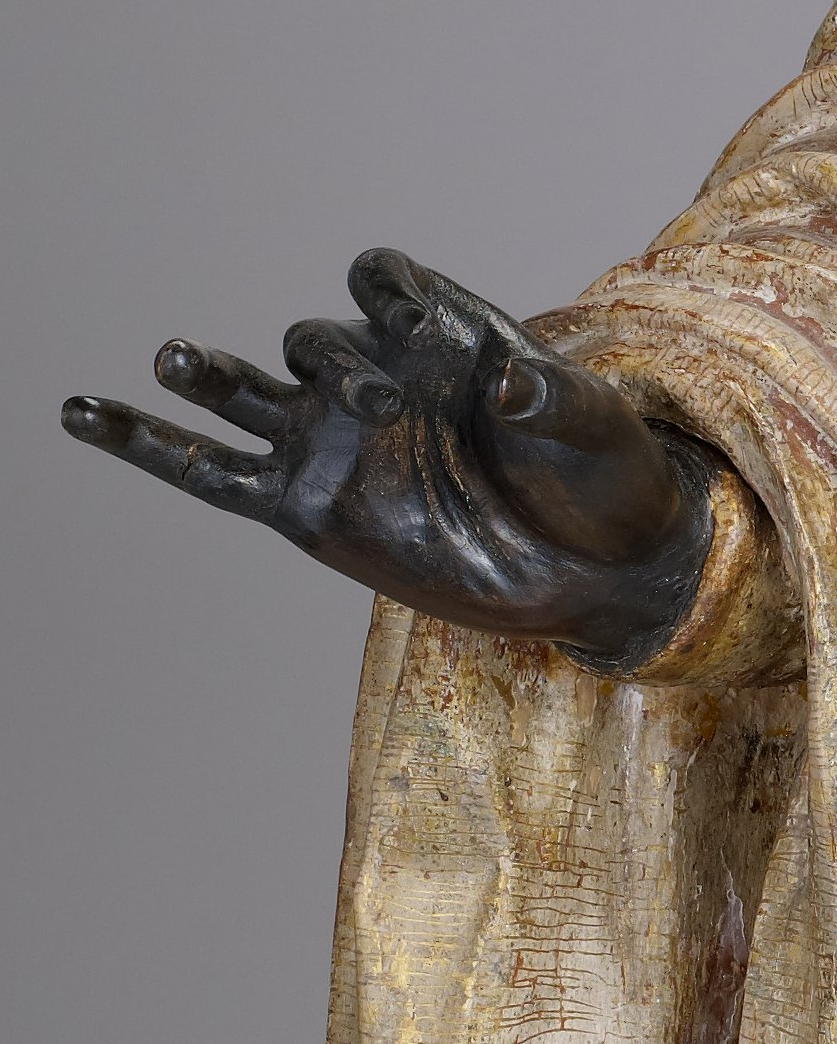
This statue is believed to be the work of the Sevillian sculptor José Montes de Oca and was carved in the 1730s. Long in a private collection in Milan, since 2010 it has formed part of the collection of the Minneapolis Institute of Art.
The Galloway Cross
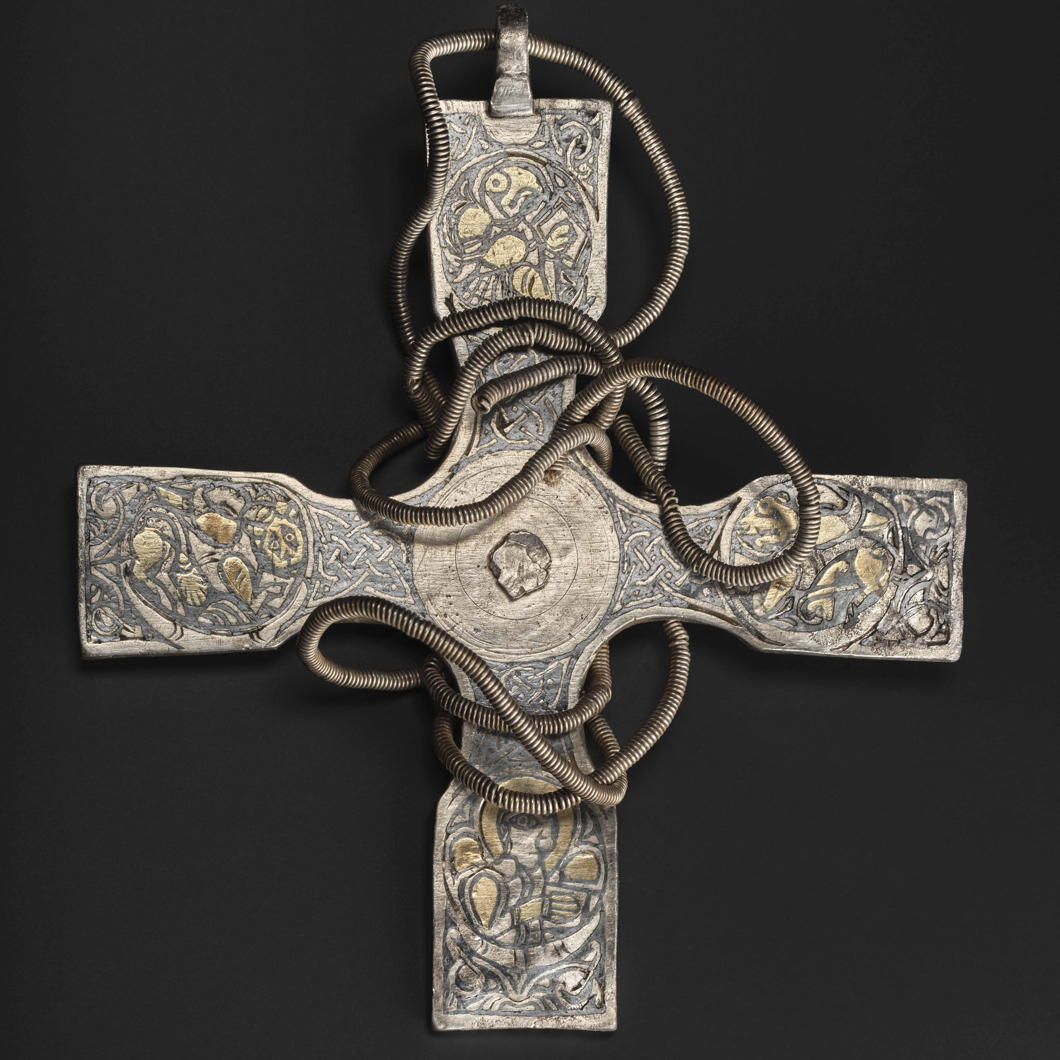
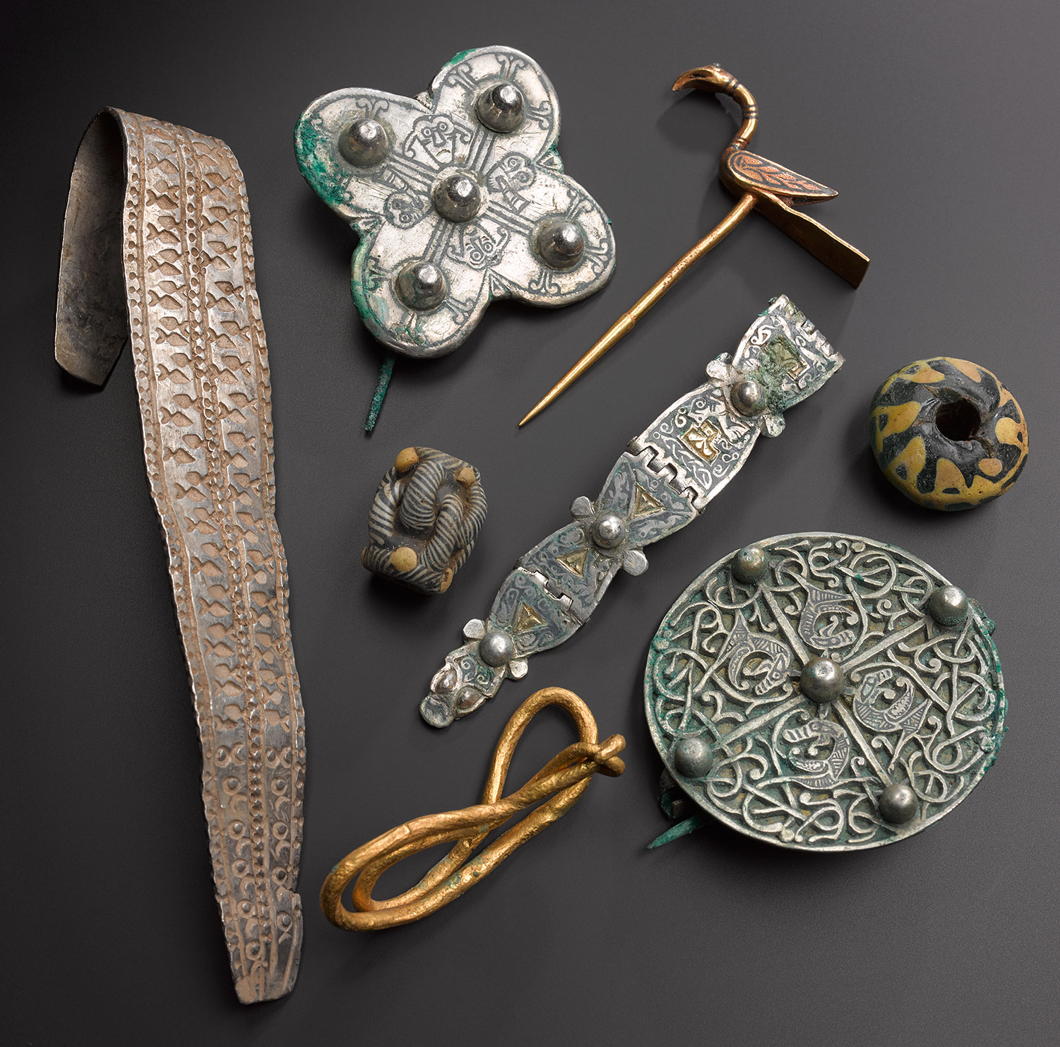
What could be better than a hoard — and a Kircudbrightshire hoard at that? Sometime during the tenth century, a gentleman decided to deposit an interesting array of objects in Galloway only for them to be rediscovered by a metal detectorist in 2014.
Thus have come to us the Galloway Hoard, a collection of objects the most important of which is this pectoral cross made of silver and decorated with symbols of the four evangelists: the eagle of John, the ox of Luke, the angel of Matthew, and the lion of Mark.
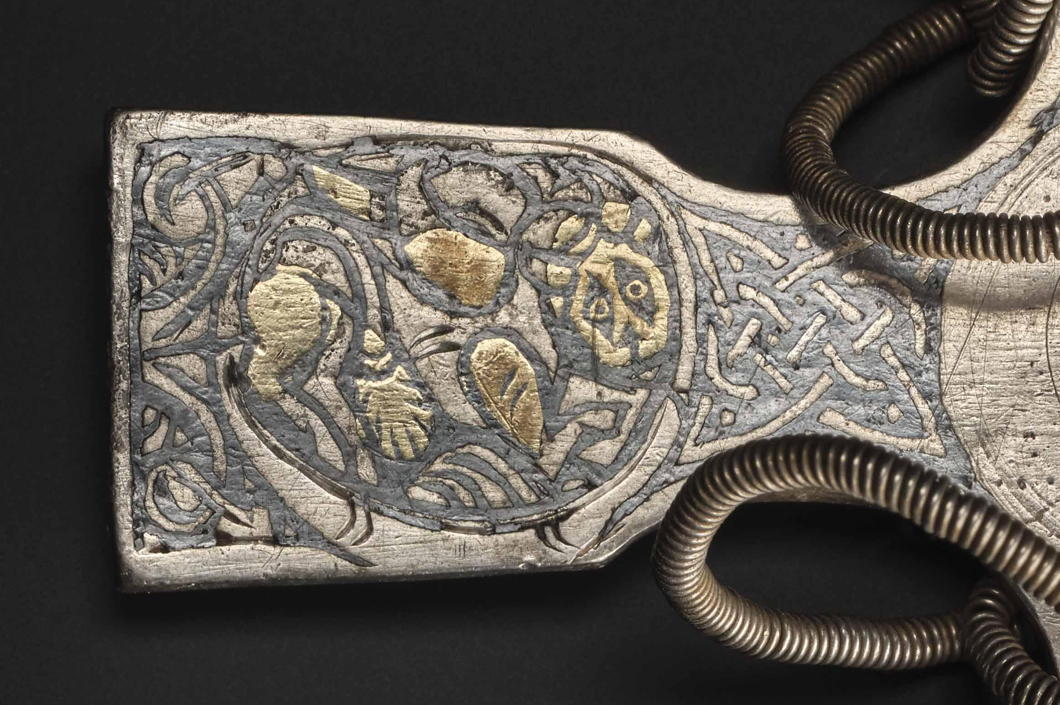
As the hoard was buried when Kircudbrightshire was part of Northumbria — before the area became Scottish — the art has been identified as Anglo-Saxon from the age of the Vikings. My theory is an expert thief was at work, nicking precious objects from hapless victims — an armband gives the name of one poor Egbert in runes.
“The pectoral cross, with its subtle decoration of evangelist symbols and foliage, glittering gold and black inlays, and its delicately coiled chain, is an outstanding example of the Anglo-Saxon goldsmith’s art,” Dr Leslie Webster, an expert, said. “It was made in Northumbria in the later ninth century for a high-ranking cleric, as the distinctive form of the cross suggests.”
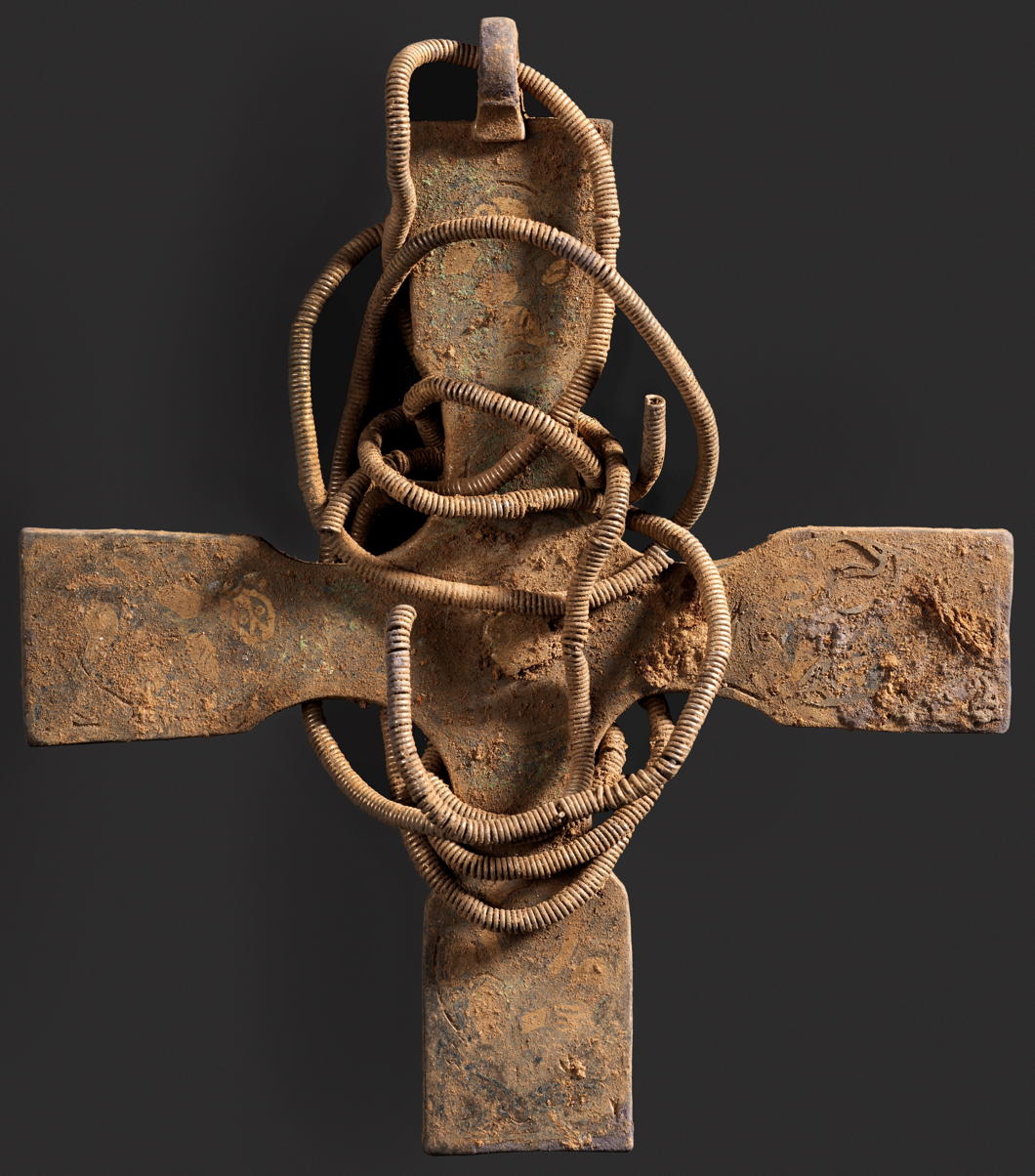
The Galloway Cross, before cleaning and conservation
All treasure found in Scotland must be reported to the Queen’s and Lord Treasurer’s Remembrancer who in 2017 determined the hoard’s value at £1.8 million. Scots law allows the discoverer to keep the full value of the hoard if there is no owner, though as it was found on glebelands belonging to the Church of Scotland that body’s General Trustees demanded a cut as well.
The objects themselves have found a home in the National Museum of Scotland who will be exhibiting them from February until May when they will go on tour to Aberdeen and Dundee.
A Scene in Buenos Aires
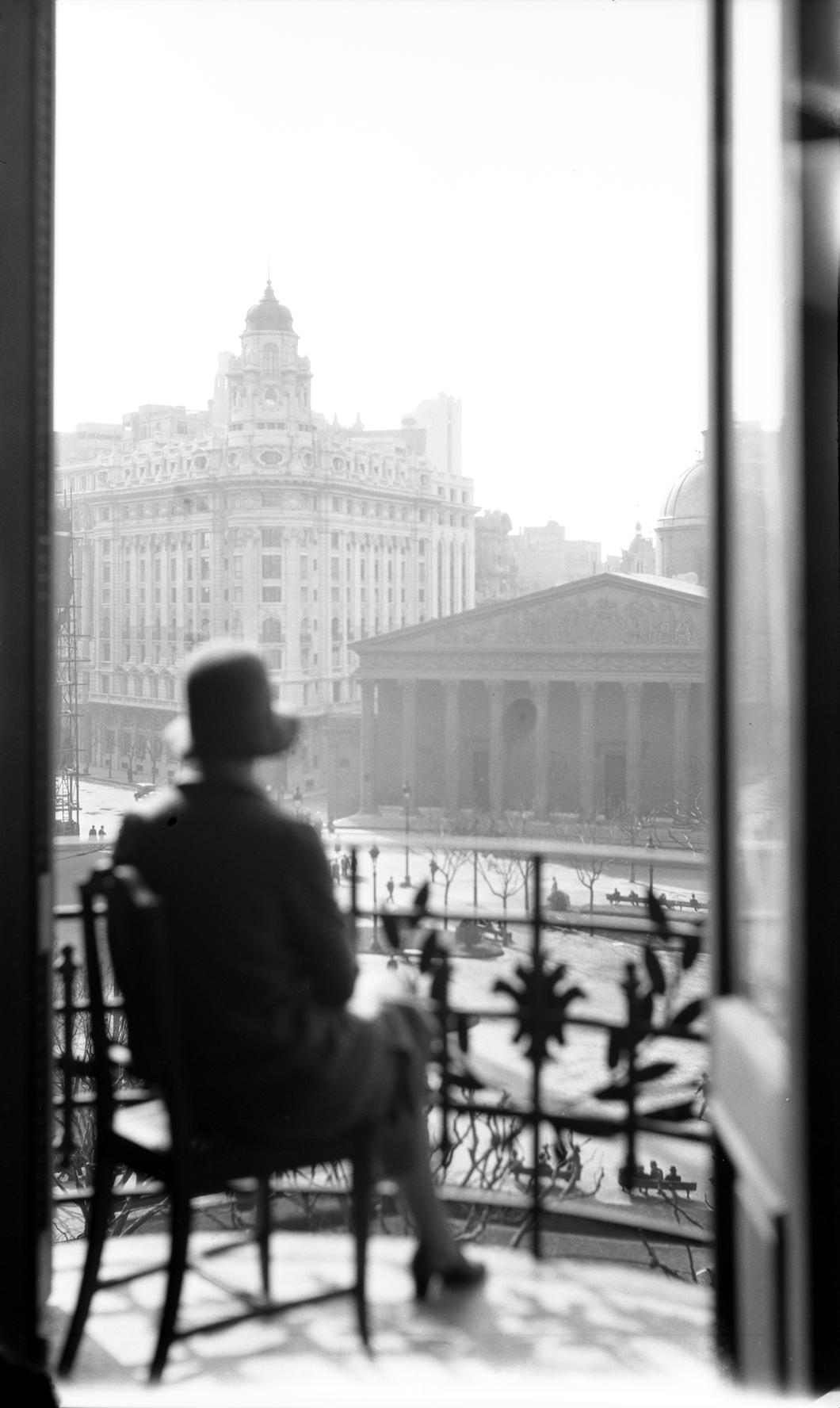
A hatted woman sits on a balcony, looking away out over the Plaza de Mayo, the Cathedral of Buenos Aires, and the city beyond.
It looks like the sort of thing taken by one of the French photographers, but in fact it is by a total amateur: Henry Dart Greene, the son of the Californian architect Henry Mather Greene (of Greene & Greene).
From 1928 to 1931, Dart Greene worked for the Argentine Fruit Distributors Company, founded by the Southern Railway to make use of the individual smallholdings long its line.
Upon his death, Dart Greene’s papers were deposited in the library of the University of California at Davis including this photograph from his time in Argentina.
While the building it’s taken from has been demolished and replaced with a bank, most of what you see beyond is still there.
A Palace for the States-General
A Palace for the States-General
The nineteenth century was the great age for building parliaments. Westminster, Budapest, and Washington are the most memorable examples from this era, but numerous other examples great and small abound in Europe and beyond.
The States-General of the Netherlands missed out on this building trend, perhaps more surprisingly so given their cramped quarters in the Binnenhof palace of the Hague. The Senate was stuck in the plenary chamber of the States-Provincial of South Holland with whom it had to share, while the Tweede Kamer struggled with a cold, tight chamber with poor acoustics.
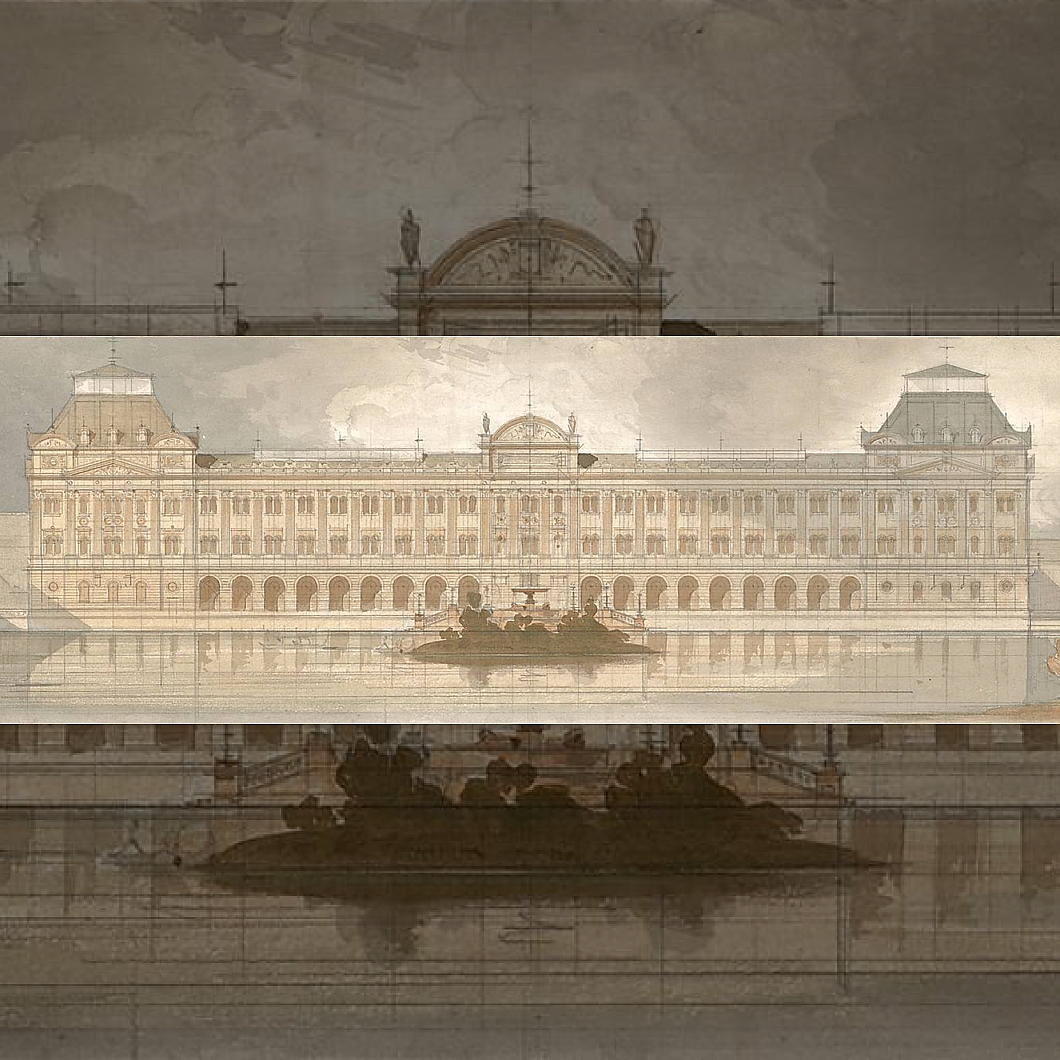
The liberal leader Johan Rudolph Thorbecke who pushed through the 1848 reforms to the Dutch constitution thought the newly empowered parliament deserved a building to match, and produced a design by Ludwig Lange of Bavaria. All the Binnenhof buildings on the Hofvijver side would be demolished and replaced by a great classical palace.
Despite members of parliament’s continual complaints about their working conditions, Thorbecke and Lange’s plans were vigorously and successfully opposed by conservatives. As the academic Diederik Smit has written,
A large part of the MPs was of the opinion that such an imposing and monumental palace did not fit well with the political situation in the Netherlands. […] In the case of housing the Dutch parliament, professionalism and modesty continued to be paramount, or so was the idea.
In fact, as Smit points out, significant alterations were made to the Binnenhof, like the demolition of the old Interior Ministry buildings by the Hofvijver, but these were replaced with structures that were actually quite historically convincing.
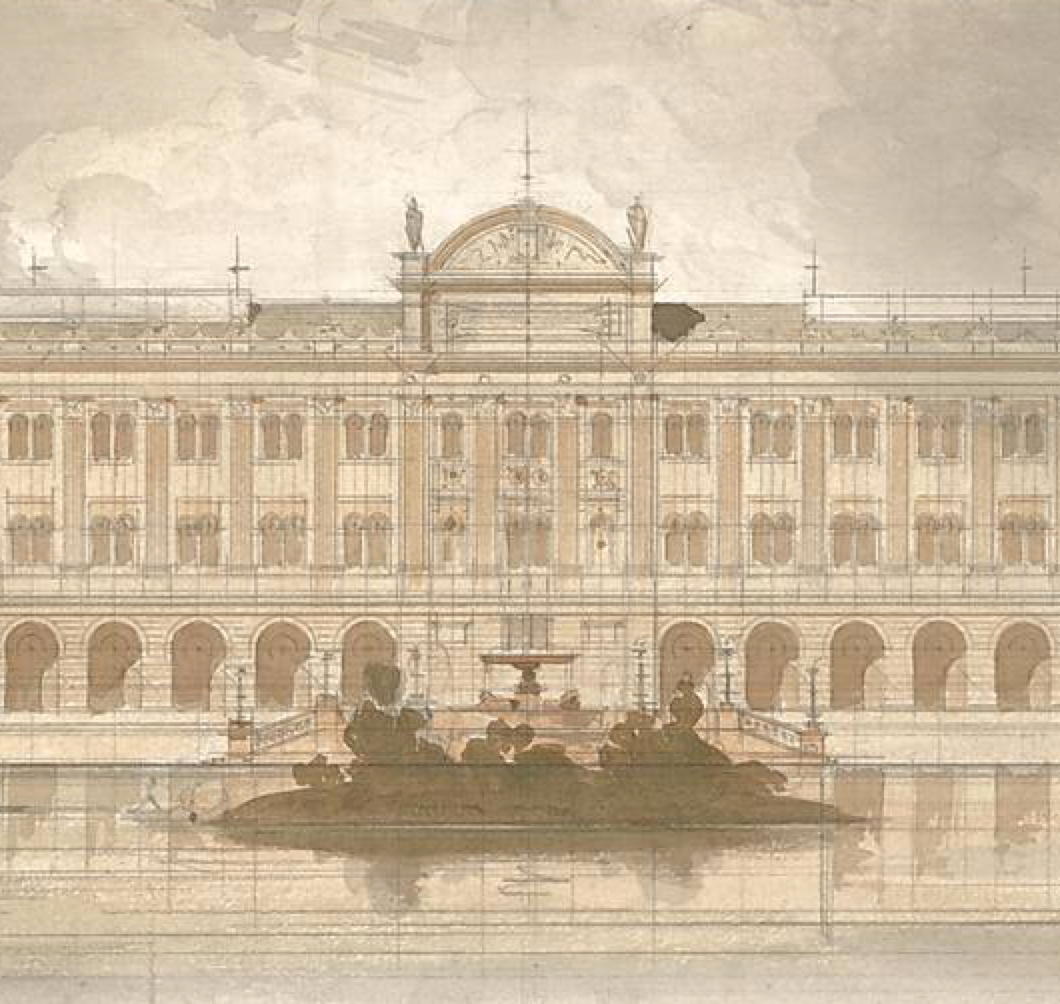
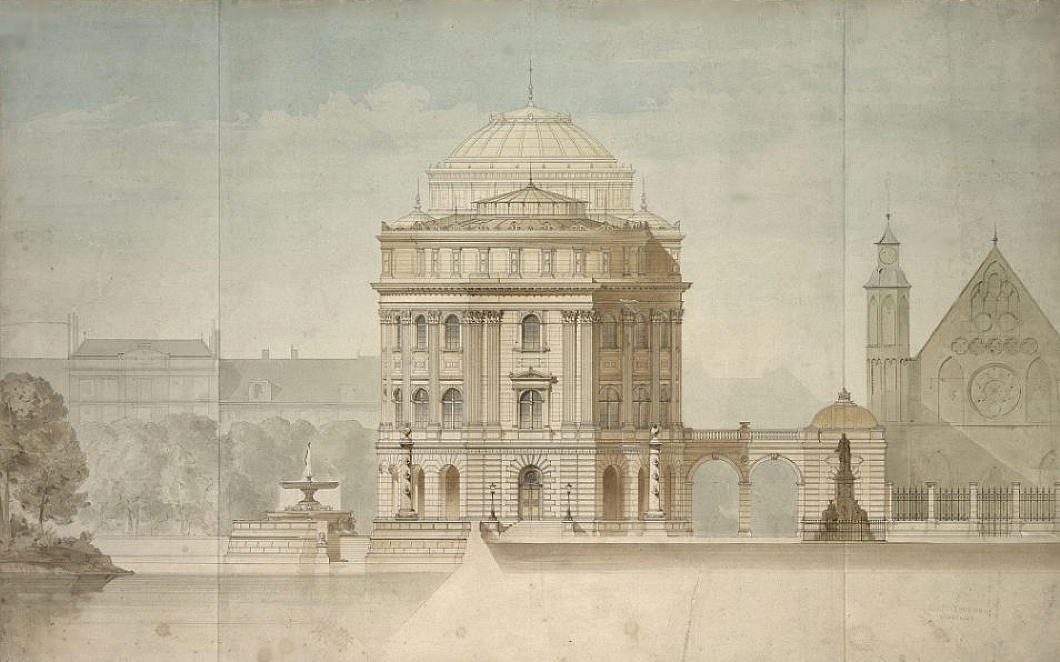
Further plans were drawn up in the 1920s — including a scheme by Berlage — but MPs felt that none of the proposals quite got things right and they were shelved accordingly. It wasn’t til the 1960s that the lack of space and the poor conditions in the lower chamber forced action. All the same, efficiency was the order of the day, as the speaker, Vondeling, made clear: “It is not the intention to create anything beautiful”.
Even then it wasn’t until the 1980s that the work was started, and the MPs moved into their new chamber in 1992. As you can see in this photograph, Vondeling’s aim of avoiding anything beautiful or showy has been achieved. The new chamber is certainly spacious — indeed some MPs claim it is too spacious. The art historian and D66 party leader Alexander Pechtold pointed out the distance between MPs inhibits real debate, unlike in the British House of Commons, and to that extent parliamentary design is inhibiting real democracy.
Battledore and Shuttlecock
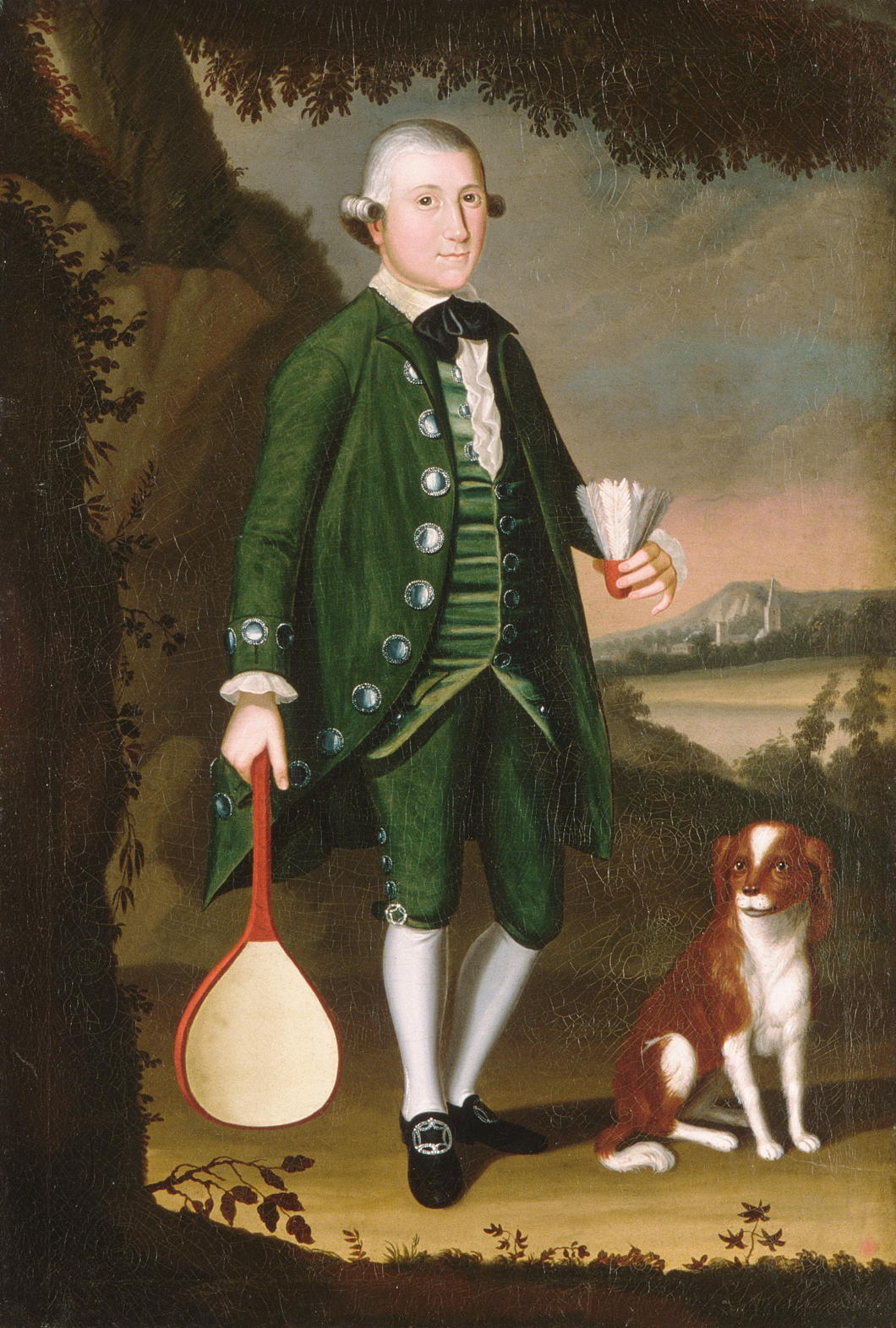
Is this the earliest-known depiction of badminton in art?
Apparently not, as the sporting accoutrements depicted herein are of the much older game of Battledore and Shuttlecock — an antecedent of badminton.
It was painted by William Williams, the sailor, writer, and painter born in Bristol in 1727 and shipwrecked in the Caribbean before living in Philadelphia.
While the subject is uncertain, he is believed to be a boy of the Crossfield family, for whom it is known that Williams had depicted other young family members.
Since 1965 it has been in the collection of the Metropolitan Museum but is not currently on view.
Williams was also the author of what is arguably the first American novel — The Journal of Llewellin Penrose, Seaman — though he couldn’t find a publisher so it was only printed in 1815 nearly a quarter century after his death.
Großcomburg
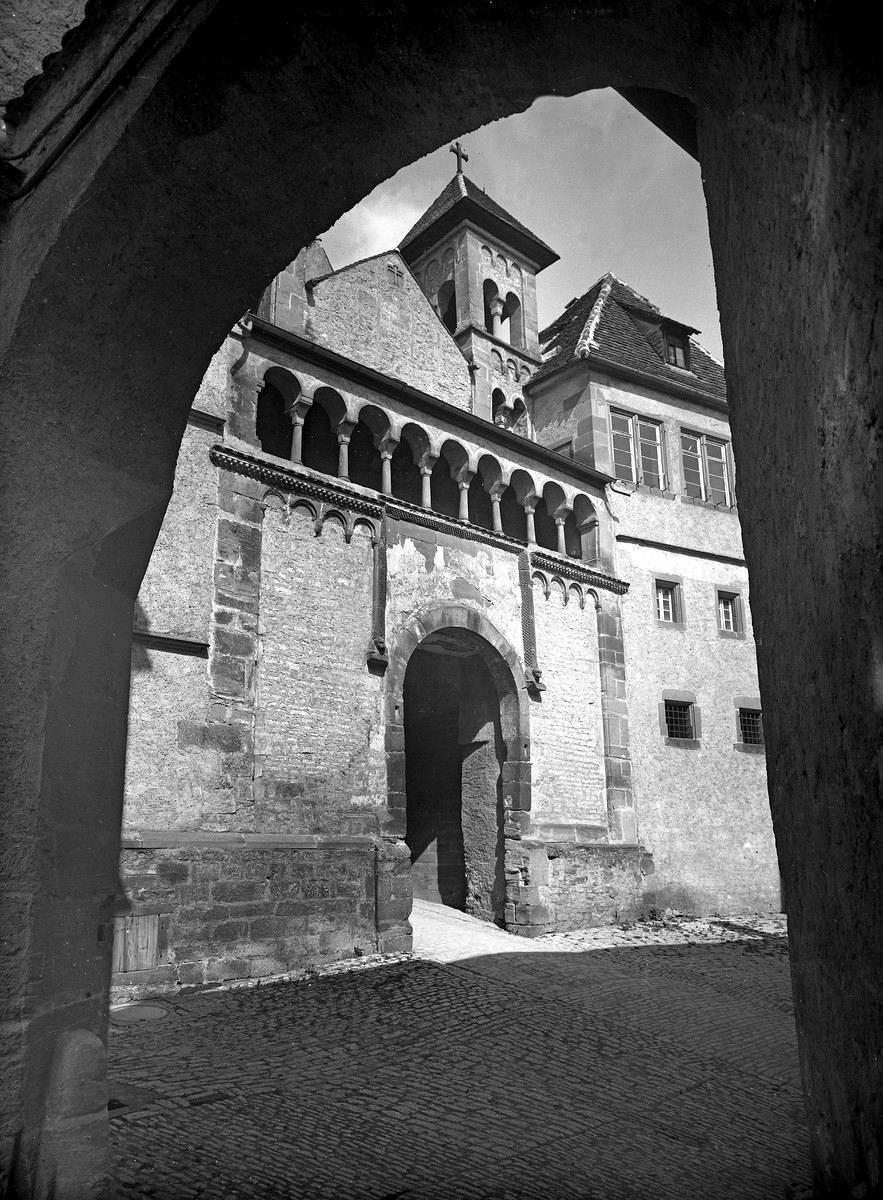
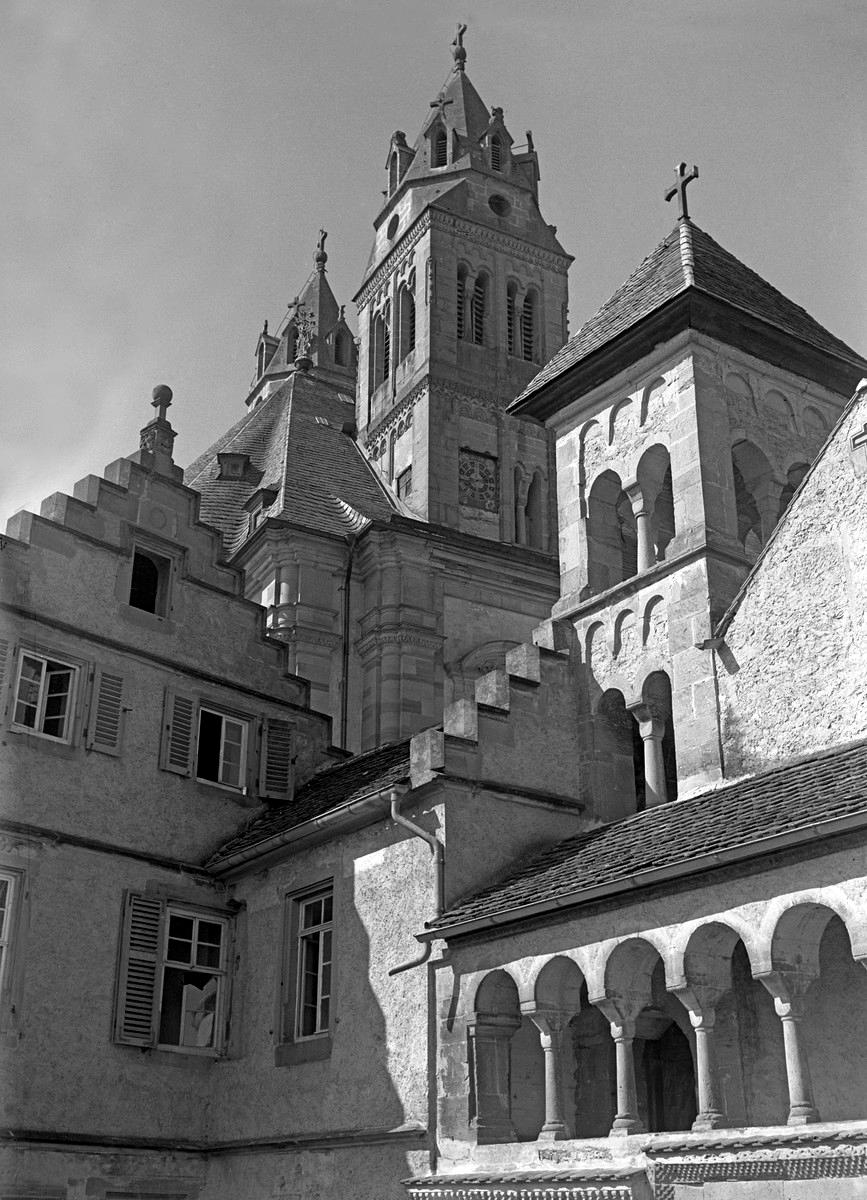
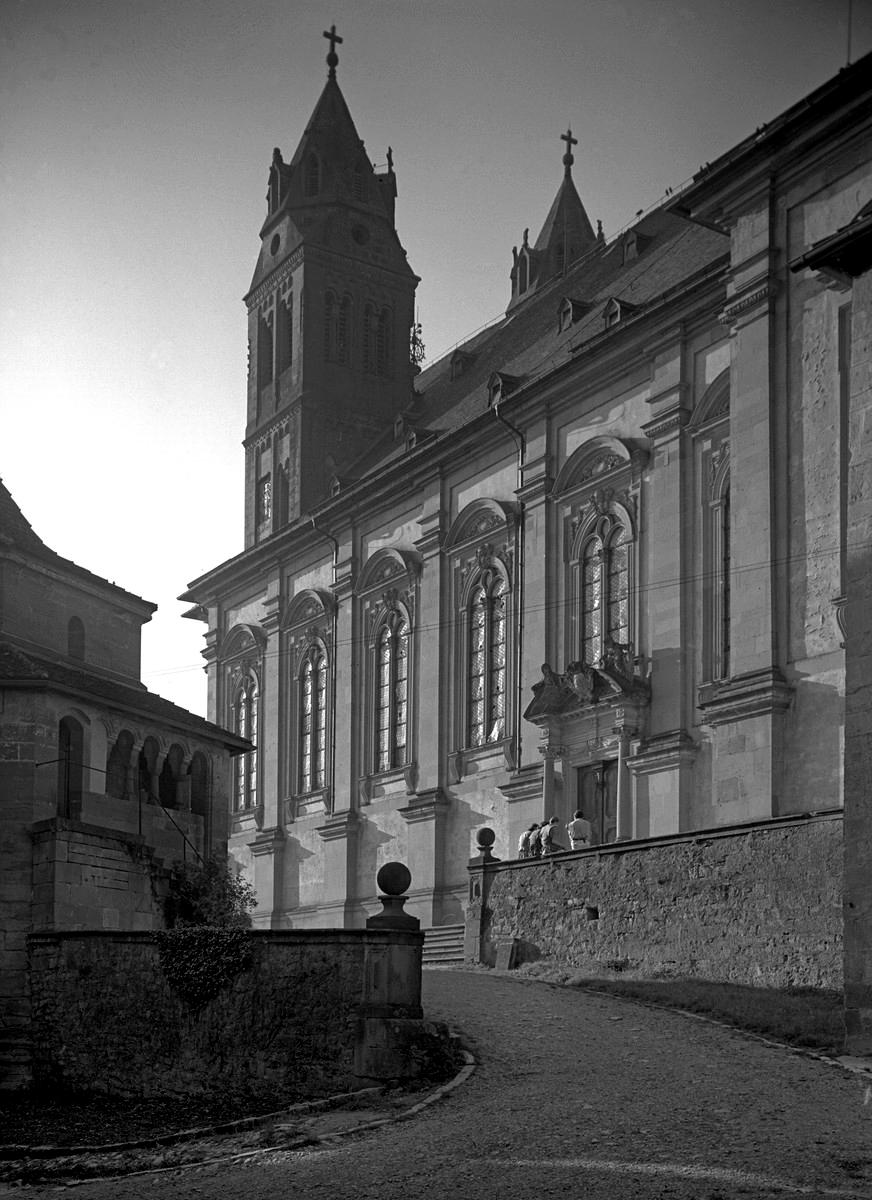
While the old basilica was demolished in the 1700s and replaced with a baroque creation there is still plenty of Romanesque abiding at Großcomburg in Swabia. The monastery was founded in 1078 and the original three-aisled, double-choired church was consecrated a decade later. Its community experienced many ups and downs before the Protestant Duke of Württemberg, Frederick III, decided to suppress the abbey and secularise it. Many of its treasures were melted down and its library transferred to the ducal one in Stuttgart where its mediæval manuscripts remain today.
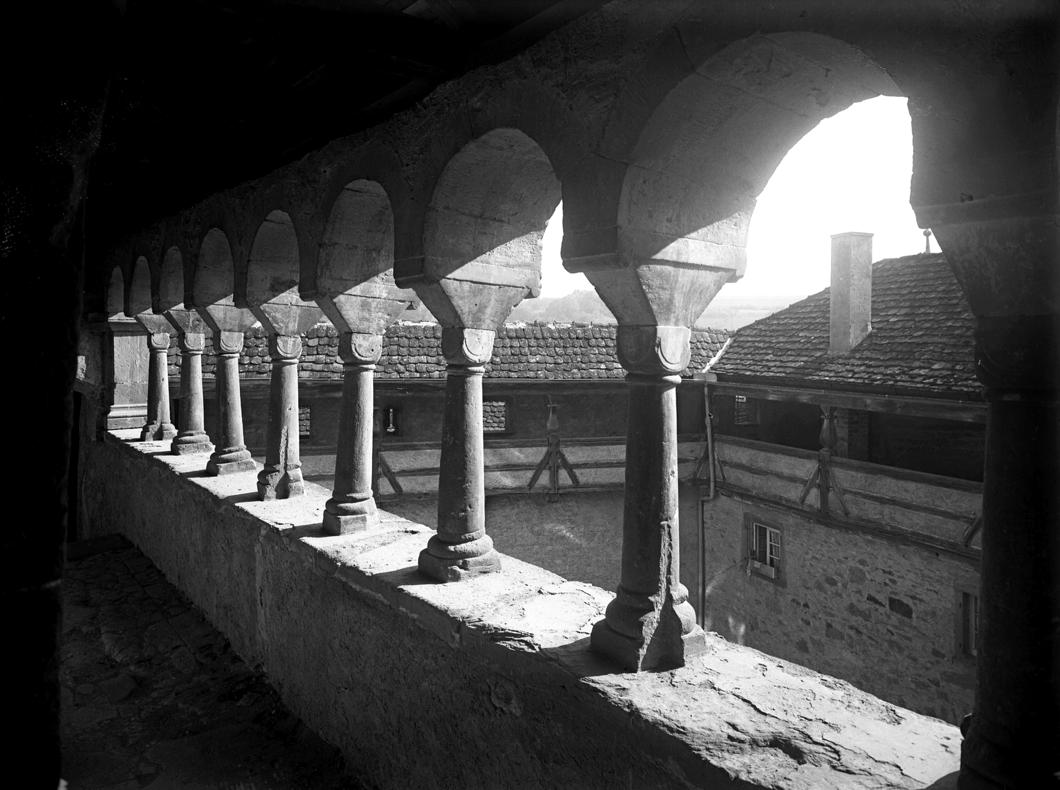
From 1817 until 1909 the abbey buildings were occupied by a corps of honourable invalids, a uniformed group of old and wounded soldiers who made their home at Comburg.
In 1926 one of the first progressive schools in Württemberg was established there, only to be closed in 1936. Under the National Socialists it went through a variety of uses: a building trades school, a Hitler Youth camp, a labour service depot, and prisoner of war camp.
With the war’s end it housed displaced persons and liberated forced-labourers until it became a state teacher training college in 1947, which it remains to this day.
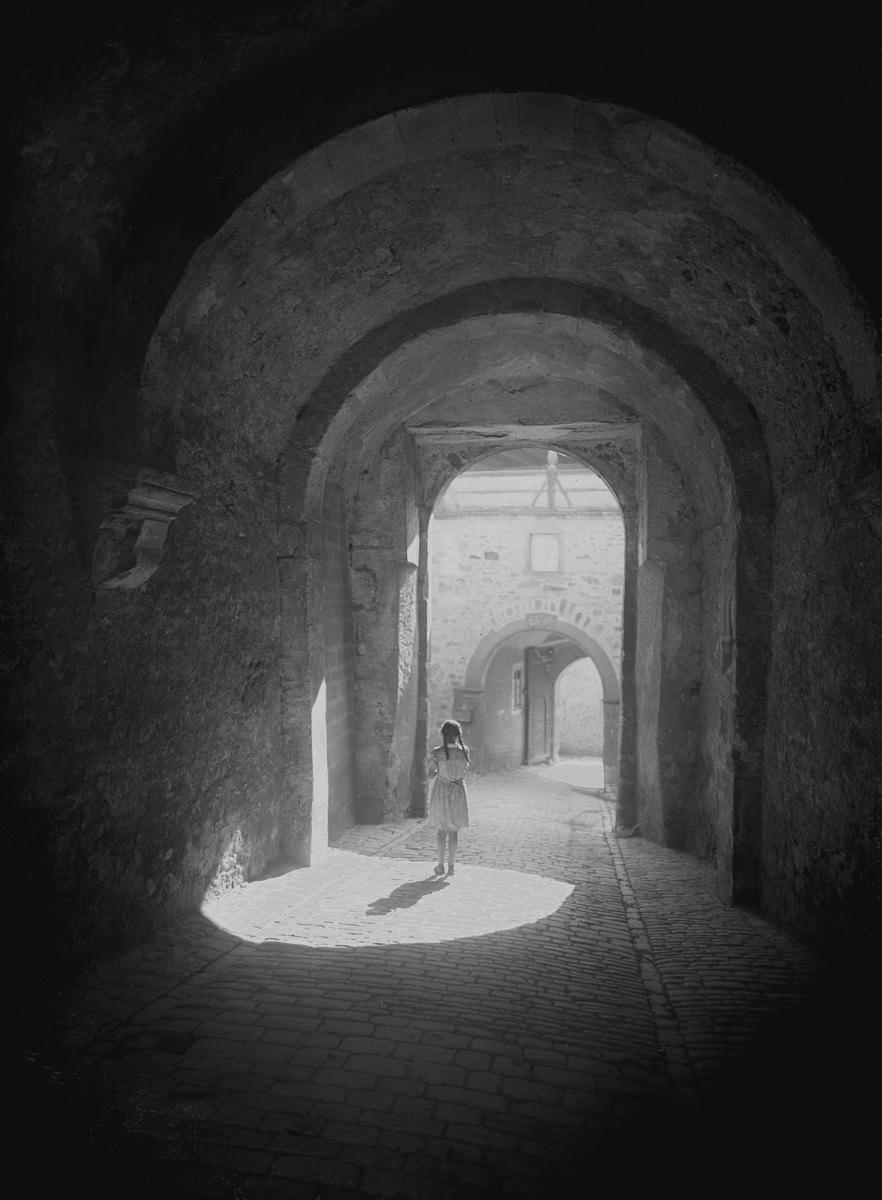
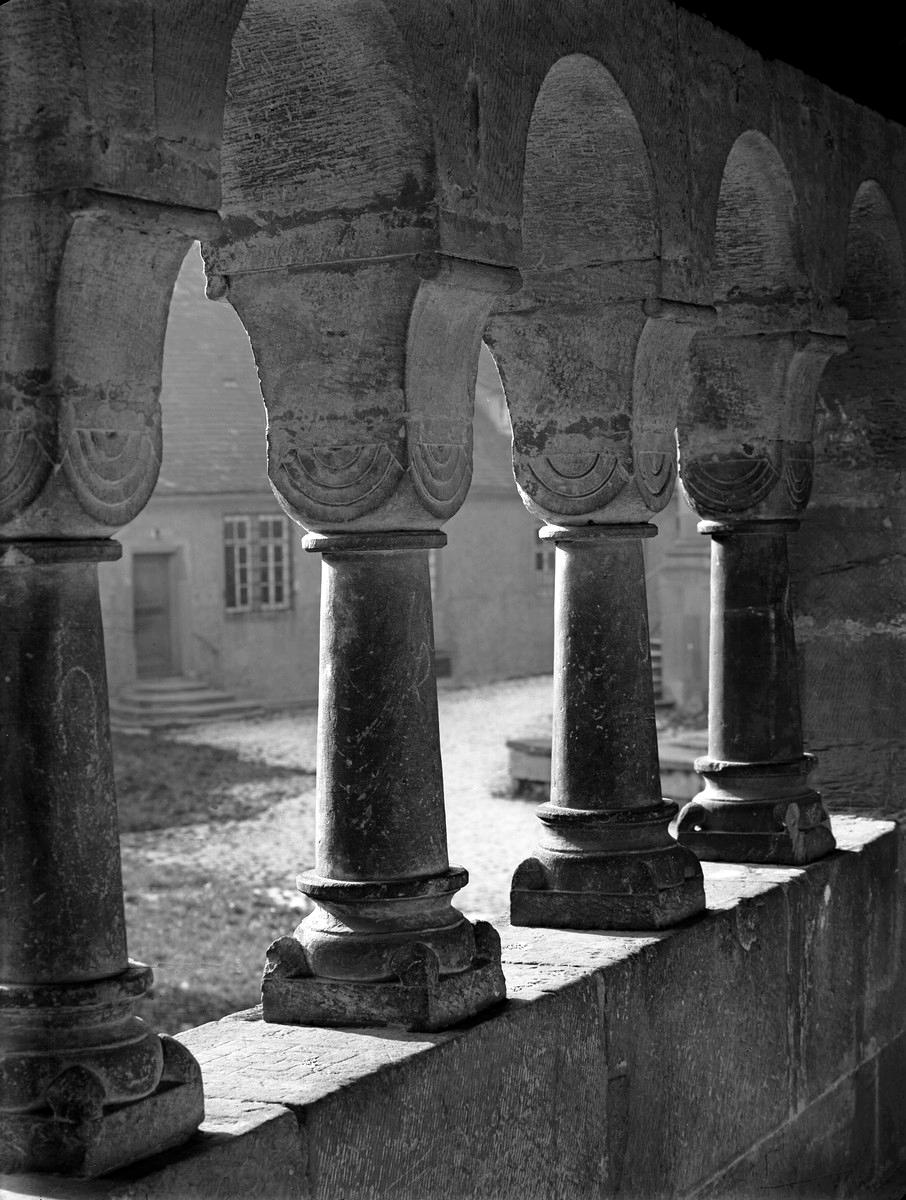
Black-and-white photography is particular suitable for capturing the beauty and the mystery of the Romanesque.
These images of Großcomburg are by Helga Schmidt-Glaßner, who was responsible for many volumes of art and architectural photography in the decades after the war.
F.X. Velarde: Forgotten & Found
Many of the architects of the “other modern” in architecture were forgotten or at least neglected once the craft moved in a more avant-garde direction.
The British Expressionist architect F.X. Velarde who produced a number of Catholic churches in and around Liverpool in the interwar period and beyond is the subject of a new book from Dominic Wilkinson and Andrew Crompton.
There will be a free online lecture tomorrow on ‘The Churches of F. X. Velarde’ given by Mr Wilkinson, Principal Lecturer in Architecture Liverpool John Moores University. Further details are available here.
The book is available from Liverpool University Press with a 25% discount through the Twentieth Century Society. (more…)
Get thee to a Lamasery
In defence of Lost Horizon
by ALEXANDER FRANCIS SHAW
Death hath no sting because I know that — on the other side of the planet — glass elevators whisper fifty-six storeys from a marble lobby to rooms of crisp white sheets and burgundy damask. The carpets are thick, the tables polished. Decanters are flushed with guava and grape. In a kaleidoscope of silver and ice, glasses of salad and sorbet are heaped with pearlescent foam, salmon and beluga.
And in one corner, in another time, Alexander Shaw fell asleep in the late afternoon, cheek pressed against the silk wing of an armchair as his gaze followed the plunge of a falcon from the Peak, through the skyscrapers, and out over Victoria Harbour. A soft audio moquette of Morrecone and Mahler accompanied the CNN news ticker and extraneous weather synopses: Sydney — sun… Los Angeles – overcast… Doha – sun… Cape Town – rain…
Please excuse the fetishism. My point deserves this tantric preamble.
If Pugin had been a Qing rather than a Victorian he might have made a start to all this, but today the backlit Onyx, the Pacific sixteen-storey silk frieze, the Qipao uniforms, and the Olympian scale of everything behove only the mighty Orient.
Why so? The Island Shangri-La Hotel is named for the fictional utopia in James Hilton’s Lost Horizon. And right there you have the problem: ‘utopia.’ The martial cultures of the East don’t comprehend the pre-echoes in that word.
Credit where it is due, the sublimation of the individual into the Gestalt (I’ll call it Gung-Ho, because that sounds like a legitimate school of oriental philosophy) is in stark contrast to the game we play with ourselves the West. Because they’ve never been saddled with accountability for the state of their societies, the Chinese haven’t had the opportunity to be disillusioned by their own idealism. A Chinese man has never had to look at himself in the mirror and realise that he buggered things up by voting for Hitler or joining a Black Lives Matter march.
Absent any higher purpose, we, on the other hand, must seek redemption for each hypocrisy and failure of our great civilisation, dumbing down in hand-wringing apologia for our very existence. Thus have we developed a misnomered ‘meekness’ of niceness, indecision, and half-measures. To believe in our superiority is to be saddled with shame – and shame is a force distinct from guilt in that it seeks remission by reference to others’ perception. You can quietly abort a child with Down Syndrome provided that you demonstrate your humanity by promoting BAME representation, carbon austerity, and the moxie of women who have the mystique of cement mixers.
A second example: the lobby-girl at the Grand Hyatt, Shanghai. Given that half the wealth of the Orient passes through those doors, some central planning committee evidently felt it prudent that the city’s 24 million citizens be combed for the sweetest smile to greet it. When I returned, breath held, a year later, she had been matched by another matchless angel.
Which brings us to the human source of utopianism – the quest for eternity. The plane-wrecked protagonists of Hilton’s novel experience a Himalayan valley of youth governed by an AWOL and arguably mad 250-year-old Luxembourgish priest. Father Perrault governs Shangri-La from a lamasery of almost obscene opulence (imagine – green bathtubs!). The guests are tastefully divided in their credulity about whether the society is an illusion and the book was devoured by an escapist West suffering the Great Depression.
Rifling my free copy in Hong Kong, I judged it the Englishman’s analogue to the continental cults whose glorious living and glorious dead are distanced by a Napoleonic boulevard of culture and commerce where the stick and carrot are applied. It seemed fortunate that the British are only really any good at stoking a frisson for utopian demise and, as the distant red flags fluttered and my Mao-faced banknotes smirked at me from their money clip, I designated Lost Horizon – and all this – to a fantastic past which would be swept away by Western humility and moderation.
I was wrong and, what is more, I’m glad I was wrong.
Since the collapse of any credible European adversary, Britain has turned inwards in its quest for maudlin schadenfreude. Our woke egalitarianism means everyone must de-mask or debunk any superiority as somehow an act.
I hazily recall a heavy session at the London Ritz at which the bar-chef challenged me to draw my sgian-dubh to establish whether I was carrying an offensive weapon. I was quick-witted enough to reveal my purist stand on another wager of the kilted gentleman which duly precipitated a less troublesome ejection from the premises. But how did we sink to this? Is there anywhere outside of the glittering palaces of sinister dictatorships where a man can live honestly without some spiv trying to trip him up?
More poignantly, perhaps, how can the professionals themselves avoid clientele who know their own job from experience and think they have ‘made it’ because they bussed tables in their student days?
Lost Horizon has at its heart a provocation to serve which the maladjusted West will now struggle to perceive. Utopia should be viewed not as a deception but rather the absence of the contempt for the familiar. The point of Shangri-La is that it was built by strangers in exotic lands for strangers in exotic lands. Lo-Tsen, for whom the valley was home, is repelled by its treasures and risks her life in order to leave. Hugh Conway – the knackered British diplomat at the centre of the novel – appears to have risked his life in order to return, inspiring the enchanted discussion among pilots which opens the book on the darkening concourse of Templehof airport in 1933.
Like the bedraggled Conway, we must keep our eyes fixed on utopia so that our journey becomes a pilgrimage with a view to one day opening the doors of our own Shangri-La.
And so much for the better if nobody follows.
Wardour
The news from the West Country is that Jasper Conran OBE is selling up his place in Wiltshire, the principal apartment at Wardour Castle.
Wardour is one of the finest country houses in Britain, designed by James Paine with additions by Quarenghi of St Petersburg fame. It was built by the Arundells, a Cornish family of Norman origin, but after the death of the 16th and last Lord Arundell of Wardour the building was leased out and in 1961 became the home of Cranborne Chase School.
A friend who had the privilege of being educated there confirms that Conran’s assertion of Cranborne Chase being “a school akin to St Trinian’s” was correct, and tells wonderful stories of the girls’ misbehaviour.
Alas the modern world does not long suffer the existence of such pockets of resistance, and the school shut in 1990. The whole place was sold for under a million to a developer who turned it into a series of apartments, for the most part rather sensitively done, if a bit minimalist.
The real gem of Wardour, however, is the magnificent Catholic chapel which is owned by a separate trust and has been kept open as a place of worship. Richard Talbot (Lord Talbot of Malahide) chairs the trust and takes a keen interest in the chapel and the building. I was down there the Sunday the chapel re-opened for public worship after the lockdown and Richard was there making sure all was well.
Those interested in helping preserve this chapel for future generations can join the Friends of Wardour Chapel.
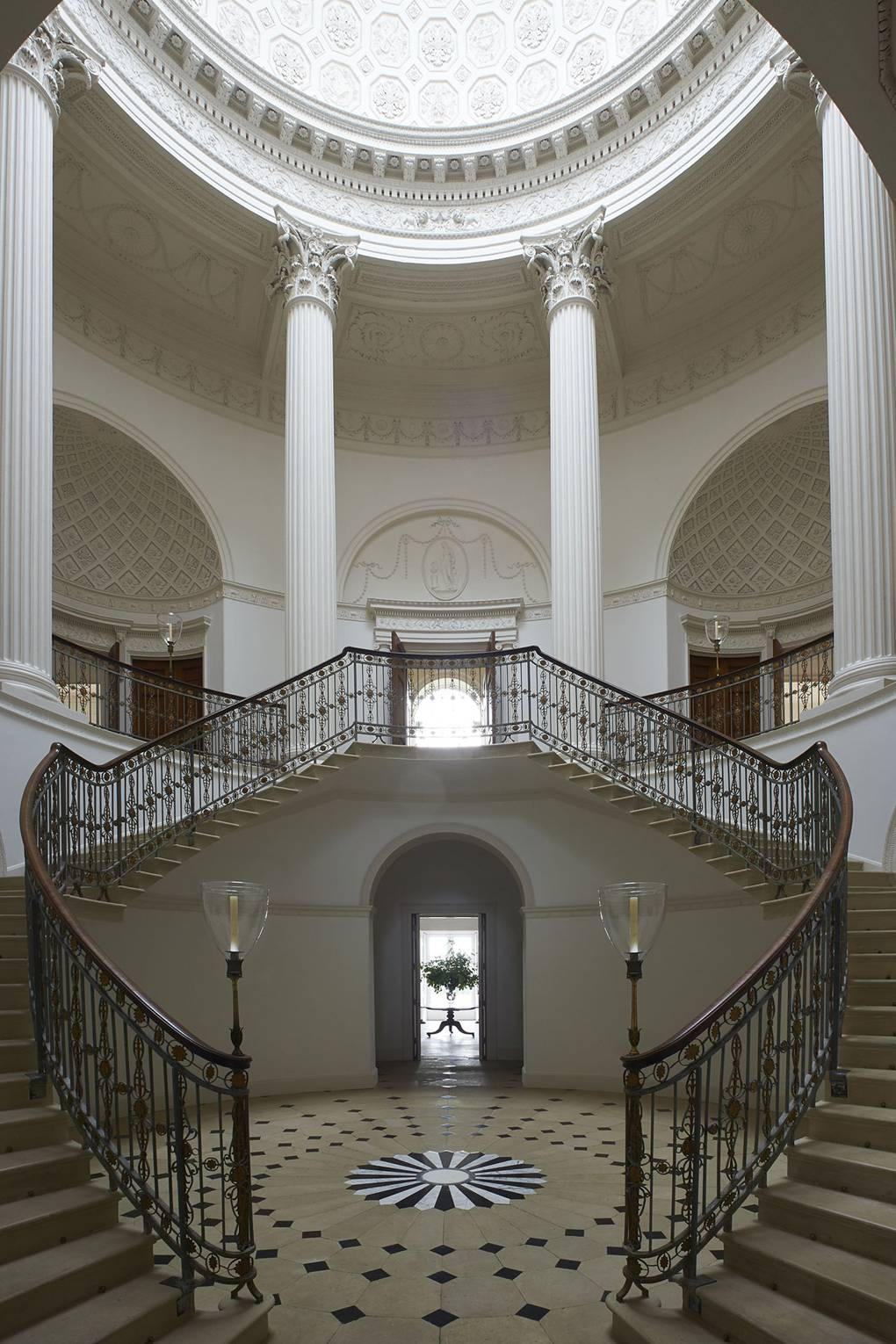

CDU @ 75

Last week was the seventy-fifth anniversary of the foundation of Germany’s Christian Democratic Union, one of the most successful democratic political parties in postwar Europe.
Indeed, under Adenauer the CDU was one of the institutions which transformed relations between the peoples of Europe and started the process of integration which, alas, has not aged well.
Nonetheless, here are some election posters from the early years of the CDU — plus one from the 1980s. (more…)
Corpus Christi
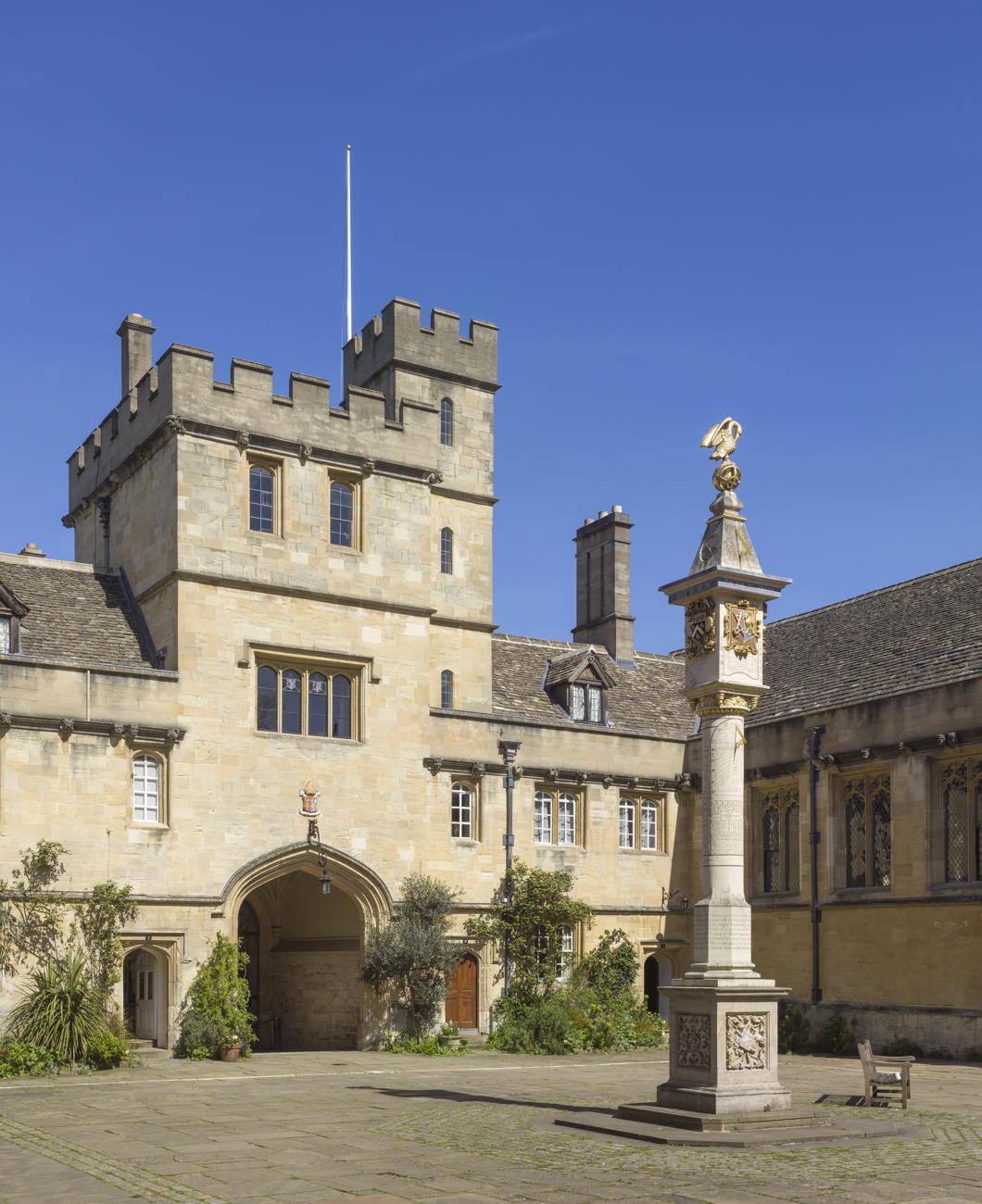
It seems silly to let today’s feast pass without mentioning Corpus Christi College at the University of Oxford. It’s one of the smaller colleges, with about 250 undergraduates and a hundred or so postgraduates studying in its charming quadrangles.
Founded in 1517, Erasmus hailed its library as inter praecipua decora Britanniae, “among the chief ornaments of Britain”, and Cardinal Pole — the last legitimate Archbishop of Canterbury — was a founding fellow.
More recently, John Keble became an undergraduate there in 1806, before accepting a fellowship at Oriel in 1811, and having Keble College founded and named after him a few years after his death in 1866.
Architecturally, Corpus’s most remarkable feature is the Pelican Sundial, which is actually a column dating from 1579 that contains twenty-seven different sundials. It was most recently restored in 2016, and copies exist at Princeton and Pomfret.
The terrace atop the new auditorium affords an excellent view of the former priory of St Frideswide, now used by the Protestants as Christ Church. (more…)
Klein Gidding
Bekend nie, want nie gesoek nie
Maar gehoor, half gehoor, in die stilte
tussen twee golwe van die see.
Vinnig, nou, hier, nou, altyd –
’n Voorwaarde van volledige eenvoud
(Koste nie minder nie as alles)
En alles sal wel wees
Allerhande dinge sal wel wees
As die tonge van vlam inmekaar gevou is
In die gekroonde knoop van vuur
En die vuur en die roos is een.
Mauritz de Haas
Stormcloud and moonlight — these were the preferred settings of the marine paintings of Mauritz Frederik Hendrik de Haas.
Born in Rotterdam in 1832, he studied at the academy there as well as in the Hague under Bosboom and Meijer.
At the age of twenty-five, de Haas accepted an artist’s commission in the Dutch Royal Navy, carrying on for two years until the Rhenish-Sephardic financier August Belmont (a former American ambassador to the Netherlands) persuaded him to come to America in 1859.
By 1867 de Haas was an academician of the National Academy and a founding member of the American Society of Painters in Water Colors.
His brother, Willem Frederik de Haas, was also a marine painter, but Mauritz’s scenes are much more atmospheric — especially as one moves from day through dusk and into the light of the moon.
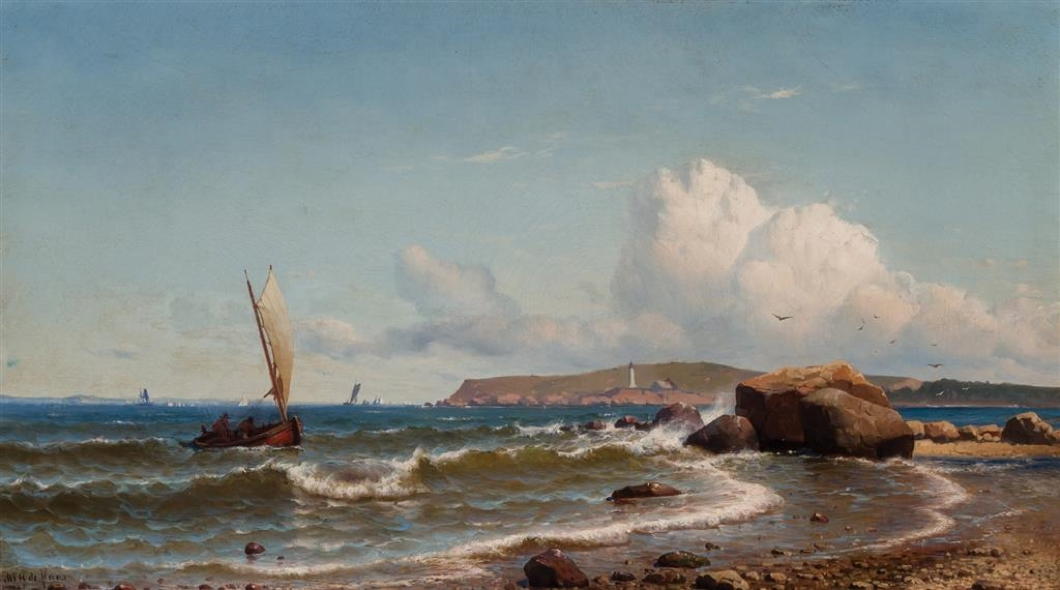
oil on canvas, 17 in. x 30 in.
Search
Instagram: @andcusack
Click here for my Instagram photos.Most Recent Posts
- Brunel’s Unbuilt Capitol February 3, 2026
- Cricket at Fordham January 27, 2026
- Palacio Barolo Revisted January 14, 2026
- Learning to Love Liguria January 14, 2026
- Crux Alba No. 2 January 13, 2026
Most Recent Comments
Book Wishlist
Monthly Archives
Categories