Arts & Culture
About Andrew Cusack
 Writer, web designer, etc.; born in New York; educated in Argentina, Scotland, and South Africa; now based in London.
 read more
News
Blogs
Reviews & Periodicals
Arts & Design
World
France
Mitteleuropa
Knickerbockers
Argentina
The Levant
Africa
Cape of Good Hope
Netherlands
Scandinavia
Québec
India
Muscovy
Germany
Academica
Peter Simple I
The death not all too long ago of Mr. Michael Wharton of the Daily Telegraph‘s Peter Simple column was a great loss to skeptics of modernity in the English-speaking world. We have decided, in little helpings, to bring you a bit of the greatness of Peter Simple on this website so that you may at least have a small taste of what we have lost. Though the column ran for over half a century, we begin with two excerpts from 2000 and 2001 respectively.
Quiz
22 DECEMBER 2000
 HERE are the answers to the annual columnar quiz: (1) the boiling point of Zirconium; (2) the Papal Bull Neo Igitir Sufflaminanda, issued by Pope Innocent the Terrible in 1264; (3) In the slow movement of Mahler’s Symphony No 43 (“the Inexhaustible”), passages for tubular bells are marked con sarcasmo; (4) Douglas Sartre’s Through a Chiltern Window (1906).
(5) We know that Col Palamountain, Dr Znacz, the Rev Ian Yeast and Mrs Library-Smith were playing bridge in the residents’ lounge of the Seaview Hotel at Norquey at 4.25pm, the precise moment when Lord Haversnake’s body was found in the shrubbery by Bates, the head porter.
According to Wendy Kakopoulidis, a temporary Greek waitress, Adam Strongitharm, self-styled ex-commando, para-pharmacist and philanderer, was seen at 4.35 abseiling from the roof of the conservatory after trying unsuccessfully to set it on fire. Therefore the murderer can only have been Miss Bagster.
The questions will appear in the New Year.
A Model Planet
9 FEBRUARY 2001
THE status of Pluto, recognised since its discovery in 1930 as the outermost planet of the solar system, is threatened by American astronomers who maintain that it is not a planet at all but merely the largest of the icy bodies, called the Kuiper Belt, that orbit Neptune.
The American Dr Neil Tyson, whose astronomer’s heart seems to be as warm as Pluto is reputed to be cold, explains how Pluto has changed “from the most puny planet to the King of the Kuiper Belt. I think it is happier that way,” he says consolingly. But an English astronomer, Jacqueline Mitton, says “we have come to know Pluto as a planet and there is no need to downgrade it now”.
The latest probe by the columnar space vehicle “Don Carlos and the Holy Alliance III” sheds a new, balmy light on this quarrel. Daguerreotypes just received from space suggest that Pluto, far from being a miserable ball of ice and rock, is a pleasant little world with many lessons to offer our own.
For such a small planet, it seems to have a remarkable variety of landscape. There are fertile valleys, mountains neither too big nor too small for symmetry, trout streams and salmon rivers, forests plentifully supplied with deer and other game, as well as wolves and bears. Towards the poles there are wild regions to attract adventurous explorers.
A hereditary class of great landowners presides over a russet-cheeked, contented peasantry toiling dutifully in the fields as their forebears have done from time immemorial, remarkable for their godly and healthy lives. Machines other than ploughshares and, interestingly, a few bicycles are nowhere to be seen. Some of the daguerreotypes, taken by electro-galvanic telescopic camera obscura, show everyday scenes that cannot fail to move anyone who fears for the future of our own human race.
Here an aged peasant, snowy haired but still straight-backed and vigorous, sits at his cottage door in the Plutonian evening, carving wooden toys for the grandchildren clustering eagerly about his knees. Indoors, a young peasant woman, perhaps their mother, decked with quiet graces, sits by candlelight, bending her modest head over her needlework – surely a scene as beautiful and edifying as any planet can offer.
Is astronomy, like all science, subjective? In the light of our discoveries, it does not seem to matter much whether Pluto is a proper planet or King of the Kuiper Belt.
The Rome of the West
The Churches of Glorious St. Louis, Capital of Middle America
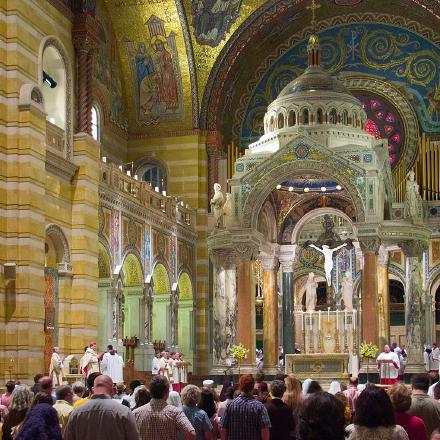
WE ON THE EASTERN Seabord often think that our cities are the last word in ecclesiastical architecture, but Mark Scott Abeln’s splendid ‘Rome of the West‘ site goes a long way towards reminding us of the great physical deposit of Western Civilization and Christian culture situated in the city of St. Louis on the Mississippi River, deep in the heart of America. To show my fellow provincial knickerbockers the richness of St. Louis’s church architecture, I’ve chosen a few photos from Mr. Abeln’s site for posting on this site. A wonderful exhibiton of America’s (which is to say Europe’s) rich cultural heritage.
The jewel in this crown of Catholic Middle America is most certainly the Cathedral Basilica of Saint Louis (above and below). The Cathedral was begun in 1907 and contains the largest collection of mosaic artwork in the world covering 83,000 square feet, the last tesserae of which was installed in 1988. The architecture of the basilica features a number of styles, from the Romanesque Revival exterior to the Byzantine plan and interior, and even contains a chapel designed in the Viennese Reconstructionist style. (more…)
Empire State
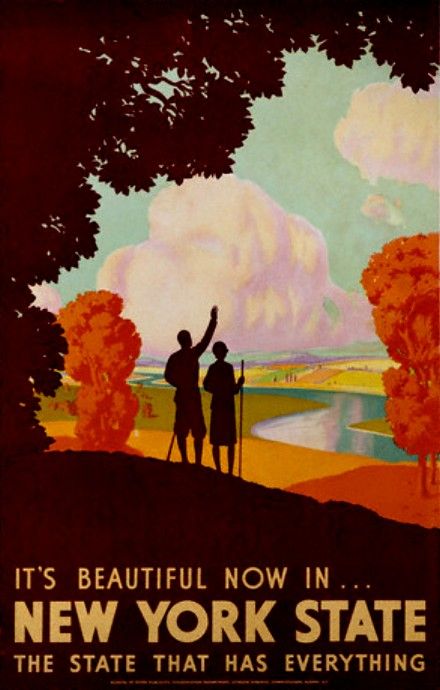
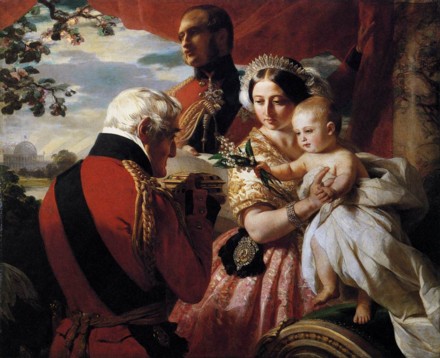
Having been duly capped on the head by the Rt. Hon. Menzies Campbell QC MP with John Knox’s breeks last Thursday I have returned to the land of my birth a Master of the Arts. Details of the various rites and festivities are forthcoming, but in the mean time I share with you these three travel posters from back in the day when they made proper travel posters. All three advertise our blessed Empire State, two of them West Point, the glorious gothic crown of the Hudson. Excelsior!
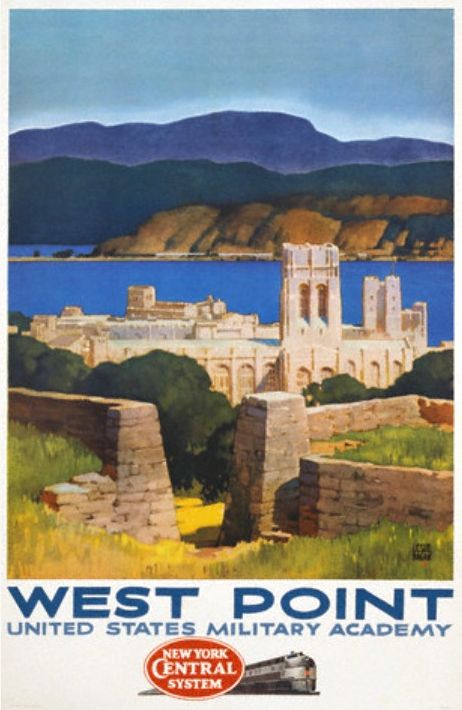
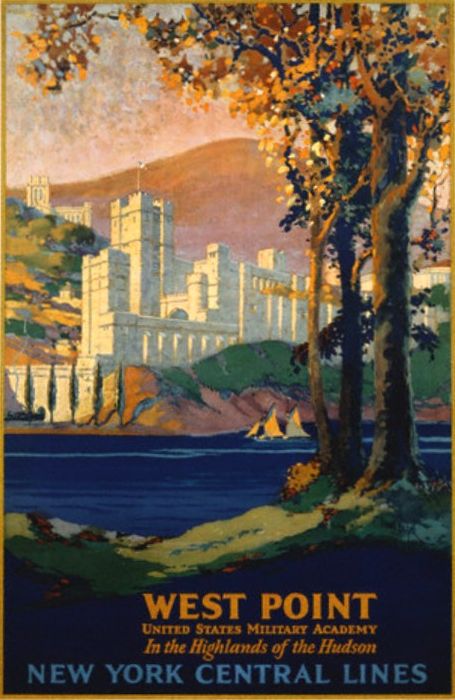
Click on the images for the full posters.
The Perils of Over-Restoration
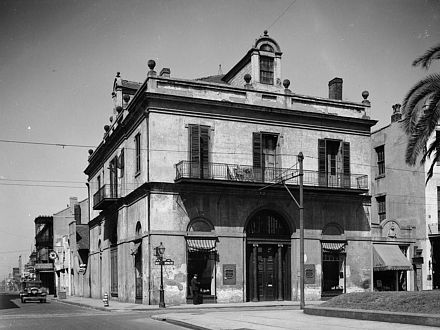
A rather good article I was reading in the Oxford American (via V&V) reminded me of a building I stumbled upon in the Historic American Buildings Survey, digitized at the Library of Congress. No. 403 Royal Street in the French Quarter of New Orleans was designed by one of the first master architects in America, Benjamin Latrobe, who also designed the Baltimore Basilica, the Mother Church of the United States. Resting at the corner of Royal and Conti streets, the building was constructed by the Louisiana State Bank (later subsumed into la Banque de la Louisiane) and features a domed banking hall in the center. After having outlived its usefulness under its original purpose, it became a private residence, with the central banking hall turned into a living room, before being turned into an events venue as it remains today. (more…)
Columbus Circle and the Human Scale
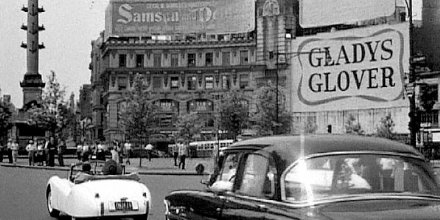
Meandering through the internet yesterday, I came across the above image from the 1954 film ‘It Should Happen to You!’ (via a New York Times article). The film capture shows Columbus Circle in 1954 and was I immediately struck by the superiority of the scale of the buildings to the street, especially compared to today when the Columbus Column is rather overshadowed by the AOL Time Warner Center. It’s not that I don’t like tall buildings; after all New York has some of the most beautiful skyscrapers in the world (though I can’t think of a single great one built after the second war).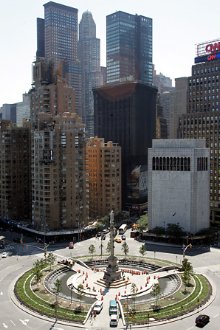 I don’t even object to the residential apartment buildings lining Central Park on Fifth Avenue and Central Park West, except for the fact that on Fifth Avenue they almost always replaced superior, smaller buildings. However, with a public square as small as Columbus Circle, it somehow seems as if lower buildings of only 3-10 storeys would be more appropriate.
The latest brouhaha concerns No. 2 Columbus Circle (the shorter, white building in the photo on the right), designed in the early 1960’s by Edward Durell Stone to house the art collection of Huntington Hartford. The current owners want to chic-ify the building by taking off the façade and recladding No. 2 in the more fashionable glass, akin to the neighboring Time Warner Center, and this has roused the ire of many of New York’s preservationist crowd. Though No. 2 has its charms, I’m not a huge fan of the building myself, but the redesign would only make it worse. The chief value of the building is its comparitively low height which, when viewed from the northwest, contributes to the feeling as if the midtown buildings are gradually lowering in height to meet the scale of Columbus Circle. Unfortunately the Time Warner Center doesn’t comply well with this lessening scale, though it at leasts goes through the motions by have a consistent, low base from which its two towers rise. The stone cladding of the Center, however, is rather too dark and gives a slightly gloomy feel to what ought to be a lovely, bright place. (more…)
The Sad State of the Modern Newspaper
…and the heroism of an Anglo-Hungarian countess.
IT IS ONE OF THE more saddening facts of life that British newspapers have suffered an inexorable decline in the past few years. The great Times of London – once the most respected newspaper in the world – has been reduced to a boring mid-brow tabloid, the once-solid Scotsman idiotified and, again, tabloided, and of course the Daily Telegraph, which has gone from staunchly conservative (as in worldview) to merely Conservative (as in the tribe of Britons who prefer blue to red).
The Telegraph, like the Conservative party itself, doesn’t seem to know what it’s there for. It has at least remained a broadsheet; going tabloid would be a disaster and would probably be considered the last straw for all the die-hards for whom loyalty to one’s newspaper is a point of pride. And, to its credit, it finally seems to have realised the damage done by constant front-page photos of “Posh” and “Becks” and other “celebrity” partisans of the Anti-Culture, for they seem fewer and far between these days (as compared to a year or two ago, when they were frequent). The Telegraph‘s base are old folk who want a quality newspaper. They are loyal to the Tele and, despite its decline, would be too embarrassed to jump ship to the Guardian, which is written better but which nonetheless expones a nefarious ideology.
As for myself, the last straw came one morning in the Common Room of St. Salvator’s Hall when, flipping through the Telegraph, I reached the page which normally displays the Court Circular but found it missing, replaced by a curt statement advising that should I desire information about the activities of the Royal Family I should direct myself to http://www.royal.gov.uk. Outrageous! As it happens, this is not a permanent loss but rather an occasional one, as the editors at the Telegraph seem to decide whether or not to print the Court Circular each day on a whim. Fair enough, but I came to the realisation that the producers of the Telegraph are not aiming at me – the reasonably educated young man who seeks in his daily read a newspaper that is well-written, right-thinking, and properly presented – and so I have ceased to be a Telegraph regular.
What to read then? We have already dismissed the Times, the Scotsman, and the Guardian. The Daily Mail is always readable but arguably aimed at a different demographic; the Daily Mirror, bonkers; the Sun, no thank you!; the Financial Times is too boring, though the Weekend edition is actually worth buying most of the time; the Independent has a good layout for a tabloid, but is rather of a Lib-Dem persuasion; the Glasgow Herald is just rather dull and has only recently repented of its long-held anti-Catholicism. Not wanting to support the nefarious New York Times, enemy of Western civilization and the last word in liberal elitism, its wholly-owned subsidiary the International Herald-Tribune is ruled out. Which pretty much rules out every English language daily newspaper available in St Andrews.
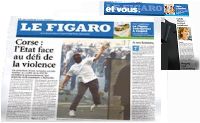 So, abandonné par ma langue, I have outsourced my daily read to the Continent (of all places!) and am now a partisan of Le Figaro. While by no means fluent in the language, I can comprehend written French with greater ability than I speak it. And while I still prefer the feel of a broadsheet, the Berliner size of Le Figaro has its advantages, being very easy to read in the confined space of my regular chair in the corner of the little coffee shop down the street. More importantly, I find it much more engaging mentally, which I put down to the fact that (not being a native or fluent French speaker) I am forced to read every word. Reading the Telegraph one unthinkingly only actually reads every third or so word; articles of particular interest excepted, naturally. The day’s Figaro usually arrives in the middle of the day or the afternoon, but I buy my paper in the morning so actually I’m usually reading the previous day’s Figaro. I don’t mind, it suits my current routine. (Mornings are for reading the newspaper in a coffee shop, afternoons are for reading books with a slow pint in the pub.)
The chief deficit of reading a French newspaper is that naturally the news is oriented towards France, and thus I don’t get the usual transatlantic focus of the British papers (which can be an advantage as well as a deficit, I’ll concede). Nonetheless, it does happen to have articles of interest to any trad.
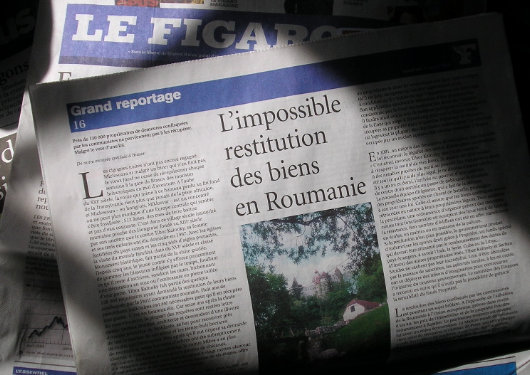
A few weeks ago, Le Figaro reported on the restitution of Romanian castles to their original, pre-Communist owners (‘L’impossible restitution des biens en Roumanie’, Le Figaro, 21 April 2006). The New York Sun rather amusingly and provincially headlined the story “Westchester Man To Take Possesion of Dracula’s Castle” — the New York Post characteristically used the headline “VLAD TIDINGS“. (FTD also reported on the restitution of Bran). When I wrote my previous post on the subject I was under the impression that Bran was one of the castles which would be restituted and then purchased back by the Romanian government, but most sources imply that this is not the case and Dominic von Habsburg (of North Salem, New York) will actually take possesion of the castle, I’m glad to hear.
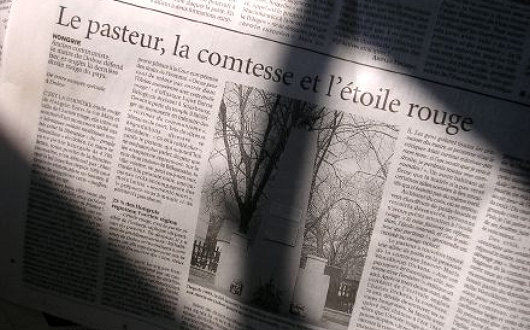
This morning, then, I read in Le Figaro of the controversy surrounding a red star which remains on a Soviet war memorial in a small town in Hungary, a country which has banned all Communist and Nazi emblems (‘Hongrie: Le pasteur, la comtesse et l’étoile rouge’, Le Figaro, 6 May 2006). The local Protestant minister has been fighting to replace the red star, and has found an ally in Countess Jeanne-Marie Wenckheim-Dickens. The Countess, aged 70 and a descendant of Charles Dickens, returned to Hungary a few years ago after her husband died. The family had fled the country in 1944 just escaping the conquering Red Army. “I return home,” the Countess says (‘with a delicious British accent’, Le Figaro reports), “and what do I find? My castle transformed into an elementary school with, right in front of the gate, a red star! To me, this star is the Antichrist.”
The Countess funded the restoration of her former castle, now a school, and obtained permission from the town to live in the old presbytery, an ancillary building of the old castle. But when, in 2004, she proposed to mark the accession of Hungary to the European Union by replacing the red star on the monument with a European flag, the ex-Communists in the town hall told her she “should not be afraid of the red star, but of the Cross!” With fighting spirit, “I placed a large cross on my entryway,” the Countess says, “then I painted it gold so that the Mayor, whose window is opposite, can see it all the better.”
“Crosses? She can build a hundred of them!” the Mayor said. “It doesn’t disturb me!” But in return the Mayor had a house on what was the domain of the Wenckheim family renovated for the use of unemployed local gypsies. “It was clearly to annoy me,” the Countess said. “They thought the gypsies were going to make the area around the nearby church, built by my grandfather, filthy. But not at all! They respect the place, and I, I love their music very much.” The Countess also gives weekly catechism lessons to the local gypsies. In her window, she displays a letter to the people of the town inviting them to vote for the conservative Fidesz party. “In December,” the Countess continues, “before Christmas, I add little angels and holy pictures; they don’t like that much across the way, since they’re aimed at the town hall. Because I, too, have a star: but is the star of the Shepherd”.
‘Voltaire’s Castle’ Up For Sale
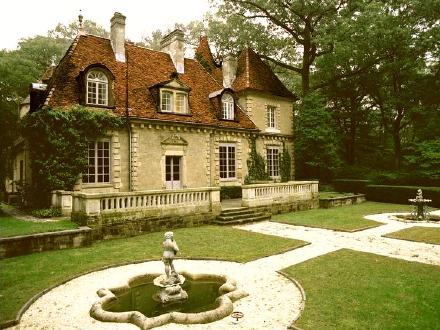
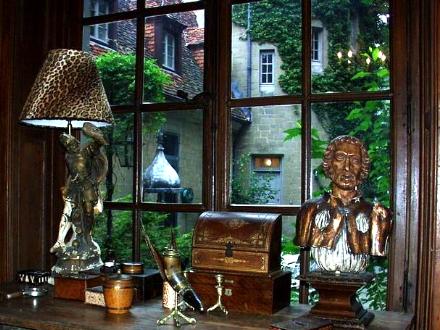
Want to live in a French philosophe’s petit chateau but don’t want to put up with high taxes, soaring unemployment, and immigrant neighborhoods in a permanent state of rebellion? Then boy have I got the house for you! The seventeenth-century Château des Thons, which tradition claims is where the dastardly ‘Enlightenment’ thinker Voltaire carried out his affair with Madame de Chatelet, was shipped during the 1920’s to the peaceful village of Upper Brookville, L.I. in the Great State of New York and is currently on the market. The house features Louis XIV panelling, a sweeping staircase, a tower, and a good few fireplaces.
One of my favorite Voltaire anecdotes is his confident claim – hilarious in hindsight – that “One hundred years from my day there will not be a Bible in the earth except one that is looked upon by an antiquarian curiosity seeker.” Two hundred and twenty eight years after his death, the Bible is still a best-seller and the most widely-read book in the world.
Resurrection
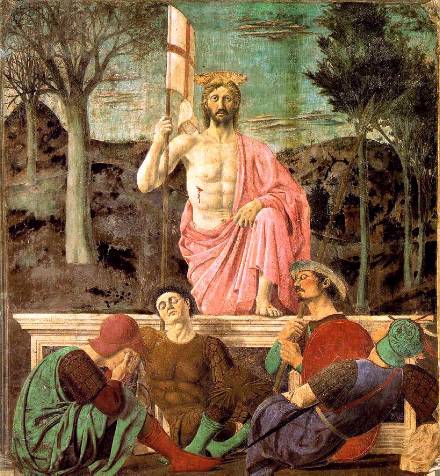
Piero della Francesca, Resurrection
Mural in fresco and tempera, 88″ x 86″
1463-1465, Sansepolcro
Bronxville Library
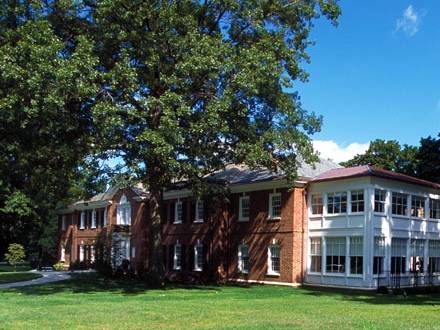
I do miss my library. In a perfect world, I would spend half the day wandering through various libraries of lower Westchester and the City. Of course we have a university library here in St Andrews, but its selection is fairly poor, especially in the subjects in which I am particularly interested. (more…)
Chinatown Bus Terminal
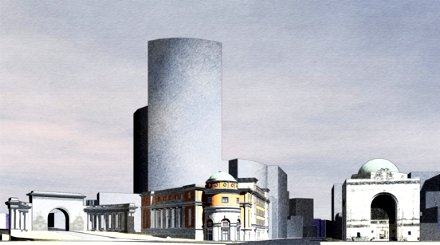
Chinatown’s Fung Wah bus is famously one of the cheapest ways to get to Boston, costing only only $15 to get to New York’s most northerly suburb. The preferred mode of transport between home and university for many a student and an economical mode of transport for the traveller-in-the-know, the chief deficiency of the ‘China bus’ as it is known is that in New York it just lets you off on a random street corner at the eponymous end of the Manhattan Bridge. Wendan Tang, a graduate student at Notre Dame’s School of Architecture (arguably the best in the country), produces his solution to the problem with a hypothetical design for a bus terminal in Chinatown, nudged between the bland modern Confucius Plaza and the beautiful classical entrance collonade and arch of the Manhattan Bridge.
Recent Floridian Architecture
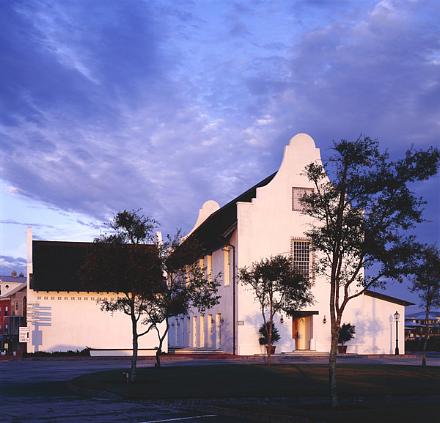
One of the unfortunate factors about places like New York which have been settled for hundreds of years is that they are generally over-developed. This leaves little land for new developments, and likewise for large-scale semi-planned communities like the ones currently being built in Florida. While much, perhaps even most, of Florida’s booming development in the late 20th century suffered from severe architectural defects, a number of outstanding works have bucked the trend.
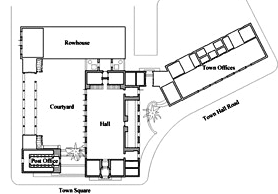 Rosemary Beach is one such development. The Town Hall, seen above, was designed by the firm of Merrill, Pastor, & Colgan. This, and other buildings in Rosemary Beach, follow a St.-Augustine-esque Spanish Colonial style, with wooden balconies, and a few Cape Dutch elements, as with the gables of the Town Hall. What’s more, most of these buildings are designed to take advantage of natural cooling methods to cut down on energy consumption, as well as being built to high standards of hurricane resistance. Below are a series of photos from Rosemary Beach and other places demonstrating some of the better trends in recent Floridian architecture, both public and domestic. (more…)
Glen Hansen’s Praha
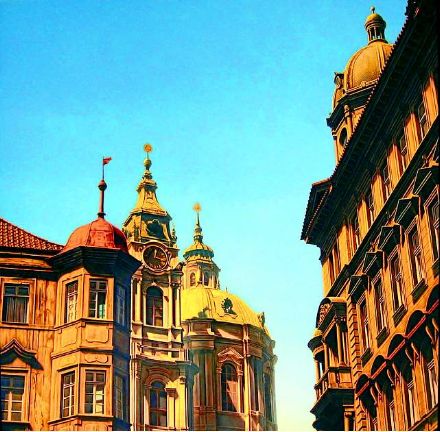
Glen Hansen, Praha – Church of St. Nicholas
Oil on panel, 32″ x 32″
2005, Fischbach Gallery

Glen Hansen, Praha – Trilogy (Homage to Agnes Martin)
Oil on panel, 24″ x 24″
2005, Fischbach Gallery
“Praha” is on display through Saturday, April 15 at the Fischbach Gallery, 210 Eleventh Ave., between 24th and 25th streets. Tue.–Fri., 10:00am–5:30pm, Sat, 10:00am–6:00pm, 212-759-2345, free.
The Governor’s Suite, City Hall
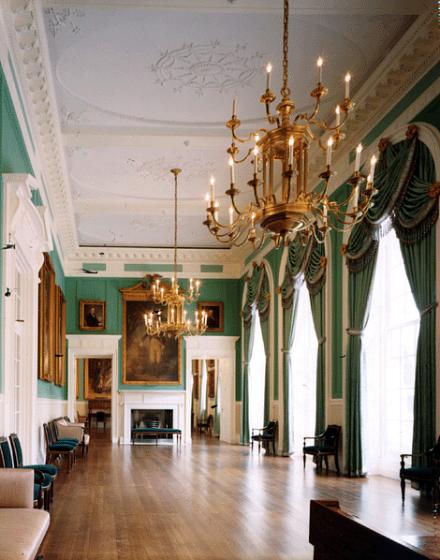
I HAVE NEVER been inside New York’s City Hall, though I have walked or driven past it on a number of occasions. With tall skyscrapers of various ilks towering over it, it always seemed rather small and inconsequential, and I knew nothing of the interiors save the Blue Room in which the Mayor usually gives press conferences and the rotunda which is fairly well-known as well.
I was delighted, therefore, to stumble upon the above photo of the recently-restored Governor’s Suite in City Hall, which shows it to have a rather handsome interior. Since the state government embarked upon an up-river journey to Albany, I presume the purpose of the Governor’s Suite is to provide a place for New York’s head of state to receive and entertain important dignitaries visiting the Big Apple. The current green color of the walls seems much preferable to the previous and rather dull white. I must endeavour to visit City Hall when I next return to the metropolis. (more…)
A Journey to Mells
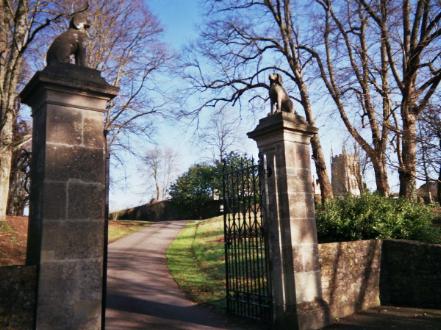
A good number of we happy St Andreans were down in the West Country recently — Somerset to be precise — for the wedding of two of our dear and closest friends [to be covered in a later post]. Being in Somerset, Alec, “Ishmael”, Clare and my good self decided to hop over to the little village of Mells last Friday to see the grave of Msgr. Ronald Knox and to sup at what is known as one of the best pubs in all of England. (more…)
New York in the Early Republic
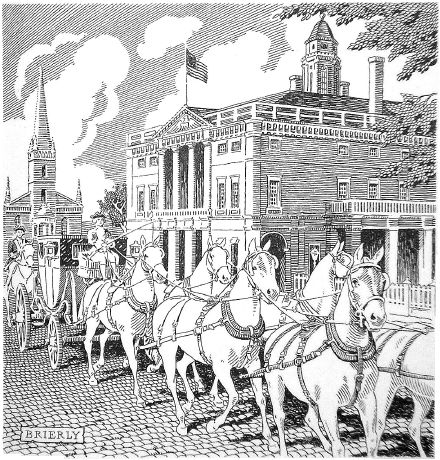
IT IS NOT OFTEN remembered that New York was the first capital of the United States and, as such, was home to the executive, legislative, and judicial branches of the new republic, albeit only for a short time. Federal Hall (above, with the Presidential carriage) was originally constructed in 1699 as a City Hall for New York. It was in this building at 26 Wall Street in 1735 that John Peter Zenger was tried and acquitted of libeling the Governor, affirming the Freedom of the Press. The Continental Congress began meeting in the City Hall in the 1780’s, and with the ratification of the new Constitution of the United States it became the first home of the federal government. Having been elected the first President of the United States, General George Washington was inaugurated on the balcony of the building on April 30, 1789. (more…)
The Restitution of Romanian Castles
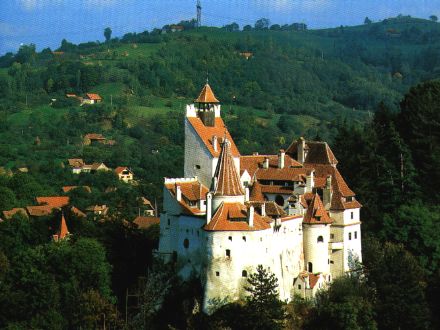
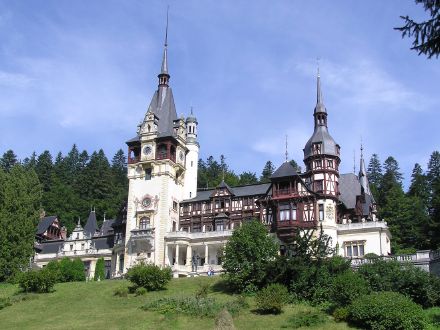
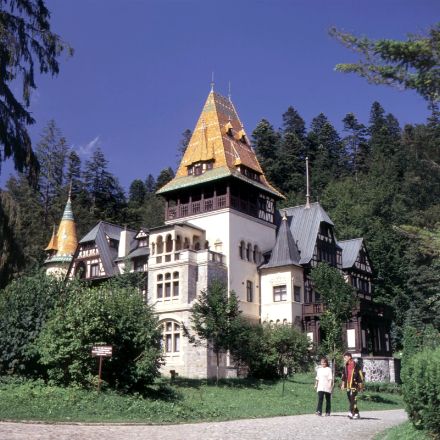
The castle of Bran (above), and the castles of Peles (below), and Pelisor (bottom) are to be restituted by the Romanian government to the Habsburgs and the Hohenzollern-Sigmaringens respectively, and then purchased back by the government for over $60 million, according to Adrian Iorgulescu, the Romanian Minister of Culture. The castles were illegitimately seized by the Communist authorities after they took power in 1947, and after buying them back the government will keep the castles as museums.
The Habsurgs are the Imperial Family of Austria as well as being the Royal Family of Hungary, Bohemia, Dalmatia, Croatia, Slavonia, Galicia, Lodomeria, Illyria, and Jerusalem, and the Ducal Family of Tuscany, Krakow, Lorraine, Salzburg, Styria, Carinthia, Carniola, the Bukovina, Transylvania, Upper Silesia, Lower Silesia, Modena, Parma, Piacenza, Guastalla, Auschwitz, Zator, Teschen, Friuli, Ragusa, and Zara. The Hohenzollern-Sigmaringen family, on the other hand, are a cadet branch of the senior Swabian branch of the Hohenzollerns, and are the Royal Family of Romania, which has been a republic since the Communist takeover in 1947 and has since, sadly, failed to restore its monarchy. Unlike the more reknowned Hohenzollerns of Brandenburg, the Romanian Royal Family are not Protestant.
UPDATE: A reader corrects: “The Hohenzollern-Sigmaringens are not the cadet branch, but in fact the surviving senior branch, which position they inherited upon the extinction in the male line of the true senior line, the Hohenzollern-Hechingens, in 1869. Historically they are of minor importance in comparison to their apostate cousins, but still a storied family. Schloss Sigmaringen, by the way, is a magnificent seat, romantically restored in the 19th century. They own it still, but do not tend to live within its forbidding walls. I was shown round it once in dead of winter: an unforgettable experience.”
Peter Simple is Dead
Michael Wharton, the genius behind the Peter Simple column in the Daily Telegraph, died on Sunday at 92 years of age. Wharton was “a quietly spoken, cherubic-featured man who ate corned beef sandwiches and drank brandy and ginger ale in a Fleet Street pub every lunchtime” according to his obituary in the Telegraph which provides some background to the man who invented an imaginary realm with which to point out the faults and foibles of the real one. Here we provide some excerpts which we found particularly interesting, amusing, or explanatory.
Young Michael was educated at Bradford Grammar School and Lincoln College, Oxford, where he learned to drink and to be idle. He took on the persona of a Tory anarchist who supported Franco and was determined to be of the Right, even if not a paid-up member. Eventually he was rusticated for throwing an egg at High Table and dismantling a sofa which was then pushed out of a window.
On the outbreak of the Second World War he joined the Royal Artillery, under his mother’s maiden name of Wharton. After obtaining a commission, he was sent to India, where he became an intelligence officer, eventually being attached to the General Staff and rising to the rank of acting lieutenant-colonel. Since the threat to India from both Germany and Japan was largely theoretical towards the end of the war, Wharton’s restless imagination came into play. He invented the Thargs, a sect of redheaded tribesmen in the Sind Desert, descendants of Alexander the Great’s soldiery who were in wireless contact with Hitler’s High Command. While studying the few facts available on some dull Japanese generals, he conjured up a one-eyed officer of the Imperial high command who had developed a fierce hatred of England after living in Harrogate where he had learnt the secret of toffee-making.
An advertisement “Learn Etruscan the Way They Did” produced a host of orders which eventually led to an announcement that the Etruscan records were sold out but that there were still stocks of Old Prussian, Aztec and Pictish; several requests inevitably followed.
The Daily Telegraph even devoted a lead editorial to Wharton’s passing, entitled ‘Death of a Genius’. God rest the soul of this brilliant and hilarious man, who provided thought and amusement for so many throughout his years.
Search
Instagram: @andcusack
Click here for my Instagram photos.Most Recent Posts
- Brunel’s Unbuilt Capitol February 3, 2026
- Cricket at Fordham January 27, 2026
- Palacio Barolo Revisted January 14, 2026
- Learning to Love Liguria January 14, 2026
- Crux Alba No. 2 January 13, 2026
Most Recent Comments
Book Wishlist
Monthly Archives
Categories