Arts & Culture
About Andrew Cusack
 Writer, web designer, etc.; born in New York; educated in Argentina, Scotland, and South Africa; now based in London.
 read more
News
Blogs
Reviews & Periodicals
Arts & Design
World
France
Mitteleuropa
Knickerbockers
Argentina
The Levant
Africa
Cape of Good Hope
Netherlands
Scandinavia
Québec
India
Muscovy
Germany
Academica
Salve Regina
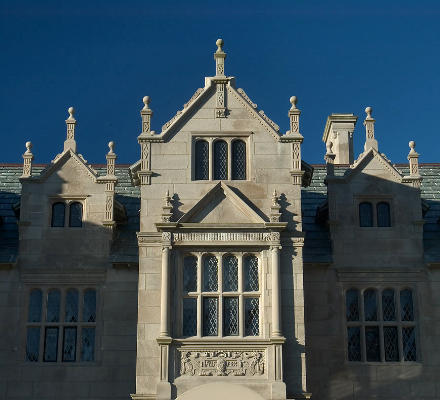
ONE OF THE MORE unfortunate aspects of the twentieth century was the decline of the country house in the British Isles and North America during the post-war period. Innumerable homes of great history and beauty were lost to the wrecking ball and the developer’s avarice. Newport, the former capital of the Colony of Rhode Island and Providence Plantations, became a summer capital to many of America’s well-to-do during the so-called “gilded era”. (It was avowed then that the highest level of society was determined by those whom Mrs. Vanderbilt could fit in the great hall of her Newport house). While many of the great homes of Long Island fell to ruin after the war, and the legendary Meadowbrook Hunt dissolved, many of the best Newport homes found a welcome new role under the wings of Salve Regina University, the city’s Catholic university. The decline of these great houses and the ascent of Salve Regina proved a quite fortunate coincidence, and has inspired the university to start one of the first academic programs in historical preservation and restoration. These great summer ‘cottages’ now house lecture halls, seminar rooms, academic offices, dormitory space, and a Catholic chapel. They are appropriate surroundings for Western civilization to be passed on to the next generations. (more…)
Film of the Year: “Zwartboek”
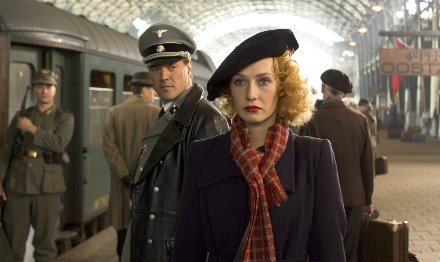
UNQUESTIONABLY: “Zwartboek”, or “Black Book” as it was released here in the United States. Sebastian Koch you will recall from “Das Leben der Anderen” (which, come to think of it, probably ties with “Zwartboek” for film of the year), while Carice van Houten will be in the next James Bond flick.
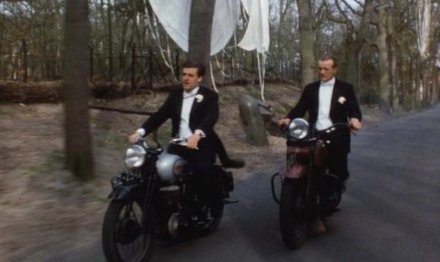
But is it better than director Paul Verhoeven’s previous Dutch World War II film, “Soldaat van Oranje”? Difficult choice! Happily, both films display a certain monarchist tendency.
The Dahlgren Residence
No. 15 East Ninety-Sixth Street, New York
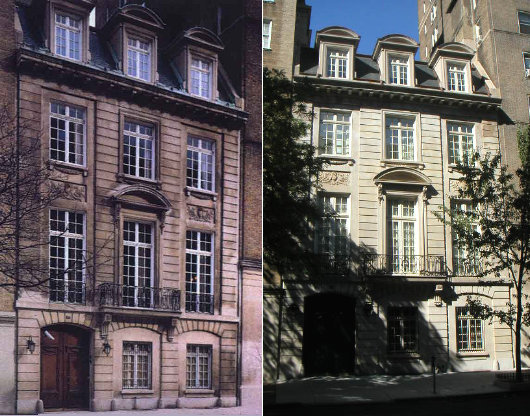
THE UPPER EAST SIDE is crossed by a number of wider cross-streets, of which 96th Street has long been agreed as the northern boundary of the neighborhood. (Overeager real estate agents have recently taken to advertising properties above that boundary as being located in the “Upper Upper East Side”). At number 15 on East 96th Street sits a splendid townhouse of superb design and execution often known as the Dahlgren residence. (Seen above, before and after complete restoration).
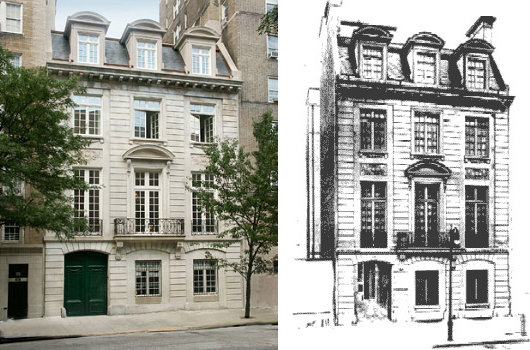
Lucy Wharton Drexel was of the Philadelphia Drexels, from which also came Saint Katharine Drexel, the founder of the Sisters of the Blessed Sacrament, as well as the initiators of Drexel University in that Pennsylvanian city. Young Miss Drexel married Mr. Eric B. Dahlgren, son of Admiral John A. Dahlgren, inventor of the Dahlgren Gun used during the Civil War at a ceremony in the Philadelphia cathedral officiated by Archbishop Corrigan of that see, and the couple soon moved to Manhattan where Mr. Dahlgren had a seat on the New York Stock Exchange. The Dahlgrens themselves were a prominent Catholic family, with Eric and his brothers attending Georgetown University, where to this day the main chapel bears the Dahlgren name. (Well-to-do Catholics must have been in short supply at the time, because after Lucy and Eric’s marriage, Lucy’s sister Elizabeth was married to Eric’s brother John).
Diary

EARLY YESTERDAY EVENING I found myself on the West Side and with a bit of free time, so I sauntered down Broadway to Columbus Circle to finally investigate in the flesh this great public place after its complete rehabilitation some two years ago. I am happy to report that the Circle’s refurbishment is quite a successful one. My only reservations were minor details, but as these were all done in an extremely simple and smooth modern style, they are much less objectional, and perhaps serve to focus attention on the sculptor Gaetano Russo’s splendid monumental column from which Cristóbal Colón, Admiral of the Ocean Sea, Viceroy and Governor of the New World presides over the grand plaza consecrated to his memory.
Colón’s name is rendered on the monument as ‘Cristoforo Colombo’, which seems appropriate since the monument was paid for by public subscription raised by Italian-Americans, and it is commonly assumed that Columbus was Italian. He may have been Genoese, Catalan, Portuguese, or Corsican, but he described himself as being from lands under the rule of Genoa, which lends significant credence to the Genoese and Corsican theories. In Spain, however, he is apparently Spanish, or so one daughter of Iberia, the wife of a frequent reader of this little corner of the web, informs us. The happy couple were strolling through Columbus Circle recently and the good lady was shocked to discover the purported Italian origin of the man who brought Christianity to the New World. After all, Spain’s national day — the Día de la Hispanidad — is October 12, the day in 1492 that Columbus first set foot in the New World. (In woebegone Venezuela, the vulgar socialist dictator has proclaimed October 12 as the Día de la Resistencia Indígena, or Day of Indigenous Resistance, and the Columbus Column in their capital city of Caracas was toppled on that day in 2004).
Anyhow, not only was the good lady was shocked at our monument’s proclamation of the Discoverer’s Italian-ness but the combination of that with the presence in Columbus Circle of the beautiful U.S.S. Maine Monument led the observer to conclude that the public plaza should be instead be named “Anti-Spain Square”. It was the disastrous sinking of the Maine, after all, which led to the Spanish-American War, the result of which was America’s most unfortunate and regretful act of taking Spain’s empire off her hands. (Contrary to Mr. Kipling’s idealistic urging of America to take up the imperial mantle in his poem ‘White Man’s Burden’, this turned out to be a fairly good deal for the Spaniards, and a very poor deal for the peoples of the United States).
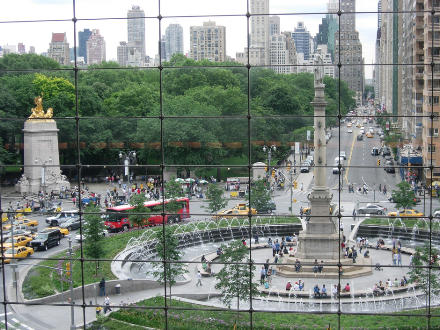
Politics aside, I enjoyed the few minutes during which I ruminated in the square (or circle, if ye be pedants). I recall many years ago the debate surrounding how to improve Columbus Circle that there was a near-universal desire for there to be more trees but that the very shallow depth between the street surface and the subway below presented difficulties in this regard. The redesigners have solved this problem by encircling the center of the circle with a raised ridge, on which are planted a number of trees which, we trust, will be even more appreciated as they mature. The raised ridge, which features jets of flowing water around the inner circle, also serves to innoculate the center from the noise of the traffic which, the Circle being situated at the confluence of Broadway, Central Park West, Central Park South, and Eigth Avenue, is considerable.
And so, I judge the new Columbus Circle a success, and I am happy to the report that the American Society of Landscape Architects concur, having awarded it their General Design Award of Honor. Another random fact which surprisingly few people know is that Columbus Circle is the spot from which distances to New York are numerated, akin to Moscow’s Red Square and London’s Trafalgar Square (if I recall correctly).
LEAVING COLUMBUS CIRCLE, I sauntered back up Broadway to another of Manhattan’s engaging places, Lincoln Center. Critics accused the architects of the performing arts complex of cribbing off of Rome’s E.U.R., but one wishes the three halls facing Lincoln Center’s plaza had the same crispness of those modern Roman structures. The thirty years between the E.U.R. of 1930s Italy and the Lincoln Center of 1960s New York were years in which the quality of modernism declined just as greatly as its supremacy increased. Despite this, the plaza of Lincoln Center is one of the most successful public places in Manhattan. I have often lamented the absence from New York of the open piazza so common on the Continent. This plaza competes with Central Park’s Bethesda Terrace as the best example of the type in Manhattan.
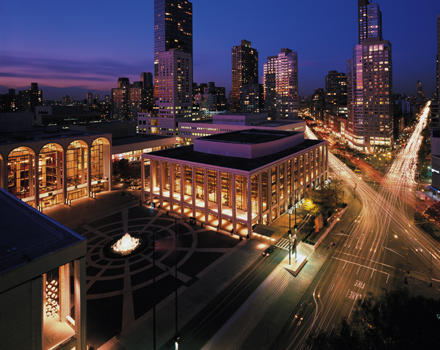
The plaza is raised above the neighboring Lincoln Square (one of the many triangular squares created by Broadway’s healthy disregard for the grid) and is reached by a gentle rise of stairs. Viewed from the square it appropriately seems like a stage upon which all our great dramas are played. The dance of the New York City Ballet in the State Theatre on the left, the music of the New York Philharmonic in Avery Fisher Hall on the left, and in the center, the Metropolitan Opera in the Metropolitan Opera House; the greatest opera company in the Americas, not to mention one of the best in the entire world. And from the hour of seven or so on the evening of performances, the three arts mix and mingle in the plaza as attendées wait to meet their companions and enter whichever of the respective halls they are to spend the evening. Some jealously preserve a seat of honor on the rim of the central fountain, while others hide from the elements (the beating sun, the heaving rain) in the shelter of the arcades, while still more meander slowly to and fro around this piazza dell’arte.
It’s unfortunate, then, that the elders of Lincoln Center insist on erecting temporary stage structures in the middle of the plaza, partially obstructing the fountain, during the warmer months when, above all other times, it should be open for all to enjoy. The creators of Lincoln Center conceived of the obvious desire for outdoor performances during the summer, and so they built the bandshell in Damrosch Park in between the Opera House and Avery Fisher Hall, just diagonally adjacent to the plaza. Surely the plaza is meant to be an open space where all the events can mix, blend, interact, influence, before finally separating into their appropriate places. If there are to be outdoor performances, hold them where they were meant to be, and if that place suffers from some malfunction of design, then redesign that place rather than rudely interjecting a particular event into what was meant to be the public square for all.
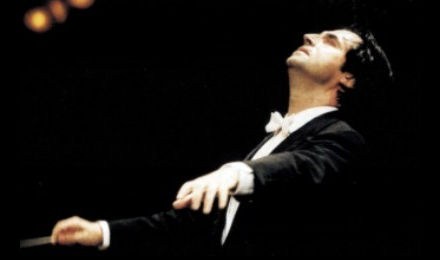
THIS PARTICULAR EVENING it was into Avery Fisher Hall for a performance of the New York Philharmonic, now in its 165th year. The program was Rossini’s overture to Semiramide and Schubert’s Symphony No. 3 in D major (D.500), with Dvořák’s Symphony No. 5 in F major (Op. 76). Riccardo Muti wielded the conductor’s baton and the result was definitely less than was expected. I had only heard Muti’s conducting on the radio in passing and, while admittedly not devoting much thought to it, he seemed a fairly capable conductor. In person, however, he left much to be desired. Rossini’s overture was merely lackluster but Schubert’s symphony was actually surprisingly poor. Perhaps the worst thing was observing Muti in action, for the man looked like an utter fool. His conducting seemed unnatural, choreographed, even foppish. And those ridiculous jestures towards the first violins! I wanted to slap the man, and I shouldn’t be surprised if the violins wanted to themselves. Towards the middle of the Schubert symphony, I began to think of the man as a proper ass, the tails of his evening jacket acting the part of hind legs. My only solution to the St. Vitus’s dance on the conductor’s dais was to shut my eyes and imagine that I was there in the Austrian capital in that autumn of 1815, after the chancellors and ministers of the crowned heads of Europe had departed the Congress of Vienna when peace and order were plotted, in the home of Otto Hatwig where (scholars posit) the work was premiered.
The friend I accompanied that evening actually knows about the inner workings of music (I am actually an ignoramus on the subject, and simply like what sounds good to me) and agreed completely with me on the subject during the intermission. Luckily, the Dvořák fared better, but one had the niggling suspicion that this was the Philharmonic working its magic in spite of Mr. Muti, rather than at the command of his baton. My knowledge and appreciation of Dvořák has slowly grown, from that first passing fondness we all have for his Symphony No. 9 “From the New World”. My appreciation for the Philharmonic grows, when I see they have printed in the program that Mr. Dvořák was born in Mühlhausen, Bohemia, rather than the more modish style of “Nelahozeves, Czech Republic” that would find favor elsewhere.
Perhaps I am too hard on Mr. Muti. Perhaps he and the Philharmonic were simply not a good fit for eachother. At any rate, I shouldn’t complain as one doesn’t often get box seats to a sold-out performance with every seat in the hall occupied (though, to be honest, the sound is better down in the orchestra seats). But how I wish I could have seen von Karajan while he was alive!
After the baton had finally fallen for the night, my friend and I had the same stroke of genius at exactly the same moment and decided to head up to good old Café Lalo, but unfortunately everyone else had the same idea (Saturday night? Lalo’s? What did we expect?) so we comforted ourselves with a pint or two at the Parlour instead.
Peter Simple V
A wise old man once said ‘good fences make good neighbours’ but history is chock full of territorial disputes nonetheless. Woefully, ancient land claims and cross-border irridentism reared their ugly head on the pages of the Daily Telegraph as well. These two columns, the fifth installment in our series introducing you to the greatest newspaper columnist who ever lived and breathed, retells just such a territorial dispute which erupted over changes in the layout and denomination of the newspaper page on which the Peter Simple column perenially (since the dawn of time, beyond the age of our forefathers) appeared.
A Small Crisis
 For some time now, the eastern part of the region in which my column occasionally appears has been headed “End Column” no matter what appears on it, whether literary criticism, humour or chess (which has taken permanent occupation of the southern part of the territory). Then one morning the world woke to a startling innovation: the territory was simply headed “Chess”. What had happened? Had an extremist group of chess writers suddenly claimed sovereignty over the whole region? It was the more surprising in that of all the paginal powers, Chess, devoted as it is to pure intellect, has historically always been the least aggressive, well satisfied with the ample territory it occupies and threatening no other power.
A serious diplomatic incident followed. Our own columnar government was not slow in sending a strong protest to the chess authorities. Partial mobilisation was ordered. A squadron of Blériot Mark II reconnaissance aircraft was sent to patrol the whole area. A gunboat of the Don Carlos class was despatched to the Interpaginal Sea.
Fortunately, the traditional panic and flight of the peasantry was quelled in time. Soon, wiser counsels prevailed and the crisis evaporated as rapidly as it had arisen. But it cannot be too strongly emphasised that in the event of a serious threat to the paginal balance of power, the column could not and would not stand idly by. For although this column is not always corporeally present in the eastern territory it is always present in a metaphorical and mystical sense, in all the territories where it has ever been.
Signs and Wonders
AS veteran readers of this column will recall (“Are there any others?” our boring expert “Narcolept” never fails to ask), a diplomatic impasse was caused last month when the chess flag was raised over the territory formerly known as “End Column”, implying an exclusive claim to suzerainty over a territory shared by other powers including ourselves.
The situation was supposed to have been normalised when, as is so often the case, wiser counsels prevailed. Sadly, this is not so. Extremist elements in the column, who have long been impatient with its conciliatory policy, are thought to be planning direct action by launching a surprise attack on the heartland of chess itself, the southern region in which its authority has never been disputed, and setting up a puppet state with only nominal allegiance, perhaps, to the parent column.
Are these hotheads and firebrands harking back to the so-called “time of troubles” in the 1970s, the time of “Peter Simple II” and the labyrinthine intrigues that led to a coup by General Waugh and the present “binary” dispensation? As a timely pronunciamiento from the Ministry of Columnar Guidance warns, “Such irresponsible day-dreaming could have the gravest possible consequences,” even leading to the onset of the long dreaded Fimbul Winter and the end of the column itself.
To make matters worse, certain elements seem bent on defying the basic columnar Law of Non-Interaction, which prevents different aspects of the column from interfering with each other. For example, it is rumoured that certain senior officers of that normally inactive regiment, the Stretchfordshire Yeomanry, are sympathetic to the extremists and, in the event of an attack on the chess territory, might join an expeditionary force (which would be styled a “liberation army”). As the pronunciamiento insists, this would be “playing with fire”.
Nor is this all. General Sir Frederick (“Tiger”) Nidgett, veteran war hero, founder of the Royal Army Tailoring Corps and Saviour of Port Said in the “dark days of 1942 when the Nazi hordes were bawling tastelessly at the gates of Egypt” – see Nidgett’s autobiography Up Sticks and Away (Viper and Bugloss, £25; paperback, £15; bulk orders welcomed) – is reported to have offered his services to the insurgents as military adviser and expert on combined operations. In a startling development, sources in the Columnar Foreign Office have dismissed Nidgett as “a buffoon and play actor whose boasted wartime service was in fact confined to looting bales of cloth and blackmailing shopkeepers in the bazaars of Cairo”. But a statement issued “from the desk of Gen Sir Frederick Nidgett” countered these criticisms with a firm “no comment”. Members of the Tailoring Corps Veterans Association have already hit back in defence of their founder, threatening reprisals with their traditional weapons, the dreaded armoured trouserpresses, failing an immediate withdrawal and apology.
To add to the confusion and breakdown of basic columnar principles, Sir Alywin Goth-Jones, the unpopular chief constable of Stretchford, has offered to place a squadron of his controversial police submarine force (currently patrolling the lake in sex-maniac-haunted Sadcake Park in pursuit of drink-drivers) at the disposal of the proposed expedition for a landing on the supposedly undefended shores of chess’s southern territories.
The pronunciamiento goes on to say that the extremists have “stirred up a veritable hornets’ nest and it is high time wiser counsels prevailed”. But will this deter irresponsible hotheads encouraged by intelligence reports, almost entirely fallacious, of growing dissent within chess itself, and signs of a modernising tendency which would put this noble and august game under the control of that most un-English authority, the Ministry of Sport?
This would lead to assimilation in the West Midland Chess League, responsible for the up-to-the-minute vandalism and hooliganism which mark the disgustingly popular annual matches between Stretchford Chess Circle and Nerdley Boardsmen, when drunken fans invade and overturn the board, and even assault the pieces without distinction between queen and pawn.
As the pronunciamiento inevitably states, it is time to draw back from the precipice. Equally, it cannot be too strongly (or too often) emphasised that, in the event of a serious threat to the paginal balance of power, this column could not and would not stand idly by.
For Saint George
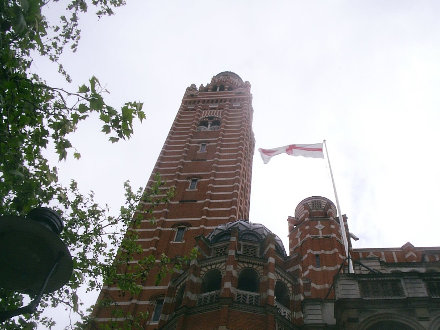
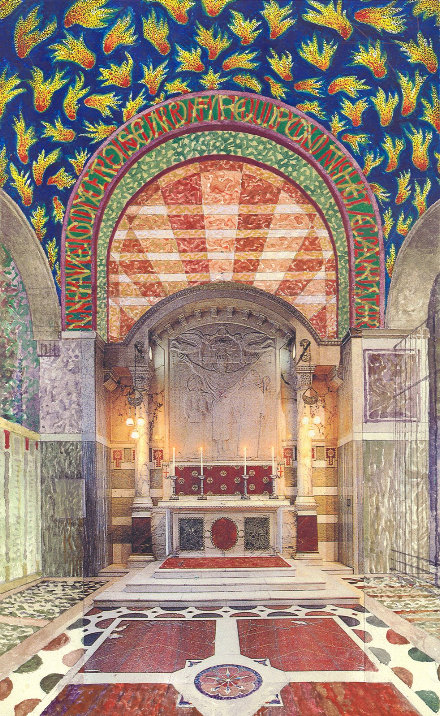
THE CROSS OF SAINT GEORGE snaps proudly from the flagpole above Westminster Cathedral, the Administrator of which, Msgr. Mark Langham, has given us a special St. George’s Day treat by revealing the newly-commissioned designs for completing the mosaic work in that cathedral’s chapel dedicated to the patron saint of England.
Felix Meritis
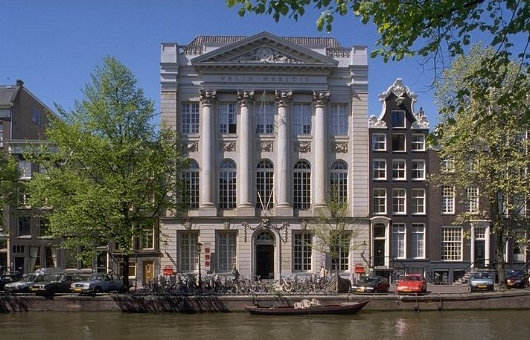
ONE OF MY FAVORITE handsome and dignified, and yet relatively small, buildings is the Felix Meritis on the Keizersgracht in Amsterdam. It has a long and interesting history to accompany the beauty of its design. The ‘Felix Meritis’ was a learned society founded by a number of prominent burghers of Amsterdam in 1777 for the promotion of the arts and sciences in their city. Its name is Latin for ‘fortunate (or more literally, ‘happy’) by merit’. Ten years later, the Felix Meritis purchased four narrow homes on the Keizersgracht and constructed a building, designed by the architect Jacob Otten Husly, on the site. (more…)
Flags of the British Nations
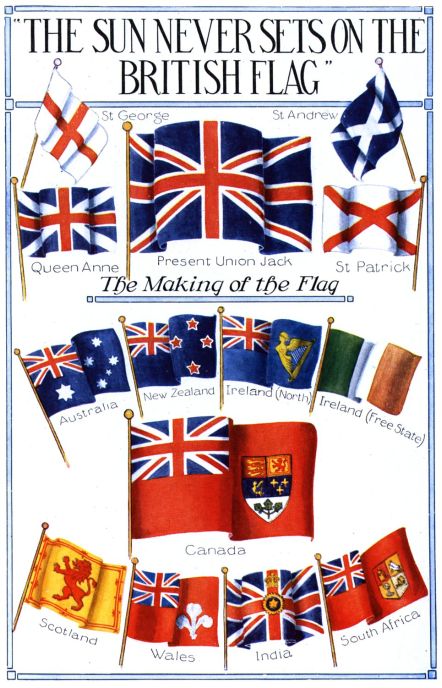
It is interesting how little-valued accuracy was in the depiction of flags “back in the day”. In this illustration, for example, the flags of Wales and “Ireland (North)” are mere inventions while the Scottish and Indian ones are arguable yet imprecise.
The “Welsh” flag depicted is a red ensign that is defaced with the three feathers of the Prince of Wales.
The “Ireland (North)” flag is handsome, but nonexistent. Northern Ireland had an official flag in use from 1953 until the Parliament of Northern Ireland was prorogued in 1972. (It was never recalled, and has since been superseded by the Northern Ireland Assembly). The flag of “Norn Iron” was a banner of the province’s coat of arms.
The flag of Scotland shown here is not actually the national flag (depicted above as the “St. Andrew” flag) but rather the Scottish royal standard, which is often (and improperly) used as an alternative national flag.
The Indian flag depicted is actually the flag of the Viceroy of India, which (admittedly) was sometimes used as a national flag for India. More often, however, a blue or red ensign was used, defaced with the Star of India.
The Canadian flag depicted here was changed in 1957, when the arms of Canada were themselves changed. The maple leaves in the bottom compartment of the sheild were specified to be “gules” (red). Up to that point, they had previously almost always been rendered “vert” (green). The Canadian flag itself was very controversially and unpopularly replaced by Prime Minister Lester B. Pearson with the Maple Leaf Flag. The Leader of the Opposition, the Rt. Hon. John Diefenbaker, derided the Liberal premier’s decision:
“We have had a flag. Flags can be changed. But flags cannot be imposed — the sacred symbols of a people’s hopes and aspirations — by the simple capricious personal choice of a prime minister of Canada. Now then, whenever the overwhelming majority of Canadian people want a new version, and when the design is meaningful and acceptable to most Canadians, that’s democracy. … I asked him [Prime Minister Pearson] this question: as to whether or not, under the circumstance, he would permit or he would arrange for a national referendum and his answer was no.”
Attack of the Killer Poets
The gentlefolks’ aortas will gush without me.
The last chance to get stained with blood
I let go by.
Ever more often I answer ancient calls
And watch the mountains turn green.
Aeschylus fought at Marathon, Maecenas rode with Octavian, and even Coleridge had a spell in the Dragoons (under the assumed name of Silas Tomkyn Combebach), yet more recent examples of convergence between the realms of the poetical and the military leave something to be desired. The above quotation is a mere snippet from the works of Radovan Karadžić, sometime leader of the Bosnian Serb forces during the disintegration of Yugoslavia. As a Hungarian friend said recently, “If that doesn’t get him sent to the Hague, I don’t know what will!”
Misery loving company, Karadzic invited Eduard Limonov, the Russian poet, writer, and all-around nasty character, to Bosnia in the midst of the Seige of Sarajevo. This brief YouTube clip shows the two poets inspecting a Serb position overlooking the town. The tousled-haired Karadzic gloats over the woebegone metropolis while Limonov takes aim at a few civilians through the sight of a sniper rifle before opening fire. (Limonov returned to Mother Russia, where he founded the National Bolshevik, or “Nazbol” party. Is there no Russian Wodehouse to ridicule this strange band of neo-Hitlerite Stalin-worshippers? “Spagbol” seems an obvious equivalent of Roderick Spode’s Black Shorts.)
Meanwhile, we read in the feuilleton of today’s Süddeutsche Zeitung (via signandsight.com) that German authorities have refused to grant asylum to the Chechen poet Apti Bisultanov. Bisultanov, as it turns out, led a unit of thirty-five men during the Battle of Grozny and has been accused of a number of war crimes and human rights violations.
Kinda makes you wonder what nefarious plots are being hatched when David Yezzi meets Ben Downing for a drink at the Old Town.
[Cross-posted at Armavirumque]
‘Titus’
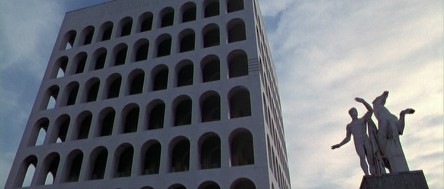
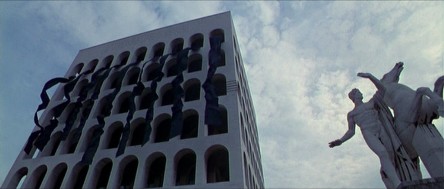
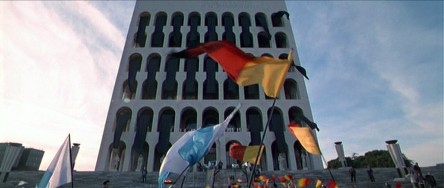
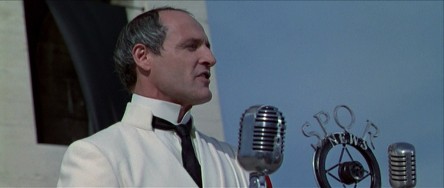
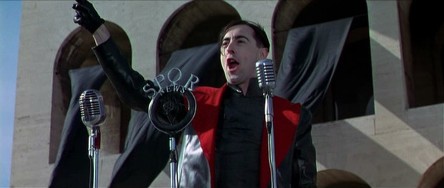
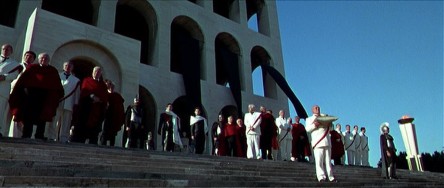
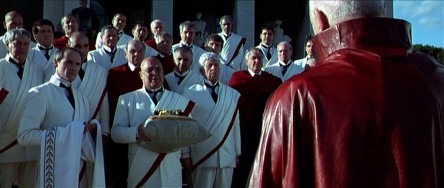
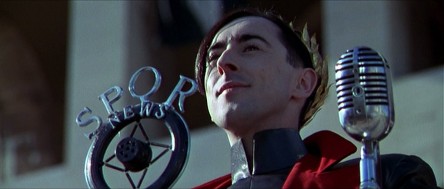
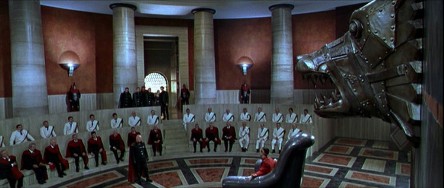
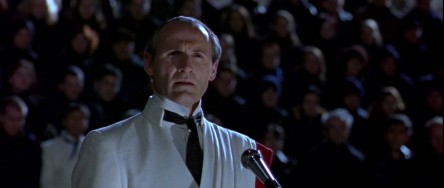
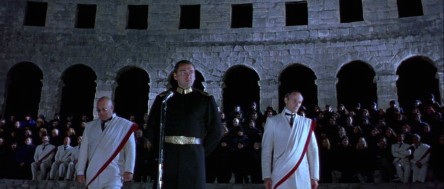
JULIE TAYMOR’S VERSION of Shakespeare’s “Titus Andronicus”, the 1999 film “Titus” (with Anthony Hopkins in the title role), is a rather interesting modern interpretation. It has rather whimsical aspects, such as the ‘SPQR News’ microphone the characters are seen speaking into. The rivals for the imperial throne bedeck their supporters in the colors of Rome’s rival football teams: the red and yellow of Roma for Saturninus and the pale blue and white of Lazio for Bassianus. I especially enjoy the Senators bedecked in old-school white suits making them appear like a convivium of Kentucky colonels. Worth seeing.
Lord Glenavy

Sir James Henry Mussen Campbell, Bt., 1st Baron Glenavy, PC, QC. was born in Dublin in 1851. Campbell graduated from the University of Dublin (Trinity College) a Bachelor of the Arts in 1874. He was called to the Irish bar in 1878, being made a Queen’s Counsel in 1892.
Campbell was elected to Parliament in 1898, being called to the English bar a year later. He was made Solicitor General for Ireland in 1903, as well as being appointed an Irish Privy Counsellor. He rose to become Lord Chief Justice of Ireland in 1916, being made a baronet the following year, and Lord Chancellor of Ireland the year after that (1918). Sir James was ennobled as 1st Baron Glenavy upon relinquishing office in 1921.
Ireland was partitioned in the following year, and Lord Glenavy became the first Cathaoirleach of Seanad Éireann (Presiding officer of the Irish senate). In 1923, he chaired the judicial committee investigating the establishment of a new courts system for the Irish Free State. His proposals were implemented the following year in the Courts of Justice Act 1924, forming the Irish courts as they remain today.
Having served one six-year term in the Seanad, he did not seek re-election in 1928, and died three years later in 1931. Holding the largely honorary position of President of the College Historical Society (“the Hist”), Dublin University’s debating society, from 1925, he was succeeded upon his death by his fellow Irish Protestant, Douglas Hyde, who himself later became the first President of Ireland from 1938 until 1945.
The Men Who Saved Quebec
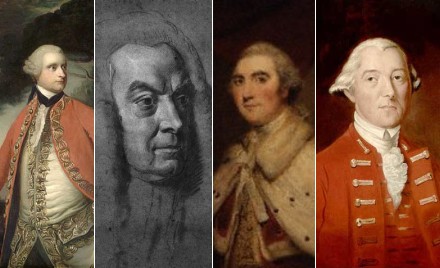
The British Crown’s toleration of Catholicism in Quebec was cited by the rebel colonists of the 1770’s as, ironically, an ‘intolerable act’. That the Church of Rome, that bastion of backwards conservatism and slavish hierarchy, could be tolerated in the lands under the power of the British parliament riled the Whigs—the enlightened liberal progressives of the day. Indeed, Benjamin Franklin was even so foolish as to go to Quebec as an emissary of the ‘Continental Congress’ to persuade the natives to rebel against the Crown; Congress’s proposals to ban Catholicism and prohibit the use of the French language ensured he was not successful.
The modern orthodox opinion of historians on the Quebec Act of 1774—the act that granted toleration to the Church—is that it was merely a persuasive exercise to keep les Canadiens from rebelling. A 1989 book challenged this perspective, arguing instead that a handful of British aristocrats were determined to ensure that Quebec did not become another Ireland: where Protestant ascendancy was thrust upon an unwilling nation of Catholic nobles, merchants, and peasants.
The following review by Gary Caldwell was published in a Canadian journal in 2001.
|
Philip Lawson.
The Imperial Challenge: Quebec and Britain in the Age of the American Revolution. Montreal and Kingston: McGill-Queen’s University Press. 192 pages. US$27.95. |
WHY REVIEW A BOOK published twelve years ago? I will explain. But first, let me tell you what it’s about.
When Britain took possession of Canada at the Treaty of Versailles in 1763, it faced an “imperial challenge:” how to integrate into the empire a society fundamentally different from England – in language, religion, and legal and political institutions. At the time, England was vigorously intolerant of Roman Catholicism or “popery,” the religion of its major enemies, France and Spain. British Protestantism was closely tied to the dominant Whig political ideology born of the Glorious Revolution of 1688-89. This doctrinal legacy prescribed that all British subjects were possessed of very definite and equal liberties, liberties endowed upon and limited to those who conformed to the Whig-Protestant definition of being British.
Hence the problem of 1763. English law and constitutional practice allowed only for protestant public officials and elected representatives. This meant excluding the entire French-speaking population, some 70,000 to 80,000 (the “new subjects”) as compared to some 300 Protestants established in the colony (the “old subjects”).
There were two schools of thought as to what should be done. The Whig position, favoured by much of the English political leadership and commercial class on both sides of the Atlantic, was not to accommodate the new subjects. It amounted to an attempted destruction of the local culture and to exclusion of the French-speaking population from all juridical, political and social positions, the hoped-for consequence being assimilation in one, perhaps two, generations. In short, what had been imposed in Ireland with the “protestant ascendancy.”
The opposing school of thought, still marginal in 1763, believed such a policy both impracticable and undesirable. James Murray, Lord Shelburne, Lord Dorchester (Gary Carleton), H. T. Cramahe, Alexander Wedderburn, Lord Mansfield and William Knox not only held that a Protestant ascendancy in Quebec would ruin the colony, they also believed that Quebec society was deserving of being preserved. Murray and Dorchester, who knew Quebec and its people, were adamant: the Canadians were a good “race”—in Murray’s words, “perhaps the best and bravest race on the globe” (p. 48)—and if protected they and their society would flourish and be loyal to the Crown. As it happened, all of these administrators and Crown legal officers, with the exception of Cramahe, were Anglo-Irish or Scottish; not one of them was of English origin.
But how were the Canadians and their culture to be accommodated? There were, as Lawson demonstrates, three distinct dimensions to this accommodation. The first was to respect the prevailing legal code and custom in civil and property matters; the second, to refrain from putting into place an English representative assembly because it would be the instrument of the 300 or so English and American voters in the colony. By far the most important was the third dimension, tolerance in Quebec of Roman Catholicism, which meant the nomination of a Bishop, the tithe and the right of Catholics to hold public office. Dorchester and the others successfully won these concessions in London by 1770, and they were contained in the Quebec Act in 1774, to the horror of much of English public sentiment, and especially the Americans who were more resolutely against “popery” and more Whig than the English themselves.
When Benjamin Franklin arrived in Montreal in 1775 with the invading army of the Continental Congress, he carried secret orders to ban the popish religion and the French language. Fortunately, the Americans were stopped in Quebec by no other than Dorchester, back from getting the Quebec Act through Parliament. At the head of an army of old and new subjects he broke the 1775-76 siege of Quebec.
Lawson’s interpretation is insightful in putting the events into the context of the Irish question. The major players in promoting the accommodation that became the Quebec Act had in mind “the Irish Imbroglio,” and were determined not to repeat the error of the “protestant ascendancy” in Ireland. The Quebec Act emerges clearly as the culmination of thoughtful and courageous policy formulation, a model of generous statesmanship. Hence, as Lawson goes on to argue, the “toleration” of Roman Catholicism in the Quebec Act paved the way for the British Acts of Toleration of 1778.
Lawson also helps understand why Murray, Dorchester and the others came to the conclusions they did about the Canathan problem. These men were essentially empirical conservatives who found the answer “in the past”—Quebec society as they had known it in the 1760s—and the “elastic nature of the British Constitution.” And here Lawson runs smack into the prevailing wisdom in Canadian historiography.
Lawson is insistent on the coincidental nature of any link between the Quebec Act and the American Revolution, affirming that there is no evidence that the inspiration for the Quebec Act was to placate the Canadians so as to keep them apart from the Americans. As this alleged link is one of the most tenacious myths in the Canadian historical consciousness, it is worth citing Lawson:
What can be done to dispose of this myth once and for all? Fifty years ago both Coupland and Burt said that they could find no evidence to justify such an assertion with Lanctot repeating the message in the 1960s, and nothing has yet come to light to contradict them (pp. 123-124).
When I first read this book in the early 1990s and realized how revolutionary his thesis was, I contacted Lawson to talk about his work. In passing, I mentioned that I supposed that The Imperial Challenge must have created quite a controversy in Canadian academic circles. His reply was “No, it has attracted very little attention in Canada.” (I never saw him again. I had arranged to see him a few years later, but just before I arrived in Edmonton he was admitted to hospital for terminal cancer and died shortly afterwards.) In subsequent years, I have been to McGill-Queens Press in Montreal to buy copies of his book to give to friends. Inquiring as to sales, I was told that only a few hundred copies had been sold. And, so far, I have encountered only one reference to Lawson’s book (in Yves Lamonde’s Histoire sociale des politiques au Quebec).
I was curious enough to go back recently to the reviews written when the book came out. There were 16 in Canada in French and English, in the United States and in the United Kingdom; all reviewers were quite positive except one (who wrote two of the reviews). They all commented positively on the extent and depth of the documentation, as well as the fresh reading from parliamentary debates, the personal archives of the principal players, and the press of the day. As for his interpretation of how the Quebec Act came to be, there is no suggestion that he was wrong in any respect. The negative reviewer suggests only that it is pretentious of Lawson to think he has added much to existing work on the Quebec Act. Of the 15 reviewers, a full half explicitly accredit Lawson with drawing out the intention of avoiding the error of Ireland.
Why, then, did a book, critically acclaimed by the author’s peers, which sheds considerable light on a pivotal period in the history of Quebec and Canada, drop out of sight in Quebec, and I suspect in the rest of Canada? Lawson calls into question the conventional wisdom on a very important subject in Canadian history, and no one takes notice. For instance, two prominent Canadians, Gerard Bouchard and John Raulston Saul, social thinkers who are presently reinterpreting Canadian history, make no mention, to my knowledge, of this book. A book that should have caused waves has generated scarcely a ripple.
Perhaps my assessment, as a non-professional historian, is faulty and I would welcome a demonstration of where I have erred. What are the factors that explain the untimely eclipse of Lawson’s work? Could it be simply that Canadian intellectual discourse is shallow, that a seminal work can be dropped into the water and hit bottom generating nothing more than a superficial ripple of perfunctory reviews and listings in compendiums? This is one possible explanation; a more certain explanation lies in ideology.
The ideological axe, starkly put, goes as follows. Quebec’s nationalist, republican-leaning contemporary intellectuals are loath to entertain the idea that a coterie of British Conservatives (half of them aristocrats) literally saved Quebec society by helping to keep it strong enough to withstand the renewed neo-liberal assault led by Lord Durham three quarters of a century later and, then, begin to rehabilitate the Quebec polity (under British institutions) in 1867. Such an idea being beyond the pale (again, the ghost of Ireland), they maintain the myth that the Quebec Act was political opportunism inspired by the American threat. What will it take for Quebec nationalist thinkers to recognize and appropriate the historical reality that Dorchester twice—in the Quebec Act and the siege of Quebec—saved Quebec? It is no exaggeration to assert that, had it not been for this one Anglo-Irish aristocrat, Quebec would likely have become anglicized and, subsequently, integrated into the American empire.
As for English-speaking Canada, the current crop of orthodox historians has long consigned our British imperialist past to the Marxist dust-heap of history: nothing good could possibly have come of it, all imperialisms being, by definition, bad. They are not about to disturb their orthodoxy that in contrast to Imperial Britain, which was incapable of any genuine sympathy for Quebec—only Canadian nationalist intellectuals are enlightened and respectful of Quebec society. So, they too maintain the “political opportunism” interpretation of the Quebec Act, despite its having been refuted by Lawson and his predecessors. Essentially, what we are seeing is a refusal to acknowledge a debt owed to dead white male Protestants (from Ireland and Scotland). But gratitude is not, as the contemporary French philosopher Alain Finkielkraut has pointed out, a hallmark of modern progressive thinkers.
I write this review knowing full well that it is too late for Lawson’s work to be rehabilitated. The Imperial Challenge is among the titles in this year’s McGill-Queen’s clear-the-warehouse sale.
Previously: Hitchcock in Quebec
Volcanic Hills Loom Over the Italian Bay
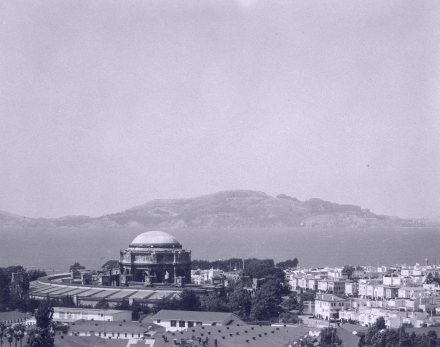
OR NOT, to be precise. I found the above view of San Francisco rather charming, a touch Neapolitan even, and decided to share it. The domed building is the Palace of Fine Arts, designed by Bernard Maybeck for the 1915 Panama-Pacific Exposition. It used to exhibit various works of art, but is now an “interactive” science museum. The Palace of Fine Arts was actually built to last only two years but the San Franciscans couldn’t bring themselves to tear it down. Eventually, the elements took their toll and in the 1960’s, it was torn down and completely rebuilt to the same external design but with a permanent structure. (more…)
‘To a Fishfinger’
of our series introducing you to Peter Simple, the greatest columnist who ever was, we bring you this taste of the poetry of Julian Birdbath.
Birdbath is a character in the world of Peter Simple who lives at the bottom of a disused mine, alone but for his pet toad Amiel, writing poetry.
Among Birdbath’s putative translations of Esperanto verse is this delightful ode to the fishfinger – one of my favourite poems.
Thou shape impacted of Old Ocean’s heart,
With frost imbu’d and golden crumbs bedight,
Casual thy vending and thy worth too light:
How soon thy form symmetric must depart!
In rangéd boxes at the supermart
Thou bidest with thy fellows day and night,
Nor dream’st thou’ll’t scale some culinary height–
Who fries and serve thee needs no subtile art!
And yet for thee the stalwart seaman rov’d
’Mid tempests’ rage; and Iceland’s anger keen
Endur’d; nor glimpsed ’mid perils dire the end
Sublime: that thou, scorned digit, should’st be so lov’d
Dearer than pizza or th’ entinnéd bean,
For soliary men both food and friend!
edited and translated by Julian Birdbath

Hitchcock in Québec
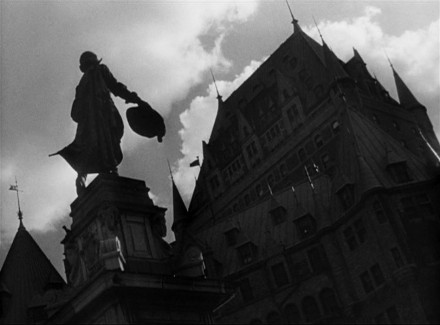
QUÉBEC, THAT STRANGE and charming province, is a most intriguing nation. It is where the British, French, and American tendencies clash and combine to form that most peculiar of all American varieties: le Québécois. Of course, since the 1960s Québec has become more French; no, not more French but more like France in that every year it plunges deeper into the depths of self-loathing: that hatred of one’s own tradition and history which has so marked out “the new Europe”. It is a race to assert one’s self by destroying any living connection to one’s past. Un jeu du fou. More’s the pity, as this once-vibrant melting pot of traditions expressed itself in interesting ways.
A splendid display of this Québec can be found in Alfred Hitchcock’s 1953 drama I Confess. The film had been recommended to me often and I finally got around to seeing it tonight. I won’t give away any of the plot, which is a good one, but Hitchcock lives up to his reputation with his excellent framing of the scenes. (Though I must admit, half of it is merely the settings in the Ville de Québec themselves). They include a peek into the Québécois Parliament. Above the Speaker’s dais is displayed not only the Sovereign’s arms, but also a crucifix, exhibiting our loyalties both temporal and spiritual. In the court room you find yet another blend of the Anglo and the French. As you no doubt recall from our handy little map, Quebec is a country with a mixed legal system. Founded as Nouvelle-France it had the civil system derived from the Romans. Captured by the British and later transformed into part of the Canadian Confederation, it has accrued layers of the Common Law so dear to we Anglos. The officials of the court wear British-style robes — the judge even has a tricorn hat — but over the jury looms a large crucifix. English government and French culture tempered by Catholic truth; not a bad mixture.
Anyhow, if you haven’t seen the film yet, here are a few snaps to enjoy until your Hitchcockian thirst is satiated. (more…)
Un Écossais en France
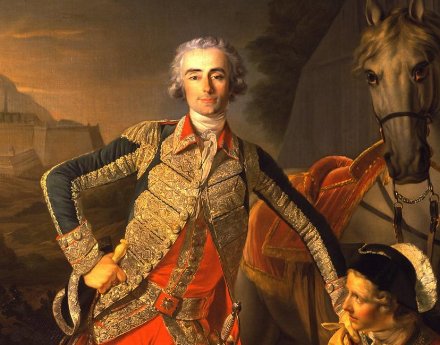
CHARLES GRANT, VICOMTE DE VAUX, was a Frenchman of Caledonian extraction who served as a sous-lieutenant in the Scots Company of the Garde du Roi, eventually rising to the rank of Lieutenant Colonel. A cadet branch of the Scottish clan, the Grants in France made sure to maintain links with their kinsmen in the old country. Abbé Peter Grant helped Sir James Grant, 8th Bt., commence an art collection while Sir James was on the Grand Tour in 1759-60. Abbé Grant’s nephew, Baron Grant de Blairfindy, was a fellow Catholic and Colonel in the Légion Royale of Louis XVI.
In a letter to Sir James, who was Chief of the Grants, Blairfindy described their fellow kinsman the Vicomte de Vaux as “a clever, brave officer, polite in company… as brave as his sword,” though, rather disappointingly, the Baron adds that the Vicomte “never drinks”. De Vaux himself took a keen interest in his extended family, and when the terrors of the French Revolution forced him into exile in London, he published there his Mémoires de la Maison Grant depicting the history of the clan. (more…)
A Sienese Gem Lost
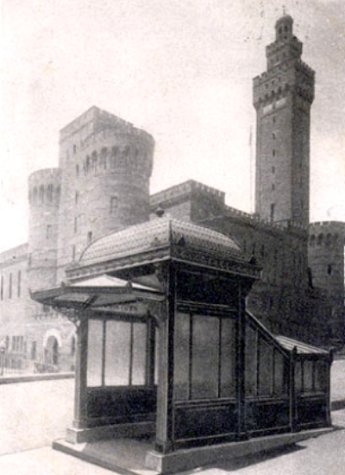
STEALING A GLANCE at the photo above, the viewer would easily be forgiven for mistaking the vista for that of a subway entrance in turn-of-the-century Siena, Italy. The proud medieval tower lurks over a comely metal-and-glass structure of continental flavor. However the city fathers of that ancient Italian municipality never deigned to erect an underground railway. The precise locus of the vista is far removed: it is the corner of Park Avenue and 33rd Street, and the building behind the subway entrance is not the town hall of Siena, but rather the armory of the 71st Regiment, New York National Guard.
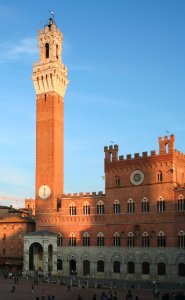 When the earlier Romanesque Revival armory of the Seventy-First Regiment burnt down in 1902, it was decided to build the new armory on the same, though slightly enlarged, site. The 1905 construction was built to the design of the architectural firm of Clinton and Russell, and was clearly inspired by the Palazzo Pubblico (the town hall, photo at right) of Siena, on that city’s Piazza de Campo. While the Seventh Regiment Armory contains the finest interiors of any military building in City, and probably the entire Empire State, the exterior of the Seventy-First’s armory was far superior. Even though the interior was not to the same lofty standard as the Seventh, it was by no means lacking, for it had all the wood-panelled rooms filled with military regalia from times gone by which one expects of New York’s armories from the period. (more…)
King Jagiello of Poland
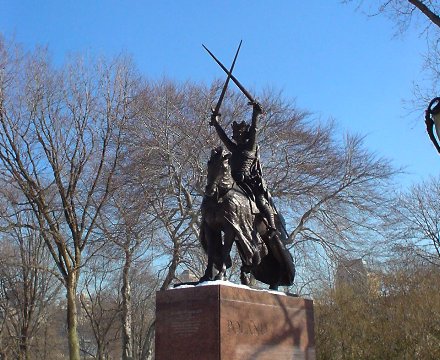
My favorite statue in Central Park is that of King Władysław II Jagiełło of Poland, by the Turtle Pond. (more…)
Search
Instagram: @andcusack
Click here for my Instagram photos.Most Recent Posts
- Brunel’s Unbuilt Capitol February 3, 2026
- Cricket at Fordham January 27, 2026
- Palacio Barolo Revisted January 14, 2026
- Learning to Love Liguria January 14, 2026
- Crux Alba No. 2 January 13, 2026
Most Recent Comments
Book Wishlist
Monthly Archives
Categories