Arts & Culture
About Andrew Cusack
 Writer, web designer, etc.; born in New York; educated in Argentina, Scotland, and South Africa; now based in London.
 read more
News
Blogs
Reviews & Periodicals
Arts & Design
World
France
Mitteleuropa
Knickerbockers
Argentina
The Levant
Africa
Cape of Good Hope
Netherlands
Scandinavia
Québec
India
Muscovy
Germany
Academica
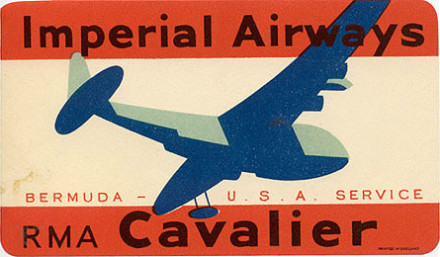
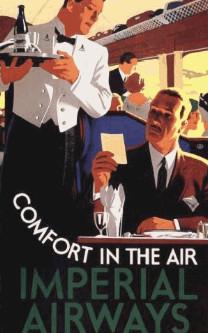
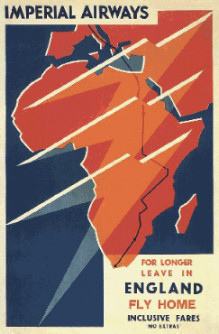
Imperial Airways







Previously: Bayerische Volkspartei | Lwow (Lvov/Lviv) | Empire State | Municipal Airports | Crêpes à Dentelles
Clarendon Court
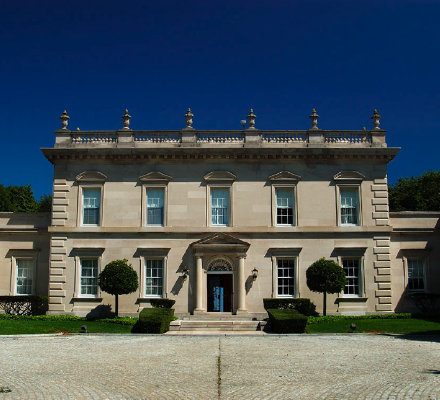
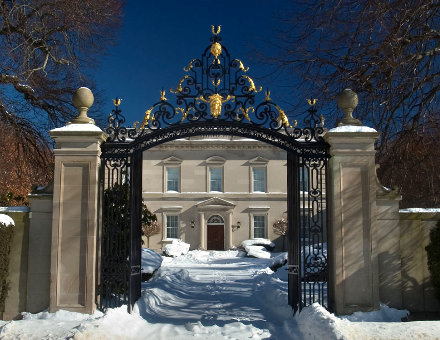
CLARENDON COURT IS one of the more comely of the Newport “cottages”. Built a little later than most, it avoids the Mediterranean gallimaufry of the Breakers and the French frilliness of many of the other Newport mansions (The Elms, Marble House, etc.). Its chief fame, however, comes not from its architectural excellence but rather as the family home where Sunny von Bülow fell into a permanent vegetative state, leading to the arrest and conviction for attempted murder of her husband Claus von Bülow. Von Bülow’s conviction was overturned on appeal, when he was represented by the famous Alan Dershowitz.

Previously: Salve Regina University
Insiginia of the Society of Colonial Wars
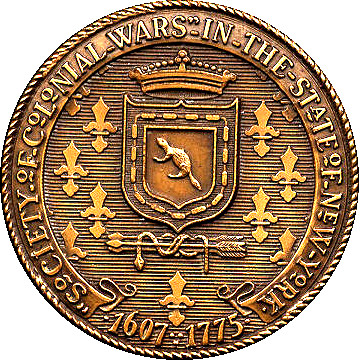
DEPRIVED OF THE hereditary principle by the lamentable break with Great Britain in 1783, Americans were eventually driven to inventing a hereditary social hierarchy, even more stringent than that of the mother country. Blood is the only qualification for membership of the numerous hereditary societies that dot the United States, unquestionably foremost among which is the Society of the Cincinnati. The Society of Colonial Wars, however, is one of the more prominent of the dozens of hereditary societies, and each state organization has devised its own seal or emblem. Below are exhibited a handful of examples.
The Church Resurgent

THE CATHOLIC COLONY of Maryland was first planted in 1634 at St. Mary’s, which became the first capital city of the Calvert family’s palatinate. The attempt to run Terra Mariae as a Catholic feudal state was continually frustrated by a number of fiery Protestant settlers, who eventually broke out into open rebellion in the 1650s while the Civil Wars raged back in England. Happily, Cecil Calvert, 2nd Baron Baltimore, sent out an army under Gov. William Stone to restore order to the colony, but was defeated by the Puritan force in March, 1655 at the Battle of the Severn. During the Puritans’ persecution of the Church, all the Catholic churches in Maryland were destroyed, and in 1667 a new ecclesiastical edifice was raised in St. Mary’s: the Brick Chapel.
The Rapalje Children
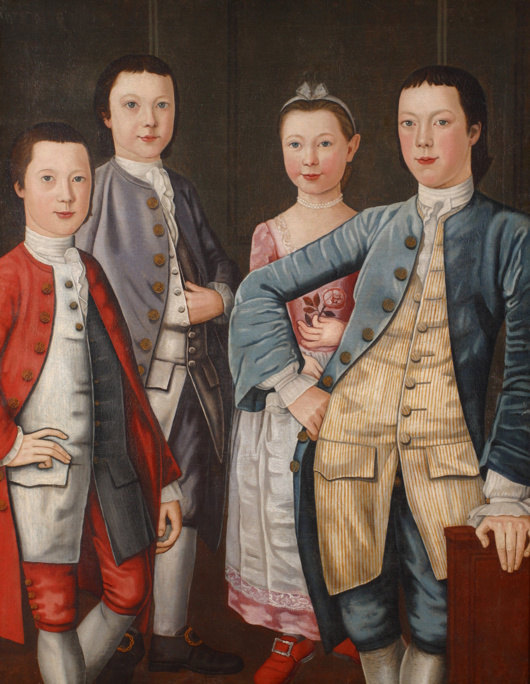
Oil on canvas, 50¾″ x 40″
1768, New-York Historical Society
Durand’s painting of the four children of this prominent mercantile family of Manhattan is one of the finest examples of group portraiture from the colonial period in America. From left to right are Garret (b. 1757), George (b. 1759), Anne (b. 1762), and Jacques (b. 1752).
The painter had come to New York from Virginia two years previous to paint individual portraits of the children of the Beekman family. Art historians suspect he was born or trained in France. Durand later returned to Virginia, where he continued to paint until his death in 1805.
Corpus Christi Church
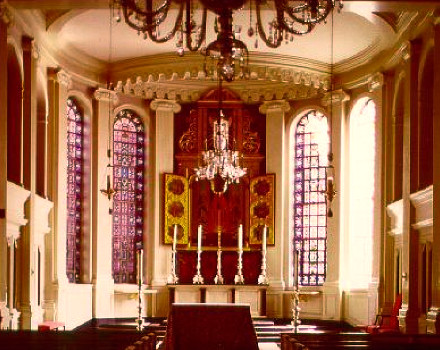
Corpus Christi Church, West 121st Street, New York: perhaps my favorite Catholic church interior in all New York, and one which simply cries out for a traditional Mass. (more…)
The Assay Office
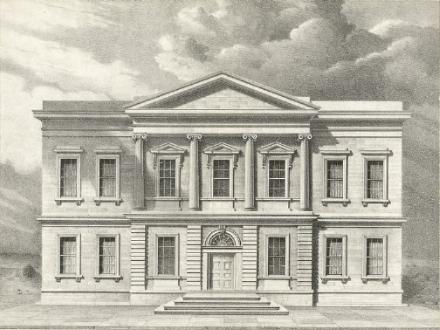
THE ASSAY OFFICE was built in 1822 as the New York branch of the Bank of the United States, located at 15½ Wall Street. The (Second) Bank of the United States was the second attempt at a central bank for this country. Eventually, the central bank grew too powerful, trying to manipulate politics and master the economy itself, and so it was abolished in 1836. The building later became the Assay Office, an adjunct to the Customs House and Sub-Treasury next door, which itself is now known as Federal Hall National Monument. When the Assay Office was torn down, the façade was preserved and donated to the Metropolitan Museum of Art by Robert W. de Forest in 1924. It is now presented in the glass-covered courtyard of the American Wing of the greatest museum of art in the New World. (more…)
Rip van Winkle
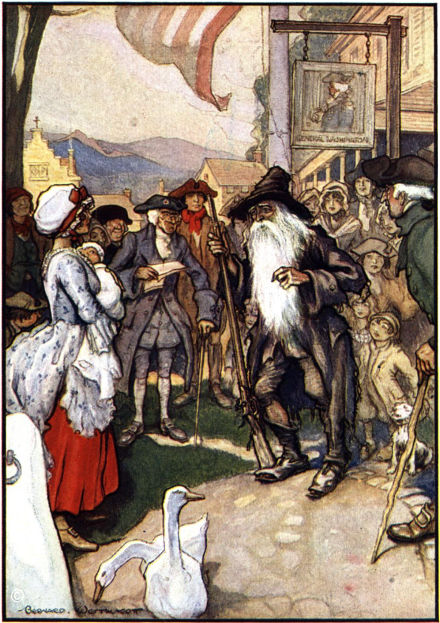
POOR RIP van Winkle; I always felt bad for him. He falls asleep for twenty years, and returns to his own native village where is now unknown and taken for some strange vagrant. “I am a poor quiet man, a native of the place, and a loyal subject of the king, God bless him!” he exclaims, in blissful ignorance of the Revolution which took place during his slumber. “A tory! a tory! a spy! a refugee! hustle him! away with him!” cry the by-standers.
I have long thought that Washington Irving was trying to make a subtle traditionalist point here: the definition of a good citizen has been arbitrarily changed. If a man was a good New Yorker in 1765 and hasn’t changed, why is he a traitor in 1785? It’s clearly ridiculous, except to proto-Jacobins and ideologues.
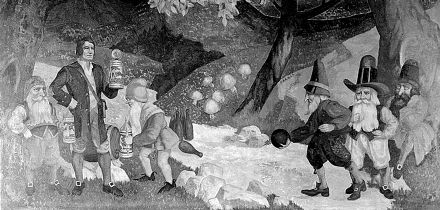
Anyhow, the lesson of the story: drink not from the flagons of odd-looking personages playing nine-pins amidst the Hudson Highlands.
Previously: Rip van Winkle
They don’t all hate us
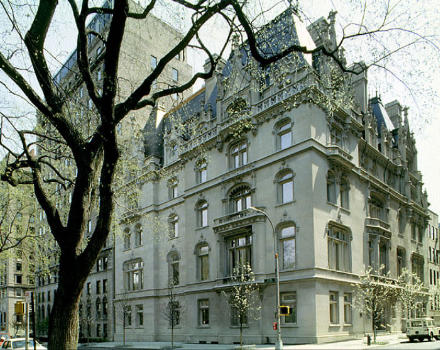
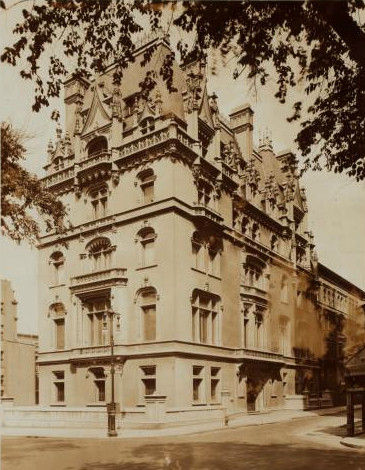
THE JEWISH MUSEUM sits at the corner of 91st Street and Fifth Avenue in the old Warburg mansion. It was expanded in 1993, nearly doubling its frontage on the avenue. See the modern addition? No? That’s the point.
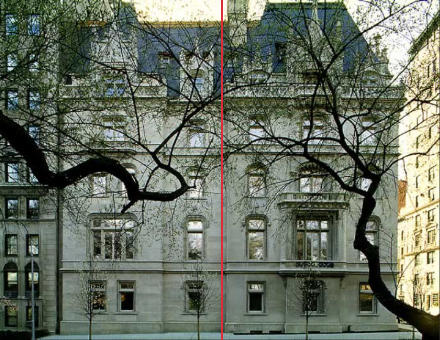
In the photograph above, the section to the right of the red line is the original Warburg house, built in 1909 and designed by C.P.H. Gilbert. The section to the left of the red line is the 1993 addition. If only the directors of the Morgan Library and the Brooklyn Museum had been similarly inspired.
Missal Mania

Baronius Press have reported a doubling in their sales of missals for the old Mass, or the “extraordinary form” as we are to call it now, since the release of the motu proprio Summorum Pontificum. Readers will be shocked to hear that I am actually a reactionary (however accidentally) because I only have a 1960 missal, not the 1962 missal which is the actual missal used at traditional masses. However, I would not object if anyone would like to gift me a brand spanking new 1962 daily missal from Baronius Press. The perfect gift for young Catholics: St. Nicholas Day is just around the corner! (Alright, over two months away, but still…).
Baronius Press are also coming out with the Little Office of the Blessed Virgin Mary, which has received an Imprimatur and will be available from sometime in October.
The Teatro Colón in Buenos Aires
Finest opera house of the New World
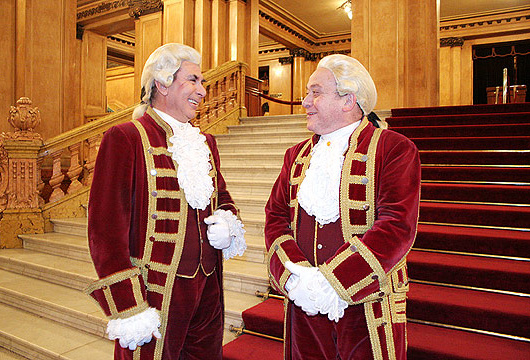
Am I old-fashioned, or aren’t footmen not supposed to smile?
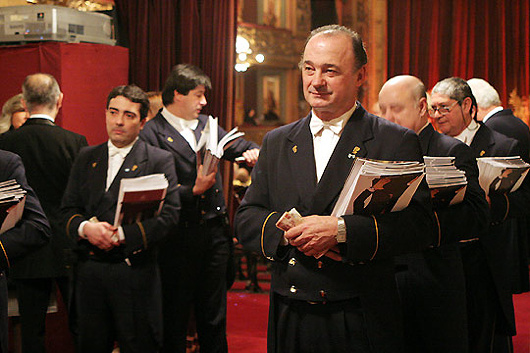
This usher knows precisely how much (which is to say, how little) emotion to show.
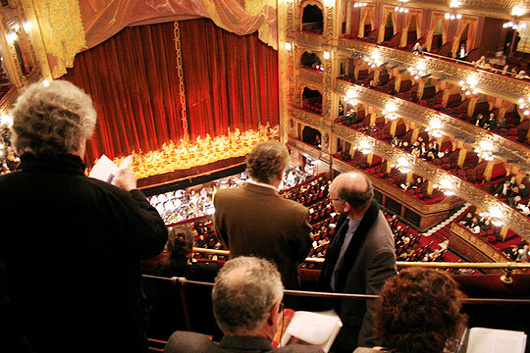
But now, everyone to their seats…
The magnificent Teatro Colón is currently closed for refurbishment until 25 May 2008, when the most prominent opera house under the Southern Cross will reopen brighter and better than ever.
A Mews in London
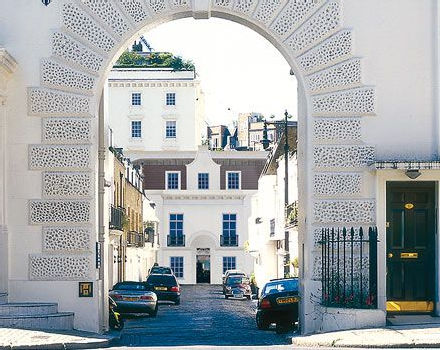
Typical London, and yet the gable on Lion Lodge (the building which terminates the view), together with the general white-wash of the façades, gives it a hint of Cape Town. Lion Lodge is a recent structure by Liam O’Connor Architects and Planning Consultants.
The Rathaus of Gladbeck
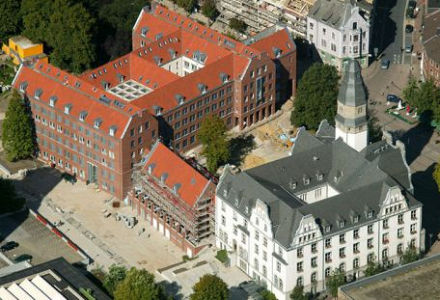
JUST SO YOU ARE aware that not all the architects hate us, let us travel to the Westphalian town of Gladbeck where the city fathers, in their infinite sagacity and wisdom and ever open to changes in inclination, have seen fit to correct the errors of the not-too-distant past by tearing down two hideous concrete boxes and replacing them with a more appropriate annex to the handsome art-nouveau Rathaus (town hall). The man to thank, apparently, is Gladbeck’s Stadtbaurat (town planning advisor) Herr Michael Stojan (a tweedy sort of fellow, it appears), who initiated the project. What a pity the directors of the Morgan Library could not exercise a similar wisdom.
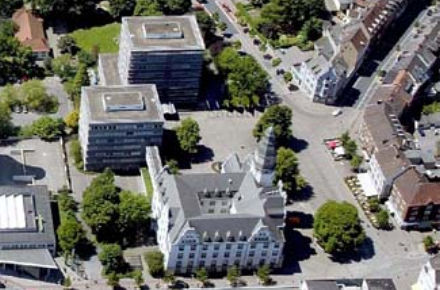
Gladbeck’s ‘Willy Brandt Platz’ before the offensive structures were removed.
The new building is modern but not modernist, and has no pretensions to being the original Rathaus’s contemporary. It exhibits a certain simplicity, and while it lacks exterior ornamentation it does not suffer much from that absence. Internal courts provide natural light to the offices within, while arcades offer shelter to passers-by in the event of an impromptu opening of the heavens. With its saddleback gables, the annex complements but does not compete with the town hall it is intended to augment. Improvements such as this are deserving of our applause.
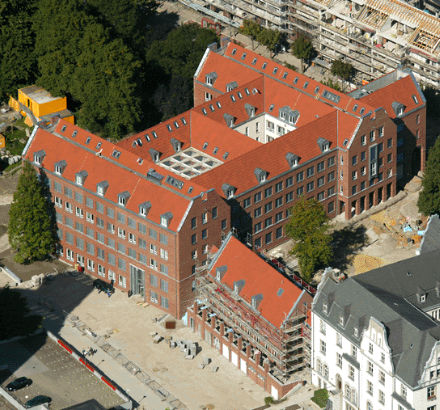
Elsewhere: Die Welt: Wie sich eine Stadt repariert (12 April 2007)


The Architects: They Really Hate Us
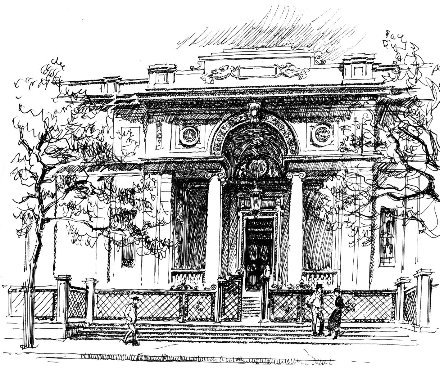
ONE OF THE GREAT things about the Morgan Library on 36th and Madison was that it used to reflect (and indeed protect) the glories of European civilization. Since its recent renovation, however, it merely expresses the post-civilization status of the mother continent. One cannot help but feel bad for poor Mr. Morgan, who would surely frown upon the vulgarity which has been thrust upon his life’s achievement: one of the finest collections of manuscripts, rare books, and drawings in the entire world. (more…)
The Old Archbishop’s Palace, New Orleans
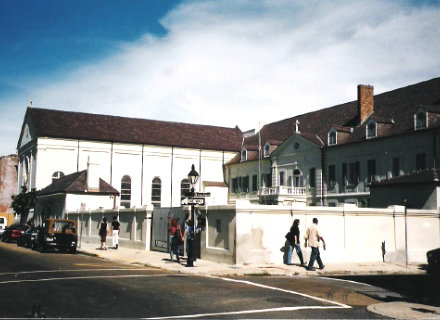
BUILT IN 1745, the Old Archbishop’s Palace in New Orleans is believed to be the oldest building in the entire Mississippi Valley. The building has gone through a number of ecclesiastical uses through the centuries, originally constructed to French plans for the Ursuline sisters who came to foster the Christian faith in la Louisiane. On the corner of Chartres Street and Ursulines Avenue in western corner of the Vieux Carré, the Convent survived the Great Fire of 1788, along with the neighboring barracks and Royal Hospital. The Ursuline nuns took orphans into their care here, and educated the daughters of the city’s elite and of the local plantation owners (among them Baroness Pontalba), as well as organizing special handiworks classes for Indian and Negro girls. And it was in the Chapel of the Convent that the Ursuline nuns kept vigil during the Battle of New Orleans in 1815, praying ceaselessly for the salvation of New Orleans from destruction. This great event was attributed to the Blessed Virgin, and Notre Dame de Bon Secours (Our Lady of Prompt Succour) was adopted as the patron of the city and diocese of New Orleans and the state of Louisiana. (more…)
Nederlands Dagblad
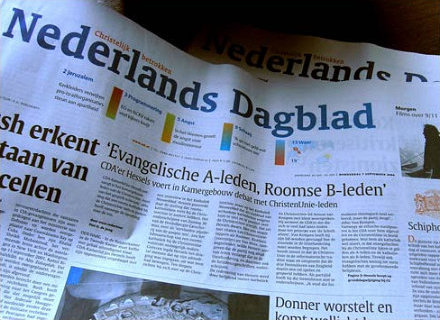
ONE ENVIES the Dutch for having a quality, serious Christian daily newspaper, Nederlands Dagblad (“Netherlands Daily”), even if it is Protestant-run and -oriented. A daily newspaper since 1967, ND currently has a circulation of 33,000. The circulation has been increasing in the past few years, reportedly among non-Christians who desire an alternative perspective from that of the mainstream newspapers. Could not the same be replicated in America, perhaps even on a Catholic basis?
Ludlow Street
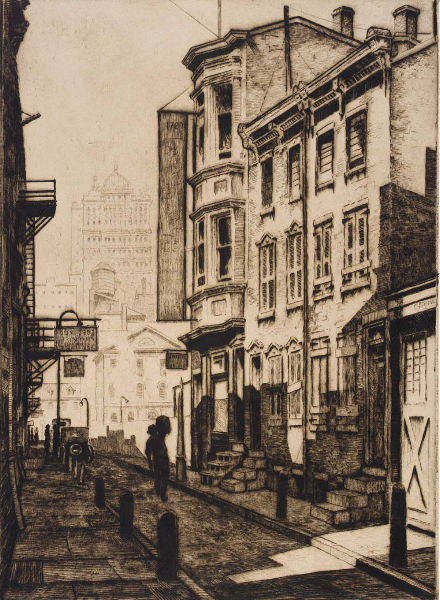
George A. Bradshaw, Ludlow Street
Drypoint on paper, 8 7/8 ” x 6 3/8 ”
1935, Smithsonian American Art Museum
Ludlow Street is the home of the world-famous Katz’s Delicatessen.
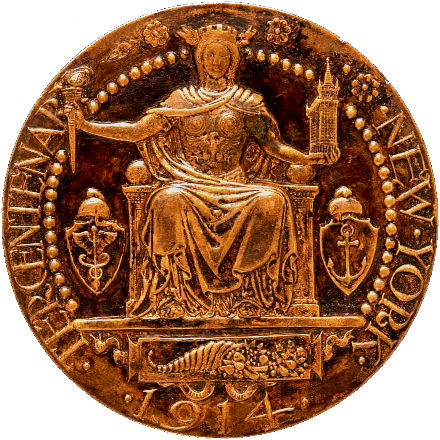
New Netherland Medal
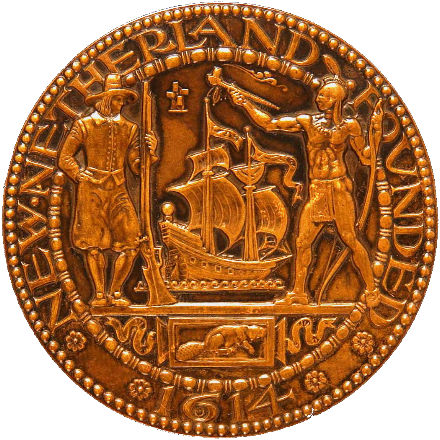
Paul Manship, New York Tercentenary Medal
Bronze, 2 3/4 inch diameter
1914, Smithsonian American Art Museum
The Edificio Metrópolis, Madrid
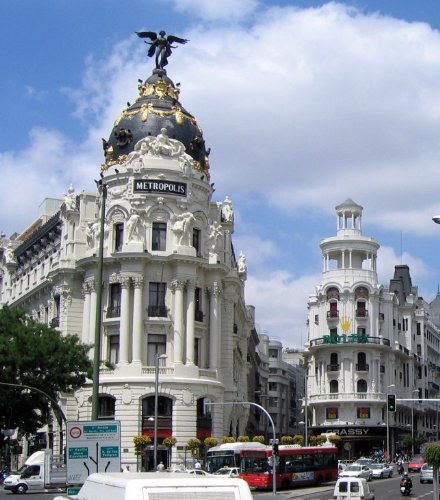
WHERE THE GRAN VÍA meets up with the Calle Alcalá in Madrid, there is a wonderful building which these days is known as the edificio Metrópolis. Designed by Jules and Raymond Février of France, it was built in 1911 for the Union and Fénix insurance company. The architects took advantage of the awkward but prominent site to create a landmark building for the company, one of the largest insurance firms in Spain. At the apex of its triangular site is a splendidly decorated round tower, originally topped by the Union and Fénix symbol of a phoenix with Ganymede. (more…)
Search
Instagram: @andcusack
Click here for my Instagram photos.Most Recent Posts
- Brunel’s Unbuilt Capitol February 3, 2026
- Cricket at Fordham January 27, 2026
- Palacio Barolo Revisted January 14, 2026
- Learning to Love Liguria January 14, 2026
- Crux Alba No. 2 January 13, 2026
Most Recent Comments
Book Wishlist
Monthly Archives
Categories