Arts & Culture
About Andrew Cusack
 Writer, web designer, etc.; born in New York; educated in Argentina, Scotland, and South Africa; now based in London.
 read more
News
Blogs
Reviews & Periodicals
Arts & Design
World
France
Mitteleuropa
Knickerbockers
Argentina
The Levant
Africa
Cape of Good Hope
Netherlands
Scandinavia
Québec
India
Muscovy
Germany
Academica
Tintin as Cusack or Cusack as Tintin?
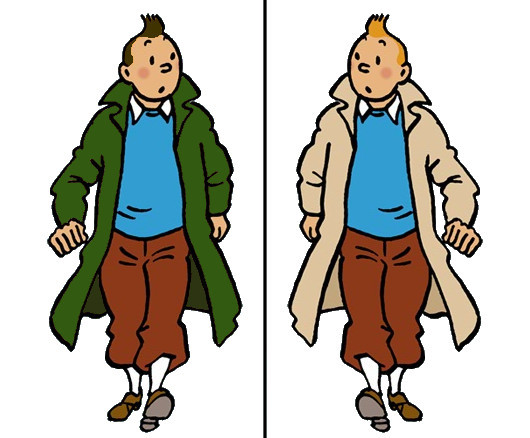
A VERY BORED Liz Smith mocked this up on a rainy day during her August hols on the Atlantic coast of France.
Previously: The almighty loden coat
New York Sun will no longer shine for all
Center-right New York daily will cease printing at end of month
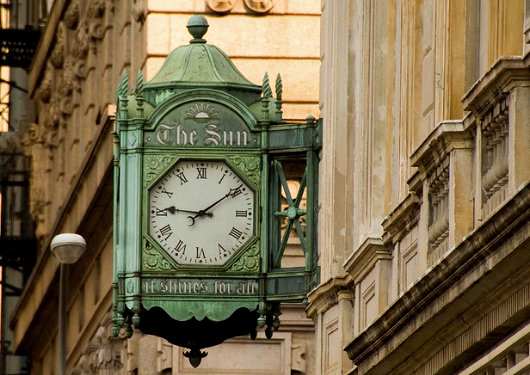
In a devastating blow to the intellectual life of the city, the New York Sun editor Seth Lipsky announced today that the small-but-influential daily newspaper will cease operations at the end of the month unless new investors can be found to put many millions of dollar into the revived title. The newspaper — known for its excellent arts & cultural coverage and willingness to lift the veil on corruption in addition to its hardcore neoconservative politics — is believed to be operating at a loss of tens of millions of dollars a year. Seth Lipsky announced the perilous state of the Sun in a letter to readers this morning:
St. Anthony Square
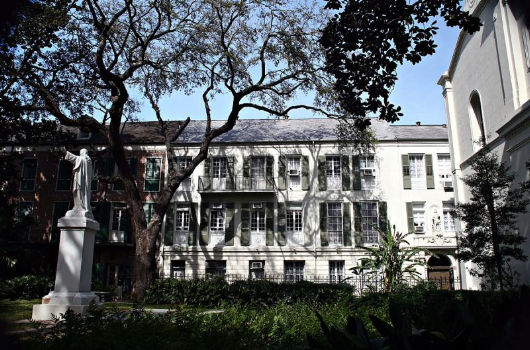
Behind the Cathedral of St. Louis, New Orleans.
The Newspaper for People in Sunglasses
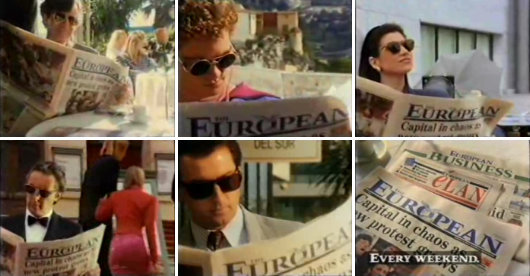
Watch this splendidly dated television advertisement for The European from 1991. In that year, the Soviet Union still existed, Eastern Airlines closed after sixty-two years in aviation, the IRA was still bombing London, Archbishop Lefebvre went on to his eternal reward, Édith Cresson became premier of France, and the Dow Jones closed above 3,000 for the first time — today it closed at 11,532.88.
Santa Maria della Pace
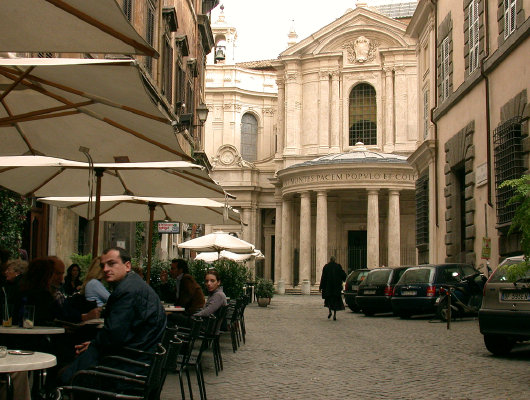
One of my favourite churches in all of Rome is that of Santa Maria della Pace. The best approach is from the alley leading out of the northwest corner of the Piazza Navona, crossing the Via di Santa Maria dell’Anima and making sure to turn left into the smaller alleyway when the little street itself swerves north. Moving forward, the perambulator suddenly emerges into a tiny trapezoidal piazza and having continued for a few paces realizes, almost as an afterthought, that there is something over your right shoulder. There is the Church of Santa Maria della Pace.
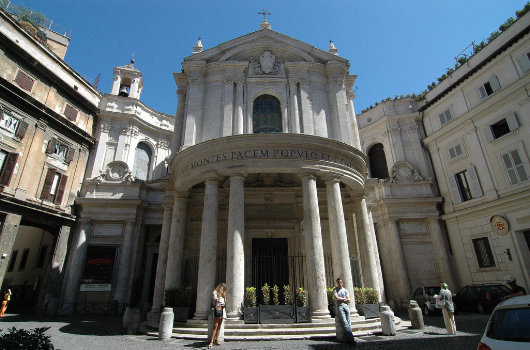
Like so many Roman edifices the Church is the work of many centuries. A church dedicated to the Apostle Andrew once stood on the site, and it was on the foundations of that church in 1482 that work on Santa Maria della Pace commenced. Sixtus IV, praying for peace in the Italian peninsula, vowed to build a church dedicated to Our Lady of Peace, and hence the Apostle’s patronage was superseded. While Baccio Pontelli deserves the credit for the church proper, Pietro da Cortona’s splendidly theatrical façade and its enveloping piazza were commissioned Alexander VII in the 1650s.
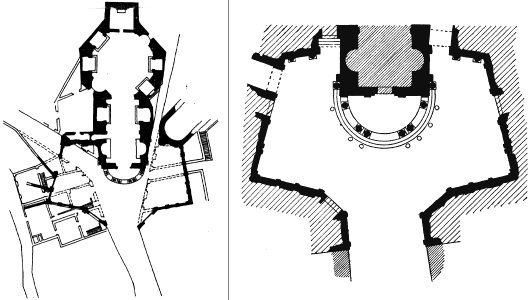
Santa Maria della Pace has a number of connections to the Chigi dynasty. The first prominent member of the Chigi family was Agostino (1465–1520), a wealthy banker and builder of the Villa Farnesina in Trastevere. Here at Santa Maria della Pace, Agostino commissioned the Capella Chigi (not to be confused with the Capella Chigi in Santa Maria del Popolo). Alexander VII himself was a Chigi, and perhaps this explains his patronage of Cortona’s façade and piazza. Among the later Chigi clan, there were a number of cardinals, some of whom were even nuncios, and more recently Ludovico Chigi Albani della Rovere was Prince & Grand Master of the Order of Malta from 1931 to 1951. Anyhow, the Chigi chapel features a fresco initiated by Raphael (and completed by his school), while the adjacent chapel includes sculptural decoration by Michelangelo.
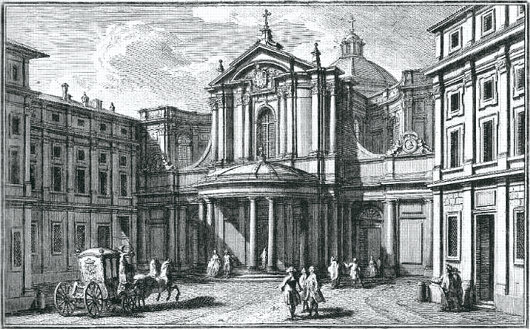
In addition to greats such as Raphael, Michelangelo, and Cortona, the cloister of the church is by none other than Bramante, and indeed was his first work in the Eternal City. Somewhat exhaustively, it doesn’t end there. Santa Maria della Pace has a high altar by Carlo Maderno, a sculpture of the Deposition by Cosimo Fancelli, two small frescoes by il Rosso Fiorentino, and another fresco by Baldassarre Peruzzi who, shall we say in kindness, was a much better architect than painter. There are further works by Maratta and Gentileschi (Orazio, that is — not Artemisia).
The Catholic Herald

First Christian de Lisle, now Jennifer Roche: at this rate within a year everyone I know will have contributed to the Catholic Herald! (And, incidentally, I did have a brief chat in the Travellers Club once with the chap who wrote the piece on the Assumption).
I might just have to take out a subscription, though an electronic one — probably the most convenient for we across the seas — is still a hefty £38: at today’s exchange rate that’s seventy good ole American smackeroons! Probably worth it, though.
Propaganda Fide

Cheers to the unknown wag who created this delightful poster, parodying the Obama “HOPE” posters.
A Rundbogenstil Library in New York
The handsome former Astor Library on Lafayette Street

One of my favorite buildings in all New York is the former Astor Library on Lafayette Street in Greenwich Village. Now the Public Theater, it is a superb example of the nineteenth-century German neo-romantic Rundbogenstil (“round-arch-style”) and one of the few remnants of that style in New York. The Astor Library was the legacy of John Jacob Astor, whose will provided for its establishment. Late in the nineteenth century, the Astor Library agreed to merge with the Lenox Library and the Tilden Trust to form the New York Public Library, one of the greatest libraries in the history of civilization. The building was bought by the Hebrew Immigrant Aid Society who tore out the book stacks and used it as a processing station for needy newcomers. In 1965, the HIAS sold it on to a developer who planned to demolish it, but, through a massive civic effort, Joseph Papp and his New York Shakespeare Festival purchased the building and turned it into the Public Theater.
Le monde diplomatique

The German edition of Le monde diplomatique underwent a complete overhaul not too long ago. Unlike the main French edition of Le monde diplo, which exhibits the exact style of a French newspaper of mediocre design circa 1996, the German edition now exudes a certain calm and composed modernity. The redesign is the work of the German typographer and designer Erik Spiekermann, whom the Royal Society have named a Royal Designer for Industry (entitling him to an HonRDI after his name; only “hon” because he is not a British subject). Mr. Spiekermann was responsible for the much-lauded redesign of The Economist, the magazine you read when the airport lounge doesn’t have a copy of The Spectator.
Saskatoon Cathedral
Matthew Alderman’s hypothetical counter-proposal

Matthew Alderman has designed a hypothetical counter-proposal for the new Catholic cathedral in Saskatoon, Saskatchewan which is infinitely more beautiful than the ugly modernist thingamajig that the diocese is actually building. Matt elaborates upon the problematic nature of the modernist design here and here.

Argentina’s Voice: La Prensa
TIME magazine, 26 October 1942
 In the ornate Paz family crypt in Buenos Aires’ comfortable La Recoleta cemetery, honors came thick last week to the late José Clemente Paz, founder of Argentina’s La Prensa. The Argentine Government issued a special commemorative postage stamp. Nationwide collections were taken to erect a monument. U.S. Secretary of State Cordell Hull sent a laudatory cable, as did many another foreign notable. It was the 100th anniversary of the birth of Argentina’s most famous journalist.
Although Don José has been dead for 30 years, the newspaper he founded 73 years ago has not changed much. La Prensa is THE Argentine newspaper, is one of the world’s ten greatest papers.
Polish, Curiosity, Comics.
A cross between the London Times and James Gordon Bennett’s old New York Herald, La Prensa is unlike any other newspaper anywhere. In its fine old building the rooms are lofty and spiced with the odor of wax polish, long accumulated. Liveried flunkies pass memoranda and letters from floor to floor on an old pulley and string contraption. But high-speed hydraulic tubes whip copy one mile from the editorial room to one of the world’s most modern printing plants—more than adequate to turn out La Prensa’s 280,000 daily, 430,000 Sunday copies.
Argentines are minutely curious about the world. Although newsprint (from the U.S.) is scarce, La Prensa usually carries 32 columns of foreign news—more than any other paper in the world. Four years ago most was European—today New York or Washington has as many datelines as London.
La Prensa’s front page is solid (save for a small box for important headlines) with classified ads. So, usually, are the following six pages—one reason the paper nets a million dollars or more annually. Lately La Prensa has made some concessions to modernity: it now carries two comic strips, occasional news pictures.
Deliveries, Duels, Discussions.
La Prensa will not deliver the paper to a politician’s office; he must have it sent to his home. It will not call for advertising copy. No local staffman has ever had a byline.
South American journalism is more hazardous than the North American brand. La Prensa’s publisher and principal owner, Ezequiel Pedro Paz, Don José’s son, has twice been challenged to a duel. Because he is a crack pistol shot, neither duel was fought. Now over 70, Don Ezequiel shows up at the paper punctually at 5 p.m. for the daily editorial conference with Editor-in-Chief Dr. Rodolfo N. Luque. Present also is his nephew and heir-apparent, handsome Alberto Gainza (“Tito”) Paz, 43, father of eight and ex-Argentine open golf champion. Significantly, La Prensa’s owner-publishers visit their editor-in-chief and not vice versa.
La Prensa’s foreign affairs editorials often wield great influence, but have not budged the isolationism of President Ramón Castillo. The paper has supported Franklin Roosevelt’s New Deal, pumped for the United Nations, denounced the totalitarians. But it speaks softly. When Argentina’s President Castillo gagged the press with a decree forbidding editorial discussions of foreign events, admirers of Don José recalled how he once suspended publication in protest at another Argentine President’s like decree. If old Don José were now alive, declared they, he would again have stopped La Prensa’s presses rather than submit to Castillo’s regulations. — TIME, Oct. 26, 1942

TIME magazine, 16 July 1934
Prensa Presses
On the roof of the imposing La Prensa building in Buenos Aires’ wide Avenida de Mayo is a large siren. Its piercing screech, audible for miles, heralds the break of hot news. Long ago a city ordinance was passed forbidding use of the siren and the publishers rarely sound it nowadays. But when some world-shaking event takes place, La Prensa’s horn shrills and a Prensa office boy trots downtown to pay the fine before its echo has died away.
Last week the fingers of La Prensa’s acting publisher, Dr. Alberto Gainza Paz, itched to push the siren button. There was much to celebrate. Not only was it Nueve de Julio, Argentina’s Independence Day, but potent old La Prensa was formally inaugurating a new $3,000,000 printing plant, finest in South America. Its holiday edition ran to 725,000 copies— 150,000 more than its previous record.
The plant is housed in a new building a half mile from the main office, in the rent-cheap industrial district. It is linked to the editorial rooms by pneumatic tubes. The installation includes a 21-unit Hoe press similar to that of the New York World-Telegram. The press is driven by 56 motors, is fed by 63 rolls of newsprint and two six-ton tanks of ink. A normal edition of 250,000 copies (400,000 Sunday) is spewed out in considerably less than an hour. Since Buenos Aires is so far from the Canadian pulp market, La Prensa keeps on hand up to 7,500 tons of newsprint, enough to supply its needs for three months or, in emergency, to produce a smaller paper for a year.
Completion of the new plant marked the almost complete retirement of La Prensa’s publisher and principal owner, Don Ezequiel P. Paz. Son of the late Dr. José C. Paz, who turned out the first copy of La Prensa 65 years ago on a tiny hand press, Don Ezequiel started to work around the shop as a youngster in 1896, took full charge while still a young man. He devoted his life completely to his newspaper, spent nearly all his waking hours in his incredibly ornate office, denied himself to practically all callers except his editors. Past 60, of nervous temperament, he lives nearly half the year at his French estate near Biarritz. On his transatlantic trips he customarily takes a large party of relatives, and for the sake of his diet, a cow. The cow makes the round trip but must be sacrificed in sight of her native land because of Argentina’s rigid quarantine against all imported cattle. Don Ezequiel sailed for Biarritz last month, regarding the new plant as perhaps the last important milestone in his publishing career. Childless, he turned his responsibilities over to his nephew, youthful Dr. Alberto Gainza Paz, whom he carefully tutored as he himself had been trained by Founder José. So puny in boyhood that he was not expected to live. Dr. Gainza made of himself one of the foremost amateur athletes in Buenos Aires.
Beyond dispute La Prensa is the leading newspaper in South America, is read throughout the continent. Sternly independent, it truckles to no political party, even refuses to accept political advertising on the ground that if any politician is really as good as he claims, he is legitimate news and will be reported accordingly.
To U. S. newsreaders, a typical copy of La Prensa is a curious sight. Prime headlines are massed in a six-column box on the front page, which is otherwise filled with classified advertisements. The “classifieds” run through the next six pages and supply the wherewithal for Publisher Paz’s proud boast that La Prensa is independent of large commercial advertisers. The news pages begin with a lengthy, learned article which most readers skip, but which is supposed to wield strong influence in high places. The news columns proper are top-heavy with foreign news. Probably no other newspaper in the world spends so much money on cable tolls—a fact partly due to Argentina’s cosmopolitan population. La Prensa demands important political speeches in full. It “discovered” Albert Einstein for the world press by first requesting United Press to interview him on his theory of relativity 15 years ago. After La Prensa printed it, U. P. decided to try Einstein on its U. S. clients. La Prensa gives any amount of space to amateur sports, demands play-by-play coverage on important chess matches, but refused Argentina’s Prizefighter Luis Firpo more than the barest mention even at the height of his popularity. It prints voluminous market news, lottery drawings, crossword puzzles, no comics except on Sunday. Its newsphotos are rare and inferior. On Sunday it offers rotogravure in color.
Employing no advertising salesmen, La Prensa never solicited an advertisement. Until a few years ago it would not permit advertisers to use large display type. It rejected a substantial Wrigley campaign because it hesitated to introduce the gum-chewing habit to Argentina. It saw no sense in a Quaker Oats breakfast food advertising program because Argentinians do not eat breakfast. However, La Prensa does print many an advertisement of doctors specializing in venereal diseases. La Prensa is one of the wealthiest newspapers in the world. The Paz family took from it enough to live in ease, plowed back huge sums for improvements and. notably, social services. One of the oldest services is a general delivery postal service, begun after the great immigration of the 1860’s when the Argentine post office proved hopelessly inadequate. To this day a letter addressed care of La Prensa will reach any Argentinian of known residence. Also La Prensa maintains free medical and surgical clinics for the poor, free legal service, and a free three-year music school. Its building houses banquet rooms, lecture halls, library, gymnasium.
The Paz family likes to regard La Prensa as Argentina’s property, themselves as hired managers. — TIME, July 16, 1934

CUSACK’S NOTE: La Prensa was confiscated by Peron’s dictatorship and its assets given to the Peronist CGT trade union. The family’s assets were restituted in 1988 and the newspaper refounded, but its readers had by then moved elsewhere and the La Prensa continues to this day in a much reduced form; its old headquarters on the Avenida de Mayo is now the Casa de la Cultura. The conservative La Nacion is now the only broadsheet in Argentina.
«Metropolis» rediscovered
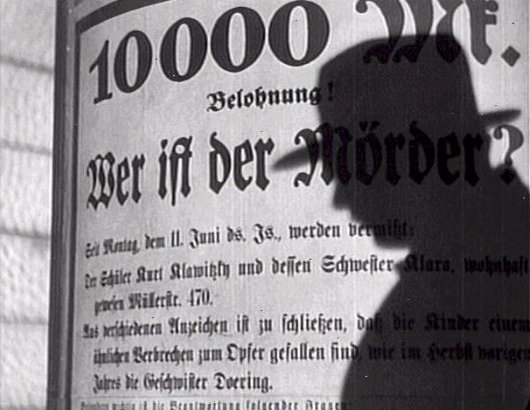
Fritz Lang’s «Metropolis» was one of the most groundbreaking films of the silent era, and so the news that scenes previously lost have been rediscovered is most welcome. While «Metropolis» is one of those films that is perhaps best appreciated if only viewed once, I certainly look forward to a restored version being released in the next few years.
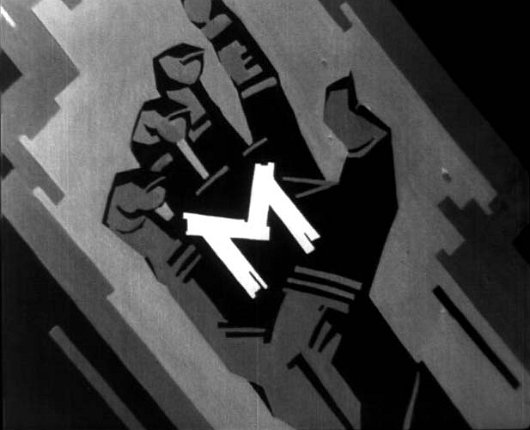
Still, my favorite of Fritz Lang’s works remains the classic «M», a sound film released in 1931, a few years into the talkie era. Peter Lorre is at his best in the starring role, and of course with Lang at the helm, «M» is expertly shot. Those whistled notes from Peer Gynt are never the same again after seeing this film!
So this is why people live in California

Jackson Street, San Francisco: 20 rooms, 9 bedrooms, 7 full bathrooms, 3 half-bathrooms, 7 fireplaces, hardwood floors, 4 storeys, an elevator, 4-car garage, and off-street parking.
The European I grew up with
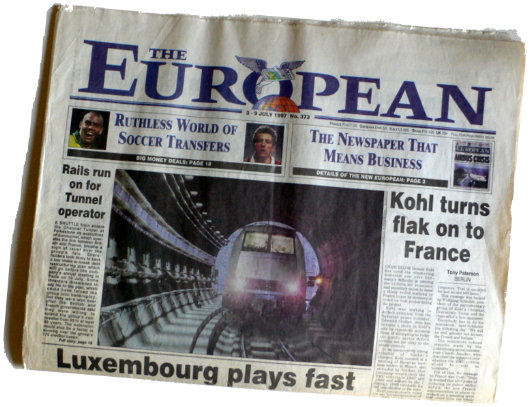
When I was a kid, The European — the weekly broadsheet that billed itself as “Europe’s national newspaper” from 1990 to 1998 — was my favourite newspaper and was an indelible part of our Sunday routine in the Cusack household. First Mass, then a trip to the pastry shop, then pick up The European at the newsagents next door, and back home to read and munch al fresco.
The paper was fiercely Euro-federalist until Andrew Neil took over, so I suspect were I to look back on a few copies now, I would probably strongly disagree with its politics. The late Peter Ustinov was a columnist, and he was not just a European integrationist but indeed a major supporter of world federalism (i.e. the abolition of nations and the rule of the planet by a single government; in theory democratic but inevitably a dictatorship of course).
Nonetheless, it was a very broad paper, with news from all across the continent from Cork to Constantinople, and I have no doubt its coverage played at least some role in the formation of your humble and obedient scribe.
The Primera Revista Latinoamericana

We are of the opinion that the more publications, the merrier, and so we certainly welcome the foundation of the Primera Revista Latinoamerican de Libros. The PRL, which is a sort of Hispanic version of the TLS, started printing last September and is based right here in New York. The bimonthly is published in Spanish but reviews both books that are printed in Spanish and books printed in English. Again, like the TLS, it is not limited to book reviews but features other literary essays as well.

The head honcho at the PRL is Fernando Gubbins, who has earned a master’s degree in Public Affairs from Columbia here in New York and a philosophy degree from the Pontifical Catholic University of Peru. Mr. Gubbins previously edited the opinion & editorial section of the Peruvian newspaper Expreso, and has worked with the Economist Intelligence Unit.
Not being a hispanophone, I am not qualified to render judgement on the quality of the publication’s content, the PRL in print is well designed and has a very traditional but modern feel to it, and it was a pleasure flicking through its pages. The Primera Revista is a welcome addition to the literary world of New York, and of Latin America.

“The Bridge of San Luis Rey”

New Spain never looked so good as in the 2004 film of Thornton Wilder’s novel The Bridge of San Luis Rey. This is no doubt partly because it wasn’t filmed in New Spain but in Old Spain (specifically in Toledo and Málaga).

New vice-regal flag for New Zealand

Elizabeth II, Queen of New Zealand, recently approved a new vice-regal flag (above) for her governor-general, His Excellency the Honourable Anand Satyanand, PCNZM, QSO, KStJ. The flag has a blue field charged with the shield from the coat of arms of Her Majesty in Right of New Zealand, topped by St. Edward’s crown. The previous flag (below) was of the standard viceregal type for the British Commonwealth of Nations, depicting the crest from the British royal arms with a scroll bearing the name of the dominion.
His Excellency, incidentally, is the first Catholic governor-general in the history of New Zealand.

Return of the Warner!
 Gerald Warner of Craigenmaddie, one of Britain’s greatest living journalists, now has a splendid blog over at the Daily Telegraph called Is It Just Me? I am sure you will all want to take a look at it. Already he has an appreciation of the recently deceased Franz Künstler, until his death the last living soldier of the Hapsburg army, a brief missive pointing out how terribly un-British the idea of a “Britishness Day” is, and a forthright post on the value of the stiff upper lip in times of crisis.
Much of what Gerald says is, to sensible people, simply obvious. But one of the great dangers of our modern age is that what ought to be simply obvious is becoming less and less so due to deliberate obfuscation by the political and media classes. Gerald’s talent is that he tells you what’s what and that he manages to do it with a graceful alacrity, and often wit, that are a welcome — and, sadly, rare — treat. Go, read, enjoy!
Warneriana: Gerald Warner Axed | ‘The Mass of All Time answers that need’ | Martyrs of Spain, Pray for Us! | Warner on the Gotha


Search
Instagram: @andcusack
Click here for my Instagram photos.Most Recent Posts
- Brunel’s Unbuilt Capitol February 3, 2026
- Cricket at Fordham January 27, 2026
- Palacio Barolo Revisted January 14, 2026
- Learning to Love Liguria January 14, 2026
- Crux Alba No. 2 January 13, 2026
Most Recent Comments
Book Wishlist
Monthly Archives
Categories