Arts & Culture
About Andrew Cusack
 Writer, web designer, etc.; born in New York; educated in Argentina, Scotland, and South Africa; now based in London.
 read more
News
Blogs
Reviews & Periodicals
Arts & Design
World
France
Mitteleuropa
Knickerbockers
Argentina
The Levant
Africa
Cape of Good Hope
Netherlands
Scandinavia
Québec
India
Muscovy
Germany
Academica
Black Rod — Swart Roede
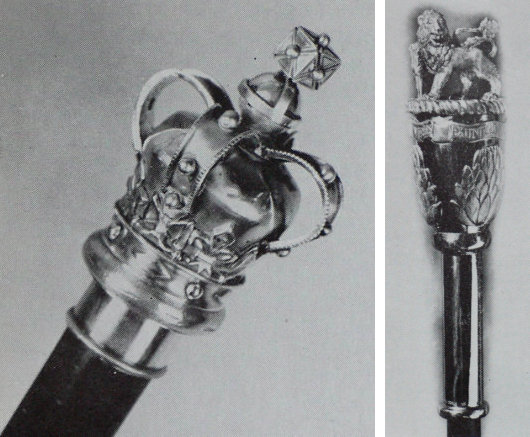
In my post on the 1947 Royal Visit to Cape Town, I mentioned just in passing the title of the Draer van Swart Roede — or the Gentleman Usher of the Black Rod, as he is known in English. Well, here is the Black Rod itself. The original South African Black Rod (left) dates from the Parliament of the Cape of Good Hope and was adopted as the Black Rod of the Union Parliament when South Africa was unified in 1910. After the abolition of the monarchy in 1961, a new Black Rod (right) was commissioned which featured protea flowers topped with the Lion crest from the South African coat of arms.
Black Rod (the person, not the staff) was the Senate’s equivalent of the House of Assembly’s sergeant-at-arms (ampswag). The first Gentleman Usher of the Black Rod in history was appointed in 1350 and the position still exists today in the British Parliament of today. Black Rod is sergeant-of-arms of the House of Lords, as well as Keeper of the Doors. The Usher’s best-known role is having the doors of the House of Commons ceremonially slammed in his face when he acts as the Crown’s messenger during each State Opening of Parliament, a ritual derived from the 1642 attempt of Charles I to arrest five members of parliament.
In South Africa, die Swart Roede traditionally wore wore a black two- or three-pointed cocked hat, a black cut-away tunic, knee breeches, silk stockings and silver-buckled shoes, but this costume of office has undergone a process of modernisation since the 1950s. After the vast expansion of the electorate in 1994 and introduction of an interim constitution, Black Rod’s title was officially shortened to “Usher of the Black Rod” to make it “gender-neutral”. (Regrettably, the Canadian Senate has also mimicked this innovation, though it is often unofficially ignored.) When a new, permanent constitution was enacted in 1997, the Senate was replaced by the National Council of Provinces as the upper house of parliament. A new Black Rod (the staff, not the person) was introduced in 2005, but is of such a garish design that it is best left uncommented upon.
L’etoile du Nord
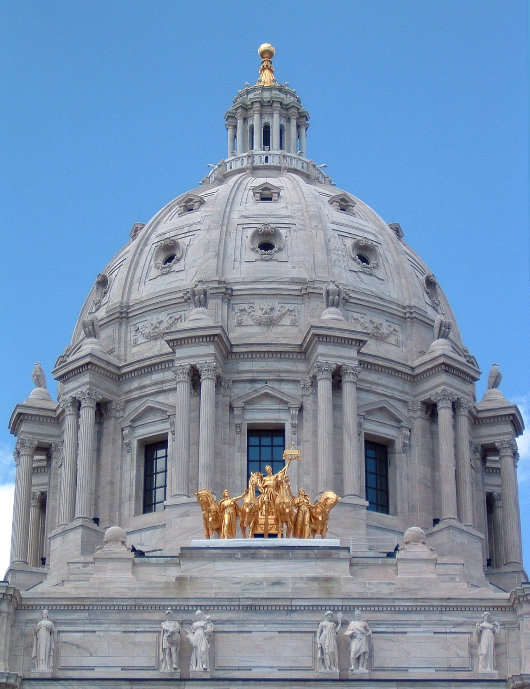
The dome of the Minnesota State Capitol, one of the finest government buildings in the New World.
Homage to Jean Seberg
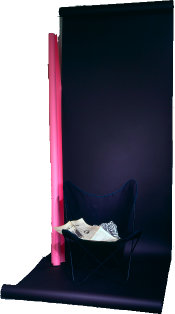 One of the earnest stalwarts of the blog was wandering around the Metropolitan recently when he came upon this curious “multi-media art work” by Barbara Bloom entitled Homage to Seberg. Bloom is a photographer, designer, and “installation artist” who was the subject of her own show at the International Center of Photography last year. This work was created in 1981 and forms part of the temporary exhibition “The Pictures Generation” at the Metropolitan Museum of Art.
The installation includes a copy of the Herald Tribune, the newspaper sold by Jean Seberg’s character in the 1960 Godard film À bout de souffle, resting one of the butterfly chairs so popular during the 1960s. Readers will remember Jean Seberg & the Trib from our post on the continued decline of the International Herald Tribune and the follow-up from the Guardian‘s media blog.
What I didn’t know was that Ms. Seberg was American, Iowa-born, and a supporter of the Black Panthers. Sadly, she died in Paris in 1979 of an overdose of barbiturates and alcohol in an incident the French authorities ruled a probable suicide. (more…)
Lord Clark
This clip of Kenneth McKenzie Clark, Baron Clark, OM, CH, KCB, FBA is from the end of his BBC documentary series Civilisation. Here Lord Clark complains about the lack of a true center, as he then could see none. Thankfully, Lord Clark found that center shortly before the end of his life, and was received into the Catholic Church.
“The great achievement of the Catholic Church,” said Lord Clark in Civilisation, “lay in harmonizing, civilising the deepest impulses of ordinary, ignorant people.”
Quebec Stamp
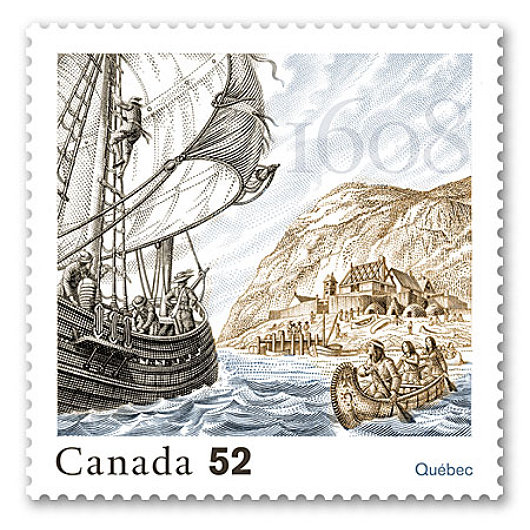
This stamp was designed by Jorge Peral, the artistic director of the Canadian Bank Note Company, for Canada Post to commemorate the four-hundredth anniversary of the foundation of Quebec.
Nature diary
by ‘REDSHANK’
St John’s Day, Midsummer Day, has come and gone, bringing to the nature diarists’ community, as the country folk call us, melancholy thoughts of the inexpugnable passage of time and of the already declining year. In our neighbourhood, St John’s Eve is a time when age-old customs, elsewhere, alas, confined to the mists of antiquity, still flourish even in these prosaic days.
 Young men and maidens, not to speak of some in neither category, forsake their clubbing to dance in the woodland glades, undeterred by ghostly commercial travellers, doomed to play solo whist among the trees for all eternity, who scarcely interrupt their play to hurl traditional insults from another world.
It is different with the watercolourists who, following another ancient custom, come trooping out from the neighbouring town to set up their easels in the woods, industriously sketching everything they see, including the indignant dancers. Many of them are retired schoolteachers recommended “remedial art therapy” by their psychiatrists, distressed gentlefolk and ordinary people lately released into the community.
All take their orders from the big, ginger-haired old fellow who seems to be their leader. From my library window I watched through powerful field glasses as he rallied them amidst the dancers, lashing out with outsize paintbrush or sharp-edged paintbox and generally giving as good as they got.
He encouraged them, too, with anecdotes of eminent painters he seems to have known well: how he and Turner saw off a gang of criminal art dealers in Petworth Park; how he and Edward Lear, attacked by bandits while painting in Albania, put them to flight by endlessly repeating Lear’s limericks.
The village folk regard him with superstitious awe. He lives, so the talk goes in the Blacksmith’s Arms, in a rambling old mansion “way out t’ other side o’ Simpleham Great Park”. He is said to be a “gurt old ‘un for t’ book learnin’.” Some say he is writing a “Book of All Known Knowledge”. Some say he is the king of all nature diarists. All believe he is a powerful enchanter.
When I called at the inn the other day, there was an animated discussion about him, carried on, of course, in the genuine old British Composite Pandialect. Jack, the retired poacher told how, when laying a trail of sultanas to trap pheasants, he had seen the big man sitting in his enchanted garden, where creatures of the wild, deemed to be extinct in other parts of England, came to his call: the speckled linnet, the ringed dotterel, the corncrake and the wolf. Jack swore he had once seen an Andean condor perching on the enchanter’s shoulder and whispering secrets in his ear.
Old Frank the waspkeeper, who has a tendency to live in the past, and contributes a “Wasp at War” feature to the local newspaper, thinks the master watercolourist is a German or even Japanese spy, using watercolours to signal to enemy airmen. All believe he and his watercolourists are creatures of ill omen, and that to speak to them brings misfortune.
Though I am inclined to smile, I am sure there is a profound rural wisdom here, far beyond the grasp of your average know-all urban intellectual.
The Young Emperor
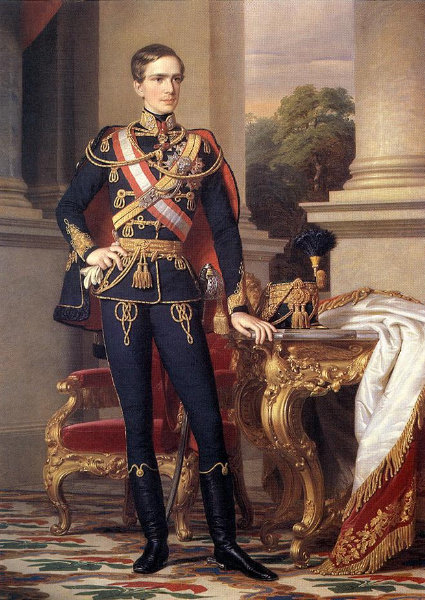
A reader notes in correspondence that Franz Joseph was not always old — though the popular conception certainly is of the Emperor in his later years. Here is the young Franz Joseph (or Ferenc József), just five years after he became Emperor of Austria, King of Hungary, Bohemia, &c. The Emperor became so at such a young age because his father, Ferdinand I, abdicated after the revolts of 1848.
This portrait is by the Hungarian painter Miklós Barabás, who also completed portraits of the composer Franz Liszt, the novelist Baron József Eötvös de Vásárosnamény, William Tierney Clark, the Bristol engineer responsible for Budapest’s famous Chain Bridge, and many, many others.
The Goerke House, Lüderitz
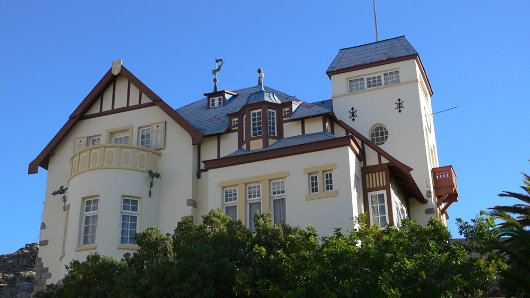
THE FAMILIAR PHRASE has a person in difficult circumstances being “between a rock and a hard place”. The Namibian town of Lüderitz is stuck between the dry sands of the desert and salt water of the South Atlantic — this is the only country whose drinking water is 100% recycled. Life in this almost-pleasant German colonial outpost on the most inhospitable coast in the world has always been something of a difficulty, but the allure of diamonds has at least made it profitable. One such adventurer who came from afar and made his fortune in this outer limit of the Teutonic domains was one Hans Goerke. (more…)
The Huguenot Monument, Franschhoek
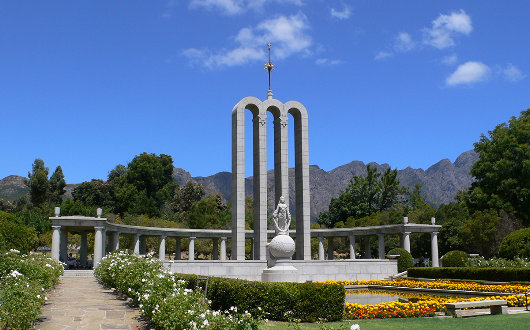
AMONG THE MANY peoples who, through the various vicissitudes of history, have found their home in South Africa are the Huguenots, or French Protestants. These people have always had a certain fascination for me, having being born so close to New Rochelle, the city in the New World founded by Huguenot refugees. The city’s public high school is a rather stately French neo-gothic chateau in the middle of Huguenot Park.
My own alma mater — a smaller private school in New Rochelle — counted Huguenot descendants among its first students and there was at least one remaining in my own school days. Street names such as Flandreau, Faneuil, and Coligni betray the French heritage of the city’s founders, and Trinity Church still has the old communion table brought over from La Rochelle. (more…)
The Saxon Palace, Warsaw

Unbenowst to me until recently, there are plans afoot to rebuild the Saxon Palace in Warsaw, though they have been — temporarily, I hope — suspended for lack of funds. The palace was almost totally destroyed in the Second World War (“The War Poland Lost Twice”), and the surviving part of the central arcade was turned into the Polish Tomb of the Unknown Soldier, now an obligatory stop for all foreign heads of state visiting the Polish capital.
The plan also provides for the neighbouring Brühl Palace to be rebuilt, to serve as the headquarters of the National Bank of Poland. Let’s hope they also decide to demolish that ugly modern monstrosity (to the right in the illustration above) that mars Piłsudski Square.
A new look for Argentina’s Herald

The Buenos Aires Herald is one of those newspapers that, by the grace of God, simply must continue existing no matter what horrors befall the newspaper industry as a whole. Finding up-to-date information on Argentina, in English, can be exceptionally frustrating and I had the Sunday version of the paper sent to me in New York every week; perfect reading for the train ride into work. Martin Gambarotta’s “Politics & Labour” column has to be one of the most informative and well-written political columns in any English-speaking newspaper. I also enjoyed the paid announcements section, informing readers of golf tournaments in aid of the Hospital Británico, meetings of the British-Argentine Chamber of Commerce, and when the next convocation of the South America Piping Association would be held. That said, when the Herald started denominating their subscription fee in dollars instead of pesos, I had to call it quits — though very reluctantly.
All the time while perusing the newspaper, however, I kept thinking “This could be better…”. Readers know how design-obsessed I am, especially when it comes to newspapers, and the Buenos Aires Herald would be such a better newspaper if they just tweaked a few things: a more judicious font choice, standardized white-spaces between columns, a few meliorations here and there. But now they’ve gone and redesigned the thing — without seeking the input of this devoted fan! — and they’ve got it all wrong. (more…)
Some reading notes
ROBERT O’BRIEN, IN a deliberately provocative gesture, once said in conversation that he pitied America for not having any literature. Preposterous! was my natural response. We have Chaucer and Shakespeare and Mallory and Dickens! Yes, you Britons have them too, but you will have to share, I’m afraid. To try to separate America from the English greats is the equivalent of forbidding a son from taking pride in his family’s long and illustrious history. He may not be the eldest male descendant, but does this mean he must deny his heritage? Of course not. Naturally, like the Scots and the Irish we have our own subset of English literature — Mark Twain, F. Scott Fitzgerald, Flannery O’Connor, and J.D. Salinger come to mind — and there are even a few crossovers such as Henry James and T.S. Eliot.
The idea of doing a degree in English or in any literature has always seemed unattractive to me, though I by no means advocate the abolition of English departments. Perhaps it’s because I rarely found English a compelling subject in high school, though I did have some extremely talented teachers: The P (as she is known), as well as Mr. Leahy. I am one of those no doubt millions who wishes he had actually read all those books he supposedly read for class at school. I did enjoy Sophocles, and Homer too, but I did not really get into Flaubert (I intend to revisit him). Crime and Punishment I soaked up at the time, but have since forgotten.
How tiresome it must be, as a formal student of literature, to be forced to answer questions about works you have read. I wonder if there should be two tracks within universities: one for gentlemen, who merely seek to learn, and another for budding academics, who need proof they’ve learnt something. Some books have taken years (and multiple readings) to truly sink in, so it seems preposterous to arbitrarily require a succinct series of answers to examination questions at the end of a term.
Idea-driven novels seem foolish to me as well. In New York, I knew a Frenchman, not much older than myself, who (I discovered) was in the midst of writing a novel. Intrigued, I asked him one day what the novel is about. He paused for a few moments, sat back, and slowly tapped his finger thrice on the table in thought, and said “Stratification”. Well! Call me a simpleton but I would have preferred “a guy, a girl, a plot, an affair, schoolmates, a day, a week . . .” anything, but “stratification”?
Well, he is writing in French, and if you are going to write an idea-driven novel, it’s probably best to do it in French.
What have I been reading lately? A few months ago I finished Erskine Childers’ The Riddle of the Sands — an absolutely cracking book. It was late in the African summer, and I was perched appropriately on the sands of Kogelbaai — one of the most stunning beaches in the Cape. What’s more, it was a weekday afternoon, and so the strand was abandoned but for our small party, so we sat, read, napped, explored the rocks, and enjoyed the beauty of our surrounds. Another cracking read was Chesterton’s The Man Who Was Thursday. The author subtitled his book “A Nightmare” and it had moments of utter fear and dread, but also, being Chesterton, moments of ridiculous farce and hilarity: a fascinating insight into the mind and mentality of a jovial and saintly man.

H.V. Morton, the man who convinced me to come to South Africa with his In Search of South Africa, showed me the Eternal City with A Traveller in Rome, and I am so tantalizingly close to finishing that magnificent work of Thomas Pakenham (now Lord Longford, since the death of his father), The Boer War. Pakenham is an historian beyond compare. I began Kristin Lavransdatter to great enjoyment, but am waiting till my return to New York to complete it. I started The Prisoner of Zenda while travelling in Namibia and finished it on Pentecost weekend. Boswell’s Johnson I found an excellent little india-paper edition of in a tiny back-alley shop in Wells last year (we ran into Michael Alexander on the street) and I’ve been pottering through it bit-by-bit. On the recommendation of Stefan Beck I picked up J.P. Donleavy’s The Ginger Man but found it obsessively vulgar and, worse, boring, so returned it to the goodly people at the Universiteit se biblioteek.
I still have out from the library a handsome, handy, small German printing of Legends of the Rhine (translated into English). I like small books, books you can easily fit in the pocket of a field coat and whip out at a moment’s notice. At a reception in a New York gallery some time ago, I learned from John Derbyshire that the determining factor of the old Penguins’ size was that it would fit in the front coat pocket of a British Army officer. The new size of Penguins are much too large to carry about as emergency reading, which makes me very glad that they’ve brought back the older, smaller size.
Penguins aside, I still prefer those shorter, fatter editions printed on thinnest india-paper. Jocelyn, my cook at university, gave me such a copy of The Pickwick Papers (inscribed “To Andrew Cusack — one of the most Pickwickian individuals I have ever met”) for my birthday one year, and it is one of the dearest editions I own. Does anyone print on india-paper anymore? I suspect not, and more’s the pity. Michael Wharton (better known as Peter Simple) noted shortly before his death how difficult it was becoming to obtain sheets of foolscap in London. Thus passes the glories of the world…
Cropsey in the City
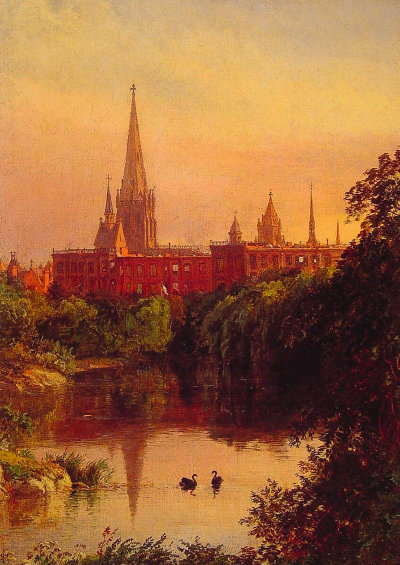
Jasper Francis Cropsey, A View in Central Park — The Spire of Dr. Hall’s Church in the Distance
Oil on canvas, 17⅛ in. x 12⅛ in.
1880, Private collection
THE HUDSON RIVER SCHOOL artist Jasper Francis Cropsey has obtained of late an almost cult-like following, the kool-aid being distributed from the well-oiled machinery of the Newington-Cropsey Foundation in Hastings-on-Hudson, New York. Whether the object of worship is worthy of the faithful’s adulation is a matter of some speculation, but it’s admittedly refreshing to see a fan base surrounding a painter of the old school rather than one of the numerous gimmicky hacks floating around the New York art scene these days. Cropsey (like most Hudson River painters) is known for his luscious landscapes, so I thought it markedly unusual when I stumbled upon this painting, a cityscape. The artist’s vantage point is from The Pond in Central Park, looking over Fifty-ninth Street (Central Park South) towards where the old Plaza Hotel now stands. (more…)
A Classical Summer in New York
ICA&CA 2009 Fellows’ Summer Lecture Series
 One of our greatest institutions here in New York is the Institute of Classical Architecture & Classical America which does such splendid work in propagating knowledge about and training in classical architecture and its allied arts. Every summer the ICA&CA presents a series of summer lectures, the first of which takes place next Wednesday. This year the series will be held in the library of the General Society (f. 1785), New York’s last remaining guild, whose 44th Street headquarters house the Institute’s offices.
In celebration of the quadricentennial of Captain Henry Hudson’s
sailing expedition on the river that now bears his name.
The Sanctified Landscape: Memory, Place, and the Mid-Hudson Valley in the Nineteenth Century
by Dr. David Schuyler, Professor of American Studies, Franklin & Marshall College. Sponsored by Hammersmith Studios.
17 June 2009
A Geography of the Ideal: The Hudson River and the Hudson River School
by Linda Ferber PhD, Executive Vice President & Museum Director of the New-York Historical Society. Sponsored by P.E. Guerin, Inc.
24 June 2009
Historic Hudson River Houses 1663-1915
by Gregory Long, President and CEO of The New York Botanical Garden. Sponsored by Peter Cosola, Inc.
8 July 2009
Edgewater: Building Classical Architecture along the Hudson River
by Michael Middleton Dwyer, architect and editor (Great Houses of the Hudson River, Bullfinch Press, 2001). Sponsored by Andrew V. Giambertone and Associates, Architects, PC.
General Society Library
No. 20, West 44th Street
Receptions at 6:30 pm
Lectures to follow at 7:00 pm
The ICA&CA Summer Lecture Series is free to ICA&CA Members and employees of Professional Member Firms, as well as all students with current identification. General Admission is $20 per lecture; $65 for the full series. Click here to become a member.
This program is supported, in part, by public funds from the New York Council for the Humanities and the New York City Department of Cultural Affairs. Special thanks to Balmer Architectural Mouldings.
St. Stephen and the Virgin & Child

The Hungarian Bishops’ Conference has a surprisingly handsome logo (above) depicting their patronal saint, King Stephen I, bestowing his crown to the Blessed Virgin and Our Saviour. Some might think the depiction of the Madonna & Child a touch too cartoonish, but I enjoy it.
The Tappan Zee in the Age of Rig & Sail
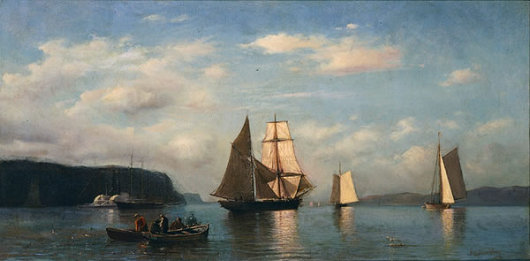
Julian Oliver Davidson, The Hudson River from the Tappan Zee
Oil on canvas, (size not on record)
1871, Private collection
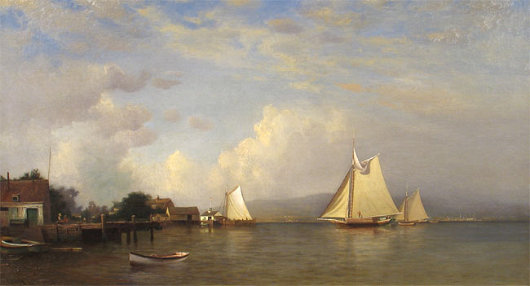
Francis Augustus Silva, On the Hudson near Tappan Zee
Oil on canvas, 20 in. x 36 in.
1880, Private collection
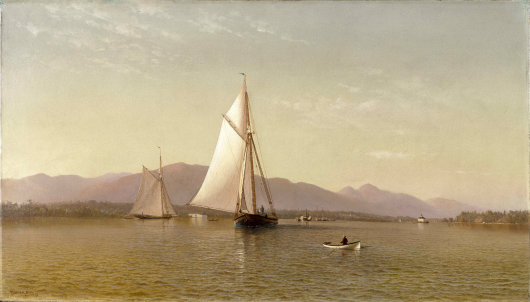
Francis Augustus Silva, The Hudson at the Tappan Zee
Oil on canvas, 24 in. x 42 3/16 in.
1876, Brooklyn Museum
Books Cusack Currently Lacks
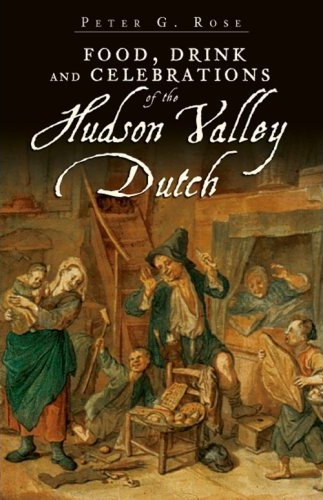
Food is one of those perpetual worries to those poor souls such as myself for whom the arts of the kitchen are simply incomprehensible. One of the reasons I miss St Andrews was the ready availability of a well-balanced meal at three regular times of the day, even if it was hall food. I sometimes wonder if some earnest benefactor concerned for the well-being of young men recently graduated from old universities might establish a hall-away-from-hall in the major metropolises, in which batchelors can live with decent meals composed of plenty of vegetables and sausages and other such necessities until the uxorial hour strikes.
Anyhow, I stumbled across the existence of the above book, Food, Drink and Celebrations of the Hudson Valley Dutch and am always stumbling across various books of interest, but always either forgetting to purchase them or else pleading poverty (to the ire of the assiduous caretakers of the Cusack library). Amazon, however, allows the user to create a “wish list” of items detailing items one desires which others may purchase and have sent to them; a fine idea. I have assembled a list (currently numbering fifty-two books over three pages) and warmly invite those so inclined to advance the cause of Western Civilization by augmenting the hallowed stacks of my library.
You can view the list by priority, by price low-to-high (irritatingly putting the books available through third parties first), or, for the particularly generous, by price high-to-low.
Some of these (like Paddy Leigh Fermor) are books I have already read but don’t own any copies of, but most of the titles are books I’ve either read reviews of, have flipped through the pages of in bookshops, or which have been recommended by friends. (Some, like Wilhelm Röpke: Swiss Localist, Global Economist, are even by friends). There are also a few advantageously-priced editions from New York Review Books. Have a look, and send along recommendations!
The Tele-tab

The Daily Telegraph prides itself on being Britain’s top-selling quality daily newspaper, but the dear old Telly has being playing tabloid of late. Compare this 2004 front page (left) to one of just a few days ago (right).
The point of a headline in a quality newspaper should be to inform the reader of what the article is about, as well as to impart information quickly to those who are scanning the page. “Payback time” the Telegraph boldy asserts, but what on earth does that tell us? Nothing; we have to go to the subheadline to find out “Cameron orders Tories to refund excessive expenses; Hazel Blears to meet £13,332 tax bill on second home”.
There is an art in creating a headline that is both punchy and informative without being vulgar, but the Telegraph seems to have abandoned this art — for now, at least.
A new look for The Walrus

The Walrus is Canada’s general-interest magazine, a sort of New Yorker for the Great White North. Founded just a few years back in 2003, it has taken many of its visual cues from The New Yorker and the result has been a very handsome monthly and a surprisingly interesting one. That’s not to say that it’s a very interesting magazine (like The Spectator), but one which surprises with the occasional article of note. Canada’s intelligentsia is notoriously boring and liberal; they tend to sneer at the neighbouring United States while simultaneously attacking long-held Canadian traditions. For some reason, Canadian intellectuals have yet to comprehend that making Canada less British doesn’t make it more Canadian but instead more American because it is precisely Canada’s Britishness that distinguishes the Great Dominion from the republic to the south.
Allies Day, May 1917
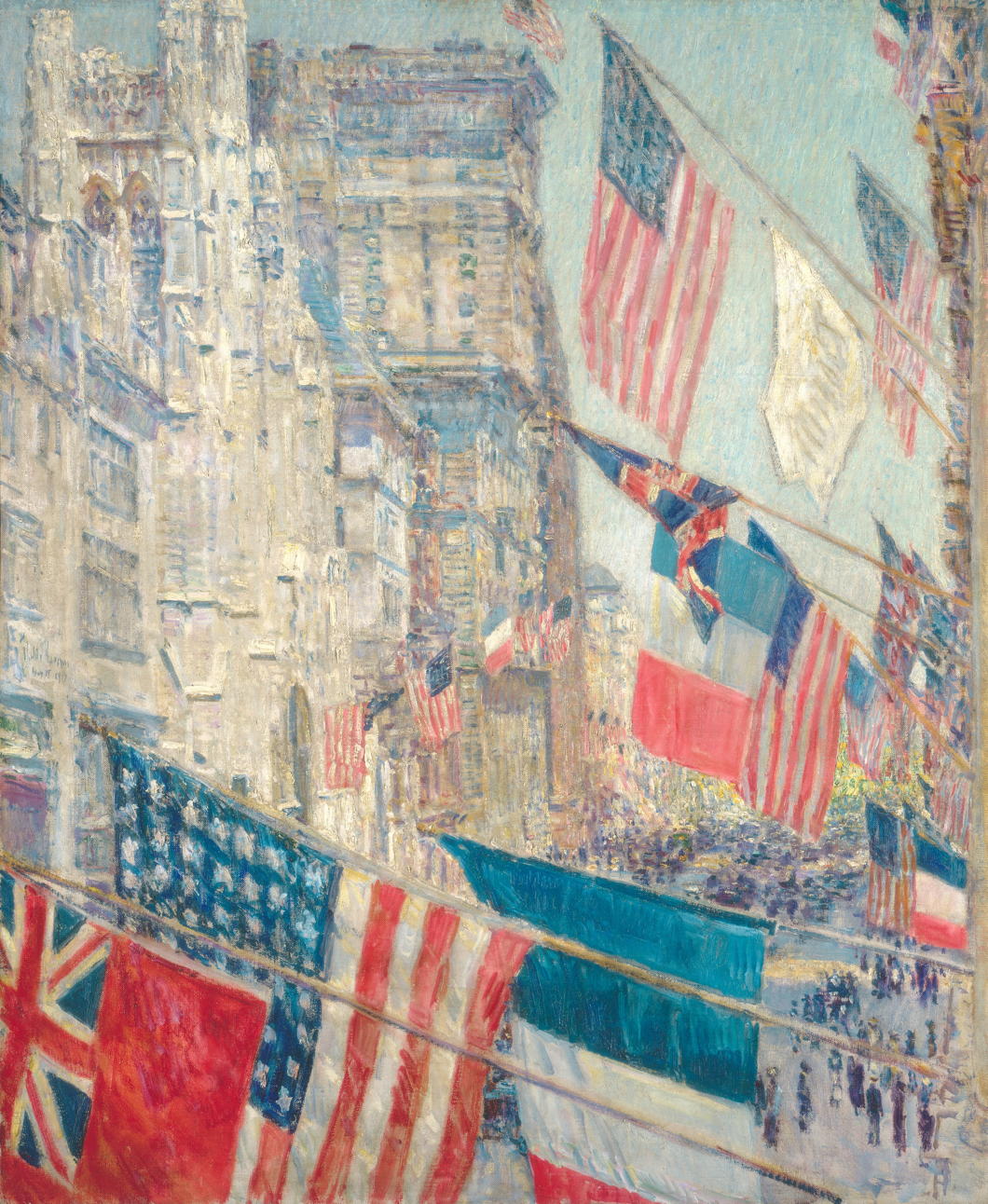
Childe Hassam, Allies Day, May 1917
Oil on canvas, 36½ in. x 30¼ in.
1917, National Gallery of Art (U.S.)
This has long been one of my favourite paintings, ever since I first saw it one day when I was very young while it was on loan to the Metropolitan. On a May day in 1917, Fifth Avenue was temporarily proclaimed “the Avenue of the Allies” and the British and French commissioners paraded down the boulevard with great ceremony. Childe Hassam set his easel on a balcony on the corner of Fifth Avenue and 52nd Street and took in the splendid scene towards the Church of St. Thomas and the University Club. Patriotic displays were much more lively then, involving bursts of flags and banners, than the rather dull and monotonous display of the single Stars-and-Stripes that became widespread after the World Trade Center attacks.
Interestingly, “Avenue of the Allies” aside, the United States was not actually allied to France and Great Britain during the First World War. President Wilson thought the United States was not so lowly as to merely intervene in a biased manner on the side of those it had lent money, but rather for the high-minded goal of establishing justice (or, as we might honestly call it, the destruction of Catholic Europe). The U.S., then, was merely a “co-belligerent” rather than an “ally”, though obviously this high-minded euphemism was lost on most people. During the Second World War, Finland found itself invaded by the Soviet Union and abandoned by the West, so — having no taste for Hitler and his Nazi charades — they became “co-belligerents” with Germany, rather than concluding a more distasteful alliance.
Hassam, who died in 1935, had little time for the avant-garde schools of art that came after the Impressionism he practised, and described modernist painters, critics, and art dealers as a cabal of “art boobys”. He was almost forgotten in the decades after his death, but the rising tide of interest in Impressionism from the 1970s onwards lifted even the boats of American Impressionists, and his Flags series of paintings are widely-known and much-loved today.
Search
Instagram: @andcusack
Click here for my Instagram photos.Most Recent Posts
- Brunel’s Unbuilt Capitol February 3, 2026
- Cricket at Fordham January 27, 2026
- Palacio Barolo Revisted January 14, 2026
- Learning to Love Liguria January 14, 2026
- Crux Alba No. 2 January 13, 2026
Most Recent Comments
Book Wishlist
Monthly Archives
Categories