Arts & Culture
About Andrew Cusack
 Writer, web designer, etc.; born in New York; educated in Argentina, Scotland, and South Africa; now based in London.
 read more
News
Blogs
Reviews & Periodicals
Arts & Design
World
France
Mitteleuropa
Knickerbockers
Argentina
The Levant
Africa
Cape of Good Hope
Netherlands
Scandinavia
Québec
India
Muscovy
Germany
Academica
The Church of Howard Johnson
Beware disgruntled anthroposophists
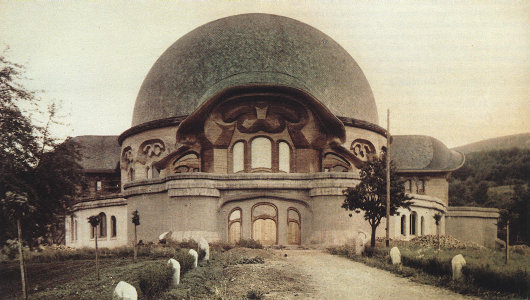
Readers will be interested to learn that two friends of mine, Mr. Stephen Klimczuk and The Much Honoured The Laird Gerald Warner of Craiggenmaddie, have collaborated on a book that looks to be of great interest. Secret Places, Hidden Sanctuaries depicts in detail many of the world’s secret nooks and crannies, from mystical sites to enigmatic bolt-holes, debunking myths and positing plausible theories along the way.
After taking an enticing gander at the book’s table of contents, it’s worth popping over to “Curated Secrets”, the blog through which the book’s two authors correspond with one another. The blog already features a picture of the first Goetheanum, the original world center of Rudolf Steiner’s movement that was burnt down by a disgruntled anthroposophist on New Year’s Eve 1922.
Nature diary
by ‘REDSHANK’
To many, the end of summer and onset of autumn brings melancholy thoughts but for us in the nature diarist community it has many consolations as the season unfolds, bringing all the traditional customs still observed in our part of the countryside.
Old Seth the wasp-keeper, last of a dying breed, has now celebrated the age-old custom of “telling the wasps”, when he gathers his vespine charges about him and confides, with their buzzing approval, all the notable events that are taking place in our neighbourhood: actual and grievous bodily harm, rape, fraud and the formation of new gangs of hooligans of ever-increasing ferocity.
 This is the season when late groups of water colourists invade our neighbourhood with their easels and brushes, under the aegis of the big ginger-haired old fellow who seems to hold them in a state of awe and even terror, making no secret of his utter contempt for their efforts.
“Now pay attention!” he can be heard roaring miles away. “First get control of your picture space. I well remember my old friend Jack Constable telling me that command of your picture space was half the battle, and you could forget all about composition, structure, tonal harmony, conceptual values and all the rest of the stuff you learnt at art school.”
His group of amateur artists, mostly pensioners and elderly people who have been advised by their psychiatrists to get something to do, and old ladies who seem unable to distinguish between paintbrushes and knitting needles, received his advice with reverence, positively elated that he should speak to them at all.
I felt rather sorry for them, but mindful of the belief, common among the village people, that any contact with these strange folk can bring misfortune, I did not intervene, even when a pathetic old pensioner with several hearing aids grasped my arm and begged me wordlessly for help.
The whole group disappeared over the brow of Mandelson’s Hill preceded by the ginger-haired leader, who is still shouting about “Bill” Monet and other eminent painters he had known, waving an outsized paintbrush, and I saw them no more.
Oddly enough, the country folk have great respect for him and seem to regard him as some kind of enchanter. Certainly they believe that all the creatures of the wild, from magpies to badgers, will come to his call. He lives in a big rambling old house with a large overgrown garden where he can be seen sitting and meditating on the secrets of nature. Old Frank the gamekeeper swears that once, peering through a gap in the garden wall, he saw him sitting amid the brambles and deadly nightshade with a huge Andean condor perched on his shoulder as he whispered his secrets to it.
The country folk call this enchanted garden “an European eco-habitat” and are agitating for an official warden with a degree in environmental studies.
The Rhodes Memorial
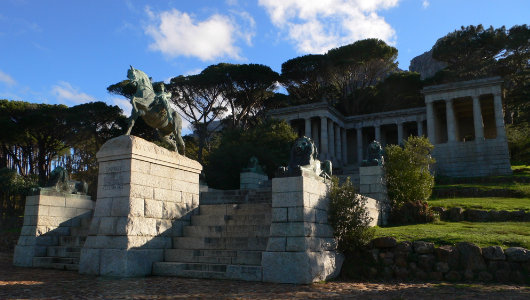
PERCHED AMID THE bluegum trees on the slopes of Devil’s Peak in Cape Town is the memorial to one of the most brilliant & cunning men the world has ever produced. Cecil John Rhodes may have been born in Bishop’s Stortford, England, but his worldly glories all emanated from the Cape of Good Hope, and so it’s appropriate that his memorial stands here in Cape Town. His first commercial enterprise in South Africa was founding the Rhodes Fruit Farms (now Rhodes Food Group) which still exist on the road from Stellenbosch to Franschhoek, and has since expanded throughout the Western Cape, and to the Transvaal and Swaziland. But it was his creation of the diamond monopoly De Beers out of the Kimberley mines that made him one of the wealthiest men in the world. Ten years after being elected to the Cape Parliament, he was made Prime Minister of the Cape in 1890, but his catastrophic and illegal attempt to seize the independent Transvaal in 1895 forced his resignation from politics in disgrace. (more…)
The Union Defence Force
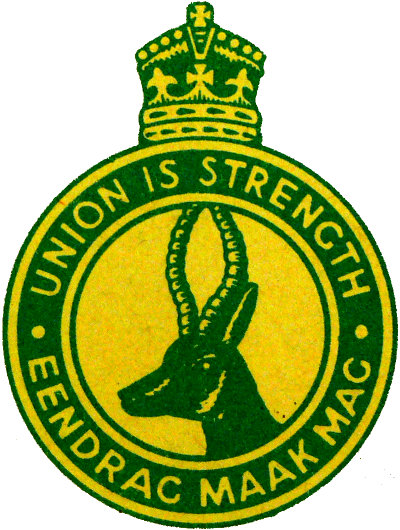
From 1912 to 1957, South Africa’s military was called the Union Defence Force (the Union in question being the Union of South Africa, the other USA). The Nationalist government renamed it the South African Defence Force (Suid-Afrikaanse Weermag) in 1957, prior to the declaration of the Republic of South Africa in 1961. After the introduction of universal suffrage in 1994, the SADF was merged with the MK (Umkhonto we Sizwe, the ANC’s terror branch) and APLA (Azanian People’s Liberation Army, the terrorist wing of the Pan-Africanist Congress), as well as the Self-Protection Units of Prince Mangosuthu Buthelezi’s Inkatha Freedom Party, into the South African National Defense Force (SANDF, or SANDEF), which remains the name of the country’s armed forces today.
The University of Dublin
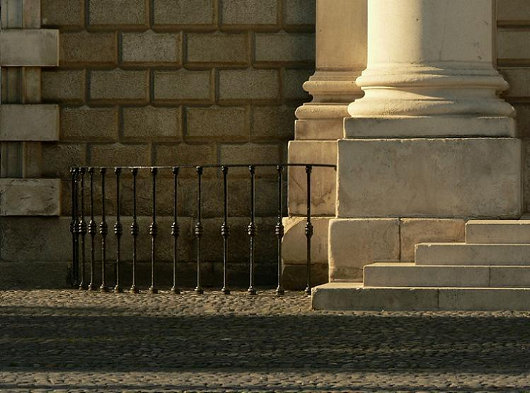
Founded in 1592, the University of Dublin is the youngest of the ancient universities of Great Britain & Ireland. (It’s ten years younger than the next youngest, Edinburgh, and nearly five-hundred years younger than the oldest, Oxford). On Archiseek, an Irish internet forum dedicated to architecture, there is a user named ‘grahamh’ who posts, from time to time, photographs he has taken from around the fair city of Dublin, of which those presented here are a selection. The University of Dublin is much more commonly known as Trinity College, Dublin, as the university has just the one college, unlike the multi-collegiate universities of Oxford, Cambridge, and elsewhere. (more…)
Il degrado della lingua italiana
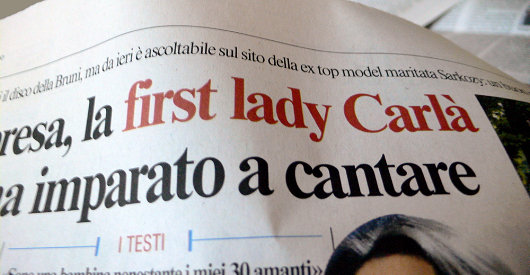
The French are always the one’s worrying about the revolting infiltration of English upon their beautiful and august language — and rightly so — but in my experience it is the Italians who should be worrying. One need only look at their newspapers to see the wretched expansion of English into one of the most beautiful languages of Europe, and indeed the world. Carla Bruni is “la first lady”? What’s wrong with “prima signora” or some other such equivalent. (more…)
Crosses Return to Columbia Crown
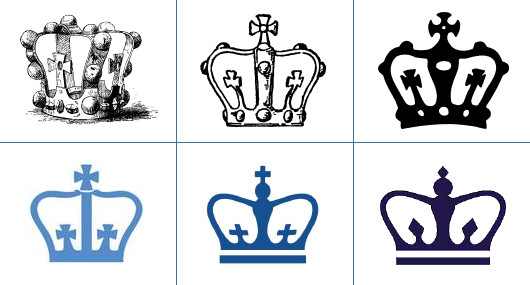
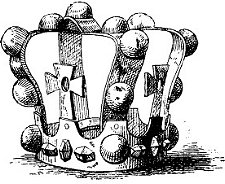 AFTER AN ABSENCE of some years, Columbia University has returned the crosses to its official crown emblem. The crosses had been missing since March 2004, when they were replaced with trapezoidal lozenges, but the more historic cross design has quietly returned to favour as the Ivy League institution’s official symbol. Columbia was founded in 1784, but claims the earlier heritage of King’s College, founded in 1754 but exiled to Nova Scotia, where it now has university status, after the tumult of the American Revolution. A copper crown (right) was originally attached to the cupola of College Hall, King’s College’s home in the colonial city of New York. When Columbia was founded in 1784, a year after New York’s independence was recognized, the state legislature gave the property and endowment of King’s College to the new Columbia College, which was organized by the remaining non-Loyalist members of King’s College. (more…)
Flammen & Citronen
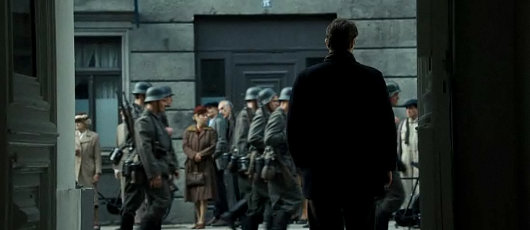
IT’S NOT VERY OFTEN that a big-budget period film comes out of Scandinavia, but recently there’ve been not one, but two. Here mentioned is the Danish film “Flammen & Citronen”, an action-drama based on the Second World War actions of Bent Faurschou-Hviid (nicknamed “Flame”) and Jørgen Haagen Schmith (“Citron”). Faurschou-Hviid and Schmith were members of the Holder Danske group, a Danish resistance organization primarily composed of Danes who had previously fought for Finland against the Soviet Union in the Winter War of 1939-1940. (more…)

Wisconsin Baroque, Priests, and Paper Architecture
Matthew G. Alderman
Taken from: Dappled Things, Ss. Peter & Paul, 2009
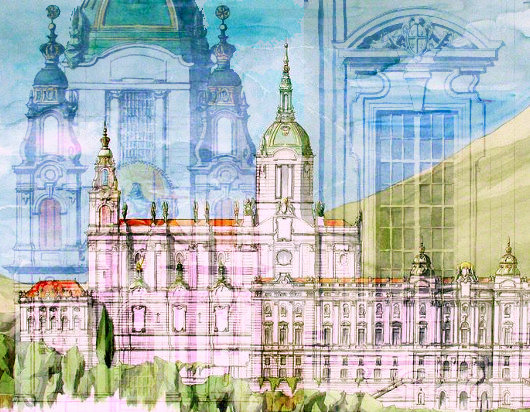
MY FAVORITE BUILDINGS never got around to being built. Some, like Sir Edwin Lutyen’s majestic design for Liverpool Cathedral, fell victim to budget cuts and the vagaries of history. Others were consigned by good taste, or occasionally outright timidity, to competition honorable mentions, and still others, like numerous student proposals or visionary dreams—like Boulée’s alarming hemispherical cenotaph for Newton, or an imaginary papal palace in Jerusalem cooked up by one of the votaries of the Vienna Sezession—weren’t terribly serious to begin with, unfortunately.
Note that I say favorite buildings, my own personal favorites, rather than the best or the most beautiful. Lutyens’ and Boulée’s fantasies may cross into that sublime territory of beauty by the power of their imaginative vision, but so many of the others owe their charm to their dreamlike extravagances, their intriguing if perhaps incomplete answers. An architect’s education lies in gathering up such fragmentary answers for the questions he will face down the road from clients and patrons. And therein lies the lure, and the value, of paper architecture.
I, like most of my colleagues, spent much of my time in school devising such useful fantasies, sometimes grand, sometimes small. Yet, they were not castles in the air. Each, while often existing in something like the best of all possible worlds in terms of budget and client, was grounded by an actual site and the laws of nature.
The most elaborate of all was my thesis project. It was an imaginary American seminary for a very real religious order, the fast-growing Institute of Christ the King, Sovereign Priest. This new congregation, dedicated to evangelization through the beauty of art, music, and the traditional Latin Mass, started out in, of all places, Gabon in Africa, but its present headquarters lies in Tuscany, in a villa bursting at the seams with seminarians in formation. While their ranks are dominated by Germans and Frenchmen, the increasing number of American clergy and their recent erection of a number of apostolates scattered across the Midwest suggested that a seminary in the United States, if not planned, might at least make for a plausible student project. Also, they seemed to have adventurous taste. I have since developed a passion for the Gothic but my first love has always been the Italian baroque. Perhaps they might be open to its vigorous beauty.
I garnered an award for the end result, the Rambusch Prize for Religious Architecture, and my putative patrons wanted copies of my enormous presentation watercolors to hang on their office walls—though, of course, the seminary would forever remain unbuilt. Its gigantic scale—typical for a student project—put it outside budgetary reach, unless, as someone cheerfully quipped, Bill Gates converted. Yet, the design was logical, consistent, and helped hone design skills I use every day at my drafting board.
The notion for the seminary came shortly after my first real-life encounter with the Institute’s work. My friends and I were road-tripping through the hill country of central Wisconsin, thick with vivid fall colors, and had just come back from a serene, silent low Mass and a long, talkative, private tour of St. Mary’s Oratory in Wausau. The Institute had transformed from a bland Midwestern Gothic to a dazzling near-replica of a fourteenth-century Bavarian court chapel. Bill Gates or no, these priests think big. Since then, they’ve overhauled a historic church in downtown Kansas City, and they’re presently turning their American priory from a burnt-out shell in a borderline south-side Chicago neighborhood into something out of Counter-Reformation Rome, and I have no doubt they’re going to succeed. Lest these projects seem like archaeological transplants, they are in fact derived from a logical extrapolation from local Catholic culture—Chicago’s colorful Polish cathedrals brought back to their ultramontane source, or, as I had just discovered, Midwestern Gothic returned to its Germanic roots. (more…)
Leeuwenhof
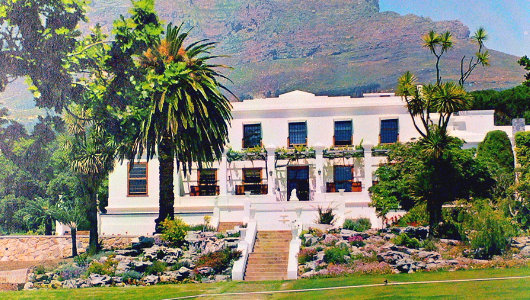
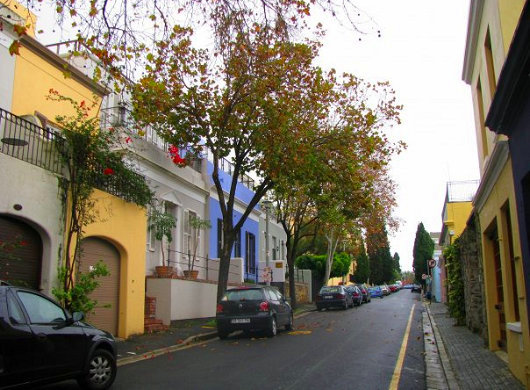
One of the better aspects of the job of Premier of the Western Cape is Leeuwenhof, the official residence that comes with the job. The estate on the slopes of Table Mountain dates from the days of the Dutch East India Company. That renowned governor of old, Simon van der Stel (after whom both Simonstad & Stellenbosch are named), granted the land to Guillaum Heems, a free burgher, to ‘clear, plant, plough, develop and work’. Heems christened the land Leeuwenhof — “Lions Court” — but sold it just two years later to Heinrich Bernhard Oldenland, Master Gardener of the Company’s Garden and Superintendent of Works for the Dutch East India Company.
Oldenland died just a few months after purchasing Leeuwenhof, and it passed into the hands of the fiscal Blesius, whose widow’s death put the estate under a series of masters until it was sold it for 14,000 guilders to Johan Christiaan Brasler, a Dane. Brasler enjoyed a good many years there in prosperity of late-eighteenth-century Cape Town, a period when the building of stately homes, townhouses, and government buildings became (as Cornelis de Jong put it at the time) “a passion, a craziness, a contagious madness that has infected nearly everyone”. This was the age of Thibault, Anreith, and Schutte — the true golden age of Cape Town’s stately finery. Inspired by the “madness” of which De Jong tells, the Dane Brasler converted the humble farmhouse of Leeuwenhof into the dignified abode we know today. (more…)
Die Koninkryk van die Swart Pelikaan
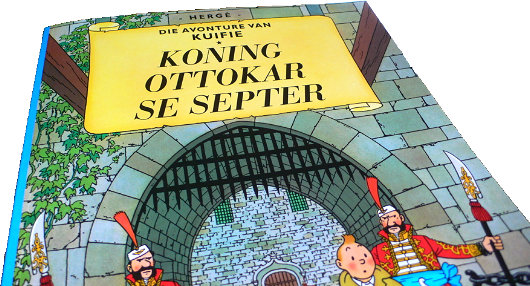
SYLDAVIA IS MY favourite country in the world. The buildings are old, the peasants are happy, and the king is ruling from his throne. Adding to my collection of Tintin books, the preponderance of which remain in New York, I know have three Afrikaans editions of Hergé’s works: Die Blou Lotus, Die Geheim van ‘De Eenhoorn’, and — my preferred among all the Tintin books — Koning Ottokar se Septer. Aside from Afrikaans, the rest of my copies are all either in French or English. I have a copy of the reprinted Tintin au Pays des Soviets and I just recently bought a copy of Tintin in the Congo, as I figured the European Union’s attempt to ban the book might make it harder to come by in years to come. I bought a copy of Le Sceptre d’Ottokar in a gas station in Brittany, one of the six special editions with a preface by Bernard Tordeur of the Hergé Foundation released in 1999/2000. Aside from Au Pays des Soviets & Le Sceptre, the only other French editions I have are L’Île Noire and Le Lotus bleu. (more…)
Avenida de Mayo
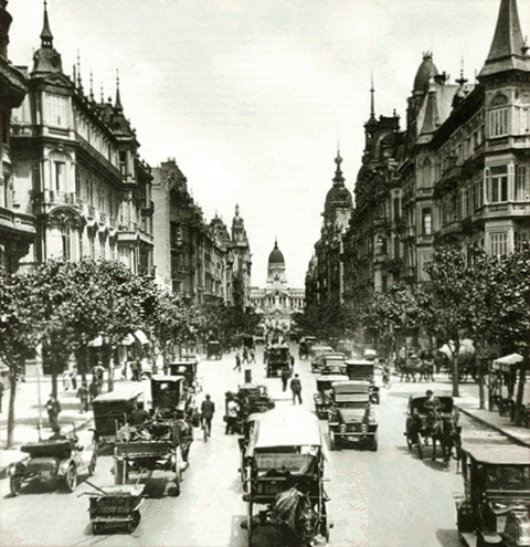
Looking down the Avenida de Mayo towards the Argentine Congress in the 1910s.
Austin Reed
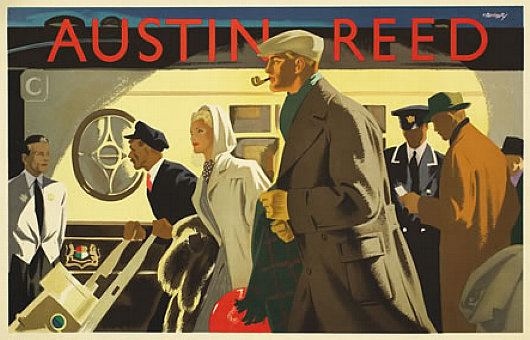
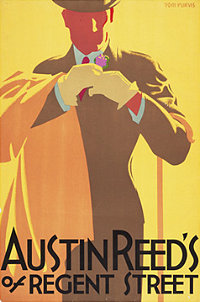 The London mens’ clothier Austin Reed was founded in 1900 and set up shop in Regent Street in 1926 as the first men’s department store. The clothes were aimed at the upper middle class male, and the firm commissioned some of the best illustrator-designers of the day to promote its brand. The above poster, “Wagon-Lits”, is by a designer named Bomarry, about whom I can find absolutely nothing — surprising in this Age of Google.
The remaining posters presented here are from the Bristol-born Tom Purvis, one of the finest commercial artists of the twentieth century. Purvis came from an artistic family, being the son of the sailor & nautical artist T. G. Purvis. Much of his output was work for LNER — the London & North Eastern Railway — producing posters advertising the various attractions to be found along the LNER’s routes from London to Edinburgh (via York & Newcastle) and on to Aberdeen and Inverness; the railway also had an extensive coverage of East Anglia. In 1936 he was among the first to be given the title of Royal Designer for Industry, but he gave up poster design after the Second World War to concentrate on portraits and religious themes. (more…)
Search
Instagram: @andcusack
Click here for my Instagram photos.Most Recent Posts
- Brunel’s Unbuilt Capitol February 3, 2026
- Cricket at Fordham January 27, 2026
- Palacio Barolo Revisted January 14, 2026
- Learning to Love Liguria January 14, 2026
- Crux Alba No. 2 January 13, 2026
Most Recent Comments
Book Wishlist
Monthly Archives
Categories