Arts & Culture
About Andrew Cusack
 Writer, web designer, etc.; born in New York; educated in Argentina, Scotland, and South Africa; now based in London.
 read more
News
Blogs
Reviews & Periodicals
Arts & Design
World
France
Mitteleuropa
Knickerbockers
Argentina
The Levant
Africa
Cape of Good Hope
Netherlands
Scandinavia
Québec
India
Muscovy
Germany
Academica
The Dovecot at Alphen (1989)
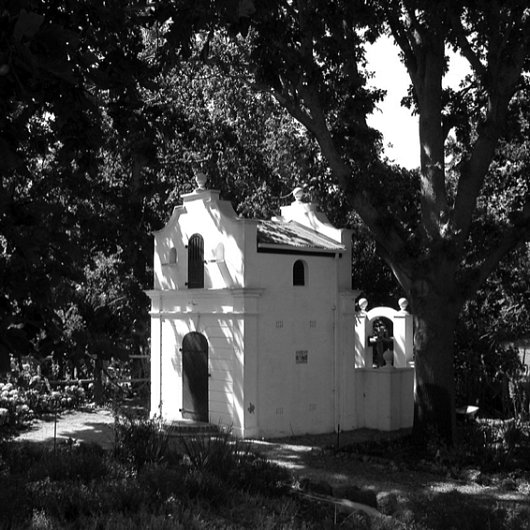
ESTABLISHED in 1714, Alphen is one of the legendary estates of the Cape Peninsula: Dr. James Barry duelled on the south terrace with Josias Cloete, and its guests include the illustrious names of Mark Twain, Cecil Rhodes, Field Marshal Smuts, and many more. While it once covered most of northern Constantia, the estate was much reduced during the twentieth century (and the M3 Simon van der Stel Freeway was built through its vineyards), Alphen, now a country-house hotel, is growing once again in the hands of the latest generation of Cloetes.
In 1989, the council authorities visited Alphen and declared that an electric substation must be built on the site or the hotel be forced to close. The ancient electric supply lines had, it turned out, been constructed illegally, and there was some danger of fire unless a substation was built on the Alphen property itself.
“Horrified we said there must be some other way,” writes Nicky Cloete-Hopkins (in the Journal of the Vernacular Architecture Society of South Africa). “There wasn’t, and Dudley [Cloete-Hopkins] said to Dirk [Visser, architect], who had been working with us for about five years by that time, ‘Disguise it as a folly or something.’”
“The ideal site for ours was … on the banks of the Diep River, at the end of a path leading from the 1772 water mill. It was in line with the strict grid pattern of the farm complex and gardens, much of which had been destroyed in the early and mid part of the twentieth century. We briefed Dirk to have fun, create a ‘folly’ and incorporate the Mitford-Barberton crucifix and family plaques from a Garden of Remembrance, demolished after the farm was subdivided.” Ella Lou O’Meara was later commissioned to do a family tree in tile for the Garden wall.
“Dirk suggested the dovecote — although we have had difficulty in keeping doves there. A little flamboyance has often enhanced the severity of the architecture at Alphen, and Dirk’s sketches for the proposed dovecote delighted us.”
Alphen and its great square of farm buildings had been designated a National Monument — akin to landmarking in the U.S. or listing a building in Britain — and so changes or additions needed to meet with the approval of certain historic advisors. “The builders had nearly completed their work when the then National Monuments Council sent representatives to inspect it. They commented that the design was not ‘honest’ and that we were fooling the public in making it look like a historic building.”
Mrs. Cloete-Hopkins wondered if the NMC wanted them to build something horrifically functional in the middle of a historic site for the sake of “honesty” or whether they wanted them to “erect something ultra-modern” like the new Louvre pyramid that was causing controversy at the time. “In any event it was too late to look at alternatives and I happily satisfied requirements by putting the date and the name of the architect and builder on the side of the building.”
A wise compromise and, like the dovecot/substation itself, informed by precedent.
Dino Marcantonio Hath a Blog!
Dino Marcantonio, habitual luncheon companion of your humble & obedient scribe, not to mention frequent commenter upon this little corner of the web, has entered into the realms of blogging himself. You can find his musings on the theory and practice of architecture here. They make for some pretty good reading so far.
An Old Dutch Holdout
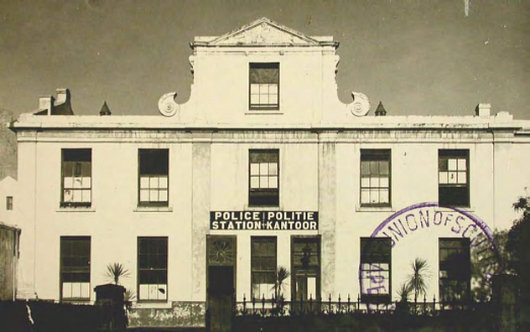
The sign on the façade of No. 7 Wale Street, Cape Town in this 1891 photo informs us of its status as a police station in the two official languages of the day, English and Dutch, not Afrikaans. ‘Politie’ is the Dutch word for Police, while the Afrikaans is ‘Polisie’. Afrikaans only became an official language of South Africa in 1925, but was so alongside Dutch and English until 1961, when Dutch was finally dropped.
This beautiful old Dutch townhouse, with its typical dak-kamer atop, didn’t survive as late as 1961. The Provinsiale-gebou, home to the Western Cape Provincial Parliament, was built on the site in the 1930s. Those who viewed the 2009 AMC/ITV reinterpretation of “The Prisoner” might remember an outdoors nighttime city scene after the main character leaves a diner, with the street sign proclaiming “Madison Ave.” and plenty of yellow New York taxicabs streaming past. The large arches in the background are the front of the Provinsiale-gebou.
Stoddart’s Ode to Ossian
The Queen’s Sculptor Plans Great Literary Monument in the West of Scotland
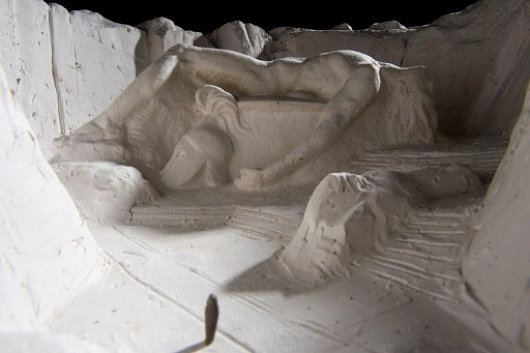
Word reaches me that Alexander Stoddart, the Queen’s Sculptor in Ordinary for Scotland, has dreamed up a massive monument to Ossian. “For fifteen years Stoddart has planned ‘a national Ossianic monument’ on the west coast of Scotland,” writes Ian Jack in The Guardian. “The scale is immense. Stoddart wants a great amphitheatre cut into the rock with Ossian’s dead son, Oscar, also cut from rock, prone on his shield on the amphitheatre’s floor.” The project would be the biggest literary monument in the world, surpassing the Scott Monument on Princes Street in Edinburgh. It could be the project of a lifetime for Stoddart.
“He says a lot of people are keen, including Scottish government ministers, landowners and historians, and that a site has been identified in Morvern and a preliminary survey completed by the engineers Ove Arup. There is also environmental opposition: the kind of people, according to Stoddart, who will ‘always find two mating ptarmigan no matter where we choose’ and haven’t taken into account Schopenhauer’s view that ‘the sound of nature is the sound of perpetual screaming’. It may account for the two death threats he says he has received.”
“The Ossian poems, especially ‘Fingal’, took Europe by storm,” the journalist continues, “and gave it a new notion of the savage and sublime. A cave on Staffa became ‘Fingal’s Cave’. Goethe incorporated Ossian into The Sorrows of Young Werther and Schubert used passages of Goethe’s translation in his lieder. By Stoddart’s estimate, nothing, not even the work of Burns, has made a larger Scottish contribution to European culture. Ossian established the Scottish wilderness as a destination for Europe’s earliest tourists. Also, by ennobling Celtic antiquity, it changed Scotland’s sense of itself.”
The traditional style of Alexander Stoddart, an avowed neo-classicist, has provoked foaming at the mouth in the rather dull arts establishment, but his works — such as the David Hume statue on the Royal Mile and the frieze on the Sackler Library at Oxford — have proven popular. Scotland’s greatest living sculptor has completed a bust of Scotland’s greatest living composer, James Macmillan, as well as of Britain’s greatest living philosopher Roger Scruton. (The old-school lefty Tony Benn — another living national institution — is the subject of a Stoddard bust as well).
“The paradox is that, by revering and understanding abandoned traditions, [Stoddart] has emerged as one of the most original artists in Britain: a stranger to his times.”
Early Morning, Madison Square
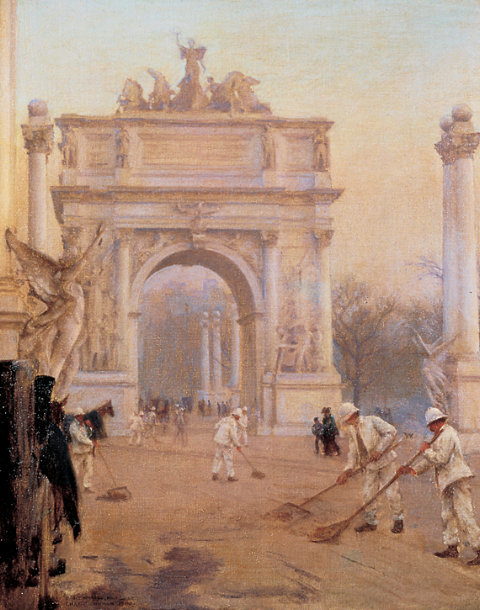
Charles Courtney Curran, Early Morning, Madison Square
Oil on canvas, 22 in. x 18 in.
1900, National Arts Club, New York
‘The Tolstoy of Transylvania’
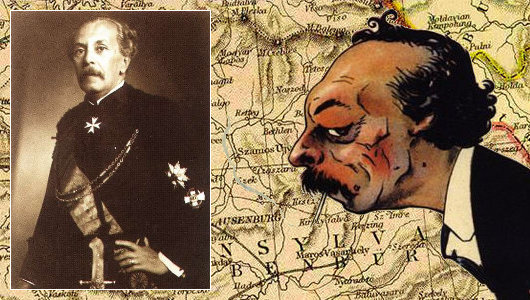
In his column in the Daily Telegraph, former editor Charles Moore praises Miklos Banffy as ‘the Tolstoy of Transylvania’. Ardent Banffyites like myself are always pleased when the Hungarian novelist gets attention in the English-speaking world, which happens all too rarely. I can’t remember how on earth I stumbled upon the works of Banffy, probably through reading the Hungarian Quarterly, a publication that — covering art, literature, history, politics, science, and more — is admirably polymathic in our age in which the specialist niche is worshipped.
To put it simply, Banffy is a must-read. If you love Paddy Leigh Fermor’s telling of his youthful walk from the Hook of Holland to Constantinople (the third and final installation of which we still await), then Miklos Banffy will be right up your alley. Start with his Transylvanian trilogy — They Were Counted, They Were Found Wanting, and They Were Divided.
The story follows two cousins, the earnest Balint Abady and the dissolute László Gyeroffy, Hungarian aristocrats in Transylvania, and the varying paths they take in the final years of European civilization. The novels “are full of love for the way of life destroyed by the First World War,” Charles Moore points out, “but without illusion about its deficiencies.”
Three volumes of nearly one-and-a-half thousand pages put together, they make for deeply, deeply rewarding reading, transporting you to the world that ended with the crack of an assassin’s bullet in Sarajevo, 1914.
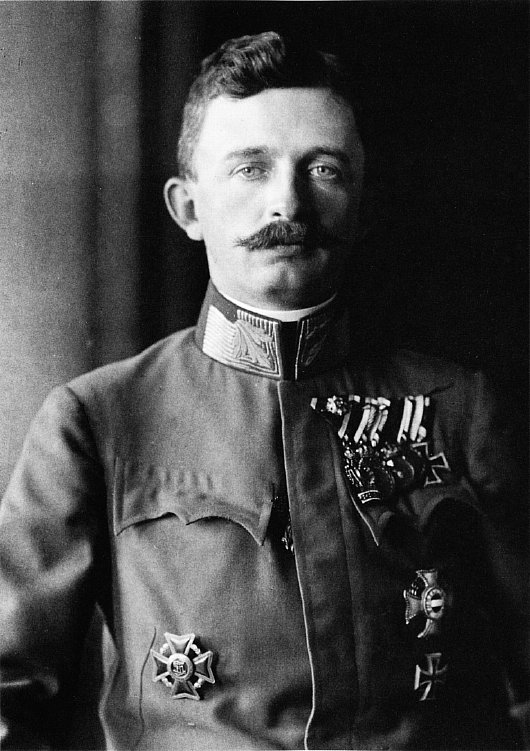
After finishing his trilogy, Banffy’s autobiographical The Phoenix Land is worthwhile; some of the real events depicted shadow those in the fictional novels. As previously mentioned, it contains a description of the last Hapsburg coronation (that of Blessed Charles) and numerous amusing tales.
After that, I’m afraid you will have to learn Hungarian, which I have neglected to do, as no more of this author’s oeuvre has yet been translated into English.
From Parking Places to People Spaces
Transforming a Suburban Parish into a Traditional Neighborhood
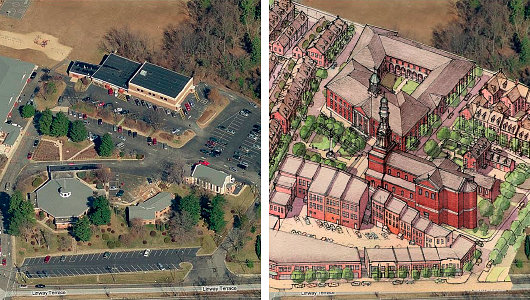
The widespread unsightliness of suburban development in the United States is one of the most significant counts one can hold against the country. The earliest suburbs, or indeed any that are pre-war, came out fairly well by contrast. One of the pleasures of living in Westchester is our system of verdant parkways (from the inter-war period) with arched stone bridges spanning the little creeks and carrying local thoroughfares over the road. The transformation of Long Island, after the Second World War, from countryside to row after row of mass-produced cookie-cutter homes was disastrous. (Levittown is my personal vision of Hell — identical homes completely divorced from any sense of livable social order.) Post-war suburban development combines ugliness, boringness, and an astonishing misuse of available land. Erik Bootsma, however, here presents a model proposal of how to transform the medium-sized property of a modern suburban parish church in Virginia into a small, livable neighborhood. (more…)
La Grande Séduction
This is a perfectly charming film. “La Grande Séduction” comically celebrates the dignity of work and the assault on the human character that inevitably results from reliance upon government welfare for survival. The inhabitants of the small fishing village of Ste-Marie-La-Mauderne have refused to abandon their homes after the collapse of fishing, but lack the resident doctor a potential investor requires in order to build his factory in the town. “La Grande Séduction” (released in Anglophone cinemas as “Seducing Dr. Lewis”) depicts the efforts of prominent townsfolk to unite and persuade the arrogant city-slicker Dr. Lewis to sign up as doctor for their little corner of the world.
Fans of “Local Hero” or “Waking Ned Devine” will find the theme familiar, but with a remote corner of maritime Quebec substituting for the Celtic hinterlands of the British Isles. If anything, the film allows the viewer an opportunity to hear that charming Québécois back-country accent. There are also elements that will grate somewhat the prudish tendencies of Anglos like us, but one must make allowances for the Latin temperament that survives in la Nouvelle-France and the other Romance realms.
Overall, a celebration of place, work, and community, and an interesting exploration of the conflict between artificiality and authenticity.
La Bandiera dell’Io Amo L’Italia

In most countries, the voter of sound mind and disposition is hard pressed to find a political party worthy of his vote. One of the charming aspects of Italy is that the inverse is true: there are usually at least half-a-dozen political parties worth voting for, sound in policies and public morals, though the more recent trend has been towards amalgamation. It nonetheless often seems that every Italian of public stature has, at some time or another, founded his own political party.
Readers will no doubt recall the Holy Father’s rather brave baptism of the Egyptian-born Italian journalist Magdi Allam during the Easter Vigil of 2008. Signore Allam has proven his Italicity by following the peninsular trend of founding one’s own political party. Founded as Protagonisti per l’Europa Cristiana (Protagonists for Christian Europe), Allam’s party is now known as Io Amo L’Italia (I Love Italy). The party has had an early success in that its founder was elected to the European Parliament in the most recent elections, and he caucuses with the Christian-democratic Unione di Centro in the continental assembly.
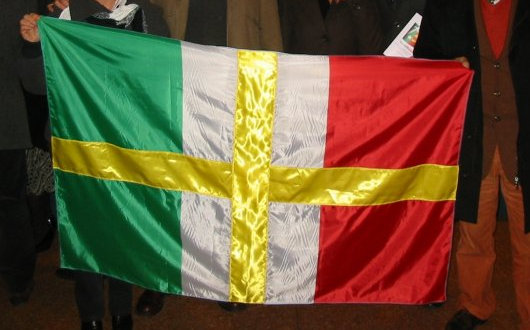
Anyhow, the relevance for us is that Magdi Cristiano Allam’s political party has adopted a “baptized” tricolore of its own: the green-white-red tricolour defaced (as is the proper vexillological term) with a simple golden cross the arms of which reach to the ends of the field. A very simple solution, and not half bad really. One of the party’s Facebook followers suggests having a tricolore with a Constantinian-style cross in the center, which is another not half bad idea.
In the Dublin auction houses
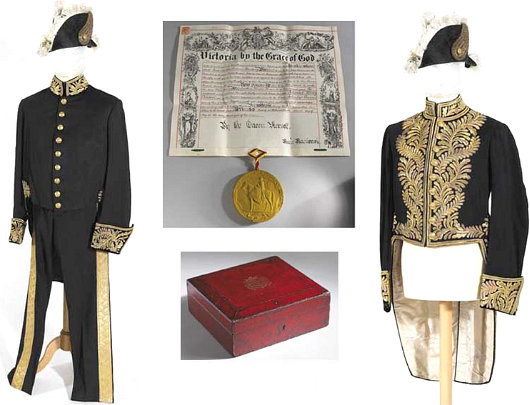
THOUGH THE BORING brains of tawdry metropolitan Londoners are all too quick at relegating Dublin to the provincial periphery of the mind, the Irish capital is a perpetual treasure trove for the old-fashioned and right-minded. A number of items of interests have recently been sold at the auction houses of the fair city, including two ceremonial uniforms (above) of that famous Dubliner, Sir Edward Carson QC. Carson was the lawyer and statesmen who passionately, but without bigotry, opposed the cause of Irish home rule. He was the defending barrister in the Archer-Shee case and led the Marquess of Queensberry’s team in Oscar Wilde’s doomed libel action. Carson and Wilde had been at Trinity together (where — little known fact! — Carson was a keen hurler), and the famous wit quipped of Carson “I trust he will conduct his cross-examination with all the added bitterness of an old friend.”
Having a fine mind for the law and being politically active meant that Carson moved through several layers of British government, holding numerous offices and positions. He was a Privy Counsellor twice over (of both Ireland and the United Kingdom), a Queen’s Counsel, served in the House of Commons as leader of the Irish Unionists, and held portfolios in the British Cabinet. The two ceremonial uniforms auctioned at Whyte’s of Molesworth Street are from his appointment as Solicitor General for England & Wales in 1900. (He had been Solicitor-General for Ireland in 1892, and was later Attorney General for England & Wales, in which position he was succeeded by the F.E. Smith of Chesterton’s famous poem).
The two black wool morning coats feature gold bullion trimming and buttons, and are sold with a pair of trousers with gold filigree stripe matching the lesser uniform, and knee breeches & silk stockings for the greater uniform. The vellum appointment as Solicitor General was also included, in a red leather box with a gilt impression of the royal arms. Whyte’s estimated a sale of €50,000-€70,000, but the lot’s realised price was €42,000. (more…)
The Oratory as It Was Built
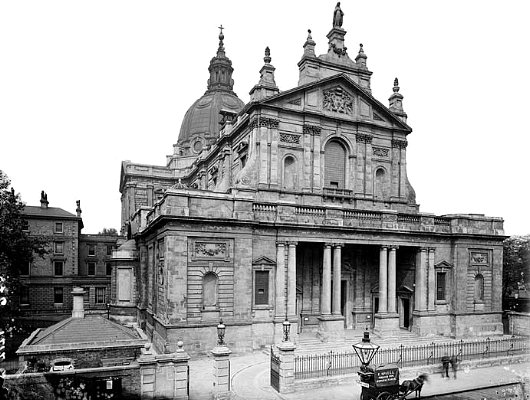
Since we explored Brompton Oratory as it might have been, here is the Oratory as it was built. The façade were finally completed in 1893 to a design by George Sherrin, with the dome following in 1894-95 by Sherrin’s assistant E. A. Rickards. How is the Oratory as depicted above different from the Oratory today? The fence and gates were replaced with a curved design at some date unknown to me, perhaps in response to a road-widening scheme.
Baptizing the Tricolore
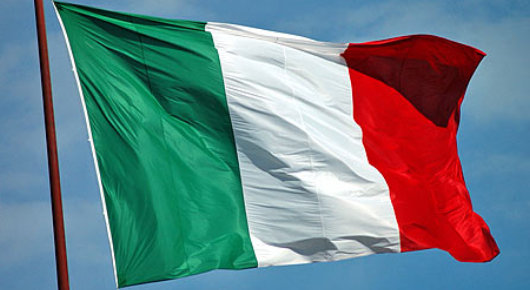
THE RECENT RULING of the self-styled “European Court of Human Rights” that the presence of crucifixes in Italian schools is a violation of the rights of a non-practicing Lutheran from Finland has sparked a surge of outrage against European institutions in Italy, and indeed elsewhere. While (as Gerald Warner has reported), the Italian Constitutional Court has shown the proverbial two fingers to the ECHR judgement in a ruling of its own, one junior cabinet minister has a suggestion of his own. Roberto Castelli, Italy’s deputy minister for infrastructure and transportation, suggests the country should reassert its Christian identity by adding a cross or crucifix to the Italian flag.
“I believe,” Mr. Castelli said, “that Europe has the right to recognize its true identity that we are starting to lose completely.” Even the Minister of Foreign Affairs, the Freemason and ex-Socialist Franco Frattini, seemed amenable to the idea. “Nine European countries already have the cross on their flag,” Frattini pointed out. “It is an extremely common proposition.” (more…)
The House of Assembly
Die Volksraad
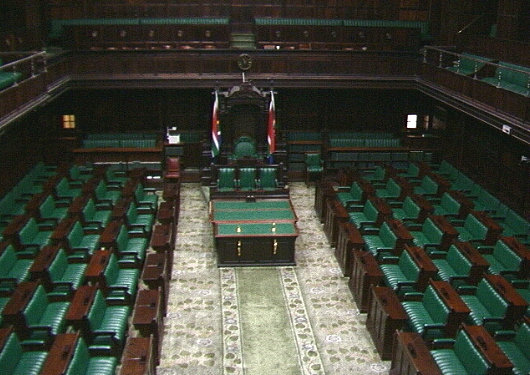
The House of Assembly (always called the Volksraad in Afrikaans, after the legislatures of the Boer republics) was South Africa’s lower chamber, and inherited the Cape House of Assembly’s debating chamber when the Cape Parliament’s home was handed over to the new Parliament of South Africa in 1910. The lower house quite soon decided to build a new addition to the building, and moved its plenary hall to the new wing. (more…)
No. 82, Eaton Square
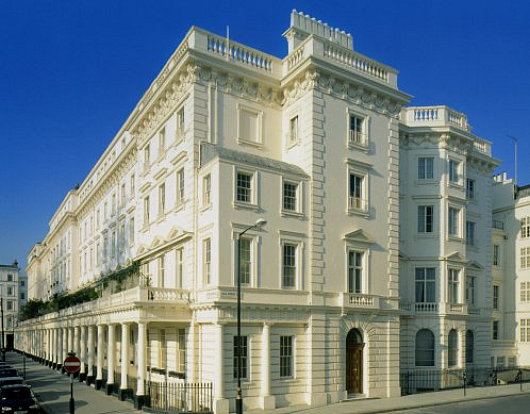
In it’s long history, the address of No. 82 Eaton Square in London has housed a Major-General of the East Indian Cavalry, a Lord Strafford, a Lord Bagot, an Earl of Dalhousie, an Earl of Clare, a Duke of Bedford, and Queen Wilhemina of the Netherlands — thankfully not all at once. It’s probably best know for its half-century as the Irish Club, a much-favoured drinking & smoking spot for the community of Gaels in London. The club was founded in 1947, with a number of pre-existing Irish clubs merging into it. George VI — grateful for the devoted service of the Irish who volunteered for his armed forces during the Second World War — heard that the club was in search of premises and asked the Duke of Westminster, one of the largest landowners in London, if he could help. The Duke provided the leasehold of No. 82 Eaton Square to the Irish Club for a nominal sum. (As it happens, the 4th Duke’s son served as a Unionist MP for Fermanagh & South Tyrone, and later in the Northern Irish Senate). (more…)
How Not to Build a Library
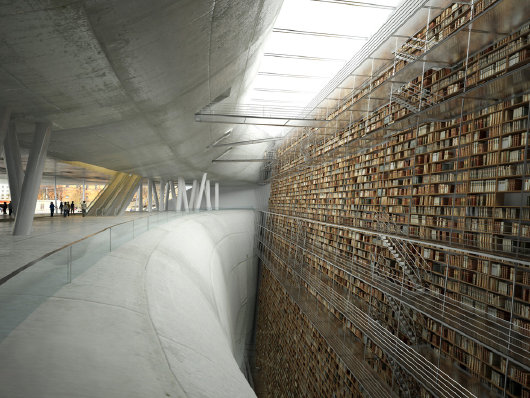
This computer-generated image has been doing the rounds on a variety of blogs across the internet. It depicts one of the numerous proposals for the extension of the Stockholm Public Library, this one drafted by a team from the Paris-Val de Seine architecture school. Over at the Long Now Blog, Alexander Rose calls it “awesome” and says “This design seems like it would lend itself well to a 10,000 year library”. As a monument this design is impressive — perhaps intimidating is the more appropriate word — but as a library it’s hard to conclude it would be anything other than a complete and total failure. And as for lasting 10,000 years, all those walkways to access the books look exceptionally brittle — I doubt they’d last a hundred years let alone ten thousand. (more…)
Le « dingbat » du Figaro
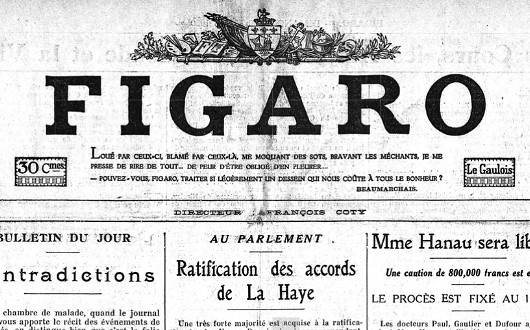
Did you know that Le Figaro used to have a “dingbat”? No, neither did I, until I was stumbling through the archives the other day. For a brief period in the 1930s, the Fig stylistically dropped the article “le” from its nameplate, while continuing to be known as “Le Figaro” for all intents and purposes. Simultaneously, they introduced a handsome horizontal dingbat to sit atop the newspaper’s unique name. (more…)
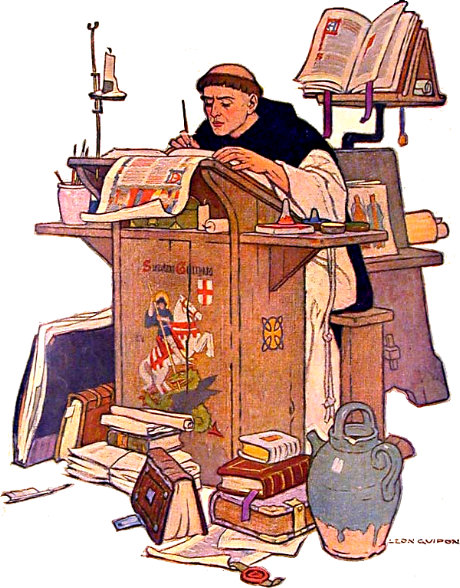

The Internal Exile of the Saar
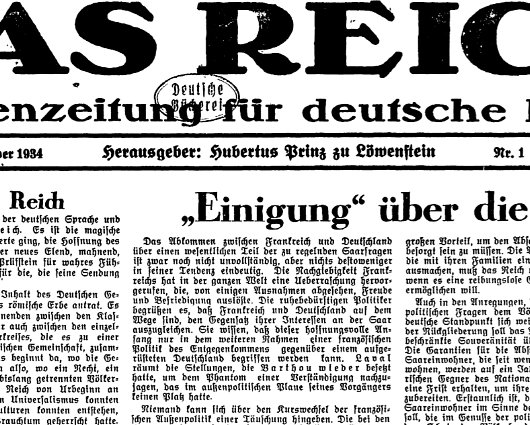
At the beginning of Hitler’s rule, many patriotic German anti-Hitlerites fled to the Saarland, which was Germany but still under French occupation. In a bizarre state of internal exile, anti-Nazi publications, be they Christian, Nationalist, Communist, or Jewish flourished for a very brief period. One of these journals was Das Reich, founded by Hubertus Prinz zu Löwenstein, who (if I recall my personal studies from St Andrews years properly) was a bit of a rogue in his own way, sympathizing with the Red forces during the Spanish Civil War.
A plebiscite on rejoining the Saarland with Germany proper had been scheduled before Hitler’s rise to power (just like the lamentable award of the 1936 Olympics to Berlin, though they turned out to be some of the most influential and well-run games to date) and, while the inhabitants were no keen Hitlerites, they had naturally tired of French occupation and duly voted to kick the French out. Right result, but very poor timing.
The anti-Hitlerites had to flee further, to Paris (where Pariser Tageblatt and later Pariser Tageszeitung were founded), London, and New York. German Jews sometimes fled as far as Shanghai where the English-language Shanghai Jewish Chronicle began a German edition in response to the influx. (There are some interesting stories about Shanghai Jews, and of course the famous newspaper-owning family of Jewish converts to Catholicism in Shanghai, but they’ll have to wait for another day).
Baron Bossom’s Bridge
The Unbuilt ‘Victory Bridge’ Crossing the Hudson River at Manhattan
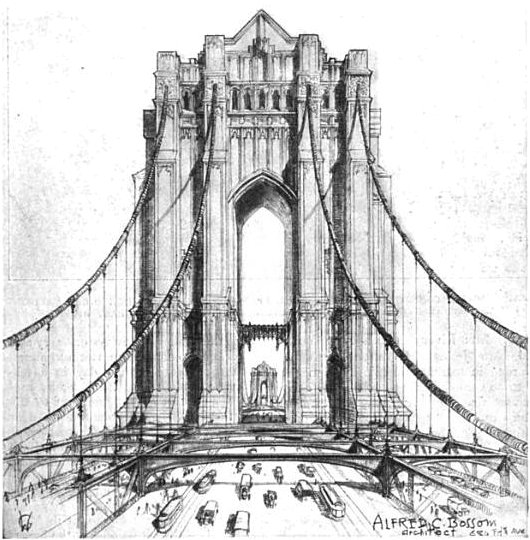
After the victory of America and her “co-belligerents” in the First World War, a temporary victory arch was erected out of wood and plaster to welcome the troops home from Europe. After the arch was dismantled, however, discussions soon arose on how to permanently commemorate the war dead of New York, with a surprising variety of suggestions made. A beautiful water gate for Battery Park was suggested, with a classical arch flanked by Bernini-like curved colonnades, so that a suitable place existed to welcome important dignitaries and visitors to New York. (Little did they know how soon the airlines would replace the ocean lines). Another proposal was for a giant memorial hall located at the site of a shuttered hotel across from Grand Central Terminal, while others suggested a bell tower.
An entirely different proposal, however, was made by the New York architect Alfred C. Bossom (later ennobled as Baron Bossom of Maidstone). Bossom, an Old Carthusian, was an Englishman by birth and eventually returned to his native land, where (in 1953) he gave away the future prime minister Margaret Roberts at her marriage to Denis Thatcher. He himself served in parliament from 1931 until 1959, excepting his wartime Home Guard service. Jokes were often made about his surname resembling both “bottom” and “bosom”. Upon being introduced to Bossom, Churchill jested “Who is this man whose name means neither one thing nor the other?” (more…)
Search
Instagram: @andcusack
Click here for my Instagram photos.Most Recent Posts
- Brunel’s Unbuilt Capitol February 3, 2026
- Cricket at Fordham January 27, 2026
- Palacio Barolo Revisted January 14, 2026
- Learning to Love Liguria January 14, 2026
- Crux Alba No. 2 January 13, 2026
Most Recent Comments
Book Wishlist
Monthly Archives
Categories